




 Программирование
Похожие презентации:







Assembly Programming
1.
Assembly Programming2.
Readings• Introduction to Computing Systems: From Bits
and Gates to C and Beyond by Patt & Patel
• Chapter 5, 6
• Appendix A – LC3 ISA
3.
Assembly Programming4.
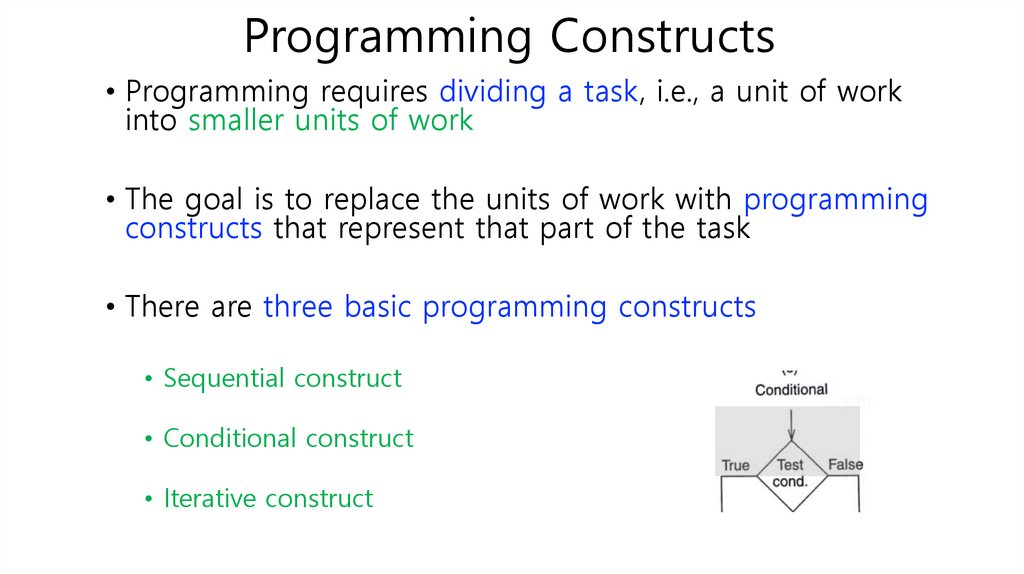
Programming Constructs• Programming requires dividing a task, i.e., a unit of work
into smaller units of work
• The goal is to replace the units of work with programming
constructs that represent that part of the task
• There are three basic programming constructs
• Sequential construct
• Conditional construct
• Iterative construct
5.
Sequential Construct• The sequential construct is used if the designated
task can be broken down into two subtasks, one
following the other
(a)
6.
Conditional ConstructThe conditional construct is used if the designated task consists
of doing one of two subtasks, but not both
Is the condition “true”
or “false”?
Either subtask may be ”do nothing”
After the correct subtask is completed, the program moves onward
E.g., if-else statement, switch-case statement
7.
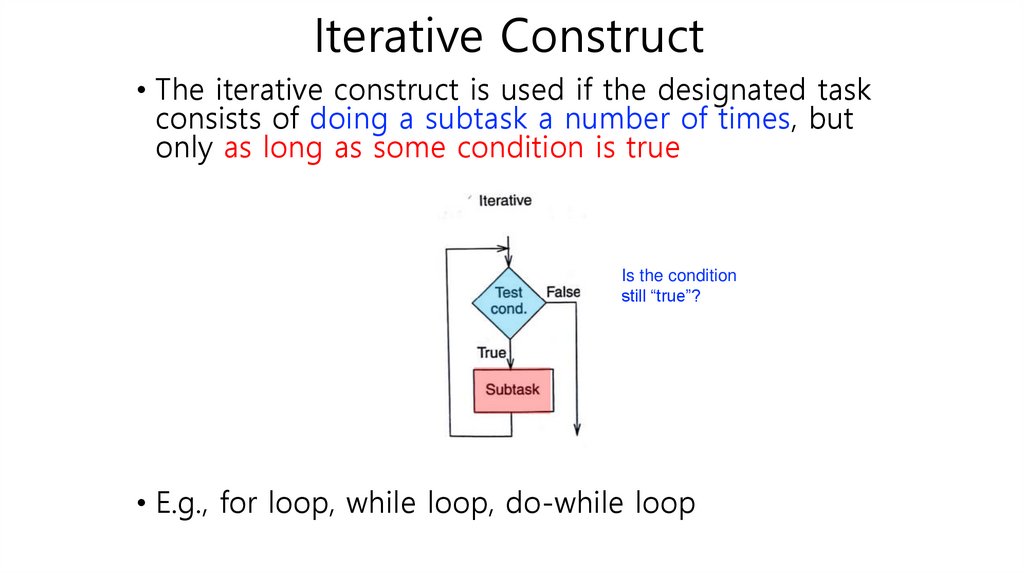
Iterative Construct• The iterative construct is used if the designated task
consists of doing a subtask a number of times, but
only as long as some condition is true
Is the condition
still “true”?
• E.g., for loop, while loop, do-while loop
8.
Constructs in an Example Program• Let us see how to use the programming constructs in an
example program
• The example program counts the number of occurrences of
a character in a text file
• It uses sequential, conditional, and iterative constructs
• We will see how to write conditional and iterative constructs
with conditional branches
9.
First LC-3 Program:Use of Conditional Branches
for Looping
10.
Readings• Introduction to Computing Systems: From Bits
and Gates to C and Beyond by Patt & Patel
• Chapter 5, 6
• Appendix A – LC3 ISA
11.
An Algorithm for Adding Integers• We want to write a program that adds 12 integers
• They are stored in addresses 0x3100 to 0x310B
• Let us take a look at the flowchart of the algorithm
R1: initial address of integers
R3: final result of addition
R2: number of integers
left to be added
Check if R2 becomes 0
(done with all integers?)
Load integer in R4
Accumulate integer value in R3
Increment address R1
Decrement R2
12.
A Program for Adding Integers in LC-3• We use conditional branch instructions to create a
loop
LEA
AND
AND
ADD
BR
LDR
ADD
ADD
ADD
BR
0x00FF
z
5
0
1
-1
n
z
p
-6
R1 = PC✝ + 0x00FF = 3100 // load address
R3 = 0 // reset register
R2 = 0 // reset register
R2 = R2 + 12 // initialize counter
?
BRz (PC ✝ + 5) = BRz 0x300A // check condition
R4 = M[R1 + 0] // load value
R3 = R3 + R4 // accumulate
R1 = R1 + 1 // increment address
R2 = R2 – 1 // decrement counter
BRnzp (PC ✝ – 6) = BRnzp 0x3004 // jump
Bit 5 to differentiate both ADD instructions
✝This is the incremented PC
13.
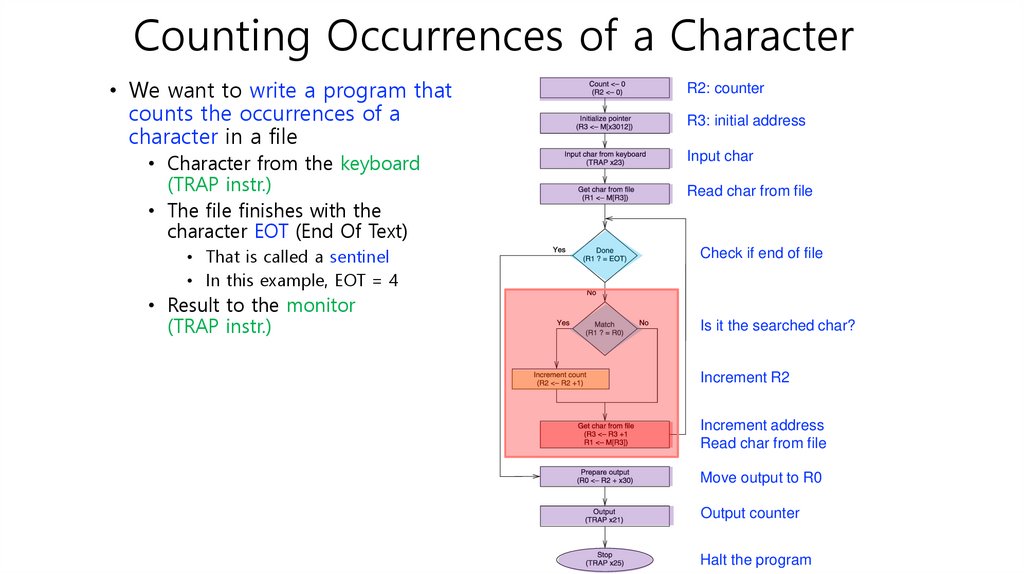
Counting Occurrences of a Character• We want to write a program that
counts the occurrences of a
character in a file
• Character from the keyboard
(TRAP instr.)
• The file finishes with the
character EOT (End Of Text)
• That is called a sentinel
• In this example, EOT = 4
• Result to the monitor
(TRAP instr.)
R2: counter
R3: initial address
Input char
Read char from file
Check if end of file
Is it the searched char?
Increment R2
Increment address
Read char from file
Move output to R0
Output counter
Halt the program
14.
Counting Occurrences of a Char in LC-3• We use conditional branch instructions to create a
loops and if statements
AND
LD
TRAP
LDR
ADD
BR
NOT
ADD
ADD
BR
ADD
ADD
LDR
BR
LD
ADD
TRAP
AND
z
n
p
n
z p
ASCII TEMPLATE
R2 = 0 // initialize counter
R3 = M[0x3012] // initial address
TRAP 0x23 // input char to R0
R1 = M[R3] // char from file
R4 = R1 – 4 // char – EOT
BRz 0x300E // check if end of file
R1 = NOT(R1) // subtract char from
R1 = R1 + 1 file from input char
R1 = R1 + R0 for comparison
BRnp 0x300B
R2 = R2 + 1 // increment the counter
R3 = R3 + 1 // increment address
R1 = M[R3] // char from file
BRnzp 0x3004
R0 = M[0x3013]
// output counter t
R0 = R0 + R2
o monitor with T
TRAP 0x21
RAP
TRAP 0x25
?
?
15.
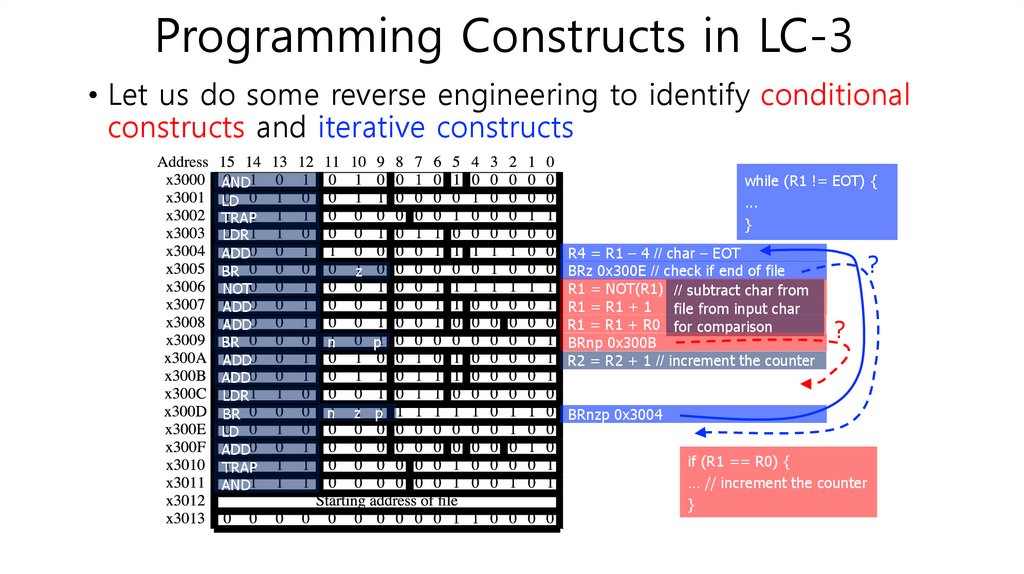
Programming Constructs in LC-3• Let us do some reverse engineering to identify conditional
constructs and iterative constructs
AND
LD
TRAP
LDR
ADD
BR
NOT
ADD
ADD
BR
ADD
ADD
LDR
BR
LD
ADD
TRAP
AND
while (R1 != EOT) {
...
}
z
n
p
n
z p
R4 = R1 – 4 // char – EOT
BRz 0x300E // check if end of file
R1 = NOT(R1) // subtract char from
R1 = R1 + 1 file from input char
R1 = R1 + R0 for comparison
BRnp 0x300B
R2 = R2 + 1 // increment the counter
?
?
BRnzp 0x3004
if (R1 == R0) {
… // increment the counter
}