

 Английский язык
Похожие презентации:



The Present Perfect Tense
1.
2.
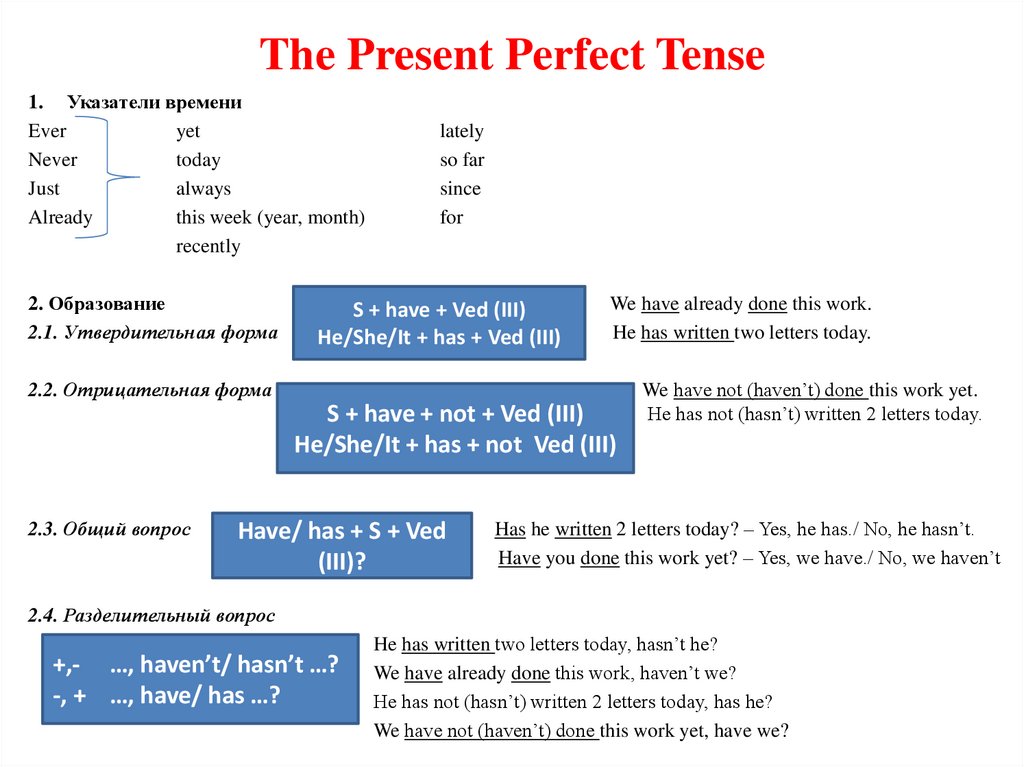
The Present Perfect Tense1. Указатели времени
Ever
yet
Never
today
Just
always
Already
this week (year, month)
recently
2. Образование
2.1. Утвердительная форма
lately
so far
since
for
S + have + Ved (III)
He/She/It + has + Ved (III)
We have already done this work.
He has written two letters today.
2.2. Отрицательная форма
S + have + not + Ved (III)
He/She/It + has + not Ved (III)
2.3. Общий вопрос
Have/ has + S + Ved
(III)?
We have not (haven’t) done this work yet.
He has not (hasn’t) written 2 letters today.
Has he written 2 letters today? – Yes, he has./ No, he hasn’t.
Have you done this work yet? – Yes, we have./ No, we haven’t
2.4. Разделительный вопрос
+,- …, haven’t/ hasn’t …?
-, + …, have/ has …?
He has written two letters today, hasn’t he?
We have already done this work, haven’t we?
He has not (hasn’t) written 2 letters today, has he?
We have not (haven’t) done this work yet, have we?
3.
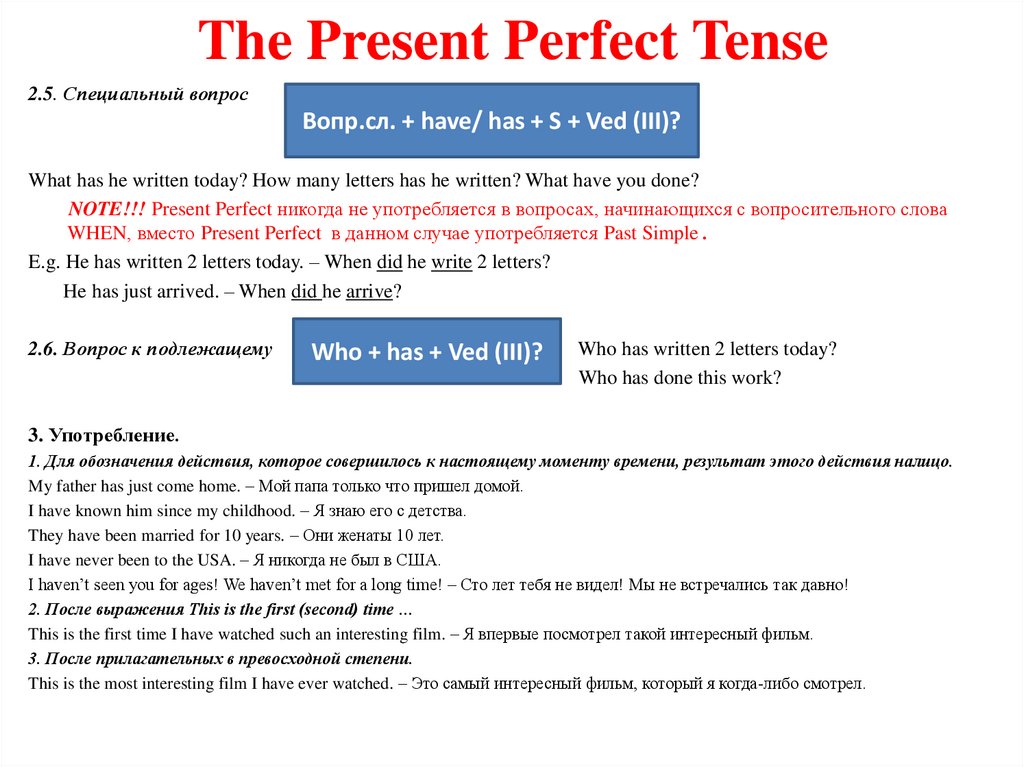
The Present Perfect Tense2.5. Специальный вопрос
Вопр.сл. + have/ has + S + Ved (III)?
What has he written today? How many letters has he written? What have you done?
NOTE!!! Present Perfect никогда не употребляется в вопросах, начинающихся с вопросительного слова
WHEN, вместо Present Perfect в данном случае употребляется Past Simple .
E.g. He has written 2 letters today. – When did he write 2 letters?
He has just arrived. – When did he arrive?
2.6. Вопрос к подлежащему
Who + has + Ved (III)?
Who has written 2 letters today?
Who has done this work?
3. Употребление.
1. Для обозначения действия, которое совершилось к настоящему моменту времени, результат этого действия налицо.
My father has just come home. – Мой папа только что пришел домой.
I have known him since my childhood. – Я знаю его с детства.
They have been married for 10 years. – Они женаты 10 лет.
I have never been to the USA. – Я никогда не был в США.
I haven’t seen you for ages! We haven’t met for a long time! – Сто лет тебя не видел! Мы не встречались так давно!
2. После выражения This is the first (second) time …
This is the first time I have watched such an interesting film. – Я впервые посмотрел такой интересный фильм.
3. После прилагательных в превосходной степени.
This is the most interesting film I have ever watched. – Это самый интересный фильм, который я когда-либо смотрел.
4.
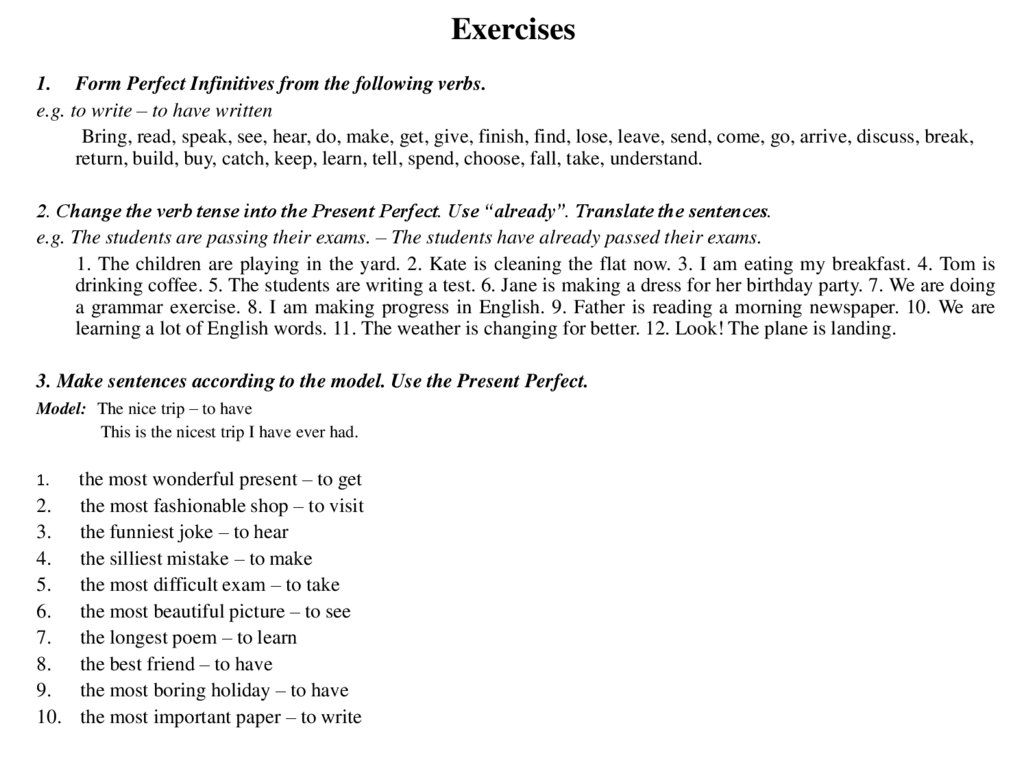
Exercises1. Form Perfect Infinitives from the following verbs.
e.g. to write – to have written
Bring, read, speak, see, hear, do, make, get, give, finish, find, lose, leave, send, come, go, arrive, discuss, break,
return, build, buy, catch, keep, learn, tell, spend, choose, fall, take, understand.
2. Change the verb tense into the Present Perfect. Use “already”. Translate the sentences.
e.g. The students are passing their exams. – The students have already passed their exams.
1. The children are playing in the yard. 2. Kate is cleaning the flat now. 3. I am eating my breakfast. 4. Tom is
drinking coffee. 5. The students are writing a test. 6. Jane is making a dress for her birthday party. 7. We are doing
a grammar exercise. 8. I am making progress in English. 9. Father is reading a morning newspaper. 10. We are
learning a lot of English words. 11. The weather is changing for better. 12. Look! The plane is landing.
3. Make sentences according to the model. Use the Present Perfect.
Model: The nice trip – to have
This is the nicest trip I have ever had.
the most wonderful present – to get
2. the most fashionable shop – to visit
3. the funniest joke – to hear
4. the silliest mistake – to make
5. the most difficult exam – to take
6. the most beautiful picture – to see
7. the longest poem – to learn
8. the best friend – to have
9. the most boring holiday – to have
10. the most important paper – to write
1.
5.
6.
7.
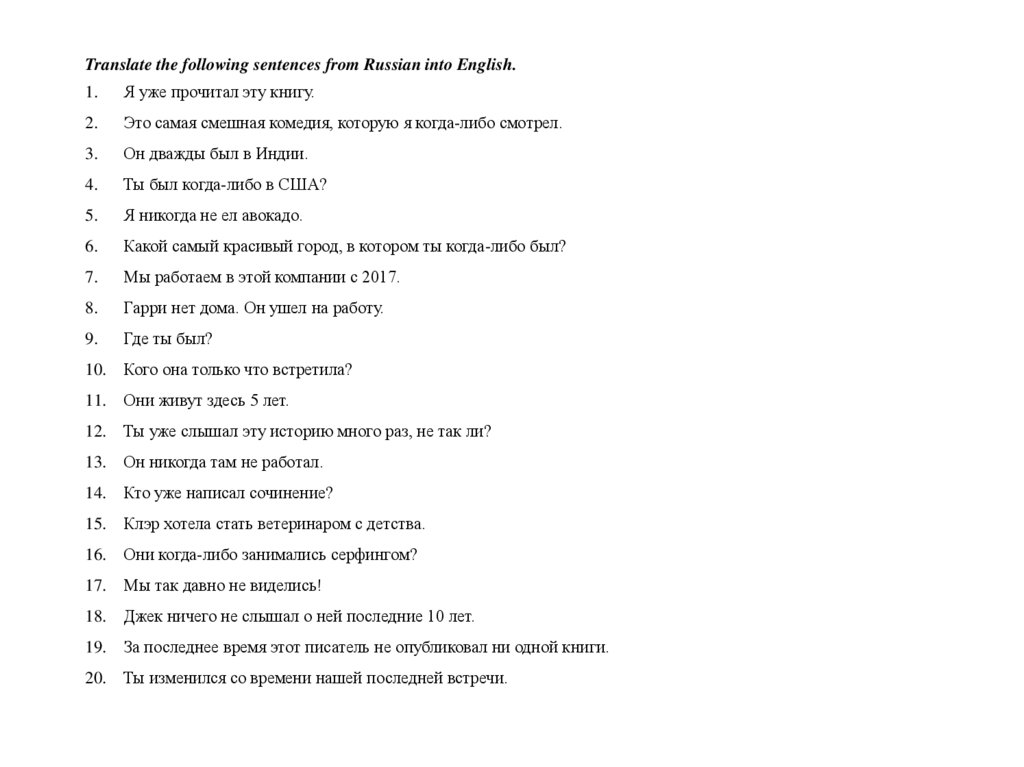
Translate the following sentences from Russian into English.1.
Я уже прочитал эту книгу.
2.
Это самая смешная комедия, которую я когда-либо смотрел.
3.
Он дважды был в Индии.
4.
Ты был когда-либо в США?
5.
Я никогда не ел авокадо.
6.
Какой самый красивый город, в котором ты когда-либо был?
7.
Мы работаем в этой компании с 2017.
8.
Гарри нет дома. Он ушел на работу.
9.
Где ты был?
10. Кого она только что встретила?
11. Они живут здесь 5 лет.
12. Ты уже слышал эту историю много раз, не так ли?
13. Он никогда там не работал.
14. Кто уже написал сочинение?
15. Клэр хотела стать ветеринаром с детства.
16. Они когда-либо занимались серфингом?
17. Мы так давно не виделись!
18. Джек ничего не слышал о ней последние 10 лет.
19. За последнее время этот писатель не опубликовал ни одной книги.
20. Ты изменился со времени нашей последней встречи.
8.
9.
10.
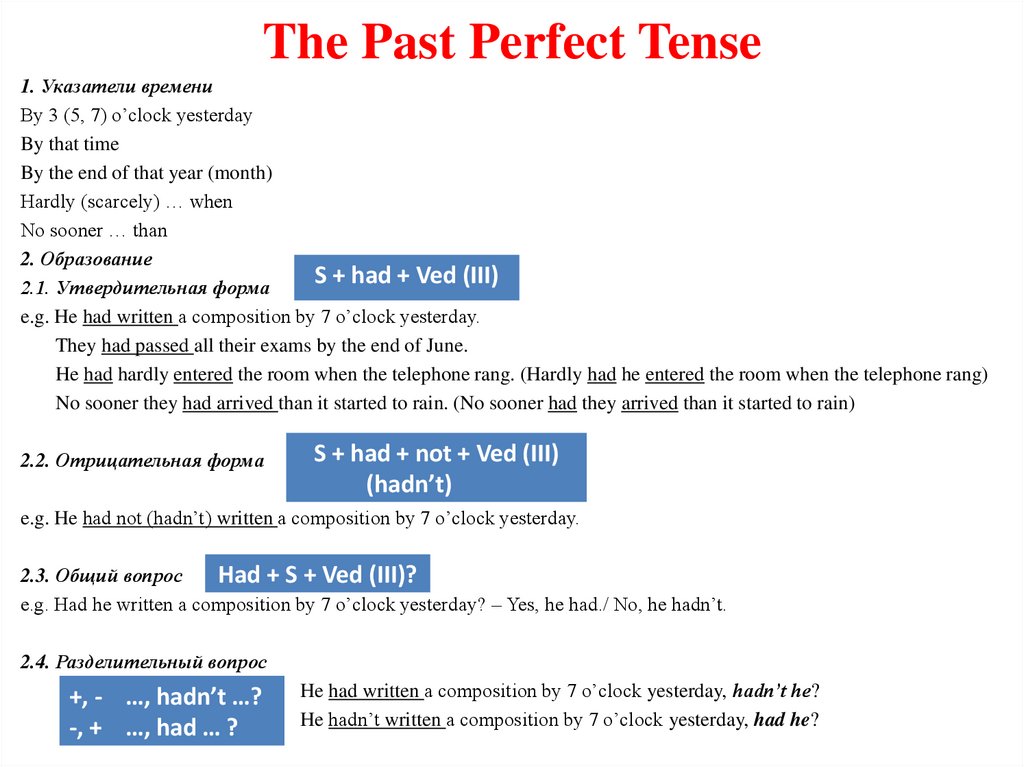
The Past Perfect Tense1. Указатели времени
By 3 (5, 7) o’clock yesterday
By that time
By the end of that year (month)
Hardly (scarcely) … when
No sooner … than
2. Образование
S + had + Ved (III)
2.1. Утвердительная форма
e.g. He had written a composition by 7 o’clock yesterday.
They had passed all their exams by the end of June.
He had hardly entered the room when the telephone rang. (Hardly had he entered the room when the telephone rang)
No sooner they had arrived than it started to rain. (No sooner had they arrived than it started to rain)
2.2. Отрицательная форма
S + had + not + Ved (III)
(hadn’t)
e.g. He had not (hadn’t) written a composition by 7 o’clock yesterday.
2.3. Общий вопрос
Had + S + Ved (III)?
e.g. Had he written a composition by 7 o’clock yesterday? – Yes, he had./ No, he hadn’t.
2.4. Разделительный вопрос
+, - …, hadn’t …?
-, + …, had … ?
He had written a composition by 7 o’clock yesterday, hadn’t he?
He hadn’t written a composition by 7 o’clock yesterday, had he?
11.
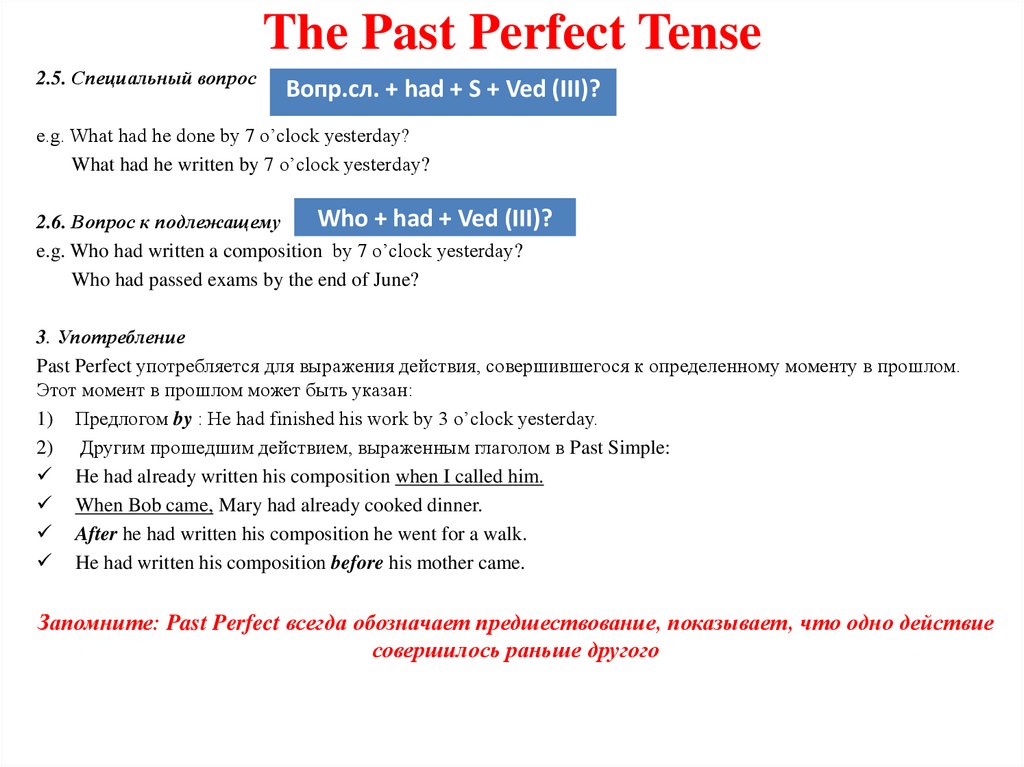
The Past Perfect Tense2.5. Специальный вопрос
Вопр.сл. + had + S + Ved (III)?
e.g. What had he done by 7 o’clock yesterday?
What had he written by 7 o’clock yesterday?
Who + had + Ved (III)?
2.6. Вопрос к подлежащему
e.g. Who had written a composition by 7 o’clock yesterday?
Who had passed exams by the end of June?
3. Употребление
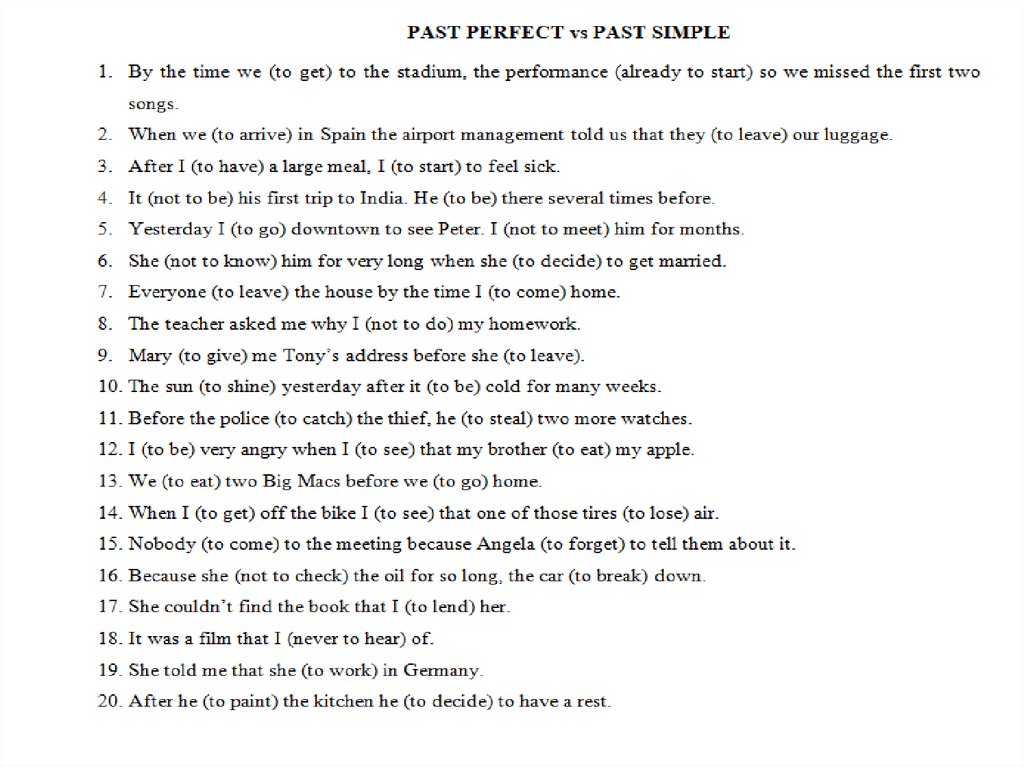
Past Perfect употребляется для выражения действия, совершившегося к определенному моменту в прошлом.
Этот момент в прошлом может быть указан:
1) Предлогом by : He had finished his work by 3 o’clock yesterday.
2) Другим прошедшим действием, выраженным глаголом в Past Simple:
He had already written his composition when I called him.
When Bob came, Mary had already cooked dinner.
After he had written his composition he went for a walk.
He had written his composition before his mother came.
Запомните: Past Perfect всегда обозначает предшествование, показывает, что одно действие
совершилось раньше другого
12.
13.
14.
15.
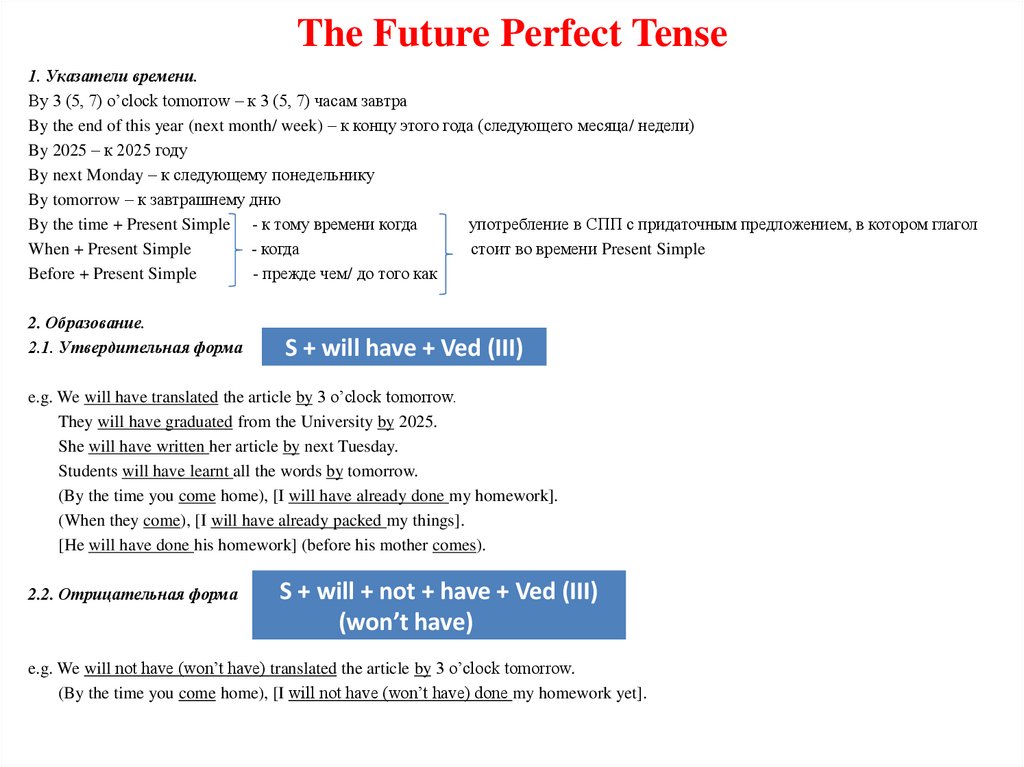
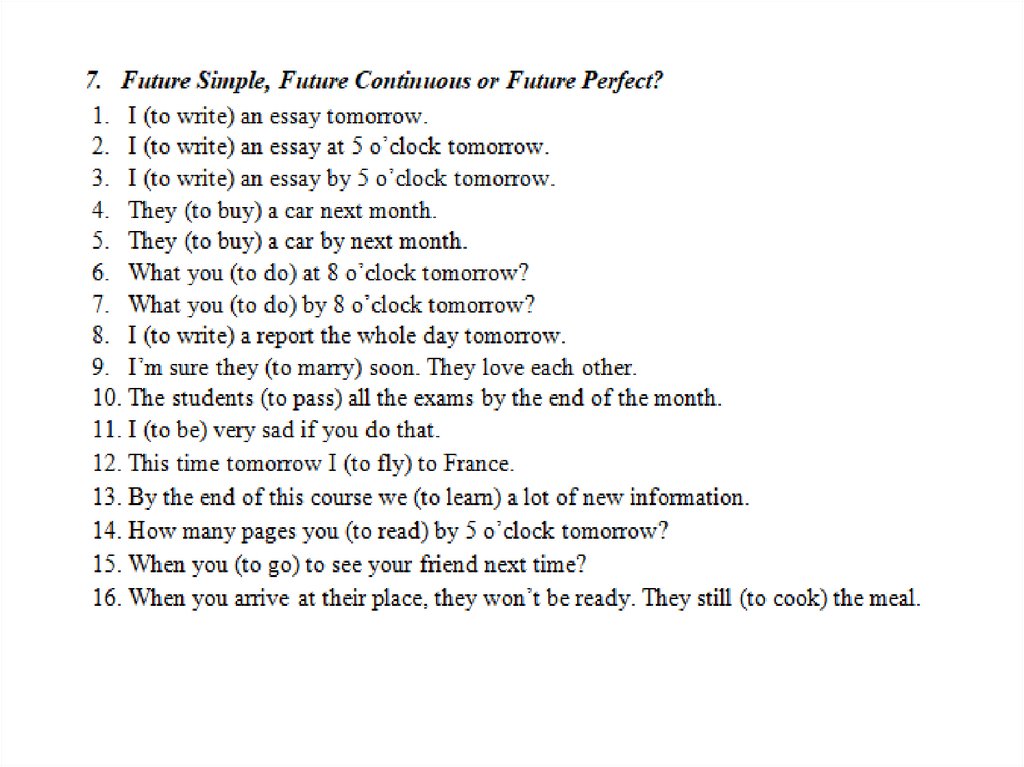
The Future Perfect Tense1. Указатели времени.
By 3 (5, 7) o’clock tomorrow – к 3 (5, 7) часам завтра
By the end of this year (next month/ week) – к концу этого года (следующего месяца/ недели)
By 2025 – к 2025 году
By next Monday – к следующему понедельнику
By tomorrow – к завтрашнему дню
By the time + Present Simple - к тому времени когда
употребление в СПП с придаточным предложением, в котором глагол
When + Present Simple
- когда
стоит во времени Present Simple
Before + Present Simple
- прежде чем/ до того как
2. Образование.
2.1. Утвердительная форма
S + will have + Ved (III)
e.g. We will have translated the article by 3 o’clock tomorrow.
They will have graduated from the University by 2025.
She will have written her article by next Tuesday.
Students will have learnt all the words by tomorrow.
(By the time you come home), [I will have already done my homework].
(When they come), [I will have already packed my things].
[He will have done his homework] (before his mother comes).
2.2. Отрицательная форма
S + will + not + have + Ved (III)
(won’t have)
e.g. We will not have (won’t have) translated the article by 3 o’clock tomorrow.
(By the time you come home), [I will not have (won’t have) done my homework yet].
16.
The Future Perfect TenseWill + S + have + Ved (III)?
2.3. Общий вопрос
e.g. Will they have translated the article by 3 o’clock tomorrow?
Will you have done your homework by the time your mother comes?
2.4. Специальный вопрос
Вопрос.слово + will + S + have + Ved (III)?
e.g. What will they have translated by 3 o’clock tomorrow?
By what time will they have passed all their exams?
2.5. Вопрос к подлежащему
Who + will have + Ved (III)?
e.g. Who will have translated the article by 3 o’clock tomorrow?
2.6. Разделительный вопрос
+ , - …, won’t …?
- , + …, will … ?
e.g. They will have graduated from the University by 2025, won’t they?
They will not have (won’t have) translated the article by 3 o’clock tomorrow, will they?