 Экономика
Похожие презентации:





Monopoly and Monopsony
1. Chapter 10
Market Power: Monopoly andMonopsony
2. Topics to be Discussed
Monopoly and Monopoly PowerSources of Monopoly Power
The Social Costs of Monopoly Power
Monopsony and Monopsony Power
Limiting Market Power: The Antitrust
Laws
©2005 Pearson Education, Inc.
Chapter 10
2
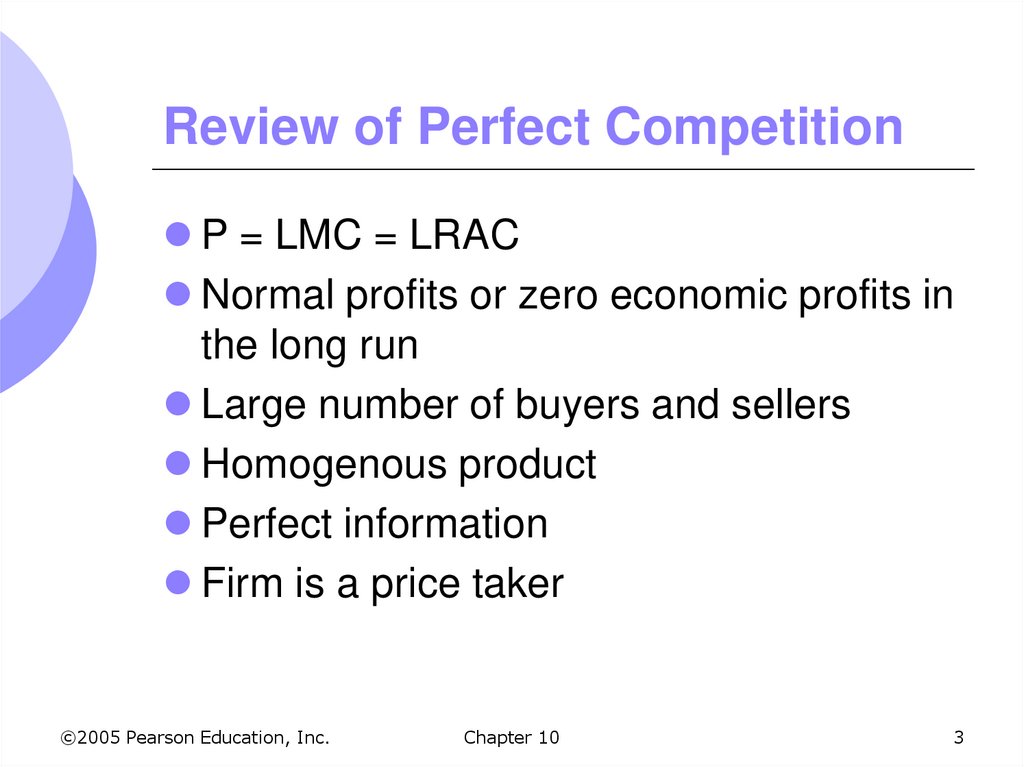
3. Review of Perfect Competition
P = LMC = LRACNormal profits or zero economic profits in
the long run
Large number of buyers and sellers
Homogenous product
Perfect information
Firm is a price taker
©2005 Pearson Education, Inc.
Chapter 10
3
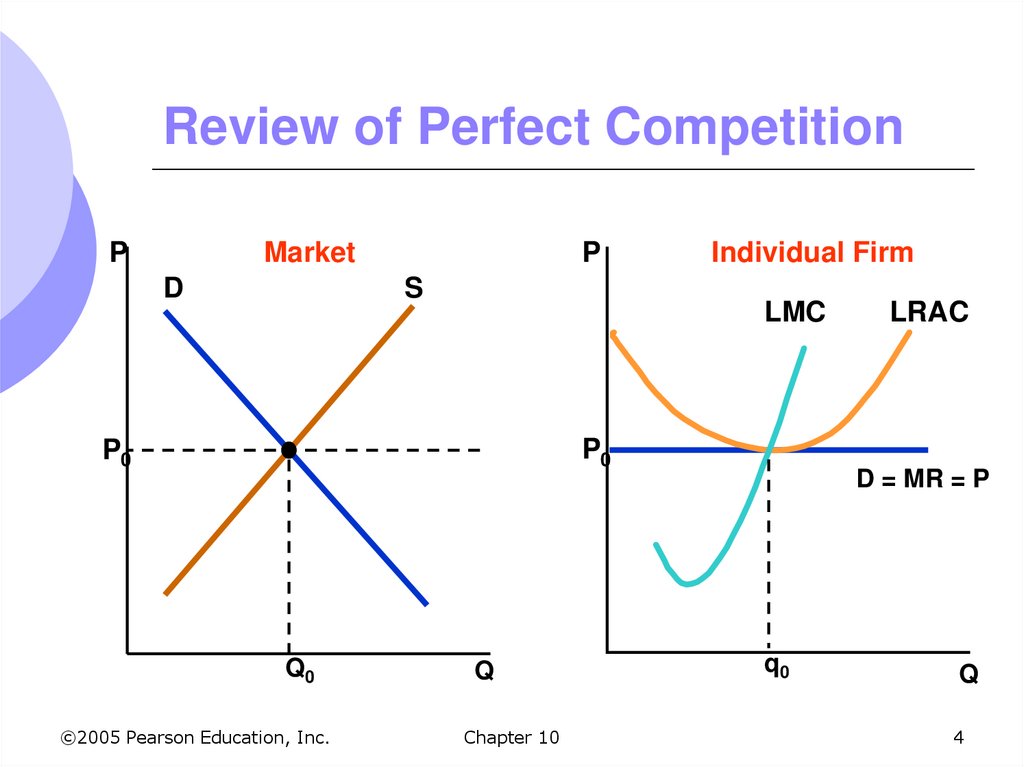
4. Review of Perfect Competition
MarketP
D
P
S
Individual Firm
LMC
P0
P0
Q0
©2005 Pearson Education, Inc.
Q
Chapter 10
LRAC
D = MR = P
q0
Q
4
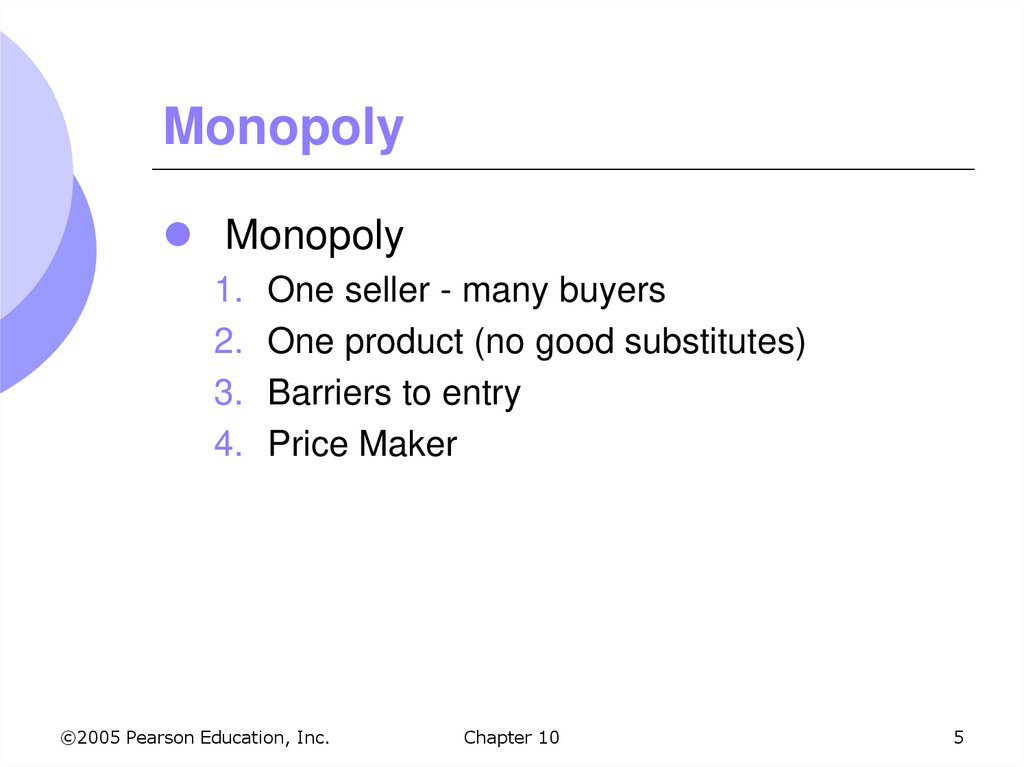
5. Monopoly
Monopoly1. One seller - many buyers
2. One product (no good substitutes)
3. Barriers to entry
4. Price Maker
©2005 Pearson Education, Inc.
Chapter 10
5
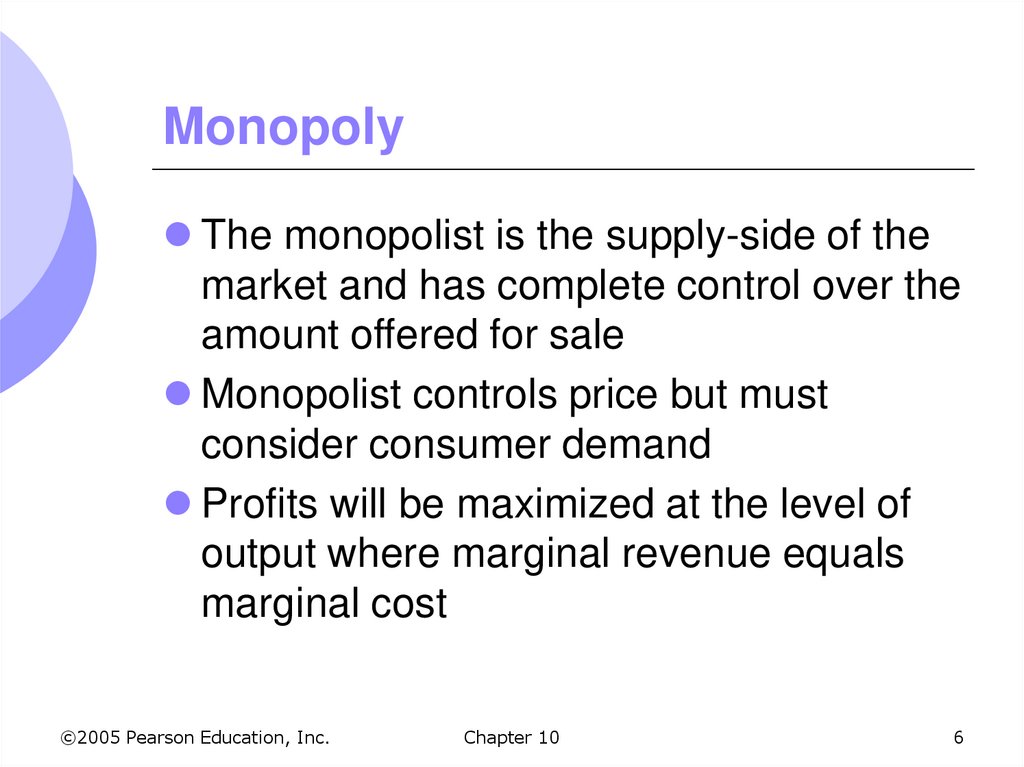
6. Monopoly
The monopolist is the supply-side of themarket and has complete control over the
amount offered for sale
Monopolist controls price but must
consider consumer demand
Profits will be maximized at the level of
output where marginal revenue equals
marginal cost
©2005 Pearson Education, Inc.
Chapter 10
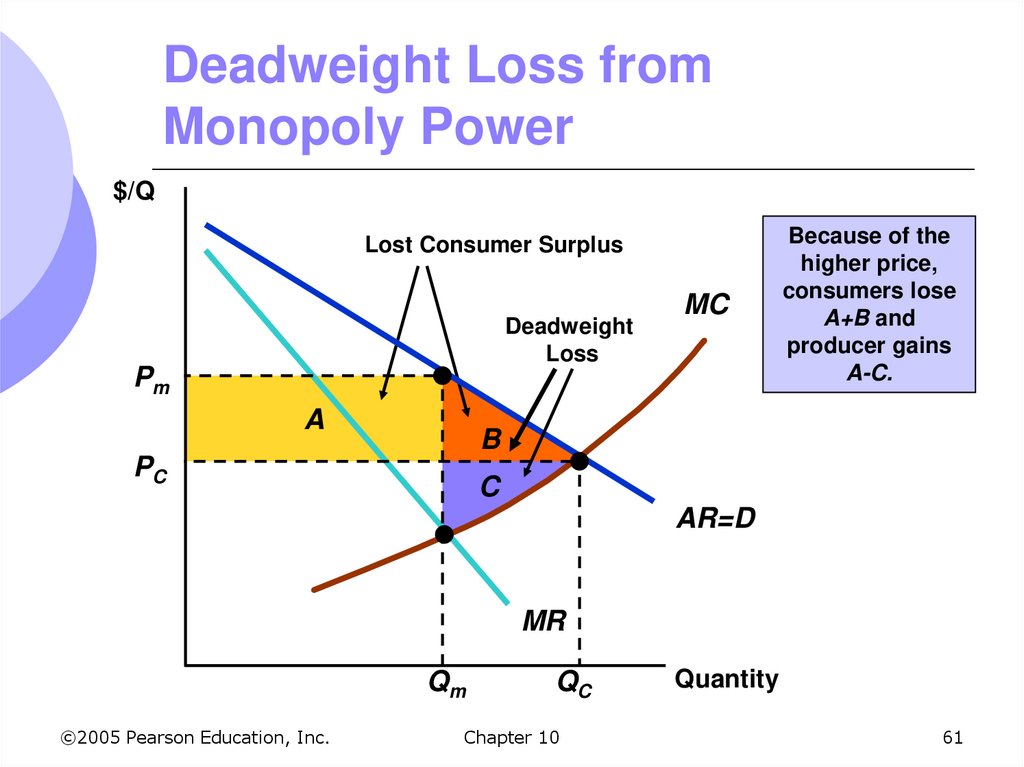
6
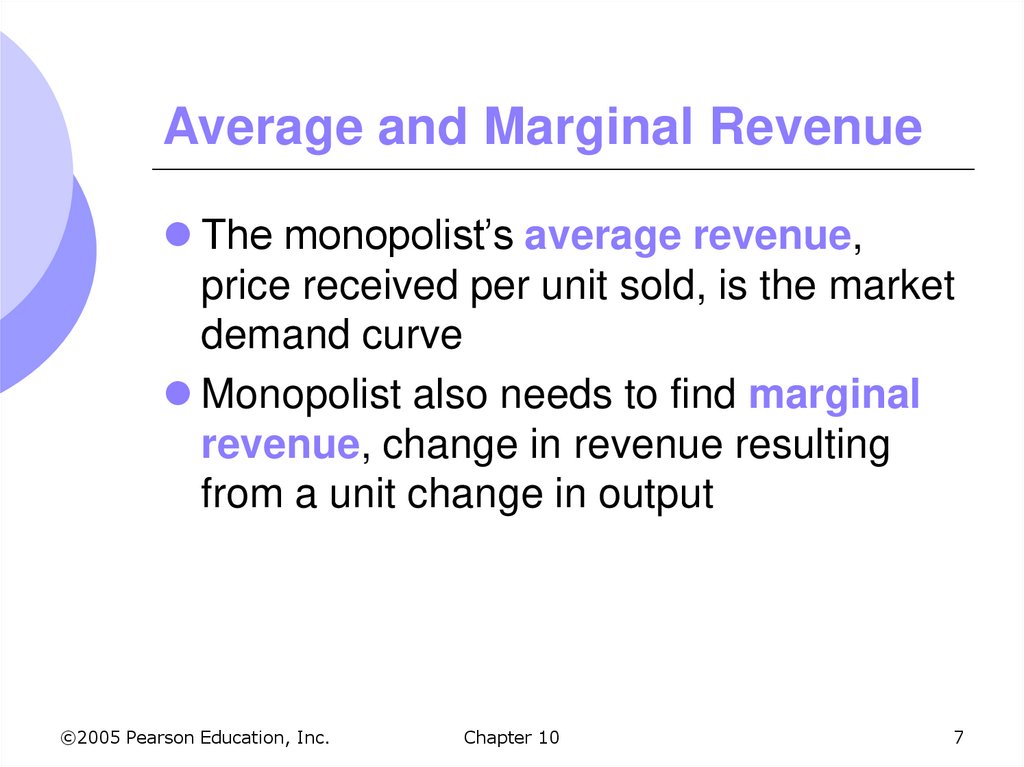
7. Average and Marginal Revenue
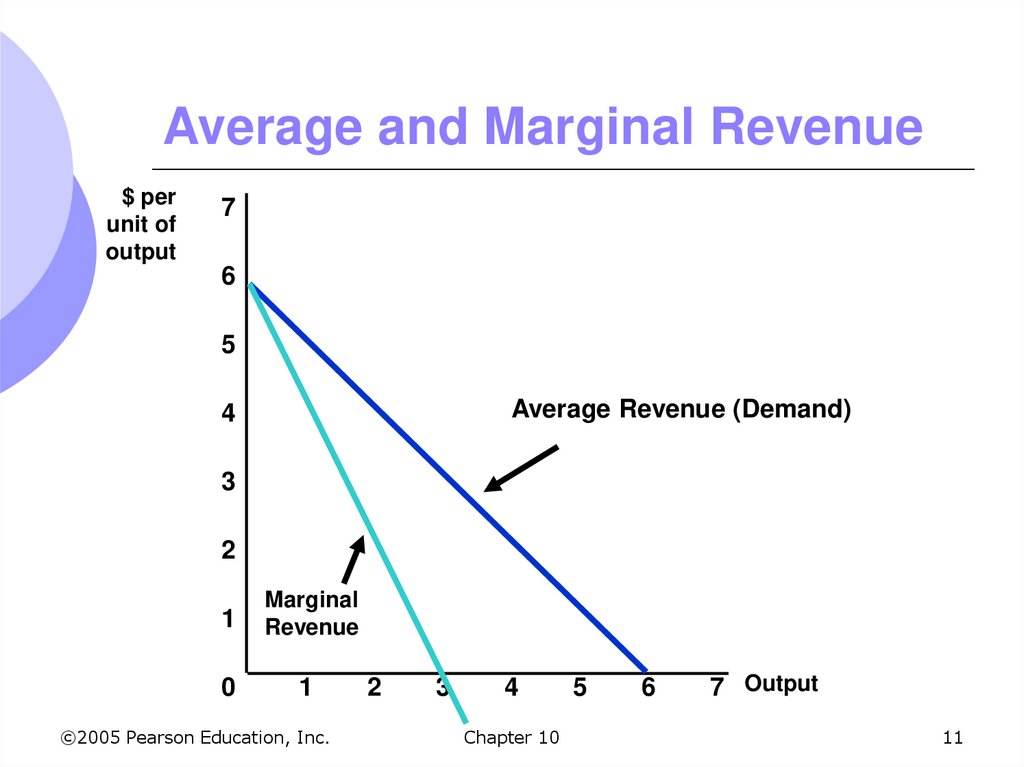
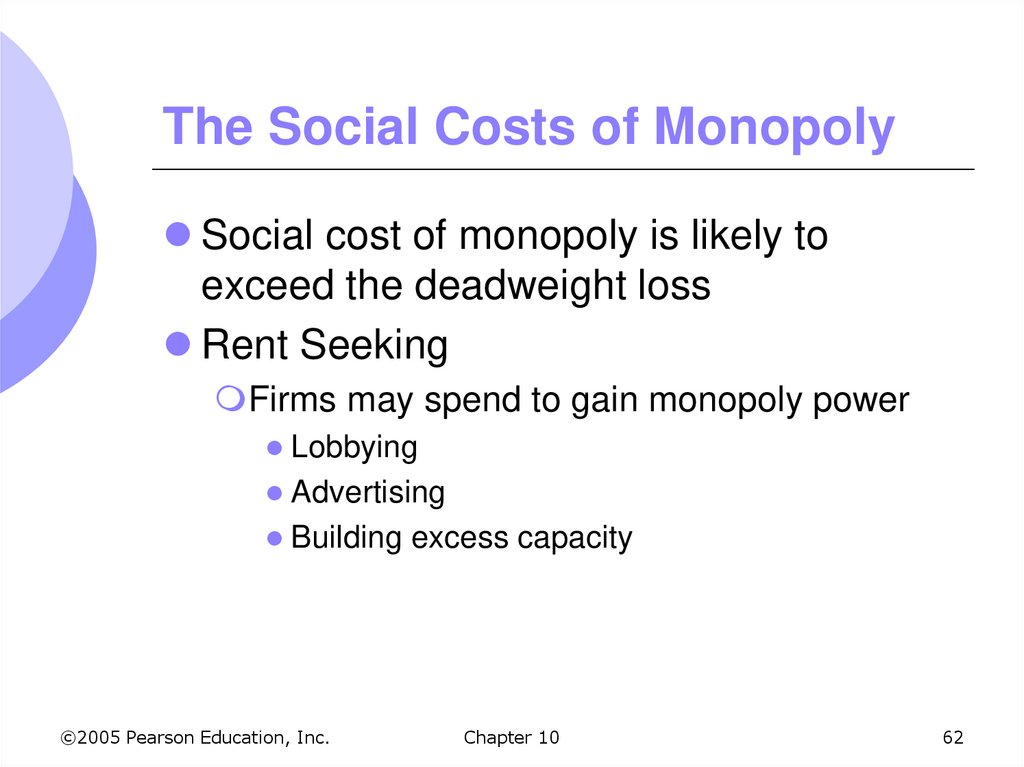
The monopolist’s average revenue,price received per unit sold, is the market
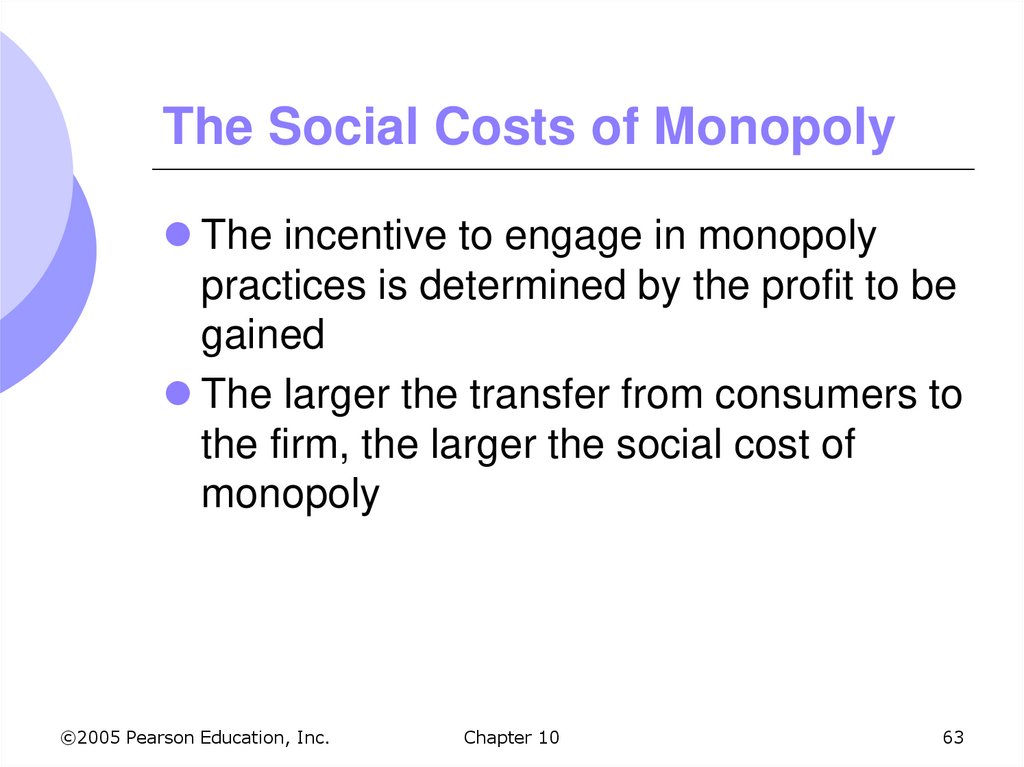
demand curve
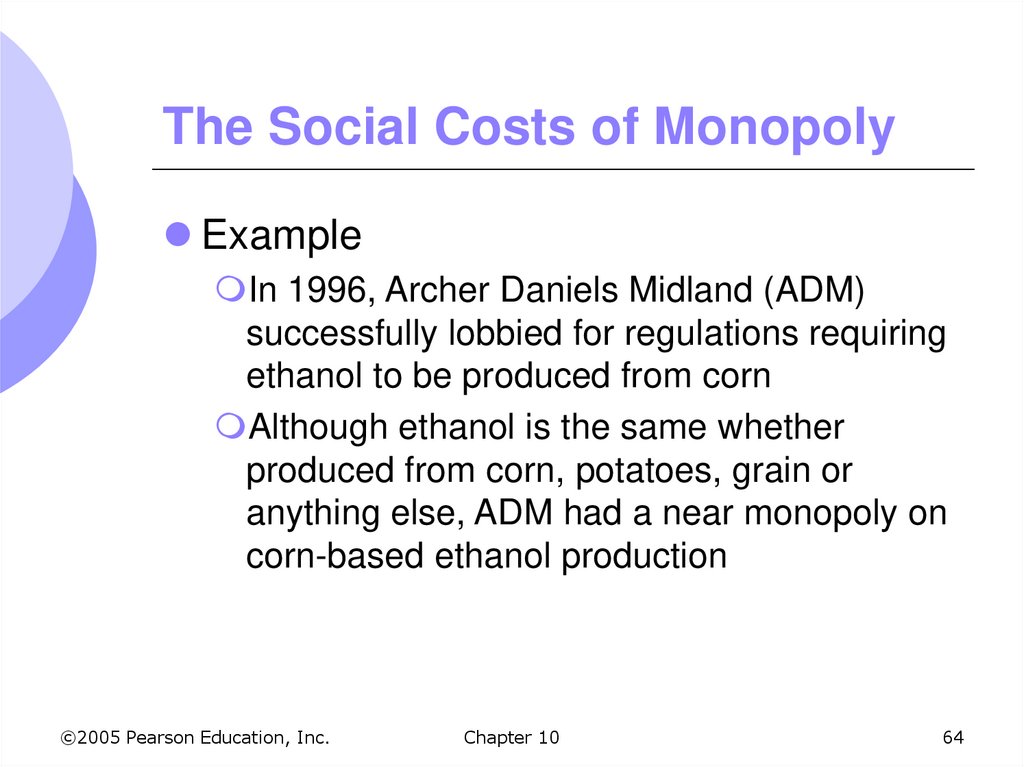
Monopolist also needs to find marginal
revenue, change in revenue resulting
from a unit change in output
©2005 Pearson Education, Inc.
Chapter 10
7
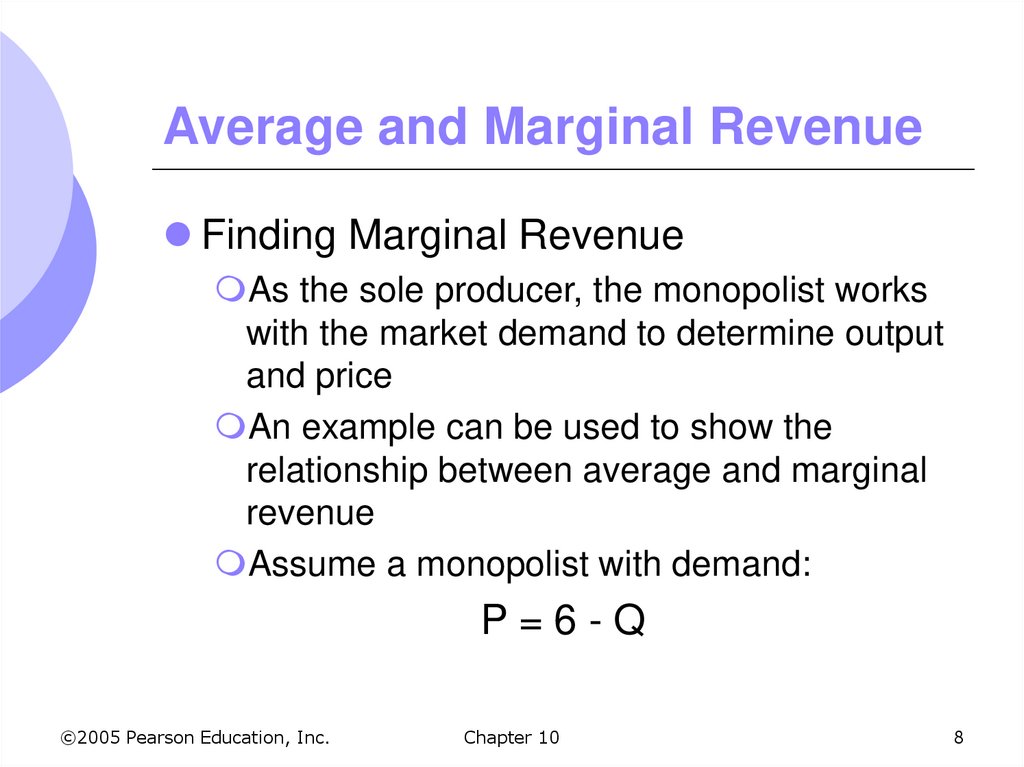
8. Average and Marginal Revenue
Finding Marginal RevenueAs the sole producer, the monopolist works
with the market demand to determine output
and price
An example can be used to show the
relationship between average and marginal
revenue
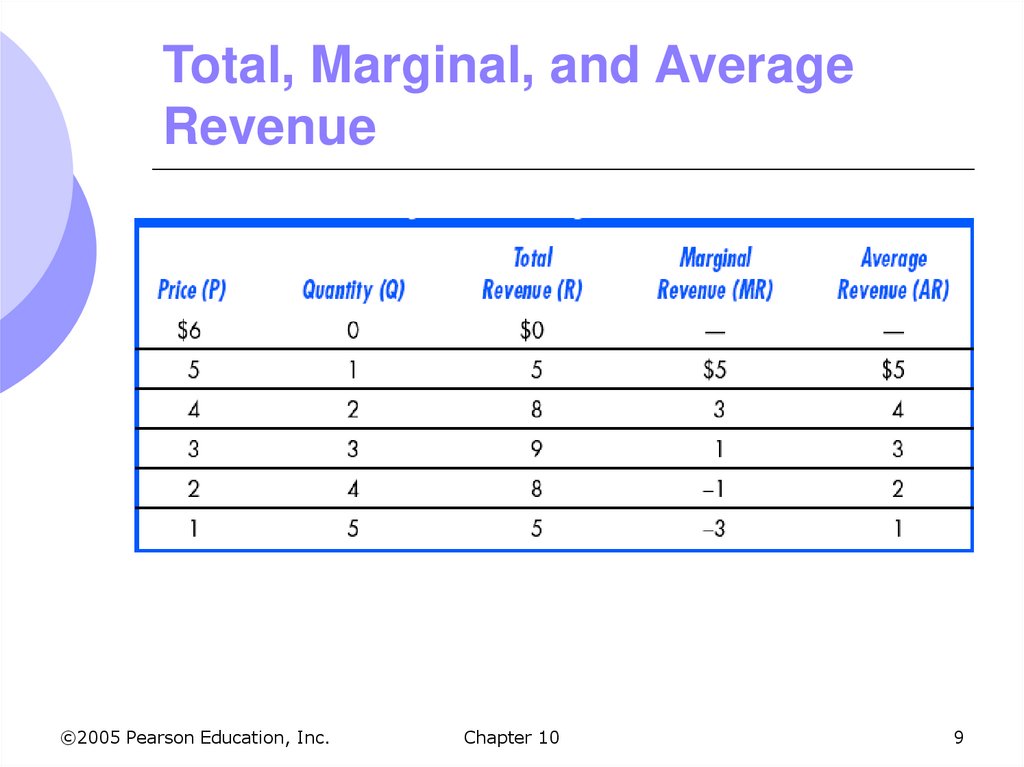
Assume a monopolist with demand:
P=6-Q
©2005 Pearson Education, Inc.
Chapter 10
8
9. Total, Marginal, and Average Revenue
©2005 Pearson Education, Inc.Chapter 10
9
10. Total, Marginal, and Average Revenue
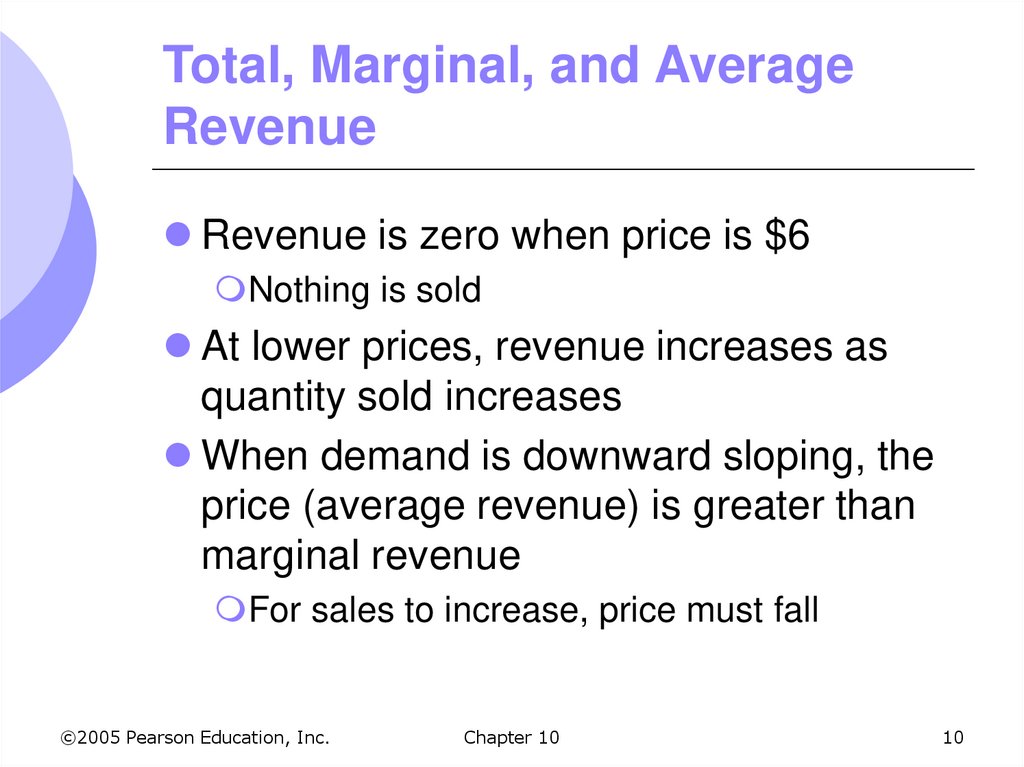
Revenue is zero when price is $6Nothing is sold
At lower prices, revenue increases as
quantity sold increases
When demand is downward sloping, the
price (average revenue) is greater than
marginal revenue
For sales to increase, price must fall
©2005 Pearson Education, Inc.
Chapter 10
10
11. Average and Marginal Revenue
$ perunit of
output
7
6
5
Average Revenue (Demand)
4
3
2
1
Marginal
Revenue
0
1
©2005 Pearson Education, Inc.
2
3
4
Chapter 10
5
6
7 Output
11
12. Monopoly
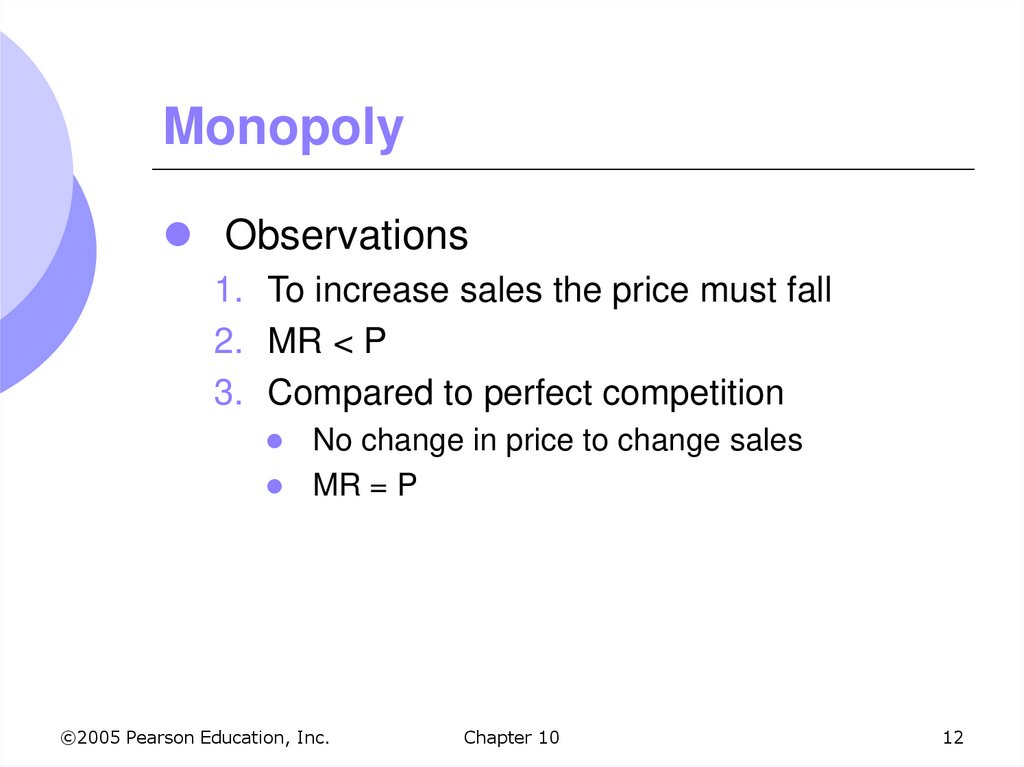
Observations1. To increase sales the price must fall
2. MR < P
3. Compared to perfect competition
No change in price to change sales
MR = P
©2005 Pearson Education, Inc.
Chapter 10
12
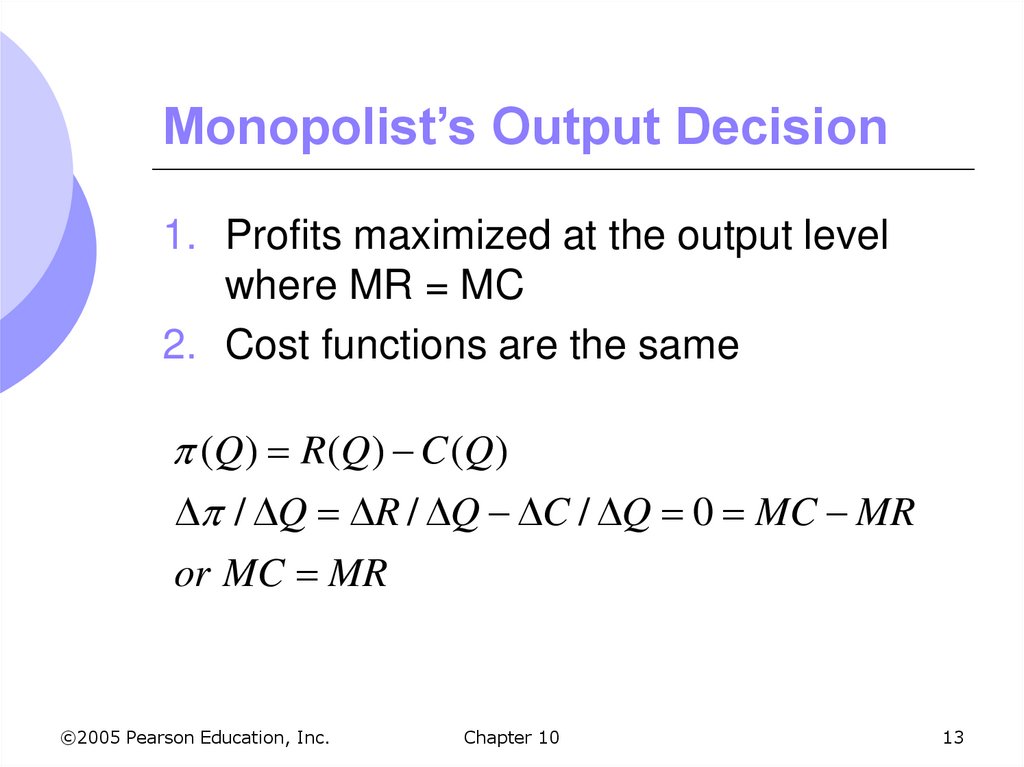
13. Monopolist’s Output Decision
1. Profits maximized at the output levelwhere MR = MC
2. Cost functions are the same
(Q) R(Q) C (Q)
/ Q R / Q C / Q 0 MC MR
or MC MR
©2005 Pearson Education, Inc.
Chapter 10
13
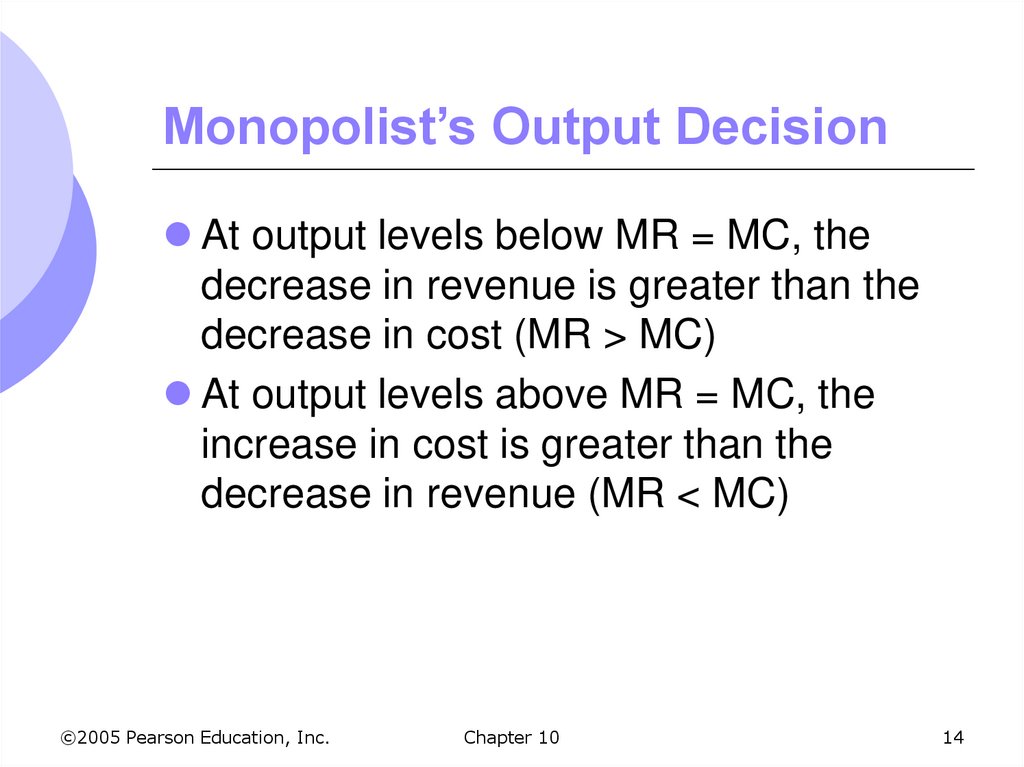
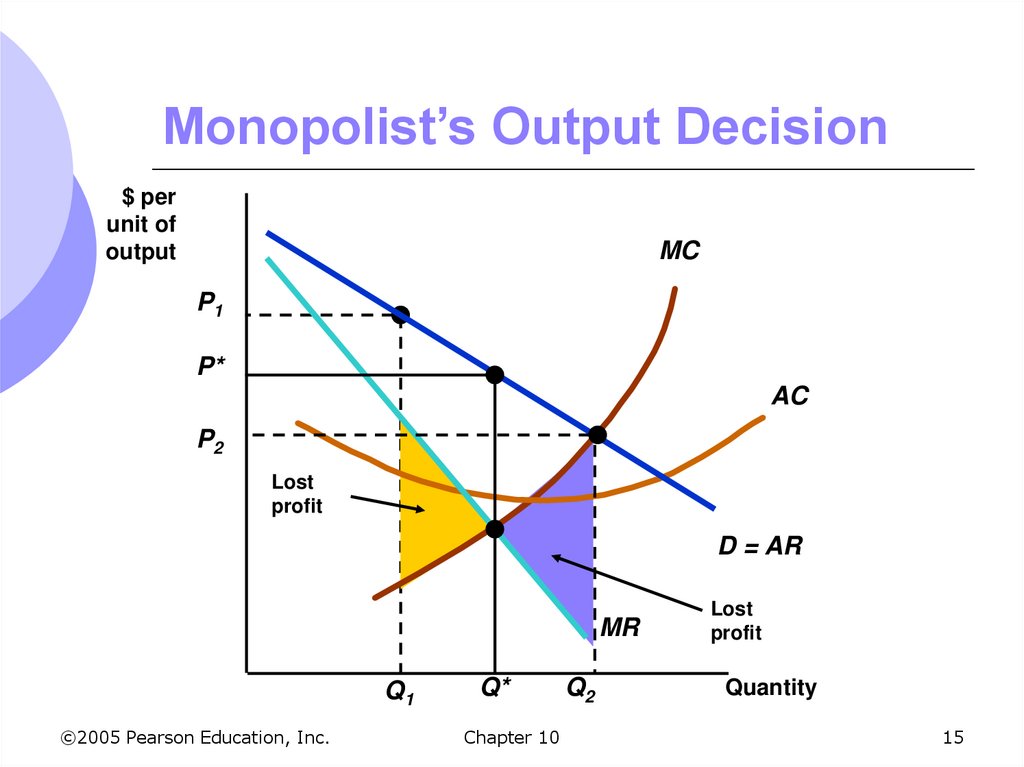
14. Monopolist’s Output Decision
At output levels below MR = MC, thedecrease in revenue is greater than the
decrease in cost (MR > MC)
At output levels above MR = MC, the
increase in cost is greater than the
decrease in revenue (MR < MC)
©2005 Pearson Education, Inc.
Chapter 10
14
15. Monopolist’s Output Decision
$ perunit of
output
MC
P1
P*
AC
P2
Lost
profit
D = AR
MR
Q1
©2005 Pearson Education, Inc.
Q*
Chapter 10
Q2
Lost
profit
Quantity
15
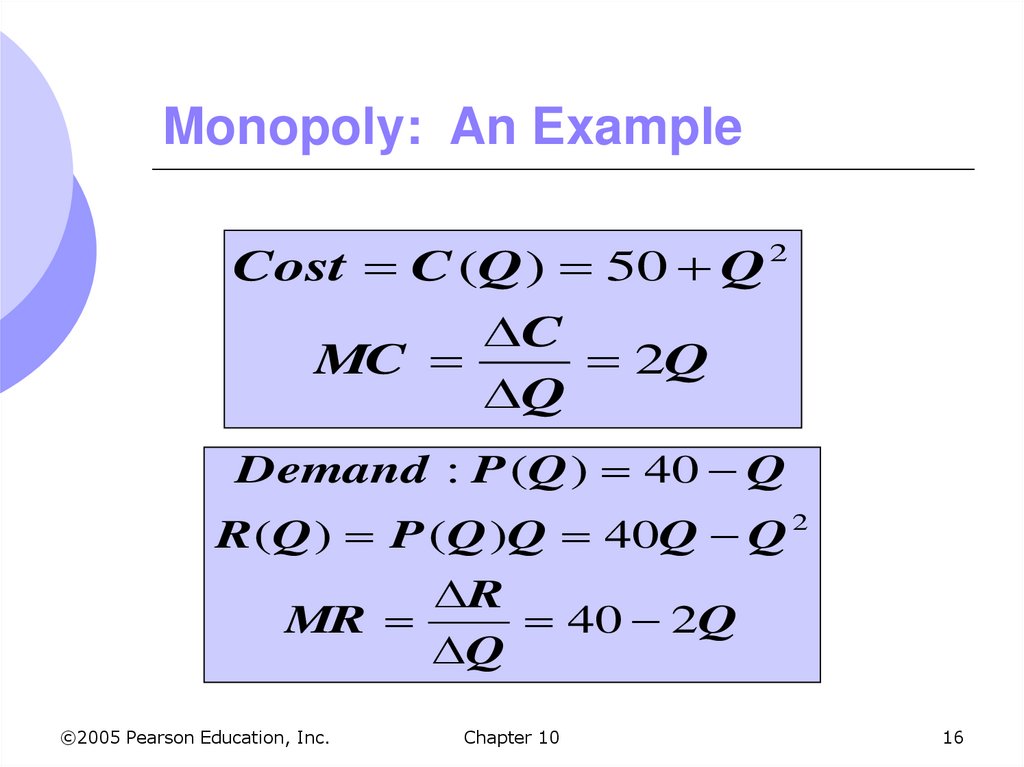
16. Monopoly: An Example
Cost C (Q ) 50 Q 2C
MC
2Q
Q
Demand : P (Q ) 40 Q
R (Q ) P (Q )Q 40Q Q 2
R
MR
40 2Q
Q
©2005 Pearson Education, Inc.
Chapter 10
16
17. Monopoly: An Example
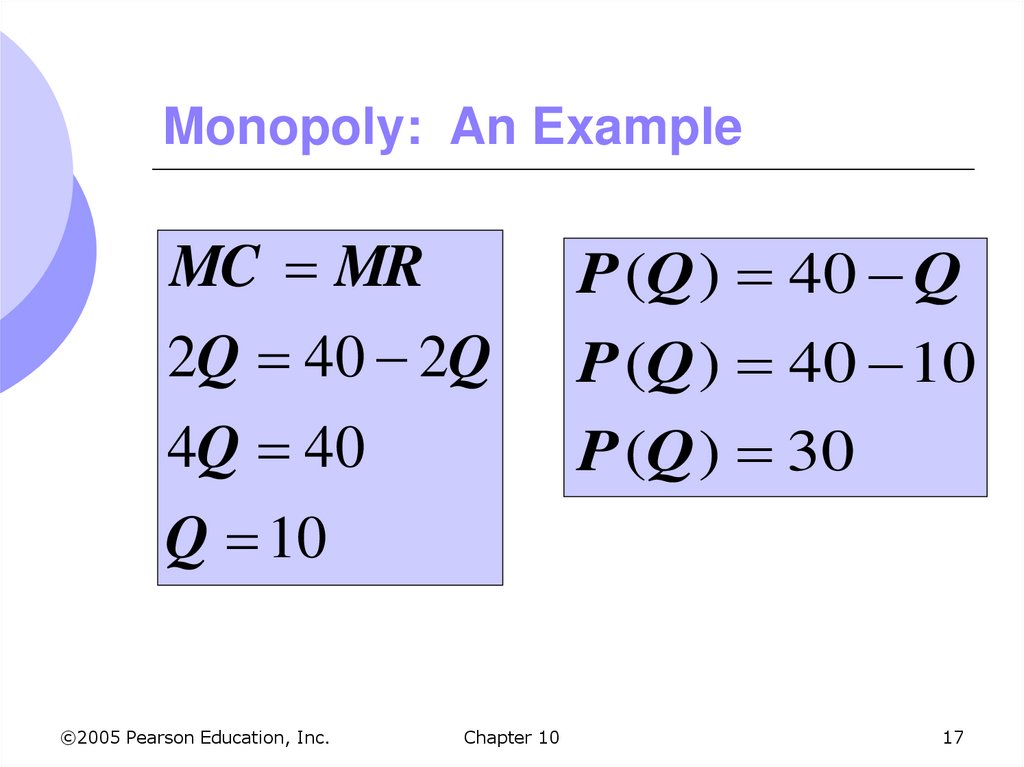
MC MR2Q 40 2Q
4Q 40
Q 10
©2005 Pearson Education, Inc.
Chapter 10
P (Q ) 40 Q
P (Q ) 40 10
P (Q ) 30
17
18. Monopoly: An Example
By setting marginal revenue equal tomarginal cost, we verified that profit is
maximized at P = $30 and Q = 10
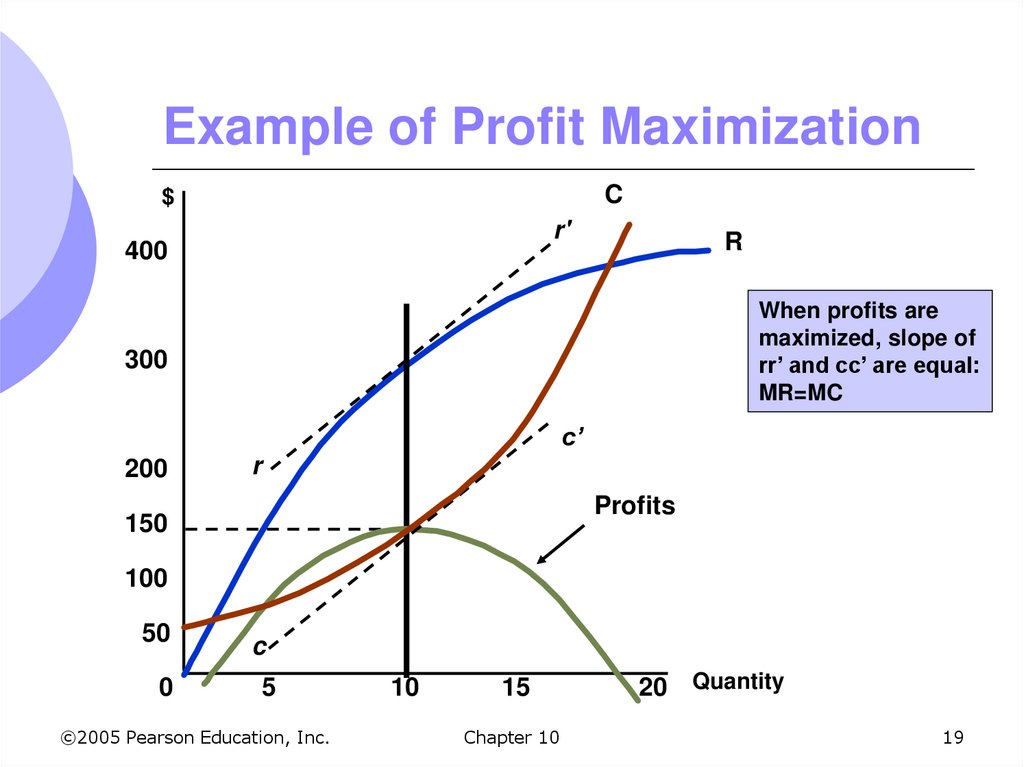
This can be seen graphically by plotting
cost, revenue and profit
Profit is initially negative when produce little
or no output
Profit increase and q increase, maximized at
Q*=10
©2005 Pearson Education, Inc.
Chapter 10
18
19. Example of Profit Maximization
C$
r'
400
R
When profits are
maximized, slope of
rr’ and cc’ are equal:
MR=MC
300
c’
200
r
Profits
150
100
50
0
c
5
©2005 Pearson Education, Inc.
10
15
Chapter 10
20 Quantity
19
20. Example of Profit Maximization
$/Q40
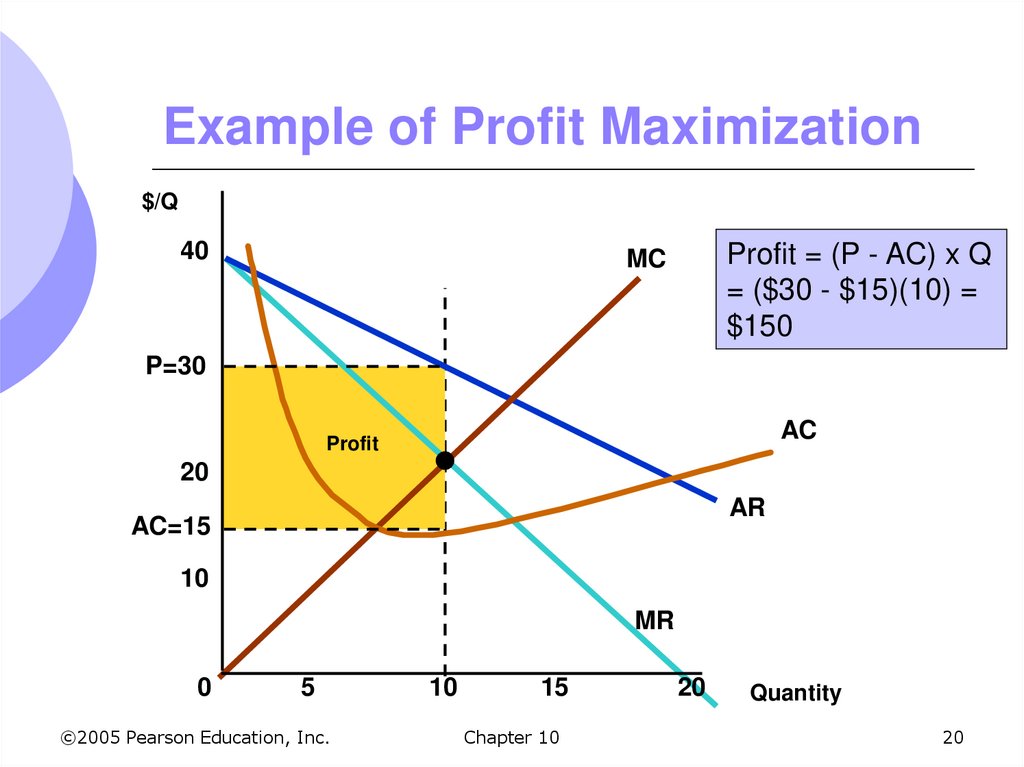
Profit = (P - AC) x Q
= ($30 - $15)(10) =
$150
MC
P=30
AC
Profit
20
AR
AC=15
10
MR
0
5
©2005 Pearson Education, Inc.
10
15
Chapter 10
20
Quantity
20
21. Monopoly
A Rule of Thumb for PricingWe want to translate the condition that
marginal revenue should equal marginal cost
into a rule of thumb that can be more easily
applied in practice
Looking at Marginal Revenue we can see
that it has two components
©2005 Pearson Education, Inc.
Chapter 10
21
22. A Rule of Thumb for Pricing
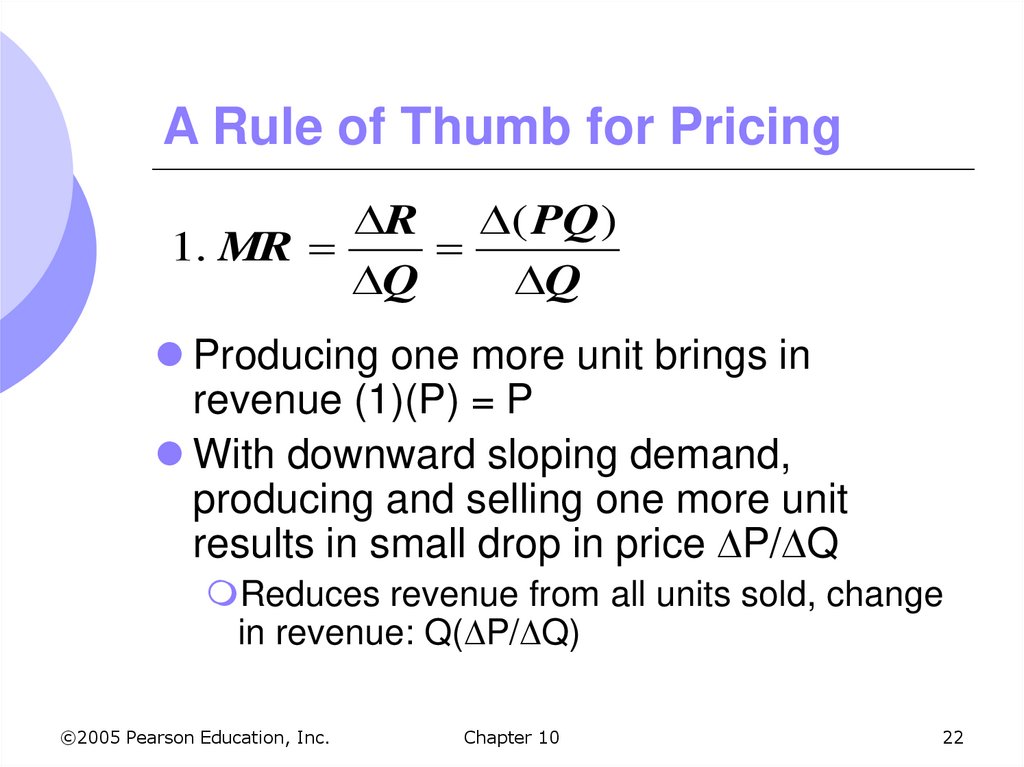
R ( PQ)1. MR
Q
Q
Producing one more unit brings in
revenue (1)(P) = P
With downward sloping demand,
producing and selling one more unit
results in small drop in price P/ Q
Reduces revenue from all units sold, change
in revenue: Q( P/ Q)
©2005 Pearson Education, Inc.
Chapter 10
22
23. A Rule of Thumb for Pricing
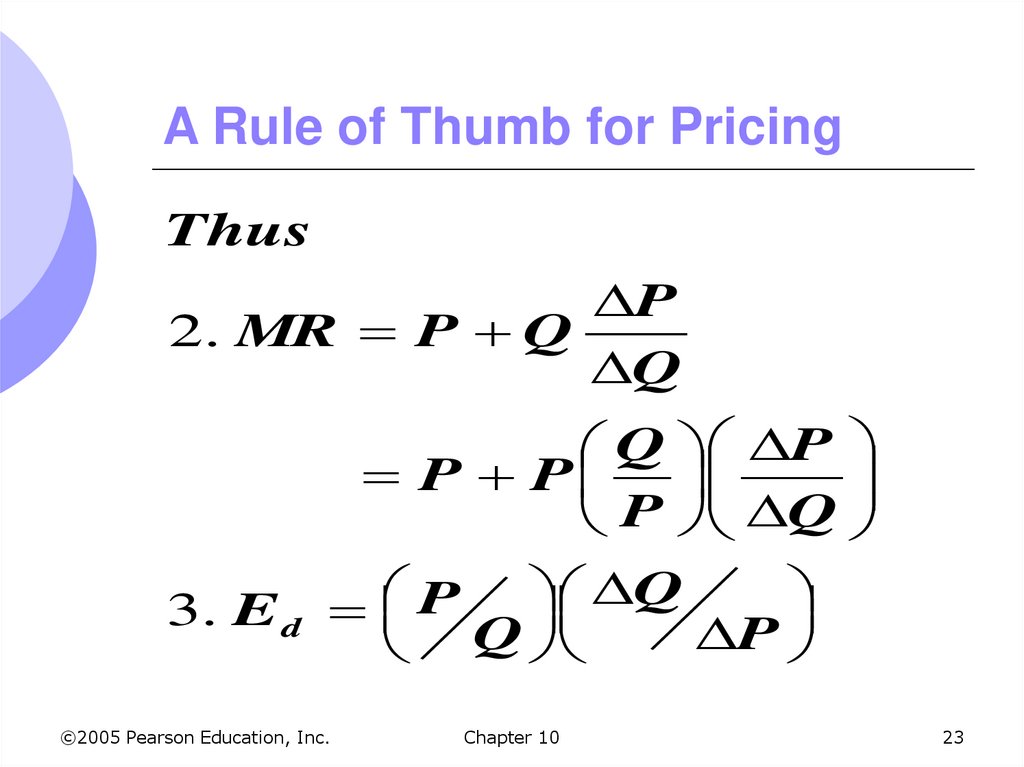
ThusP
2. MR P Q
Q
Q P
P P
P Q
Q
P
3. E d
Q
P
©2005 Pearson Education, Inc.
Chapter 10
23
24. A Rule of Thumb for Pricing
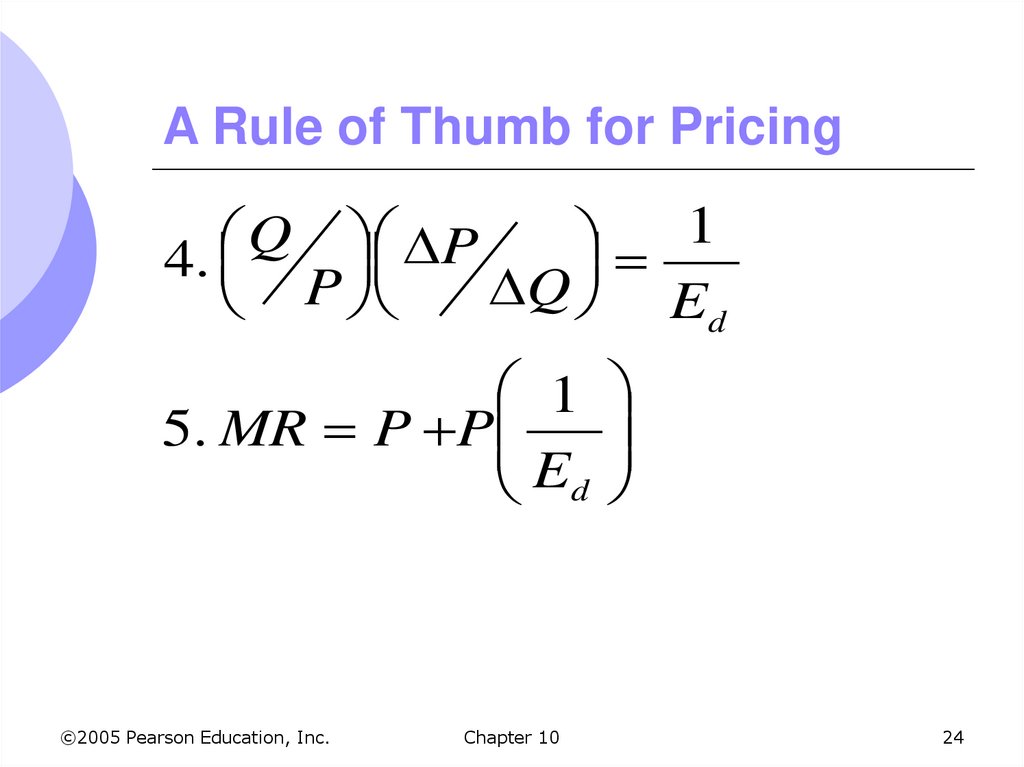
1Q
P
4.
Q E
P
d
1
5. MR P P
Ed
©2005 Pearson Education, Inc.
Chapter 10
24
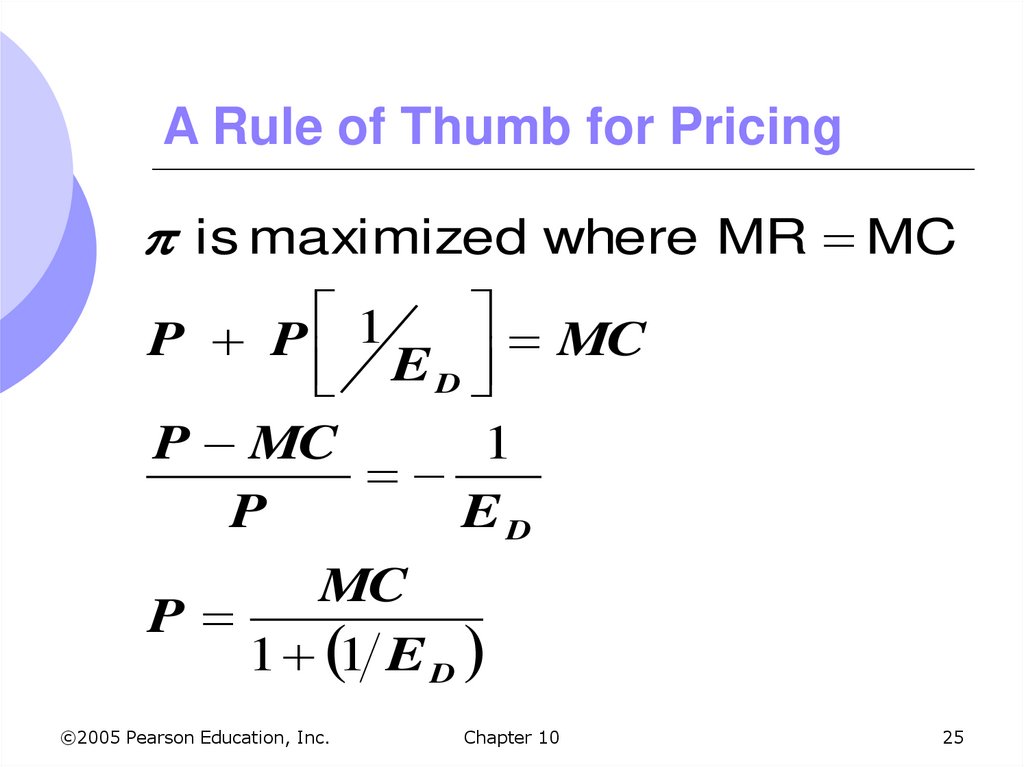
25. A Rule of Thumb for Pricing
is maximized where MR MC1
P P
MC
E D
P MC
1
P
ED
MC
P
1 1 E D
©2005 Pearson Education, Inc.
Chapter 10
25
26. A Rule of Thumb for Pricing
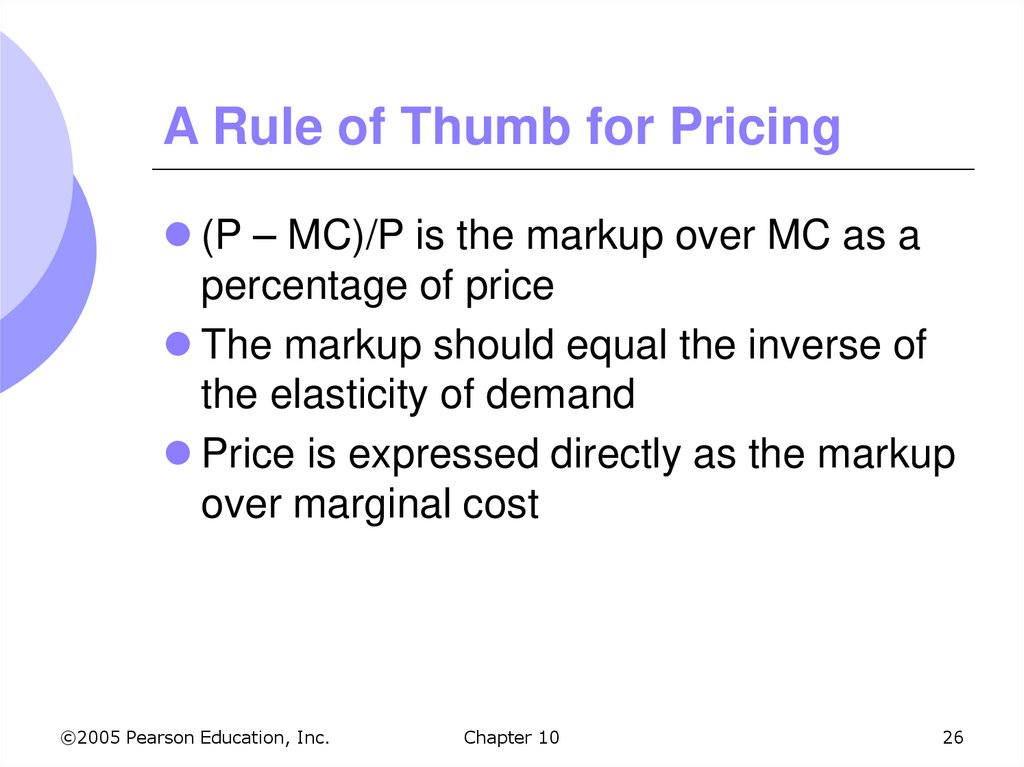
(P – MC)/P is the markup over MC as apercentage of price
The markup should equal the inverse of
the elasticity of demand
Price is expressed directly as the markup
over marginal cost
©2005 Pearson Education, Inc.
Chapter 10
26
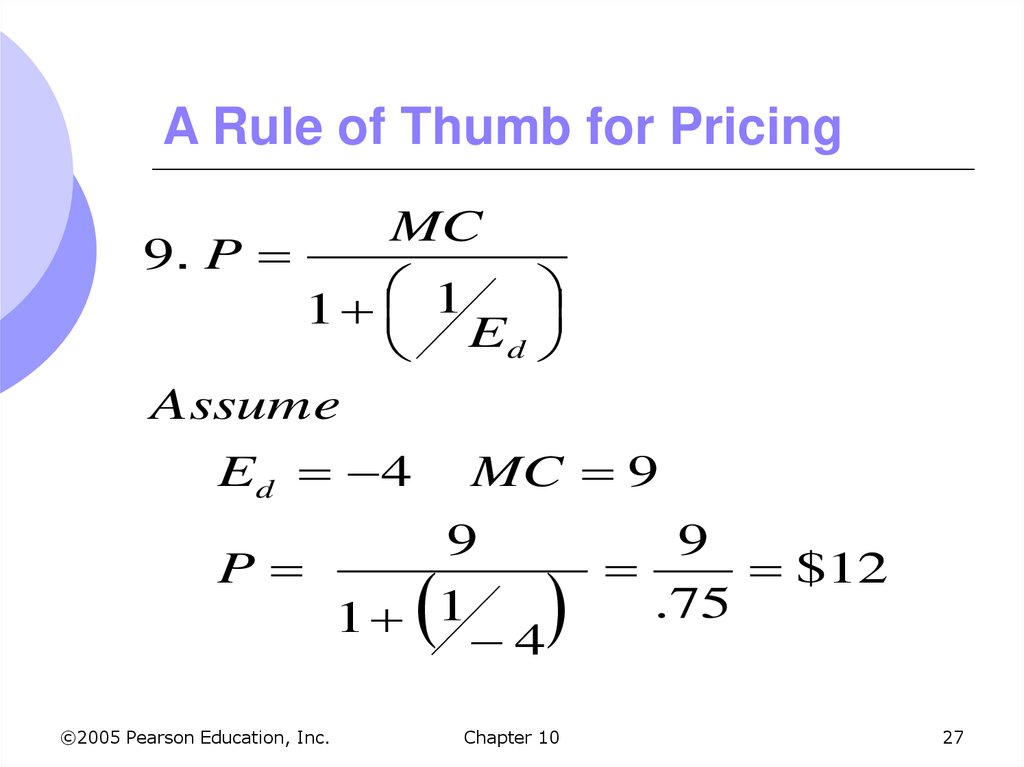
27. A Rule of Thumb for Pricing
MC9. P
1
1
E
d
Assume
Ed 4 MC 9
9
P
1 1
4
©2005 Pearson Education, Inc.
Chapter 10
9
$12
.75
27
28. Monopoly
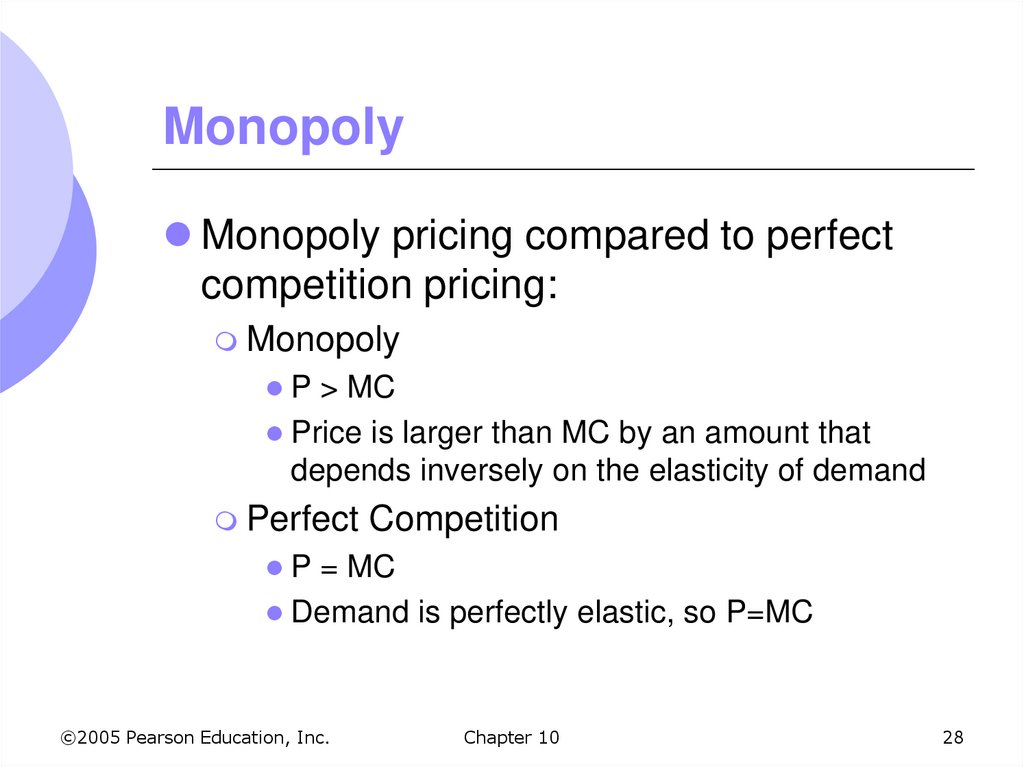
Monopoly pricing compared to perfectcompetition pricing:
Monopoly
P > MC
Price is larger than MC by an amount that
depends inversely on the elasticity of demand
Perfect Competition
P = MC
Demand is perfectly elastic, so P=MC
©2005 Pearson Education, Inc.
Chapter 10
28
29. Monopoly
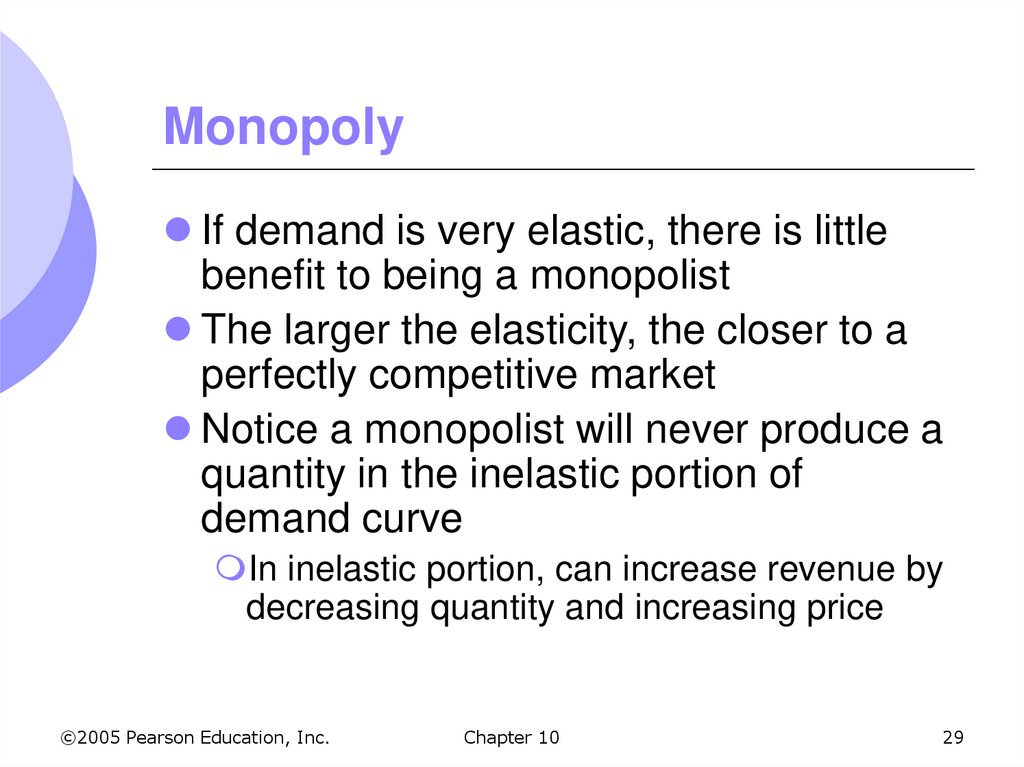
If demand is very elastic, there is littlebenefit to being a monopolist
The larger the elasticity, the closer to a
perfectly competitive market
Notice a monopolist will never produce a
quantity in the inelastic portion of
demand curve
In inelastic portion, can increase revenue by
decreasing quantity and increasing price
©2005 Pearson Education, Inc.
Chapter 10
29
30. Shifts in Demand
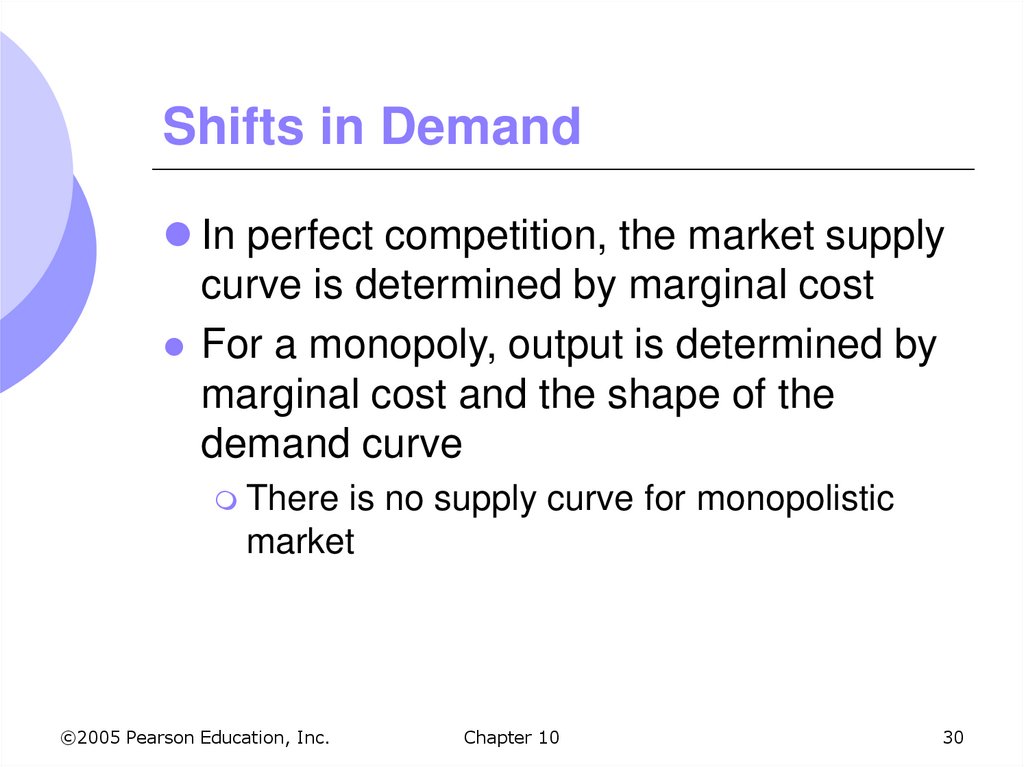
In perfect competition, the market supplycurve is determined by marginal cost
For a monopoly, output is determined by
marginal cost and the shape of the
demand curve
There is no supply curve for monopolistic
market
©2005 Pearson Education, Inc.
Chapter 10
30
31. Shifts in Demand
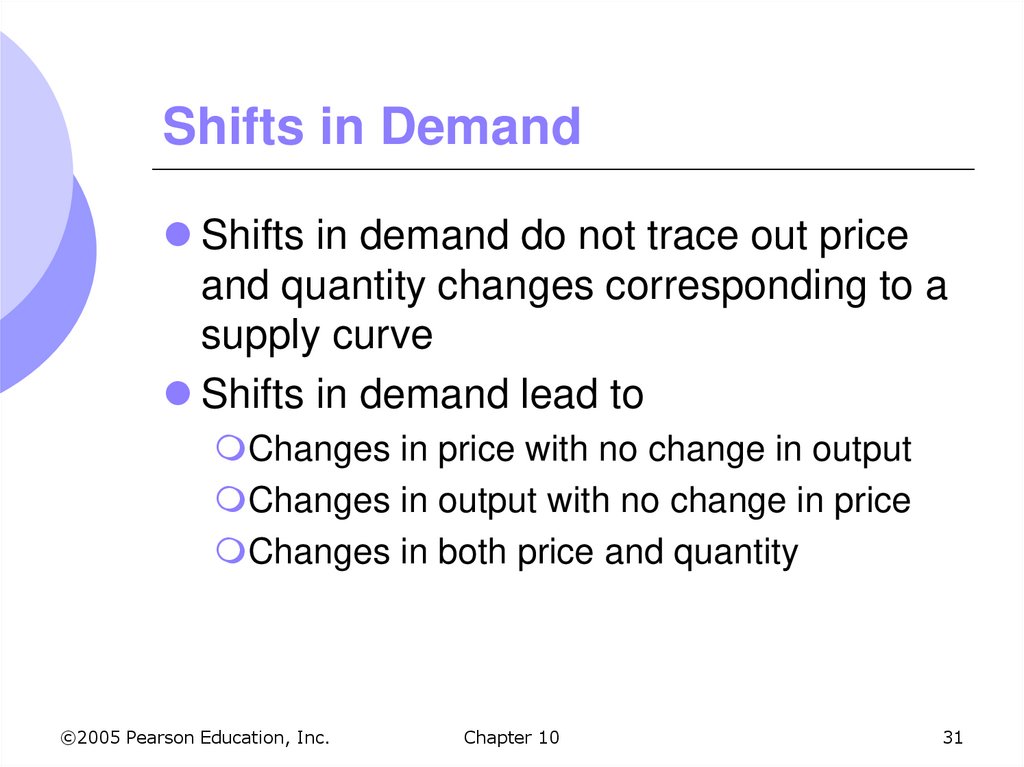
Shifts in demand do not trace out priceand quantity changes corresponding to a
supply curve
Shifts in demand lead to
Changes in price with no change in output
Changes in output with no change in price
Changes in both price and quantity
©2005 Pearson Education, Inc.
Chapter 10
31
32. Shifts in Demand
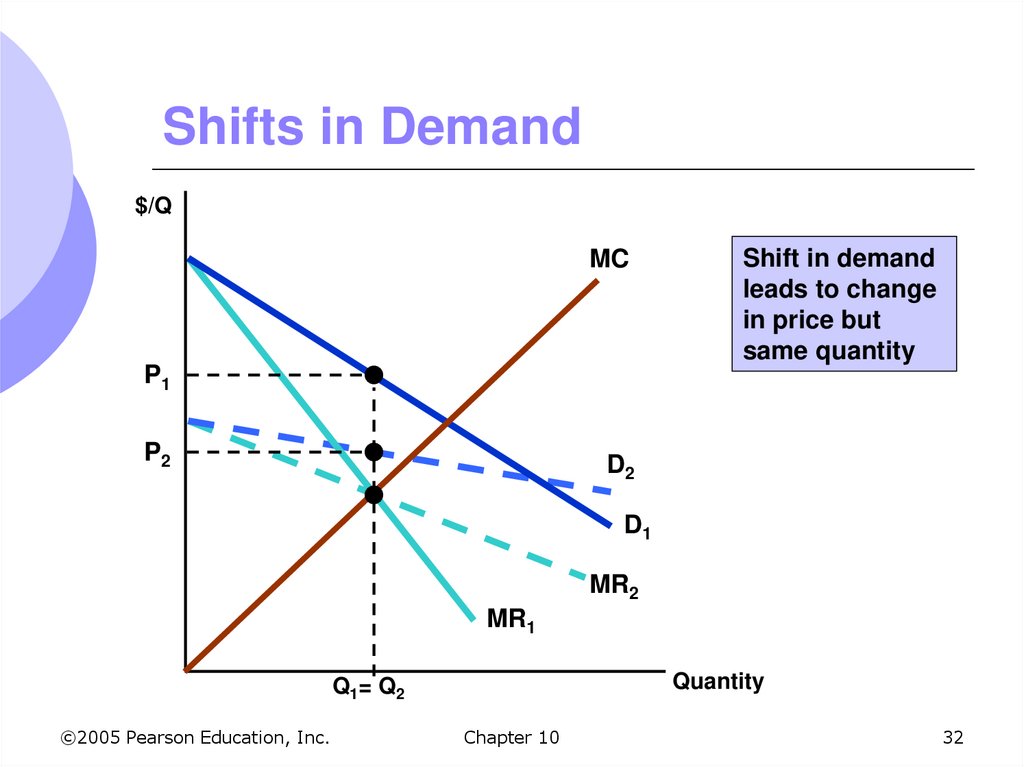
$/QMC
Shift in demand
leads to change
in price but
same quantity
P1
P2
D2
D1
MR2
MR1
Quantity
Q1= Q2
©2005 Pearson Education, Inc.
Chapter 10
32
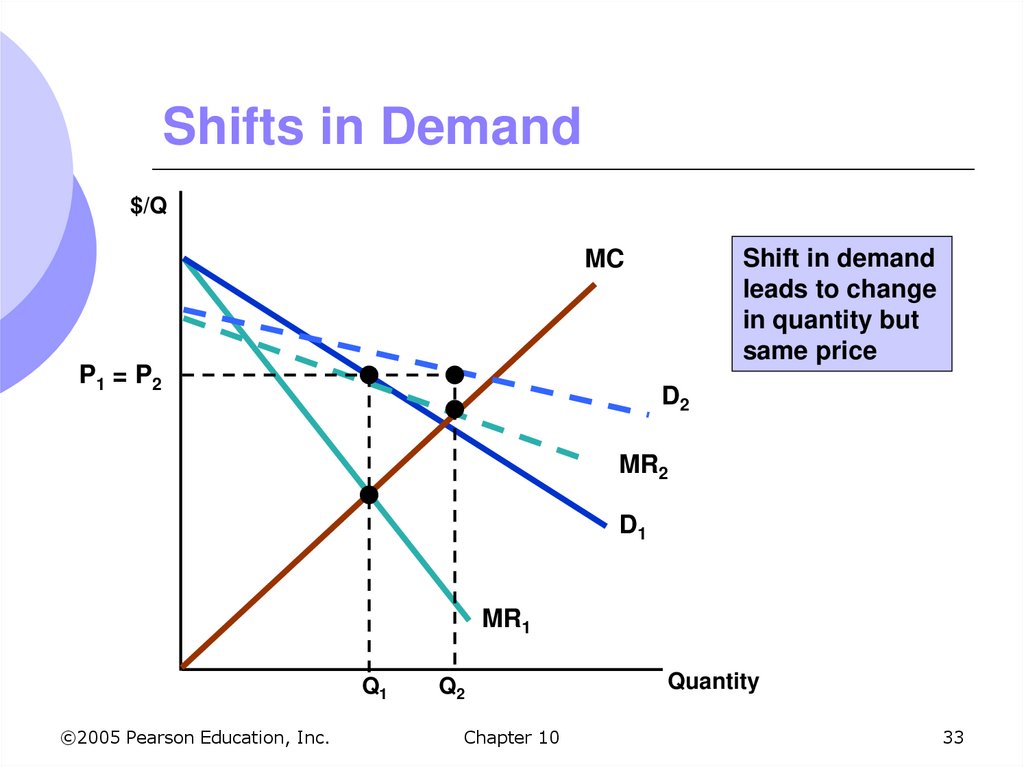
33. Shifts in Demand
$/QShift in demand
leads to change
in quantity but
same price
MC
P1 = P2
D2
MR2
D1
MR1
Q1
©2005 Pearson Education, Inc.
Q2
Chapter 10
Quantity
33
34. Monopoly
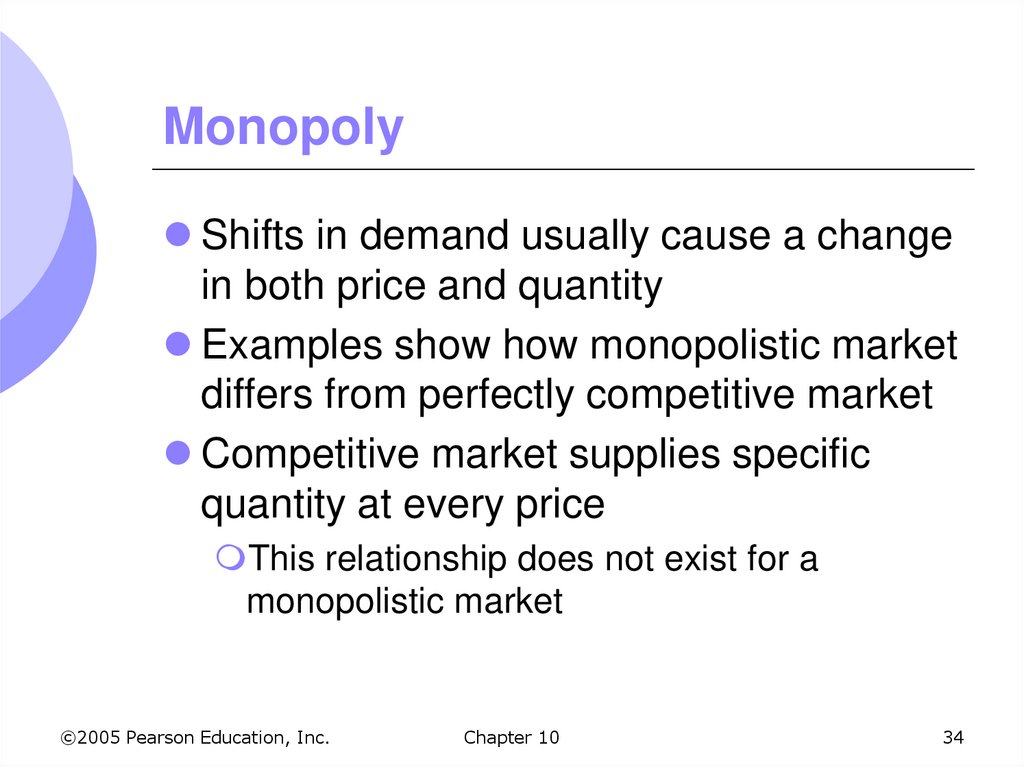
Shifts in demand usually cause a changein both price and quantity
Examples show how monopolistic market
differs from perfectly competitive market
Competitive market supplies specific
quantity at every price
This relationship does not exist for a
monopolistic market
©2005 Pearson Education, Inc.
Chapter 10
34
35. The Effect of a Tax
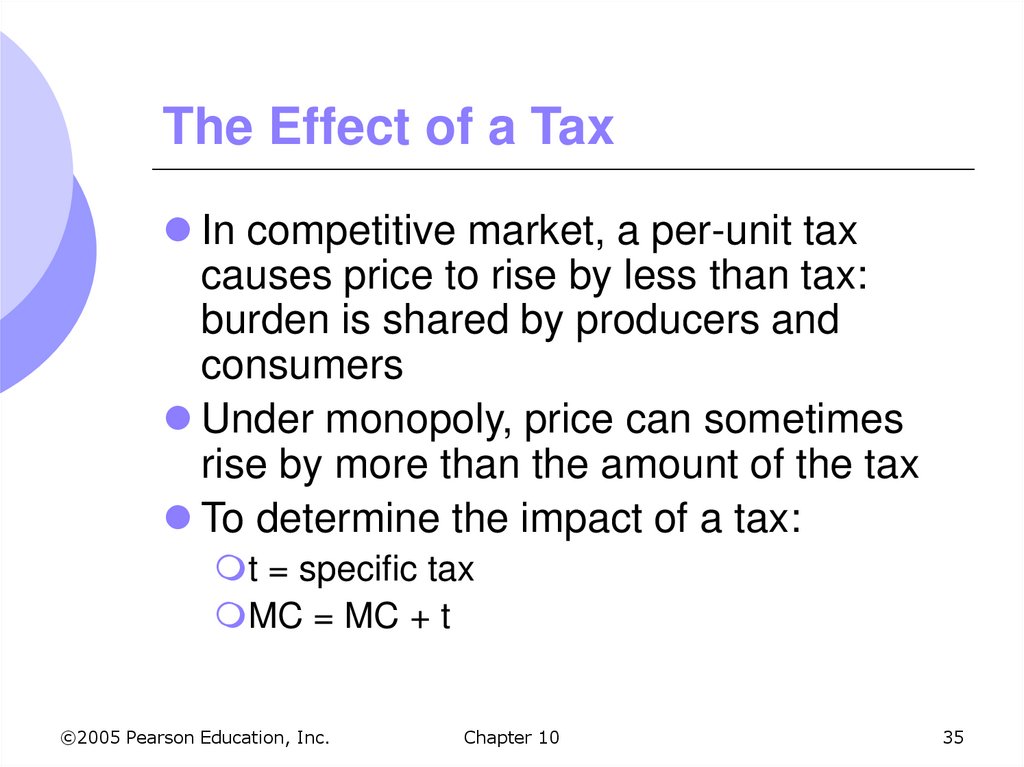
In competitive market, a per-unit taxcauses price to rise by less than tax:
burden is shared by producers and
consumers
Under monopoly, price can sometimes
rise by more than the amount of the tax
To determine the impact of a tax:
t = specific tax
MC = MC + t
©2005 Pearson Education, Inc.
Chapter 10
35
36. Effect of Excise Tax on Monopolist
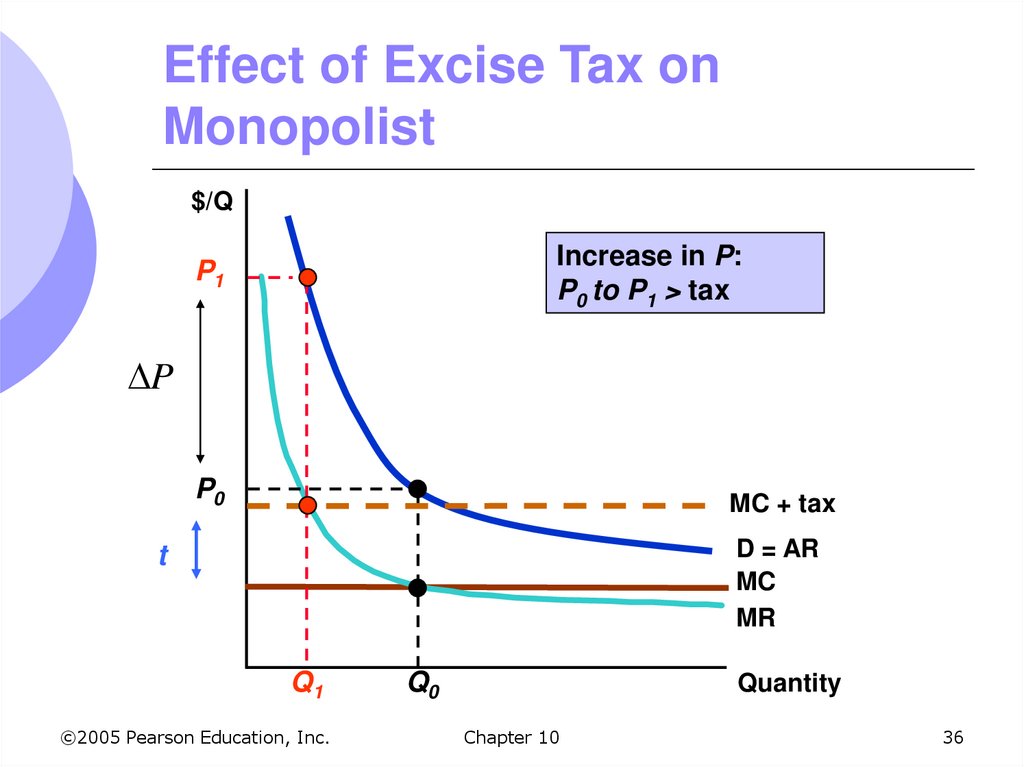
$/QIncrease in P:
P0 to P1 > tax
P1
P
P0
MC + tax
D = AR
MC
MR
t
Q1
©2005 Pearson Education, Inc.
Q0
Quantity
Chapter 10
36
37. Effect of Excise Tax on Monopolist
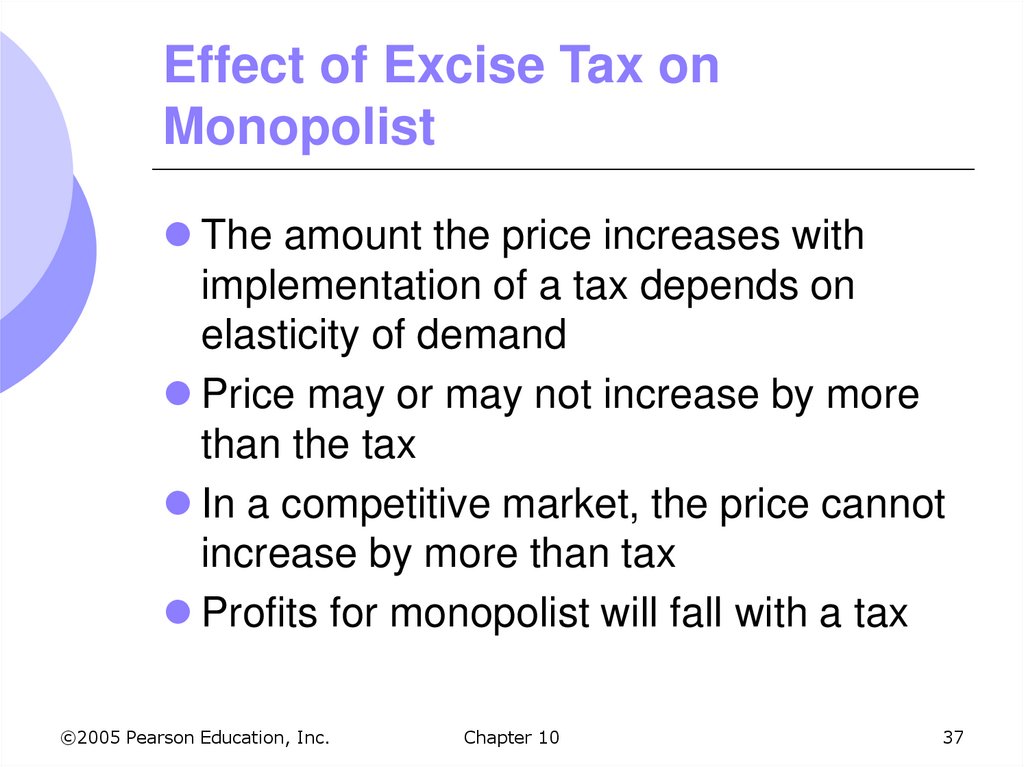
The amount the price increases withimplementation of a tax depends on
elasticity of demand
Price may or may not increase by more
than the tax
In a competitive market, the price cannot
increase by more than tax
Profits for monopolist will fall with a tax
©2005 Pearson Education, Inc.
Chapter 10
37
38. The Multi-plant Firm
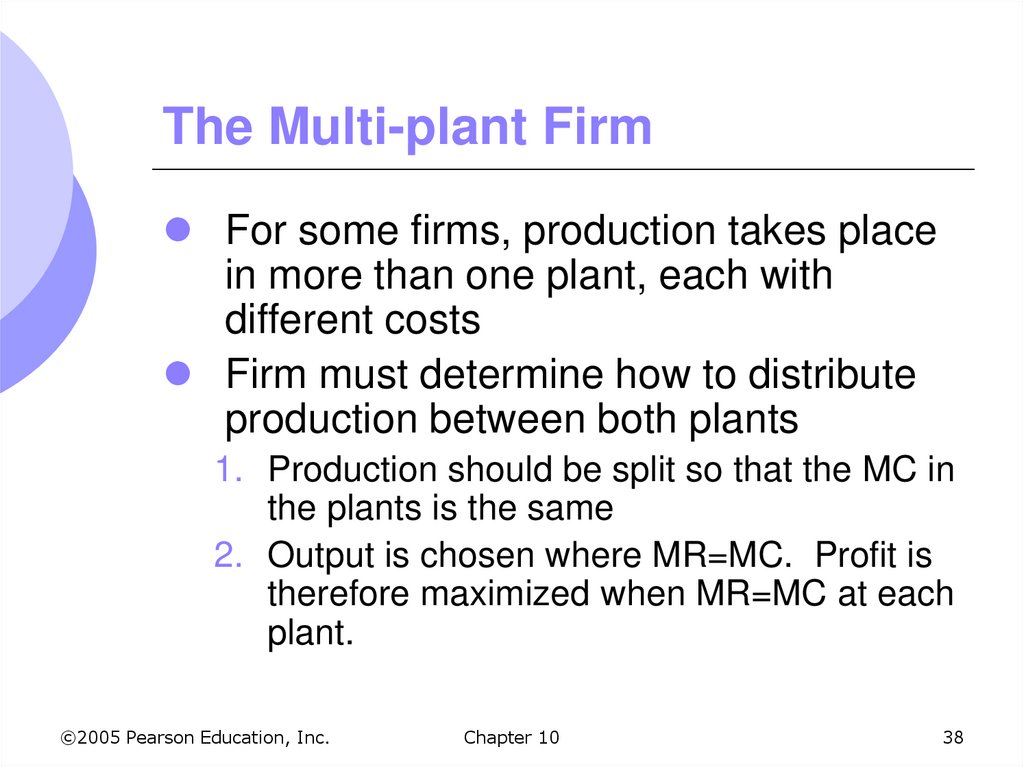
For some firms, production takes placein more than one plant, each with
different costs
Firm must determine how to distribute
production between both plants
1. Production should be split so that the MC in
the plants is the same
2. Output is chosen where MR=MC. Profit is
therefore maximized when MR=MC at each
plant.
©2005 Pearson Education, Inc.
Chapter 10
38
39. The Multi-plant Firm
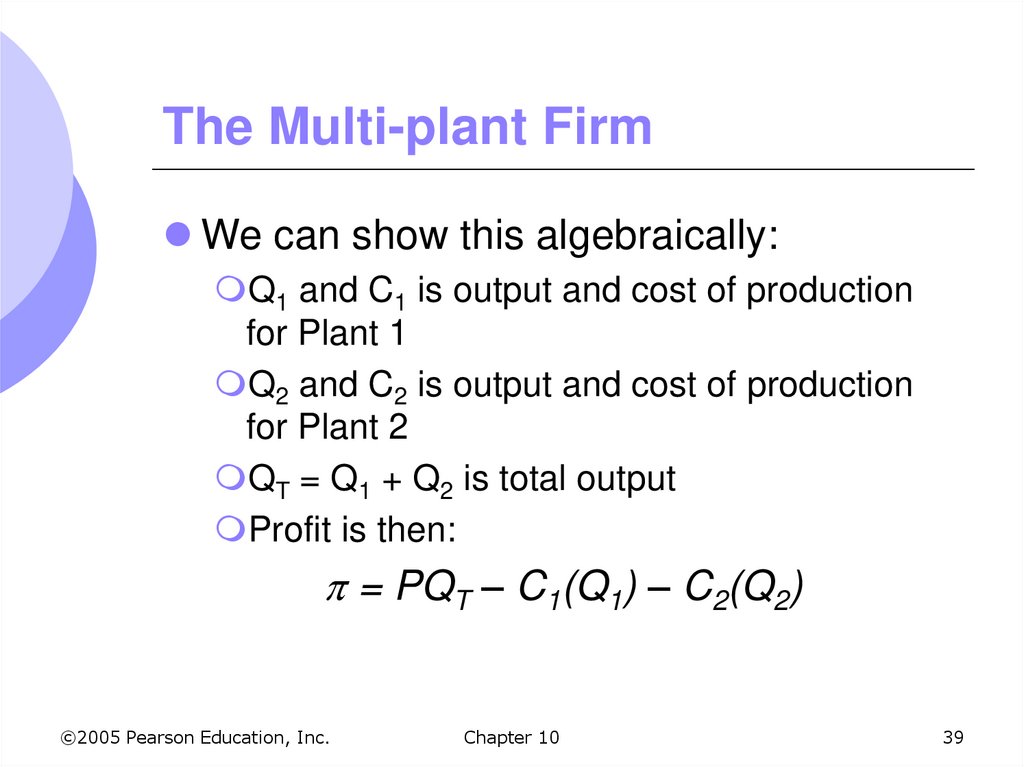
We can show this algebraically:Q1 and C1 is output and cost of production
for Plant 1
Q2 and C2 is output and cost of production
for Plant 2
QT = Q1 + Q2 is total output
Profit is then:
= PQT – C1(Q1) – C2(Q2)
©2005 Pearson Education, Inc.
Chapter 10
39
40. The Multi-plant Firm
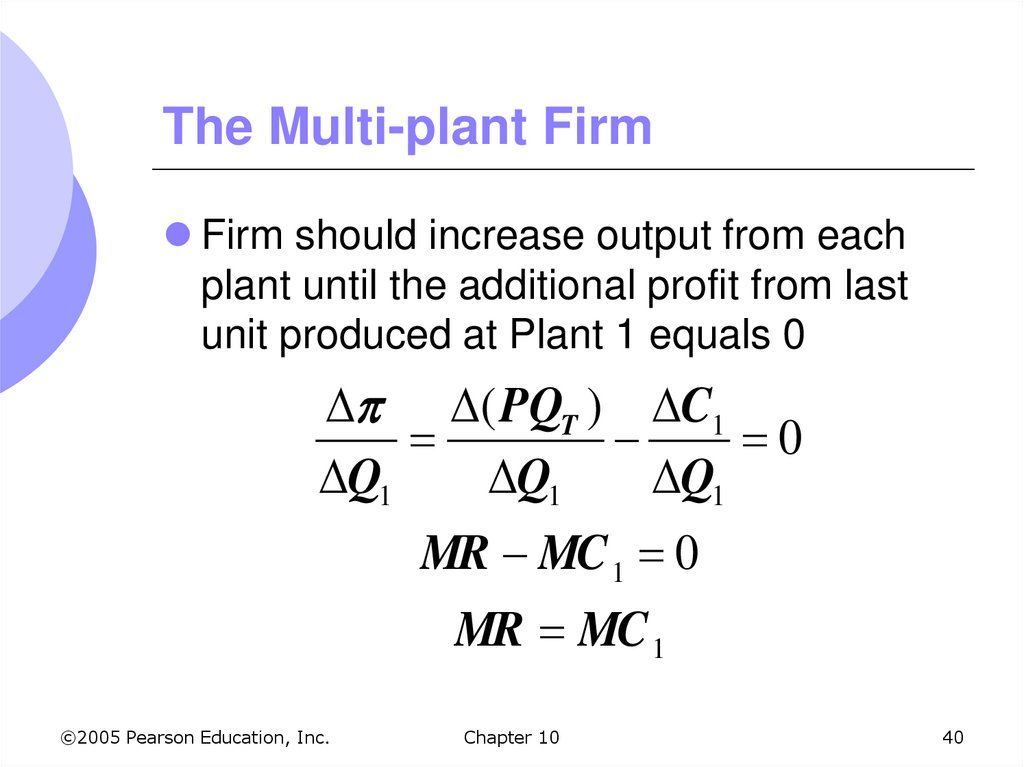
Firm should increase output from eachplant until the additional profit from last
unit produced at Plant 1 equals 0
( PQT ) C1
0
Q1
Q1
Q1
MR MC 1 0
MR MC 1
©2005 Pearson Education, Inc.
Chapter 10
40
41. The Multi-plant Firm
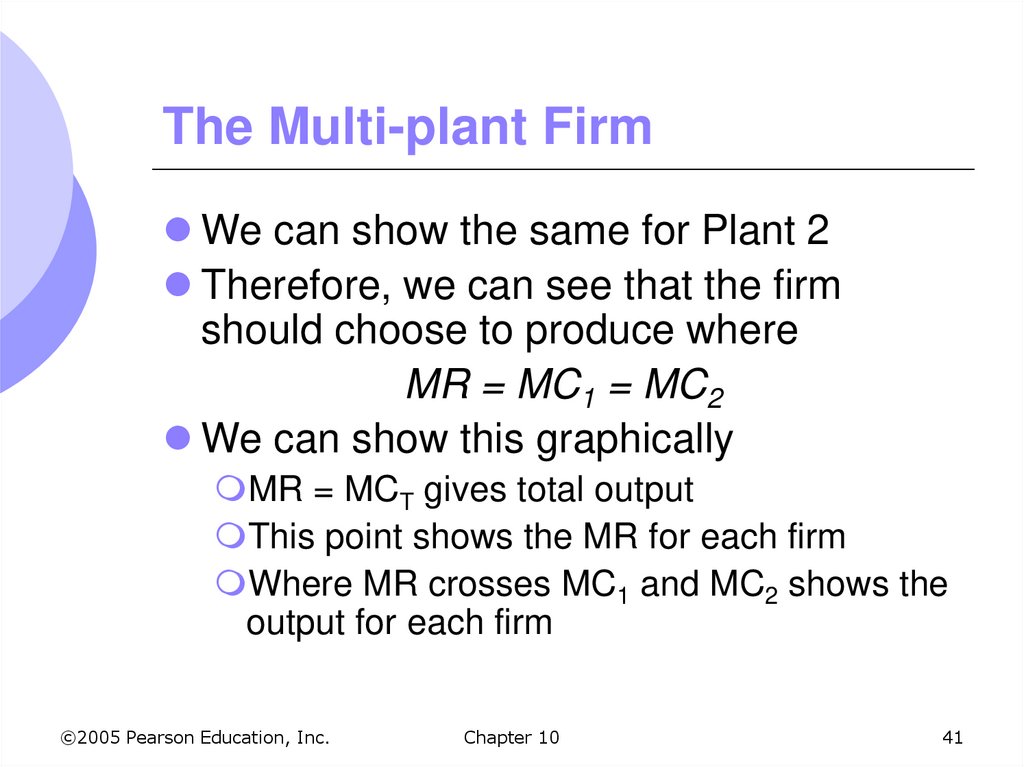
We can show the same for Plant 2Therefore, we can see that the firm
should choose to produce where
MR = MC1 = MC2
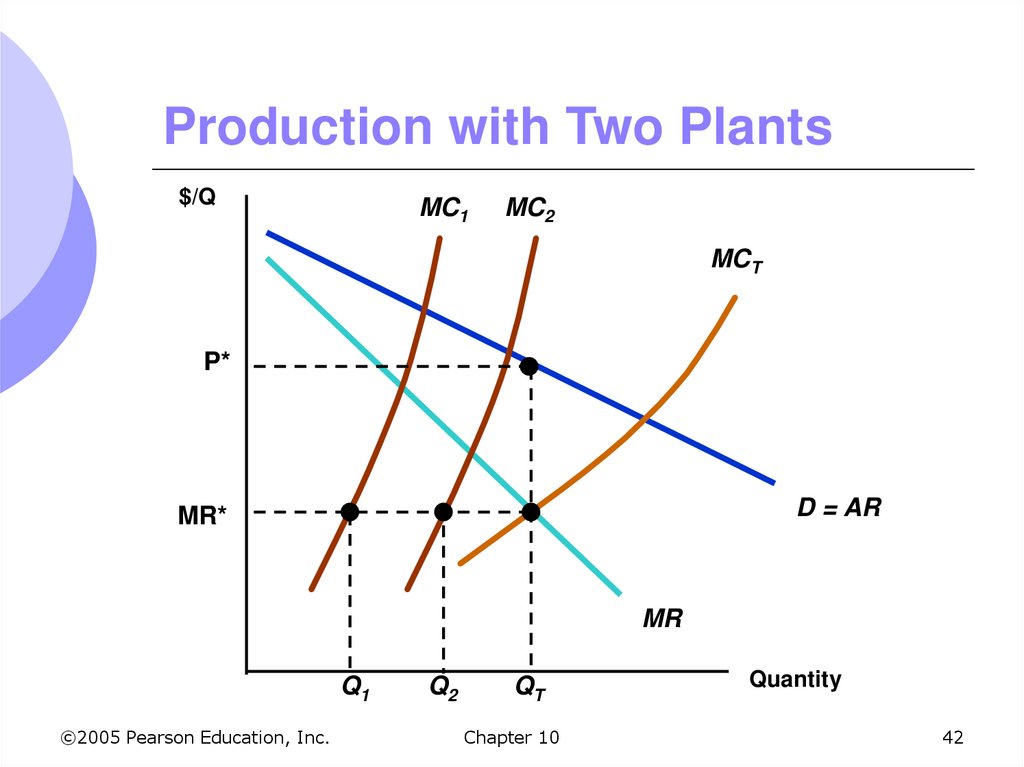
We can show this graphically
MR = MCT gives total output
This point shows the MR for each firm
Where MR crosses MC1 and MC2 shows the
output for each firm
©2005 Pearson Education, Inc.
Chapter 10
41
42. Production with Two Plants
$/QMC1
MC2
MCT
P*
D = AR
MR*
MR
Q1
©2005 Pearson Education, Inc.
Q2
QT
Chapter 10
Quantity
42
43. Monopoly Power
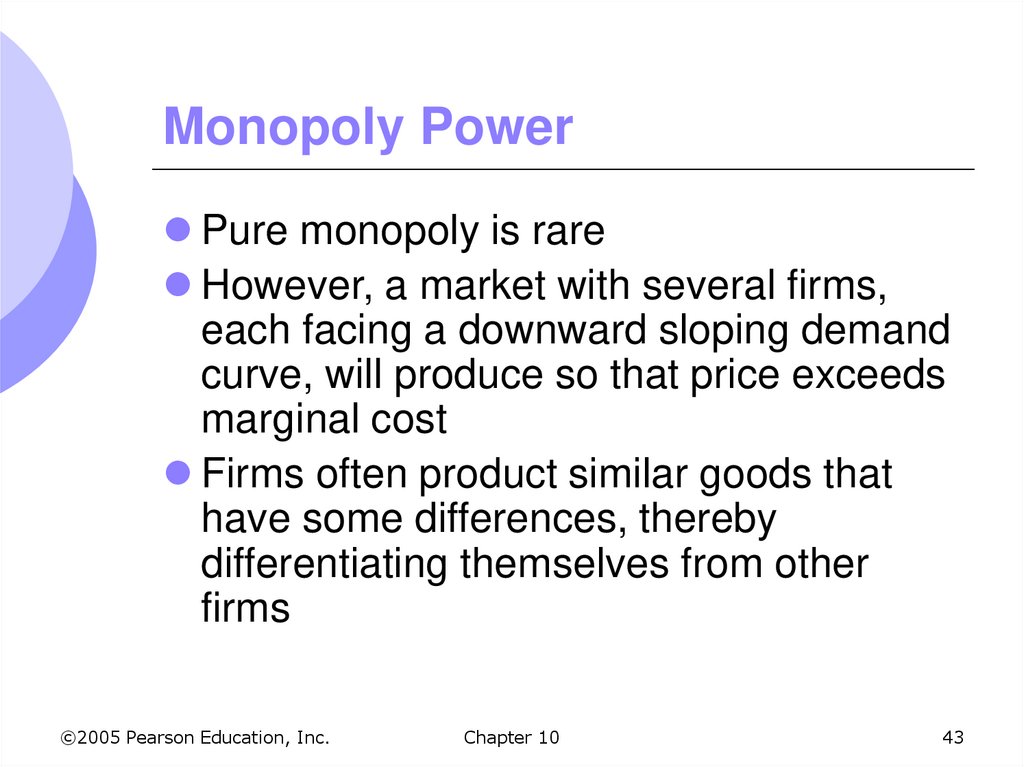
Pure monopoly is rareHowever, a market with several firms,
each facing a downward sloping demand
curve, will produce so that price exceeds
marginal cost
Firms often product similar goods that
have some differences, thereby
differentiating themselves from other
firms
©2005 Pearson Education, Inc.
Chapter 10
43
44. Monopoly Power: Example
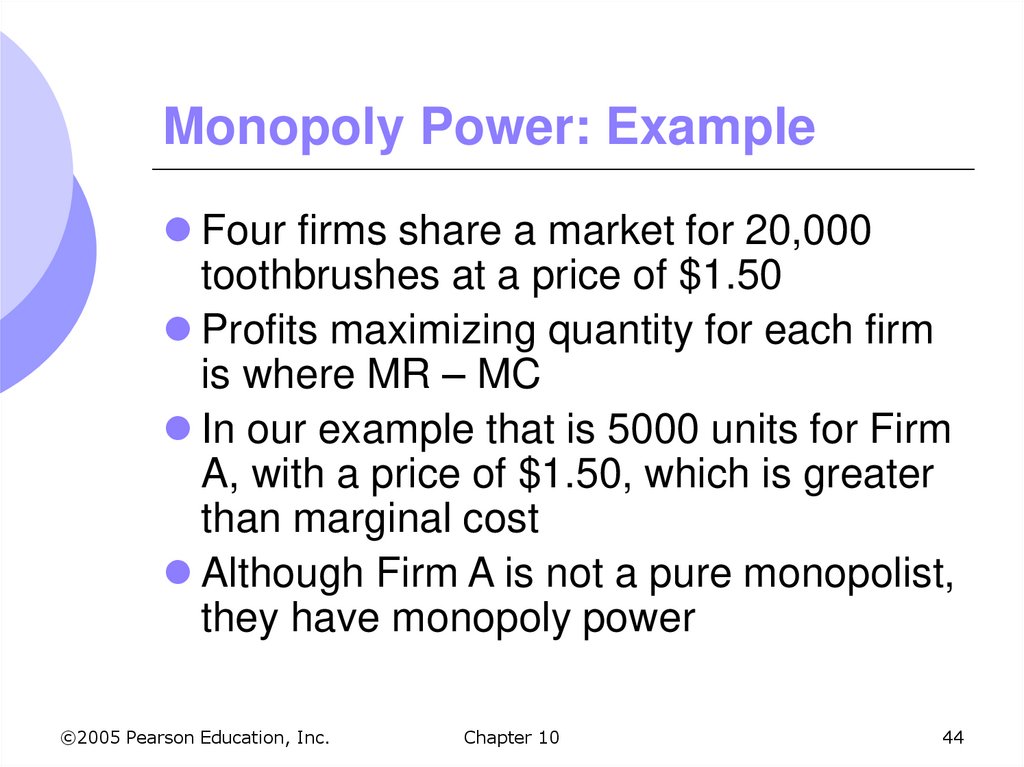
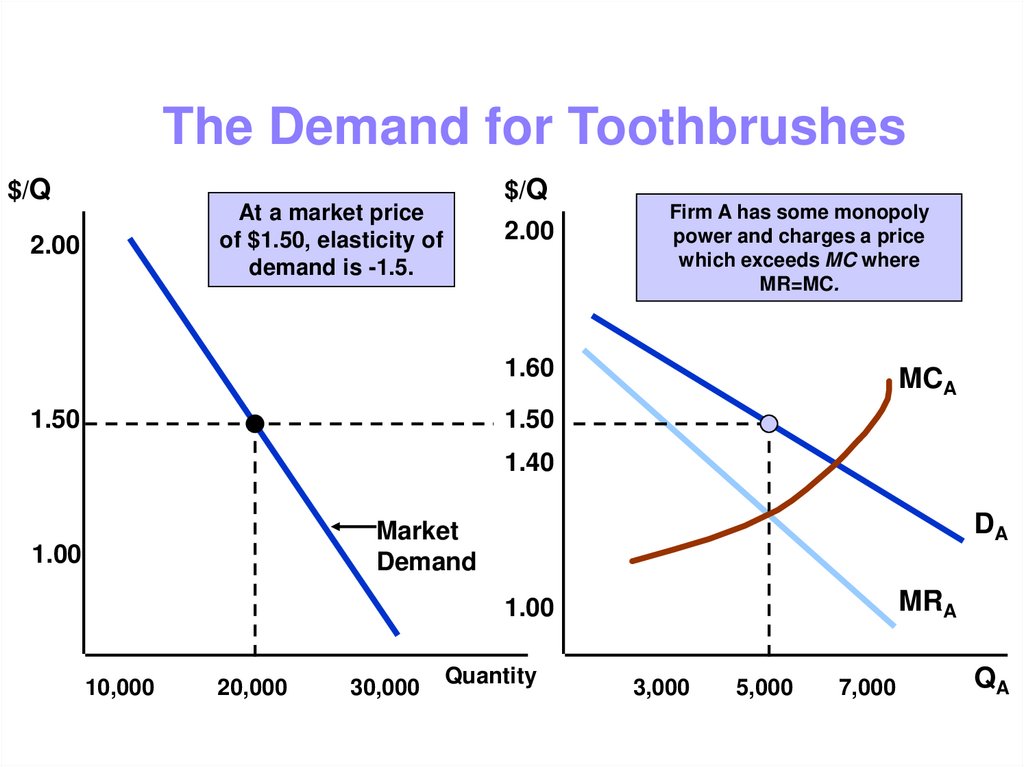
Four firms share a market for 20,000toothbrushes at a price of $1.50
Profits maximizing quantity for each firm
is where MR – MC
In our example that is 5000 units for Firm
A, with a price of $1.50, which is greater
than marginal cost
Although Firm A is not a pure monopolist,
they have monopoly power
©2005 Pearson Education, Inc.
Chapter 10
44
45. The Demand for Toothbrushes
$/Q$/Q
At a market price
of $1.50, elasticity of
demand is -1.5.
2.00
2.00
Firm A has some monopoly
power and charges a price
which exceeds MC where
MR=MC.
1.60
1.50
MCA
1.50
1.40
DA
Market
Demand
1.00
MRA
1.00
10,000
20,000
30,000
Quantity
3,000
5,000
7,000
QA
46. Measuring Monopoly Power
Our firm would have more monopoly power, ofcourse, if it could get rid of the other firms
But the firm’s monopoly power might still be
substantial
How can we measure monopoly power to
compare firms?
What are the sources of monopoly power?
Why do some firms have more than others?
©2005 Pearson Education, Inc.
Chapter 10
46
47. Measuring Monopoly Power
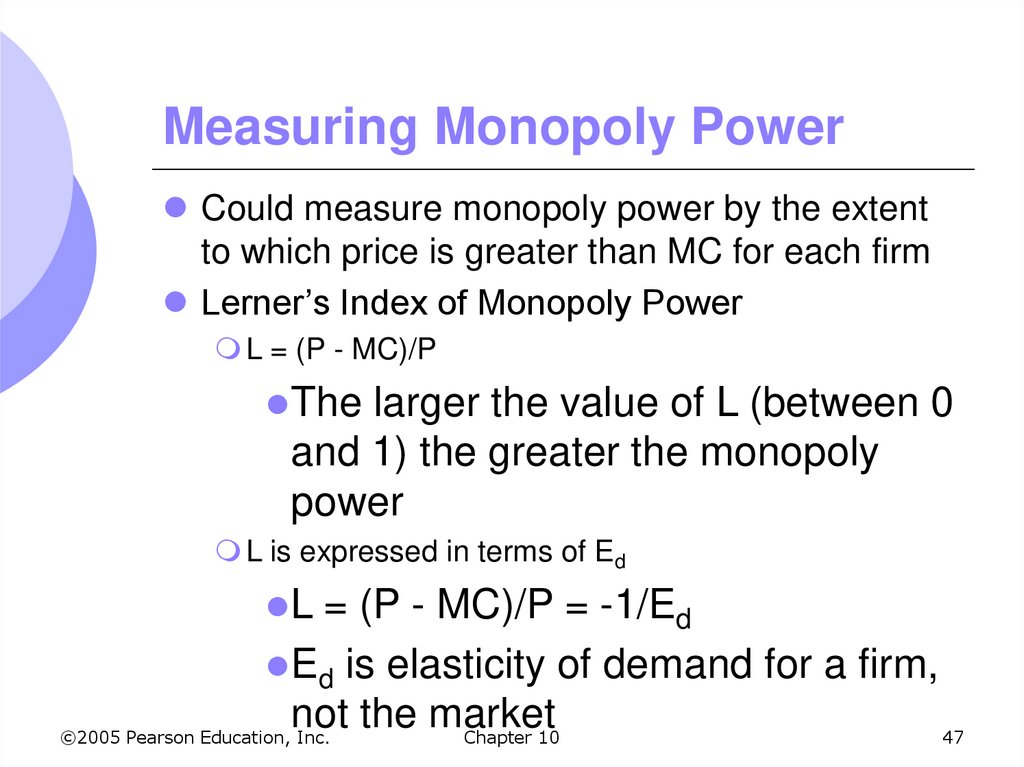
Could measure monopoly power by the extentto which price is greater than MC for each firm
Lerner’s Index of Monopoly Power
L = (P - MC)/P
The larger the value of L (between 0
and 1) the greater the monopoly
power
L is expressed in terms of Ed
L = (P - MC)/P = -1/Ed
Ed is elasticity of demand for a firm,
not the market
Chapter 10
©2005 Pearson Education, Inc.
47
48. Monopoly Power
Monopoly power, however, does notguarantee profits
Profit depends on average cost relative
to price
One firm may have more monopoly
power but lower profits due to high
average costs
©2005 Pearson Education, Inc.
Chapter 10
48
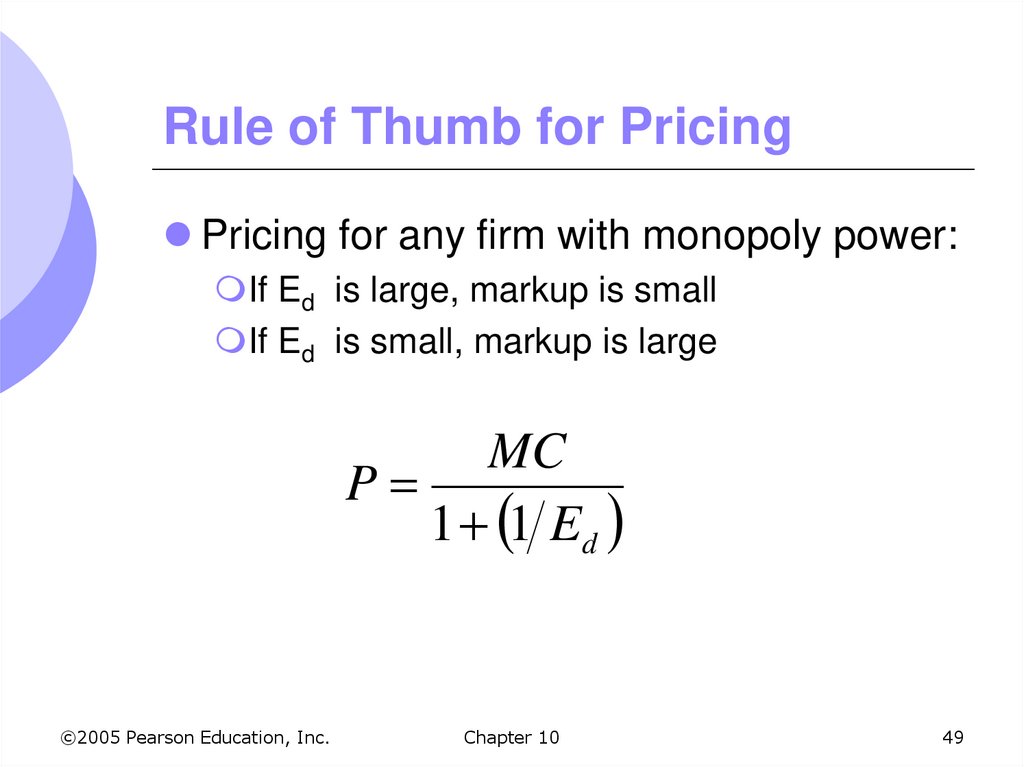
49. Rule of Thumb for Pricing
Pricing for any firm with monopoly power:If Ed is large, markup is small
If Ed is small, markup is large
MC
P
1 1 Ed
©2005 Pearson Education, Inc.
Chapter 10
49
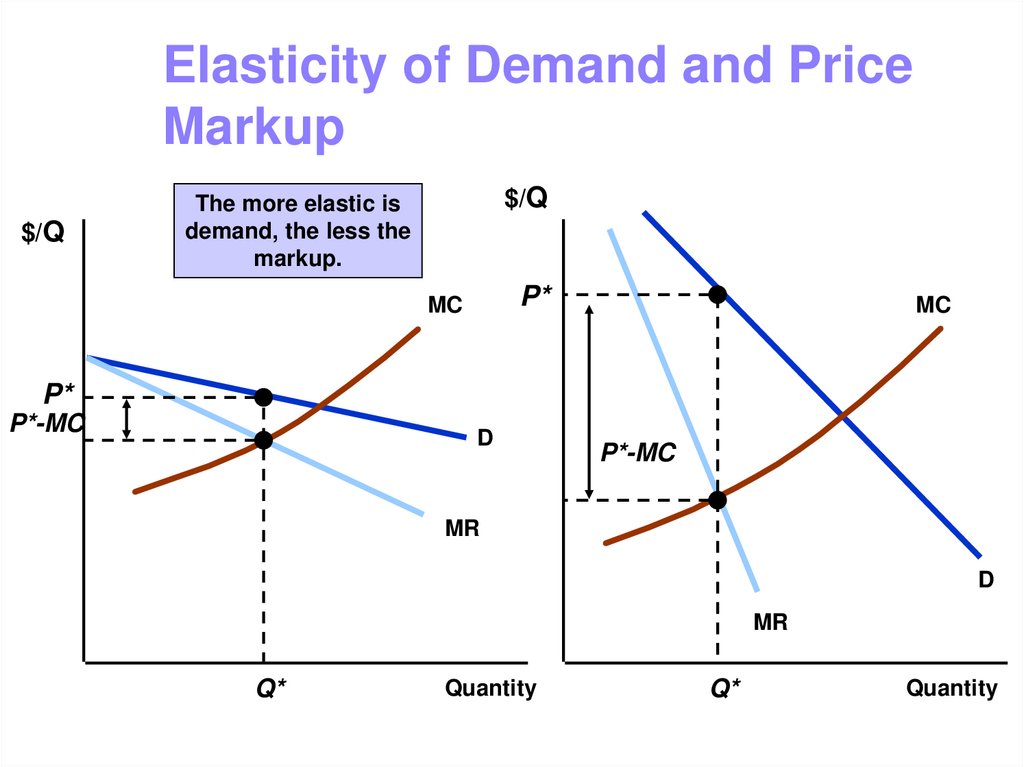
50. Elasticity of Demand and Price Markup
$/Q$/Q
The more elastic is
demand, the less the
markup.
P*
MC
MC
P*
P*-MC
D
P*-MC
MR
D
MR
Q*
Quantity
Q*
Quantity
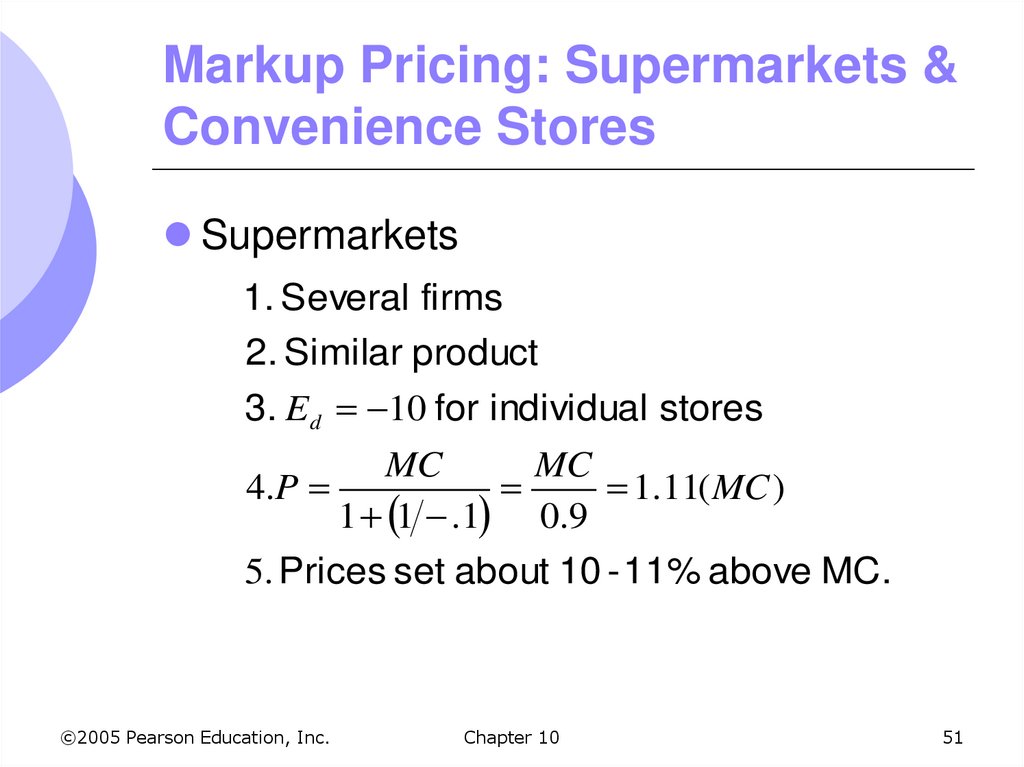
51. Markup Pricing: Supermarkets & Convenience Stores
Markup Pricing: Supermarkets &Convenience Stores
Supermarkets
1. Several firms
2. Similar product
3. Ed 10 for individual stores
MC
MC
4 .P
1.11( MC )
1 1 .1 0.9
5. Prices set about 10 - 11% above MC.
©2005 Pearson Education, Inc.
Chapter 10
51
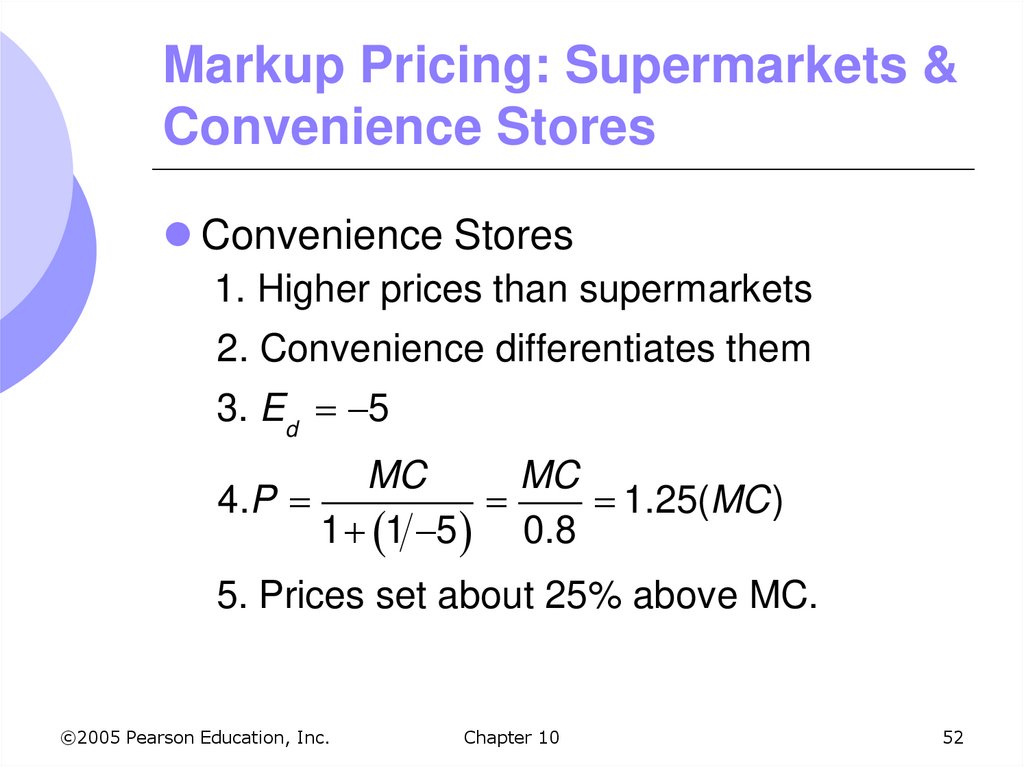
52. Markup Pricing: Supermarkets & Convenience Stores
Markup Pricing: Supermarkets &Convenience Stores
Convenience Stores
1. Higher prices than supermarkets
2. Convenience differentiates them
3. Ed 5
MC
MC
4.P
1.25(MC )
1 1 5 0.8
5. Prices set about 25% above MC.
©2005 Pearson Education, Inc.
Chapter 10
52
53. Markup Pricing: Supermarkets & Convenience Stores
Markup Pricing: Supermarkets &Convenience Stores
Convenience stores have more
monopoly power
Convenience stores do have higher
profits than supermarkets, however
Volume is far smaller and average fixed
costs are larger
©2005 Pearson Education, Inc.
Chapter 10
53
54. Sources of Monopoly Power
Why do some firms have considerablemonopoly power, and others have little or
none?
Monopoly power is determined by ability
to set price higher than marginal cost
A firm’s monopoly power, therefore, is
determined by the firm’s elasticity of
demand
©2005 Pearson Education, Inc.
Chapter 10
54
55. Sources of Monopoly Power
The less elastic the demand curve, themore monopoly power a firm has
The firm’s elasticity of demand is
determined by:
1) Elasticity of market demand
2) Number of firms in market
3) The interaction among firms
©2005 Pearson Education, Inc.
Chapter 10
55
56. Elasticity of Market Demand
With one firm, their demand curve ismarket demand curve
Degree of monopoly power is determined
completely by elasticity of market demand
With more firms, individual demand may
differ from market demand
Demand for a firm’s product is more elastic
than the market elasticity
©2005 Pearson Education, Inc.
Chapter 10
56
57. Number of Firms
The monopoly power of a firm falls as thenumber of firms increases; all else equal
More important are the number of firms with
significant market share
Market is highly concentrated if only a few
firms account for most of the sales
Firms would like to create barriers to
entry to keep new firms out of market
Patent, copyrights, licenses, economies of
scale
©2005 Pearson Education, Inc.
Chapter 10
57
58. Interaction Among Firms
If firms are aggressive in gaining marketshare by, for example, undercutting the
other firms, prices may reach close to
competitive levels
If firms collude (violation of antitrust
rules), could generate substantial
monopoly power
Markets are dynamic and therefore, so is
the concept of monopoly power
©2005 Pearson Education, Inc.
Chapter 10
58
59. The Social Costs of Monopoly Power
Monopoly power results in higher pricesand lower quantities
However, does monopoly power make
consumers and producers in the
aggregate better or worse off?
We can compare producer and consumer
surplus when in a competitive market and
in a monopolistic market
©2005 Pearson Education, Inc.
Chapter 10
59
60. The Social Costs of Monopoly
Perfectly competitive firm will produce whereMC = D PC and QC
Monopoly produces where MR = MC, getting
their price from the demand curve PM and QM
There is a loss in consumer surplus when going
from perfect competition to monopoly
A deadweight loss is also created with
monopoly
©2005 Pearson Education, Inc.
Chapter 10
60
61. Deadweight Loss from Monopoly Power
$/QLost Consumer Surplus
Deadweight
Loss
MC
Pm
A
Because of the
higher price,
consumers lose
A+B and
producer gains
A-C.
B
PC
C
AR=D
MR
Qm
©2005 Pearson Education, Inc.
QC
Chapter 10
Quantity
61
62. The Social Costs of Monopoly
Social cost of monopoly is likely toexceed the deadweight loss
Rent Seeking
Firms may spend to gain monopoly power
Lobbying
Advertising
Building excess capacity
©2005 Pearson Education, Inc.
Chapter 10
62
63. The Social Costs of Monopoly
The incentive to engage in monopolypractices is determined by the profit to be
gained
The larger the transfer from consumers to
the firm, the larger the social cost of
monopoly
©2005 Pearson Education, Inc.
Chapter 10
63
64. The Social Costs of Monopoly
ExampleIn 1996, Archer Daniels Midland (ADM)
successfully lobbied for regulations requiring
ethanol to be produced from corn
Although ethanol is the same whether
produced from corn, potatoes, grain or
anything else, ADM had a near monopoly on
corn-based ethanol production
©2005 Pearson Education, Inc.
Chapter 10
64
65. The Social Costs of Monopoly
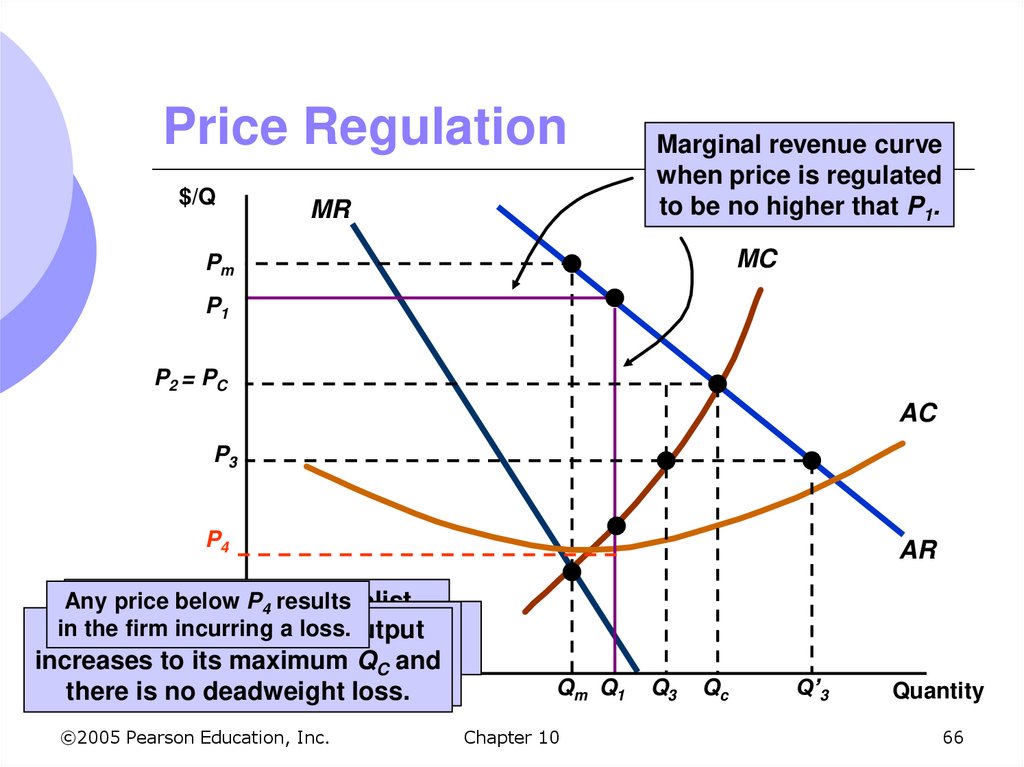
Government can regulate monopolypower through price regulation
Recall that in competitive markets, price
regulation creates a deadweight loss
Price regulation can eliminate deadweight
loss with a monopoly
The effect of the regulation can be shown
graphically
©2005 Pearson Education, Inc.
Chapter 10
65
66. Price Regulation
$/QMR
Marginal revenue curve
when price is regulated
to be no higher that P1.
MC
Pm
P1
P2 = P C
AC
P3
P4
AR
AnyIfprice
below Pa4 monopolist
results
left alone,
Ifthe
price
lowered
to
For
output
levels
above
QP1 , .
firm
incurring
a loss.
3 output
Ifinprice
is is
lowered
to
PCPoutput
produces
Q
m and charges
m
decreases
andmaximum
aaverage
shortage
exists.
the original
and
increases
to its
Q
C and
marginal
revenue
curves
apply.
there
is no
deadweight
loss.
©2005 Pearson Education, Inc.
Qm Q1
Chapter 10
Q3
Qc
Q’3
Quantity
66
67. The Social Costs of Monopoly Power
Natural MonopolyA firm that can produce the entire output of
an industry at a cost lower than what it would
be if there were several firms
Usually arises when there are large
economies of scale
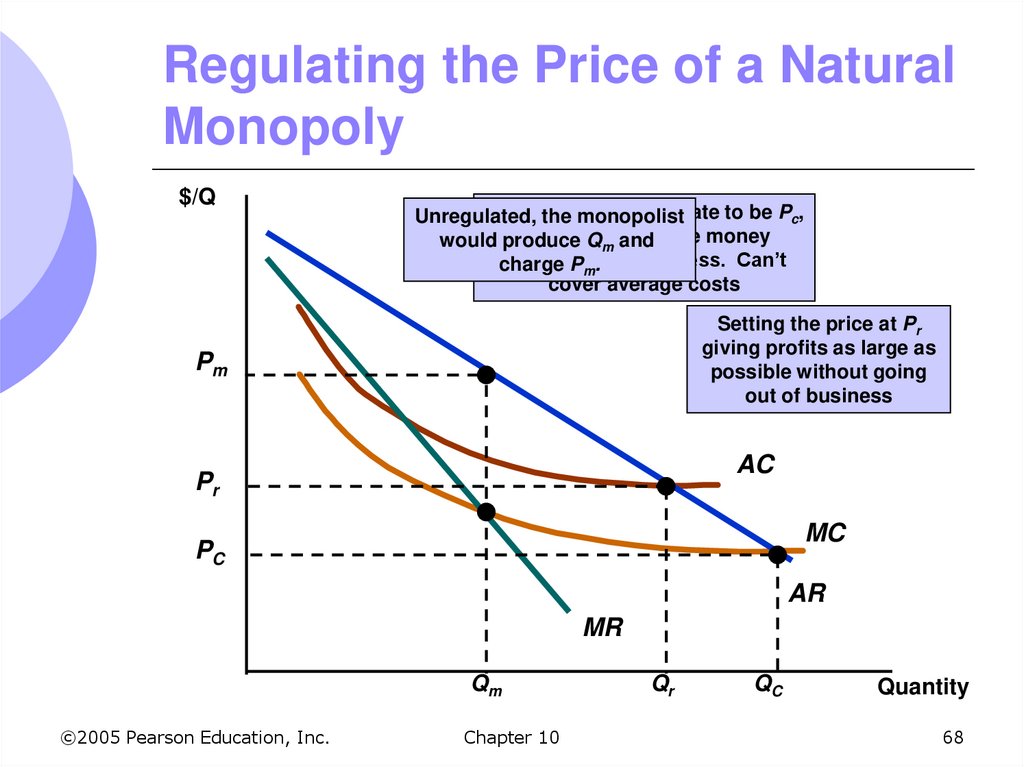
We can show that splitting the market into
two firms results in higher AC for each firm
than when only one firm was producing
©2005 Pearson Education, Inc.
Chapter 10
67
68. Regulating the Price of a Natural Monopoly
$/QIf the price
were regulate to be Pc,
Unregulated,
the monopolist
the firmQwould
lose money
would produce
m and
and go P
out
of business. Can’t
charge
m.
cover average costs
Setting the price at Pr
giving profits as large as
possible without going
out of business
Pm
AC
Pr
MC
PC
AR
MR
Qm
©2005 Pearson Education, Inc.
Chapter 10
Qr
QC
Quantity
68
69. The Social Costs of Monopoly Power
Regulation in PracticeIt is very difficult to estimate the firm's cost
and demand functions because they change
with evolving market conditions
An alternative pricing technique – rate-ofreturn regulation allows the firms to set a
maximum price based on the expected rate
or return that the firm will earn
©2005 Pearson Education, Inc.
Chapter 10
69
70. Regulation in Practice
There are problems, however, with rateof return regulation
1. Firm’s capital stock is difficult to value
2. “Fair” rate of return is based on actual cost
of capital, that cost is based on regulatory
behavior (and investor’s perception of
allowed rates in the future)
©2005 Pearson Education, Inc.
Chapter 10
70
71. Regulation in Practice
Rate of return regulation leads to lags inregulatory response to changes in cost
and other market conditions
Leads to long and expensive regulatory
hearings
The hearing process creates a regulatory
lag that may benefit producers (1950s &
‘60s) or consumers (1970s & ‘80s)
©2005 Pearson Education, Inc.
Chapter 10
71
72. Regulation in Practice
Government may also set price capsbased on firm’s variable costs, past
prices, and possibly inflation and
productivity growth
A firm is typically allowed to raise its price
each year without approval from
regulatory agency by amount equal to
inflation minus expected productivity
growth
©2005 Pearson Education, Inc.
Chapter 10
72
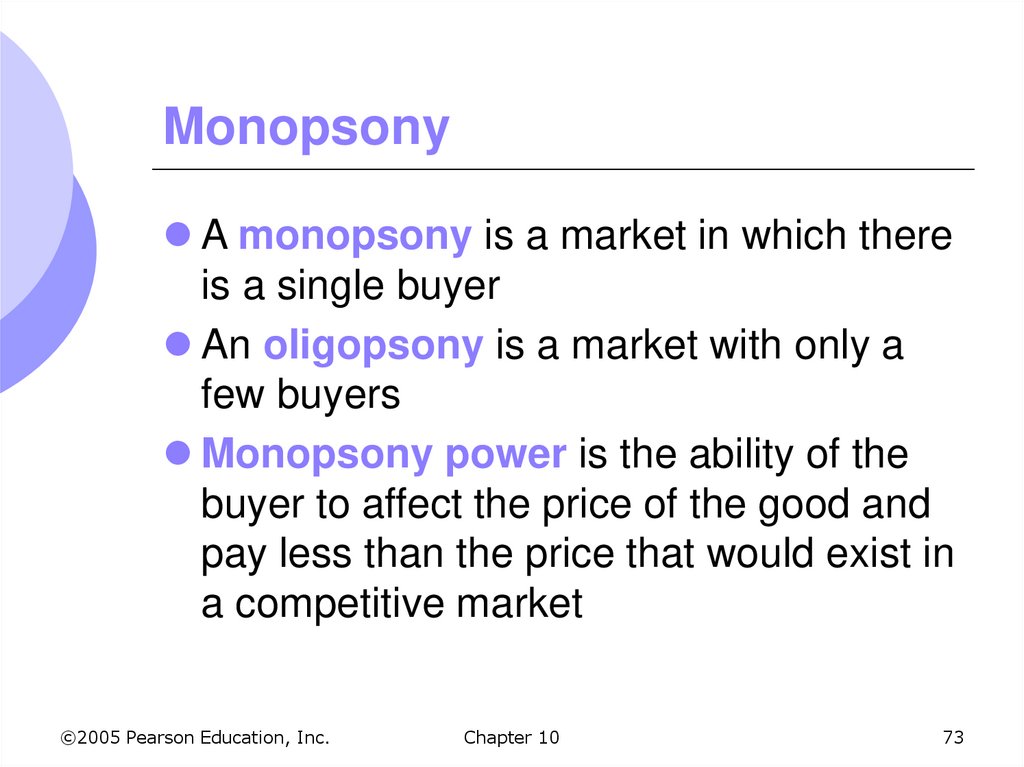
73. Monopsony
A monopsony is a market in which thereis a single buyer
An oligopsony is a market with only a
few buyers
Monopsony power is the ability of the
buyer to affect the price of the good and
pay less than the price that would exist in
a competitive market
©2005 Pearson Education, Inc.
Chapter 10
73
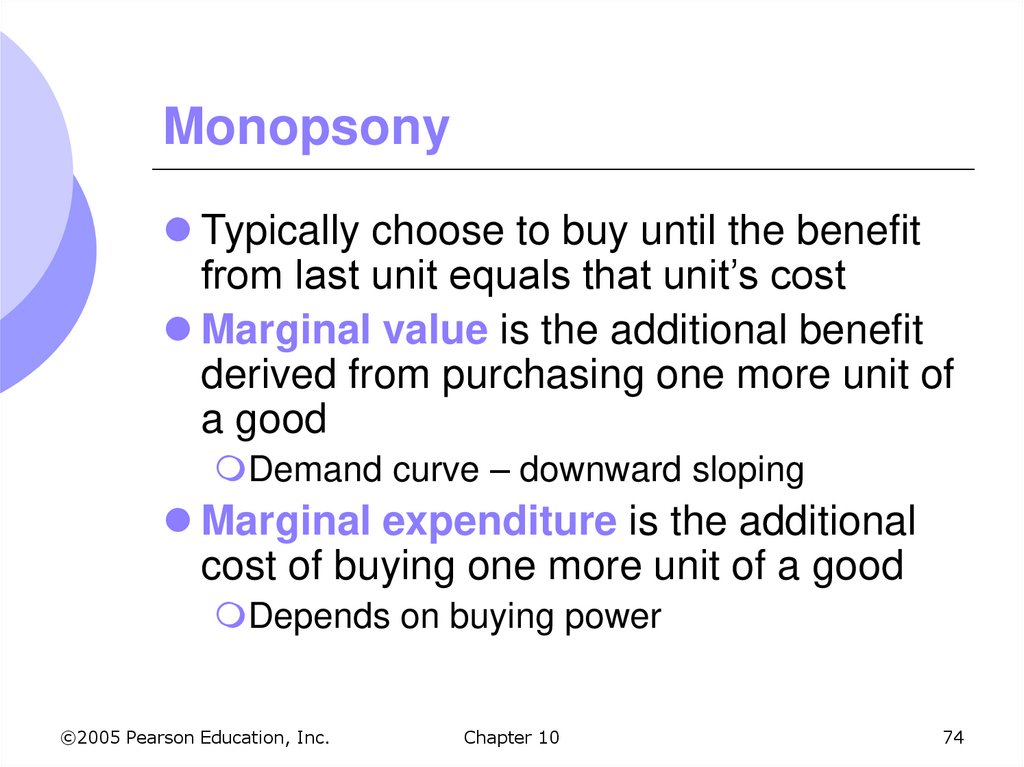
74. Monopsony
Typically choose to buy until the benefitfrom last unit equals that unit’s cost
Marginal value is the additional benefit
derived from purchasing one more unit of
a good
Demand curve – downward sloping
Marginal expenditure is the additional
cost of buying one more unit of a good
Depends on buying power
©2005 Pearson Education, Inc.
Chapter 10
74
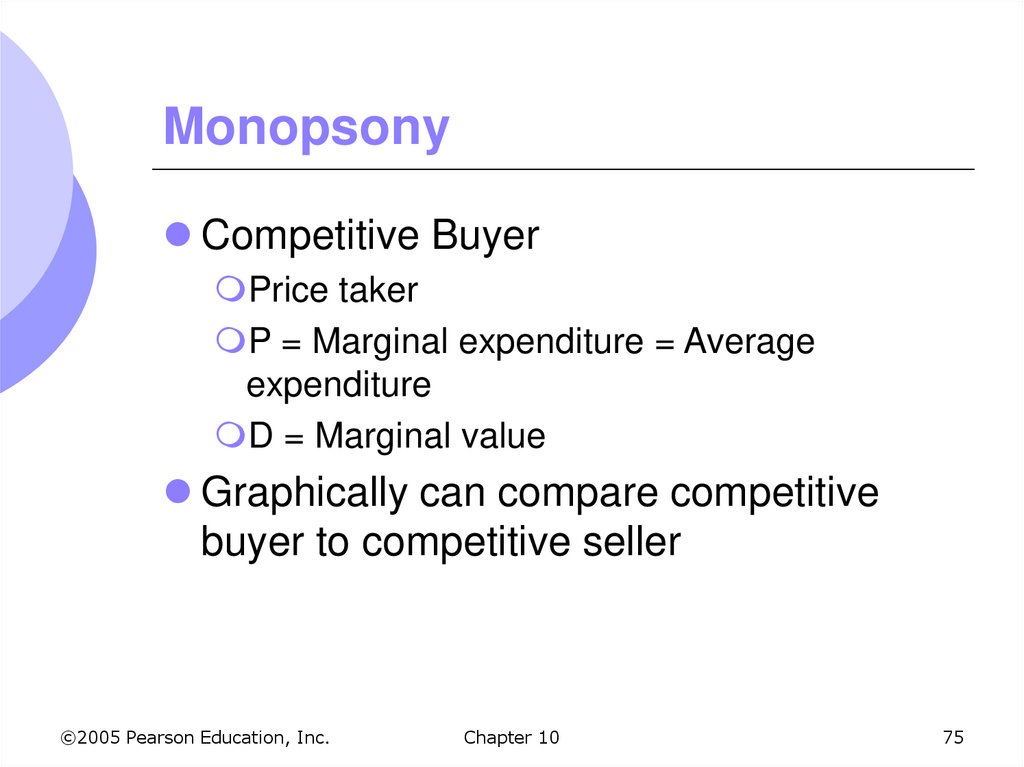
75. Monopsony
Competitive BuyerPrice taker
P = Marginal expenditure = Average
expenditure
D = Marginal value
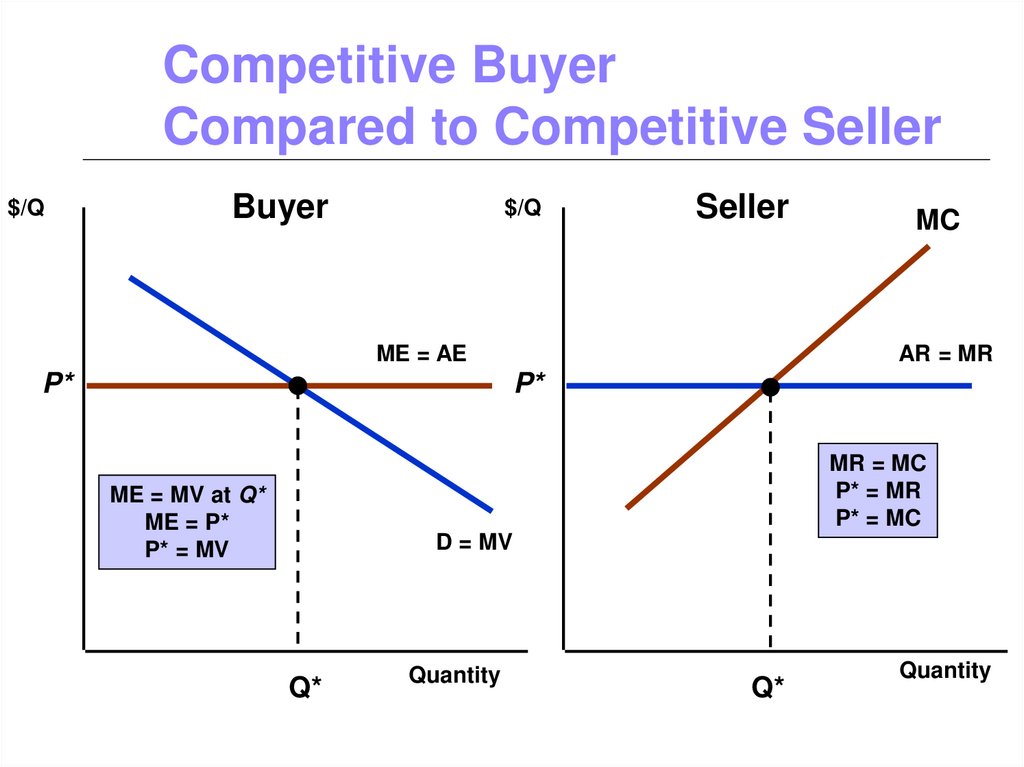
Graphically can compare competitive
buyer to competitive seller
©2005 Pearson Education, Inc.
Chapter 10
75
76. Competitive Buyer Compared to Competitive Seller
$/QBuyer
$/Q
Seller
ME = AE
P*
MC
AR = MR
P*
MR = MC
P* = MR
P* = MC
ME = MV at Q*
ME = P*
P* = MV
D = MV
Q*
Quantity
Q*
Quantity
77. Monopsonist Buyer
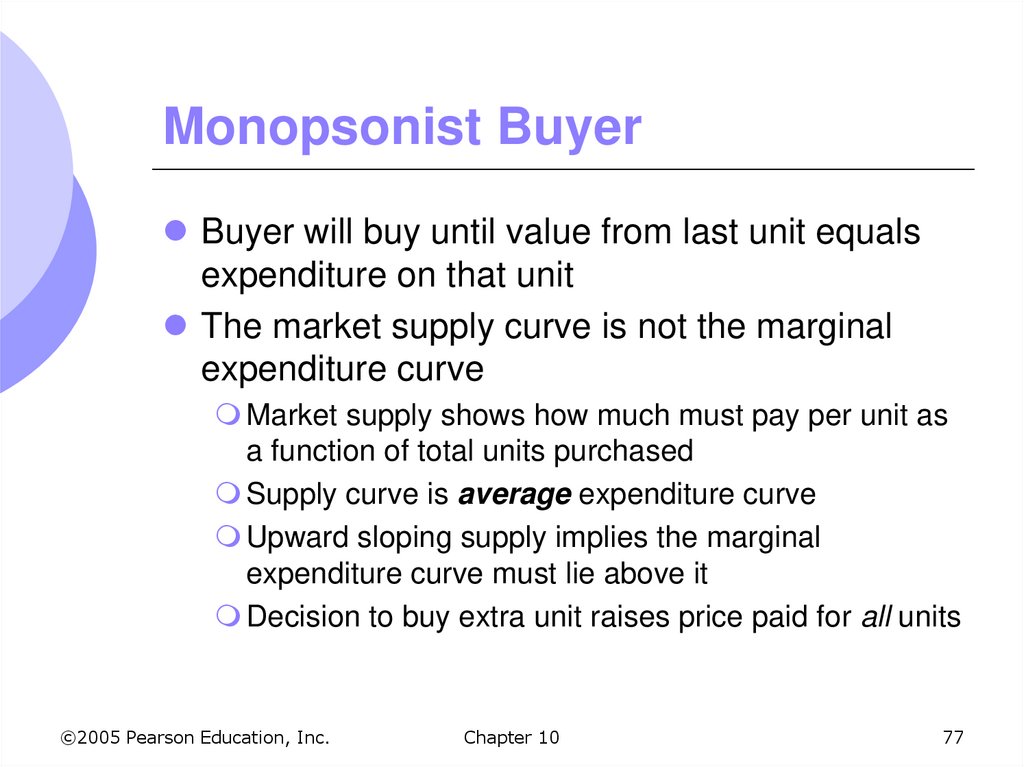
Buyer will buy until value from last unit equalsexpenditure on that unit
The market supply curve is not the marginal
expenditure curve
Market supply shows how much must pay per unit as
a function of total units purchased
Supply curve is average expenditure curve
Upward sloping supply implies the marginal
expenditure curve must lie above it
Decision to buy extra unit raises price paid for all units
©2005 Pearson Education, Inc.
Chapter 10
77
78. Monopsonist Buyer
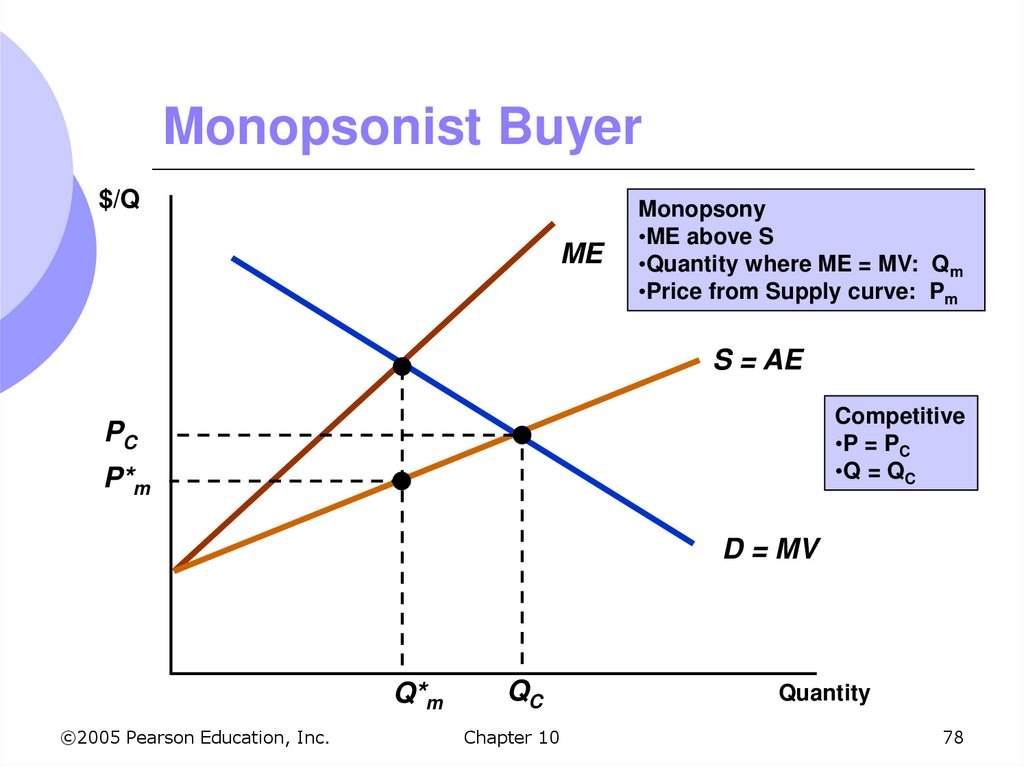
$/QME
Monopsony
•ME above S
•Quantity where ME = MV: Qm
•Price from Supply curve: Pm
S = AE
Competitive
•P = PC
•Q = QC
PC
P*m
D = MV
Q*m
©2005 Pearson Education, Inc.
QC
Chapter 10
Quantity
78
79. Monopoly and Monopsony
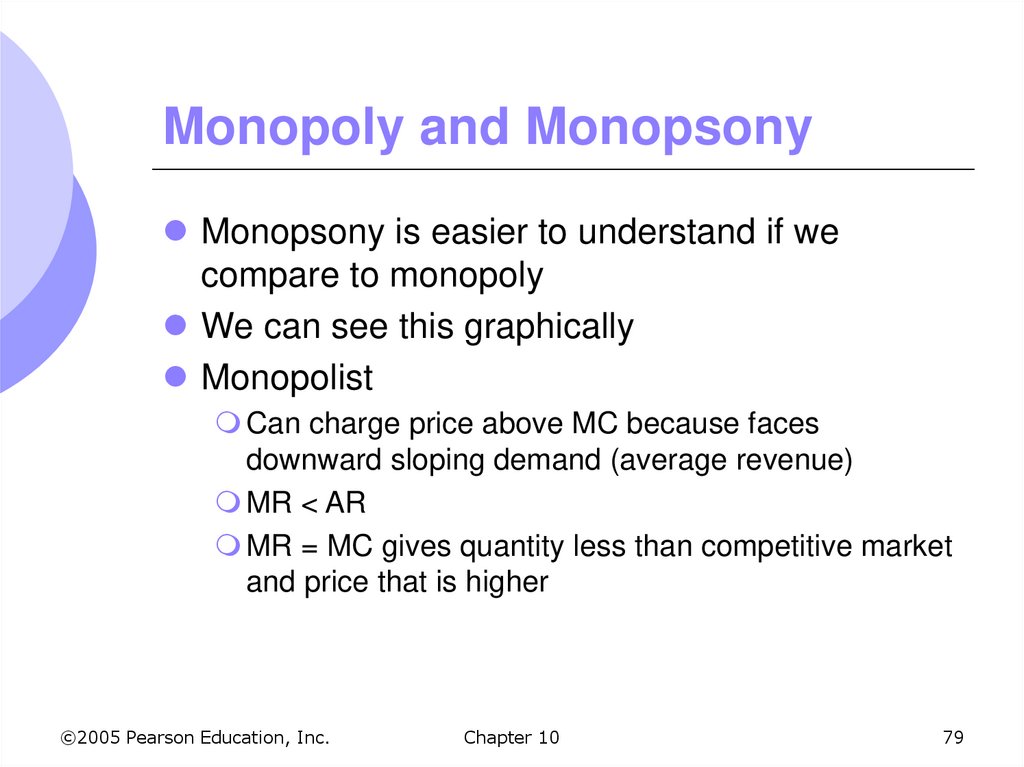
Monopsony is easier to understand if wecompare to monopoly
We can see this graphically
Monopolist
Can charge price above MC because faces
downward sloping demand (average revenue)
MR < AR
MR = MC gives quantity less than competitive market
and price that is higher
©2005 Pearson Education, Inc.
Chapter 10
79
80. Monopoly and Monopsony
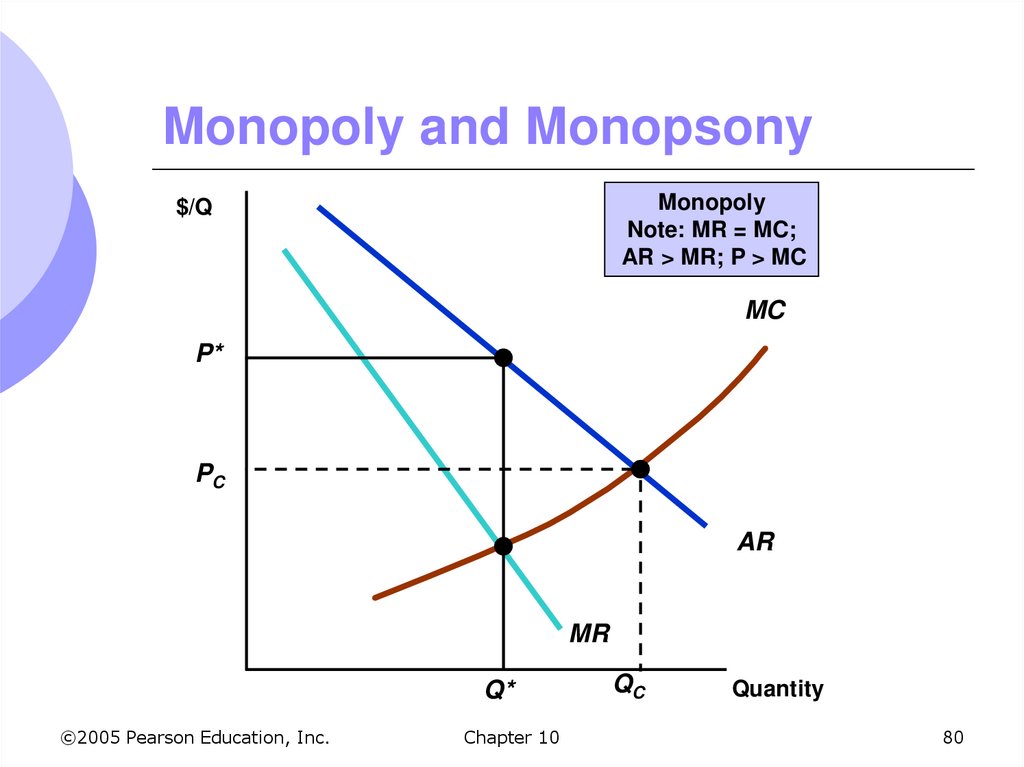
MonopolyNote: MR = MC;
AR > MR; P > MC
$/Q
MC
P*
PC
AR
MR
Q*
©2005 Pearson Education, Inc.
Chapter 10
QC
Quantity
80
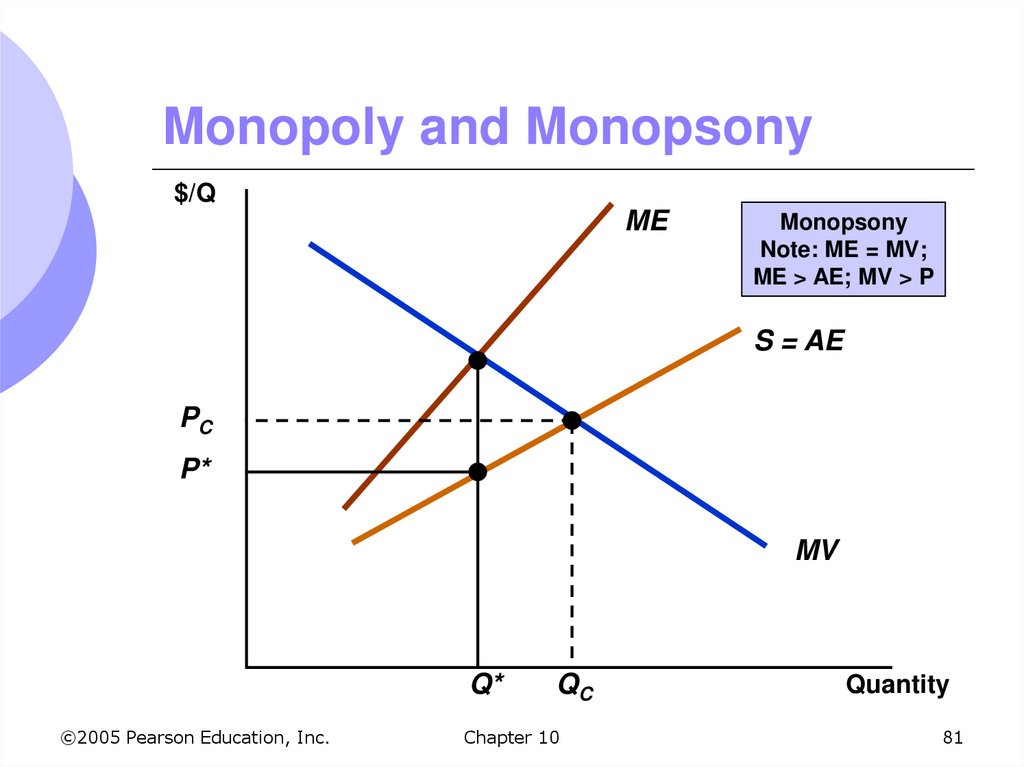
81. Monopoly and Monopsony
$/QME
Monopsony
Note: ME = MV;
ME > AE; MV > P
S = AE
PC
P*
MV
Q*
©2005 Pearson Education, Inc.
QC
Chapter 10
Quantity
81
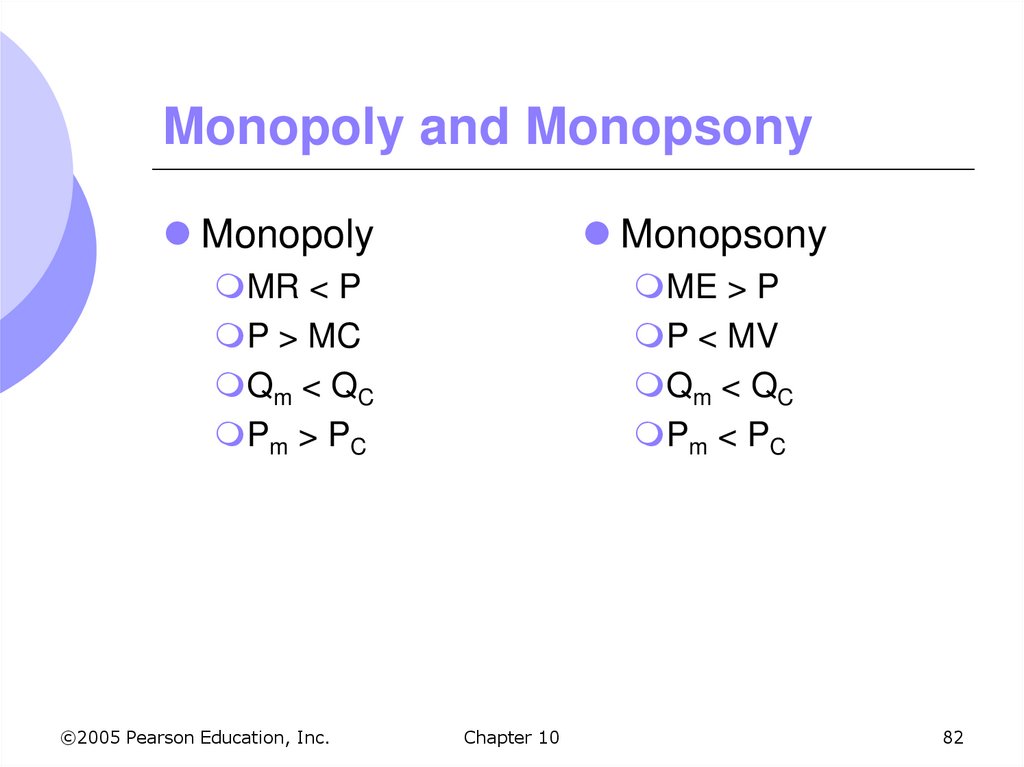
82. Monopoly and Monopsony
MonopolyMonopsony
MR < P
P > MC
Qm < QC
Pm > PC
©2005 Pearson Education, Inc.
ME > P
P < MV
Qm < QC
Pm < PC
Chapter 10
82
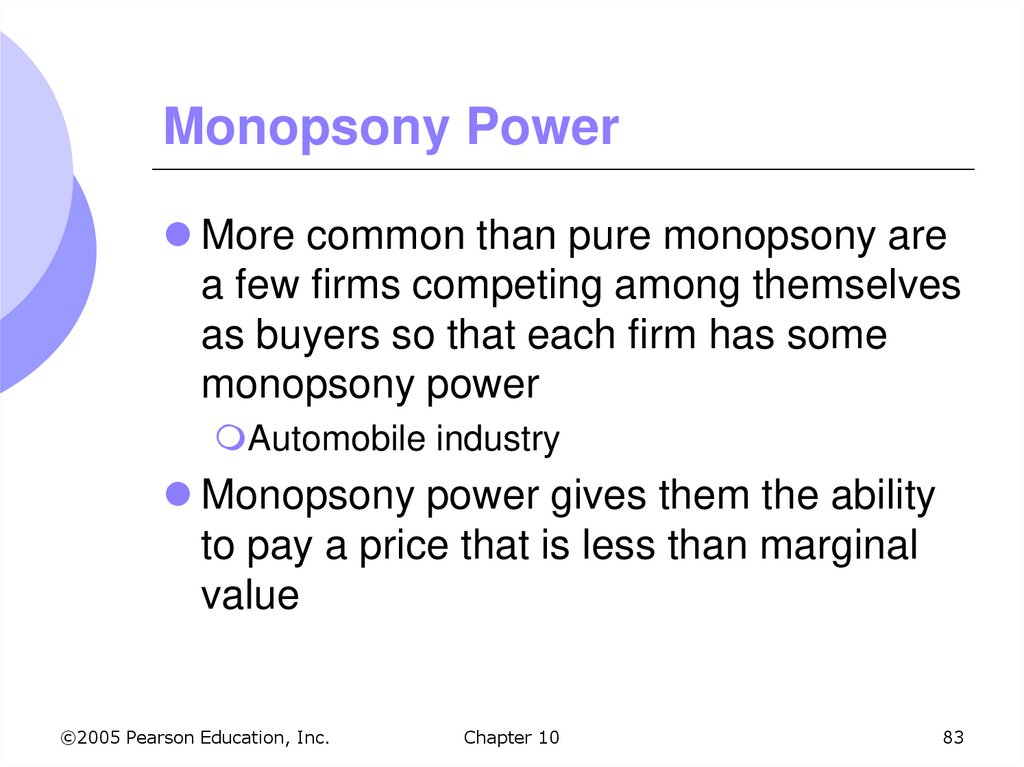
83. Monopsony Power
More common than pure monopsony area few firms competing among themselves
as buyers so that each firm has some
monopsony power
Automobile industry
Monopsony power gives them the ability
to pay a price that is less than marginal
value
©2005 Pearson Education, Inc.
Chapter 10
83
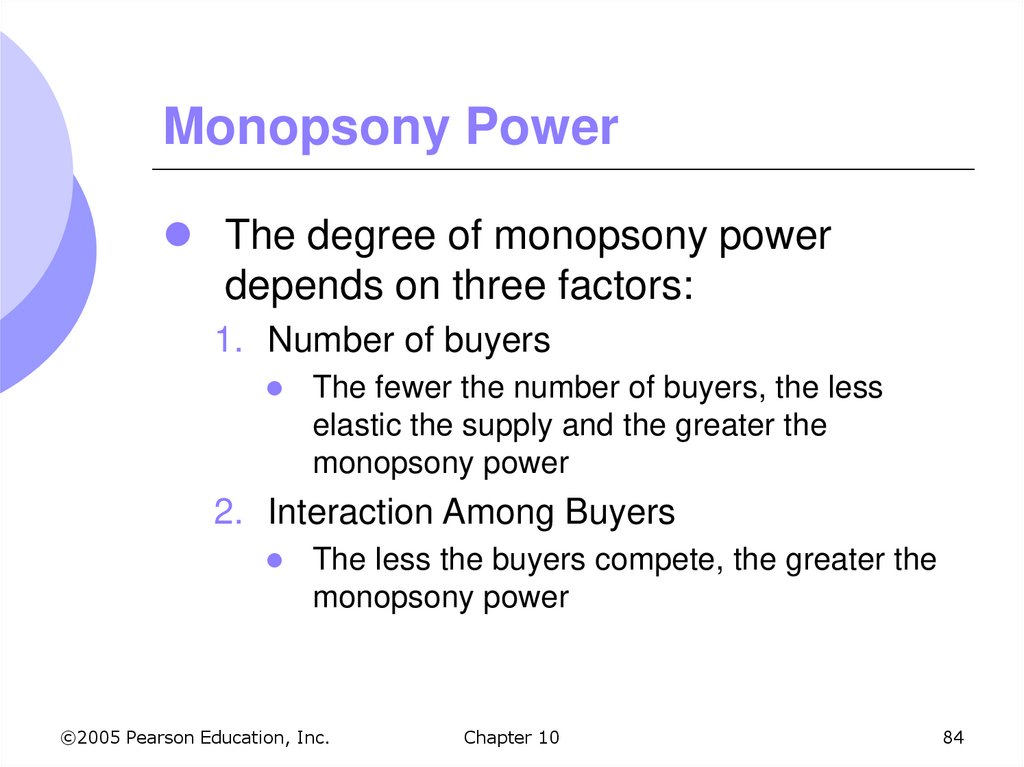
84. Monopsony Power
The degree of monopsony powerdepends on three factors:
1. Number of buyers
The fewer the number of buyers, the less
elastic the supply and the greater the
monopsony power
2. Interaction Among Buyers
The less the buyers compete, the greater the
monopsony power
©2005 Pearson Education, Inc.
Chapter 10
84
85. Monopsony Power
The degree of monopsony powerdepends on three factors (cont’d):
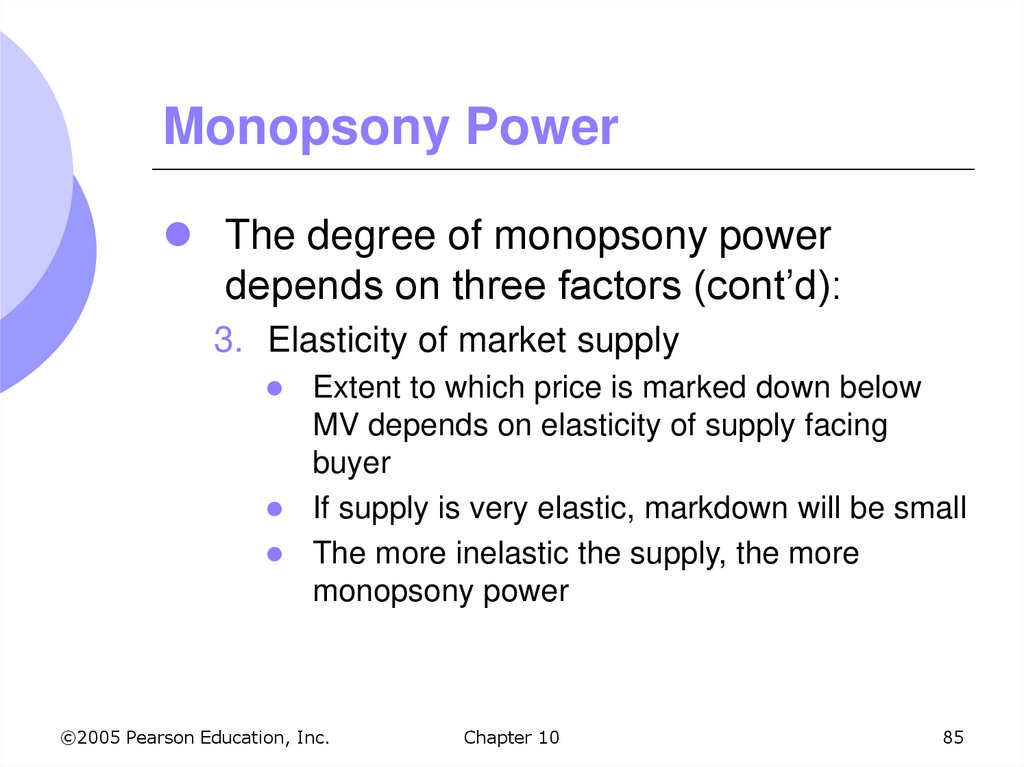
3. Elasticity of market supply
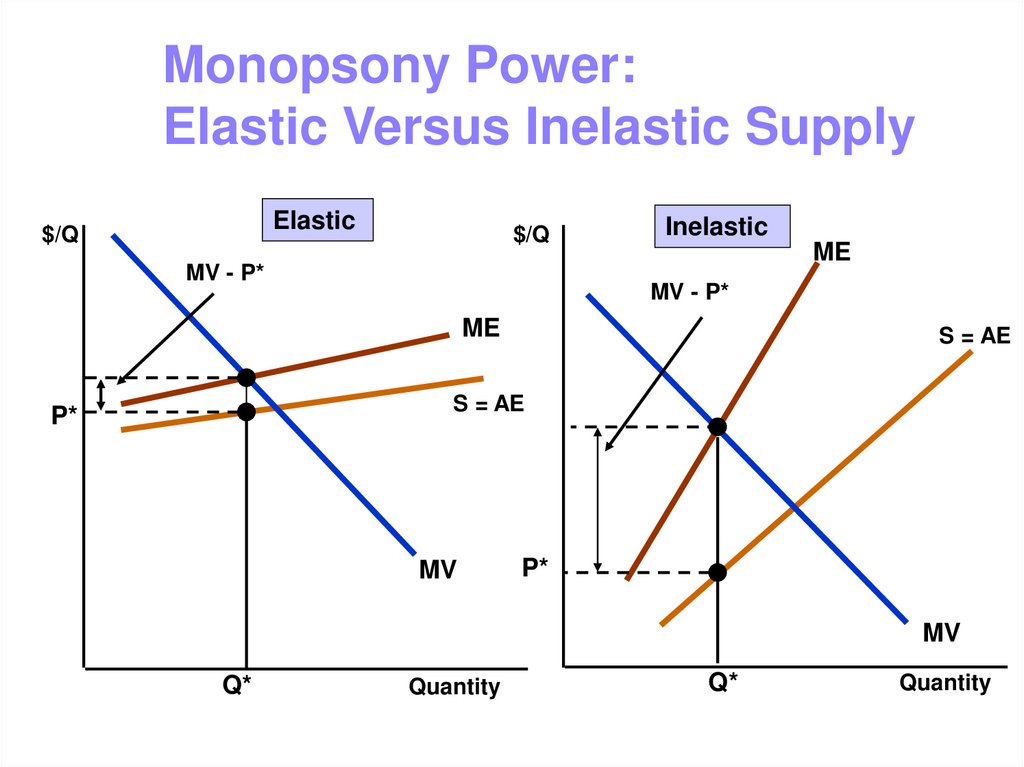
Extent to which price is marked down below
MV depends on elasticity of supply facing
buyer
If supply is very elastic, markdown will be small
The more inelastic the supply, the more
monopsony power
©2005 Pearson Education, Inc.
Chapter 10
85
86. Monopsony Power: Elastic Versus Inelastic Supply
Elastic$/Q
$/Q
MV - P*
Inelastic
ME
MV - P*
ME
S = AE
S = AE
P*
MV
P*
MV
Q*
Quantity
Q*
Quantity
87. Social Costs of Monopsony Power
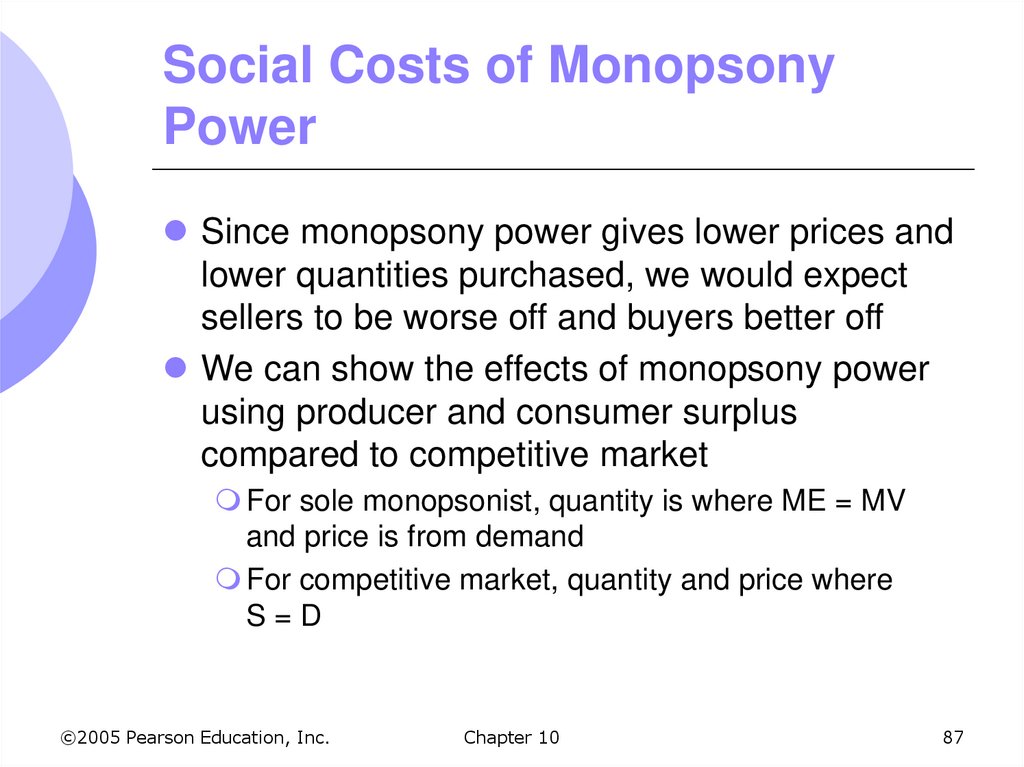
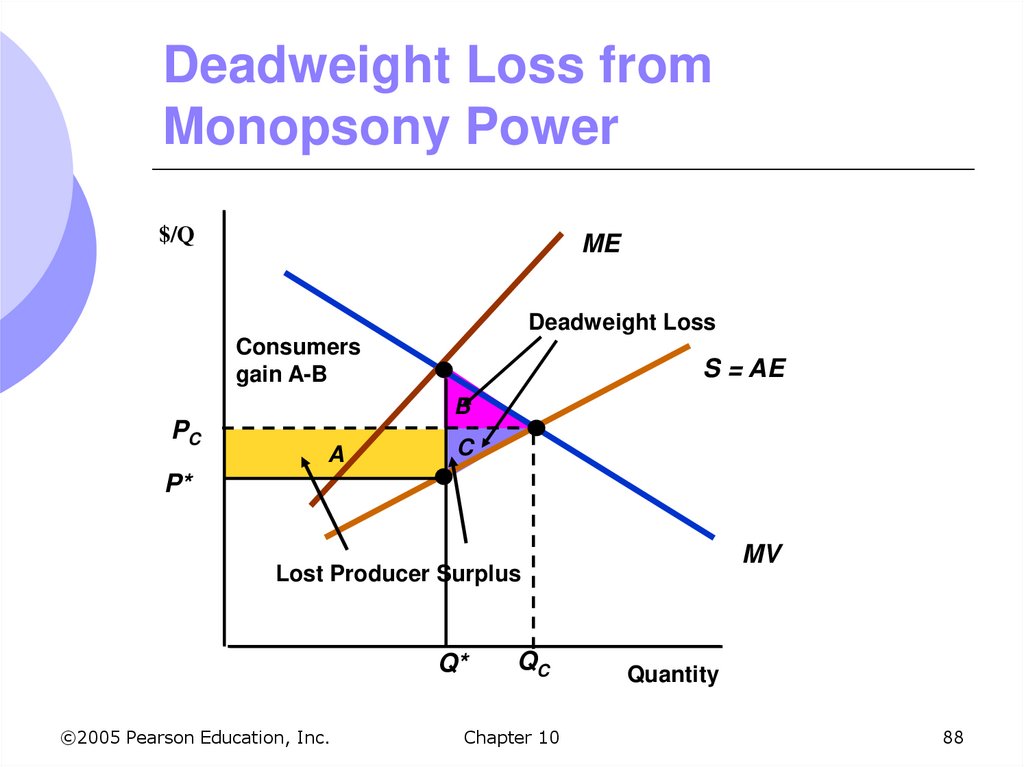
Since monopsony power gives lower prices andlower quantities purchased, we would expect
sellers to be worse off and buyers better off
We can show the effects of monopsony power
using producer and consumer surplus
compared to competitive market
For sole monopsonist, quantity is where ME = MV
and price is from demand
For competitive market, quantity and price where
S=D
©2005 Pearson Education, Inc.
Chapter 10
87
88. Deadweight Loss from Monopsony Power
$/QME
Deadweight Loss
Consumers
gain A-B
S = AE
B
PC
A
C
P*
MV
Lost Producer Surplus
Q*
©2005 Pearson Education, Inc.
QC
Chapter 10
Quantity
88
89. Monopsony Power
Bilateral MonopolyMarket where there is only one buyer and
one seller
Bilateral monopoly is rare, however, markets
with a small number of sellers with monopoly
power selling to a market with few buyers
with monopsony power is more common
Even with bargaining, in general, monopsony
and monopoly power will counteract each
other
©2005 Pearson Education, Inc.
Chapter 10
89
90. Limiting Market Power: The Antitrust Laws
Market power harms some players in themarket – buyer or seller
Market power reduces output, leading to
deadweight loss
Excessive market power could raise
problems of equity and fairness
©2005 Pearson Education, Inc.
Chapter 10
90
91. Limiting Market Power: The Antitrust Laws
What can we do to limit market powerand keep it from being used anticompetitively?
Tax away monopoly profits and redistribute
to consumers
Difficult to measure and find all those who lost
Direct price regulation of natural monopolies
Keep firms from acquiring excessive market
power
Antitrust laws
©2005 Pearson Education, Inc.
Chapter 10
91
92. The Antitrust Laws
Rules and regulations designed topromote a competitive economy by:
Prohibiting actions that restrain or are likely
to restrain competition
Restricting the forms of allowable market
structures
Monopoly power arises in a number of
ways, each of which is covered by the
antitrust laws
©2005 Pearson Education, Inc.
Chapter 10
92
93. Limiting Market Power: The Antitrust Laws
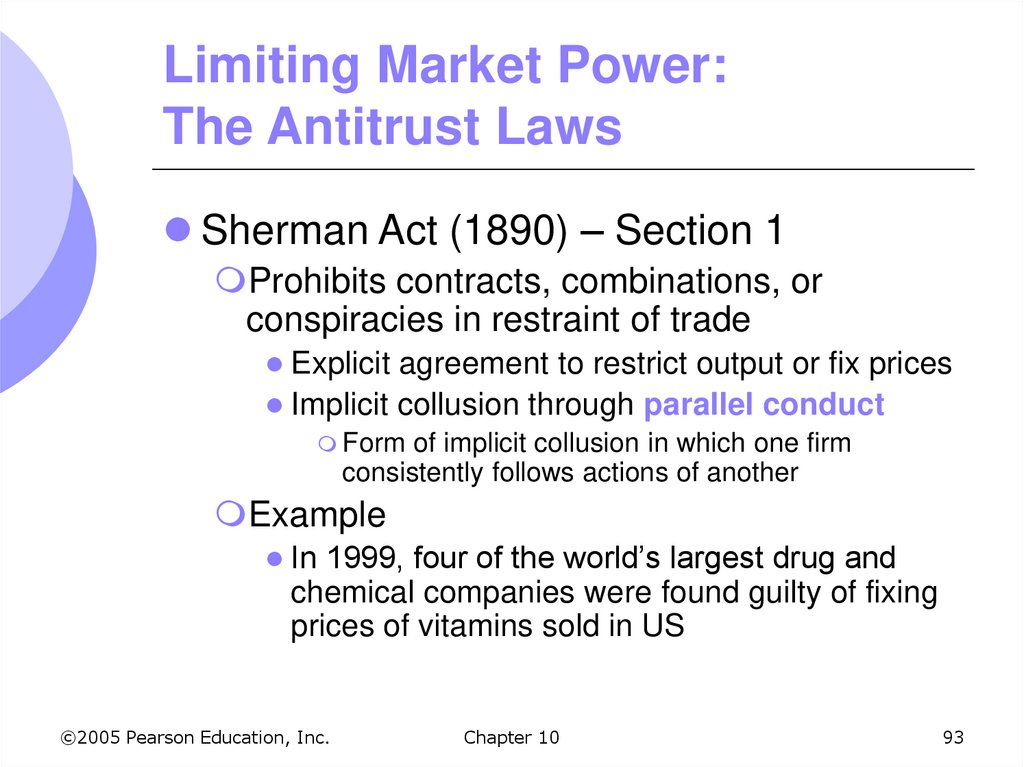
Sherman Act (1890) – Section 1Prohibits contracts, combinations, or
conspiracies in restraint of trade
Explicit agreement to restrict output or fix prices
Implicit collusion through parallel conduct
Form of implicit collusion in which one firm
consistently follows actions of another
Example
In 1999, four of the world’s largest drug and
chemical companies were found guilty of fixing
prices of vitamins sold in US
©2005 Pearson Education, Inc.
Chapter 10
93
94. Limiting Market Power: The Antitrust Laws
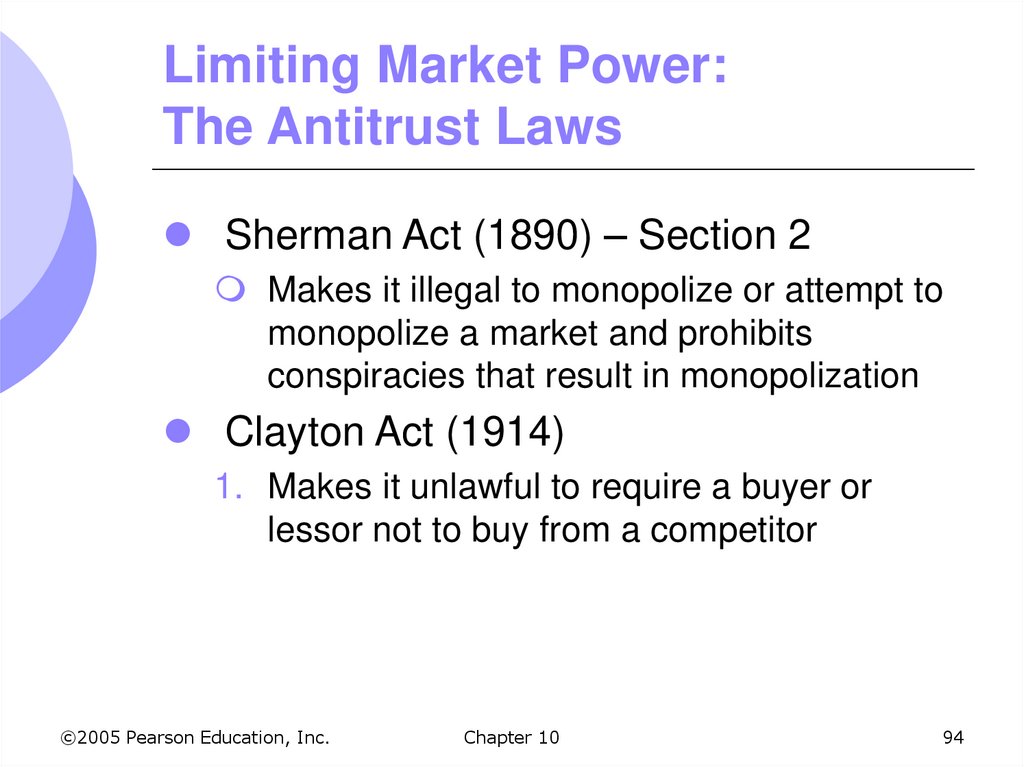
Sherman Act (1890) – Section 2Makes it illegal to monopolize or attempt to
monopolize a market and prohibits
conspiracies that result in monopolization
Clayton Act (1914)
1. Makes it unlawful to require a buyer or
lessor not to buy from a competitor
©2005 Pearson Education, Inc.
Chapter 10
94
95. Limiting Market Power: The Antitrust Laws
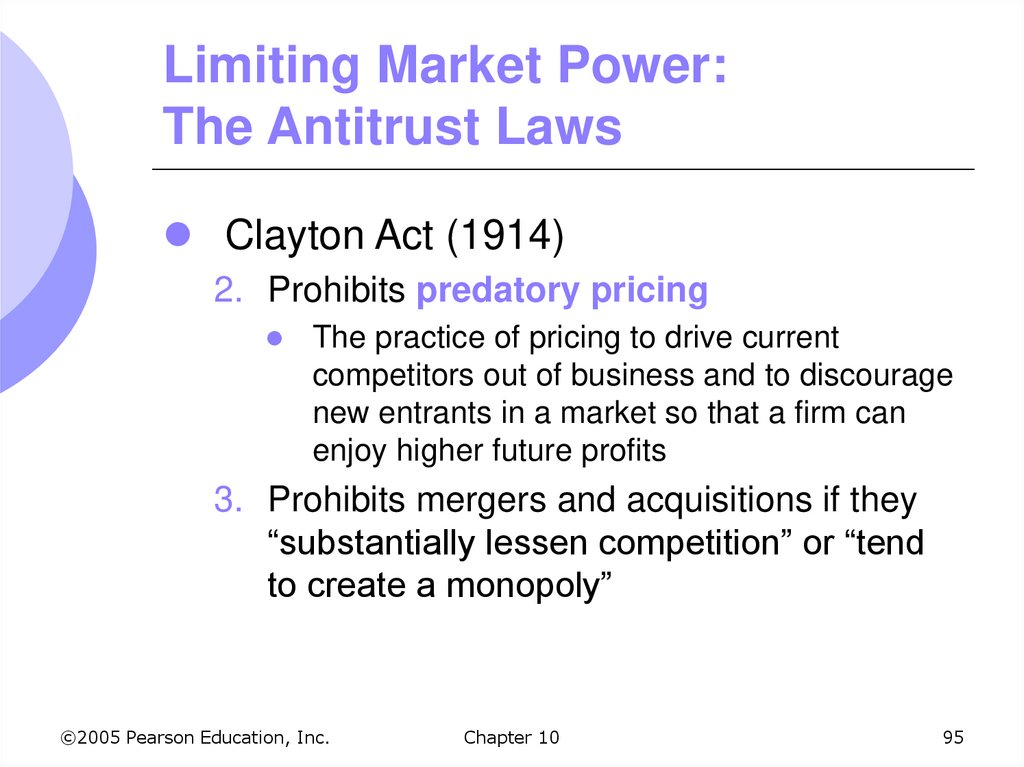
Clayton Act (1914)2. Prohibits predatory pricing
The practice of pricing to drive current
competitors out of business and to discourage
new entrants in a market so that a firm can
enjoy higher future profits
3. Prohibits mergers and acquisitions if they
“substantially lessen competition” or “tend
to create a monopoly”
©2005 Pearson Education, Inc.
Chapter 10
95
96. Limiting Market Power: The Antitrust Laws
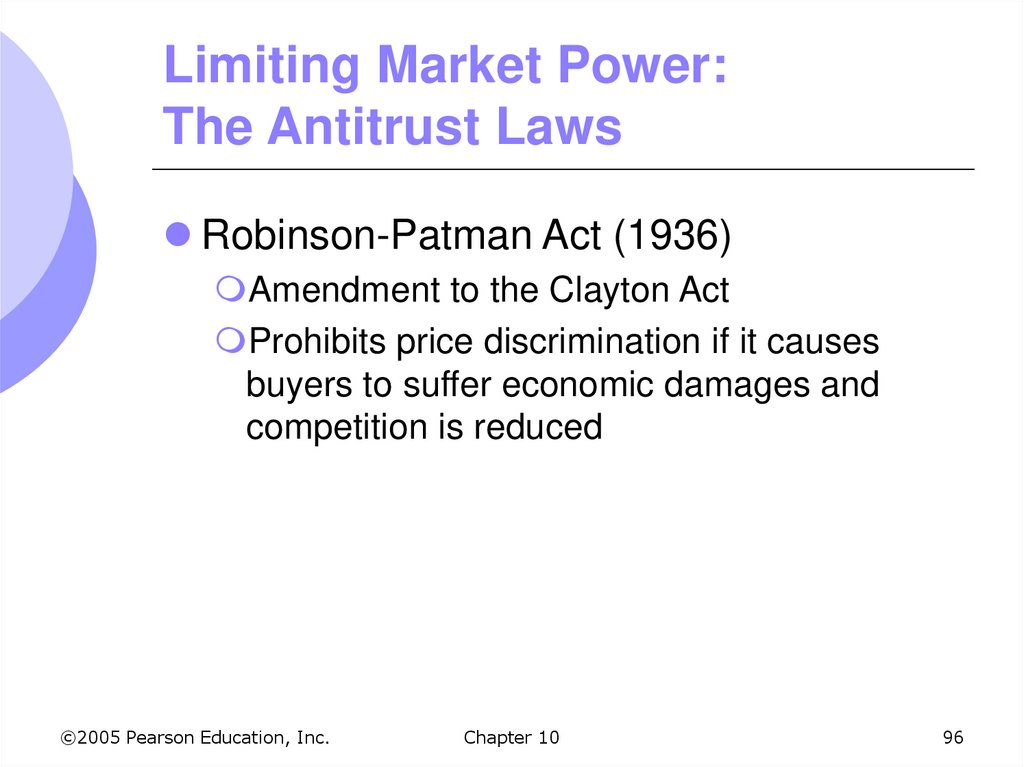
Robinson-Patman Act (1936)Amendment to the Clayton Act
Prohibits price discrimination if it causes
buyers to suffer economic damages and
competition is reduced
©2005 Pearson Education, Inc.
Chapter 10
96
97. Limiting Market Power: The Antitrust Laws
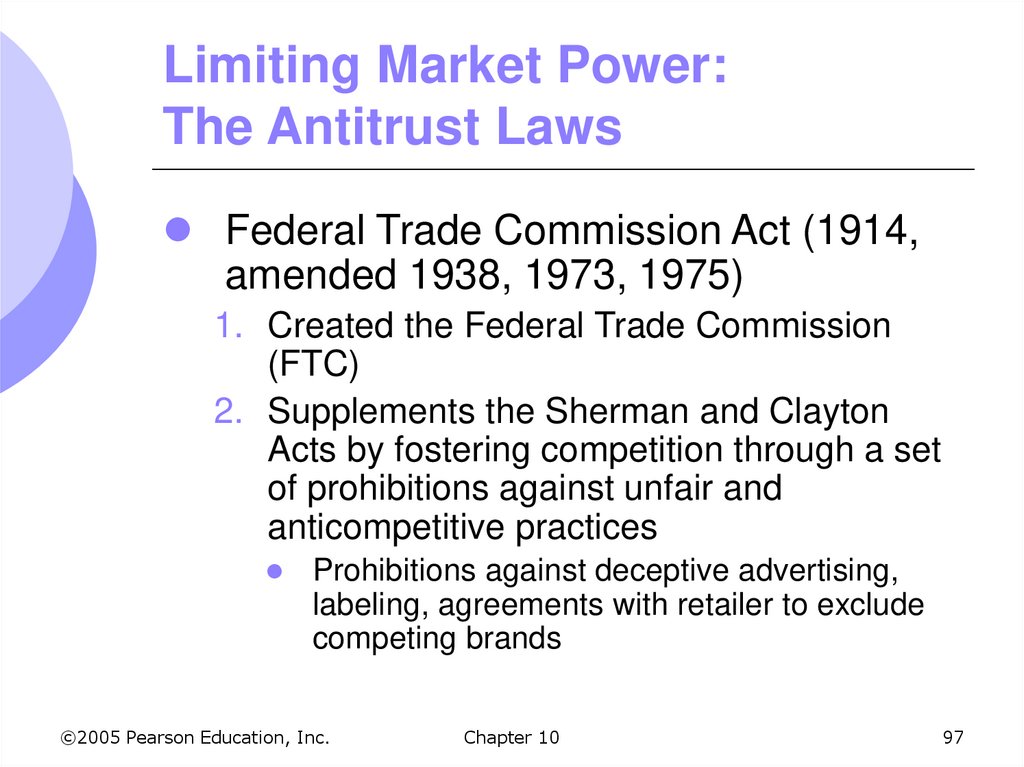
Federal Trade Commission Act (1914,amended 1938, 1973, 1975)
1. Created the Federal Trade Commission
(FTC)
2. Supplements the Sherman and Clayton
Acts by fostering competition through a set
of prohibitions against unfair and
anticompetitive practices
Prohibitions against deceptive advertising,
labeling, agreements with retailer to exclude
competing brands
©2005 Pearson Education, Inc.
Chapter 10
97
98. Enforcement of Antitrust Laws
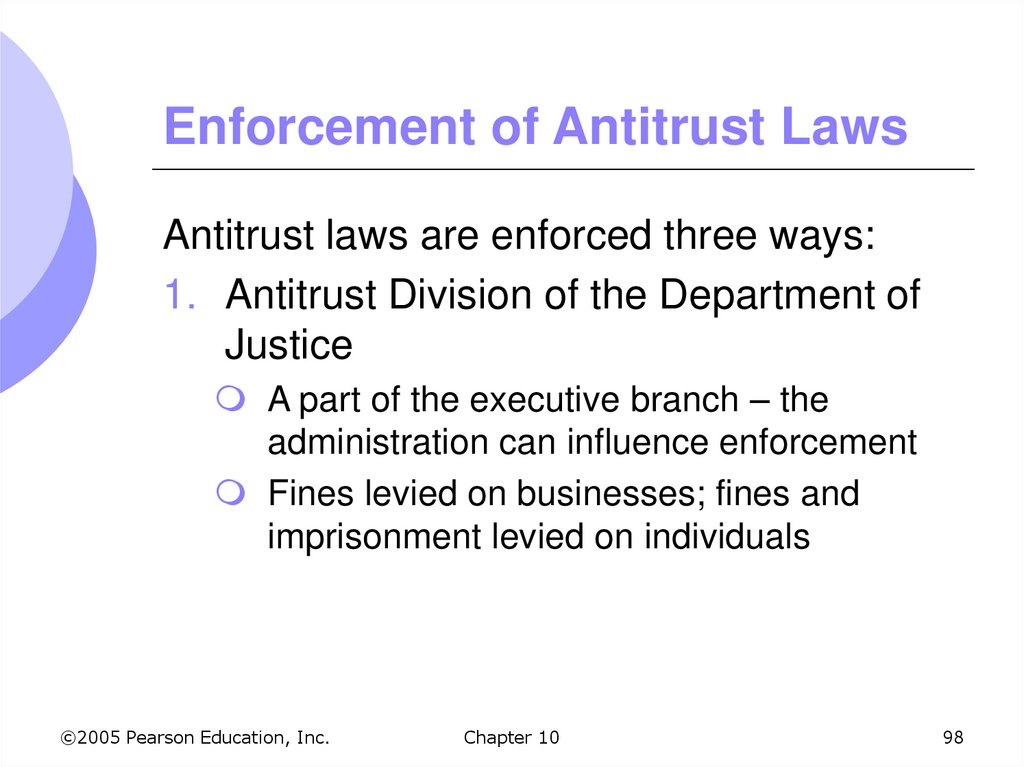
Antitrust laws are enforced three ways:1. Antitrust Division of the Department of
Justice
A part of the executive branch – the
administration can influence enforcement
Fines levied on businesses; fines and
imprisonment levied on individuals
©2005 Pearson Education, Inc.
Chapter 10
98
99. Enforcement of Antitrust Laws
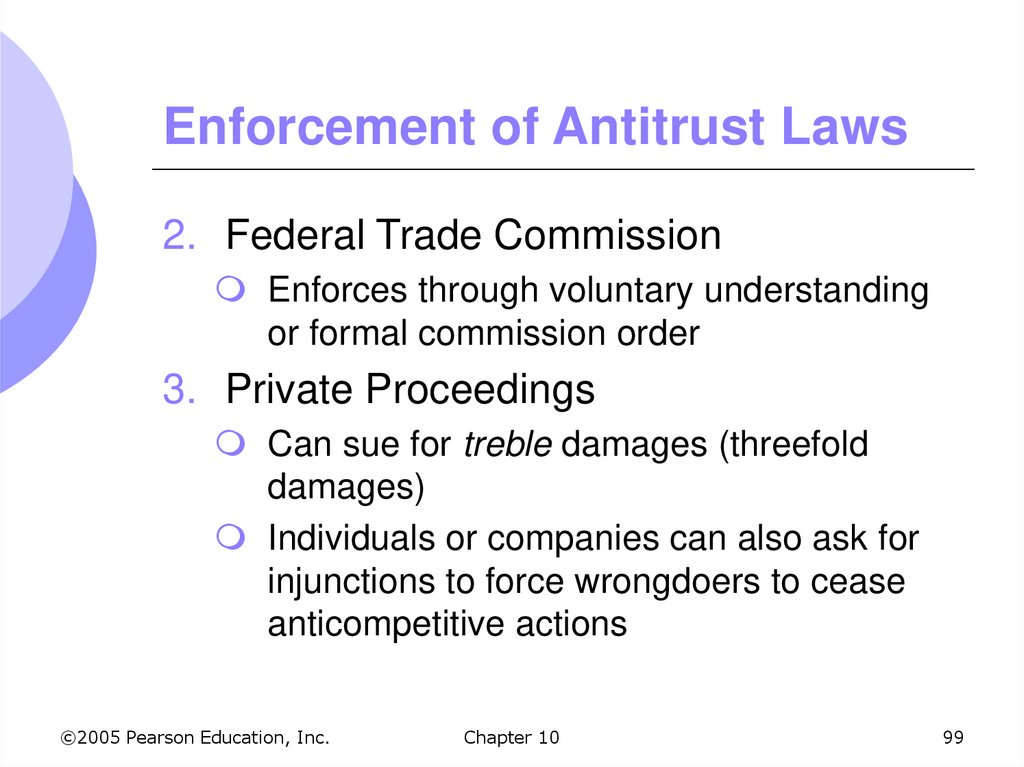
2. Federal Trade CommissionEnforces through voluntary understanding
or formal commission order
3. Private Proceedings
Can sue for treble damages (threefold
damages)
Individuals or companies can also ask for
injunctions to force wrongdoers to cease
anticompetitive actions
©2005 Pearson Education, Inc.
Chapter 10
99
100. Enforcement of Antitrust Laws
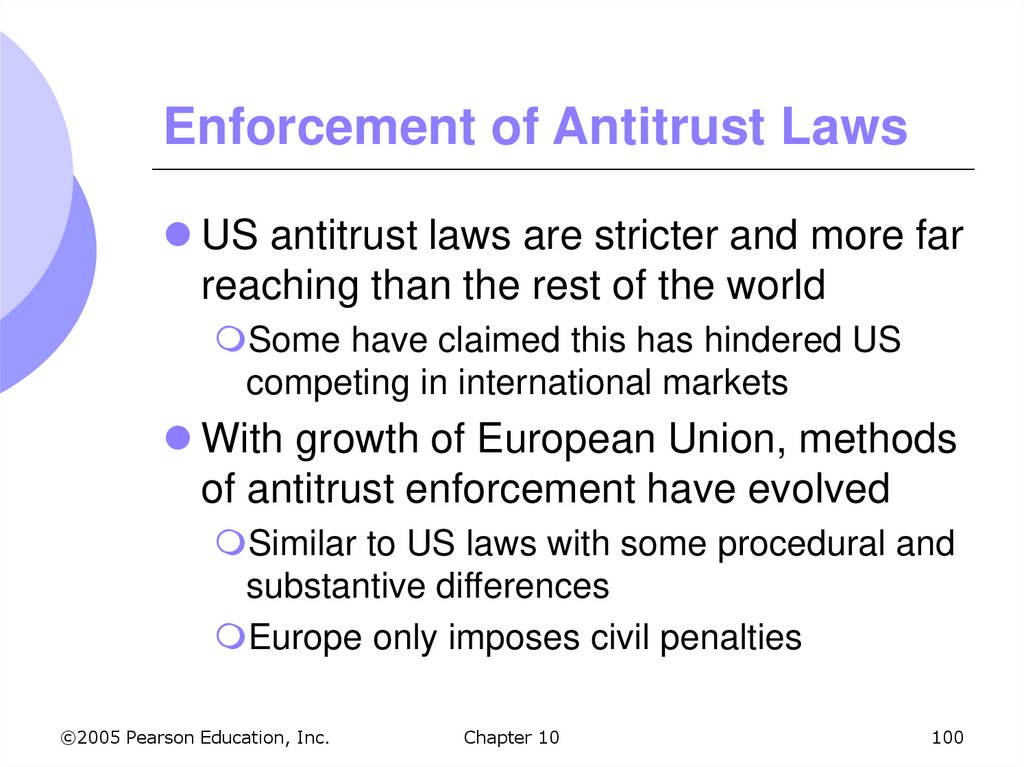
US antitrust laws are stricter and more farreaching than the rest of the world
Some have claimed this has hindered US
competing in international markets
With growth of European Union, methods
of antitrust enforcement have evolved
Similar to US laws with some procedural and
substantive differences
Europe only imposes civil penalties
©2005 Pearson Education, Inc.
Chapter 10
100
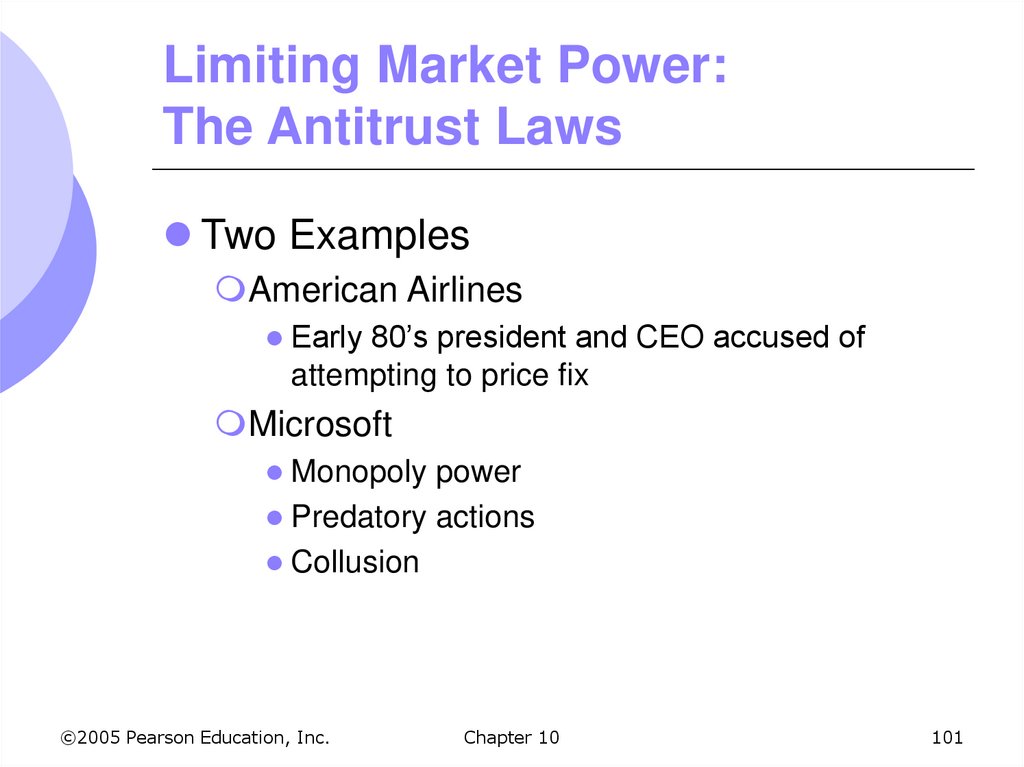
101. Limiting Market Power: The Antitrust Laws
Two ExamplesAmerican Airlines
Early 80’s president and CEO accused of
attempting to price fix
Microsoft
Monopoly power
Predatory actions
Collusion
©2005 Pearson Education, Inc.
Chapter 10
101