


 Информатика
Похожие презентации:







Instruction Set of 8086
1.
Chapter 031
2.
Instruction Set of 8086An instruction is a binary pattern designed
inside a microprocessor to perform a specific
function.
The entire group of instructions that a
microprocessor supports is called
Instruction Set.
8086 has more than 20,000 instructions.
2
3.
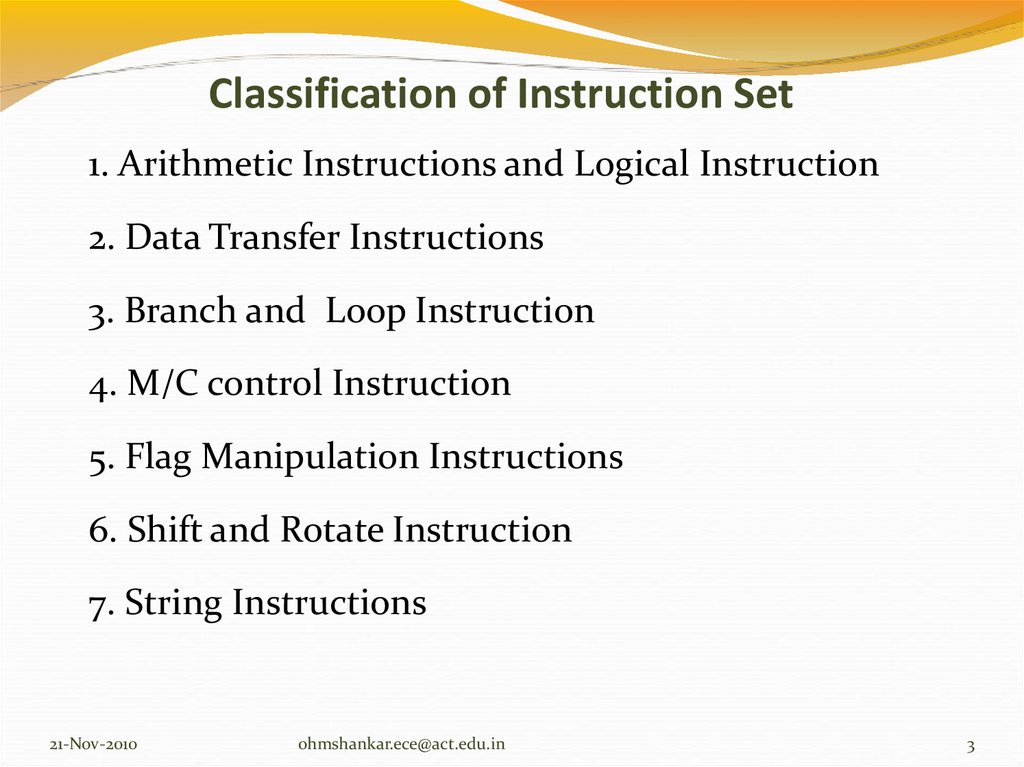
Classification of Instruction Set1. Arithmetic Instructions and Logical Instruction
2. Data Transfer Instructions
3. Branch and Loop Instruction
4. M/C control Instruction
5. Flag Manipulation Instructions
6. Shift and Rotate Instruction
7. String Instructions
21-Nov-2010
ohmshankar.ece@act.edu.in
3
4.
1. Arithmetic And LogicalInstructions
5.
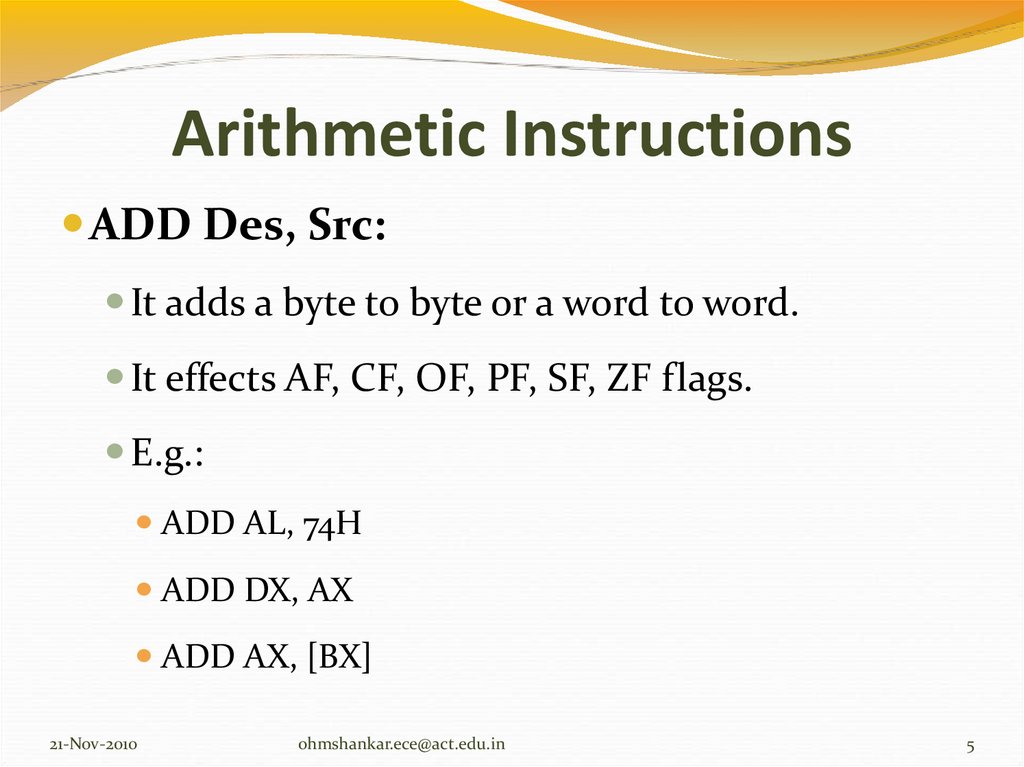
Arithmetic InstructionsADD Des, Src:
It adds a byte to byte or a word to word.
It effects AF, CF, OF, PF, SF, ZF flags.
E.g.:
ADD AL, 74H
ADD DX, AX
ADD AX, [BX]
21-Nov-2010
ohmshankar.ece@act.edu.in
5
6.
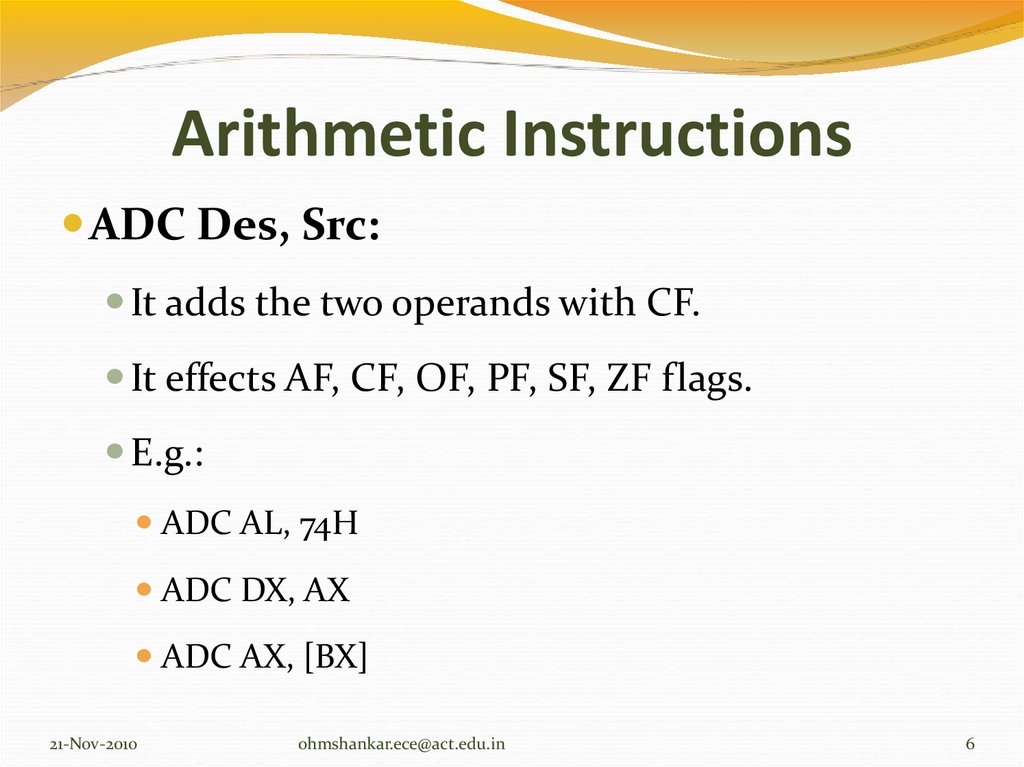
Arithmetic InstructionsADC Des, Src:
It adds the two operands with CF.
It effects AF, CF, OF, PF, SF, ZF flags.
E.g.:
ADC AL, 74H
ADC DX, AX
ADC AX, [BX]
21-Nov-2010
ohmshankar.ece@act.edu.in
6
7.
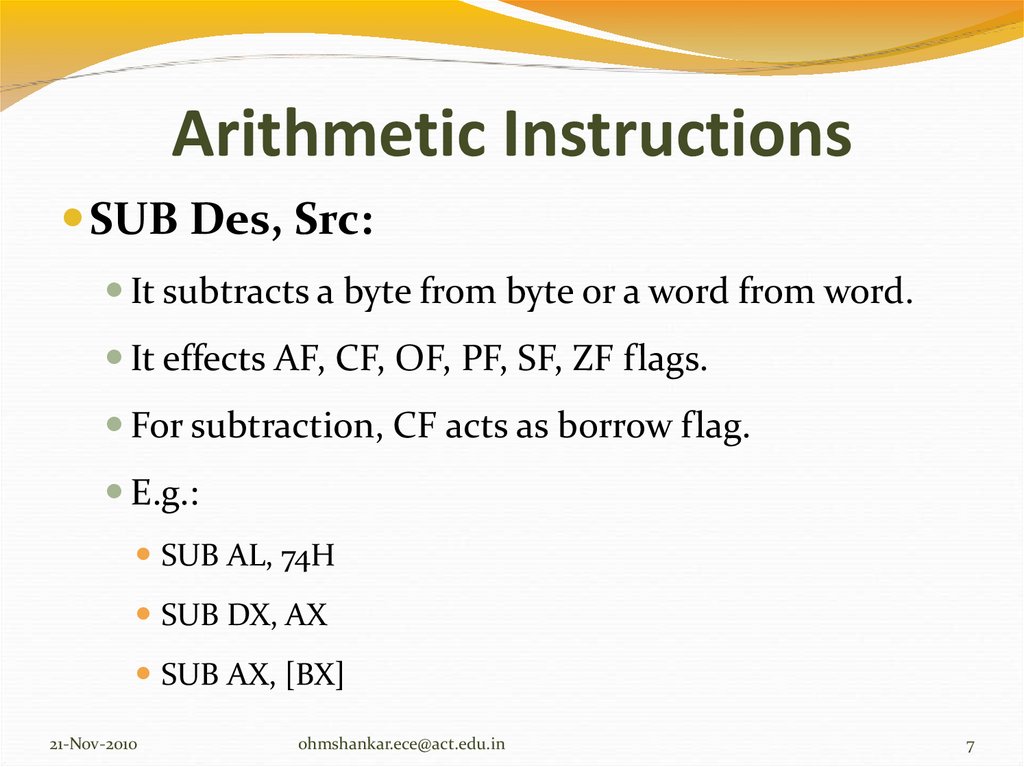
Arithmetic InstructionsSUB Des, Src:
It subtracts a byte from byte or a word from word.
It effects AF, CF, OF, PF, SF, ZF flags.
For subtraction, CF acts as borrow flag.
E.g.:
SUB AL, 74H
SUB DX, AX
SUB AX, [BX]
21-Nov-2010
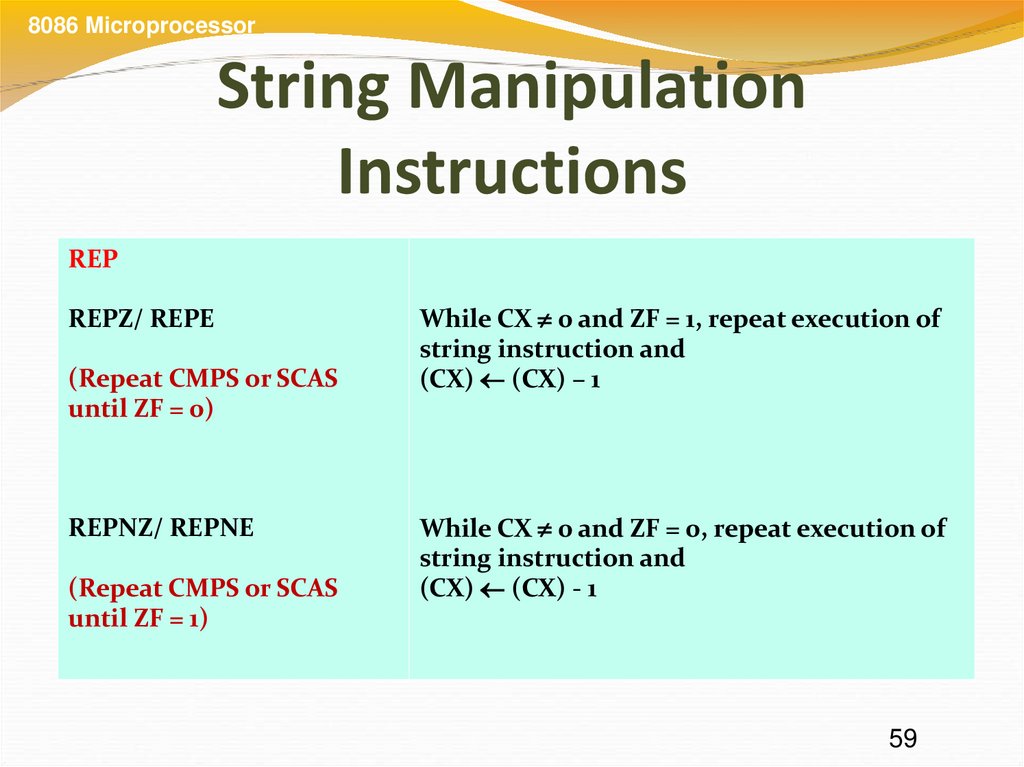
ohmshankar.ece@act.edu.in
7
8.
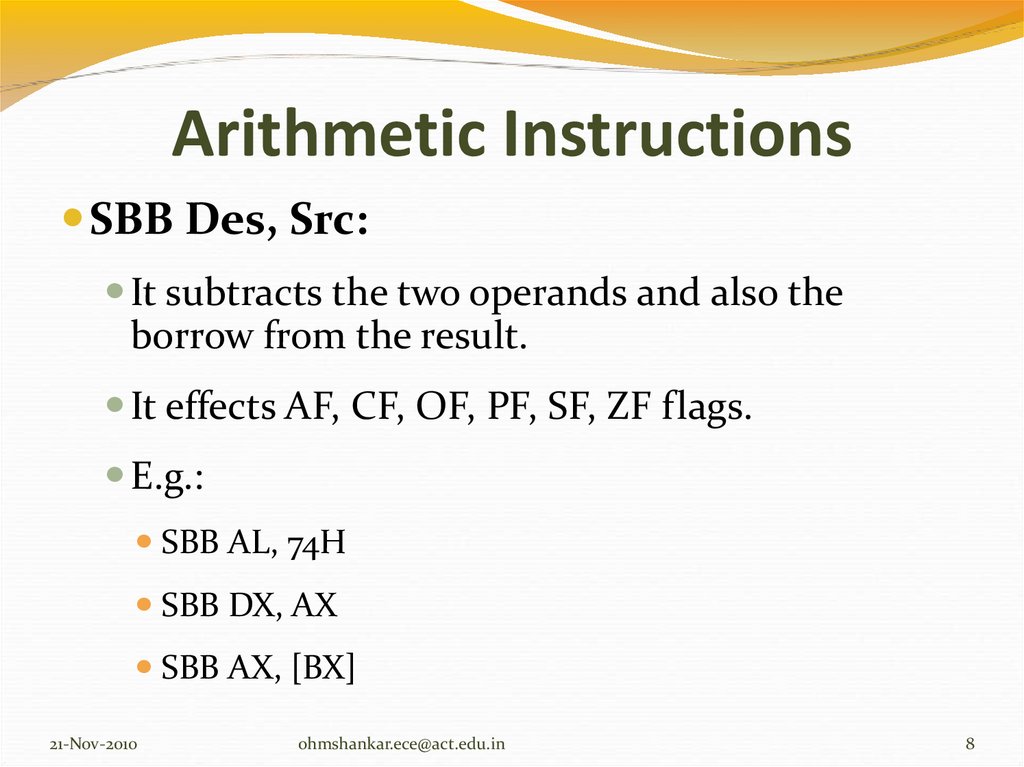
Arithmetic InstructionsSBB Des, Src:
It subtracts the two operands and also the
borrow from the result.
It effects AF, CF, OF, PF, SF, ZF flags.
E.g.:
SBB AL, 74H
SBB DX, AX
SBB AX, [BX]
21-Nov-2010
ohmshankar.ece@act.edu.in
8
9.
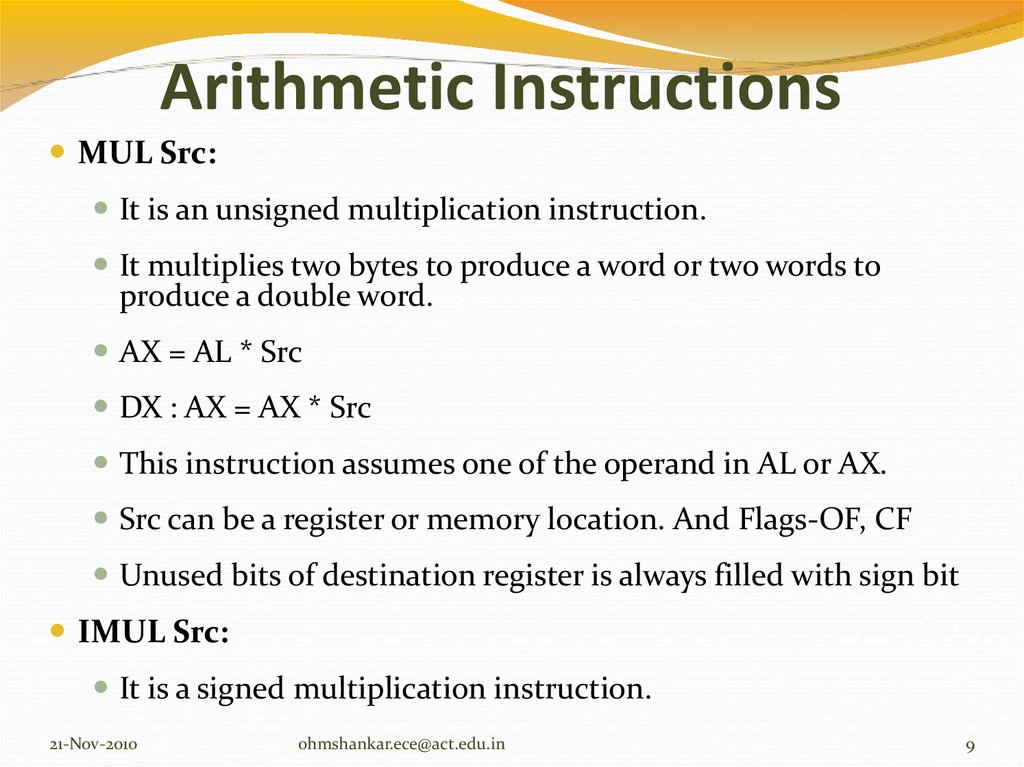
Arithmetic InstructionsMUL Src:
It is an unsigned multiplication instruction.
It multiplies two bytes to produce a word or two words to
produce a double word.
AX = AL * Src
DX : AX = AX * Src
This instruction assumes one of the operand in AL or AX.
Src can be a register or memory location. And Flags-OF, CF
Unused bits of destination register is always filled with sign bit
IMUL Src:
It is a signed multiplication instruction.
21-Nov-2010
ohmshankar.ece@act.edu.in
9
10.
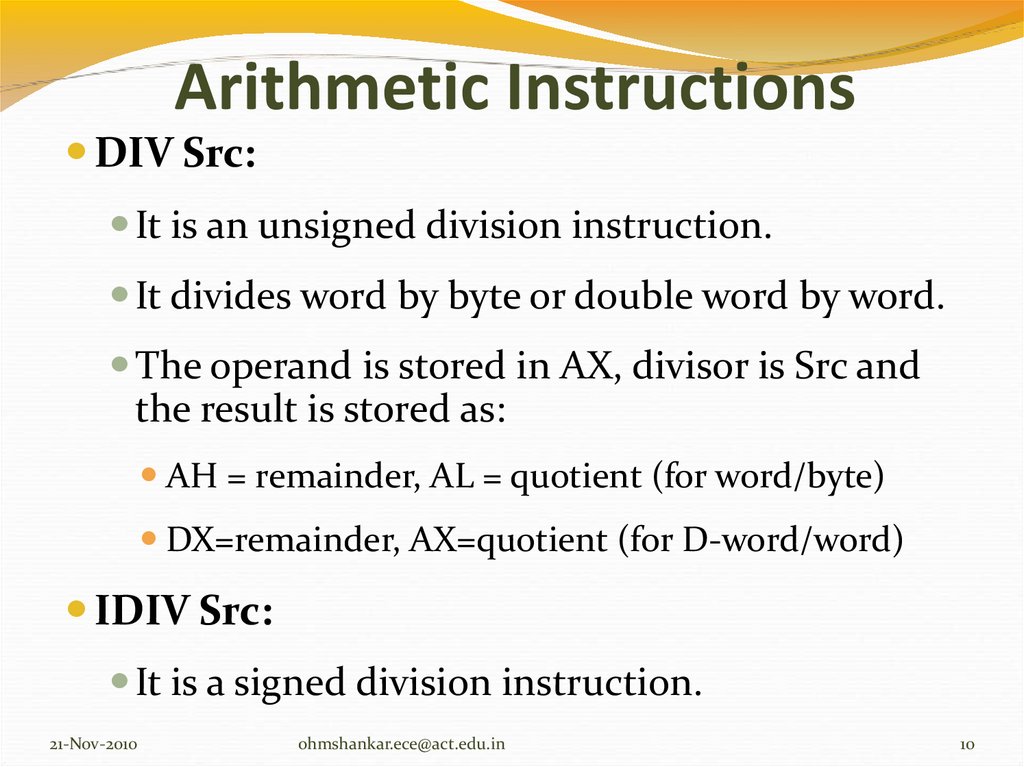
Arithmetic InstructionsDIV Src:
It is an unsigned division instruction.
It divides word by byte or double word by word.
The operand is stored in AX, divisor is Src and
the result is stored as:
AH = remainder, AL = quotient (for word/byte)
DX=remainder, AX=quotient (for D-word/word)
IDIV Src:
It is a signed division instruction.
21-Nov-2010
ohmshankar.ece@act.edu.in
10
11.
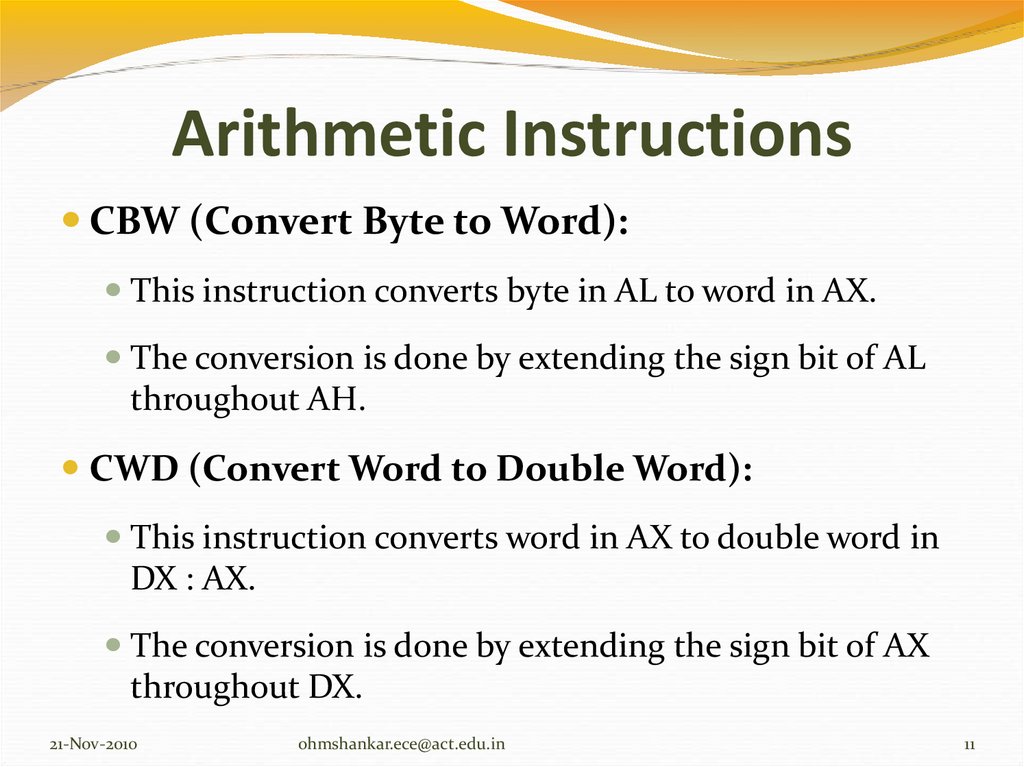
Arithmetic InstructionsCBW (Convert Byte to Word):
This instruction converts byte in AL to word in AX.
The conversion is done by extending the sign bit of AL
throughout AH.
CWD (Convert Word to Double Word):
This instruction converts word in AX to double word in
DX : AX.
The conversion is done by extending the sign bit of AX
throughout DX.
21-Nov-2010
ohmshankar.ece@act.edu.in
11
12.
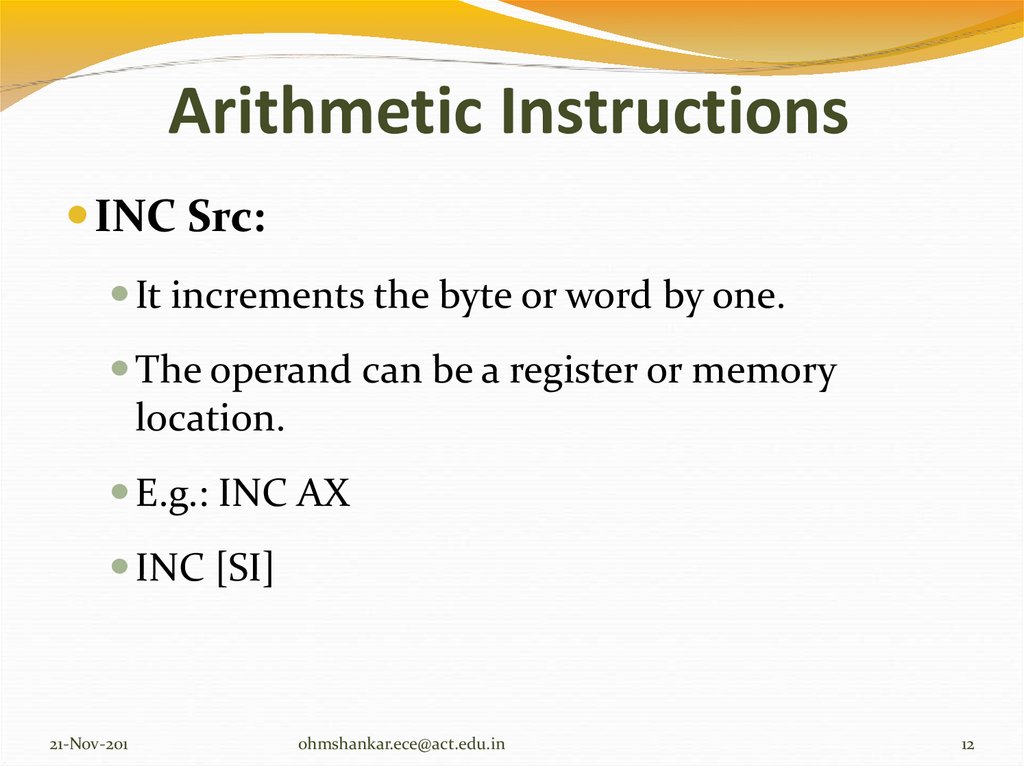
Arithmetic InstructionsINC Src:
It increments the byte or word by one.
The operand can be a register or memory
location.
E.g.: INC AX
INC [SI]
21-Nov-201
ohmshankar.ece@act.edu.in
12
13.
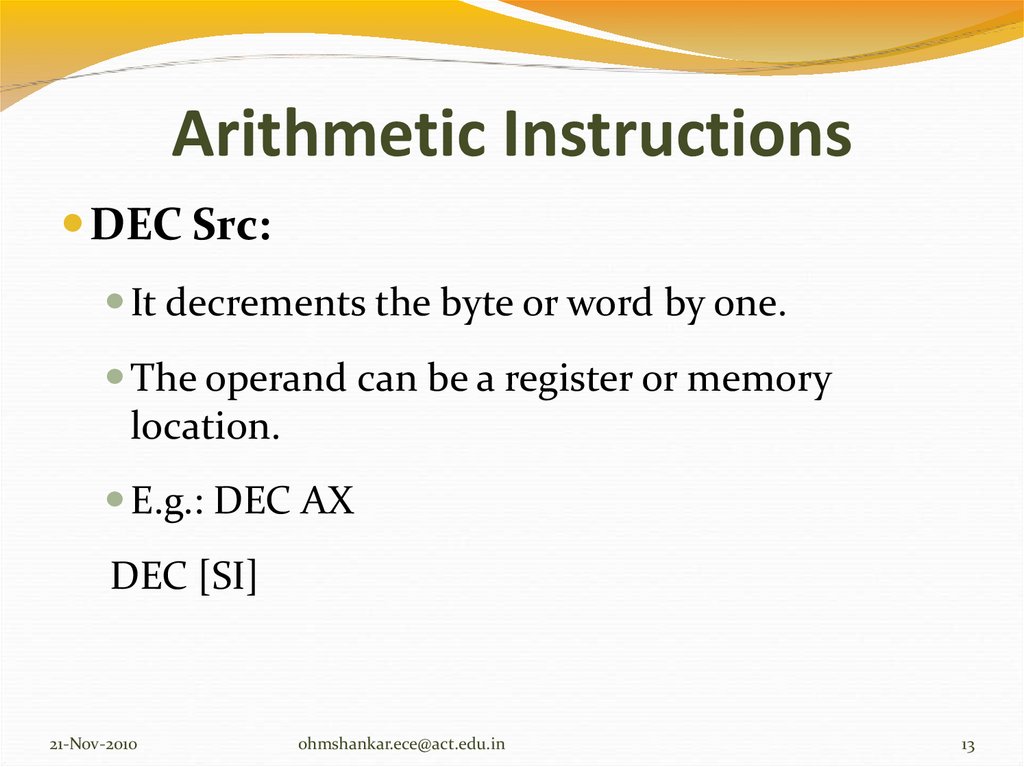
Arithmetic InstructionsDEC Src:
It decrements the byte or word by one.
The operand can be a register or memory
location.
E.g.: DEC AX
DEC [SI]
21-Nov-2010
ohmshankar.ece@act.edu.in
13
14.
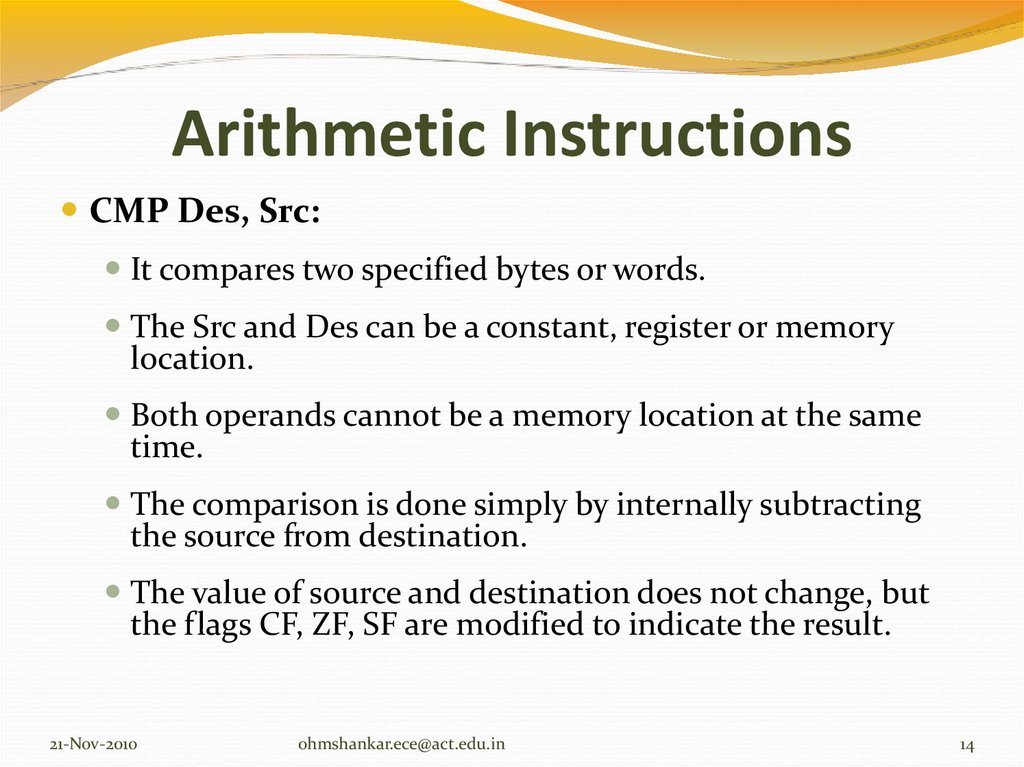
Arithmetic InstructionsCMP Des, Src:
It compares two specified bytes or words.
The Src and Des can be a constant, register or memory
location.
Both operands cannot be a memory location at the same
time.
The comparison is done simply by internally subtracting
the source from destination.
The value of source and destination does not change, but
the flags CF, ZF, SF are modified to indicate the result.
21-Nov-2010
ohmshankar.ece@act.edu.in
14
15.
Arithmetic InstructionsNEG Src:
It creates 2’s complement of a given
number.
That means, it changes the sign of a
number.
21-Nov-2010
ohmshankar.ece@act.edu.in
15
16.
Arithmetic InstructionsDAA (Decimal Adjust after Addition)
It is used to make sure that the result of adding two BCD
numbers is adjusted to be a correct BCD number.
It only works on AL register.
For Subtraction : DAS (Decimal Adjust after
Subtraction)
21-Nov-2010
ohmshankar.ece@act.edu.in
16
17.
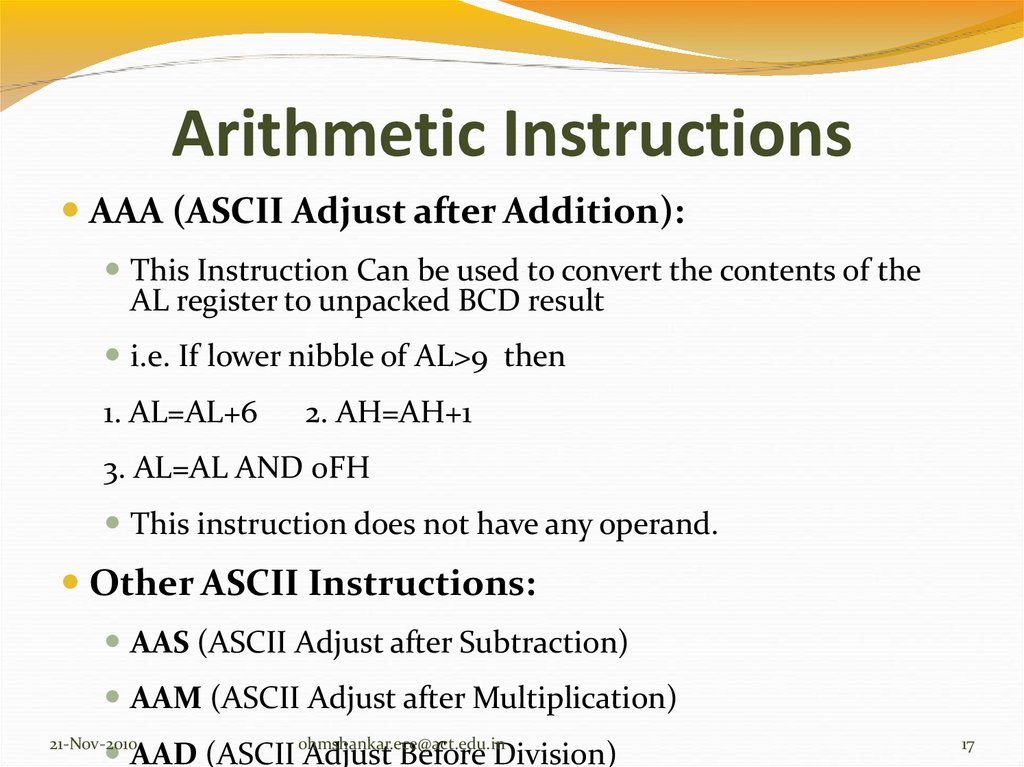
Arithmetic InstructionsAAA (ASCII Adjust after Addition):
This Instruction Can be used to convert the contents of the
AL register to unpacked BCD result
i.e. If lower nibble of AL>9 then
1. AL=AL+6
2. AH=AH+1
3. AL=AL AND 0FH
This instruction does not have any operand.
Other ASCII Instructions:
AAS (ASCII Adjust after Subtraction)
AAM (ASCII Adjust after Multiplication)
21-Nov-2010
AAD (ASCII ohmshankar.ece@act.edu.in
Adjust Before Division)
17
18.
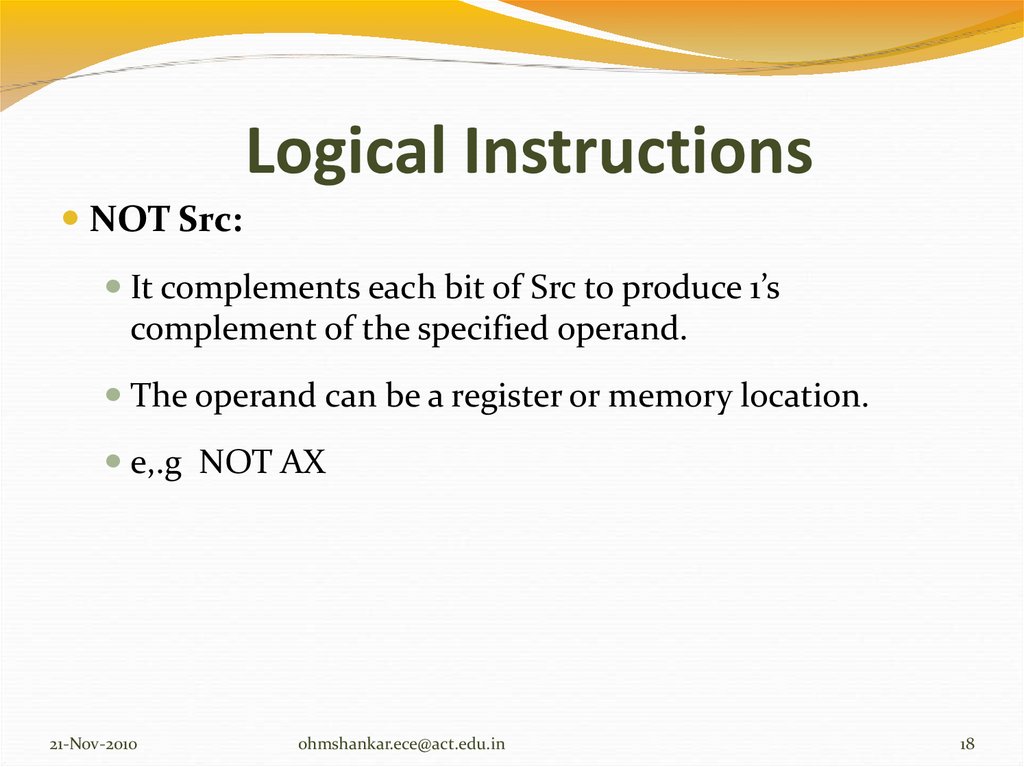
Logical InstructionsNOT Src:
It complements each bit of Src to produce 1’s
complement of the specified operand.
The operand can be a register or memory location.
e,.g NOT AX
21-Nov-2010
ohmshankar.ece@act.edu.in
18
19.
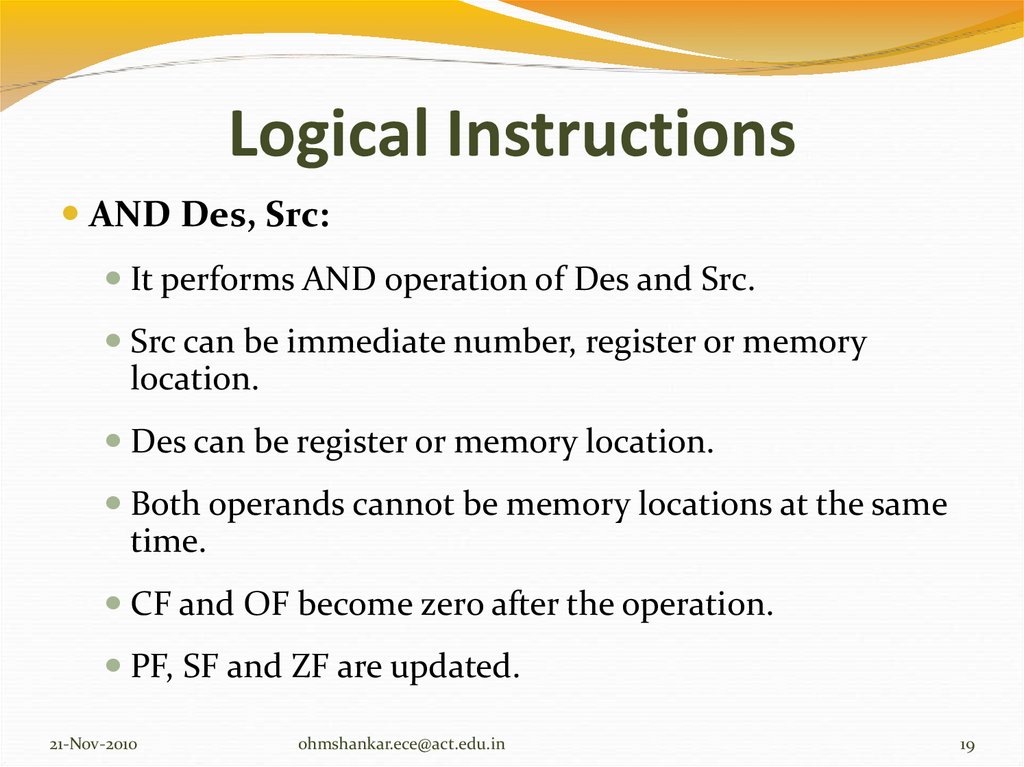
Logical InstructionsAND Des, Src:
It performs AND operation of Des and Src.
Src can be immediate number, register or memory
location.
Des can be register or memory location.
Both operands cannot be memory locations at the same
time.
CF and OF become zero after the operation.
PF, SF and ZF are updated.
21-Nov-2010
ohmshankar.ece@act.edu.in
19
20.
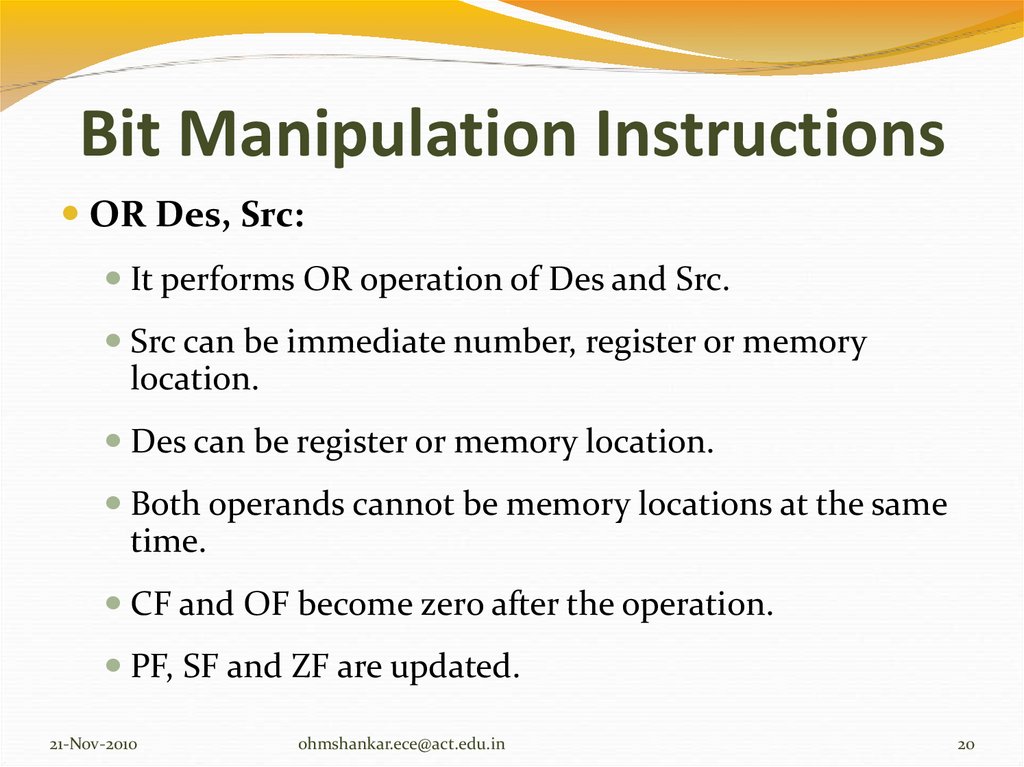
Bit Manipulation InstructionsOR Des, Src:
It performs OR operation of Des and Src.
Src can be immediate number, register or memory
location.
Des can be register or memory location.
Both operands cannot be memory locations at the same
time.
CF and OF become zero after the operation.
PF, SF and ZF are updated.
21-Nov-2010
ohmshankar.ece@act.edu.in
20
21.
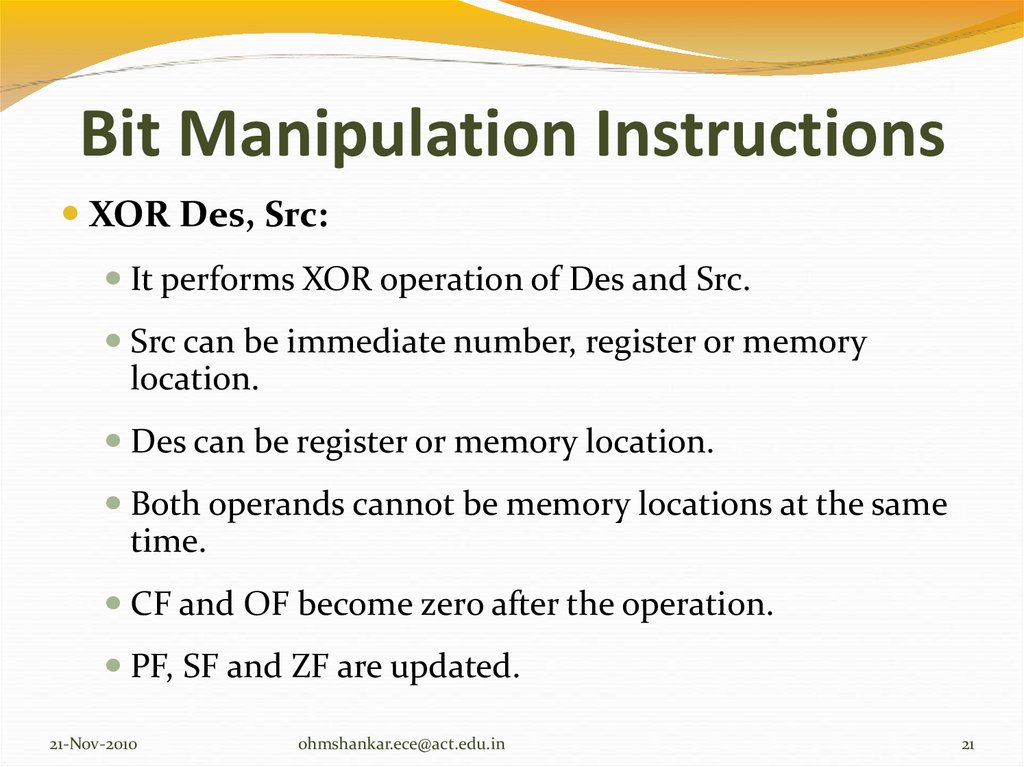
Bit Manipulation InstructionsXOR Des, Src:
It performs XOR operation of Des and Src.
Src can be immediate number, register or memory
location.
Des can be register or memory location.
Both operands cannot be memory locations at the same
time.
CF and OF become zero after the operation.
PF, SF and ZF are updated.
21-Nov-2010
ohmshankar.ece@act.edu.in
21
22.
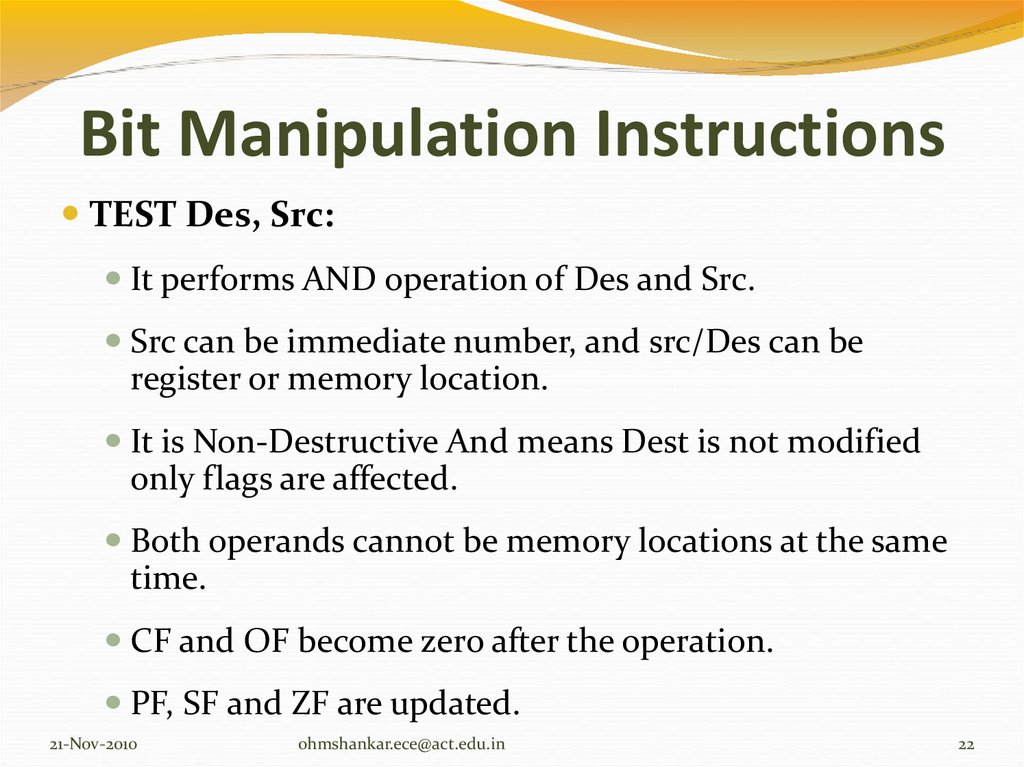
Bit Manipulation InstructionsTEST Des, Src:
It performs AND operation of Des and Src.
Src can be immediate number, and src/Des can be
register or memory location.
It is Non-Destructive And means Dest is not modified
only flags are affected.
Both operands cannot be memory locations at the same
time.
CF and OF become zero after the operation.
PF, SF and ZF are updated.
21-Nov-2010
ohmshankar.ece@act.edu.in
22
23.
2. Data Transfer Instructions23
24.
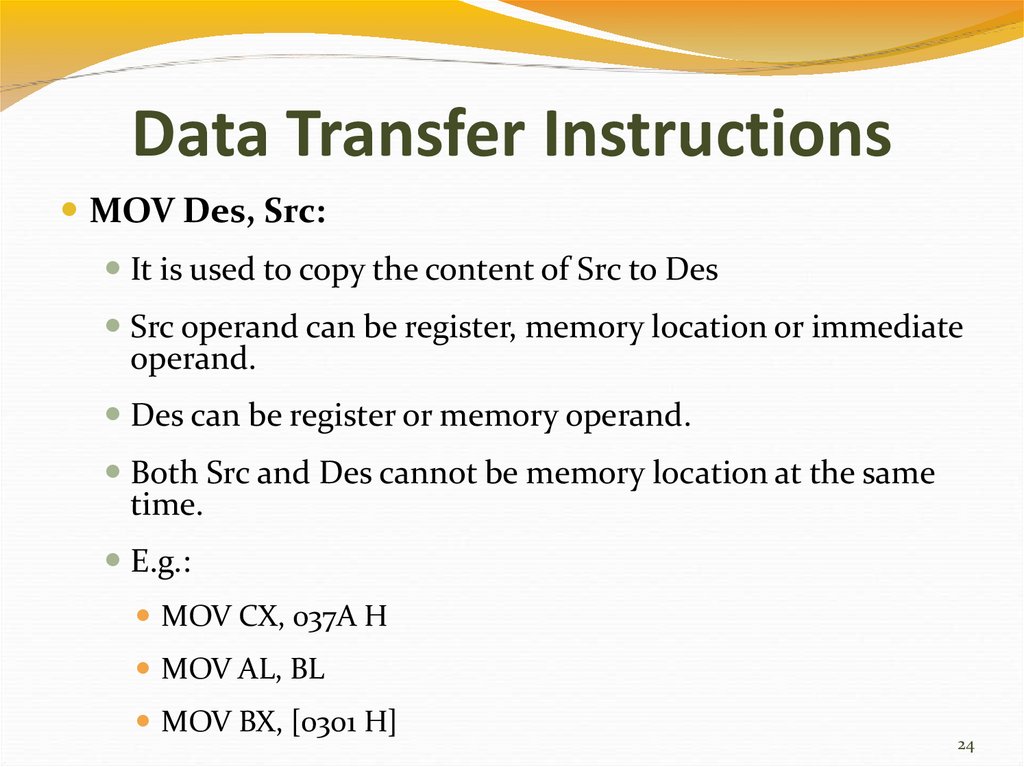
Data Transfer InstructionsMOV Des, Src:
It is used to copy the content of Src to Des
Src operand can be register, memory location or immediate
operand.
Des can be register or memory operand.
Both Src and Des cannot be memory location at the same
time.
E.g.:
MOV CX, 037A H
MOV AL, BL
MOV BX, [0301 H]
24
25.
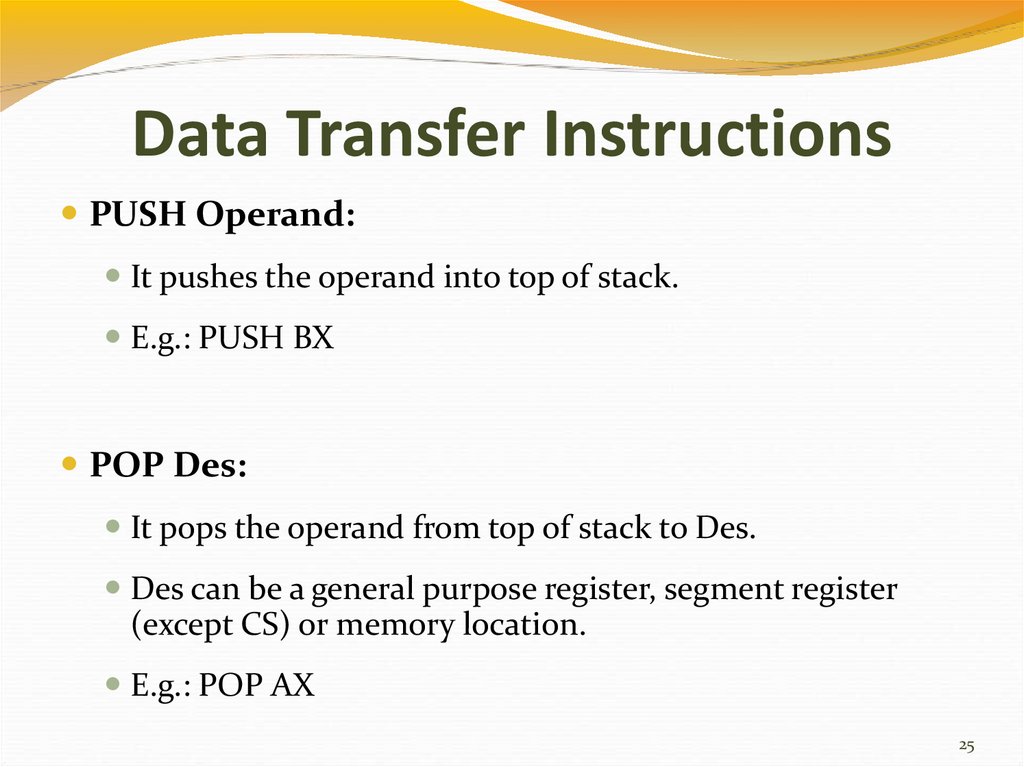
Data Transfer InstructionsPUSH Operand:
It pushes the operand into top of stack.
E.g.: PUSH BX
POP Des:
It pops the operand from top of stack to Des.
Des can be a general purpose register, segment register
(except CS) or memory location.
E.g.: POP AX
25
26.
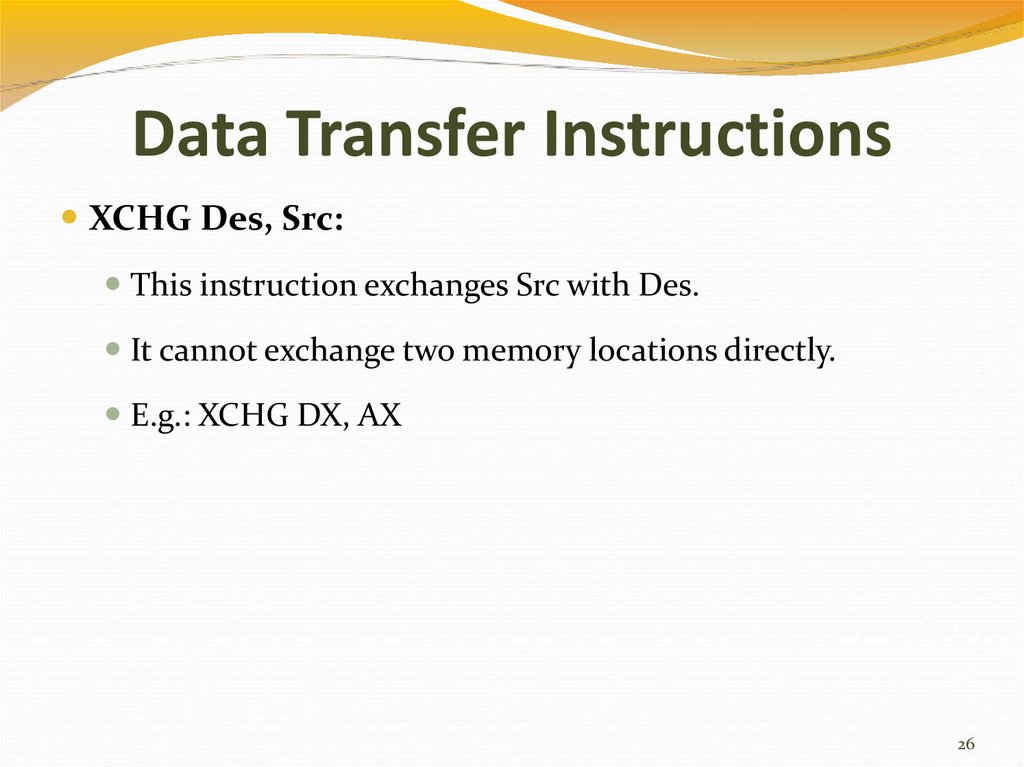
Data Transfer InstructionsXCHG Des, Src:
This instruction exchanges Src with Des.
It cannot exchange two memory locations directly.
E.g.: XCHG DX, AX
26
27.
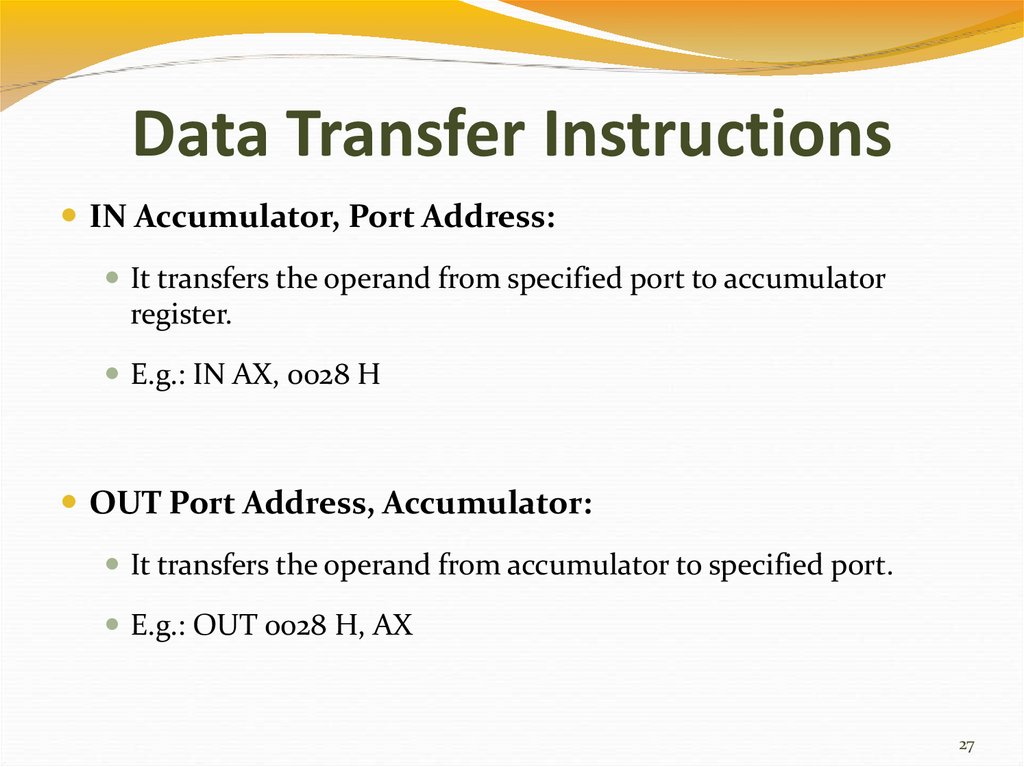
Data Transfer InstructionsIN Accumulator, Port Address:
It transfers the operand from specified port to accumulator
register.
E.g.: IN AX, 0028 H
OUT Port Address, Accumulator:
It transfers the operand from accumulator to specified port.
E.g.: OUT 0028 H, AX
27
28.
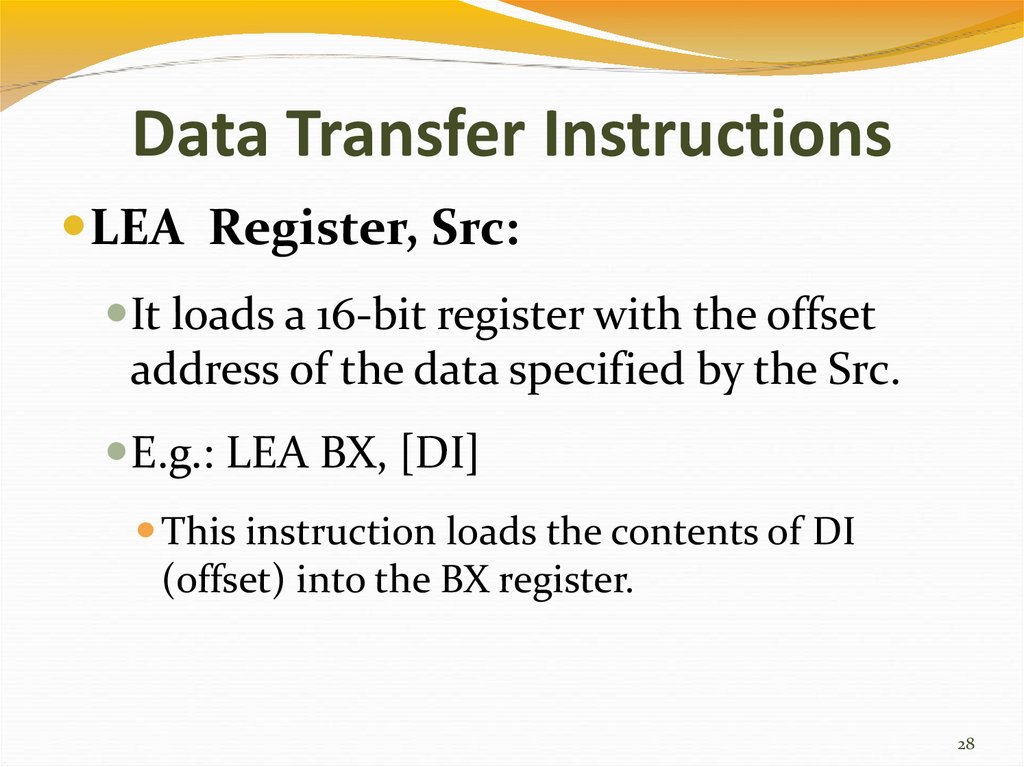
Data Transfer InstructionsLEA Register, Src:
It loads a 16-bit register with the offset
address of the data specified by the Src.
E.g.: LEA BX, [DI]
This instruction loads the contents of DI
(offset) into the BX register.
28
29.
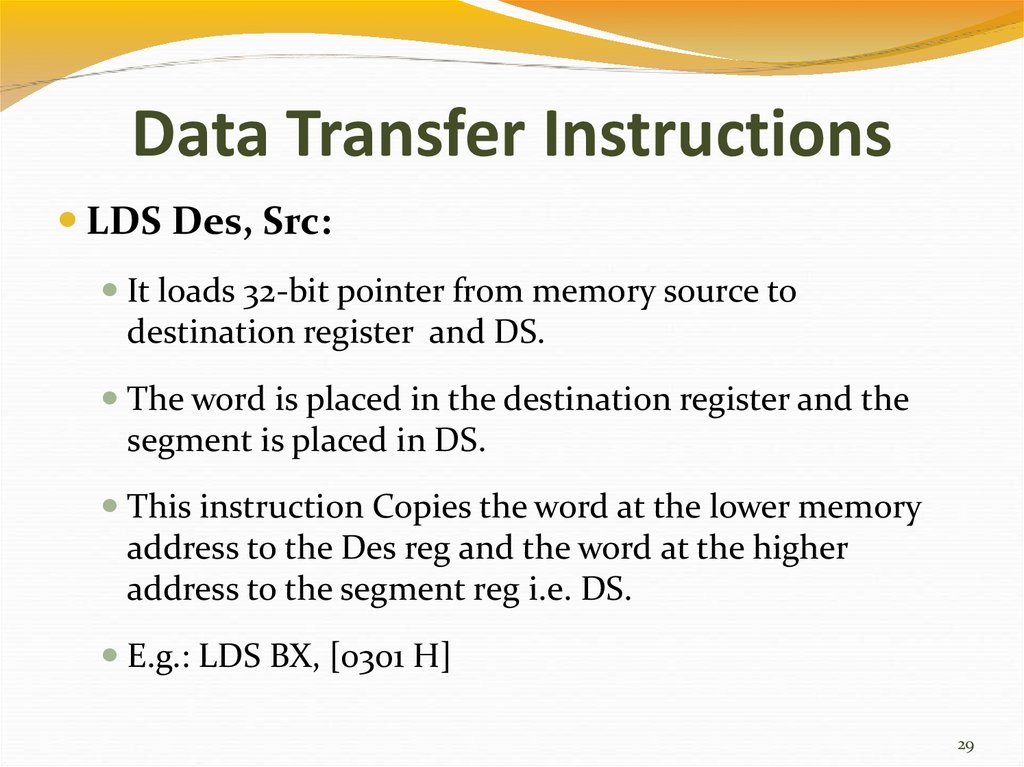
Data Transfer InstructionsLDS Des, Src:
It loads 32-bit pointer from memory source to
destination register and DS.
The word is placed in the destination register and the
segment is placed in DS.
This instruction Copies the word at the lower memory
address to the Des reg and the word at the higher
address to the segment reg i.e. DS.
E.g.: LDS BX, [0301 H]
29
30.
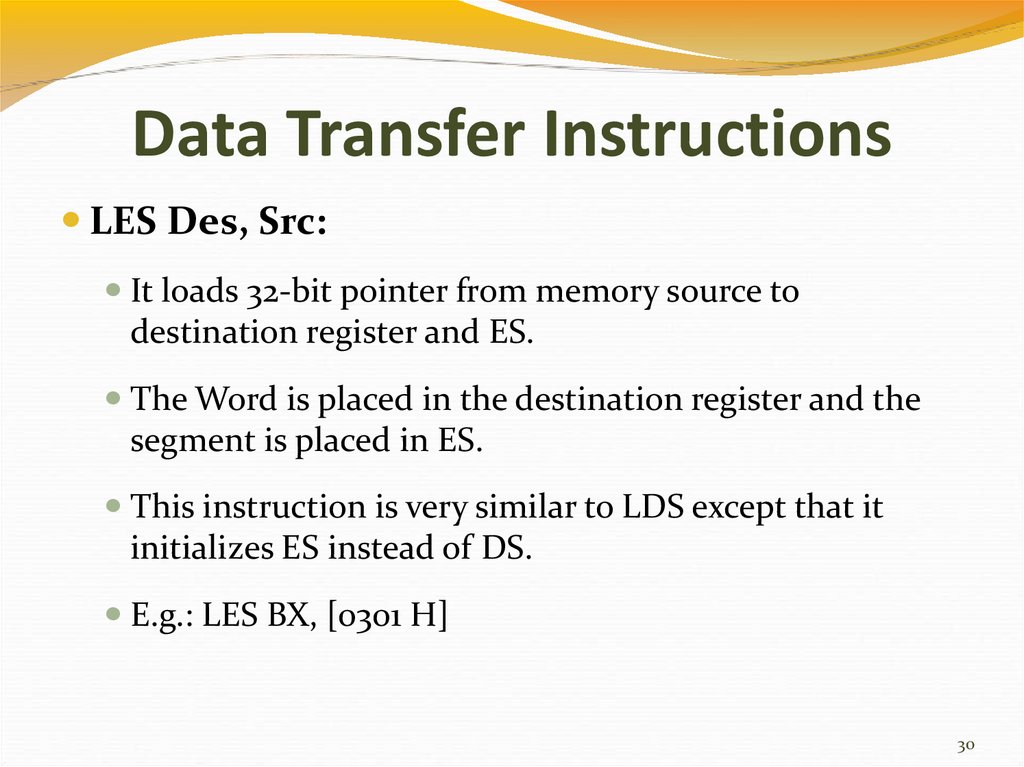
Data Transfer InstructionsLES Des, Src:
It loads 32-bit pointer from memory source to
destination register and ES.
The Word is placed in the destination register and the
segment is placed in ES.
This instruction is very similar to LDS except that it
initializes ES instead of DS.
E.g.: LES BX, [0301 H]
30
31.
Data Transfer InstructionsLAHF:
It copies the lower byte of flag register to AH.
SAHF:
It copies the contents of AH to lower byte of flag register.
PUSHF:
Pushes flag register to top of stack.
POPF:
Pops the stack top to flag register.
31
32.
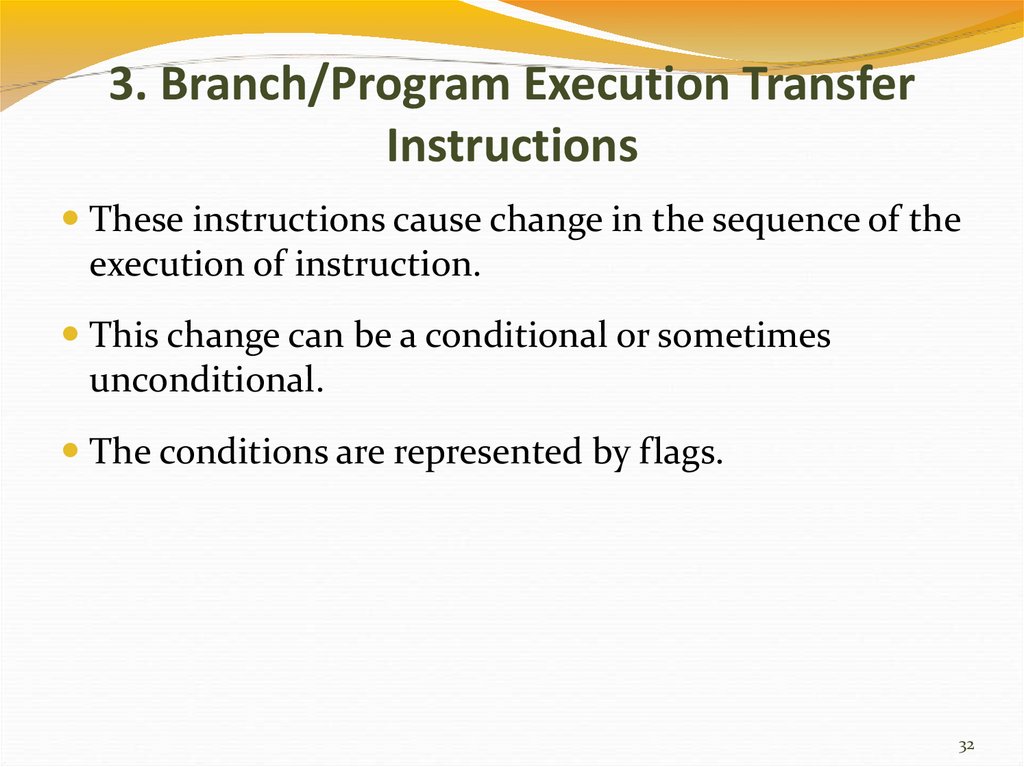
3. Branch/Program Execution TransferInstructions
These instructions cause change in the sequence of the
execution of instruction.
This change can be a conditional or sometimes
unconditional.
The conditions are represented by flags.
32
33.
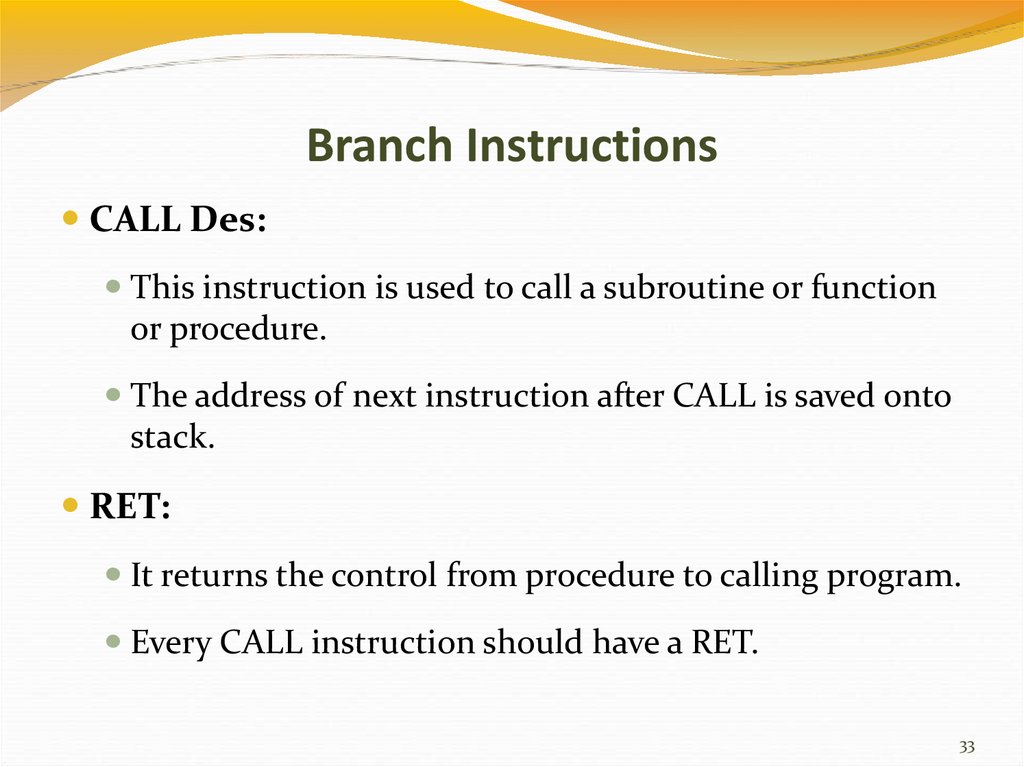
Branch InstructionsCALL Des:
This instruction is used to call a subroutine or function
or procedure.
The address of next instruction after CALL is saved onto
stack.
RET:
It returns the control from procedure to calling program.
Every CALL instruction should have a RET.
33
34.
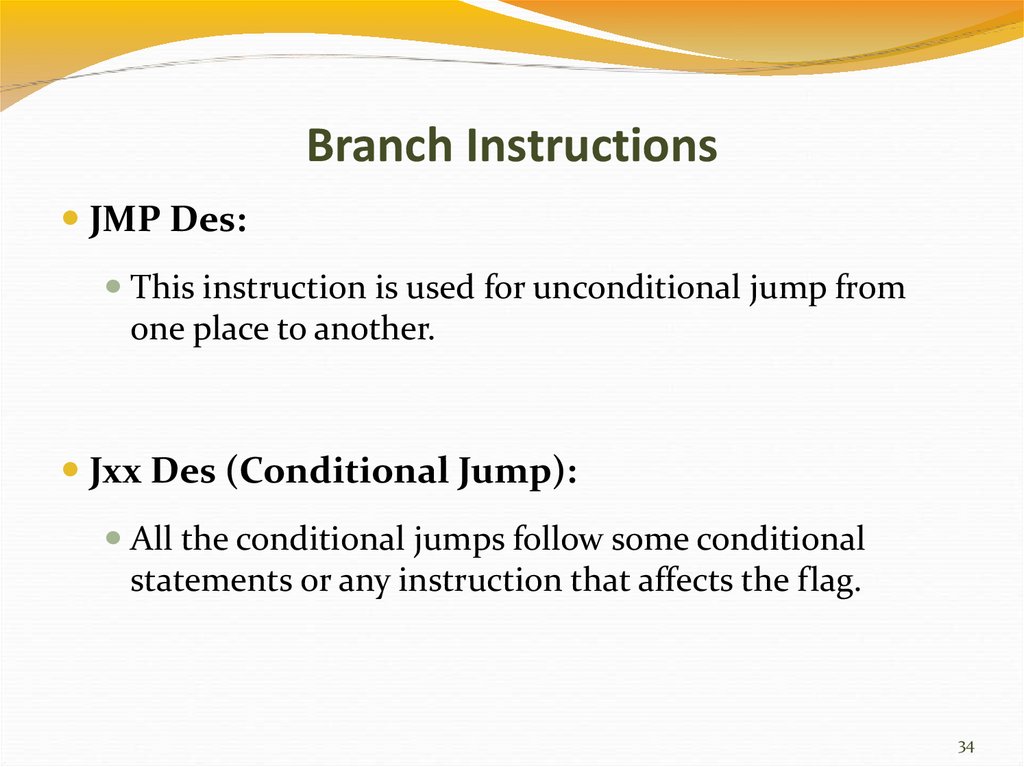
Branch InstructionsJMP Des:
This instruction is used for unconditional jump from
one place to another.
Jxx Des (Conditional Jump):
All the conditional jumps follow some conditional
statements or any instruction that affects the flag.
34
35.
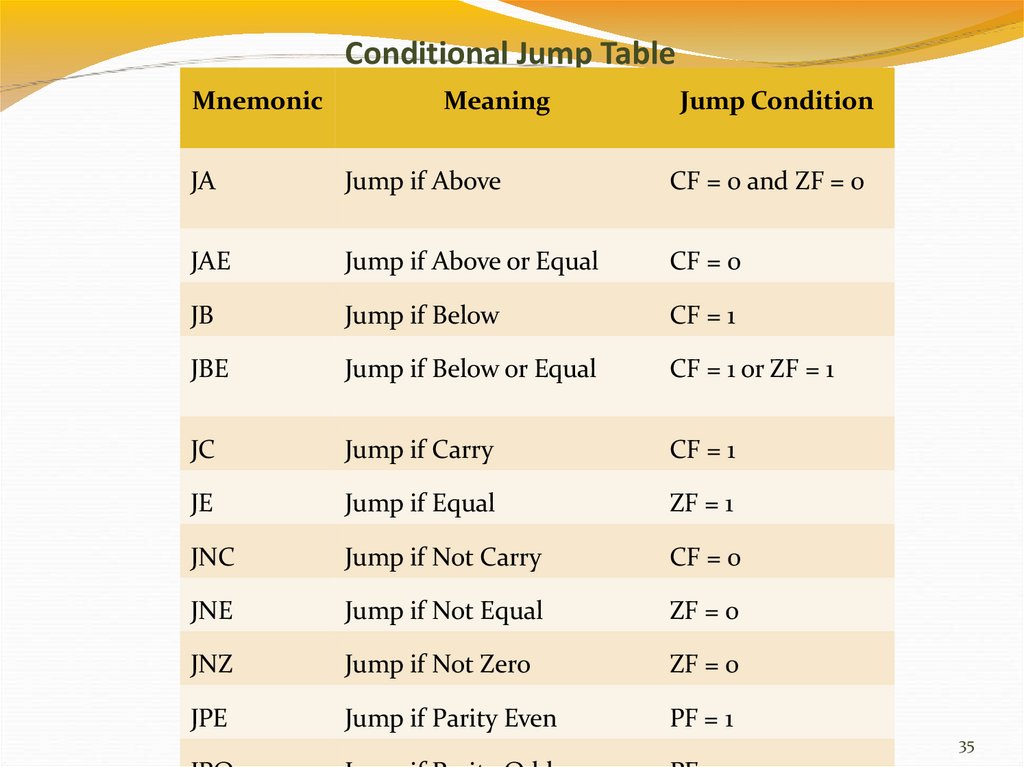
Conditional Jump TableMnemonic
Meaning
Jump Condition
JA
Jump if Above
CF = 0 and ZF = 0
JAE
Jump if Above or Equal
CF = 0
JB
Jump if Below
CF = 1
JBE
Jump if Below or Equal
CF = 1 or ZF = 1
JC
Jump if Carry
CF = 1
JE
Jump if Equal
ZF = 1
JNC
Jump if Not Carry
CF = 0
JNE
Jump if Not Equal
ZF = 0
JNZ
Jump if Not Zero
ZF = 0
JPE
Jump if Parity Even
PF = 1
35
36.
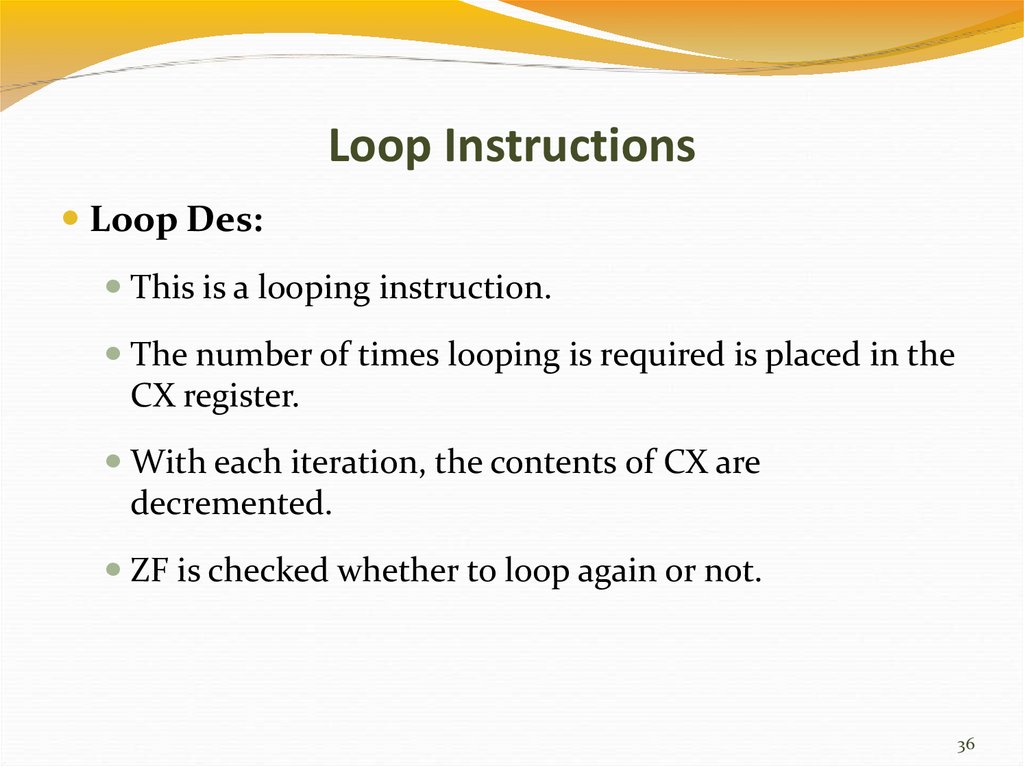
Loop InstructionsLoop Des:
This is a looping instruction.
The number of times looping is required is placed in the
CX register.
With each iteration, the contents of CX are
decremented.
ZF is checked whether to loop again or not.
36
37.
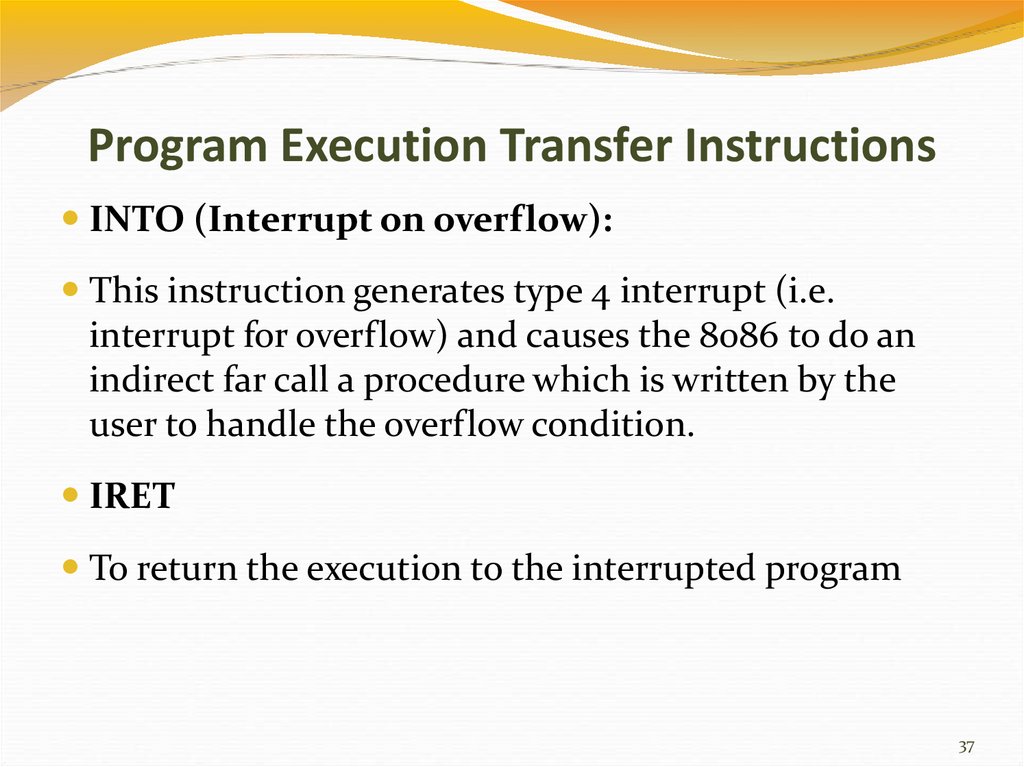
Program Execution Transfer InstructionsINTO (Interrupt on overflow):
This instruction generates type 4 interrupt (i.e.
interrupt for overflow) and causes the 8086 to do an
indirect far call a procedure which is written by the
user to handle the overflow condition.
IRET
To return the execution to the interrupted program
37
38.
4. Machine ControlInstructions
39.
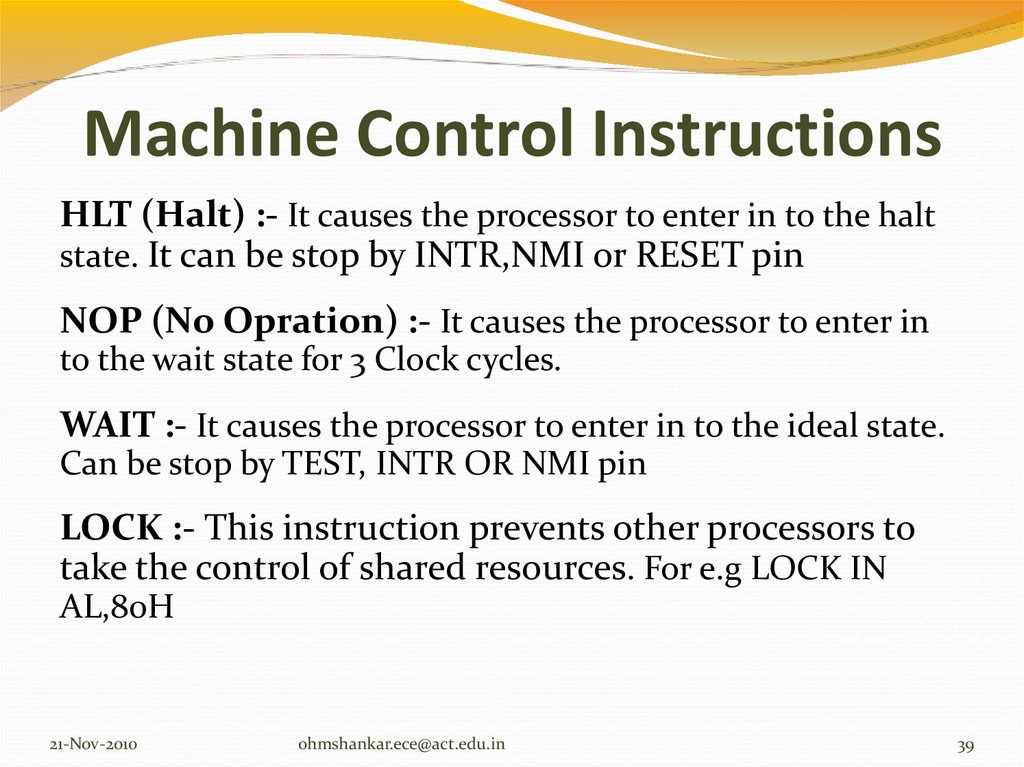
Machine Control InstructionsHLT (Halt) :- It causes the processor to enter in to the halt
state. It can be stop by INTR,NMI or RESET pin
NOP (No Opration) :- It causes the processor to enter in
to the wait state for 3 Clock cycles.
WAIT :- It causes the processor to enter in to the ideal state.
Can be stop by TEST, INTR OR NMI pin
LOCK :- This instruction prevents other processors to
take the control of shared resources. For e.g LOCK IN
AL,80H
21-Nov-2010
ohmshankar.ece@act.edu.in
39
40.
5. Flag ManipulationInstructions
41.
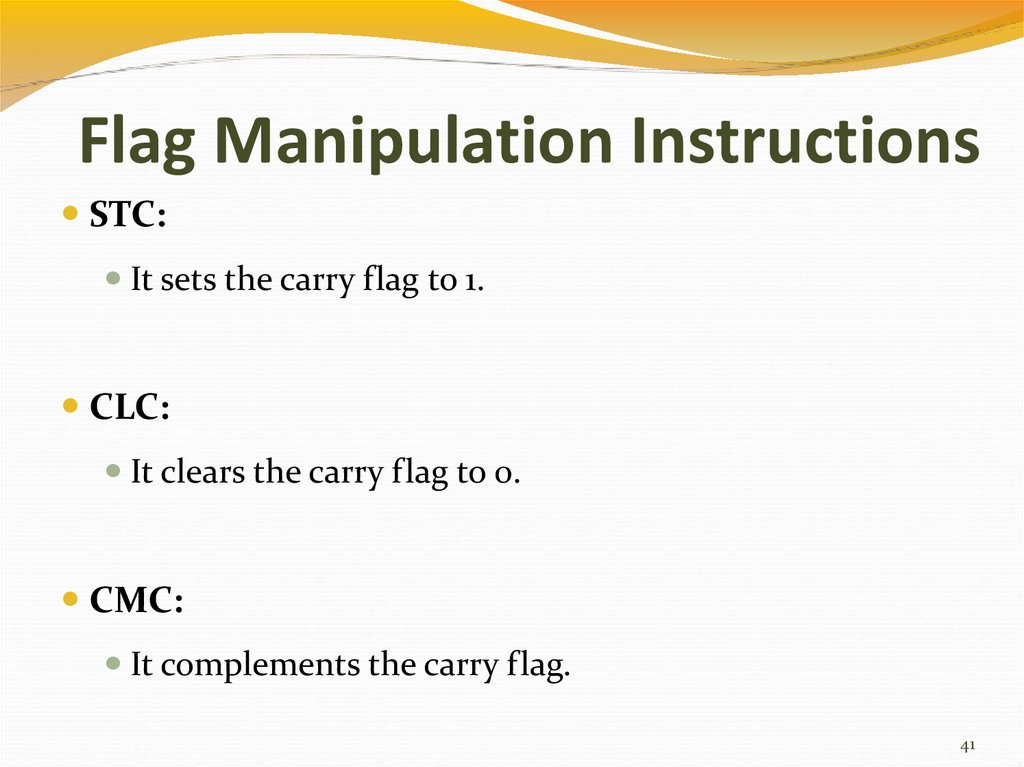
Flag Manipulation InstructionsSTC:
It sets the carry flag to 1.
CLC:
It clears the carry flag to 0.
CMC:
It complements the carry flag.
41
42.
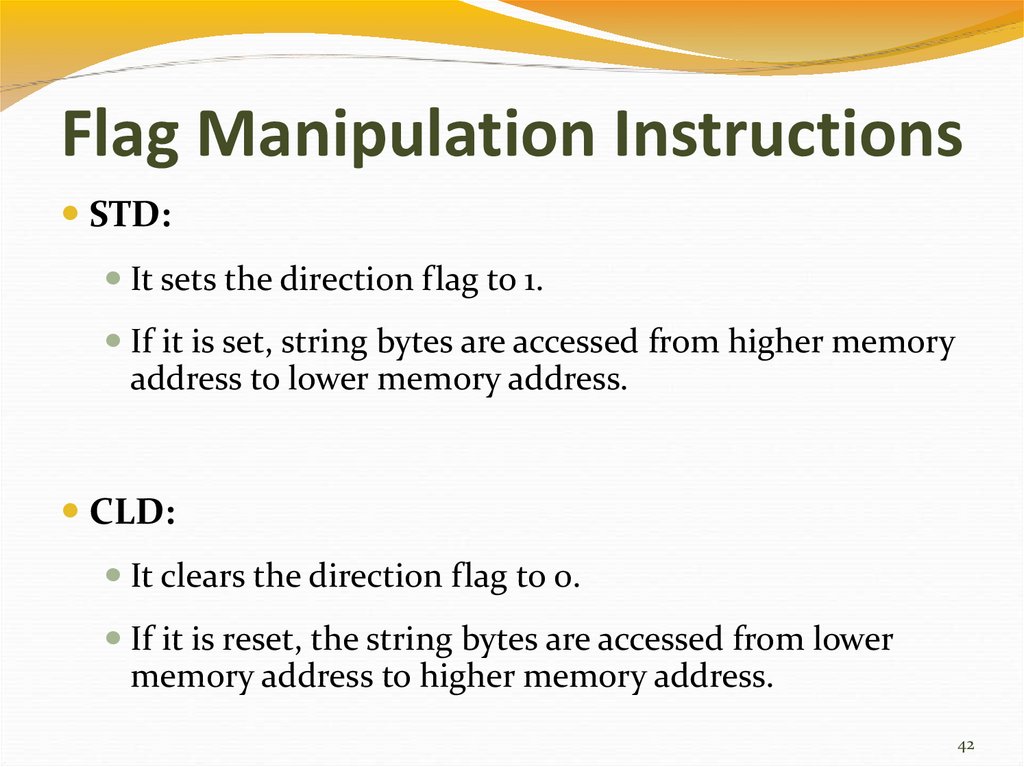
Flag Manipulation InstructionsSTD:
It sets the direction flag to 1.
If it is set, string bytes are accessed from higher memory
address to lower memory address.
CLD:
It clears the direction flag to 0.
If it is reset, the string bytes are accessed from lower
memory address to higher memory address.
42
43.
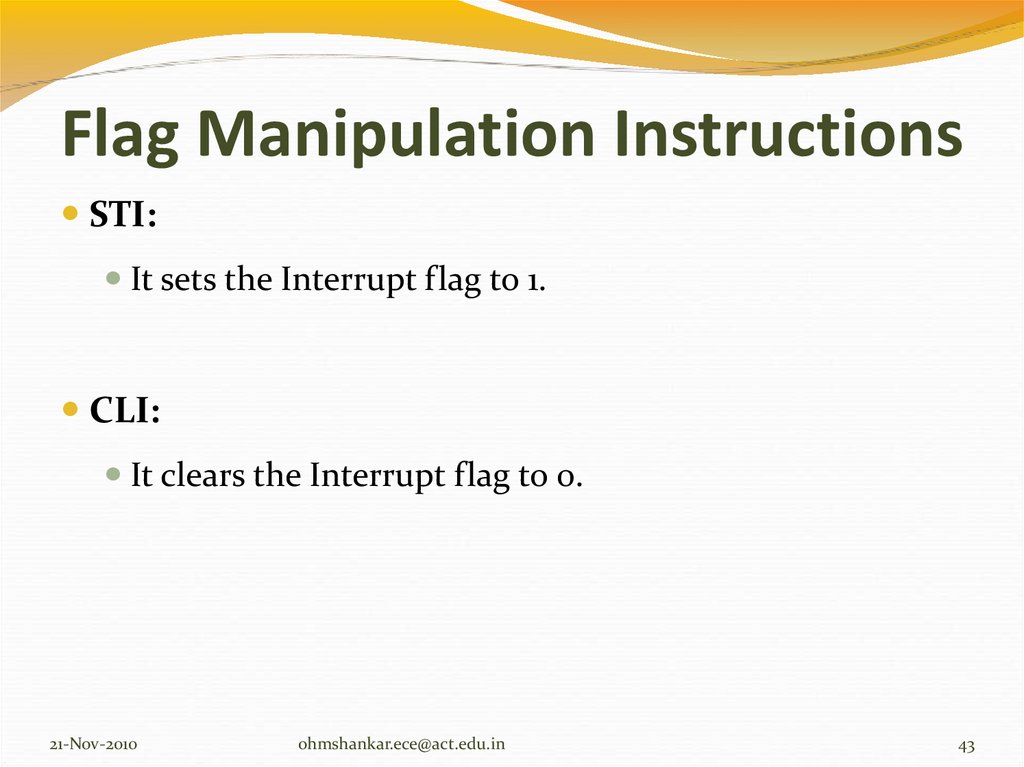
Flag Manipulation InstructionsSTI:
It sets the Interrupt flag to 1.
CLI:
It clears the Interrupt flag to 0.
21-Nov-2010
ohmshankar.ece@act.edu.in
43
44.
6. Shift And Rotate Instructions45.
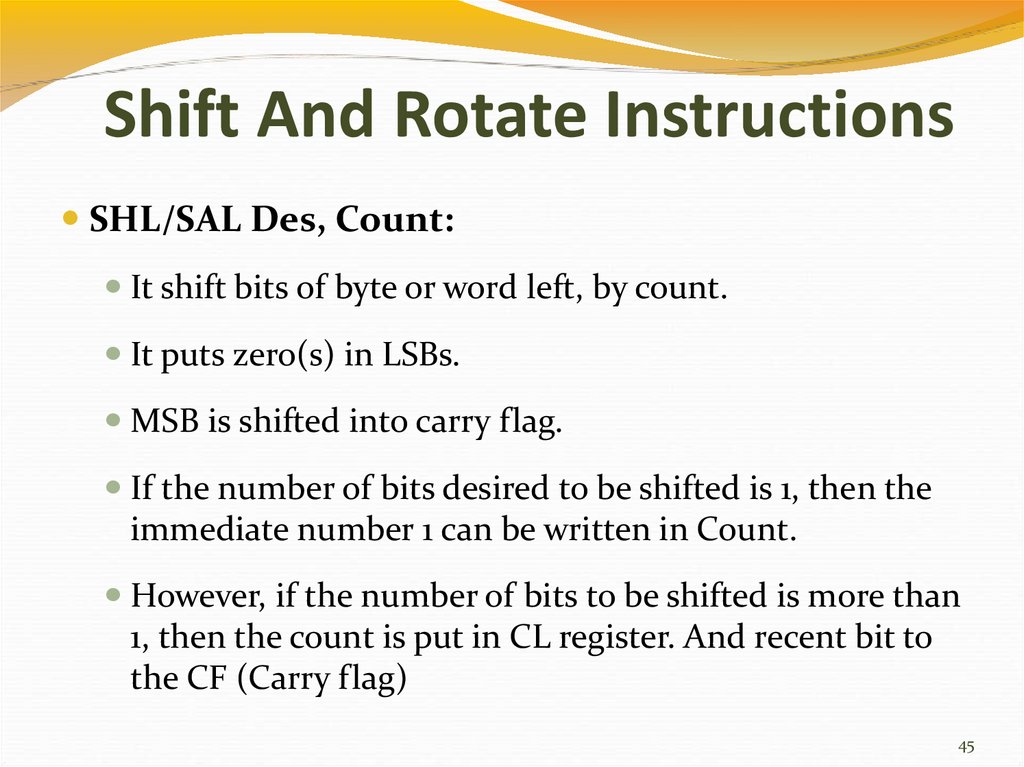
Shift And Rotate InstructionsSHL/SAL Des, Count:
It shift bits of byte or word left, by count.
It puts zero(s) in LSBs.
MSB is shifted into carry flag.
If the number of bits desired to be shifted is 1, then the
immediate number 1 can be written in Count.
However, if the number of bits to be shifted is more than
1, then the count is put in CL register. And recent bit to
the CF (Carry flag)
45
46.
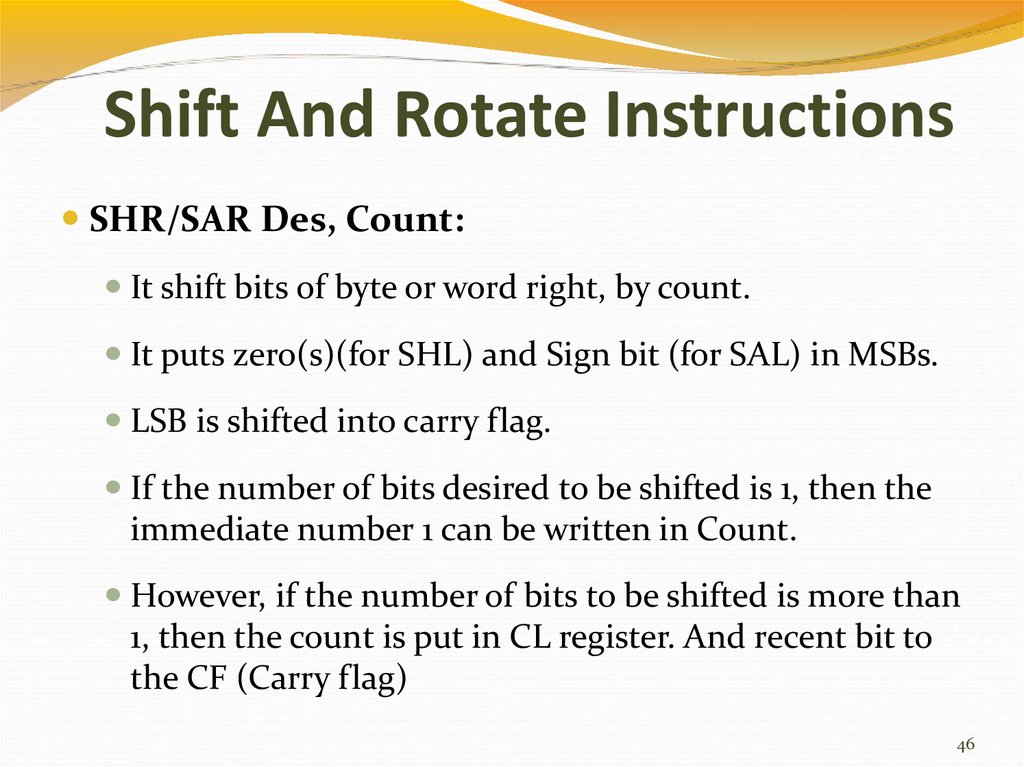
Shift And Rotate InstructionsSHR/SAR Des, Count:
It shift bits of byte or word right, by count.
It puts zero(s)(for SHL) and Sign bit (for SAL) in MSBs.
LSB is shifted into carry flag.
If the number of bits desired to be shifted is 1, then the
immediate number 1 can be written in Count.
However, if the number of bits to be shifted is more than
1, then the count is put in CL register. And recent bit to
the CF (Carry flag)
46
47.
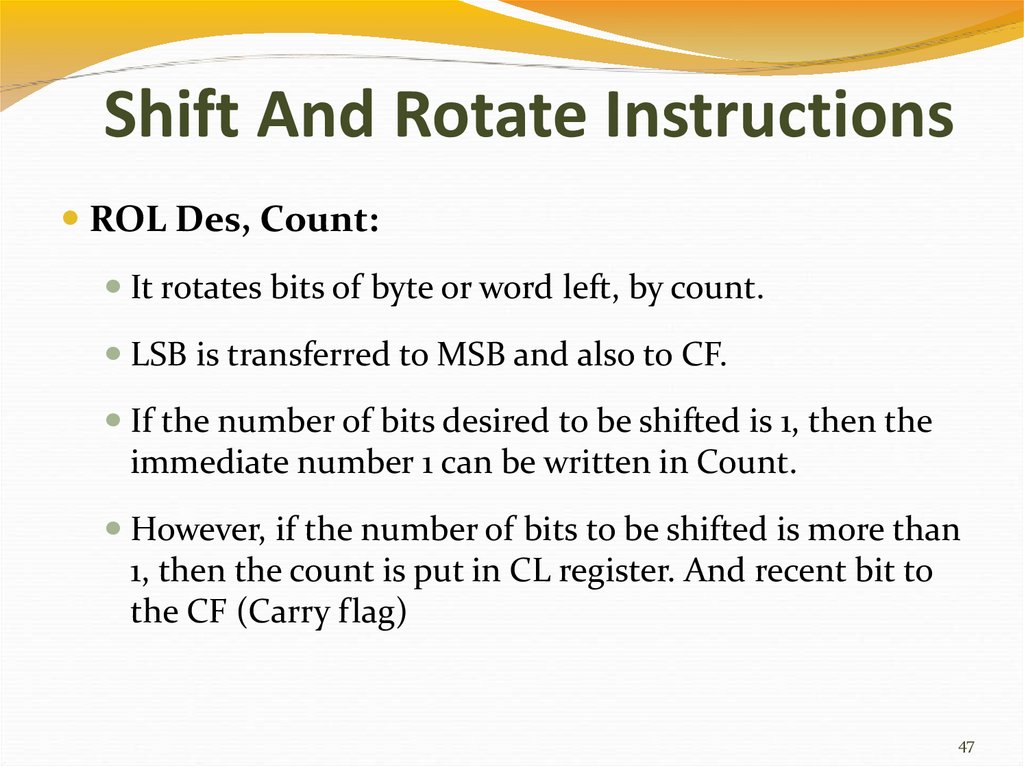
Shift And Rotate InstructionsROL Des, Count:
It rotates bits of byte or word left, by count.
LSB is transferred to MSB and also to CF.
If the number of bits desired to be shifted is 1, then the
immediate number 1 can be written in Count.
However, if the number of bits to be shifted is more than
1, then the count is put in CL register. And recent bit to
the CF (Carry flag)
47
48.
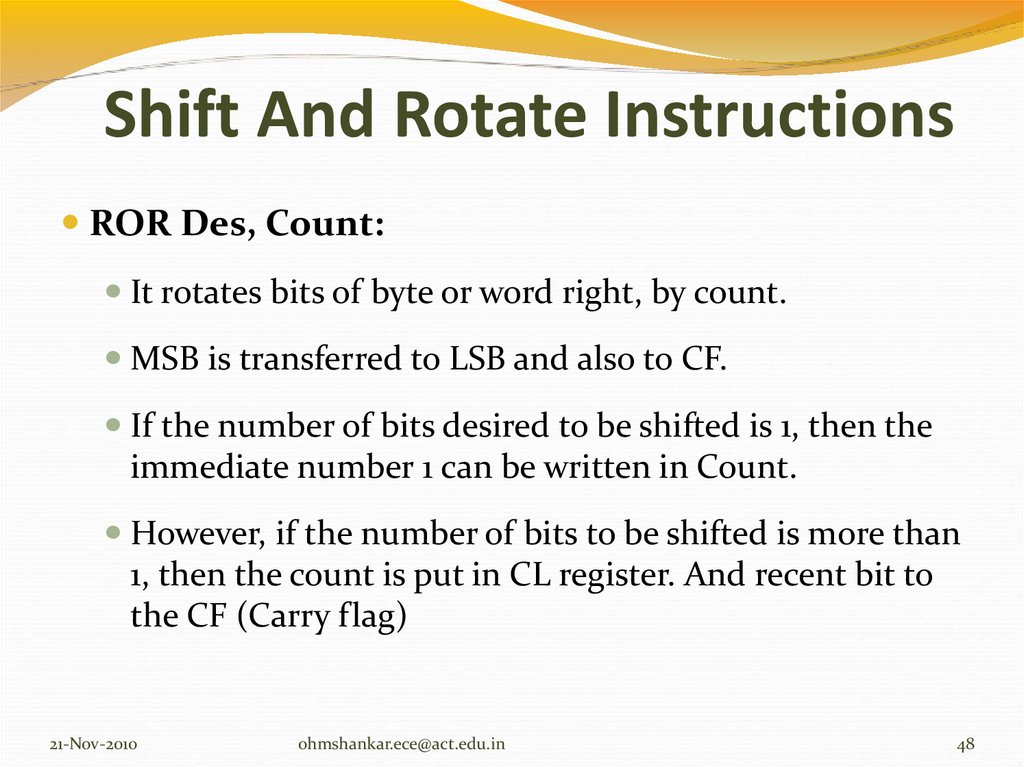
Shift And Rotate InstructionsROR Des, Count:
It rotates bits of byte or word right, by count.
MSB is transferred to LSB and also to CF.
If the number of bits desired to be shifted is 1, then the
immediate number 1 can be written in Count.
However, if the number of bits to be shifted is more than
1, then the count is put in CL register. And recent bit to
the CF (Carry flag)
21-Nov-2010
ohmshankar.ece@act.edu.in
48
49.
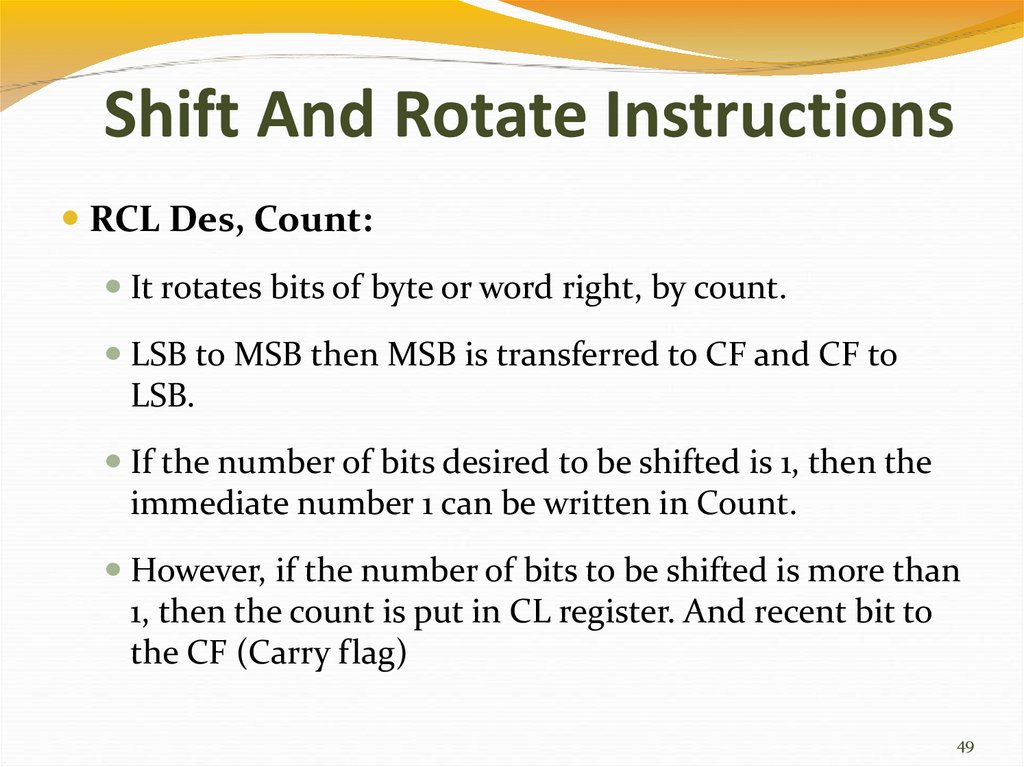
Shift And Rotate InstructionsRCL Des, Count:
It rotates bits of byte or word right, by count.
LSB to MSB then MSB is transferred to CF and CF to
LSB.
If the number of bits desired to be shifted is 1, then the
immediate number 1 can be written in Count.
However, if the number of bits to be shifted is more than
1, then the count is put in CL register. And recent bit to
the CF (Carry flag)
49
50.
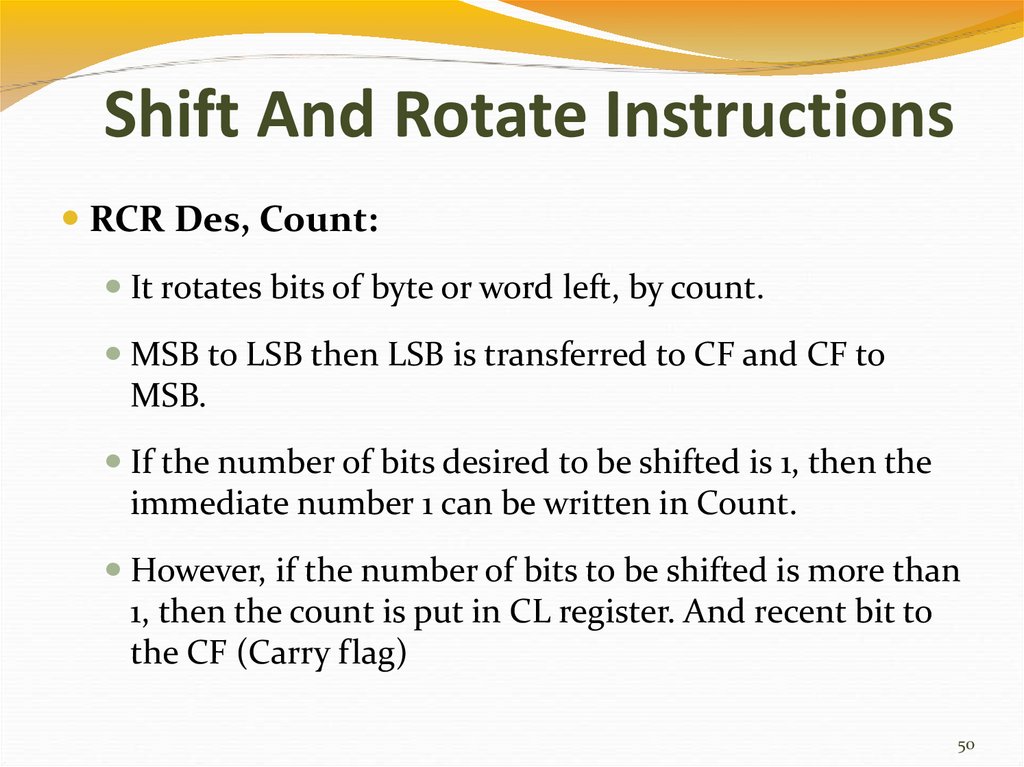
Shift And Rotate InstructionsRCR Des, Count:
It rotates bits of byte or word left, by count.
MSB to LSB then LSB is transferred to CF and CF to
MSB.
If the number of bits desired to be shifted is 1, then the
immediate number 1 can be written in Count.
However, if the number of bits to be shifted is more than
1, then the count is put in CL register. And recent bit to
the CF (Carry flag)
50
51.
7. String ManipulationInstructions
52.
String ManipulationInstructions
String in assembly language is just a sequentially
stored bytes or words.
There are very strong set of string instructions in 8086.
By using these string instructions, the size of the
program is considerably reduced.
52
53.
8086 MicroprocessorString Manipulation Instructions
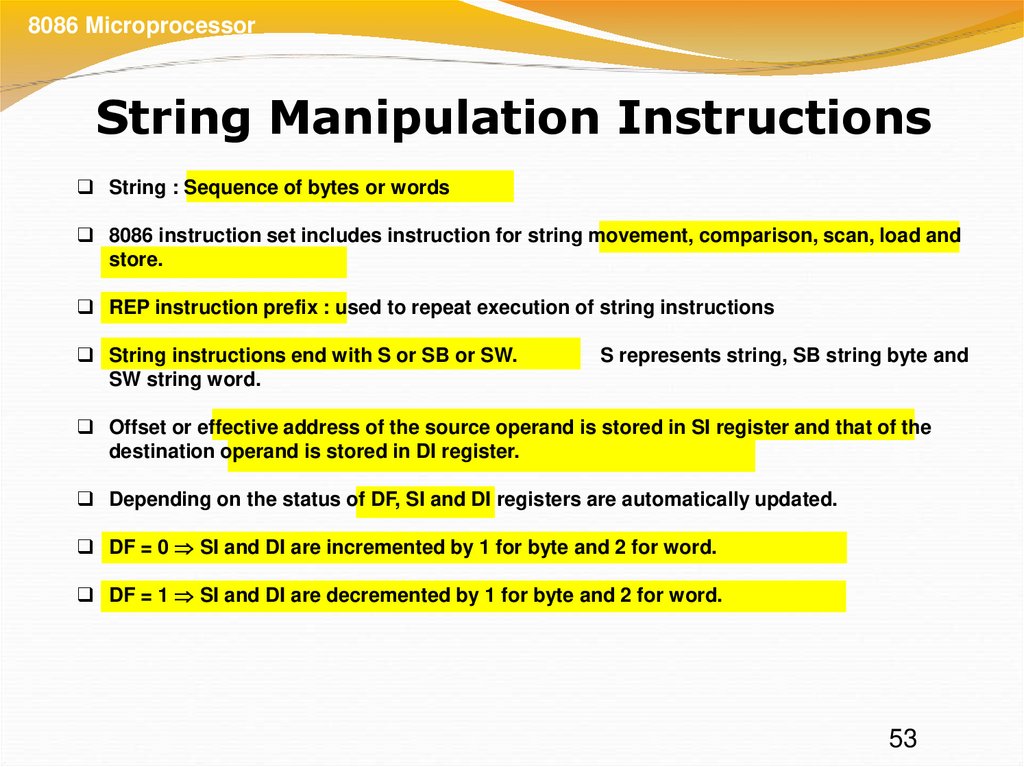
String : Sequence of bytes or words
8086 instruction set includes instruction for string movement, comparison, scan, load and
store.
REP instruction prefix : used to repeat execution of string instructions
String instructions end with S or SB or SW.
SW string word.
S represents string, SB string byte and
Offset or effective address of the source operand is stored in SI register and that of the
destination operand is stored in DI register.
Depending on the status of DF, SI and DI registers are automatically updated.
DF = 0 SI and DI are incremented by 1 for byte and 2 for word.
DF = 1 SI and DI are decremented by 1 for byte and 2 for word.
53
54.
String ManipulationInstructions
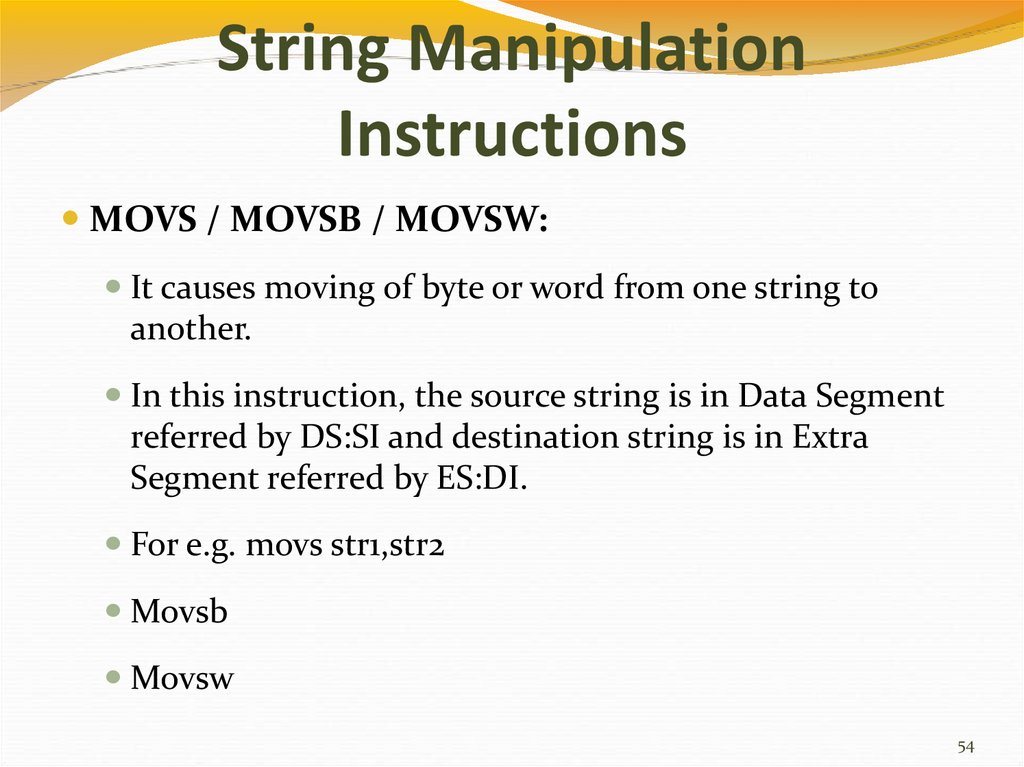
MOVS / MOVSB / MOVSW:
It causes moving of byte or word from one string to
another.
In this instruction, the source string is in Data Segment
referred by DS:SI and destination string is in Extra
Segment referred by ES:DI.
For e.g. movs str1,str2
Movsb
Movsw
54
55.
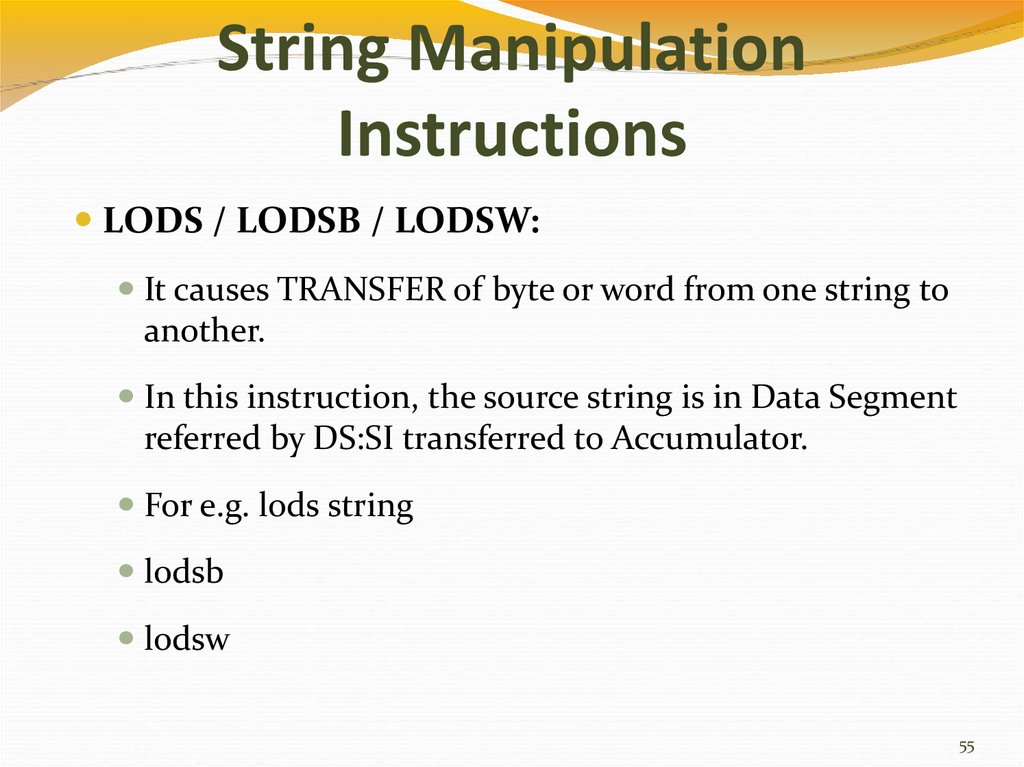
String ManipulationInstructions
LODS / LODSB / LODSW:
It causes TRANSFER of byte or word from one string to
another.
In this instruction, the source string is in Data Segment
referred by DS:SI transferred to Accumulator.
For e.g. lods string
lodsb
lodsw
55
56.
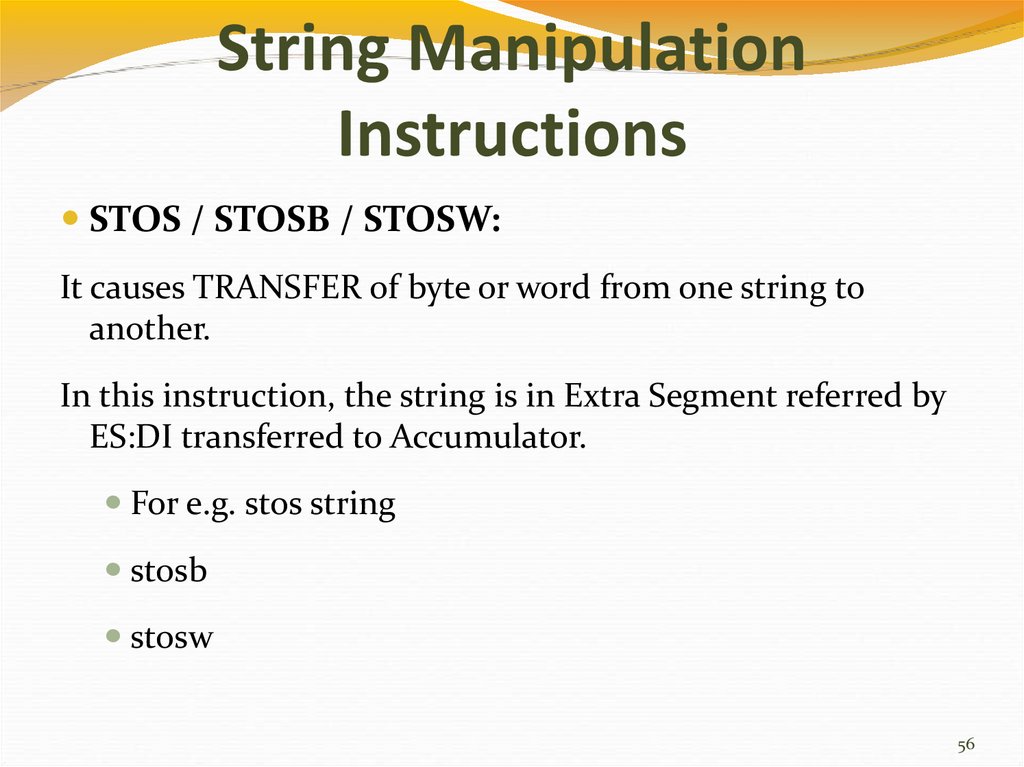
String ManipulationInstructions
STOS / STOSB / STOSW:
It causes TRANSFER of byte or word from one string to
another.
In this instruction, the string is in Extra Segment referred by
ES:DI transferred to Accumulator.
For e.g. stos string
stosb
stosw
56
57.
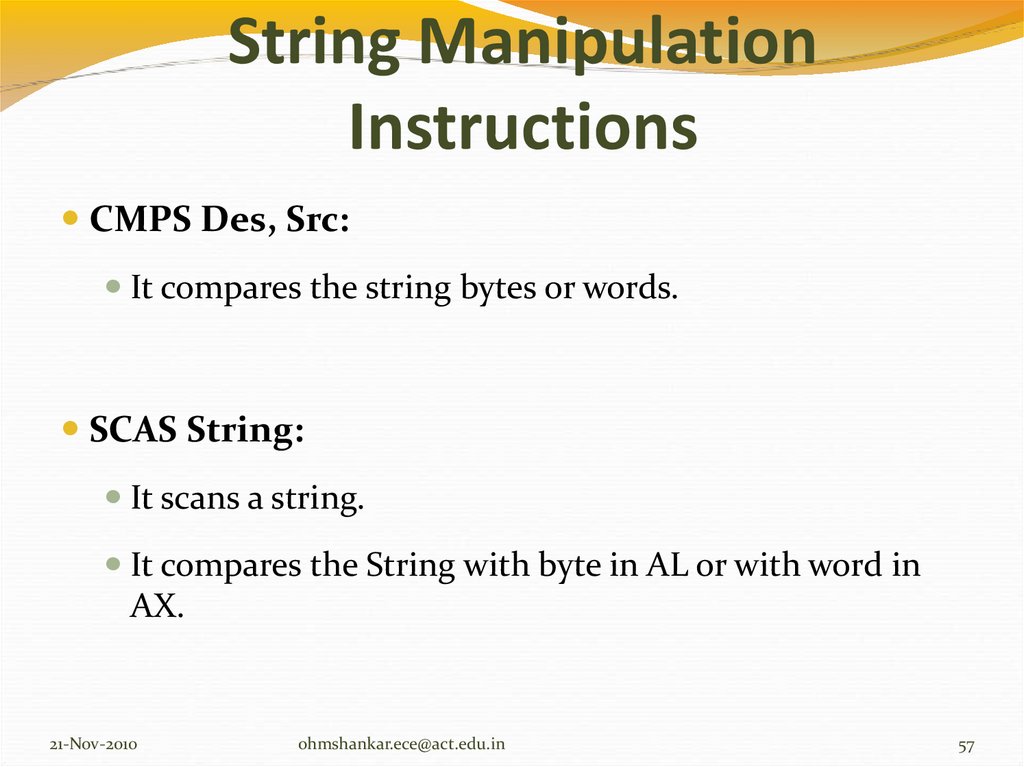
String ManipulationInstructions
CMPS Des, Src:
It compares the string bytes or words.
SCAS String:
It scans a string.
It compares the String with byte in AL or with word in
AX.
21-Nov-2010
ohmshankar.ece@act.edu.in
57
58.
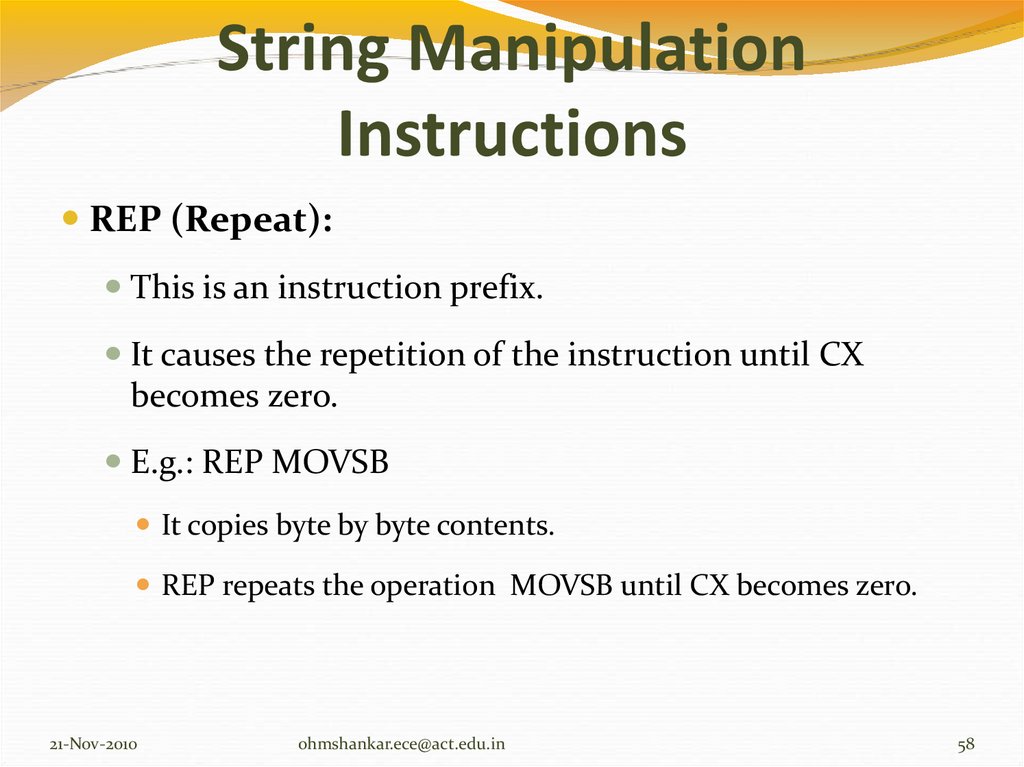
String ManipulationInstructions
REP (Repeat):
This is an instruction prefix.
It causes the repetition of the instruction until CX
becomes zero.
E.g.: REP MOVSB
It copies byte by byte contents.
REP repeats the operation MOVSB until CX becomes zero.
21-Nov-2010
ohmshankar.ece@act.edu.in
58
59.
8086 MicroprocessorString Manipulation
Instructions
REP
REPZ/ REPE
(Repeat CMPS or SCAS
until ZF = 0)
REPNZ/ REPNE
(Repeat CMPS or SCAS
until ZF = 1)
While CX 0 and ZF = 1, repeat execution of
string instruction and
(CX) (CX) – 1
While CX 0 and ZF = 0, repeat execution of
string instruction and
(CX) (CX) - 1
59