







 Интернет
 Информатика
Похожие презентации:






Network Layer. Module 3
1.
RiseAbove
With
Acharya
Uzbekistan
2.
Network LayerModule 3
Uzbekistan
The Network Layer is responsible for data
routing, forwarding, and addressing. It
determines the best physical path for data to
reach its destination based on network
conditions, the priority of service, and other
factors. This layer manages logical
addressing through IP addresses and
handles packet forwarding.
3.
What is a packet?Module 3
Uzbekistan
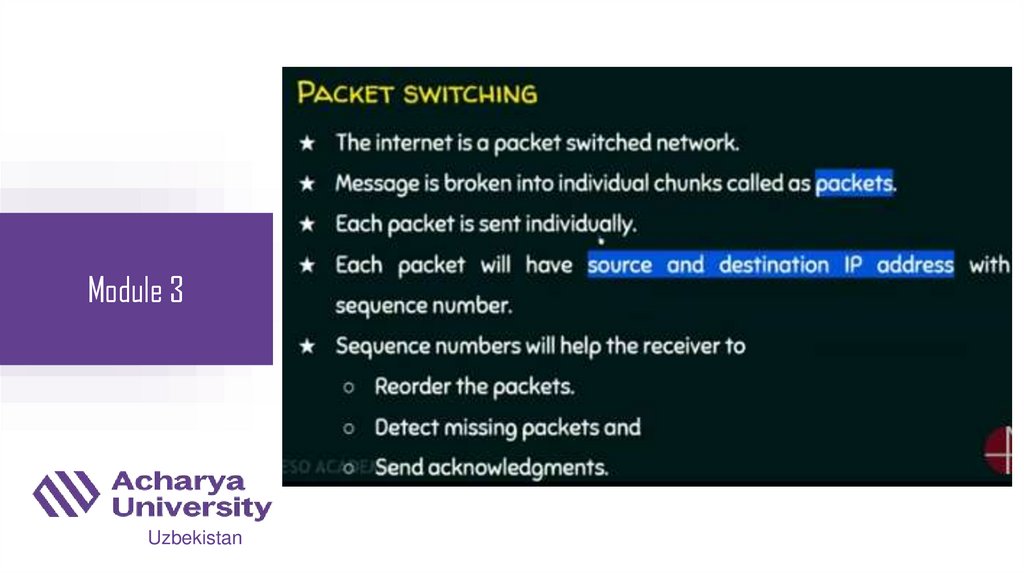
A packet is a unit of data that’s transmitted across a
network. The packet consists of a header, a payload, and
a trailer. The header contains control information, such
as source and destination addresses, identifying value,
and error-checking codes. Inside the payload is the real
data being transmitted. The trailer contains information
to inform the recipient device when it reaches the end of
the packet.
4.
Why is the network layer important?Module 3
The network layer plays a crucial role in the overall functioning of a computer
network. A few reasons why it is important include:
•Addressing and routing: The network layer enables logical addressing,
which allows devices to be uniquely identified on a network. It also
determines the most efficient route for data packets to reach their
destination, considering factors such as network congestion, reliability, and
performance.
•Interconnectivity: The network layer facilitates the interconnection of
different networks, enabling seamless communication and data transfer
between devices and networks that may employ different underlying
technologies.
•End-to-end delivery: The network layer ensures reliable end-to-end
delivery of data packets across multiple networks. It handles packet
fragmentation and reassembly, error detection and correction, and
congestion control mechanisms to optimize data transmission.
Uzbekistan
•Network security: The network layer contributes to network security by
5.
Module 3Uzbekistan
6.
Module 3Uzbekistan
7.
Module 3Uzbekistan
8.
Module 3Uzbekistan
9.
Module 3Uzbekistan
10.
Module 3Uzbekistan
11.
Module 3Uzbekistan
12.
Module 3Uzbekistan
13.
Module 3Uzbekistan
14.
Module 3Uzbekistan
15.
Module 3Uzbekistan
16.
Module 3Uzbekistan
17.
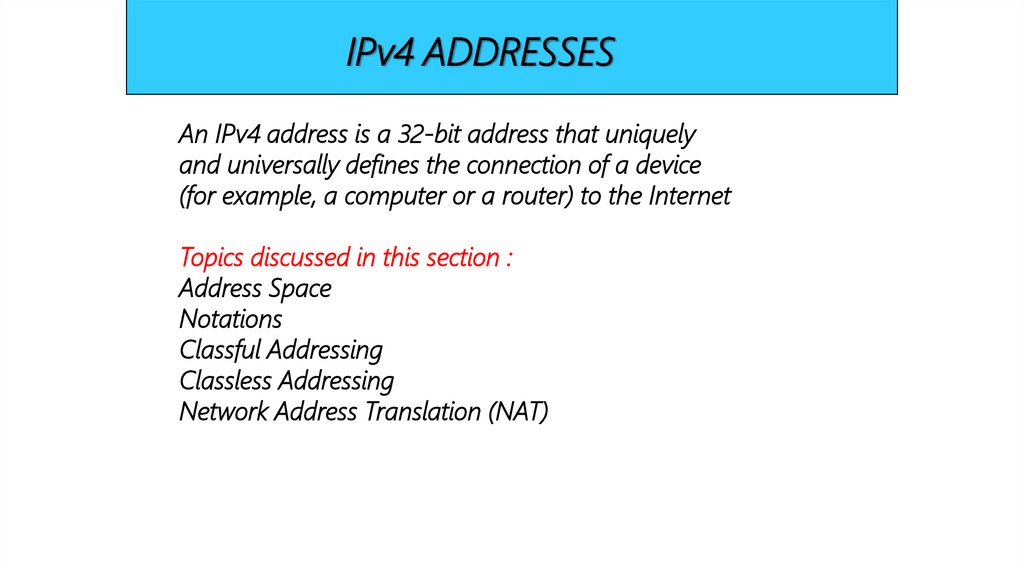
IPv4 ADDRESSESAn IPv4 address is a 32-bit address that uniquely
and universally defines the connection of a device
(for example, a computer or a router) to the Internet
Topics discussed in this section :
Address Space
Notations
Classful Addressing
Classless Addressing
Network Address Translation (NAT)
18.
IPv4 ADDRESSESAn IPv4 address is 32 bits long
19.
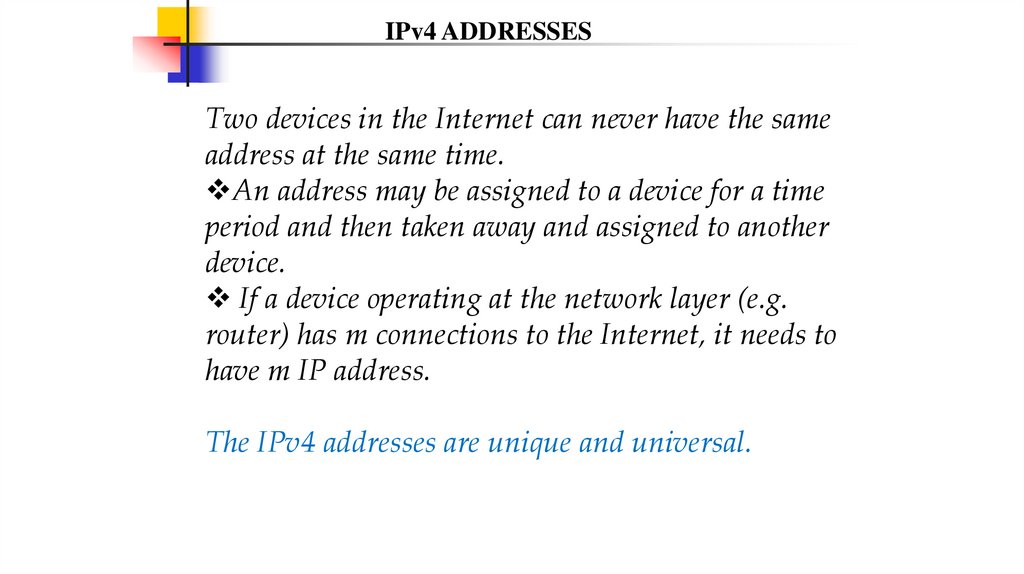
IPv4 ADDRESSESTwo devices in the Internet can never have the same
address at the same time.
An address may be assigned to a device for a time
period and then taken away and assigned to another
device.
If a device operating at the network layer (e.g.
router) has m connections to the Internet, it needs to
have m IP address.
The IPv4 addresses are unique and universal.
20.
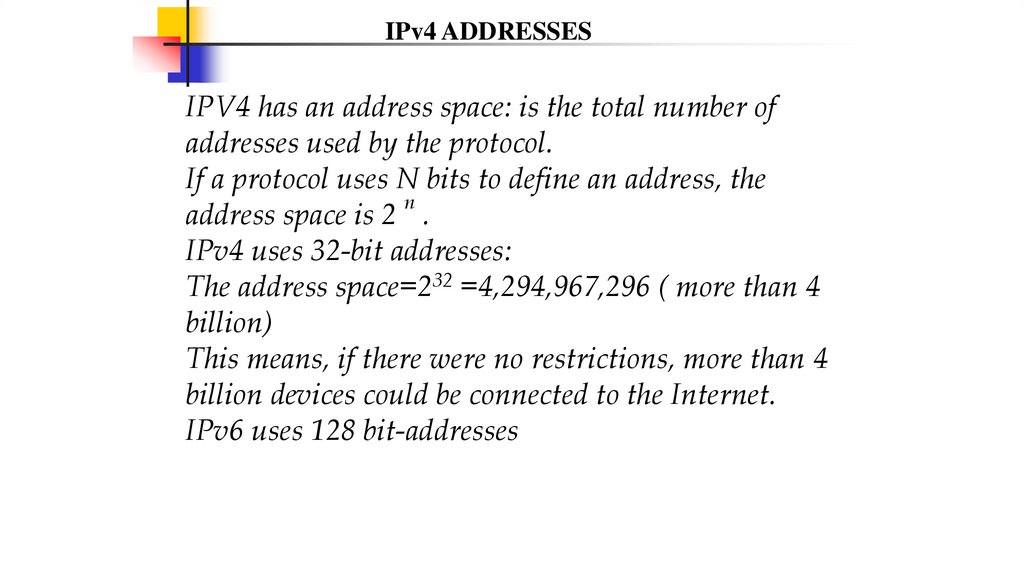
IPv4 ADDRESSESIPV4 has an address space: is the total number of
addresses used by the protocol.
If a protocol uses N bits to define an address, the
n
address space is 2 .
IPv4 uses 32-bit addresses:
The address space=232 =4,294,967,296 ( more than 4
billion)
This means, if there were no restrictions, more than 4
billion devices could be connected to the Internet.
IPv6 uses 128 bit-addresses
21.
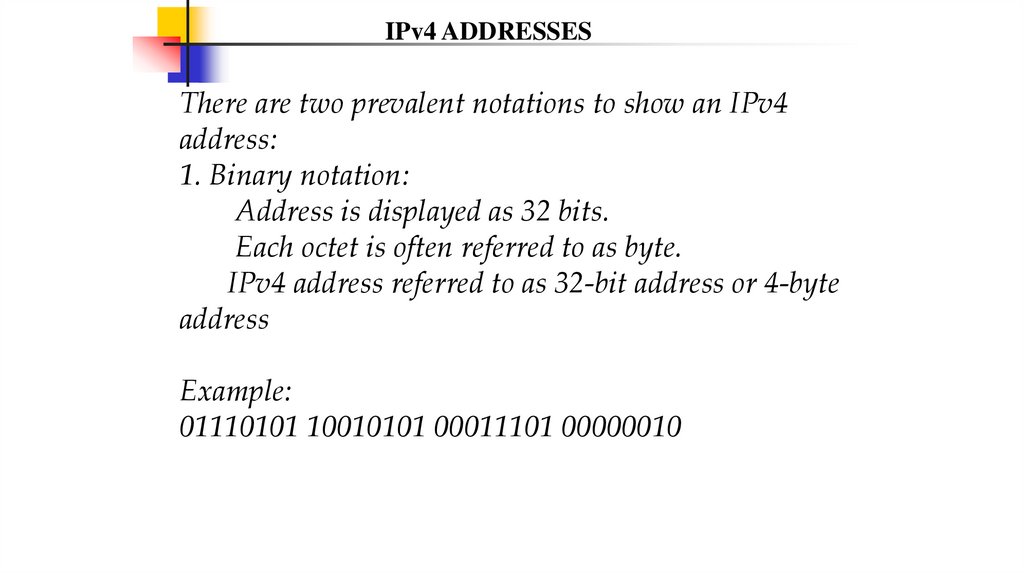
IPv4 ADDRESSESThere are two prevalent notations to show an IPv4
address:
1. Binary notation:
Address is displayed as 32 bits.
Each octet is often referred to as byte.
IPv4 address referred to as 32-bit address or 4-byte
address
Example:
01110101 10010101 00011101 00000010
22.
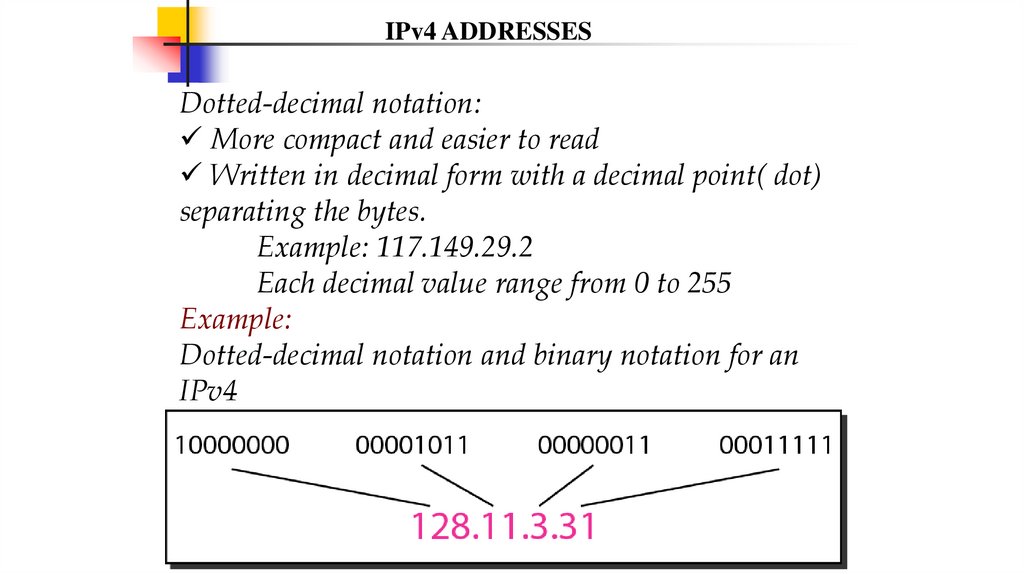
IPv4 ADDRESSESDotted-decimal notation:
More compact and easier to read
Written in decimal form with a decimal point( dot)
separating the bytes.
Example: 117.149.29.2
Each decimal value range from 0 to 255
Example:
Dotted-decimal notation and binary notation for an
IPv4
address
23.
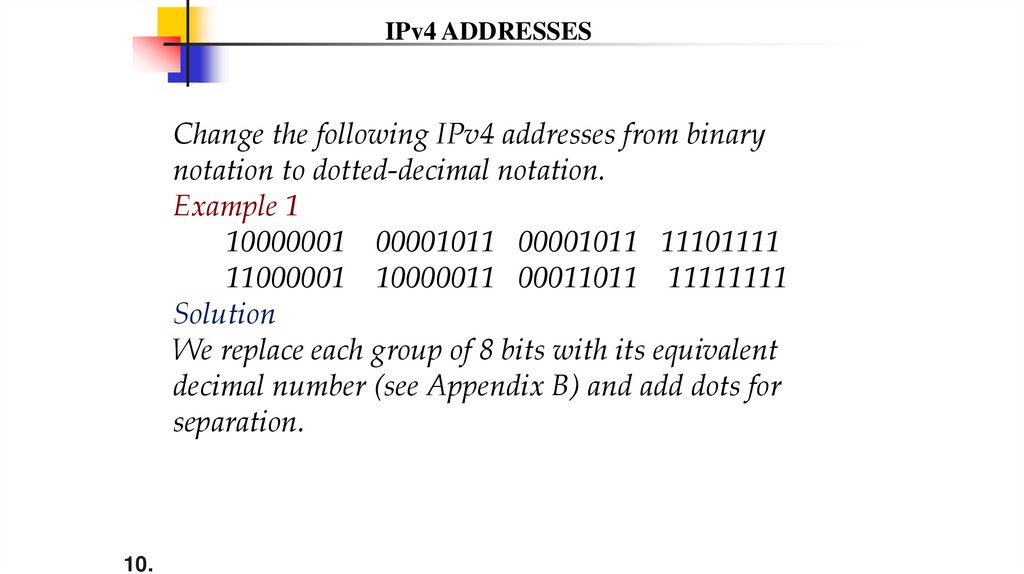
IPv4 ADDRESSESChange the following IPv4 addresses from binary
notation to dotted-decimal notation.
Example 1
10000001 00001011 00001011 11101111
11000001 10000011 00011011 11111111
Solution
We replace each group of 8 bits with its equivalent
decimal number (see Appendix B) and add dots for
separation.
10.
24.
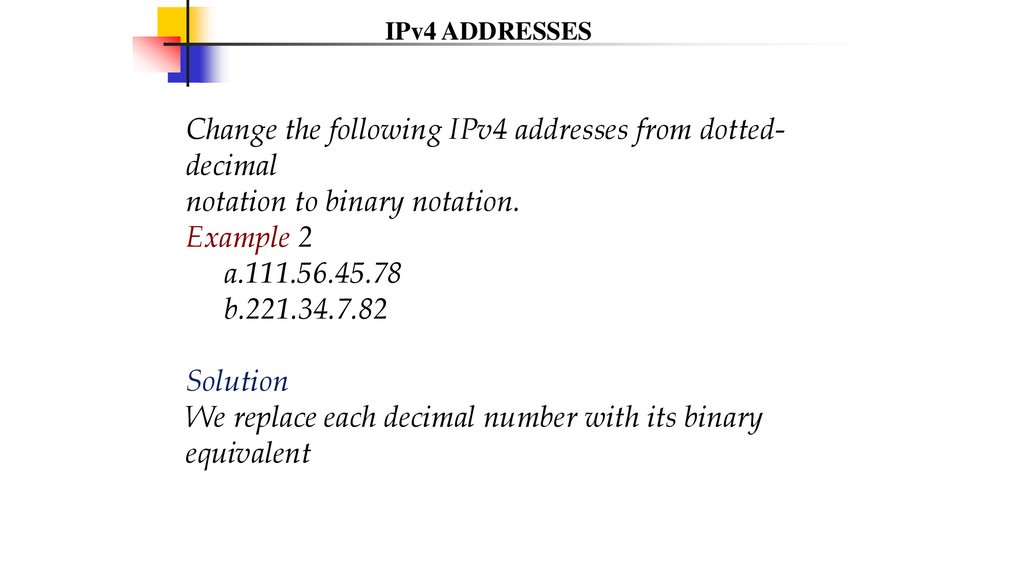
IPv4 ADDRESSESChange the following IPv4 addresses from dotteddecimal
notation to binary notation.
Example 2
a.111.56.45.78
b.221.34.7.82
Solution
We replace each decimal number with its binary
equivalent
25.
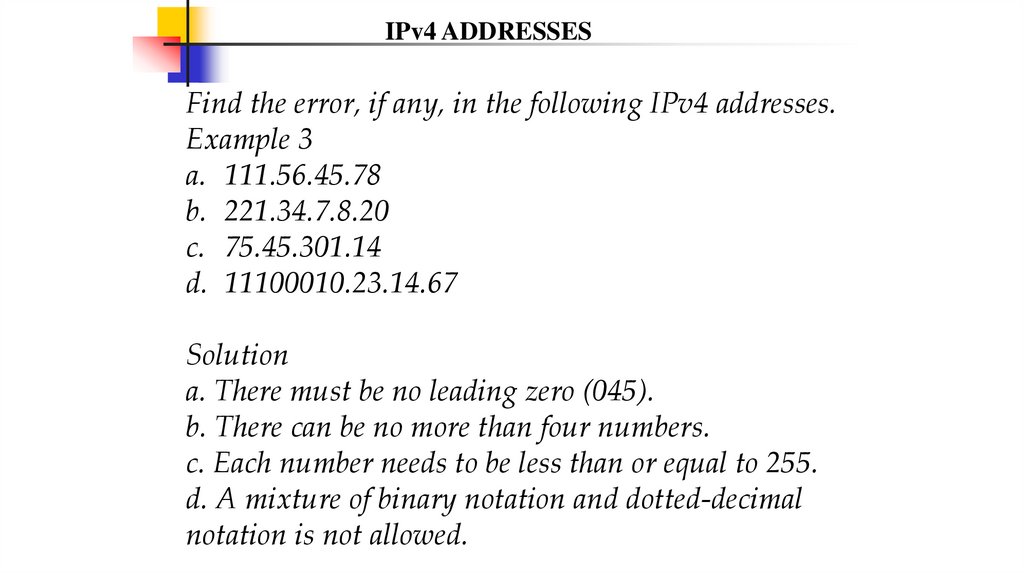
IPv4 ADDRESSESFind the error, if any, in the following IPv4 addresses.
Example 3
a. 111.56.45.78
b. 221.34.7.8.20
c. 75.45.301.14
d. 11100010.23.14.67
Solution
a. There must be no leading zero (045).
b. There can be no more than four numbers.
c. Each number needs to be less than or equal to 255.
d. A mixture of binary notation and dotted-decimal
notation is not allowed.
26.
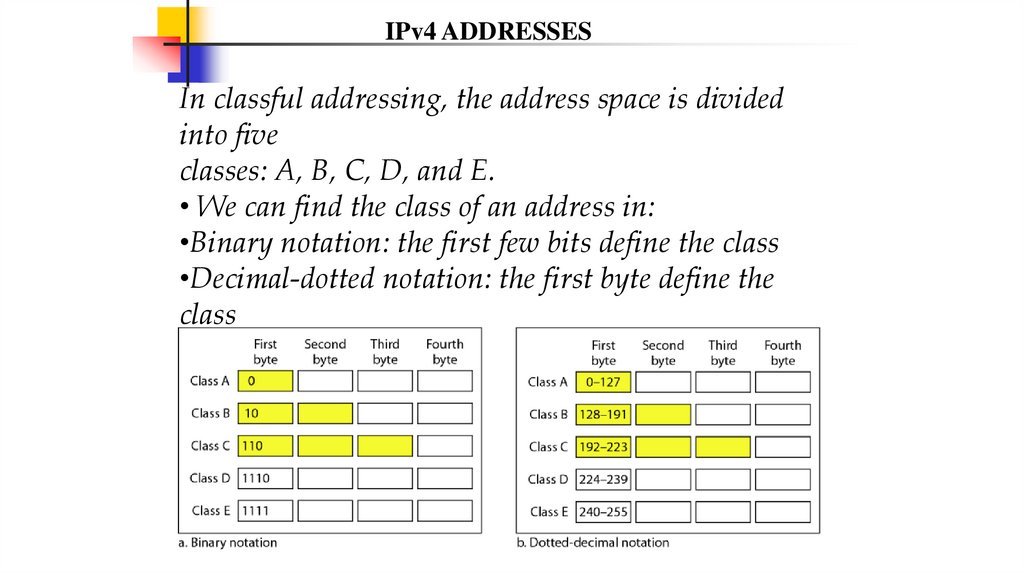
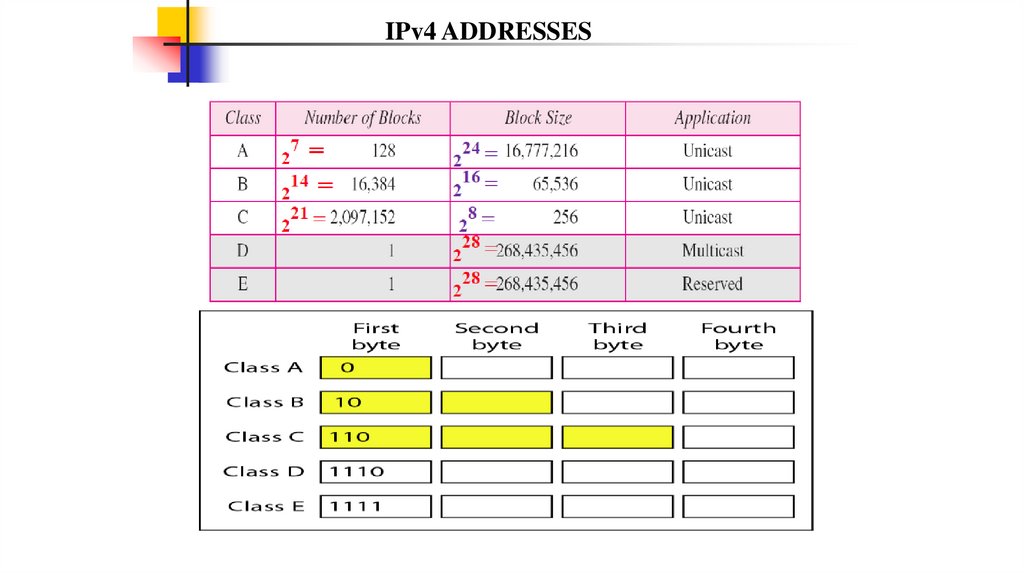
IPv4 ADDRESSESIn classful addressing, the address space is divided
into five
classes: A, B, C, D, and E.
• We can find the class of an address in:
•Binary notation: the first few bits define the class
•Decimal-dotted notation: the first byte define the
class
27.
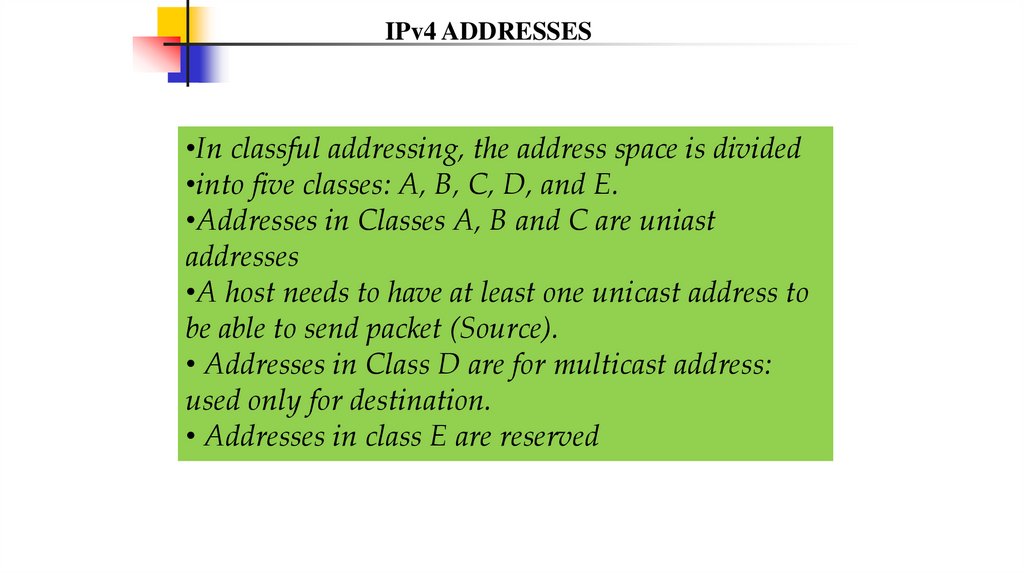
IPv4 ADDRESSES•In classful addressing, the address space is divided
•into five classes: A, B, C, D, and E.
•Addresses in Classes A, B and C are uniast
addresses
•A host needs to have at least one unicast address to
be able to send packet (Source).
• Addresses in Class D are for multicast address:
used only for destination.
• Addresses in class E are reserved
28.
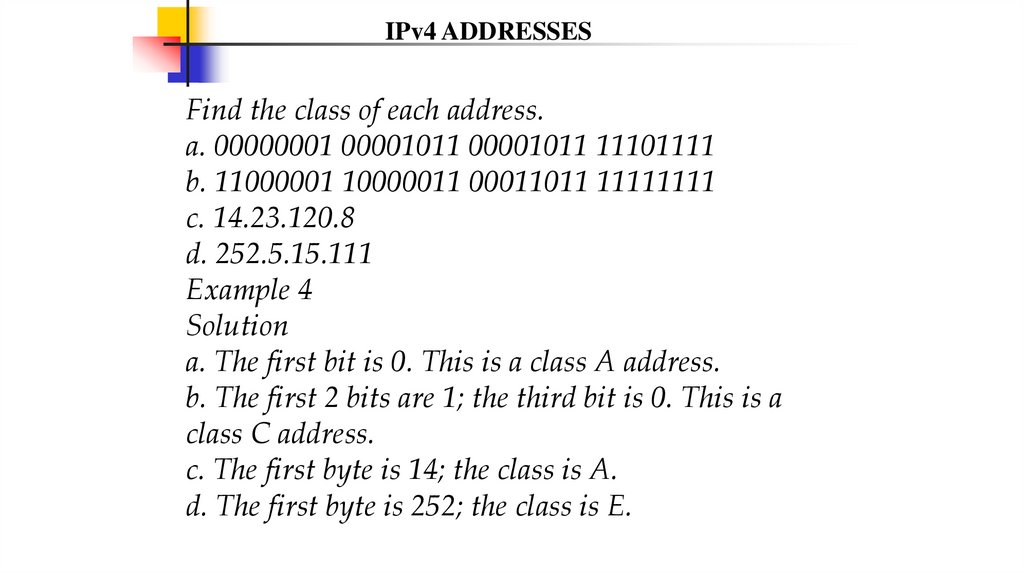
IPv4 ADDRESSESFind the class of each address.
a. 00000001 00001011 00001011 11101111
b. 11000001 10000011 00011011 11111111
c. 14.23.120.8
d. 252.5.15.111
Example 4
Solution
a. The first bit is 0. This is a class A address.
b. The first 2 bits are 1; the third bit is 0. This is a
class C address.
c. The first byte is 14; the class is A.
d. The first byte is 252; the class is E.
29.
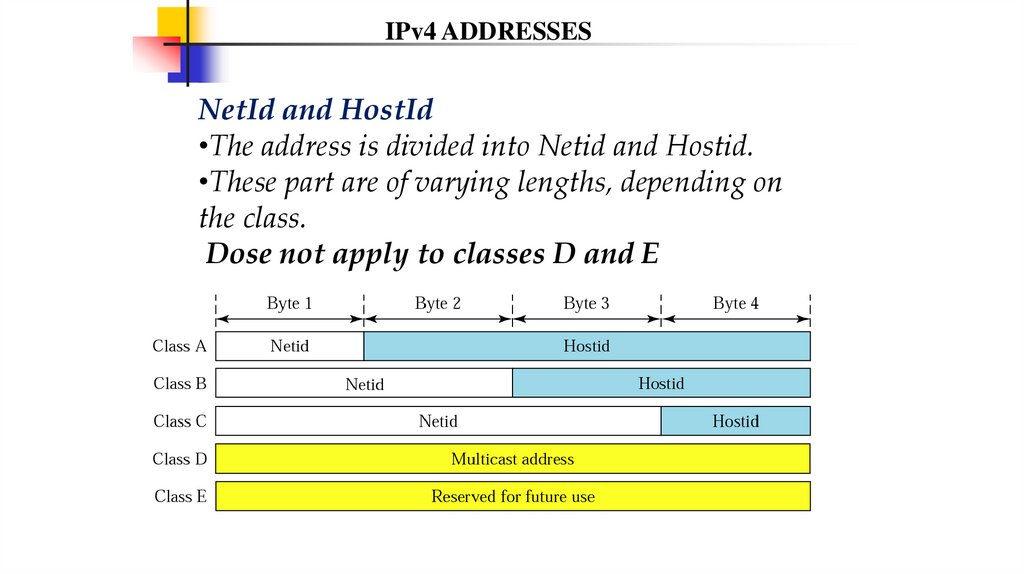
IPv4 ADDRESSESNetId and HostId
•The address is divided into Netid and Hostid.
•These part are of varying lengths, depending on
the class.
Dose not apply to classes D and E
30.
IPv4 ADDRESSES31.
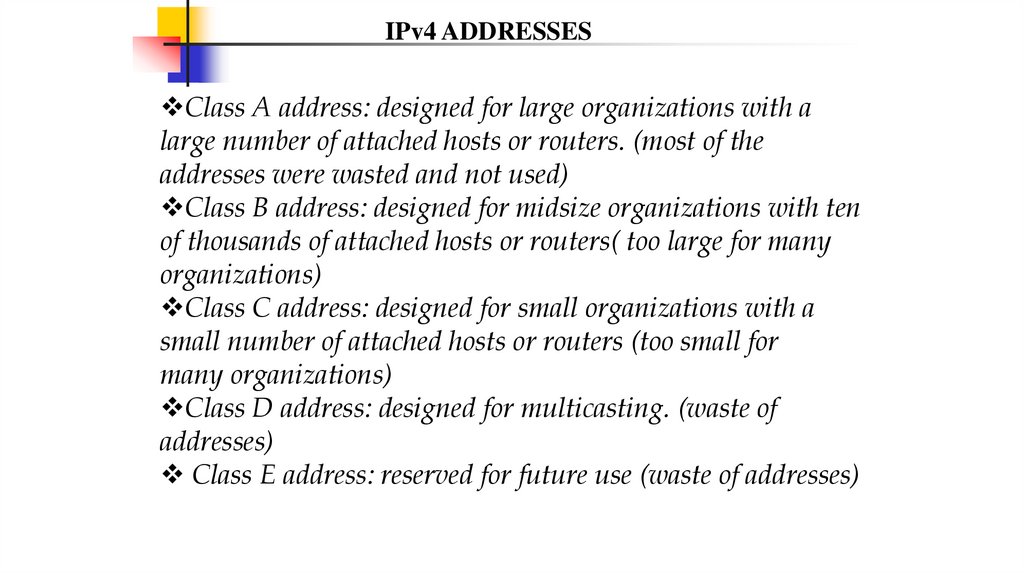
IPv4 ADDRESSESClass A address: designed for large organizations with a
large number of attached hosts or routers. (most of the
addresses were wasted and not used)
Class B address: designed for midsize organizations with ten
of thousands of attached hosts or routers( too large for many
organizations)
Class C address: designed for small organizations with a
small number of attached hosts or routers (too small for
many organizations)
Class D address: designed for multicasting. (waste of
addresses)
Class E address: reserved for future use (waste of addresses)
32.
IPv4 ADDRESSESOne problem is that each class is divided into fixed
number of blocks with each block having a fixed size
In classfull addressing, a large
part of the available addresses
were wasted.
33.
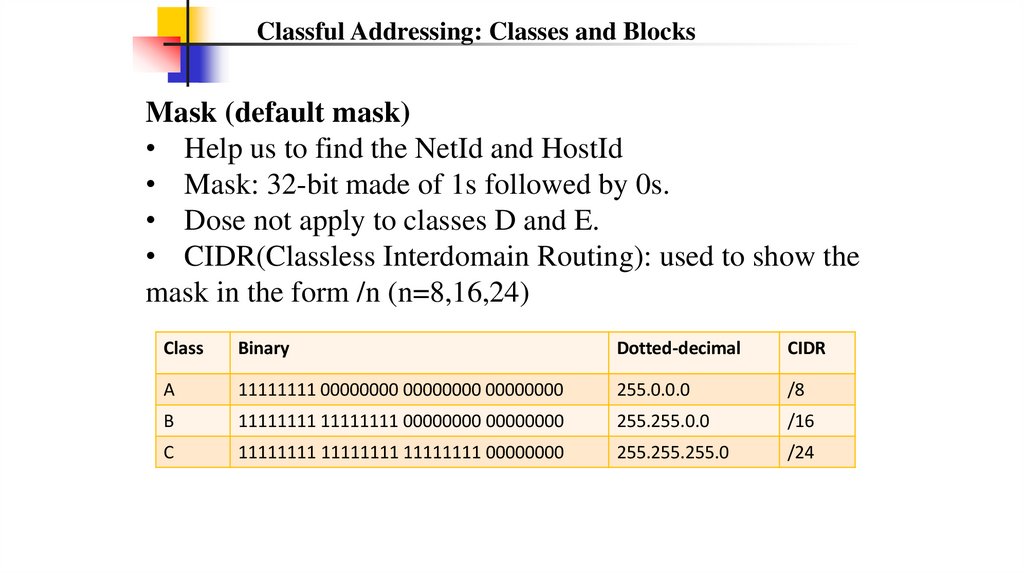
Classful Addressing: Classes and BlocksMask (default mask)
• Help us to find the NetId and HostId
• Mask: 32-bit made of 1s followed by 0s.
• Dose not apply to classes D and E.
• CIDR(Classless Interdomain Routing): used to show the
mask in the form /n (n=8,16,24)
Class
Binary
Dotted-decimal
CIDR
A
11111111 00000000 00000000 00000000
255.0.0.0
/8
B
11111111 11111111 00000000 00000000
255.255.0.0
/16
C
11111111 11111111 11111111 00000000
255.255.255.0
/24
34.
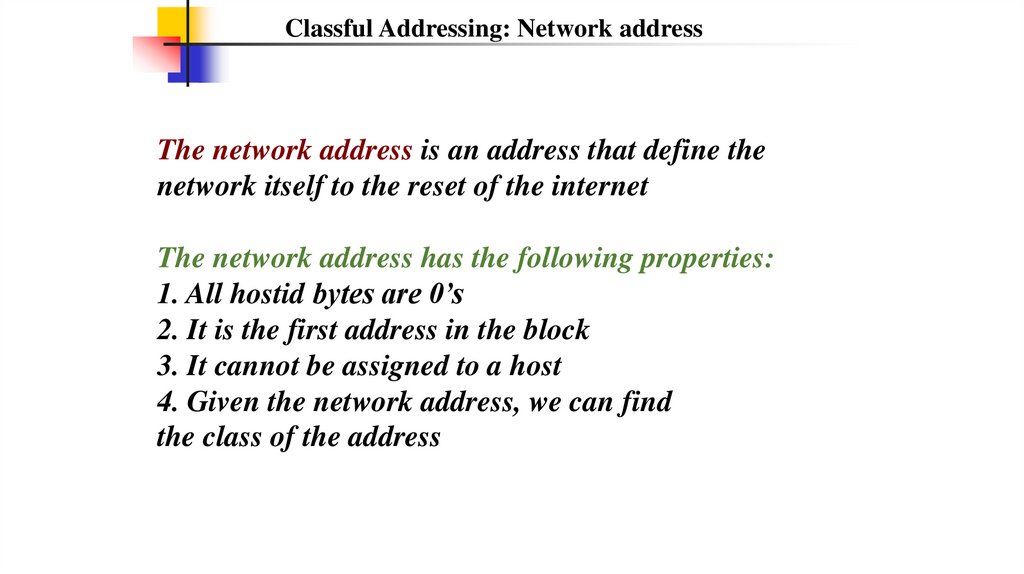
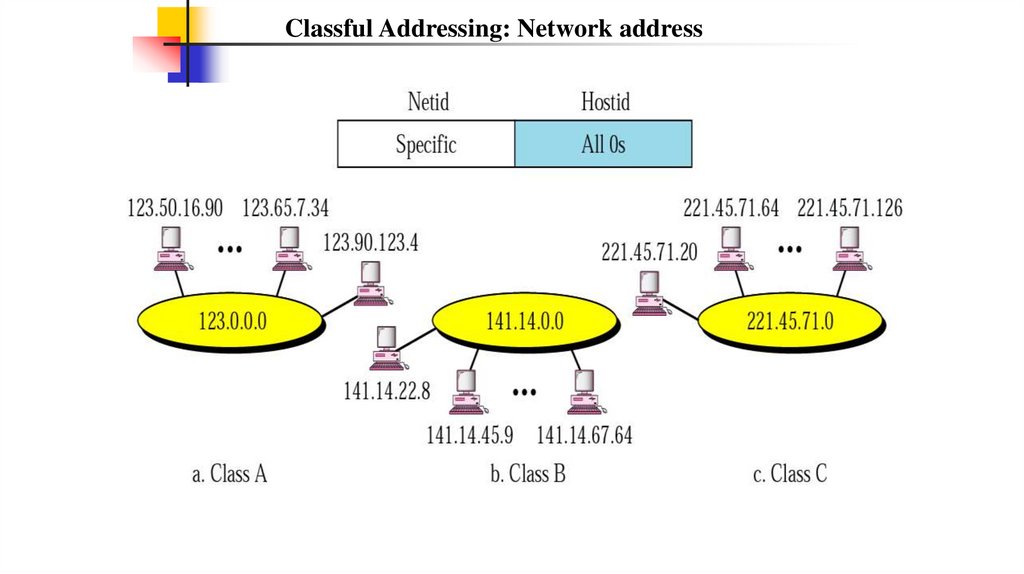
Classful Addressing: Network addressThe network address is an address that define the
network itself to the reset of the internet
The network address has the following properties:
1. All hostid bytes are 0’s
2. It is the first address in the block
3. It cannot be assigned to a host
4. Given the network address, we can find
the class of the address
35.
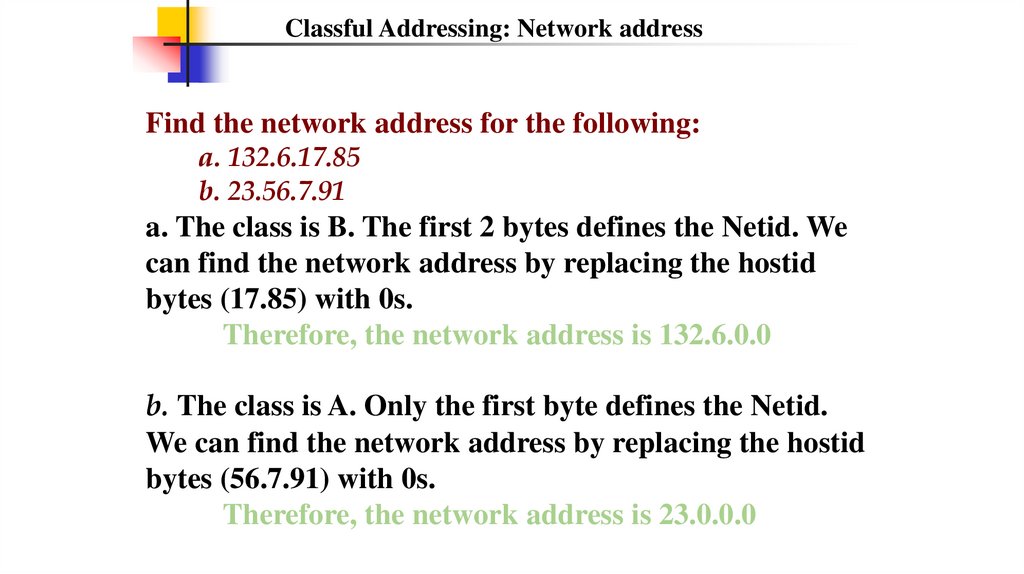
Classful Addressing: Network addressFind the network address for the following:
a. 132.6.17.85
b. 23.56.7.91
a. The class is B. The first 2 bytes defines the Netid. We
can find the network address by replacing the hostid
bytes (17.85) with 0s.
Therefore, the network address is 132.6.0.0
b. The class is A. Only the first byte defines the Netid.
We can find the network address by replacing the hostid
bytes (56.7.91) with 0s.
Therefore, the network address is 23.0.0.0
36.
Classful Addressing: Network address37.
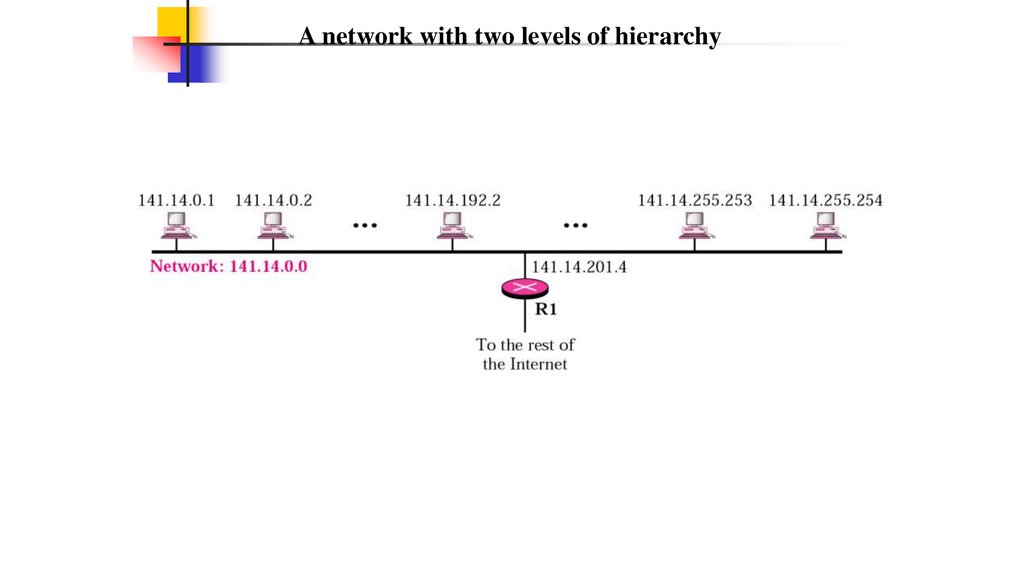
Classful addressing : subnettingIP addresses are designed with two
levels of hierarchy.
38.
A network with two levels of hierarchy39.
Classful Addressing:Subnetting
If an organization was granted a large block in classes A or B
It could divide the addresses into several contiguous groups
and assign each group to smaller networks ( subnets)
It increases the number of 1s in the mask
• Number of 1s in a subnet mask is more than the number of 1s
in the corresponding mask.
• To make a subnet mask , we change some of the leftmost 0s in
mask to 1s
The number of subnets is determine by the number of extra1s.
n
• If the number of extra 1 is n, the number of subnets is 2 .
• If the number of subnets is N, the number of extra 1s is log2N
40.
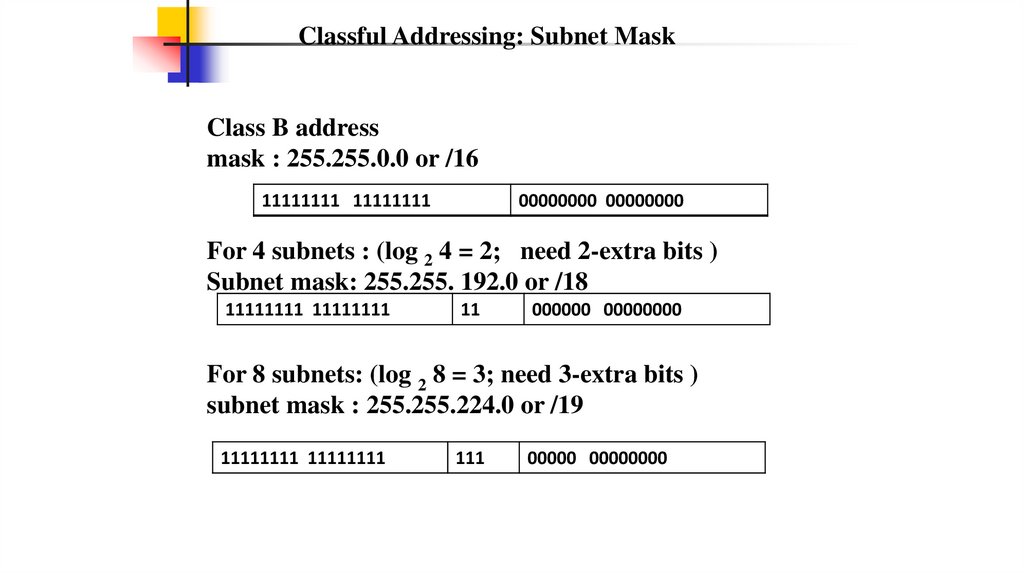
Classful Addressing: Subnet MaskClass B address
mask : 255.255.0.0 or /16
11111111 11111111
00000000 00000000
For 4 subnets : (log 2 4 = 2; need 2-extra bits )
Subnet mask: 255.255. 192.0 or /18
11111111 11111111
11
000000 00000000
For 8 subnets: (log 2 8 = 3; need 3-extra bits )
subnet mask : 255.255.224.0 or /19
11111111 11111111
111
00000 00000000
41.
Classful Addressing:Subnetting
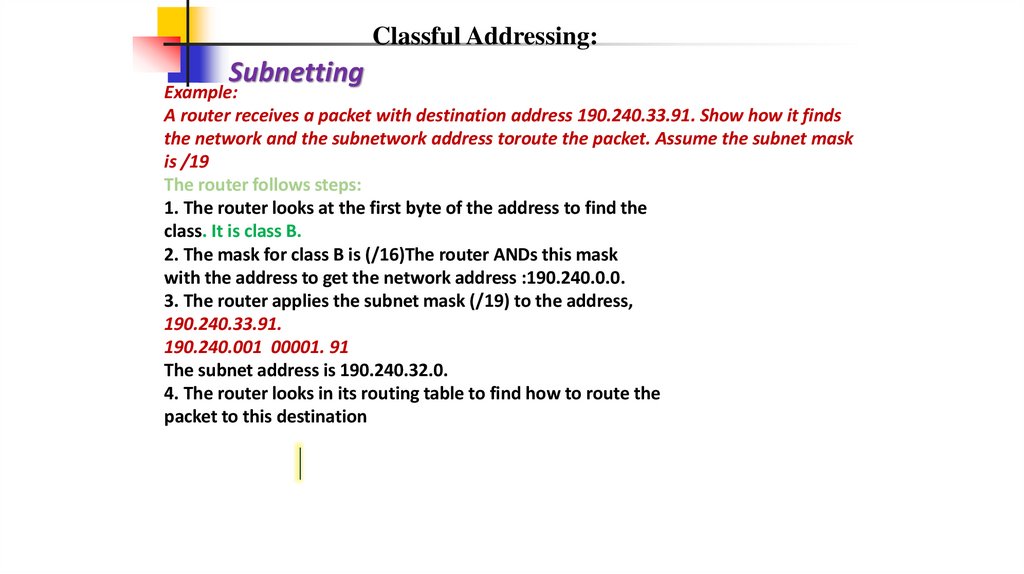
Example:
A router receives a packet with destination address 190.240.33.91. Show how it finds
the network and the subnetwork address toroute the packet. Assume the subnet mask
is /19
The router follows steps:
1. The router looks at the first byte of the address to find the
class. It is class B.
2. The mask for class B is (/16)The router ANDs this mask
with the address to get the network address :190.240.0.0.
3. The router applies the subnet mask (/19) to the address,
190.240.33.91.
190.240.001 00001. 91
The subnet address is 190.240.32.0.
4. The router looks in its routing table to find how to route the
packet to this destination
42.
Classful Addressingsupernetting
Huge demand for midsize blocks.
• Although class A and B addresses are almost depleted, class C addresses are still
available( size of block= 256 address did not satisfy the needs).
• In supernetting, an organization can combine several class C blocks to create a
larger range of addresses.
• Several networks are combined to create a supernetwork (
supernet). e.g. Organization needs 1000 address can be granted 4 contiguous class C
blocks to create one supernetwork.
Decreases the number of 1s in the mask. E.g. The mask changes from /24 to /22
for 4 class C block
43.
Classful Addressing: supernettingAddress Depletion
Near depletion of the available address because of the fast growth of the
Internet.
Run out of classes A and B address.
Classes C block is too small for most mid size organizations.
Solution: Classless addressing
44.
Module 3Uzbekistan
45.
Module 3Uzbekistan
46.
Module 3Uzbekistan
47.
Module 3Uzbekistan
48.
Module 3Uzbekistan
49.
Module 3Uzbekistan
50.
Module 3Uzbekistan
51.
Module 3Uzbekistan
52.
Module 3Uzbekistan
53.
Module 3Uzbekistan
54.
Module 3Uzbekistan
55.
Module 3Uzbekistan
56.
Module 3Uzbekistan
57.
Module 3Uzbekistan
58.
Module 3Uzbekistan
59.
Module 3Uzbekistan
60.
Module 3Uzbekistan
61.
Module 3Uzbekistan
62.
Module 3Uzbekistan
63.
Module 3Uzbekistan
64.
Module 3Uzbekistan
65.
Module 3Uzbekistan
66.
Module 3Uzbekistan
67.
Module 3Uzbekistan
68.
Module 3Uzbekistan
69.
Module 3Uzbekistan
70.
Module 3Uzbekistan
71.
Module 3Uzbekistan
72.
Module 3Uzbekistan
73.
Module 3Uzbekistan