
 Информатика
Похожие презентации:



Types of Computers. A Detailed Overview
1.
Types of ComputersA Detailed Overview
Presented by: Asanhodzaev Daud
Date: 28:05:2025
2.
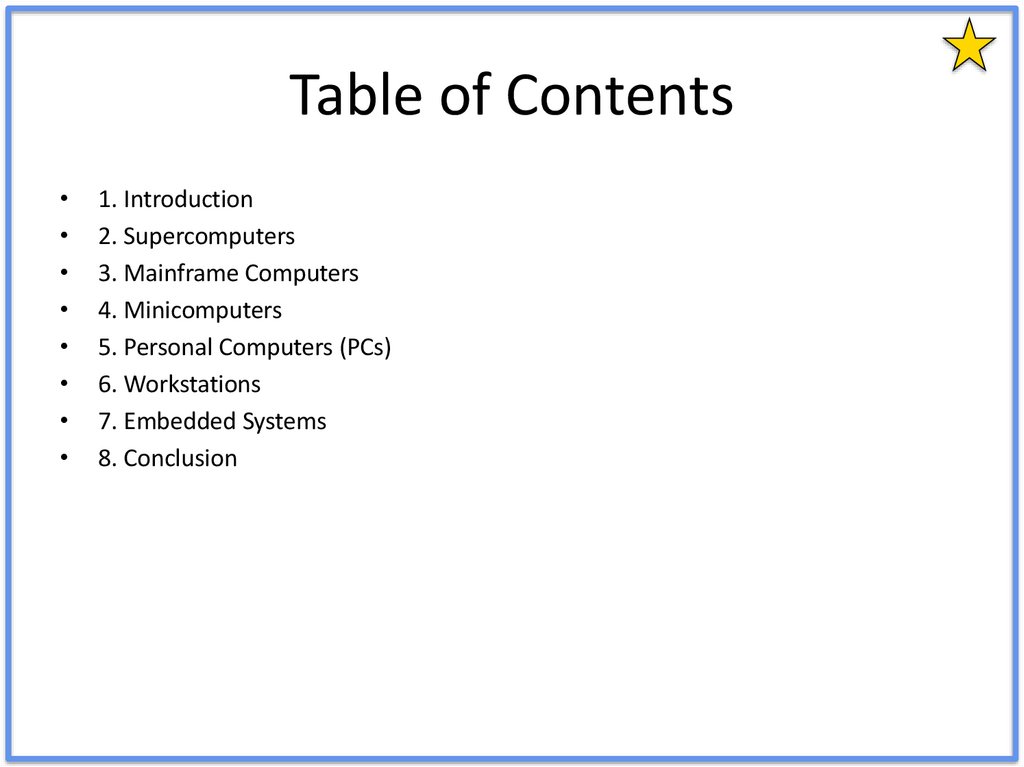
Table of Contents1. Introduction
2. Supercomputers
3. Mainframe Computers
4. Minicomputers
5. Personal Computers (PCs)
6. Workstations
7. Embedded Systems
8. Conclusion
3.
Introduction• Computers are versatile machines that process data and perform tasks.
• They are classified based on performance, size, and usage.
• From massive supercomputers to tiny embedded systems, each has a unique
role.
• Understanding these types helps in choosing the right system for different needs.
4.
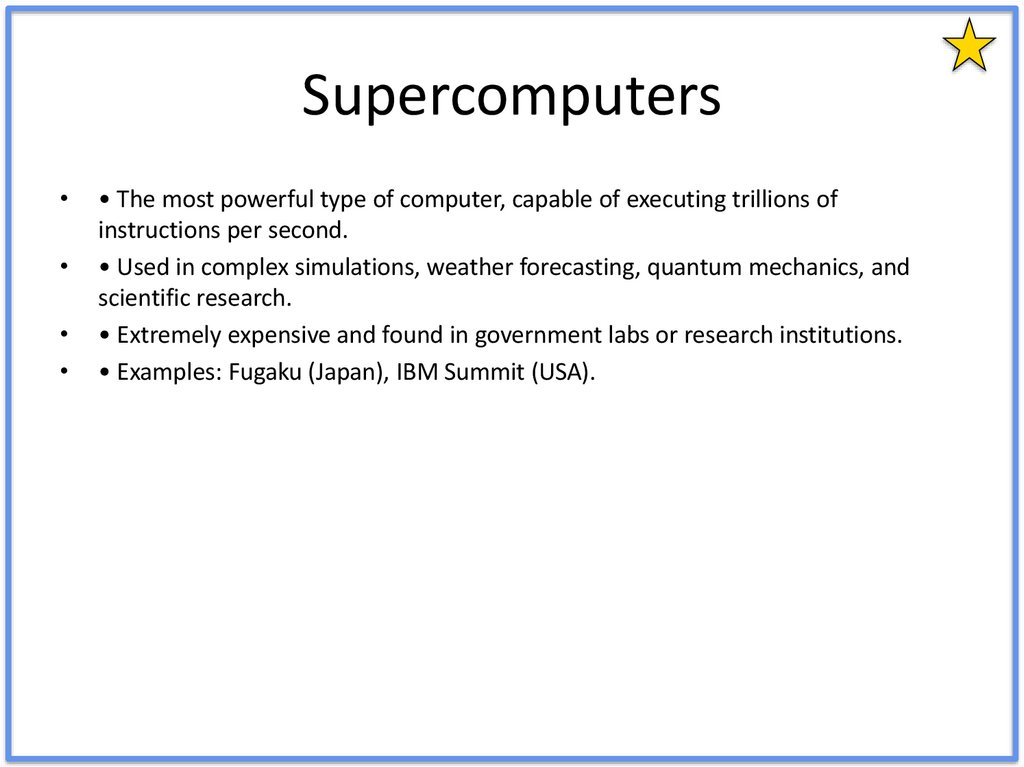
Supercomputers• The most powerful type of computer, capable of executing trillions of
instructions per second.
• Used in complex simulations, weather forecasting, quantum mechanics, and
scientific research.
• Extremely expensive and found in government labs or research institutions.
• Examples: Fugaku (Japan), IBM Summit (USA).
5.
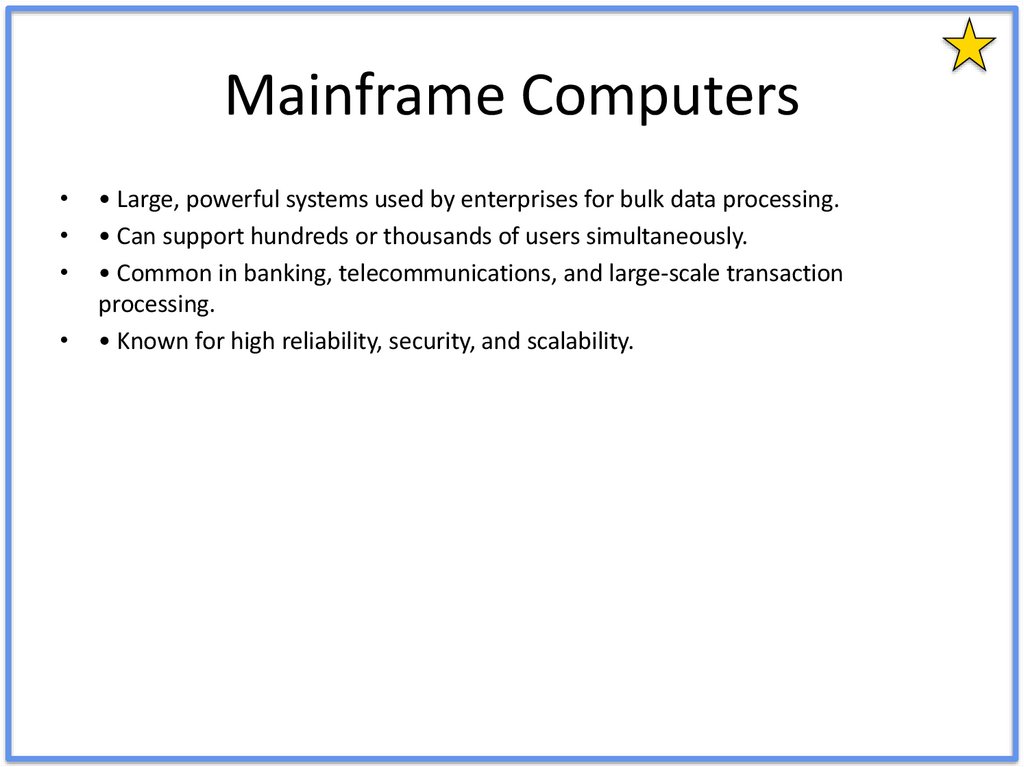
Mainframe Computers• Large, powerful systems used by enterprises for bulk data processing.
• Can support hundreds or thousands of users simultaneously.
• Common in banking, telecommunications, and large-scale transaction
processing.
• Known for high reliability, security, and scalability.
6.
Minicomputers• Also known as mid-range computers.
• Smaller than mainframes but larger than personal computers.
• Used in manufacturing plants, laboratories, and business environments.
• Often used for specific tasks such as process control or database management.
7.
Personal Computers (PCs)• The most common type used by individuals.
• Includes desktops, laptops, and tablets.
• Designed for general-purpose use: internet browsing, document editing, gaming,
etc.
• Affordable and user-friendly, widely used in homes and offices.
8.
Workstations• High-performance computers for technical or scientific applications.
• Used by engineers, architects, software developers, and animators.
• Have powerful CPUs, large RAM, and specialized graphic cards.
• Designed for multitasking and intensive computing tasks.
9.
Embedded Systems• Specialized computers integrated into larger systems.
• Perform dedicated functions with limited computing resources.
• Found in everyday devices: washing machines, cars, ATMs, and medical
equipment.
• Typically not directly interacted with by users.
10.
Conclusion• Computers vary widely in function, size, and performance.
• From supercomputers to embedded systems, each type is tailored to specific
needs.
• Understanding computer types is essential in today's digital world.
• The right type ensures efficiency, scalability, and proper performance.
11.
Questions?Thank you for your attention!
Do you have any questions or comments?