
 Английский язык
Похожие презентации:







IELTS Reading
1. IELTS Reading
Matching Info, Sentence Completion2.
3.
Reading Passage has eight sections, A-H.Which paragraph contains the following information?
Write the correct letter, A-H, in boxes 1-6 on your answer sheet
NB You may use any letter more than once.
1 an acceptance that not all diseases can be totally eliminated
2 examples of physical conditions caused by human behaviour
3 a reference to classifying diseases on the basis of how far they extend
geographically
4 reasons why the level of access to healthcare can vary within a country
5 a description of health geography as a mixture of different academic fields
6 a description of the type of area where a particular illness is rare
4.
A While many diseases that affect humans have beeneradicated due to improvements in vaccinations and the
availability of healthcare, there are still areas around the
world where certain health issues are more prevalent. In a
world that is far more globalised than ever before, people
come into contact with one another through travel and
living closer and closer to each other. As a result, superviruses and other infections resistant to antibiotics are
becoming more and more common.
B Geography can often play a very large role in the health
concerns of certain populations. For instance, depending
on where you live, you will not have the same health
concerns as someone who lives in a different
geographical region. Perhaps one of the most obvious
examples of this idea is malaria-prone areas, which are
usually tropical regions that foster a warm and damp
environment in which the mosquitos that can give people
this disease can grew. Malaria is much less of a problem
in high-altitude deserts, for instance.
NB You may use any letter more than once.
1 an acceptance that not all diseases can be
totally eliminated
2 examples of physical conditions caused by
human behaviour
3 a reference to classifying diseases on the
basis of how far they extend geographically
4 reasons why the level of access to healthcare
can vary within a country
5 a description of health geography as a
mixture of different academic fields
6 a description of the type of area where a
particular illness is rare
5.
C In some countries, geographical factors influencethe health and well-being of the population in very
obvious ways. In many large cities, the wind is not
strong enough to clear the air of the massive amounts
of smog and pollution that cause asthma, lung
problems, eyesight issues and more in the people who
live there. Part of the problem is, of course, the
massive number of cars being driven, in addition to
factories that run on coal power. The rapid
industrialisation of some countries in recent years has
also led to the cutting down of forests to allow for the
expansion of big cities, which makes it even harder to
fight the pollution with the fresh air that is produced by
plants.
NB You may use any letter more than once.
1 an acceptance that not all diseases can be
totally eliminated
2 examples of physical conditions caused by
human behaviour
3 a reference to classifying diseases on the
basis of how far they extend geographically
4 reasons why the level of access to healthcare
can vary within a country
5 a description of health geography as a
mixture of different academic fields
6 a description of the type of area where a
particular illness is rare B
6.
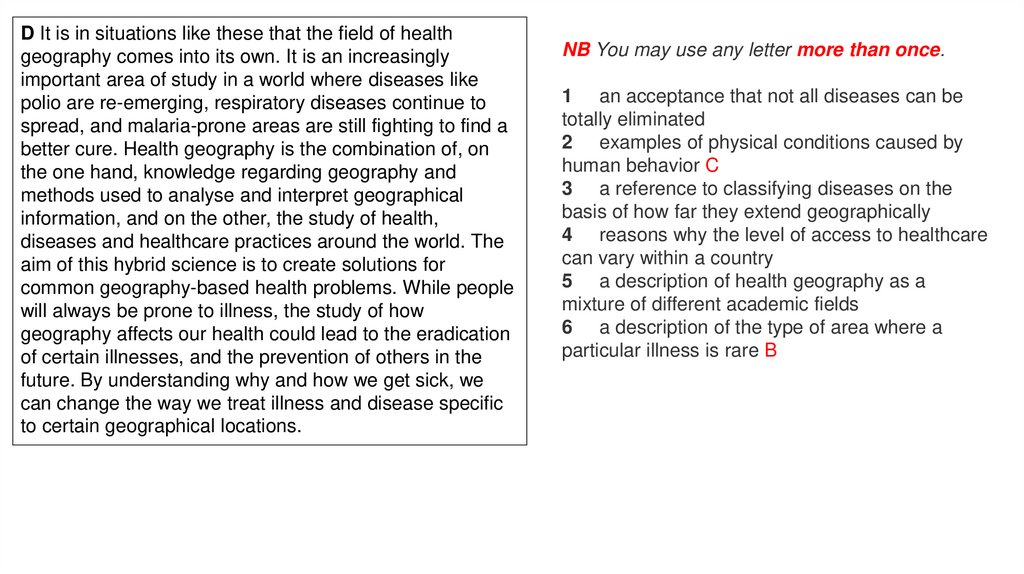
D It is in situations like these that the field of healthgeography comes into its own. It is an increasingly
important area of study in a world where diseases like
polio are re-emerging, respiratory diseases continue to
spread, and malaria-prone areas are still fighting to find a
better cure. Health geography is the combination of, on
the one hand, knowledge regarding geography and
methods used to analyse and interpret geographical
information, and on the other, the study of health,
diseases and healthcare practices around the world. The
aim of this hybrid science is to create solutions for
common geography-based health problems. While people
will always be prone to illness, the study of how
geography affects our health could lead to the eradication
of certain illnesses, and the prevention of others in the
future. By understanding why and how we get sick, we
can change the way we treat illness and disease specific
to certain geographical locations.
NB You may use any letter more than once.
1 an acceptance that not all diseases can be
totally eliminated
2 examples of physical conditions caused by
human behavior C
3 a reference to classifying diseases on the
basis of how far they extend geographically
4 reasons why the level of access to healthcare
can vary within a country
5 a description of health geography as a
mixture of different academic fields
6 a description of the type of area where a
particular illness is rare B
7.
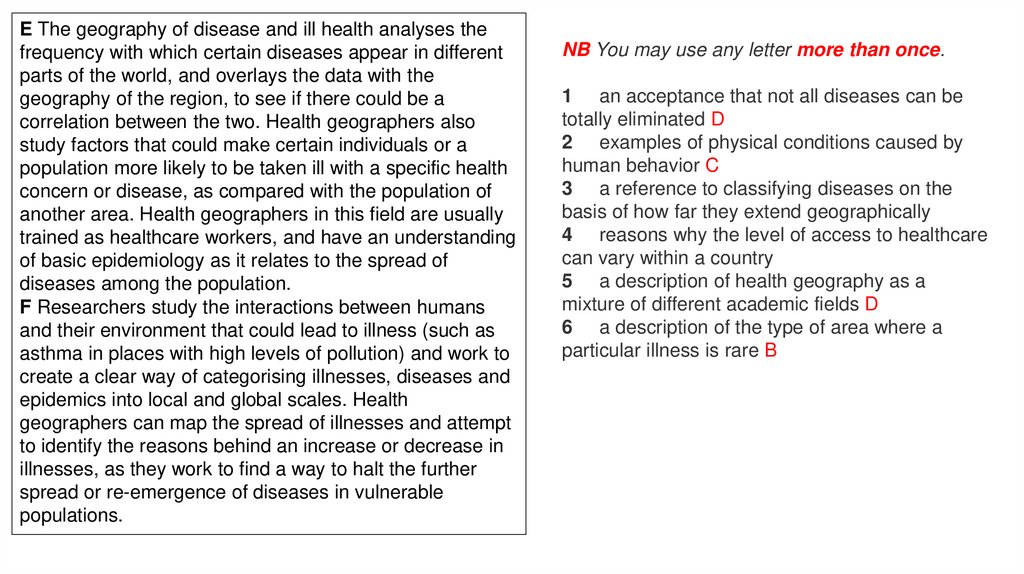
E The geography of disease and ill health analyses thefrequency with which certain diseases appear in different
parts of the world, and overlays the data with the
geography of the region, to see if there could be a
correlation between the two. Health geographers also
study factors that could make certain individuals or a
population more likely to be taken ill with a specific health
concern or disease, as compared with the population of
another area. Health geographers in this field are usually
trained as healthcare workers, and have an understanding
of basic epidemiology as it relates to the spread of
diseases among the population.
F Researchers study the interactions between humans
and their environment that could lead to illness (such as
asthma in places with high levels of pollution) and work to
create a clear way of categorising illnesses, diseases and
epidemics into local and global scales. Health
geographers can map the spread of illnesses and attempt
to identify the reasons behind an increase or decrease in
illnesses, as they work to find a way to halt the further
spread or re-emergence of diseases in vulnerable
populations.
NB You may use any letter more than once.
1 an acceptance that not all diseases can be
totally eliminated D
2 examples of physical conditions caused by
human behavior C
3 a reference to classifying diseases on the
basis of how far they extend geographically
4 reasons why the level of access to healthcare
can vary within a country
5 a description of health geography as a
mixture of different academic fields D
6 a description of the type of area where a
particular illness is rare B
8.
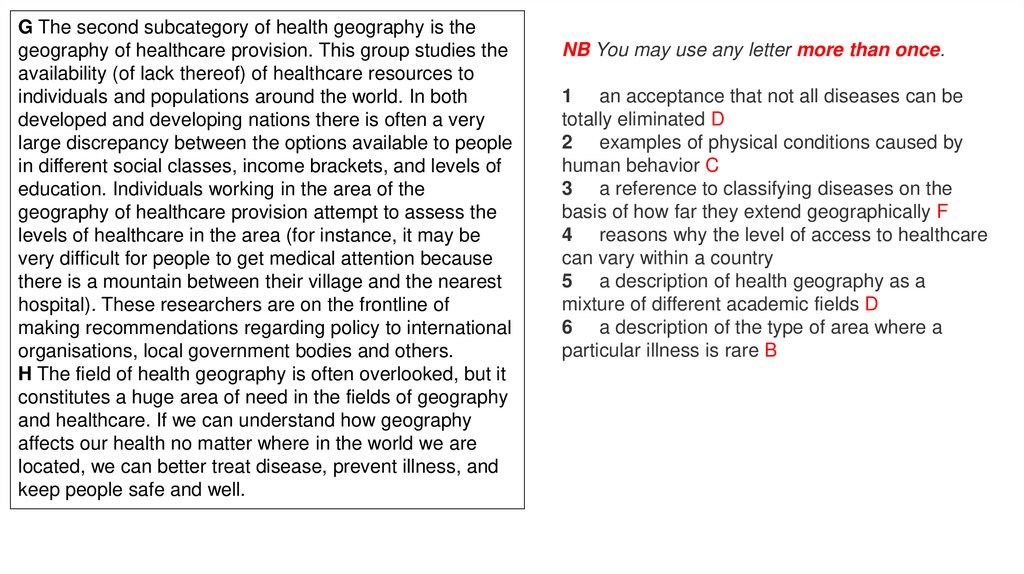
G The second subcategory of health geography is thegeography of healthcare provision. This group studies the
availability (of lack thereof) of healthcare resources to
individuals and populations around the world. In both
developed and developing nations there is often a very
large discrepancy between the options available to people
in different social classes, income brackets, and levels of
education. Individuals working in the area of the
geography of healthcare provision attempt to assess the
levels of healthcare in the area (for instance, it may be
very difficult for people to get medical attention because
there is a mountain between their village and the nearest
hospital). These researchers are on the frontline of
making recommendations regarding policy to international
organisations, local government bodies and others.
H The field of health geography is often overlooked, but it
constitutes a huge area of need in the fields of geography
and healthcare. If we can understand how geography
affects our health no matter where in the world we are
located, we can better treat disease, prevent illness, and
keep people safe and well.
NB You may use any letter more than once.
1 an acceptance that not all diseases can be
totally eliminated D
2 examples of physical conditions caused by
human behavior C
3 a reference to classifying diseases on the
basis of how far they extend geographically F
4 reasons why the level of access to healthcare
can vary within a country
5 a description of health geography as a
mixture of different academic fields D
6 a description of the type of area where a
particular illness is rare B
9.
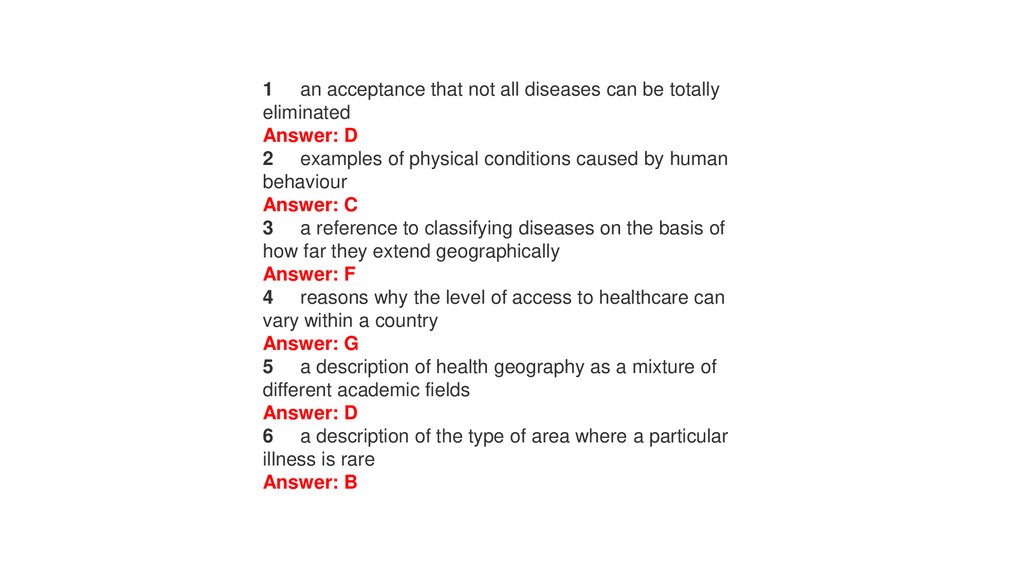
1 an acceptance that not all diseases can be totallyeliminated
Answer: D Locate
2 examples of physical conditions caused by human
behaviour
Answer: C Locate
3 a reference to classifying diseases on the basis of
how far they extend geographically
Answer: F Locate
4 reasons why the level of access to healthcare can
vary within a country
Answer: G Locate
5 a description of health geography as a mixture of
different academic fields
Answer: D Locate
6 a description of the type of area where a particular
illness is rare
Answer: B Locate
10.
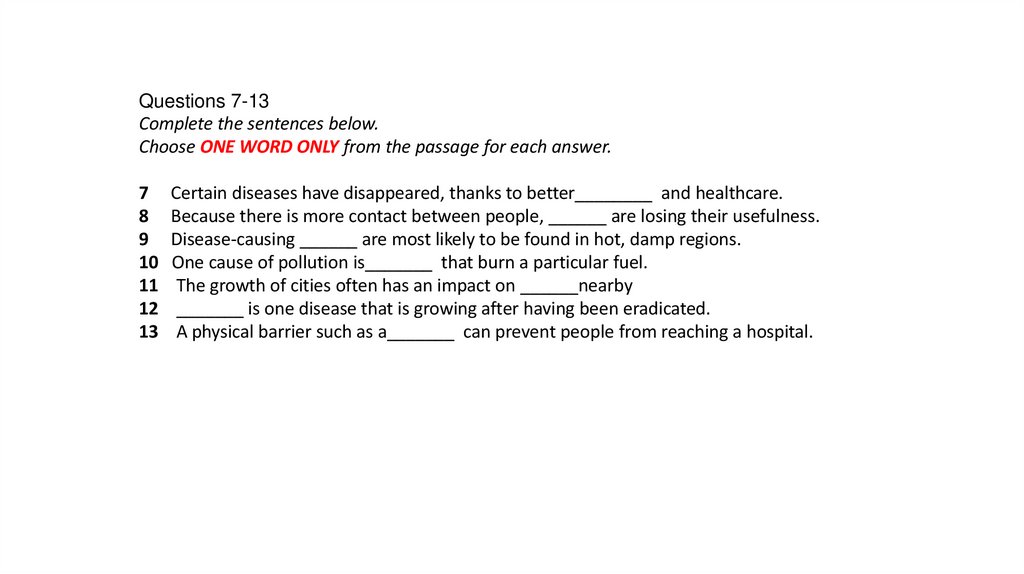
Questions 7-13Complete the sentences below.
Choose ONE WORD ONLY from the passage for each answer.
7 Certain diseases have disappeared, thanks to better________ and healthcare.
8 Because there is more contact between people, ______ are losing their usefulness.
9 Disease-causing ______ are most likely to be found in hot, damp regions.
10 One cause of pollution is_______ that burn a particular fuel.
11 The growth of cities often has an impact on ______nearby
12 _______ is one disease that is growing after having been eradicated.
13 A physical barrier such as a_______ can prevent people from reaching a hospital.
11.
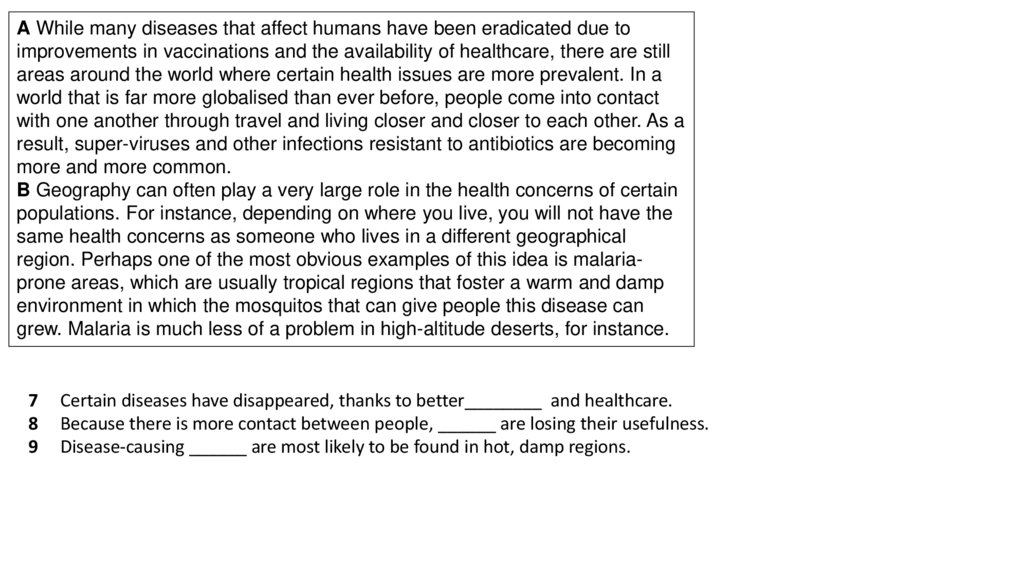
A While many diseases that affect humans have been eradicated due toimprovements in vaccinations and the availability of healthcare, there are still
areas around the world where certain health issues are more prevalent. In a
world that is far more globalised than ever before, people come into contact
with one another through travel and living closer and closer to each other. As a
result, super-viruses and other infections resistant to antibiotics are becoming
more and more common.
B Geography can often play a very large role in the health concerns of certain
populations. For instance, depending on where you live, you will not have the
same health concerns as someone who lives in a different geographical
region. Perhaps one of the most obvious examples of this idea is malariaprone areas, which are usually tropical regions that foster a warm and damp
environment in which the mosquitos that can give people this disease can
grew. Malaria is much less of a problem in high-altitude deserts, for instance.
7
8
9
Certain diseases have disappeared, thanks to better________ and healthcare.
Because there is more contact between people, ______ are losing their usefulness.
Disease-causing ______ are most likely to be found in hot, damp regions.
12.
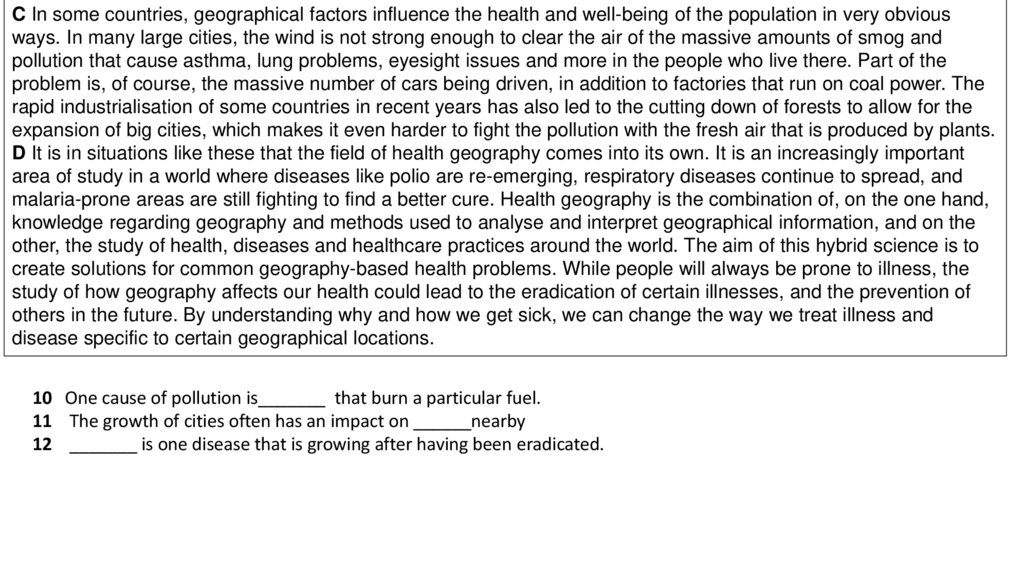
C In some countries, geographical factors influence the health and well-being of the population in very obviousways. In many large cities, the wind is not strong enough to clear the air of the massive amounts of smog and
pollution that cause asthma, lung problems, eyesight issues and more in the people who live there. Part of the
problem is, of course, the massive number of cars being driven, in addition to factories that run on coal power. The
rapid industrialisation of some countries in recent years has also led to the cutting down of forests to allow for the
expansion of big cities, which makes it even harder to fight the pollution with the fresh air that is produced by plants.
D It is in situations like these that the field of health geography comes into its own. It is an increasingly important
area of study in a world where diseases like polio are re-emerging, respiratory diseases continue to spread, and
malaria-prone areas are still fighting to find a better cure. Health geography is the combination of, on the one hand,
knowledge regarding geography and methods used to analyse and interpret geographical information, and on the
other, the study of health, diseases and healthcare practices around the world. The aim of this hybrid science is to
create solutions for common geography-based health problems. While people will always be prone to illness, the
study of how geography affects our health could lead to the eradication of certain illnesses, and the prevention of
others in the future. By understanding why and how we get sick, we can change the way we treat illness and
disease specific to certain geographical locations.
10 One cause of pollution is_______ that burn a particular fuel.
11 The growth of cities often has an impact on ______nearby
12 _______ is one disease that is growing after having been eradicated.
13.
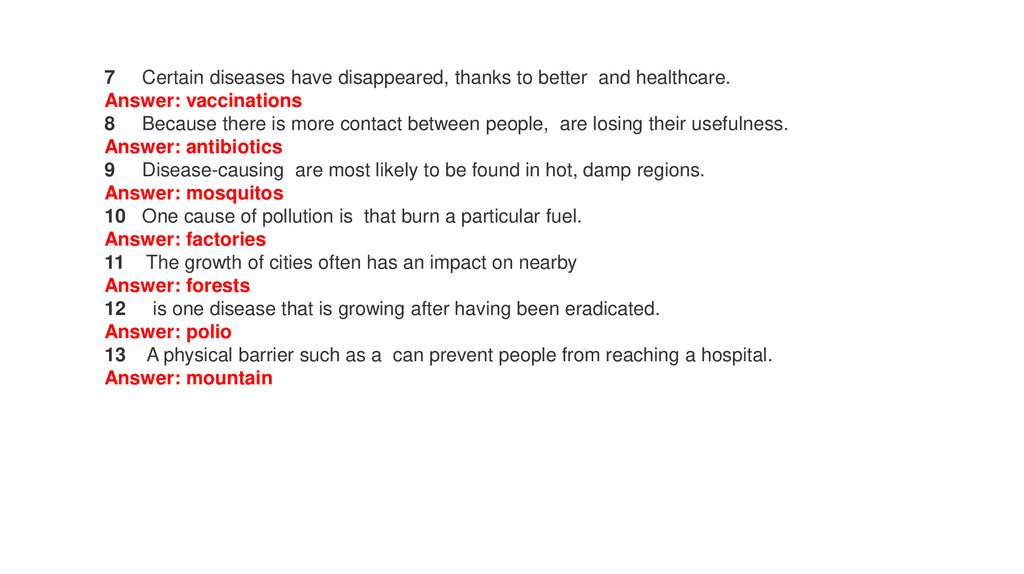
7 Certain diseases have disappeared, thanks to better and healthcare.Answer: vaccinations Locate
8 Because there is more contact between people, are losing their usefulness.
Answer: antibiotics Locate
9 Disease-causing are most likely to be found in hot, damp regions.
Answer: mosquitos Locate
10 One cause of pollution is that burn a particular fuel.
Answer: factories Locate
11 The growth of cities often has an impact on nearby
Answer: forests Locate
12 is one disease that is growing after having been eradicated.
Answer: polio Locate
13 A physical barrier such as a can prevent people from reaching a hospital.
Answer: mountain Locate