 География
Похожие презентации:
Russian Federation Altai Territory
1. Russian Federation Altai Territory
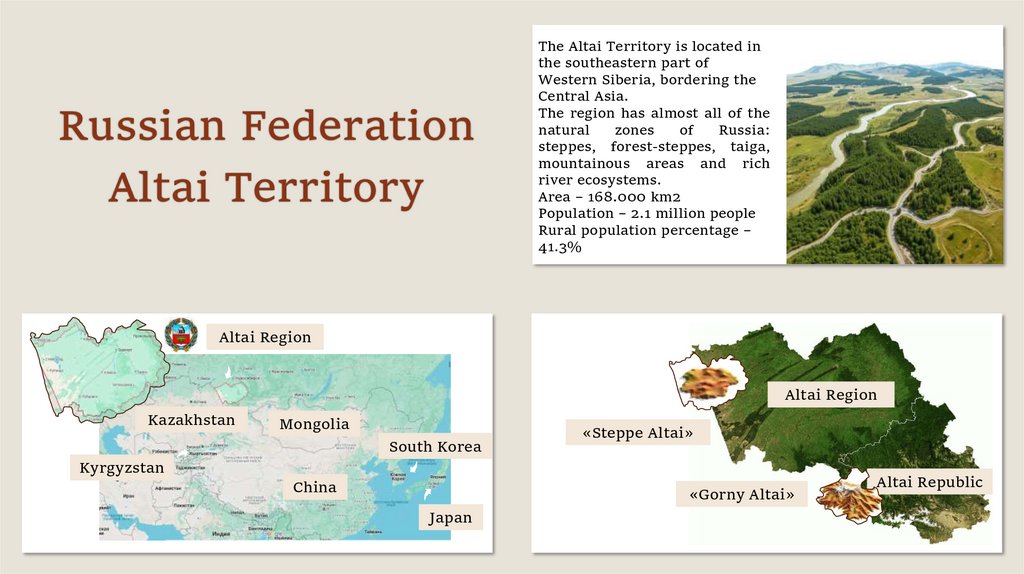
The Altai Territory is located inthe southeastern part of
Western Siberia, bordering the
Central Asia.
The region has almost all of the
natural
zones
of
Russia:
steppes, forest-steppes, taiga,
mountainous areas and rich
river ecosystems.
Area – 168.000 km2
Population – 2.1 million people
Rural population percentage –
41.3%
Altai Region
Altai Region
Kazakhstan
Mongolia
South Korea
«Steppe Altai»
Kyrgyzstan
China
«Gorny Altai»
Japan
Altai Republic
2. «The Siberian Switzerland»
Beautiful mountainouslandscapes, clear air and
developed infrastructure
make Belokurikha
comparable to European
resorts like Davos and
Courchevel
Photo source link
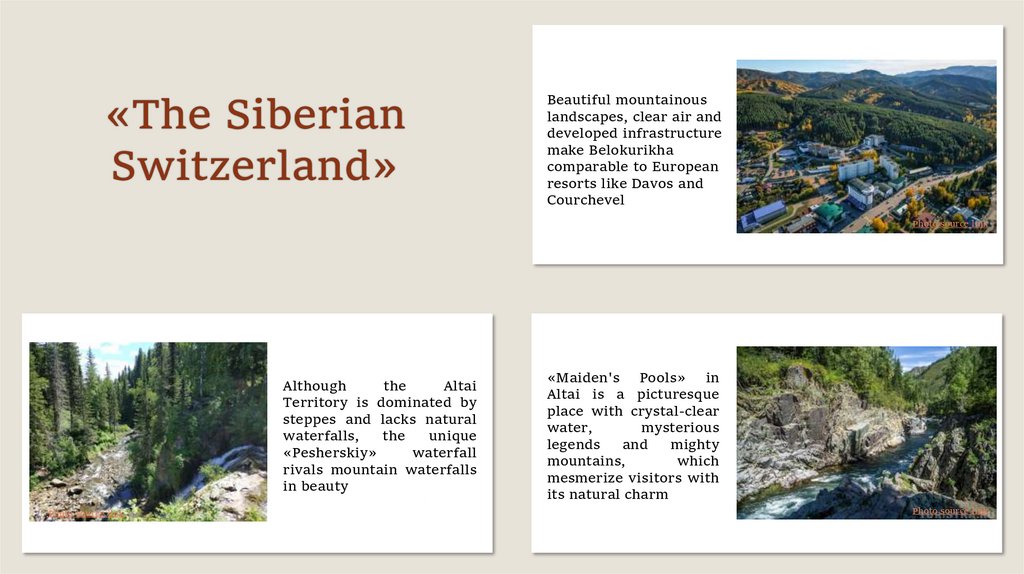
Although
the
Altai
Territory is dominated by
steppes and lacks natural
waterfalls,
the
unique
«Pesherskiy»
waterfall
rivals mountain waterfalls
in beauty
Photo source link
«Maiden's Pools» in
Altai is a picturesque
place with crystal-clear
water,
mysterious
legends
and
mighty
mountains,
which
mesmerize visitors with
its natural charm
Photo source link
3. «Тhe Land of a hundred Lakes»
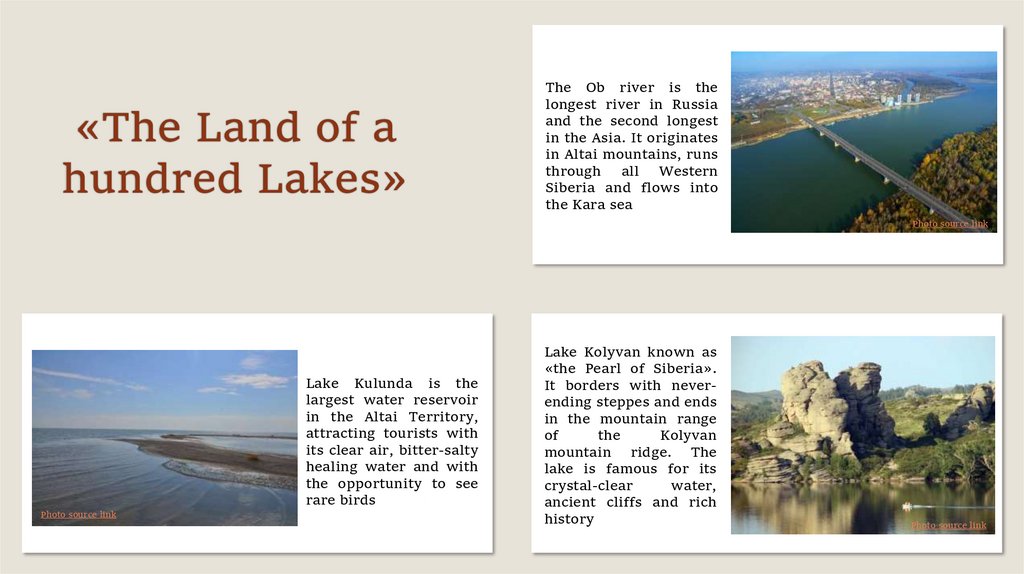
The Ob river is thelongest river in Russia
and the second longest
in the Asia. It originates
in Altai mountains, runs
through all Western
Siberia and flows into
the Kara sea
Photo source link
Lake Kulunda is the
largest water reservoir
in the Altai Territory,
attracting tourists with
its clear air, bitter-salty
healing water and with
the opportunity to see
rare birds
Photo source link
Lake Kolyvan known as
«the Pearl of Siberia».
It borders with neverending steppes and ends
in the mountain range
of
the
Kolyvan
mountain ridge. The
lake is famous for its
crystal-clear
water,
ancient cliffs and rich
history
Photo source link
4. «Ribbon Forests»
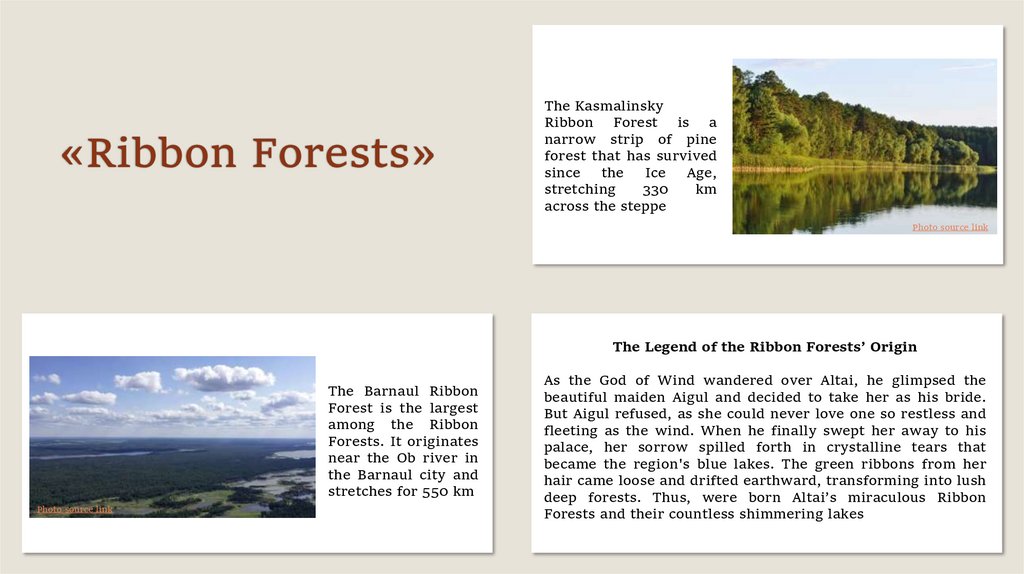
The KasmalinskyRibbon Forest is a
narrow strip of pine
forest that has survived
since
the
Ice
Age,
stretching
330
km
across the steppe
Photo source link
The Legend of the Ribbon Forests’ Origin
The Barnaul Ribbon
Forest is the largest
among the Ribbon
Forests. It originates
near the Ob river in
the Barnaul city and
stretches for 550 km
Photo source link
As the God of Wind wandered over Altai, he glimpsed the
beautiful maiden Aigul and decided to take her as his bride.
But Aigul refused, as she could never love one so restless and
fleeting as the wind. When he finally swept her away to his
palace, her sorrow spilled forth in crystalline tears that
became the region's blue lakes. The green ribbons from her
hair came loose and drifted earthward, transforming into lush
deep forests. Thus, were born Altai’s miraculous Ribbon
Forests and their countless shimmering lakes
5. «Chipmunk – the symbol of Altai Territory»
The Altai Territory hasWestern
Siberia's
only
known breeding colony of
the long-eared bat. This
species is listed in both the
Russian Red Data Book and
the Altai Territory Red
Data Book
Photo source link
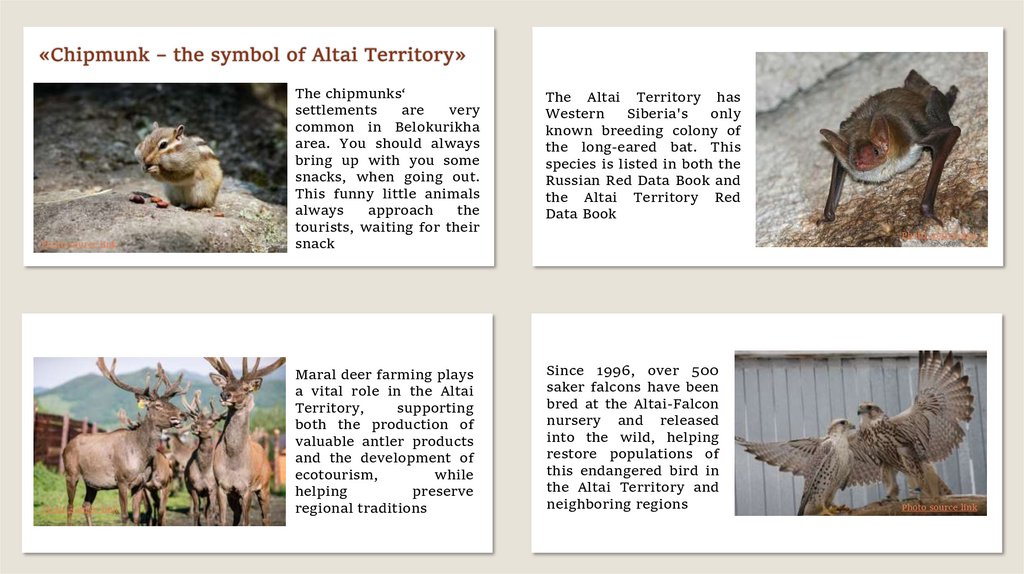
The chipmunks‘
settlements
are
very
common in Belokurikha
area. You should always
bring up with you some
snacks, when going out.
This funny little animals
always
approach
the
tourists, waiting for their
snack
Photo source link
Maral deer farming plays
a vital role in the Altai
Territory,
supporting
both the production of
valuable antler products
and the development of
ecotourism,
while
helping
preserve
regional traditions
Since 1996, over 500
saker falcons have been
bred at the Altai-Falcon
nursery and released
into the wild, helping
restore populations of
this endangered bird in
the Altai Territory and
neighboring regions
Photo source link
Photo source link
6. «The Cradle of Humanity»
Excavationsin
the
Southern
Gallery
have
helped
specify
the
chronology
of
our
ancestors'
presence
Denisovans
appeared
approximately
300,000
years ago, Neanderthals
around 160,000 years ago,
and
were
eventually
replaced by Homo sapiens
about 50,000 years ago
Photo source link
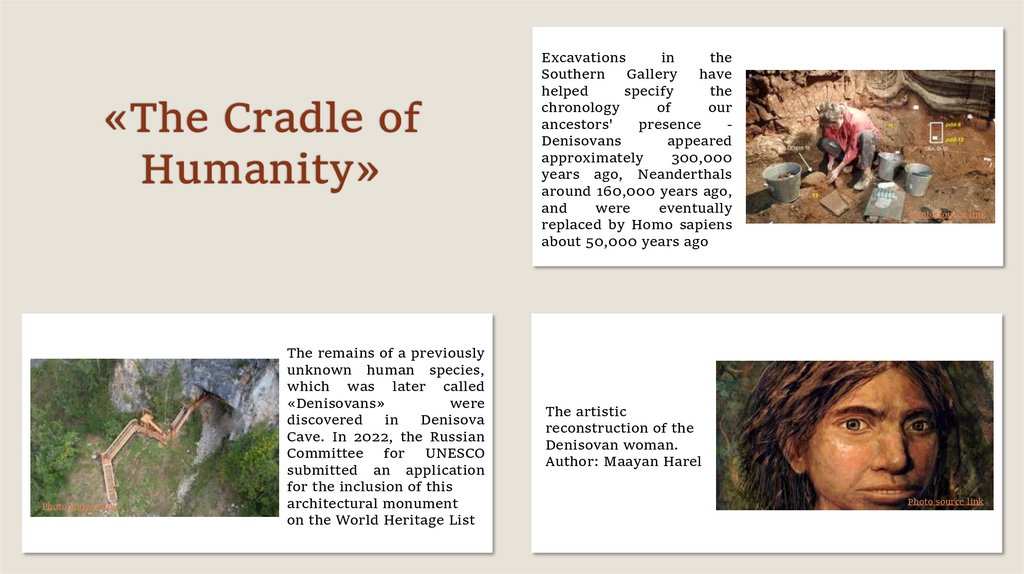
The remains of a previously
unknown human species,
which was later called
«Denisovans»
were
discovered
in
Denisova
Cave. In 2022, the Russian
Committee for UNESCO
submitted an application
for the inclusion of this
architectural monument
on the World Heritage List
Photo source link
The artistic
reconstruction of the
Denisovan woman.
Author: Maayan Harel
Photo source link
7. «Тhe Granary of Siberia»
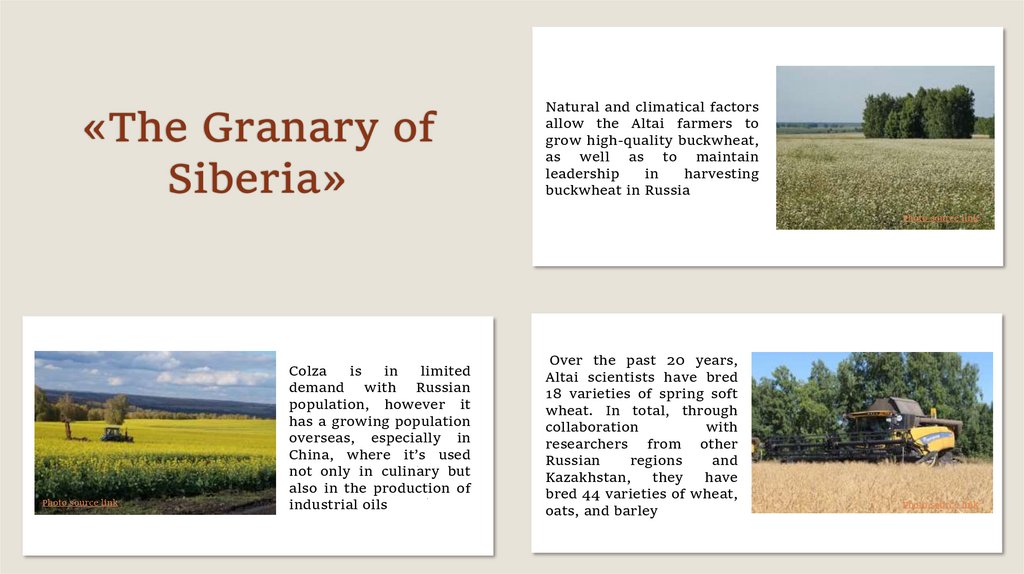
Natural and climatical factorsallow the Altai farmers to
grow high-quality buckwheat,
as well as to maintain
leadership
in
harvesting
buckwheat in Russia
Photo source link
Photo source link
Colza
is
in
limited
demand with Russian
population, however it
has a growing population
overseas, especially in
China, where it’s used
not only in culinary but
also in the production of
industrial oils
Over the past 20 years,
Altai scientists have bred
18 varieties of spring soft
wheat. In total, through
collaboration
with
researchers from other
Russian
regions
and
Kazakhstan,
they
have
bred 44 varieties of wheat,
oats, and barley
Photo source link
8. «Тhe Capital of honey and cheese»
The steppe Altai is famousfor its endless fields and a
great diversity of plants.
Which is why the region is
considered to be the main
source of the famous Altai
honey. Compared to Gorny
Altai, our region produces 10
times more honey
Photo source link
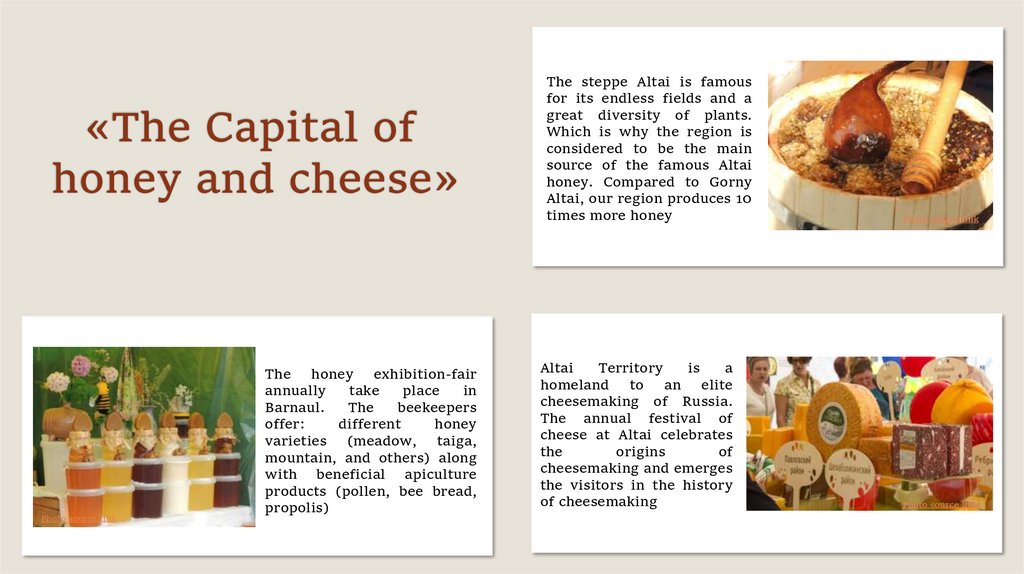
The honey exhibition-fair
annually
take
place
in
Barnaul.
The
beekeepers
offer:
different
honey
varieties (meadow, taiga,
mountain, and others) along
with beneficial apiculture
products (pollen, bee bread,
propolis)
Altai
Territory
is
a
homeland to an elite
cheesemaking of Russia.
The annual festival of
cheese at Altai celebrates
the
origins
of
cheesemaking and emerges
the visitors in the history
of cheesemaking
Photo source link
Photo source link
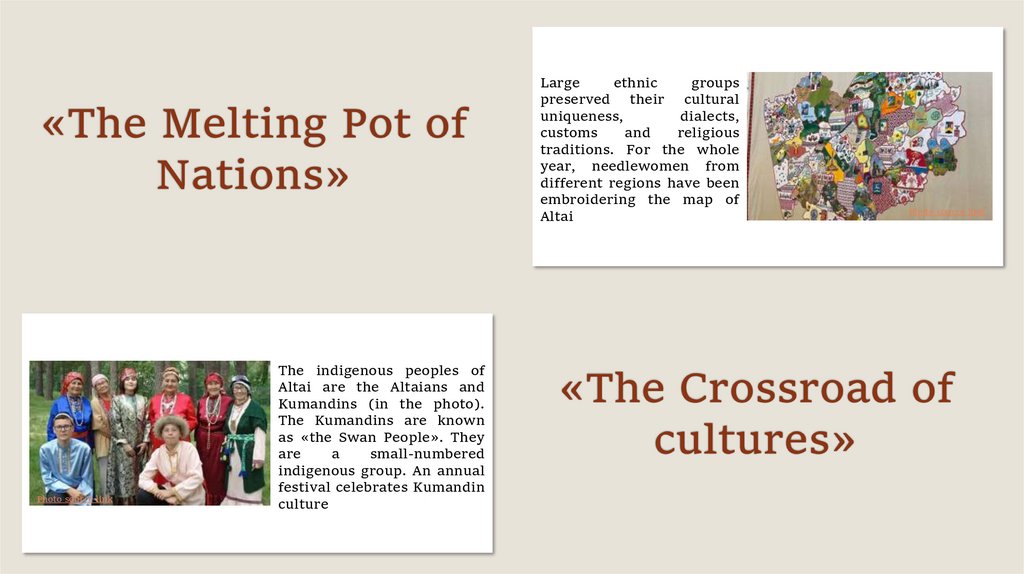
9. «Тhe Melting Pot of Nations»
Largeethnic
groups
preserved their cultural
uniqueness,
dialects,
customs
and
religious
traditions. For the whole
year, needlewomen from
different regions have been
embroidering the map of
Altai
Photo source link
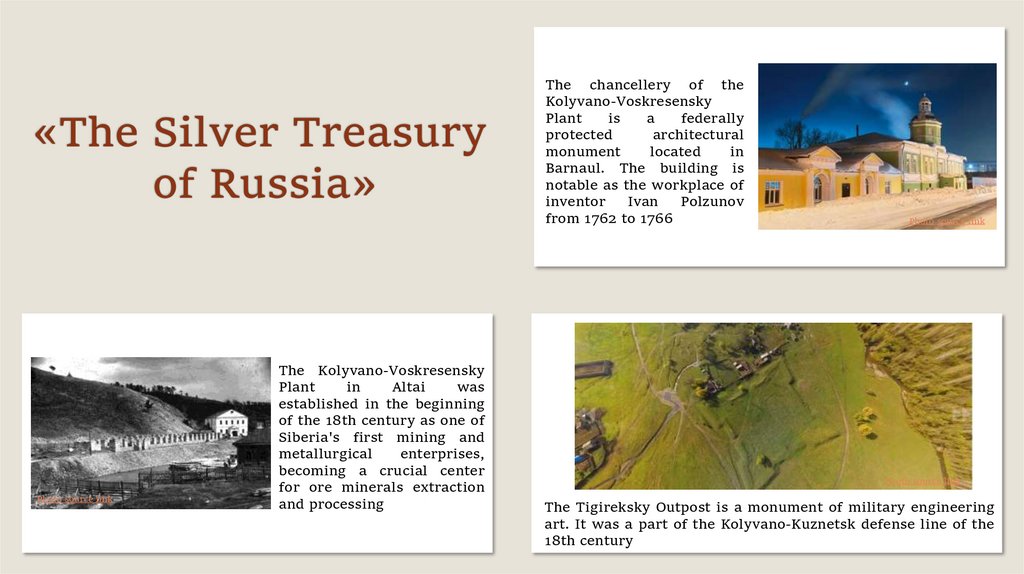
The indigenous peoples of
Altai are the Altaians and
Kumandins (in the photo).
The Kumandins are known
as «the Swan People». They
are
a
small-numbered
indigenous group. An annual
festival celebrates Kumandin
culture
Photo source link
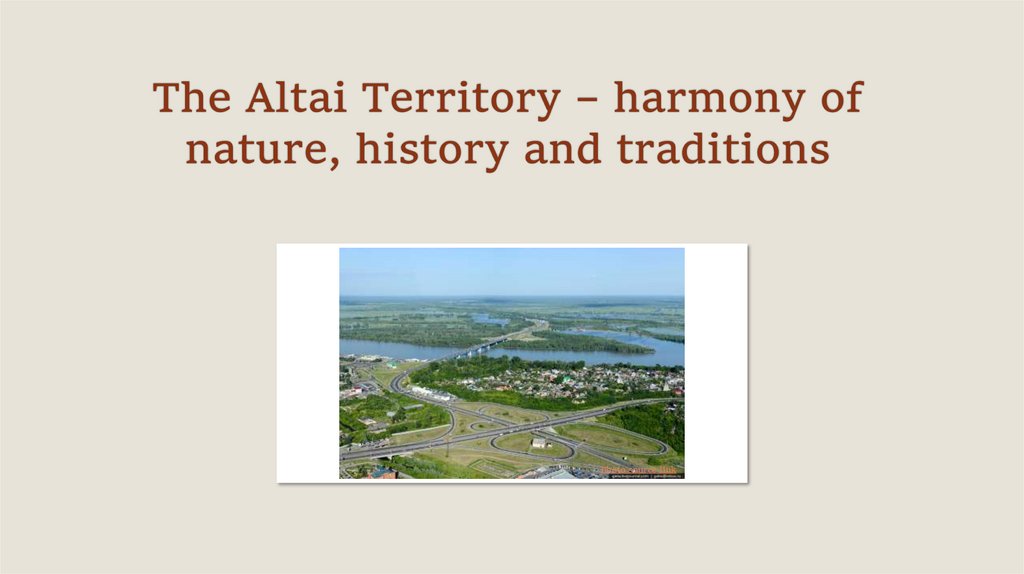
10. «Тhe Silver Treasury of Russia»
The chancellery of theKolyvano-Voskresensky
Plant
is
a
federally
protected
architectural
monument
located
in
Barnaul. The building is
notable as the workplace of
inventor
Ivan
Polzunov
from 1762 to 1766
Photo source link
The Kolyvano-Voskresensky
Plant
in
Altai
was
established in the beginning
of the 18th century as one of
Siberia's first mining and
metallurgical
enterprises,
becoming a crucial center
for ore minerals extraction
and processing
Photo source link
Photo source link
The Tigireksky Outpost is a monument of military engineering
art. It was a part of the Kolyvano-Kuznetsk defense line of the
18th century