
 Английский язык
Похожие презентации:





English is the Language of International
1.
English is the Language of InternationalCommunication
Иностранный язык - язык
международного значения
2.
План занятия:1. Грамматический материал: Pronouns.
2. Работа с текстом «English is the Language of
International Communication»:
3. Отработка речевых формул
3.
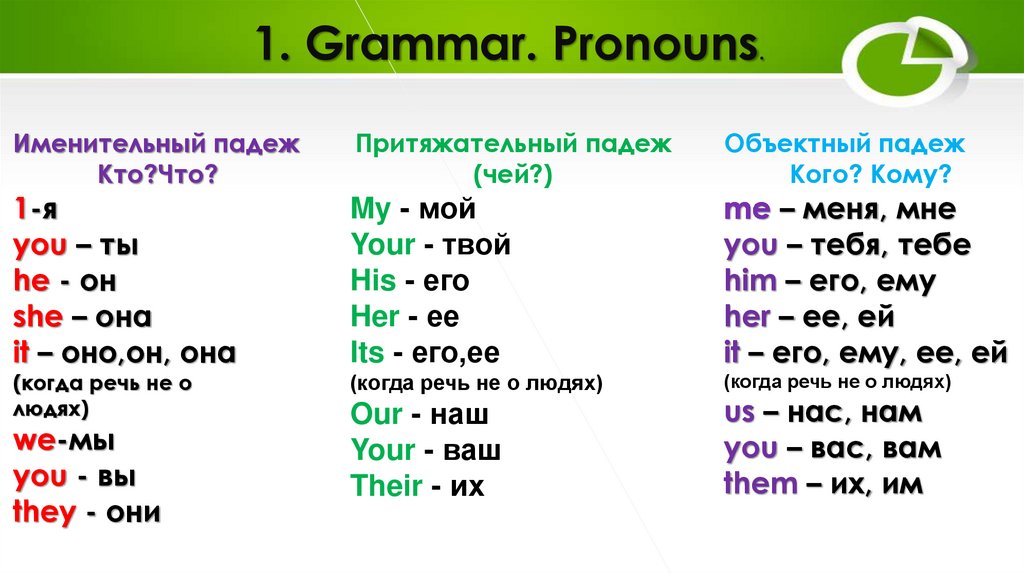
1. Grammar. Pronouns.Именительный падеж
Кто?Что?
Притяжательный падеж
(чей?)
Объектный падеж
Кого? Кому?
1-я
you – ты
he - он
she – она
it – оно,он, она
My - мой
Your - твой
His - его
Her - ее
Its - его,ее
– меня, мне
you – тебя, тебе
him – его, ему
her – ее, ей
it – его, ему, ее, ей
(когда речь не о людях)
(когда речь не о людях)
(когда речь не о
людях)
we-мы
you - вы
they - они
Our - наш
Your - ваш
Their - их
us – нас, нам
you – вас, вам
them – иx, им
4.
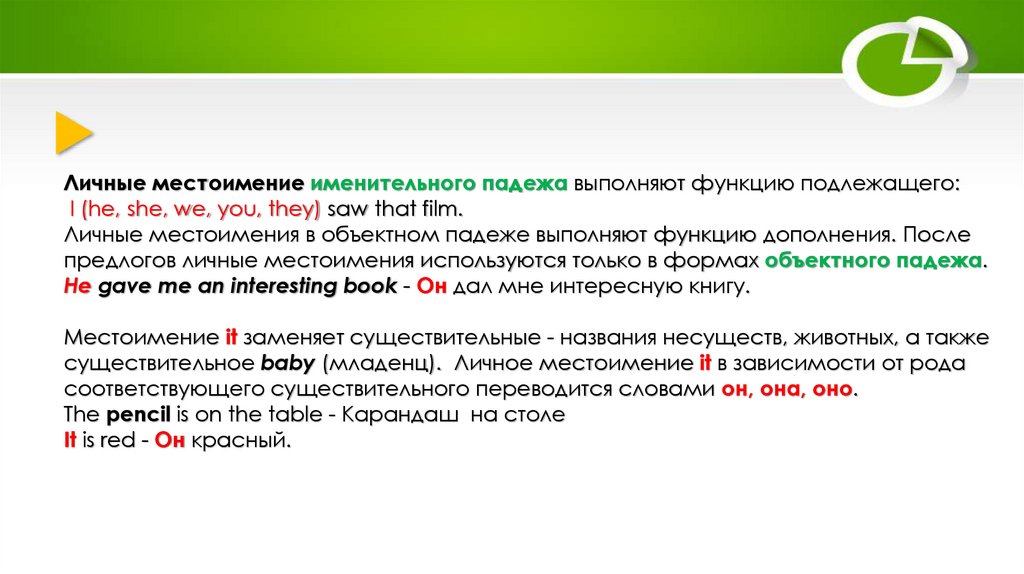
Личные местоимение именительного падежа выполняют функцию подлежащего:I (he, she, we, you, they) saw that film.
Личные местоимения в объектном падеже выполняют функцию дополнения. После
предлогов личные местоимения используются только в формах объектного падежа.
He gave me an interesting book - Он дал мне интересную книгу.
Местоимение it заменяет существительные - названия несуществ, животных, а также
существительное baby (младенц). Личное местоимение it в зависимости от рода
соответствующего существительного переводится словами он, она, оно.
The pencil is on the table - Карандаш на столе
It is red - Он красный.
5.
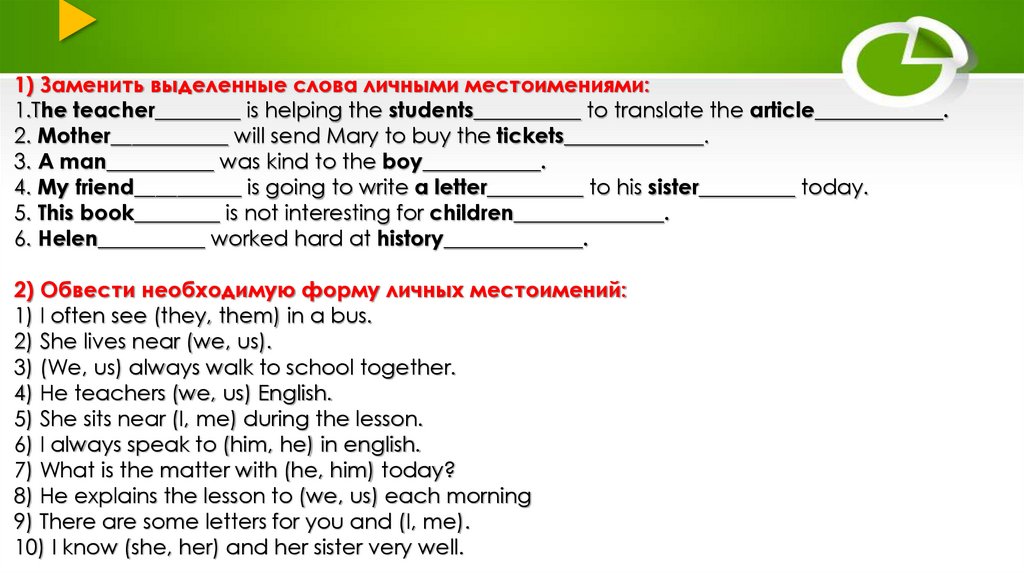
1) Заменить выделенные слова личными местоимениями:1.The teacher________ is helping the students__________ to translate the article____________.
2. Mother___________ will send Mary to buy the tickets_____________.
3. A man__________ was kind to the boy___________.
4. My friend__________ is going to write a letter_________ to his sister_________ today.
5. This book________ is not interesting for children______________.
6. Helen__________ worked hard at history_____________.
2) Обвести необходимую форму личных местоимений:
1) I often see (they, them) in a bus.
2) She lives near (we, us).
3) (We, us) always walk to school together.
4) He teachers (we, us) English.
5) She sits near (I, me) during the lesson.
6) I always speak to (him, he) in english.
7) What is the matter with (he, him) today?
8) Не explains the lesson to (we, us) each morning
9) There are some letters for you and (I, me).
10) I know (she, her) and her sister very well.
6.
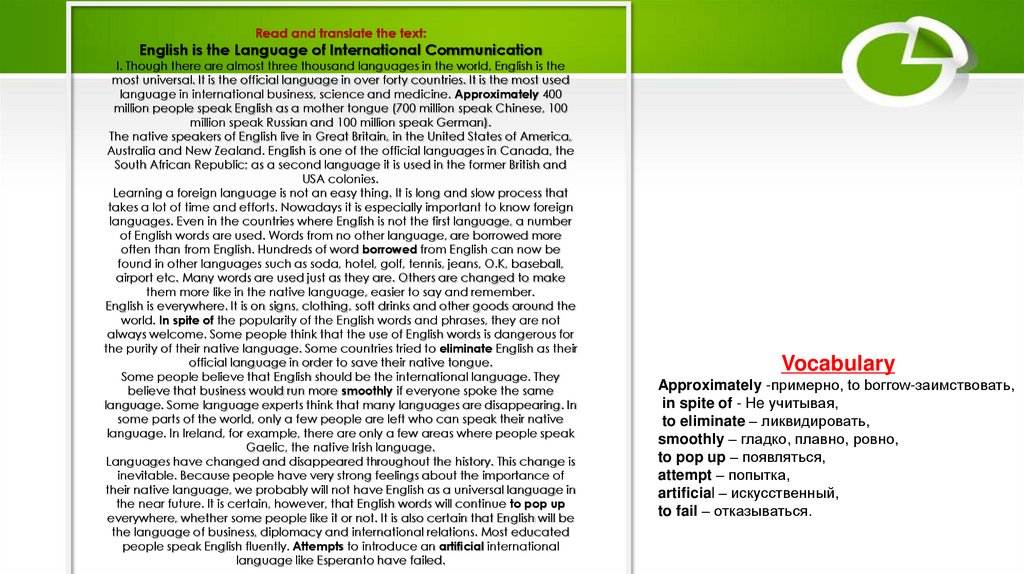
Read and translate the text:English is the Language of International Communication
I. Though there are almost three thousand languages in the world, English is the
most universal. It is the official language in over forty countries. It is the most used
language in international business, science and medicine. Approximately 400
million people speak English as a mother tongue (700 million speak Chinese, 100
million speak Russian and 100 million speak German).
The native speakers of English live in Great Britain, in the United States of America,
Australia and New Zealand. English is one of the official languages in Canada, the
South African Republic; as a second language it is used in the former British and
USA colonies.
Learning a foreign language is not an easy thing. It is long and slow process that
takes a lot of time and efforts. Nowadays it is especially important to know foreign
languages. Even in the countries where English is not the first language, a number
of English words are used. Words from no other language, are borrowed more
often than from English. Hundreds of word borrowed from English can now be
found in other languages such as soda, hotel, golf, tennis, jeans, O.K, baseball,
airport etc. Many words are used just as they are. Others are changed to make
them more like in the native language, easier to say and remember.
English is everywhere. It is on signs, clothing, soft drinks and other goods around the
world. In spite of the popularity of the English words and phrases, they are not
always welcome. Some people think that the use of English words is dangerous for
the purity of their native language. Some countries tried to eliminate English as their
official language in order to save their native tongue.
Some people believe that English should be the international language. They
believe that business would run more smoothly if everyone spoke the same
language. Some language experts think that many languages are disappearing. In
some parts of the world, only a few people are left who can speak their native
language. In Ireland, for example, there are only a few areas where people speak
Gaelic, the native Irish language.
Languages have changed and disappeared throughout the history. This change is
inevitable. Because people have very strong feelings about the importance of
their native language, we probably will not have English as a universal language in
the near future. It is certain, however, that English words will continue to pop up
everywhere, whether some people like it or not. It is also certain that English will be
the language of business, diplomacy and international relations. Most educated
people speak English fluently. Attempts to introduce an artificial international
language like Esperanto have failed.
Vocabulary
Approximately -примерно, tо bоггоw-заимствовать,
in spite of - He учитывая,
to eliminate – ликвидировать,
smoothly – гладко, плавно, ровно,
to pop up – появляться,
attempt – попытка,
artificial – искусственный,
to fail – отказываться.
7.
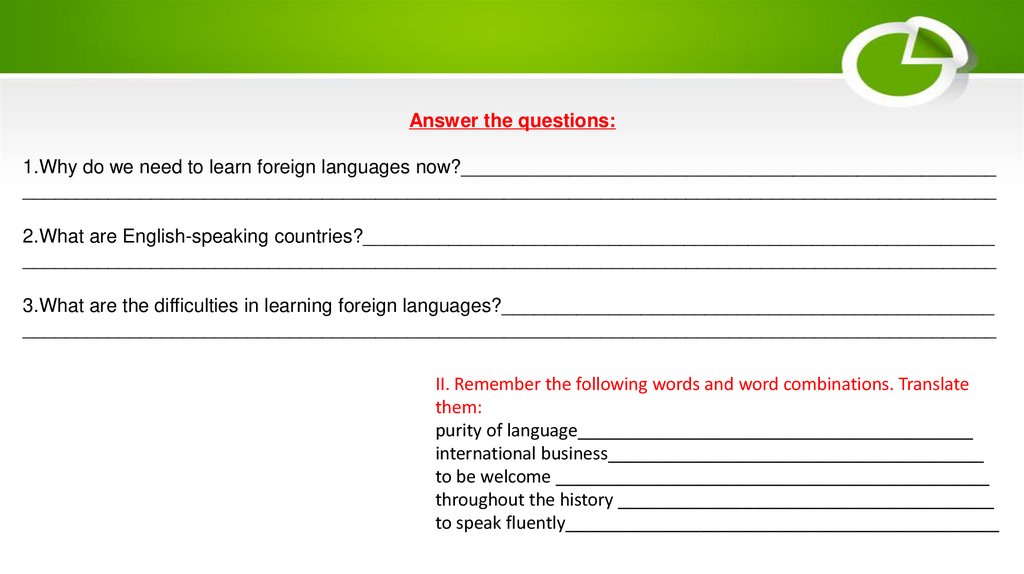
Answer the questions:1.Why do we need to learn foreign languages now?__________________________________________________
___________________________________________________________________________________________
2.What are English-speaking countries?___________________________________________________________
___________________________________________________________________________________________
3.What are the difficulties in learning foreign languages?______________________________________________
___________________________________________________________________________________________
II. Remember the following words and word combinations. Translate
them:
purity of language_________________________________________
international business_______________________________________
to be welcome _____________________________________________
throughout the history _______________________________________
to speak fluently_____________________________________________
8.
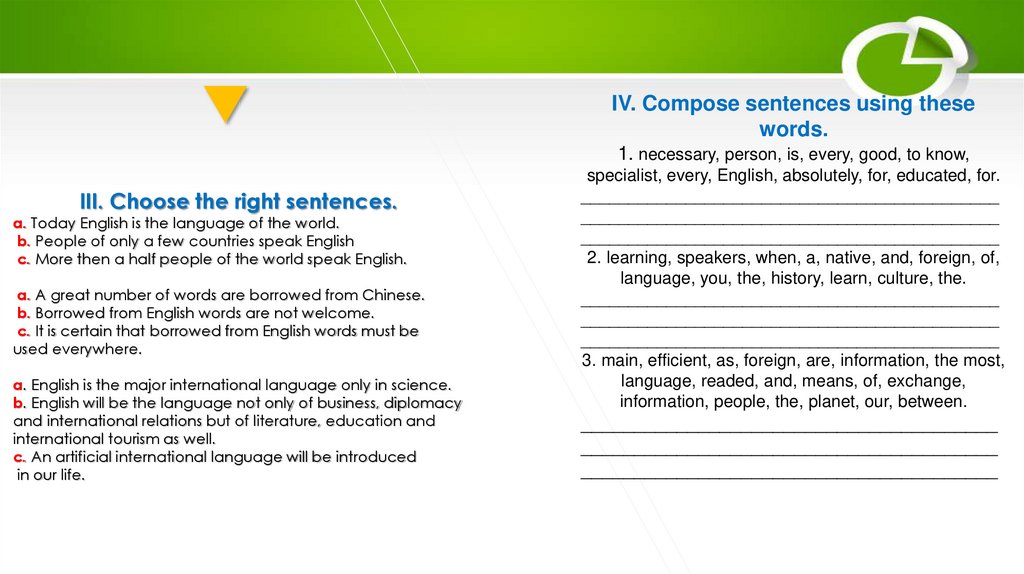
IV. Compose sentences using thesewords.
1. necessary, person, is, every, good, to know,
III. Choose the right sentences.
a. Today English is the language of the world.
b. People of only a few countries speak English
c. More then a half people of the world speak English.
a. A great number of words are borrowed from Chinese.
b. Borrowed from English words are not welcome.
c. It is certain that borrowed from English words must be
used everywhere.
a. English is the major international language only in science.
b. English will be the language not only of business, diplomacy
and international relations but of literature, education and
international tourism as well.
c. An artificial international language will be introduced
in our life.
specialist, every, English, absolutely, for, educated, for.
____________________________________________
____________________________________________
____________________________________________
2. learning, speakers, when, a, native, and, foreign, of,
language, you, the, history, learn, culture, the.
____________________________________________
____________________________________________
____________________________________________
3. main, efficient, as, foreign, are, information, the most,
language, readed, and, means, of, exchange,
information, people, the, planet, our, between.
_______________________________________
_______________________________________
_______________________________________
9.
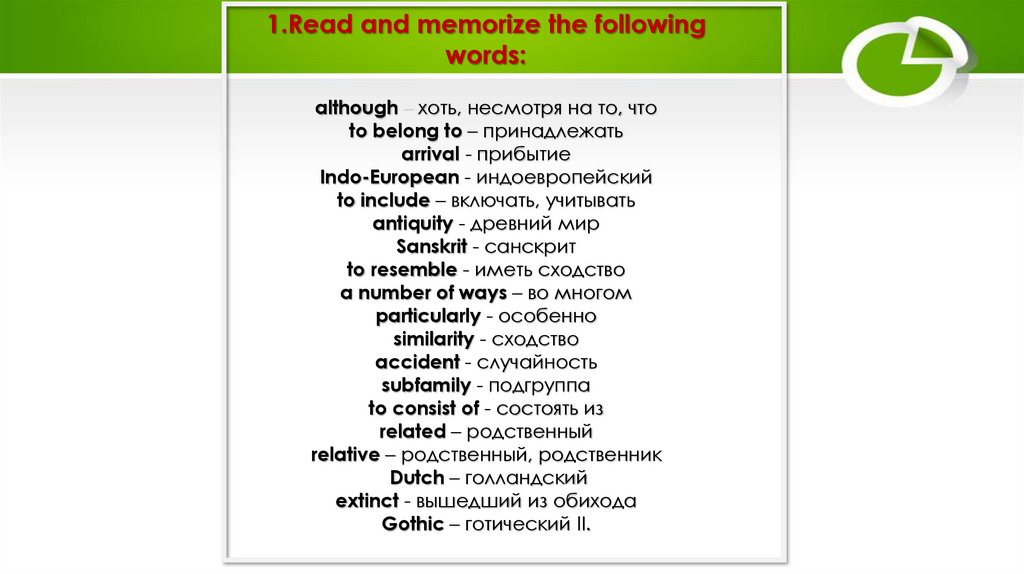
1.Read and memorize the followingwords:
although – хоть, несмотря на то, что
to belong to – принадлежать
arrival - прибытие
Indo-European - индоевропейский
to include – включать, учитывать
antiquity - древний мир
Sanskrit - санскрит
to resemble - иметь сходство
a number of ways – во многом
particularly - особенно
similarity - сходство
accident - случайность
subfamily - подгруппа
to consist of - состоять из
related – родственный
relative – родственный, родственник
Dutch – голландский
extinct - вышедший из обихода
Gothic – готический II.
10.
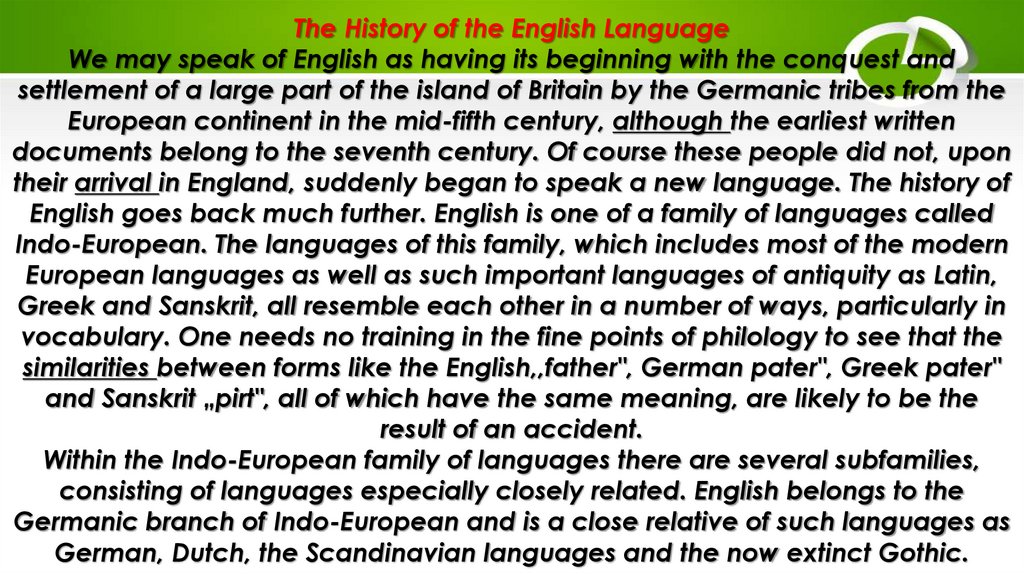
The History of the English LanguageWe may speak of English as having its beginning with the conquest and
settlement of a large part of the island of Britain by the Germanic tribes from the
European continent in the mid-fifth century, although the earliest written
documents belong to the seventh century. Of course these people did not, upon
their arrival in England, suddenly began to speak a new language. The history of
English goes back much further. English is one of a family of languages called
Indo-European. The languages of this family, which includes most of the modern
European languages as well as such important languages of antiquity as Latin,
Greek and Sanskrit, all resemble each other in a number of ways, particularly in
vocabulary. One needs no training in the fine points of philology to see that the
similarities between forms like the English,,father", German pater", Greek pater"
and Sanskrit „pirt", all of which have the same meaning, are likely to be the
result of an accident.
Within the Indo-European family of languages there are several subfamilies,
consisting of languages especially closely related. English belongs to the
Germanic branch of Indo-European and is a close relative of such languages as
German, Dutch, the Scandinavian languages and the now extinct Gothic.
11.
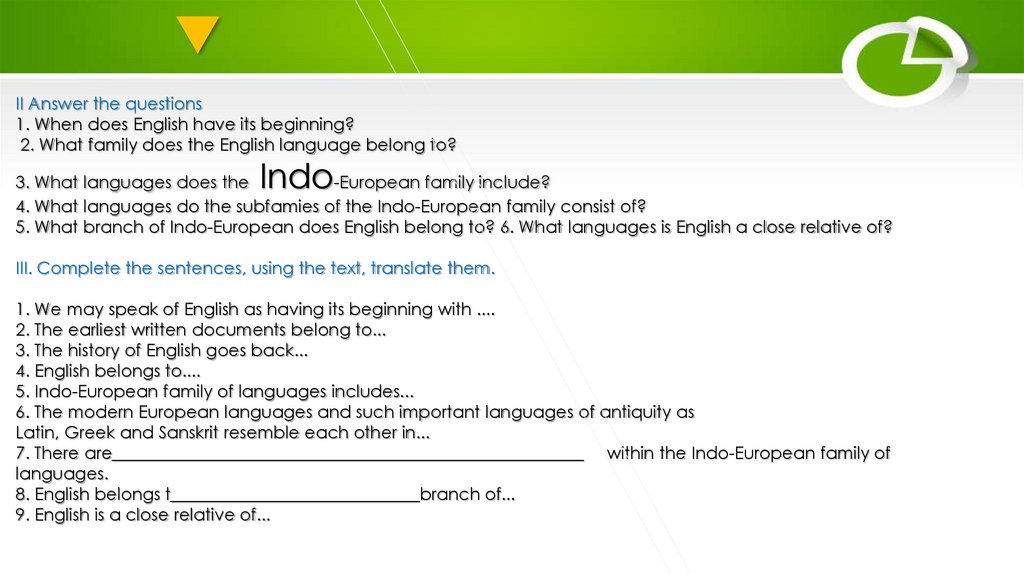
II Answer the questions1. When does English have its beginning?
2. What family does the English language belong to?
Indo
3. What languages does the
-European family include?
4. What languages do the subfamies of the Indo-European family consist of?
5. What branch of Indo-European does English belong to? 6. What languages is English a close relative of?
III. Complete the sentences, using the text, translate them.
1. We may speak of English as having its beginning with ....
2. The earliest written documents belong to...
3. The history of English goes back...
4. English belongs to....
5. Indo-European family of languages includes...
6. The modern European languages and such important languages of antiquity as
Latin, Greek and Sanskrit resemble each other in...
7. There are_______________________________________________________ within the Indo-European family of
languages.
8. English belongs t_____________________________branch of...
9. English is a close relative of...
12.
ARETHE BEST
STUDENTS
CLICK HERE TO ADD THE TEXT, THE TEXT