

 Английский язык
Похожие презентации:




Module 2.Mass Media. Week 4. Lesson 1. Case Study
1. Module 2.Mass Media. Week 4. Lesson 1. Case Study.
Astana IT UniversitySchool of General Education Disciplines
English for Academic Purposes
B2
2025-2026 academic year
2. Lesson objectives:
• to expand students’vocabulary by introducing and
practicing a variety of new
words.
• to develop reading
comprehension abilities by
engaging students in various
reading activities.
• to analyze the steps of the
case study on news literacy
and social media to develop a
deeper understanding of the
topic.
2
3. Outline
Warm upPre-reading
Outline
While-reading
Post-reading
Case Study
Task explanation
4. Warm up. Work in small groups and discuss the following questions related to the impact of social media on mass media. Take
turns sharing your thoughts andideas and try to provide examples or personal experience to support your viewpoints
(5 minutes).
1. How has social media changed the way we consume and
share news and information?
2. What are some advantages of using social media platforms
for staying informed about current events?
3. Are there any disadvantages or challenges associated with
relying on social media for news? If so, what are they?
5. Exercise 1. Vocabulary. Match the words on the left with their definitions on the right. You DO not need to use all the options
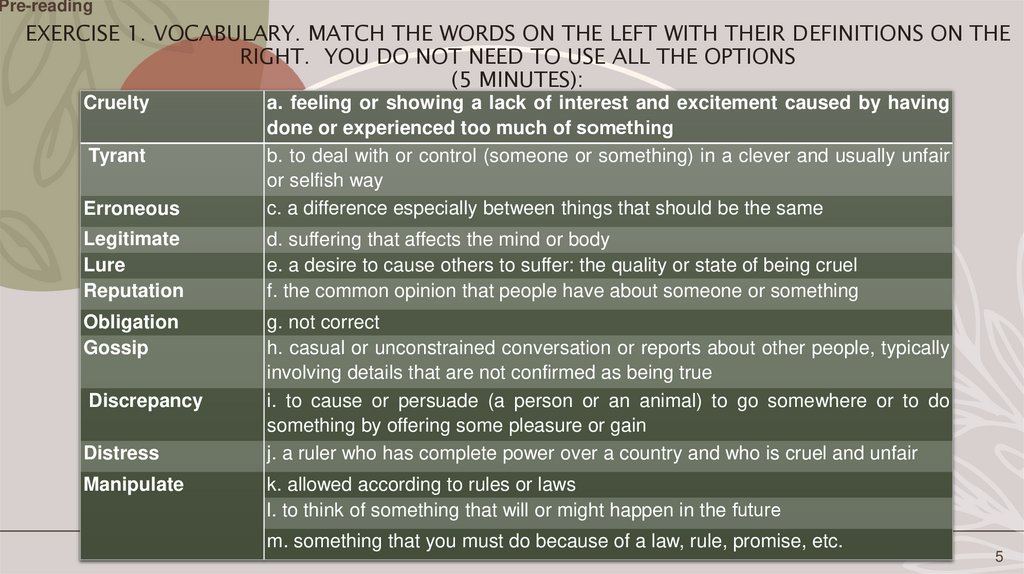
Pre-readingEXERCISE 1. VOCABULARY. MATCH THE WORDS ON THE LEFT WITH THEIR DEFINITIONS ON THE
RIGHT. YOU DO NOT NEED TO USE ALL THE OPTIONS
(5 MINUTES):
Cruelty
Erroneous
a. feeling or showing a lack of interest and excitement caused by having
done or experienced too much of something
b. to deal with or control (someone or something) in a clever and usually unfair
or selfish way
c. a difference especially between things that should be the same
Legitimate
Lure
Reputation
d. suffering that affects the mind or body
e. a desire to cause others to suffer: the quality or state of being cruel
f. the common opinion that people have about someone or something
Obligation
Gossip
g. not correct
h. casual or unconstrained conversation or reports about other people, typically
involving details that are not confirmed as being true
i. to cause or persuade (a person or an animal) to go somewhere or to do
something by offering some pleasure or gain
j. a ruler who has complete power over a country and who is cruel and unfair
Tyrant
Discrepancy
Distress
Manipulate
k. allowed according to rules or laws
l. to think of something that will or might happen in the future
m. something that you must do because of a law, rule, promise, etc.
5
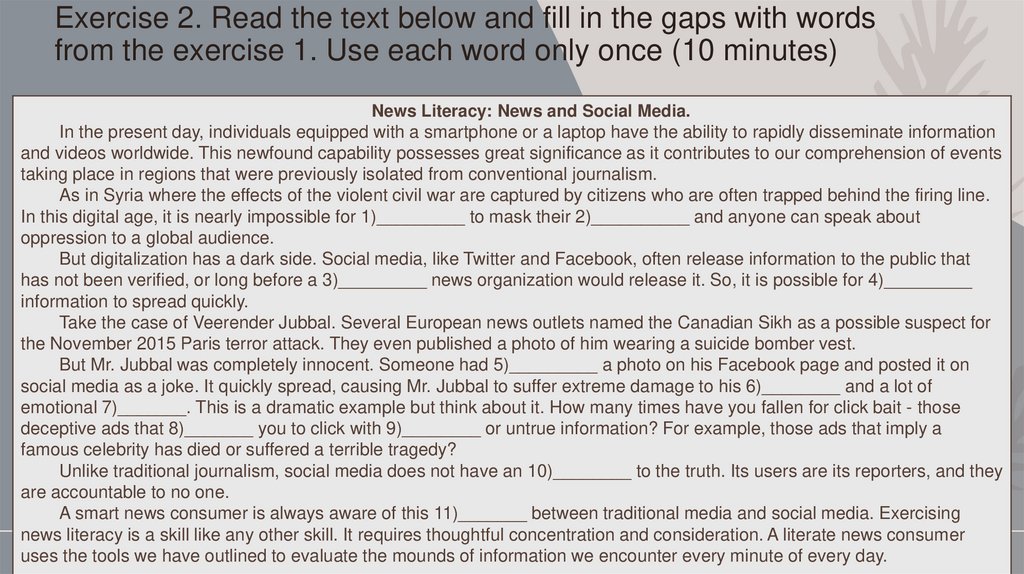
6. Exercise 2. Read the text below and fill in the gaps with words from the exercise 1. Use each word only once (10 minutes)
News Literacy: News and Social Media.In the present day, individuals equipped with a smartphone or a laptop have the ability to rapidly disseminate information
and videos worldwide. This newfound capability possesses great significance as it contributes to our comprehension of events
taking place in regions that were previously isolated from conventional journalism.
As in Syria where the effects of the violent civil war are captured by citizens who are often trapped behind the firing line.
In this digital age, it is nearly impossible for 1)_________ to mask their 2)__________ and anyone can speak about
oppression to a global audience.
But digitalization has a dark side. Social media, like Twitter and Facebook, often release information to the public that
has not been verified, or long before a 3)_________ news organization would release it. So, it is possible for 4)_________
information to spread quickly.
Take the case of Veerender Jubbal. Several European news outlets named the Canadian Sikh as a possible suspect for
the November 2015 Paris terror attack. They even published a photo of him wearing a suicide bomber vest.
But Mr. Jubbal was completely innocent. Someone had 5)_________ a photo on his Facebook page and posted it on
social media as a joke. It quickly spread, causing Mr. Jubbal to suffer extreme damage to his 6)________ and a lot of
emotional 7)_______. This is a dramatic example but think about it. How many times have you fallen for click bait - those
deceptive ads that 8)_______ you to click with 9)________ or untrue information? For example, those ads that imply a
famous celebrity has died or suffered a terrible tragedy?
Unlike traditional journalism, social media does not have an 10)________ to the truth. Its users are its reporters, and they
are accountable to no one.
A smart news consumer is always aware of this 11)_______ between traditional media and social media. Exercising
news literacy is a skill like any other skill. It requires thoughtful concentration and consideration. A literate news consumer
uses the tools we have outlined to evaluate the mounds
WHILE-READING
of information we encounter every minute of every day.
6
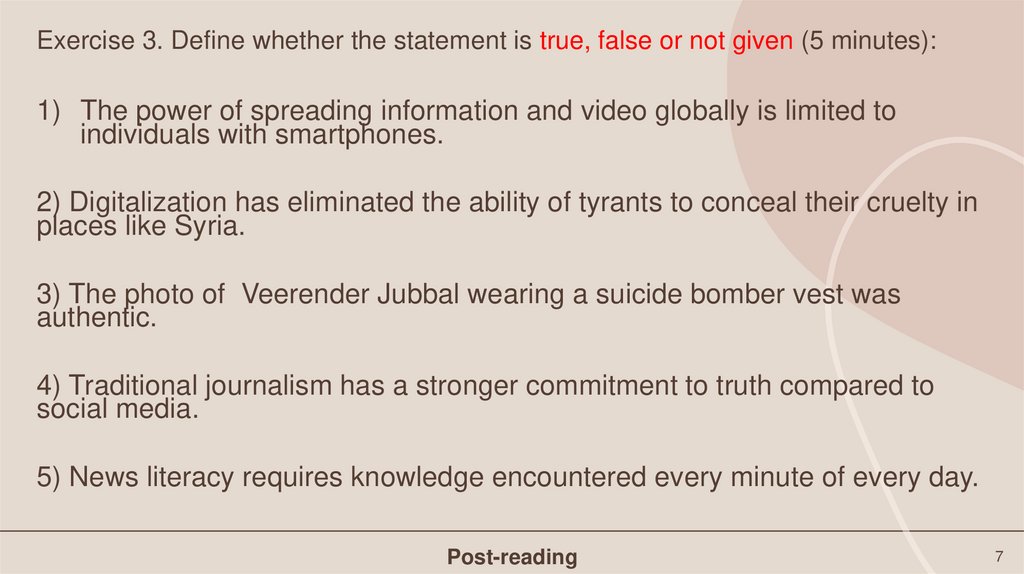
7. Exercise 3. Define whether the statement is true, false or not given (5 minutes):
Exercise 3. Define whether the statement is true, false or not given (5 minutes):1) The power of spreading information and video globally is limited to
individuals with smartphones.
2) Digitalization has eliminated the ability of tyrants to conceal their cruelty in
places like Syria.
3) The photo of Veerender Jubbal wearing a suicide bomber vest was
authentic.
4) Traditional journalism has a stronger commitment to truth compared to
social media.
5) News literacy requires knowledge encountered every minute of every day.
Post-reading
7
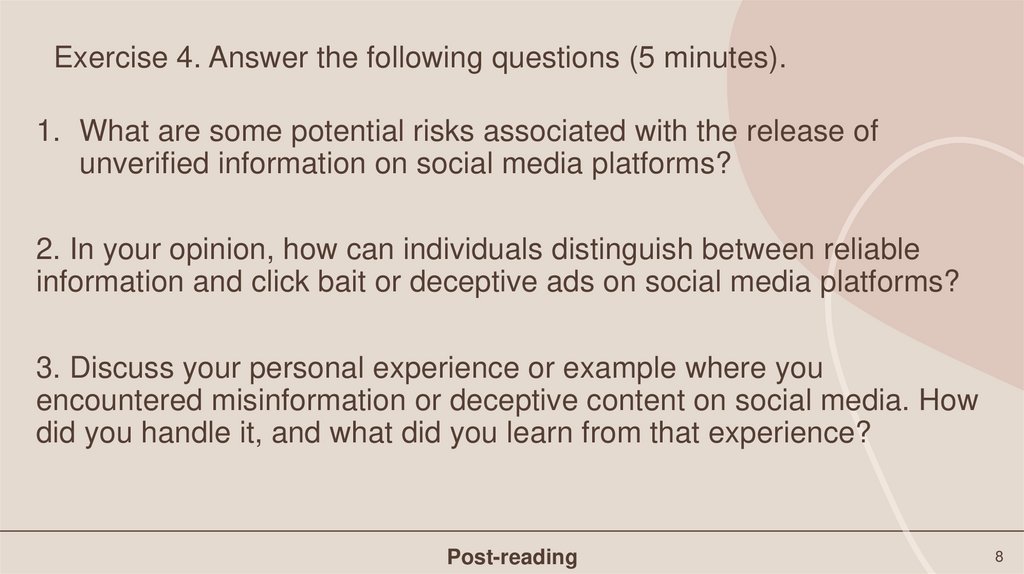
8. Exercise 4. Answer the following questions (5 minutes).
1. What are some potential risks associated with the release ofunverified information on social media platforms?
2. In your opinion, how can individuals distinguish between reliable
information and click bait or deceptive ads on social media platforms?
3. Discuss your personal experience or example where you
encountered misinformation or deceptive content on social media. How
did you handle it, and what did you learn from that experience?
Post-reading
8
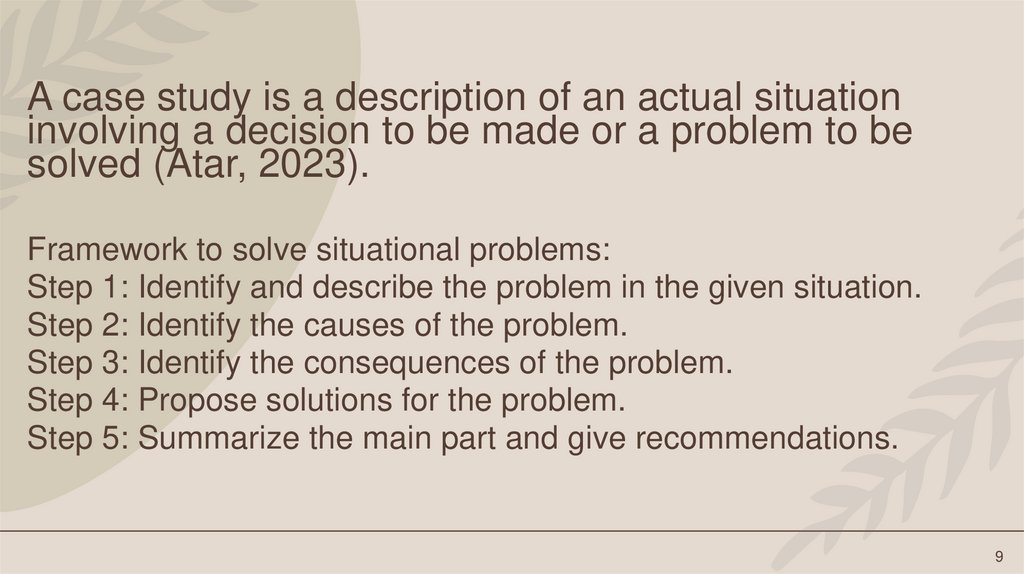
9.
A case study is a description of an actual situationinvolving a decision to be made or a problem to be
solved (Atar, 2023).
Framework to solve situational problems:
Step 1: Identify and describe the problem in the given situation.
Step 2: Identify the causes of the problem.
Step 3: Identify the consequences of the problem.
Step 4: Propose solutions for the problem.
Step 5: Summarize the main part and give recommendations.
9
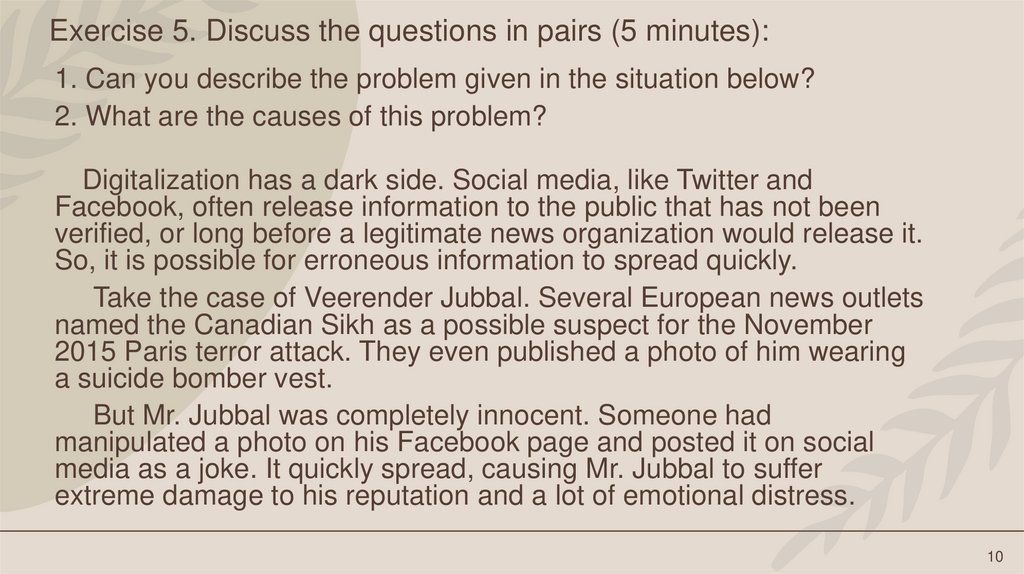
10. Exercise 5. Discuss the questions in pairs (5 minutes):
1. Can you describe the problem given in the situation below?2. What are the causes of this problem?
Digitalization has a dark side. Social media, like Twitter and
Facebook, often release information to the public that has not been
verified, or long before a legitimate news organization would release it.
So, it is possible for erroneous information to spread quickly.
Take the case of Veerender Jubbal. Several European news outlets
named the Canadian Sikh as a possible suspect for the November
2015 Paris terror attack. They even published a photo of him wearing
a suicide bomber vest.
But Mr. Jubbal was completely innocent. Someone had
manipulated a photo on his Facebook page and posted it on social
media as a joke. It quickly spread, causing Mr. Jubbal to suffer
extreme damage to his reputation and a lot of emotional distress.
10
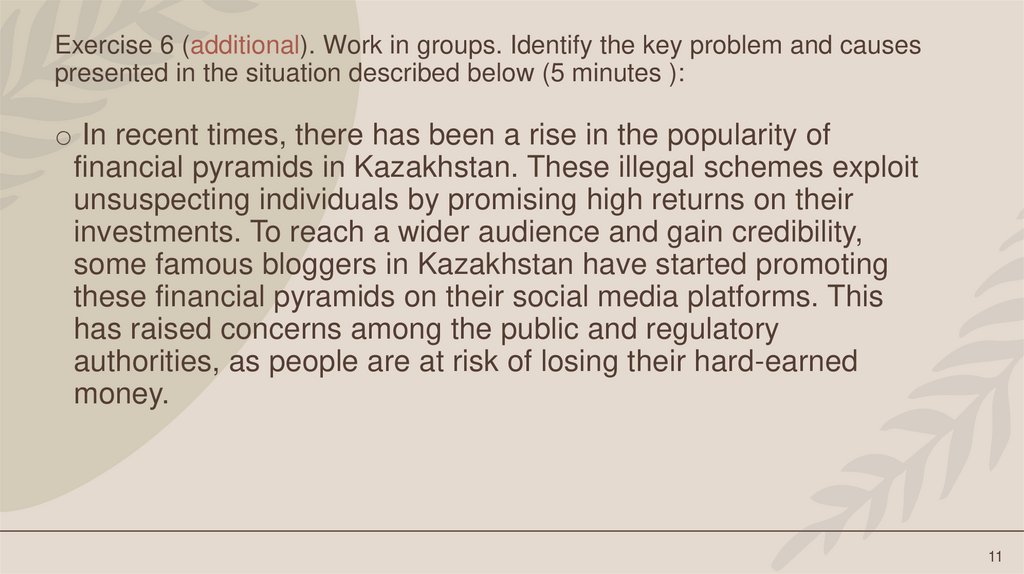
11. Exercise 6 (additional). Work in groups. Identify the key problem and causes presented in the situation described below (5
minutes ):o In recent times, there has been a rise in the popularity of
financial pyramids in Kazakhstan. These illegal schemes exploit
unsuspecting individuals by promising high returns on their
investments. To reach a wider audience and gain credibility,
some famous bloggers in Kazakhstan have started promoting
these financial pyramids on their social media platforms. This
has raised concerns among the public and regulatory
authorities, as people are at risk of losing their hard-earned
money.
11
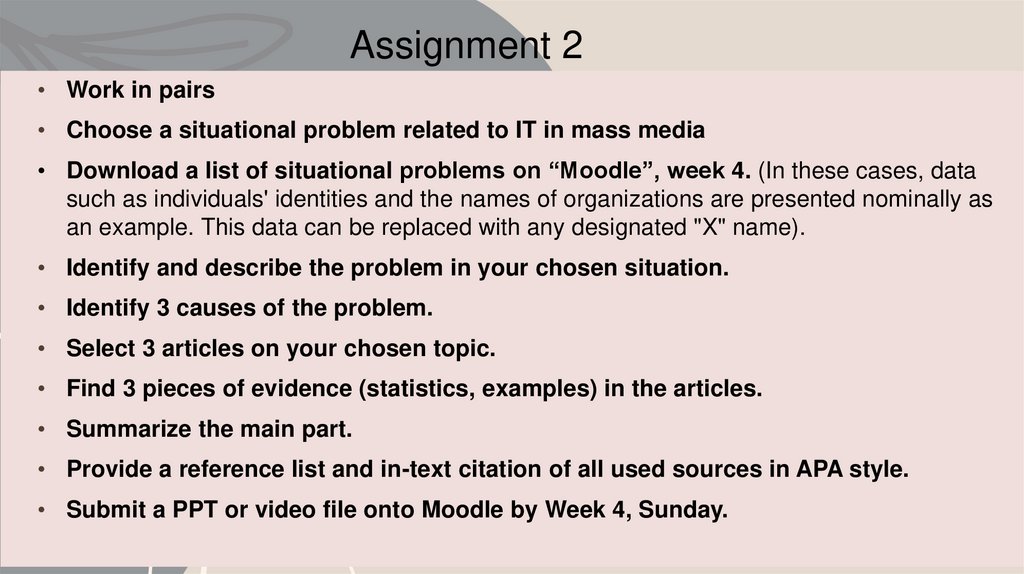
12. Assignment 2
• Work in pairs• Choose a situational problem related to IT in mass media
• Download a list of situational problems on “Moodle”, week 4. (In these cases, data
such as individuals' identities and the names of organizations are presented nominally as
an example. This data can be replaced with any designated "X" name).
• Identify and describe the problem in your chosen situation.
• Identify 3 causes of the problem.
• Select 3 articles on your chosen topic.
• Find 3 pieces of evidence (statistics, examples) in the articles.
• Summarize the main part.
• Provide a reference list and in-text citation of all used sources in APA style.
• Submit a PPT or video file onto Moodle by Week 4, Sunday.
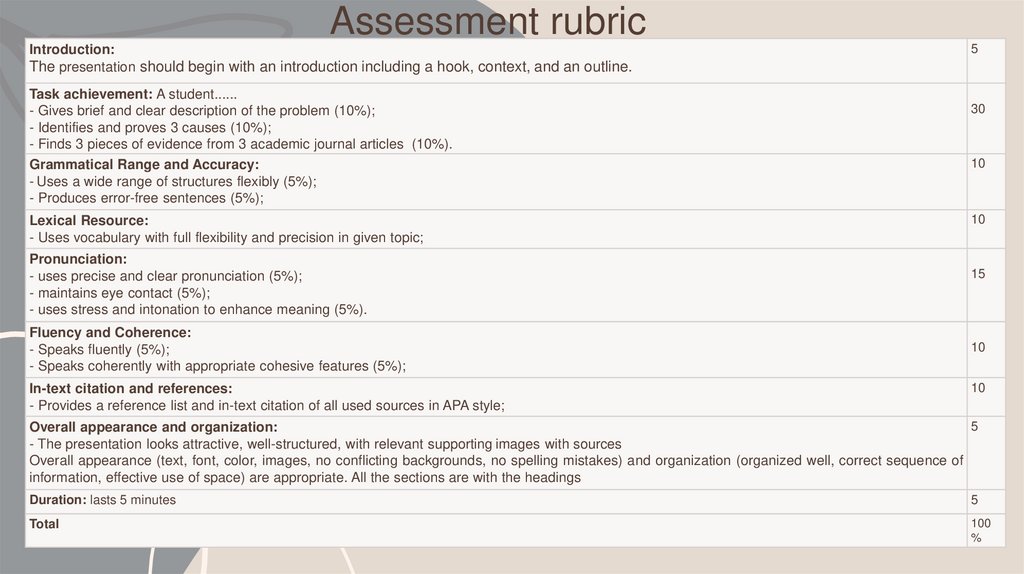
13. Assessment rubric
Introduction:The presentation should begin with an introduction including a hook, context, and an outline.
Task achievement: A student......
- Gives brief and clear description of the problem (10%);
- Identifies and proves 3 causes (10%);
- Finds 3 pieces of evidence from 3 academic journal articles (10%).
Grammatical Range and Accuracy:
- Uses a wide range of structures flexibly (5%);
- Produces error-free sentences (5%);
Lexical Resource:
- Uses vocabulary with full flexibility and precision in given topic;
Pronunciation:
- uses precise and clear pronunciation (5%);
- maintains eye contact (5%);
- uses stress and intonation to enhance meaning (5%).
Fluency and Coherence:
- Speaks fluently (5%);
- Speaks coherently with appropriate cohesive features (5%);
In-text citation and references:
- Provides a reference list and in-text citation of all used sources in APA style;
5
30
10
10
15
10
10
5
Overall appearance and organization:
- The presentation looks attractive, well-structured, with relevant supporting images with sources
Overall appearance (text, font, color, images, no conflicting backgrounds, no spelling mistakes) and organization (organized well, correct sequence of
information, effective use of space) are appropriate. All the sections are with the headings
Duration: lasts 5 minutes
5
Total
100
%