
 Медицина
Похожие презентации:




Oncological Rehabilitation: The Path from Fighting the Disease to a Full Life
1.
▪▪
▪
▪
▪
▪
▪
▪
▪
▪
▪
▪
▪
▪
▪
▪
▪
Secretary General, Asian Pacific Organization for Cancer Prevention (APOCP)
Member, IASLC Staging and Prognostic Factors Group (SPFG) for Thoracic Cancers
Working Group Member, IARC WHO Handbook 21 on Lung Cancer Screening
Member, Tobacco Control and Smoking Cessation Committee (TCSC), IASLC
Chair elect, Advocacy Committee, International Gynecologic Cancer Society (IGCS)
Chair elect, International Gynecologic Cancer Advocacy Network (IGCAN), IGCS
Member, Asian National Cancer Center Alliance (ANCCA)
Member, Strategic Group, Asia Pacific Oncology Alliance (APOA)
Member, Education Committee, Multinational Association of Supportive Care in Cancer
Member, Survivorship & Digital Health Study Group, MASCC
Country Ambassador India, International PapillomaVirus Society (IPVS)
Associate Editor, Asian Pacific Journal of Cancer Prevention (APJCP)
Associate Editor, South Asian Journal of Cancer (SAJC)
Editor in Chief, Asian Pacific Journal of Cancer Care (APJCC)
Editorial Board Member, BMJ Medicine
Founder & Honorary Secretary, Indian Society of Clinical Oncology (ISCO)
Founder & Chief Coordinator, Pink Chain Campaign
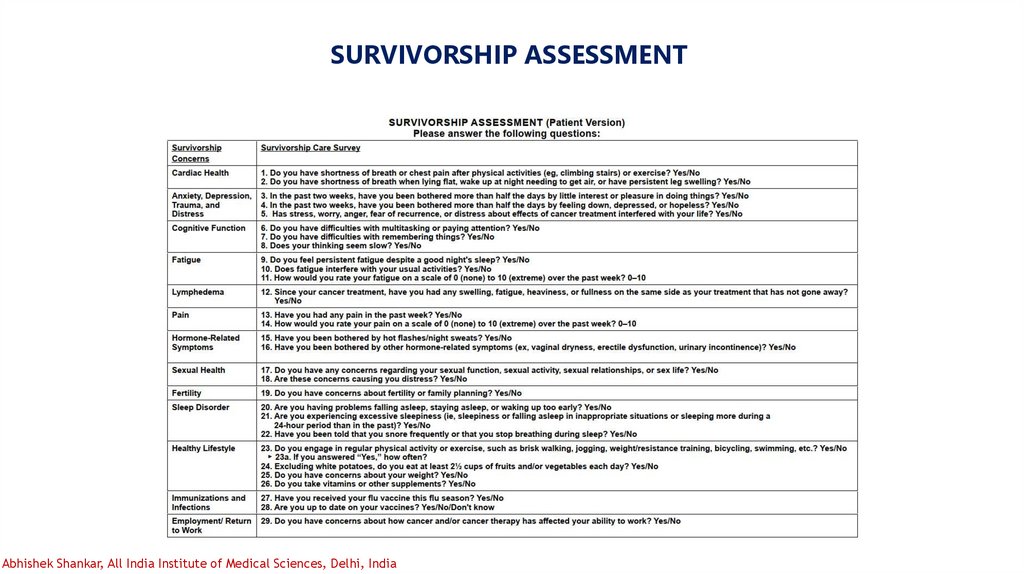
Oncological Rehabilitation:
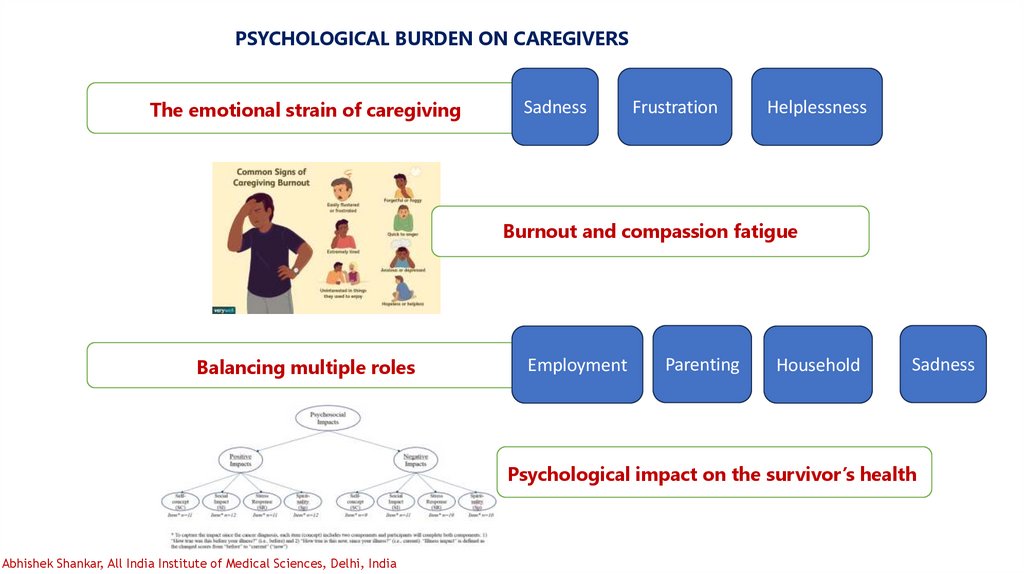
The Path from Fighting the
Disease to a Full Life
Dr. Abhishek Shankar, MD, MBA, CPFP, FUICC
IASLC Global Mentorship Fellow, Japan
Assistant Professor, Department of Radiation Oncology
All India Institute of Medical Sciences, Delhi, India
Abhishek Shankar, All India Institute of Medical Sciences, Delhi India
Email: doc.abhishankar@gmail.com
2.
I do not have any relevant financial relationships to discloseI have not used ChatGPT for making this presentation
3.
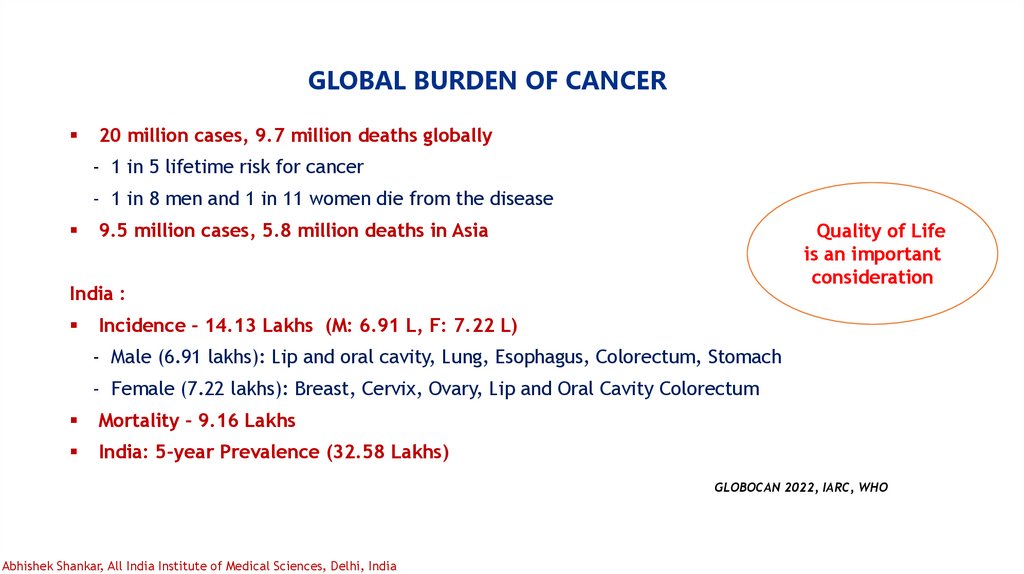
GLOBAL BURDEN OF CANCER20 million cases, 9.7 million deaths globally
- 1 in 5 lifetime risk for cancer
- 1 in 8 men and 1 in 11 women die from the disease
9.5 million cases, 5.8 million deaths in Asia
Quality of Life
is an important
consideration
India :
Incidence - 14.13 Lakhs (M: 6.91 L, F: 7.22 L)
- Male (6.91 lakhs): Lip and oral cavity, Lung, Esophagus, Colorectum, Stomach
- Female (7.22 lakhs): Breast, Cervix, Ovary, Lip and Oral Cavity Colorectum
Abhishek Shankar,
All India Institute
of Medical
Sciences, India
Mortality
- 9.16
Lakhs
India: 5-year Prevalence (32.58 Lakhs)
GLOBOCAN 2022, IARC, WHO
Abhishek Shankar, All India Institute of Medical Sciences, Delhi, India
4.
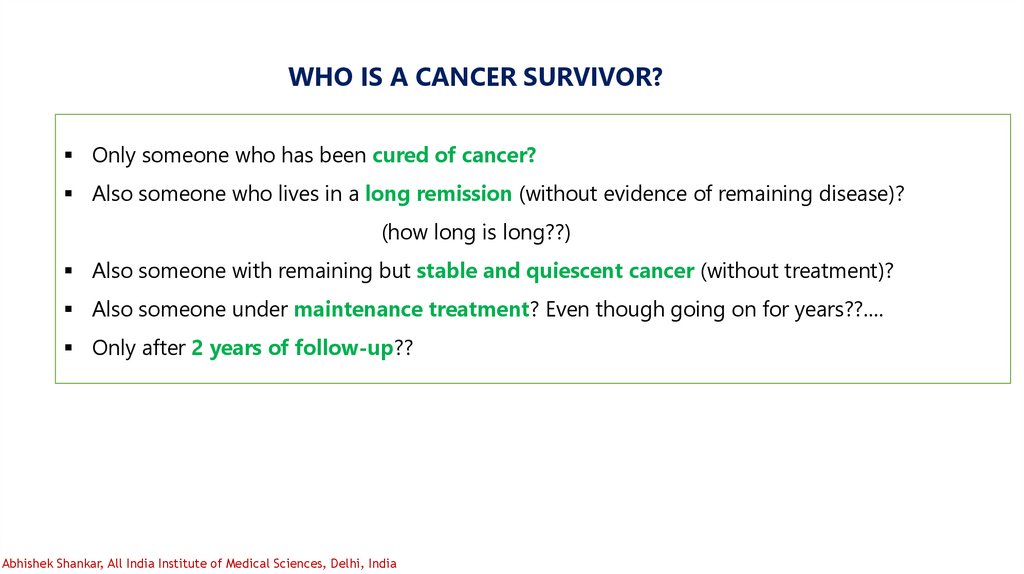
WHO IS A CANCER SURVIVOR?Only someone who has been cured of cancer?
Also someone who lives in a long remission (without evidence of remaining disease)?
(how long is long??)
Also someone with remaining but stable and quiescent cancer (without treatment)?
Also someone under maintenance treatment? Even though going on for years??….
Only after 2 years of follow-up??
Abhishek Shankar, All India Institute of Medical Sciences, Delhi, India
5.
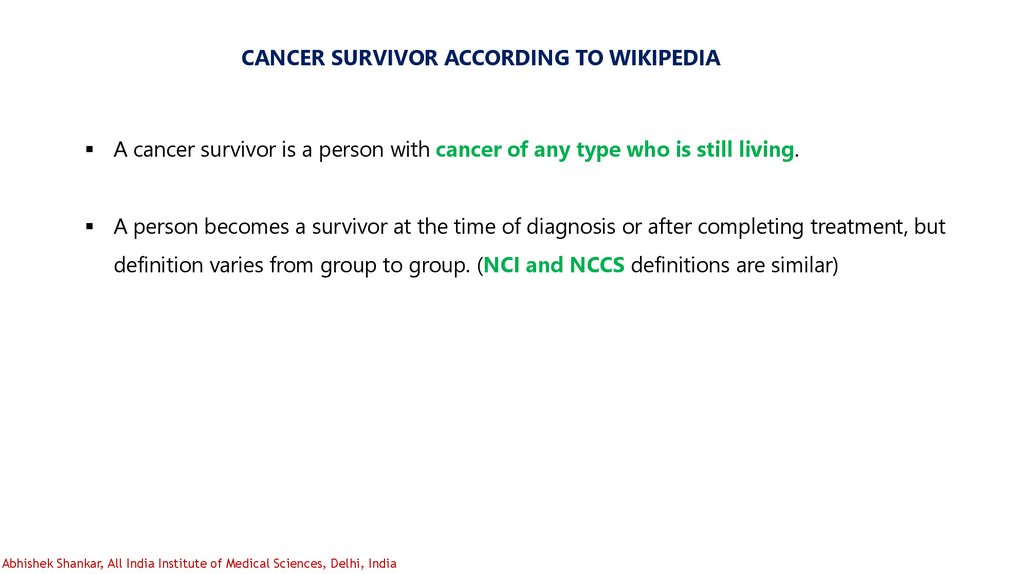
CANCER SURVIVOR ACCORDING TO WIKIPEDIAA cancer survivor is a person with cancer of any type who is still living.
A person becomes a survivor at the time of diagnosis or after completing treatment, but
definition varies from group to group. (NCI and NCCS definitions are similar)
Abhishek Shankar, All India Institute of Medical Sciences, Delhi, India
6.
Abhishek Shankar, All India Institute of Medical Sciences, Delhi, India7.
8.
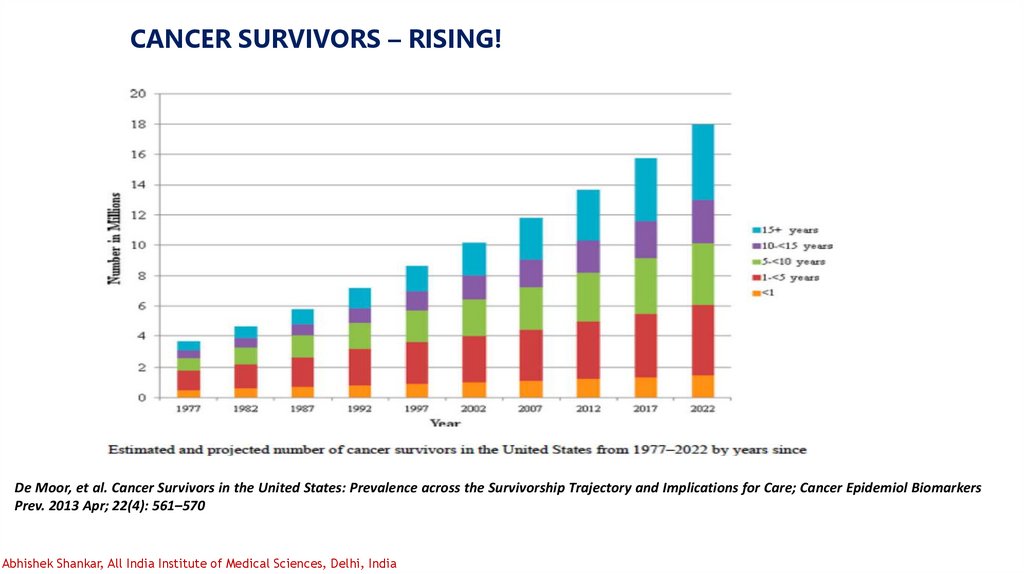
CANCER SURVIVORS – RISING!De Moor, et al. Cancer Survivors in the United States: Prevalence across the Survivorship Trajectory and Implications for Care; Cancer Epidemiol Biomarkers
Prev. 2013 Apr; 22(4): 561–570
Abhishek Shankar, All India Institute of Medical Sciences, Delhi, India
9.
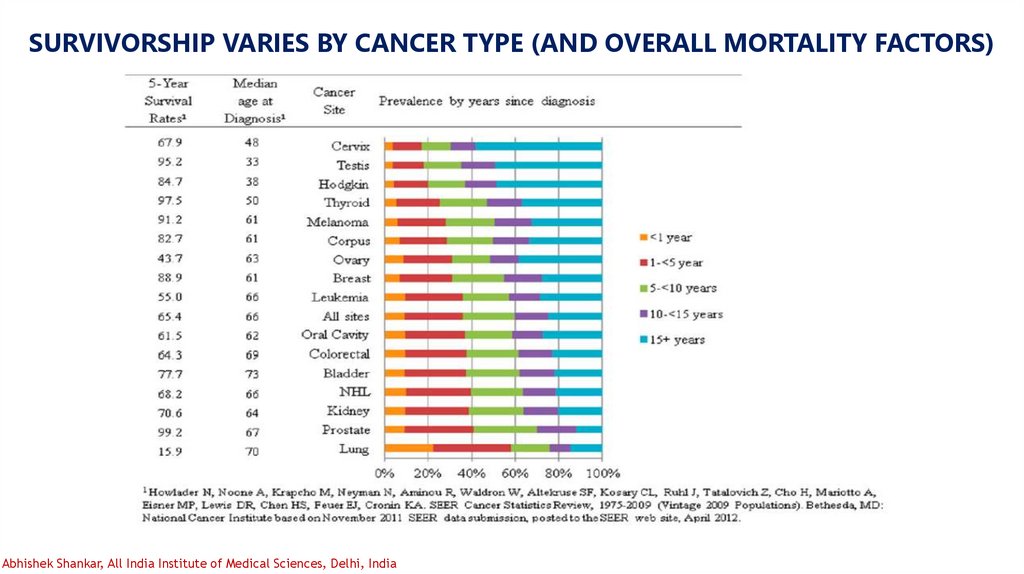
SURVIVORSHIP VARIES BY CANCER TYPE (AND OVERALL MORTALITY FACTORS)Abhishek Shankar, All India Institute of Medical Sciences, Delhi, India
10.
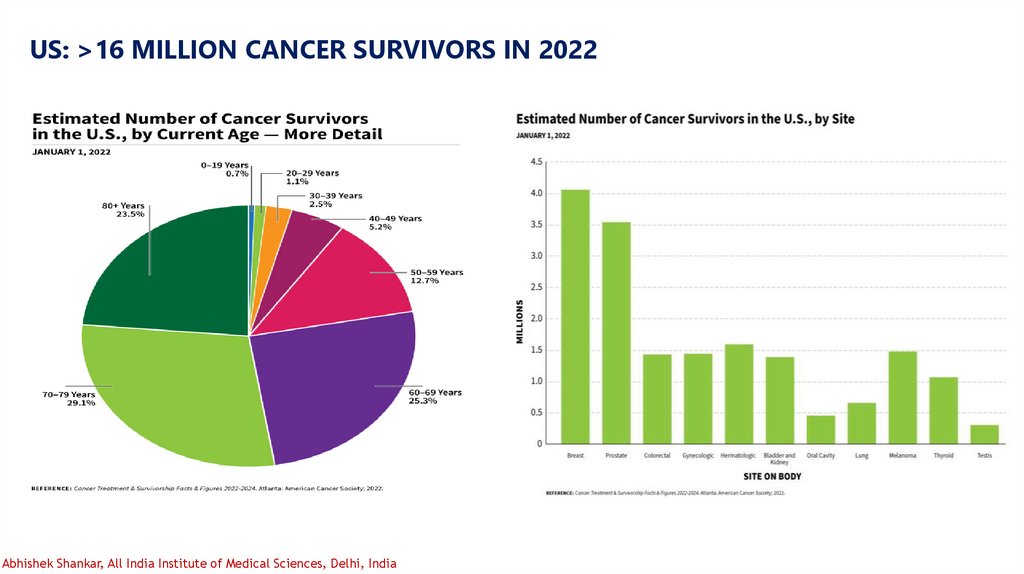
US: >16 MILLION CANCER SURVIVORS IN 2022Abhishek Shankar, All India Institute of Medical Sciences, Delhi, India
11.
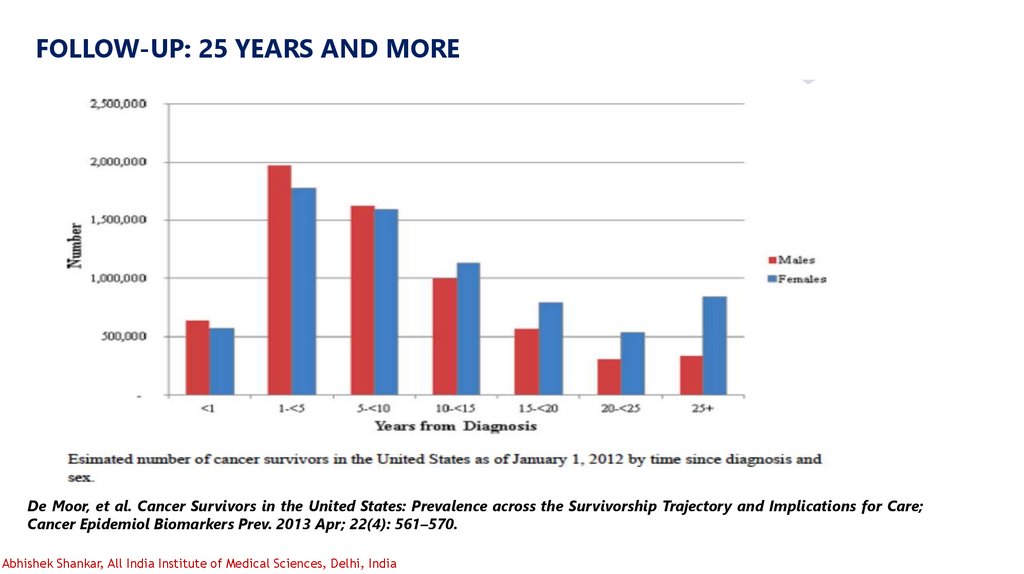
FOLLOW-UP: 25 YEARS AND MOREDe Moor, et al. Cancer Survivors in the United States: Prevalence across the Survivorship Trajectory and Implications for Care;
Cancer Epidemiol Biomarkers Prev. 2013 Apr; 22(4): 561–570.
Abhishek Shankar, All India Institute of Medical Sciences, Delhi, India
12.
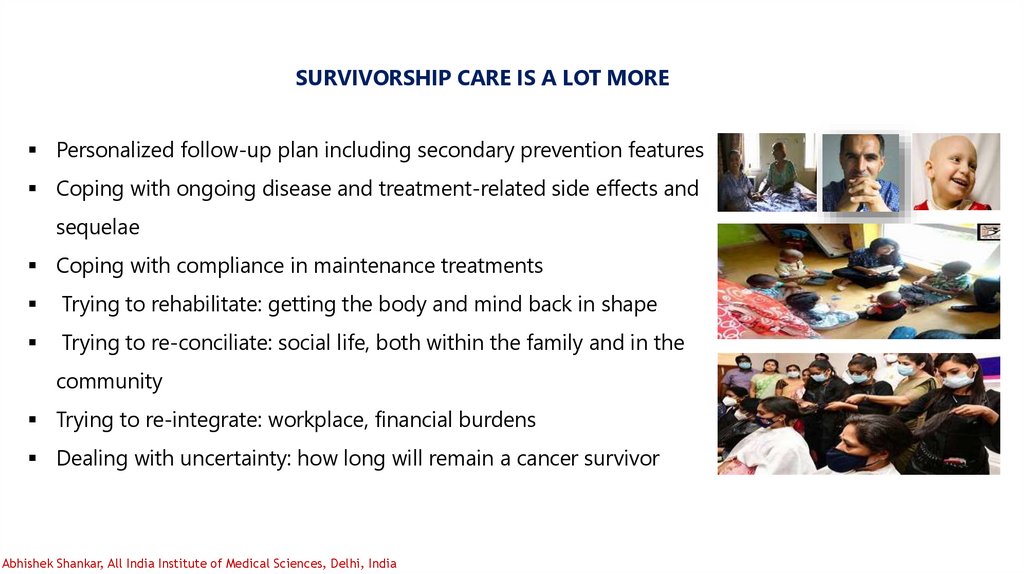
SURVIVORSHIP CARE IS A LOT MOREPersonalized follow-up plan including secondary prevention features
Coping with ongoing disease and treatment-related side effects and
sequelae
Coping with compliance in maintenance treatments
Trying to rehabilitate: getting the body and mind back in shape
Trying to re-conciliate: social life, both within the family and in the
community
Trying to re-integrate: workplace, financial burdens
Dealing with uncertainty: how long will remain a cancer survivor
Abhishek Shankar, All India Institute of Medical Sciences, Delhi, India
13.
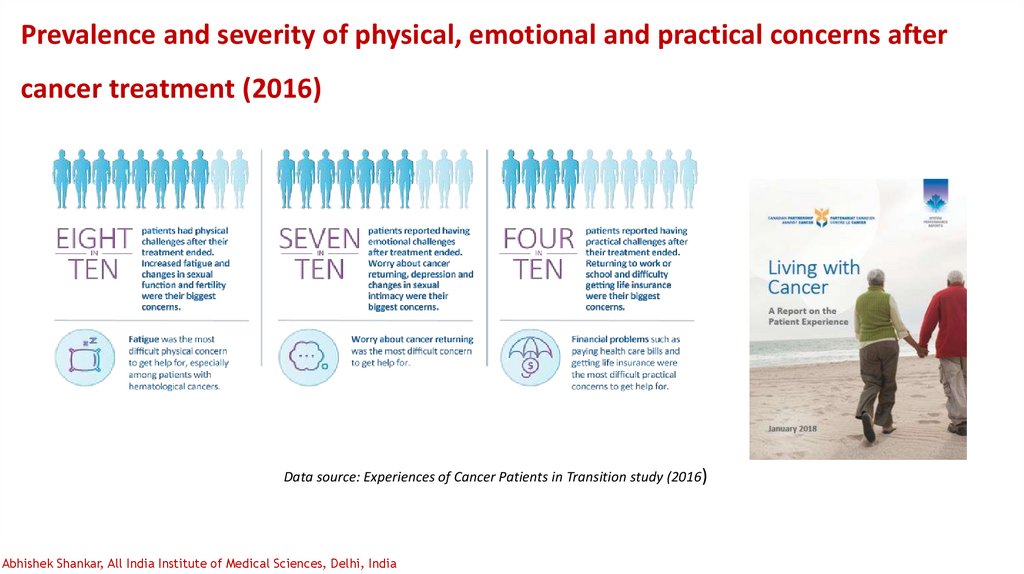
Prevalence and severity of physical, emotional and practical concerns aftercancer treatment (2016)
Data source: Experiences of Cancer Patients in Transition study (2016)
Abhishek Shankar, All India Institute of Medical Sciences, Delhi, India
14.
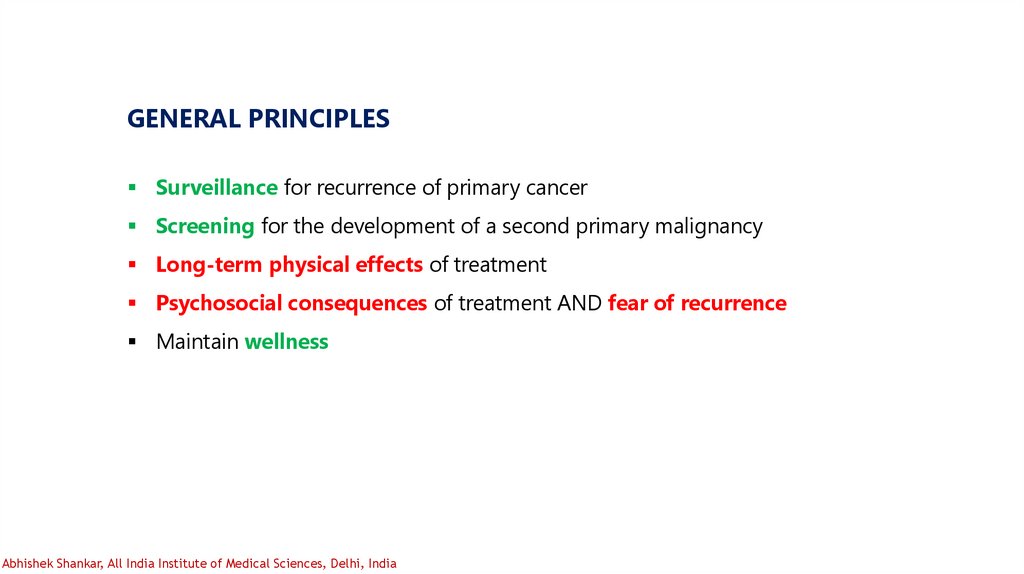
GENERAL PRINCIPLESSurveillance for recurrence of primary cancer
Screening for the development of a second primary malignancy
Long-term physical effects of treatment
Psychosocial consequences of treatment AND fear of recurrence
Maintain wellness
Abhishek Shankar, All India Institute of Medical Sciences, Delhi, India
15.
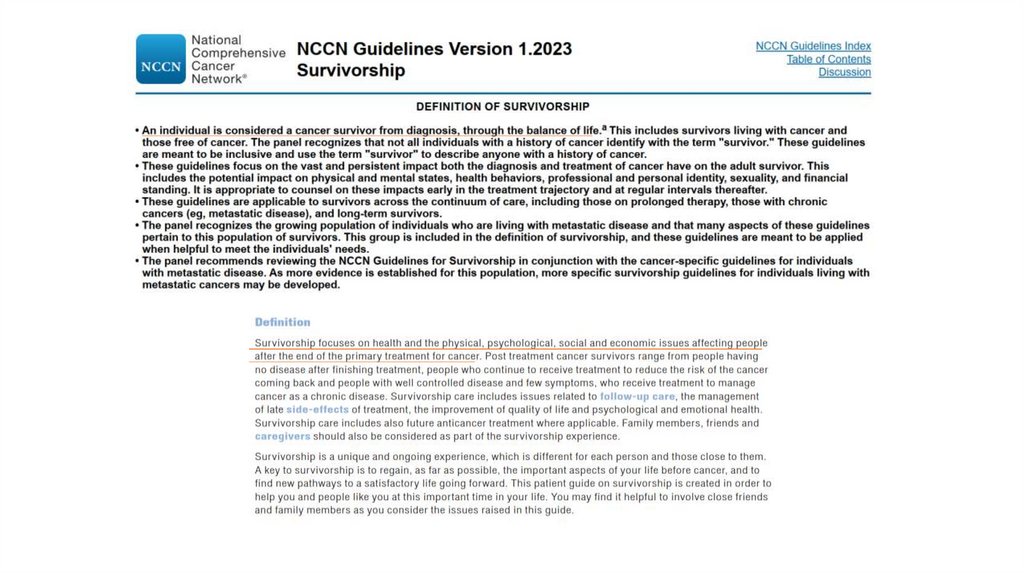
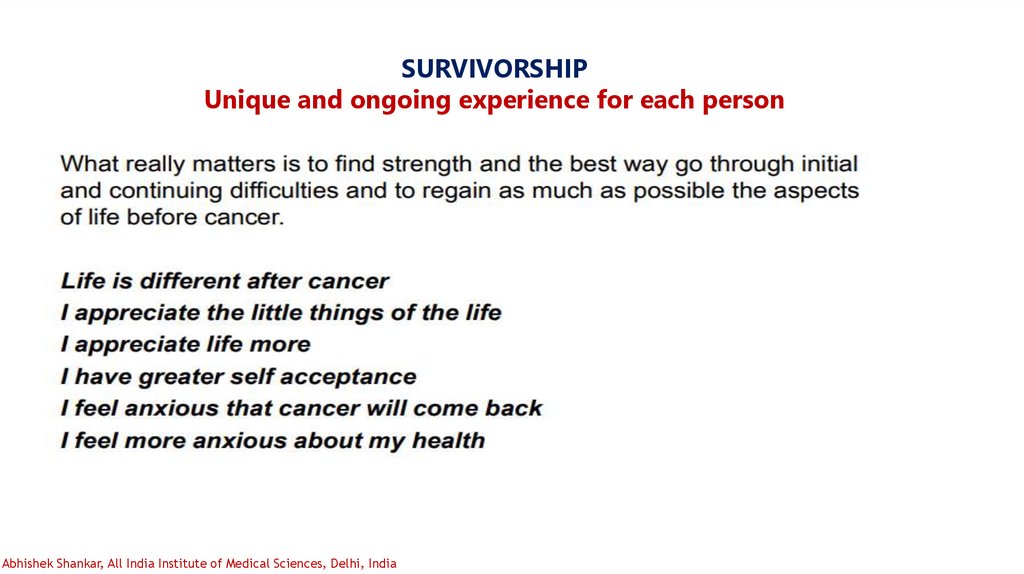
SURVIVORSHIPUnique and ongoing experience for each person
Abhishek Shankar, All India Institute of Medical Sciences, Delhi, India
16.
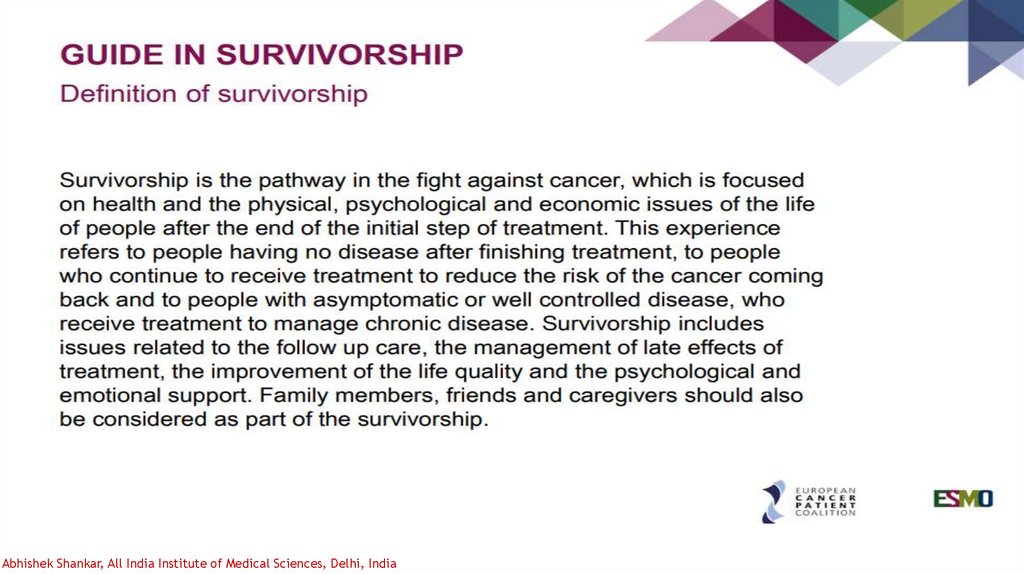
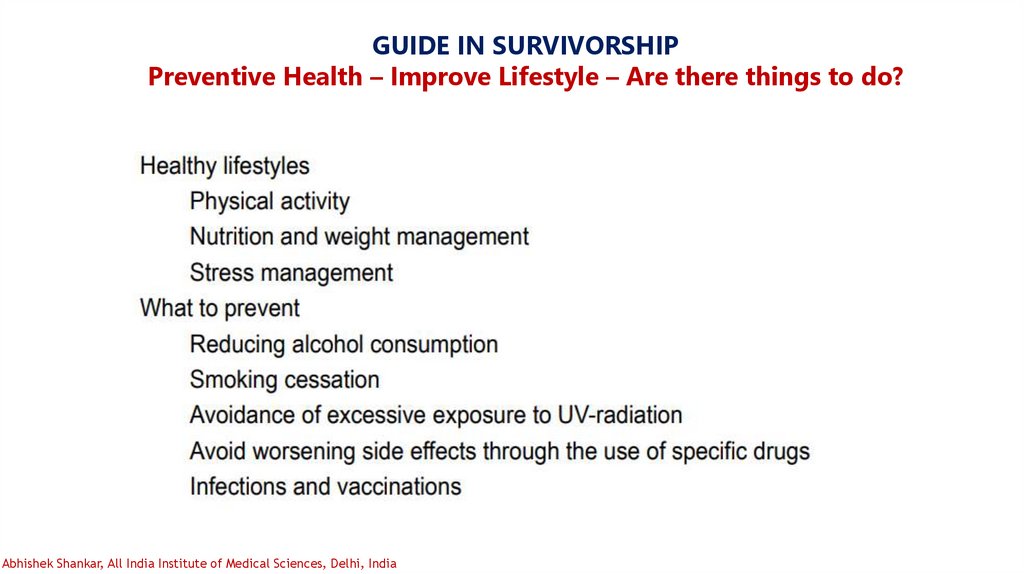
GUIDE IN SURVIVORSHIPPreventive Health – Improve Lifestyle – Are there things to do?
Abhishek Shankar, All India Institute of Medical Sciences, Delhi, India
17.
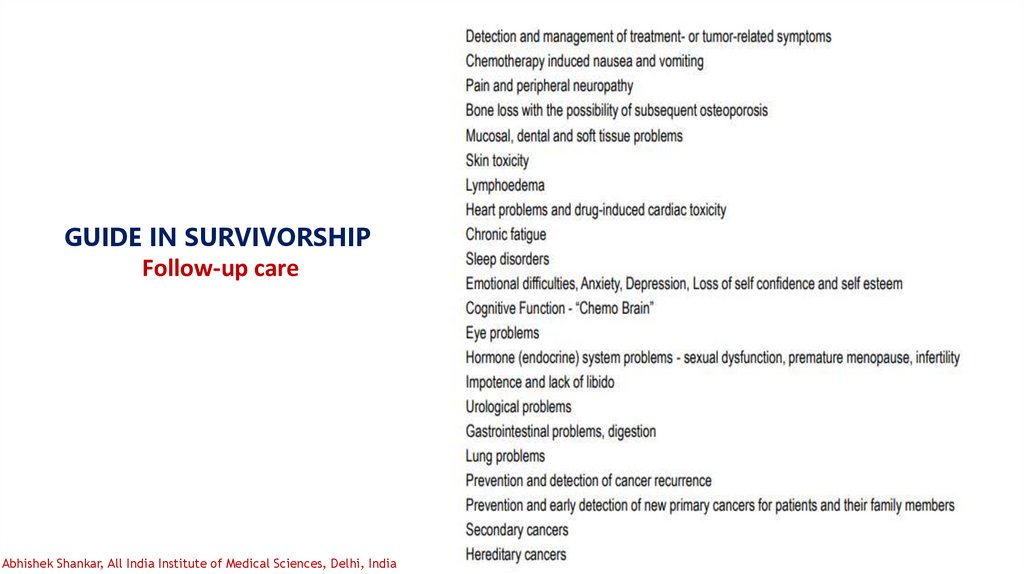
GUIDE IN SURVIVORSHIPFollow-up care
Abhishek Shankar, All India Institute of Medical Sciences, Delhi, India
18.
Abhishek Shankar, All India Institute of Medical Sciences, Delhi, India19.
Abhishek Shankar, All India Institute of Medical Sciences, Delhi, India20.
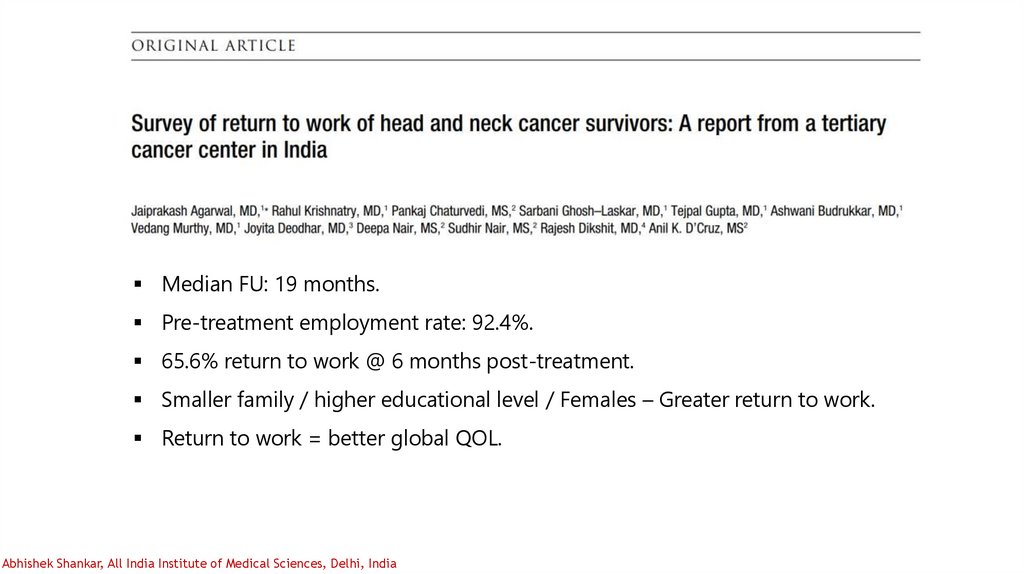
Median FU: 19 months.Pre-treatment employment rate: 92.4%.
65.6% return to work @ 6 months post-treatment.
Smaller family / higher educational level / Females – Greater return to work.
Return to work = better global QOL.
Abhishek Shankar, All India Institute of Medical Sciences, Delhi, India
21.
Abhishek Shankar, All India Institute of Medical Sciences, Delhi, India22.
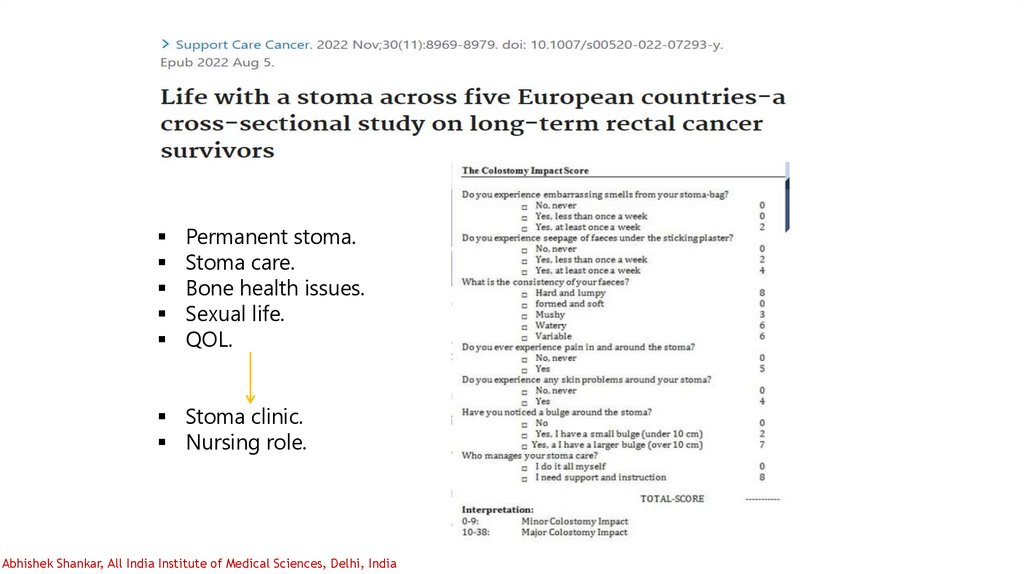
Permanent stoma.Stoma care.
Bone health issues.
Sexual life.
QOL.
Stoma clinic.
Nursing role.
Abhishek Shankar, All India Institute of Medical Sciences, Delhi, India
23.
Abhishek Shankar, All India Institute of Medical Sciences, Delhi, India24.
Abhishek Shankar, All India Institute of Medical Sciences, Delhi, India25.
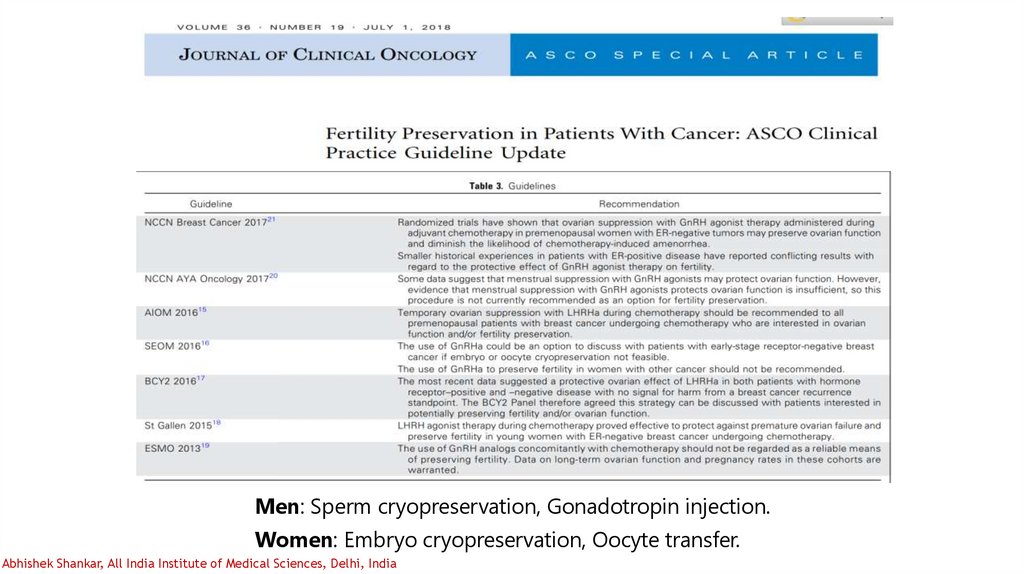
Men: Sperm cryopreservation, Gonadotropin injection.Women: Embryo cryopreservation, Oocyte transfer.
Abhishek Shankar, All India Institute of Medical Sciences, Delhi, India
26.
Abhishek Shankar, All India Institute of Medical Sciences, Delhi, India27.
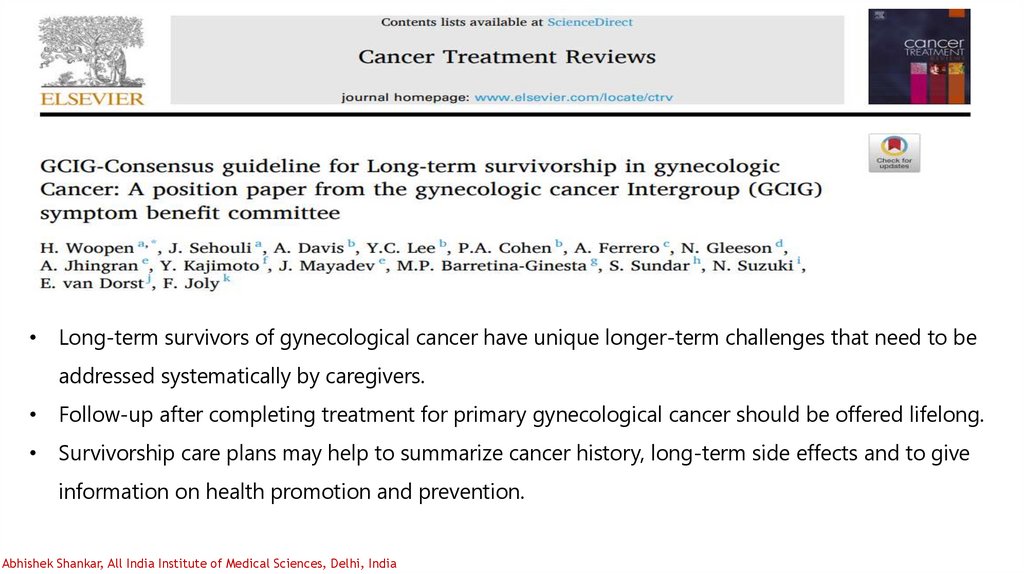
• Long-term survivors of gynecological cancer have unique longer-term challenges that need to beaddressed systematically by caregivers.
• Follow-up after completing treatment for primary gynecological cancer should be offered lifelong.
• Survivorship care plans may help to summarize cancer history, long-term side effects and to give
information on health promotion and prevention.
Abhishek Shankar, All India Institute of Medical Sciences, Delhi, India
28.
Abhishek Shankar, All India Institute of Medical Sciences, Delhi, India29.
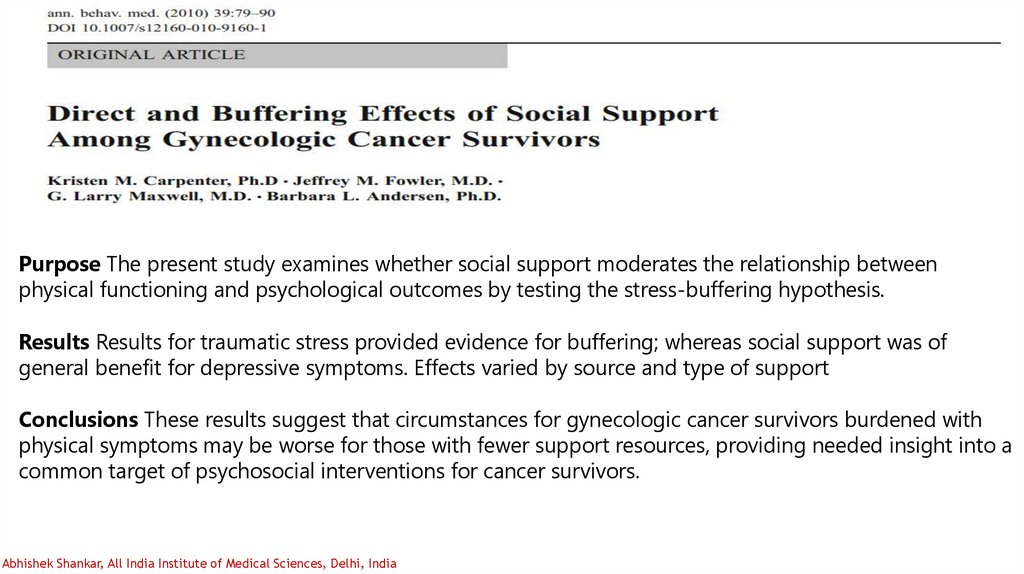
Purpose The present study examines whether social support moderates the relationship betweenphysical functioning and psychological outcomes by testing the stress-buffering hypothesis.
Results Results for traumatic stress provided evidence for buffering; whereas social support was of
general benefit for depressive symptoms. Effects varied by source and type of support
Conclusions These results suggest that circumstances for gynecologic cancer survivors burdened with
physical symptoms may be worse for those with fewer support resources, providing needed insight into a
common target of psychosocial interventions for cancer survivors.
Abhishek Shankar, All India Institute of Medical Sciences, Delhi, India
30.
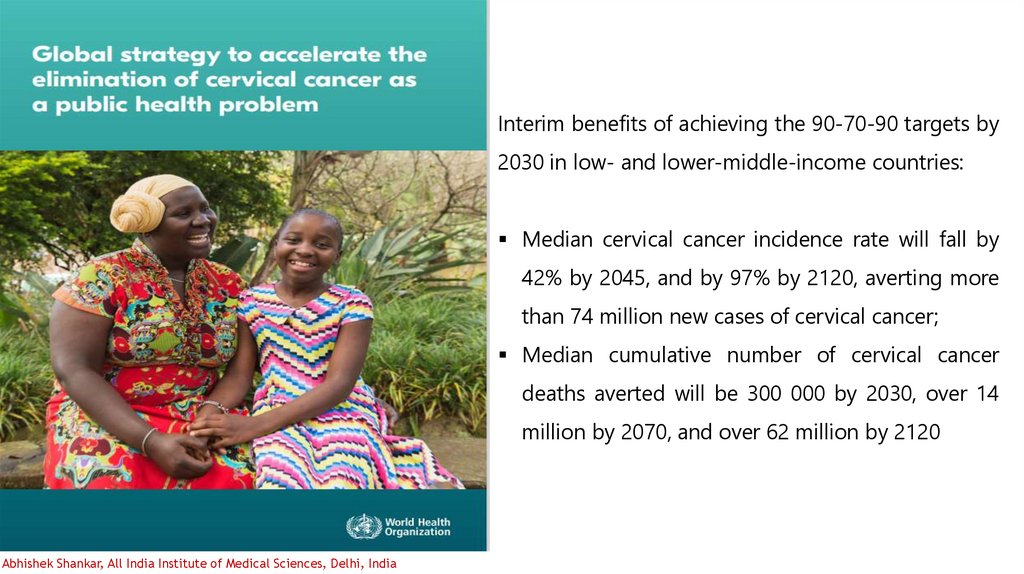
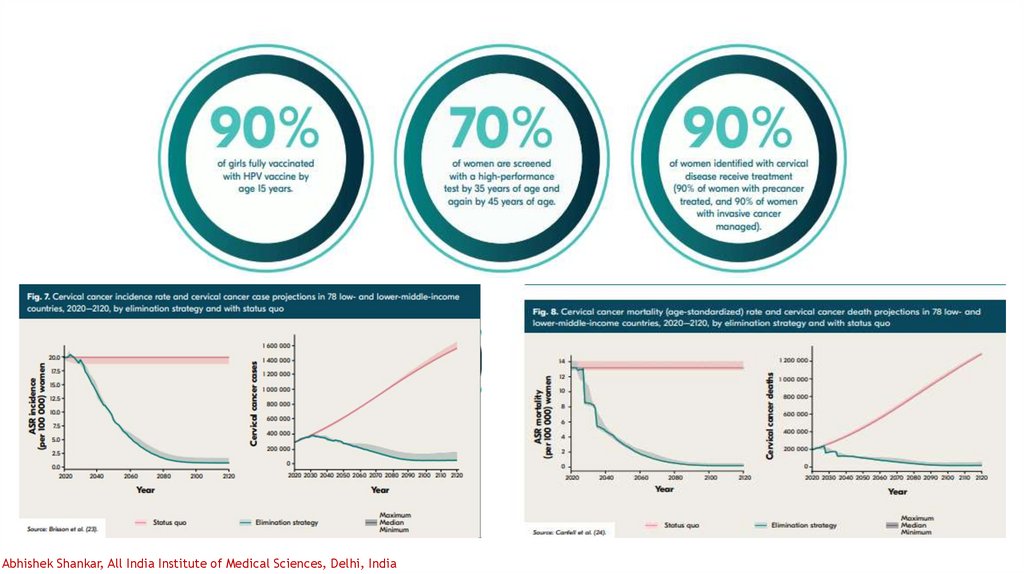
Interim benefits of achieving the 90-70-90 targets by2030 in low- and lower-middle-income countries:
Median cervical cancer incidence rate will fall by
42% by 2045, and by 97% by 2120, averting more
than 74 million new cases of cervical cancer;
Median cumulative number of cervical cancer
deaths averted will be 300 000 by 2030, over 14
million by 2070, and over 62 million by 2120
Abhishek Shankar, All India Institute of Medical Sciences, Delhi, India
31.
Abhishek Shankar, All India Institute of Medical Sciences, Delhi, India32.
Abhishek Shankar, All India Institute of Medical Sciences, Delhi, India33.
Abhishek Shankar, All India Institute of Medical Sciences, Delhi, India34.
Abhishek Shankar, All India Institute of Medical Sciences, Delhi, India35.
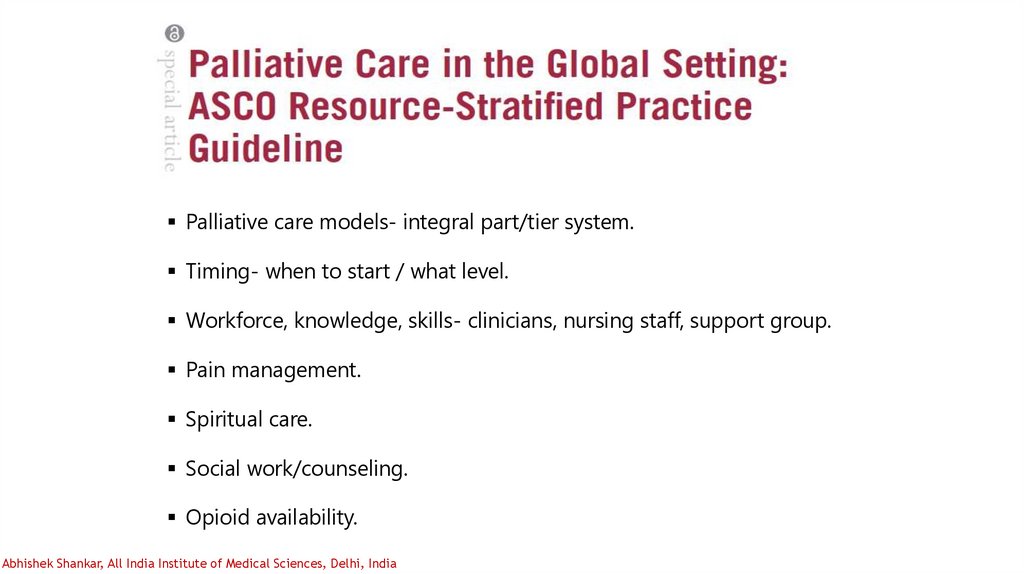
Palliative care models- integral part/tier system.Timing- when to start / what level.
Workforce, knowledge, skills- clinicians, nursing staff, support group.
Pain management.
Spiritual care.
Social work/counseling.
Opioid availability.
Abhishek Shankar, All India Institute of Medical Sciences, Delhi, India
36.
Abhishek Shankar, All India Institute of Medical Sciences, Delhi, India37. SURVIVORSHIP ASSESSMENT
Abhishek Shankar, All India Institute of Medical Sciences, Delhi, India38.
PSYCHOLOGICAL BURDEN ON CAREGIVERSThe emotional strain of caregiving
Sadness
Frustration
Helplessness
Burnout and compassion fatigue
Balancing multiple roles
Employment
Parenting
Household
Sadness
Psychological impact on the survivor’s health
Abhishek Shankar, All India Institute of Medical Sciences, Delhi, India
39.
Abhishek Shankar, All India Institute of Medical Sciences, Delhi, India40.
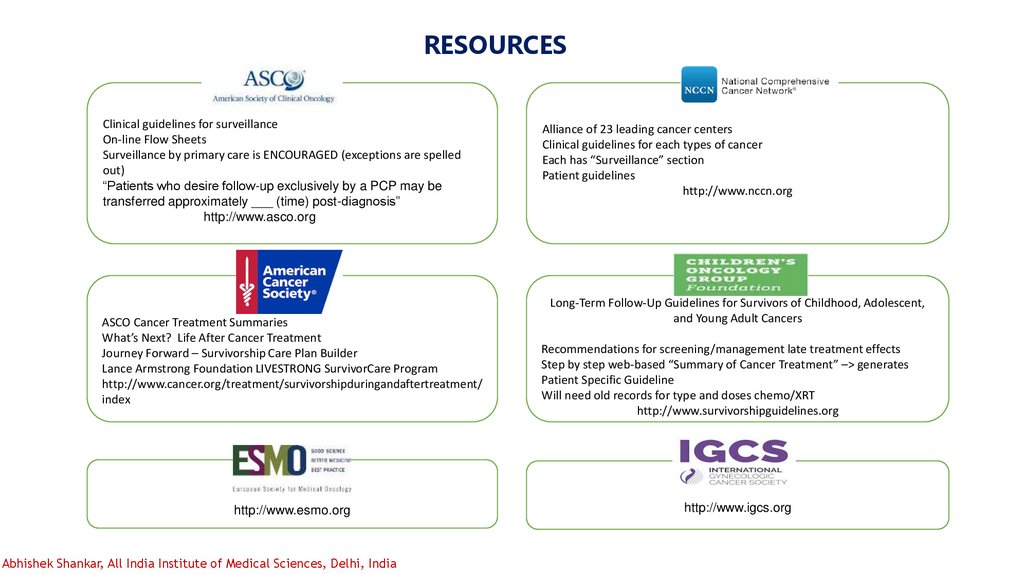
RESOURCESClinical guidelines for surveillance
On-line Flow Sheets
Surveillance by primary care is ENCOURAGED (exceptions are spelled
out)
“Patients who desire follow-up exclusively by a PCP may be
transferred approximately ___ (time) post-diagnosis”
http://www.asco.org
ASCO Cancer Treatment Summaries
What’s Next? Life After Cancer Treatment
Journey Forward – Survivorship Care Plan Builder
Lance Armstrong Foundation LIVESTRONG SurvivorCare Program
http://www.cancer.org/treatment/survivorshipduringandaftertreatment/
index
http://www.esmo.org
Abhishek Shankar, All India Institute of Medical Sciences, Delhi, India
Alliance of 23 leading cancer centers
Clinical guidelines for each types of cancer
Each has “Surveillance” section
Patient guidelines
http://www.nccn.org
Long-Term Follow-Up Guidelines for Survivors of Childhood, Adolescent,
and Young Adult Cancers
Recommendations for screening/management late treatment effects
Step by step web-based “Summary of Cancer Treatment” –> generates
Patient Specific Guideline
Will need old records for type and doses chemo/XRT
http://www.survivorshipguidelines.org
http://www.igcs.org
41.
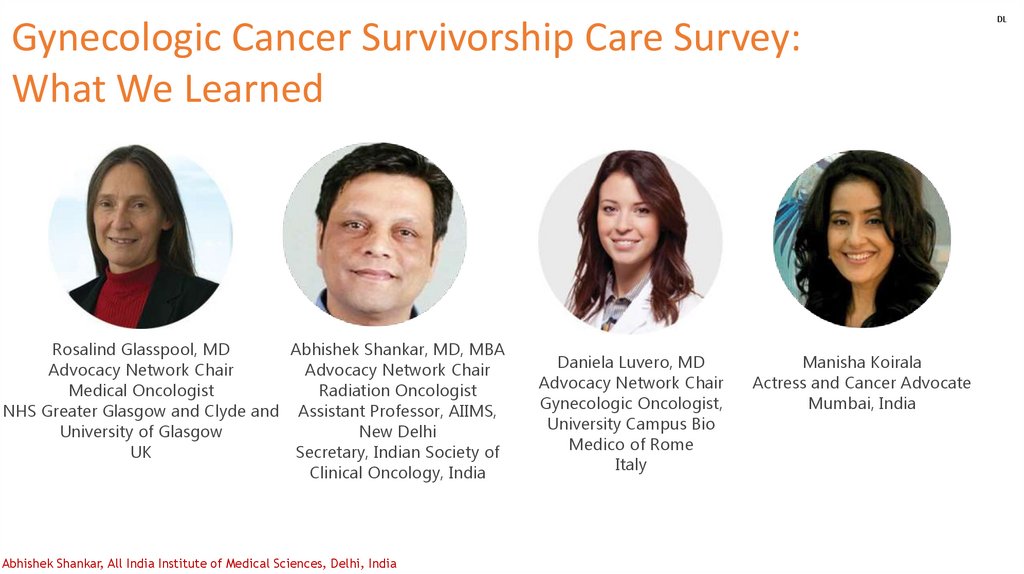
Gynecologic Cancer Survivorship Care Survey:What We Learned
Rosalind Glasspool, MD
Abhishek Shankar, MD, MBA
Advocacy Network Chair
Advocacy Network Chair
Medical Oncologist
Radiation Oncologist
NHS Greater Glasgow and Clyde and Assistant Professor, AIIMS,
University of Glasgow
New Delhi
UK
Secretary, Indian Society of
Clinical Oncology, India
Abhishek Shankar, All India Institute of Medical Sciences, Delhi, India
Daniela Luvero, MD
Advocacy Network Chair
Gynecologic Oncologist,
University Campus Bio
Medico of Rome
Italy
Manisha Koirala
Actress and Cancer Advocate
Mumbai, India
DL
42. CANCER SURVIVORSHIP
RGCANCER SURVIVORSHIP
IGCS defines A cancer survivor as anyone living with a history of cancer — from diagnosis
through the remainder of life.
We asked patient-survivors if they agreed with this definition.
93% agreed 7% did not agree
Some respondents noted what the term cancer survivor means to them:
• “Anytime after the diagnosis of cancer”
• “Living with and beyond a diagnosis of cancer”
While others preferred to move away from the “war analogy”
Abhishek Shankar, All India Institute of Medical Sciences, Delhi, India
43.
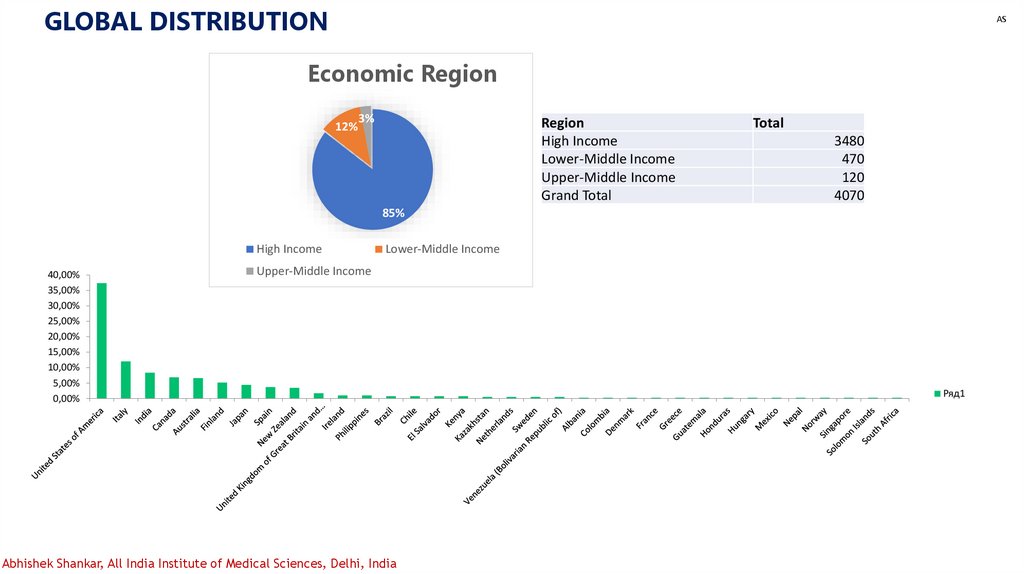
GLOBAL DISTRIBUTIONAS
Economic Region
12%
3%
Region
High Income
Lower-Middle Income
Upper-Middle Income
Grand Total
Total
3480
470
120
4070
85%
High Income
40,00%
35,00%
30,00%
25,00%
20,00%
15,00%
10,00%
5,00%
0,00%
Lower-Middle Income
Upper-Middle Income
Abhishek Shankar, All India Institute of Medical Sciences, Delhi, India
Ряд1
44. TUMOR TYPES
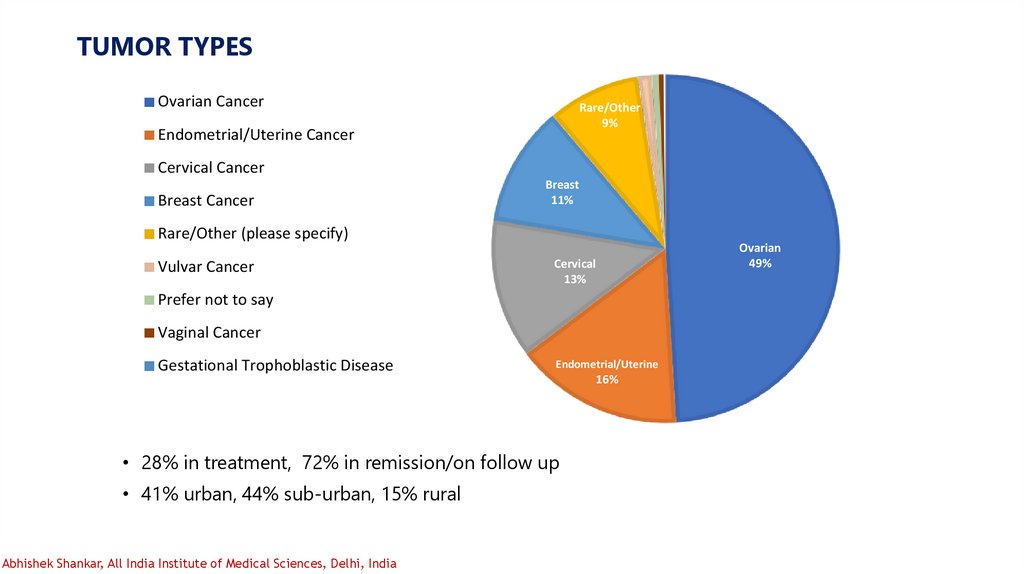
Ovarian CancerRare/Other
9%
Endometrial/Uterine Cancer
Cervical Cancer
Breast Cancer
Breast
11%
Rare/Other (please specify)
Vulvar Cancer
Cervical
13%
Prefer not to say
Vaginal Cancer
Gestational Trophoblastic Disease
Endometrial/Uterine
• 28% in treatment, 72% in remission/on follow up
• 41% urban, 44% sub-urban, 15% rural
Abhishek Shankar, All India Institute of Medical Sciences, Delhi, India
16%
Ovarian
49%
45. AWARENESS
RGAWARENESS
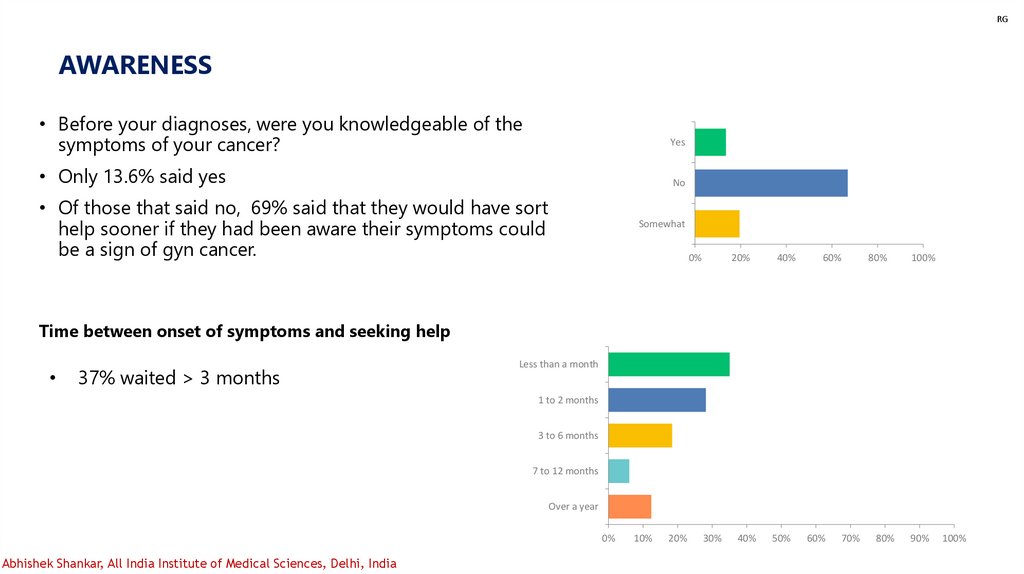
• Before your diagnoses, were you knowledgeable of the
symptoms of your cancer?
Yes
• Only 13.6% said yes
No
• Of those that said no, 69% said that they would have sort
help sooner if they had been aware their symptoms could
be a sign of gyn cancer.
Somewhat
0%
20%
40%
40%
50%
60%
80%
100%
Time between onset of symptoms and seeking help
37% waited > 3 months
Less than a month
1 to 2 months
3 to 6 months
7 to 12 months
Over a year
0%
Abhishek Shankar, All India Institute of Medical Sciences, Delhi, India
10%
20%
30%
60%
70%
80%
90%
100%
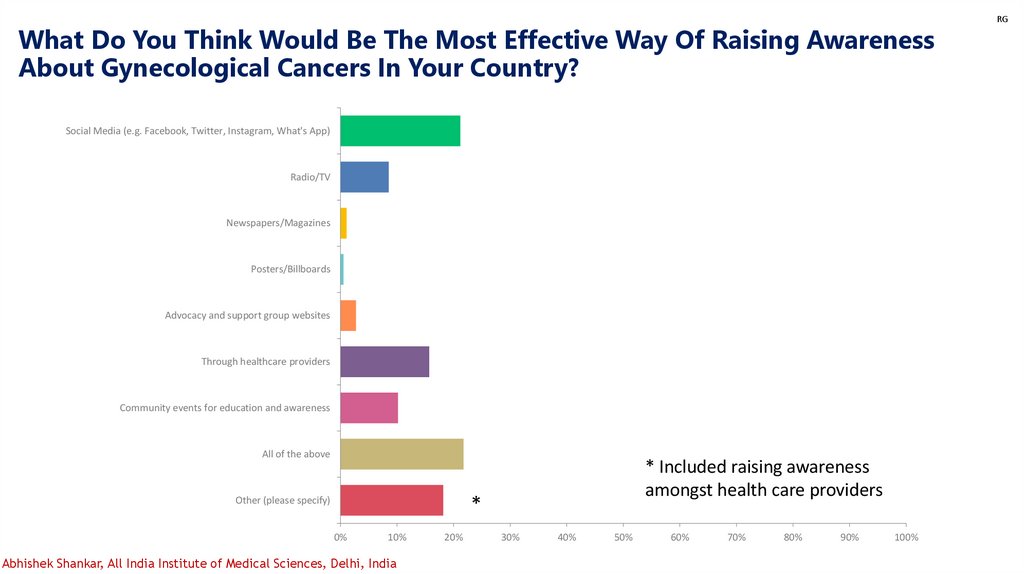
46. What Do You Think Would Be The Most Effective Way Of Raising Awareness About Gynecological Cancers In Your Country?
Social Media (e.g. Facebook, Twitter, Instagram, What's App)Radio/TV
Newspapers/Magazines
Posters/Billboards
Advocacy and support group websites
Through healthcare providers
Community events for education and awareness
All of the above
* Included raising awareness
amongst health care providers
*
Other (please specify)
0%
10%
Abhishek Shankar, All India Institute of Medical Sciences, Delhi, India
20%
30%
40%
50%
60%
70%
80%
90%
100%
RG
47. SUPPORT NEEDS – PHYSICAL
RGSUPPORT NEEDS – PHYSICAL
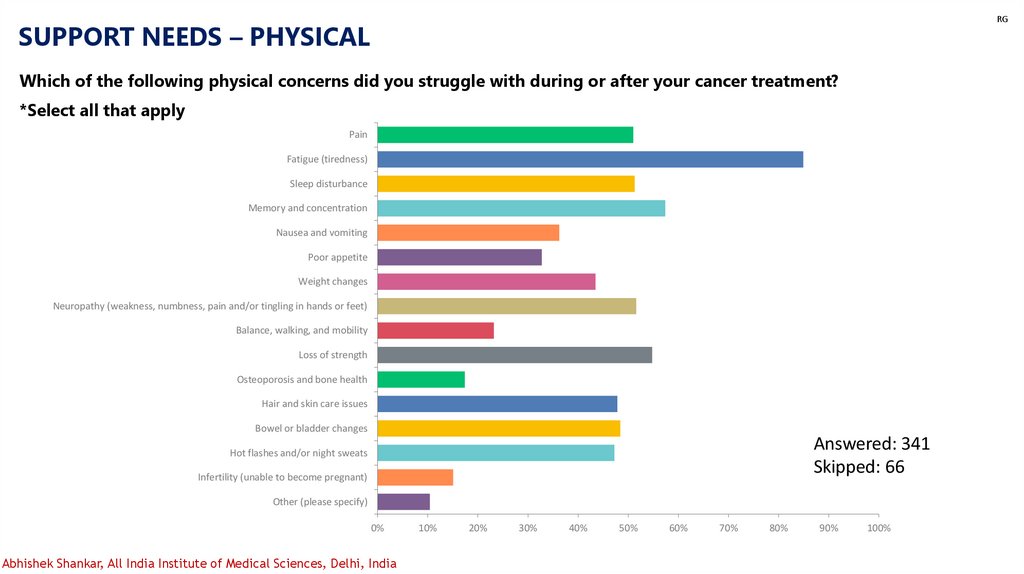
Which of the following physical concerns did you struggle with during or after your cancer treatment?
*Select all that apply
Pain
Fatigue (tiredness)
Sleep disturbance
Memory and concentration
Nausea and vomiting
Poor appetite
Weight changes
Neuropathy (weakness, numbness, pain and/or tingling in hands or feet)
Balance, walking, and mobility
Loss of strength
Osteoporosis and bone health
Hair and skin care issues
Bowel or bladder changes
Answered: 341
Skipped: 66
Hot flashes and/or night sweats
Infertility (unable to become pregnant)
Other (please specify)
0%
Abhishek Shankar, All India Institute of Medical Sciences, Delhi, India
10%
20%
30%
40%
50%
60%
70%
80%
90%
100%
48. SUPPORT NEEDS – PSYCHOLOGICAL/EMOTIONAL
RGSUPPORT NEEDS – PSYCHOLOGICAL/EMOTIONAL
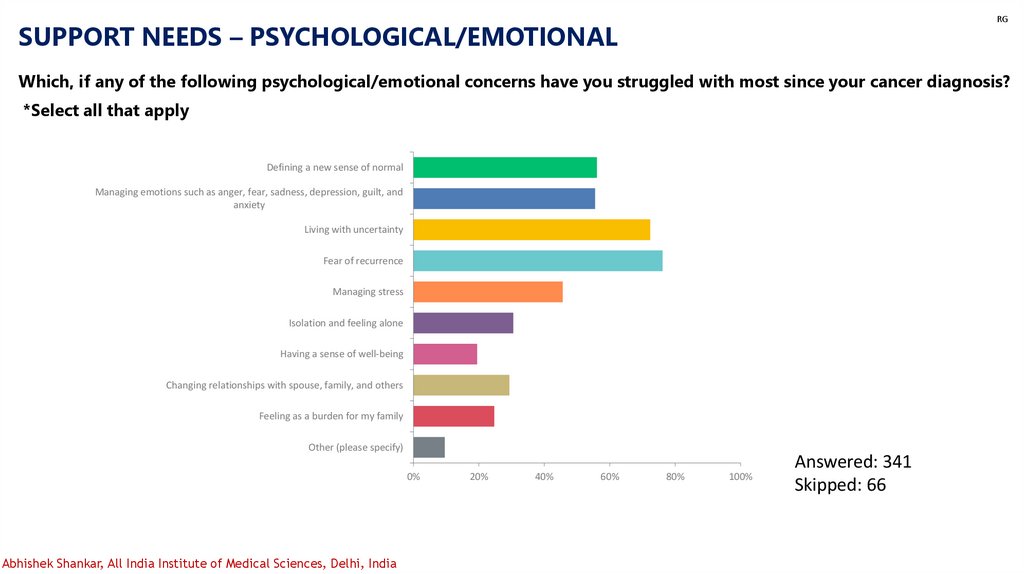
Which, if any of the following psychological/emotional concerns have you struggled with most since your cancer diagnosis?
*Select all that apply
Defining a new sense of normal
Managing emotions such as anger, fear, sadness, depression, guilt, and
anxiety
Living with uncertainty
Fear of recurrence
Managing stress
Isolation and feeling alone
Having a sense of well-being
Changing relationships with spouse, family, and others
Feeling as a burden for my family
Other (please specify)
0%
Abhishek Shankar, All India Institute of Medical Sciences, Delhi, India
20%
40%
60%
80%
100%
Answered: 341
Skipped: 66
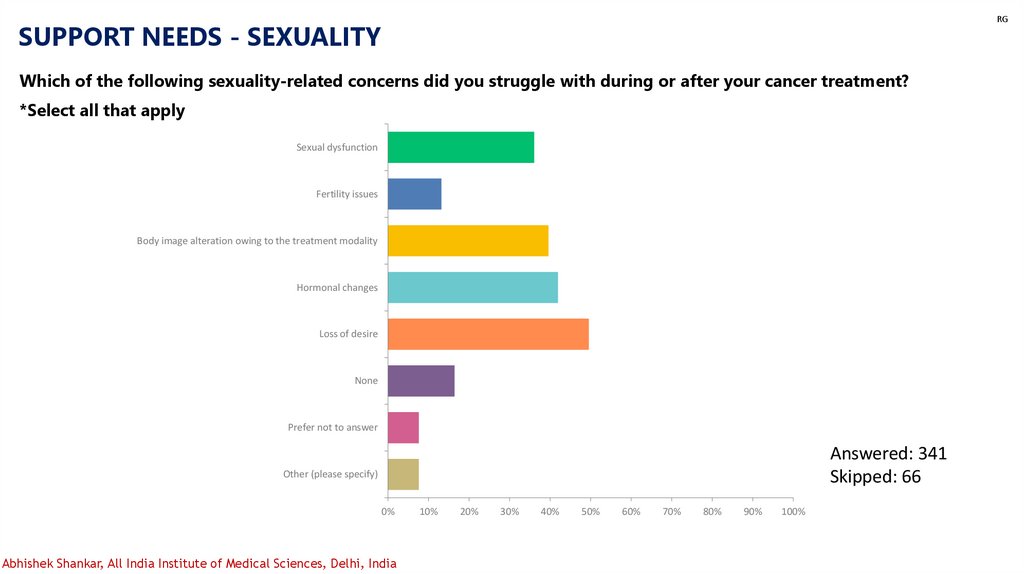
49. SUPPORT NEEDS - SEXUALITY
RGSUPPORT NEEDS - SEXUALITY
Which of the following sexuality-related concerns did you struggle with during or after your cancer treatment?
*Select all that apply
Sexual dysfunction
Fertility issues
Body image alteration owing to the treatment modality
Hormonal changes
Loss of desire
None
Prefer not to answer
Answered: 341
Skipped: 66
Other (please specify)
0%
Abhishek Shankar, All India Institute of Medical Sciences, Delhi, India
10%
20%
30%
40%
50%
60%
70%
80%
90%
100%
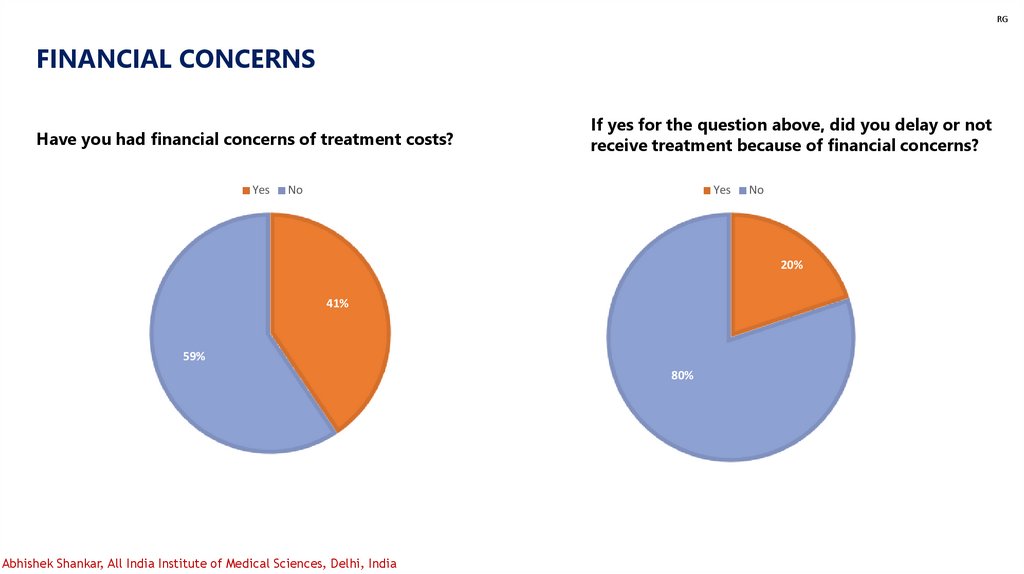
50. FINANCIAL CONCERNS
RGFINANCIAL CONCERNS
Have you had financial concerns of treatment costs?
Yes
If yes for the question above, did you delay or not
receive treatment because of financial concerns?
No
Yes
No
20%
41%
59%
80%
Abhishek Shankar, All India Institute of Medical Sciences, Delhi, India
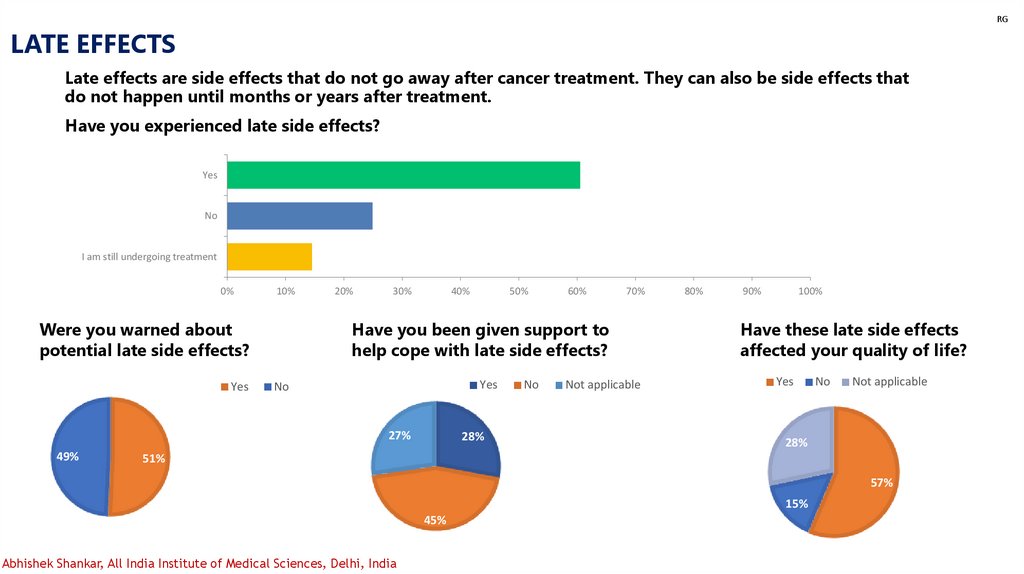
51. LATE EFFECTS
RGLATE EFFECTS
Late effects are side effects that do not go away after cancer treatment. They can also be side effects that
do not happen until months or years after treatment.
Have you experienced late side effects?
Yes
No
I am still undergoing treatment
0%
10%
Were you warned about
potential late side effects?
Yes
20%
30%
40%
60%
70%
Have you been given support to
help cope with late side effects?
Yes
No
27%
49%
50%
28%
No
Not applicable
80%
90%
100%
Have these late side effects
affected your quality of life?
Yes
No
Not applicable
28%
51%
57%
15%
45%
Abhishek Shankar, All India Institute of Medical Sciences, Delhi, India
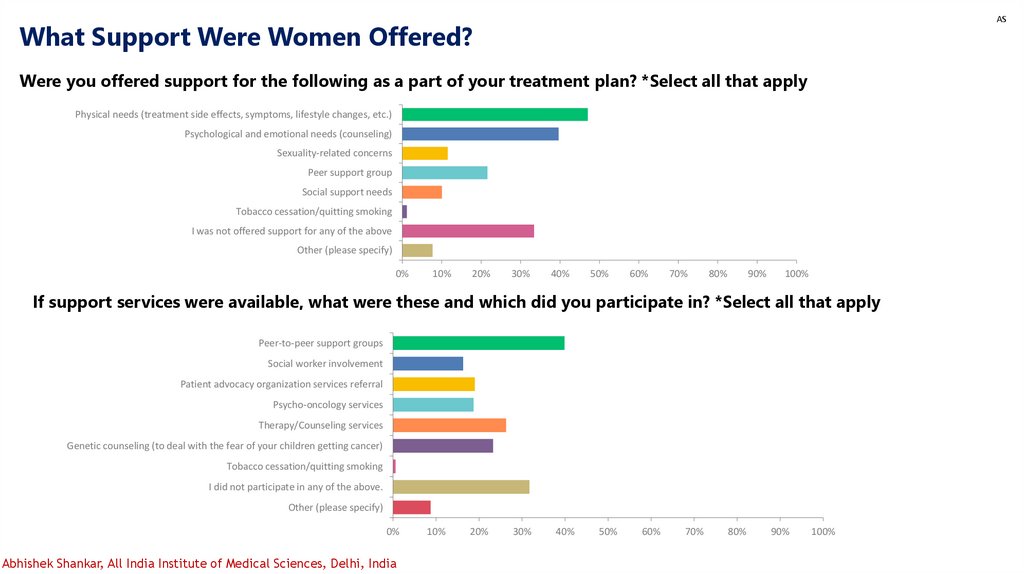
52. What Support Were Women Offered?
ASWhat Support Were Women Offered?
Were you offered support for the following as a part of your treatment plan? *Select all that apply
Physical needs (treatment side effects, symptoms, lifestyle changes, etc.)
Psychological and emotional needs (counseling)
Sexuality-related concerns
Peer support group
Social support needs
Tobacco cessation/quitting smoking
I was not offered support for any of the above
Other (please specify)
0%
10%
20%
30%
40%
50%
60%
70%
80%
90%
100%
If support services were available, what were these and which did you participate in? *Select all that apply
Peer-to-peer support groups
Social worker involvement
Patient advocacy organization services referral
Psycho-oncology services
Therapy/Counseling services
Genetic counseling (to deal with the fear of your children getting cancer)
Tobacco cessation/quitting smoking
I did not participate in any of the above.
Other (please specify)
0%
Abhishek Shankar, All India Institute of Medical Sciences, Delhi, India
10%
20%
30%
40%
50%
60%
70%
80%
90%
100%
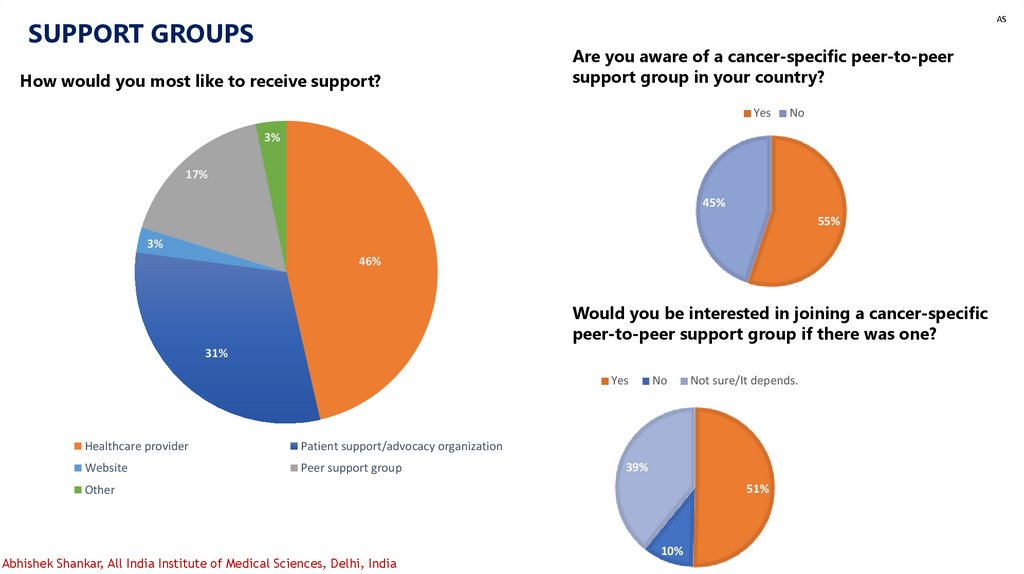
53. SUPPORT GROUPS
ASSUPPORT GROUPS
How would you most like to receive support?
Are you aware of a cancer-specific peer-to-peer
support group in your country?
Yes
No
3%
17%
45%
55%
3%
46%
Would you be interested in joining a cancer-specific
peer-to-peer support group if there was one?
31%
Yes
Healthcare provider
Patient support/advocacy organization
Website
Peer support group
No
39%
51%
Other
Abhishek Shankar, All India Institute of Medical Sciences, Delhi, India
Not sure/It depends.
10%
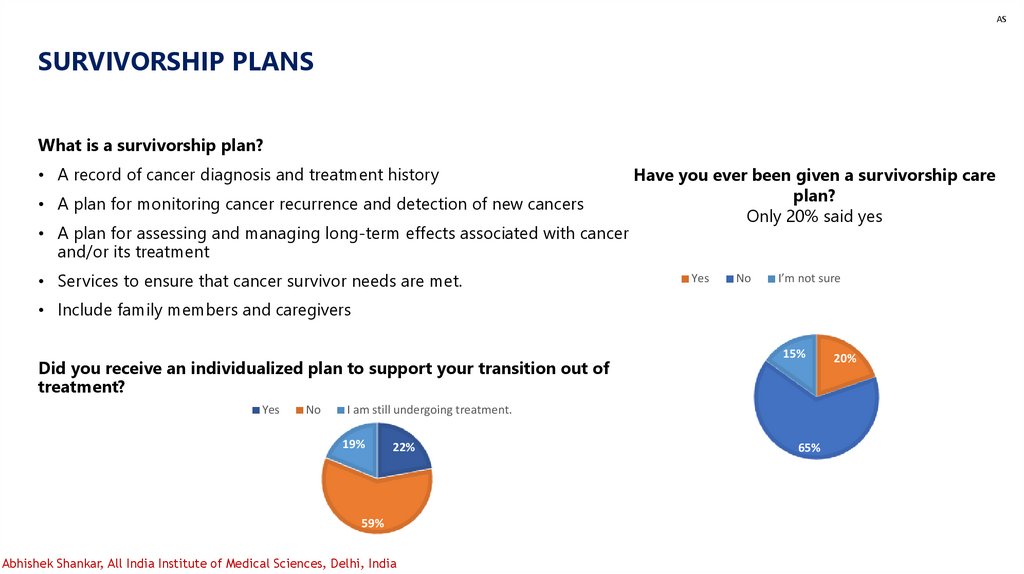
54. SURVIVORSHIP PLANS
ASSURVIVORSHIP PLANS
What is a survivorship plan?
• A record of cancer diagnosis and treatment history
• A plan for monitoring cancer recurrence and detection of new cancers
• A plan for assessing and managing long-term effects associated with cancer
and/or its treatment
• Services to ensure that cancer survivor needs are met.
Have you ever been given a survivorship care
plan?
Only 20% said yes
Yes
No
I’m not sure
• Include family members and caregivers
Did you receive an individualized plan to support your transition out of
treatment?
Yes
No
15%
I am still undergoing treatment.
19%
22%
59%
Abhishek Shankar, All India Institute of Medical Sciences, Delhi, India
65%
20%
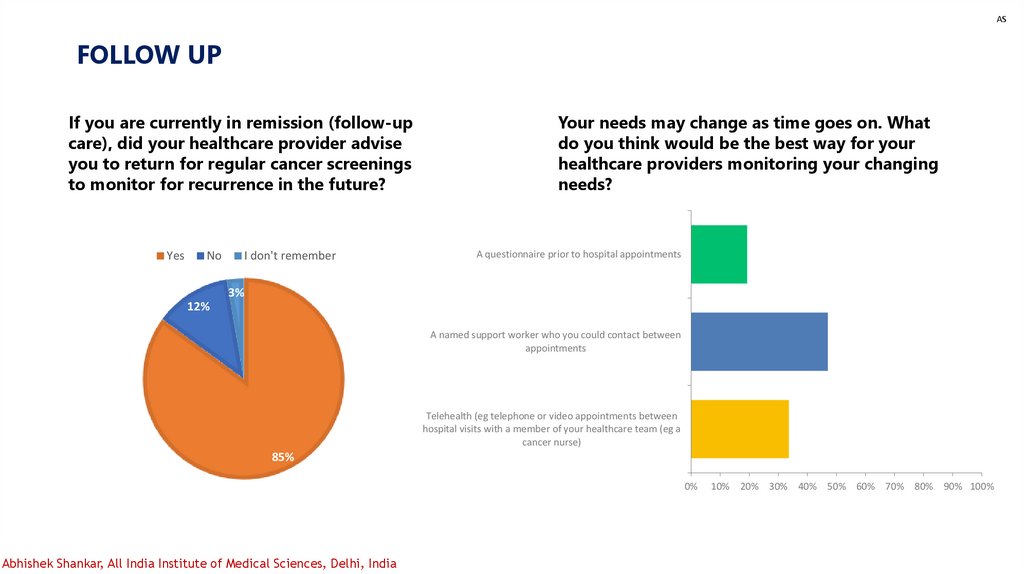
55. FOLLOW UP
ASFOLLOW UP
If you are currently in remission (follow-up
care), did your healthcare provider advise
you to return for regular cancer screenings
to monitor for recurrence in the future?
Yes
No
I don't remember
Your needs may change as time goes on. What
do you think would be the best way for your
healthcare providers monitoring your changing
needs?
A questionnaire prior to hospital appointments
3%
12%
A named support worker who you could contact between
appointments
Telehealth (eg telephone or video appointments between
hospital visits with a member of your healthcare team (eg a
cancer nurse)
85%
0%
Abhishek Shankar, All India Institute of Medical Sciences, Delhi, India
10% 20% 30% 40% 50% 60% 70% 80% 90% 100%
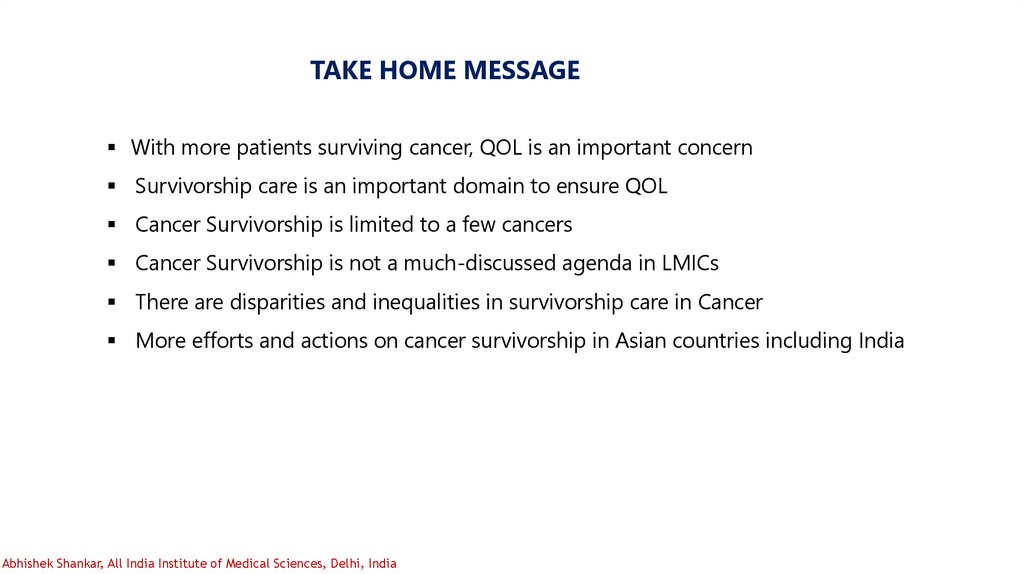
56.
TAKE HOME MESSAGEWith more patients surviving cancer, QOL is an important concern
Survivorship care is an important domain to ensure QOL
Cancer Survivorship is limited to a few cancers
Cancer Survivorship is not a much-discussed agenda in LMICs
There are disparities and inequalities in survivorship care in Cancer
More efforts and actions on cancer survivorship in Asian countries including India
Abhishek Shankar, All India Institute of Medical Sciences, Delhi, India