
 Философия
Похожие презентации:



Epistemology. Lecture 4
1.
Lecture 4.EPISTEMOLOGY.
2.
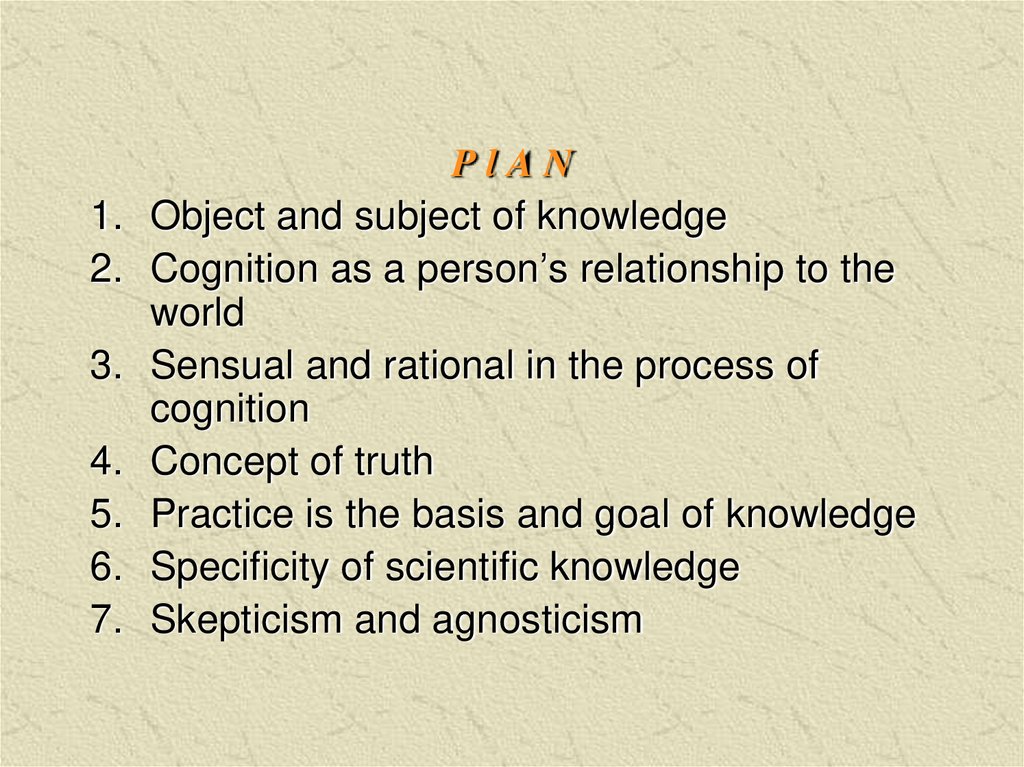
PlAN1. Object and subject of knowledge
2. Cognition as a person’s relationship to the
world
3. Sensual and rational in the process of
cognition
4. Concept of truth
5. Practice is the basis and goal of knowledge
6. Specificity of scientific knowledge
7. Skepticism and agnosticism
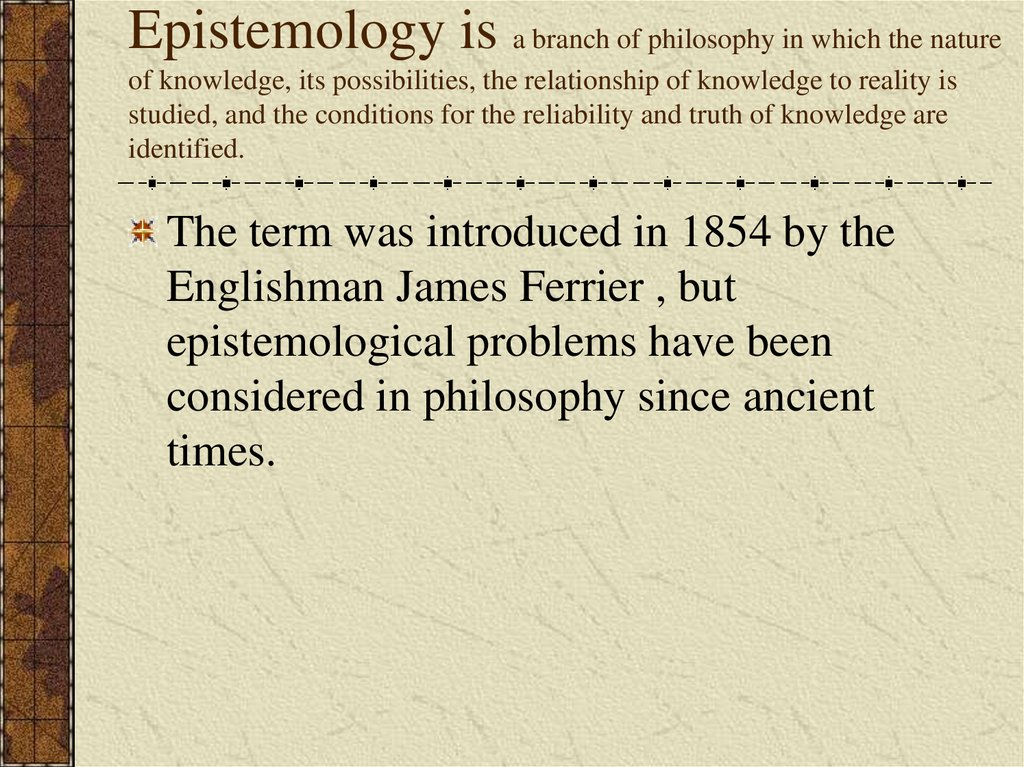
3. Epistemology is a branch of philosophy in which the nature of knowledge, its possibilities, the relationship of knowledge to
reality isstudied, and the conditions for the reliability and truth of knowledge are
identified.
The term was introduced in 1854 by the
Englishman James Ferrier , but
epistemological problems have been
considered in philosophy since ancient
times.
4.
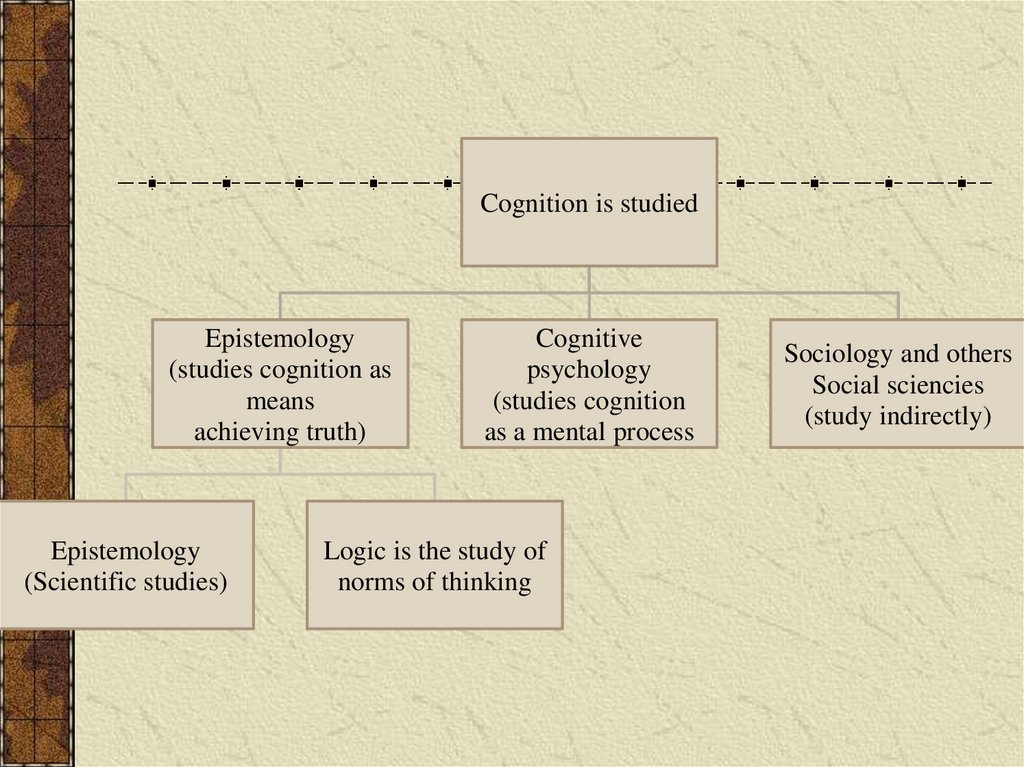
Cognition is studiedEpistemology
(studies cognition as
means
achieving truth)
Epistemology
(Scientific studies)
Cognitive
psychology
(studies cognition
as a mental process
Logic is the study of
norms of thinking
Sociology and others
Social sciencies
(study indirectly)
5. COGNITION
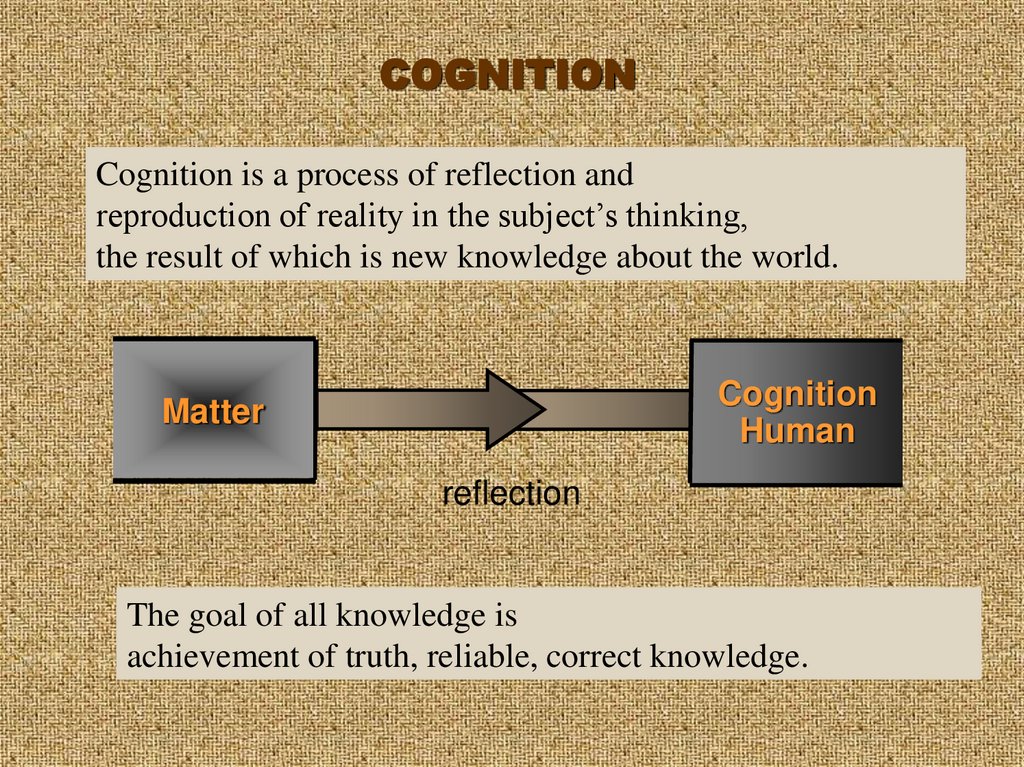
Cognition is a process of reflection andreproduction of reality in the subject’s thinking,
the result of which is new knowledge about the world.
Cognition
Human
Matter
reflection
The goal of all knowledge is
achievement of truth, reliable, correct knowledge.
6.
The main concepts that epistemology operates onare “subject” and “object”.
The subject is understood as a carrier of cognitive
activity aimed at objects of the surrounding
reality. The subject can be both individual
(individual personality) and collective (social
group).
An object is something that opposes the subject in
his cognitive and objective-practical activities.
Moreover, sometimes the subject itself can act as
an object.
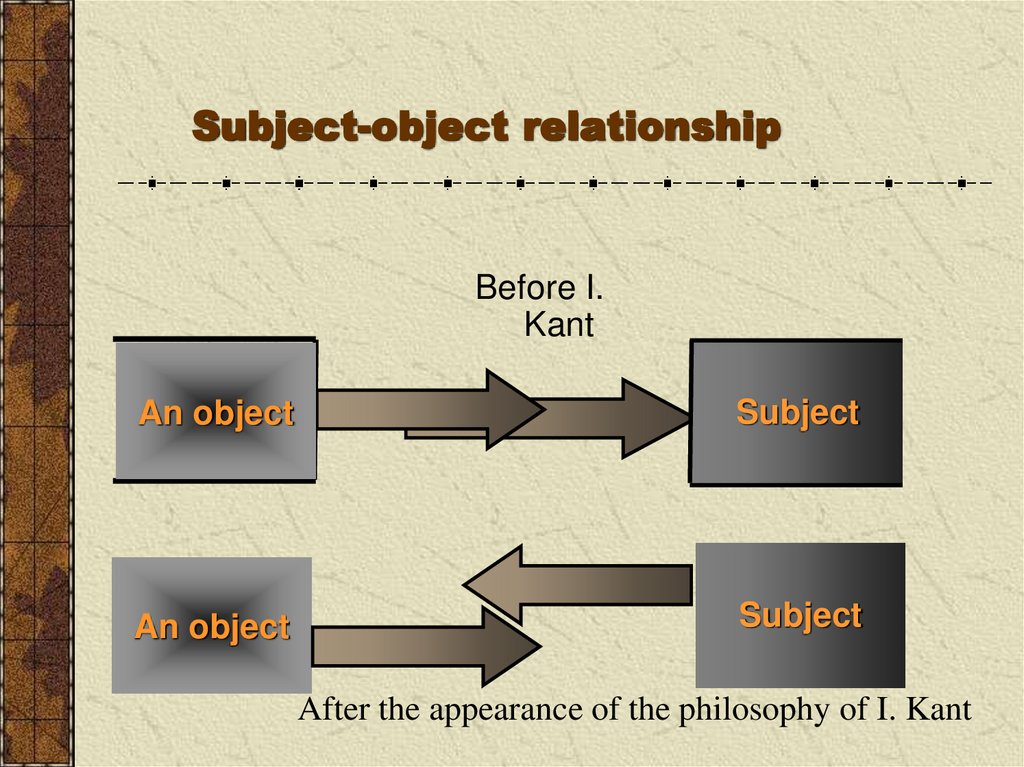
7. Subject-object relationship
Before I.Kant
An object
Subject
An object
Subject
After the appearance of the philosophy of I. Kant
8.
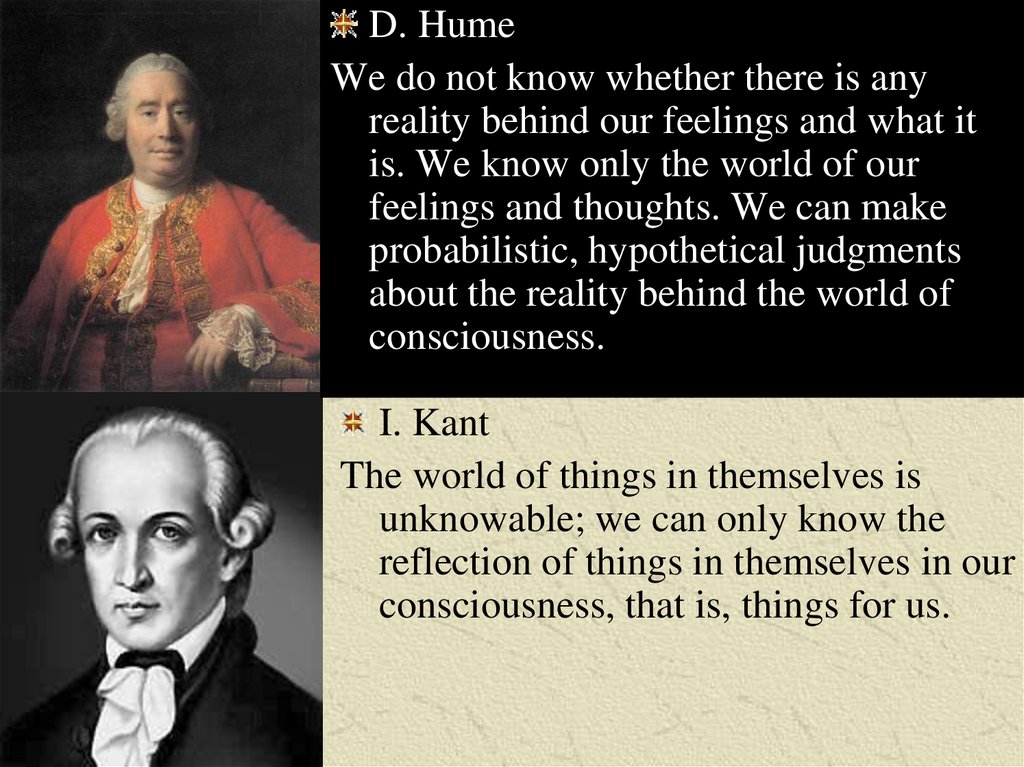
D. HumeWe do not know whether there is any
reality behind our feelings and what it
is. We know only the world of our
feelings and thoughts. We can make
probabilistic, hypothetical judgments
about the reality behind the world of
consciousness.
I. Kant
The world of things in themselves is
unknowable; we can only know the
reflection of things in themselves in our
consciousness, that is, things for us.
9. Materialist Point of View
The origins of cognition are rooted in thebiological need to survive in the environment.
After all, in order to adequately respond to the
challenges of the surrounding reality, you need to
imagine this reality adequately, as close to reality
as possible. The task of cognition has been taken
over by the nervous system, the highest stage of
evolution of which is thinking, which is the main
instrument of the subject’s cognitive activity.
The very survival of living beings and the success
of human activity indicate that knowledge of the
world is possible
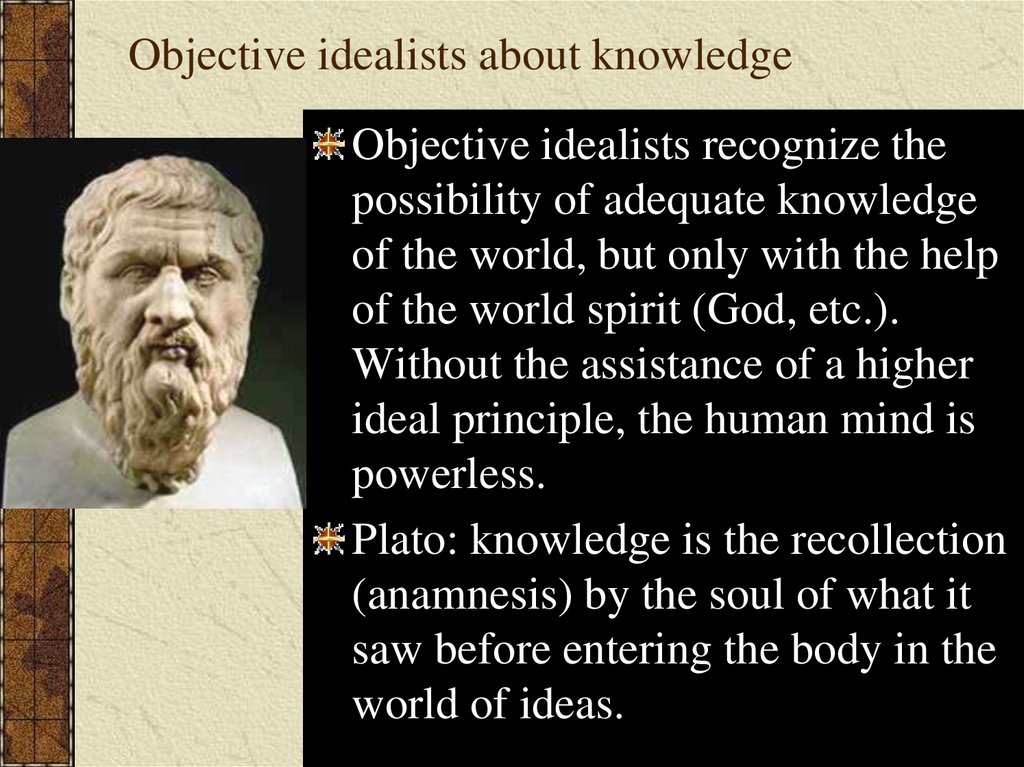
10. Objective idealists about knowledge
Objective idealists recognize thepossibility of adequate knowledge
of the world, but only with the help
of the world spirit (God, etc.).
Without the assistance of a higher
ideal principle, the human mind is
powerless.
Plato: knowledge is the recollection
(anamnesis) by the soul of what it
saw before entering the body in the
world of ideas.
11.
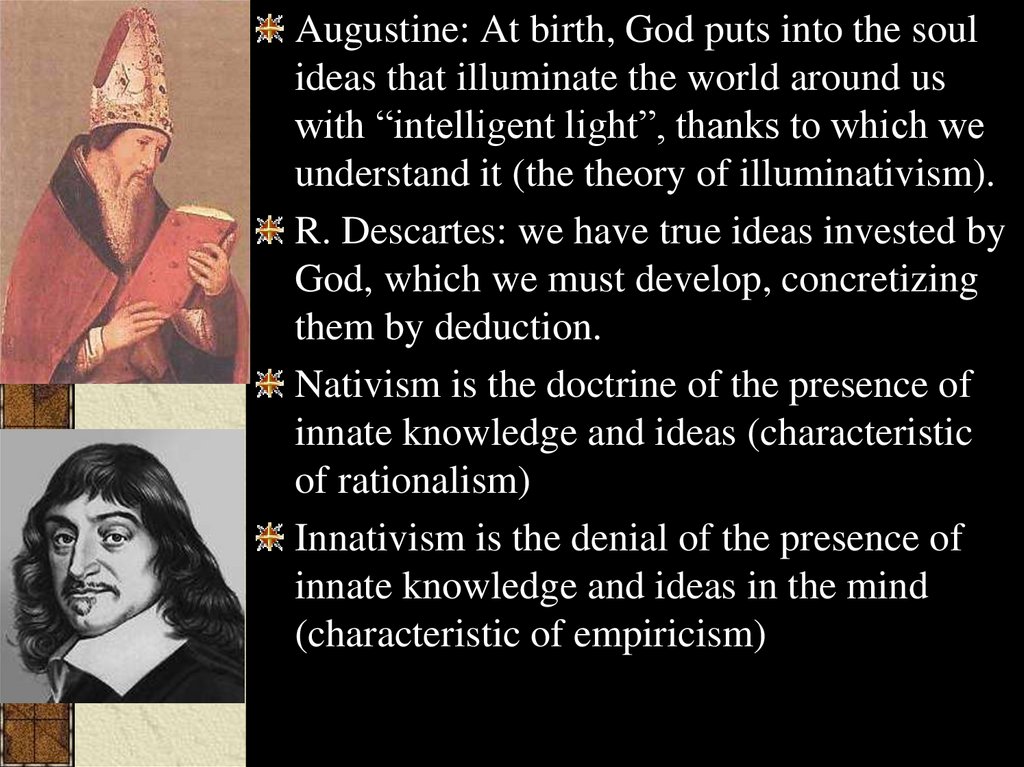
Augustine: At birth, God puts into the soulideas that illuminate the world around us
with “intelligent light”, thanks to which we
understand it (the theory of illuminativism).
R. Descartes: we have true ideas invested by
God, which we must develop, concretizing
them by deduction.
Nativism is the doctrine of the presence of
innate knowledge and ideas (characteristic
of rationalism)
Innativism is the denial of the presence of
innate knowledge and ideas in the mind
(characteristic of empiricism)
12.
Nativism is the doctrineof the presence of innate
knowledge and ideas
(characteristic of
rationalism).
According to R. Descartes
and G. Leibniz, the soul
at birth already has an
innate content that
determines the
accumulation of
experience and the
acquisition of new
knowledge
Innativism is the denial of
the presence of innate
knowledge and ideas in the
mind (characteristic of
empiricism)
According to D. Locke, the
soul of a baby is like a blank
slate - tabula rasa .
Everything that exists in the
mind has passed through the
senses.
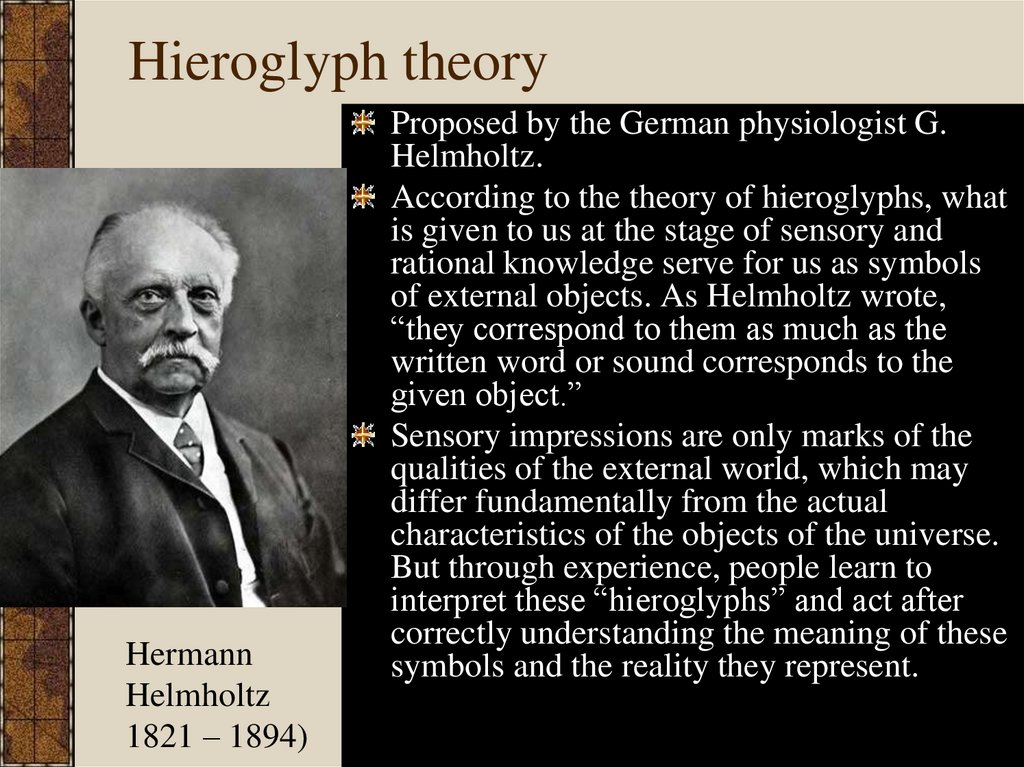
13. Hieroglyph theory
HermannHelmholtz
1821 – 1894)
Proposed by the German physiologist G.
Helmholtz.
According to the theory of hieroglyphs, what
is given to us at the stage of sensory and
rational knowledge serve for us as symbols
of external objects. As Helmholtz wrote,
“they correspond to them as much as the
written word or sound corresponds to the
given object.”
Sensory impressions are only marks of the
qualities of the external world, which may
differ fundamentally from the actual
characteristics of the objects of the universe.
But through experience, people learn to
interpret these “hieroglyphs” and act after
correctly understanding the meaning of these
symbols and the reality they represent.
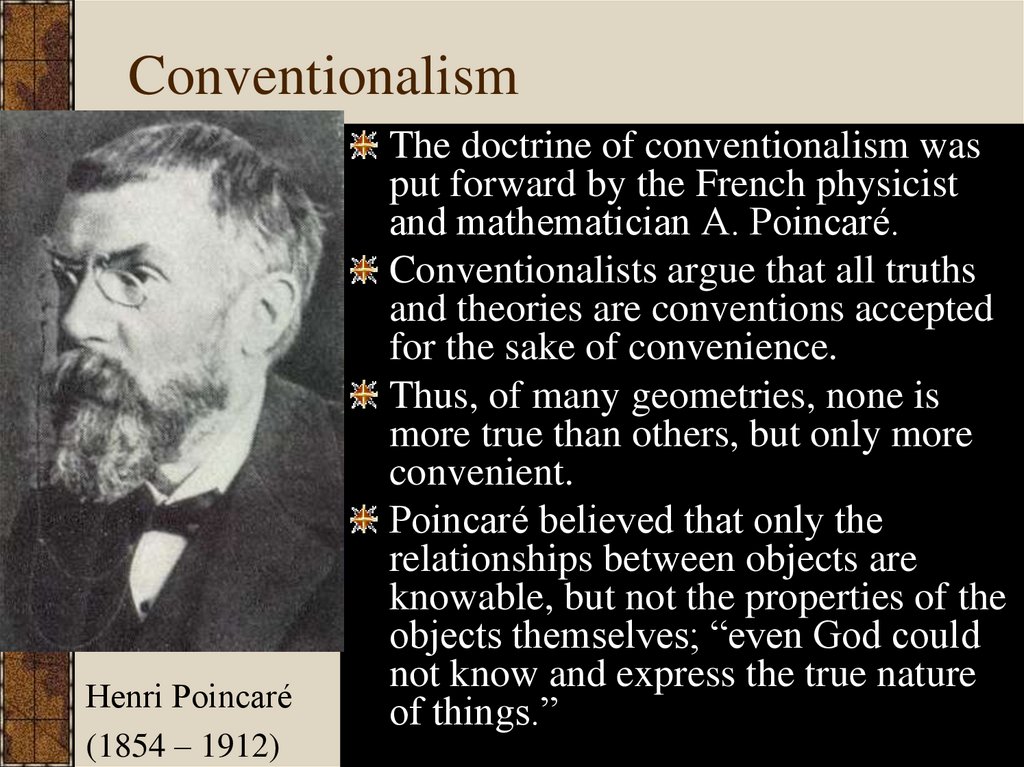
14. Conventionalism
Henri Poincaré(1854 – 1912)
The doctrine of conventionalism was
put forward by the French physicist
and mathematician A. Poincaré.
Conventionalists argue that all truths
and theories are conventions accepted
for the sake of convenience.
Thus, of many geometries, none is
more true than others, but only more
convenient.
Poincaré believed that only the
relationships between objects are
knowable, but not the properties of the
objects themselves; “even God could
not know and express the true nature
of things.”
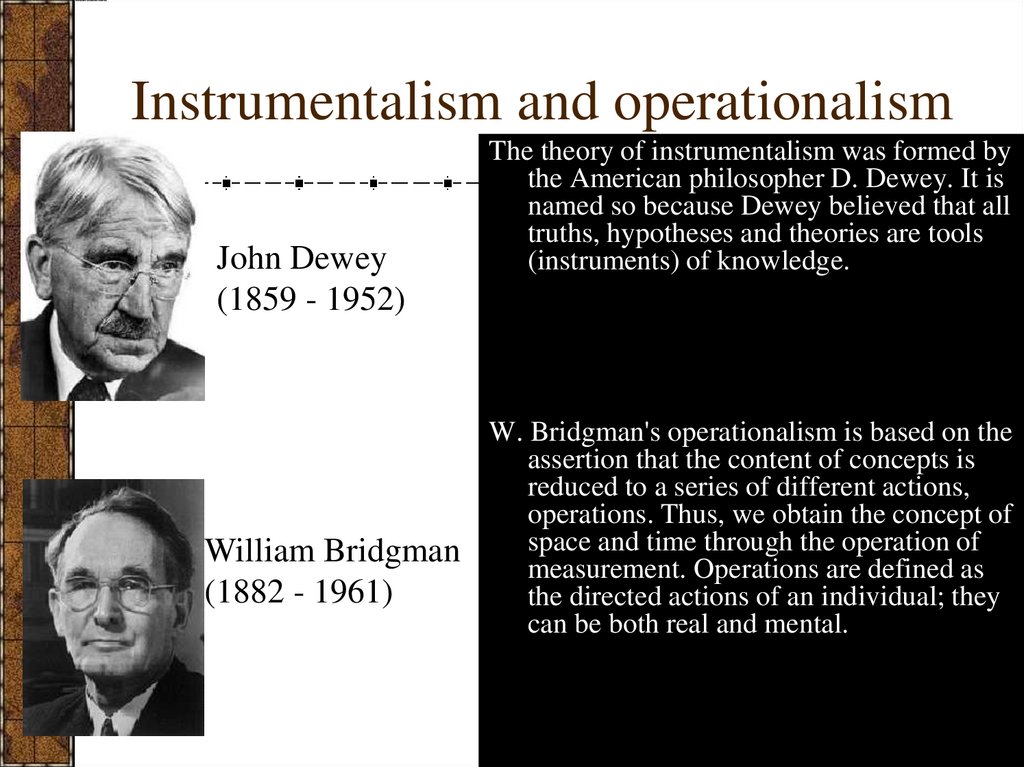
15. Instrumentalism and operationalism
John Dewey(1859 - 1952)
William Bridgman
(1882 - 1961)
The theory of instrumentalism was formed by
the American philosopher D. Dewey. It is
named so because Dewey believed that all
truths, hypotheses and theories are tools
(instruments) of knowledge.
W. Bridgman's operationalism is based on the
assertion that the content of concepts is
reduced to a series of different actions,
operations. Thus, we obtain the concept of
space and time through the operation of
measurement. Operations are defined as
the directed actions of an individual; they
can be both real and mental.
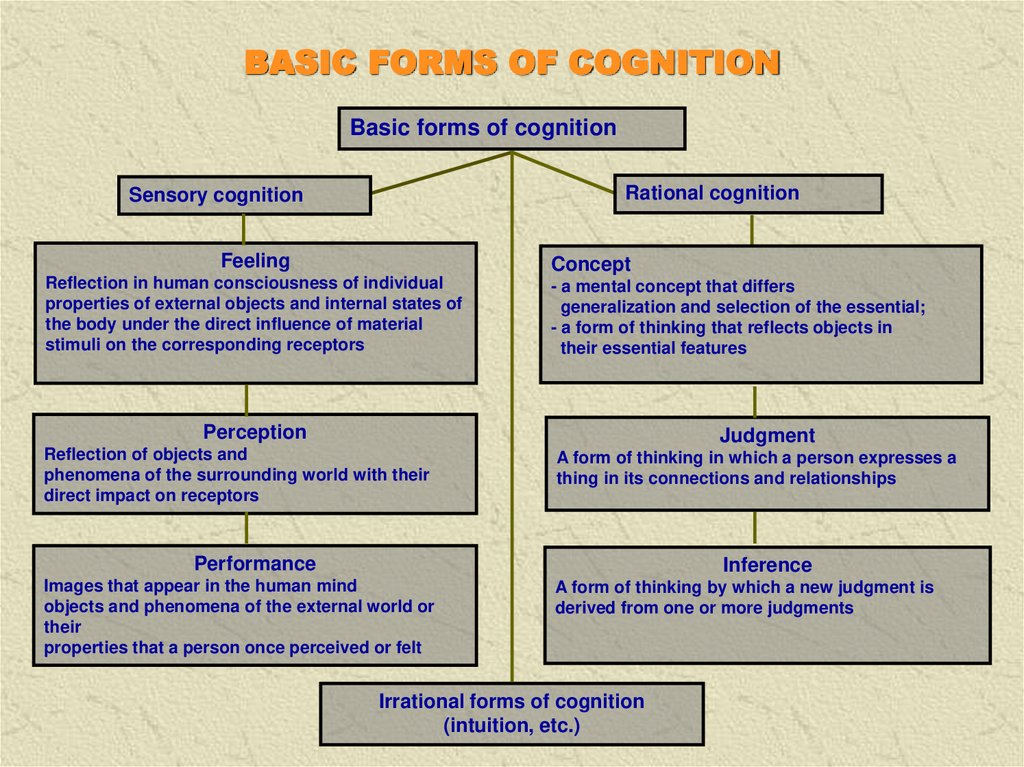
16. BASIC FORMS OF COGNITION
Basic forms of cognitionRational cognition
Sensory cognition
Feeling
Concept
Reflection in human consciousness of individual
properties of external objects and internal states of
the body under the direct influence of material
stimuli on the corresponding receptors
- a mental concept that differs
generalization and selection of the essential;
- a form of thinking that reflects objects in
their essential features
Perception
Judgment
Reflection of objects and
phenomena of the surrounding world with their
direct impact on receptors
A form of thinking in which a person expresses a
thing in its connections and relationships
Performance
Inference
Images that appear in the human mind
objects and phenomena of the external world or
their
properties that a person once perceived or felt
A form of thinking by which a new judgment is
derived from one or more judgments
Irrational forms of cognition
(intuition, etc.)
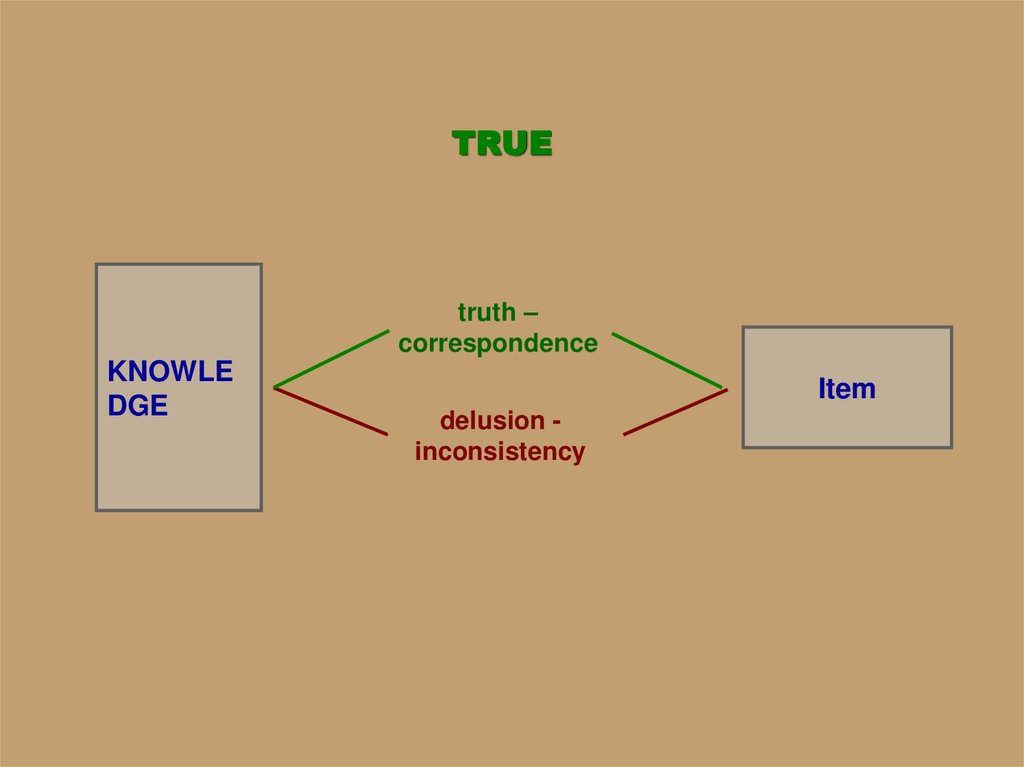
17. 1
TRUEtruth –
correspondence
KNOWLE
DGE
Item
delusion inconsistency
18. 1
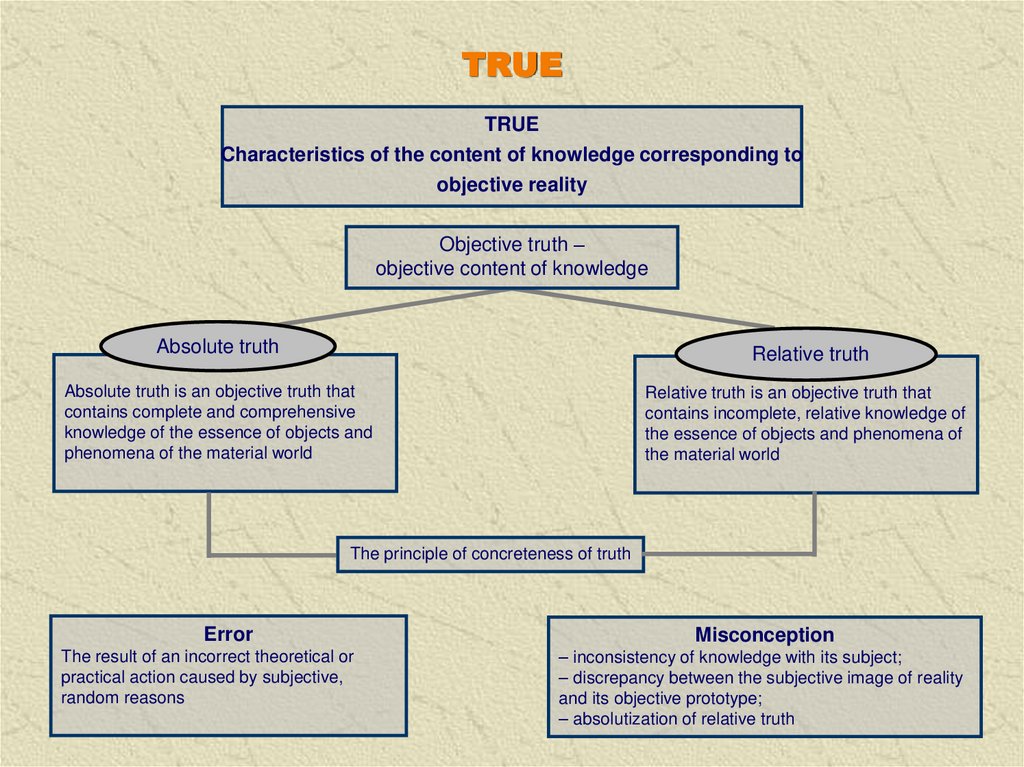
TRUETRUE
Characteristics of the content of knowledge corresponding to
objective reality
Objective truth –
objective content of knowledge
Absolute truth
Relative truth
Absolute truth is an objective truth that
contains complete and comprehensive
knowledge of the essence of objects and
phenomena of the material world
Relative truth is an objective truth that
contains incomplete, relative knowledge of
the essence of objects and phenomena of
the material world
The principle of concreteness of truth
Error
The result of an incorrect theoretical or
practical action caused by subjective,
random reasons
Misconception
– inconsistency of knowledge with its subject;
– discrepancy between the subjective image of reality
and its objective prototype;
– absolutization of relative truth
19. PRACTICE AND ITS ROLE IN COGNITION
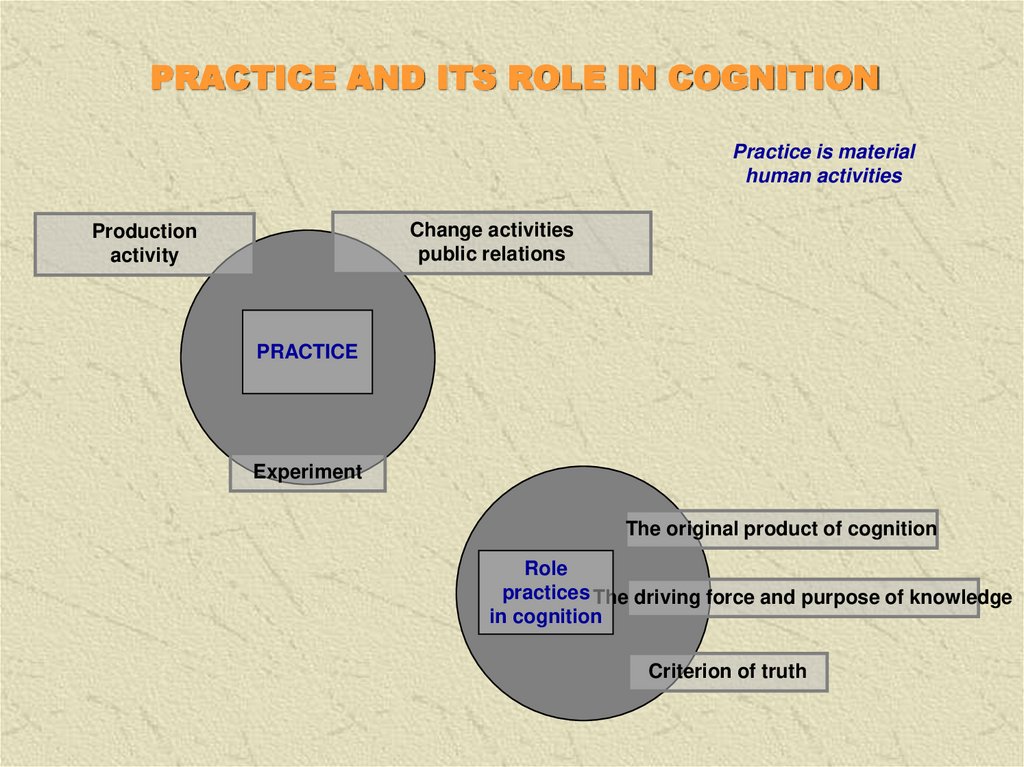
Practice is materialhuman activities
Change activities
public relations
Production
activity
PRACTICE
Experiment
The original product of cognition
Role
practices The driving force and purpose of knowledge
in cognition
Criterion of truth
20. PRACTICE AS A CRITERION OF COGNITION
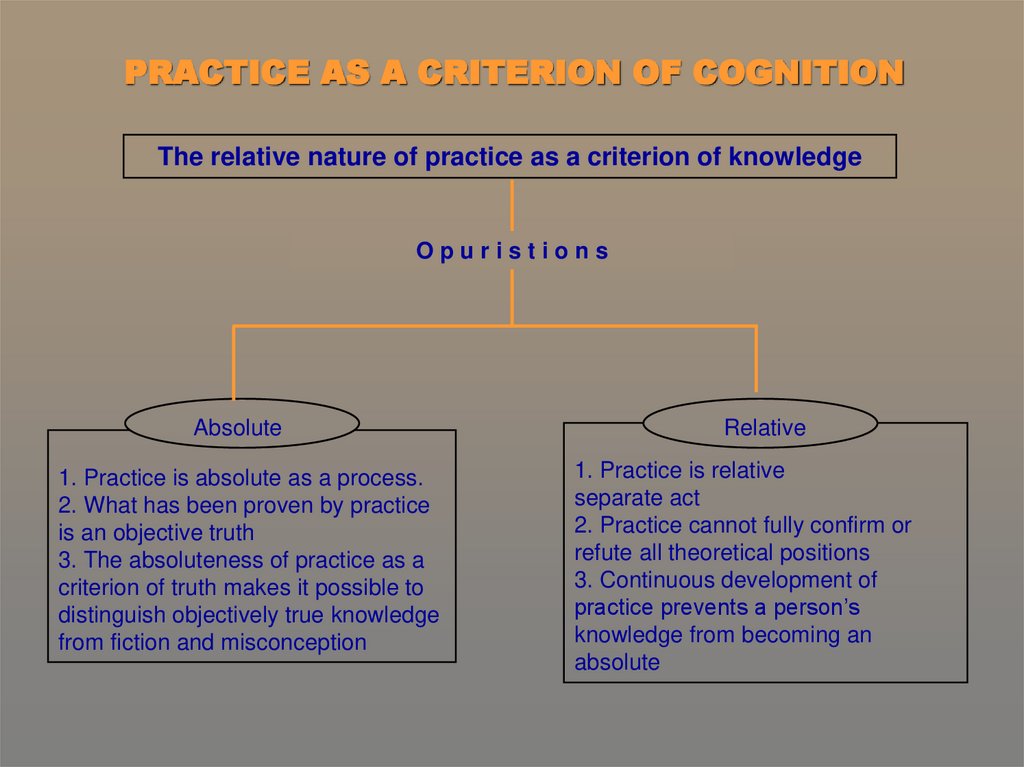
The relative nature of practice as a criterion of knowledgeOpuristions
Absolute
1. Practice is absolute as a process.
2. What has been proven by practice
is an objective truth
3. The absoluteness of practice as a
criterion of truth makes it possible to
distinguish objectively true knowledge
from fiction and misconception
Relative
1. Practice is relative
separate act
2. Practice cannot fully confirm or
refute all theoretical positions
3. Continuous development of
practice prevents a person’s
knowledge from becoming an
absolute
21. NATURE OF COGNITIVE PROCESS (process of cognition)
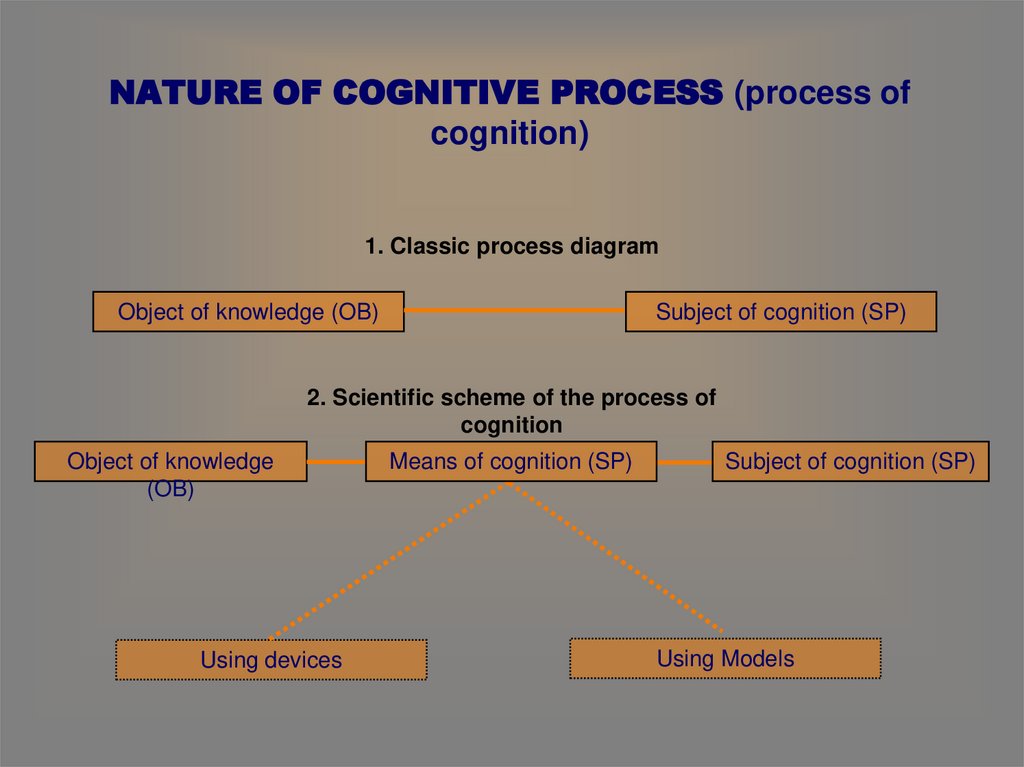
1. Classic process diagramObject of knowledge (OB)
Subject of cognition (SP)
2. Scientific scheme of the process of
cognition
Object of knowledge
(OB)
Using devices
Means of cognition (SP)
Subject of cognition (SP)
Using Models
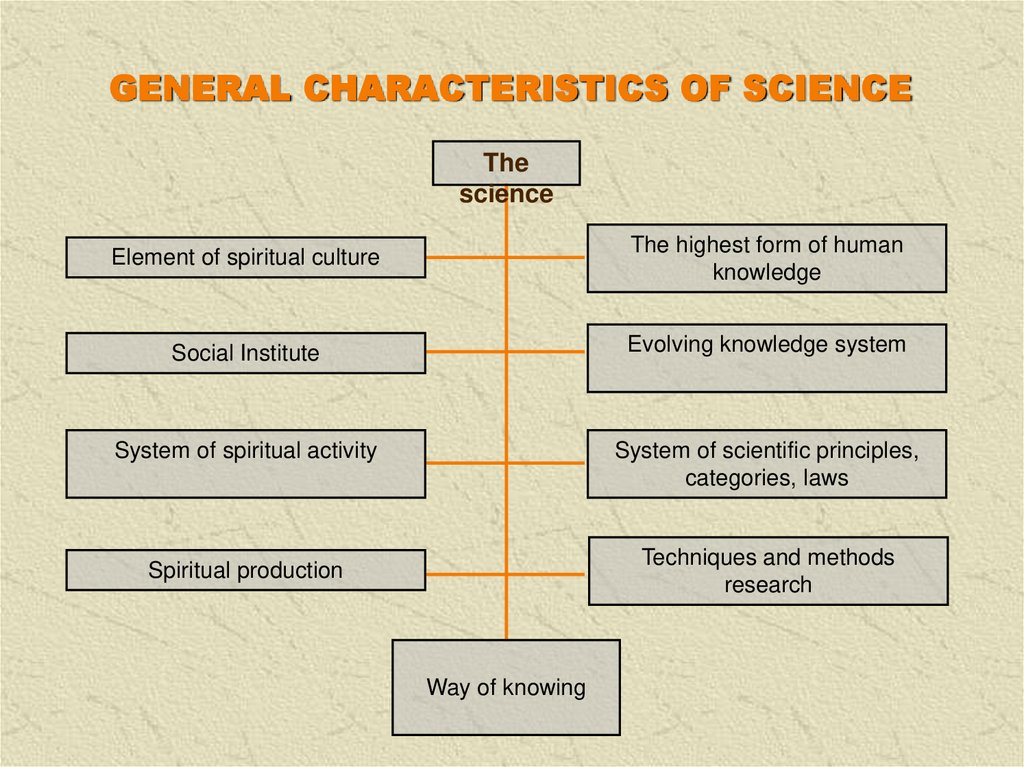
22. GENERAL CHARACTERISTICS OF SCIENCE
Thescience
Element of spiritual culture
The highest form of human
knowledge
Social Institute
Evolving knowledge system
System of spiritual activity
System of scientific principles,
categories, laws
Techniques and methods
research
Spiritual production
Way of knowing
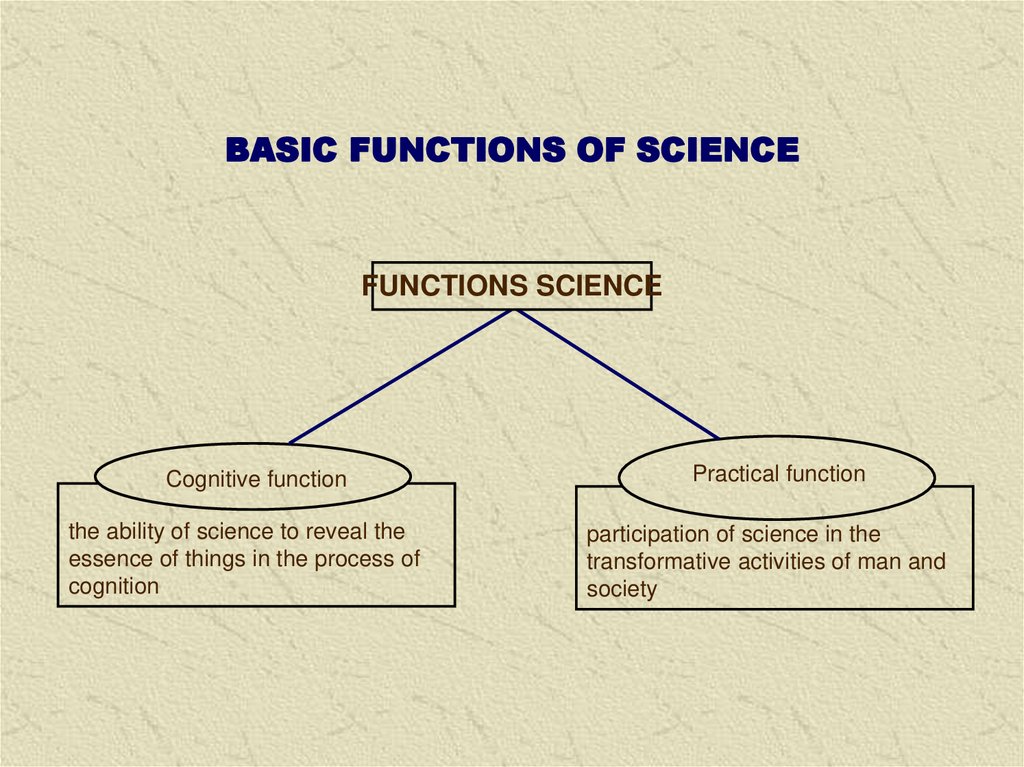
23. BASIC FUNCTIONS OF SCIENCE
FUNCTIONS SCIENCECognitive function
Practical function
the ability of science to reveal the
essence of things in the process of
cognition
participation of science in the
transformative activities of man and
society
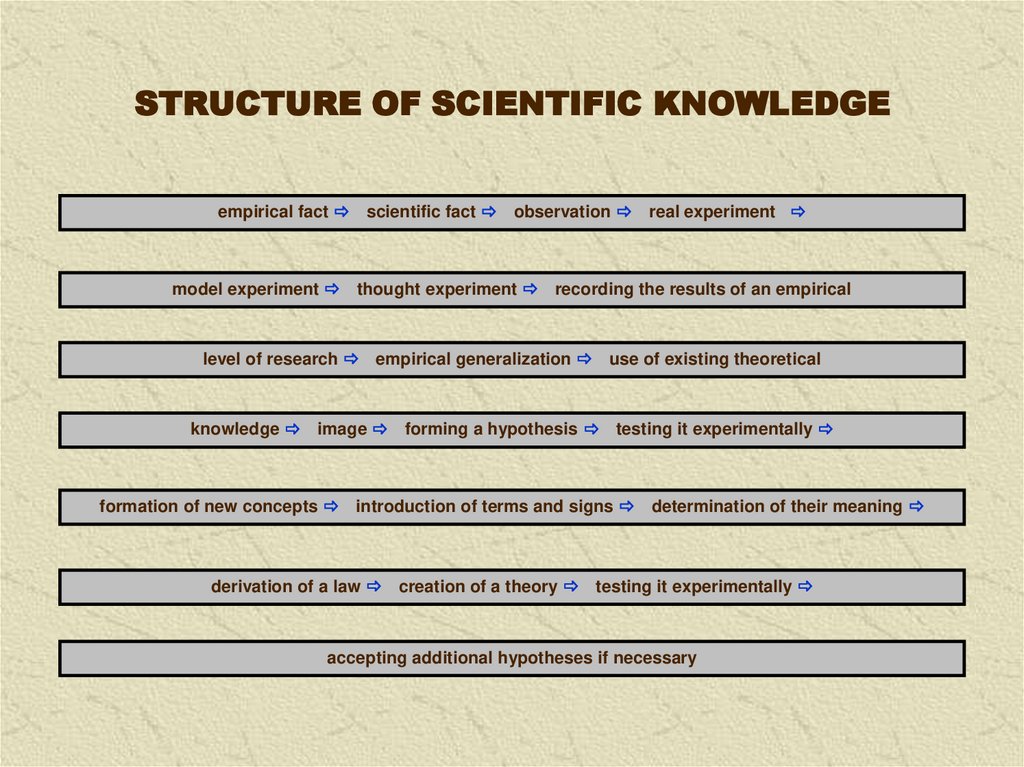
24. STRUCTURE OF SCIENTIFIC KNOWLEDGE
empirical fact _model experiment _
scientific fact _
observation _
thought experiment _ recording the results of an empirical
level of research _ empirical generalization _
knowledge _
image _
formation of new concepts _
real experiment _
use of existing theoretical
forming a hypothesis _ testing it experimentally _
introduction of terms and signs _
derivation of a law _
creation of a theory _
determination of their meaning _
testing it experimentally _
accepting additional hypotheses if necessary
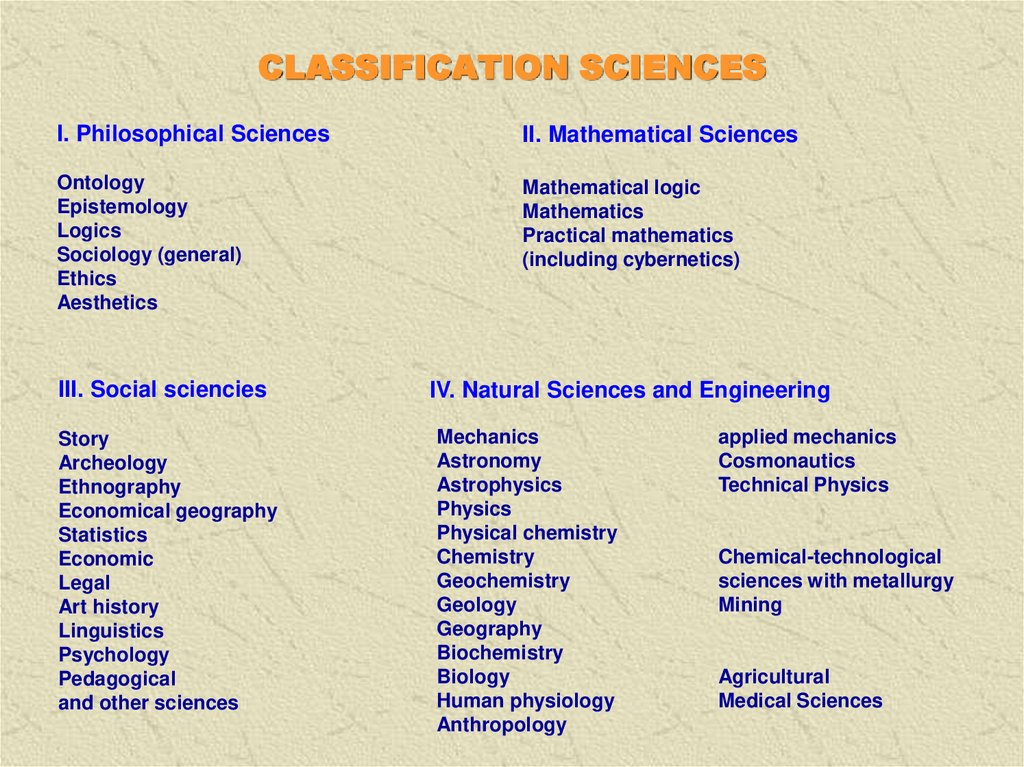
25. CLASSIFICATION SCIENCES
I. Philosophical SciencesII. Mathematical Sciences
Ontology
Epistemology
Logics
Sociology (general)
Ethics
Aesthetics
Mathematical logic
Mathematics
Practical mathematics
(including cybernetics)
III. Social sciencies
IV. Natural Sciences and Engineering
Story
Archeology
Ethnography
Economical geography
Statistics
Economic
Legal
Art history
Linguistics
Psychology
Pedagogical
and other sciences
Mechanics
Astronomy
Astrophysics
Physics
Physical chemistry
Chemistry
Geochemistry
Geology
Geography
Biochemistry
Biology
Human physiology
Anthropology
applied mechanics
Cosmonautics
Technical Physics
Chemical-technological
sciences with metallurgy
Mining
Agricultural
Medical Sciences
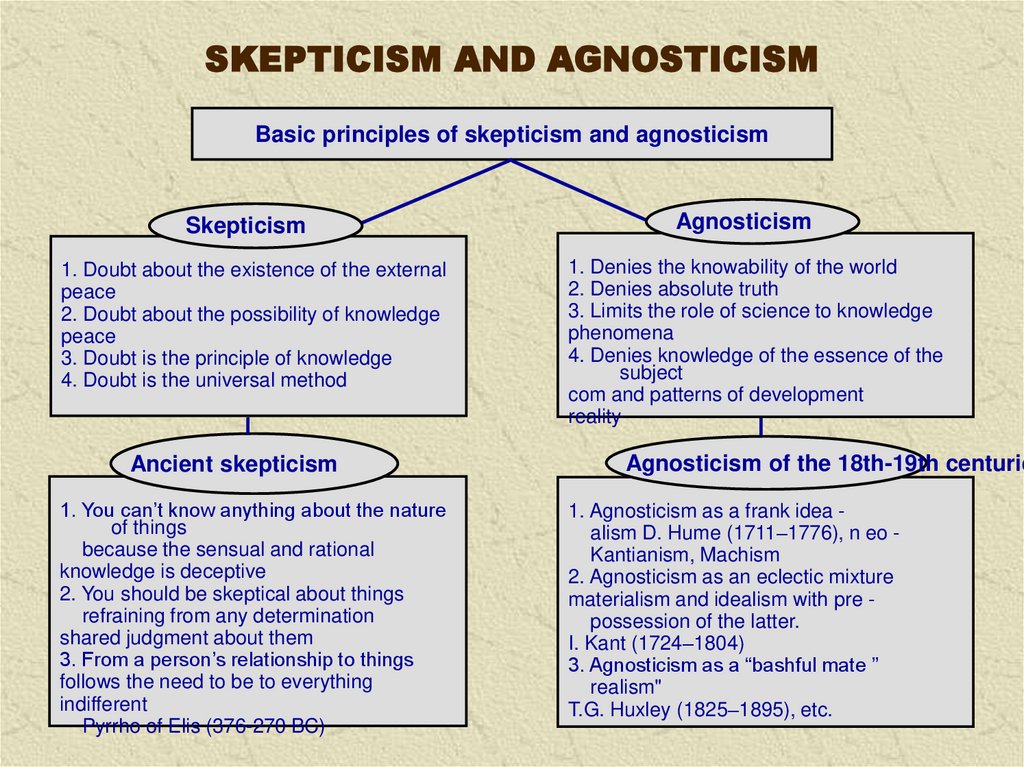
26. Basic principles of skepticism and agnosticism
SKEPTICISM AND AGNOSTICISMBasic principles of skepticism and agnosticism
Skepticism
Agnosticism
1. Doubt about the existence of the external
peace
2. Doubt about the possibility of knowledge
peace
3. Doubt is the principle of knowledge
4. Doubt is the universal method
1. Denies the knowability of the world
2. Denies absolute truth
3. Limits the role of science to knowledge
phenomena
4. Denies knowledge of the essence of the
subject
com and patterns of development
reality
Ancient skepticism
1. You can’t know anything about the nature
of things
because the sensual and rational
knowledge is deceptive
2. You should be skeptical about things
refraining from any determination
shared judgment about them
3. From a person’s relationship to things
follows the need to be to everything
indifferent
Pyrrho of Elis (376-270 BC)
Agnosticism of the 18th-19th centurie
1. Agnosticism as a frank idea alism D. Hume (1711–1776), n eo Kantianism, Machism
2. Agnosticism as an eclectic mixture
materialism and idealism with pre possession of the latter.
I. Kant (1724–1804)
3. Agnosticism as a “bashful mate ”
realism"
T.G. Huxley (1825–1895), etc.
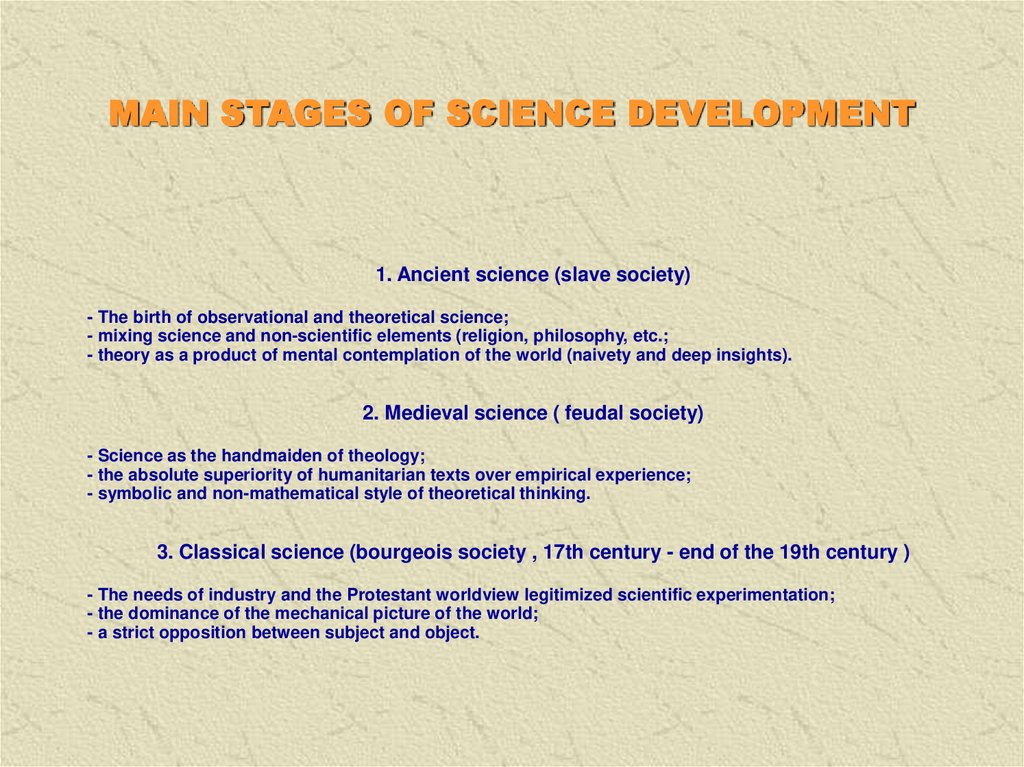
27.
MAIN STAGES OF SCIENCE DEVELOPMENT1. Ancient science (slave society)
- The birth of observational and theoretical science;
- mixing science and non-scientific elements (religion, philosophy, etc.;
- theory as a product of mental contemplation of the world (naivety and deep insights).
2. Medieval science ( feudal society)
- Science as the handmaiden of theology;
- the absolute superiority of humanitarian texts over empirical experience;
- symbolic and non-mathematical style of theoretical thinking.
3. Classical science (bourgeois society , 17th century - end of the 19th century )
- The needs of industry and the Protestant worldview legitimized scientific experimentation;
- the dominance of the mechanical picture of the world;
- a strict opposition between subject and object.
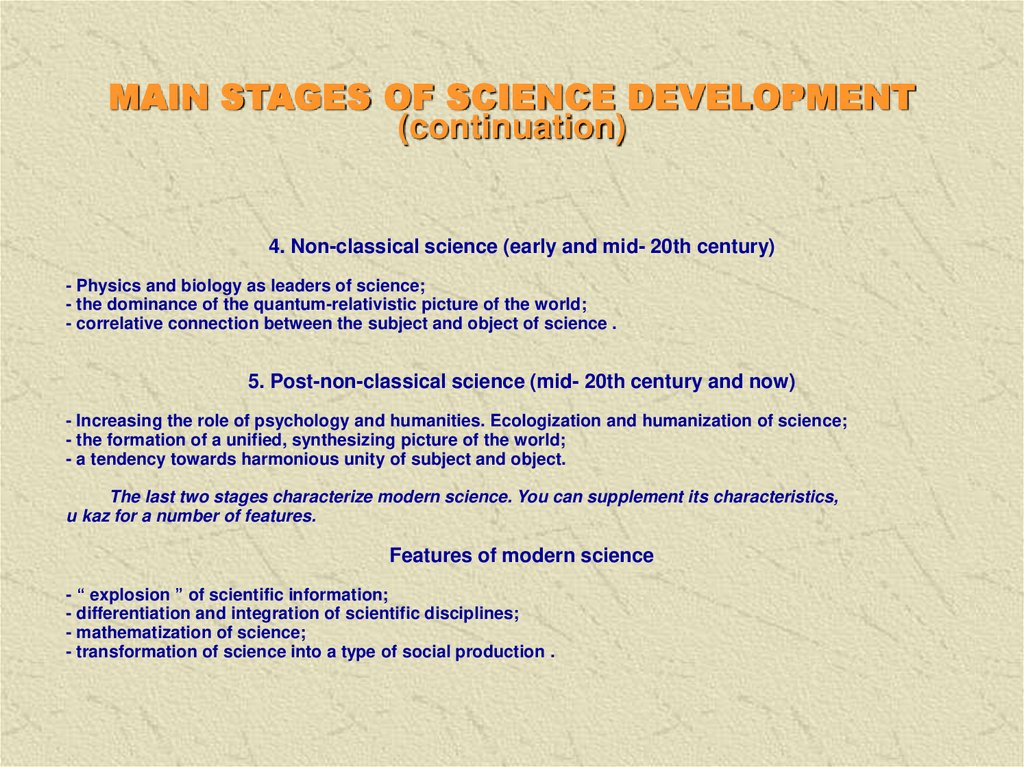
28.
MAIN STAGES OF SCIENCE DEVELOPMENT(continuation)
4. Non-classical science (early and mid- 20th century)
- Physics and biology as leaders of science;
- the dominance of the quantum-relativistic picture of the world;
- correlative connection between the subject and object of science .
5. Post-non-classical science (mid- 20th century and now)
- Increasing the role of psychology and humanities. Ecologization and humanization of science;
- the formation of a unified, synthesizing picture of the world;
- a tendency towards harmonious unity of subject and object.
The last two stages characterize modern science. You can supplement its characteristics,
u kaz for a number of features.
Features of modern science
- “ explosion ” of scientific information;
- differentiation and integration of scientific disciplines;
- mathematization of science;
- transformation of science into a type of social production .