 Философия
Похожие презентации:


Philosophy of positivism. Lecture 5
1. Lecture 5. Philosophy of positivism.
2. Lecture outline:
• 1. First positivism (classical)• 2. “Second positivism”
or empirio-criticism
• 3. Neopositivism and the Vienna Circle
• 4. Post-positivism
3. 1. First positivism (classical)
• Positivism: the main body of knowledge aboutthe world, man and society is obtained in special
sciences,
• “positive” science must abandon attempts to
comprehend “the first principles of being and
knowledge,” which is what philosophy has been
striving for since its inception.
• Positive knowledge and “positive science” are
contrasted in positivism with traditional
philosophy as “metaphysics”.
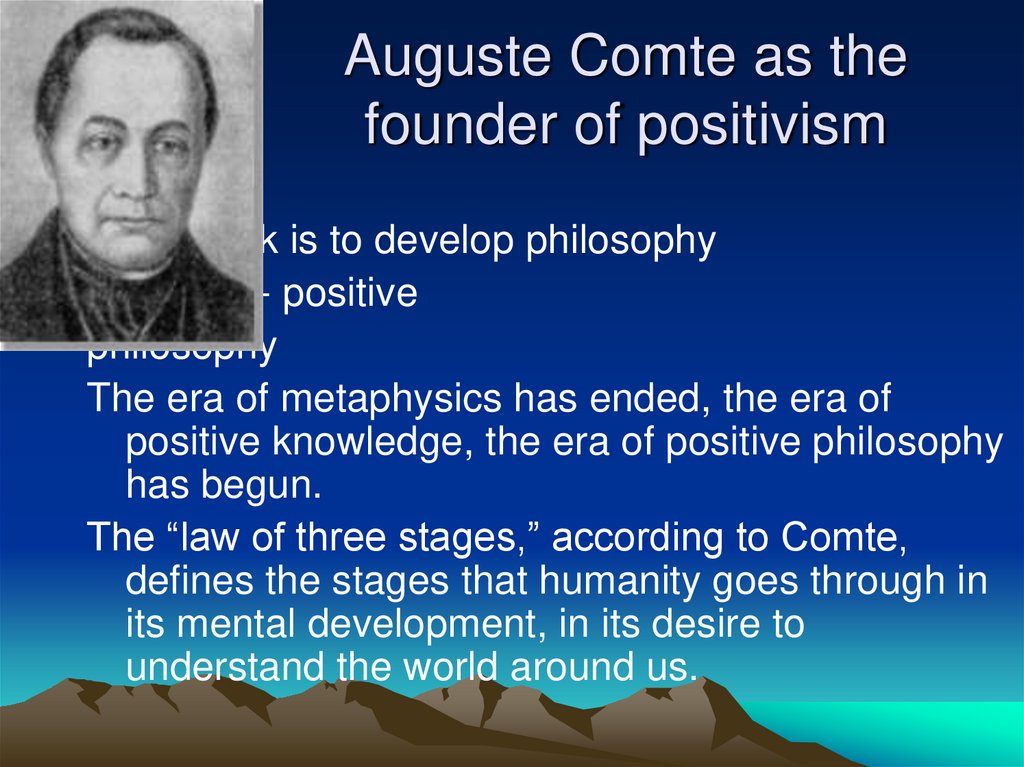
4. Auguste Comte as the founder of positivism
• The task is to develop philosophynew type - positive
philosophy
The era of metaphysics has ended, the era of
positive knowledge, the era of positive philosophy
has begun.
The “law of three stages,” according to Comte,
defines the stages that humanity goes through in
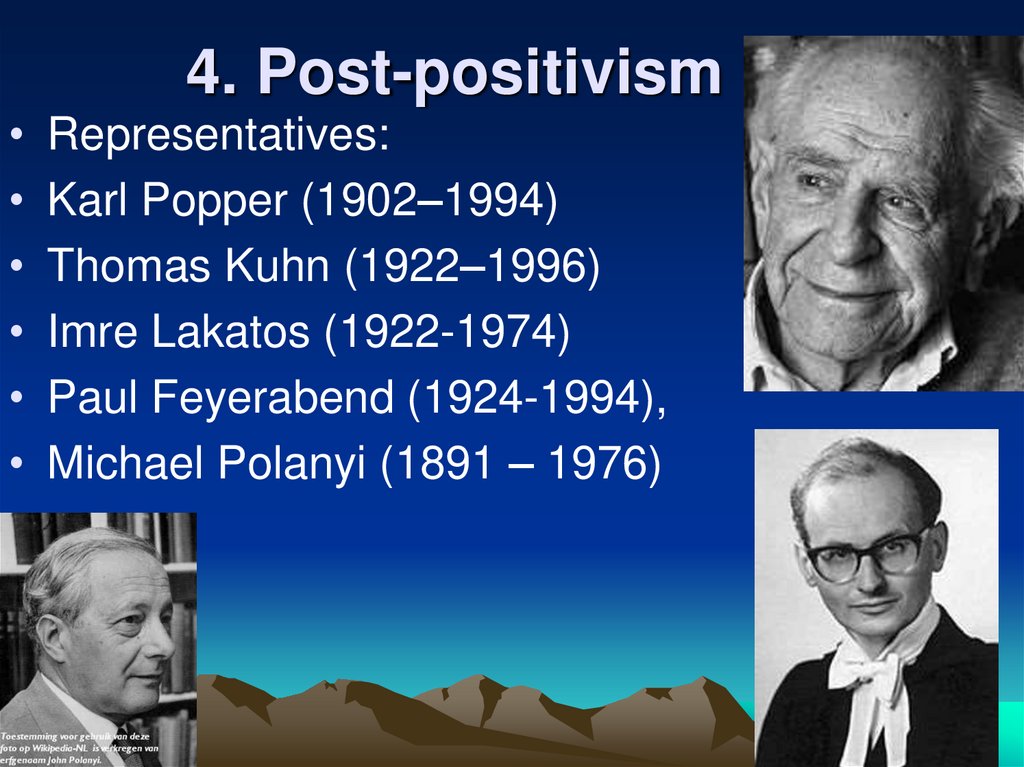
its mental development, in its desire to
understand the world around us.
5. The first stage is theological
• Man strives to explain all phenomena by the intervention ofsupernatural forces, understood by analogy with himself:
gods, spirits, souls, angels, heroes, etc.
• The second stage is metaphysical. It, like the theological
stage, is characterized by the desire to achieve exhaustive
absolute knowledge about the world.
• But unlike the first stage, the explanation of the phenomena
of the world is achieved not by appealing to divine principles
and forces, but comes down to reference to various fictitious
primary entities,
• supposedly hiding behind the world of phenomena, behind
everything that we perceive in experience, the basis of which
they form
6. The third stage is positive
• Having risen to this stage, humanity abandonshopeless and fruitless attempts to know the first
and final causes, to know the absolute nature or
essence of all things,
• those. abandons both theological and
metaphysical questions and claims and
• rushes along the path of accumulation of
positive knowledge obtained by private sciences
7. At the third stage
• the law of constant subordination of imagination toobservation comes into full force,
• Because It is observation that Comte considers as a
universal method of acquiring knowledge.
• O. Comte: “The true positive spirit consists primarily in
replacing the study of the first or final causes of
phenomena with the study of their immutable laws, in
other words, in replacing the word why with the word
how.”
• Description is an important function of science, but not
the main one
• Comte attaches minimal importance to explanation as a
function of science.
8. Comte sees the main function of science in prediction:
• “Thus, true positive thinking consists primarily inthe ability to see,
• to foresee, study what is, and
• from here we can conclude what should happen,
according to the general proposition about the
immutability of natural laws."
• It is in foreseeing the future that Comte sees the
social function of science, especially since it
studies social phenomena.
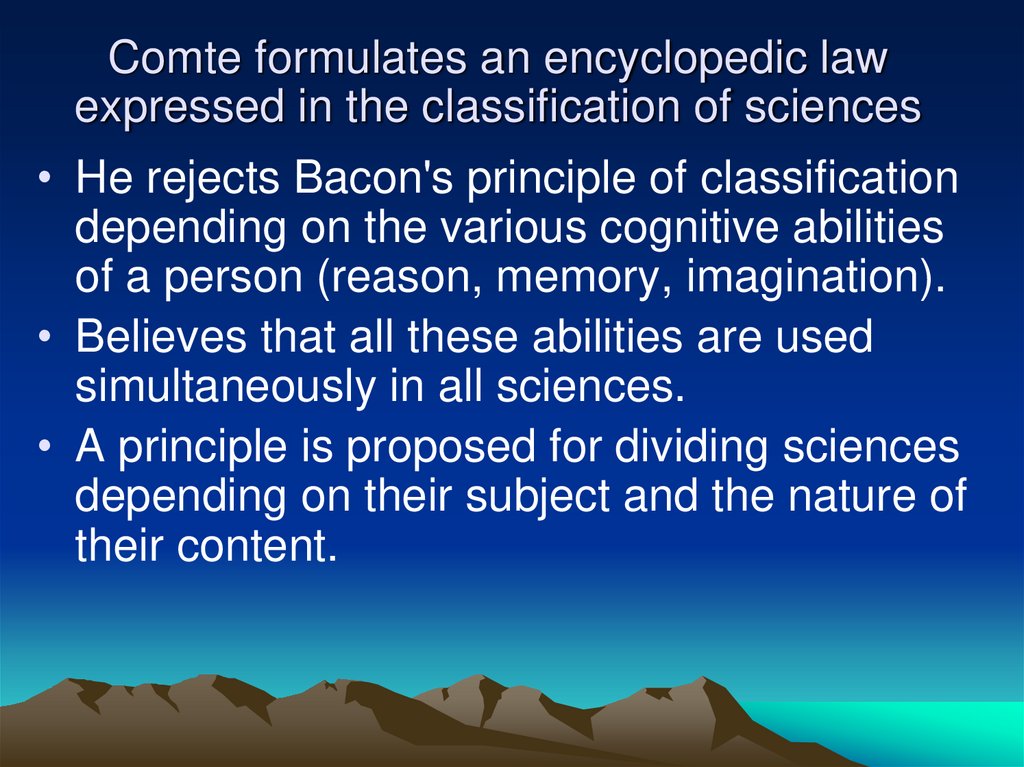
9. Comte formulates an encyclopedic law expressed in the classification of sciences
• He rejects Bacon's principle of classificationdepending on the various cognitive abilities
of a person (reason, memory, imagination).
• Believes that all these abilities are used
simultaneously in all sciences.
• A principle is proposed for dividing sciences
depending on their subject and the nature of
their content.
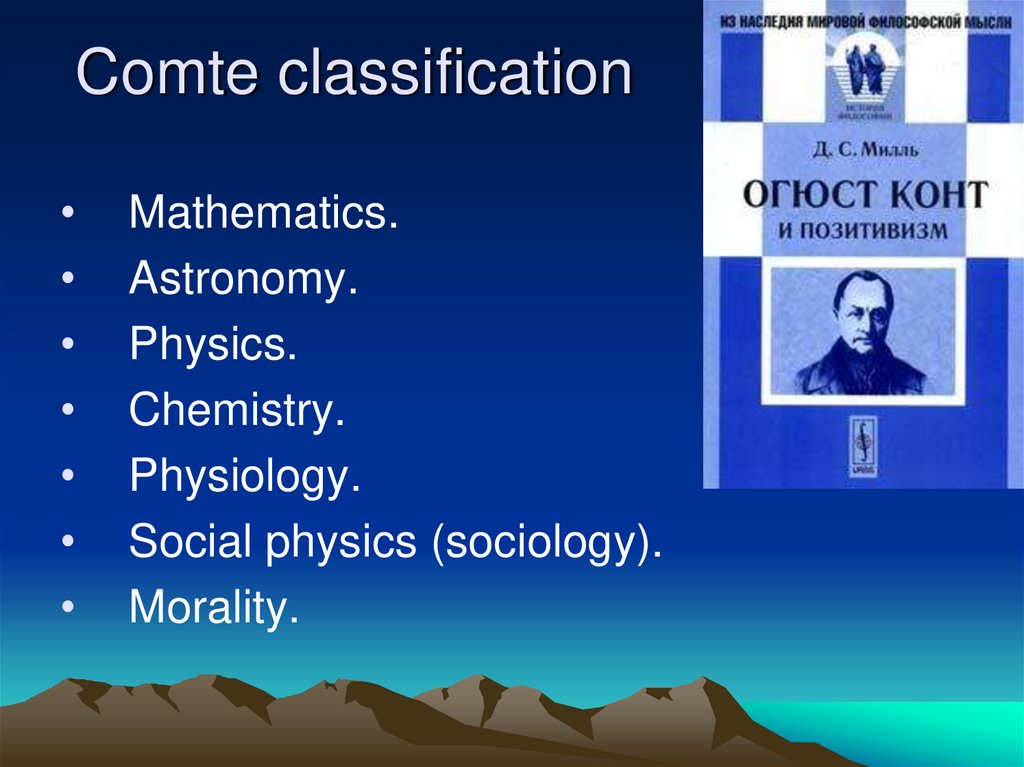
10. Comte classification
Mathematics.
Astronomy.
Physics.
Chemistry.
Physiology.
Social physics (sociology).
Morality.
11. The model of science for positivism is natural science
• Positivism transfers the methods andtechniques of natural science to the social
and human sciences, the specifics of which
are not taken into account in any way.
• This feature constituted a specific limitation
of the positivist method, which later
provoked sharp criticism from neo-Kantians
and philosophers of life
12. Comte sought to build
• “positive” science of society - sociology(this term itself is his successful invention),
which was something like “social physics.”
• Comte's sociology is presented in three
sections:
• 1. The doctrine of the conditions of
existence of society,
• 2. The doctrine of changing social
systems,
• 3. Social action program.
13. The first section is “social statics”
• In it he examines the main, according to Comte, socialinstitutions (family, state, church).
• Comte considers the family to be the basic unit of society,
which represents a kind of “substance” of society.
• The second section - the Doctrine of change in social
systems - Comte calls "social dynamics".
• The idea of social progress is leading in Comte's “social
dynamics”. Development here also occurs according to the “law
of three stages.”
• The theological stage - before 1300 - is divided into three
stages: fetishism, polytheism and monotheism.
• The metaphysical stage covers the period from 1300 to 1800
and is transitional - here the decomposition of traditional beliefs
and social order occurs as a result of philosophical criticism
(Reformation, Enlightenment, Revolution).
• Early 19th century - gradual birth of the “Positive Stage”
14. The third section of his sociology
• Comte calls it "social policy". Its main thesis isthe transformation of “positive philosophy” into
the religion of all humanity.
• In general, it is an attempt at a strictly scientific
approach to social life,
• based on the application of the concept of fact to
it.
• Denial of the cognitive value of philosophical
research.
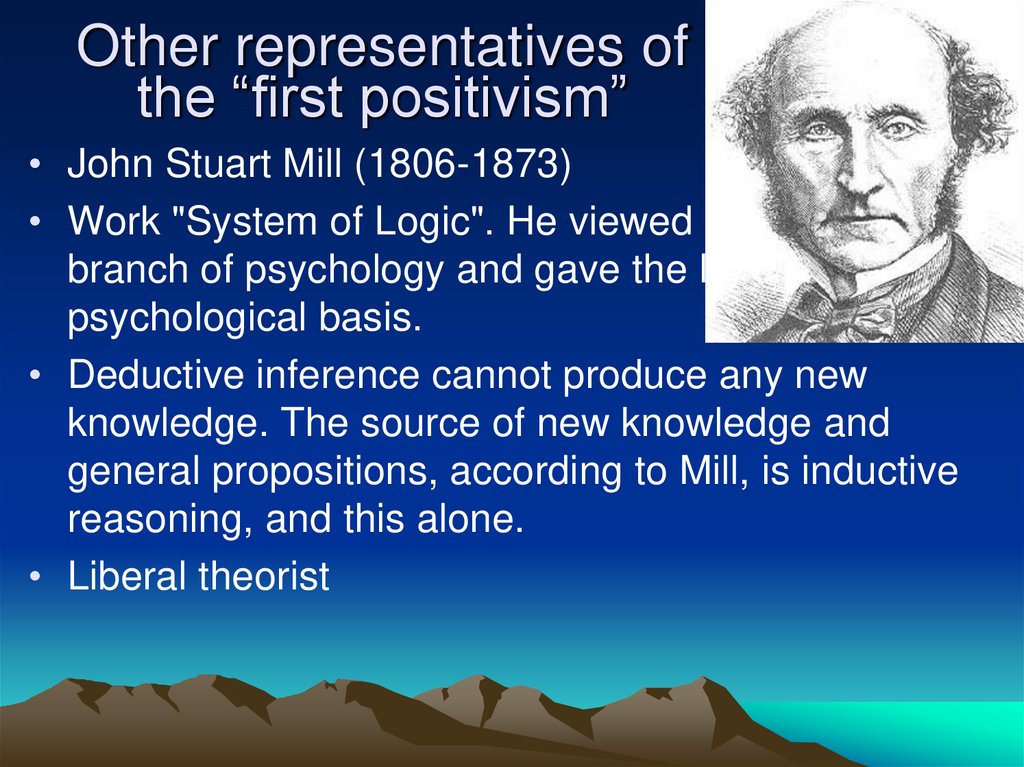
15. Other representatives of the “first positivism”
• John Stuart Mill (1806-1873)• Work "System of Logic". He viewed logic as a
branch of psychology and gave the laws of logic a
psychological basis.
• Deductive inference cannot produce any new
knowledge. The source of new knowledge and
general propositions, according to Mill, is inductive
reasoning, and this alone.
• Liberal theorist
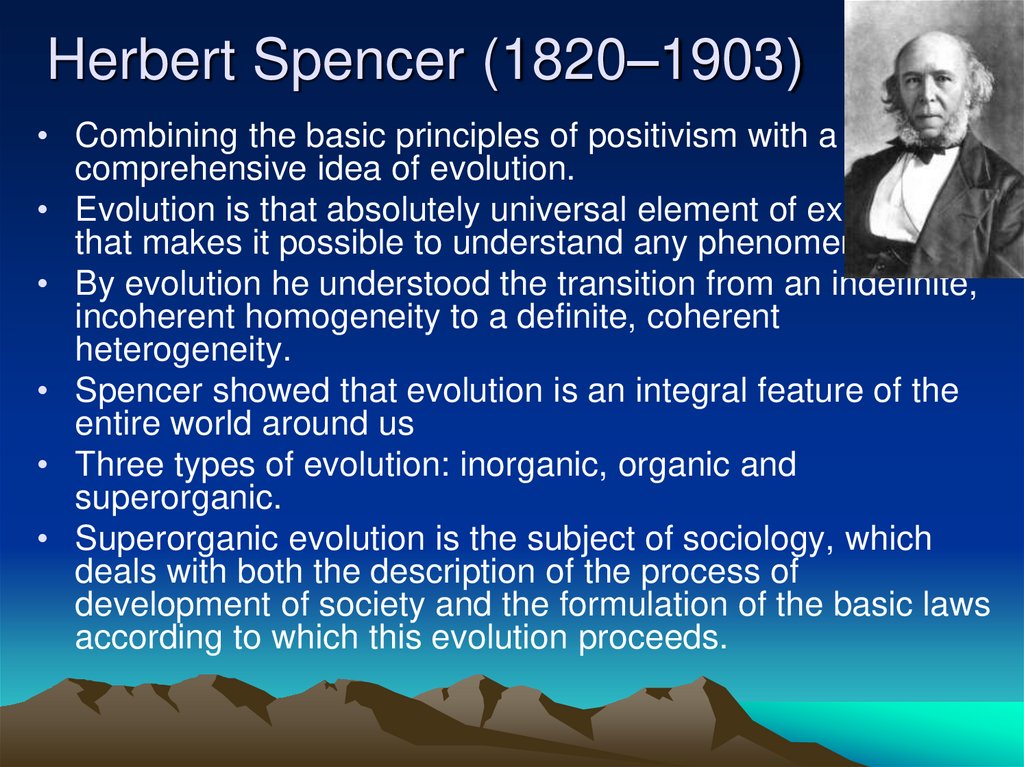
16. Herbert Spencer (1820–1903)
• Combining the basic principles of positivism with acomprehensive idea of evolution.
• Evolution is that absolutely universal element of experience
that makes it possible to understand any phenomena.
• By evolution he understood the transition from an indefinite,
incoherent homogeneity to a definite, coherent
heterogeneity.
• Spencer showed that evolution is an integral feature of the
entire world around us
• Three types of evolution: inorganic, organic and
superorganic.
• Superorganic evolution is the subject of sociology, which
deals with both the description of the process of
development of society and the formulation of the basic laws
according to which this evolution proceeds.
17. 2. “Second positivism” or empirio-criticism
• Ernst Mach - Austrian physicist and philosopher• Richard Avenarius,
• At its core, real knowledge is the content of
positive sciences
• We set the task of developing methods for
selecting the material of the positive sciences
that should rightfully relate to their content,
• criteria capable of weeding out what is included
in experimental knowledge due to oversight.
• "Experience cleansing" program
18. An important obstacle to the “purification of experience”
• Avenarius considers the “investment” of anything perceivedinto the consciousness of the individual.
• Mach developed it into the principle that formed the basis of
the second positivism - the principle of economy of thinking.
• This principle of Mach combines biologism (cognition as a
biologically economical adaptation to the environment),
positivism (cognition as an economical “pure description” of
phenomena) and subjectivism (the criterion of economy in
cognition is determined by the subject, preceding any
experience).
• Considering economical thinking as “pure description,” Mach
acted from the position of radical philosophical empiricism,
not recognizing theoretical concepts as having any other
role than that of a sign for the totality of sensory data.
19. 3. Neopositivism
• It developed in the 20s of the 20th century almostsimultaneously in Austria, England and Poland.
• Basis - logical positivism
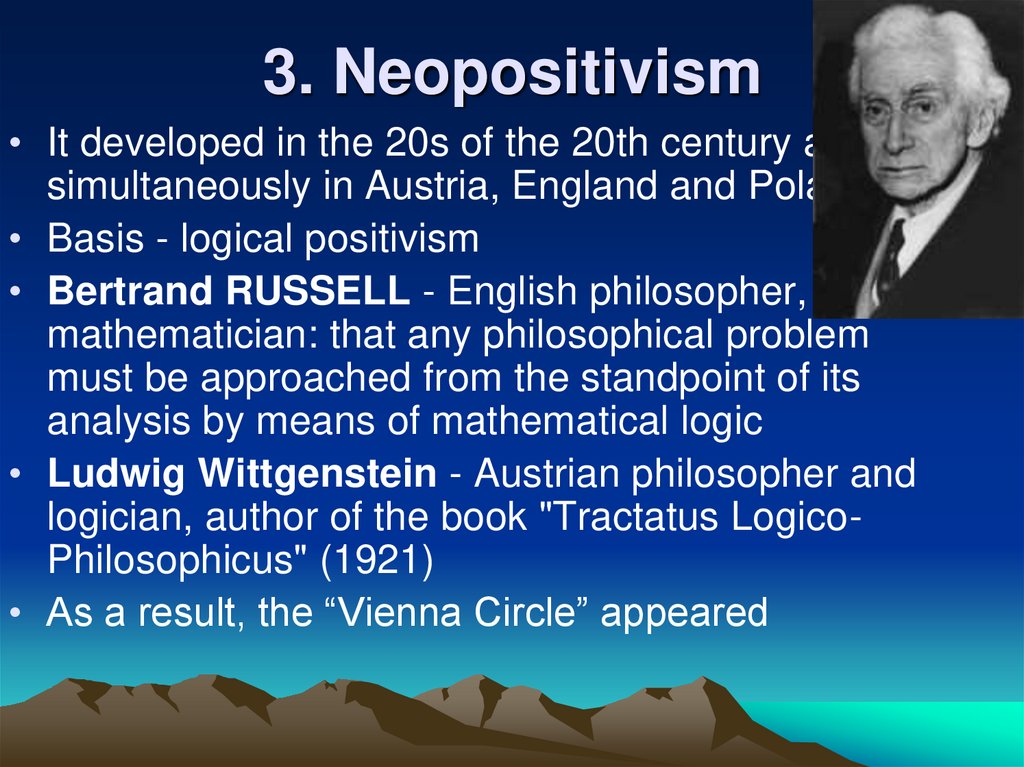
• Bertrand RUSSELL - English philosopher, logician,
mathematician: that any philosophical problem
must be approached from the standpoint of its
analysis by means of mathematical logic
• Ludwig Wittgenstein - Austrian philosopher and
logician, author of the book "Tractatus LogicoPhilosophicus" (1921)
• As a result, the “Vienna Circle” appeared
20. Vienna Circle
• A group of logicians, philosophers,mathematicians and sociologists,
which arose in 1922 on the basis of a seminar
at the Department of Philosophy of Inductive
Sciences at the University of Vienna.
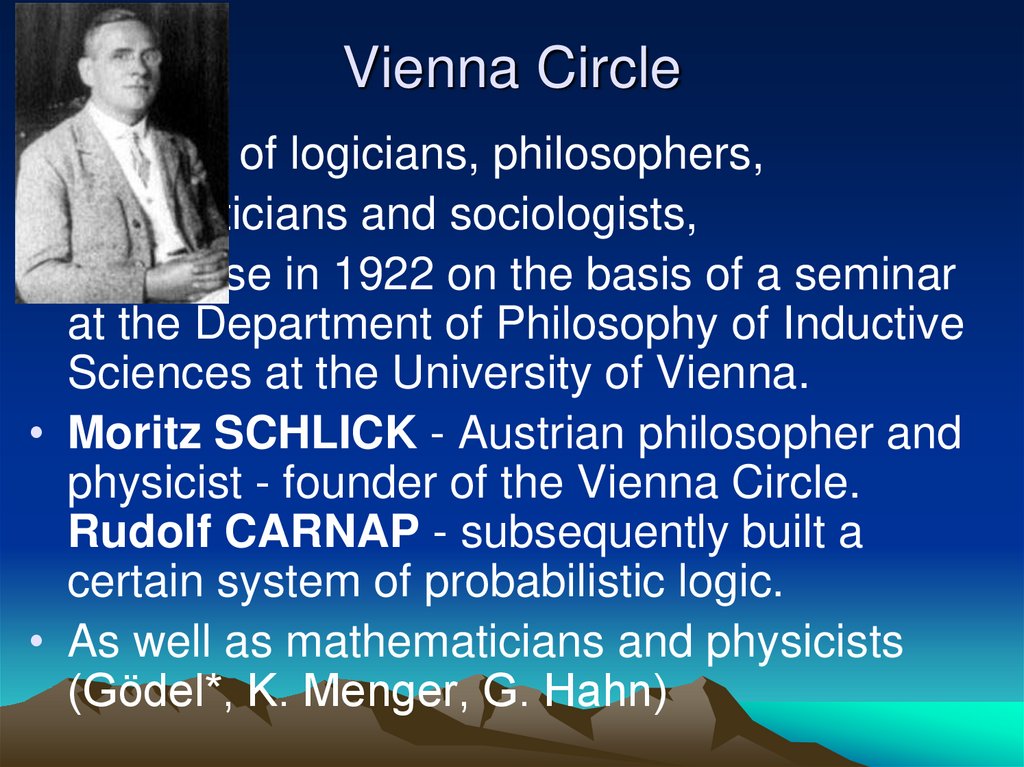
• Moritz SCHLICK - Austrian philosopher and
physicist - founder of the Vienna Circle.
Rudolf CARNAP - subsequently built a
certain system of probabilistic logic.
• As well as mathematicians and physicists
(Gödel*, K. Menger, G. Hahn)
21. Specifics of logical positivism
• The method of philosophizing is modernformal mathematical logic.
• “Logic is the essence of philosophy” (Russell).
• “Philosophy is the logic of science”
(Carnap).
22. All the opinions that people have ever expressed
• Logical positivists are divided into two mutuallyexclusive classes:
• meaningful statements, i.e. those that can be
expressed in logically perfect language,
• meaningless statements that violate the rules of
logic.
• Traditionally, logical positivists qualify philosophical,
“metaphysical” statements as meaningless.
23. Meaningful statements are divided into
1. Analytical, which are tautological in nature
and do not carry meaningful information,
2. Synthetic.
Logical positivists classify statements of logic
and mathematics as analytical, tautological in
nature.
According to this classification, synthetic
statements include all statements of
experimental sciences.
24. The question of the truth of statements
• Solvable in two ways:• 1. By logical analysis of their linguistic
form without resorting to any facts
(analytical),
• 2. Through direct or indirect (certain logical
transformations) comparison of them with
the data of sensory experience. (synthetic)
25. The procedure for verifying a statement (checking its truth)
consists in obtaining a finite number of statements that
record observational data (a set of so-called protocol
sentences), from which a given statement logically follows.
The reduction of all meaningful provisions of experimental
sciences to the class of synthetic statements contains two
assumptions
There is a certain basic level of knowledge, a set of socalled protocol sentences,
Relations between scientific concepts are limited to
connections of a formal-logical nature
26. Philosophy, according to neopositivism,
• there is not a theory,but an activity.
• The content of this activity was reflected in how
neopositivism began to be called in the 40s of the 20th
century - the philosophy of analysis.
• The subject of this philosophy is the activity of analyzing the
concepts and provisions of specific sciences in order to
clarify their meaning.
• The task of the philosopher is, with the help of a certain
logical technique, to make the transition from statements of
specific sciences to sentences that can be compared with
sensory data.
• So, philosophy according to neopositivism is only an
analytical activity to find the meaning of concepts and
proposals of specific sciences
27. 4. Post-positivism
• Representatives:• Karl Popper (1902–1994)
• Thomas Kuhn (1922–1996)
• Imre Lakatos (1922-1974)
• Paul Feyerabend (1924-1994),
• Michael Polanyi (1891 – 1976)
28. Concept of scientific knowledge by K. Popper
• Basic concepts:• demarcation problem
• falsification principle
• fallibilism principle
• "three worlds" theory.
The problem of demarcation is one of the main
tasks of philosophy, which consists in separating
scientific knowledge from non-scientific
• The method of demarcation, according to
Popper, is the principle of falsification.
29. The principle of falsification
• The principle proposed by Popper as ademarcation of science from
"metaphysics", non-science as an
alternative to the principle of verification,
• put forward by neopositivism.
• This principle requires the fundamental
refutability (falsifiability) of any statement
related to science
30. PRINCIPLE OF FALLIBILISM
• the principle of Popper's concept, which statesthat all scientific knowledge is only hypothetical
and subject to error.
• The growth of scientific knowledge, according to
Popper, consists of putting forward bold
hypotheses and carrying out decisive refutations
of them.
• Arguing against the neo-positivism of the Vienna
Circle , Popper criticized the principle of
induction, pointing out that theoretical
knowledge is not deduced from experience.
Since there are no other sources of knowledge
besides experience, reliable theoretical
knowledge is impossible.
31. THEORY OF "THREE WORLDS"
THEORY OF "THREEWORLDS"
• theory of the philosophical concept of K. Popper,
which asserts the existence of the first world the world of objects,
• the second world - the world of subjects and
• third world - the world of OBJECTIVE
KNOWLEDGE , which is generated by the first
and second worlds, but exists independently of
them.
• The analysis of the growth and development of
knowledge in this independent third world is,
according to Popper, the subject of the
philosophy of science
32. Karl Popper believed
• That theoretical knowledge cannot be obtainedfrom experience.
• In his opinion, the theory is based on a guess.
• And he assigned the role of a predictor of new
properties to the theory itself, which might not be
confirmed during the experiment.
• He also said that any theory is replaced by a
new theory due to the imperfection of the theory,
and the terms of science are always too loaded.
33. Imre Lakatos (1922-1974)
• Developing Popper's ideas,• To describe the progress of science, I used the
model of evolution not of theories, but of
methodological programs.
• Lakatos abandoned the concept of “truth”,
replacing it with “progressive problem shift” and
“negative problem shift”, while abandoning the
coherent theory of truth.
• Replacing the concept of theory with the concept
of a research program, Lakatos moves from a
view of science as an independent phenomenon
(characteristic of Popper and even more so of the
Vienna Circle) to a description of real scientific
activity as a process.
34. Basic concepts of Imre Lakatos' concept:
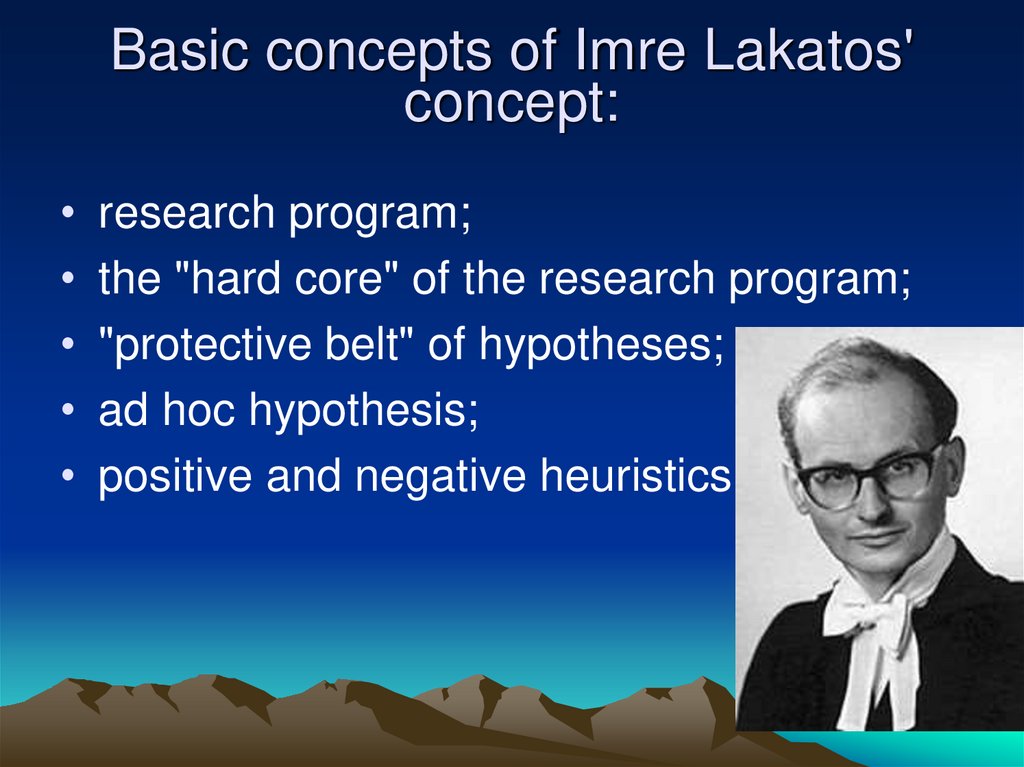
Basic concepts of Imre Lakatos'concept:
• research program;
• the "hard core" of the research program;
• "protective belt" of hypotheses;
• ad hoc hypothesis;
• positive and negative heuristics.
35. Research program
• The central concept of a universal logicalnormative reconstruction of the development ofscience,
• which is called the methodology of research
programs.
• Lakatos' methodology views the growth of
"mature" (developed) science as a succession of
a number of related research programs.
• Important structural elements of a research
program are its “hard core” and “protective belt”
of hypotheses.
36. The "hard core" of the research program
The "hard core" of the researchprogram
• a structural element of a program that includes
its conditionally irrefutable fundamental
assumptions.
• “ Protective belt” of hypotheses –
• A structural element of a program, consisting of
auxiliary hypotheses and ensuring the safety of
the “hard core” of the program from refutations.
• According to Lakatos, the "protective belt" of
hypotheses can be partially or completely
replaced when faced with counterexamples
37. HYPOTHESIS ad hoc
• - a hypothesis from the “protective belt”, relatingonly to this case, i.e. protecting the "hard core"
of the program from a specific counterexample
• Positive and negative heuristics –
• determine the change of programs by regulatory
rules,
• prescribing which paths are most promising for
further research ("positive heuristics"), and
which paths should be avoided.
38. In the development of the research program
• Two main stages can be distinguished progressive and degenerate.• At the progressive stage, “positive heuristics”
actively stimulates the development of
hypotheses that expand the empirical and
theoretical content.
• However, in the future, the development of the
research program slows down sharply, its
“positive heuristics” loses its heuristic power, as
a result of which the number of ad hoc
hypotheses increases.
39. Thomas Kuhn believes that
• Scientific research is built in accordance with theprevailing system of views on the object of
research and on scientific activity itself ( Scientific
Paradigm ).
• This system of views leads to the dominance in
each era of a certain paradigm, which, in turn,
during the period of the scientific revolution is
replaced by another paradigm,
• Moreover, the choice of paradigm is dictated not
by some “progress of knowledge”, but often by
psychological and other extra-scientific factors
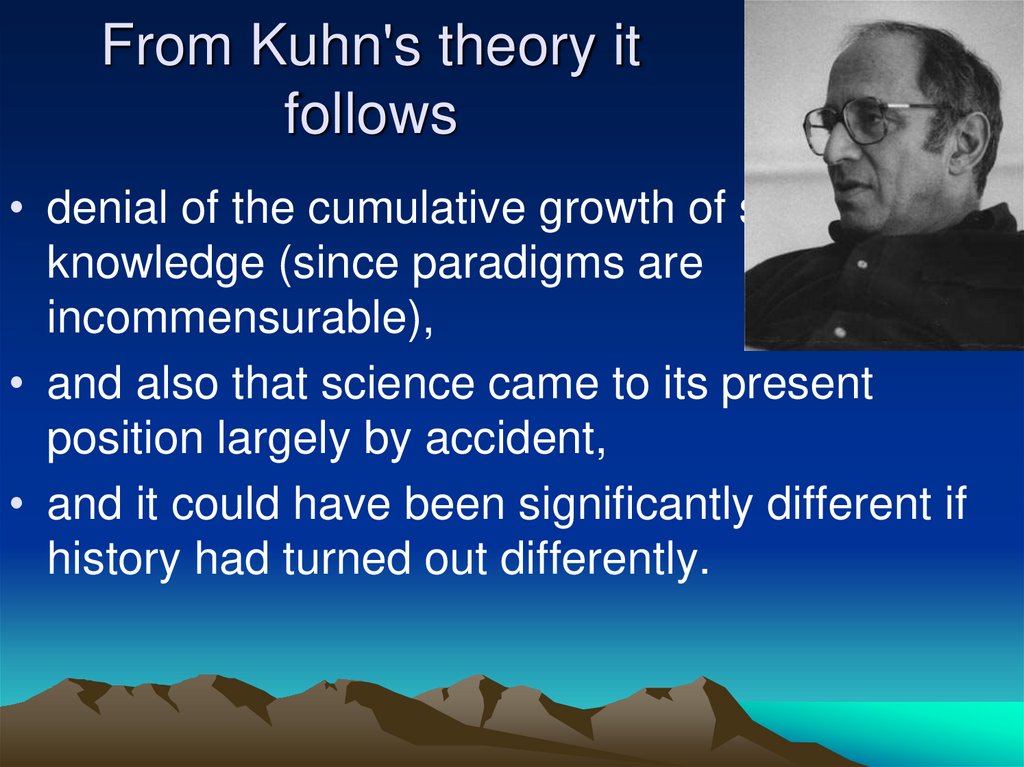
40. From Kuhn's theory it follows
From Kuhn's theory itfollows
• denial of the cumulative growth of scientific
knowledge (since paradigms are
incommensurable),
• and also that science came to its present
position largely by accident,
• and it could have been significantly different if
history had turned out differently.
41. Scientific paradigm
• the basic concept of the concept of historicaldynamics of scientific knowledge by T. Kuhn,
• which reveals the basis for the formation and
functioning of scientific communities, the
competitive struggle between which constitutes
the history of science.
• This basis is the acceptance by members of the
scientific community of a certain model of
scientific activity - a set of theoretical standards,
methodological norms, value criteria, worldviews
• which is called a paradigm
42. Paul Feyerabend (1924-1994),
• Continuing Kuhn's line,• comes to the conclusion that science, neither
in its methods, nor in its objects of research,
nor in its goals
• is not fundamentally different from myth and
political demagoguery and is, in essence,
one of the instruments of power.
43. Anarchism in the methodology of science
• the position of P. Feyerabend's methodologicalconcept, which states that every scientist can
invent and develop his own theories, not paying
attention to contradictions and criticism.
• The activity of a scientist is not subject to any
rational norms, therefore the development of
science is irrational, and science is no different
from myth and religion, representing one of the
forms of ideology.
• Therefore, it is necessary to free society from the
“dictation of science”, separate science from the
state and give science, myth, magic, and religion
equal rights in public life
44. Michael Polanyi (1891 – 1976)
• Polanyi is the author of the concept of “personal(or tacit) knowledge ,” which, from his point of
view, cannot be expressed in explicit form (for
example, in the form of texts and diagrams),
• but which is an essential component of the
scientist’s activity.
• Personal or tacit knowledge is formed through
personal contacts and has a direct impact on
scientists' theoretical and practical skills,
imagination and creativity.
45. Conclusions:
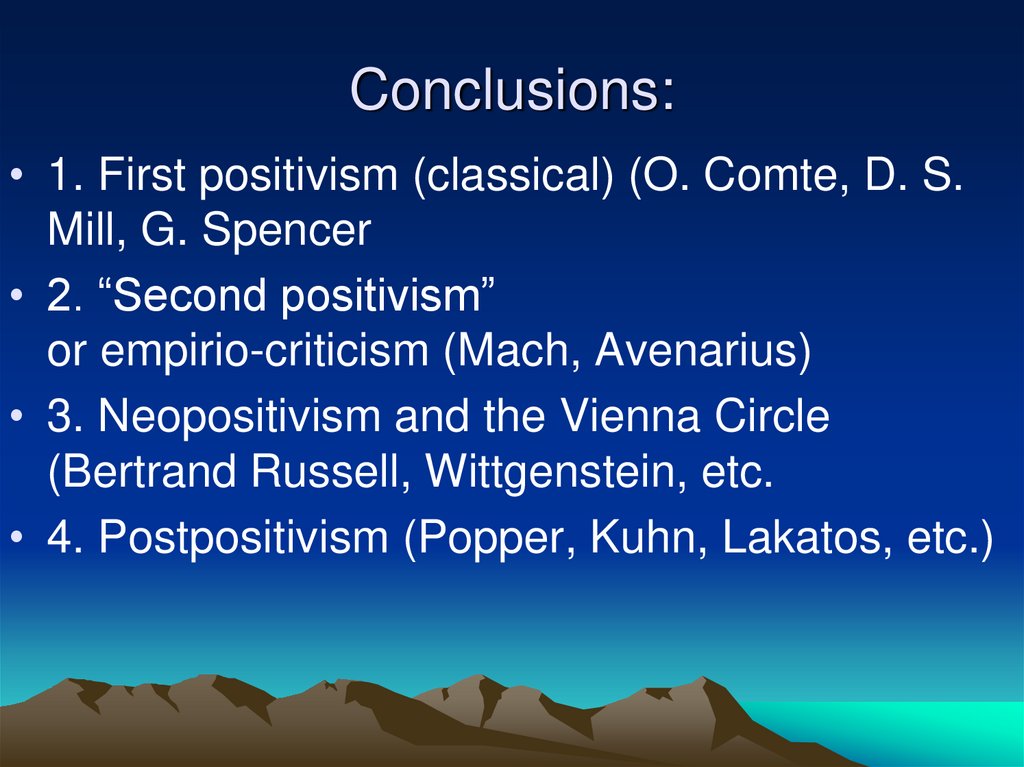
• 1. First positivism (classical) (O. Comte, D. S.Mill, G. Spencer
• 2. “Second positivism”
or empirio-criticism (Mach, Avenarius)
• 3. Neopositivism and the Vienna Circle
(Bertrand Russell, Wittgenstein, etc.
• 4. Postpositivism (Popper, Kuhn, Lakatos, etc.)