Похожие презентации:







Education-in-the-UK-Overview
1.
Education in the UK:Overview
The United Kingdom is a popular destination for international students,
offering high-quality education recognized worldwide.
Recognition
Quality
Degrees are recognized
High standards of teaching
globally.
and research.
Diversity
Multicultural student environment.
2.
Structure of the Education SystemThe UK education system is divided into four main stages, from compulsory primary to higher
education.
Primary
Secondary
Further Education
Higher Education
Compulsory Education
Aimed at developing basic skills in reading, writing, and natural sciences (ages 5–16).
Higher Education
Includes Bachelor's, Master's, and Doctoral (PhD) degrees at leading universities.
3.
Primary Education (Ages 5–11)Primary education (Key Stage 1 and 2) focuses on basic subjects and the development of core skills.
Key Stages
Types of Schools
KS1
Ages 5–7.
State Schools
KS2
Free, co-educational.
Ages 7–11.
Assessment
Religious Schools
Free, with a religious component.
Grades in the traditional sense are not given. The
teacher assesses whether the child's work meets
the age-appropriate standard.
Private Schools
Fee-paying, with high standards.
4.
Secondary Education (Ages11–16)
Secondary school (Key Stage 3 and 4) culminates in GCSE examinations
at age 16.
Age
Examinations
11–16 years old.
GCSE (General Certificate of
Secondary Education)
examinations.
Core Subjects
Mathematics, English, Sciences, Foreign Languages.
5.
Types of Schools in the UKIn the UK, there are several types of schools, differing in funding and curriculum.
State (80%)
Private/Independent
Free for residents, follow the National Curriculum.
Fee-paying, smaller classes, often prepare for Oxbridge and Russell Group.
International
Special
Offer IB, American, or other international programs.
For students with special educational needs, with individualized support.
6.
Qualifications (16–18 years old)After 16, students choose an academic or technical path to prepare for university or work.
A-Levels
Academic path. 3–4 specialized subjects for university admission.
T-Levels
Technical qualifications. Equivalent to 3 A-Levels + 45 days of work placement.
BTECs & NVQs
Vocational training. Practical preparation in various industries.
GCSE (14–16 years old) — standard qualification upon completion of secondary education (8–
10 subjects).
7.
Higher Education (18+)The UK is a global leader in research and innovation, offering a diverse range of degrees.
Degree Levels
Admissions
Bachelor's (3–4 years),
Via UCAS (for Bachelor's).
Master's (1–2 years),
High A-Level/IB grades or
Doctorate (3–4 years).
equivalent are required.
Employment
Over 80% of graduates are employed or pursue further studies
within six months.
8.
Funding Your StudiesTuition fees vary, but various financial support options are available,
especially for international students.
Tuition Fees
£9,250 per year (public universities).
(Domestic)
Tuition Fees
£15,000 – £38,000 per year (depends on
(International)
the program).
Scholarships for
Commonwealth, Chevening, and
International
scholarships from the universities
Students
themselves (Oxford, Cambridge, etc.).
Part-time Work
Up to 20 hours per week during term time
for students with a visa.
9.
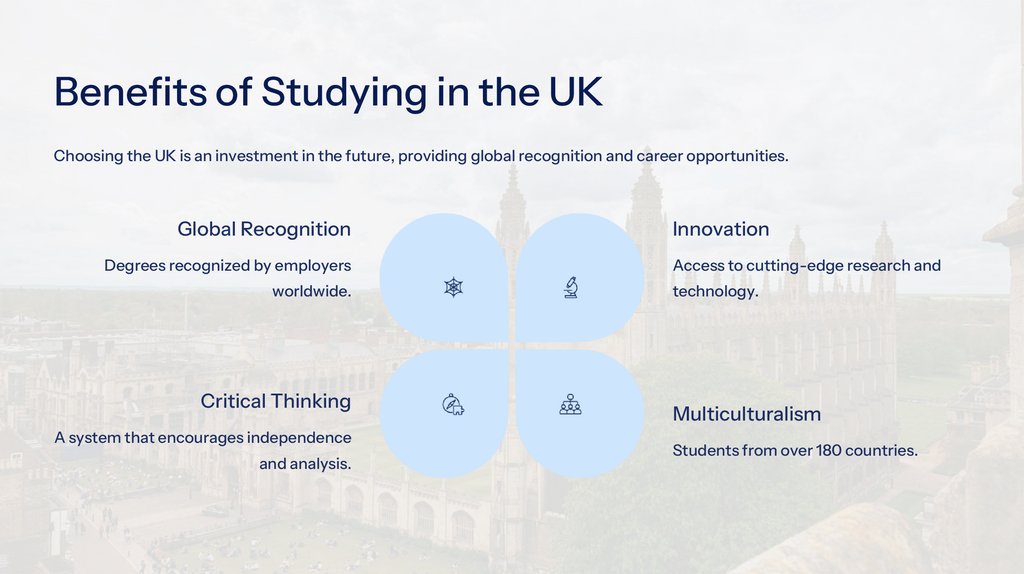
Benefits of Studying in the UKChoosing the UK is an investment in the future, providing global recognition and career opportunities.
Global Recognition
Degrees recognized by employers
worldwide.
Critical Thinking
A system that encourages independence
and analysis.
Innovation
Access to cutting-edge research and
technology.
Multiculturalism
Students from over 180 countries.
10.
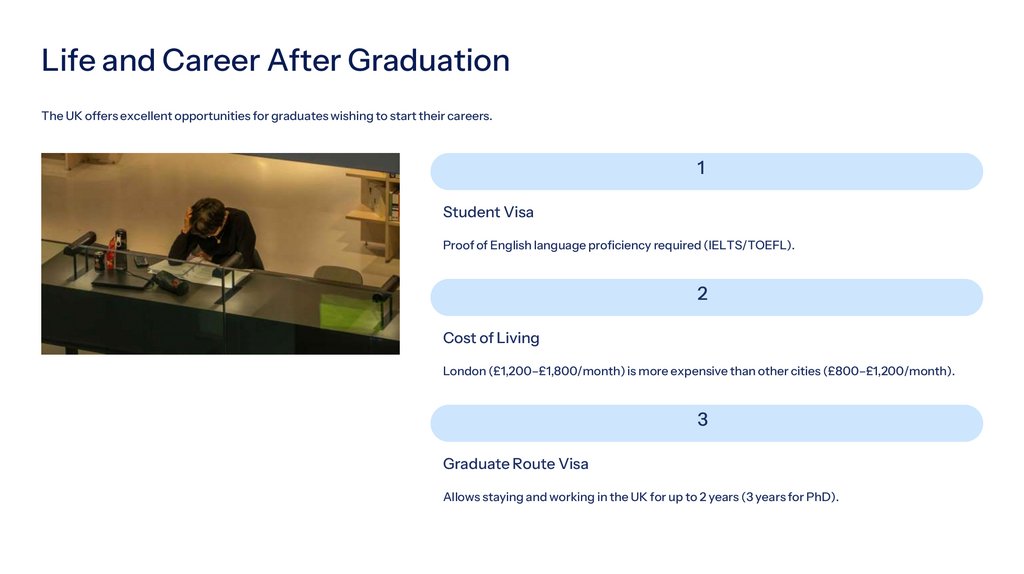
Life and Career After GraduationThe UK offers excellent opportunities for graduates wishing to start their careers.
1
Student Visa
Proof of English language proficiency required (IELTS/TOEFL).
2
Cost of Living
London (£1,200–£1,800/month) is more expensive than other cities (£800–£1,200/month).
3
Graduate Route Visa
Allows staying and working in the UK for up to 2 years (3 years for PhD).