



 Английский язык
Похожие презентации:






London-Attractions[1]
1.
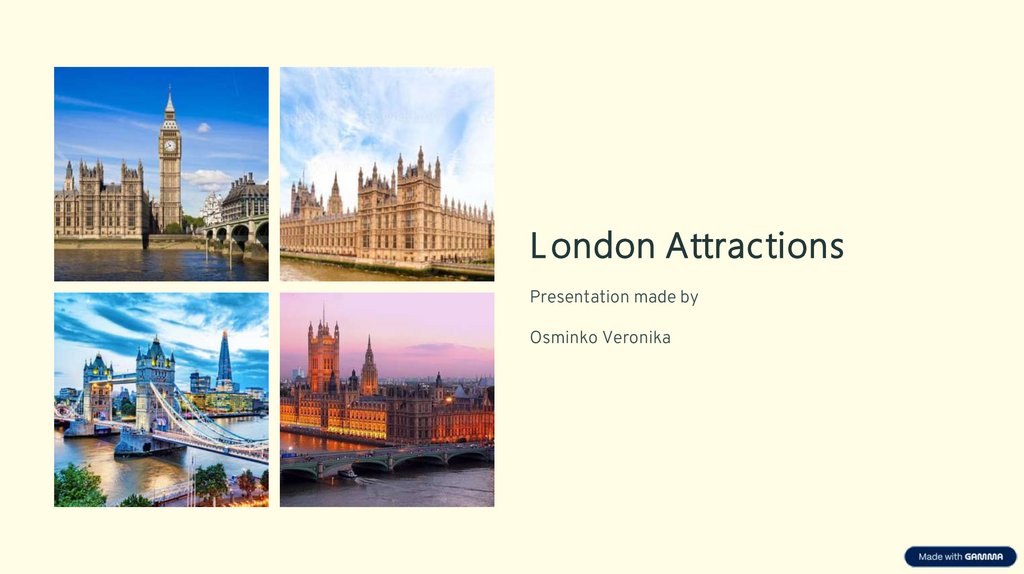
L ondon AttractionsPresentation made by
Osminko Veronika
2.
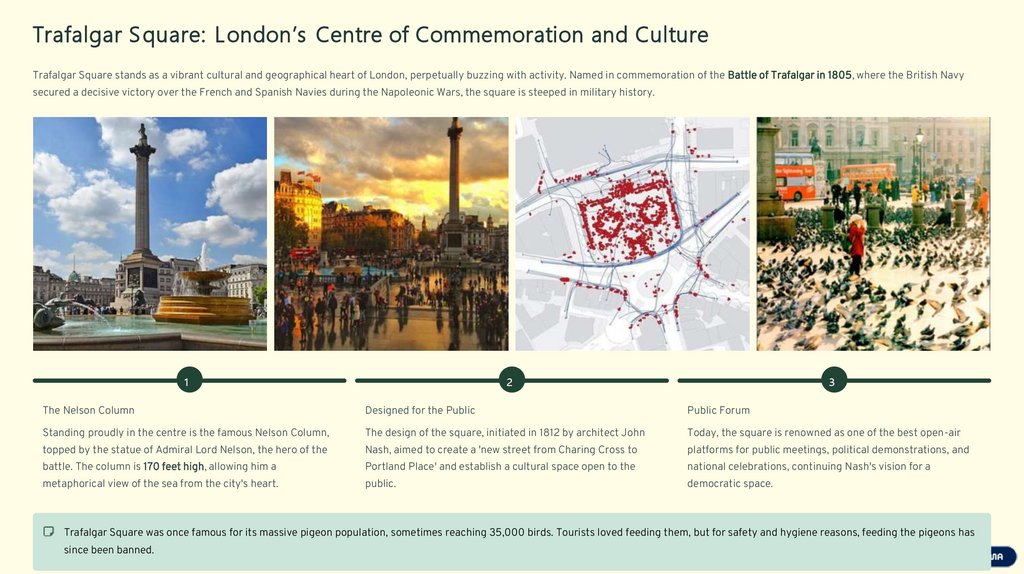
Trafalgar S quare: L ondon’s Centre of Commemoration and CultureTrafalgar Square stands as a vibrant cultural and geographical heart of London, perpetually buzzing with activity. Named in commemoration of the Battle of Trafalgar in 1805, where the British Navy
secured a decisive victory over the French and Spanish Navies during the Napoleonic Wars, the square is steeped in military history.
1
2
3
The Nelson Column
Designed for the Public
Public Forum
Standing proudly in the centre is the famous Nelson Column,
The design of the square, initiated in 1812 by architect John
Today, the square is renowned as one of the best open-air
topped by the statue of Admiral Lord Nelson, the hero of the
Nash, aimed to create a 'new street from Charing Cross to
platforms for public meetings, political demonstrations, and
battle. The column is 170 feet high, allowing him a
Portland Place' and establish a cultural space open to the
national celebrations, continuing Nash's vision for a
metaphorical view of the sea from the city's heart.
public.
democratic space.
Trafalgar Square was once famous for its massive pigeon population, sometimes reaching 35,000 birds. Tourists loved feeding them, but for safety and hygiene reasons, feeding the pigeons has
since been banned.
3.
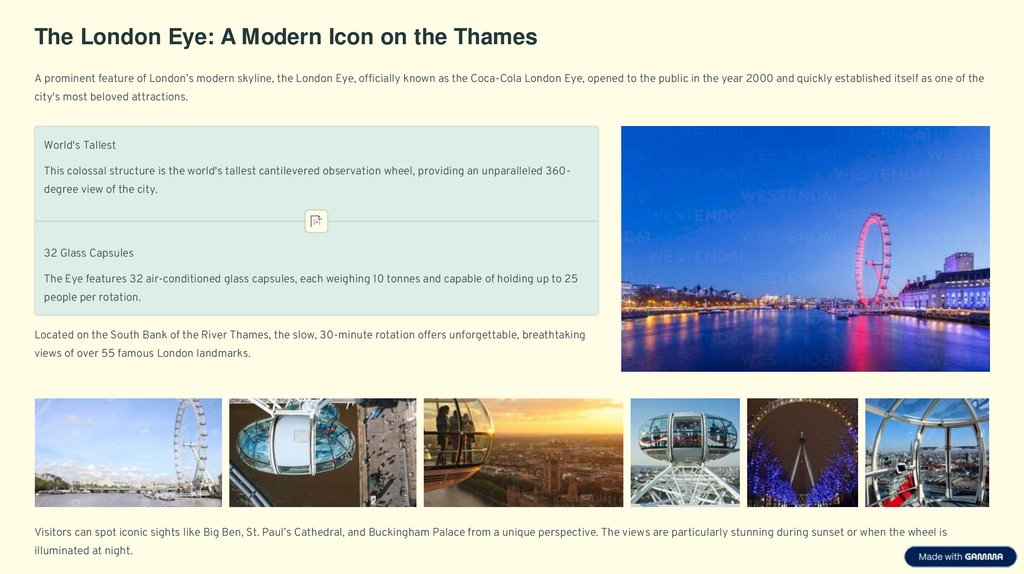
The London Eye: A Modern Icon on the ThamesA prominent feature of London’s modern skyline, the London Eye, officially known as the Coca-Cola London Eye, opened to the public in the year 2000 and quickly established itself as one of the
city's most beloved attractions.
World's Tallest
This colossal structure is the world's tallest cantilevered observation wheel, providing an unparalleled 360degree view of the city.
32 Glass Capsules
The Eye features 32 air-conditioned glass capsules, each weighing 10 tonnes and capable of holding up to 25
people per rotation.
Located on the South Bank of the River Thames, the slow, 30-minute rotation offers unforgettable, breathtaking
views of over 55 famous London landmarks.
Visitors can spot iconic sights like Big Ben, St. Paul’s Cathedral, and Buckingham Palace from a unique perspective. The views are particularly stunning during sunset or when the wheel is
illuminated at night.
4.
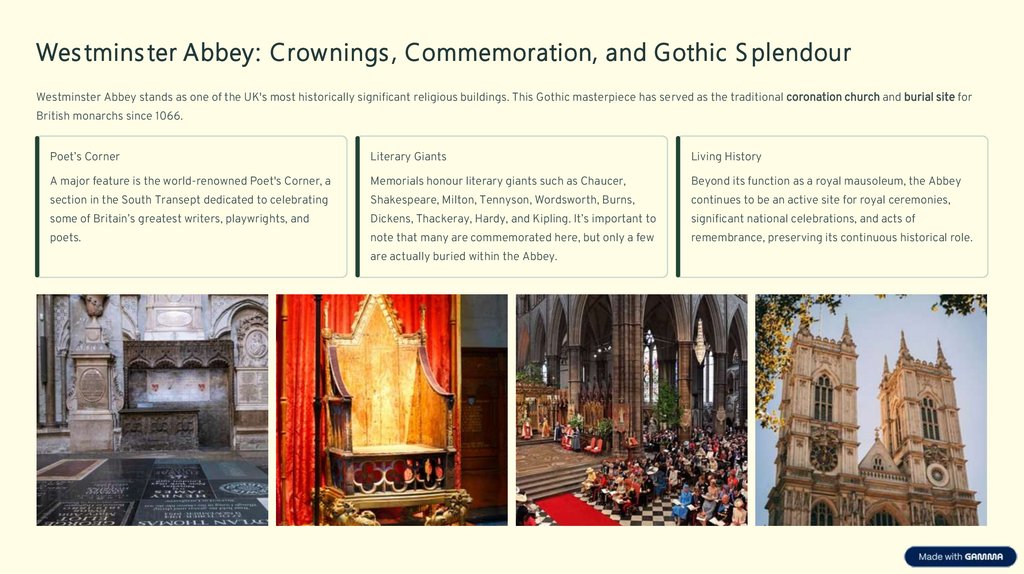
Wes tmins ter Abbey: Crownings , Commemoration, and Gothic S plendourWestminster Abbey stands as one of the UK's most historically significant religious buildings. This Gothic masterpiece has served as the traditional coronation church and burial site for
British monarchs since 1066.
Poet’s Corner
Literary Giants
Living History
A major feature is the world-renowned Poet's Corner, a
Memorials honour literary giants such as Chaucer,
Beyond its function as a royal mausoleum, the Abbey
section in the South Transept dedicated to celebrating
Shakespeare, Milton, Tennyson, Wordsworth, Burns,
continues to be an active site for royal ceremonies,
some of Britain’s greatest writers, playwrights, and
Dickens, Thackeray, Hardy, and Kipling. It’s important to
significant national celebrations, and acts of
poets.
note that many are commemorated here, but only a few
remembrance, preserving its continuous historical role.
are actually buried within the Abbey.
5.
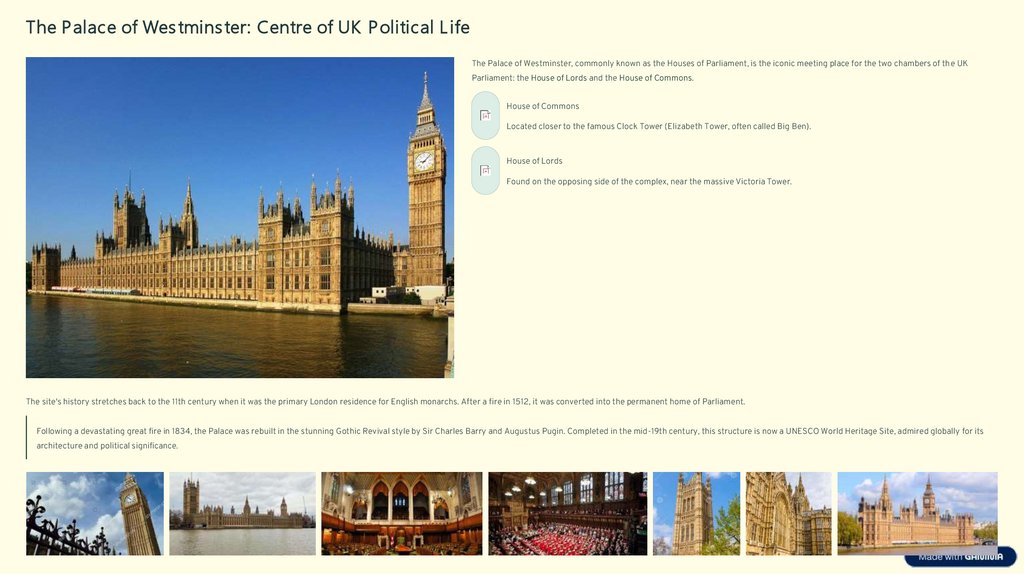
The P alace of Wes tmins ter: Centre of UK P olitical L ifeThe Palace of Westminster, commonly known as the Houses of Parliament, is the iconic meeting place for the two chambers of the UK
Parliament: the House of Lords and the House of Commons.
House of Commons
Located closer to the famous Clock Tower (Elizabeth Tower, often called Big Ben).
House of Lords
Found on the opposing side of the complex, near the massive Victoria Tower.
The site's history stretches back to the 11th century when it was the primary London residence for English monarchs. After a fire in 1512, it was converted into the permanent home of Parliament.
Following a devastating great fire in 1834, the Palace was rebuilt in the stunning Gothic Revival style by Sir Charles Barry and Augustus Pugin. Completed in the mid-19th century, this structure is now a UNESCO World Heritage Site, admired globally for its
architecture and political significance.
6.
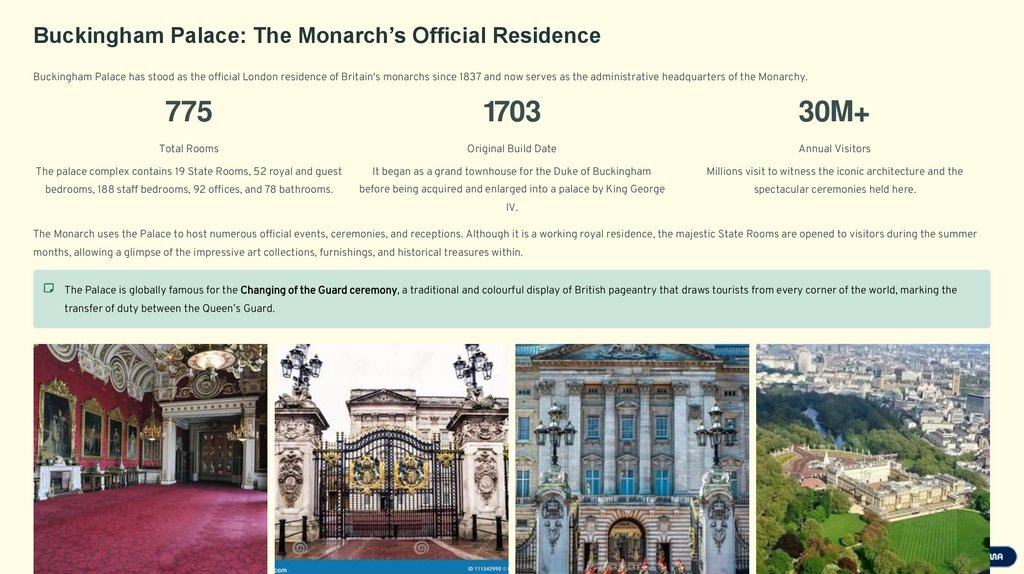
Buckingham Palace: The Monarch’s Official ResidenceBuckingham Palace has stood as the official London residence of Britain's monarchs since 1837 and now serves as the administrative headquarters of the Monarchy.
775
1703
30M+
Total Rooms
Original Build Date
Annual Visitors
The palace complex contains 19 State Rooms, 52 royal and guest
It began as a grand townhouse for the Duke of Buckingham
Millions visit to witness the iconic architecture and the
bedrooms, 188 staff bedrooms, 92 offices, and 78 bathrooms.
before being acquired and enlarged into a palace by King George
spectacular ceremonies held here.
IV.
The Monarch uses the Palace to host numerous official events, ceremonies, and receptions. Although it is a working royal residence, the majestic State Rooms are opened to visitors during the summer
months, allowing a glimpse of the impressive art collections, furnishings, and historical treasures within.
The Palace is globally famous for the Changing of the Guard ceremony, a traditional and colourful display of British pageantry that draws tourists from every corner of the world, marking the
transfer of duty between the Queen’s Guard.
7.
The Tower of London: R oyal Fortres s & His toric P ris onFor over 900 years, the Tower of London has stood as a powerful fortress and
significant landmark. It was built by William the Conqueror after he invaded
England.
Many Roles Through History
A palace for early monarchs.
A famous prison for historical figures.
Also used as a place for weapons, money, records, and even a temporary zoo.
Today, visitors can see the priceless Crown Jewels kept safe within its walls. The Tower is still guarded by the well-known Yeoman Warders, or Beefeaters. They offer tours and share the
Tower's rich and often dark past.
8.
St Paul’s Cathedral: Wren’s Architectural MasterpieceSt Paul’s Cathedral is a magnificent Anglican cathedral located on Ludgate Hill, which is the highest point within the City of London. It is the seat of the Bishop of London and a hugely recognizable landmark.
Historical Site
The current structure is the fifth St Paul’s Cathedral built on this site, which has been a place of Christian
worship since AD 604.
Rebuilt After the Fire
The current building was designed by Sir Christopher Wren and completed in the 17th century after its
Architectural Feat
predecessor was destroyed in the Great Fire of London (1666).
At 365 feet (111 m) tall, it was the tallest building in London from 1710 until 1962. Its majestic dome is one of
the highest and most recognizable in the world.
The Cathedral has played host to many historically important events, including the funerals of Lord Nelson, the Duke of Wellington, and Sir Winston Churchill, as well as the wedding of Prince Charles and Lady Diana Spencer.
Explore the stunning architecture and historic significance of St Paul's Cathedral through these images:
9.
L ondon's World-Clas sMus eums
London is home to an extraordinary collection of world-class
museums and galleries, many of which offer free entry to their main
collections. These institutions serve as invaluable repositories of
global history, art, and science, attracting millions of visitors
annually.
A Cultural Hub
These institutions allow the public to explore and engage with
human history, natural science, and artistic achievements from
around the world.
The museums are not just tourist attractions; they are vital
educational and research centres.
10.
The British Museum: A Collection of World HistoryThe British Museum is dedicated to human history, art, and culture, with a permanent collection of around eight
million works. It documents the story of human culture from its beginnings to the present day.
Exhibits and Collections
Focuses on human history from prehistoric times right up to the modern era, spanning all continents.
Highlights include the Rosetta Stone, which was key to deciphering Egyptian hieroglyphs.
The Parthenon Sculptures (Elgin Marbles) from ancient Greece.
One of the world's most comprehensive collections of Ancient Egyptian mummies and artifacts.
General entry to the British Museum is free, though special, temporary exhibitions usually require a ticket.
Explore some of the British Museum's most iconic exhibits and stunning architecture:
11.
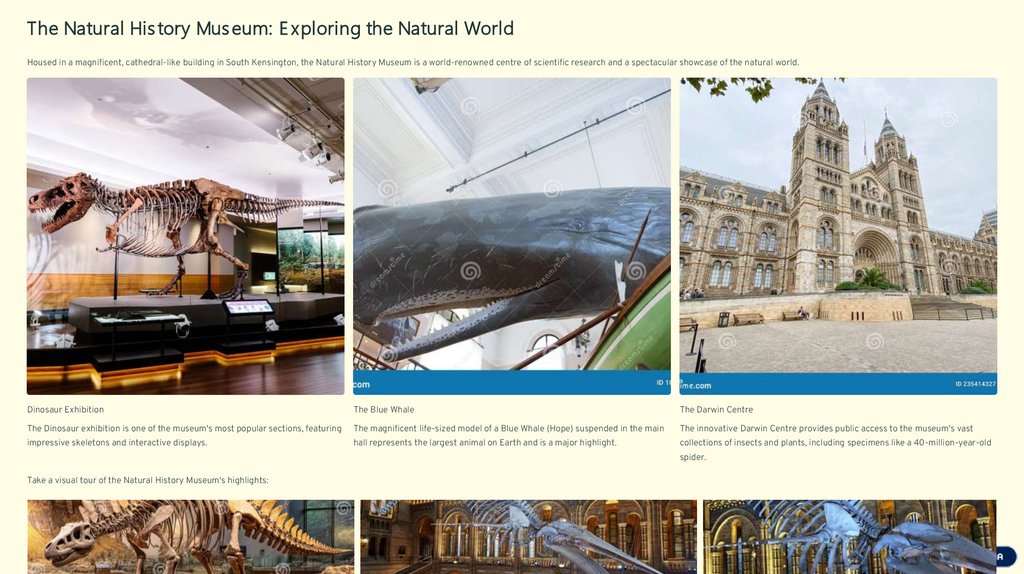
The Natural His tory Mus eum: E x ploring the Natural WorldHoused in a magnificent, cathedral-like building in South Kensington, the Natural History Museum is a world-renowned centre of scientific research and a spectacular showcase of the natural world.
Dinosaur Exhibition
The Blue Whale
The Darwin Centre
The Dinosaur exhibition is one of the museum's most popular sections, featuring
The magnificent life-sized model of a Blue Whale (Hope) suspended in the main
The innovative Darwin Centre provides public access to the museum's vast
impressive skeletons and interactive displays.
hall represents the largest animal on Earth and is a major highlight.
collections of insects and plants, including specimens like a 40-million-year-old
spider.
Take a visual tour of the Natural History Museum's highlights:
12.
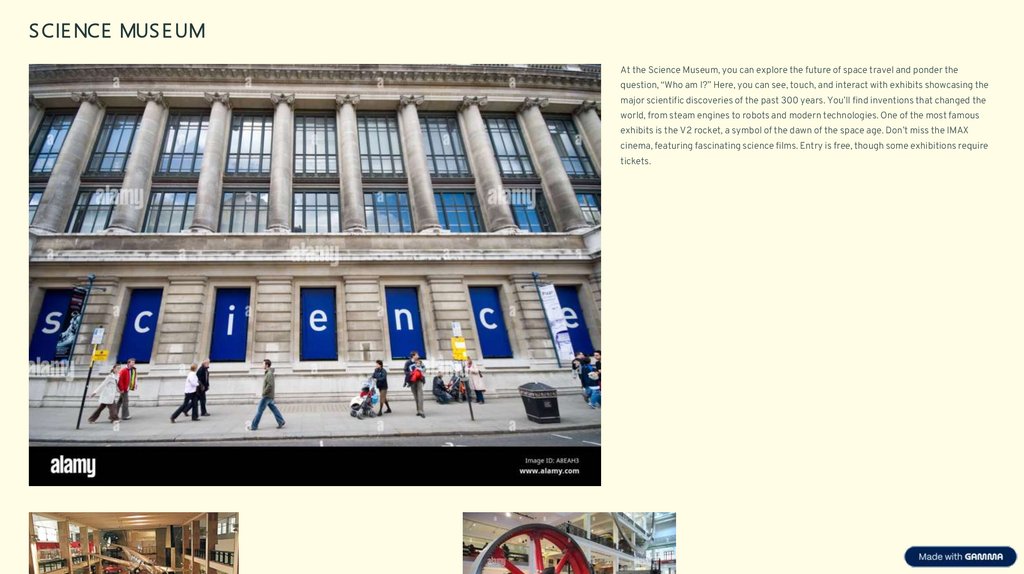
S CIE NCE MUS E UMAt the Science Museum, you can explore the future of space travel and ponder the
question, “Who am I?” Here, you can see, touch, and interact with exhibits showcasing the
major scientific discoveries of the past 300 years. You’ll find inventions that changed the
world, from steam engines to robots and modern technologies. One of the most famous
exhibits is the V2 rocket, a symbol of the dawn of the space age. Don’t miss the IMAX
cinema, featuring fascinating science films. Entry is free, though some exhibitions require
tickets.