 Английский язык
Похожие презентации:






Commercial insurance policies. Lecture 5
1. Lecture 5 Commercial insurance policies
Hasan UmarovFinance Department
2. Lecture 5. Learning Outcomes:
• Describe the basic features and typical policy cover ofdifferent commercial insurance policies
Lecture 5.
Learning Outcomes: • Explain the underwriting approach and considerations for
various classes of insurance
Finance Department
2
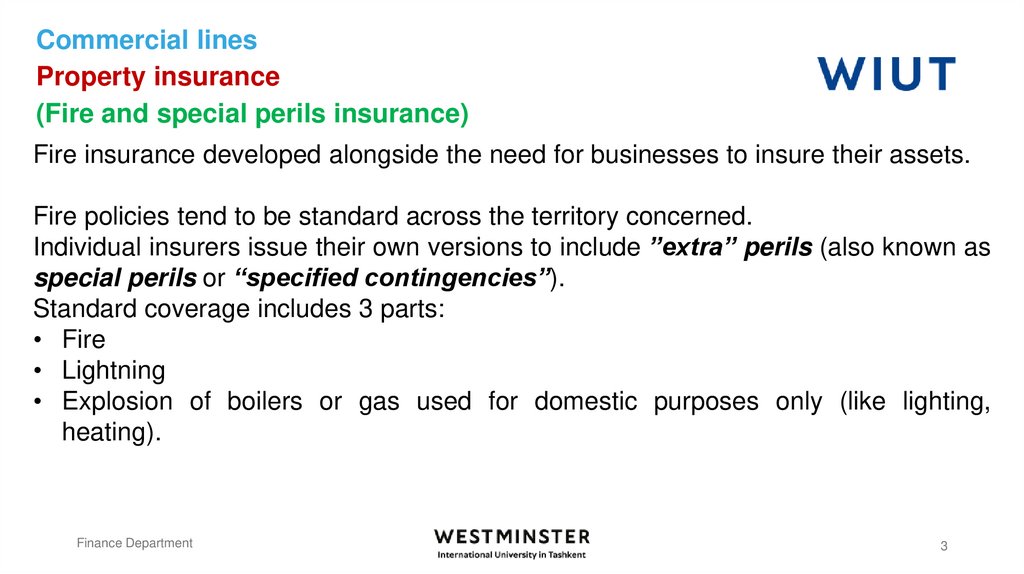
3. Commercial lines Property insurance (Fire and special perils insurance)
Fire insurance developed alongside the need for businesses to insure their assets.Fire policies tend to be standard across the territory concerned.
Individual insurers issue their own versions to include ”extra” perils (also known as
special perils or “specified contingencies”).
Standard coverage includes 3 parts:
• Fire
• Lightning
• Explosion of boilers or gas used for domestic purposes only (like lighting,
heating).
Finance Department
3
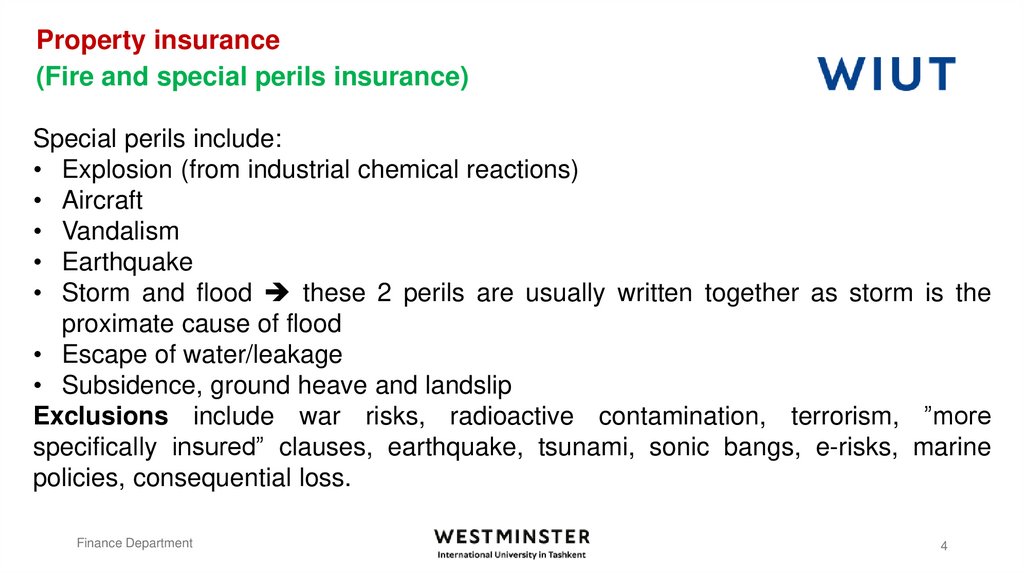
4. Property insurance (Fire and special perils insurance)
Special perils include:• Explosion (from industrial chemical reactions)
• Aircraft
• Vandalism
• Earthquake
• Storm and flood these 2 perils are usually written together as storm is the
proximate cause of flood
• Escape of water/leakage
• Subsidence, ground heave and landslip
Exclusions include war risks, radioactive contamination, terrorism, ”more
specifically insured” clauses, earthquake, tsunami, sonic bangs, e-risks, marine
policies, consequential loss.
Finance Department
4
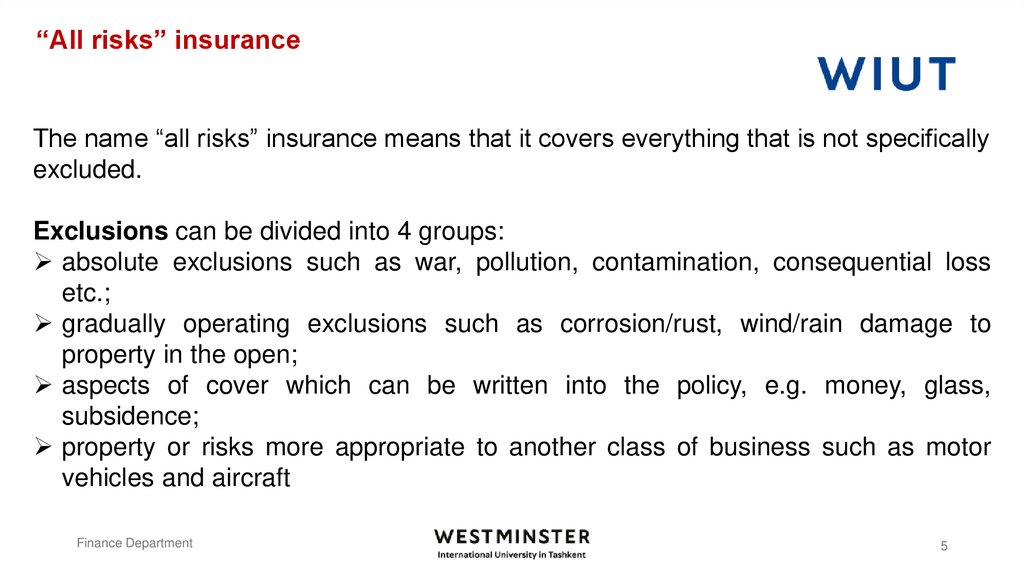
5. “All risks” insurance
The name “all risks” insurance means that it covers everything that is not specificallyexcluded.
Exclusions can be divided into 4 groups:
absolute exclusions such as war, pollution, contamination, consequential loss
etc.;
gradually operating exclusions such as corrosion/rust, wind/rain damage to
property in the open;
aspects of cover which can be written into the policy, e.g. money, glass,
subsidence;
property or risks more appropriate to another class of business such as motor
vehicles and aircraft
Finance Department
5
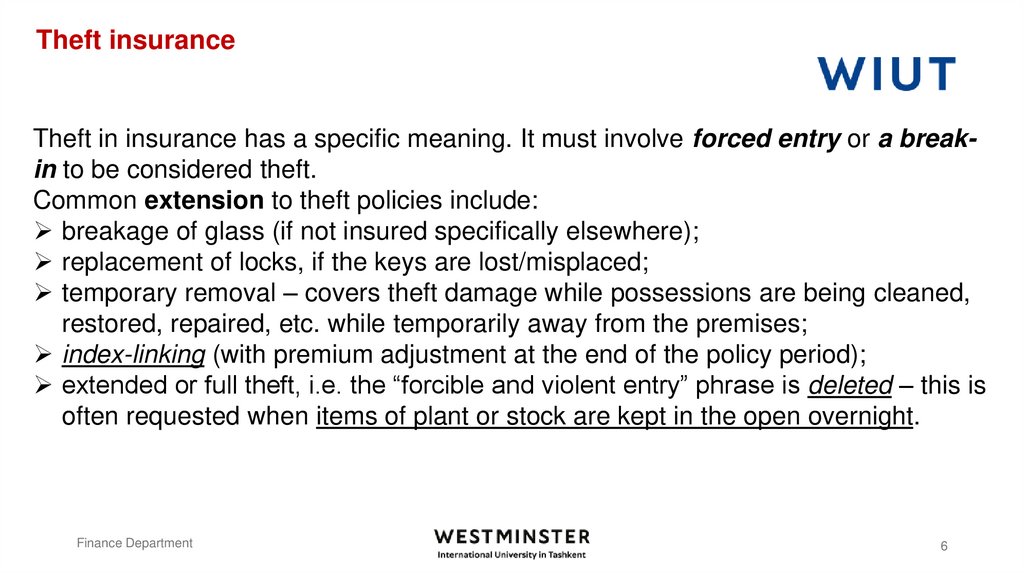
6. Theft insurance
Theft in insurance has a specific meaning. It must involve forced entry or a breakin to be considered theft.Common extension to theft policies include:
breakage of glass (if not insured specifically elsewhere);
replacement of locks, if the keys are lost/misplaced;
temporary removal – covers theft damage while possessions are being cleaned,
restored, repaired, etc. while temporarily away from the premises;
index-linking (with premium adjustment at the end of the policy period);
extended or full theft, i.e. the “forcible and violent entry” phrase is deleted – this is
often requested when items of plant or stock are kept in the open overnight.
Finance Department
6
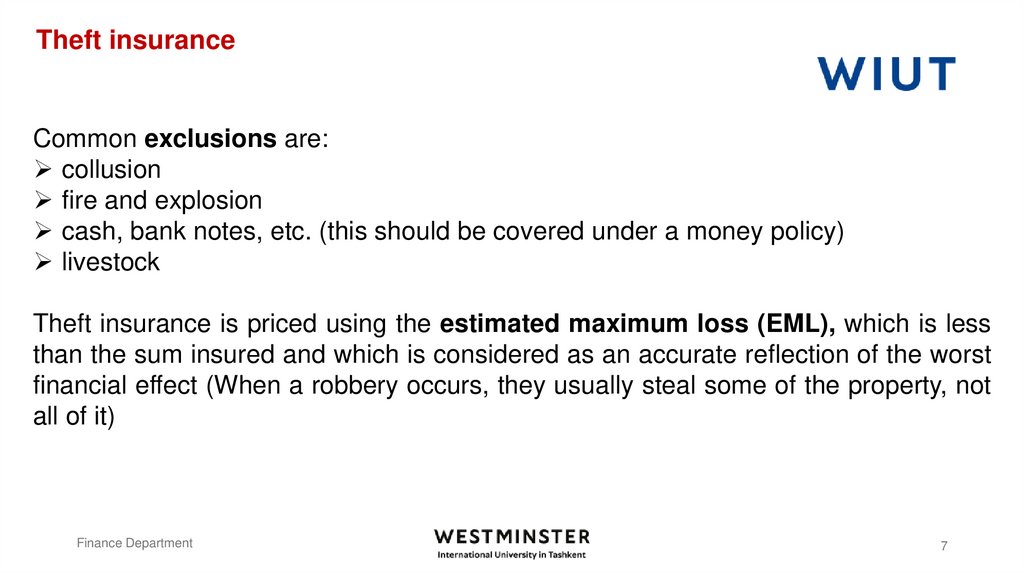
7. Theft insurance
Common exclusions are:collusion
fire and explosion
cash, bank notes, etc. (this should be covered under a money policy)
livestock
Theft insurance is priced using the estimated maximum loss (EML), which is less
than the sum insured and which is considered as an accurate reflection of the worst
financial effect (When a robbery occurs, they usually steal some of the property, not
all of it)
Finance Department
7
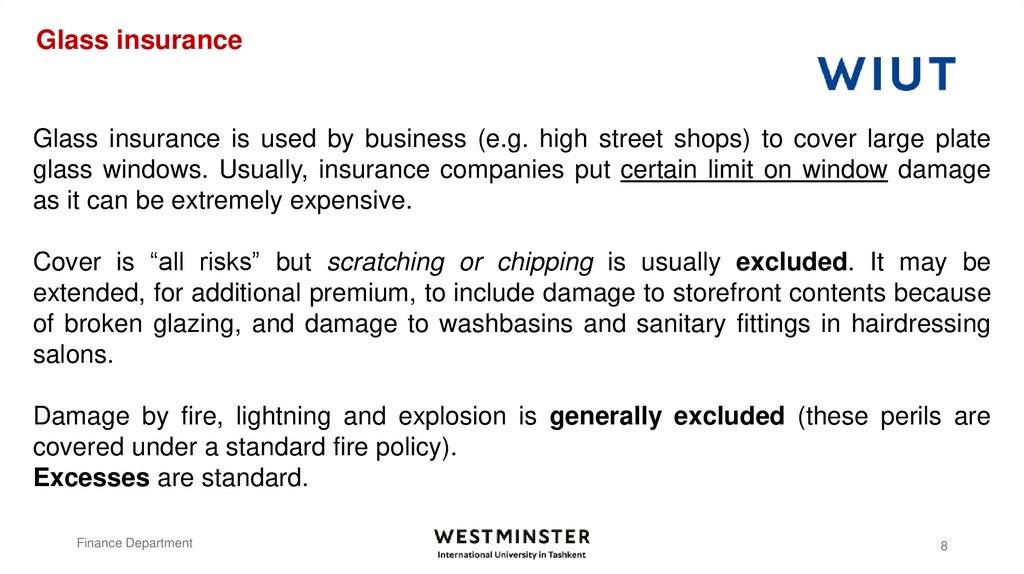
8. Glass insurance
Glass insurance is used by business (e.g. high street shops) to cover large plateglass windows. Usually, insurance companies put certain limit on window damage
as it can be extremely expensive.
Cover is “all risks” but scratching or chipping is usually excluded. It may be
extended, for additional premium, to include damage to storefront contents because
of broken glazing, and damage to washbasins and sanitary fittings in hairdressing
salons.
Damage by fire, lightning and explosion is generally excluded (these perils are
covered under a standard fire policy).
Excesses are standard.
Finance Department
8
9. Money insurance
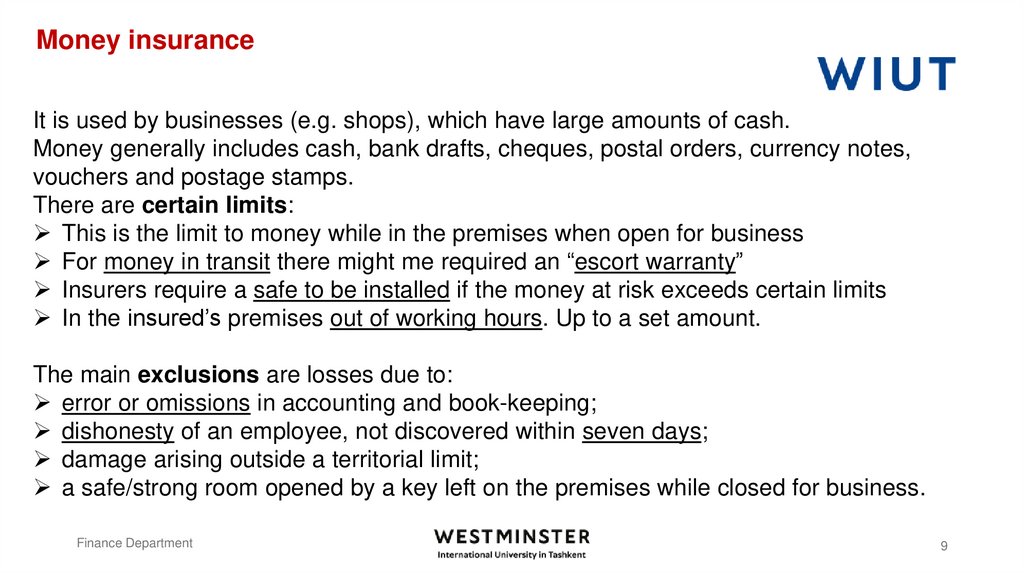
It is used by businesses (e.g. shops), which have large amounts of cash.Money generally includes cash, bank drafts, cheques, postal orders, currency notes,
vouchers and postage stamps.
There are certain limits:
This is the limit to money while in the premises when open for business
For money in transit there might me required an “escort warranty”
Insurers require a safe to be installed if the money at risk exceeds certain limits
In the insured’s premises out of working hours. Up to a set amount.
The main exclusions are losses due to:
error or omissions in accounting and book-keeping;
dishonesty of an employee, not discovered within seven days;
damage arising outside a territorial limit;
a safe/strong room opened by a key left on the premises while closed for business.
Finance Department
9
10. Pecuniary insurance
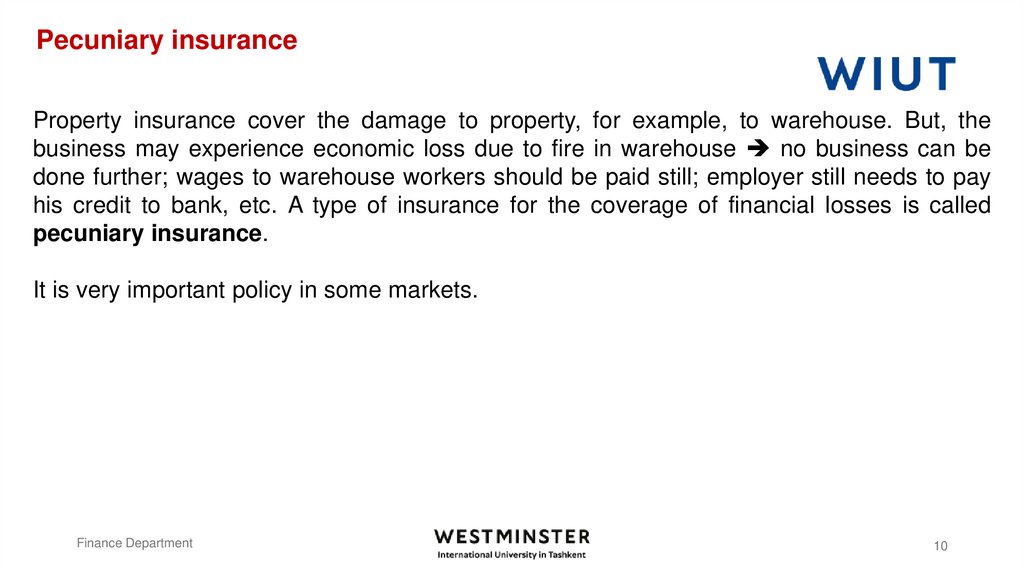
Property insurance cover the damage to property, for example, to warehouse. But, thebusiness may experience economic loss due to fire in warehouse no business can be
done further; wages to warehouse workers should be paid still; employer still needs to pay
his credit to bank, etc. A type of insurance for the coverage of financial losses is called
pecuniary insurance.
It is very important policy in some markets.
Finance Department
10
11. Business interruption insurance
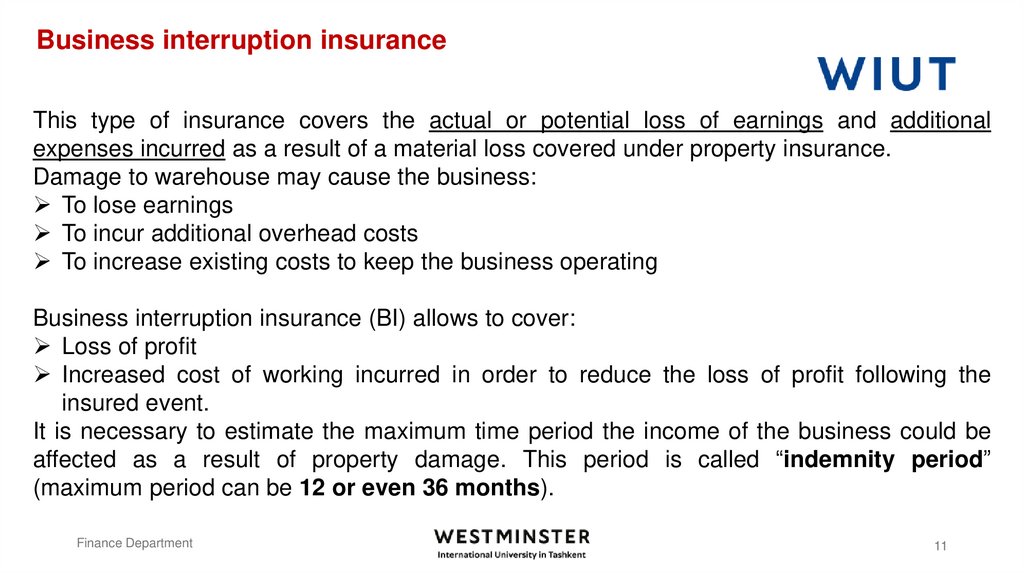
This type of insurance covers the actual or potential loss of earnings and additionalexpenses incurred as a result of a material loss covered under property insurance.
Damage to warehouse may cause the business:
To lose earnings
To incur additional overhead costs
To increase existing costs to keep the business operating
Business interruption insurance (BI) allows to cover:
Loss of profit
Increased cost of working incurred in order to reduce the loss of profit following the
insured event.
It is necessary to estimate the maximum time period the income of the business could be
affected as a result of property damage. This period is called “indemnity period”
(maximum period can be 12 or even 36 months).
Finance Department
11
12. Business interruption insurance
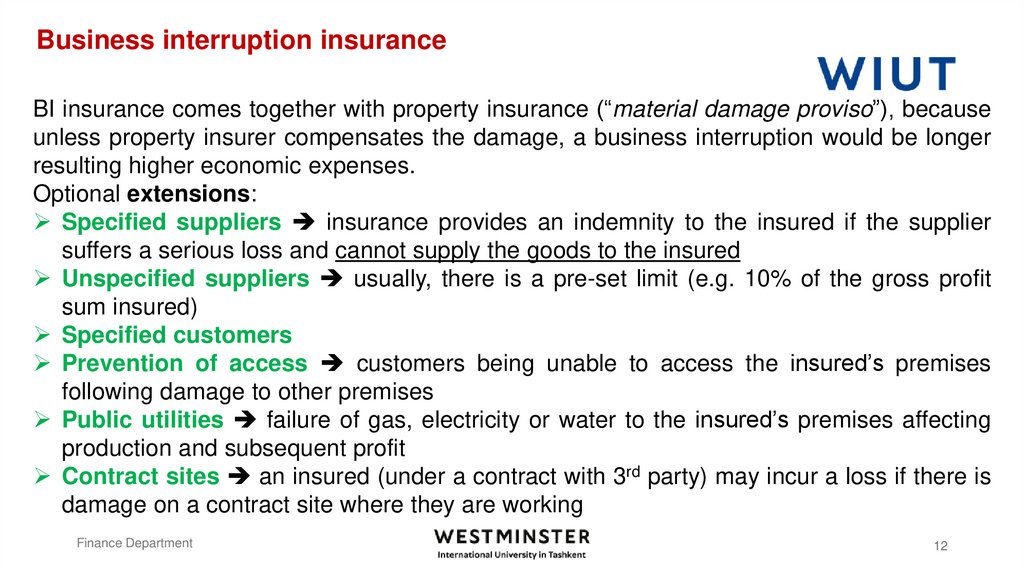
BI insurance comes together with property insurance (“material damage proviso”), becauseunless property insurer compensates the damage, a business interruption would be longer
resulting higher economic expenses.
Optional extensions:
Specified suppliers insurance provides an indemnity to the insured if the supplier
suffers a serious loss and cannot supply the goods to the insured
Unspecified suppliers usually, there is a pre-set limit (e.g. 10% of the gross profit
sum insured)
Specified customers
Prevention of access customers being unable to access the insured’s premises
following damage to other premises
Public utilities failure of gas, electricity or water to the insured’s premises affecting
production and subsequent profit
Contract sites an insured (under a contract with 3rd party) may incur a loss if there is
damage on a contract site where they are working
Finance Department
12
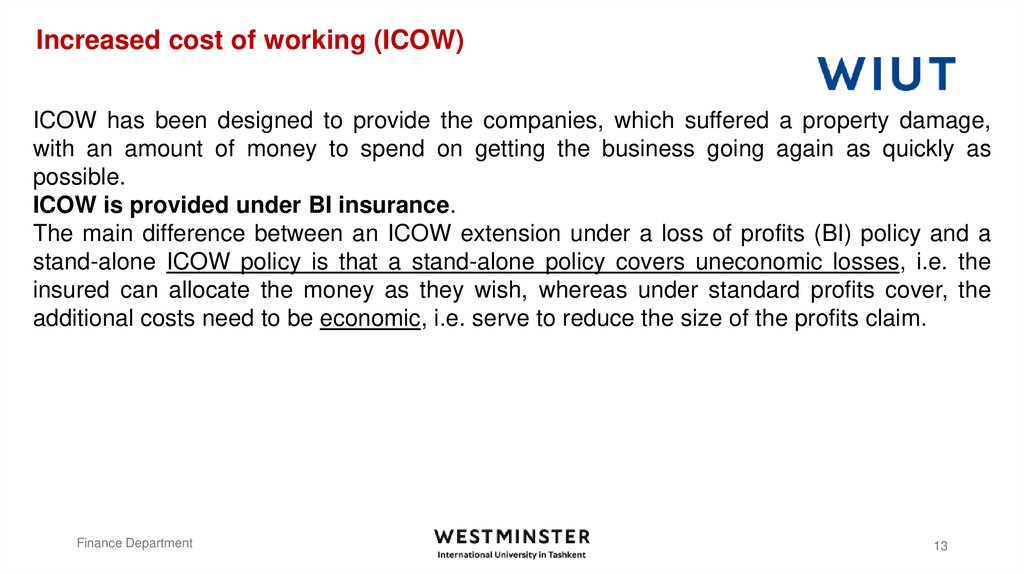
13. Increased cost of working (ICOW)
ICOW has been designed to provide the companies, which suffered a property damage,with an amount of money to spend on getting the business going again as quickly as
possible.
ICOW is provided under BI insurance.
The main difference between an ICOW extension under a loss of profits (BI) policy and a
stand-alone ICOW policy is that a stand-alone policy covers uneconomic losses, i.e. the
insured can allocate the money as they wish, whereas under standard profits cover, the
additional costs need to be economic, i.e. serve to reduce the size of the profits claim.
Finance Department
13
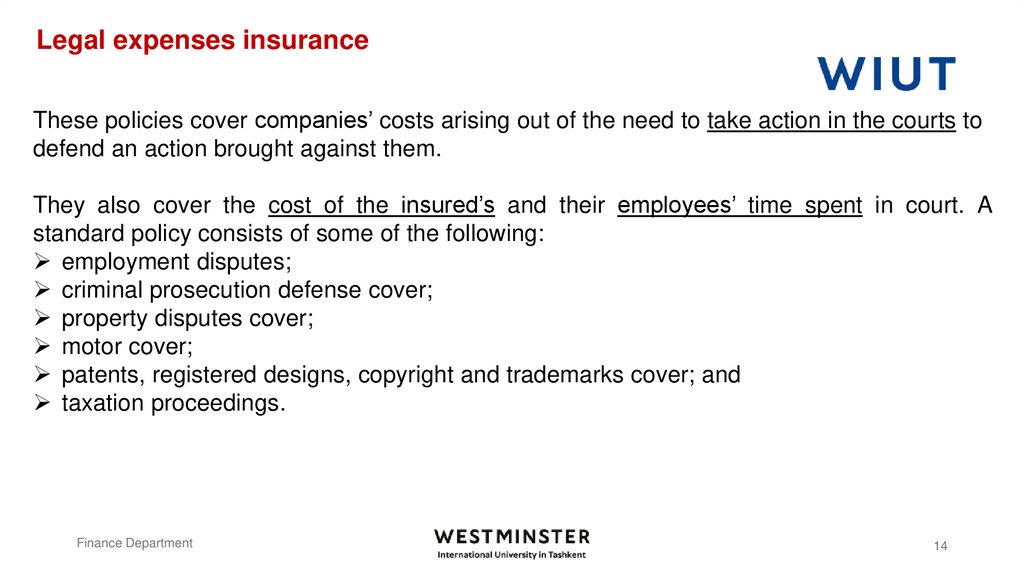
14. Legal expenses insurance
These policies cover companies’ costs arising out of the need to take action in the courts todefend an action brought against them.
They also cover the cost of the insured’s and their employees’ time spent in court. A
standard policy consists of some of the following:
employment disputes;
criminal prosecution defense cover;
property disputes cover;
motor cover;
patents, registered designs, copyright and trademarks cover; and
taxation proceedings.
Finance Department
14
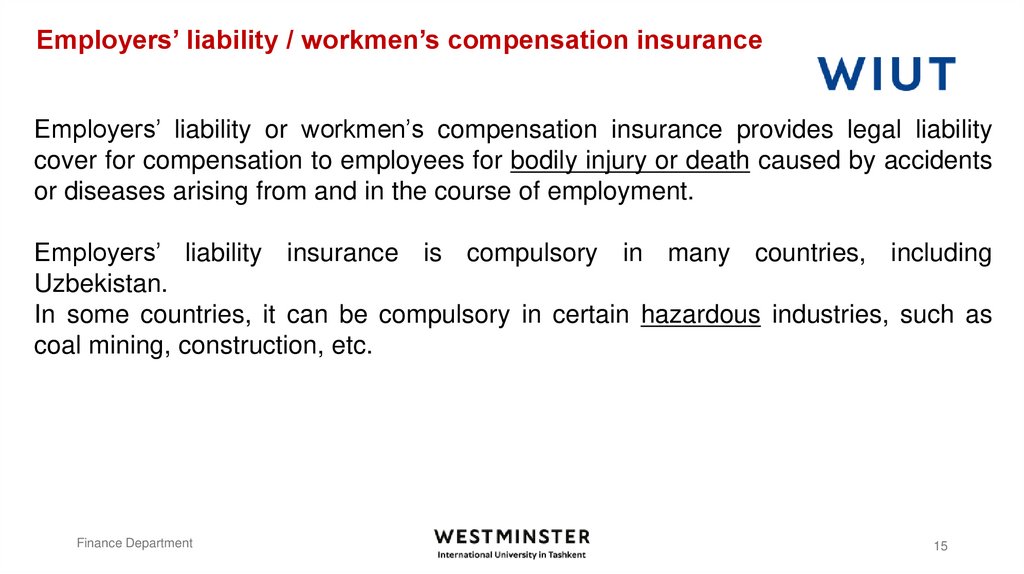
15. Employers’ liability / workmen’s compensation insurance
Employers’ liability or workmen’s compensation insurance provides legal liabilitycover for compensation to employees for bodily injury or death caused by accidents
or diseases arising from and in the course of employment.
Employers’ liability insurance is compulsory in many countries, including
Uzbekistan.
In some countries, it can be compulsory in certain hazardous industries, such as
coal mining, construction, etc.
Finance Department
15
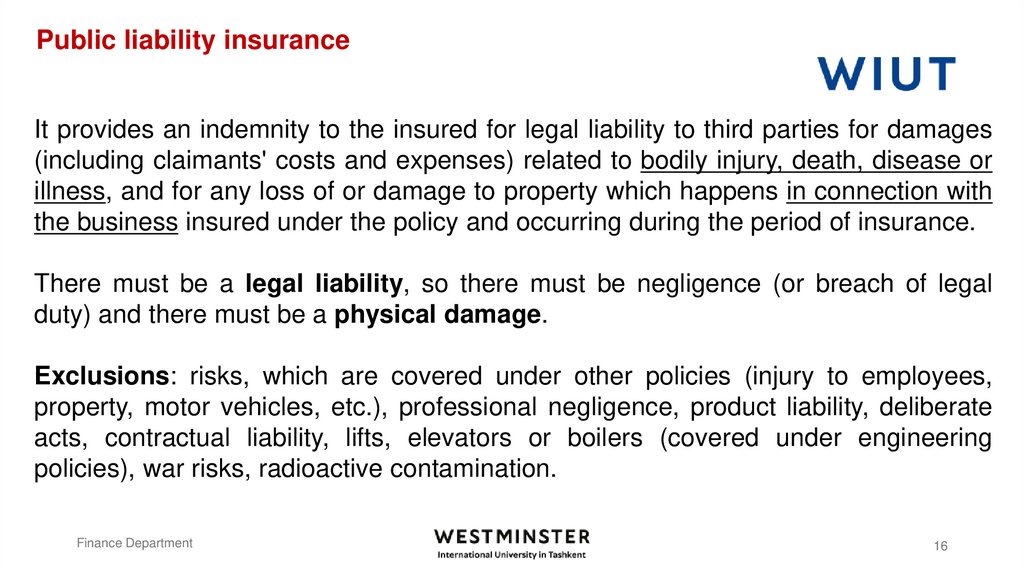
16. Public liability insurance
It provides an indemnity to the insured for legal liability to third parties for damages(including claimants' costs and expenses) related to bodily injury, death, disease or
illness, and for any loss of or damage to property which happens in connection with
the business insured under the policy and occurring during the period of insurance.
There must be a legal liability, so there must be negligence (or breach of legal
duty) and there must be a physical damage.
Exclusions: risks, which are covered under other policies (injury to employees,
property, motor vehicles, etc.), professional negligence, product liability, deliberate
acts, contractual liability, lifts, elevators or boilers (covered under engineering
policies), war risks, radioactive contamination.
Finance Department
16
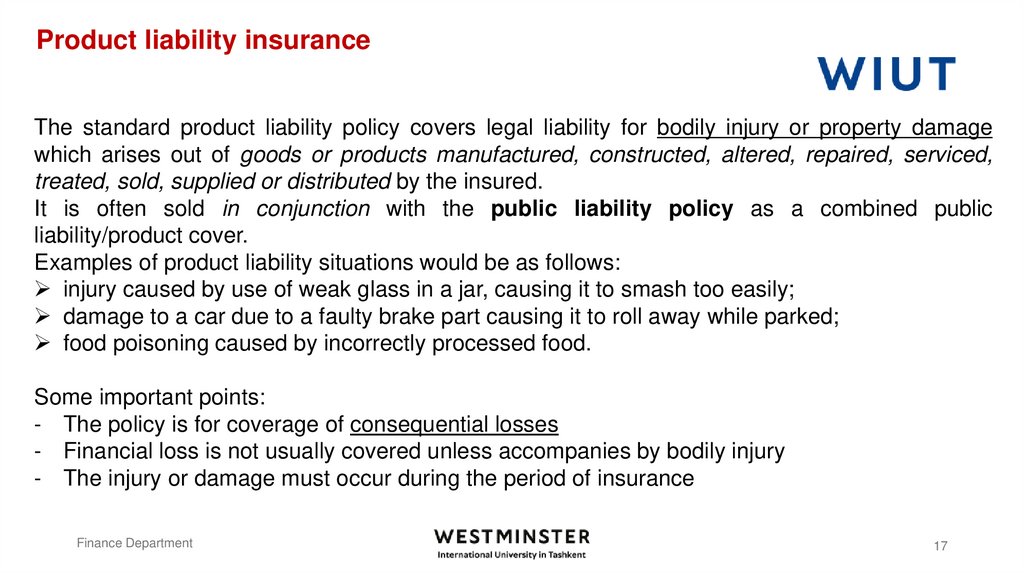
17. Product liability insurance
The standard product liability policy covers legal liability for bodily injury or property damagewhich arises out of goods or products manufactured, constructed, altered, repaired, serviced,
treated, sold, supplied or distributed by the insured.
It is often sold in conjunction with the public liability policy as a combined public
liability/product cover.
Examples of product liability situations would be as follows:
injury caused by use of weak glass in a jar, causing it to smash too easily;
damage to a car due to a faulty brake part causing it to roll away while parked;
food poisoning caused by incorrectly processed food.
Some important points:
- The policy is for coverage of consequential losses
- Financial loss is not usually covered unless accompanies by bodily injury
- The injury or damage must occur during the period of insurance
Finance Department
17
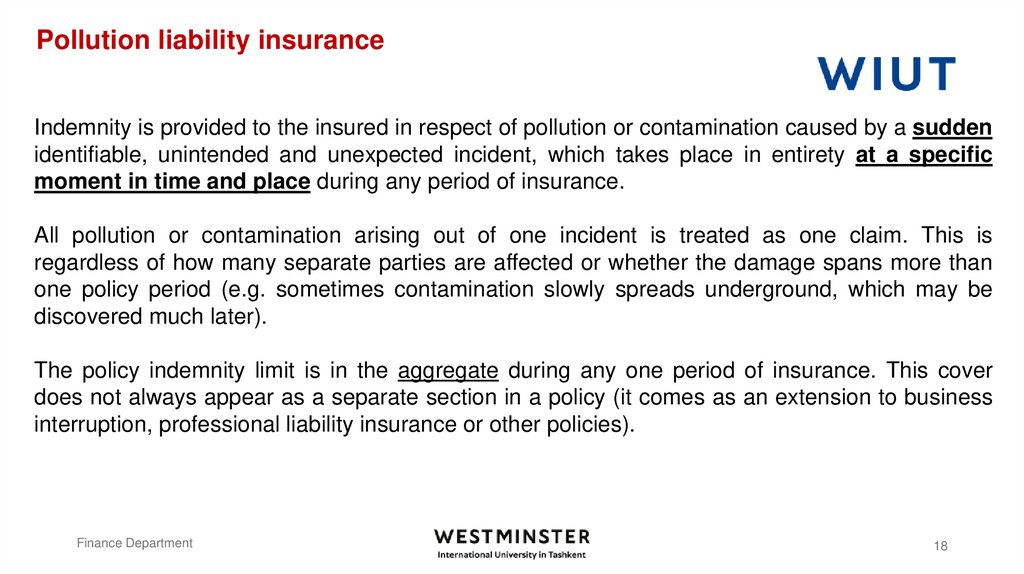
18. Pollution liability insurance
Indemnity is provided to the insured in respect of pollution or contamination caused by a suddenidentifiable, unintended and unexpected incident, which takes place in entirety at a specific
moment in time and place during any period of insurance.
All pollution or contamination arising out of one incident is treated as one claim. This is
regardless of how many separate parties are affected or whether the damage spans more than
one policy period (e.g. sometimes contamination slowly spreads underground, which may be
discovered much later).
The policy indemnity limit is in the aggregate during any one period of insurance. This cover
does not always appear as a separate section in a policy (it comes as an extension to business
interruption, professional liability insurance or other policies).
Finance Department
18
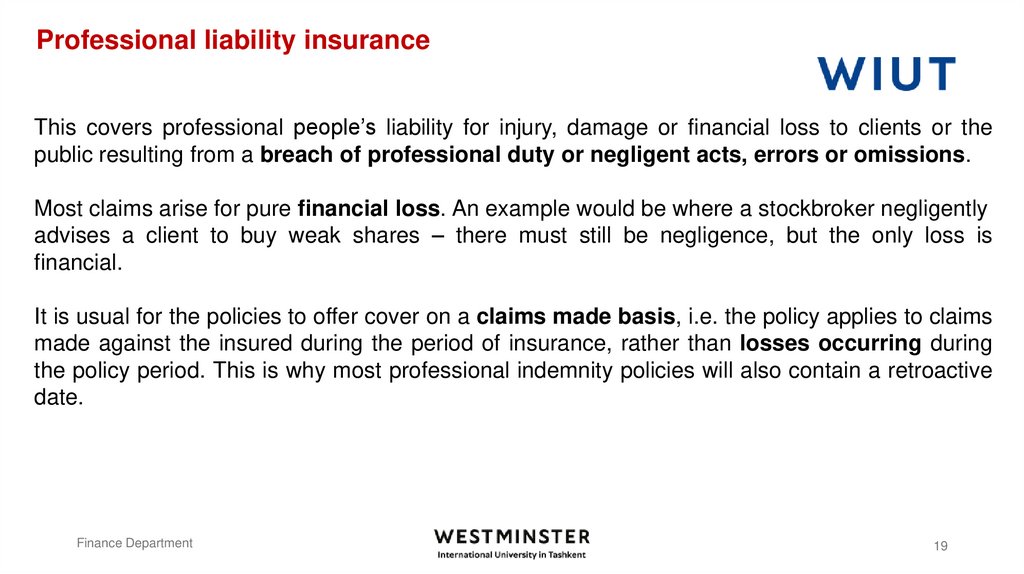
19. Professional liability insurance
This covers professional people’s liability for injury, damage or financial loss to clients or thepublic resulting from a breach of professional duty or negligent acts, errors or omissions.
Most claims arise for pure financial loss. An example would be where a stockbroker negligently
advises a client to buy weak shares – there must still be negligence, but the only loss is
financial.
It is usual for the policies to offer cover on a claims made basis, i.e. the policy applies to claims
made against the insured during the period of insurance, rather than losses occurring during
the policy period. This is why most professional indemnity policies will also contain a retroactive
date.
Finance Department
19
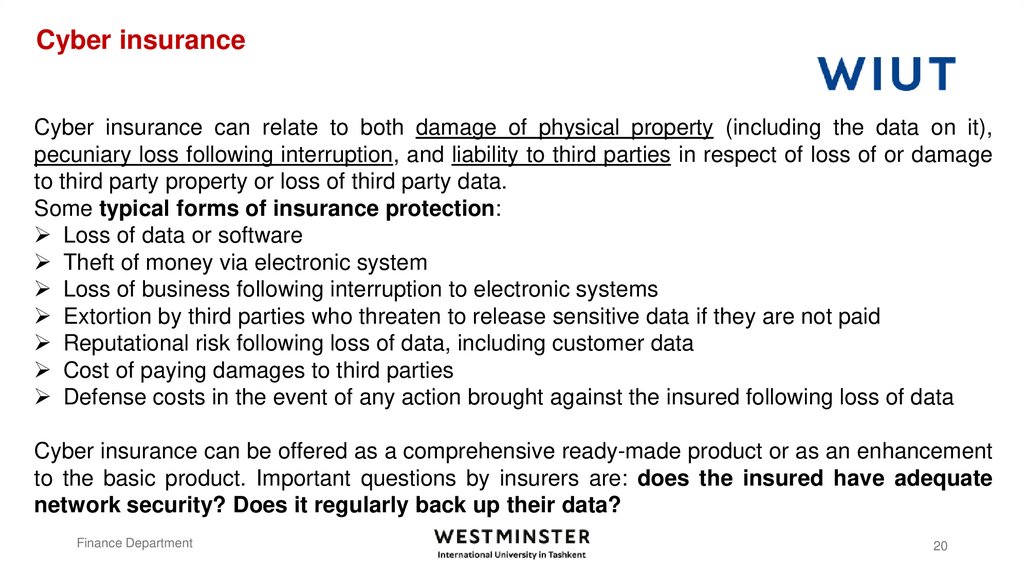
20. Cyber insurance
Cyber insurance can relate to both damage of physical property (including the data on it),pecuniary loss following interruption, and liability to third parties in respect of loss of or damage
to third party property or loss of third party data.
Some typical forms of insurance protection:
Loss of data or software
Theft of money via electronic system
Loss of business following interruption to electronic systems
Extortion by third parties who threaten to release sensitive data if they are not paid
Reputational risk following loss of data, including customer data
Cost of paying damages to third parties
Defense costs in the event of any action brought against the insured following loss of data
Cyber insurance can be offered as a comprehensive ready-made product or as an enhancement
to the basic product. Important questions by insurers are: does the insured have adequate
network security? Does it regularly back up their data?
Finance Department
20
21. Thank you
Finance Department21