 История
Похожие презентации:








History of Donetsk. State University
1.
History of DonetskState University
Donetsk State University was established on
July 15, 1937, as the Stalino State
Pedagogical Institute. Its creation addressed
the critical need for qualified personnel for the
rapidly developing industrial region of
Donbass. The university became an
intellectual centre designed to supply
specialists for the region's metallurgical and
coal enterprises.
2.
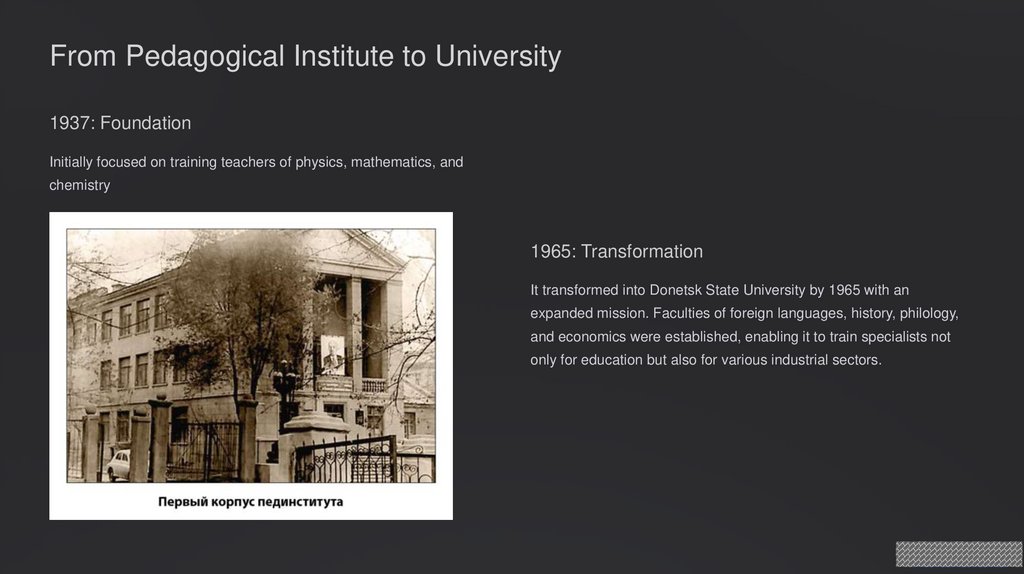
From Pedagogical Institute to University1937: Foundation
Initially focused on training teachers of physics, mathematics, and
chemistry
1965: Transformation
It transformed into Donetsk State University by 1965 with an
expanded mission. Faculties of foreign languages, history, philology,
and economics were established, enabling it to train specialists not
only for education but also for various industrial sectors.
3.
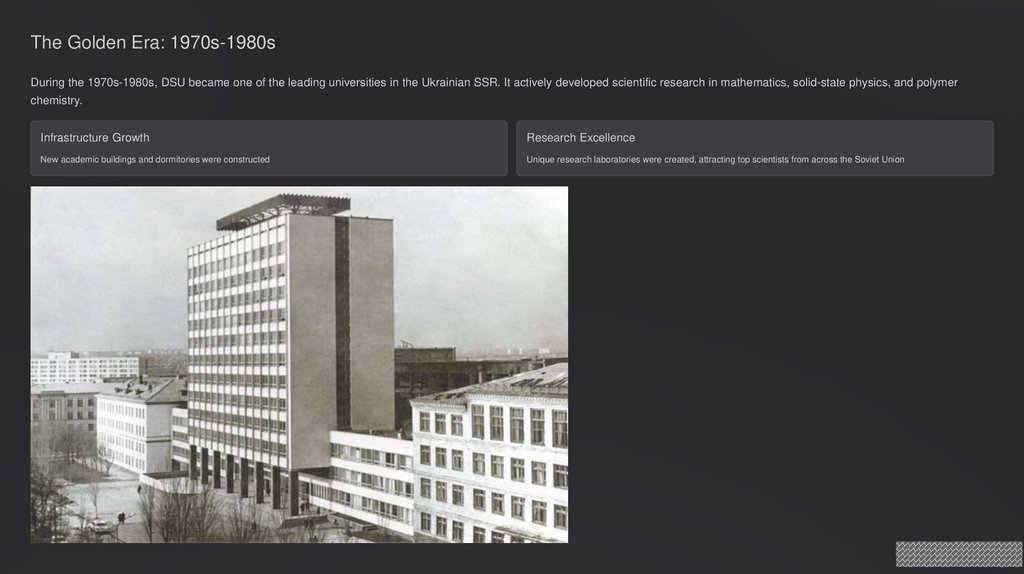
The Golden Era: 1970s-1980sDuring the 1970s-1980s, DSU became one of the leading universities in the Ukrainian SSR. It actively developed scientific research in mathematics, solid-state physics, and polymer
chemistry.
Infrastructure Growth
Research Excellence
New academic buildings and dormitories were constructed
Unique research laboratories were created, attracting top scientists from across the Soviet Union
4.
A Classical University EmergesBy the 1990s, DSU had become a classical university with 12 faculties and 5 research institutes. Its
strengths were particularly in semiconductor physics, applied mathematics, and biochemistry. The
university became a recognised centre for training specialists for science and industry, not only in
Donbass but nationwide.
5.
Notable AlumniAlexander Shamarin
Vladimir Seminozhenko
Renowned metallurgist, academician of the National
Chairman of the State Committee for Science and
Academy of Sciences of Ukraine
Technology of Ukraine
University graduates led major industrial enterprises, research institutes, and government bodies.
6.
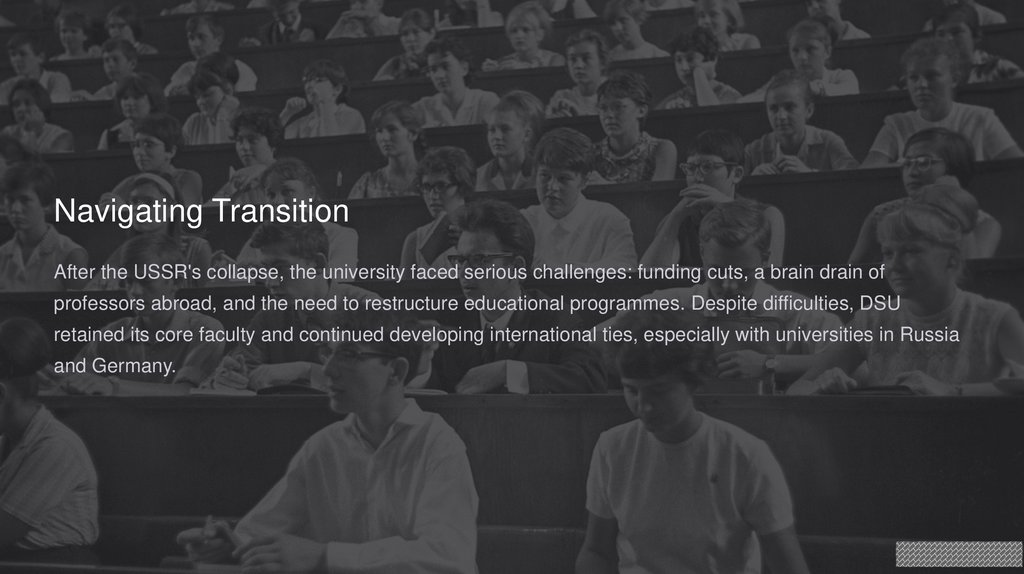
Navigating TransitionAfter the USSR's collapse, the university faced serious challenges: funding cuts, a brain drain of
professors abroad, and the need to restructure educational programmes. Despite difficulties, DSU
retained its core faculty and continued developing international ties, especially with universities in Russia
and Germany.
7.
European Integration: The 2000sIn the 2000s, the university successfully integrated into the European educational space by adopting the Bologna System.
New Specialities
Distance Learning
Industry Partnerships
New specialities in IT, international
Distance learning was developed
Partnerships with regional industrial
relations, and ecology were opened
enterprises were strengthened
8.
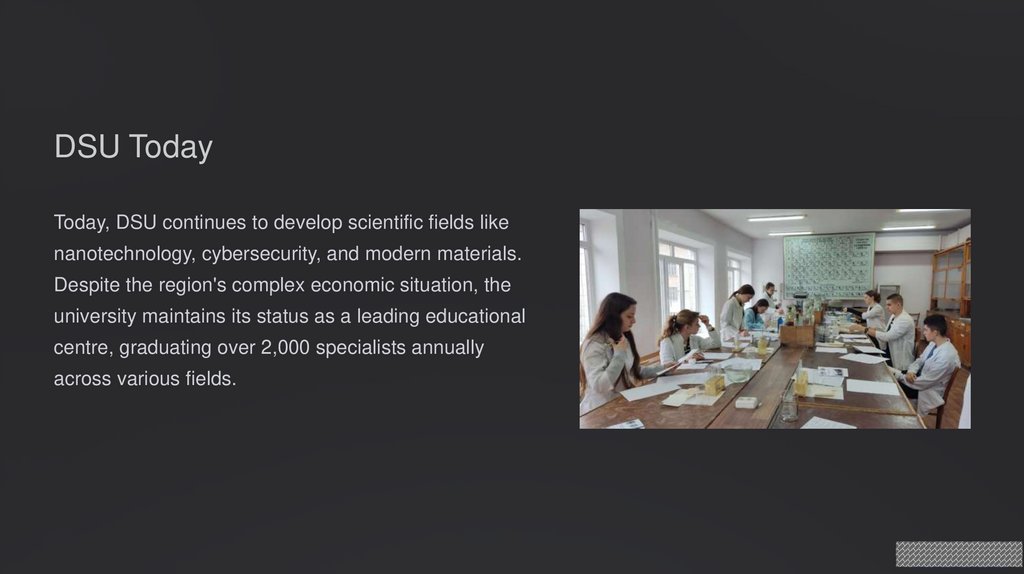
DSU TodayToday, DSU continues to develop scientific fields like
nanotechnology, cybersecurity, and modern materials.
Despite the region's complex economic situation, the
university maintains its status as a leading educational
centre, graduating over 2,000 specialists annually
across various fields.
9.
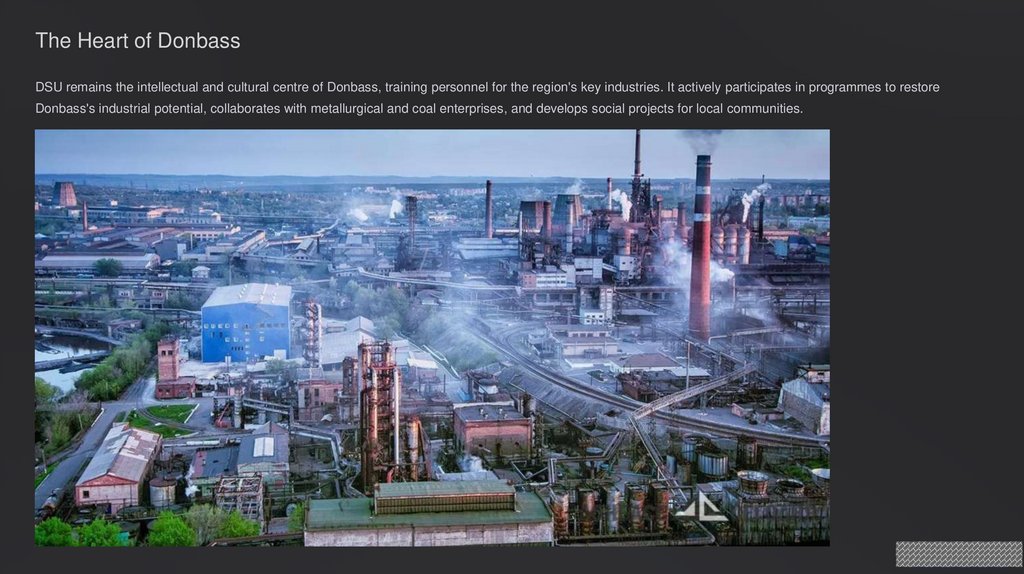
The Heart of DonbassDSU remains the intellectual and cultural centre of Donbass, training personnel for the region's key industries. It actively participates in programmes to restore
Donbass's industrial potential, collaborates with metallurgical and coal enterprises, and develops social projects for local communities.
10.
Looking Ahead: Challenges and OpportunitiesThe university faces the necessity of digital transformation and adaptation to new economic realities. Key
challenges remain modernising its infrastructure and preserving scientific schools.
Question to the audience:
What development strategies should be prioritised for a classical university in the era of digitalisation
and global labour market changes?