 Интернет
Похожие презентации:


The Human Firewall Your First Line of Defence
1.
The Human F irewall: Your F irs t L ine of DefenceWhy Cybersecurity Starts with You, Not the IT Department
2.
Our Shared Digital ResponsibilityToday, we'll shatter a common myth, learn a new mindset, identify our main adversaries, and arm ourselves with
practical defences. Cybersecurity isn't just a technical challenge—it's a human one that requires everyone's participation.
01
02
The Security Illusion
The Cybersecurity Mindset
Debunking the "IT's problem" myth and understanding our
Core principles that transform employees into vigilant
collective vulnerability
defenders
03
04
Meet the Digital Predators
Building Your Human Firewall
Recognising the top threats targeting organisations like
Practical steps to protect yourself and your colleagues
ours
3.
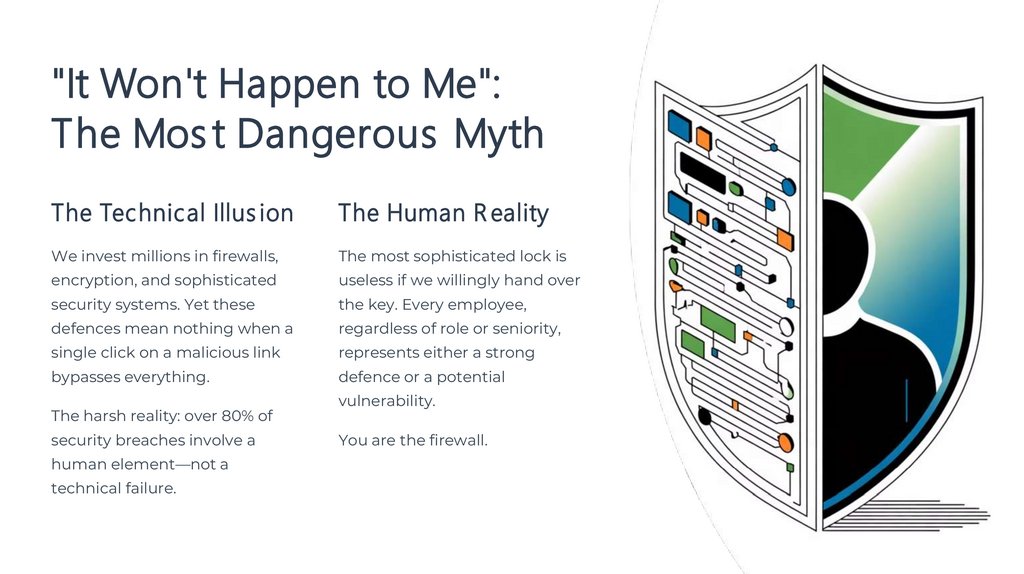
"It Won't Happen to Me":The Mos t Dangerous Myth
The Technical Illus ion
The Human R eality
We invest millions in firewalls,
The most sophisticated lock is
encryption, and sophisticated
useless if we willingly hand over
security systems. Yet these
the key. Every employee,
defences mean nothing when a
regardless of role or seniority,
single click on a malicious link
represents either a strong
bypasses everything.
defence or a potential
The harsh reality: over 80% of
security breaches involve a
human element—not a
technical failure.
vulnerability.
You are the firewall.
4.
The Digital S elf-Defence MantraYou don't need to be a tech genius to protect yourself and your organisation. You simply need to adopt these three
fundamental principles for your digital life.
Vigilance
L eas t Privilege
Confidentiality
"If it seems suspicious, it probably
"Only access what you need"
"Data is a secret. Keep it that way"
Don't request access to systems or
Customer information, financial
Trust your instincts. That urgent
data beyond your role. The fewer
data, strategic plans—treat all
email from your CEO requesting a
keys you hold, the fewer doors a
business information as
wire transfer at 11 PM? That's
criminal can unlock if your
confidential. Never discuss
worth a phone call to verify. Pause
credentials are compromised.
sensitive matters in public spaces
is"
before you click.
or unsecured channels.
5.
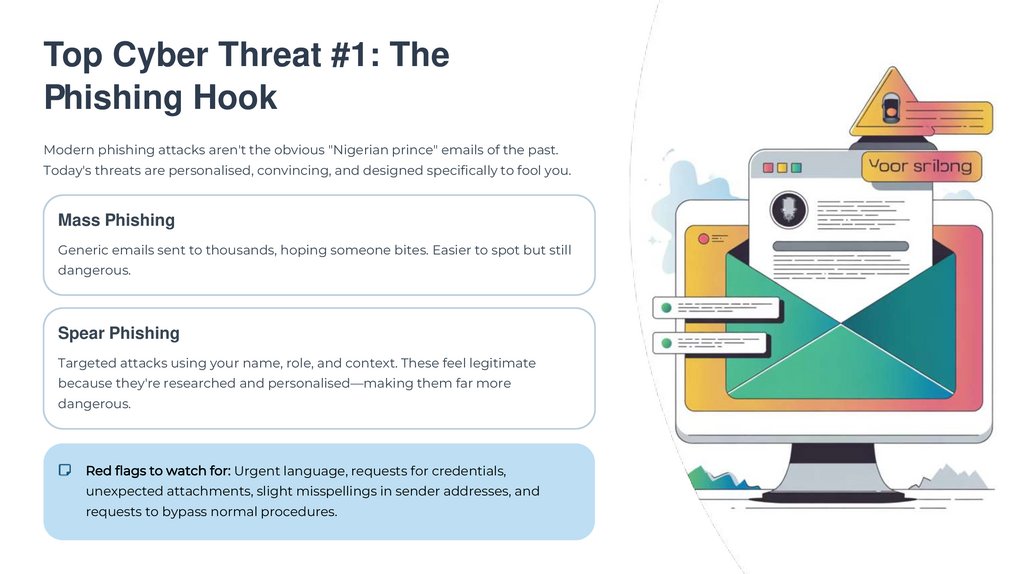
Top Cyber Threat #1: ThePhishing Hook
Modern phishing attacks aren't the obvious "Nigerian prince" emails of the past.
Today's threats are personalised, convincing, and designed specifically to fool you.
Mass Phishing
Generic emails sent to thousands, hoping someone bites. Easier to spot but still
dangerous.
Spear Phishing
Targeted attacks using your name, role, and context. These feel legitimate
because they're researched and personalised—making them far more
dangerous.
Red flags to watch for: Urgent language, requests for credentials,
unexpected attachments, slight misspellings in sender addresses, and
requests to bypass normal procedures.
6.
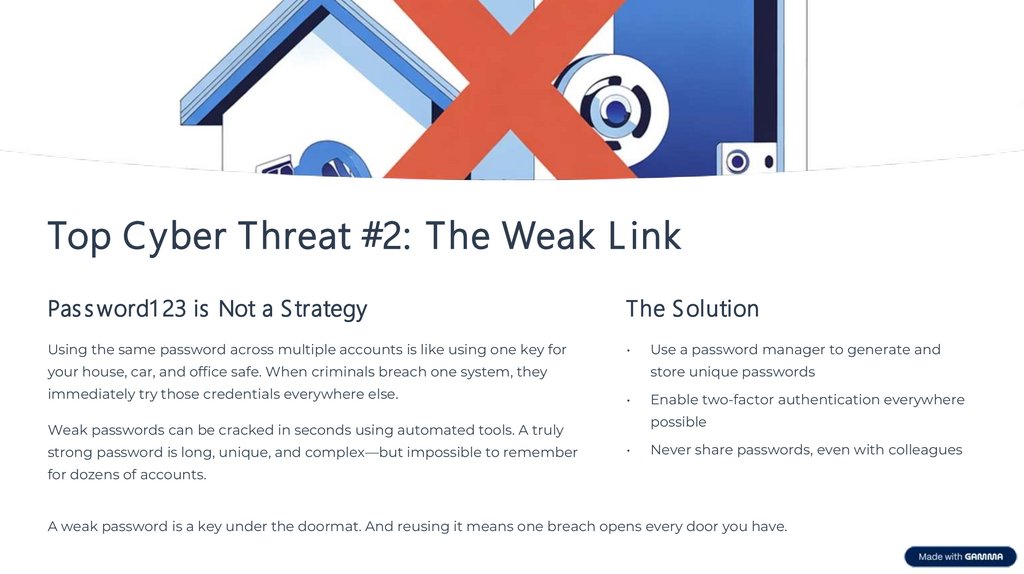
Top Cyber Threat #2: The Weak L inkPas s word1 23 is Not a S trategy
The S olution
Using the same password across multiple accounts is like using one key for
your house, car, and office safe. When criminals breach one system, they
immediately try those credentials everywhere else.
store unique passwords
Enable two-factor authentication everywhere
possible
Weak passwords can be cracked in seconds using automated tools. A truly
strong password is long, unique, and complex—but impossible to remember
Use a password manager to generate and
Never share passwords, even with colleagues
for dozens of accounts.
A weak password is a key under the doormat. And reusing it means one breach opens every door you have.
7.
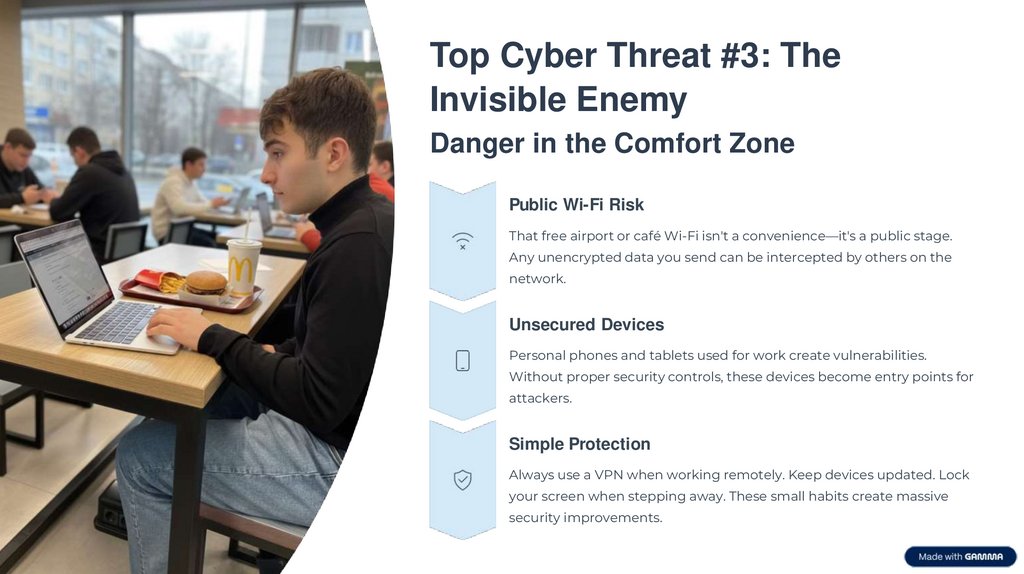
Top Cyber Threat #3: TheInvisible Enemy
Danger in the Comfort Zone
Public Wi-Fi Risk
That free airport or café Wi-Fi isn't a convenience—it's a public stage.
Any unencrypted data you send can be intercepted by others on the
network.
Unsecured Devices
Personal phones and tablets used for work create vulnerabilities.
Without proper security controls, these devices become entry points for
attackers.
Simple Protection
Always use a VPN when working remotely. Keep devices updated. Lock
your screen when stepping away. These small habits create massive
security improvements.
8.
Speak Like a Security ProYou don't need to be an expert, but knowing this basic vocabulary empowers you to recognise and report threats
accurately. Understanding these terms transforms you from a potential victim into an informed defender.
Phishing
2FA (Two-Factor Authentication)
A fraudulent attempt to obtain sensitive information
A second step—like a code sent to your phone—to
by disguising as a trustworthy entity in electronic
prove it's really you attempting to access an account.
communications.
Malware
VPN (Virtual Private Network)
Malicious software designed to disrupt, damage, or
A secure, encrypted tunnel for your internet traffic
gain unauthorised access to computer systems.
that protects your data from prying eyes on public
networks.
9.
We Are the Strongest LinkA firewall made of code can be updated overnight. A firewall made of people
can adapt, think, learn, and protect in ways no algorithm ever could.
Stay Vigilant
Strengthen Your Defences
Question suspicious requests.
Use strong, unique passwords.
Verify before you click. Report
Enable 2FA. Keep software
potential threats immediately.
updated. Use VPNs on public
networks.
Build the Colony
Share knowledge with colleagues. Create a culture where security
questions are encouraged, not embarrassing.
Security isn't a single wall—it's a resilient colony where everyone protects
each other. Let's build it together, starting today.
10.
Thank YouQuestions?
Stop Hacking. The result is on the picture to the right.