 Физика
Похожие презентации:







Interaction Cross-Section
1.
Interaction Cross-SectionConcept and Application in Nuclear Physics
Nuclear Physics • Particle Physics
2.
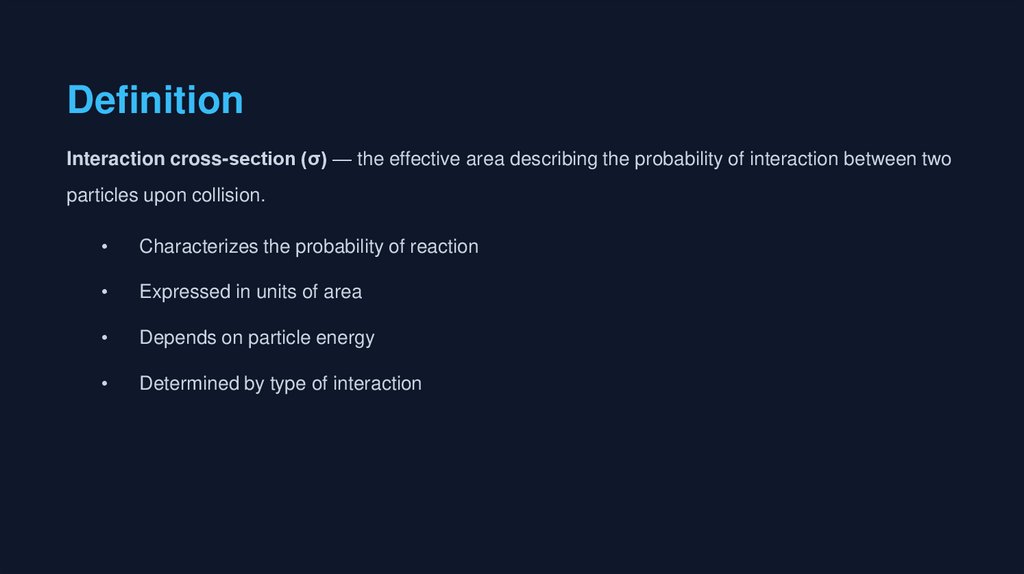
DefinitionInteraction cross-section (σ) — the effective area describing the probability of interaction between two
particles upon collision.
Characterizes the probability of reaction
Expressed in units of area
Depends on particle energy
Determined by type of interaction
3.
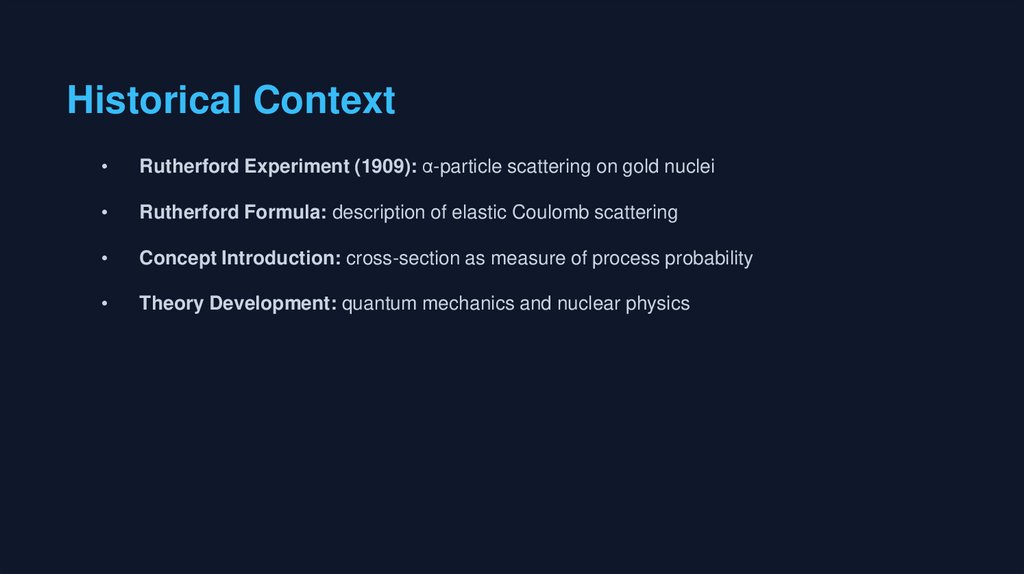
Historical ContextRutherford Experiment (1909): α-particle scattering on gold nuclei
Rutherford Formula: description of elastic Coulomb scattering
Concept Introduction: cross-section as measure of process probability
Theory Development: quantum mechanics and nuclear physics
4.
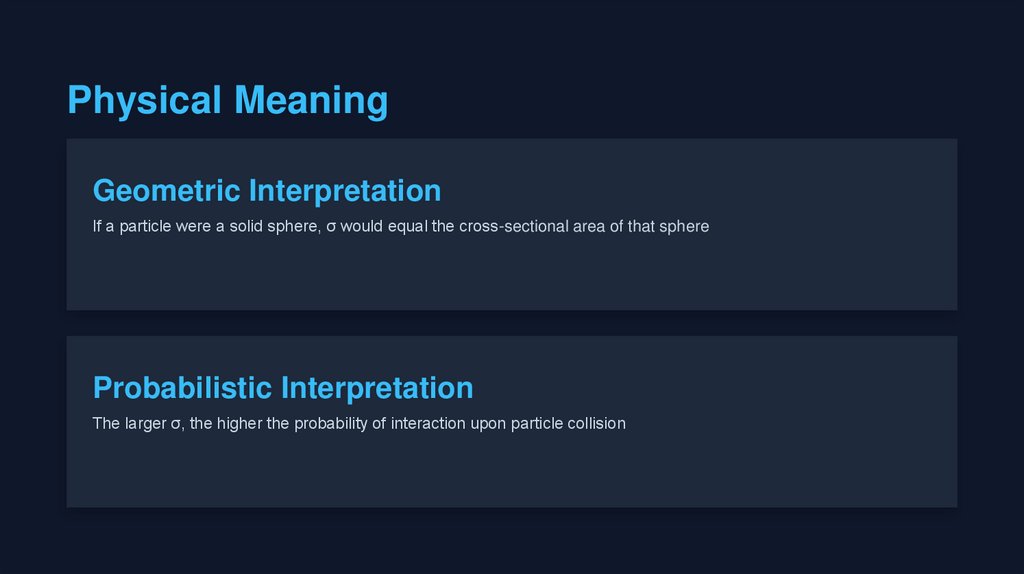
Physical MeaningGeometric Interpretation
If a particle were a solid sphere, σ would equal the cross-sectional area of that sphere
Probabilistic Interpretation
The larger σ, the higher the probability of interaction upon particle collision
5.
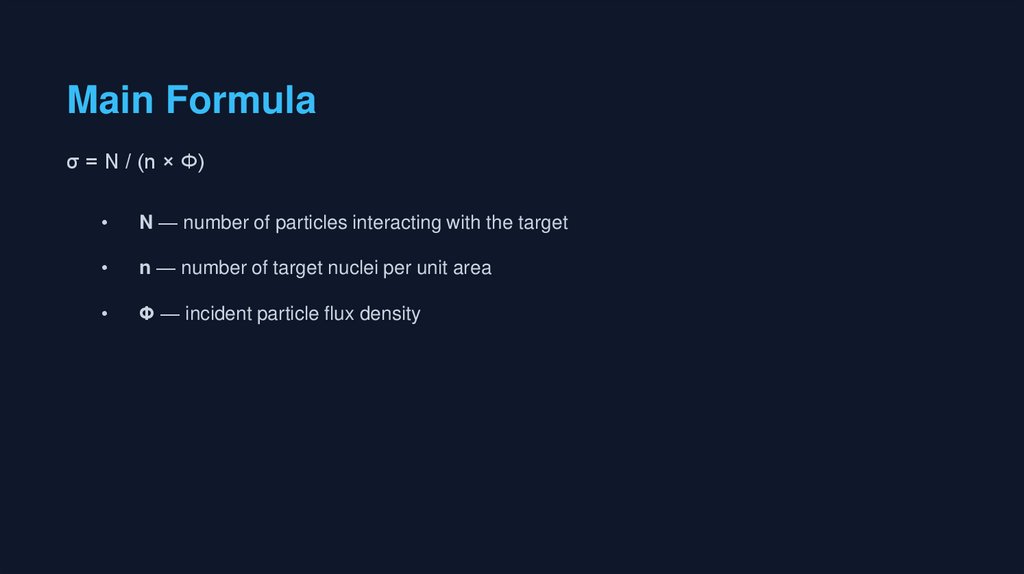
Main Formulaσ = N / (n × Φ)
N — number of particles interacting with the target
n — number of target nuclei per unit area
Φ — incident particle flux density
6.
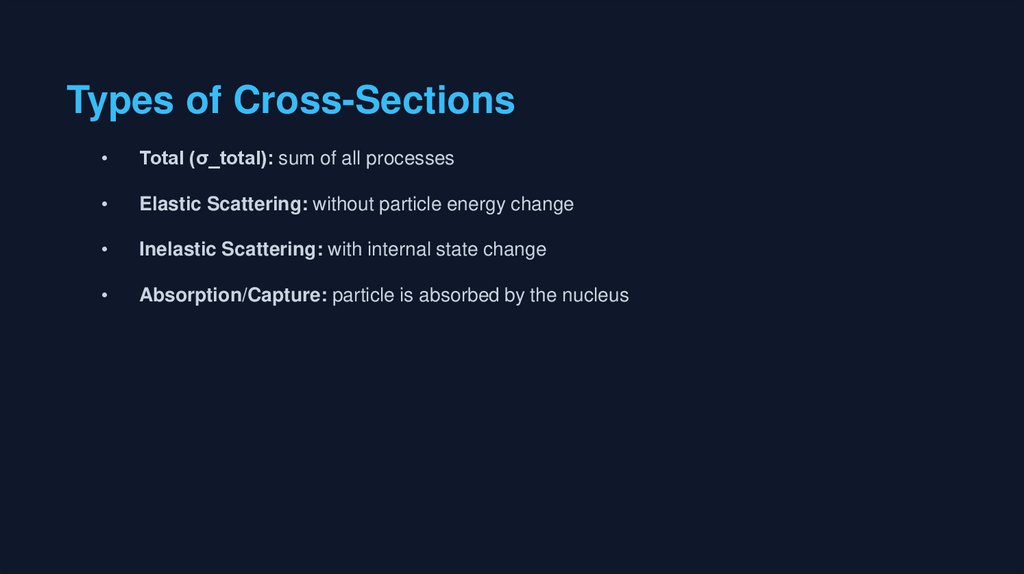
Types of Cross-SectionsTotal (σ_total): sum of all processes
Elastic Scattering: without particle energy change
Inelastic Scattering: with internal state change
Absorption/Capture: particle is absorbed by the nucleus
7.
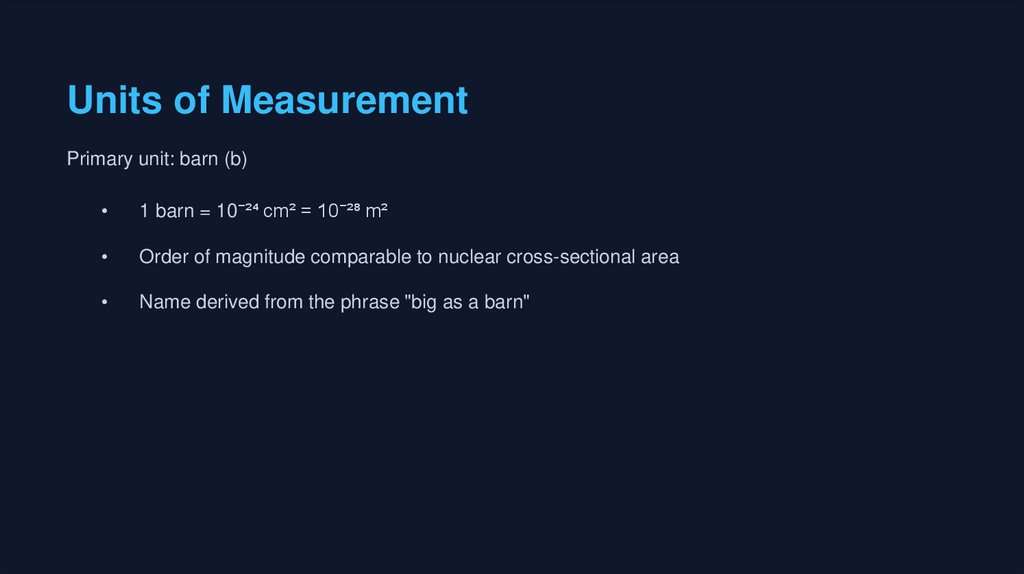
Units of MeasurementPrimary unit: barn (b)
1 barn = 10⁻²⁴ cm² = 10⁻²⁸ m²
Order of magnitude comparable to nuclear cross-sectional area
Name derived from the phrase "big as a barn"
8.
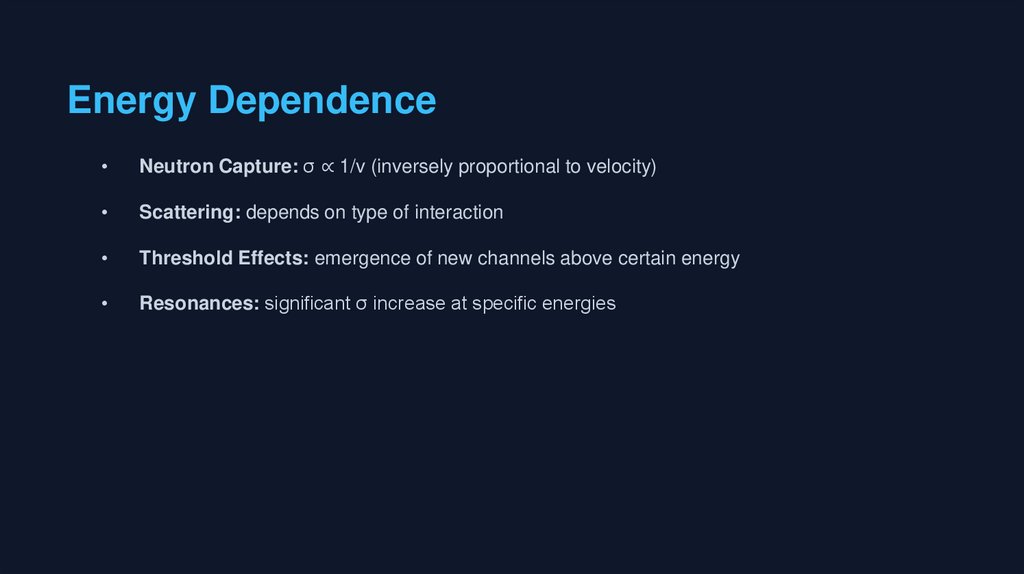
Energy DependenceNeutron Capture: σ ∝ 1/v (inversely proportional to velocity)
Scattering: depends on type of interaction
Threshold Effects: emergence of new channels above certain energy
Resonances: significant σ increase at specific energies
9.
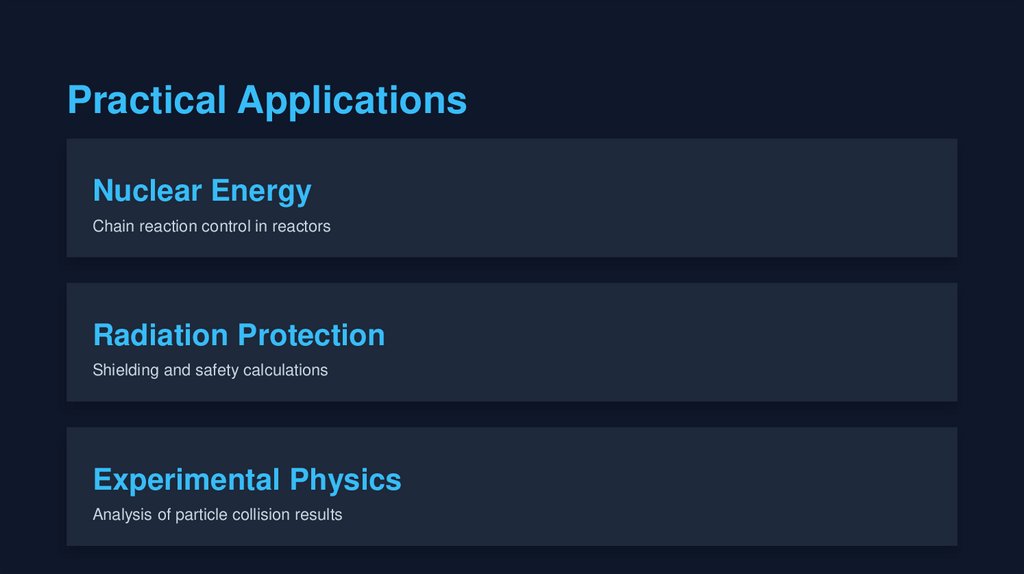
Practical ApplicationsNuclear Energy
Chain reaction control in reactors
Radiation Protection
Shielding and safety calculations
Experimental Physics
Analysis of particle collision results
10.
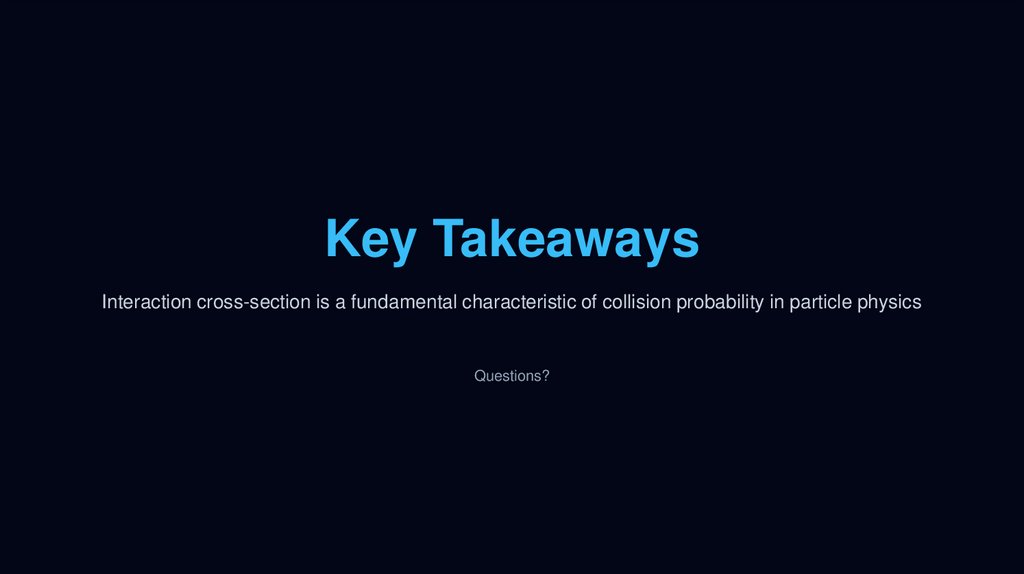
Key TakeawaysInteraction cross-section is a fundamental characteristic of collision probability in particle physics
Questions?