 Промышленность
Похожие презентации:






Charmed particles production is implemented in MC generators. First of all, it is presented in Pythia code
1.
Charmed particlein in
nucleusCharmedproduction
Particle Production
Geant4
nucleus interactions
AA.Galoyan, A. Ribon, V. Uzhinsky
19.09.25
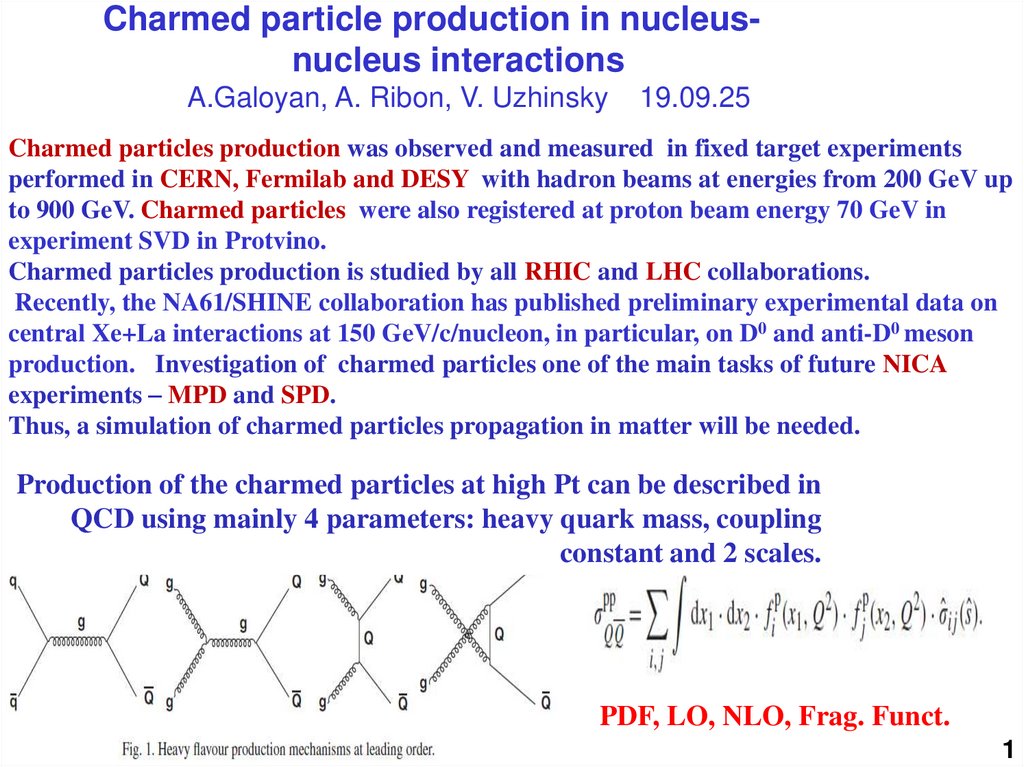
Charmed particles production was observed and measured in fixed target experiments
performed in CERN, Fermilab and DESY with hadron beams at energies from 200 GeV up
to 900 GeV. Charmed particles were also registered at proton beam energy 70 GeV in
experiment SVD in Protvino.
Charmed particles production is studied by all RHIC and LHC collaborations.
Recently, the NA61/SHINE collaboration has published preliminary experimental data on
central Xe+La interactions at 150 GeV/c/nucleon, in particular, on D0 and anti-D0 meson
production. Investigation of charmed particles one of the main tasks of future NICA
experiments – MPD and SPD.
Thus, a simulation of charmed particles propagation in matter will be needed.
Production of the charmed particles at high Pt can be described in
QCD using mainly 4 parameters: heavy quark mass, coupling
constant and 2 scales.
PDF, LO, NLO, Frag. Funct.
1
2.
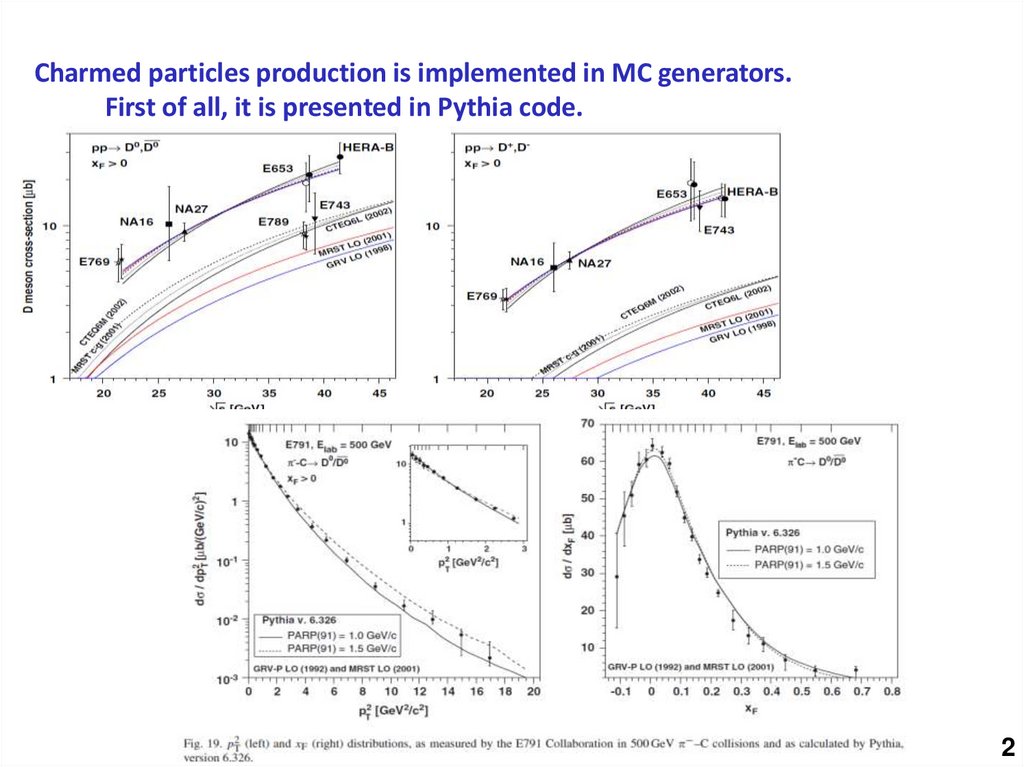
Charmed particles production is implemented in MC generators.First of all, it is presented in Pythia code.
2
3.
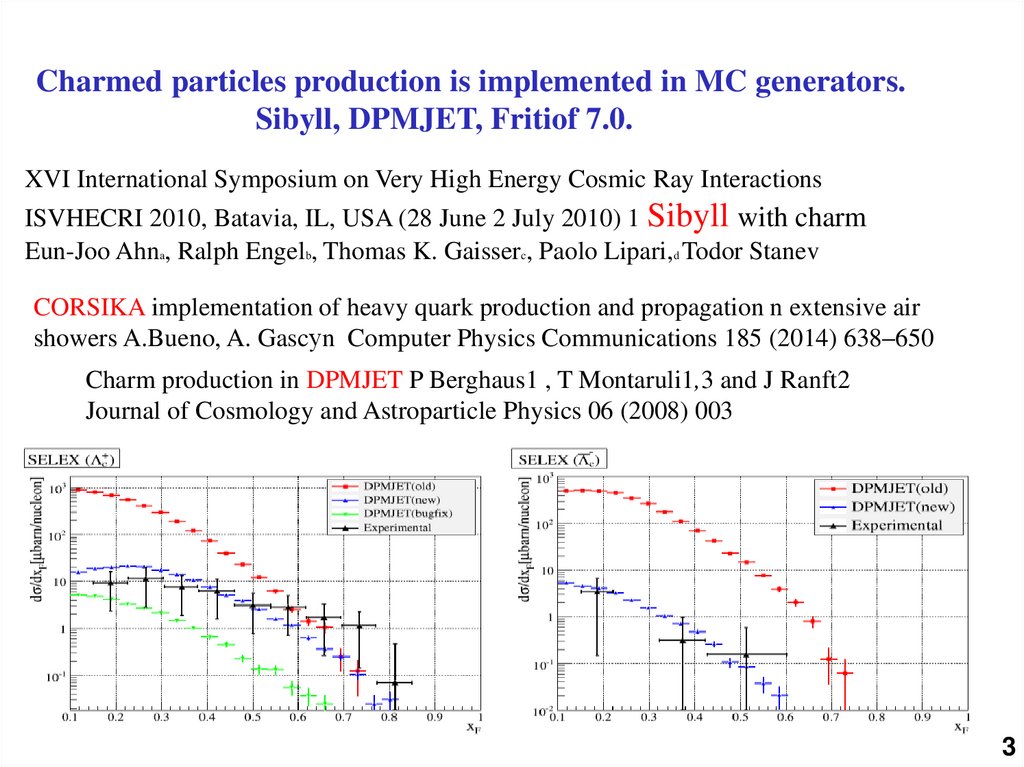
Charmed particles production is implemented in MC generators.Sibyll, DPMJET, Fritiof 7.0.
XVI International Symposium on Very High Energy Cosmic Ray Interactions
ISVHECRI 2010, Batavia, IL, USA (28 June 2 July 2010) 1 Sibyll with charm
Eun-Joo Ahna, Ralph Engelb, Thomas K. Gaisserc, Paolo Lipari,d Todor Stanev
CORSIKA implementation of heavy quark production and propagation n extensive air
showers A.Bueno, A. Gascуn Computer Physics Communications 185 (2014) 638–650
Charm production in DPMJET P Berghaus1 , T Montaruli1,3 and J Ranft2
Journal of Cosmology and Astroparticle Physics 06 (2008) 003
3
4.
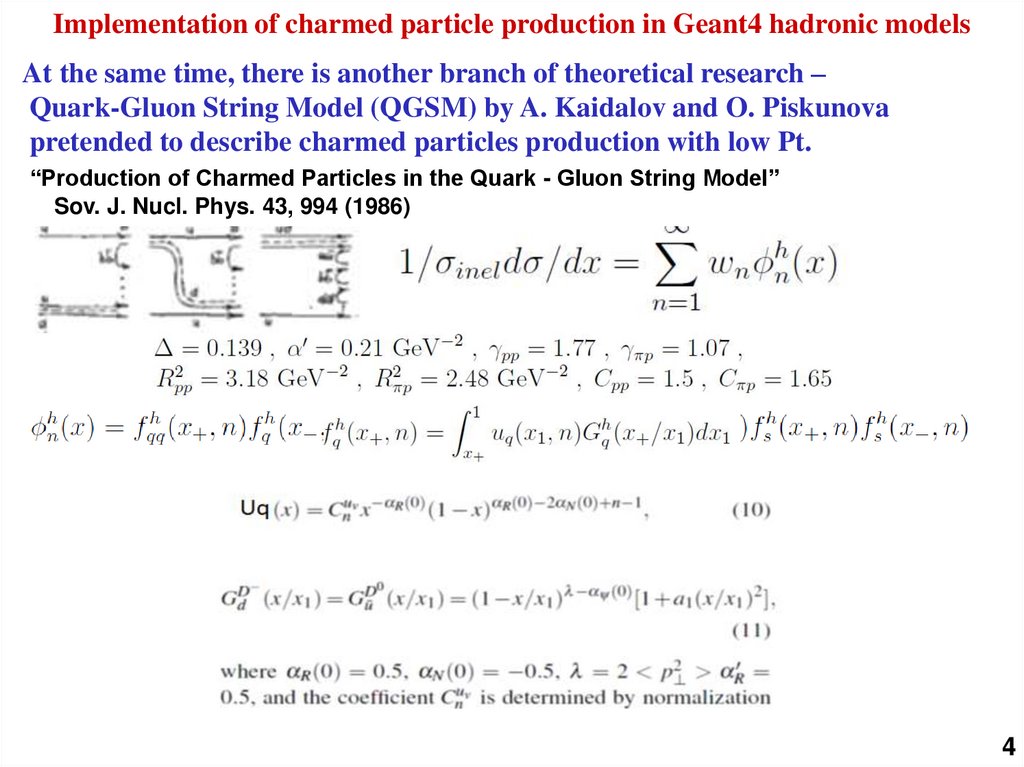
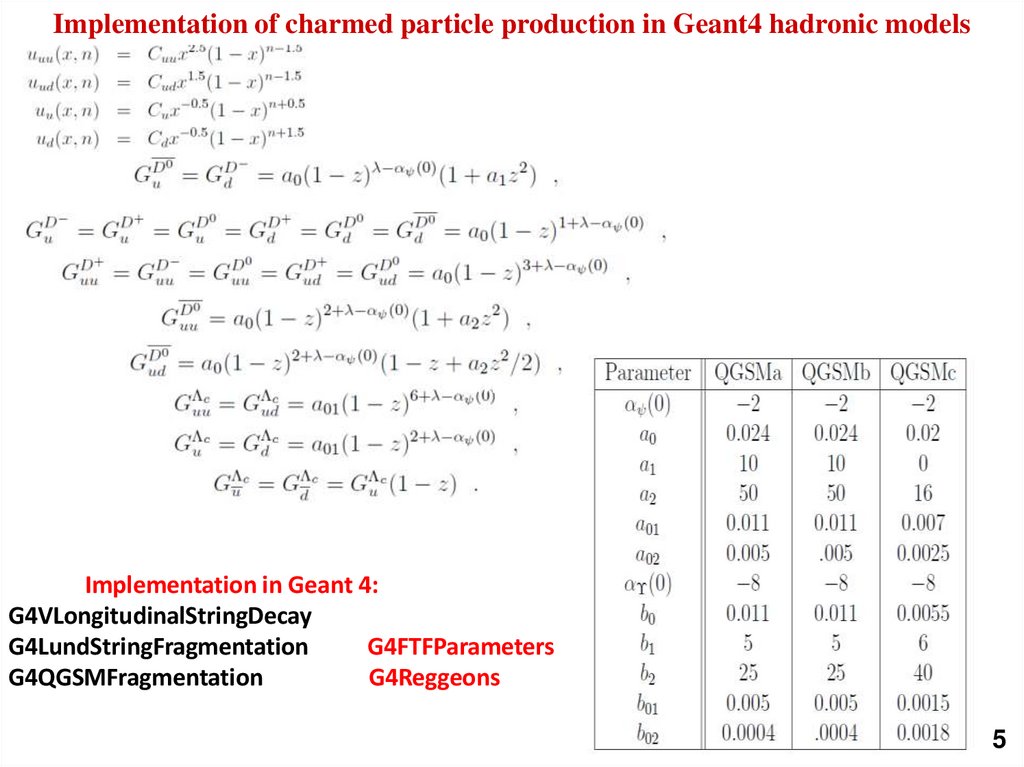
Implementation of charmed particle production in Geant4 hadronic modelsAt the same time, there is another branch of theoretical research –
Quark-Gluon String Model (QGSM) by A. Kaidalov and O. Piskunova
pretended to describe charmed particles production with low Pt.
“Production of Charmed Particles in the Quark - Gluon String Model”
Sov. J. Nucl. Phys. 43, 994 (1986)
4
5.
Implementation of charmed particle production in Geant4 hadronic modelsКайдалов
Implementation in Geant 4:
G4VLongitudinalStringDecay
G4LundStringFragmentation
G4FTFParameters
G4QGSMFragmentation
G4Reggeons
5
6.
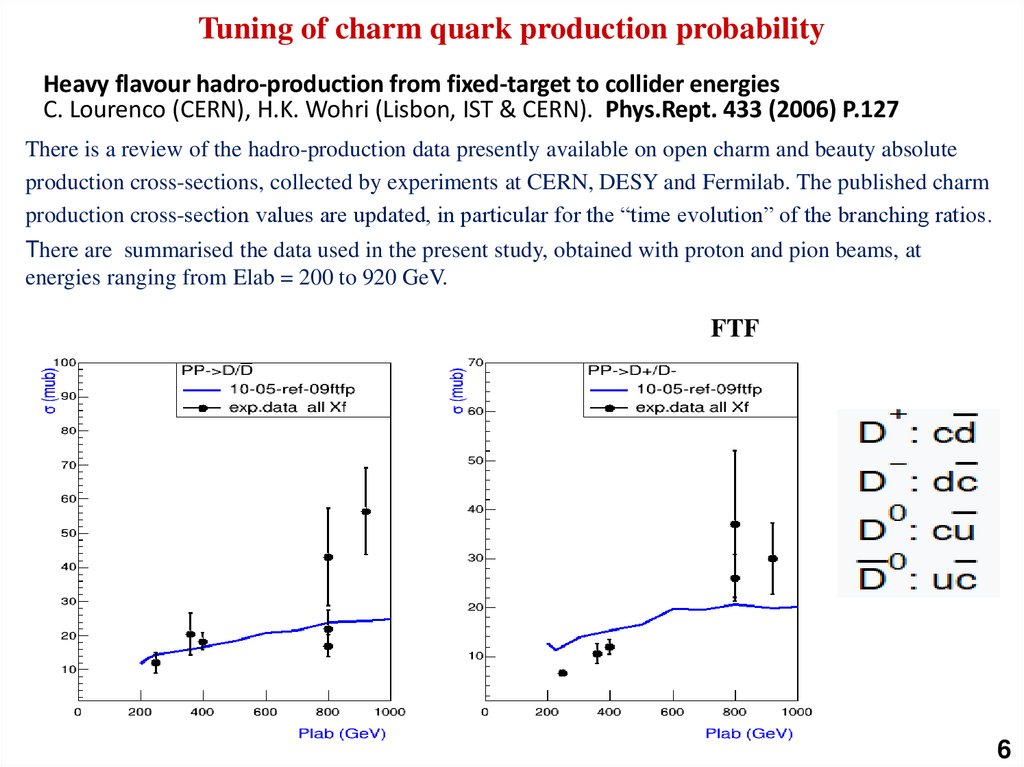
Tuning of charm quark production probabilityHeavy flavour hadro-production from fixed-target to collider energies
C. Lourenco (CERN), H.K. Wohri (Lisbon, IST & CERN). Phys.Rept. 433 (2006) P.127
There is a review of the hadro-production data presently available on open charm and beauty absolute
production cross-sections, collected by experiments at CERN, DESY and Fermilab. The published charm
production cross-section values are updated, in particular for the “time evolution” of the branching ratios.
There are summarised the data used in the present study, obtained with proton and pion beams, at
energies ranging from Elab = 200 to 920 GeV.
FTF
6
7.
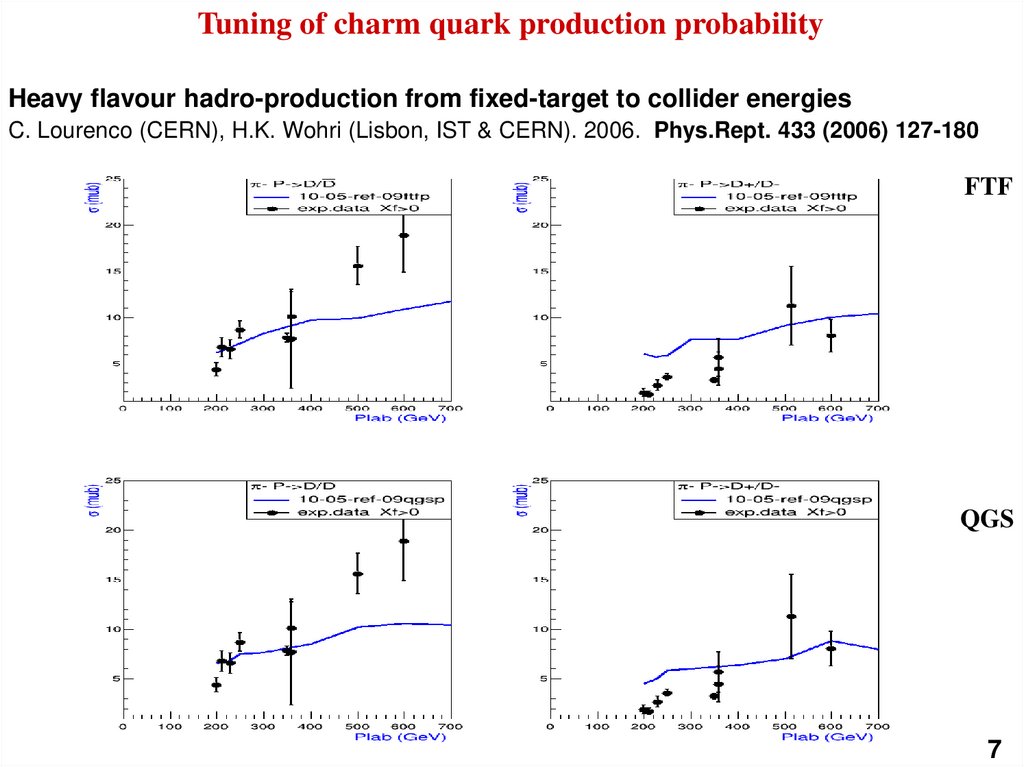
Tuning of charm quark production probabilityHeavy flavour hadro-production from fixed-target to collider energies
C. Lourenco (CERN), H.K. Wohri (Lisbon, IST & CERN). 2006. Phys.Rept. 433 (2006) 127-180
FTF
QGS
7
8.
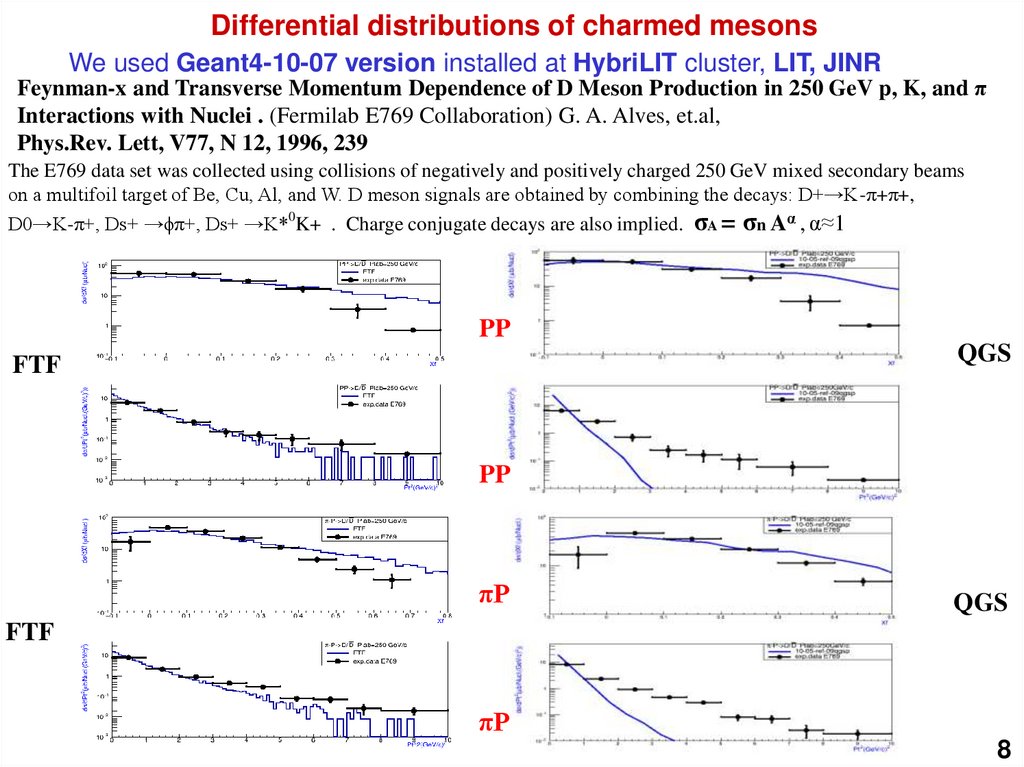
Differential distributions of charmed mesonsWe used Geant4-10-07 version installed at HybriLIT cluster, LIT, JINR
Feynman-x and Transverse Momentum Dependence of D Meson Production in 250 GeV p, K, and π
Interactions with Nuclei . (Fermilab E769 Collaboration) G. A. Alves, et.al,
Phys.Rev. Lett, V77, N 12, 1996, 239
The E769 data set was collected using collisions of negatively and positively charged 250 GeV mixed secondary beams
on a multifoil target of Be, Cu, Al, and W. D meson signals are obtained by combining the decays: D+→K-π+π+,
D0→K-π+, Ds+ →ϕπ+, Ds+ →K*0K+ . Charge conjugate decays are also implied. σA = σn Aα , α≈1
PP
QGS
FTF
PP
πP
QGS
FTF
πP
8
9.
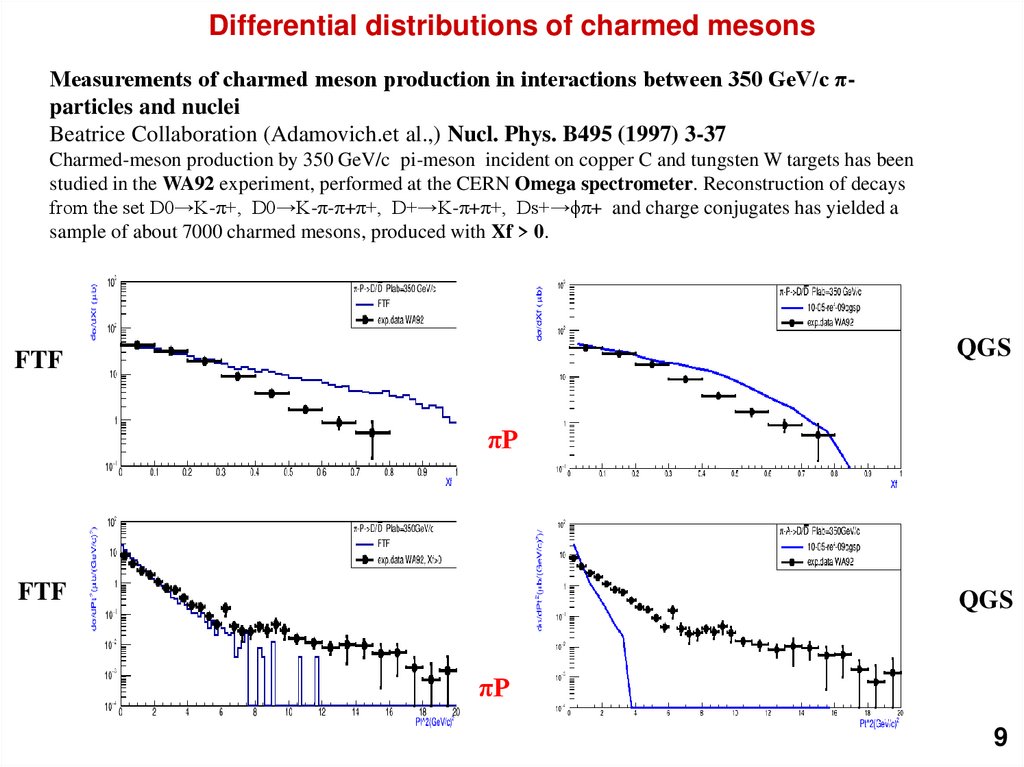
Differential distributions of charmed mesonsMeasurements of charmed meson production in interactions between 350 GeV/c πparticles and nuclei
Beatrice Collaboration (Adamovich.et al.,) Nucl. Phys. B495 (1997) 3-37
Charmed-meson production by 350 GeV/c pi-meson incident on copper C and tungsten W targets has been
studied in the WA92 experiment, performed at the CERN Omega spectrometer. Reconstruction of decays
from the set D0→K-π+, D0→K-π-π+π+, D+→K-π+π+, Ds+→ϕπ+ and charge conjugates has yielded a
sample of about 7000 charmed mesons, produced with Xf > 0.
QGS
FTF
πP
FTF
QGS
πP
9
10.
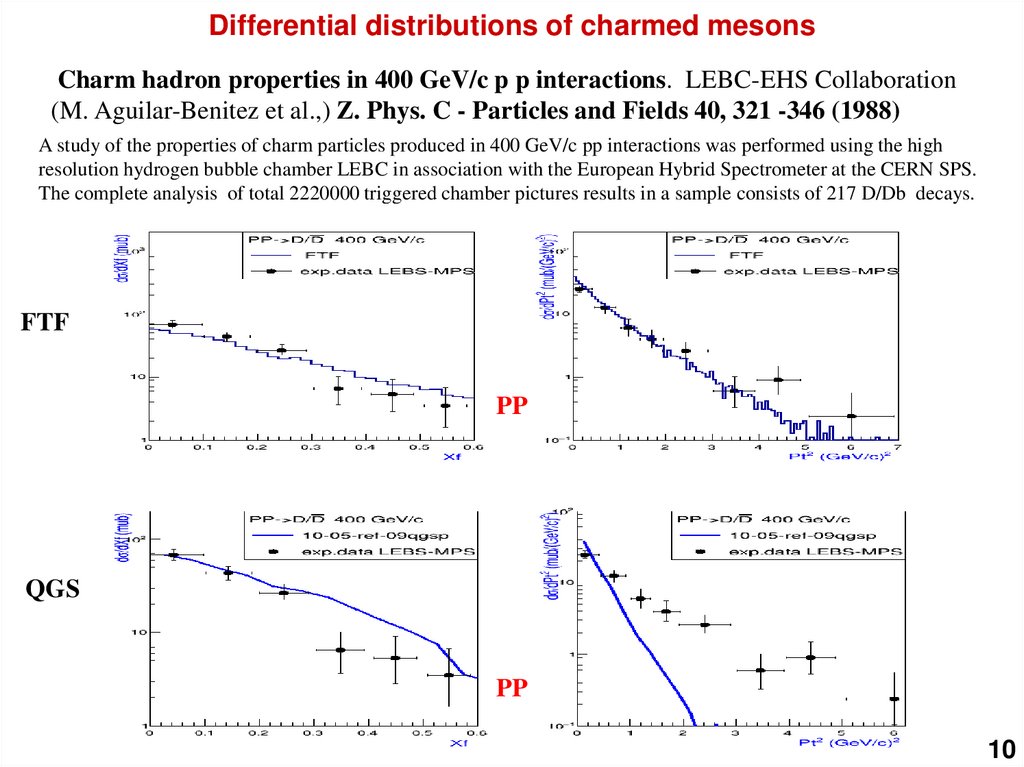
Differential distributions of charmed mesonsCharm hadron properties in 400 GeV/c p p interactions. LEBC-EHS Collaboration
(M. Aguilar-Benitez et al.,) Z. Phys. C - Particles and Fields 40, 321 -346 (1988)
A study of the properties of charm particles produced in 400 GeV/c pp interactions was performed using the high
resolution hydrogen bubble chamber LEBC in association with the European Hybrid Spectrometer at the CERN SPS.
The complete analysis of total 2220000 triggered chamber pictures results in a sample consists of 217 D/Db decays.
FTF
PP
QGS
PP
10
11.
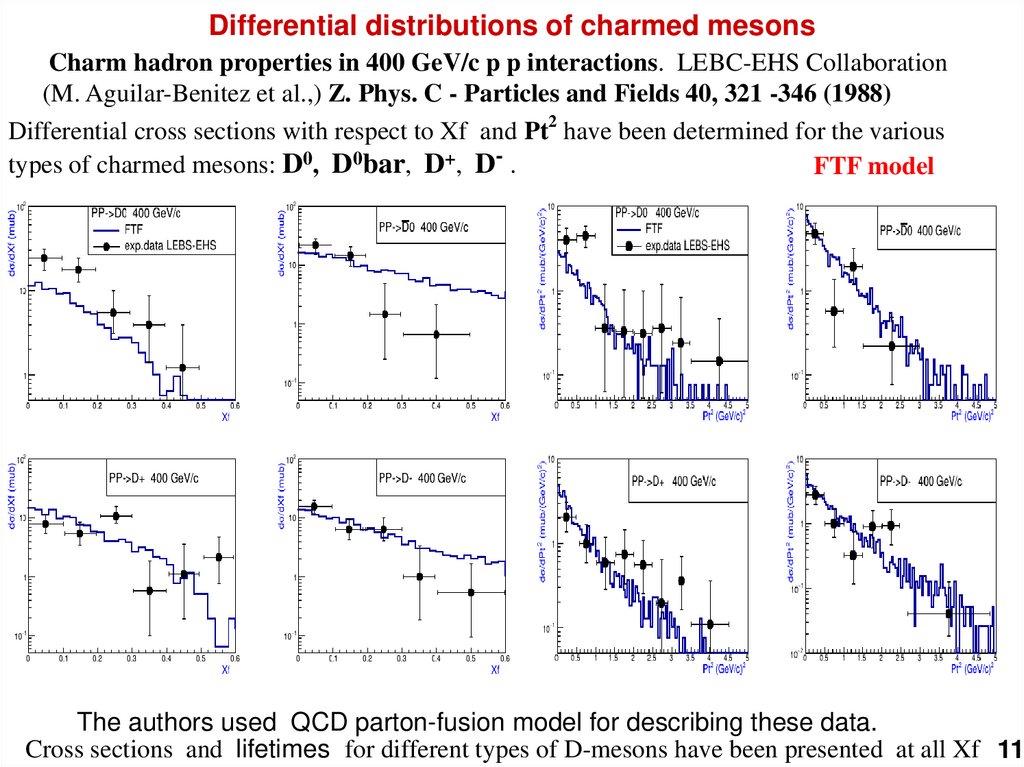
Differential distributions of charmed mesonsCharm hadron properties in 400 GeV/c p p interactions. LEBC-EHS Collaboration
(M. Aguilar-Benitez et al.,) Z. Phys. C - Particles and Fields 40, 321 -346 (1988)
Differential cross sections with respect to Xf and Pt2 have been determined for the various
types of charmed mesons: D0, D0bar, D+, D- .
FTF model
FTF
The authors used QCD parton-fusion model for describing these data.
Cross sections and lifetimes :for different types of D-mesons have been presented at all Xf 11
12.
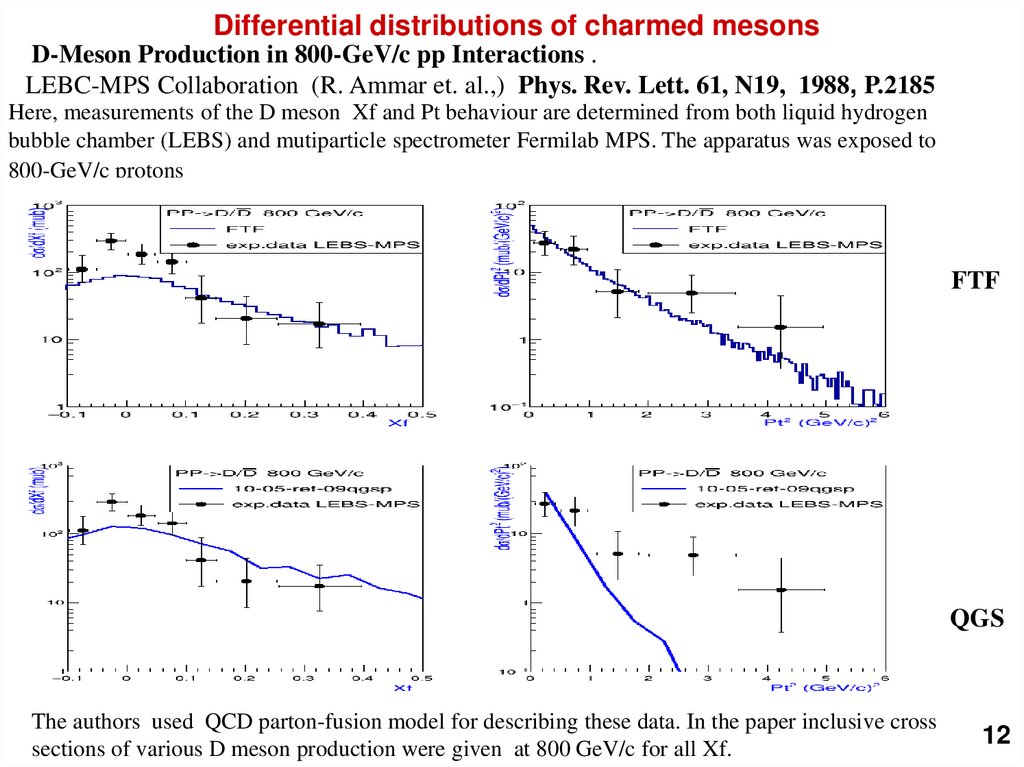
Differential distributions of charmed mesonsD-Meson Production in 800-GeV/c pp Interactions .
LEBC-MPS Collaboration (R. Ammar et. al.,) Phys. Rev. Lett. 61, N19, 1988, P.2185
Here, measurements of the D meson Xf and Pt behaviour are determined from both liquid hydrogen
bubble chamber (LEBS) and mutiparticle spectrometer Fermilab MPS. The apparatus was exposed to
800-GeV/c protons.
FTF
QGS
The authors used QCD parton-fusion model for describing these data. In the paper inclusive cross
sections of various D meson production were given at 800 GeV/c for all Xf.
12
13.
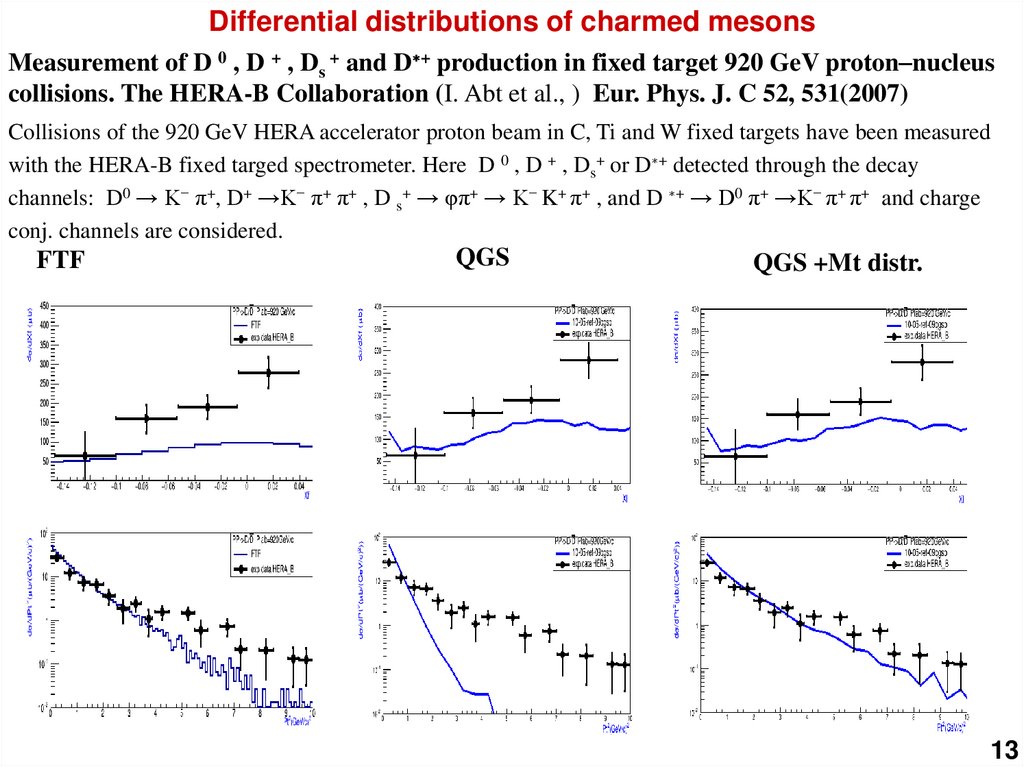
Differential distributions of charmed mesonsMeasurement of D 0 , D + , Ds + and D∗+ production in fixed target 920 GeV proton–nucleus
collisions. The HERA-B Collaboration (I. Abt et al., ) Eur. Phys. J. C 52, 531(2007)
Collisions of the 920 GeV HERA accelerator proton beam in C, Ti and W fixed targets have been measured
with the HERA-B fixed targed spectrometer. Here D 0 , D + , Ds+ or D∗+ detected through the decay
channels: D0 → K− π+, D+ →K− π+ π+ , D s+ → φπ+ → K− K+ π+ , and D ∗+ → D0 π+ →K− π+ π+ and charge
conj. channels are considered.
FTF
QGS
QGS +Mt distr.
13
14.
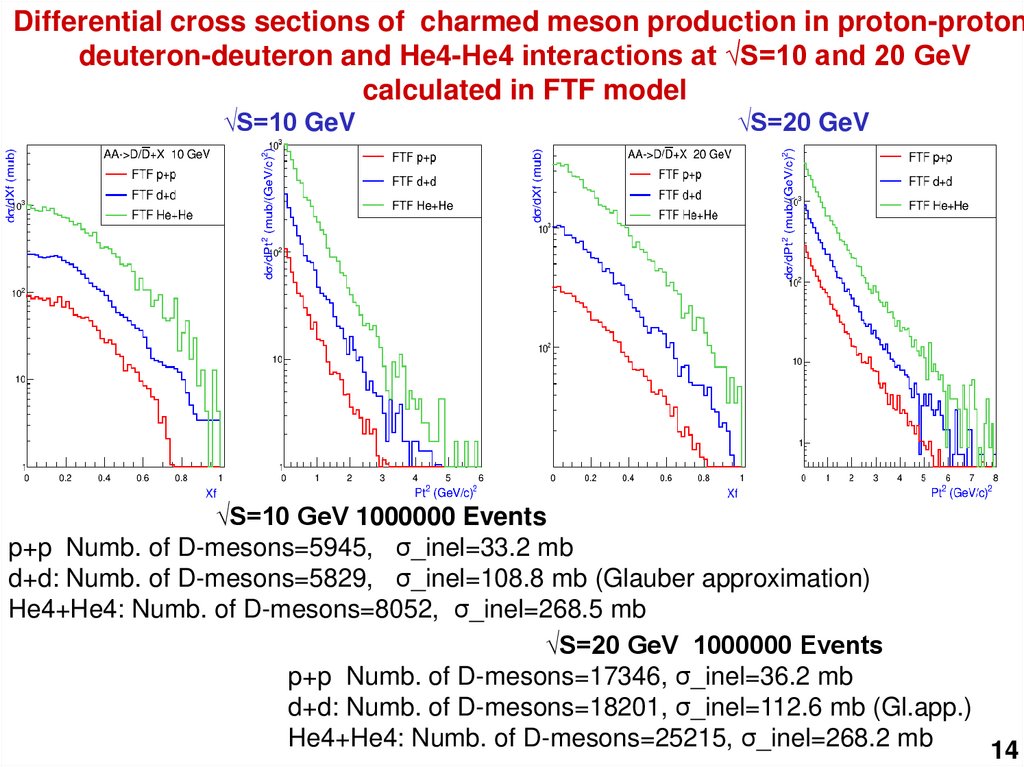
Differential cross sections of charmed meson production in proton-protondeuteron-deuteron and He4-He4 interactions at √S=10 and 20 GeV
calculated in FTF model
√S=10 GeV
√S=20 GeV
√S=10 GeV 1000000 Events
p+p Numb. of D-mesons=5945, σ_inel=33.2 mb
d+d: Numb. of D-mesons=5829, σ_inel=108.8 mb (Glauber approximation)
He4+He4: Numb. of D-mesons=8052, σ_inel=268.5 mb
√S=20 GeV 1000000 Events
p+p Numb. of D-mesons=17346, σ_inel=36.2 mb
d+d: Numb. of D-mesons=18201, σ_inel=112.6 mb (Gl.app.)
He4+He4: Numb. of D-mesons=25215, σ_inel=268.2 mb
14
15.
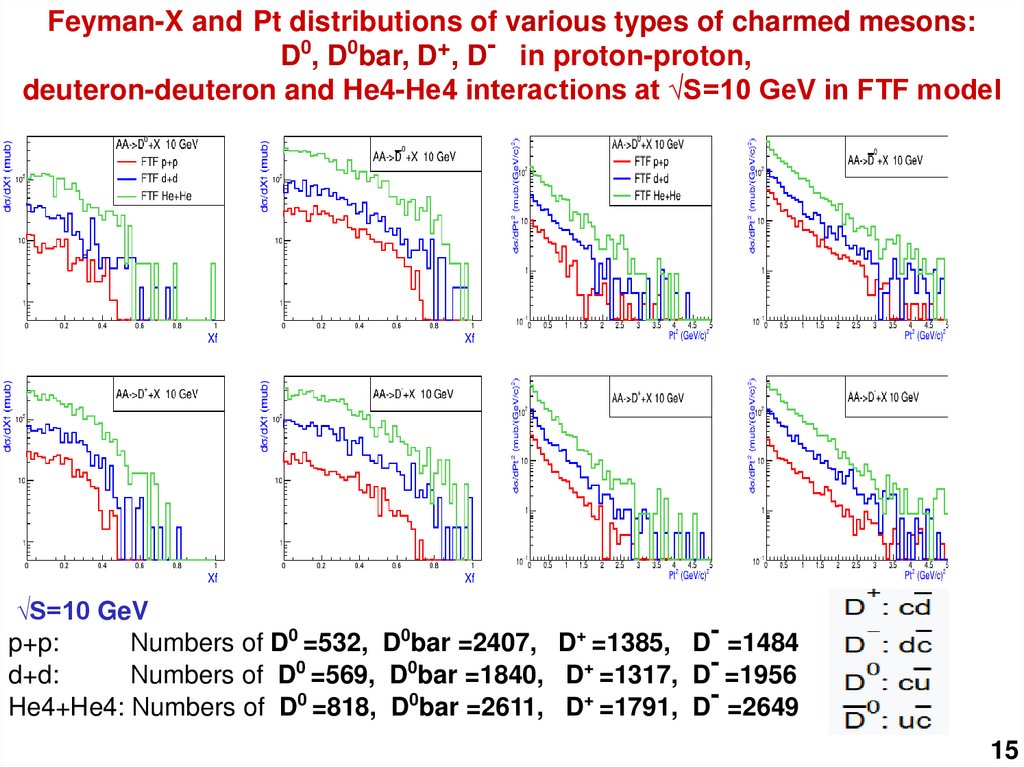
Feyman-X and Pt distributions of various types of charmed mesons:D0, D0bar, D+, D- in proton-proton,
deuteron-deuteron and He4-He4 interactions at √S=10 GeV in FTF model
√S=10 GeV
p+p:
Νumbers of D0 =532, D0bar =2407, D+ =1385, D- =1484
d+d:
Νumbers of D0 =569, D0bar =1840, D+ =1317, D- =1956
He4+He4: Νumbers of D0 =818, D0bar =2611, D+ =1791, D- =2649
15
16.
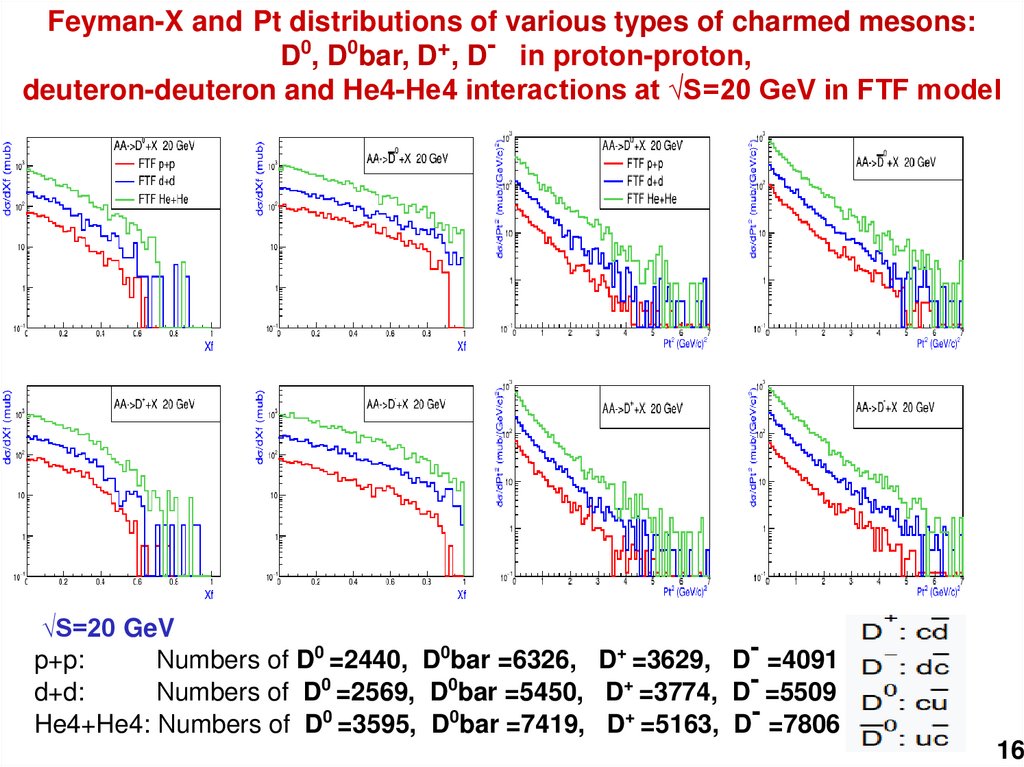
Feyman-X and Pt distributions of various types of charmed mesons:D0, D0bar, D+, D- in proton-proton,
deuteron-deuteron and He4-He4 interactions at √S=20 GeV in FTF model
√S=20 GeV
p+p:
Νumbers of D0 =2440, D0bar =6326, D+ =3629, D- =4091
d+d:
Νumbers of D0 =2569, D0bar =5450, D+ =3774, D- =5509
He4+He4: Νumbers of D0 =3595, D0bar =7419, D+ =5163, D- =7806
16
17.
First D0 + D0bar measurement in heavy-ion collisions at SPS energies with NA61/SHINEFirst D-meson measurements in heavy-ion collisions at SPS energies
with NA61/SHINE
PoS (QNP2024) 128
10th International Conference on Quarks and Nuclear Physics (QNP2024)
8-12 July, 2024, Barcelona, Spain
Recent results from NA61/SHINE strong interaction program
Grzegorz Stefanek, for the NA61/SHINE Collaboration.
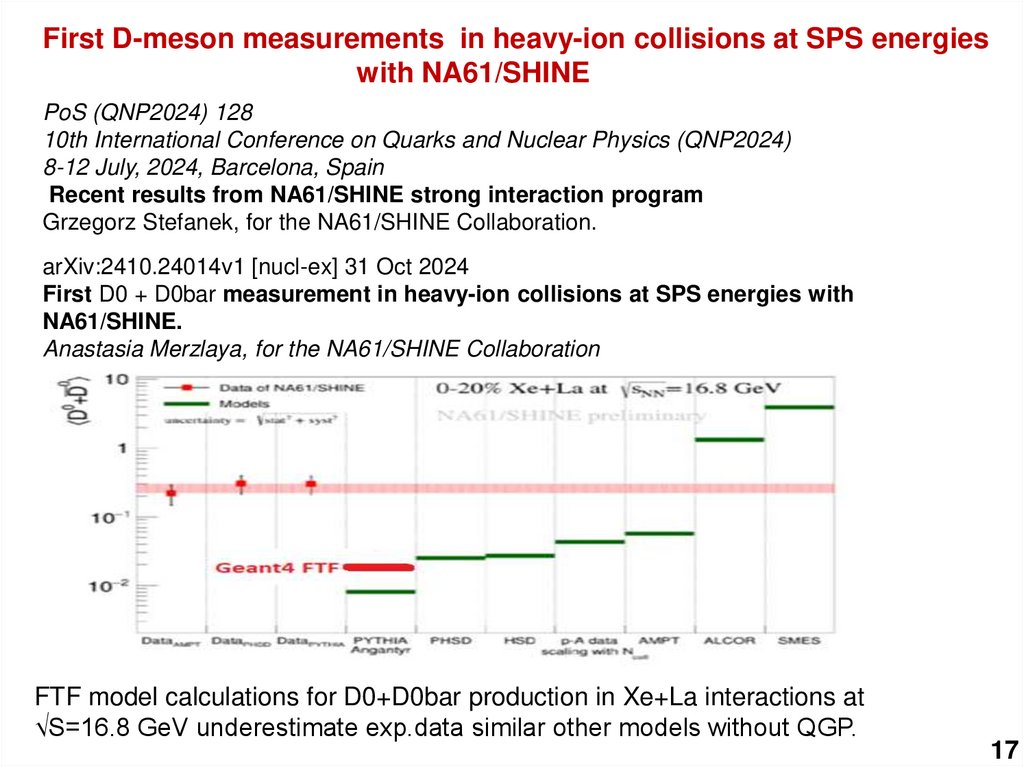
arXiv:2410.24014v1 [nucl-ex] 31 Oct 2024
First D0 + D0bar measurement in heavy-ion collisions at SPS energies with
NA61/SHINE.
Anastasia Merzlaya, for the NA61/SHINE Collaboration
FTF model calculations for D0+D0bar production in Xe+La interactions at
√S=16.8 GeV underestimate exp.data similar other models without QGP.
17
18.
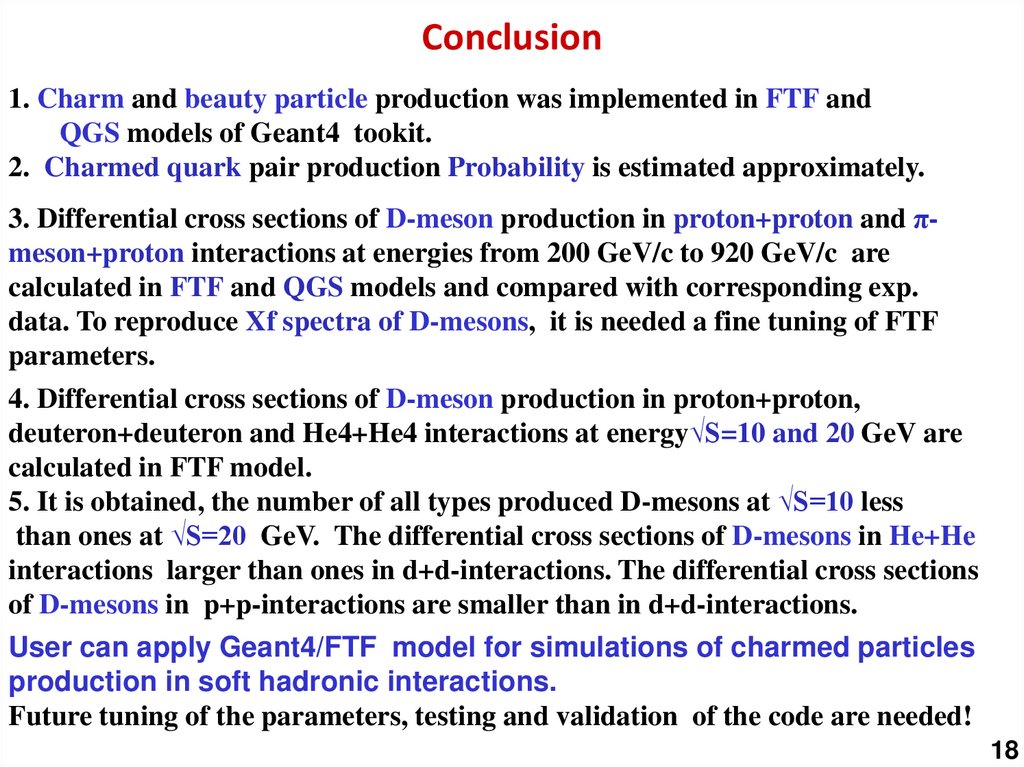
Conclusion1. Charm and beauty particle production was implemented in FTF and
QGS models of Geant4 tookit.
2. Charmed quark pair production Probability is estimated approximately.
3. Differential cross sections of D-meson production in proton+proton and πmeson+proton interactions at energies from 200 GeV/c to 920 GeV/c are
calculated in FTF and QGS models and compared with corresponding exp.
data. To reproduce Xf spectra of D-mesons, it is needed a fine tuning of FTF
parameters.
4. Differential cross sections of D-meson production in proton+proton,
deuteron+deuteron and He4+He4 interactions at energy√S=10 and 20 GeV are
calculated in FTF model.
5. It is obtained, the number of all types produced D-mesons at √S=10 less
than ones at √S=20 GeV. The differential cross sections of D-mesons in He+He
interactions larger than ones in d+d-interactions. The differential cross sections
of D-mesons in p+p-interactions are smaller than in d+d-interactions.
User can apply Geant4/FTF model for simulations of charmed particles
production in soft hadronic interactions.
Future tuning of the parameters, testing and validation of the code are needed!
18
19.
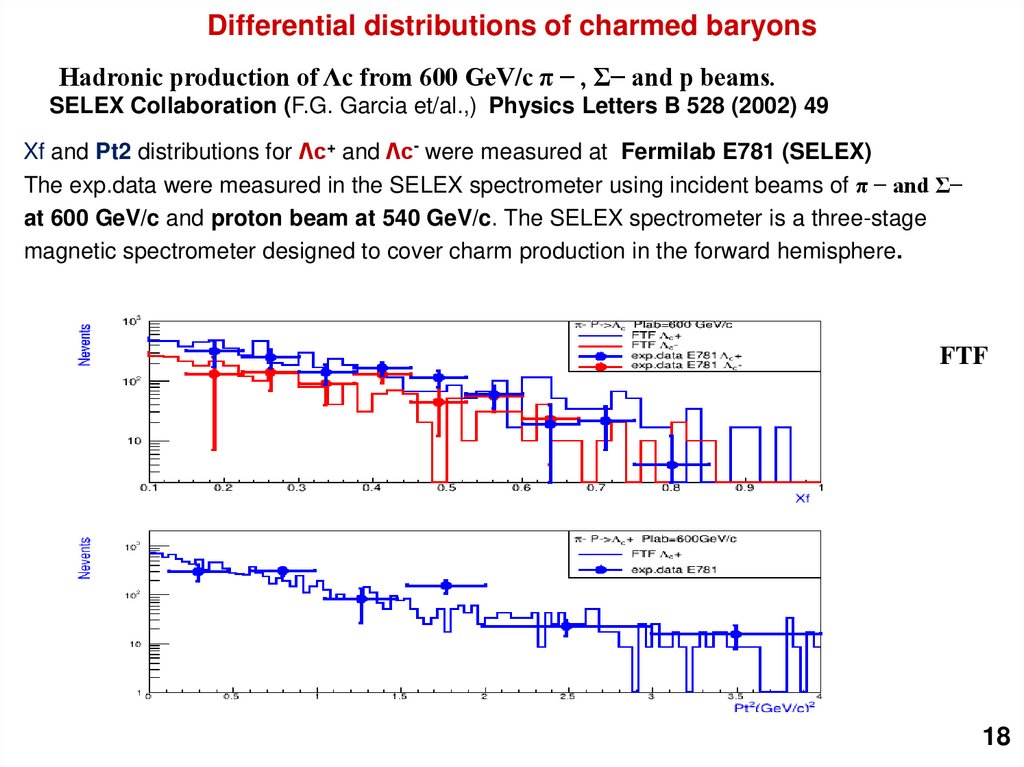
Differential distributions of charmed baryonsHadronic production of Λc from 600 GeV/c π − , Σ− and p beams.
SELEX Collaboration (F.G. Garcia et/al.,) Physics Letters B 528 (2002) 49
Xf and Pt2 distributions for Λc+ and Λc- were measured at Fermilab E781 (SELEX)
The exp.data were measured in the SELEX spectrometer using incident beams of π − and Σ−
at 600 GeV/c and proton beam at 540 GeV/c. The SELEX spectrometer is a three-stage
magnetic spectrometer designed to cover charm production in the forward hemisphere.
FTF
18
20.
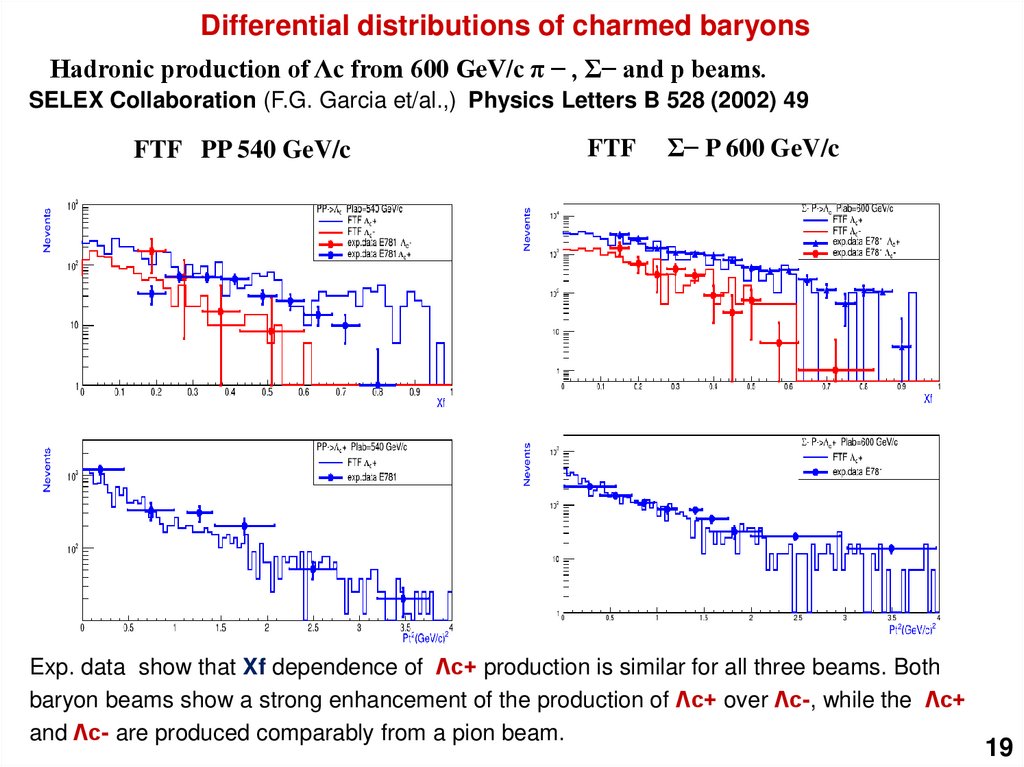
Differential distributions of charmed baryonsHadronic production of Λc from 600 GeV/c π − , Σ− and p beams.
SELEX Collaboration (F.G. Garcia et/al.,) Physics Letters B 528 (2002) 49
FTF PP 540 GeV/c
FTF
Σ− P 600 GeV/c
Exp. data show that Xf dependence of Λc+ production is similar for all three beams. Both
baryon beams show a strong enhancement of the production of Λc+ over Λc-, while the Λc+
and Λc- are produced comparably from a pion beam.
19
21.
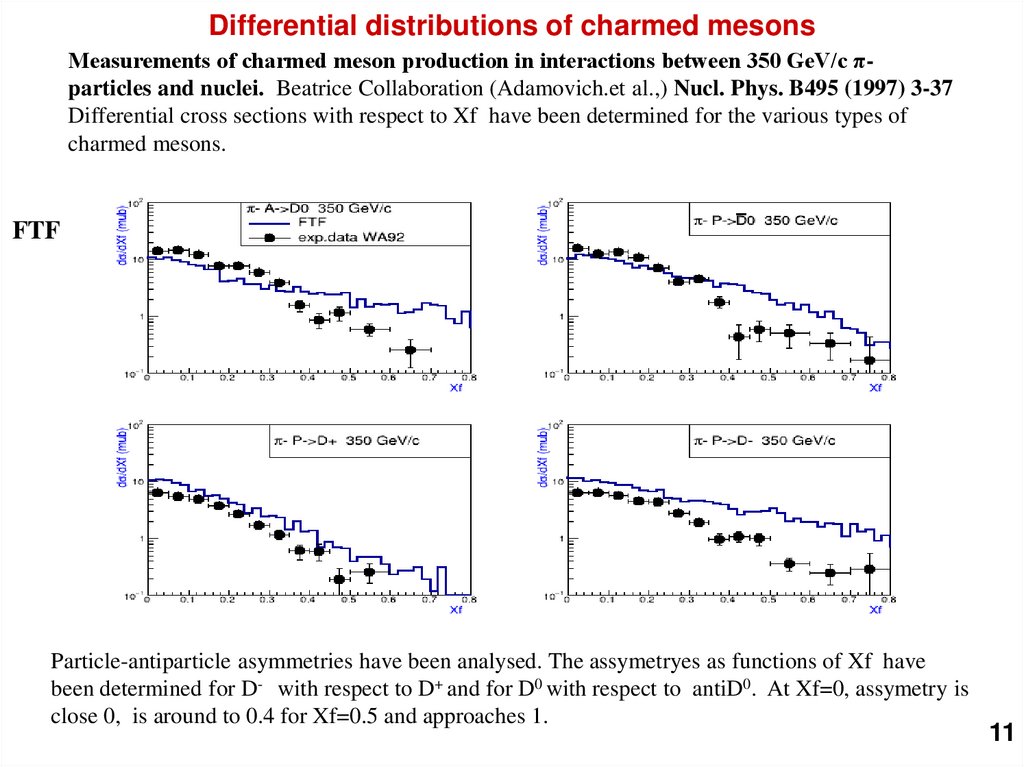
Differential distributions of charmed mesonsMeasurements of charmed meson production in interactions between 350 GeV/c πparticles and nuclei. Beatrice Collaboration (Adamovich.et al.,) Nucl. Phys. B495 (1997) 3-37
Differential cross sections with respect to Xf have been determined for the various types of
charmed mesons.
FTF
Particle-antiparticle asymmetries have been analysed. The assymetryes as functions of Xf have
been determined for D- with respect to D+ and for D0 with respect to antiD0. At Xf=0, assymetry is
close 0, is around to 0.4 for Xf=0.5 and approaches 1.
11
22.
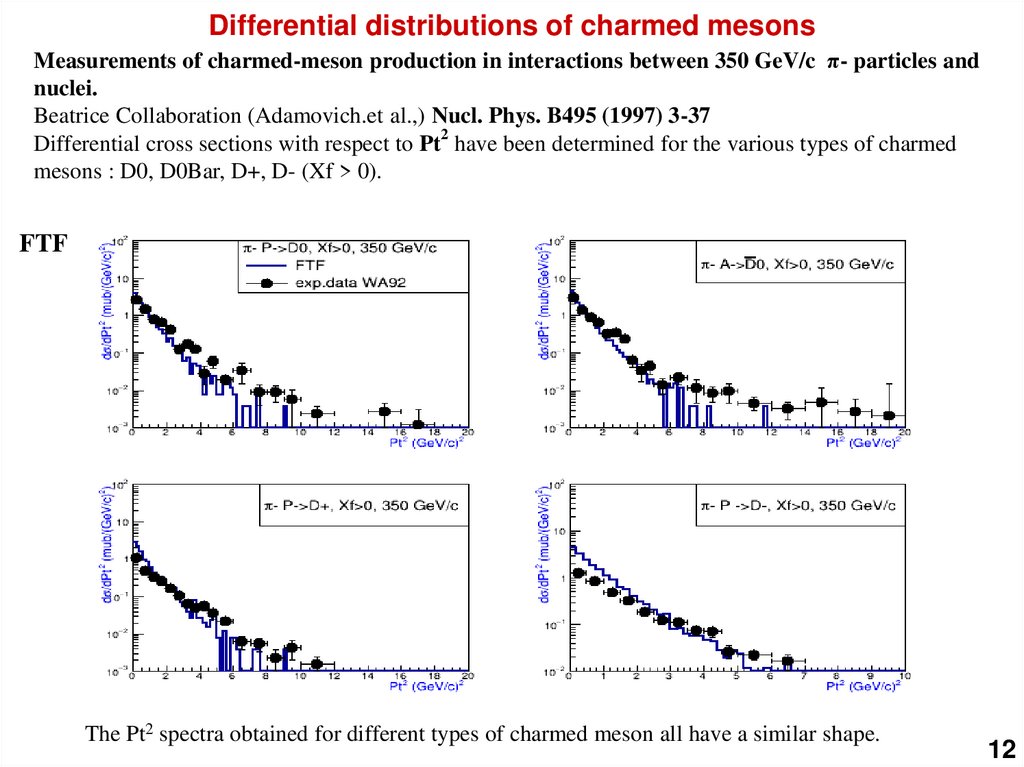
Differential distributions of charmed mesonsMeasurements of charmed-meson production in interactions between 350 GeV/c π- particles and
nuclei.
Beatrice Collaboration (Adamovich.et al.,) Nucl. Phys. B495 (1997) 3-37
2
Differential cross sections with respect to Pt have been determined for the various types of charmed
mesons : D0, D0Bar, D+, D- (Xf > 0).
FTF
The Pt2 spectra obtained for different types of charmed meson all have a similar shape.
12
23.
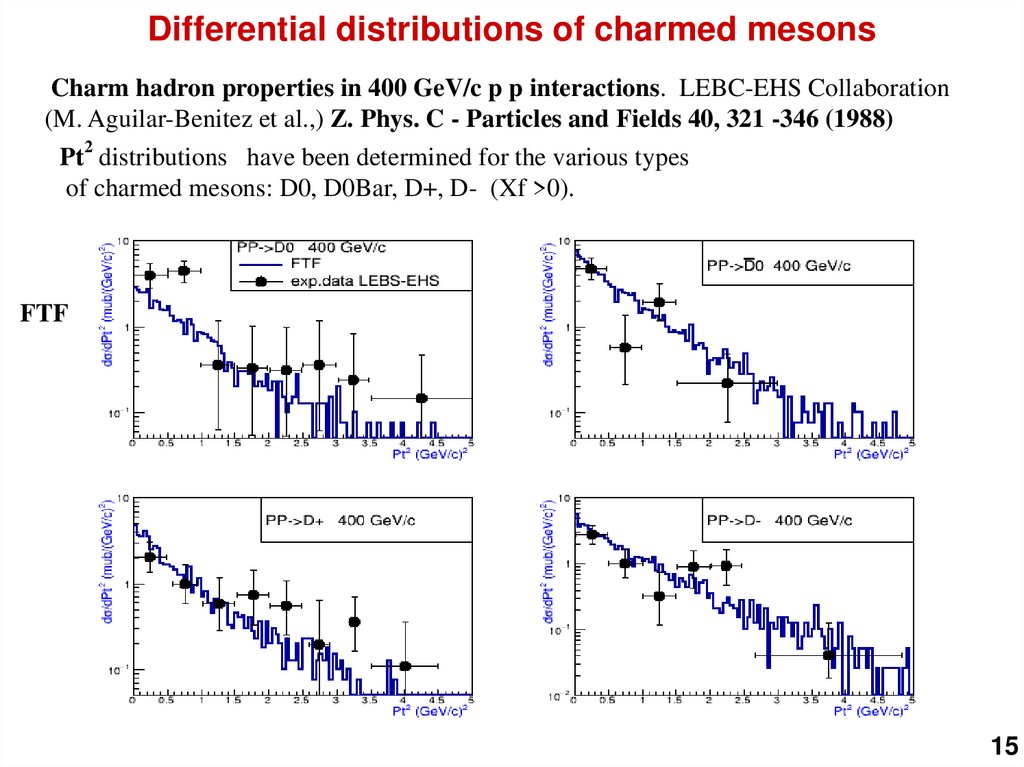
Differential distributions of charmed mesonsCharm hadron properties in 400 GeV/c p p interactions. LEBC-EHS Collaboration
(M. Aguilar-Benitez et al.,) Z. Phys. C - Particles and Fields 40, 321 -346 (1988)
Pt2 distributions have been determined for the various types
of charmed mesons: D0, D0Bar, D+, D- (Xf >0).
FTF
15
24.
Validation of FTF and QGS models of Geant4 for charmedparticles production
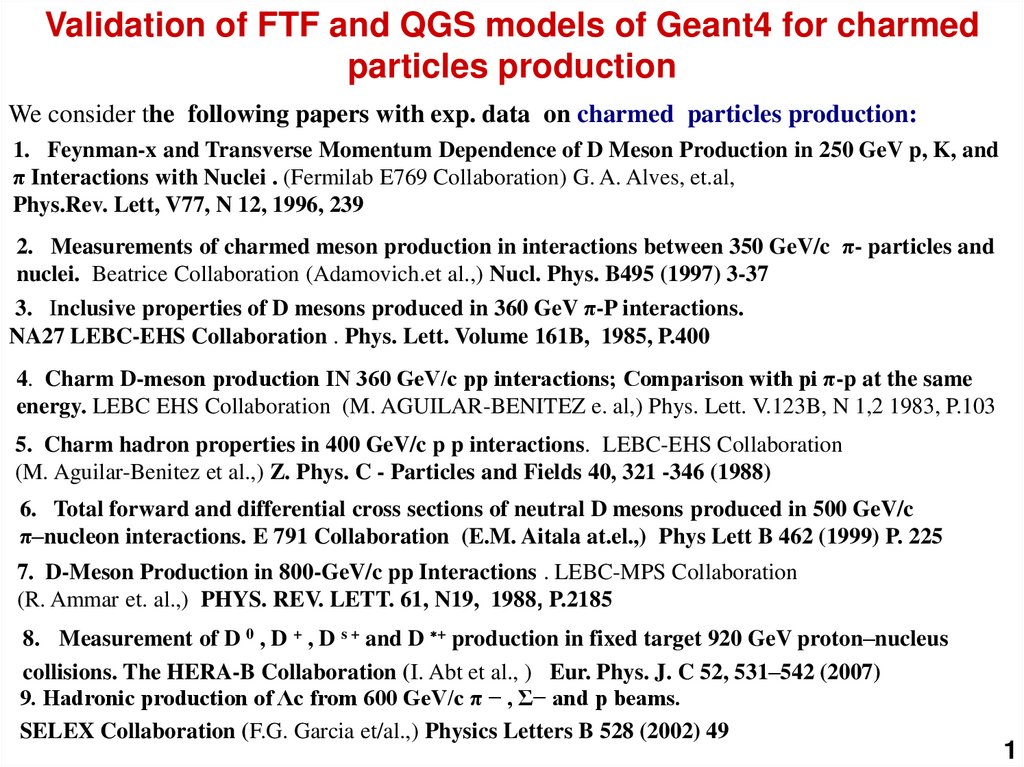
We consider the following papers with exp. data on charmed particles production:
1. Feynman-x and Transverse Momentum Dependence of D Meson Production in 250 GeV p, K, and
π Interactions with Nuclei . (Fermilab E769 Collaboration) G. A. Alves, et.al,
Phys.Rev. Lett, V77, N 12, 1996, 239
2. Measurements of charmed meson production in interactions between 350 GeV/c π- particles and
nuclei. Beatrice Collaboration (Adamovich.et al.,) Nucl. Phys. B495 (1997) 3-37
3. Inclusive properties of D mesons produced in 360 GeV π-P interactions.
NA27 LEBC-EHS Collaboration . Phys. Lett. Volume 161B, 1985, P.400
4. Charm D-meson production IN 360 GeV/c pp interactions; Comparison with pi π-p at the same
energy. LEBC EHS Collaboration (M. AGUILAR-BENITEZ e. al,) Phys. Lett. V.123B, N 1,2 1983, P.103
5. Charm hadron properties in 400 GeV/c p p interactions. LEBC-EHS Collaboration
(M. Aguilar-Benitez et al.,) Z. Phys. C - Particles and Fields 40, 321 -346 (1988)
6. Total forward and differential cross sections of neutral D mesons produced in 500 GeV/c
π–nucleon interactions. E 791 Collaboration (E.M. Aitala at.el.,) Phys Lett B 462 (1999) P. 225
7. D-Meson Production in 800-GeV/c pp Interactions . LEBC-MPS Collaboration
(R. Ammar et. al.,) PHYS. REV. LETT. 61, N19, 1988, P.2185
8. Measurement of D 0 , D + , D s + and D ∗+ production in fixed target 920 GeV proton–nucleus
collisions. The HERA-B Collaboration (I. Abt et al., ) Eur. Phys. J. C 52, 531–542 (2007)
9. Hadronic production of Λc from 600 GeV/c π − , Σ− and p beams.
SELEX Collaboration (F.G. Garcia et/al.,) Physics Letters B 528 (2002) 49
1
25.
Implementation of charmed particle production in Geant4 hadronic modelsG4FTFParameters
CHIPS X -> Barashenkov-Glauber-Gribov X
+ Grishin’s extension for strange, charmed
and beauty hadron projectiles!
GEANT4 Model for Heavy Baryon/Meson–Nucleon Cross Sections
V.M. Grichine , EEE Trans.Nucl.Sci. 67 (2020) 9, 1993-1995
6