










 Английский язык
Похожие презентации:









Аннотация (abstract). Образцы клишированных аннотаций на английском языке
1.
Summaries and AbstractsMeanings of different words
2.
Аннотация (abstract) – это маленькая статья внутри статьи. Она должна содержать очень краткий,но полный пересказ статьи, т.к. влияет на решение читателя рассматривать ли далее Вашу статью.
Аннотация отражается во всех раферативных базах данных.
Аннотация должна состоять приблизительно из шести предложений:
1. Декларируется важность тематики исследования и приводится общая информация
2. Указывается цель исследования, которая может подкрепляться указанием на пробел в знаниях
3. Кратко описывается подход к решению проблемы
4. …
5. Приводятся достижения, полученные в статье
6. Делаются выводы о влиянии результатов на предметную область // описываются планы на
дальнейшие исследования
3.
Общие требования, предъявляемые к написанию аннотаций, следующие:1. Учет назначения аннотации. От этого зависит полнота охвата и содержание заключительной части.
2. Объем аннотации колеблется от 500-2000 печатных знаков.
3. Соблюдение логичности структуры, которая может отличаться от порядка изложения в оригинале.
4. Соблюдение языковых особенностей аннотации, что включает в себя следующее:
- изложение основных положений оригинала просто, ясно, кратко;
- избежание повторений, в том числе и заглавия статьи;
- соблюдение единства терминов и сокращений;
- использование общепринятых сокращений;
- употребление безличных конструкций типа «рассматривается…, анализируется…, сообщается…» и
пассивного залога;
- избежание использования прилагательных, наречий, вводных слов, не влияющих на содержание;
- использование некоторых обобщающих слов и словосочетаний, обеспечивающих логические связи между
отдельными частями высказываний типа «как показано…», «…, однако», «следовательно…» и т.д.
4.
Образец аннотацииАннотация: Изложена одна из методик рассмотрения задачи радиолокационного наблюдения
в радиолокаторе с синтезированной апертурой (РСА) при использовании модели отраженного
сигнала в виде дискретного нормального случайного процесса. Показано, что в общем случае
оптимальная обработка сигналов, отраженных от разрешаемого элемента поверхности,
должна состоять в многоканальной линейной фильтрации с весовыми коэффициентами,
учитывающими корреляционные свойства отраженного сигнала и шумов приемника,
вычислении мощности выходных сигналов линейных фильтров с последующим весовым
суммированием результатов. Эти результаты рассмотрены применительно к задаче
внутрипериодной (угломестной) обработки ЛЧМ сигналов в РСА. Оценена эффективность
внутрипериодной обработки и определены предельно достижимые значения
радиометрического разрешения и относительного уровня мешающих сигналов от
окружающих элементов поверхности при сжатии ЛЧМ сигнала. Полученные результаты
могут быть использованы при проектировании перспективных устройств обработки
сигналов в РСА.
5.
Abstract: One of the techniques for considering the problem of radar tracking in a synthetic aperture radar(SAR) using the model of the reflected signal in the form of a discrete normal random process is presented. It is
shown that, in general case, the optimal processing of signals reflected from the resolved surface element should
consist in multichannel linear filtering with weight coefficients taking into account the correlation properties of
the reflected signal and receiver noise. It should also calculate the power of the output signals of the linear
filters, followed by weight summation of the results. These results are considered in relation to the problem of
intraperiodic (elevation) processing of linear frequency modulation (LFM) signals in SAR. The efficiency of
intraperiodic processing is estimated. Maximum achievable values of radio-metric resolution and the relative
level of interfering signals from the surrounding surface elements during the compression of linear frequency
modulation signal are determined. The results obtained can be used in designing of promising signal processing
devices in SAR.
6.
NEARLY CONSTANT LOSS CURRENT REGULATION STRATEGY FOR AN OPEN-END WINDINGTRACTION INDUCTION MOTOR
Induction motors are widely used in heavy traction applications such as mining trucks and locomotives. However,
they have limitations when operating at low and zero speeds with high low-frequency currents caused by thermal
cycling of the power modules of the traction inverter. The problem of thermal cycling of traction inverter power
modules can be solved using an open-end winding motor configuration powered by a dual SiC MOSFET inverter.
We propose a method of current regulation with nearly constant losses and implementation of a field-oriented
control system for a traction induction motor with open-end windings. It is shown that the proposed method of
current regulation makes it possible to reduce the loss deviation in semiconducting devices at low and zero speeds
from 100% to about 20% of the average value thus providing a significant increase in the service life of the traction
converter in severe operating conditions.
7.
РеферированиеРеферат (от лат. «refero», что означает «сообщаю») представляет собой краткое изложение в
письменном виде или в форме публичного доклада содержания научного труда (трудов) литературы по
теме с раскрытием его основного содержания по всем затронутым вопросам, сопровождаемое оценкой
и выводами референта.
Он должен дать читателю объективное представление о характере освещаемой работы, изложить наиболее
существенные моменты ее содержания. В отличие от аннотации реферат не только дает ответ на вопрос о
чем говорится в первичном печатном документе, но и что говорится, т.е. какая основная информация
содержится в реферируемом первоисточнике. Реферат дает описание первичного документа, оповещает о
выходе в свет и о наличии соответствующих первичных документов, также он является источником для
получения справочных данных и самостоятельным средством научной информации.
8.
Цель реферата – дать читателю относительно полное представление о затронутых в первоисточникевопросах и тем самым освободить пользователя от необходимости полного перевода первоисточника.
Текст реферата не должен быть сокращенным переводом или механическим пересказом реферируемого
материала. В нем должно быть выделено все то, что заслуживает особого внимания с точки зрения
новизны и возможности использования в будущей производственной или научно-исследовательской
работе. В тексте реферата не должно быть повторений и общих фраз. Исключается использование прямой
речи и диалогов.
Целесообразно включить в текст реферата основные выводы автора первоисточника.
9.
Для языка реферата свойственно использование определенных грамматико-стилистических средств. К ним впервую очередь следует отнести простые законченные предложения, которые способствуют быстрому
восприятию реферата. Для характеристики различных процессов могут быть использованы причастные
обороты, обеспечивающие экономию объема.
Употребление неопределенно-личных предложений позволяет сосредоточить внимание читателя только на
существенном, например, «анализируют, применяют, рассматривают и т.д.».
Особенностью языка реферата является большое число перечислений, которое появляется в результате сжатия
логического изложения. Перечисления могут иметь вид перечня или лишь называть затронутые в работе
второстепенные вопросы, например, «рассмотрены различные подходы к решению проблемы, представлен
подробный перечень их анализа и т.д.».
Для повышения информативной и справочной роли реферата используются иллюстрации и схемы
реферируемой работы.
Объем реферата колеблется в зависимости от первичного печатного документа и характера реферата и может
составлять 1/8 или 10-15 % от объема первоисточника.
10.
Сущность и методы компрессии материала первоисточникаВозможность выражать одну и ту же мысль разными словами лежит в основе компрессии материала при
реферировании. В содержании каждой мысли всегда имеется главное и второстепенное, есть причины и
следствия, есть логические посылки и есть логические выводы. Все эти элементы составляют содержание
всего сообщения, реферат же призван передать не все это сообщение, а лишь основную информацию,
содержащуюся в нем. Так, если следствия не имеют существенного значения для практического
использования, то в реферате они не находят своего выражения, точно так же могут опускаться различные
посылки при сохранении вытекающих из них выводов.
В ходе реферирования всегда выполняются две задачи:
- выделение основного и главного;
- краткое формулирование этого главного.
Таким образом, сокращение исходного материала идет двумя путями: по линии отсеивания второстепенного
и несущественного и по линии перефразирования главной мысли в краткую форму речевого произведения.
11.
Экспериментально установлено, что для успешного выполнения этих двух задач необходимопользоваться следующей последовательностью действий:
1. Проводится беглый просмотр первичного документа и ознакомление с общим смыслом. Обращается
внимание на заголовки, графики, рисунки и т.д.
2. Текст читается вторично более внимательно для целостного восприятия. На данном этапе
определяются значения незнакомых слов по контексту и по словарю. Необходимо досконально понять
все нюансы содержания, разобраться в научно-технической стороне освещаемого вопроса и, если
необходимо, то пополнить свои знания по этому вопросу из других доступных источников. Известную
помощь тут могут оказать различные энциклопедические справочники специальная литература на
родном языке.
3. Определяется основная тема текста.
4. Проводится смысловой анализ текста с целью выделения абзацев, содержащих информацию, которая
подтверждает, раскрывает или уточняет заглавие текста, а, следовательно, и основную тему. Абзацы,
содержащие информацию по теме, отмечаются знаком (+), где нет существенной информации знаком
(-). Абзацы, требующие проведения дополнительного анализа, отмечаются знаком (?). Часто уже сам
источник имеет разбивку на главы и разделы.
12.
5. Перечитываются абзацы, вызвавшие трудность в понимании. Если возникает необходимость, делаетсяперевод. После выяснения смысла отрывка он помечается знаком (+) или (-).
6. Распределяется весь материал статьи на три группы по степени его важности:
а) выделение наиболее важных сообщений, требующих точного и полного отражения в реферате
б) выделение второстепенной информации, которую следует передать в сокращенном виде
в) выделение малозначительной информации, которую можно опустить
7. Определяется ключевая мысль каждого абзаца, отмеченного знаком (+), которая записывается с номером
абзаца. Таким образом, составляется логический план текста. Желательно все пункты плана формулировать
назывными предложениями, оставляя на бумаге после каждого пункта плана свободное место для
последующего формулирования главной мысли этого раздела. Назывные предложения плана легче всего
преобразовать в предложения, формулирующие главную мысль каждого раздела и важнейшие доказательства,
подкрепляющие эту мысль, что и составляет сущность самого реферирования. Главная мысль и
доказательства записываются одним или двумя краткими предложениями. Завершив таким образом обработку
всех пунктов плана, необходимо сформулировать главную мысль всего первоисточника, если это не сделано
самим автором.
13.
Модель реферата научной статьи1. Вводная часть реферата
В статье "...", помещенной в журнале "..." №... за ... год, рассматриваются
вопросы (проблемы, пути, методы)
Автор статьи - известный ученый...
Статья называется (носит название..., под названием..., озаглавлена..., под
заголовком.., опубликована в...)
2. Тема статьи, ее общая характеристика
Тема статьи -... ( Статья на тему..., Статья посвящена теме (проблеме,
вопросу)...)...
Статья представляет собой обобщение (изложение, описание, анализ, обзор).
3. Проблема статьи
В статье речь идет... (о чем?), (говорится (о чем?), рассматривается (что?),
дается оценка (чему?, чего?), анализ (чего?), изложение (чего?).
Сущность проблемы сводится... (к чему?), заключается (в чем?), состоит (в
чем?).
4. Композиция статьи
Статья делится на … части (-ей) (состоит из ... частей, начинается (с чего?),
заканчивается (чем?)...).
14.
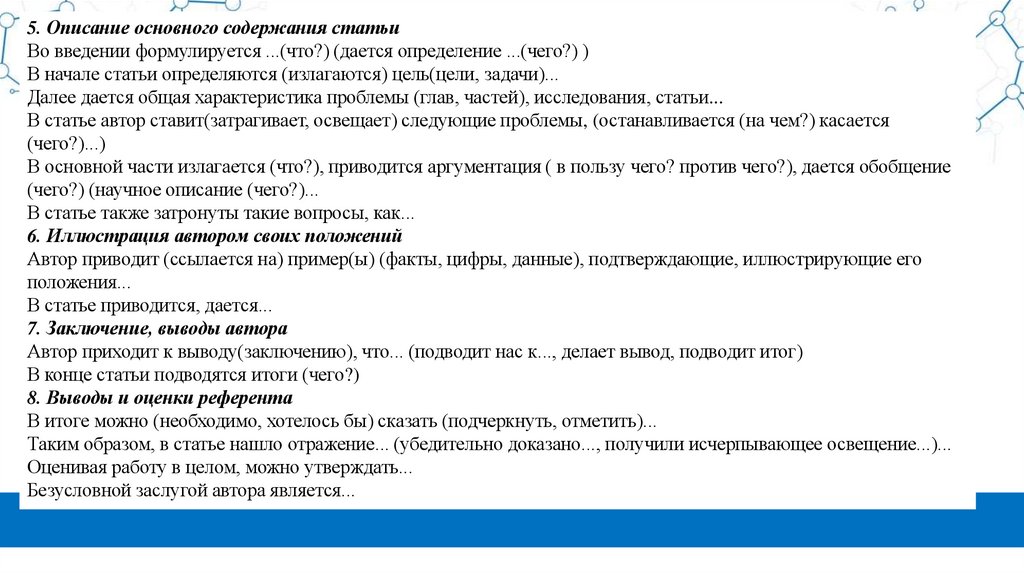
5. Описание основного содержания статьиВо введении формулируется ...(что?) (дается определение ...(чего?) )
В начале статьи определяются (излагаются) цель(цели, задачи)...
Далее дается общая характеристика проблемы (глав, частей), исследования, статьи...
В статье автор ставит(затрагивает, освещает) следующие проблемы, (останавливается (на чем?) касается
(чего?)...)
В основной части излагается (что?), приводится аргументация ( в пользу чего? против чего?), дается обобщение
(чего?) (научное описание (чего?)...
В статье также затронуты такие вопросы, как...
6. Иллюстрация автором своих положений
Автор приводит (ссылается на) пример(ы) (факты, цифры, данные), подтверждающие, иллюстрирующие его
положения...
В статье приводится, дается...
7. Заключение, выводы автора
Автор приходит к выводу(заключению), что... (подводит нас к..., делает вывод, подводит итог)
В конце статьи подводятся итоги (чего?)
8. Выводы и оценки референта
В итоге можно (необходимо, хотелось бы) сказать (подчеркнуть, отметить)...
Таким образом, в статье нашло отражение... (убедительно доказано..., получили исчерпывающее освещение...)...
Оценивая работу в целом, можно утверждать...
Безусловной заслугой автора является...
15.
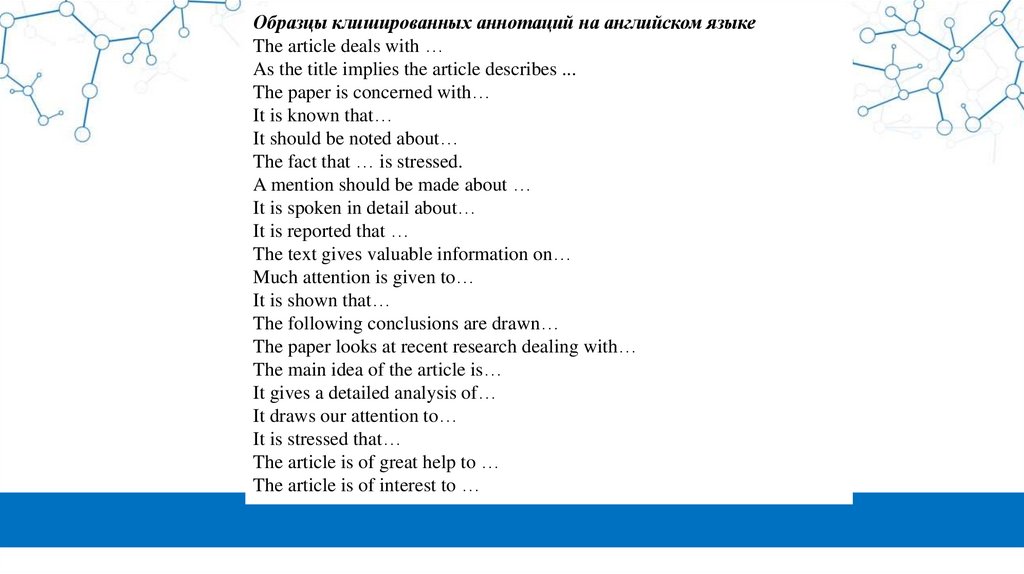
Образцы клишированных аннотаций на английском языкеThe article deals with …
As the title implies the article describes ...
The paper is concerned with…
It is known that…
It should be noted about…
The fact that … is stressed.
A mention should be made about …
It is spoken in detail about…
It is reported that …
The text gives valuable information on…
Much attention is given to…
It is shown that…
The following conclusions are drawn…
The paper looks at recent research dealing with…
The main idea of the article is…
It gives a detailed analysis of…
It draws our attention to…
It is stressed that…
The article is of great help to …
The article is of interest to …
16.
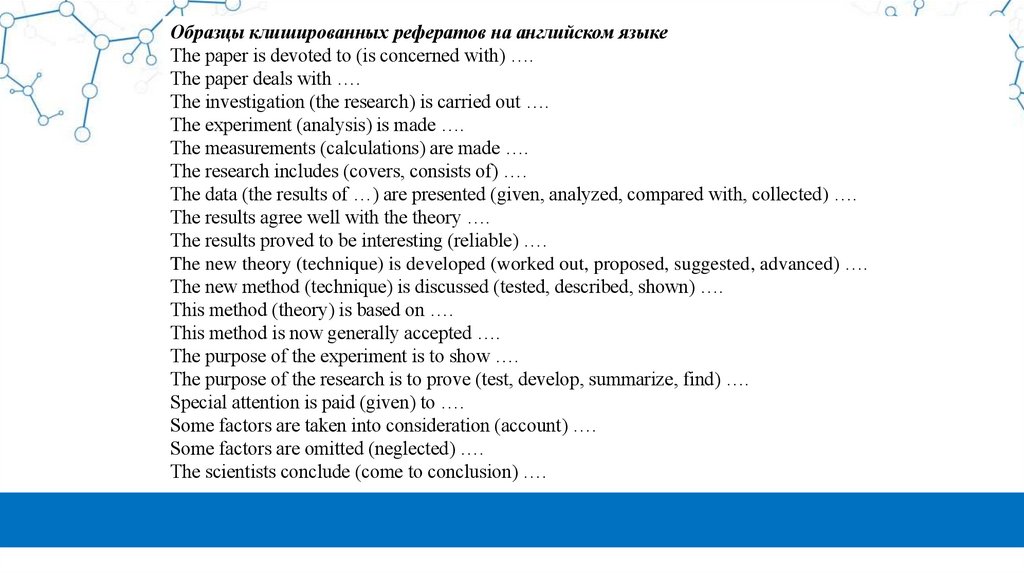
Образцы клишированных рефератов на английском языкеThe paper is devoted to (is concerned with) ….
The paper deals with ….
The investigation (the research) is carried out ….
The experiment (analysis) is made ….
The measurements (calculations) are made ….
The research includes (covers, consists of) ….
The data (the results of …) are presented (given, analyzed, compared with, collected) ….
The results agree well with the theory ….
The results proved to be interesting (reliable) ….
The new theory (technique) is developed (worked out, proposed, suggested, advanced) ….
The new method (technique) is discussed (tested, described, shown) ….
This method (theory) is based on ….
This method is now generally accepted ….
The purpose of the experiment is to show ….
The purpose of the research is to prove (test, develop, summarize, find) ….
Special attention is paid (given) to ….
Some factors are taken into consideration (account) ….
Some factors are omitted (neglected) ….
The scientists conclude (come to conclusion) ….
17.
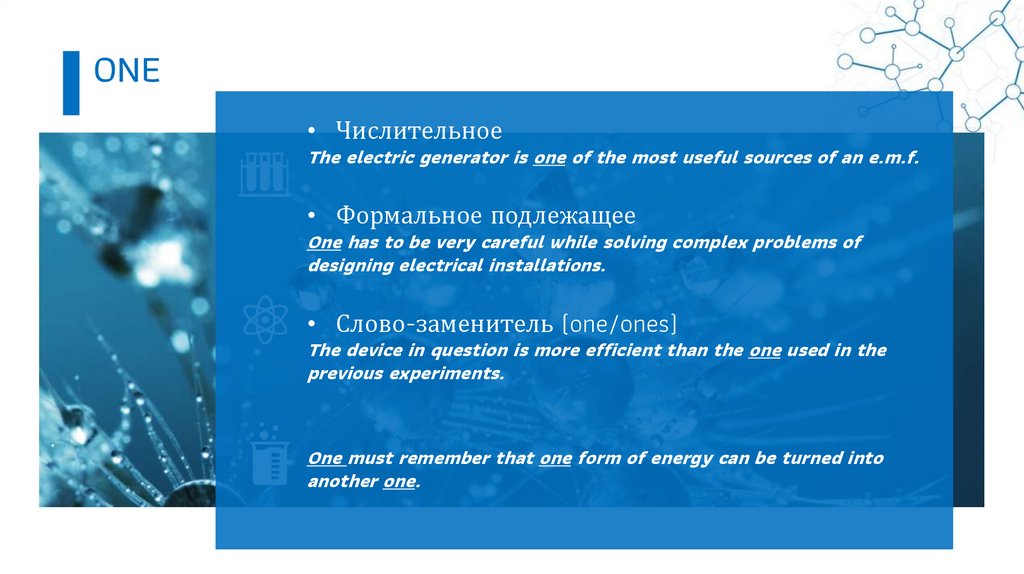
ONE• Числительное
The electric generator is one of the most useful sources of an e.m.f.
• Формальное подлежащее
One has to be very careful while solving complex problems of
designing electrical installations.
• Слово-заменитель (one/ones)
The device in question is more efficient than the one used in the
previous experiments.
One must remember that one form of energy can be turned into
another one.
18.
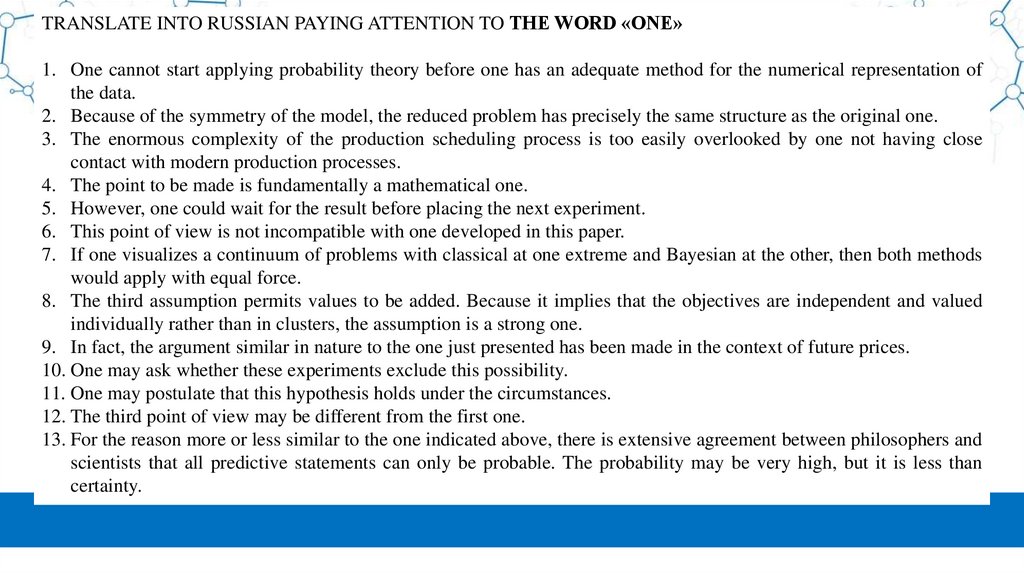
TRANSLATE INTO RUSSIAN PAYING ATTENTION TO THE WORD «ONE»1. One cannot start applying probability theory before one has an adequate method for the numerical representation of
the data.
2. Because of the symmetry of the model, the reduced problem has precisely the same structure as the original one.
3. The enormous complexity of the production scheduling process is too easily overlooked by one not having close
contact with modern production processes.
4. The point to be made is fundamentally a mathematical one.
5. However, one could wait for the result before placing the next experiment.
6. This point of view is not incompatible with one developed in this paper.
7. If one visualizes a continuum of problems with classical at one extreme and Bayesian at the other, then both methods
would apply with equal force.
8. The third assumption permits values to be added. Because it implies that the objectives are independent and valued
individually rather than in clusters, the assumption is a strong one.
9. In fact, the argument similar in nature to the one just presented has been made in the context of future prices.
10. One may ask whether these experiments exclude this possibility.
11. One may postulate that this hypothesis holds under the circumstances.
12. The third point of view may be different from the first one.
13. For the reason more or less similar to the one indicated above, there is extensive agreement between philosophers and
scientists that all predictive statements can only be probable. The probability may be very high, but it is less than
certainty.
19.
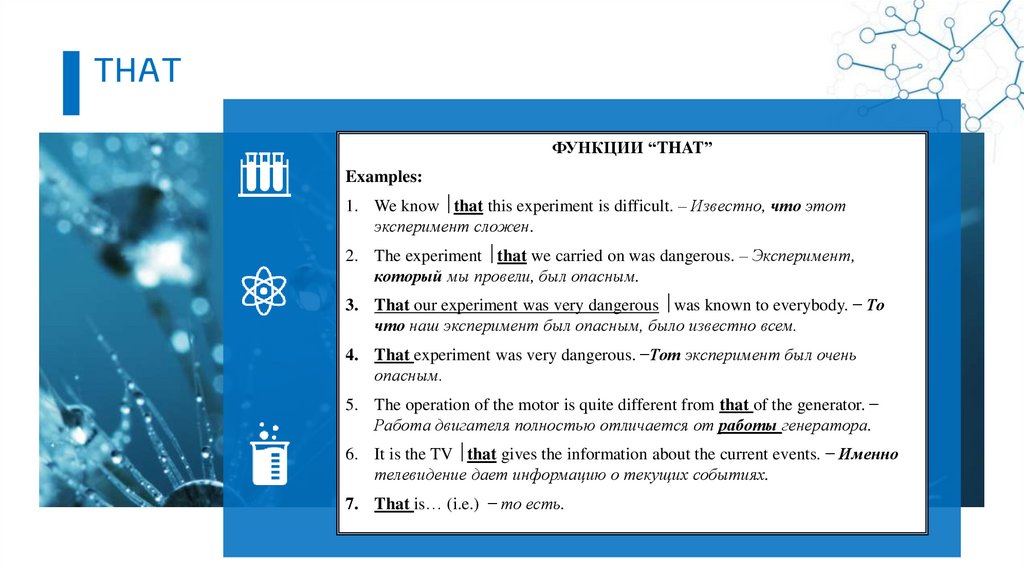
THATФУНКЦИИ “THAT”
Examples:
1. We know that this experiment is difficult. – Известно, что этот
эксперимент сложен.
2. The experiment that we carried on was dangerous. – Эксперимент,
который мы провели, был опасным.
3. That our experiment was very dangerous was known to everybody. ̶ То
что наш эксперимент был опасным, было известно всем.
4. That experiment was very dangerous. ̶ Тот эксперимент был очень
опасным.
5. The operation of the motor is quite different from that of the generator. ̶
Работа двигателя полностью отличается от работы генератора.
6. It is the TV that gives the information about the current events. ̶ Именно
телевидение дает информацию о текущих событиях.
7. That is… (i.e.) ̶ то есть.
20.
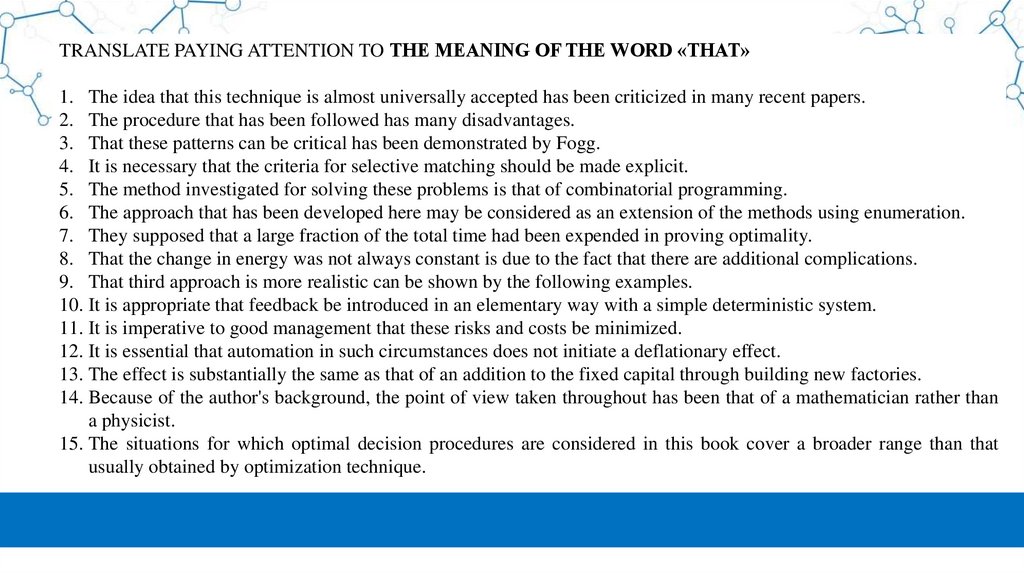
TRANSLATE PAYING ATTENTION TO THE MEANING OF THE WORD «THAT»1. The idea that this technique is almost universally accepted has been criticized in many recent papers.
2. The procedure that has been followed has many disadvantages.
3. That these patterns can be critical has been demonstrated by Fogg.
4. It is necessary that the criteria for selective matching should be made explicit.
5. The method investigated for solving these problems is that of combinatorial programming.
6. The approach that has been developed here may be considered as an extension of the methods using enumeration.
7. They supposed that a large fraction of the total time had been expended in proving optimality.
8. That the change in energy was not always constant is due to the fact that there are additional complications.
9. That third approach is more realistic can be shown by the following examples.
10. It is appropriate that feedback be introduced in an elementary way with a simple deterministic system.
11. It is imperative to good management that these risks and costs be minimized.
12. It is essential that automation in such circumstances does not initiate a deflationary effect.
13. The effect is substantially the same as that of an addition to the fixed capital through building new factories.
14. Because of the author's background, the point of view taken throughout has been that of a mathematician rather than
a physicist.
15. The situations for which optimal decision procedures are considered in this book cover a broader range than that
usually obtained by optimization technique.
21.
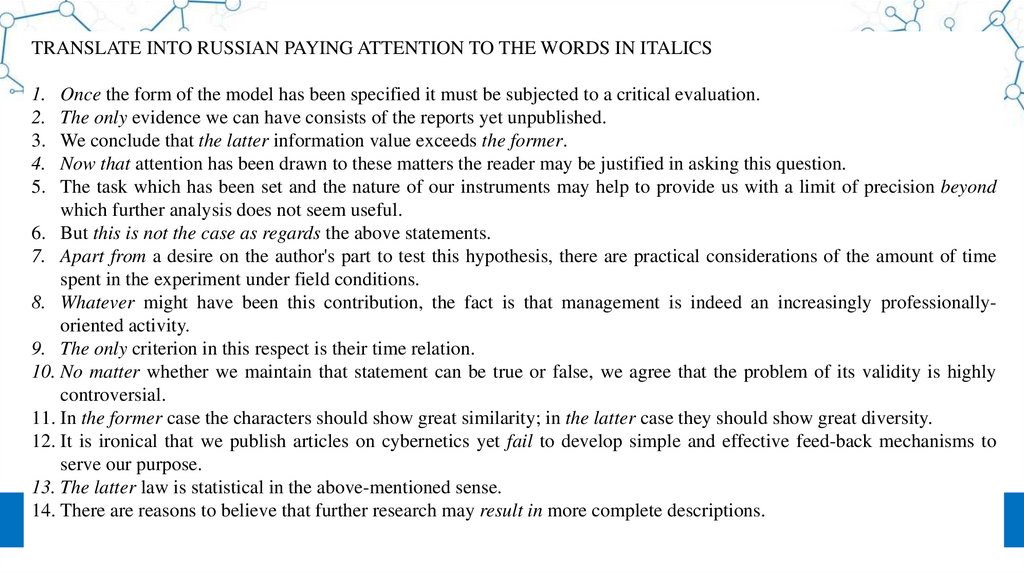
TRANSLATE INTO RUSSIAN PAYING ATTENTION TO THE WORDS IN ITALICS1.
2.
3.
4.
5.
Once the form of the model has been specified it must be subjected to a critical evaluation.
The only evidence we can have consists of the reports yet unpublished.
We conclude that the latter information value exceeds the former.
Now that attention has been drawn to these matters the reader may be justified in asking this question.
The task which has been set and the nature of our instruments may help to provide us with a limit of precision beyond
which further analysis does not seem useful.
6. But this is not the case as regards the above statements.
7. Apart from a desire on the author's part to test this hypothesis, there are practical considerations of the amount of time
spent in the experiment under field conditions.
8. Whatever might have been this contribution, the fact is that management is indeed an increasingly professionallyoriented activity.
9. The only criterion in this respect is their time relation.
10. No matter whether we maintain that statement can be true or false, we agree that the problem of its validity is highly
controversial.
11. In the former case the characters should show great similarity; in the latter case they should show great diversity.
12. It is ironical that we publish articles on cybernetics yet fail to develop simple and effective feed-back mechanisms to
serve our purpose.
13. The latter law is statistical in the above-mentioned sense.
14. There are reasons to believe that further research may result in more complete descriptions.
22.
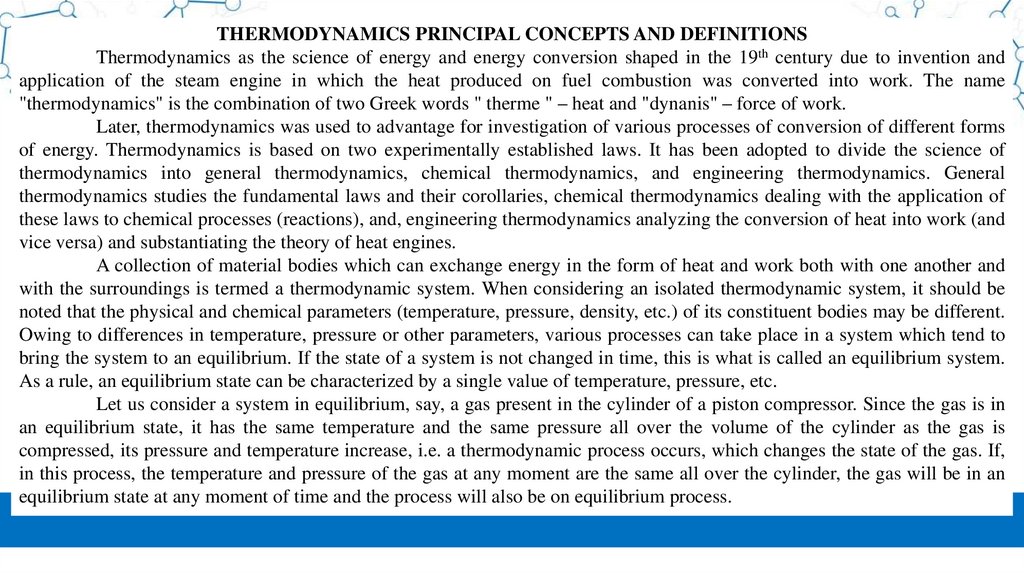
THERMODYNAMICS PRINCIPAL CONCEPTS AND DEFINITIONSThermodynamics as the science of energy and energy conversion shaped in the 19th century due to invention and
application of the steam engine in which the heat produced on fuel combustion was converted into work. The name
"thermodynamics" is the combination of two Greek words " therme " – heat and "dynanis" – force of work.
Later, thermodynamics was used to advantage for investigation of various processes of conversion of different forms
of energy. Thermodynamics is based on two experimentally established laws. It has been adopted to divide the science of
thermodynamics into general thermodynamics, chemical thermodynamics, and engineering thermodynamics. General
thermodynamics studies the fundamental laws and their corollaries, chemical thermodynamics dealing with the application of
these laws to chemical processes (reactions), and, engineering thermodynamics analyzing the conversion of heat into work (and
vice versa) and substantiating the theory of heat engines.
A collection of material bodies which can exchange energy in the form of heat and work both with one another and
with the surroundings is termed a thermodynamic system. When considering an isolated thermodynamic system, it should be
noted that the physical and chemical parameters (temperature, pressure, density, etc.) of its constituent bodies may be different.
Owing to differences in temperature, pressure or other parameters, various processes can take place in a system which tend to
bring the system to an equilibrium. If the state of a system is not changed in time, this is what is called an equilibrium system.
As a rule, an equilibrium state can be characterized by a single value of temperature, pressure, etc.
Let us consider a system in equilibrium, say, a gas present in the cylinder of a piston compressor. Since the gas is in
an equilibrium state, it has the same temperature and the same pressure all over the volume of the cylinder as the gas is
compressed, its pressure and temperature increase, i.e. a thermodynamic process occurs, which changes the state of the gas. If,
in this process, the temperature and pressure of the gas at any moment are the same all over the cylinder, the gas will be in an
equilibrium state at any moment of time and the process will also be on equilibrium process.
23.
Key Concepts in Industrial Protection Relay NetworksAbstract:
Protective relays at industrial facilities are interconnected (or networked) in a wide variety
of ways, for many different purposes. The intended uses of the network and the nature of
the protected system must determine the way in which the network is implemented. While
industrial networks have some commonality with networks at transmission and
distribution utilities, there are also differences necessitating an industry-specific approach.
This paper will review the different purposes of protective relay networks and provide an
overview of network architecture and implementation issues. Various protocols and
architectures will be reviewed with attention to their capabilities for tasks important for an
industrial site such as transfer tripping, arc flash incident energy reduction, alarm and
status monitoring, and data logging. References to existing papers and standards will be
provided to the extent that they are useful for an industrial facility.
24.
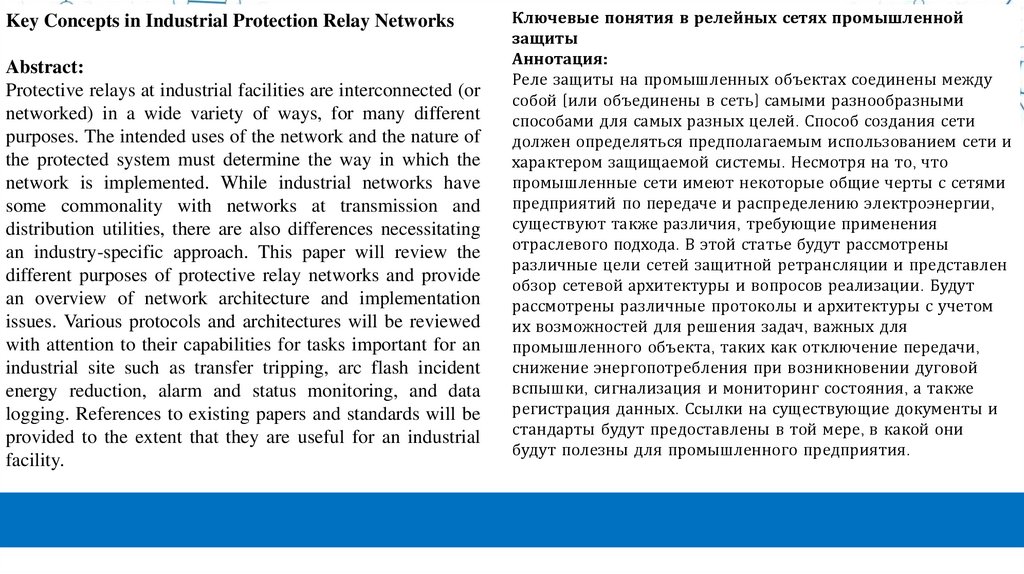
Key Concepts in Industrial Protection Relay NetworksAbstract:
Protective relays at industrial facilities are interconnected (or
networked) in a wide variety of ways, for many different
purposes. The intended uses of the network and the nature of
the protected system must determine the way in which the
network is implemented. While industrial networks have
some commonality with networks at transmission and
distribution utilities, there are also differences necessitating
an industry-specific approach. This paper will review the
different purposes of protective relay networks and provide
an overview of network architecture and implementation
issues. Various protocols and architectures will be reviewed
with attention to their capabilities for tasks important for an
industrial site such as transfer tripping, arc flash incident
energy reduction, alarm and status monitoring, and data
logging. References to existing papers and standards will be
provided to the extent that they are useful for an industrial
facility.
Ключевые понятия в релейных сетях промышленной
защиты
Аннотация:
Реле защиты на промышленных объектах соединены между
собой (или объединены в сеть) самыми разнообразными
способами для самых разных целей. Способ создания сети
должен определяться предполагаемым использованием сети и
характером защищаемой системы. Несмотря на то, что
промышленные сети имеют некоторые общие черты с сетями
предприятий по передаче и распределению электроэнергии,
существуют также различия, требующие применения
отраслевого подхода. В этой статье будут рассмотрены
различные цели сетей защитной ретрансляции и представлен
обзор сетевой архитектуры и вопросов реализации. Будут
рассмотрены различные протоколы и архитектуры с учетом
их возможностей для решения задач, важных для
промышленного объекта, таких как отключение передачи,
снижение энергопотребления при возникновении дуговой
вспышки, сигнализация и мониторинг состояния, а также
регистрация данных. Ссылки на существующие документы и
стандарты будут предоставлены в той мере, в какой они
будут полезны для промышленного предприятия.