 Английский язык
Похожие презентации:









Rainbow English
1.
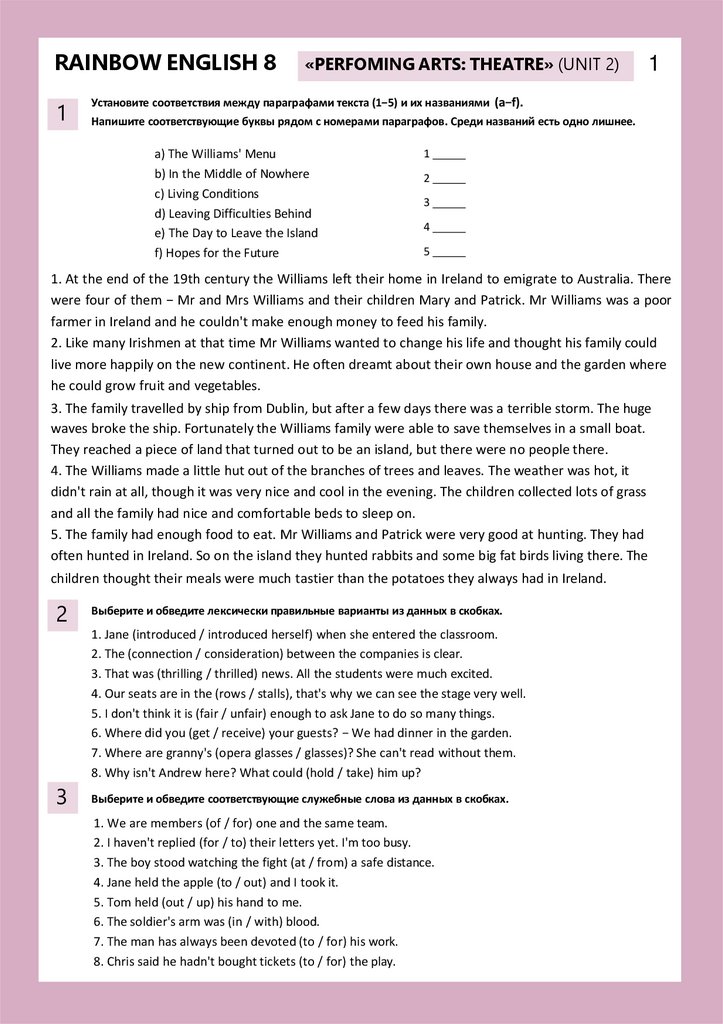
RAINBOW ENGLISH 81
«PERFOMING ARTS: THEATRE» (UNIT 2)
1
Установите соответствия между параграфами текста (1−5) и их названиями (a−f).
Напишите соответствующие буквы рядом с номерами параграфов. Среди названий есть одно лишнее.
a) The Williams' Menu
b) In the Middle of Nowhere
c) Living Conditions
d) Leaving Difficulties Behind
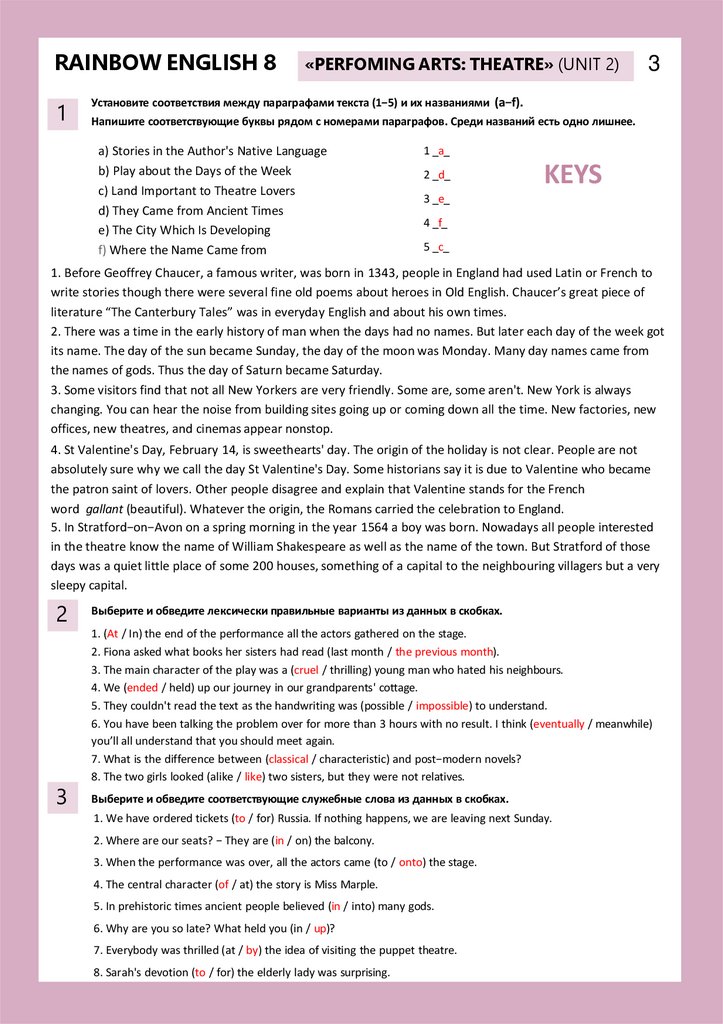
e) The Day to Leave the Island
f) Hopes for the Future
1
2
3
4
5
1. At the end of the 19th century the Williams left their home in Ireland to emigrate to Australia. There
were four of them − Mr and Mrs Williams and their children Mary and Patrick. Mr Williams was a poor
farmer in Ireland and he couldn't make enough money to feed his family.
2. Like many Irishmen at that time Mr Williams wanted to change his life and thought his family could
live more happily on the new continent. He often dreamt about their own house and the garden where
he could grow fruit and vegetables.
3. The family travelled by ship from Dublin, but after a few days there was a terrible storm. The huge
waves broke the ship. Fortunately the Williams family were able to save themselves in a small boat.
They reached a piece of land that turned out to be an island, but there were no people there.
4. The Williams made a little hut out of the branches of trees and leaves. The weather was hot, it
didn't rain at all, though it was very nice and cool in the evening. The children collected lots of grass
and all the family had nice and comfortable beds to sleep on.
5. The family had enough food to eat. Mr Williams and Patrick were very good at hunting. They had
often hunted in Ireland. So on the island they hunted rabbits and some big fat birds living there. The
children thought their meals were much tastier than the potatoes they always had in Ireland.
2
Выберите и обведите лексически правильные варианты из данных в скобках.
1. Jane (introduced / introduced herself) when she entered the classroom.
2. The (connection / consideration) between the companies is clear.
3. That was (thrilling / thrilled) news. All the students were much excited.
4. Our seats are in the (rows / stalls), that's why we can see the stage very well.
5. I don't think it is (fair / unfair) enough to ask Jane to do so many things.
6. Where did you (get / receive) your guests? − We had dinner in the garden.
7. Where are granny's (opera glasses / glasses)? She can't read without them.
8. Why isn't Andrew here? What could (hold / take) him up?
3
Выберите и обведите соответствующие служебные слова из данных в скобках.
1. We are members (of / for) one and the same team.
2. I haven't replied (for / to) their letters yet. I'm too busy.
3. The boy stood watching the fight (at / from) a safe distance.
4. Jane held the apple (to / out) and I took it.
5. Tom held (out / up) his hand to me.
6. The soldier's arm was (in / with) blood.
7. The man has always been devoted (to / for) his work.
8. Chris said he hadn't bought tickets (to / for) the play.
2.
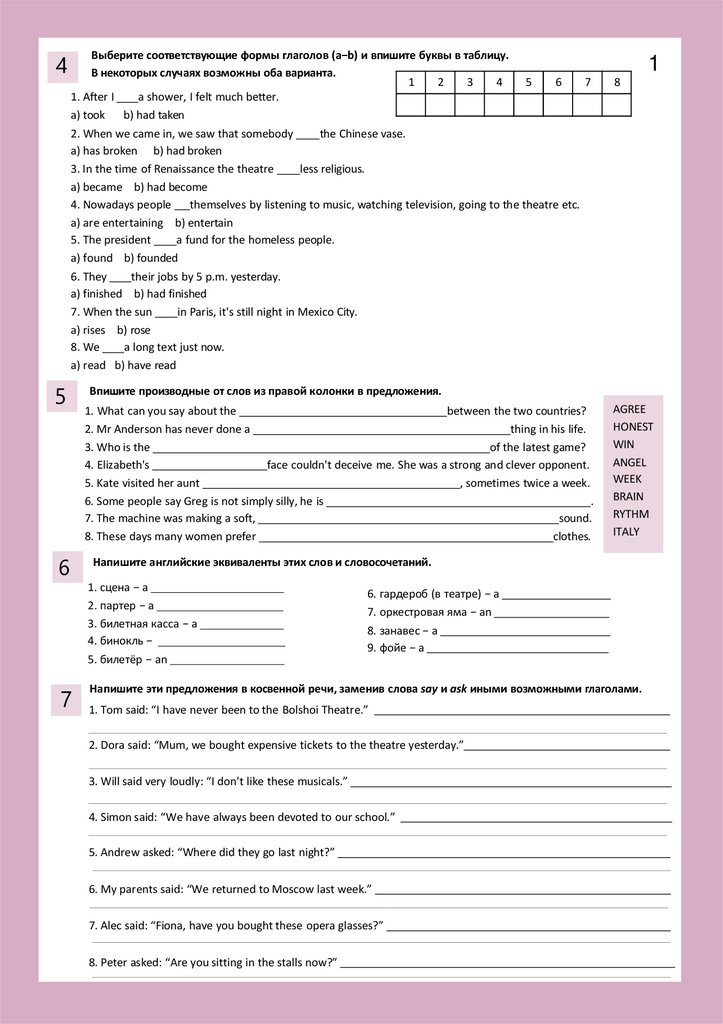
4Выберите соответствующие формы глаголов (a−b) и впишите буквы в таблицу.
В некоторых случаях возможны оба варианта.
1
2
3
4
1. After I
a shower, I felt much better.
a) took
b) had taken
2. When we came in, we saw that somebody
a) has broken b) had broken
3. In the time of Renaissance the theatre
1
5
6
7
8
the Chinese vase.
less religious.
a) became b) had become
4. Nowadays people
themselves by listening to music, watching television, going to the theatre etc.
a) are entertaining b) entertain
5. The president
a fund for the homeless people.
a) found b) founded
6. They
their jobs by 5 p.m. yesterday.
a) finished b) had finished
7. When the sun
in Paris, it's still night in Mexico City.
a) rises b) rose
8. We
a long text just now.
a) read b) have read
5
Впишите производные от слов из правой колонки в предложения.
1. What can you say about the
between the two countries?
2. Mr Anderson has never done a
3. Who is the
4. Elizabeth's
thing in his life.
of the latest game?
face couldn't deceive me. She was a strong and clever opponent.
5. Kate visited her aunt
6
.
sound.
8. These days many women prefer
clothes.
ANGEL
WEEK
BRAIN
RYTHM
ITALY
Напишите английские эквиваленты этих слов и словосочетаний.
1. сцена − a
2. партер − a
3. билетная касса − a
4. бинокль −
5. билетёр − an
7
, sometimes twice a week.
6. Some people say Greg is not simply silly, he is
7. The machine was making a soft,
AGREE
HONEST
WIN
6. гардероб (в театре) − a
7. оркестровая яма − an
8. занавес − a
9. фойе − a
Напишите эти предложения в косвенной речи, заменив слова say и ask иными возможными глаголами.
1. Tom said: “I have never been to the Bolshoi Theatre.”
2. Dora said: “Mum, we bought expensive tickets to the theatre yesterday.”
3. Will said very loudly: “I don't like these musicals.”
4. Simon said: “We have always been devoted to our school.”
5. Andrew asked: “Where did they go last night?”
6. My parents said: “We returned to Moscow last week.”
7. Alec said: “Fiona, have you bought these opera glasses?”
8. Peter asked: “Are you sitting in the stalls now?”
3.
RAINBOW ENGLISH 81
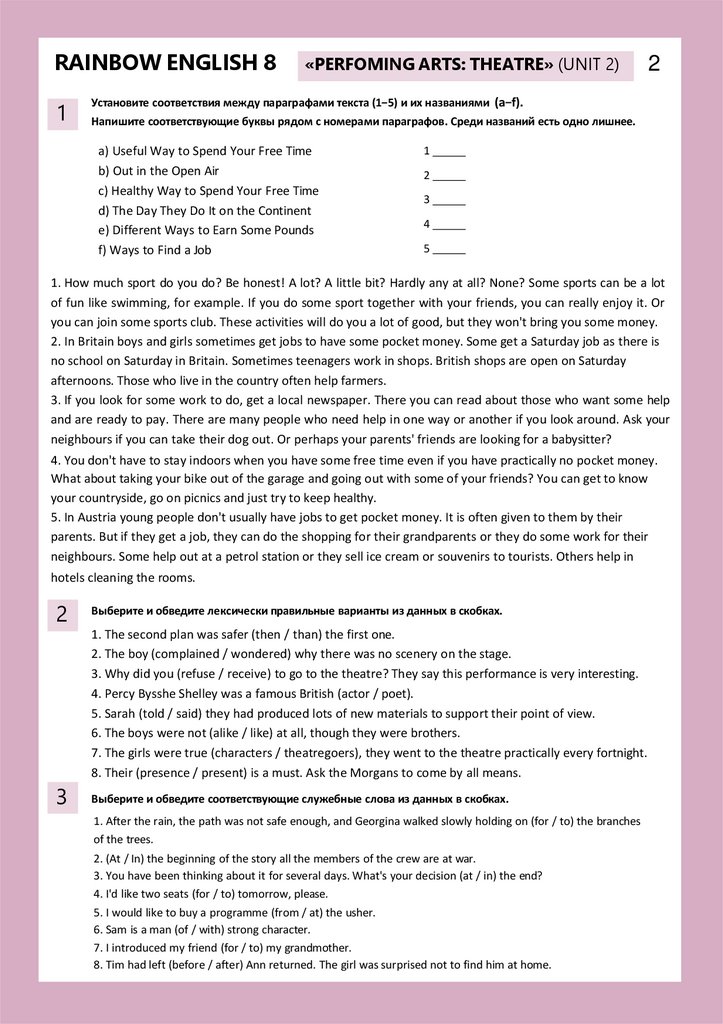
«PERFOMING ARTS: THEATRE» (UNIT 2)
2
Установите соответствия между параграфами текста (1−5) и их названиями (a−f).
Напишите соответствующие буквы рядом с номерами параграфов. Среди названий есть одно лишнее.
a) Useful Way to Spend Your Free Time
b) Out in the Open Air
c) Healthy Way to Spend Your Free Time
d) The Day They Do It on the Continent
e) Different Ways to Earn Some Pounds
f) Ways to Find a Job
1
2
3
4
5
1. How much sport do you do? Be honest! A lot? A little bit? Hardly any at all? None? Some sports can be a lot
of fun like swimming, for example. If you do some sport together with your friends, you can really enjoy it. Or
you can join some sports club. These activities will do you a lot of good, but they won't bring you some money.
2. In Britain boys and girls sometimes get jobs to have some pocket money. Some get a Saturday job as there is
no school on Saturday in Britain. Sometimes teenagers work in shops. British shops are open on Saturday
afternoons. Those who live in the country often help farmers.
3. If you look for some work to do, get a local newspaper. There you can read about those who want some help
and are ready to pay. There are many people who need help in one way or another if you look around. Ask your
neighbours if you can take their dog out. Or perhaps your parents' friends are looking for a babysitter?
4. You don't have to stay indoors when you have some free time even if you have practically no pocket money.
What about taking your bike out of the garage and going out with some of your friends? You can get to know
your countryside, go on picnics and just try to keep healthy.
5. In Austria young people don't usually have jobs to get pocket money. It is often given to them by their
parents. But if they get a job, they can do the shopping for their grandparents or they do some work for their
neighbours. Some help out at a petrol station or they sell ice cream or souvenirs to tourists. Others help in
hotels cleaning the rooms.
2
Выберите и обведите лексически правильные варианты из данных в скобках.
1. The second plan was safer (then / than) the first one.
2. The boy (complained / wondered) why there was no scenery on the stage.
3. Why did you (refuse / receive) to go to the theatre? They say this performance is very interesting.
4. Percy Bysshe Shelley was a famous British (actor / poet).
5. Sarah (told / said) they had produced lots of new materials to support their point of view.
6. The boys were not (alike / like) at all, though they were brothers.
7. The girls were true (characters / theatregoers), they went to the theatre practically every fortnight.
8. Their (presence / present) is a must. Ask the Morgans to come by all means.
3
Выберите и обведите соответствующие служебные слова из данных в скобках.
1. After the rain, the path was not safe enough, and Georgina walked slowly holding on (for / to) the branches
of the trees.
2. (At / In) the beginning of the story all the members of the crew are at war.
3. You have been thinking about it for several days. What's your decision (at / in) the end?
4. I'd like two seats (for / to) tomorrow, please.
5. I would like to buy a programme (from / at) the usher.
6. Sam is a man (of / with) strong character.
7. I introduced my friend (for / to) my grandmother.
8. Tim had left (before / after) Ann returned. The girl was surprised not to find him at home.
4.
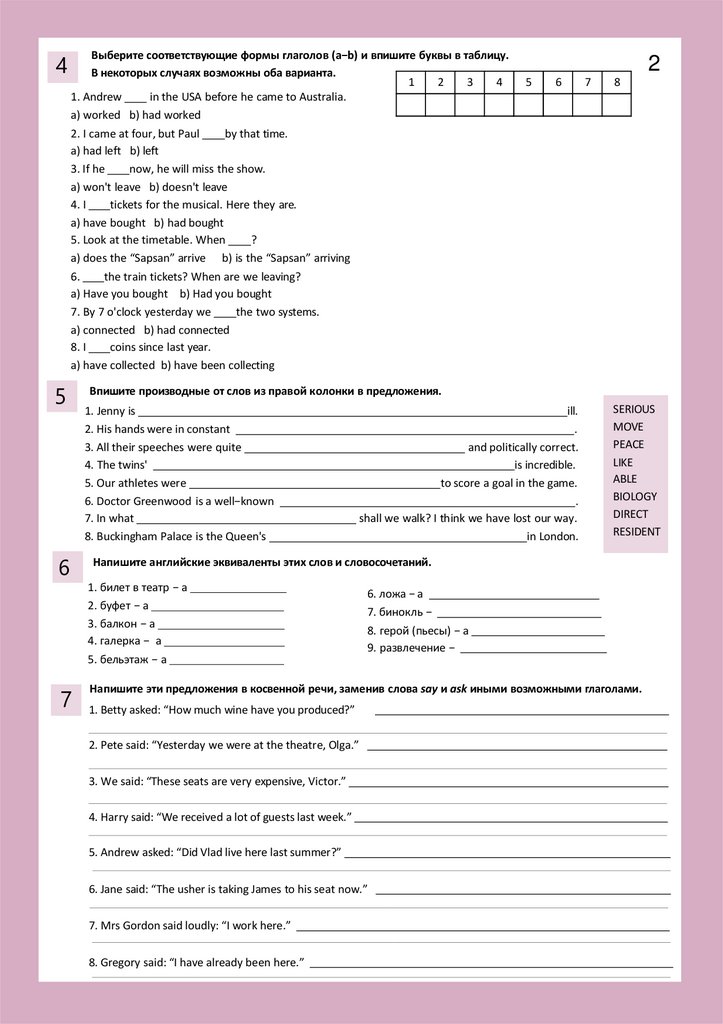
4Выберите соответствующие формы глаголов (a−b) и впишите буквы в таблицу.
В некоторых случаях возможны оба варианта.
1
2
3
4
1. Andrew
in the USA before he came to Australia.
a) worked b) had worked
2. I came at four, but Paul
a) had left b) left
3. If he
2
5
6
7
8
by that time.
now, he will miss the show.
a) won't leave b) doesn't leave
4. I
tickets for the musical. Here they are.
a) have bought b) had bought
5. Look at the timetable. When
?
a) does the “Sapsan” arrive b) is the “Sapsan” arriving
6.
the train tickets? When are we leaving?
a) Have you bought b) Had you bought
7. By 7 o'clock yesterday we
the two systems.
a) connected b) had connected
8. I
coins since last year.
a) have collected b) have been collecting
5
Впишите производные от слов из правой колонки в предложения.
1. Jenny is
ill.
2. His hands were in constant
.
3. All their speeches were quite
4. The twins'
and politically correct.
is incredible.
5. Our athletes were
6
.
shall we walk? I think we have lost our way.
8. Buckingham Palace is the Queen's
in London.
LIKE
ABLE
BIOLOGY
DIRECT
RESIDENT
Напишите английские эквиваленты этих слов и словосочетаний.
1. билет в театр − a
2. буфет − a
3. балкон − a
4. галерка − a
5. бельэтаж − a
7
to score a goal in the game.
6. Doctor Greenwood is a well−known
7. In what
SERIOUS
MOVE
PEACE
6. ложа − a
7. бинокль −
8. герой (пьесы) − a
9. развлечение −
Напишите эти предложения в косвенной речи, заменив слова say и ask иными возможными глаголами.
1. Betty asked: “How much wine have you produced?”
2. Pete said: “Yesterday we were at the theatre, Olga.”
3. We said: “These seats are very expensive, Victor.”
4. Harry said: “We received a lot of guests last week.”
5. Andrew asked: “Did Vlad live here last summer?”
6. Jane said: “The usher is taking James to his seat now.”
7. Mrs Gordon said loudly: “I work here.”
8. Gregory said: “I have already been here.”
5.
RAINBOW ENGLISH 81
«PERFOMING ARTS: THEATRE» (UNIT 2)
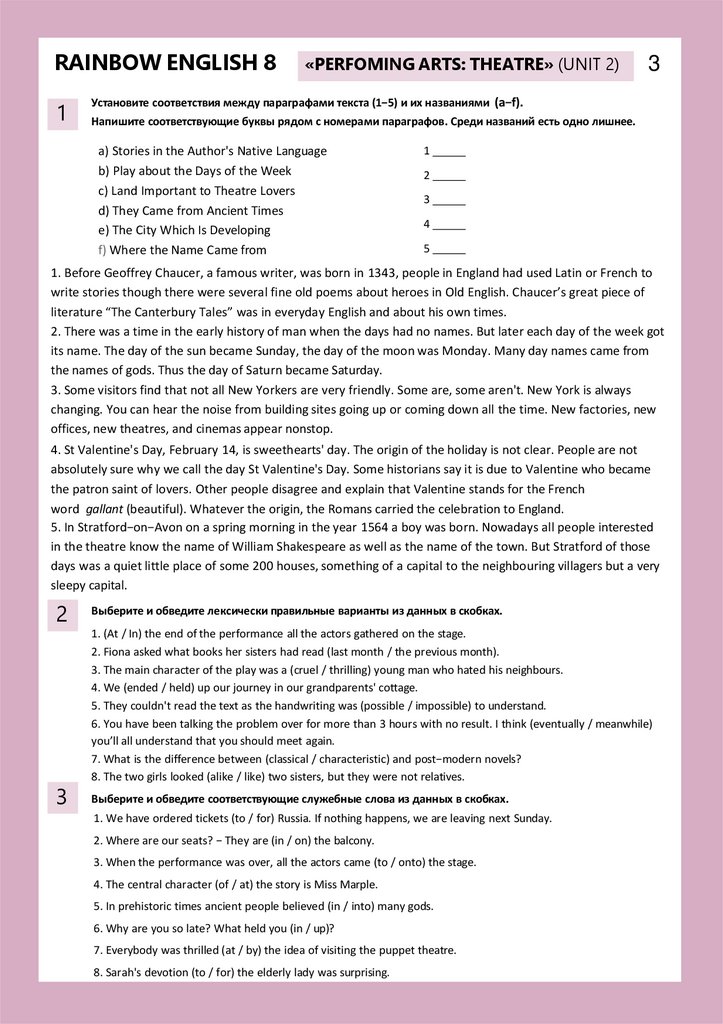
3
Установите соответствия между параграфами текста (1−5) и их названиями (a−f).
Напишите соответствующие буквы рядом с номерами параграфов. Среди названий есть одно лишнее.
a) Stories in the Author's Native Language
b) Play about the Days of the Week
c) Land Important to Theatre Lovers
d) They Came from Ancient Times
e) The City Which Is Developing
f) Where the Name Came from
1
2
3
4
5
1. Before Geoffrey Chaucer, a famous writer, was born in 1343, people in England had used Latin or French to
write stories though there were several fine old poems about heroes in Old English. Chaucer’s great piece of
literature “The Canterbury Tales” was in everyday English and about his own times.
2. There was a time in the early history of man when the days had no names. But later each day of the week got
its name. The day of the sun became Sunday, the day of the moon was Monday. Many day names came from
the names of gods. Thus the day of Saturn became Saturday.
3. Some visitors find that not all New Yorkers are very friendly. Some are, some aren't. New York is always
changing. You can hear the noise from building sites going up or coming down all the time. New factories, new
offices, new theatres, and cinemas appear nonstop.
4. St Valentine's Day, February 14, is sweethearts' day. The origin of the holiday is not clear. People are not
absolutely sure why we call the day St Valentine's Day. Some historians say it is due to Valentine who became
the patron saint of lovers. Other people disagree and explain that Valentine stands for the French
word gallant (beautiful). Whatever the origin, the Romans carried the celebration to England.
5. In Stratford−on−Avon on a spring morning in the year 1564 a boy was born. Nowadays all people interested
in the theatre know the name of William Shakespeare as well as the name of the town. But Stratford of those
days was a quiet little place of some 200 houses, something of a capital to the neighbouring villagers but a very
sleepy capital.
2
Выберите и обведите лексически правильные варианты из данных в скобках.
1. (At / In) the end of the performance all the actors gathered on the stage.
2. Fiona asked what books her sisters had read (last month / the previous month).
3. The main character of the play was a (cruel / thrilling) young man who hated his neighbours.
4. We (ended / held) up our journey in our grandparents' cottage.
5. They couldn't read the text as the handwriting was (possible / impossible) to understand.
6. You have been talking the problem over for more than 3 hours with no result. I think (eventually / meanwhile)
you’ll all understand that you should meet again.
3
7. What is the difference between (classical / characteristic) and post−modern novels?
8. The two girls looked (alike / like) two sisters, but they were not relatives.
Выберите и обведите соответствующие служебные слова из данных в скобках.
1. We have ordered tickets (to / for) Russia. If nothing happens, we are leaving next Sunday.
2. Where are our seats? − They are (in / on) the balcony.
3. When the performance was over, all the actors came (to / onto) the stage.
4. The central character (of / at) the story is Miss Marple.
5. In prehistoric times ancient people believed (in / into) many gods.
6. Why are you so late? What held you (in / up)?
7. Everybody was thrilled (at / by) the idea of visiting the puppet theatre.
8. Sarah's devotion (to / for) the elderly lady was surprising.
6.
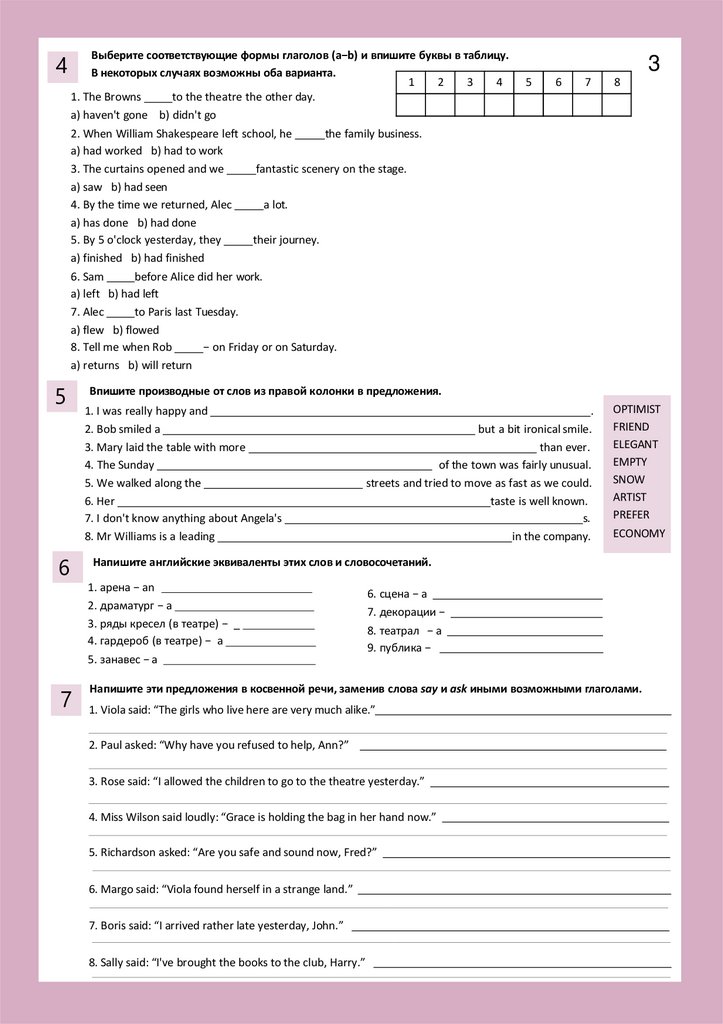
4Выберите соответствующие формы глаголов (a−b) и впишите буквы в таблицу.
В некоторых случаях возможны оба варианта.
1
2
3
4
1. The Browns
to the theatre the other day.
a) haven't gone b) didn't go
2. When William Shakespeare left school, he
a) had worked b) had to work
3. The curtains opened and we
a) saw b) had seen
4. By the time we returned, Alec
a) has done b) had done
5. By 5 o'clock yesterday, they
a) finished b) had finished
3
5
6
7
8
.
taste is well known.
s.
OPTIMIST
FRIEND
ELEGANT
EMPTY
SNOW
ARTIST
PREFER
in the company.
ECONOMY
the family business.
fantastic scenery on the stage.
a lot.
their journey.
6. Sam
before Alice did her work.
a) left b) had left
7. Alec
to Paris last Tuesday.
a) flew b) flowed
8. Tell me when Rob
− on Friday or on Saturday.
a) returns b) will return
5
Впишите производные от слов из правой колонки в предложения.
1. I was really happy and
2. Bob smiled a
but a bit ironical smile.
3. Mary laid the table with more
4. The Sunday
5. We walked along the
than ever.
of the town was fairly unusual.
streets and tried to move as fast as we could.
6. Her
7. I don't know anything about Angela's
8. Mr Williams is a leading
6
Напишите английские эквиваленты этих слов и словосочетаний.
1. арена − an
2. драматург − a
3. ряды кресел (в театре) − _
4. гардероб (в театре) − a
5. занавес − a
7
6. сцена − a
7. декорации −
8. театрал − a
9. публика −
Напишите эти предложения в косвенной речи, заменив слова say и ask иными возможными глаголами.
1. Viola said: “The girls who live here are very much alike.”
2. Paul asked: “Why have you refused to help, Ann?”
3. Rose said: “I allowed the children to go to the theatre yesterday.”
4. Miss Wilson said loudly: “Grace is holding the bag in her hand now.”
5. Richardson asked: “Are you safe and sound now, Fred?”
6. Margo said: “Viola found herself in a strange land.”
7. Boris said: “I arrived rather late yesterday, John.”
8. Sally said: “I've brought the books to the club, Harry.”
7.
RAINBOW ENGLISH 81
«PERFOMING ARTS: THEATRE» (UNIT 2)
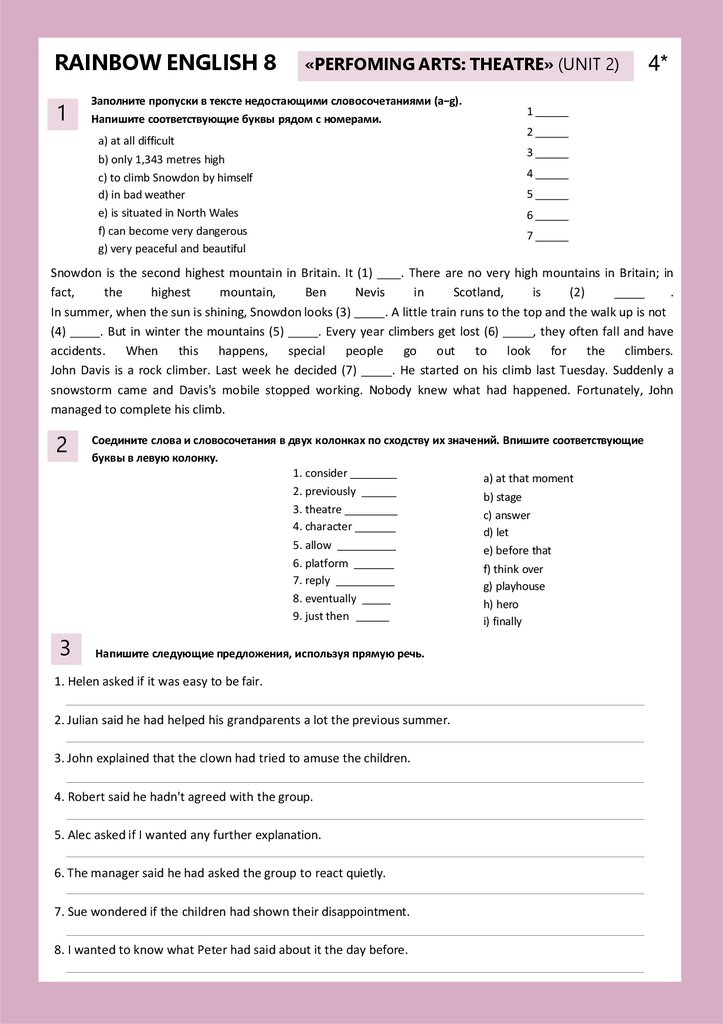
Заполните пропуски в тексте недостающими словосочетаниями (a−g).
Напишите соответствующие буквы рядом с номерами.
4*
1
2
a) at all difficult
3
b) only 1,343 metres high
c) to climb Snowdon by himself
d) in bad weather
4
e) is situated in North Wales
6
f) can become very dangerous
g) very peaceful and beautiful
7
5
Snowdon is the second highest mountain in Britain. It (1)
. There are no very high mountains in Britain; in
fact,
the
highest
mountain,
Ben
Nevis
in
Scotland,
is
(2)
.
In summer, when the sun is shining, Snowdon looks (3)
. A little train runs to the top and the walk up is not
(4)
. But in winter the mountains (5)
. Every year climbers get lost (6)
, they often fall and have
accidents. When this happens, special people
go out to look
for the climbers.
John Davis is a rock climber. Last week he decided (7)
. He started on his climb last Tuesday. Suddenly a
snowstorm came and Davis's mobile stopped working. Nobody knew what had happened. Fortunately, John
managed to complete his climb.
2
3
Соедините слова и словосочетания в двух колонках по сходству их значений. Впишите соответствующие
буквы в левую колонку.
1. consider
a) at that moment
2. previously
b) stage
3. theatre
4. character
c) answer
d) let
5. allow
e) before that
6. platform
7. reply
f) think over
g) playhouse
8. eventually
9. just then
h) hero
i) finally
Напишите следующие предложения, используя прямую речь.
1. Helen asked if it was easy to be fair.
2. Julian said he had helped his grandparents a lot the previous summer.
3. John explained that the clown had tried to amuse the children.
4. Robert said he hadn't agreed with the group.
5. Alec asked if I wanted any further explanation.
6. The manager said he had asked the group to react quietly.
7. Sue wondered if the children had shown their disappointment.
8. I wanted to know what Peter had said about it the day before.
8.
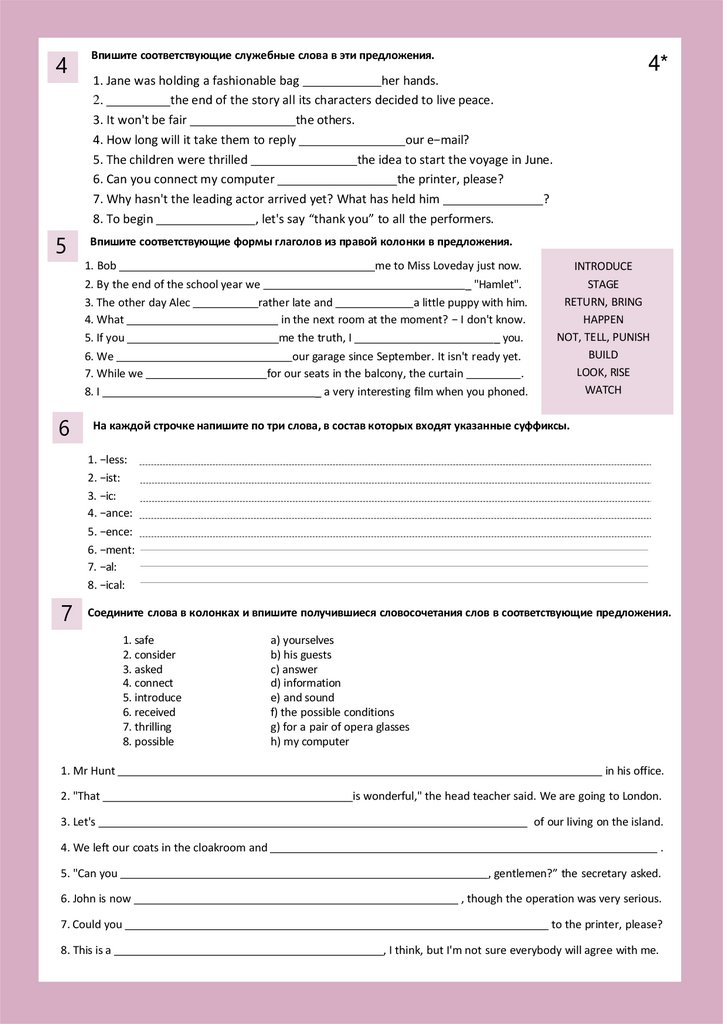
4Впишите соответствующие служебные слова в эти предложения.
5
Впишите соответствующие формы глаголов из правой колонки в предложения.
1. Bob
me to Miss Loveday just now.
2. By the end of the school year we
3. The other day Alec
4. What
_ "Hamlet".
rather late and
a little puppy with him.
in the next room at the moment? − I don't know.
5. If you
6. We
7. While we
me the truth, I
_ you.
our garage since September. It isn't ready yet.
for our seats in the balcony, the curtain
.
8. I
6
4*
1. Jane was holding a fashionable bag
her hands.
2.
the end of the story all its characters decided to live peace.
3. It won't be fair
the others.
4. How long will it take them to reply
our e−mail?
5. The children were thrilled
the idea to start the voyage in June.
6. Can you connect my computer
the printer, please?
7. Why hasn't the leading actor arrived yet? What has held him
?
8. To begin
, let's say “thank you” to all the performers.
_ a very interesting film when you phoned.
INTRODUCE
STAGE
RETURN, BRING
HAPPEN
NOT, TELL, PUNISH
BUILD
LOOK, RISE
WATCH
На каждой строчке напишите по три слова, в состав которых входят указанные суффиксы.
1. −less:
2. −ist:
3. −ic:
4. −ance:
5. −ence:
6. −ment:
7. −al:
8. −ical:
7 Соедините слова в колонках и впишите получившиеся словосочетания слов в соответствующие предложения.
1. safe
2. consider
3. asked
4. connect
5. introduce
6. received
7. thrilling
8. possible
1. Mr Hunt
a) yourselves
b) his guests
c) answer
d) information
e) and sound
f) the possible conditions
g) for a pair of opera glasses
h) my computer
in his office.
2. "That
is wonderful," the head teacher said. We are going to London.
3. Let's
of our living on the island.
4. We left our coats in the cloakroom and
5. "Can you
6. John is now
7. Could you
8. This is a
.
, gentlemen?” the secretary asked.
, though the operation was very serious.
to the printer, please?
, I think, but I'm not sure everybody will agree with me.
9.
RAINBOW ENGLISH 81
«PERFOMING ARTS: THEATRE» (UNIT 2)
1
Установите соответствия между параграфами текста (1−5) и их названиями (a−f).
Напишите соответствующие буквы рядом с номерами параграфов. Среди названий есть одно лишнее.
a) The Williams' Menu
b) In the Middle of Nowhere
c) Living Conditions
d) Leaving Difficulties Behind
e) The Day to Leave the Island
f) Hopes for the Future
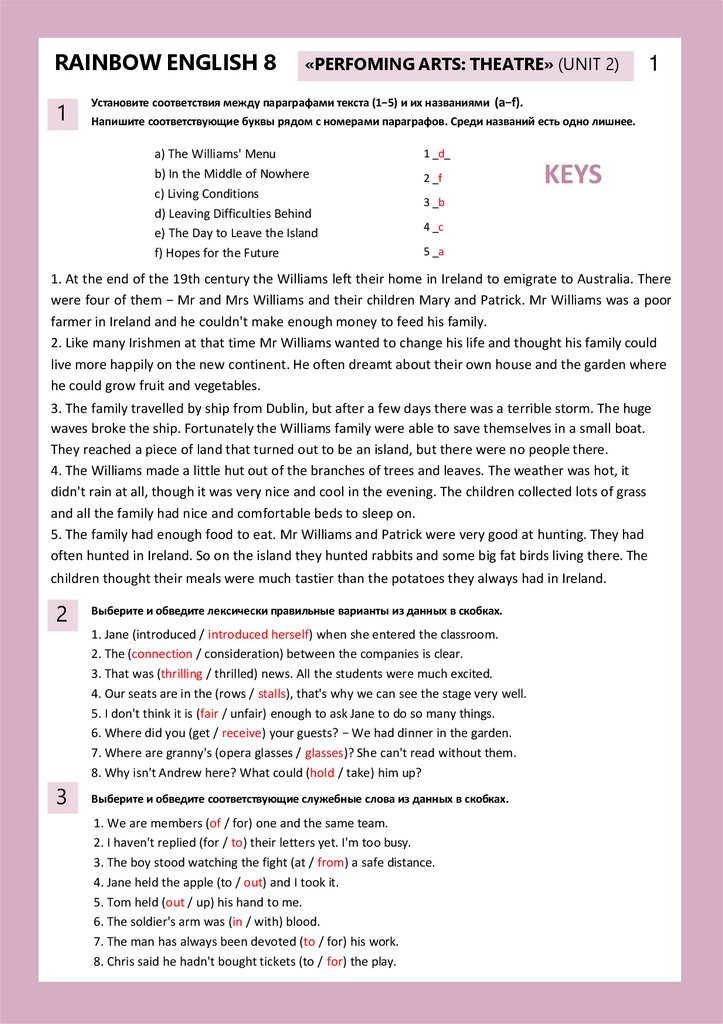
1 _d_
2 _f
KEYS
3 _b
4 _c
5 _a
1. At the end of the 19th century the Williams left their home in Ireland to emigrate to Australia. There
were four of them − Mr and Mrs Williams and their children Mary and Patrick. Mr Williams was a poor
farmer in Ireland and he couldn't make enough money to feed his family.
2. Like many Irishmen at that time Mr Williams wanted to change his life and thought his family could
live more happily on the new continent. He often dreamt about their own house and the garden where
he could grow fruit and vegetables.
3. The family travelled by ship from Dublin, but after a few days there was a terrible storm. The huge
waves broke the ship. Fortunately the Williams family were able to save themselves in a small boat.
They reached a piece of land that turned out to be an island, but there were no people there.
4. The Williams made a little hut out of the branches of trees and leaves. The weather was hot, it
didn't rain at all, though it was very nice and cool in the evening. The children collected lots of grass
and all the family had nice and comfortable beds to sleep on.
5. The family had enough food to eat. Mr Williams and Patrick were very good at hunting. They had
often hunted in Ireland. So on the island they hunted rabbits and some big fat birds living there. The
children thought their meals were much tastier than the potatoes they always had in Ireland.
2
Выберите и обведите лексически правильные варианты из данных в скобках.
1. Jane (introduced / introduced herself) when she entered the classroom.
2. The (connection / consideration) between the companies is clear.
3. That was (thrilling / thrilled) news. All the students were much excited.
4. Our seats are in the (rows / stalls), that's why we can see the stage very well.
5. I don't think it is (fair / unfair) enough to ask Jane to do so many things.
6. Where did you (get / receive) your guests? − We had dinner in the garden.
7. Where are granny's (opera glasses / glasses)? She can't read without them.
8. Why isn't Andrew here? What could (hold / take) him up?
3
Выберите и обведите соответствующие служебные слова из данных в скобках.
1. We are members (of / for) one and the same team.
2. I haven't replied (for / to) their letters yet. I'm too busy.
3. The boy stood watching the fight (at / from) a safe distance.
4. Jane held the apple (to / out) and I took it.
5. Tom held (out / up) his hand to me.
6. The soldier's arm was (in / with) blood.
7. The man has always been devoted (to / for) his work.
8. Chris said he hadn't bought tickets (to / for) the play.
10.
4Выберите соответствующие формы глаголов (a−b) и впишите буквы в таблицу.
В некоторых случаях возможны оба варианта.
1
2
3
4
1. After I
a shower, I felt much better.
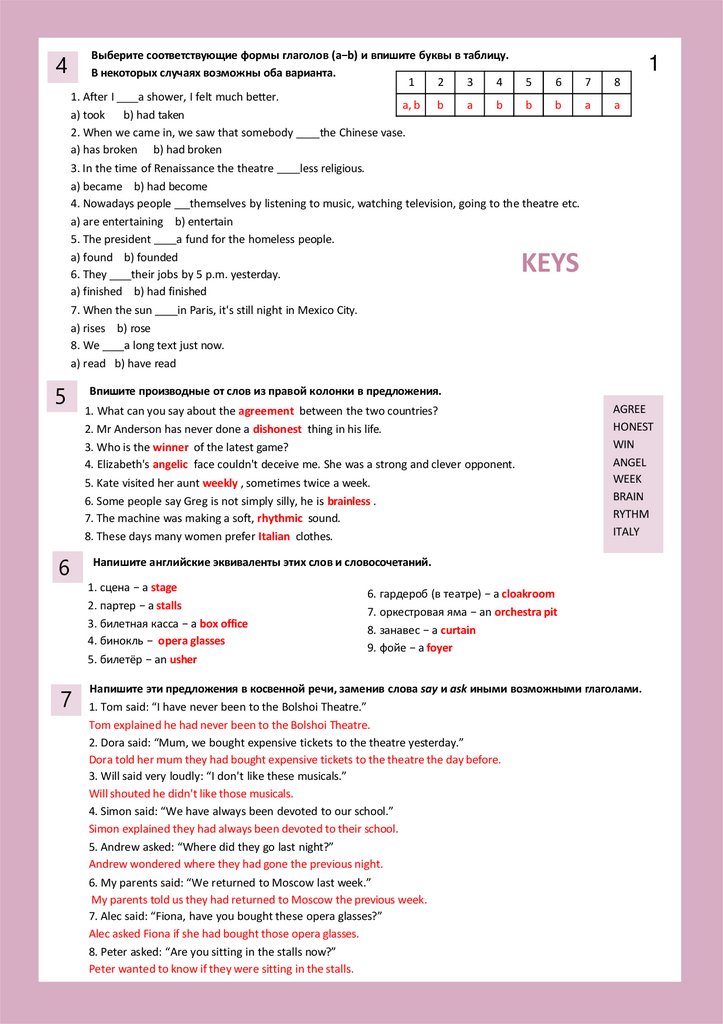
a, b b
a
b
a) took
b) had taken
2. When we came in, we saw that somebody
the Chinese vase.
a) has broken b) had broken
3. In the time of Renaissance the theatre
1
5
6
7
8
b
b
a
a
less religious.
a) became b) had become
4. Nowadays people
themselves by listening to music, watching television, going to the theatre etc.
a) are entertaining b) entertain
5. The president
a fund for the homeless people.
a) found b) founded
6. They
their jobs by 5 p.m. yesterday.
a) finished b) had finished
KEYS
7. When the sun
in Paris, it's still night in Mexico City.
a) rises b) rose
8. We
a long text just now.
a) read b) have read
5
Впишите производные от слов из правой колонки в предложения.
1. What can you say about the agreement between the two countries?
2. Mr Anderson has never done a dishonest thing in his life.
3. Who is the winner of the latest game?
4. Elizabeth's angelic face couldn't deceive me. She was a strong and clever opponent.
5. Kate visited her aunt weekly , sometimes twice a week.
6. Some people say Greg is not simply silly, he is brainless .
7. The machine was making a soft, rhythmic sound.
8. These days many women prefer Italian clothes.
6
ANGEL
WEEK
BRAIN
RYTHM
ITALY
Напишите английские эквиваленты этих слов и словосочетаний.
1. сцена − a stage
2. партер − a stalls
3. билетная касса − a box office
4. бинокль − opera glasses
5. билетёр − an usher
7
AGREE
HONEST
WIN
6. гардероб (в театре) − a cloakroom
7. оркестровая яма − an orchestra pit
8. занавес − a curtain
9. фойе − a foyer
Напишите эти предложения в косвенной речи, заменив слова say и ask иными возможными глаголами.
1. Tom said: “I have never been to the Bolshoi Theatre.”
Tom explained he had never been to the Bolshoi Theatre.
2. Dora said: “Mum, we bought expensive tickets to the theatre yesterday.”
Dora told her mum they had bought expensive tickets to the theatre the day before.
3. Will said very loudly: “I don't like these musicals.”
Will shouted he didn't like those musicals.
4. Simon said: “We have always been devoted to our school.”
Simon explained they had always been devoted to their school.
5. Andrew asked: “Where did they go last night?”
Andrew wondered where they had gone the previous night.
6. My parents said: “We returned to Moscow last week.”
My parents told us they had returned to Moscow the previous week.
7. Alec said: “Fiona, have you bought these opera glasses?”
Alec asked Fiona if she had bought those opera glasses.
8. Peter asked: “Are you sitting in the stalls now?”
Peter wanted to know if they were sitting in the stalls.
11.
RAINBOW ENGLISH 81
«PERFOMING ARTS: THEATRE» (UNIT 2)
2
Установите соответствия между параграфами текста (1−5) и их названиями (a−f).
Напишите соответствующие буквы рядом с номерами параграфов. Среди названий есть одно лишнее.
a) Useful Way to Spend Your Free Time
b) Out in the Open Air
c) Healthy Way to Spend Your Free Time
d) The Day They Do It on the Continent
e) Different Ways to Earn Some Pounds
f) Ways to Find a Job
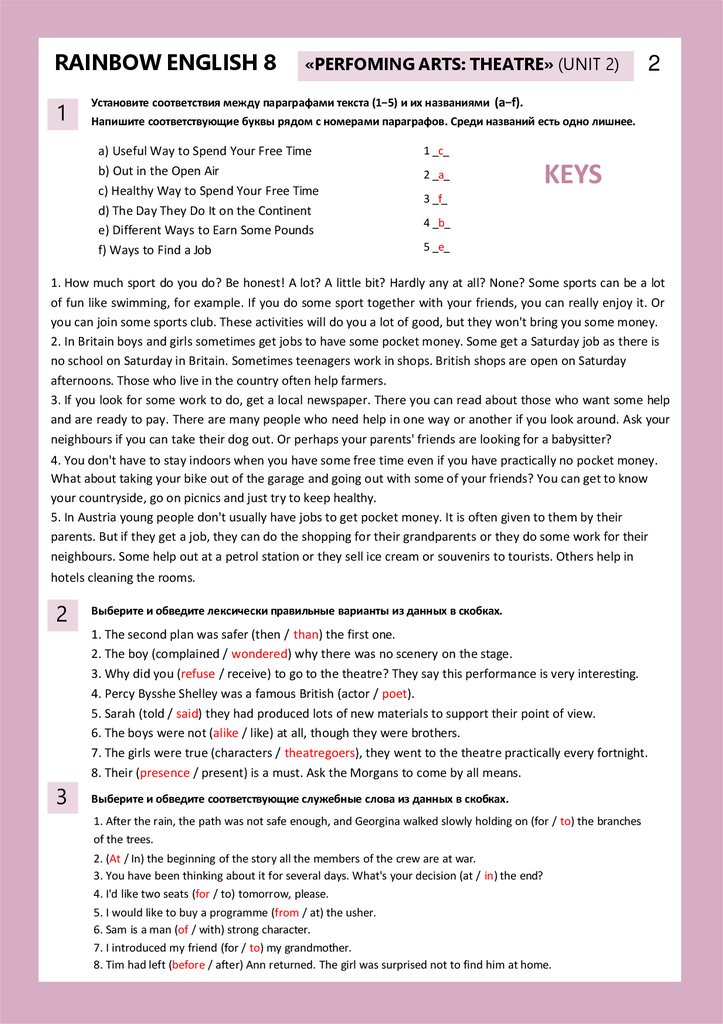
1 _c_
2 _a_
KEYS
3 _f_
4 _b_
5 _e_
1. How much sport do you do? Be honest! A lot? A little bit? Hardly any at all? None? Some sports can be a lot
of fun like swimming, for example. If you do some sport together with your friends, you can really enjoy it. Or
you can join some sports club. These activities will do you a lot of good, but they won't bring you some money.
2. In Britain boys and girls sometimes get jobs to have some pocket money. Some get a Saturday job as there is
no school on Saturday in Britain. Sometimes teenagers work in shops. British shops are open on Saturday
afternoons. Those who live in the country often help farmers.
3. If you look for some work to do, get a local newspaper. There you can read about those who want some help
and are ready to pay. There are many people who need help in one way or another if you look around. Ask your
neighbours if you can take their dog out. Or perhaps your parents' friends are looking for a babysitter?
4. You don't have to stay indoors when you have some free time even if you have practically no pocket money.
What about taking your bike out of the garage and going out with some of your friends? You can get to know
your countryside, go on picnics and just try to keep healthy.
5. In Austria young people don't usually have jobs to get pocket money. It is often given to them by their
parents. But if they get a job, they can do the shopping for their grandparents or they do some work for their
neighbours. Some help out at a petrol station or they sell ice cream or souvenirs to tourists. Others help in
hotels cleaning the rooms.
2
Выберите и обведите лексически правильные варианты из данных в скобках.
1. The second plan was safer (then / than) the first one.
2. The boy (complained / wondered) why there was no scenery on the stage.
3. Why did you (refuse / receive) to go to the theatre? They say this performance is very interesting.
4. Percy Bysshe Shelley was a famous British (actor / poet).
5. Sarah (told / said) they had produced lots of new materials to support their point of view.
6. The boys were not (alike / like) at all, though they were brothers.
7. The girls were true (characters / theatregoers), they went to the theatre practically every fortnight.
8. Their (presence / present) is a must. Ask the Morgans to come by all means.
3
Выберите и обведите соответствующие служебные слова из данных в скобках.
1. After the rain, the path was not safe enough, and Georgina walked slowly holding on (for / to) the branches
of the trees.
2. (At / In) the beginning of the story all the members of the crew are at war.
3. You have been thinking about it for several days. What's your decision (at / in) the end?
4. I'd like two seats (for / to) tomorrow, please.
5. I would like to buy a programme (from / at) the usher.
6. Sam is a man (of / with) strong character.
7. I introduced my friend (for / to) my grandmother.
8. Tim had left (before / after) Ann returned. The girl was surprised not to find him at home.
12.
4Выберите соответствующие формы глаголов (a−b) и впишите буквы в таблицу.
В некоторых случаях возможны оба варианта.
1
2
3
4
1. Andrew
in the USA before he came to Australia.
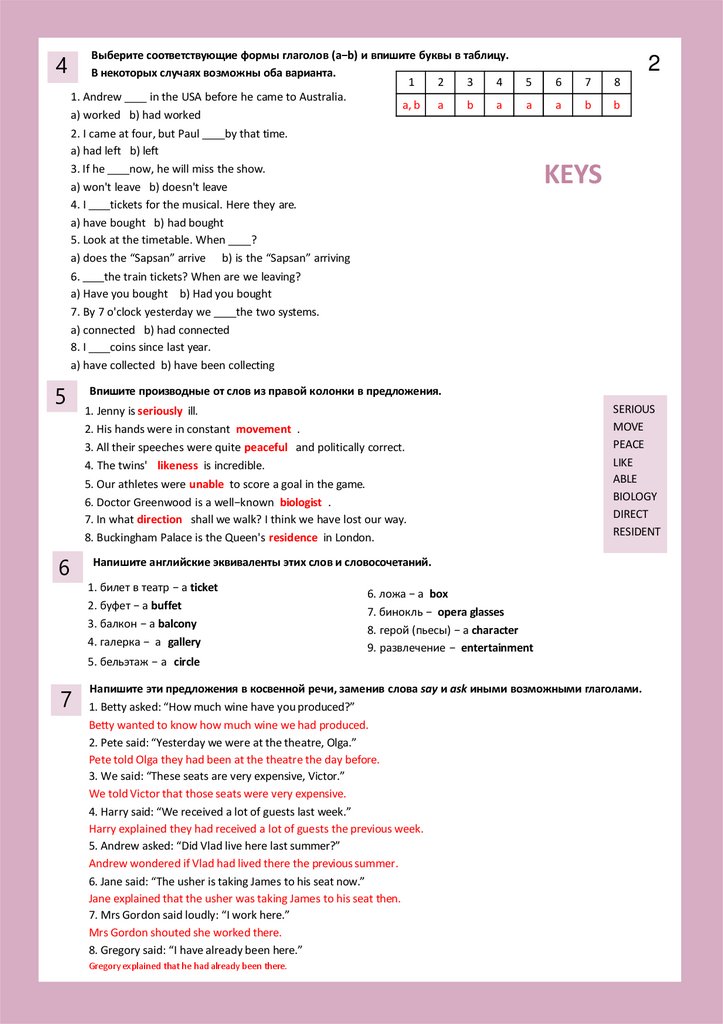
a, b a
b
a
a) worked b) had worked
2. I came at four, but Paul
a) had left b) left
3. If he
2
5
6
7
8
a
a
b
b
by that time.
KEYS
now, he will miss the show.
a) won't leave b) doesn't leave
4. I
tickets for the musical. Here they are.
a) have bought b) had bought
5. Look at the timetable. When
?
a) does the “Sapsan” arrive b) is the “Sapsan” arriving
6.
the train tickets? When are we leaving?
a) Have you bought b) Had you bought
7. By 7 o'clock yesterday we
the two systems.
a) connected b) had connected
8. I
coins since last year.
a) have collected b) have been collecting
5
Впишите производные от слов из правой колонки в предложения.
1. Jenny is seriously ill.
2. His hands were in constant movement .
3. All their speeches were quite peaceful and politically correct.
4. The twins' likeness is incredible.
5. Our athletes were unable to score a goal in the game.
6. Doctor Greenwood is a well−known biologist .
7. In what direction shall we walk? I think we have lost our way.
8. Buckingham Palace is the Queen's residence in London.
6
SERIOUS
MOVE
PEACE
LIKE
ABLE
BIOLOGY
DIRECT
RESIDENT
Напишите английские эквиваленты этих слов и словосочетаний.
1. билет в театр − a ticket
2. буфет − a buffet
3. балкон − a balcony
4. галерка − a gallery
6. ложа − a box
7. бинокль − opera glasses
8. герой (пьесы) − a character
9. развлечение − entertainment
5. бельэтаж − a circle
7
Напишите эти предложения в косвенной речи, заменив слова say и ask иными возможными глаголами.
1. Betty asked: “How much wine have you produced?”
Betty wanted to know how much wine we had produced.
2. Pete said: “Yesterday we were at the theatre, Olga.”
Pete told Olga they had been at the theatre the day before.
3. We said: “These seats are very expensive, Victor.”
We told Victor that those seats were very expensive.
4. Harry said: “We received a lot of guests last week.”
Harry explained they had received a lot of guests the previous week.
5. Andrew asked: “Did Vlad live here last summer?”
Andrew wondered if Vlad had lived there the previous summer.
6. Jane said: “The usher is taking James to his seat now.”
Jane explained that the usher was taking James to his seat then.
7. Mrs Gordon said loudly: “I work here.”
Mrs Gordon shouted she worked there.
8. Gregory said: “I have already been here.”
Gregory explained that he had already been there.
13.
RAINBOW ENGLISH 81
«PERFOMING ARTS: THEATRE» (UNIT 2)
3
Установите соответствия между параграфами текста (1−5) и их названиями (a−f).
Напишите соответствующие буквы рядом с номерами параграфов. Среди названий есть одно лишнее.
a) Stories in the Author's Native Language
b) Play about the Days of the Week
c) Land Important to Theatre Lovers
d) They Came from Ancient Times
e) The City Which Is Developing
f) Where the Name Came from
1 _a_
2 _d_
KEYS
3 _e_
4 _f_
5 _c_
1. Before Geoffrey Chaucer, a famous writer, was born in 1343, people in England had used Latin or French to
write stories though there were several fine old poems about heroes in Old English. Chaucer’s great piece of
literature “The Canterbury Tales” was in everyday English and about his own times.
2. There was a time in the early history of man when the days had no names. But later each day of the week got
its name. The day of the sun became Sunday, the day of the moon was Monday. Many day names came from
the names of gods. Thus the day of Saturn became Saturday.
3. Some visitors find that not all New Yorkers are very friendly. Some are, some aren't. New York is always
changing. You can hear the noise from building sites going up or coming down all the time. New factories, new
offices, new theatres, and cinemas appear nonstop.
4. St Valentine's Day, February 14, is sweethearts' day. The origin of the holiday is not clear. People are not
absolutely sure why we call the day St Valentine's Day. Some historians say it is due to Valentine who became
the patron saint of lovers. Other people disagree and explain that Valentine stands for the French
word gallant (beautiful). Whatever the origin, the Romans carried the celebration to England.
5. In Stratford−on−Avon on a spring morning in the year 1564 a boy was born. Nowadays all people interested
in the theatre know the name of William Shakespeare as well as the name of the town. But Stratford of those
days was a quiet little place of some 200 houses, something of a capital to the neighbouring villagers but a very
sleepy capital.
2
Выберите и обведите лексически правильные варианты из данных в скобках.
1. (At / In) the end of the performance all the actors gathered on the stage.
2. Fiona asked what books her sisters had read (last month / the previous month).
3. The main character of the play was a (cruel / thrilling) young man who hated his neighbours.
4. We (ended / held) up our journey in our grandparents' cottage.
5. They couldn't read the text as the handwriting was (possible / impossible) to understand.
6. You have been talking the problem over for more than 3 hours with no result. I think (eventually / meanwhile)
you’ll all understand that you should meet again.
3
7. What is the difference between (classical / characteristic) and post−modern novels?
8. The two girls looked (alike / like) two sisters, but they were not relatives.
Выберите и обведите соответствующие служебные слова из данных в скобках.
1. We have ordered tickets (to / for) Russia. If nothing happens, we are leaving next Sunday.
2. Where are our seats? − They are (in / on) the balcony.
3. When the performance was over, all the actors came (to / onto) the stage.
4. The central character (of / at) the story is Miss Marple.
5. In prehistoric times ancient people believed (in / into) many gods.
6. Why are you so late? What held you (in / up)?
7. Everybody was thrilled (at / by) the idea of visiting the puppet theatre.
8. Sarah's devotion (to / for) the elderly lady was surprising.
14.
4Выберите соответствующие формы глаголов (a−b) и впишите буквы в таблицу.
В некоторых случаях возможны оба варианта.
1
2
3
4
1. The Browns
to the theatre the other day.
b
b
a
b
a) haven't gone b) didn't go
2. When William Shakespeare left school, he
the family business.
a) had worked b) had to work
3. The curtains opened and we
a) saw b) had seen
4. By the time we returned, Alec
a) has done b) had done
5. By 5 o'clock yesterday, they
a) finished b) had finished
fantastic scenery on the stage.
3
5
6
7
8
b
a, b
a
b
KEYS
a lot.
their journey.
6. Sam
before Alice did her work.
a) left b) had left
7. Alec
to Paris last Tuesday.
a) flew b) flowed
8. Tell me when Rob
− on Friday or on Saturday.
a) returns b) will return
5
Впишите производные от слов из правой колонки в предложения.
7. I don't know anything about Angela's preferences.
OPTIMIST
FRIEND
ELEGANT
EMPTY
SNOW
ARTIST
PREFER
8. Mr Williams is a leading economist in the company.
ECONOMY
1. I was really happy and optimistic .
2. Bob smiled a friendly but a bit ironical smile.
3. Mary laid the table with more elegance than ever.
4. The Sunday emptiness of the town was fairly unusual.
5. We walked along the snowy streets and tried to move as fast as we could.
6. Her artistic taste is well known.
6
Напишите английские эквиваленты этих слов и словосочетаний.
1. арена − an arena
2. драматург − a dramatist
3. ряды кресел (в театре) − rows of seats
4. гардероб (в театре) − a cloakroom
5. занавес − a curtain
7
6. сцена − a stage
7. декорации − scenery
8. театрал − a theatregoer
9. публика − audience
Напишите эти предложения в косвенной речи, заменив слова say и ask иными возможными глаголами.
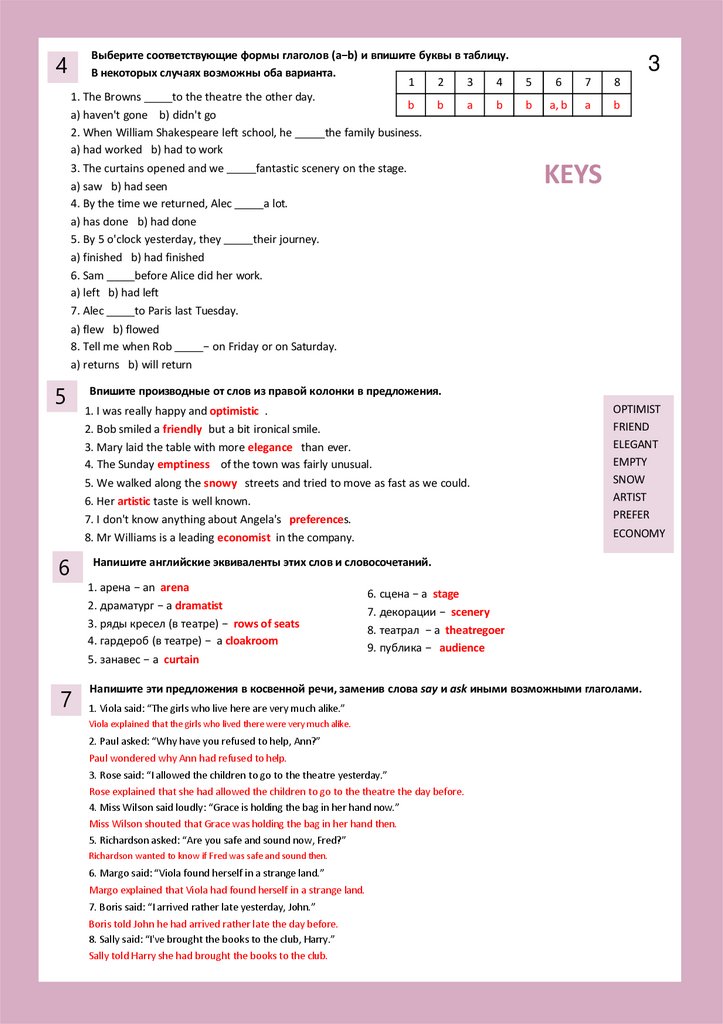
1. Viola said: “The girls who live here are very much alike.”
Viola explained that the girls who lived there were very much alike.
2. Paul asked: “Why have you refused to help, Ann?”
Paul wondered why Ann had refused to help.
3. Rose said: “I allowed the children to go to the theatre yesterday.”
Rose explained that she had allowed the children to go to the theatre the day before.
4. Miss Wilson said loudly: “Grace is holding the bag in her hand now.”
Miss Wilson shouted that Grace was holding the bag in her hand then.
5. Richardson asked: “Are you safe and sound now, Fred?”
Richardson wanted to know if Fred was safe and sound then.
6. Margo said: “Viola found herself in a strange land.”
Margo explained that Viola had found herself in a strange land.
7. Boris said: “I arrived rather late yesterday, John.”
Boris told John he had arrived rather late the day before.
8. Sally said: “I've brought the books to the club, Harry.”
Sally told Harry she had brought the books to the club.
15.
RAINBOW ENGLISH 81
«PERFOMING ARTS: THEATRE» (UNIT 2)
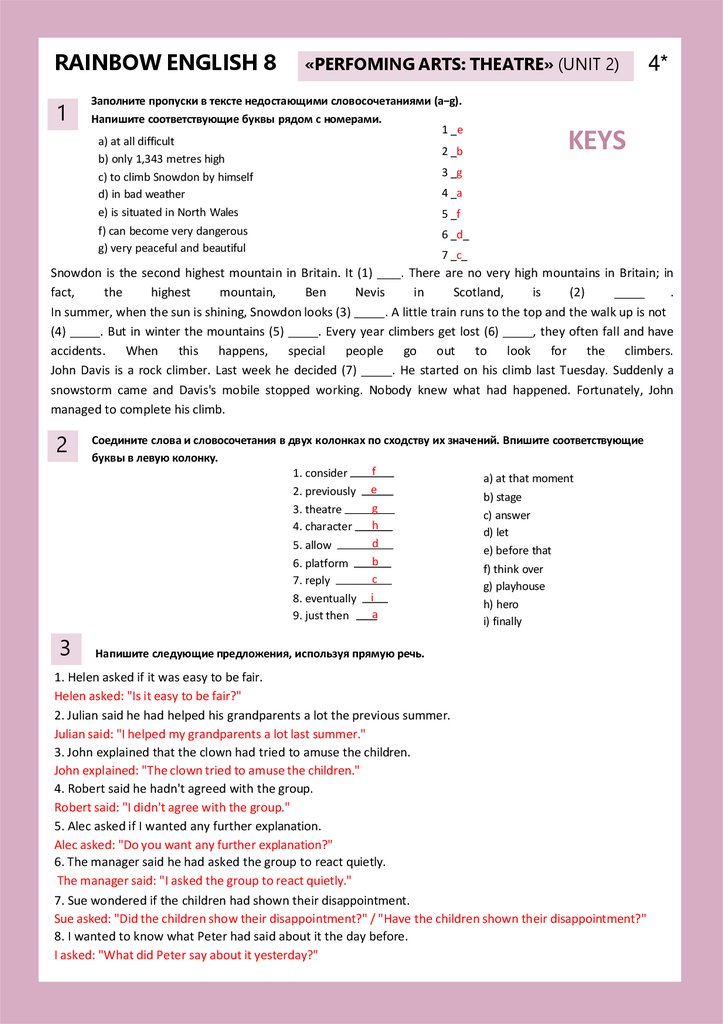
Заполните пропуски в тексте недостающими словосочетаниями (a−g).
Напишите соответствующие буквы рядом с номерами.
1 _e
a) at all difficult
2 _b
b) only 1,343 metres high
3 _g
c) to climb Snowdon by himself
d) in bad weather
4 _a
e) is situated in North Wales
5 _f
f) can become very dangerous
g) very peaceful and beautiful
6 _d_
4*
KEYS
7 _c_
Snowdon is the second highest mountain in Britain. It (1)
. There are no very high mountains in Britain; in
fact,
the
highest
mountain,
Ben
Nevis
in
Scotland,
is
(2)
.
In summer, when the sun is shining, Snowdon looks (3)
. A little train runs to the top and the walk up is not
(4)
. But in winter the mountains (5)
. Every year climbers get lost (6)
, they often fall and have
accidents. When this happens, special people
go out to look
for the climbers.
John Davis is a rock climber. Last week he decided (7)
. He started on his climb last Tuesday. Suddenly a
snowstorm came and Davis's mobile stopped working. Nobody knew what had happened. Fortunately, John
managed to complete his climb.
2
3
Соедините слова и словосочетания в двух колонках по сходству их значений. Впишите соответствующие
буквы в левую колонку.
f
1. consider
a) at that moment
2. previously e
b) stage
g
3. theatre
c) answer
h
4. character
d) let
d
5. allow
e) before that
b
6. platform
f) think over
c
7. reply
g) playhouse
8. eventually i
h) hero
a
9. just then
i) finally
Напишите следующие предложения, используя прямую речь.
1. Helen asked if it was easy to be fair.
Helen asked: "Is it easy to be fair?"
2. Julian said he had helped his grandparents a lot the previous summer.
Julian said: "I helped my grandparents a lot last summer."
3. John explained that the clown had tried to amuse the children.
John explained: "The clown tried to amuse the children."
4. Robert said he hadn't agreed with the group.
Robert said: "I didn't agree with the group."
5. Alec asked if I wanted any further explanation.
Alec asked: "Do you want any further explanation?"
6. The manager said he had asked the group to react quietly.
The manager said: "I asked the group to react quietly."
7. Sue wondered if the children had shown their disappointment.
Sue asked: "Did the children show their disappointment?" / "Have the children shown their disappointment?"
8. I wanted to know what Peter had said about it the day before.
I asked: "What did Peter say about it yesterday?"
16.
4Впишите соответствующие служебные слова в эти предложения.
5
Впишите соответствующие формы глаголов из правой колонки в предложения.
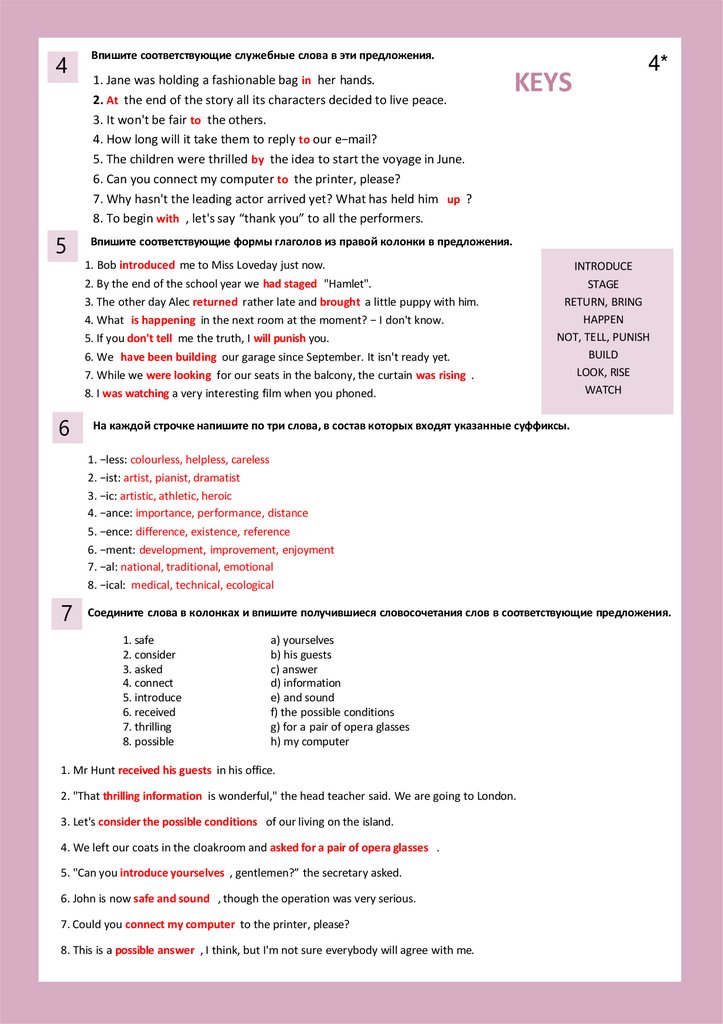
1. Jane was holding a fashionable bag in her hands.
2. At the end of the story all its characters decided to live peace.
3. It won't be fair to the others.
4. How long will it take them to reply to our e−mail?
5. The children were thrilled by the idea to start the voyage in June.
6. Can you connect my computer to the printer, please?
7. Why hasn't the leading actor arrived yet? What has held him up ?
8. To begin with , let's say “thank you” to all the performers.
KEYS
1. Bob introduced me to Miss Loveday just now.
2. By the end of the school year we had staged "Hamlet".
3. The other day Alec returned rather late and brought a little puppy with him.
4. What is happening in the next room at the moment? − I don't know.
5. If you don't tell me the truth, I will punish you.
6. We have been building our garage since September. It isn't ready yet.
7. While we were looking for our seats in the balcony, the curtain was rising .
8. I was watching a very interesting film when you phoned.
6
4*
INTRODUCE
STAGE
RETURN, BRING
HAPPEN
NOT, TELL, PUNISH
BUILD
LOOK, RISE
WATCH
На каждой строчке напишите по три слова, в состав которых входят указанные суффиксы.
1. −less: colourless, helpless, careless
2. −ist: artist, pianist, dramatist
3. −ic: artistic, athletic, heroic
4. −ance: importance, performance, distance
5. −ence: difference, existence, reference
6. −ment: development, improvement, enjoyment
7. −al: national, traditional, emotional
8. −ical: medical, technical, ecological
7 Соедините слова в колонках и впишите получившиеся словосочетания слов в соответствующие предложения.
1. safe
2. consider
3. asked
4. connect
5. introduce
6. received
7. thrilling
8. possible
a) yourselves
b) his guests
c) answer
d) information
e) and sound
f) the possible conditions
g) for a pair of opera glasses
h) my computer
1. Mr Hunt received his guests in his office.
2. "That thrilling information is wonderful," the head teacher said. We are going to London.
3. Let's consider the possible conditions of our living on the island.
4. We left our coats in the cloakroom and asked for a pair of opera glasses .
5. "Can you introduce yourselves , gentlemen?” the secretary asked.
6. John is now safe and sound , though the operation was very serious.
7. Could you connect my computer to the printer, please?
8. This is a possible answer , I think, but I'm not sure everybody will agree with me.