 Физика
Похожие презентации:






Interaction Cross - Section. Concept and Application in Nuclear Physics
1.
Interaction Cross-SectionConcept and Application in Nuclear Physics
2.
DefinitionThe interaction cross-section is the probability of interaction of ionizing particles with one atom,
an electron, the nucleus of an atom, or all the atoms (electrons, nuclei) located in a given volume
of matter..
3.
Historical ContextRutherford Experiment (1909): α-particle scattering on gold nuclei
Rutherford Formula: description of elastic Coulomb scattering
Concept Introduction: cross-section as measure of process probability
Theory Development: quantum mechanics and nuclear physics
4.
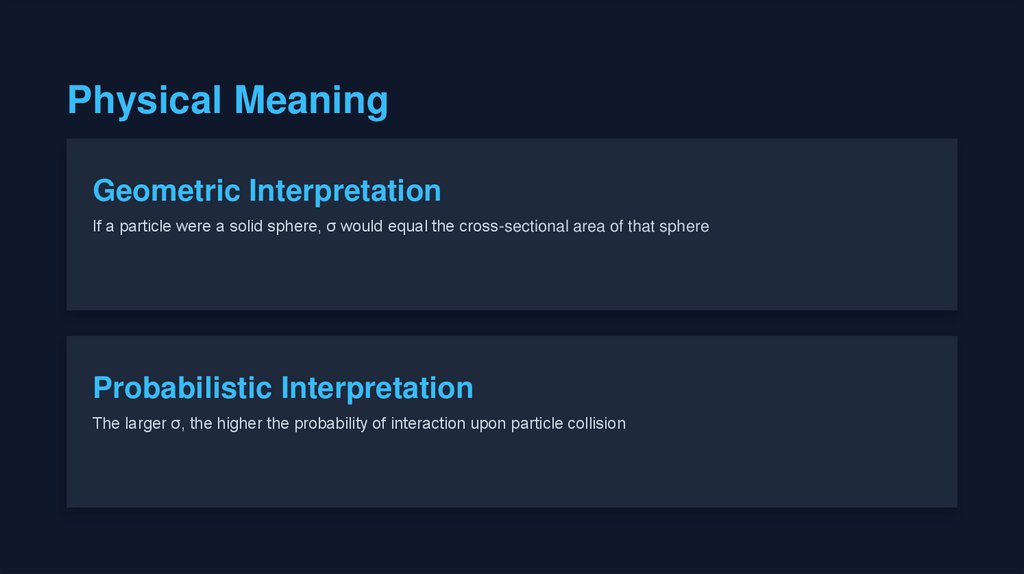
Physical MeaningGeometric Interpretation
If a particle were a solid sphere, σ would equal the cross-sectional area of that sphere
Probabilistic Interpretation
The larger σ, the higher the probability of interaction upon particle collision
5.
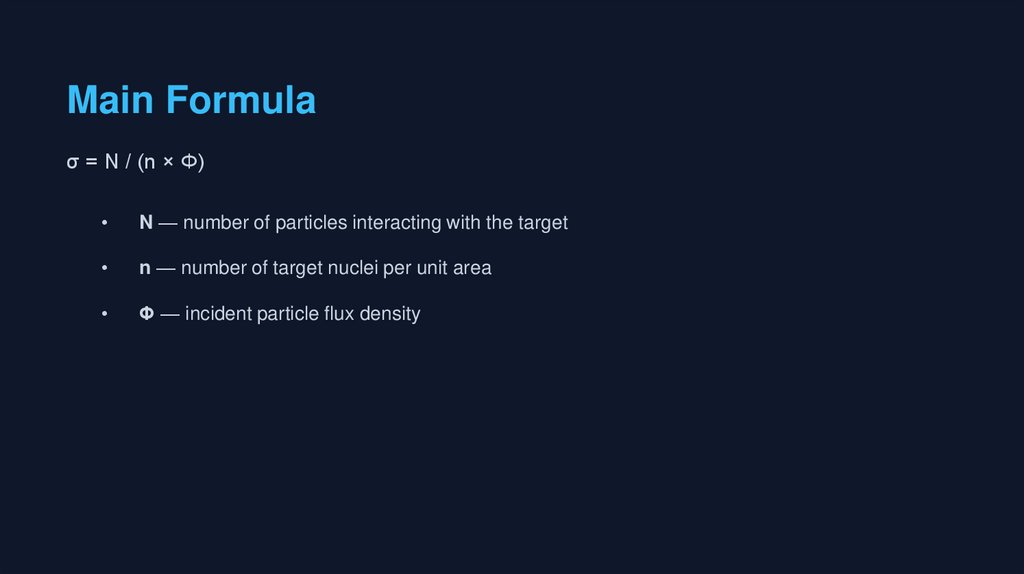
Main Formulaσ = N / (n × Φ)
N — number of particles interacting with the target
n — number of target nuclei per unit area
Φ — incident particle flux density
6.
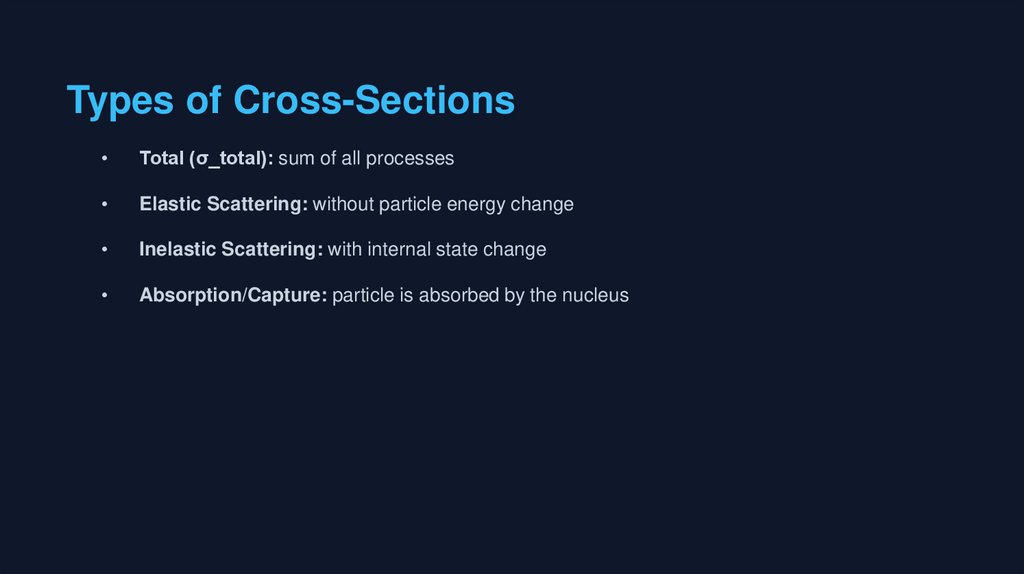
Types of Cross-SectionsTotal (σ_total): sum of all processes
Elastic Scattering: without particle energy change
Inelastic Scattering: with internal state change
Absorption/Capture: particle is absorbed by the nucleus
7.
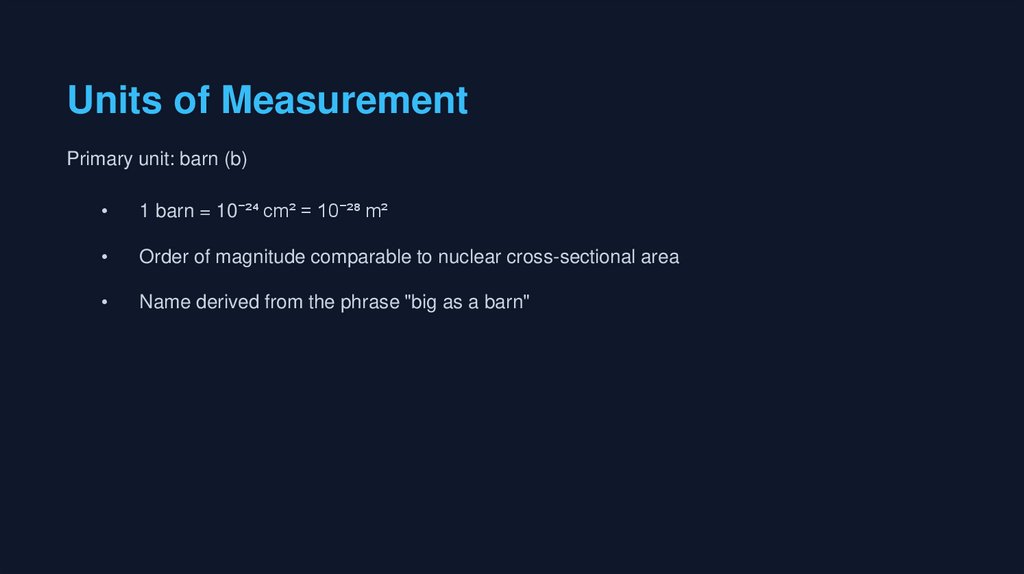
Units of MeasurementPrimary unit: barn (b)
1 barn = 10⁻²⁴ cm² = 10⁻²⁸ m²
Order of magnitude comparable to nuclear cross-sectional area
Name derived from the phrase "big as a barn"
8.
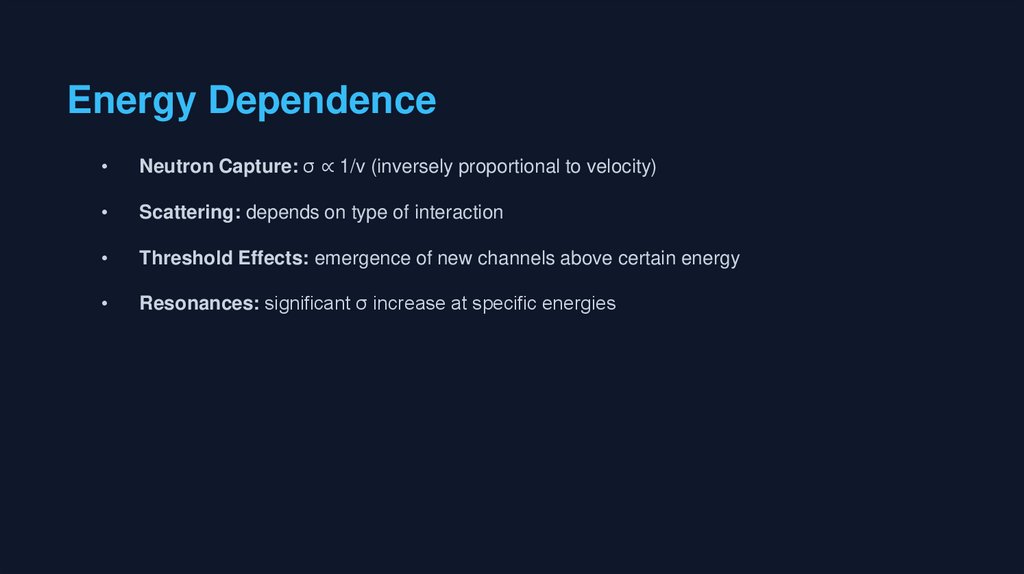
Energy DependenceNeutron Capture: σ ∝ 1/v (inversely proportional to velocity)
Scattering: depends on type of interaction
Threshold Effects: emergence of new channels above certain energy
Resonances: significant σ increase at specific energies
9.
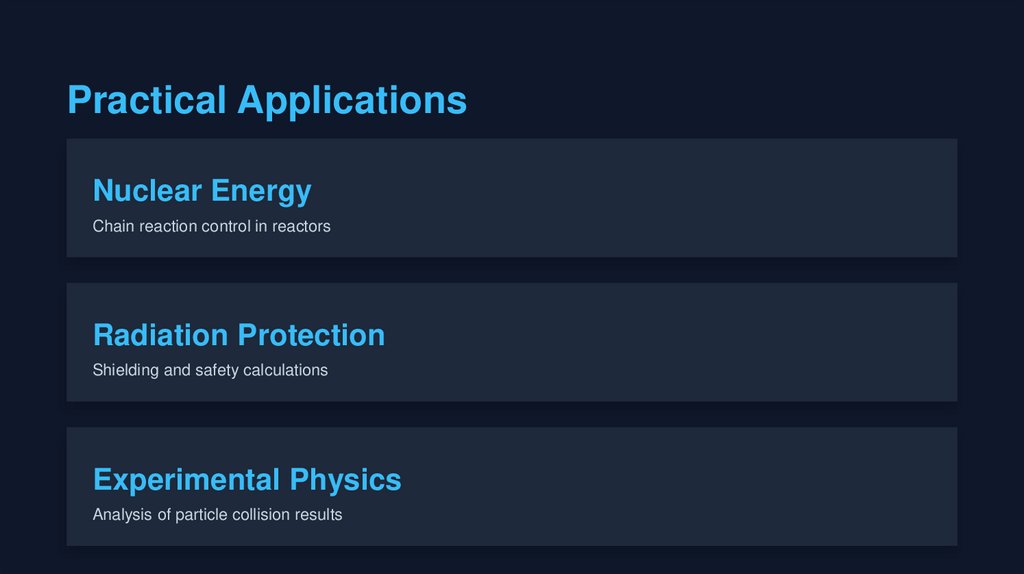
Practical ApplicationsNuclear Energy
Chain reaction control in reactors
Radiation Protection
Shielding and safety calculations
Experimental Physics
Analysis of particle collision results
10.
Key TakeawaysInteraction cross-section is a fundamental characteristic of collision probability in particle physics