 Биографии
Похожие презентации:



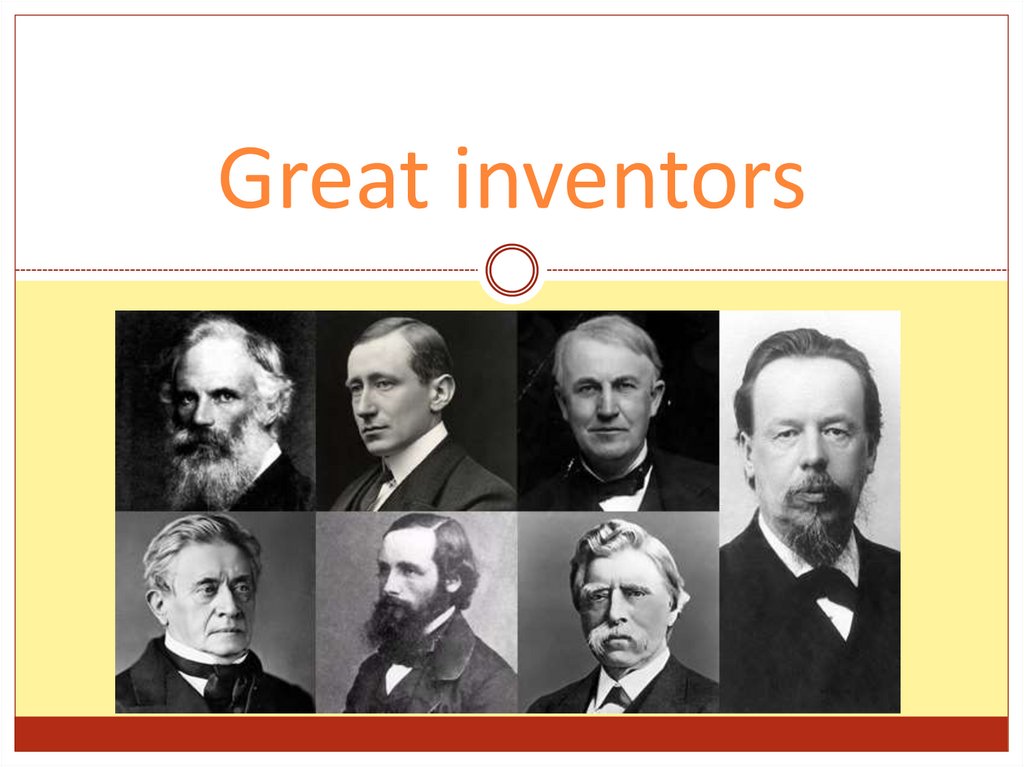
Great inventors
1. Great inventors
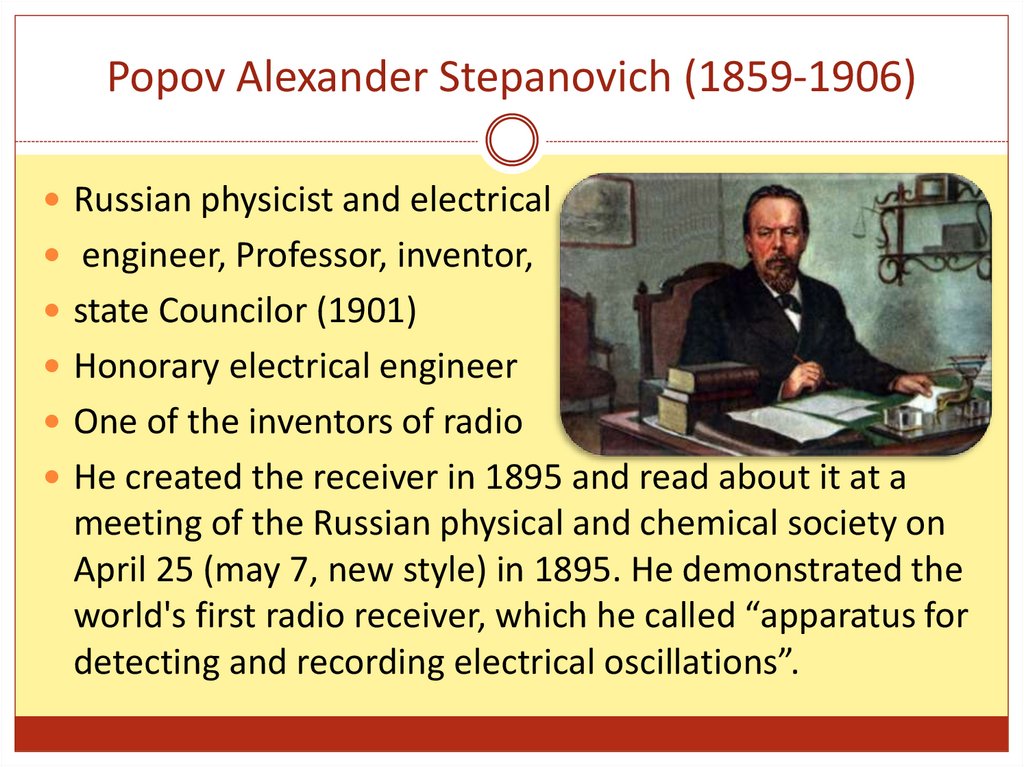
2. Popov Alexander Stepanovich (1859-1906)
Russian physicist and electricalengineer, Professor, inventor,
state Councilor (1901)
Honorary electrical engineer
One of the inventors of radio
He created the receiver in 1895 and read about it at a
meeting of the Russian physical and chemical society on
April 25 (may 7, new style) in 1895. He demonstrated the
world's first radio receiver, which he called “apparatus for
detecting and recording electrical oscillations”.
3.
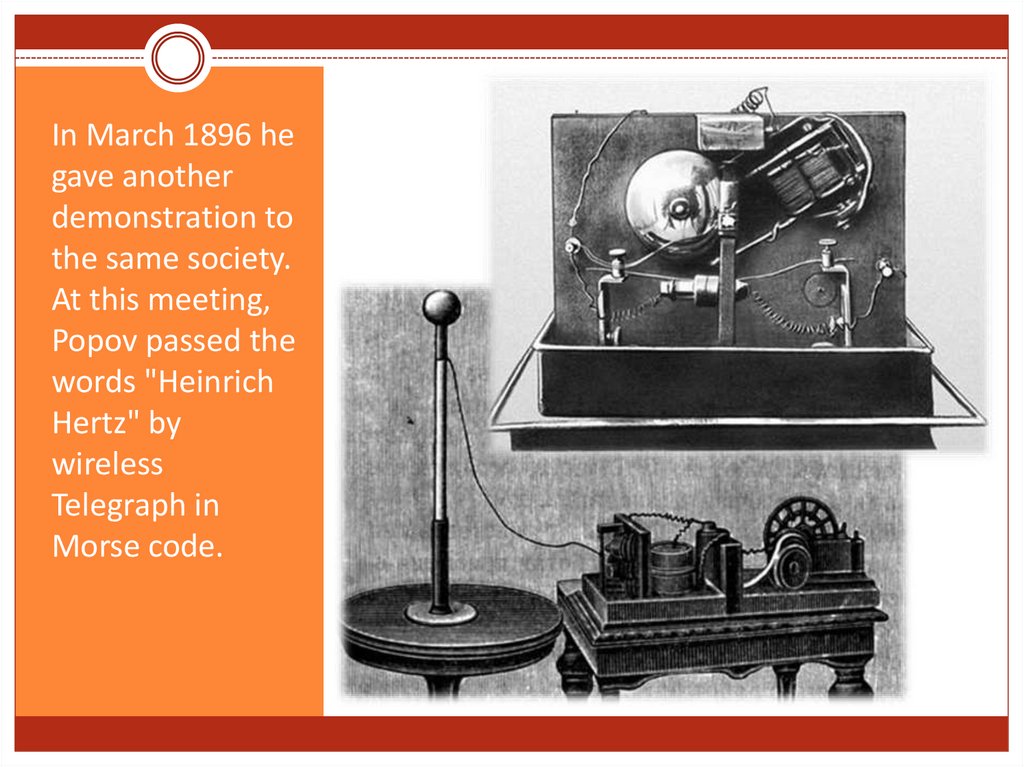
In March 1896 hegave another
demonstration to
the same society.
At this meeting,
Popov passed the
words "Heinrich
Hertz" by
wireless
Telegraph in
Morse code.
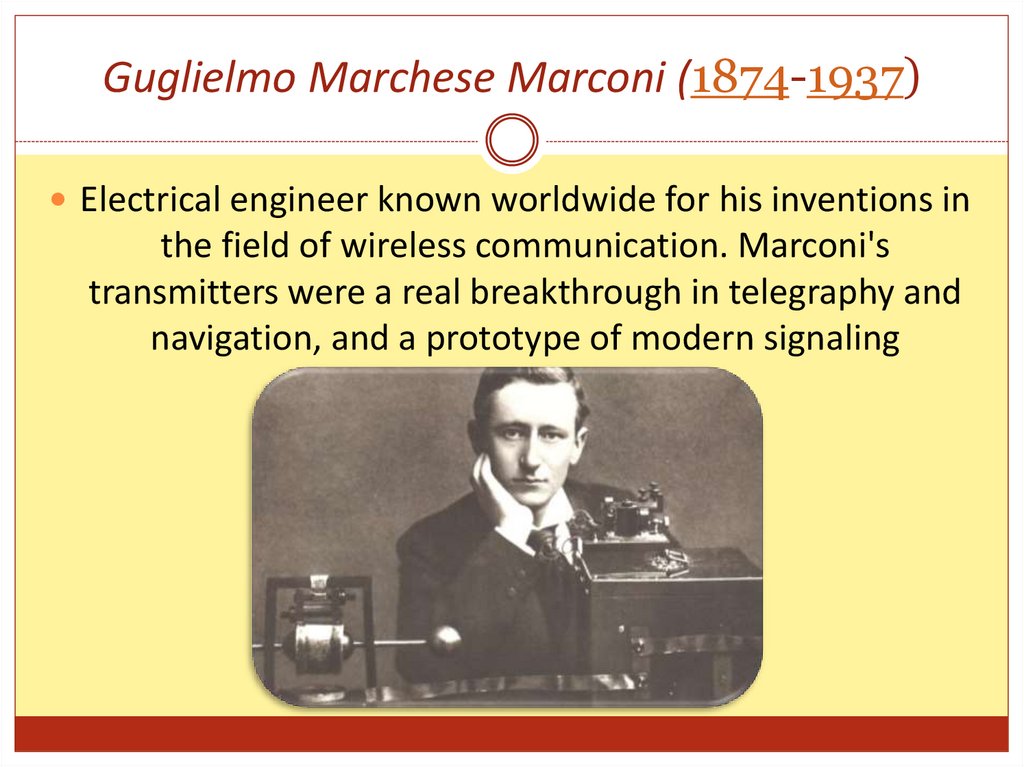
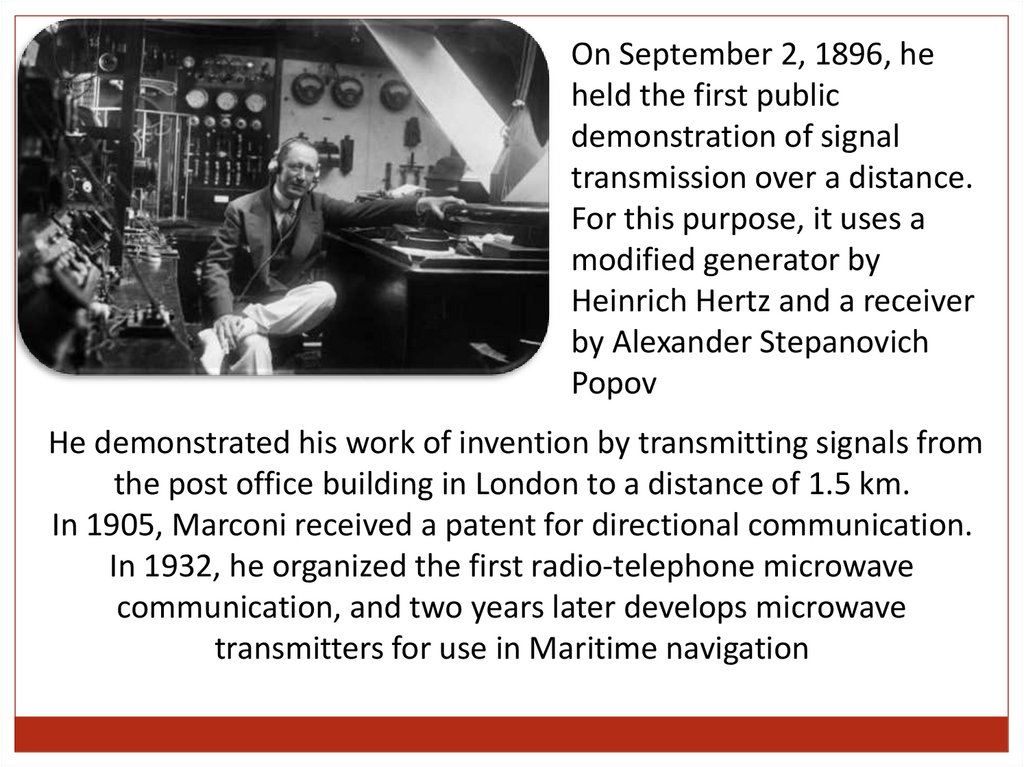
4. Guglielmo Marchese Marconi (1874-1937)
Electrical engineer known worldwide for his inventions inthe field of wireless communication. Marconi's
transmitters were a real breakthrough in telegraphy and
navigation, and a prototype of modern signaling
5.
On September 2, 1896, heheld the first public
demonstration of signal
transmission over a distance.
For this purpose, it uses a
modified generator by
Heinrich Hertz and a receiver
by Alexander Stepanovich
Popov
He demonstrated his work of invention by transmitting signals from
the post office building in London to a distance of 1.5 km.
In 1905, Marconi received a patent for directional communication.
In 1932, he organized the first radio-telephone microwave
communication, and two years later develops microwave
transmitters for use in Maritime navigation
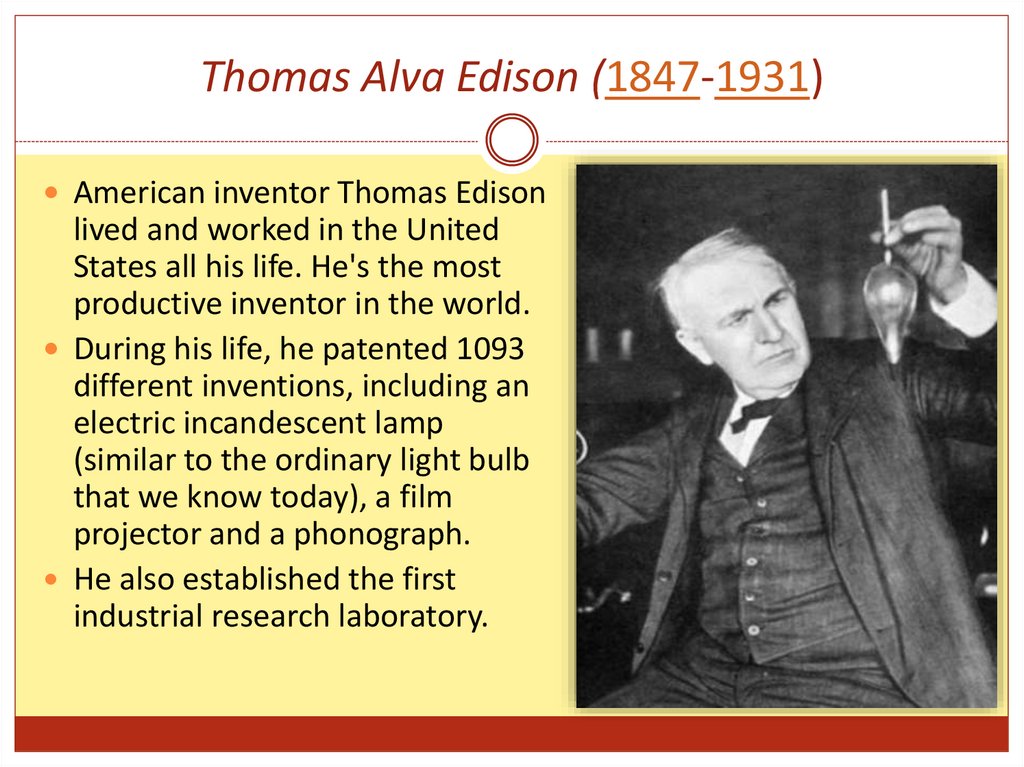
6. Thomas Alva Edison (1847-1931)
American inventor Thomas Edisonlived and worked in the United
States all his life. He's the most
productive inventor in the world.
During his life, he patented 1093
different inventions, including an
electric incandescent lamp
(similar to the ordinary light bulb
that we know today), a film
projector and a phonograph.
He also established the first
industrial research laboratory.
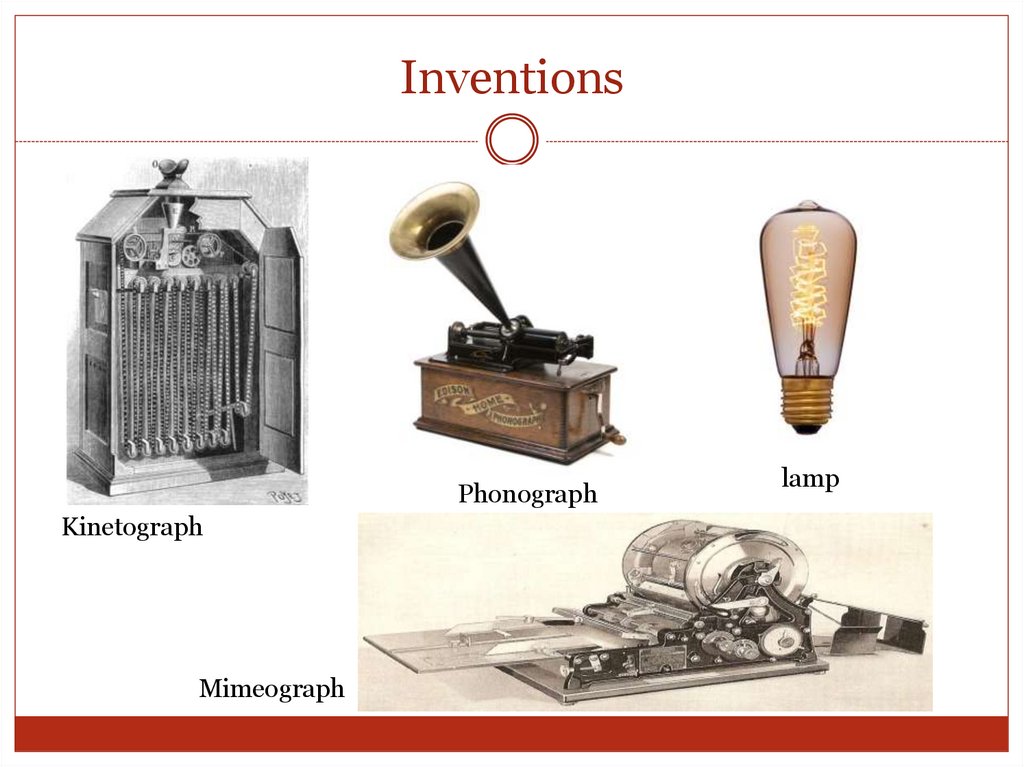
7. Inventions
PhonographKinetograph
Mimeograph
lamp
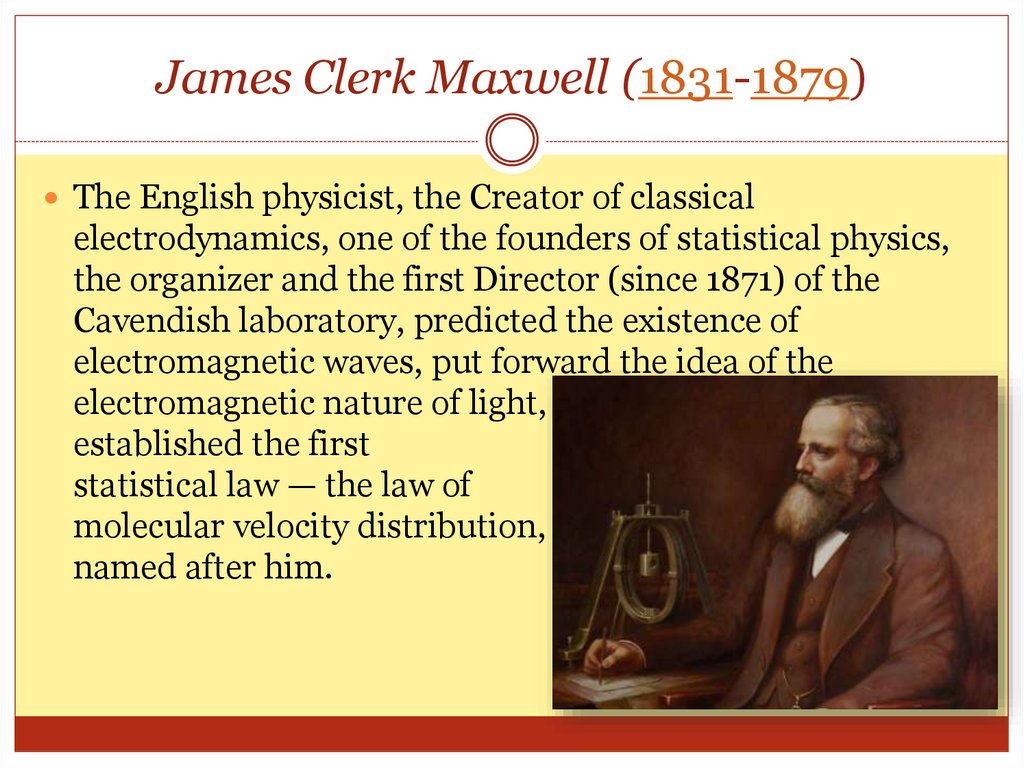
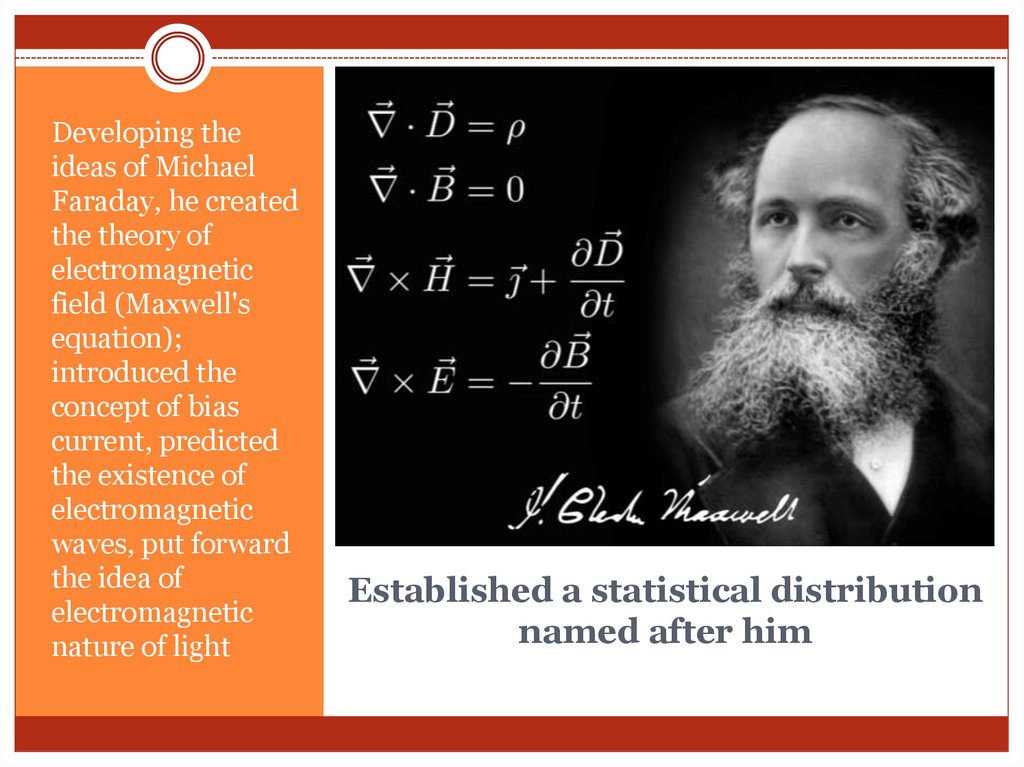
8. James Clerk Maxwell (1831-1879)
The English physicist, the Creator of classicalelectrodynamics, one of the founders of statistical physics,
the organizer and the first Director (since 1871) of the
Cavendish laboratory, predicted the existence of
electromagnetic waves, put forward the idea of the
electromagnetic nature of light,
established the first
statistical law — the law of
molecular velocity distribution,
named after him.
9. Established a statistical distribution named after him
Developing theideas of Michael
Faraday, he created
the theory of
electromagnetic
field (Maxwell's
equation);
introduced the
concept of bias
current, predicted
the existence of
electromagnetic
waves, put forward
the idea of
electromagnetic
nature of light
Established a statistical distribution
named after him
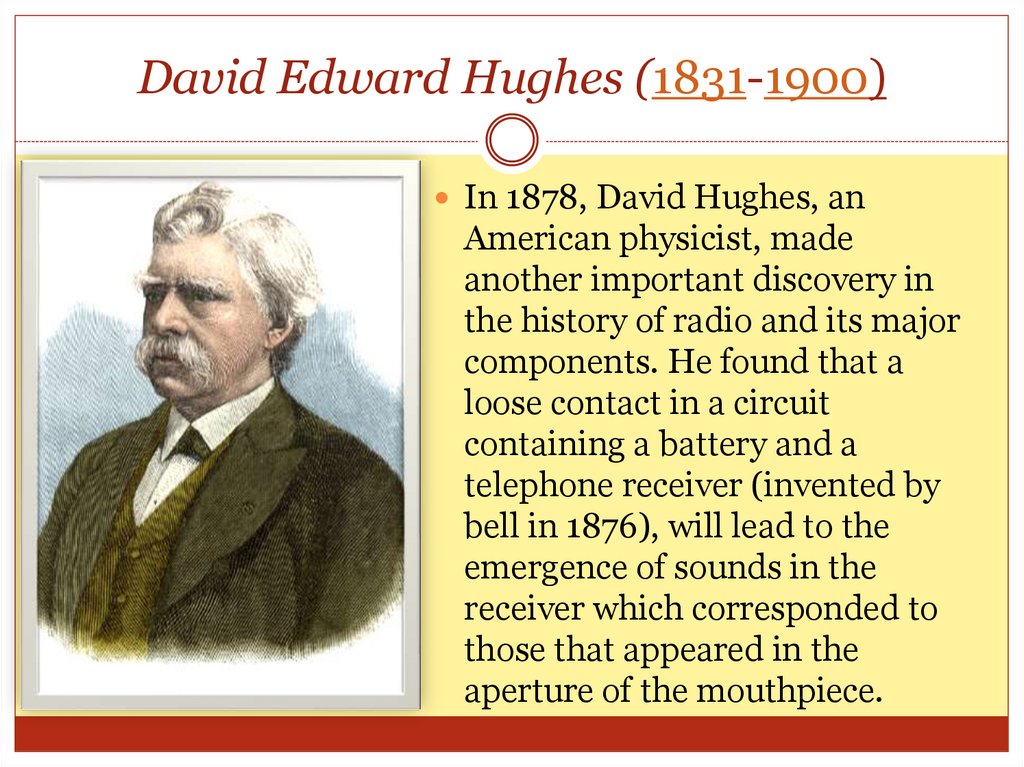
10. David Edward Hughes (1831-1900)
In 1878, David Hughes, anAmerican physicist, made
another important discovery in
the history of radio and its major
components. He found that a
loose contact in a circuit
containing a battery and a
telephone receiver (invented by
bell in 1876), will lead to the
emergence of sounds in the
receiver which corresponded to
those that appeared in the
aperture of the mouthpiece.
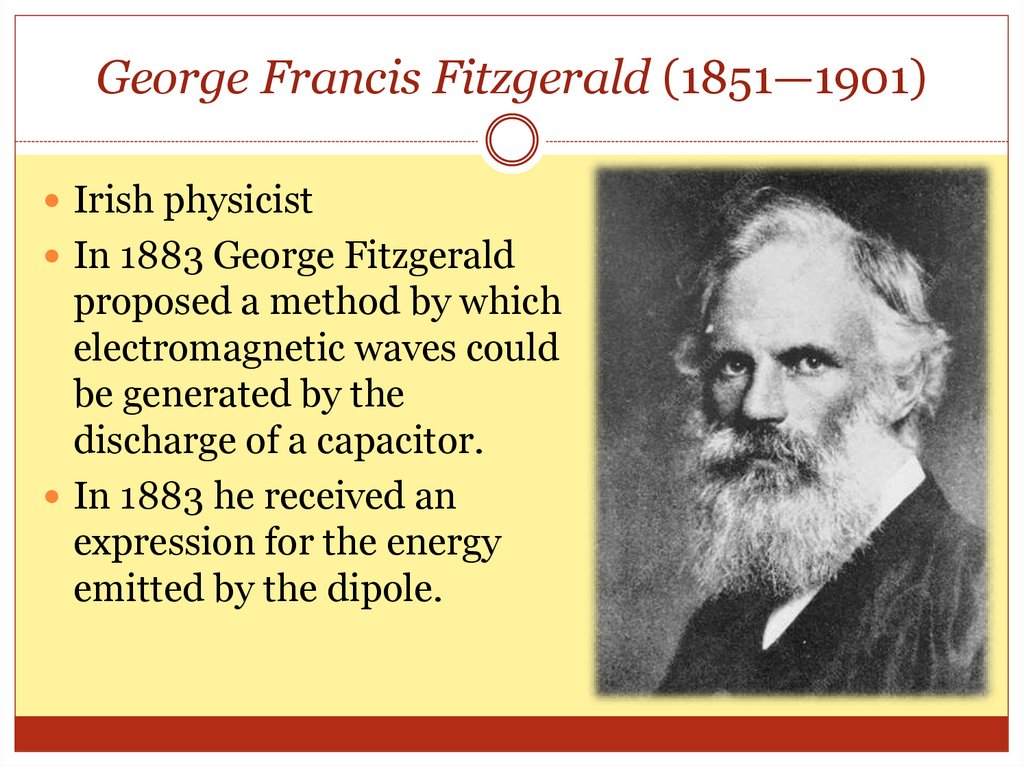
11. George Francis Fitzgerald (1851—1901)
Irish physicistIn 1883 George Fitzgerald
proposed a method by which
electromagnetic waves could
be generated by the
discharge of a capacitor.
In 1883 he received an
expression for the energy
emitted by the dipole.
12.
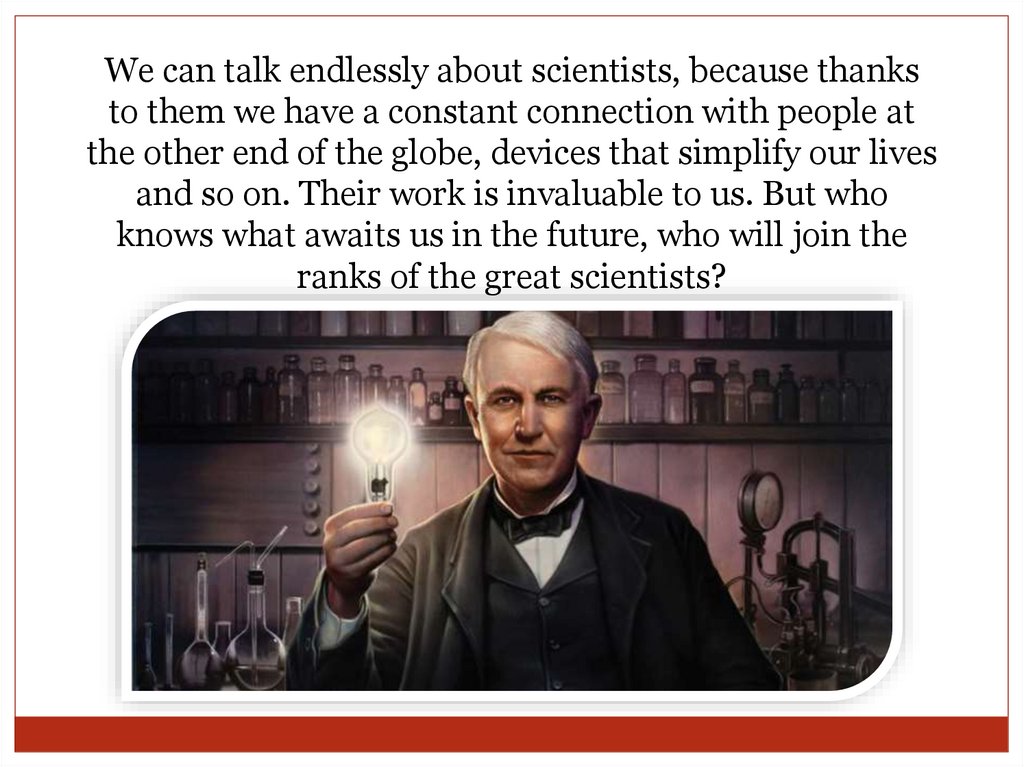
We can talk endlessly about scientists, because thanksto them we have a constant connection with people at
the other end of the globe, devices that simplify our lives
and so on. Their work is invaluable to us. But who
knows what awaits us in the future, who will join the
ranks of the great scientists?