 Электроника
Похожие презентации:







The importance of electronics and radio electronics
1.
The importance of electronics and radio electronics.Electronics and radio electronics are the technological foundation of modern
civilization.
Electronics (the control of electrical signals) forms the basis of all digital
technology—from computers and smartphones to medical devices and
automation systems.
Radio electronics (wireless data transmission) enables mobile communication,
the internet, navigation, television broadcasting, and space communication.
Their significance:
An engine of progress across all industries
The foundation of modern communication and information
A driver of globalization and social development
A platform for future innovations (AI, IoT, quantum technologies)
2.
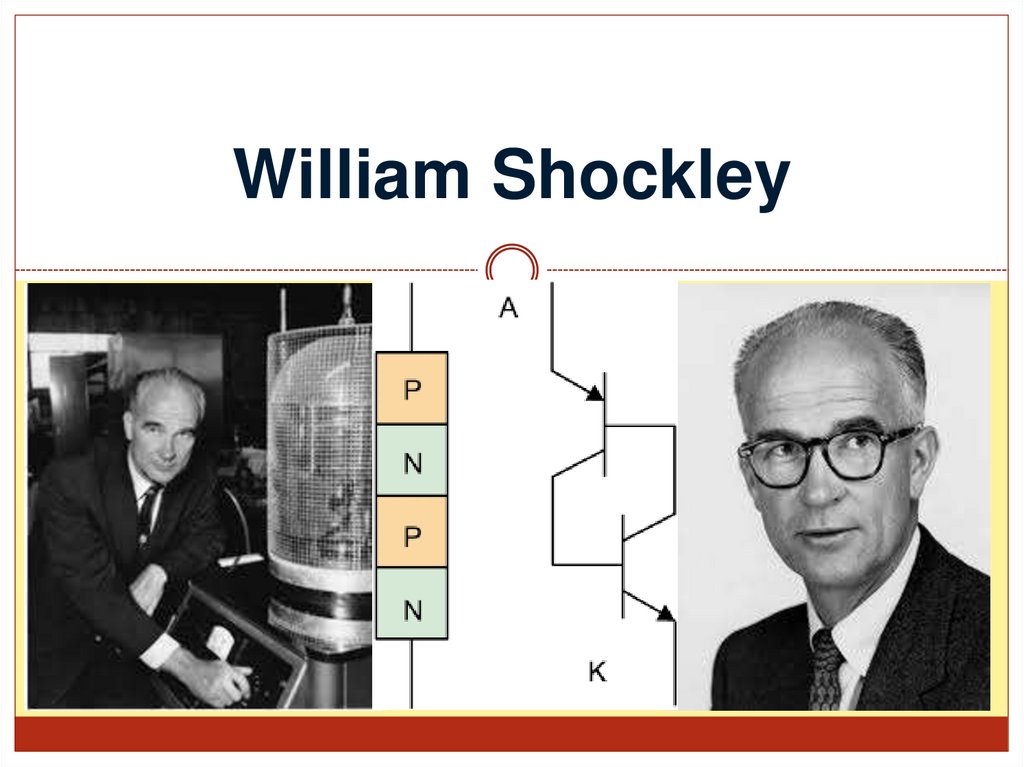
William Shockley3.
Biography William ShockleyEducation: Earned a Ph.D. in physics from MIT (1936).
Breakthrough at Bell Labs: Led the research group that created the first working point-contact
transistor in 1947. Shortly after, he personally developed the more advanced and practical
junction (bipolar) transistor (1948), for which he received the Nobel Prize in Physics in 1956.
Entrepreneurship: In 1956, he founded Shockley Semiconductor Laboratory in Palo Alto — the
first company to manufacture silicon transistors in the region. This event is considered the
official birth of Silicon Valley.
Management Failure: His authoritarian leadership style sparked a rebellion. In 1957, eight of his
top engineers (the "Traitorous Eight") left to found Fairchild Semiconductor, which in turn
became the precursor to Intel and the entire modern microelectronics industry. Thus, his failure
as a manager unexpectedly accelerated the technological revolution.
Legacy and Controversy: Recognized as the "godfather" of Silicon Valley. However, in his later
years, he actively promoted racist eugenics theories, which permanently tarnished his scientific
reputation.
4.
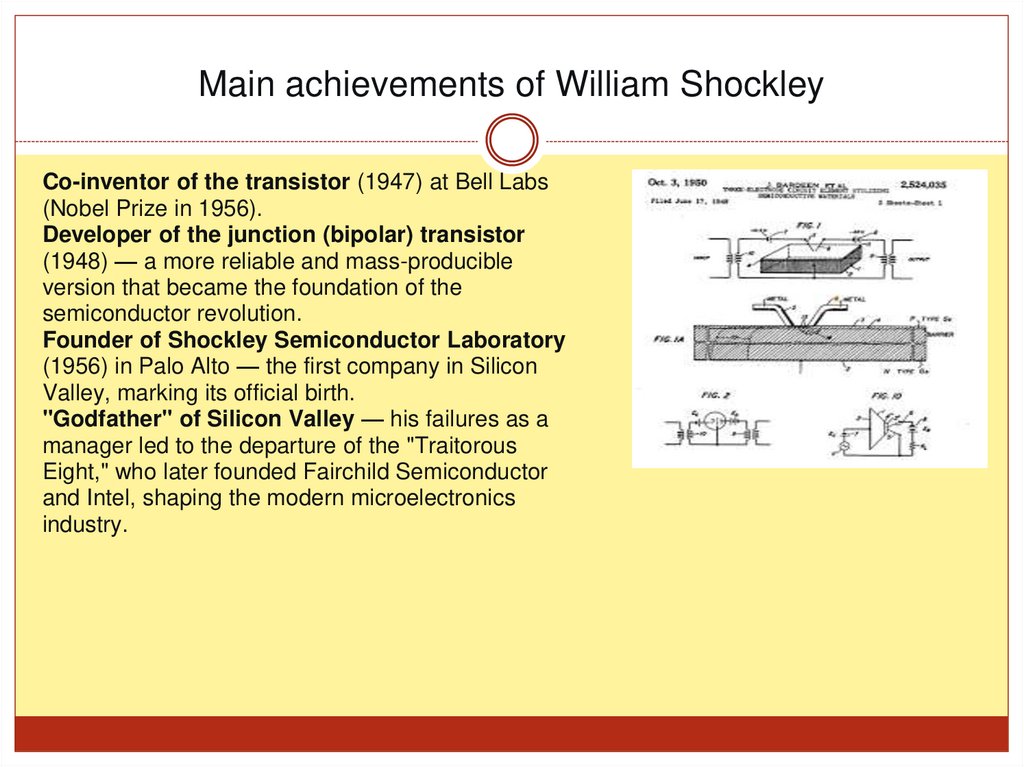
Main achievements of William ShockleyCo-inventor of the transistor (1947) at Bell Labs
(Nobel Prize in 1956).
Developer of the junction (bipolar) transistor
(1948) — a more reliable and mass-producible
version that became the foundation of the
semiconductor revolution.
Founder of Shockley Semiconductor Laboratory
(1956) in Palo Alto — the first company in Silicon
Valley, marking its official birth.
"Godfather" of Silicon Valley — his failures as a
manager led to the departure of the "Traitorous
Eight," who later founded Fairchild Semiconductor
and Intel, shaping the modern microelectronics
industry.
5.
Emphasis on progress and future directions in electronics and radiotechnology.
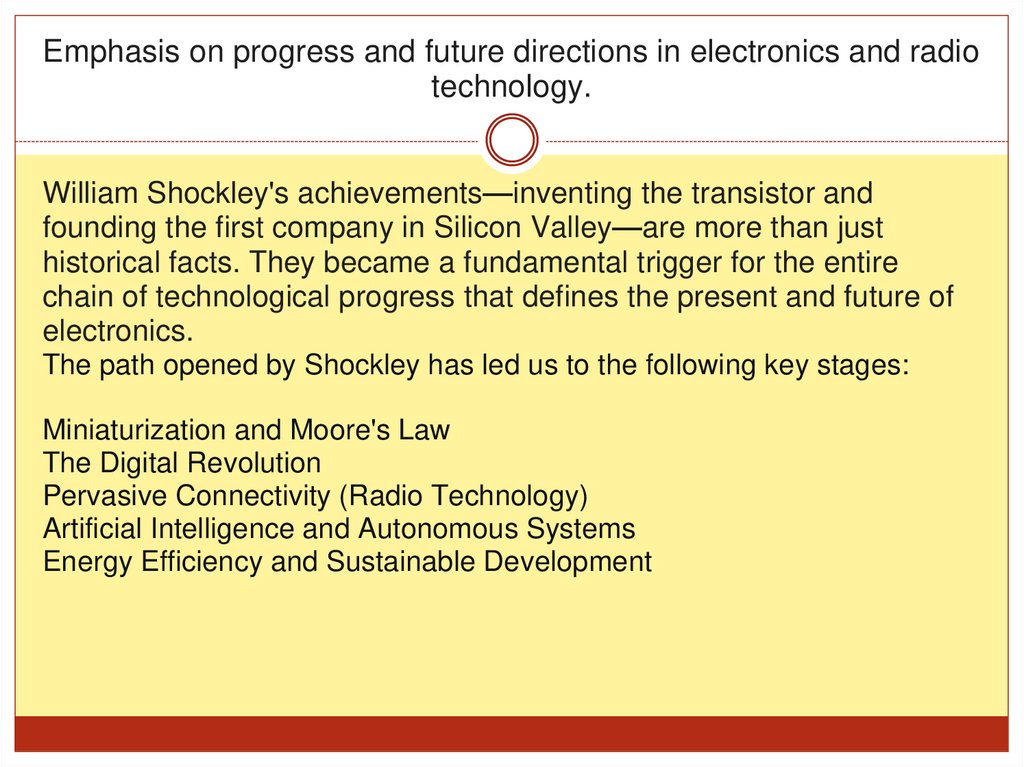
William Shockley's achievements—inventing the transistor and
founding the first company in Silicon Valley—are more than just
historical facts. They became a fundamental trigger for the entire
chain of technological progress that defines the present and future of
electronics.
The path opened by Shockley has led us to the following key stages:
Miniaturization and Moore's Law
The Digital Revolution
Pervasive Connectivity (Radio Technology)
Artificial Intelligence and Autonomous Systems
Energy Efficiency and Sustainable Development