

 Промышленность
Похожие презентации:









Modern materials and their properties
1.
PRESENTATIONON THE
TOPIC:“MODERN
MATERIALS AND
THEIR
PROPERTIES ”
The work was
performed by Artur
Volkov, a 2nd year
student of the 1206
group.
2. Content:
CONTENT:WHAT ARE THE
MATERIALS AND WHERE
ARE THEY USED?
WHAT PROPERTIES OF
MATERIALS ARE
IMPORTANT IN
INDUSTRY AND SPORTS?
KEVLAR. WHAT IS IT
USED FOR IN LIFE?WHY
DID I CHOOSE THIS
PARTICULAR MATERIAL?
WHAT KIND OF
MATERIALS CAN THERE
BE IN THE FUTURE?
3. Let's talk about where the materials are used
LET'S TALK ABOUTWHERE THE
MATERIALS ARE
USED
Materials in DesignerSport Boots
Carbon Fiber: Upper part – lightweight
and rigid.
Aramid Fiber : Strength and impact
resistance.
Polyurethane Foam: Internal padding –
soft, absorbs impacts.
Thermoplastic Polyurethane (TPU):
Sole – tough and flexible, for studs
(acceleration and stability).
4. What properties of materials are important in industry and sports?
WHAT PROPERTIES OF MATERIALS AREIMPORTANT IN INDUSTRY AND SPORTS?
Material Properties and Suitability
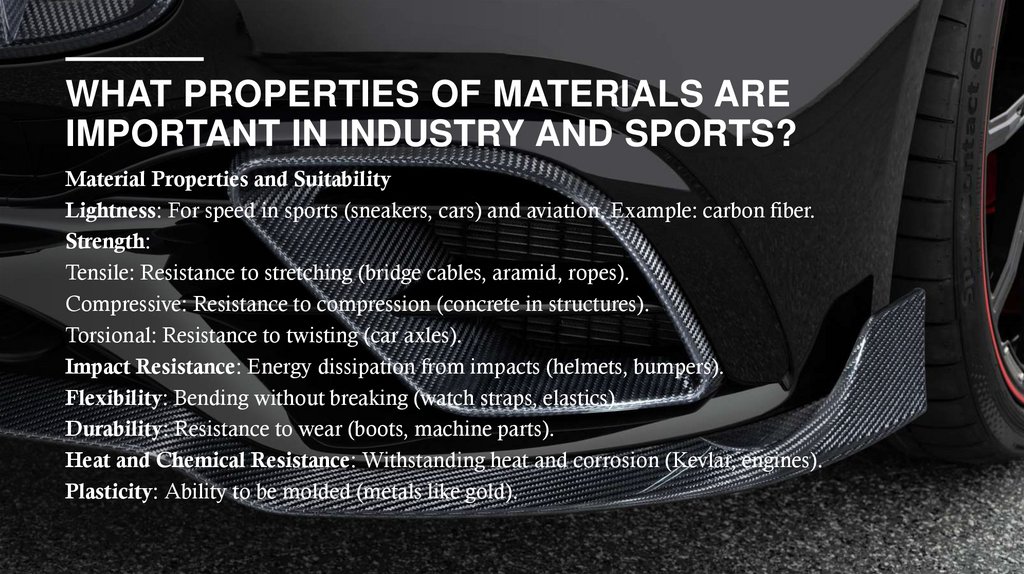
Lightness: For speed in sports (sneakers, cars) and aviation. Example: carbon fiber.
Strength:
Tensile: Resistance to stretching (bridge cables, aramid, ropes).
Compressive: Resistance to compression (concrete in structures).
Torsional: Resistance to twisting (car axles).
Impact Resistance: Energy dissipation from impacts (helmets, bumpers).
Flexibility: Bending without breaking (watch straps, elastics).
Durability: Resistance to wear (boots, machine parts).
Heat and Chemical Resistance: Withstanding heat and corrosion (Kevlar, engines).
Plasticity: Ability to be molded (metals like gold).
5. Kevlar. What is it used for in life?Why did I choose this particular material?
KEVLAR. WHAT IS IT USED FOR INLIFE?WHY DID I CHOOSE THIS
PARTICULAR MATERIAL?
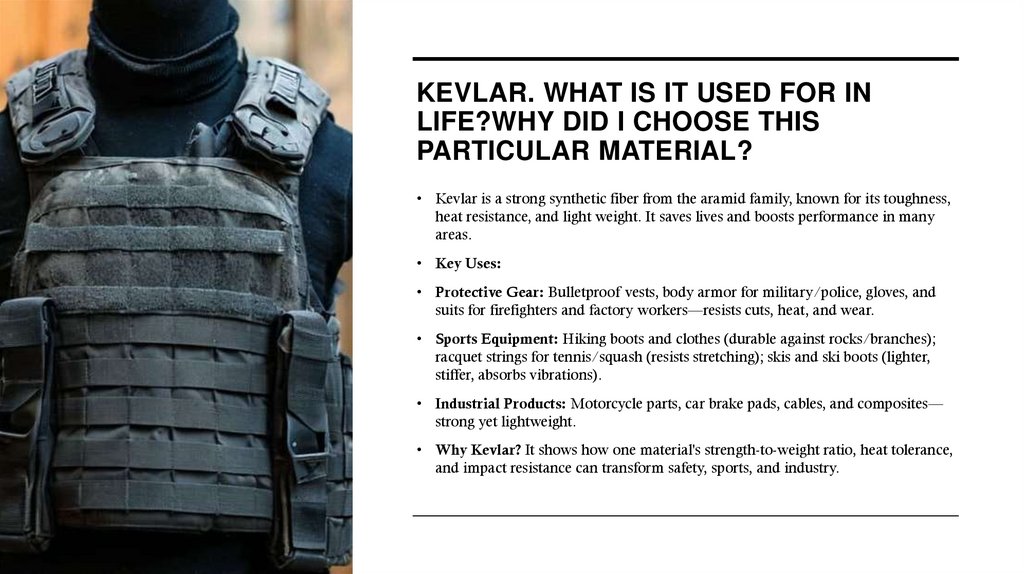
• Kevlar is a strong synthetic fiber from the aramid family, known for its toughness,
heat resistance, and light weight. It saves lives and boosts performance in many
areas.
• Key Uses:
• Protective Gear: Bulletproof vests, body armor for military/police, gloves, and
suits for firefighters and factory workers—resists cuts, heat, and wear.
• Sports Equipment: Hiking boots and clothes (durable against rocks/branches);
racquet strings for tennis/squash (resists stretching); skis and ski boots (lighter,
stiffer, absorbs vibrations).
• Industrial Products: Motorcycle parts, car brake pads, cables, and composites—
strong yet lightweight.
• Why Kevlar? It shows how one material's strength-to-weight ratio, heat tolerance,
and impact resistance can transform safety, sports, and industry.
6. What kind of materials can there be in the future?
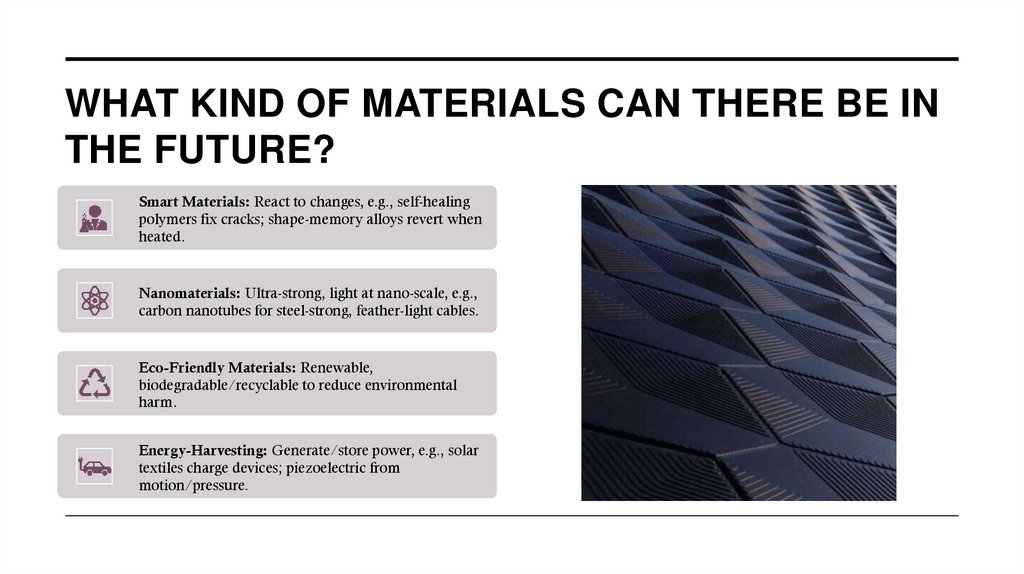
WHAT KIND OF MATERIALS CAN THERE BE INTHE FUTURE?
Smart Materials: React to changes, e.g., self-healing
polymers fix cracks; shape-memory alloys revert when
heated.
Nanomaterials: Ultra-strong, light at nano-scale, e.g.,
carbon nanotubes for steel-strong, feather-light cables.
Eco-Friendly Materials: Renewable,
biodegradable/recyclable to reduce environmental
harm.
Energy-Harvesting: Generate/store power, e.g., solar
textiles charge devices; piezoelectric from
motion/pressure.
7. Thank you for your attention !
THANK YOUFOR YOUR
ATTENTION !