Похожие презентации:






The International Lif
1.
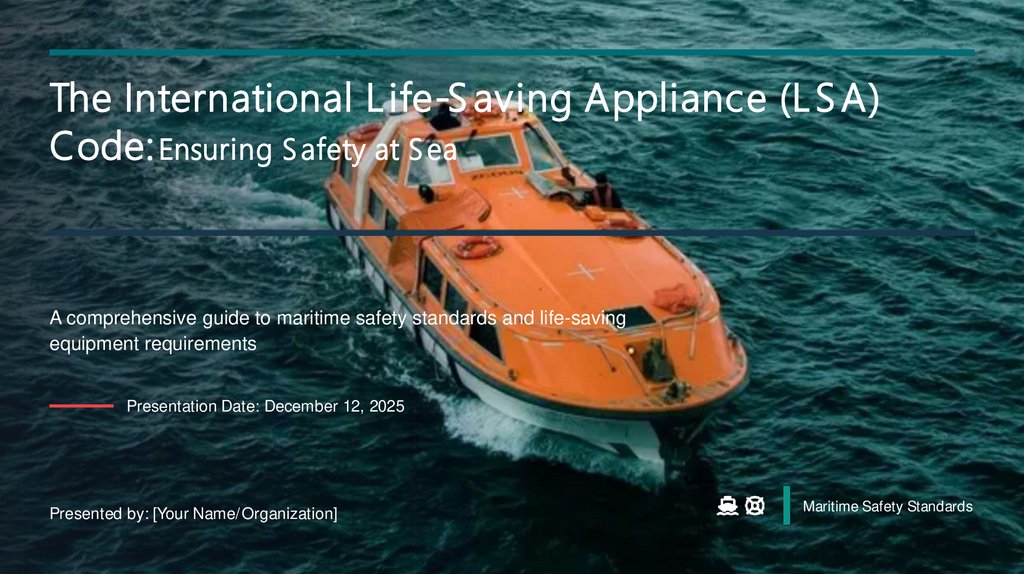
The International L ife-S aving Appliance (L S A)Code: Ensuring S afety at S ea
A comprehensive guide to maritime safety standards and life-saving
equipment requirements
Presentation Date: December 12, 2025
Presented by: [Your Name/Organization]
Maritime Safety Standards
2.
What is the LSA Code?Definition
The International Life-Saving Appliance (LSA) Code is a mandatory international
standard established under the International Convention for the Safety of Life at
Sea (SOLAS), 1974.
Mandatory Compliance
Purpose
Provide specific technical requirements for life-saving appliances
Ensure global standardization of safety equipment
Mandated by SOLAS Regulation III/3.10
Since July 1, 1998
Life-Saving Focus
Protecting lives at sea
LSA Code on Ships
2/13
3.
Importance and Scope of LSA CodeImportance
Global Standardization
Ensuring consistent safety equipment and performance across
international shipping
Operational Readiness
Setting technical specifications that guarantee equipment functions
Scope
The LSA Code covers a broad range of life-saving appliances:
Lifebuoys & Lifejackets
Visual Aids (Flares)
Survival Craft (Lifeboats)
Rescue Boats
Launching Appliances
Alarm & PA Systems
effectively in emergencies
Life Protection
Providing necessary means for survival and rescue in emergency
situations at sea
LSA Code on Ships
3/13
4.
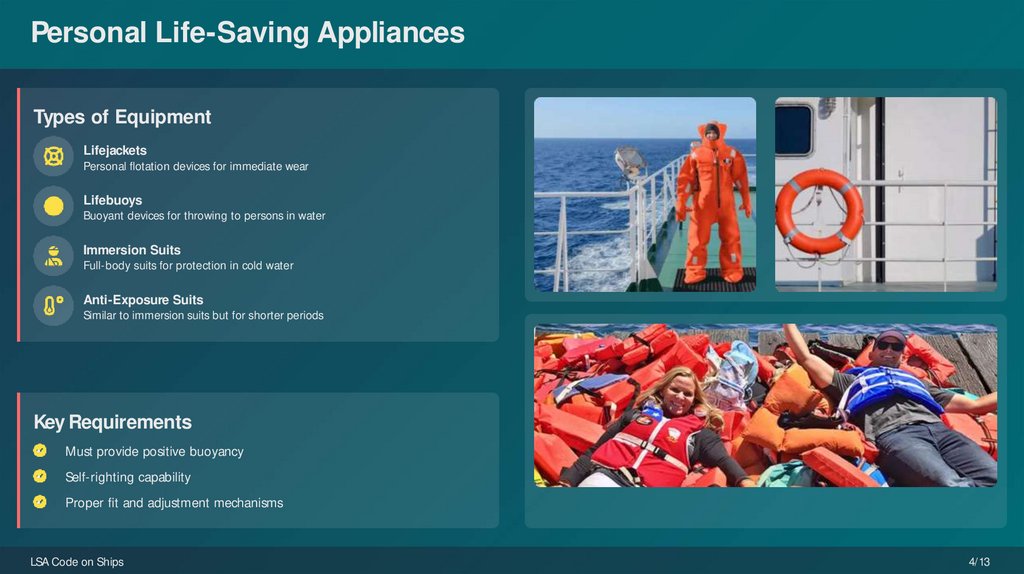
Personal Life-Saving AppliancesTypes of Equipment
Lifejackets
Personal flotation devices for immediate wear
Lifebuoys
Buoyant devices for throwing to persons in water
Immersion Suits
Full-body suits for protection in cold water
Anti-Exposure Suits
Similar to immersion suits but for shorter periods
Key Requirements
Must provide positive buoyancy
Self-righting capability
Proper fit and adjustment mechanisms
LSA Code on Ships
4/13
5.
Vis ual S ignaling E quipmentVisual signaling equipment is a critical component of a ship's
emergency survival kit, designed to aid in detection and rescue
operations.
Parachute Flares
Orange incendiary signals with parachute recovery system, burning
at not less than 1 500°C for not less than 40 seconds.
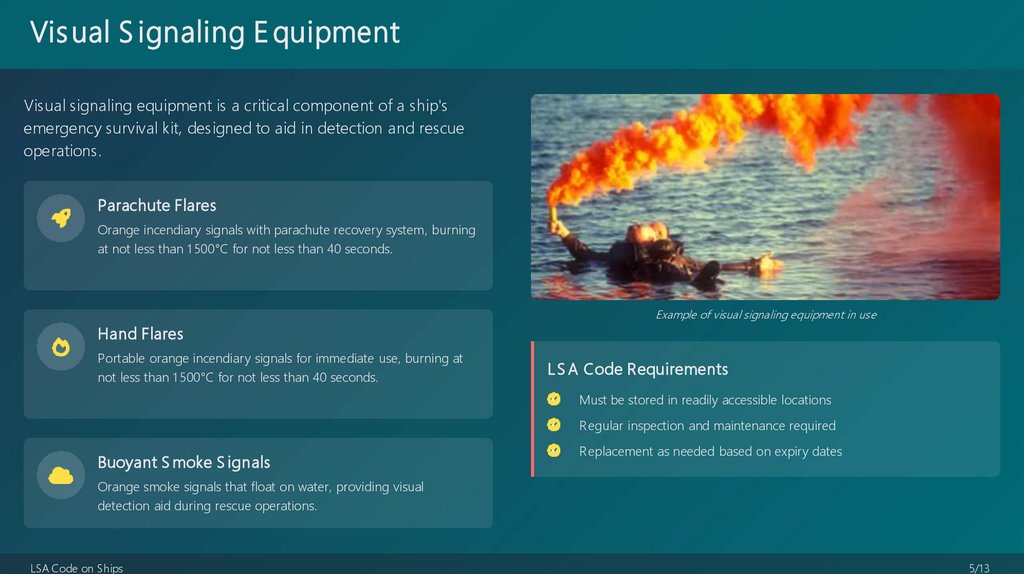
Example of visual signaling equipment in use
Hand Flares
Portable orange incendiary signals for immediate use, burning at
not less than 1 500°C for not less than 40 seconds.
Buoyant S moke S ignals
L S A Code Requirements
Must be stored in readily accessible locations
Regular inspection and maintenance required
Replacement as needed based on expiry dates
Orange smoke signals that float on water, providing visual
detection aid during rescue operations.
LSA Code on S hips
5/13
6.
L ifeboats RequirementsCons truction
Rigid hulls from fire-retardant materials
Positive stability when holed below waterline
Capacity
Maximum 150 persons allowed
Seating for all occupants (100 kg static load)
Propuls ion
Compression ignition engine
Start at -15°C within 2 minutes
Speed: 6 knots for 24 hours
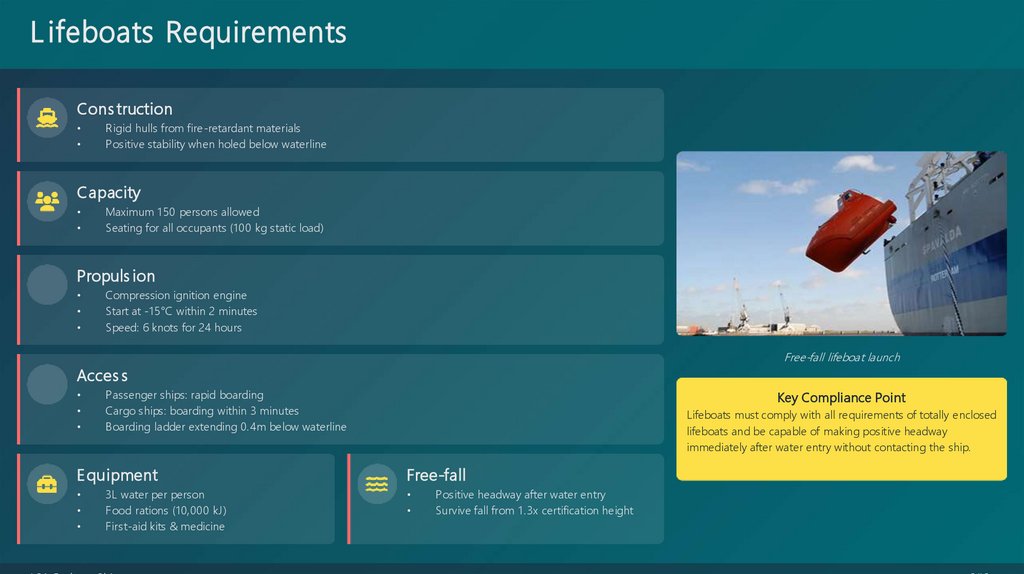
Free-fall lifeboat launch
Acces s
Passenger ships: rapid boarding
Cargo ships: boarding within 3 minutes
Boarding ladder extending 0.4m below waterline
Key Compliance Point
Lifeboats must comply with all requirements of totally enclosed
lifeboats and be capable of making positive headway
immediately after water entry without contacting the ship.
E quipment
Free-fall
3L water per person
Food rations (10,000 kJ)
First-aid kits & medicine
Positive headway after water entry
Survive fall from 1 .3x certification height
7.
Liferafts SpecificationsConstruction & Durability
Liferafts must withstand 30 days afloat in all sea conditions
Withstand jumps from 4.5m height without damage
Operate after being dropped from 18m or stowage height (whichever greater)
Capacity
No liferaft approved with carrying capacity less than 6 persons
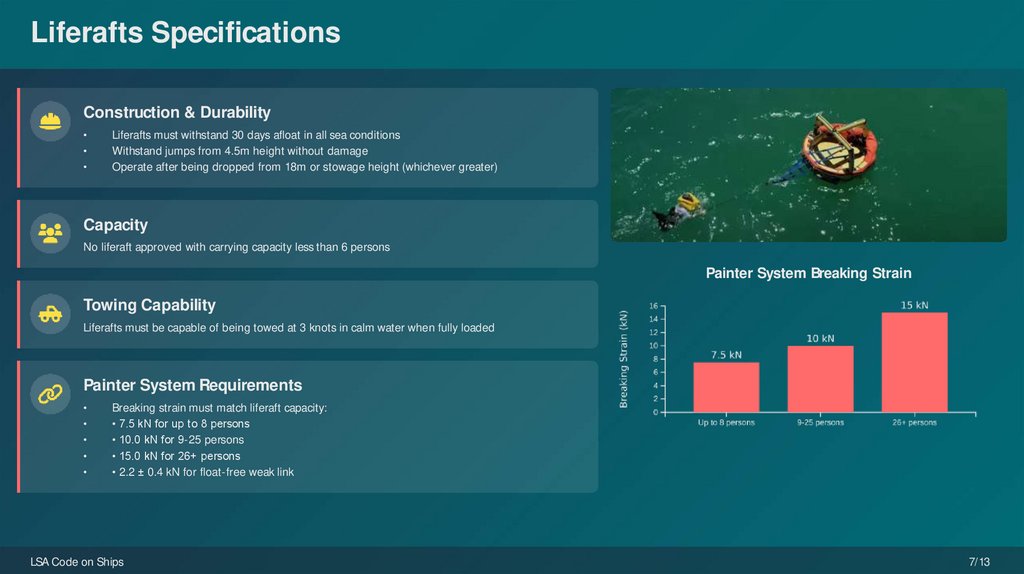
Painter System Breaking Strain
Towing Capability
Liferafts must be capable of being towed at 3 knots in calm water when fully loaded
Painter System Requirements
Breaking strain must match liferaft capacity:
• 7.5 kN for up to 8 persons
• 10.0 kN for 9-25 persons
• 15.0 kN for 26+ persons
• 2.2 ± 0.4 kN for float-free weak link
LSA Code on Ships
7/13
8.
Rescue Boats and PerformanceSize Requirements
Length: 3.8 - 8.5 meters
Performance
Speed: 6 knots
Duration: 4 hours
Capacity
Towing & Propulsion
5 seated persons
1 person on stretcher
Towing capability: 2 knots
Propulsion: Inboard engine or outboard motor
Rescue boats must be capable of rapid deployment and maneuverability for emergency response operations.
LSA Code on Ships
8/13
9.
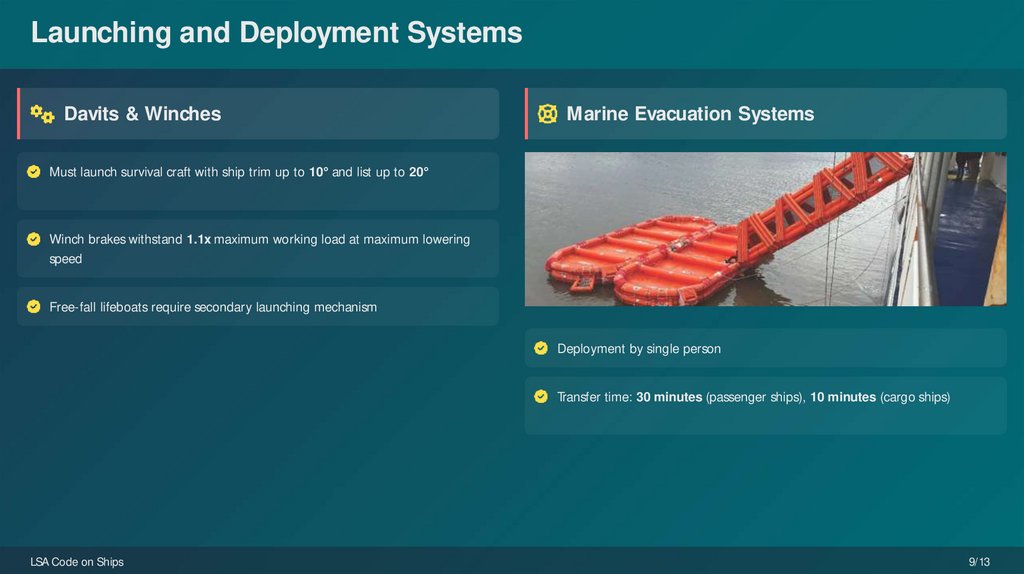
Launching and Deployment SystemsDavits & Winches
Marine Evacuation Systems
Must launch survival craft with ship trim up to 10° and list up to 20°
Winch brakes withstand 1.1x maximum working load at maximum lowering
speed
Free-fall lifeboats require secondary launching mechanism
Deployment by single person
Transfer time: 30 minutes (passenger ships), 10 minutes (cargo ships)
LSA Code on Ships
9/13
10.
Communication and Alarm S ys temsGeneral E mergency Alarm S ys tem
Public Addres s (PA) S ys tem
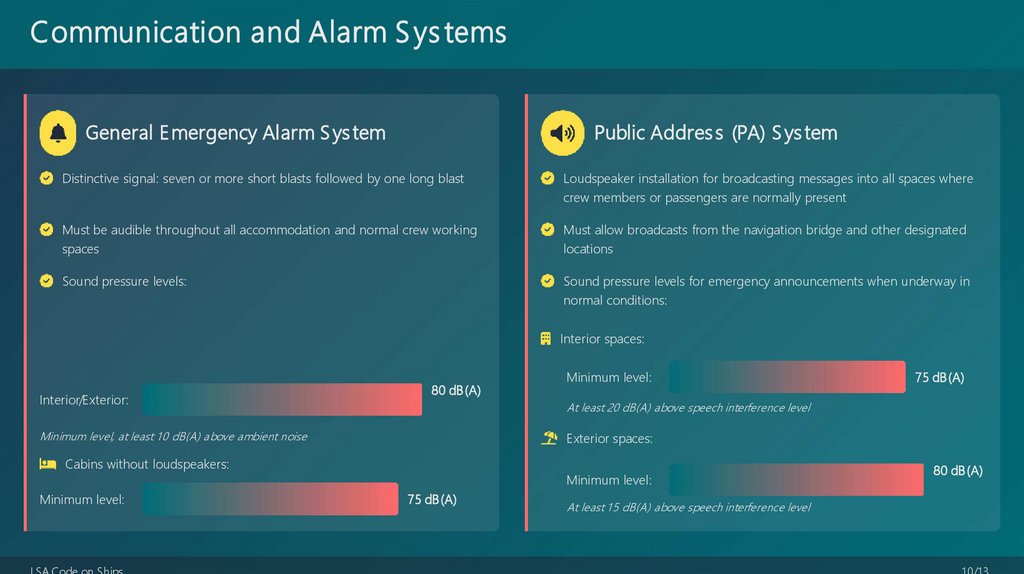
Distinctive signal: seven or more short blasts followed by one long blast
Loudspeaker installation for broadcasting messages into all spaces where
crew members or passengers are normally present
Must be audible throughout all accommodation and normal crew working
spaces
Must allow broadcasts from the navigation bridge and other designated
locations
Sound pressure levels:
Sound pressure levels for emergency announcements when underway in
normal conditions:
Interior spaces:
Interior/Exterior:
80 dB(A)
Exterior spaces:
Cabins without loudspeakers:
LSA Code on S hips
75 dB(A)
At least 20 dB(A) above speech interference level
Minimum level, at least 1 0 dB(A) above ambient noise
Minimum level:
Minimum level:
Minimum level:
75 dB(A)
80 dB(A)
At least 1 5 dB(A) above speech interference level
1 0/13
11.
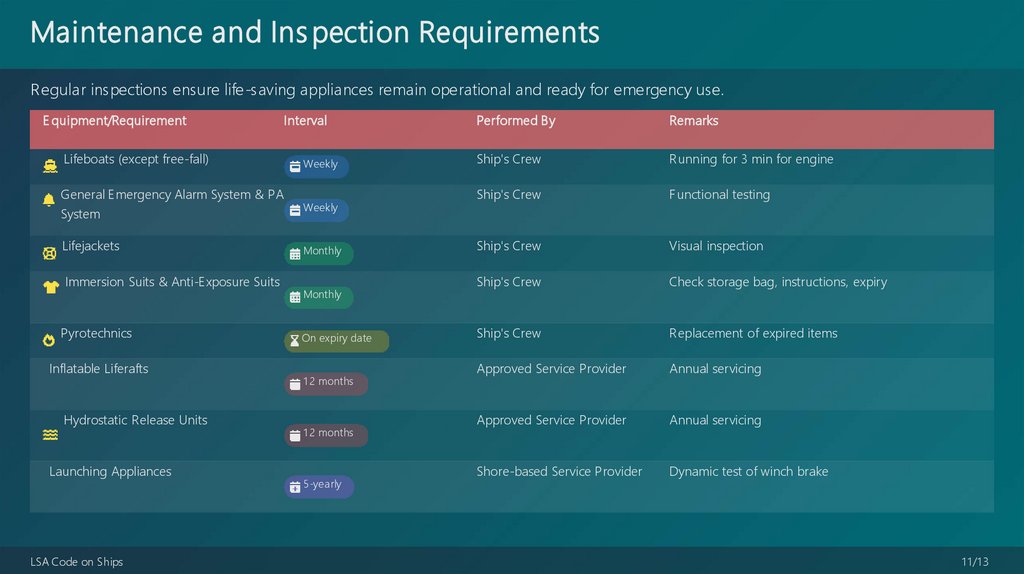
Maintenance and Ins pection RequirementsR egular inspections ensure life-saving appliances remain operational and ready for emergency use.
E quipment/Requirement
Interval
Lifeboats (except free-fall)
Weekly
General Emergency Alarm System & PA
System
Weekly
Lifejackets
Monthly
Immersion Suits & Anti-Exposure Suits
Pyrotechnics
Inflatable Liferafts
Hydrostatic Release Units
Launching Appliances
LSA Code on S hips
Monthly
On expiry date
1 2 months
1 2 months
5-yearly
Performed By
Remarks
Ship's Crew
Running for 3 min for engine
Ship's Crew
Functional testing
Ship's Crew
Visual inspection
Ship's Crew
Check storage bag, instructions, expiry
Ship's Crew
Replacement of expired items
Approved Service Provider
Annual servicing
Approved Service Provider
Annual servicing
Shore-based Service Provider
Dynamic test of winch brake
1 1/1 3
12.
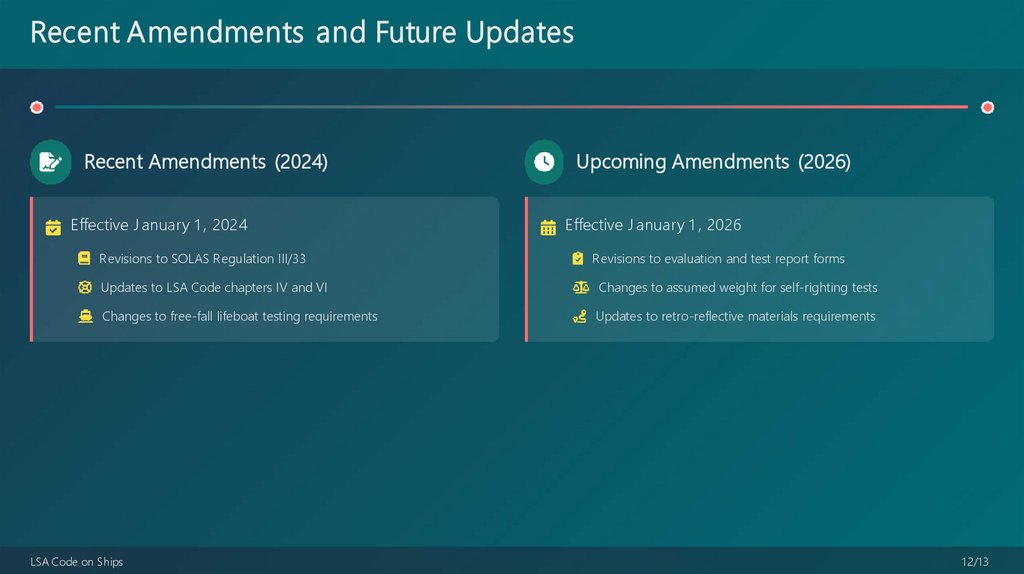
Recent Amendments and Future UpdatesRecent Amendments (2024)
Effective J anuary 1 , 2024
Upcoming Amendments (2026)
Effective J anuary 1 , 2026
Revisions to SOLAS Regulation III/33
Revisions to evaluation and test report forms
Updates to LSA Code chapters IV and VI
Changes to assumed weight for self-righting tests
Changes to free-fall lifeboat testing requirements
Updates to retro-reflective materials requirements
LSA Code on S hips
1 2/13
13.
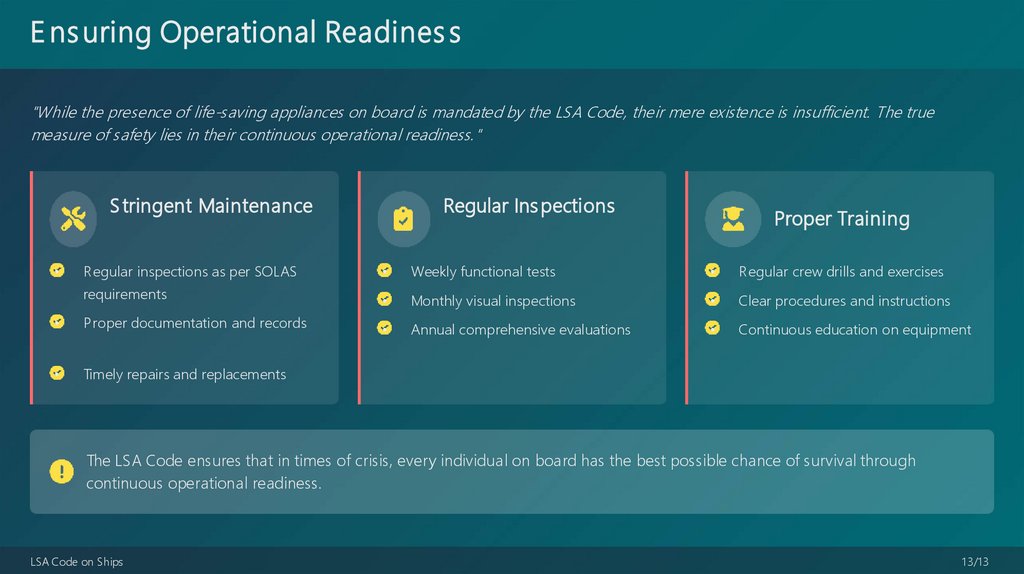
E ns uring Operational Readines s"While the presence of life-saving appliances on board is mandated by the LSA Code, their mere existence is insufficient. The true
measure of safety lies in their continuous operational readiness."
S tringent Maintenance
Regular Ins pections
Proper Training
Regular inspections as per SOLAS
Weekly functional tests
Regular crew drills and exercises
requirements
Monthly visual inspections
Clear procedures and instructions
Proper documentation and records
Annual comprehensive evaluations
Continuous education on equipment
Timely repairs and replacements
The LSA Code ensures that in times of crisis, every individual on board has the best possible chance of survival through
continuous operational readiness.
LSA Code on S hips
1 3/13