
 География
Похожие презентации:







Energy resources of Kyrgyz Republic
1. Lesson: Geography of Kyrgyz Republic Subject: Energy resources of Kyrgyz Republic
Lecturer: Emilbek Zholdoshbekovemilbek.zholdoshbekov@alatoo.edu.kg
2.
Outline of the presentation• Overview of energy resources of Kyrgyz Republic
• Share of electricity production
• Share of energy sources
3. Overview of Energy resources of Kyrgyz Republic
• Energy is a key source of economic growth because manyproduction and consumption activities involve energy as a basic
input. Energy is one of the most important inputs for economic
development. From a physical viewpoint, the use of energy drives
economic productivity and industrial growth and is central to the
operation of any modern economy.
• The structure of energy sources depends from the geography of
the country. Countries satisfy their energy demands from available
energy sources.
• Energy sector has always been a strategic sector of the Kyrgyz
Republic directly affecting the living standards of the population
and all economy sectors.
• The energy sector accounts for about 5.5 % of GDP and 16 % of
industrial production, and generates about 10 % of state budget
revenues.
4. Share of electricity production
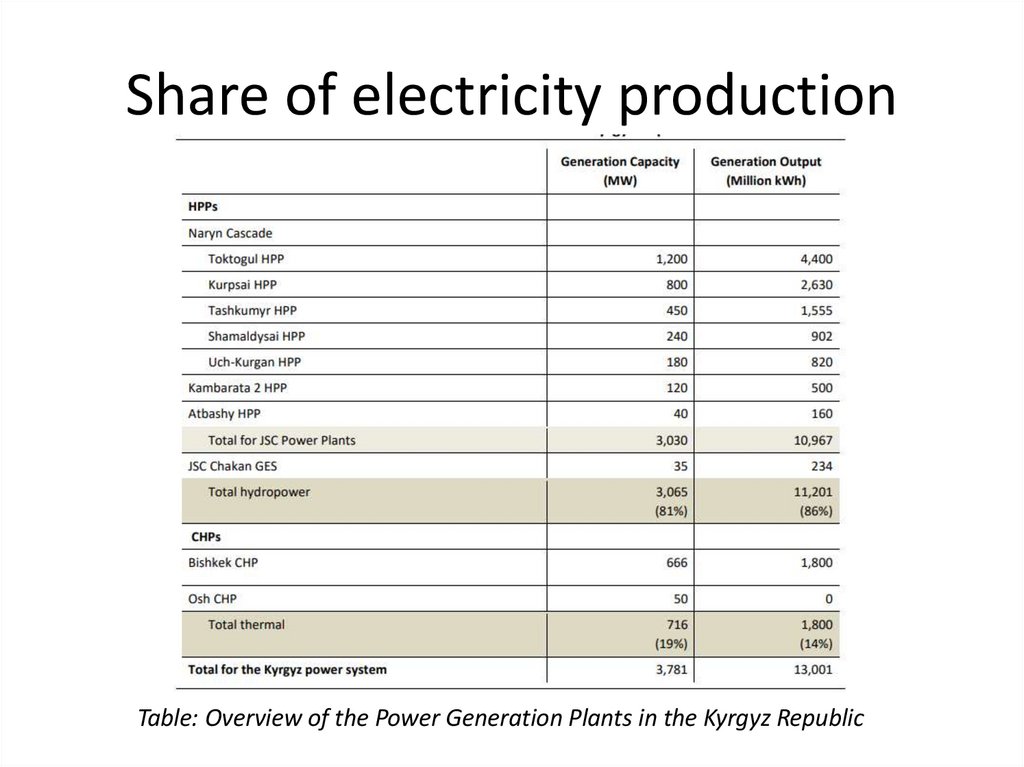
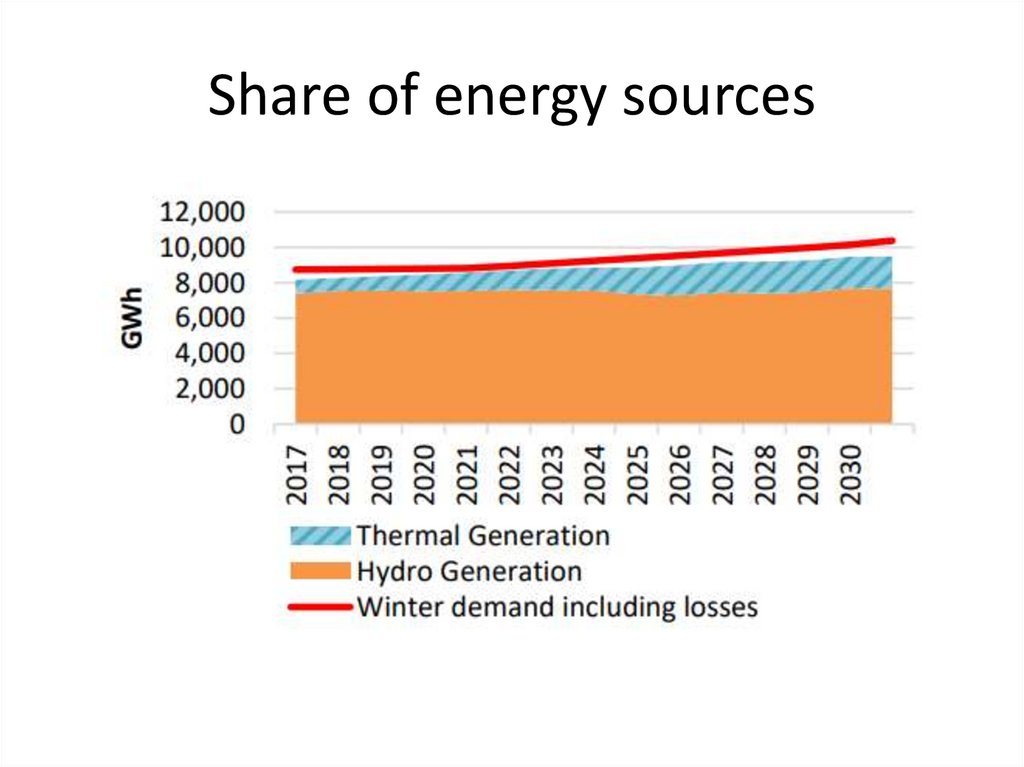
• Electricity supply in the Kyrgyz Republic is fueled by a mix of hydroelectricand thermal generators. The Kyrgyz Republic has huge reserves of clean
energy. The hydropower energy potential of large and small rivers is
estimated at 142.5 billion kWh that is currently used only at the level of 10
%.
• Renewability of hydropower energy resources and unconventional energy
sources, a small degree of their use, obvious environmental advantages
compared with fossil fuels, and the extremely high potential capacity of the
main water recourses give grounds to the viability and high economic
efficiency of building large and small hydroelectric power plants.
• More than 90 % of electricity in the country is produced by hydroelectric
power plants (HPP). The rest of the electricity is generated by thermal power
plants. However, small and medium energy sector is not actually involved.
5. Share of electricity production
Table: Overview of the Power Generation Plants in the Kyrgyz Republic6. Share of electricity production
AB
C
D
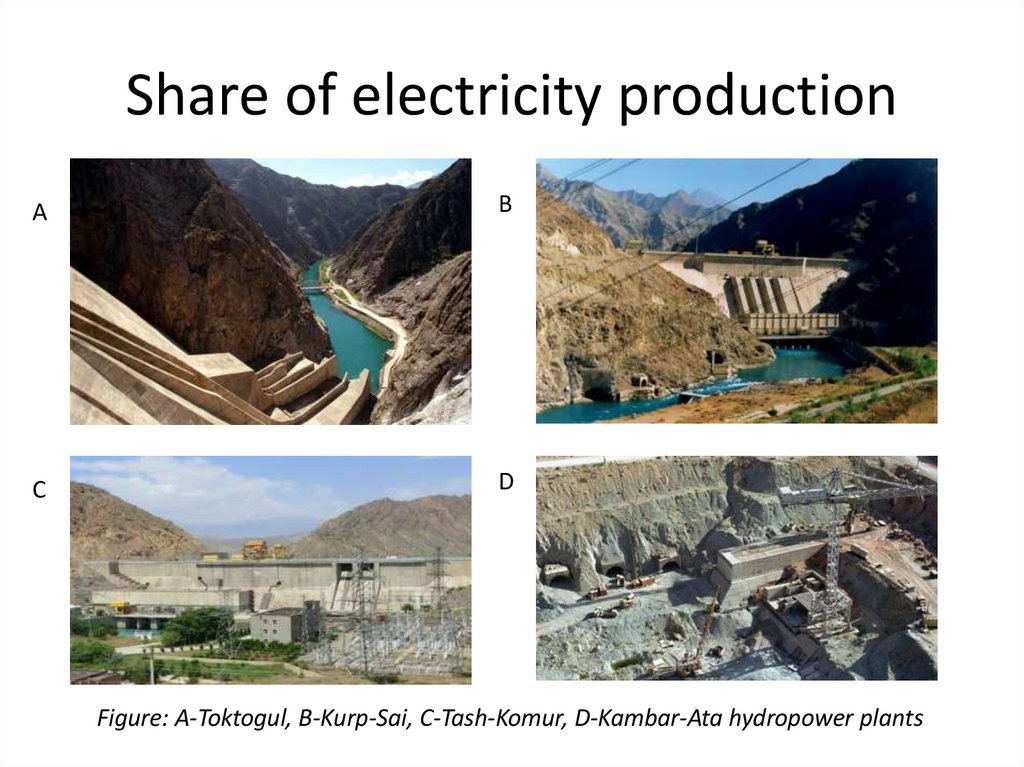
Figure: A-Toktogul, B-Kurp-Sai, C-Tash-Komur, D-Kambar-Ata hydropower plants
7. Share of electricity production
AB
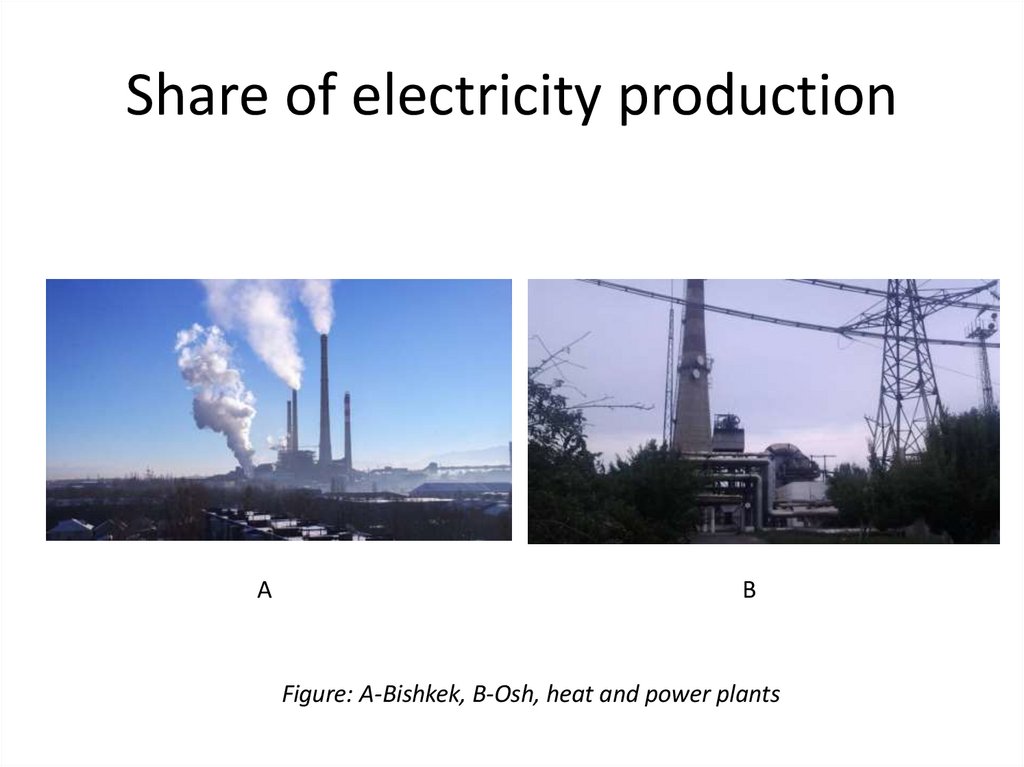
Figure: A-Bishkek, B-Osh, heat and power plants
8. Share of energy sources
Coal
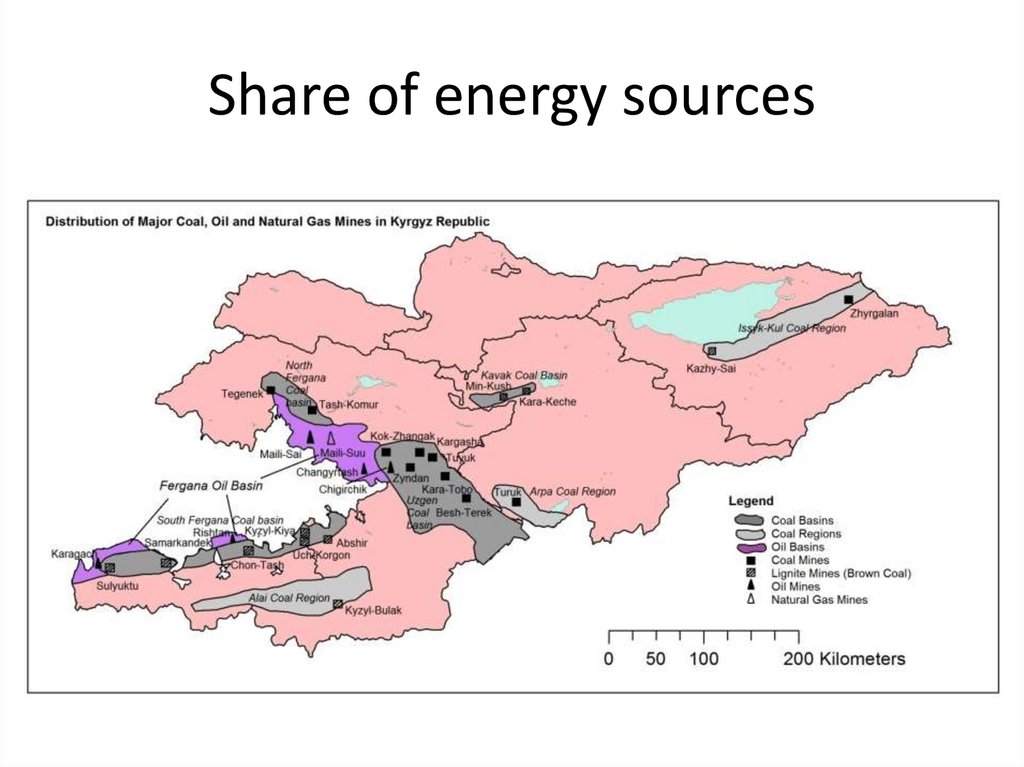
Approximately 70 deposits and coal occure in 4 coal basins
and 3 coal regions have been found on the territory of the
country. They are grouped into four basins: Southern
Fergana (Sulyukta, Kyzyl-Kyia, Beshburkhan, Abshyr,
Almalyk), Uzgen (Kok-Yangak, Kumbel, Zindan); Northern
Fergana (Tashkumyr, Kara-Tut, Tegenek); Kavak (Kok-Moinok,
Minkush, Kara-Keche) and three coal-regions: Alai, AlabukaChatyrkul and Southern Issyk-Kul.
Coal deposits are formed by the Trias-Jurassic sediments
represented by alternating clay, argillite, siltstone,
sandstone and bibbley-rock with coal beds. Commercial coal
beds are confined to the lower part of section, to Early
Jurassic rocks. 1,377,486 thousand tonnes of coal are
registered, including 76% under А+В+С1 categories and 24%
under С2 category.
Most perspective areas for development are Kara-Keche and
Minkush deposits with explored reserves of 435 and 116
million tonnes. Total coal deposit of the coal is about 28
billion tones.
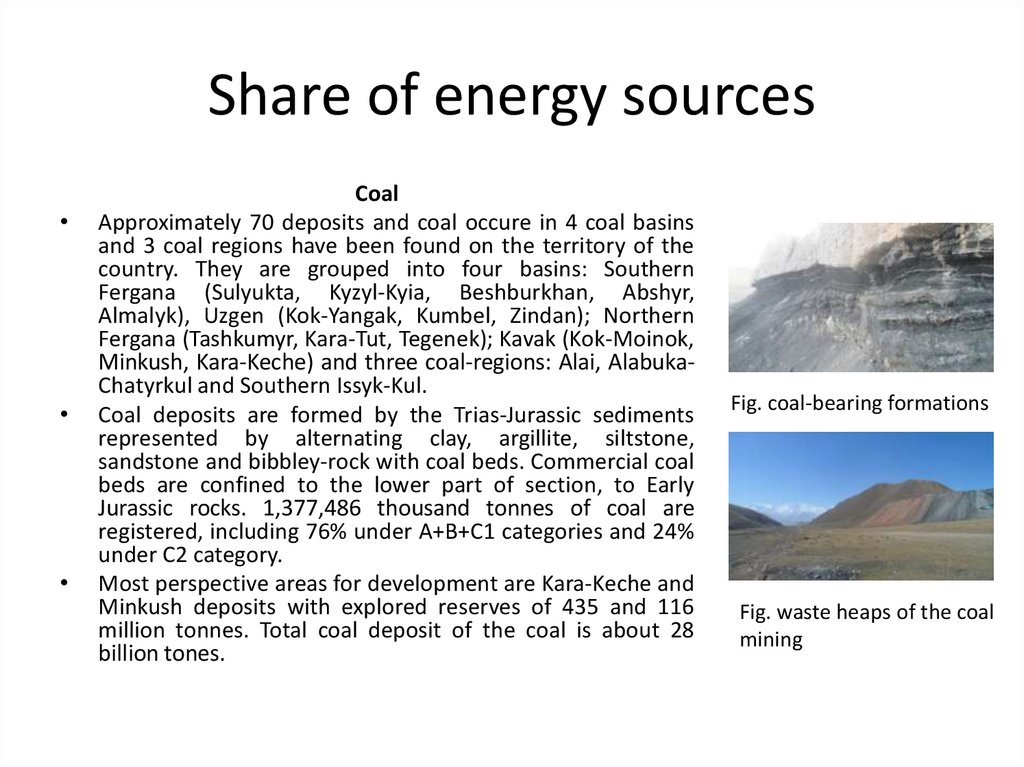
Fig. coal-bearing formations
Fig. waste heaps of the coal
mining
9. Share of energy sources
10. Share of energy sources
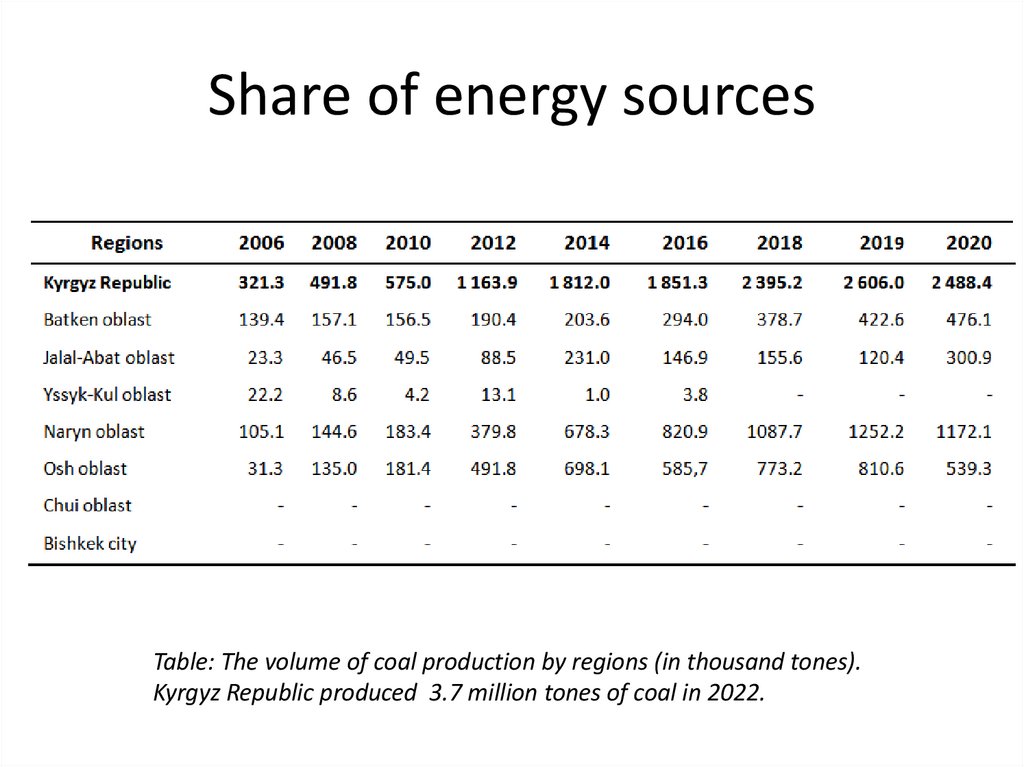
Table: The volume of coal production by regions (in thousand tones).Kyrgyz Republic produced 3.7 million tones of coal in 2022.
11. Share of energy sources
Oil and natural gas
Oil and gas recovery is carried out in the Fergana valley. Oil and gas deposits are
multi-layered and confined to aleurolite-siltstone rocks of the Jurassic and
Cretaceous period, to carbonate-terrigenous reservoirs of the Paleogene period
and gravelite-sand sediments of the Neogene period. 14 deposits were defined,
including 7 oil deposits (Maili-Sai, Chigirchik, Changyrtash, Karagachi, Tamchy,
Bishkent-Togap, Tashravat), 4 oil and gas deposits (Mailisu III, Mailisu IV Vostochnyi Izbaskent, Izbaskent, Nyiazbek - Severnyi Karachikum), 2 gas deposits
(Suzak, Yuzhnyi Rishtan).
Recoverable reserves amount to oil - 13 million tonnes, gas - 6.5 billion m³. Over
10 million tonnes of oil and over 7.5 billion m3 of gas were recovered since
commencement of development in the Fergana valley of Kyrgyzstan. The highest
value of oil recovery amounted to 320 thousand tonnes per year, gas - 380
million m3 per year.
Country haven’t sufficient crude oil and natural gas reserves to satisfy its
demands. Over 90% of oil products (mainly diesel and motor gasoline) and
natural gas are imported. The most important trading partners for oil and gas are
the Russian Federation and Kazakhstan.
12. Share of energy sources
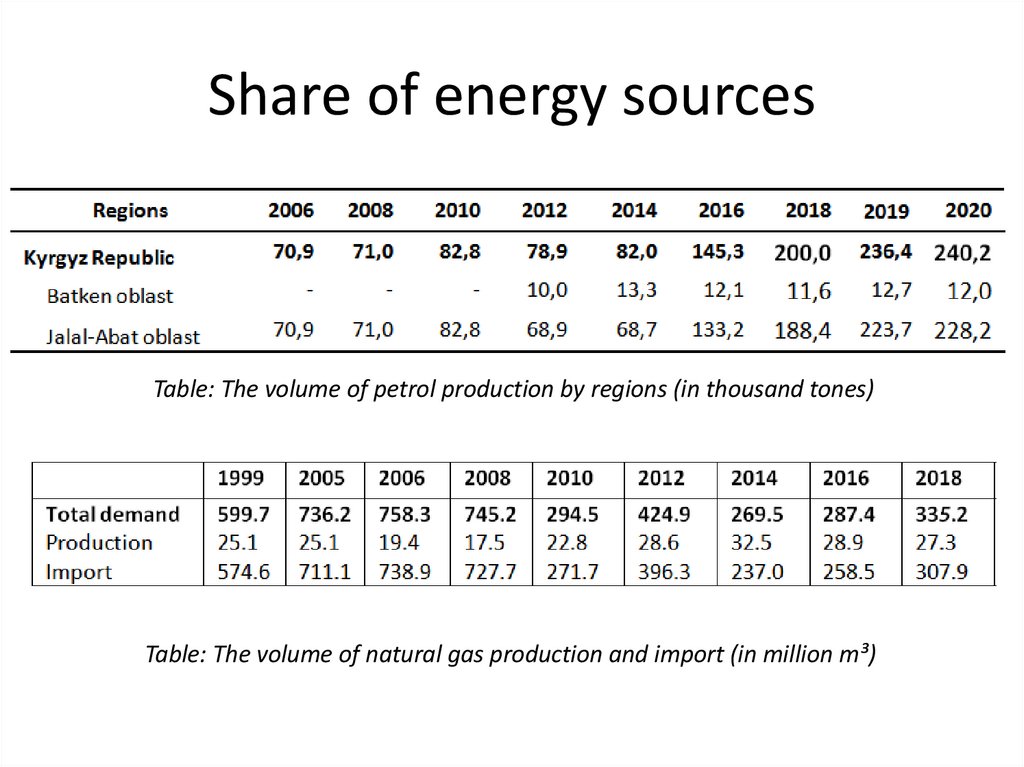
Table: The volume of petrol production by regions (in thousand tones)Table: The volume of natural gas production and import (in million m³)
13. Share of energy sources
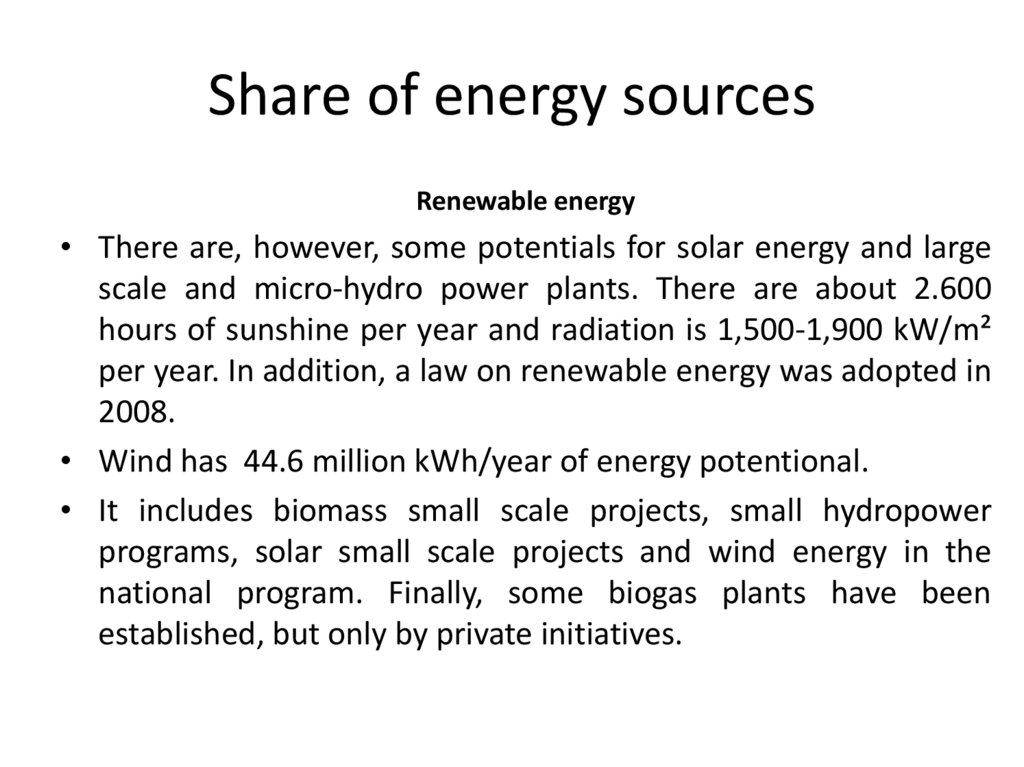
Renewable energy• There are, however, some potentials for solar energy and large
scale and micro-hydro power plants. There are about 2.600
hours of sunshine per year and radiation is 1,500-1,900 kW/m²
per year. In addition, a law on renewable energy was adopted in
2008.
• Wind has 44.6 million kWh/year of energy potentional.
• It includes biomass small scale projects, small hydropower
programs, solar small scale projects and wind energy in the
national program. Finally, some biogas plants have been
established, but only by private initiatives.