
Похожие презентации:







The Weaponization of Information
1.
The weaponization ofInformation
“When we allow information to be weaponized — turned into a tool of
control rather than enlightenment — we surrender not just our privacy, but
our ability to think freely and govern ourselves.”
Edward Snowden, former US intelligence officer
Prepared by Voronichev Alexander, 7th group
2.
Beyond "Fake News": A New Era ofDigital Deception
Deepfakes
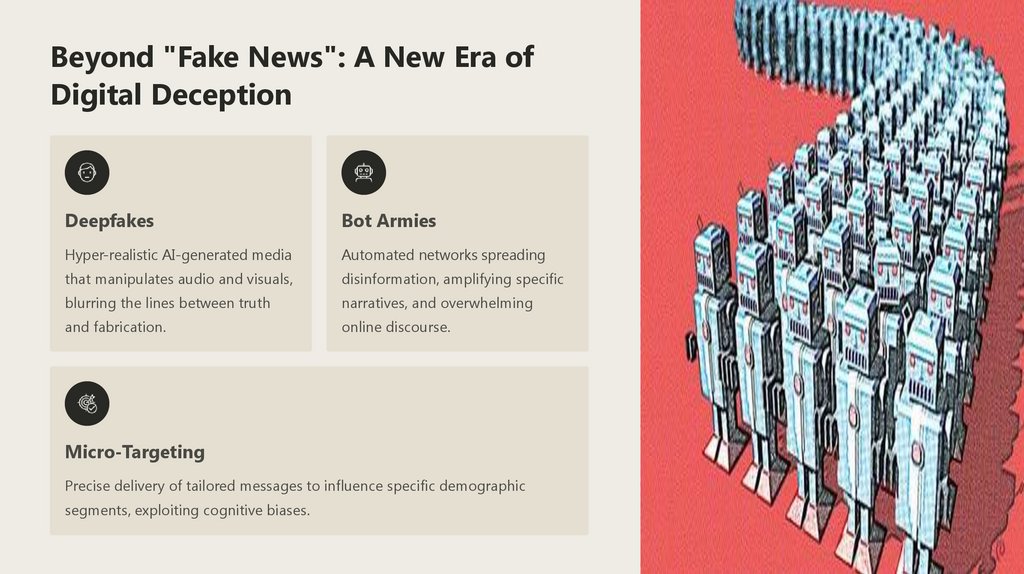
Bot Armies
Hyper-realistic AI-generated media
Automated networks spreading
that manipulates audio and visuals,
disinformation, amplifying specific
blurring the lines between truth
narratives, and overwhelming
and fabrication.
online discourse.
Micro-Targeting
Precise delivery of tailored messages to influence specific demographic
segments, exploiting cognitive biases.
3.
The Destabilizing Force: Cyber-Conflict'sImpact
Information is no longer just power; it's a low-cost weapon with high-impact potential.
Cyber-conflict transcends traditional warfare, targeting the very fabric of societal trust
and stability.
Social Polarization
Market Manipulation
Amplifying divisions, creating echo
Spreading false information to
chambers, and fueling discontent
influence stock prices, damage
among populations.
corporate reputations, and create
economic instability.
Undermining
Democracy
Interfering with elections, eroding public faith in institutions, and fostering political
apathy.
4.
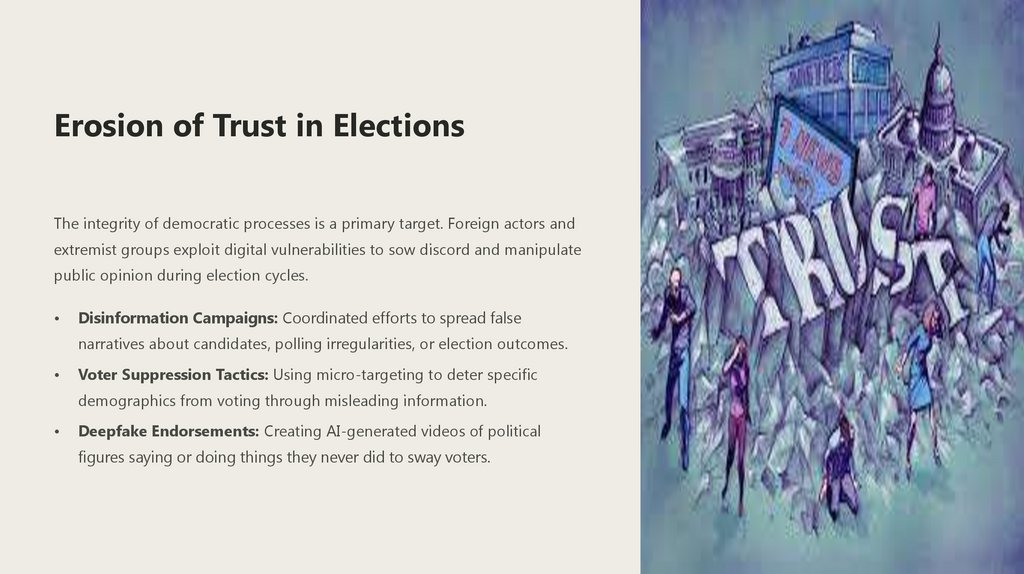
Erosion of Trust in ElectionsThe integrity of democratic processes is a primary target. Foreign actors and
extremist groups exploit digital vulnerabilities to sow discord and manipulate
public opinion during election cycles.
Disinformation Campaigns: Coordinated efforts to spread false
narratives about candidates, polling irregularities, or election outcomes.
Voter Suppression Tactics: Using micro-targeting to deter specific
demographics from voting through misleading information.
Deepfake Endorsements: Creating AI-generated videos of political
figures saying or doing things they never did to sway voters.
5.
Case Study on Information as aWeapon in the Electoral Process
“Exposure to the Russian Internet Research Agency Foreign Influence
Campaign on Twitter in the 2016 U.S. Election and Its Relationship to
Attitudes and Voting Behavior”
Published in Nature Communications in 2023 by researchers from University
of California, Berkeley, and others.
Key findings:
• Users heavily exposed to IRA tweets showed measurable changes in
perceptions of political candidates and issues.
•. Effects were stronger among users with pre-existing partisan alignment
matching the disinformation narrative.
• The research concluded that information weaponization in digital
campaigns can meaningfully influence electoral outcomes, not just by
changing minds en masse, but by targeting and activating specific
demographic and ideological segments.
6.
The Economic Toll: MarketDestabilization
Beyond politics, weaponized information can wreak havoc on global markets,
causing financial losses and undermining investor confidence.
$100B+ 30%
1.5M
Estimated Annual
Cost
Market Volatility
Of cyberattacks and
sectors targeted by
Identified as spreading
disinformation to the
disinformation
financially motivated
global economy.
campaigns.
disinformation.
Increase observed in
Fake Social
Accounts
7.
Technical Defense Challenges: AMoving Target
Combating these advanced digital threats requires continuous innovation in
detection and response, often against well-funded and adaptive adversaries.
1
2
AI Detection Limitations
Deepfake technology evolves faster than detection algorithms.
Attribution Difficulty
Tracing the origins of attacks is complex due to proxy networks and
anonymity tools.
3
Scalability of Attack
Bot networks can launch attacks at an unprecedented scale,
overwhelming defenses.
8.
Social Defense: Rebuilding Shared RealityBeyond technical solutions, society must cultivate resilience against manipulation by
fostering critical thinking and media literacy.
Media Literacy
Educating citizens to
critically evaluate
Community
Engagement
Promoting dialogue and
information sources and
fostering trusted local
identify manipulation.
information networks.
International
Collaboration
Sharing threat
intelligence and
coordinating responses
across borders.
Ethical
Frameworks
Developing industry
standards and
regulations for AI and
content creation.
9.
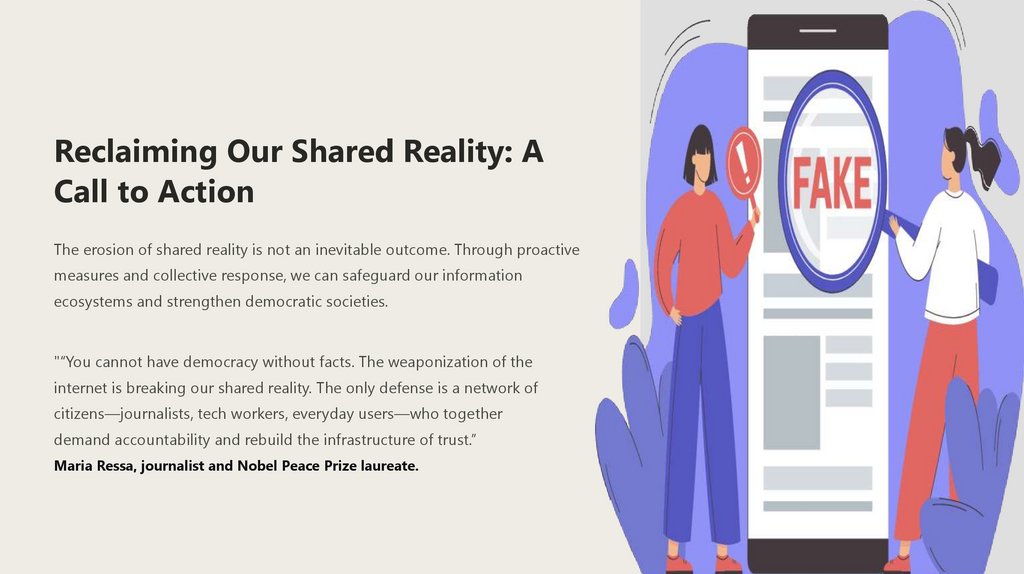
Reclaiming Our Shared Reality: ACall to Action
The erosion of shared reality is not an inevitable outcome. Through proactive
measures and collective response, we can safeguard our information
ecosystems and strengthen democratic societies.
"“You cannot have democracy without facts. The weaponization of the
internet is breaking our shared reality. The only defense is a network of
citizens—journalists, tech workers, everyday users—who together
demand accountability and rebuild the infrastructure of trust.”
Maria Ressa, journalist and Nobel Peace Prize laureate.
10.
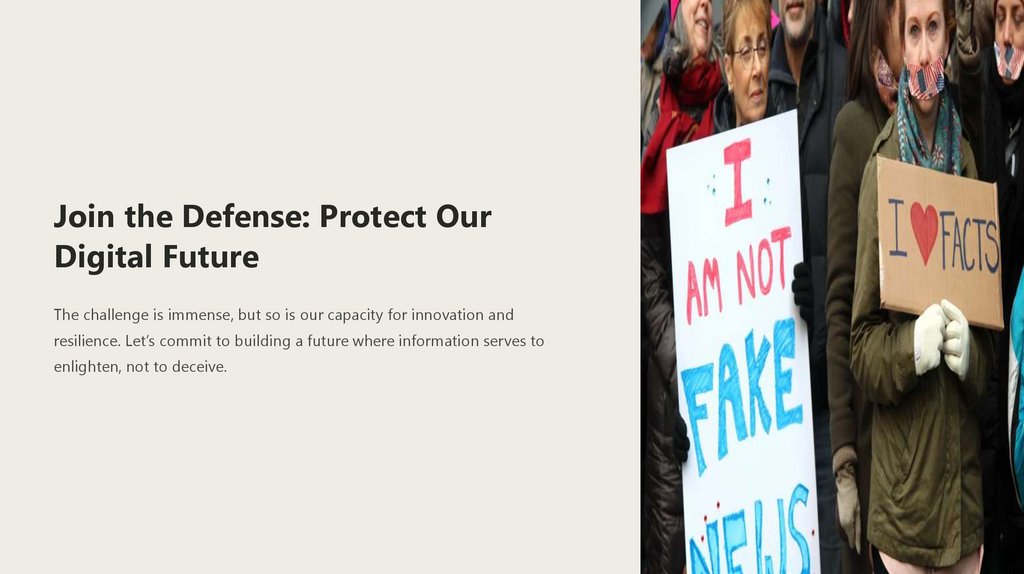
Join the Defense: Protect OurDigital Future
The challenge is immense, but so is our capacity for innovation and
resilience. Let’s commit to building a future where information serves to
enlighten, not to deceive.