













 Английский язык
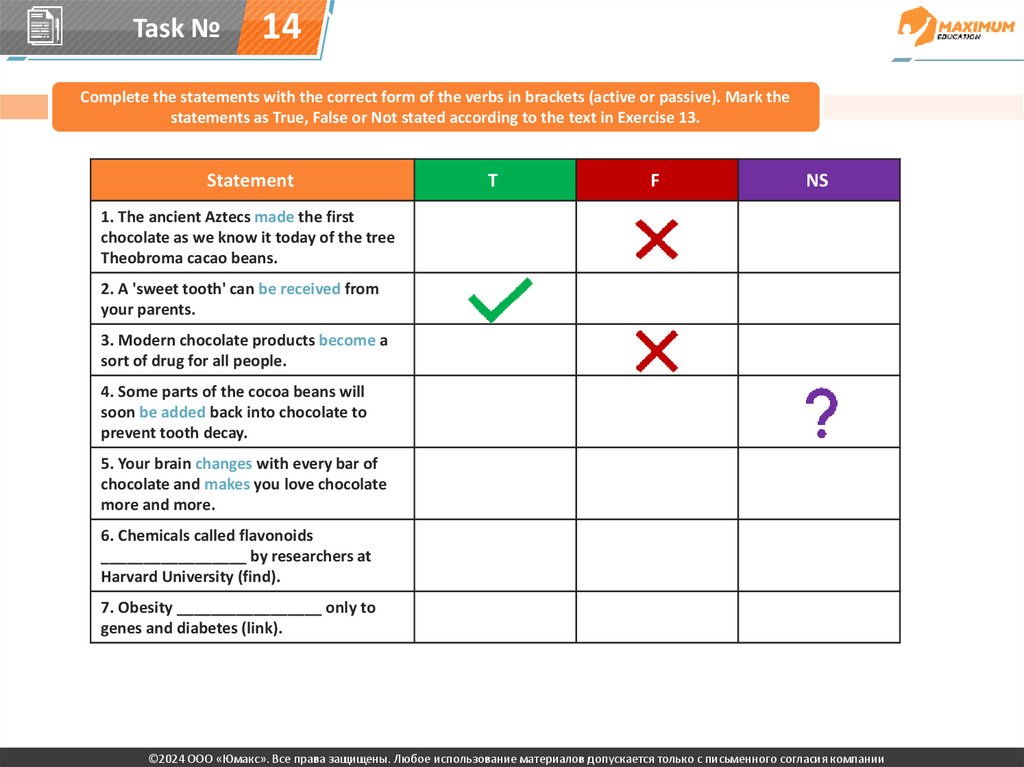
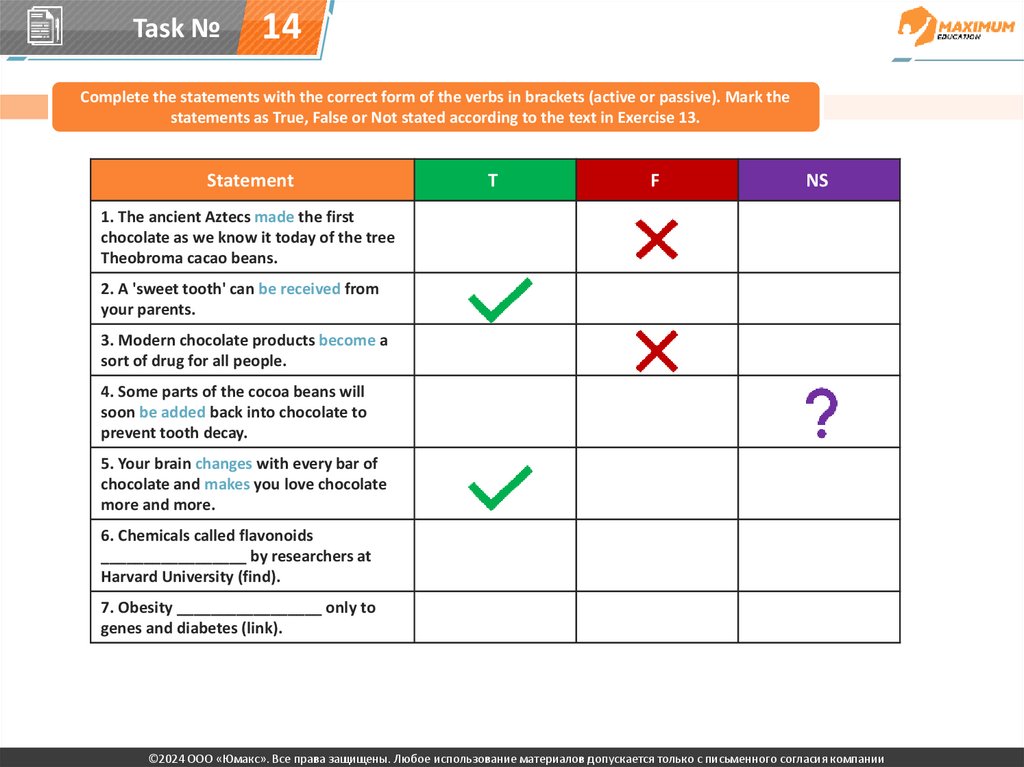
Похожие презентации:




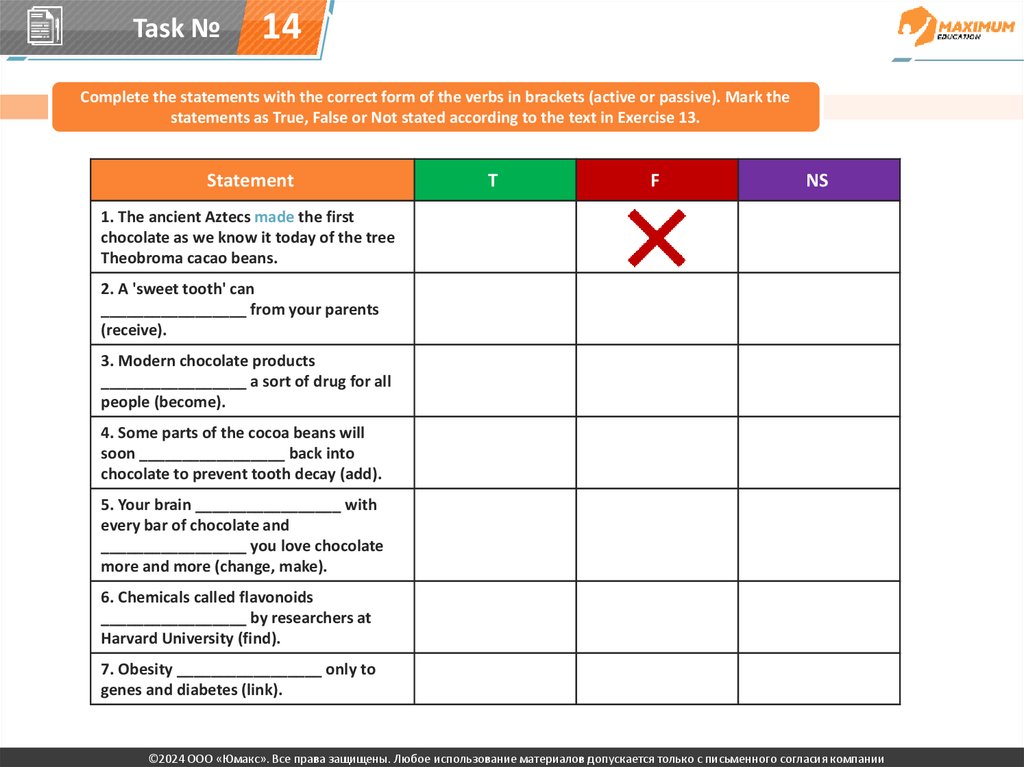
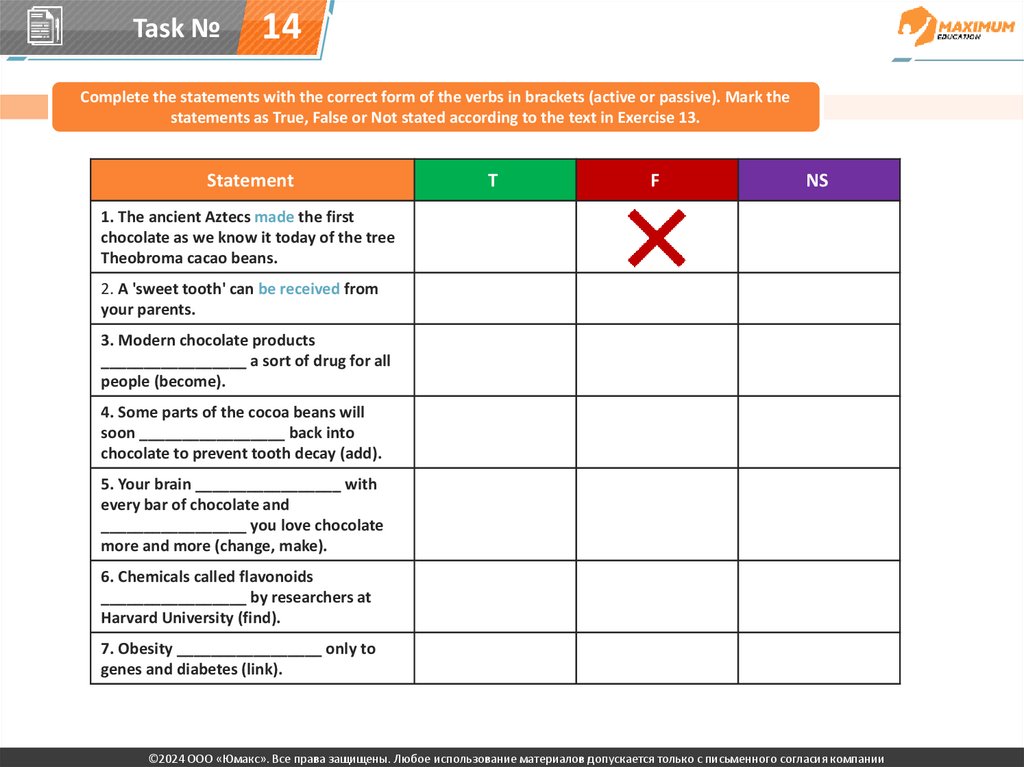
Food and Drinks. Отработать активную лексику: глаголы и прилагательные ЕГЭ
1.
Английскийязык
ЕГЭ
Food and Drinks
part III
2.
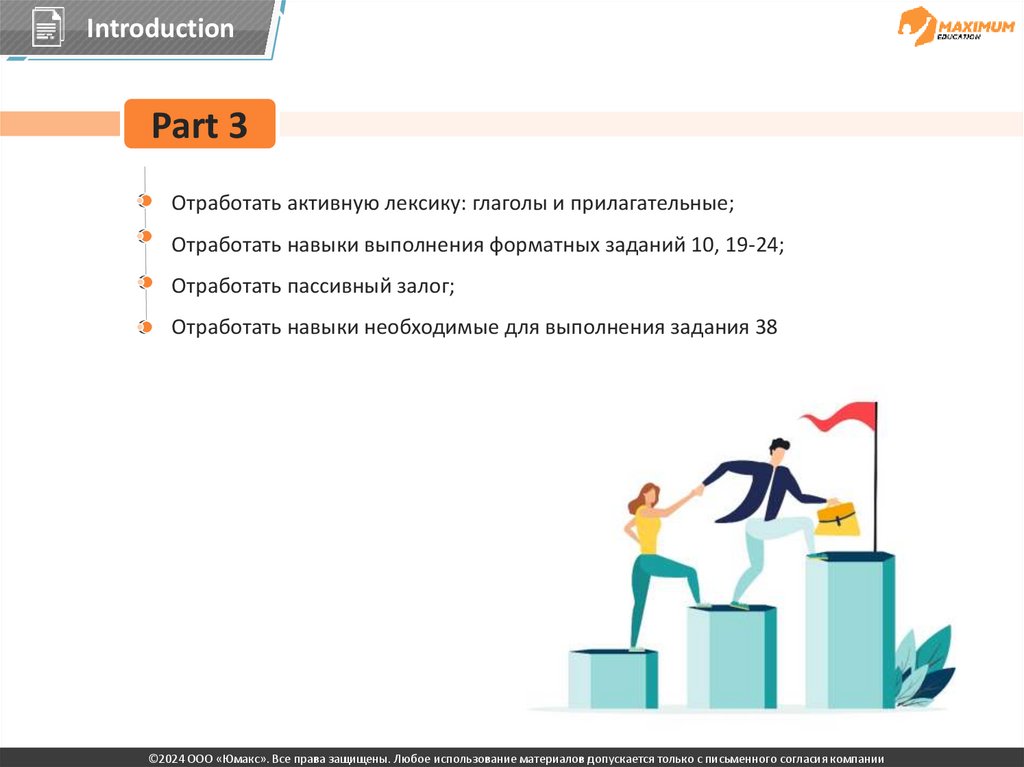
IntroductionPart 3
Отработать активную лексику: глаголы и прилагательные;
Отработать навыки выполнения форматных заданий 10, 19-24;
Отработать пассивный залог;
Отработать навыки необходимые для выполнения задания 38
©2024 ООО «Юмакс». Все права защищены. Любое использование материалов допускается только с письменного согласия компании
3.
Let’s go!Task 9
©2024 ООО «Юмакс». Все права защищены. Любое использование материалов допускается только с письменного согласия компании
4.
9Task №
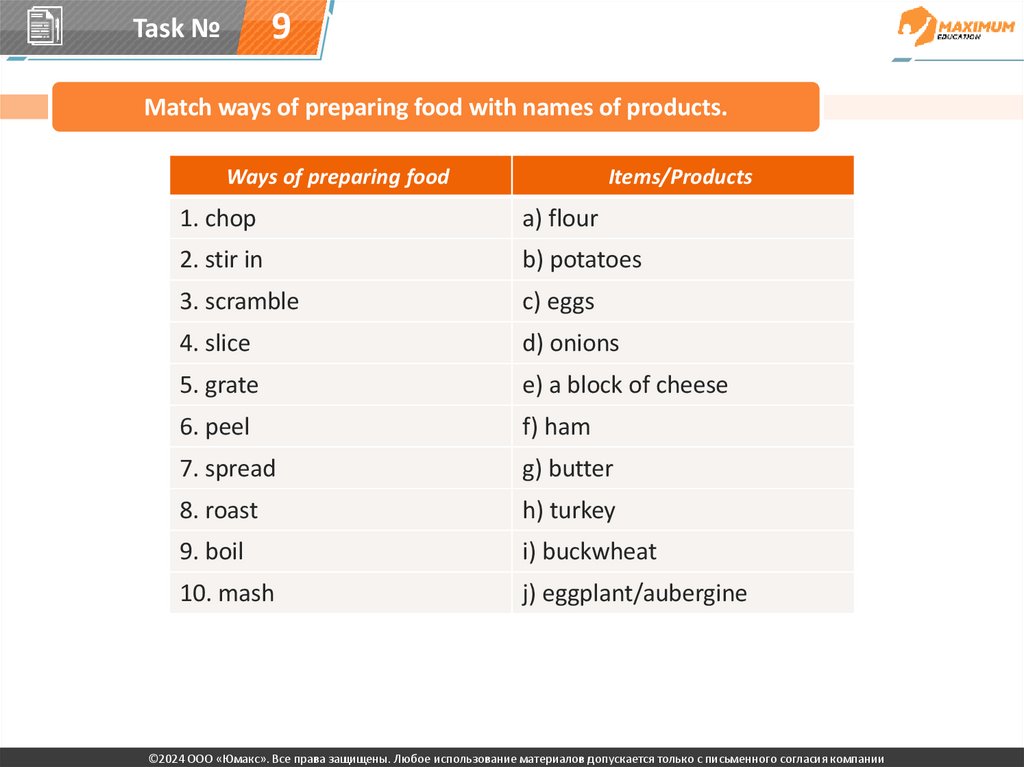
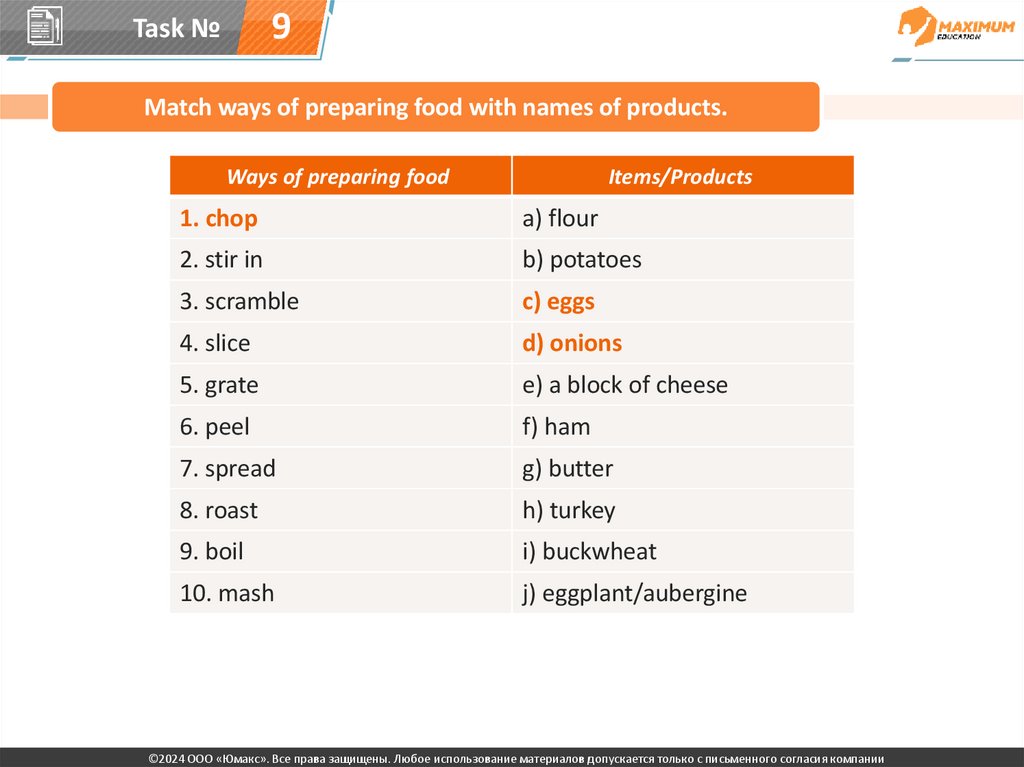
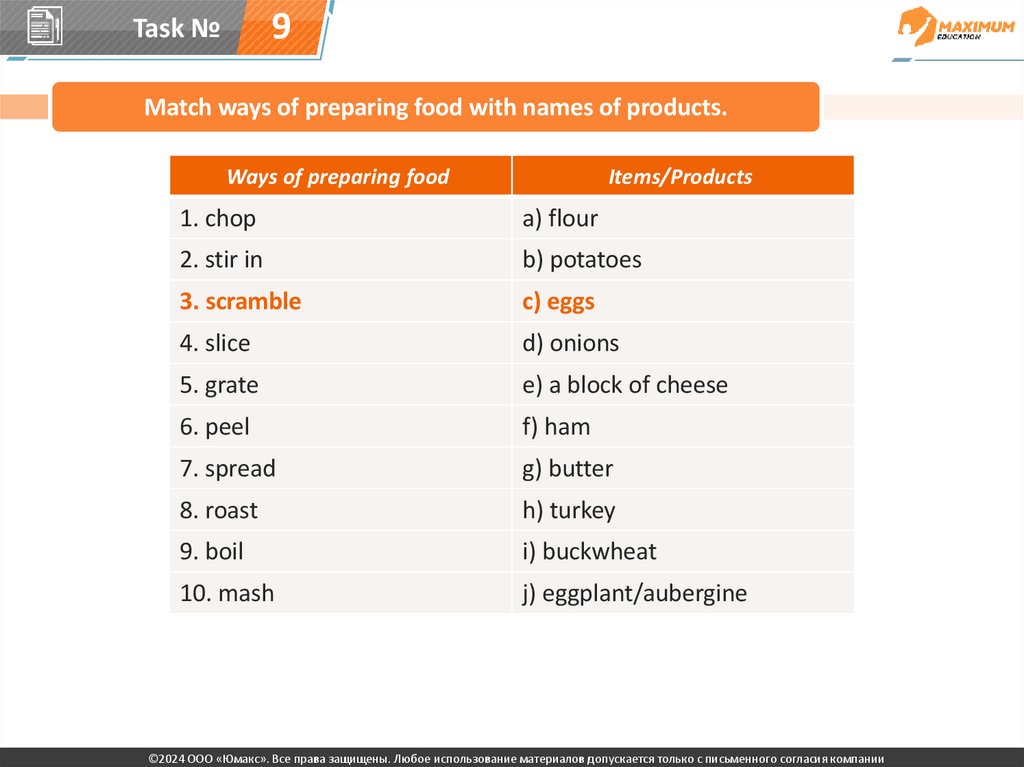
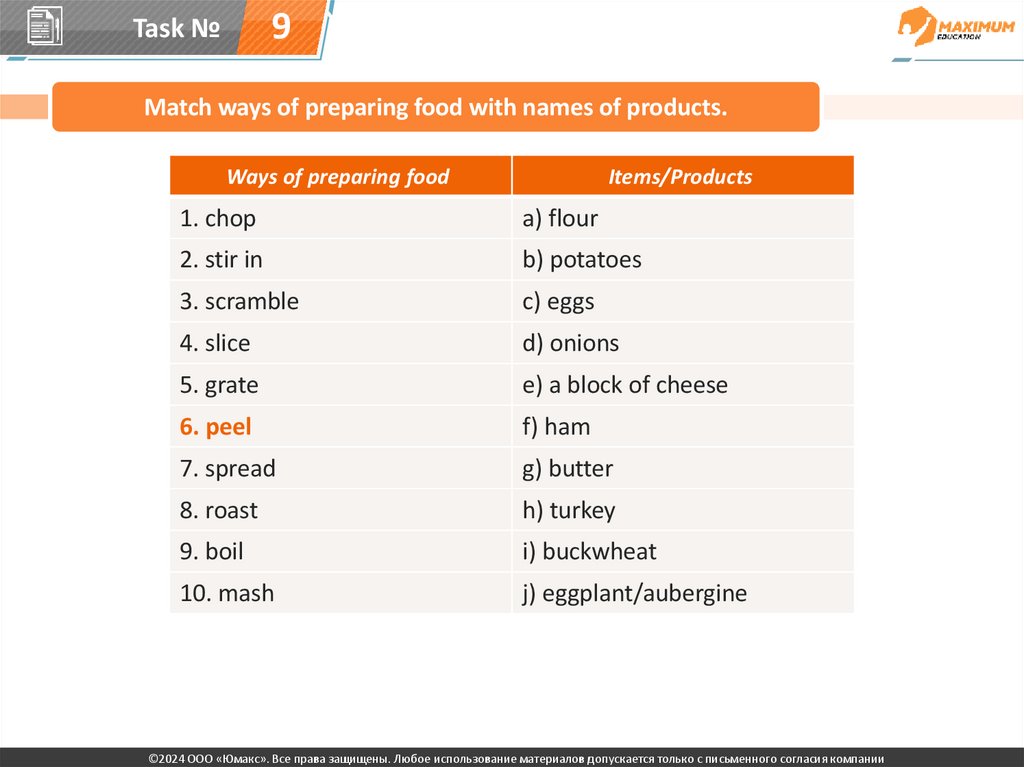
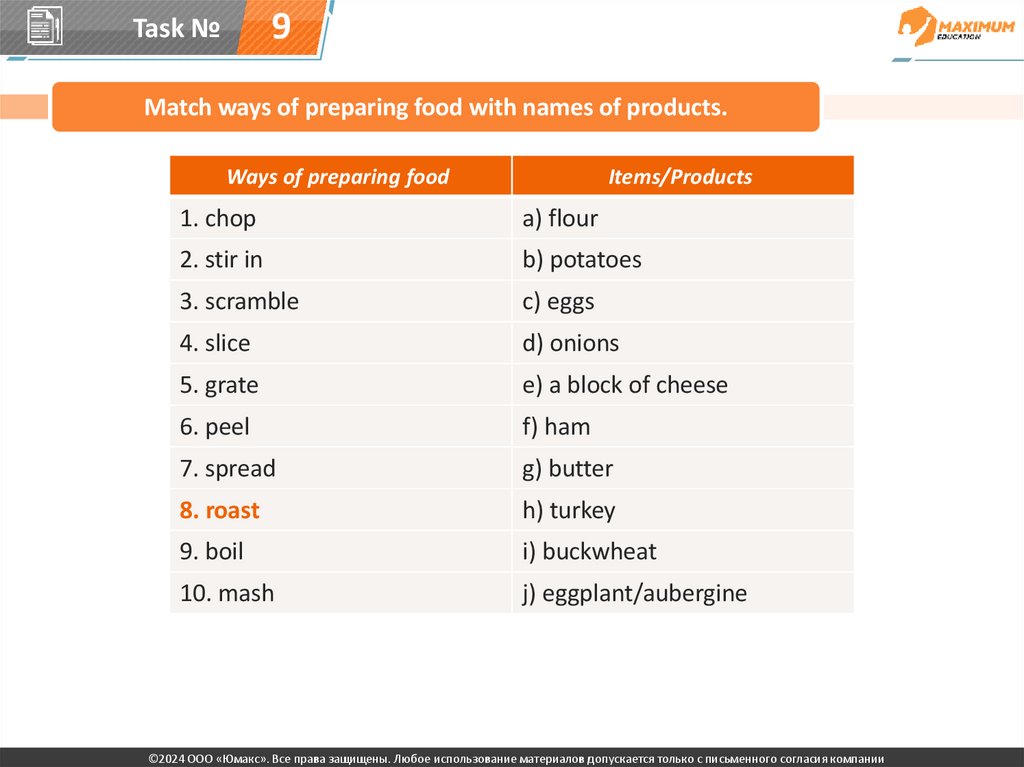
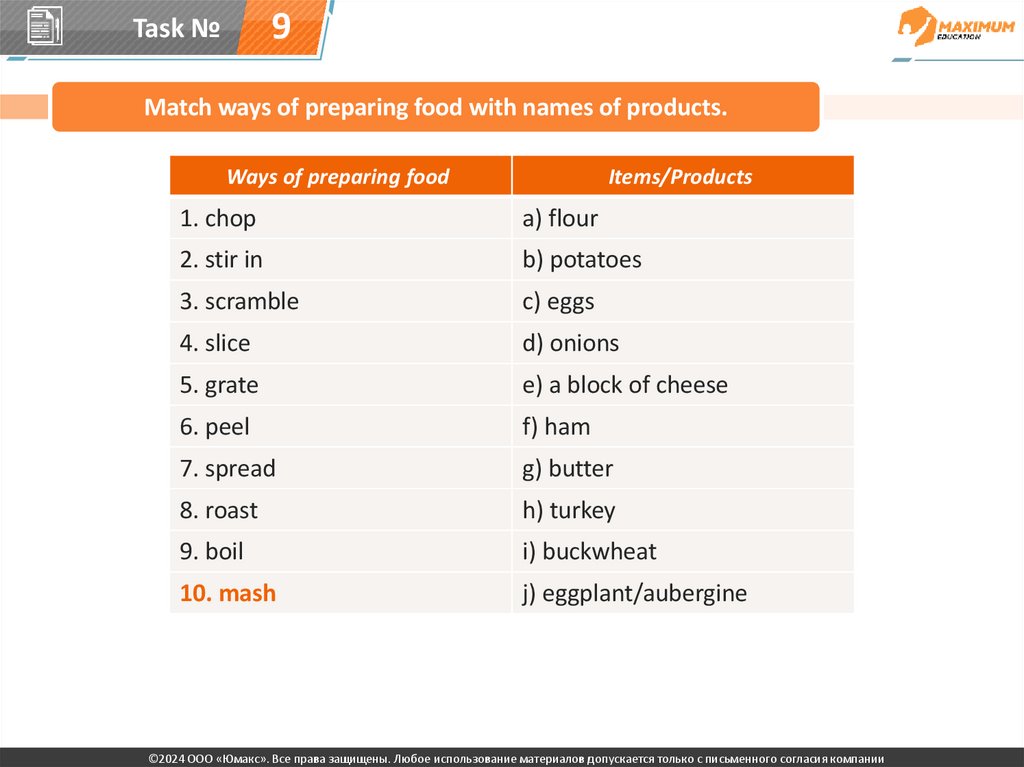
Match ways of preparing food with names of products.
Ways of preparing food
Items/Products
1. chop
a) flour
2. stir in
b) potatoes
3. scramble
c) eggs
4. slice
d) onions
5. grate
e) a block of cheese
6. peel
f) ham
7. spread
g) butter
8. roast
h) turkey
9. boil
i) buckwheat
10. mash
j) eggplant/aubergine
©2024 ООО «Юмакс». Все права защищены. Любое использование материалов допускается только с письменного согласия компании
5.
9Task №
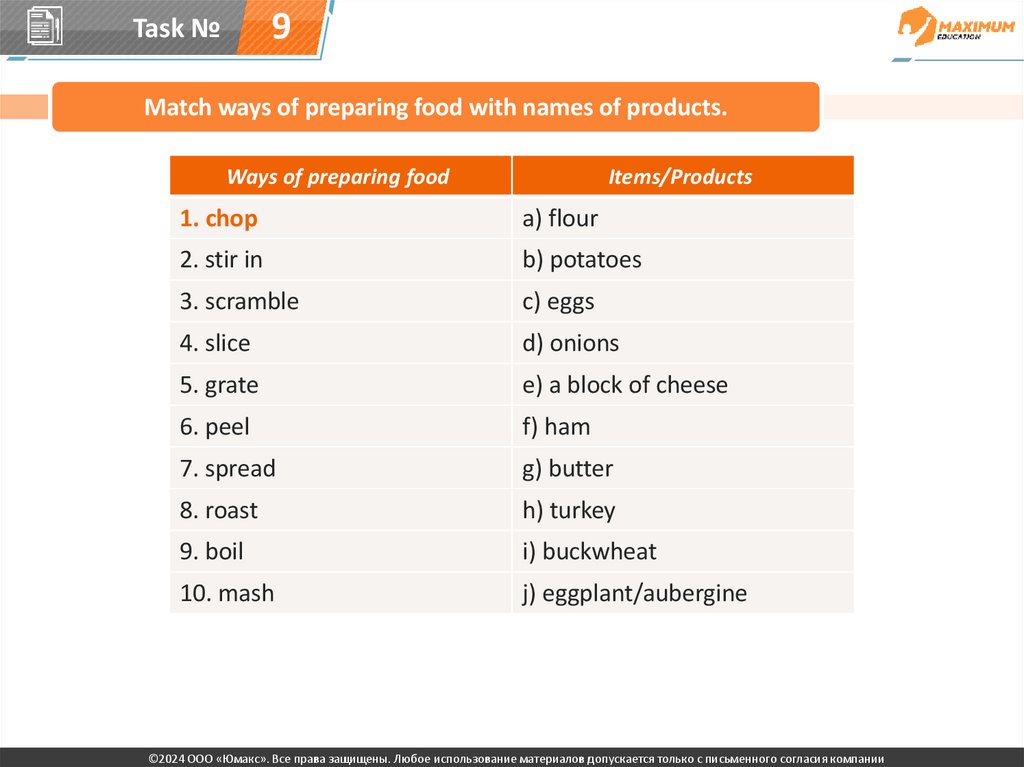
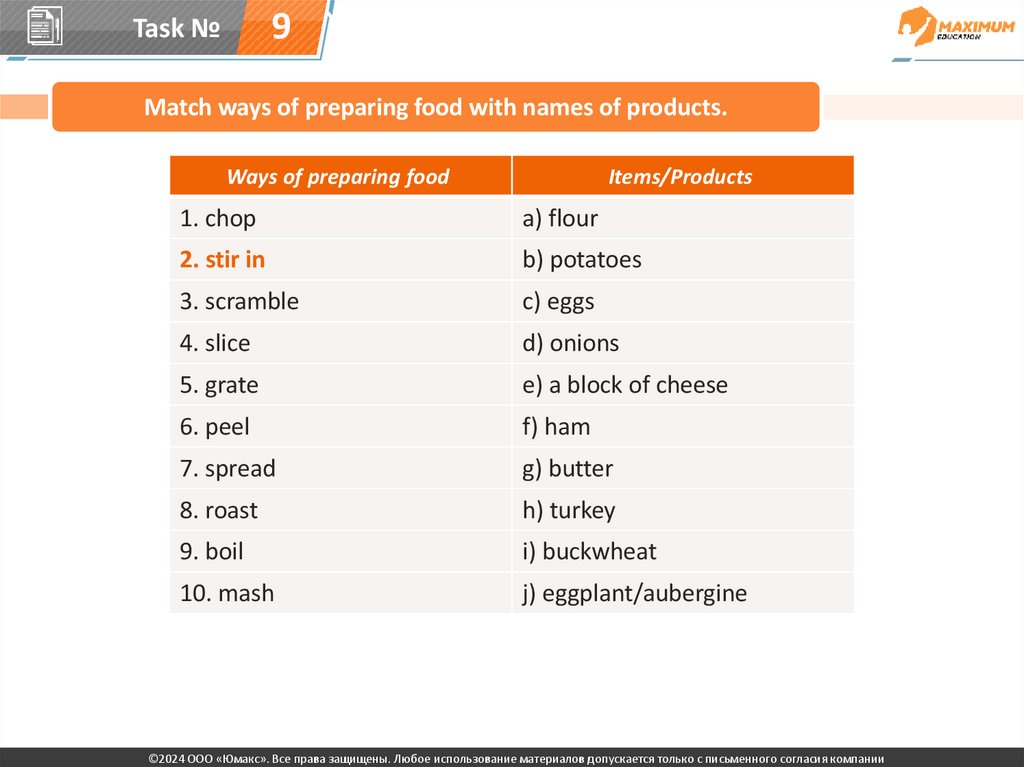
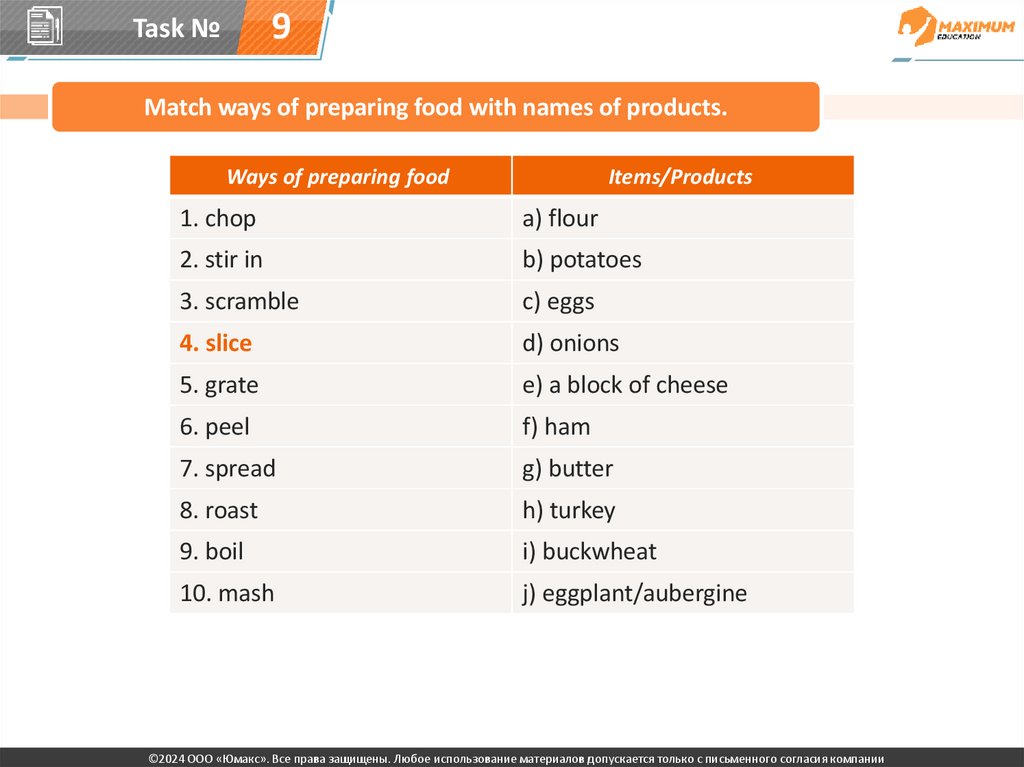
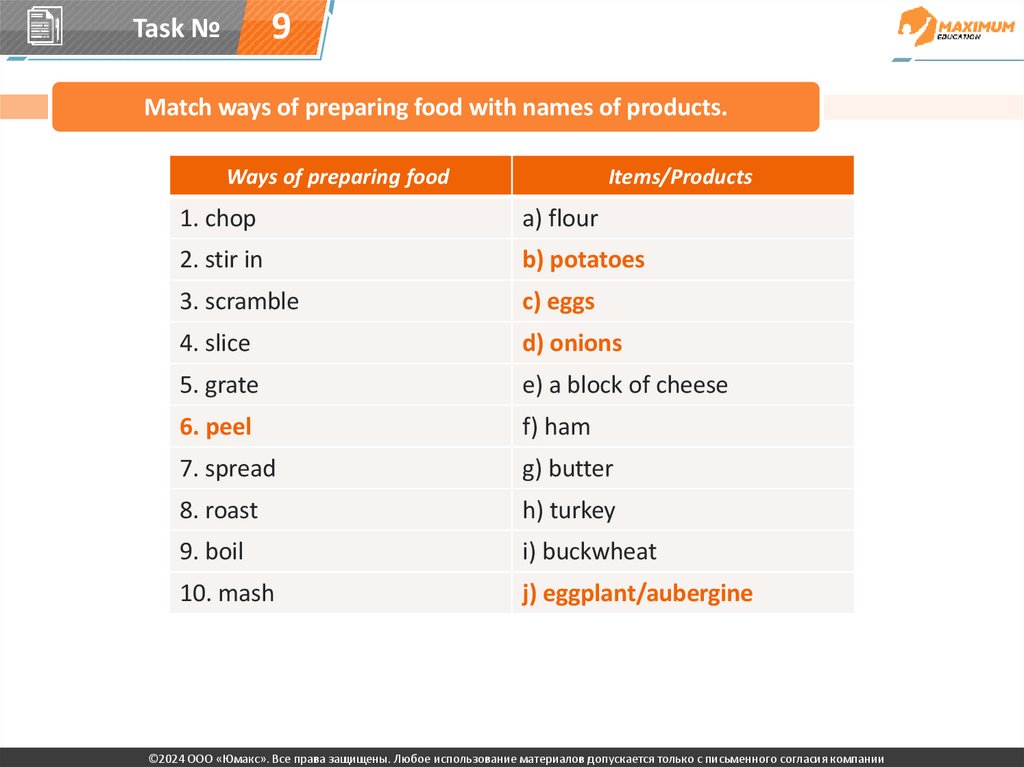
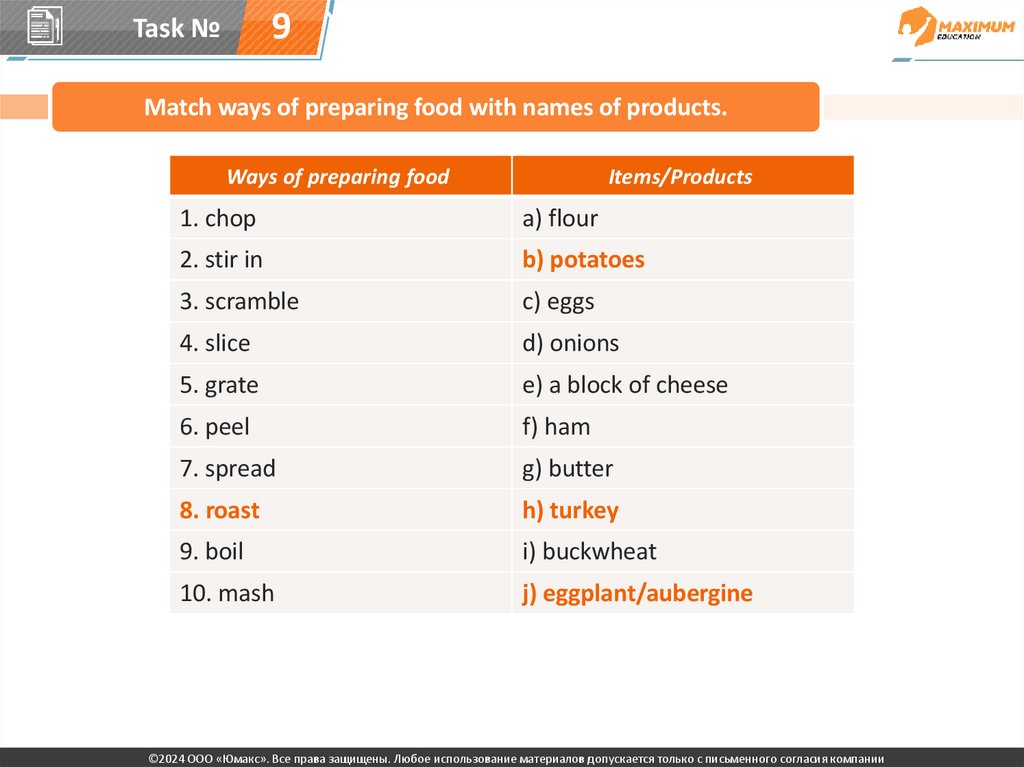
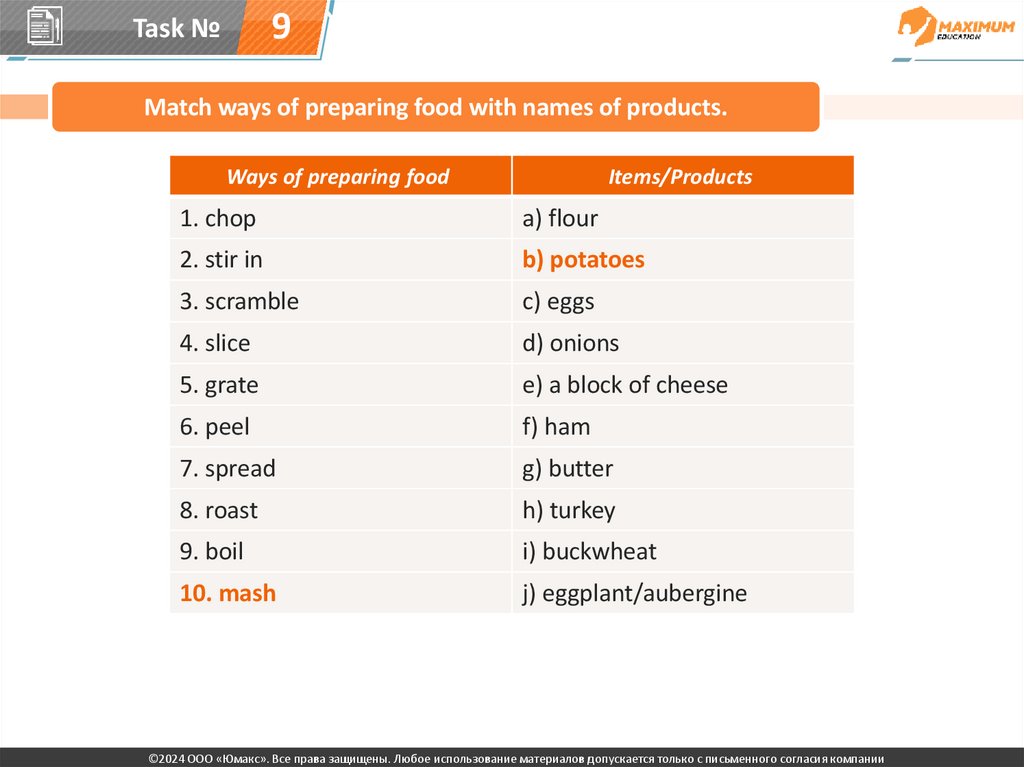
Match ways of preparing food with names of products.
Ways of preparing food
Items/Products
1. chop
a) flour
2. stir in
b) potatoes
3. scramble
c) eggs
4. slice
d) onions
5. grate
e) a block of cheese
6. peel
f) ham
7. spread
g) butter
8. roast
h) turkey
9. boil
i) buckwheat
10. mash
j) eggplant/aubergine
©2024 ООО «Юмакс». Все права защищены. Любое использование материалов допускается только с письменного согласия компании
6.
9Task №
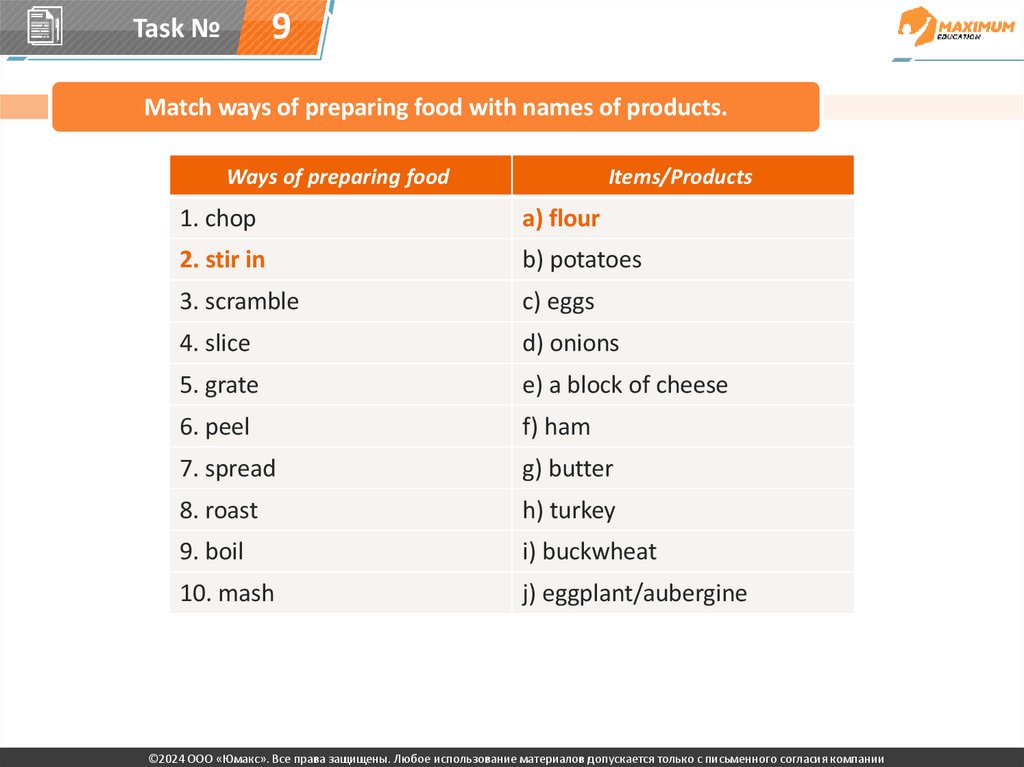
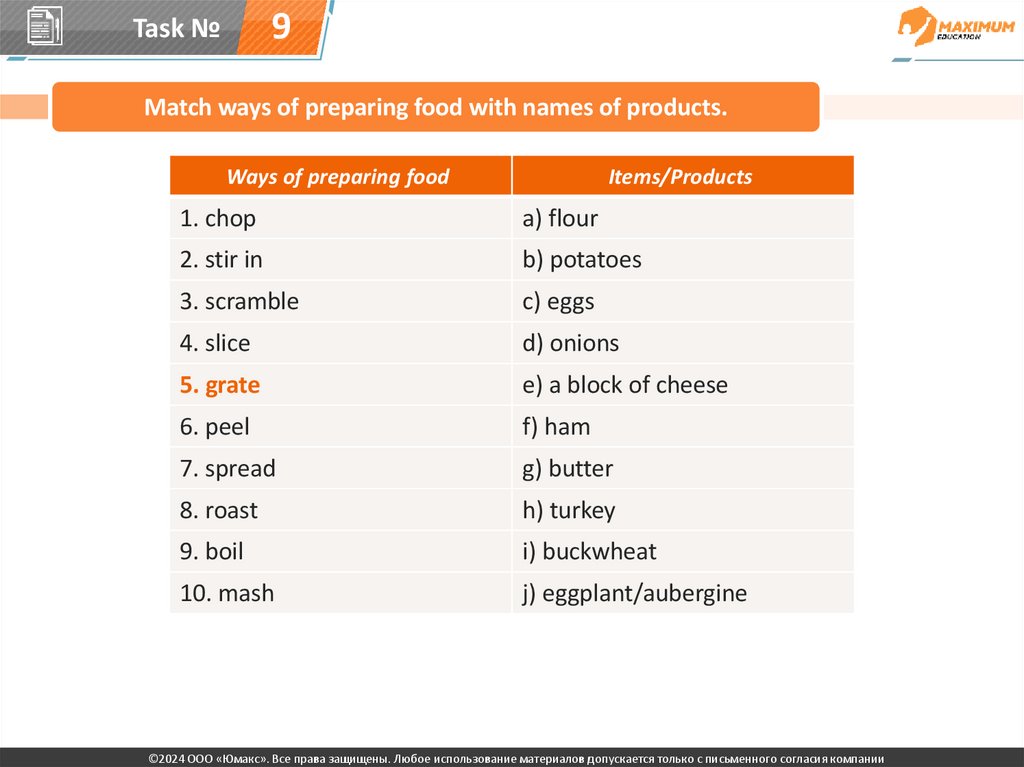
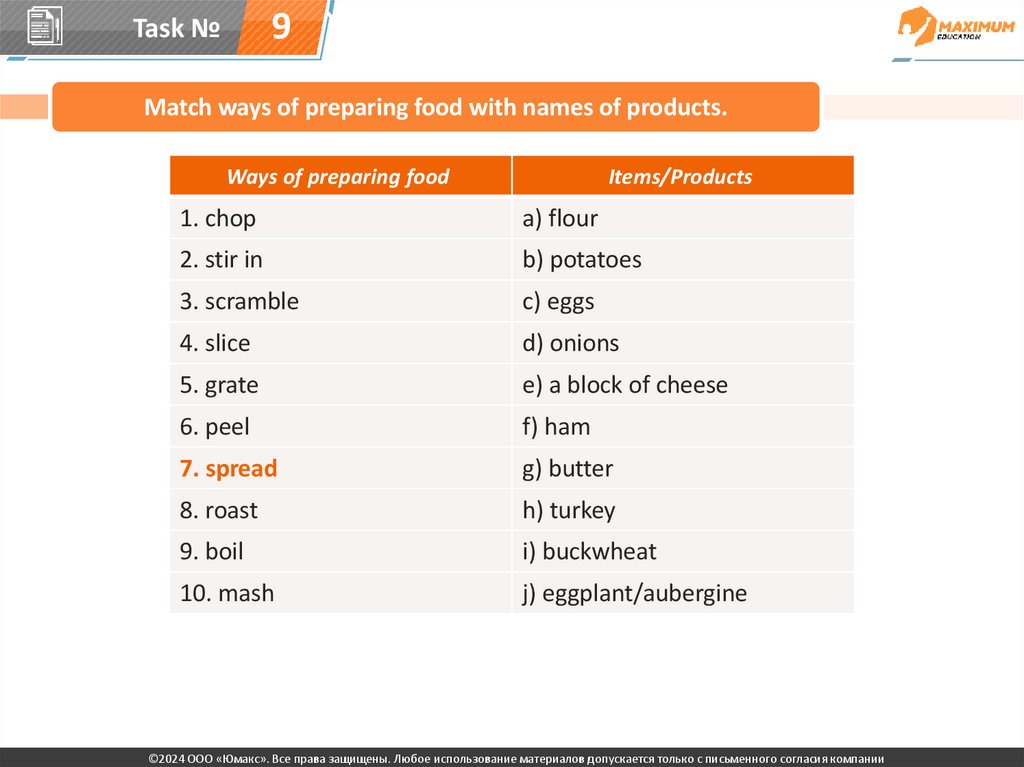
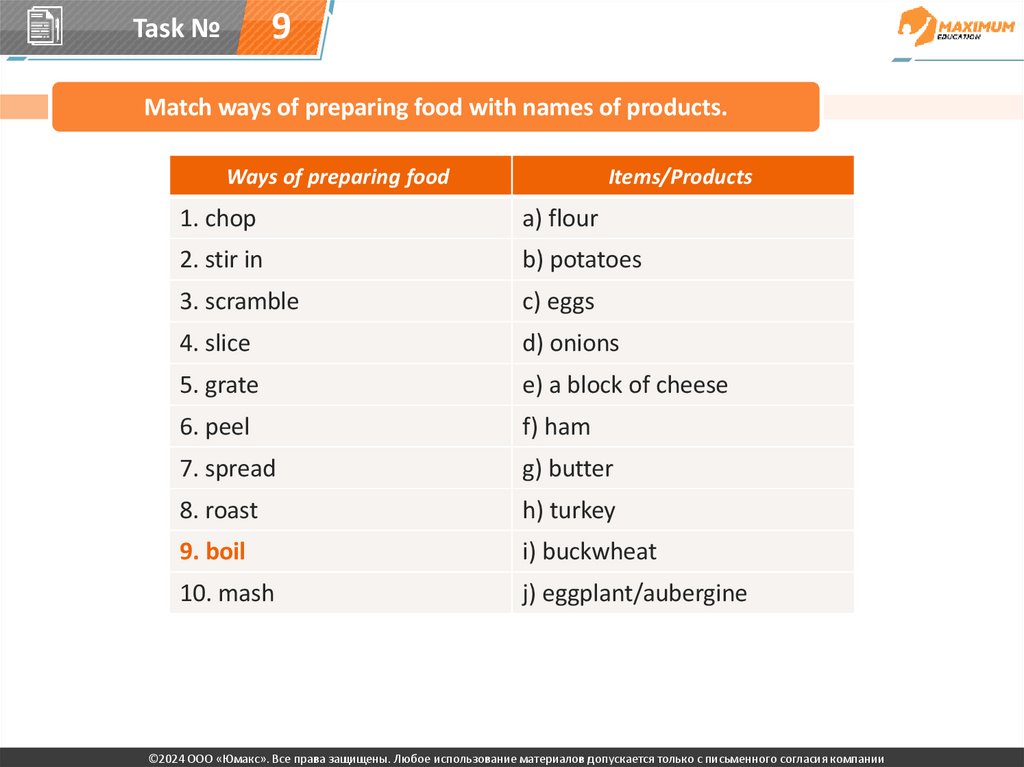
Match ways of preparing food with names of products.
Ways of preparing food
Items/Products
1. chop
a) flour
2. stir in
b) potatoes
3. scramble
c) eggs
4. slice
d) onions
5. grate
e) a block of cheese
6. peel
f) ham
7. spread
g) butter
8. roast
h) turkey
9. boil
i) buckwheat
10. mash
j) eggplant/aubergine
©2024 ООО «Юмакс». Все права защищены. Любое использование материалов допускается только с письменного согласия компании
7.
9Task №
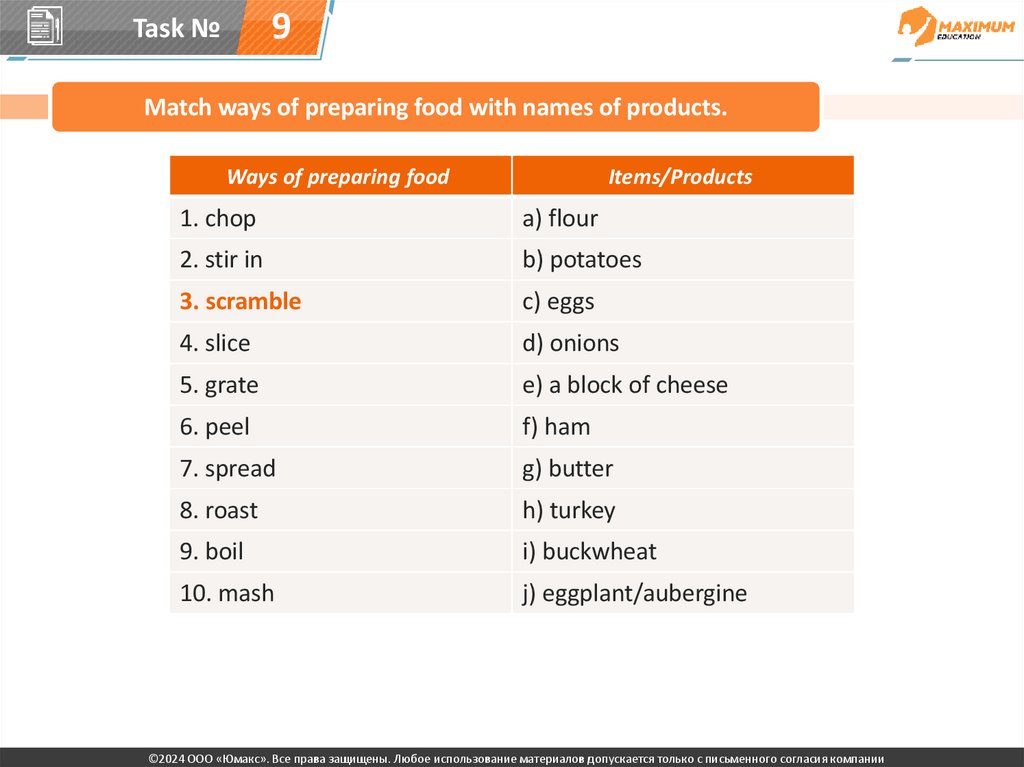
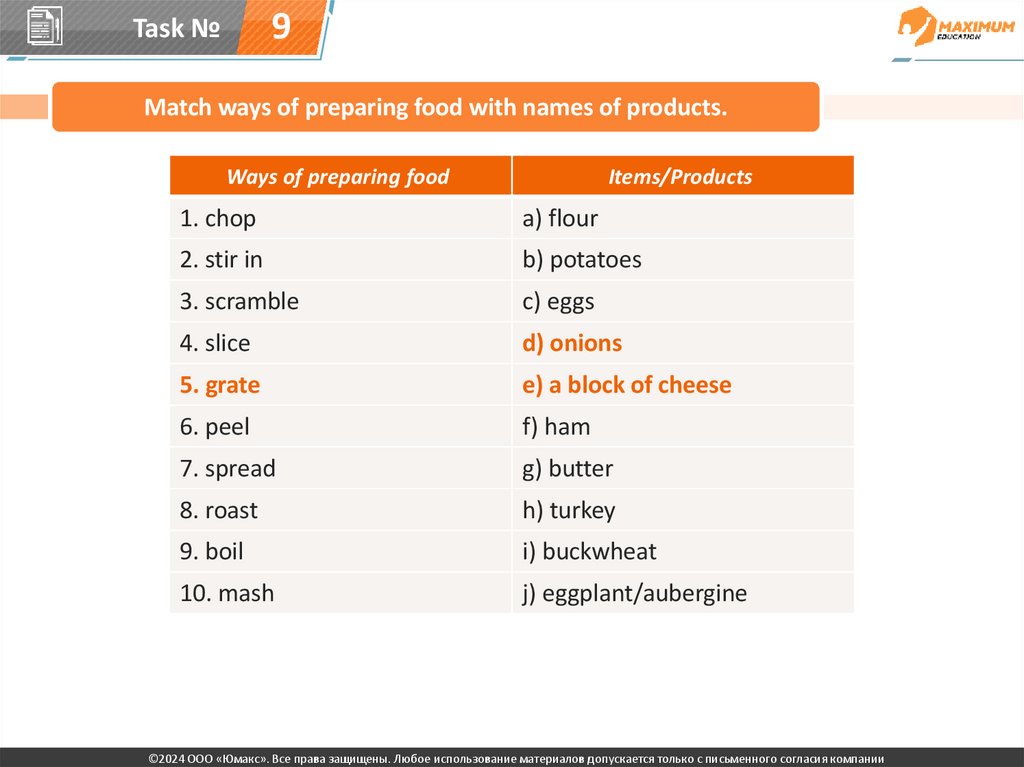
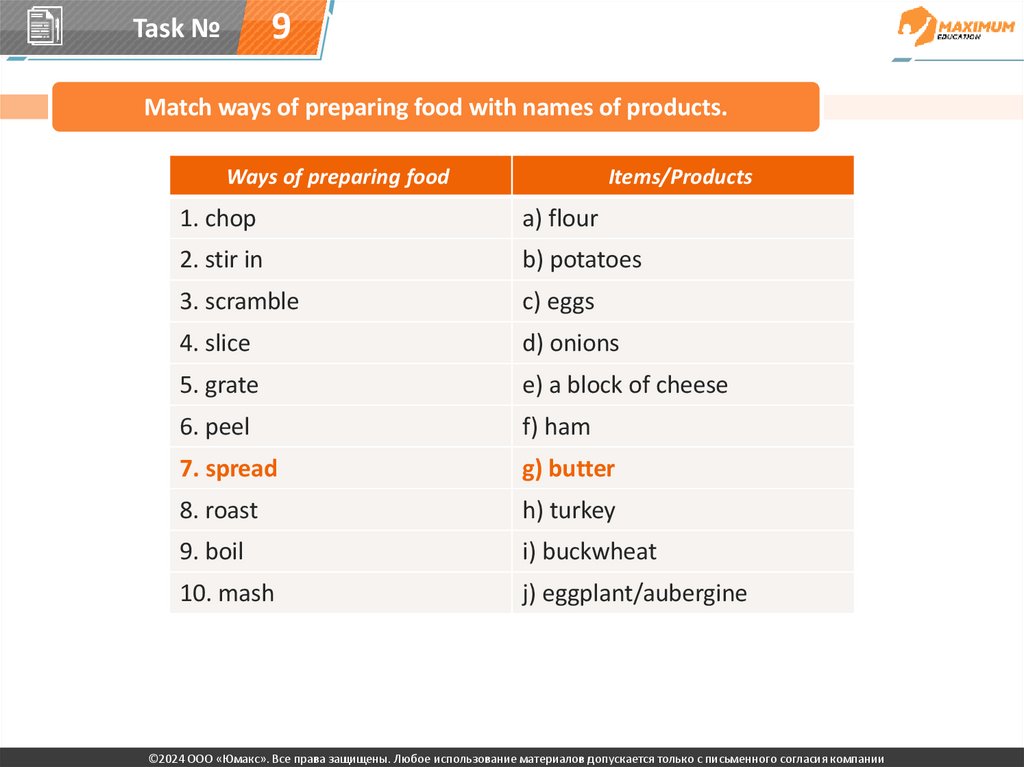
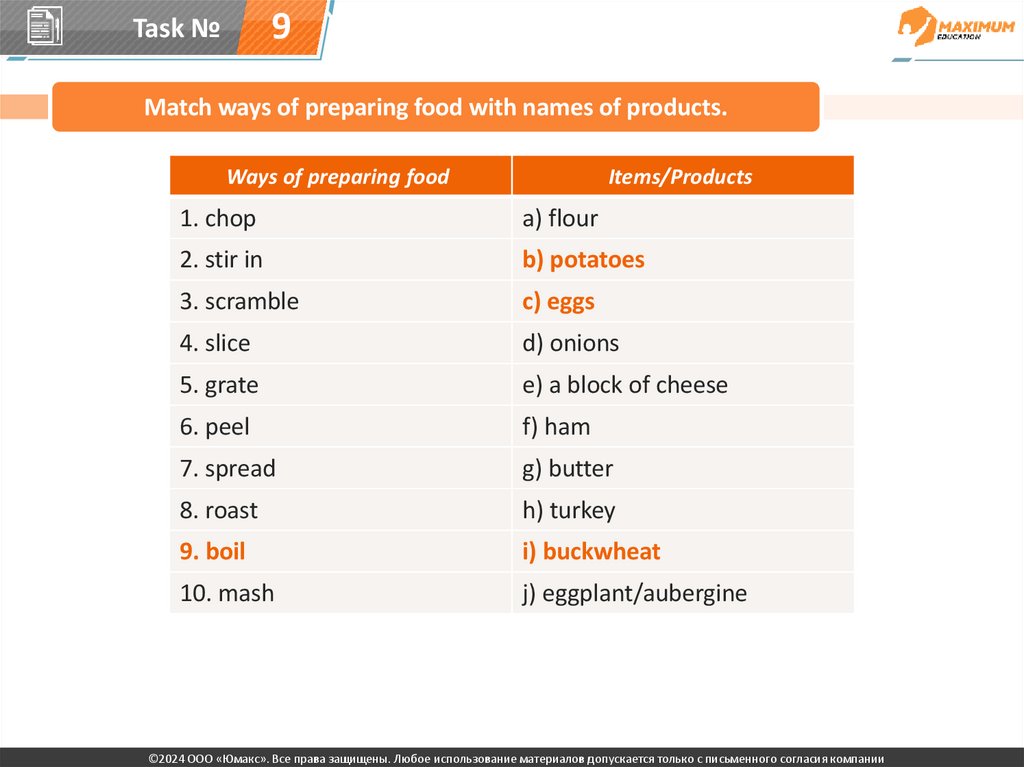
Match ways of preparing food with names of products.
Ways of preparing food
Items/Products
1. chop
a) flour
2. stir in
b) potatoes
3. scramble
c) eggs
4. slice
d) onions
5. grate
e) a block of cheese
6. peel
f) ham
7. spread
g) butter
8. roast
h) turkey
9. boil
i) buckwheat
10. mash
j) eggplant/aubergine
©2024 ООО «Юмакс». Все права защищены. Любое использование материалов допускается только с письменного согласия компании
8.
9Task №
Match ways of preparing food with names of products.
Ways of preparing food
Items/Products
1. chop
a) flour
2. stir in
b) potatoes
3. scramble
c) eggs
4. slice
d) onions
5. grate
e) a block of cheese
6. peel
f) ham
7. spread
g) butter
8. roast
h) turkey
9. boil
i) buckwheat
10. mash
j) eggplant/aubergine
©2024 ООО «Юмакс». Все права защищены. Любое использование материалов допускается только с письменного согласия компании
9.
9Task №
Match ways of preparing food with names of products.
Ways of preparing food
Items/Products
1. chop
a) flour
2. stir in
b) potatoes
3. scramble
c) eggs
4. slice
d) onions
5. grate
e) a block of cheese
6. peel
f) ham
7. spread
g) butter
8. roast
h) turkey
9. boil
i) buckwheat
10. mash
j) eggplant/aubergine
©2024 ООО «Юмакс». Все права защищены. Любое использование материалов допускается только с письменного согласия компании
10.
9Task №
Match ways of preparing food with names of products.
Ways of preparing food
Items/Products
1. chop
a) flour
2. stir in
b) potatoes
3. scramble
c) eggs
4. slice
d) onions
5. grate
e) a block of cheese
6. peel
f) ham
7. spread
g) butter
8. roast
h) turkey
9. boil
i) buckwheat
10. mash
j) eggplant/aubergine
©2024 ООО «Юмакс». Все права защищены. Любое использование материалов допускается только с письменного согласия компании
11.
9Task №
Match ways of preparing food with names of products.
Ways of preparing food
Items/Products
1. chop
a) flour
2. stir in
b) potatoes
3. scramble
c) eggs
4. slice
d) onions
5. grate
e) a block of cheese
6. peel
f) ham
7. spread
g) butter
8. roast
h) turkey
9. boil
i) buckwheat
10. mash
j) eggplant/aubergine
©2024 ООО «Юмакс». Все права защищены. Любое использование материалов допускается только с письменного согласия компании
12.
9Task №
Match ways of preparing food with names of products.
Ways of preparing food
Items/Products
1. chop
a) flour
2. stir in
b) potatoes
3. scramble
c) eggs
4. slice
d) onions
5. grate
e) a block of cheese
6. peel
f) ham
7. spread
g) butter
8. roast
h) turkey
9. boil
i) buckwheat
10. mash
j) eggplant/aubergine
©2024 ООО «Юмакс». Все права защищены. Любое использование материалов допускается только с письменного согласия компании
13.
9Task №
Match ways of preparing food with names of products.
Ways of preparing food
Items/Products
1. chop
a) flour
2. stir in
b) potatoes
3. scramble
c) eggs
4. slice
d) onions
5. grate
e) a block of cheese
6. peel
f) ham
7. spread
g) butter
8. roast
h) turkey
9. boil
i) buckwheat
10. mash
j) eggplant/aubergine
©2024 ООО «Юмакс». Все права защищены. Любое использование материалов допускается только с письменного согласия компании
14.
9Task №
Match ways of preparing food with names of products.
Ways of preparing food
Items/Products
1. chop
a) flour
2. stir in
b) potatoes
3. scramble
c) eggs
4. slice
d) onions
5. grate
e) a block of cheese
6. peel
f) ham
7. spread
g) butter
8. roast
h) turkey
9. boil
i) buckwheat
10. mash
j) eggplant/aubergine
©2024 ООО «Юмакс». Все права защищены. Любое использование материалов допускается только с письменного согласия компании
15.
9Task №
Match ways of preparing food with names of products.
Ways of preparing food
Items/Products
1. chop
a) flour
2. stir in
b) potatoes
3. scramble
c) eggs
4. slice
d) onions
5. grate
e) a block of cheese
6. peel
f) ham
7. spread
g) butter
8. roast
h) turkey
9. boil
i) buckwheat
10. mash
j) eggplant/aubergine
©2024 ООО «Юмакс». Все права защищены. Любое использование материалов допускается только с письменного согласия компании
16.
9Task №
Match ways of preparing food with names of products.
Ways of preparing food
Items/Products
1. chop
a) flour
2. stir in
b) potatoes
3. scramble
c) eggs
4. slice
d) onions
5. grate
e) a block of cheese
6. peel
f) ham
7. spread
g) butter
8. roast
h) turkey
9. boil
i) buckwheat
10. mash
j) eggplant/aubergine
©2024 ООО «Юмакс». Все права защищены. Любое использование материалов допускается только с письменного согласия компании
17.
9Task №
Match ways of preparing food with names of products.
Ways of preparing food
Items/Products
1. chop
a) flour
2. stir in
b) potatoes
3. scramble
c) eggs
4. slice
d) onions
5. grate
e) a block of cheese
6. peel
f) ham
7. spread
g) butter
8. roast
h) turkey
9. boil
i) buckwheat
10. mash
j) eggplant/aubergine
©2024 ООО «Юмакс». Все права защищены. Любое использование материалов допускается только с письменного согласия компании
18.
9Task №
Match ways of preparing food with names of products.
Ways of preparing food
Items/Products
1. chop
a) flour
2. stir in
b) potatoes
3. scramble
c) eggs
4. slice
d) onions
5. grate
e) a block of cheese
6. peel
f) ham
7. spread
g) butter
8. roast
h) turkey
9. boil
i) buckwheat
10. mash
j) eggplant/aubergine
©2024 ООО «Юмакс». Все права защищены. Любое использование материалов допускается только с письменного согласия компании
19.
9Task №
Match ways of preparing food with names of products.
Ways of preparing food
Items/Products
1. chop
a) flour
2. stir in
b) potatoes
3. scramble
c) eggs
4. slice
d) onions
5. grate
e) a block of cheese
6. peel
f) ham
7. spread
g) butter
8. roast
h) turkey
9. boil
i) buckwheat
10. mash
j) eggplant/aubergine
©2024 ООО «Юмакс». Все права защищены. Любое использование материалов допускается только с письменного согласия компании
20.
9Task №
Match ways of preparing food with names of products.
Ways of preparing food
Items/Products
1. chop
a) flour
2. stir in
b) potatoes
3. scramble
c) eggs
4. slice
d) onions
5. grate
e) a block of cheese
6. peel
f) ham
7. spread
g) butter
8. roast
h) turkey
9. boil
i) buckwheat
10. mash
j) eggplant/aubergine
©2024 ООО «Юмакс». Все права защищены. Любое использование материалов допускается только с письменного согласия компании
21.
9Task №
Match ways of preparing food with names of products.
Ways of preparing food
Items/Products
1. chop
a) flour
2. stir in
b) potatoes
3. scramble
c) eggs
4. slice
d) onions
5. grate
e) a block of cheese
6. peel
f) ham
7. spread
g) butter
8. roast
h) turkey
9. boil
i) buckwheat
10. mash
j) eggplant/aubergine
©2024 ООО «Юмакс». Все права защищены. Любое использование материалов допускается только с письменного согласия компании
22.
9Task №
Match ways of preparing food with names of products.
Ways of preparing food
Items/Products
1. chop
a) flour
2. stir in
b) potatoes
3. scramble
c) eggs
4. slice
d) onions
5. grate
e) a block of cheese
6. peel
f) ham
7. spread
g) butter
8. roast
h) turkey
9. boil
i) buckwheat
10. mash
j) eggplant/aubergine
©2024 ООО «Юмакс». Все права защищены. Любое использование материалов допускается только с письменного согласия компании
23.
9Task №
Match ways of preparing food with names of products.
Ways of preparing food
Items/Products
1. chop
a) flour
2. stir in
b) potatoes
3. scramble
c) eggs
4. slice
d) onions
5. grate
e) a block of cheese
6. peel
f) ham
7. spread
g) butter
8. roast
h) turkey
9. boil
i) buckwheat
10. mash
j) eggplant/aubergine
©2024 ООО «Юмакс». Все права защищены. Любое использование материалов допускается только с письменного согласия компании
24.
9Task №
Match ways of preparing food with names of products.
Ways of preparing food
Items/Products
1. chop
a) flour
2. stir in
b) potatoes
3. scramble
c) eggs
4. slice
d) onions
5. grate
e) a block of cheese
6. peel
f) ham
7. spread
g) butter
8. roast
h) turkey
9. boil
i) buckwheat
10. mash
j) eggplant/aubergine
©2024 ООО «Юмакс». Все права защищены. Любое использование материалов допускается только с письменного согласия компании
25.
Let’s go!Task 10
©2024 ООО «Юмакс». Все права защищены. Любое использование материалов допускается только с письменного согласия компании
26.
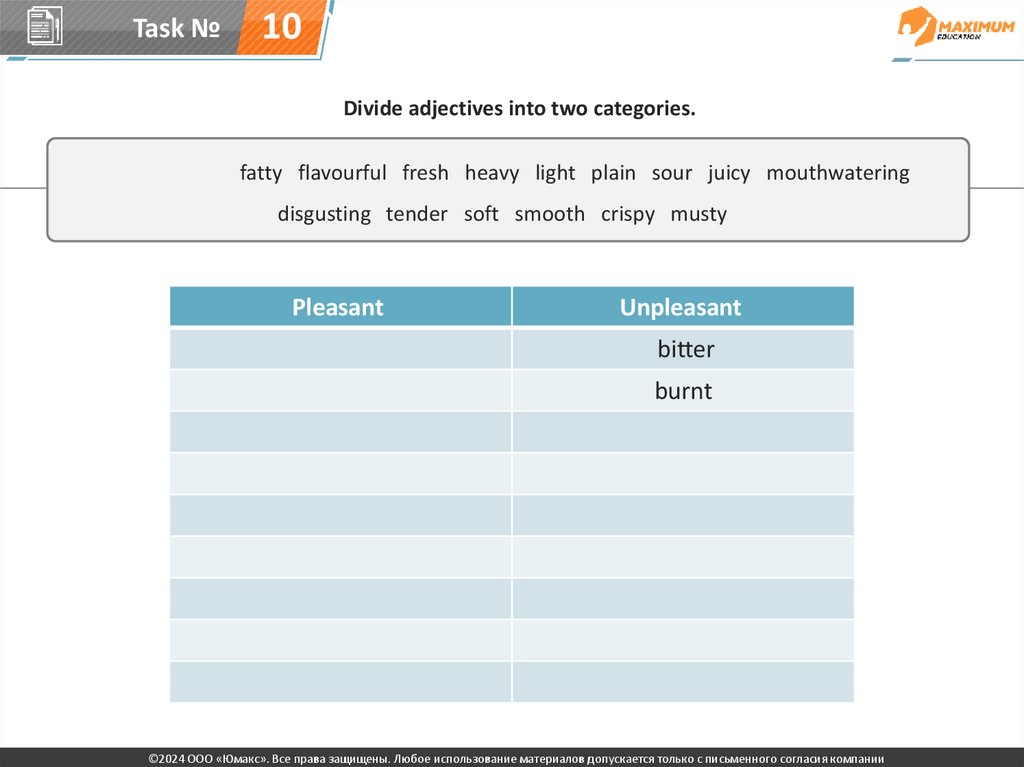
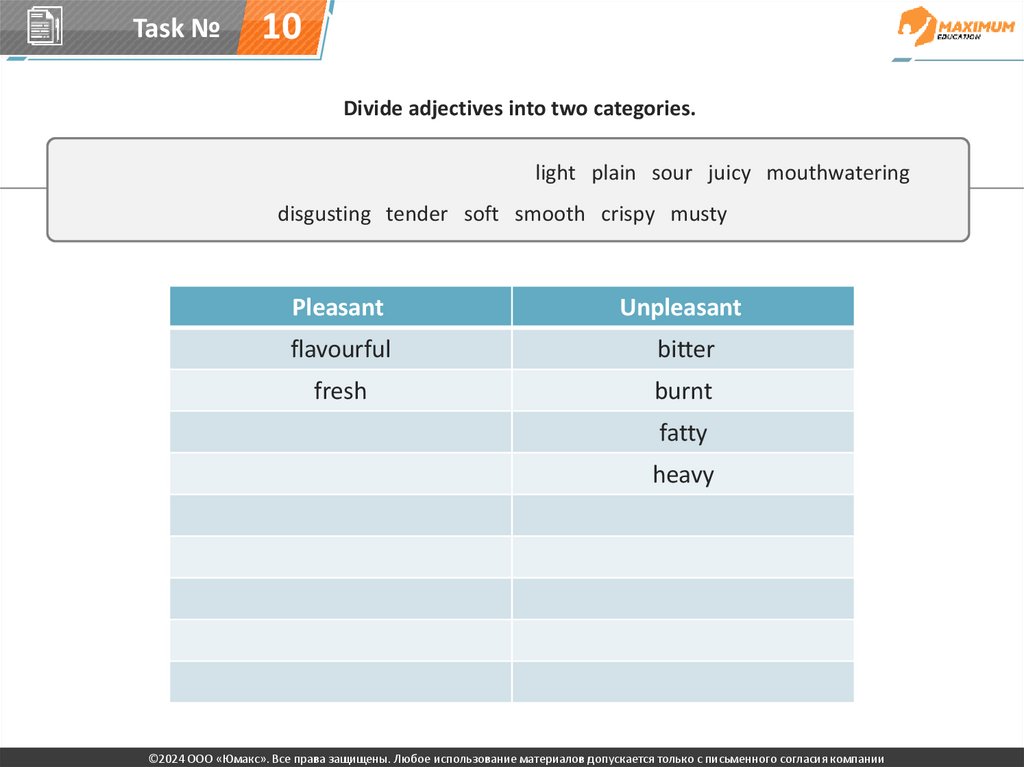
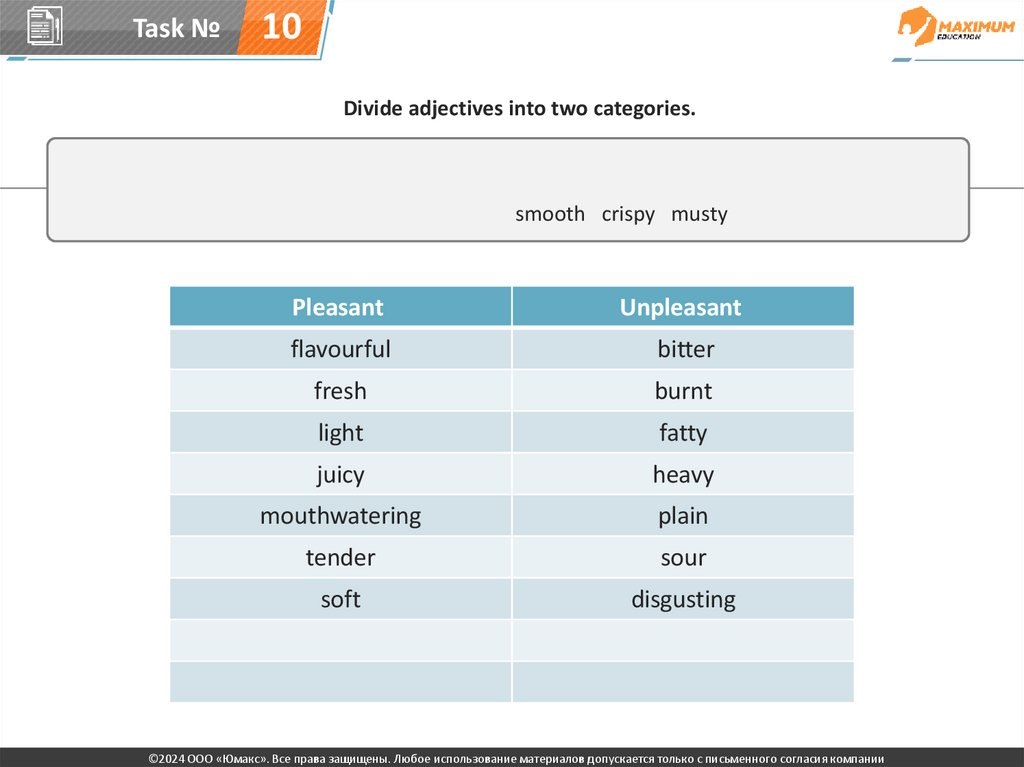
Task №10
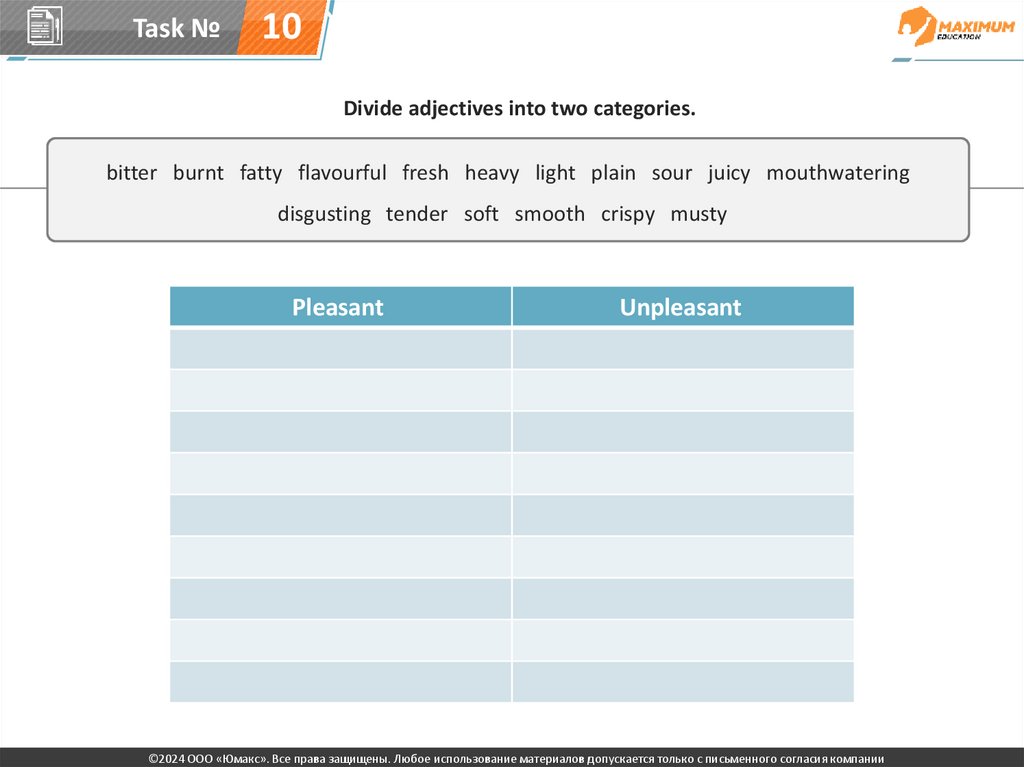
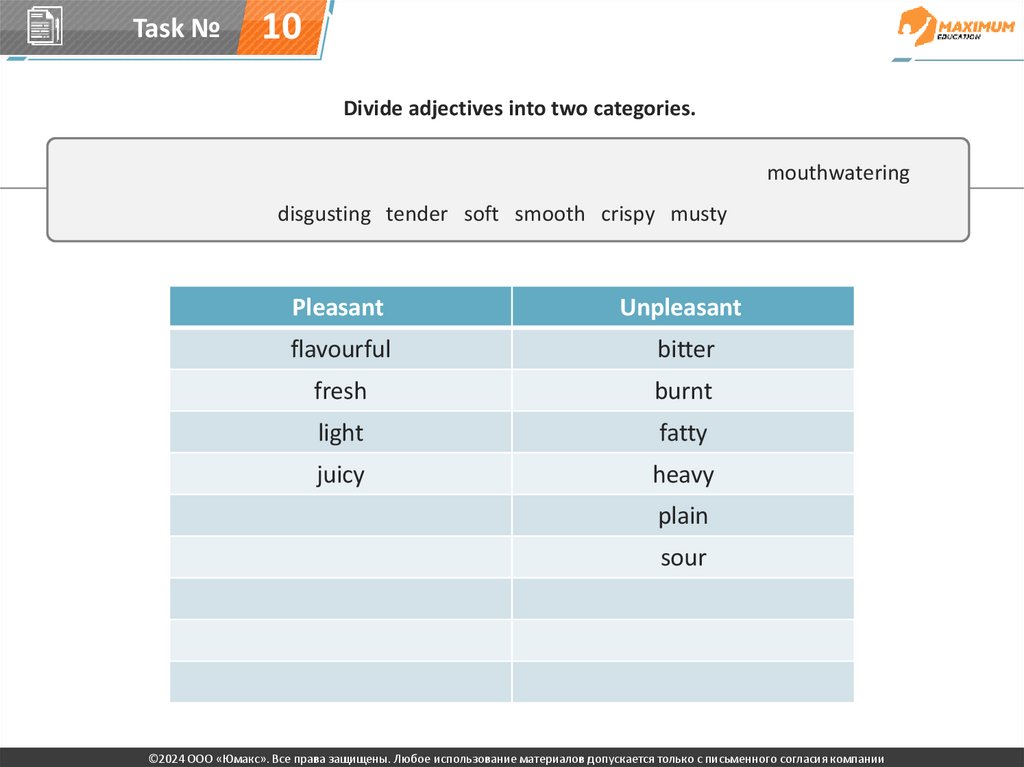
Divide adjectives into two categories.
bitter burnt fatty flavourful fresh heavy light plain sour juicy mouthwatering
disgusting tender soft smooth crispy musty
Pleasant
Unpleasant
©2024 ООО «Юмакс». Все права защищены. Любое использование материалов допускается только с письменного согласия компании
27.
Task №10
Divide adjectives into two categories.
bitter burnt fatty flavourful fresh heavy light plain sour juicy mouthwatering
disgusting tender soft smooth crispy musty
Pleasant
Unpleasant
bitter
©2024 ООО «Юмакс». Все права защищены. Любое использование материалов допускается только с письменного согласия компании
28.
Task №10
Divide adjectives into two categories.
bitter burnt fatty flavourful fresh heavy light plain sour juicy mouthwatering
disgusting tender soft smooth crispy musty
Pleasant
Unpleasant
bitter
burnt
©2024 ООО «Юмакс». Все права защищены. Любое использование материалов допускается только с письменного согласия компании
29.
Task №10
Divide adjectives into two categories.
bitter burnt fatty flavourful fresh heavy light plain sour juicy mouthwatering
disgusting tender soft smooth crispy musty
Pleasant
Unpleasant
bitter
burnt
fatty
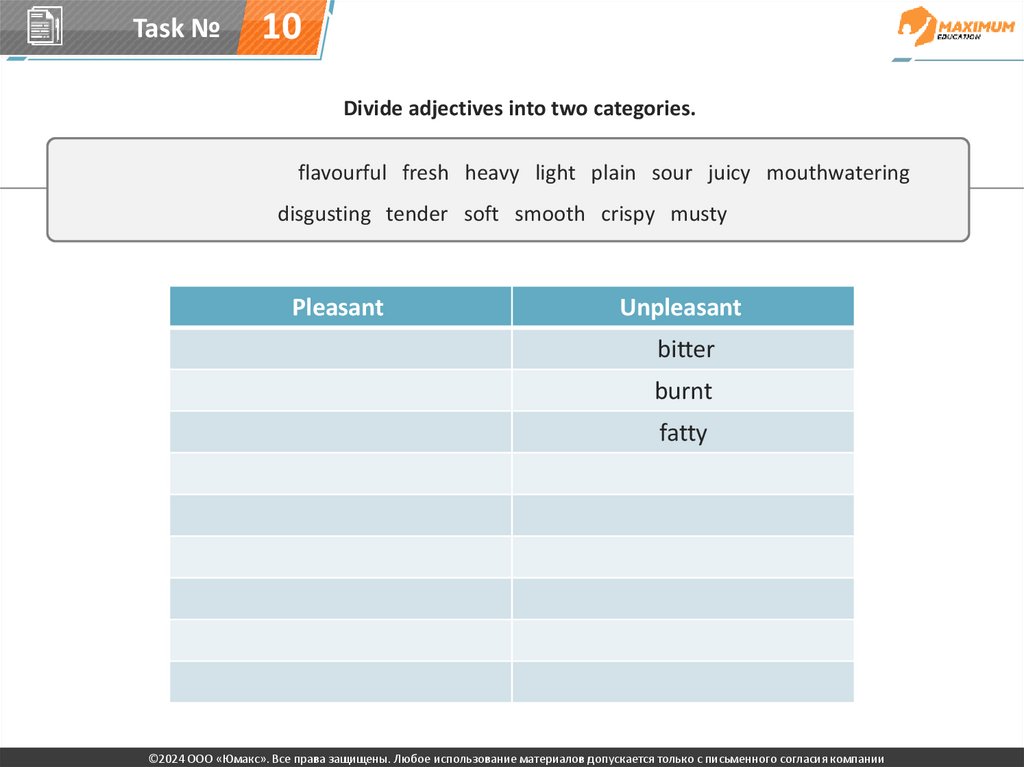
©2024 ООО «Юмакс». Все права защищены. Любое использование материалов допускается только с письменного согласия компании
30.
Task №10
Divide adjectives into two categories.
bitter burnt fatty flavourful fresh heavy light plain sour juicy mouthwatering
disgusting tender soft smooth crispy musty
Pleasant
Unpleasant
flavourful
bitter
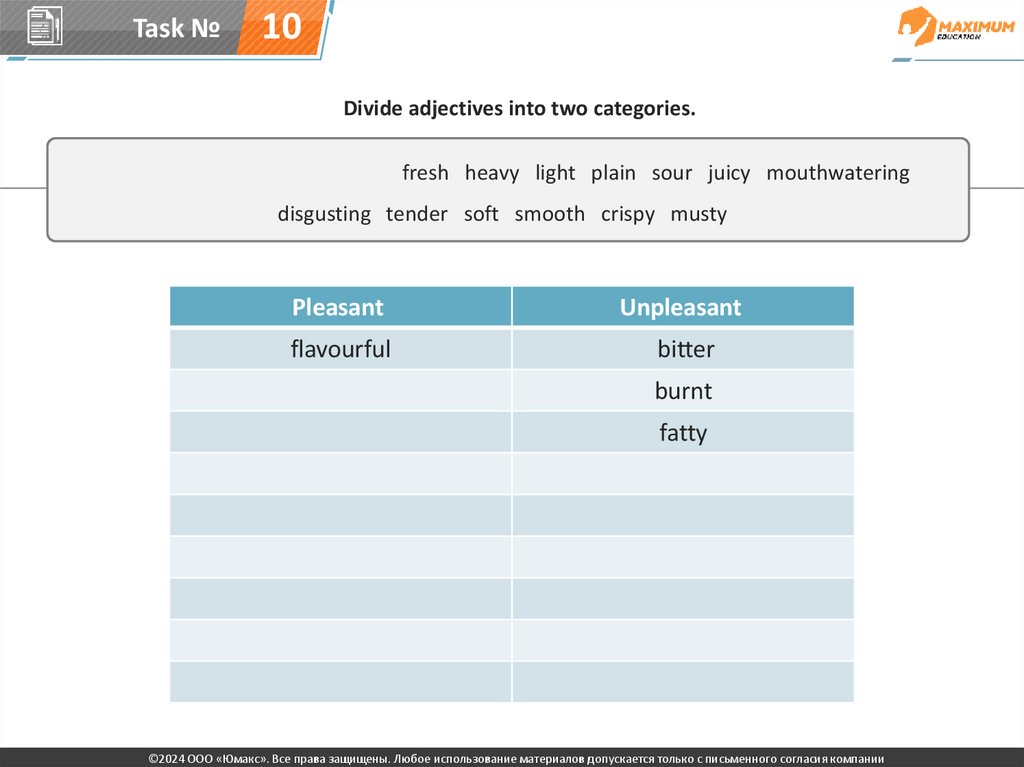
burnt
fatty
©2024 ООО «Юмакс». Все права защищены. Любое использование материалов допускается только с письменного согласия компании
31.
Task №10
Divide adjectives into two categories.
bitter burnt fatty flavourful fresh heavy light plain sour juicy mouthwatering
disgusting tender soft smooth crispy musty
Pleasant
Unpleasant
flavourful
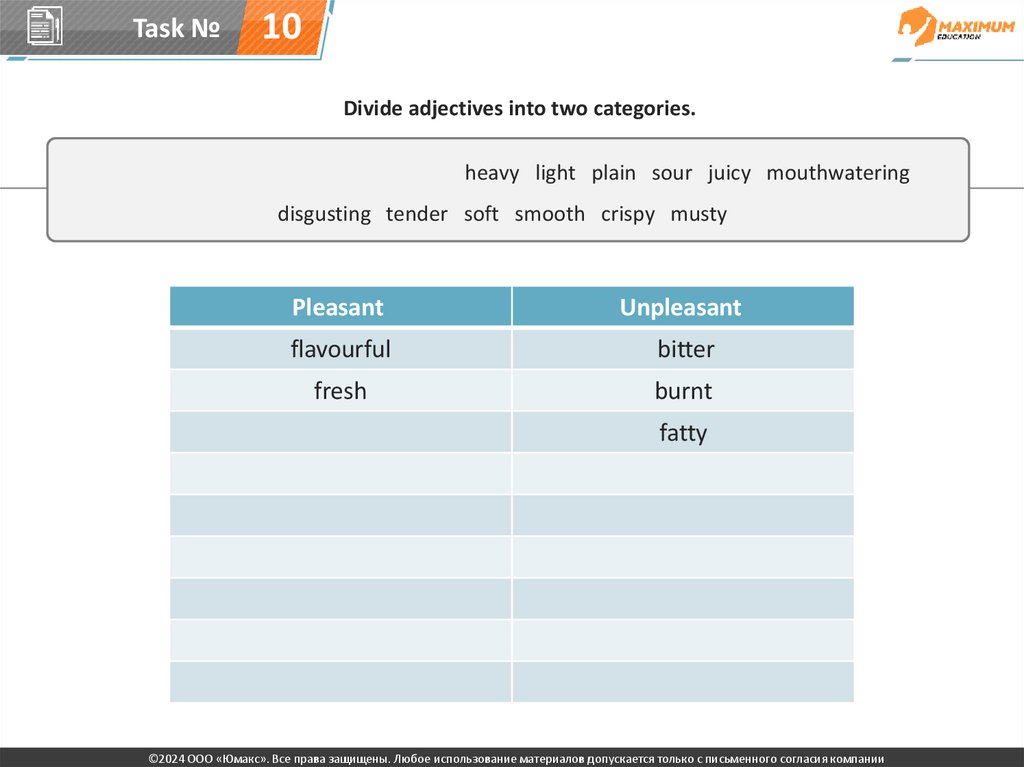
bitter
fresh
burnt
fatty
©2024 ООО «Юмакс». Все права защищены. Любое использование материалов допускается только с письменного согласия компании
32.
Task №10
Divide adjectives into two categories.
bitter burnt fatty flavourful fresh heavy light plain sour juicy mouthwatering
disgusting tender soft smooth crispy musty
Pleasant
Unpleasant
flavourful
bitter
fresh
burnt
fatty
heavy
©2024 ООО «Юмакс». Все права защищены. Любое использование материалов допускается только с письменного согласия компании
33.
Task №10
Divide adjectives into two categories.
bitter burnt fatty flavourful fresh heavy light plain sour juicy mouthwatering
disgusting tender soft smooth crispy musty
Pleasant
Unpleasant
flavourful
bitter
fresh
burnt
light
fatty
heavy
©2024 ООО «Юмакс». Все права защищены. Любое использование материалов допускается только с письменного согласия компании
34.
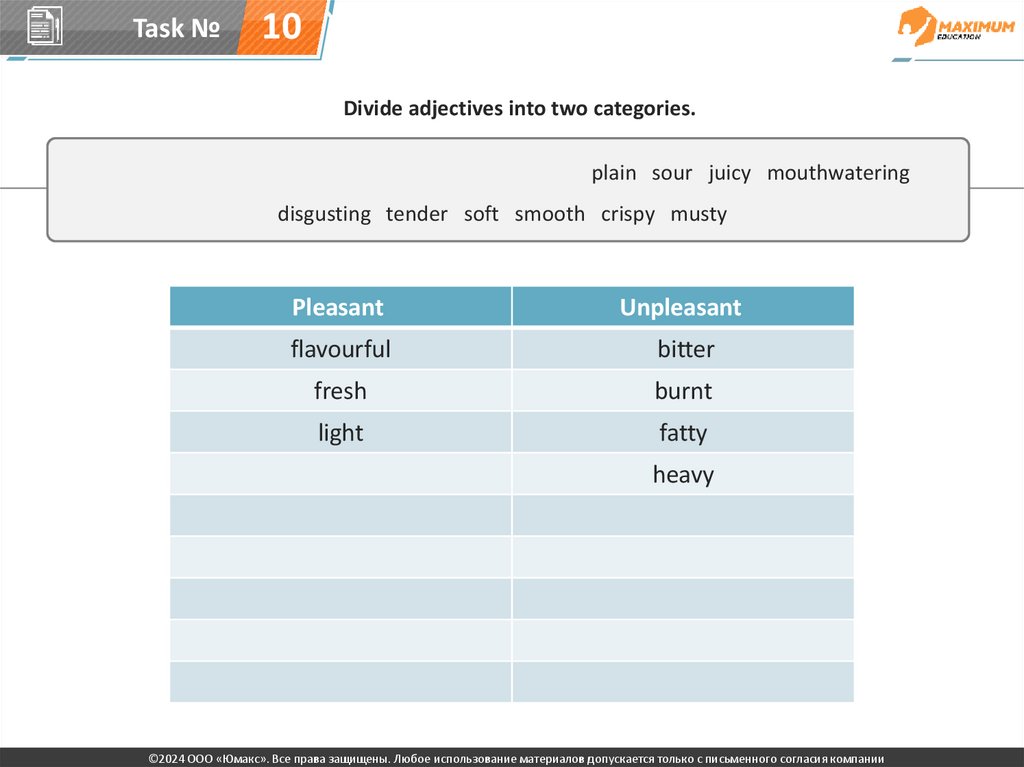
Task №10
Divide adjectives into two categories.
bitter burnt fatty flavourful fresh heavy light plain sour juicy mouthwatering
disgusting tender soft smooth crispy musty
Pleasant
Unpleasant
flavourful
bitter
fresh
burnt
light
fatty
heavy
plain
©2024 ООО «Юмакс». Все права защищены. Любое использование материалов допускается только с письменного согласия компании
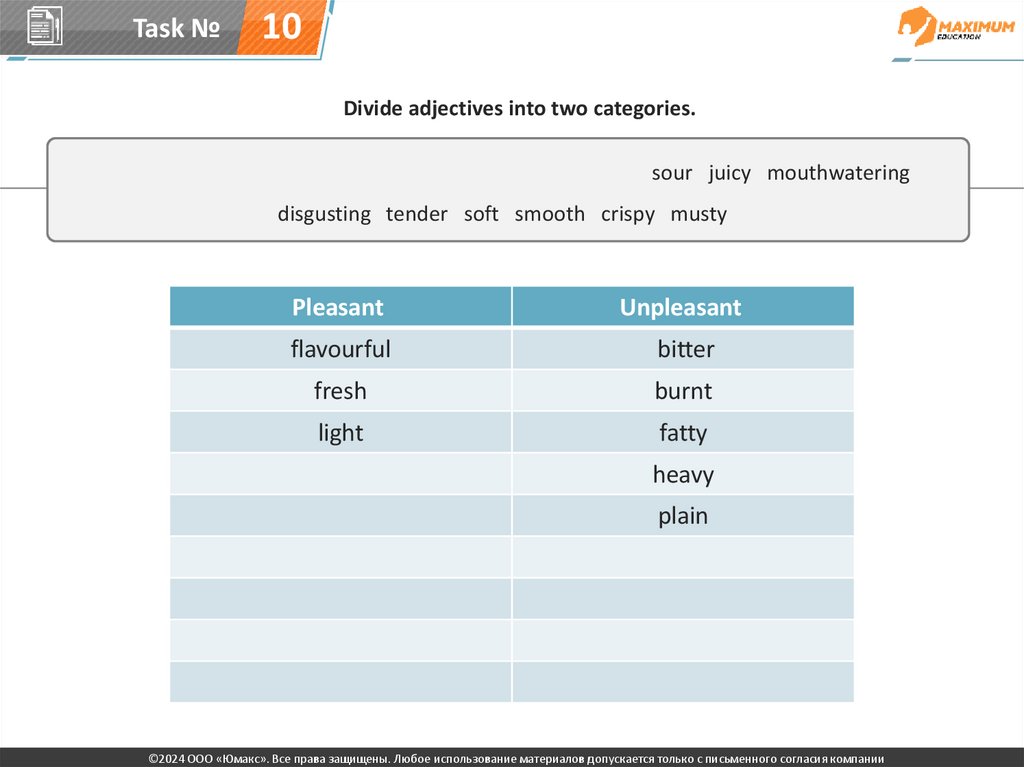
35.
Task №10
Divide adjectives into two categories.
bitter burnt fatty flavourful fresh heavy light plain sour juicy mouthwatering
disgusting tender soft smooth crispy musty
Pleasant
Unpleasant
flavourful
bitter
fresh
burnt
light
fatty
heavy
plain
sour
©2024 ООО «Юмакс». Все права защищены. Любое использование материалов допускается только с письменного согласия компании
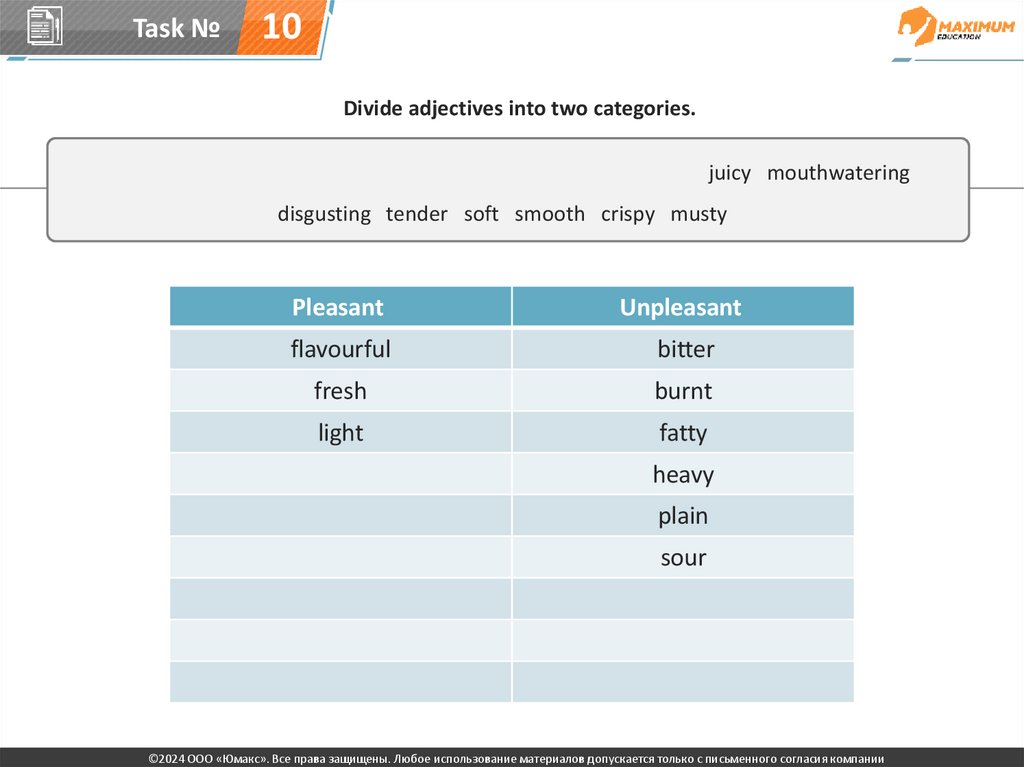
36.
Task №10
Divide adjectives into two categories.
bitter burnt fatty flavourful fresh heavy light plain sour juicy mouthwatering
disgusting tender soft smooth crispy musty
Pleasant
Unpleasant
flavourful
bitter
fresh
burnt
light
fatty
juicy
heavy
plain
sour
©2024 ООО «Юмакс». Все права защищены. Любое использование материалов допускается только с письменного согласия компании
37.
Task №10
Divide adjectives into two categories.
bitter burnt fatty flavourful fresh heavy light plain sour juicy mouthwatering
disgusting tender soft smooth crispy musty
Pleasant
Unpleasant
flavourful
bitter
fresh
burnt
light
fatty
juicy
heavy
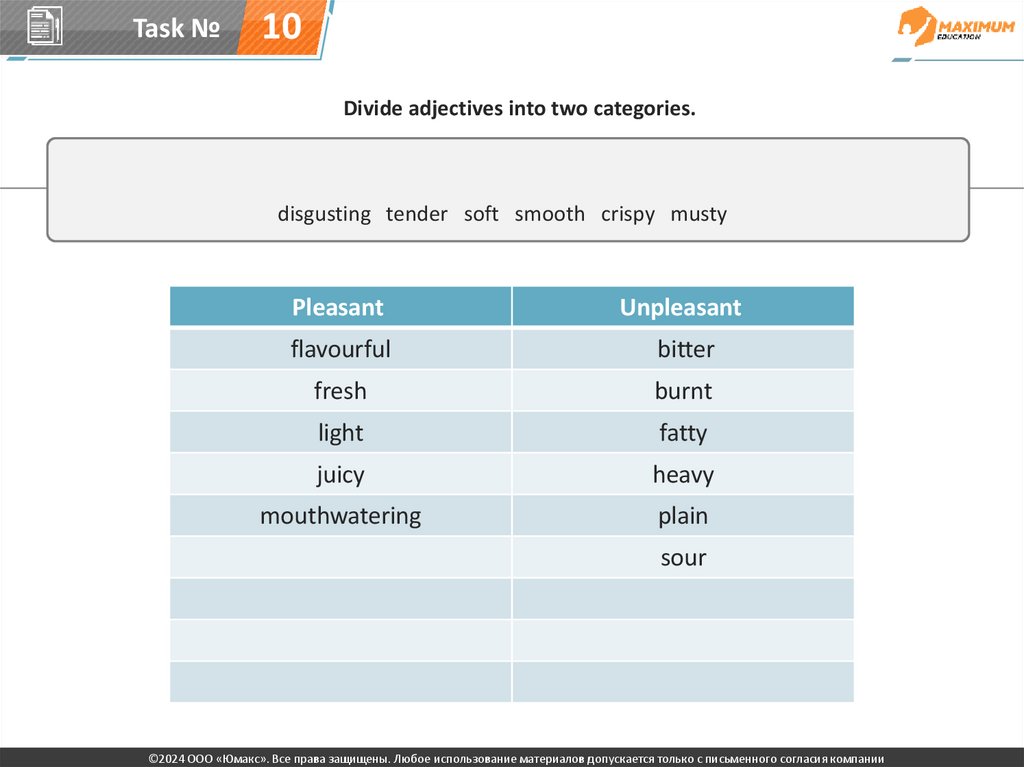
mouthwatering
plain
sour
©2024 ООО «Юмакс». Все права защищены. Любое использование материалов допускается только с письменного согласия компании
38.
Task №10
Divide adjectives into two categories.
bitter burnt fatty flavourful fresh heavy light plain sour juicy mouthwatering
disgusting tender soft smooth crispy musty
Pleasant
Unpleasant
flavourful
bitter
fresh
burnt
light
fatty
juicy
heavy
mouthwatering
plain
sour
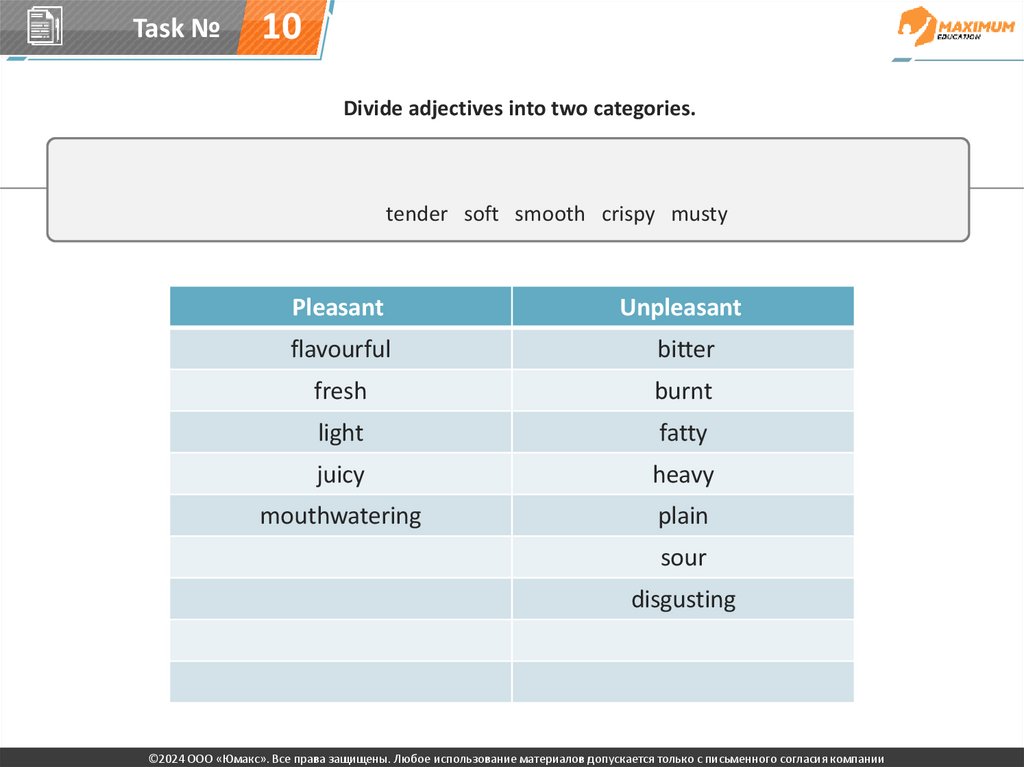
disgusting
©2024 ООО «Юмакс». Все права защищены. Любое использование материалов допускается только с письменного согласия компании
39.
Task №10
Divide adjectives into two categories.
bitter burnt fatty flavourful fresh heavy light plain sour juicy mouthwatering
disgusting tender soft smooth crispy musty
Pleasant
Unpleasant
flavourful
bitter
fresh
burnt
light
fatty
juicy
heavy
mouthwatering
plain
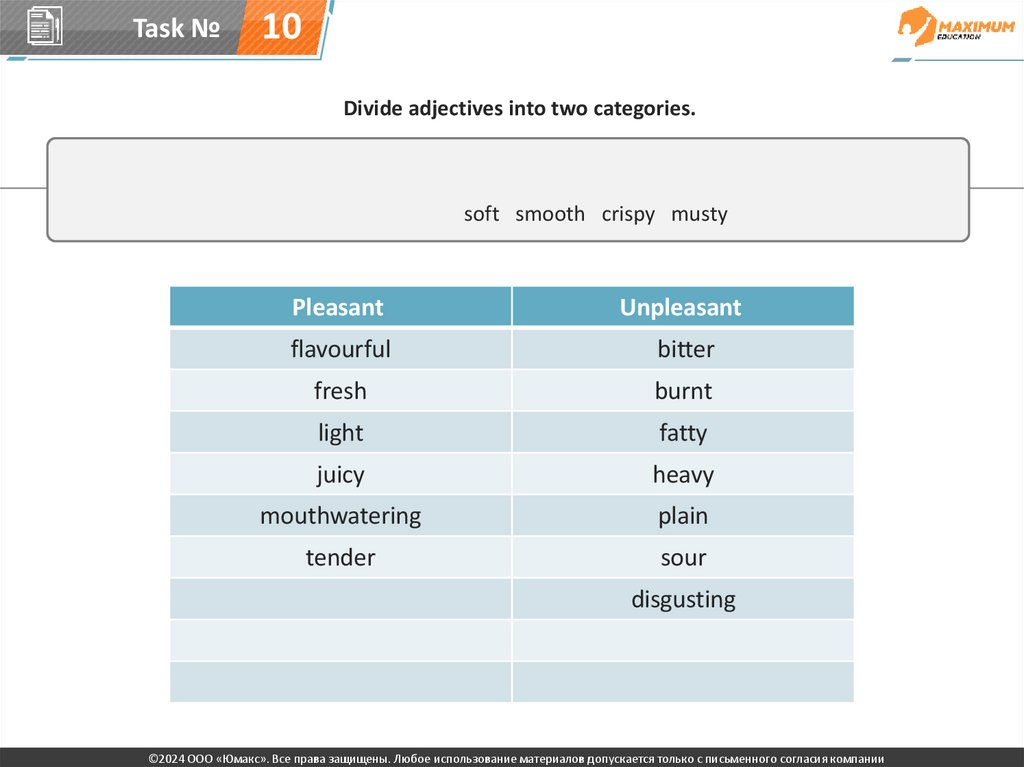
tender
sour
disgusting
©2024 ООО «Юмакс». Все права защищены. Любое использование материалов допускается только с письменного согласия компании
40.
Task №10
Divide adjectives into two categories.
bitter burnt fatty flavourful fresh heavy light plain sour juicy mouthwatering
disgusting tender soft smooth crispy musty
Pleasant
Unpleasant
flavourful
bitter
fresh
burnt
light
fatty
juicy
heavy
mouthwatering
plain
tender
sour
soft
disgusting
©2024 ООО «Юмакс». Все права защищены. Любое использование материалов допускается только с письменного согласия компании
41.
Task №10
Divide adjectives into two categories.
bitter burnt fatty flavourful fresh heavy light plain sour juicy mouthwatering
disgusting tender soft smooth crispy musty
Pleasant
Unpleasant
flavourful
bitter
fresh
burnt
light
fatty
juicy
heavy
mouthwatering
plain
tender
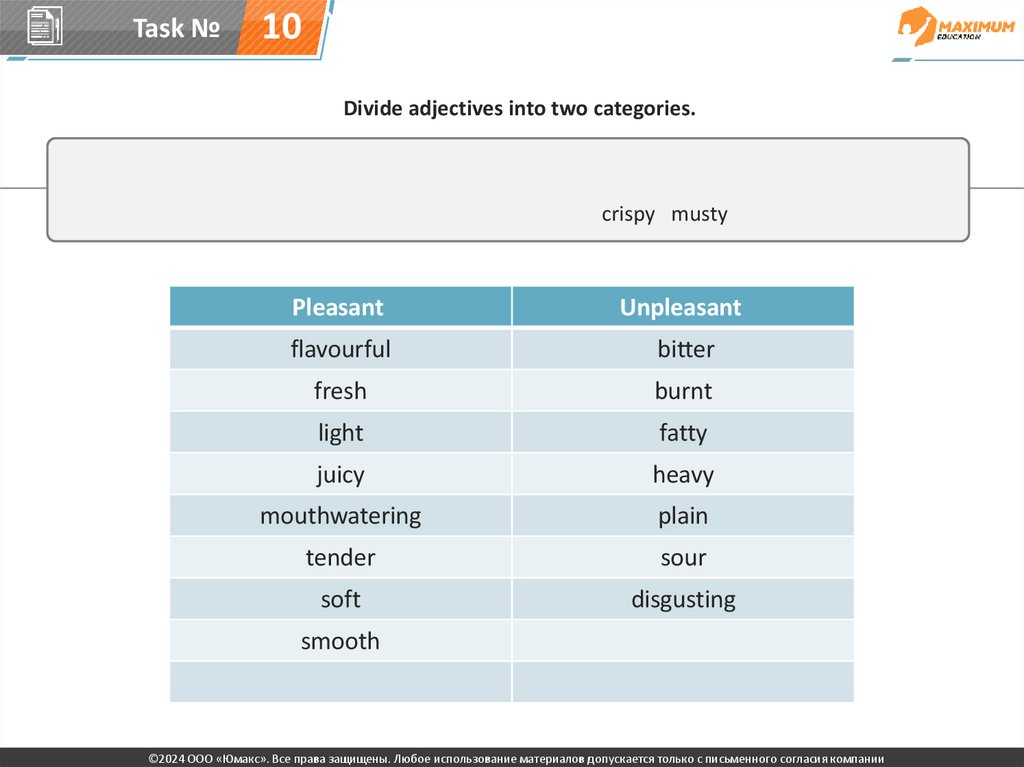
sour
soft
disgusting
smooth
©2024 ООО «Юмакс». Все права защищены. Любое использование материалов допускается только с письменного согласия компании
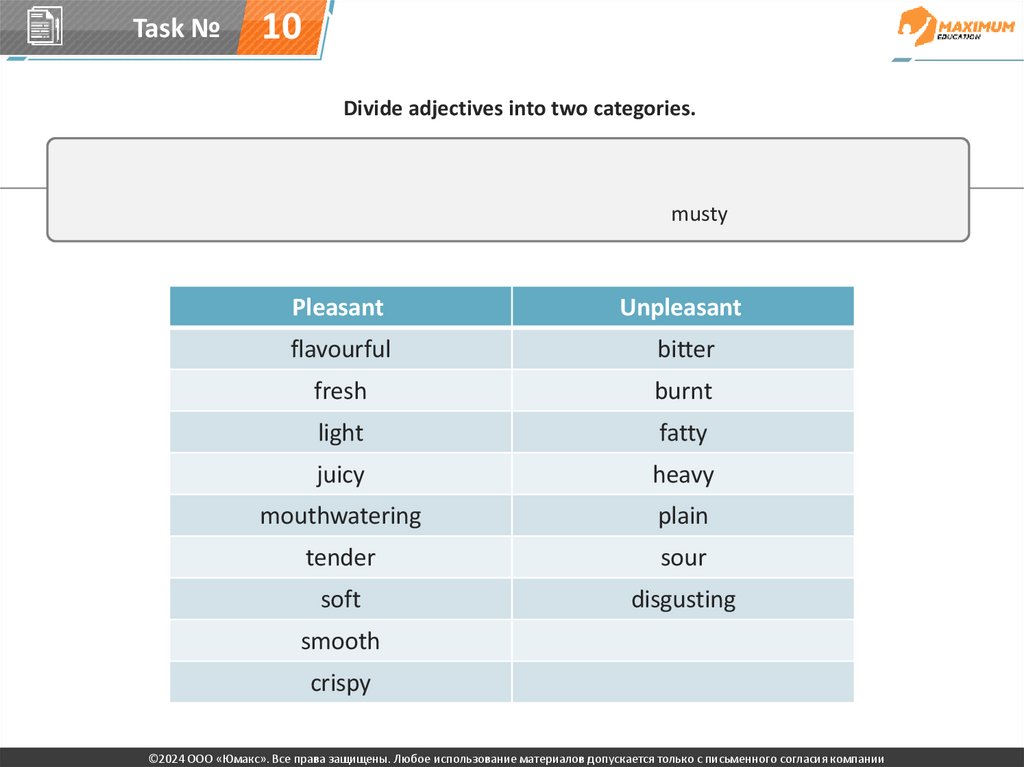
42.
Task №10
Divide adjectives into two categories.
bitter burnt fatty flavourful fresh heavy light plain sour juicy mouthwatering
disgusting tender soft smooth crispy musty
Pleasant
Unpleasant
flavourful
bitter
fresh
burnt
light
fatty
juicy
heavy
mouthwatering
plain
tender
sour
soft
disgusting
smooth
crispy
©2024 ООО «Юмакс». Все права защищены. Любое использование материалов допускается только с письменного согласия компании
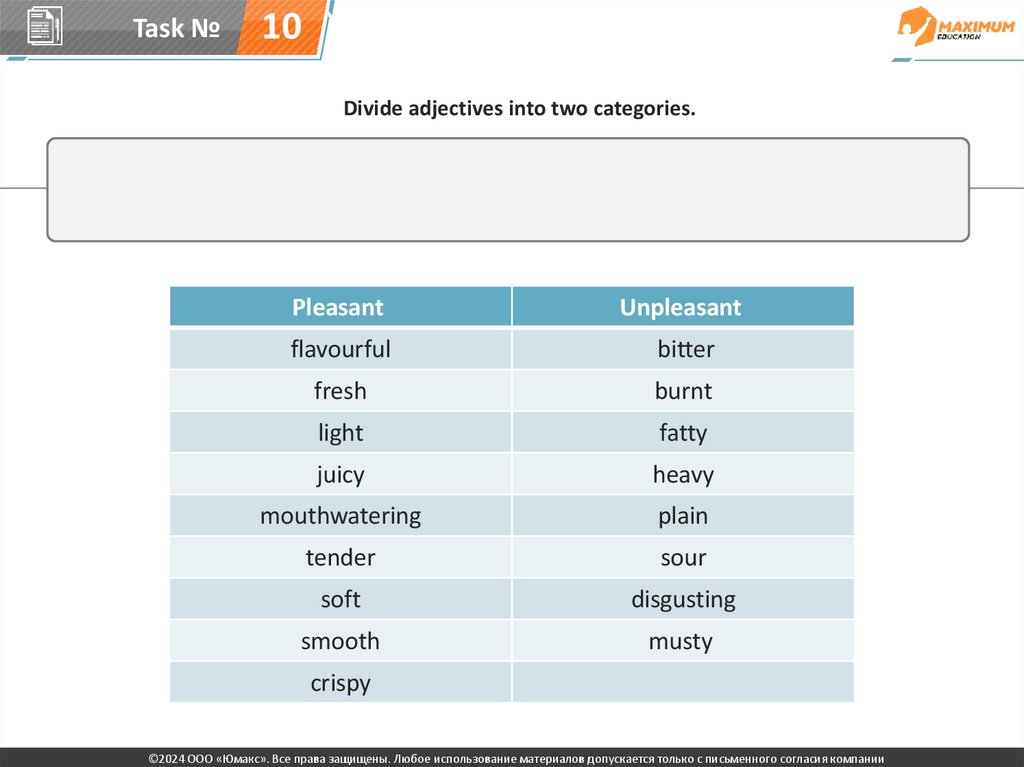
43.
Task №10
Divide adjectives into two categories.
bitter burnt fatty flavourful fresh heavy light plain sour juicy mouthwatering
disgusting tender soft smooth crispy musty
Pleasant
Unpleasant
flavourful
bitter
fresh
burnt
light
fatty
juicy
heavy
mouthwatering
plain
tender
sour
soft
disgusting
smooth
musty
crispy
©2024 ООО «Юмакс». Все права защищены. Любое использование материалов допускается только с письменного согласия компании
44.
Let’s go!Task 11
©2024 ООО «Юмакс». Все права защищены. Любое использование материалов допускается только с письменного согласия компании
45.
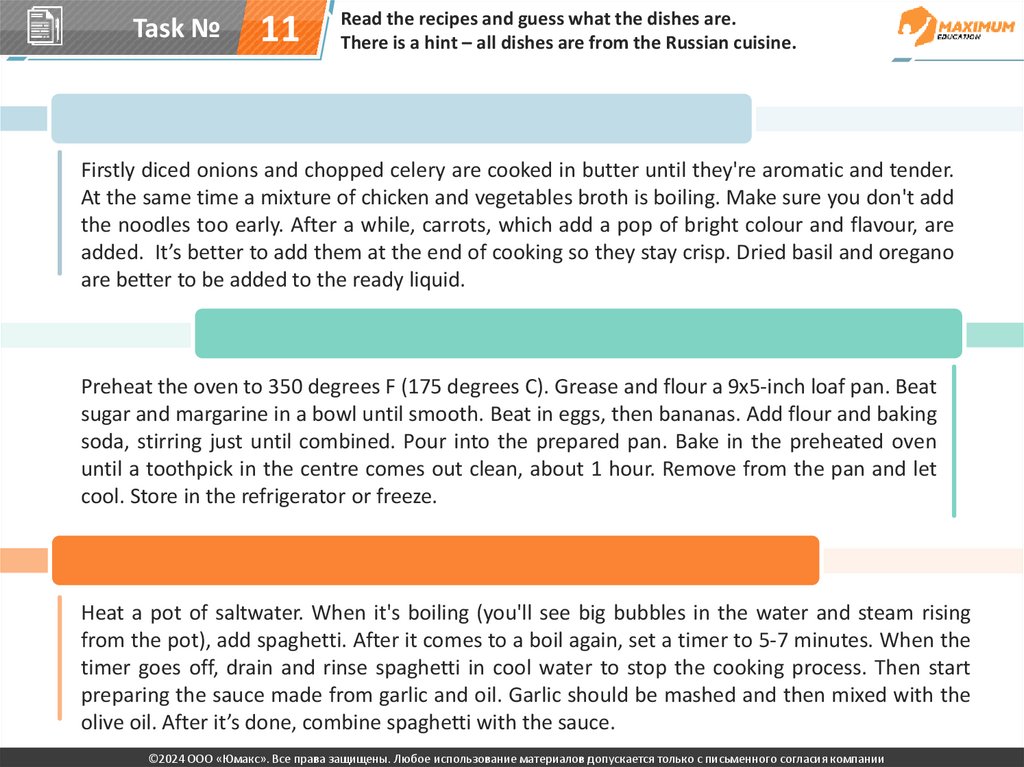
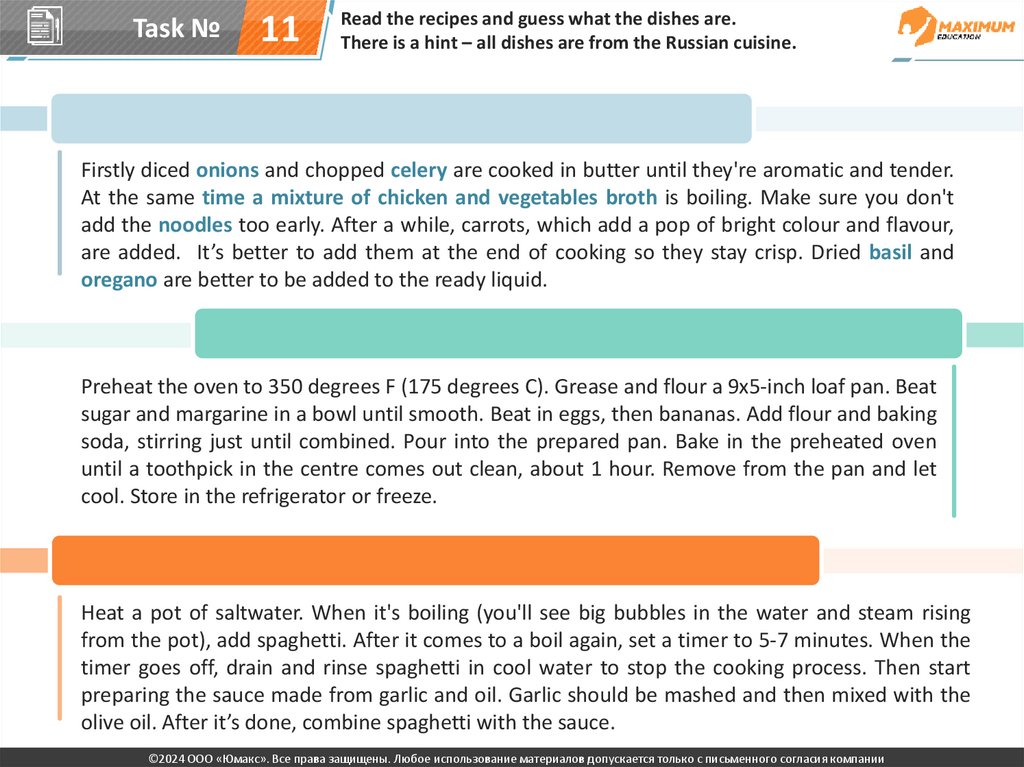
Task №11
Read the recipes and guess what the dishes are.
There is a hint – all dishes are from the Russian cuisine.
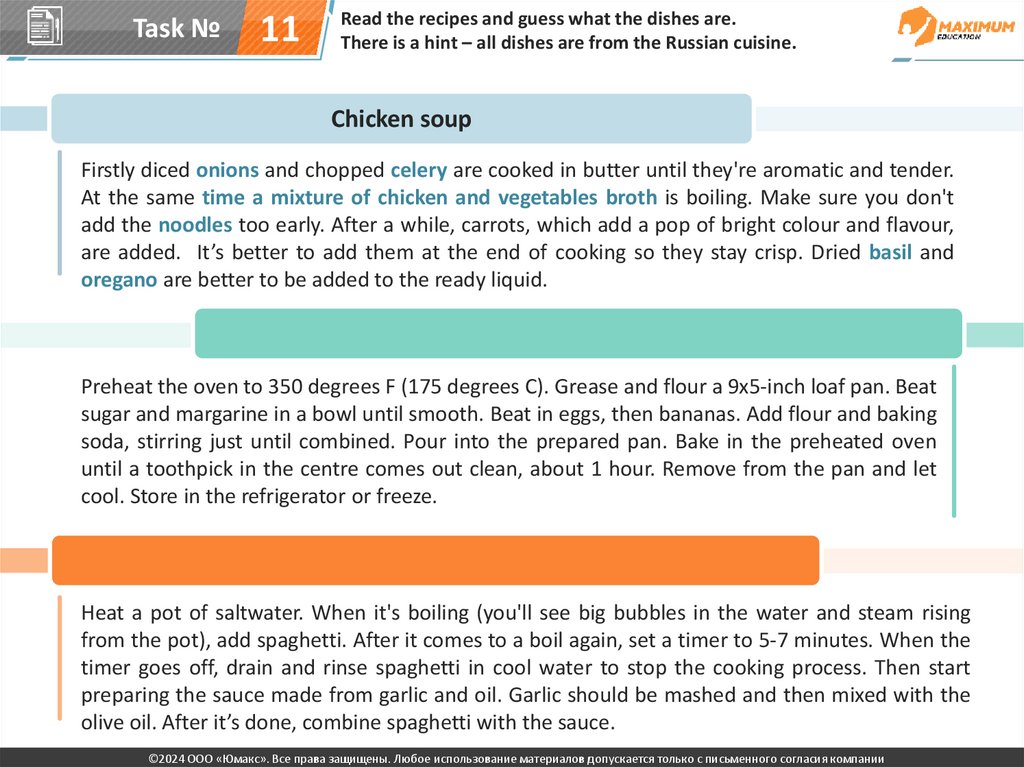
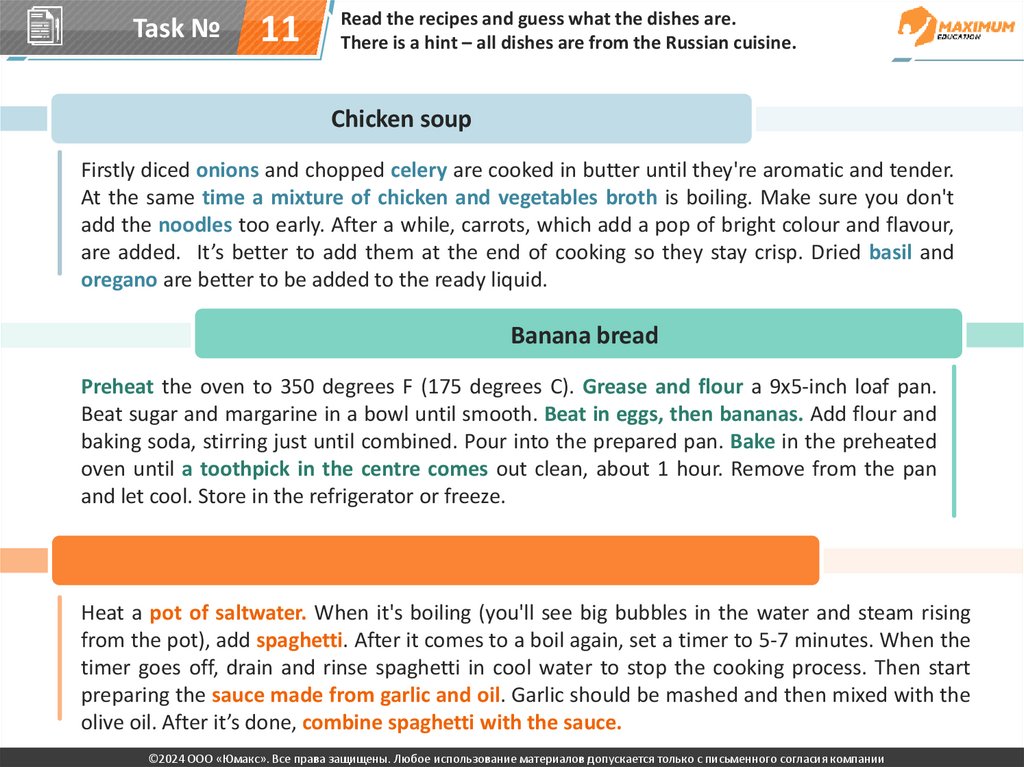
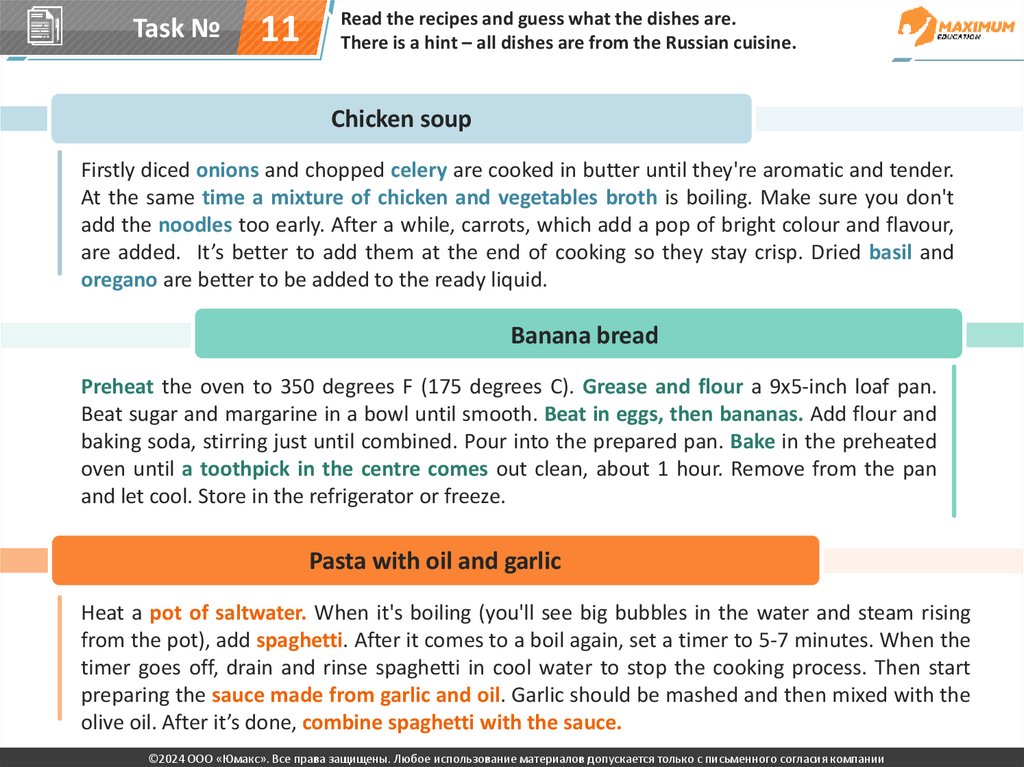
Chicken soup
Firstly diced onions and chopped celery are cooked in butter until they're aromatic and tender.
At the same time a mixture of chicken and vegetables broth is boiling. Make sure you don't add
the noodles too early. After a while, carrots, which add a pop of bright colour and flavour, are
added. It’s better to add them at the end of cooking so they stay crisp. Dried basil and oregano
are better to be added to the ready liquid.
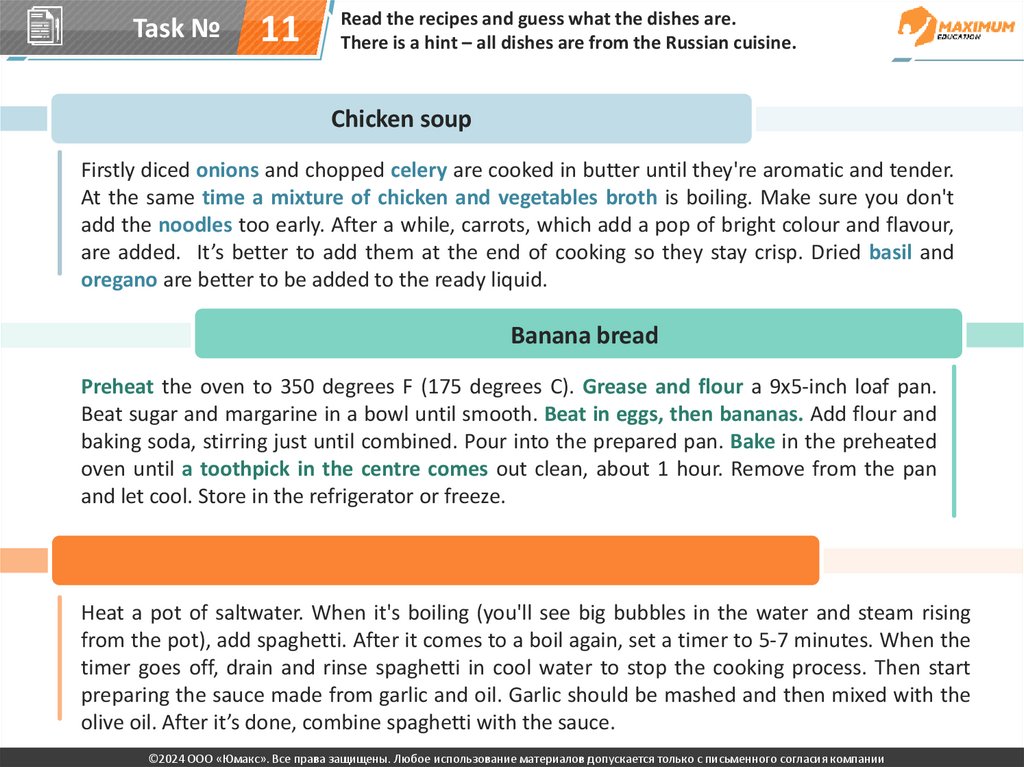
Banana bread
Preheat the oven to 350 degrees F (175 degrees C). Grease and flour a 9x5-inch loaf pan. Beat
sugar and margarine in a bowl until smooth. Beat in eggs, then bananas. Add flour and baking
soda, stirring just until combined. Pour into the prepared pan. Bake in the preheated oven
until a toothpick in the centre comes out clean, about 1 hour. Remove from the pan and let
cool. Store in the refrigerator or freeze.
Pasta with oil and garlic
Heat a pot of saltwater. When it's boiling (you'll see big bubbles in the water and steam rising
from the pot), add spaghetti. After it comes to a boil again, set a timer to 5-7 minutes. When the
timer goes off, drain and rinse spaghetti in cool water to stop the cooking process. Then start
preparing the sauce made from garlic and oil. Garlic should be mashed and then mixed with the
olive oil. After it’s done, combine spaghetti with the sauce.
©2024 ООО «Юмакс». Все права защищены. Любое использование материалов допускается только с письменного согласия компании
46.
Task №11
Read the recipes and guess what the dishes are.
There is a hint – all dishes are from the Russian cuisine.
Chicken soup
Firstly diced onions and chopped celery are cooked in butter until they're aromatic and tender.
At the same time a mixture of chicken and vegetables broth is boiling. Make sure you don't
add the noodles too early. After a while, carrots, which add a pop of bright colour and flavour,
are added. It’s better to add them at the end of cooking so they stay crisp. Dried basil and
oregano are better to be added to the ready liquid.
Banana bread
Preheat the oven to 350 degrees F (175 degrees C). Grease and flour a 9x5-inch loaf pan. Beat
sugar and margarine in a bowl until smooth. Beat in eggs, then bananas. Add flour and baking
soda, stirring just until combined. Pour into the prepared pan. Bake in the preheated oven
until a toothpick in the centre comes out clean, about 1 hour. Remove from the pan and let
cool. Store in the refrigerator or freeze.
Pasta with oil and garlic
Heat a pot of saltwater. When it's boiling (you'll see big bubbles in the water and steam rising
from the pot), add spaghetti. After it comes to a boil again, set a timer to 5-7 minutes. When the
timer goes off, drain and rinse spaghetti in cool water to stop the cooking process. Then start
preparing the sauce made from garlic and oil. Garlic should be mashed and then mixed with the
olive oil. After it’s done, combine spaghetti with the sauce.
©2024 ООО «Юмакс». Все права защищены. Любое использование материалов допускается только с письменного согласия компании
47.
Task №11
Read the recipes and guess what the dishes are.
There is a hint – all dishes are from the Russian cuisine.
Chicken soup
Firstly diced onions and chopped celery are cooked in butter until they're aromatic and tender.
At the same time a mixture of chicken and vegetables broth is boiling. Make sure you don't
add the noodles too early. After a while, carrots, which add a pop of bright colour and flavour,
are added. It’s better to add them at the end of cooking so they stay crisp. Dried basil and
oregano are better to be added to the ready liquid.
Banana bread
Preheat the oven to 350 degrees F (175 degrees C). Grease and flour a 9x5-inch loaf pan. Beat
sugar and margarine in a bowl until smooth. Beat in eggs, then bananas. Add flour and baking
soda, stirring just until combined. Pour into the prepared pan. Bake in the preheated oven
until a toothpick in the centre comes out clean, about 1 hour. Remove from the pan and let
cool. Store in the refrigerator or freeze.
Pasta with oil and garlic
Heat a pot of saltwater. When it's boiling (you'll see big bubbles in the water and steam rising
from the pot), add spaghetti. After it comes to a boil again, set a timer to 5-7 minutes. When the
timer goes off, drain and rinse spaghetti in cool water to stop the cooking process. Then start
preparing the sauce made from garlic and oil. Garlic should be mashed and then mixed with the
olive oil. After it’s done, combine spaghetti with the sauce.
©2024 ООО «Юмакс». Все права защищены. Любое использование материалов допускается только с письменного согласия компании
48.
Task №11
Read the recipes and guess what the dishes are.
There is a hint – all dishes are from the Russian cuisine.
Chicken soup
Firstly diced onions and chopped celery are cooked in butter until they're aromatic and tender.
At the same time a mixture of chicken and vegetables broth is boiling. Make sure you don't
add the noodles too early. After a while, carrots, which add a pop of bright colour and flavour,
are added. It’s better to add them at the end of cooking so they stay crisp. Dried basil and
oregano are better to be added to the ready liquid.
Banana bread
Preheat the oven to 350 degrees F (175 degrees C). Grease and flour a 9x5-inch loaf pan.
Beat sugar and margarine in a bowl until smooth. Beat in eggs, then bananas. Add flour and
baking soda, stirring just until combined. Pour into the prepared pan. Bake in the preheated
oven until a toothpick in the centre comes out clean, about 1 hour. Remove from the pan
and let cool. Store in the refrigerator or freeze.
Pasta with oil and garlic
Heat a pot of saltwater. When it's boiling (you'll see big bubbles in the water and steam rising
from the pot), add spaghetti. After it comes to a boil again, set a timer to 5-7 minutes. When the
timer goes off, drain and rinse spaghetti in cool water to stop the cooking process. Then start
preparing the sauce made from garlic and oil. Garlic should be mashed and then mixed with the
olive oil. After it’s done, combine spaghetti with the sauce.
©2024 ООО «Юмакс». Все права защищены. Любое использование материалов допускается только с письменного согласия компании
49.
Task №11
Read the recipes and guess what the dishes are.
There is a hint – all dishes are from the Russian cuisine.
Chicken soup
Firstly diced onions and chopped celery are cooked in butter until they're aromatic and tender.
At the same time a mixture of chicken and vegetables broth is boiling. Make sure you don't
add the noodles too early. After a while, carrots, which add a pop of bright colour and flavour,
are added. It’s better to add them at the end of cooking so they stay crisp. Dried basil and
oregano are better to be added to the ready liquid.
Banana bread
Preheat the oven to 350 degrees F (175 degrees C). Grease and flour a 9x5-inch loaf pan.
Beat sugar and margarine in a bowl until smooth. Beat in eggs, then bananas. Add flour and
baking soda, stirring just until combined. Pour into the prepared pan. Bake in the preheated
oven until a toothpick in the centre comes out clean, about 1 hour. Remove from the pan
and let cool. Store in the refrigerator or freeze.
Pasta with oil and garlic
Heat a pot of saltwater. When it's boiling (you'll see big bubbles in the water and steam rising
from the pot), add spaghetti. After it comes to a boil again, set a timer to 5-7 minutes. When the
timer goes off, drain and rinse spaghetti in cool water to stop the cooking process. Then start
preparing the sauce made from garlic and oil. Garlic should be mashed and then mixed with the
olive oil. After it’s done, combine spaghetti with the sauce.
©2024 ООО «Юмакс». Все права защищены. Любое использование материалов допускается только с письменного согласия компании
50.
Task №11
Read the recipes and guess what the dishes are.
There is a hint – all dishes are from the Russian cuisine.
Chicken soup
Firstly diced onions and chopped celery are cooked in butter until they're aromatic and tender.
At the same time a mixture of chicken and vegetables broth is boiling. Make sure you don't
add the noodles too early. After a while, carrots, which add a pop of bright colour and flavour,
are added. It’s better to add them at the end of cooking so they stay crisp. Dried basil and
oregano are better to be added to the ready liquid.
Banana bread
Preheat the oven to 350 degrees F (175 degrees C). Grease and flour a 9x5-inch loaf pan.
Beat sugar and margarine in a bowl until smooth. Beat in eggs, then bananas. Add flour and
baking soda, stirring just until combined. Pour into the prepared pan. Bake in the preheated
oven until a toothpick in the centre comes out clean, about 1 hour. Remove from the pan
and let cool. Store in the refrigerator or freeze.
Pasta with oil and garlic
Heat a pot of saltwater. When it's boiling (you'll see big bubbles in the water and steam rising
from the pot), add spaghetti. After it comes to a boil again, set a timer to 5-7 minutes. When the
timer goes off, drain and rinse spaghetti in cool water to stop the cooking process. Then start
preparing the sauce made from garlic and oil. Garlic should be mashed and then mixed with the
olive oil. After it’s done, combine spaghetti with the sauce.
©2024 ООО «Юмакс». Все права защищены. Любое использование материалов допускается только с письменного согласия компании
51.
Task №11
Read the recipes and guess what the dishes are.
There is a hint – all dishes are from the Russian cuisine.
Chicken soup
Firstly diced onions and chopped celery are cooked in butter until they're aromatic and tender.
At the same time a mixture of chicken and vegetables broth is boiling. Make sure you don't
add the noodles too early. After a while, carrots, which add a pop of bright colour and flavour,
are added. It’s better to add them at the end of cooking so they stay crisp. Dried basil and
oregano are better to be added to the ready liquid.
Banana bread
Preheat the oven to 350 degrees F (175 degrees C). Grease and flour a 9x5-inch loaf pan.
Beat sugar and margarine in a bowl until smooth. Beat in eggs, then bananas. Add flour and
baking soda, stirring just until combined. Pour into the prepared pan. Bake in the preheated
oven until a toothpick in the centre comes out clean, about 1 hour. Remove from the pan
and let cool. Store in the refrigerator or freeze.
Pasta with oil and garlic
Heat a pot of saltwater. When it's boiling (you'll see big bubbles in the water and steam rising
from the pot), add spaghetti. After it comes to a boil again, set a timer to 5-7 minutes. When the
timer goes off, drain and rinse spaghetti in cool water to stop the cooking process. Then start
preparing the sauce made from garlic and oil. Garlic should be mashed and then mixed with the
olive oil. After it’s done, combine spaghetti with the sauce.
©2024 ООО «Юмакс». Все права защищены. Любое использование материалов допускается только с письменного согласия компании
52.
Let’s go!Task 12
©2024 ООО «Юмакс». Все права защищены. Любое использование материалов допускается только с письменного согласия компании
53.
Task №12
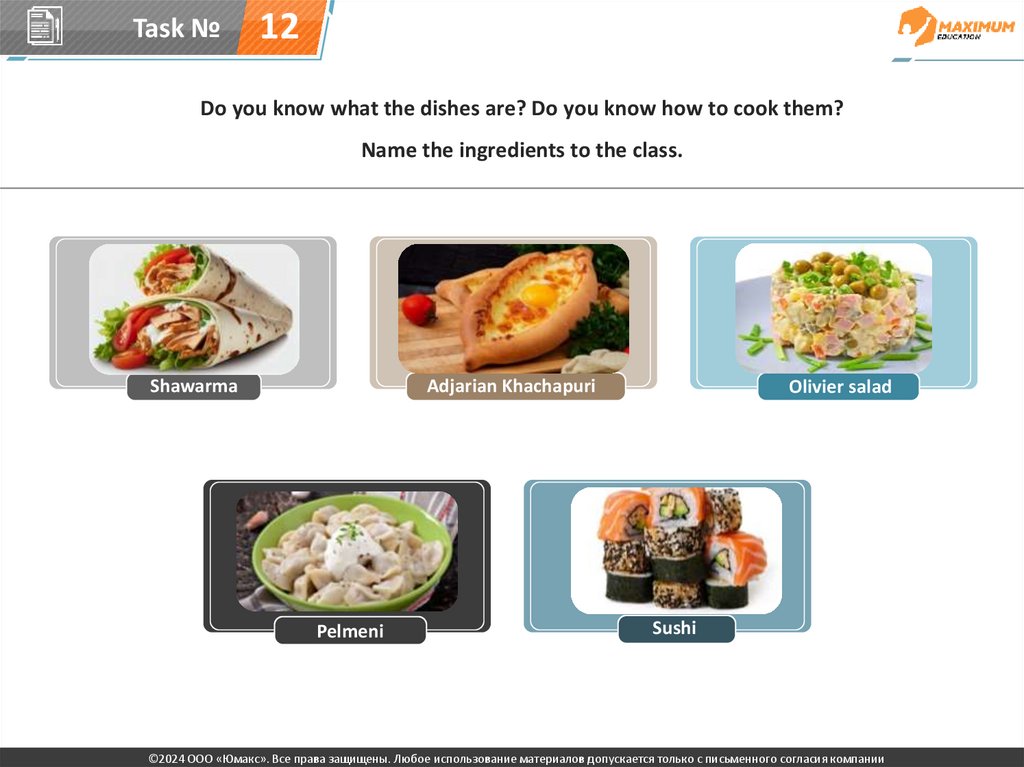
Do you know what the dishes are? Do you know how to cook them?
Name the ingredients to the class.
Shawarma
Adjarian Khachapuri
Pelmeni
cruise
ship/liner
Olivier
salad
Sushi
©2024 ООО «Юмакс». Все права защищены. Любое использование материалов допускается только с письменного согласия компании
54.
Let’s go!Task 13
©2024 ООО «Юмакс». Все права защищены. Любое использование материалов допускается только с письменного согласия компании
55.
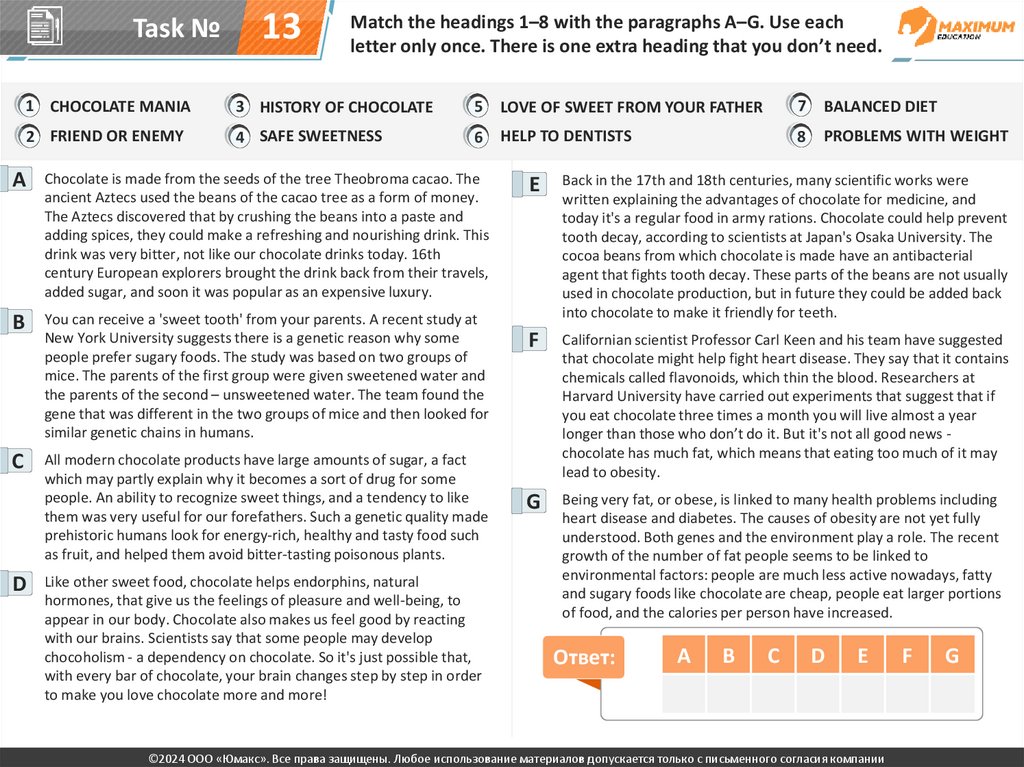
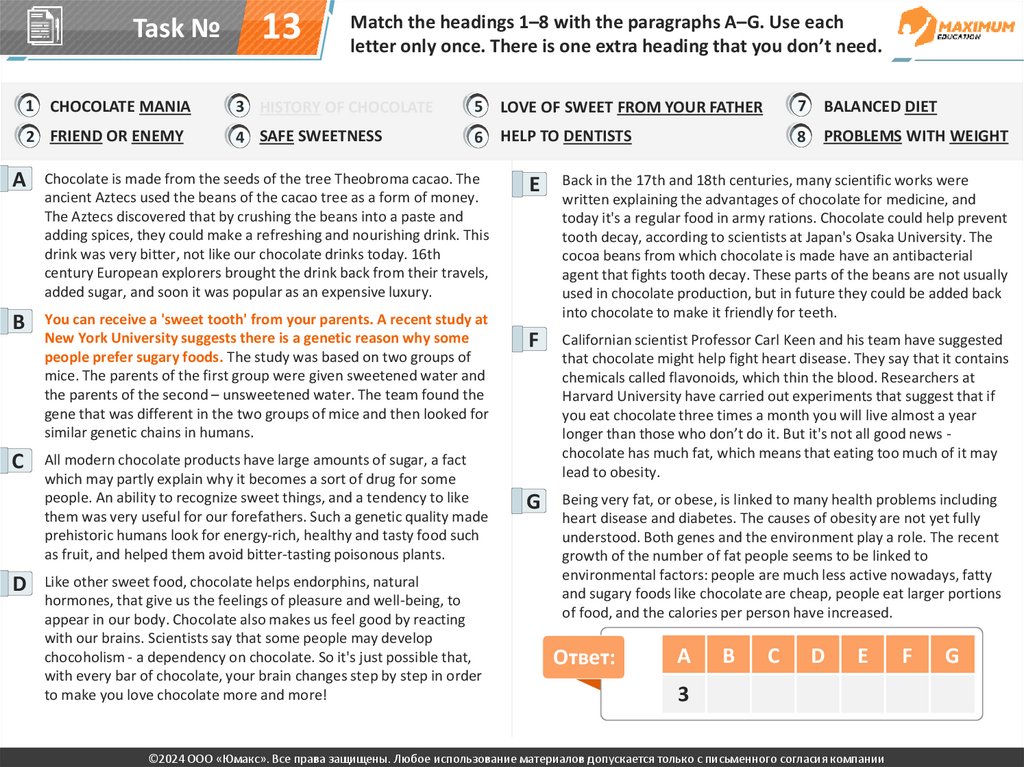
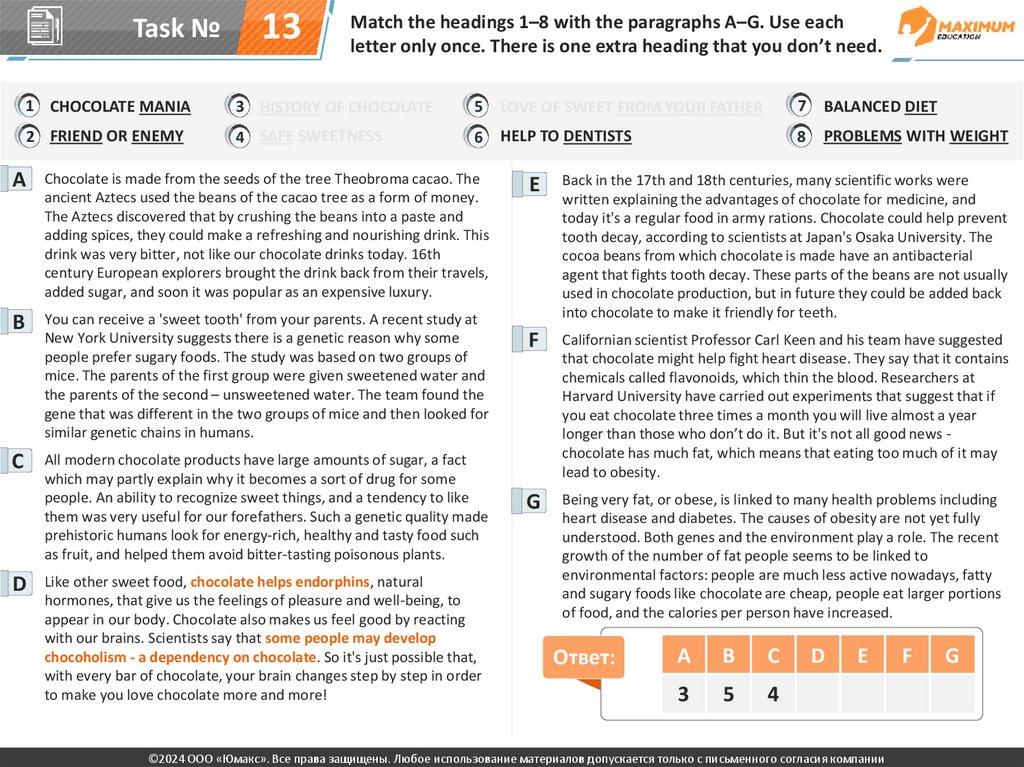
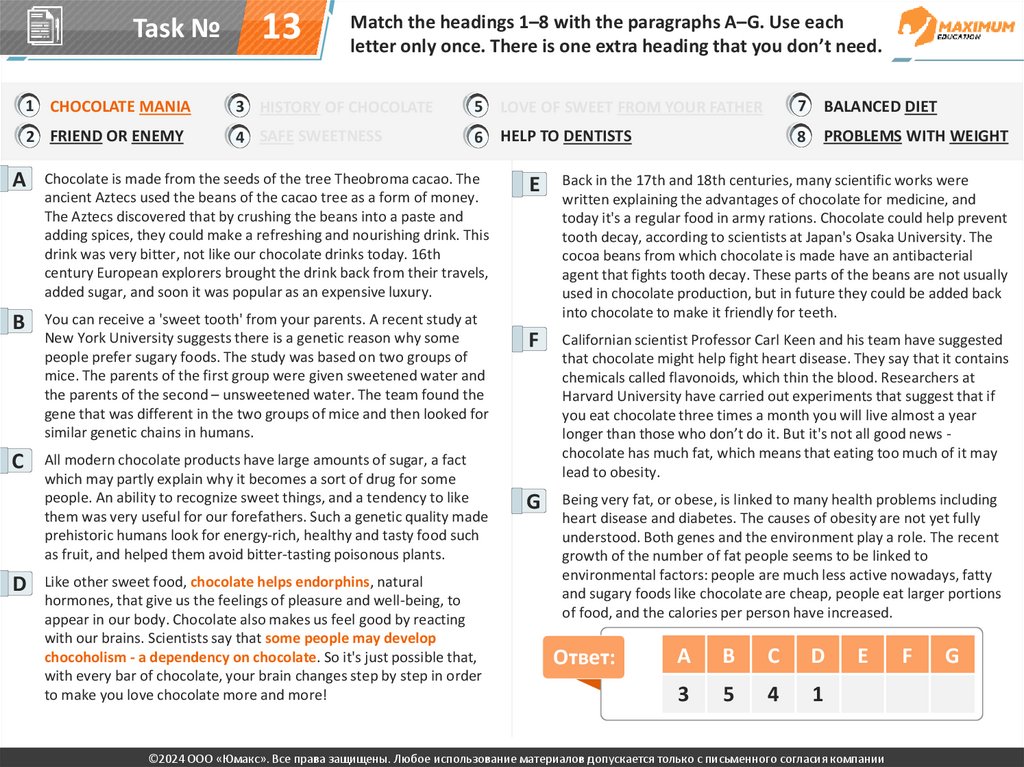
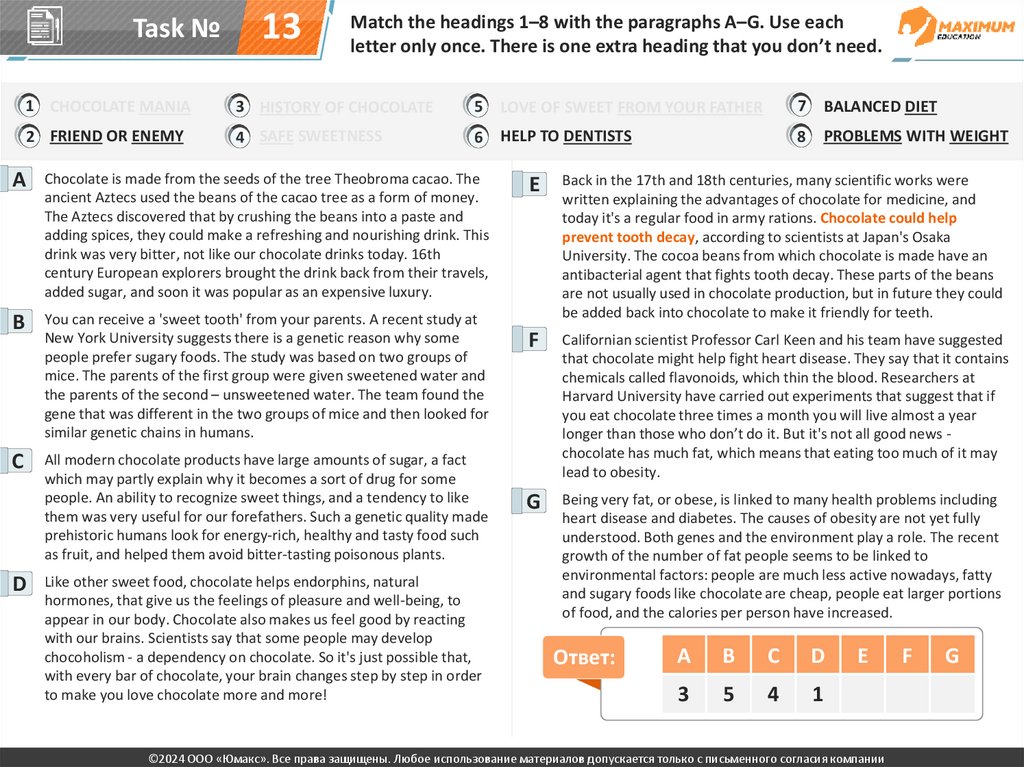
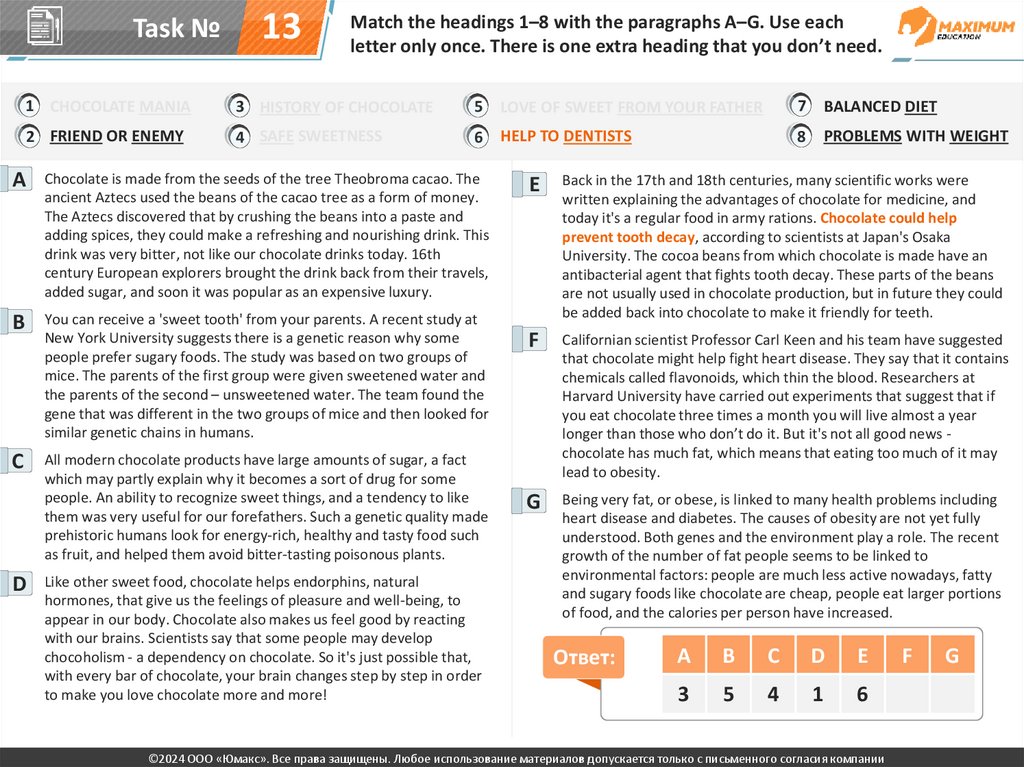
Task №13
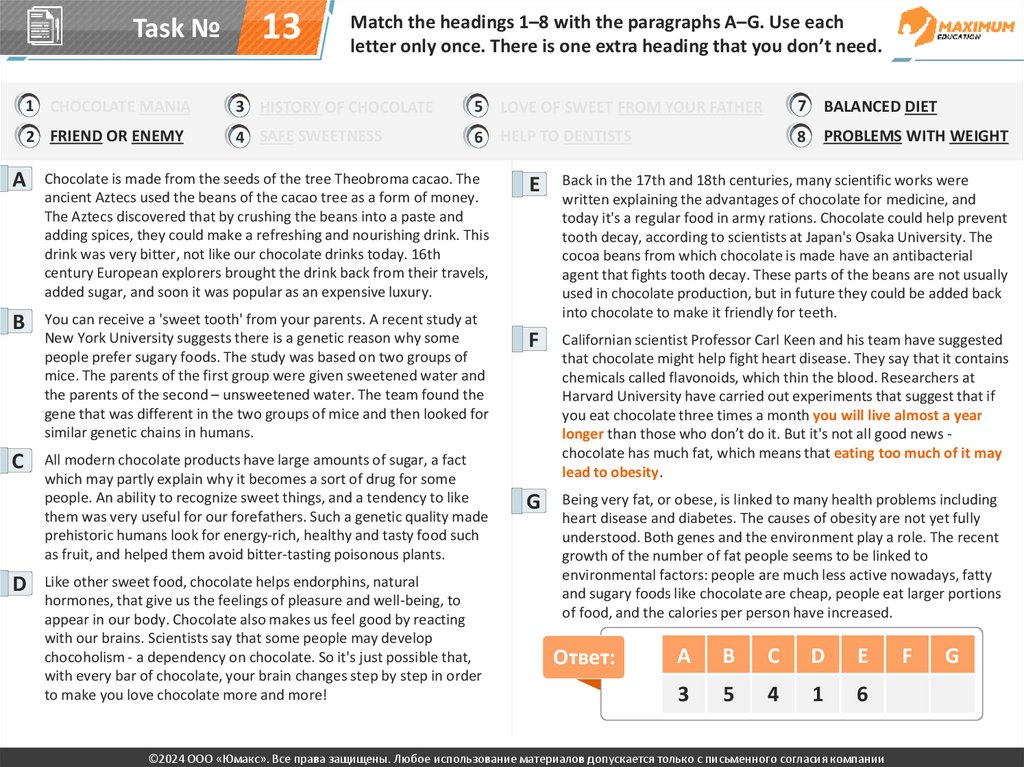
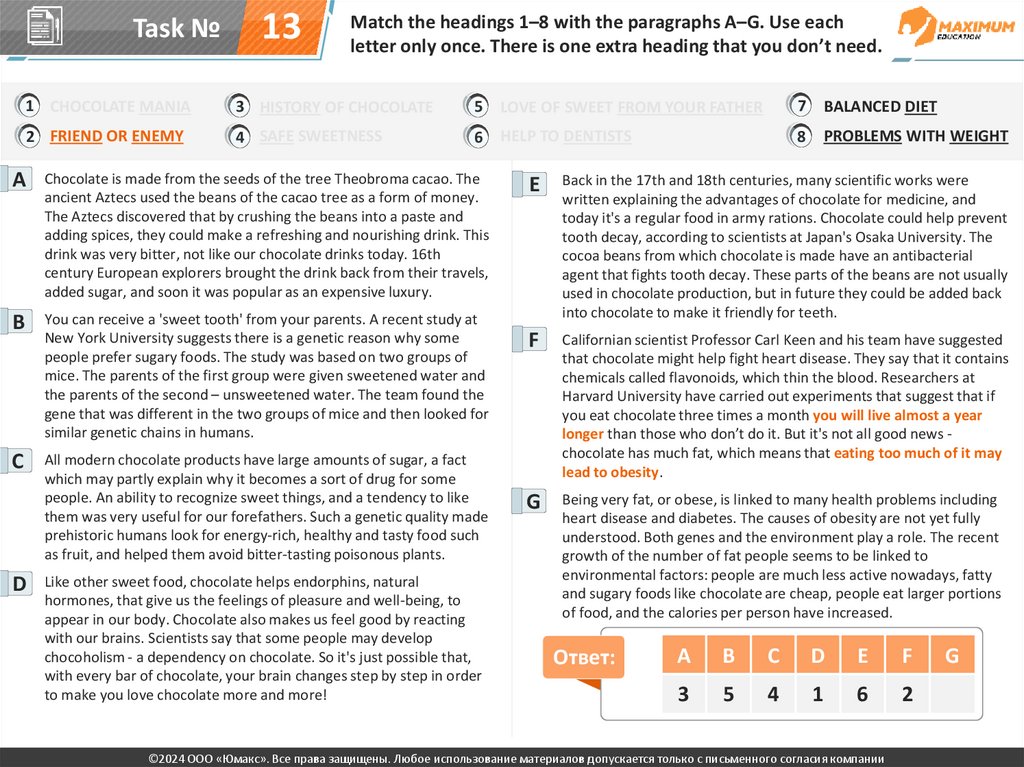
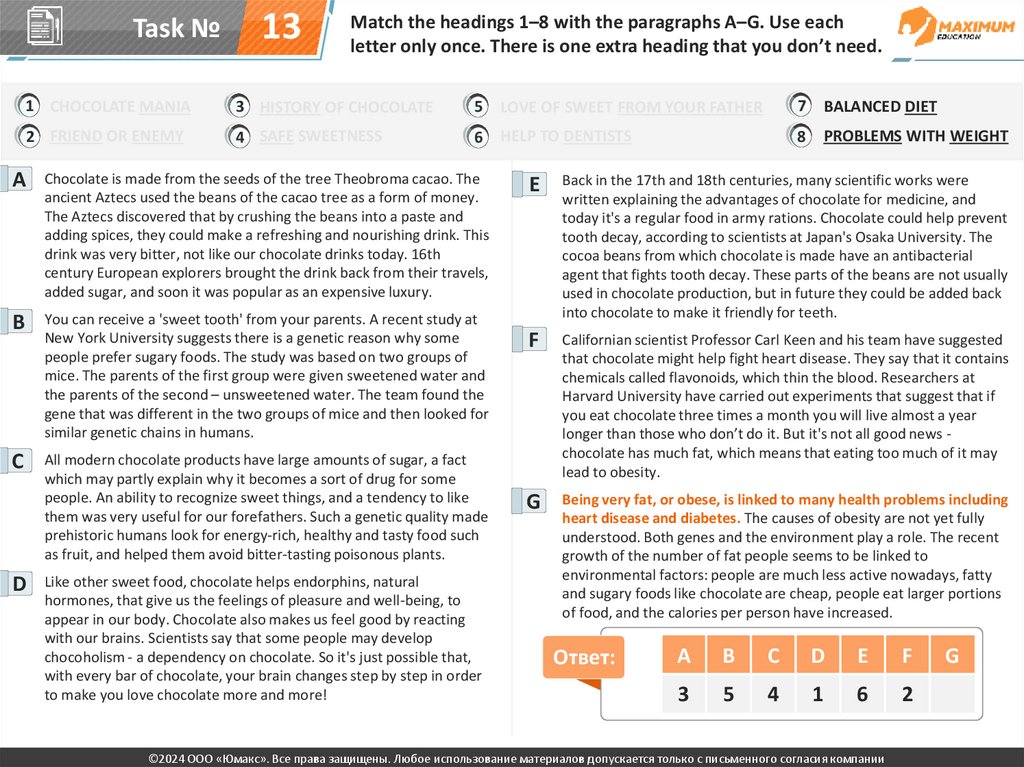
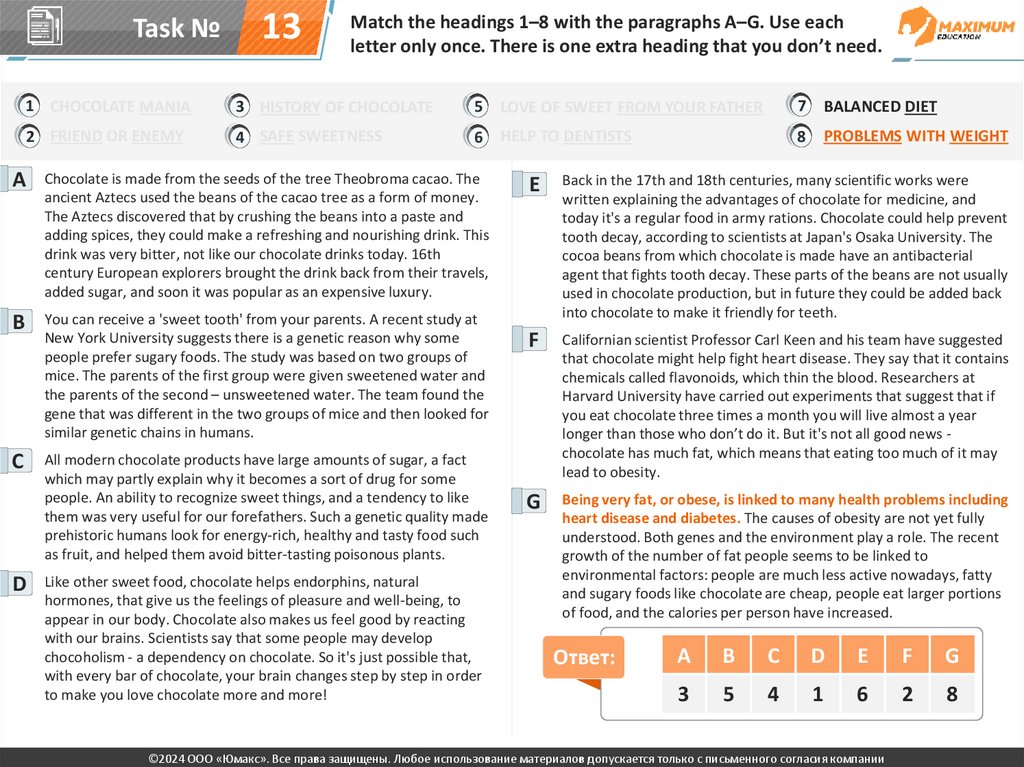
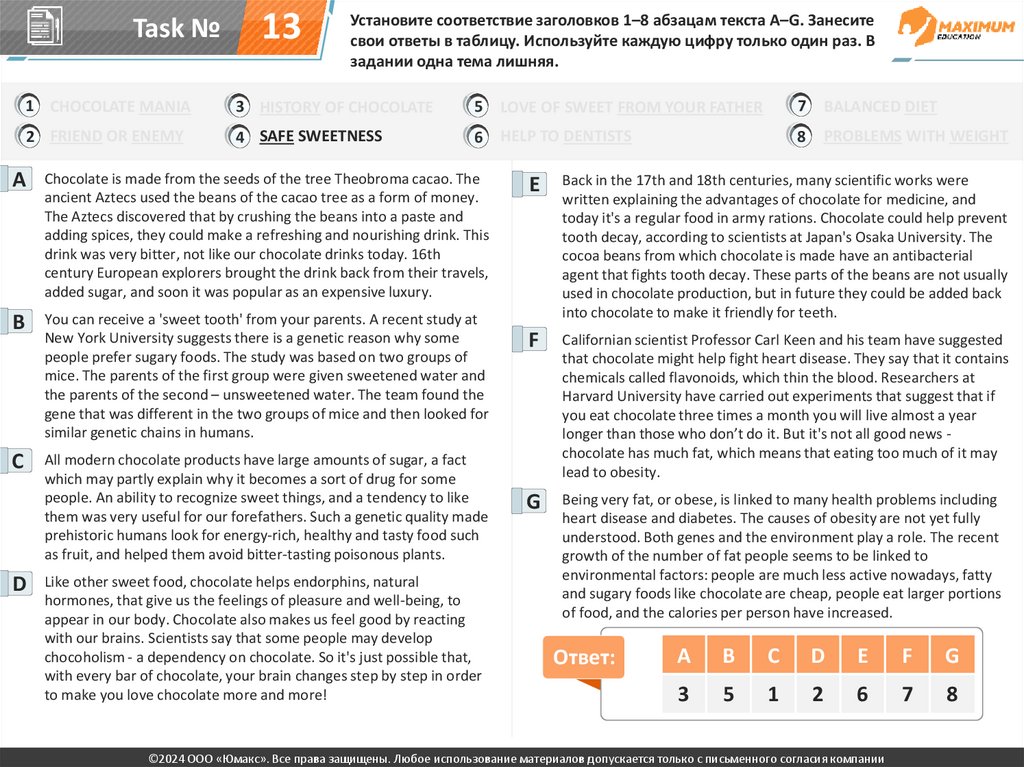
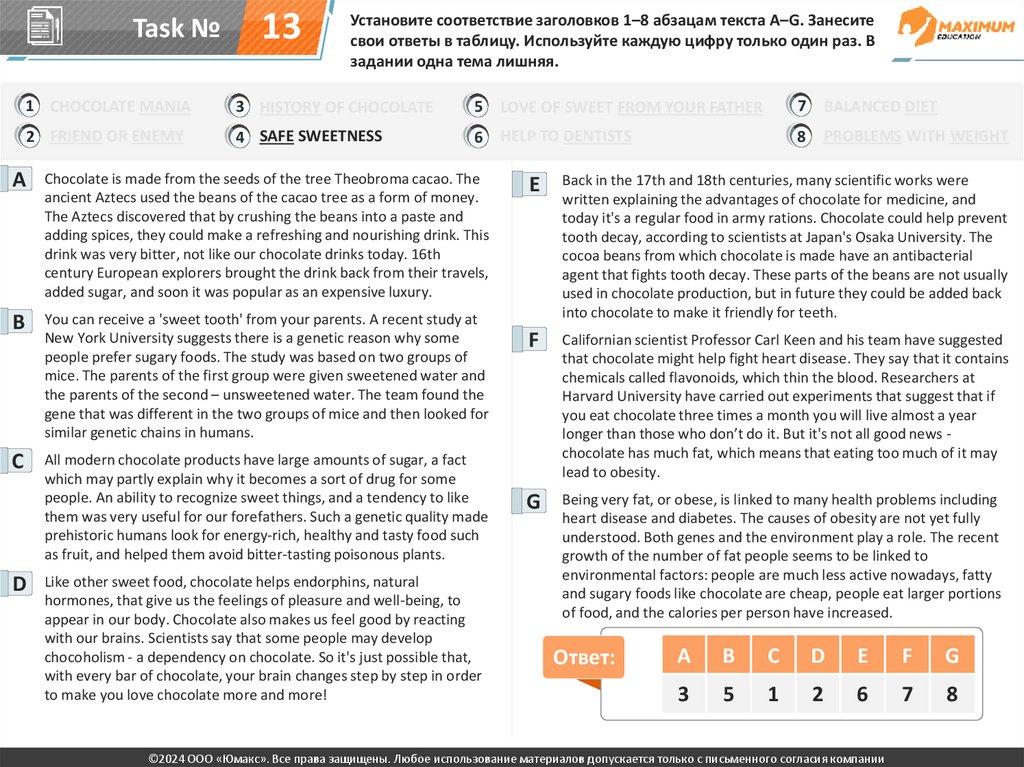
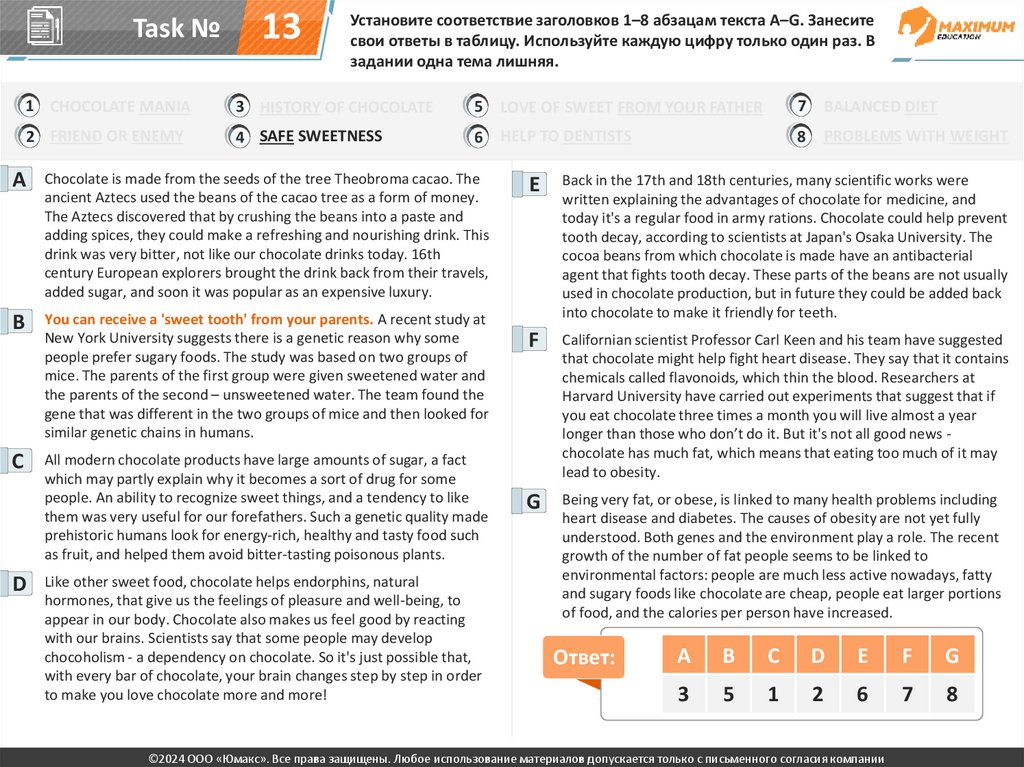
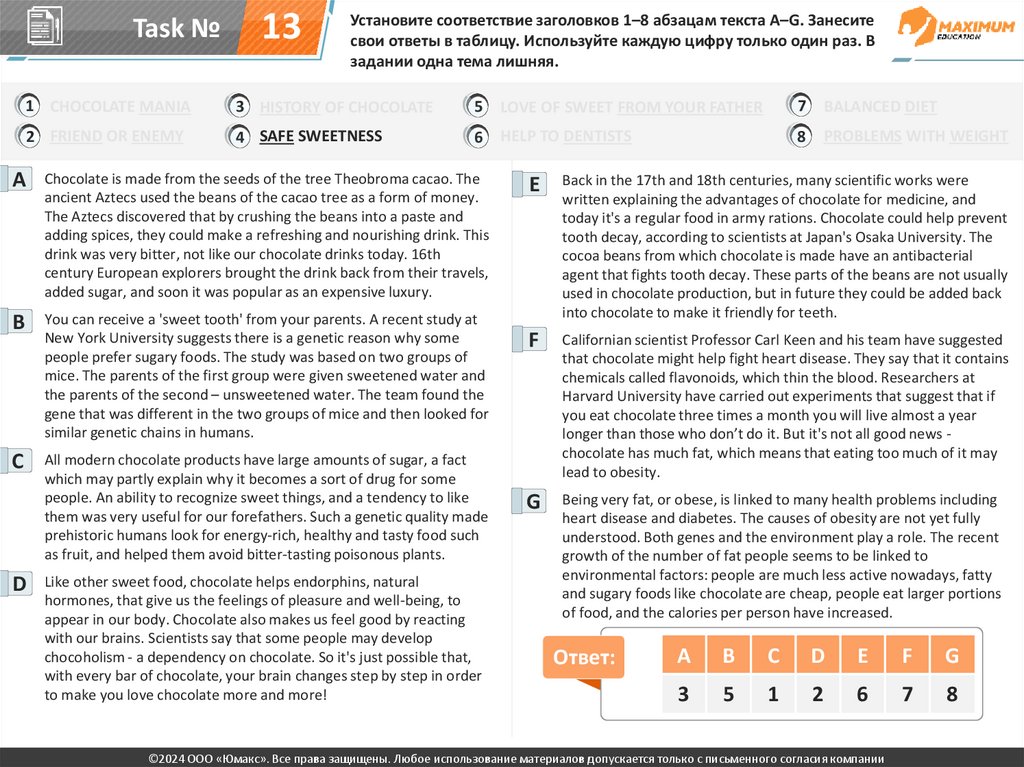
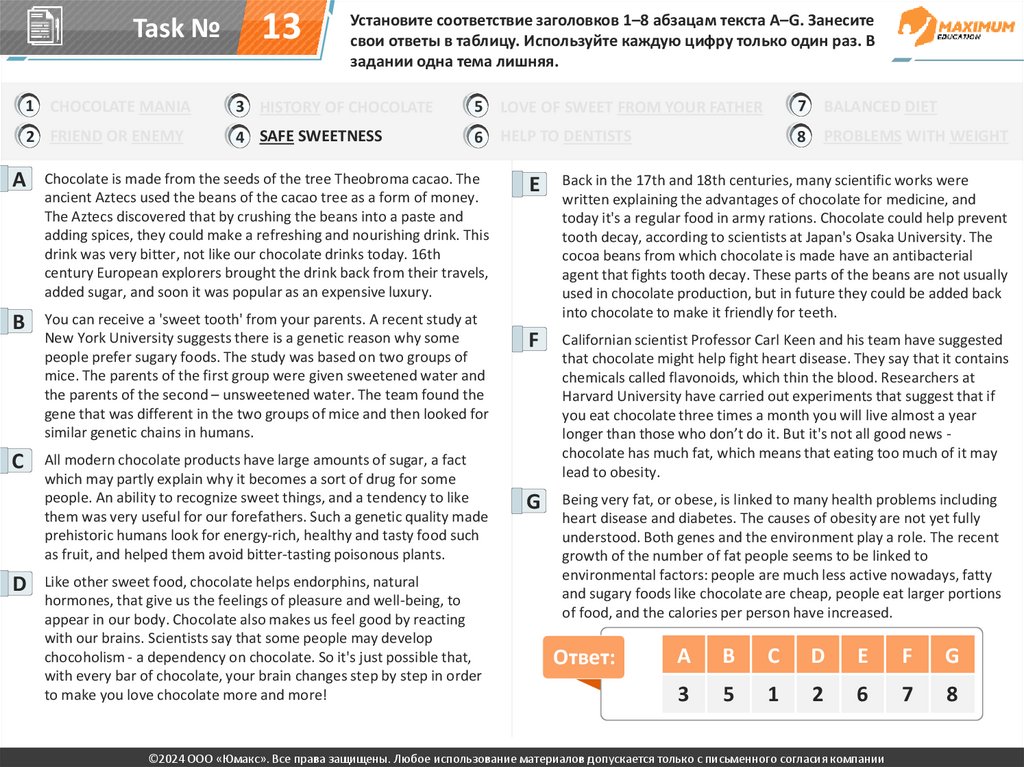
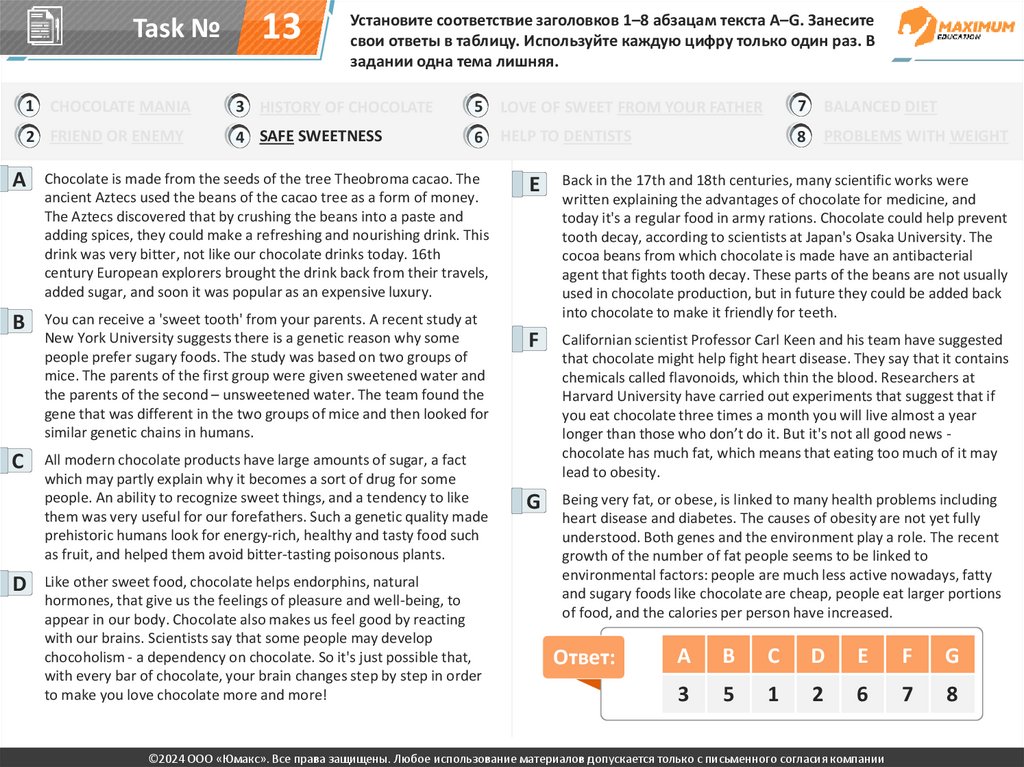
Match the headings 1–8 with the paragraphs A–G. Use each
letter only once. There is one extra heading that you don’t need.
1 CHOCOLATE MANIA
3 HISTORY OF CHOCOLATE
5
LOVE OF SWEET FROM YOUR FATHER
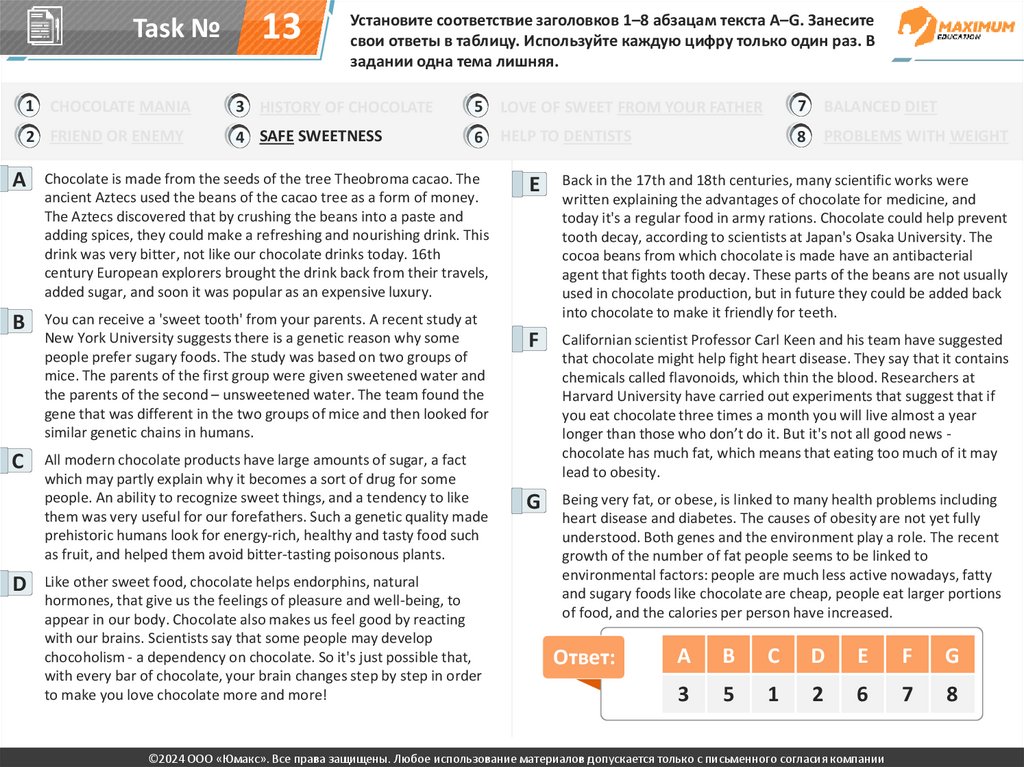
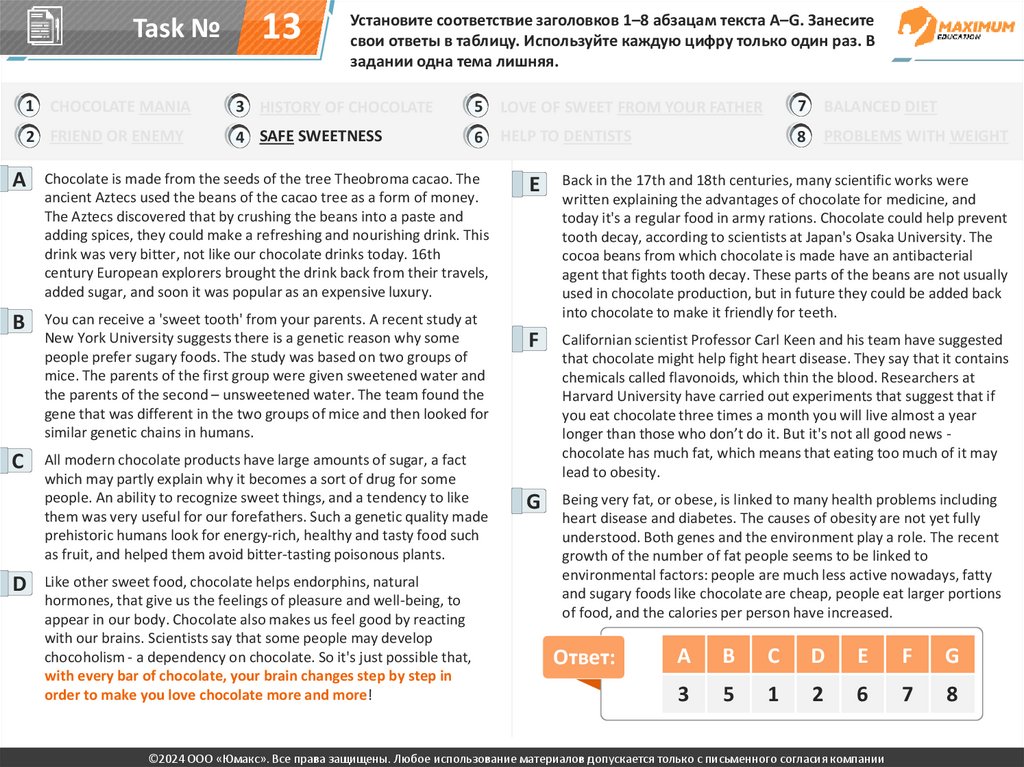
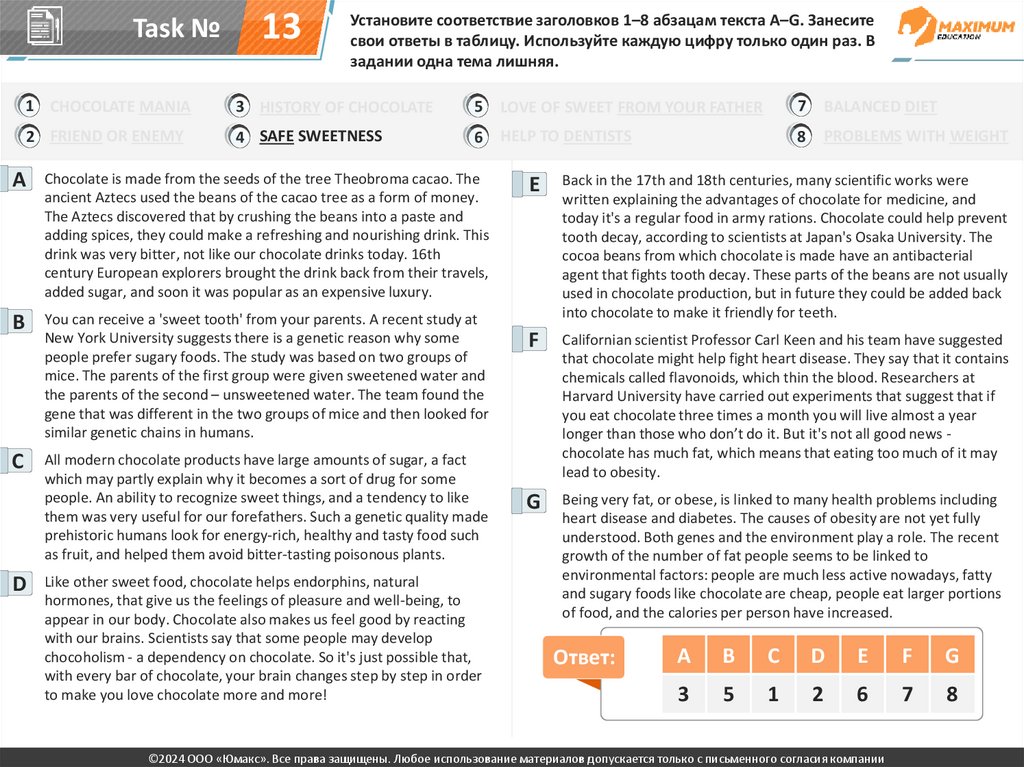
7
BALANCED DIET
2 FRIEND OR ENEMY
4 SAFE SWEETNESS
6
HELP TO DENTISTS
8
PROBLEMS WITH WEIGHT
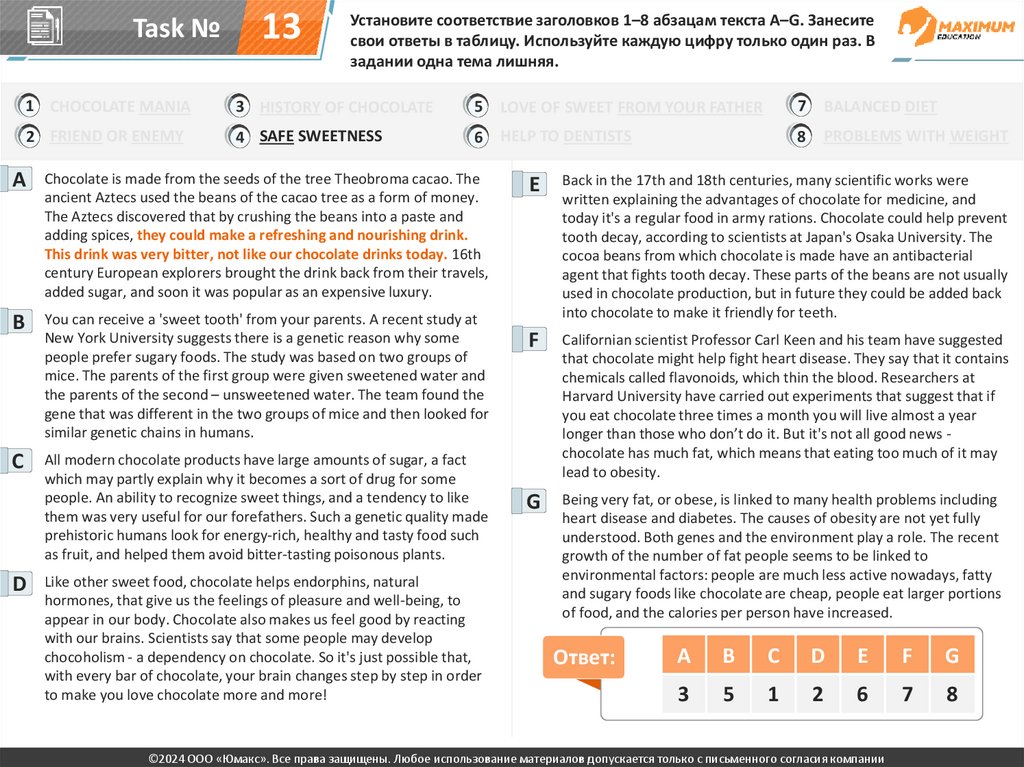
A
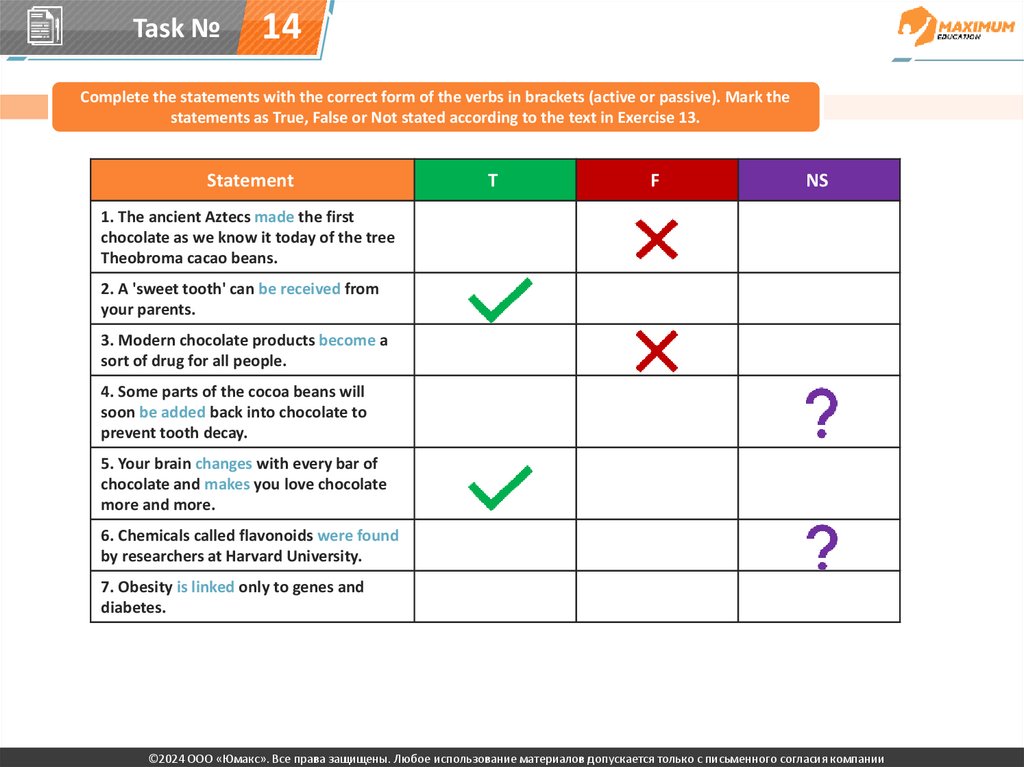
Chocolate is made from the seeds of the tree Theobroma cacao. The
ancient Aztecs used the beans of the cacao tree as a form of money.
The Aztecs discovered that by crushing the beans into a paste and
adding spices, they could make a refreshing and nourishing drink. This
drink was very bitter, not like our chocolate drinks today. 16th
century European explorers brought the drink back from their travels,
added sugar, and soon it was popular as an expensive luxury.
B
You can receive a 'sweet tooth' from your parents. A recent study at
New York University suggests there is a genetic reason why some
people prefer sugary foods. The study was based on two groups of
mice. The parents of the first group were given sweetened water and
the parents of the second – unsweetened water. The team found the
gene that was different in the two groups of mice and then looked for
similar genetic chains in humans.
C
All modern chocolate products have large amounts of sugar, a fact
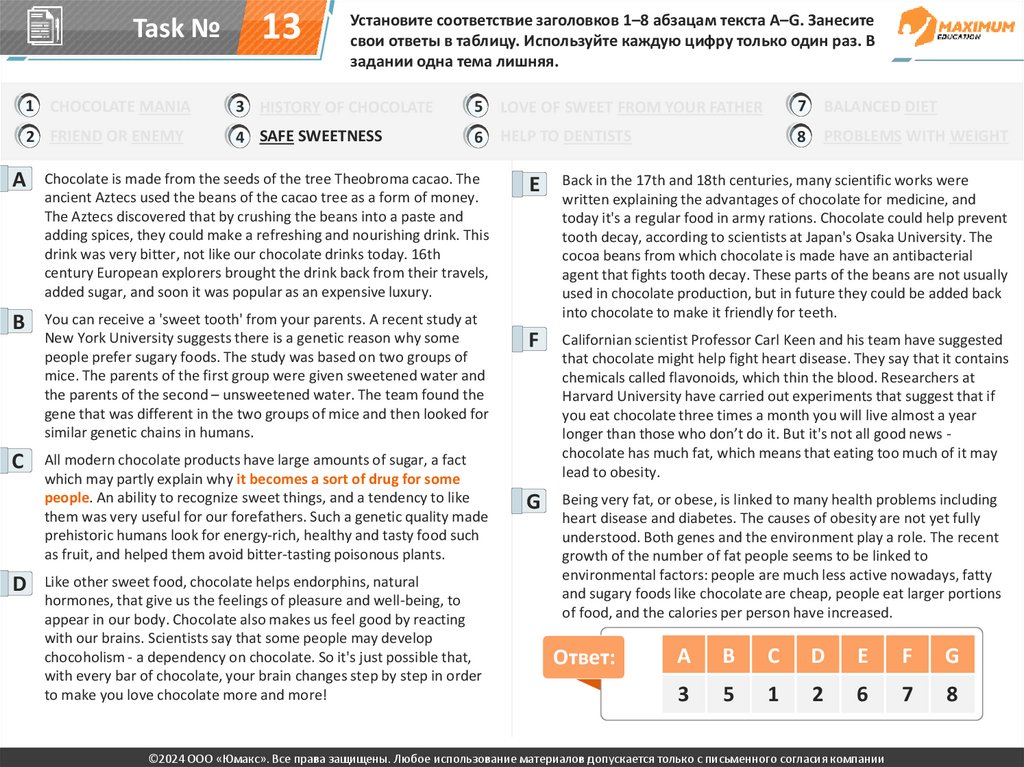
which may partly explain why it becomes a sort of drug for some
people. An ability to recognize sweet things, and a tendency to like
them was very useful for our forefathers. Such a genetic quality made
prehistoric humans look for energy-rich, healthy and tasty food such
as fruit, and helped them avoid bitter-tasting poisonous plants.
D
Like other sweet food, chocolate helps endorphins, natural
hormones, that give us the feelings of pleasure and well-being, to
appear in our body. Chocolate also makes us feel good by reacting
with our brains. Scientists say that some people may develop
chocoholism - a dependency on chocolate. So it's just possible that,
with every bar of chocolate, your brain changes step by step in order
to make you love chocolate more and more!
E
Back in the 17th and 18th centuries, many scientific works were
written explaining the advantages of chocolate for medicine, and
today it's a regular food in army rations. Chocolate could help prevent
tooth decay, according to scientists at Japan's Osaka University. The
cocoa beans from which chocolate is made have an antibacterial
agent that fights tooth decay. These parts of the beans are not usually
used in chocolate production, but in future they could be added back
into chocolate to make it friendly for teeth.
F
Californian scientist Professor Carl Keen and his team have suggested
that chocolate might help fight heart disease. They say that it contains
chemicals called flavonoids, which thin the blood. Researchers at
Harvard University have carried out experiments that suggest that if
you eat chocolate three times a month you will live almost a year
longer than those who don’t do it. But it's not all good news chocolate has much fat, which means that eating too much of it may
lead to obesity.
G
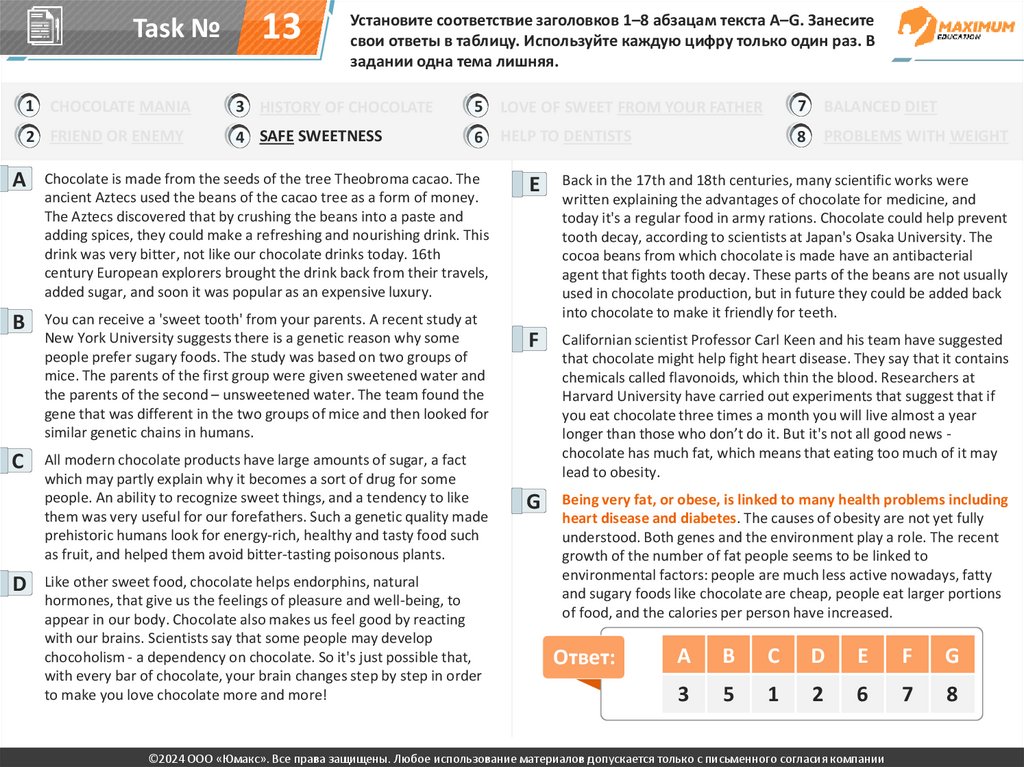
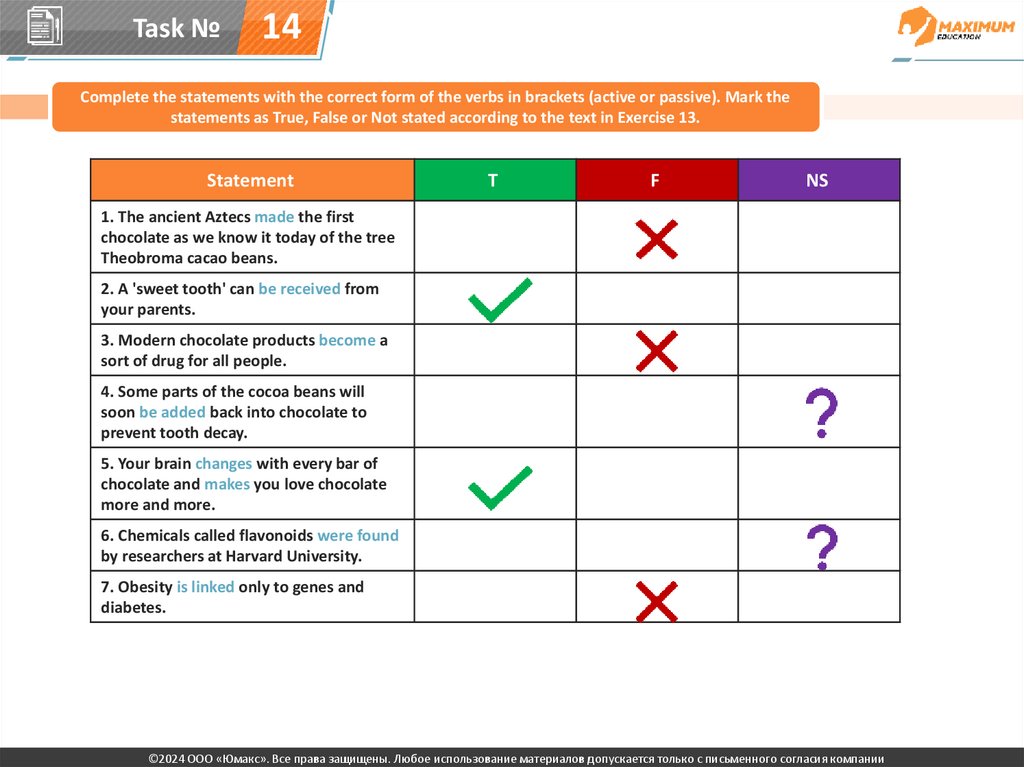
Being very fat, or obese, is linked to many health problems including
heart disease and diabetes. The causes of obesity are not yet fully
understood. Both genes and the environment play a role. The recent
growth of the number of fat people seems to be linked to
environmental factors: people are much less active nowadays, fatty
and sugary foods like chocolate are cheap, people eat larger portions
of food, and the calories per person have increased.
Ответ:
A
B
C
D
E
©2024 ООО «Юмакс». Все права защищены. Любое использование материалов допускается только с письменного согласия компании
F
G
56.
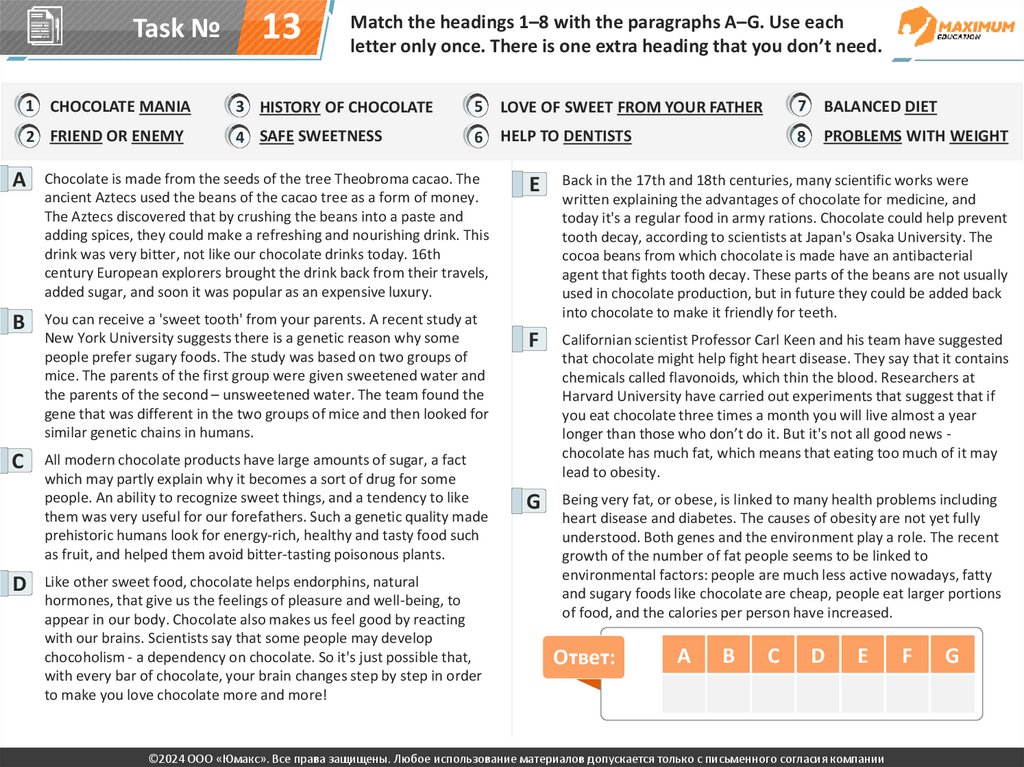
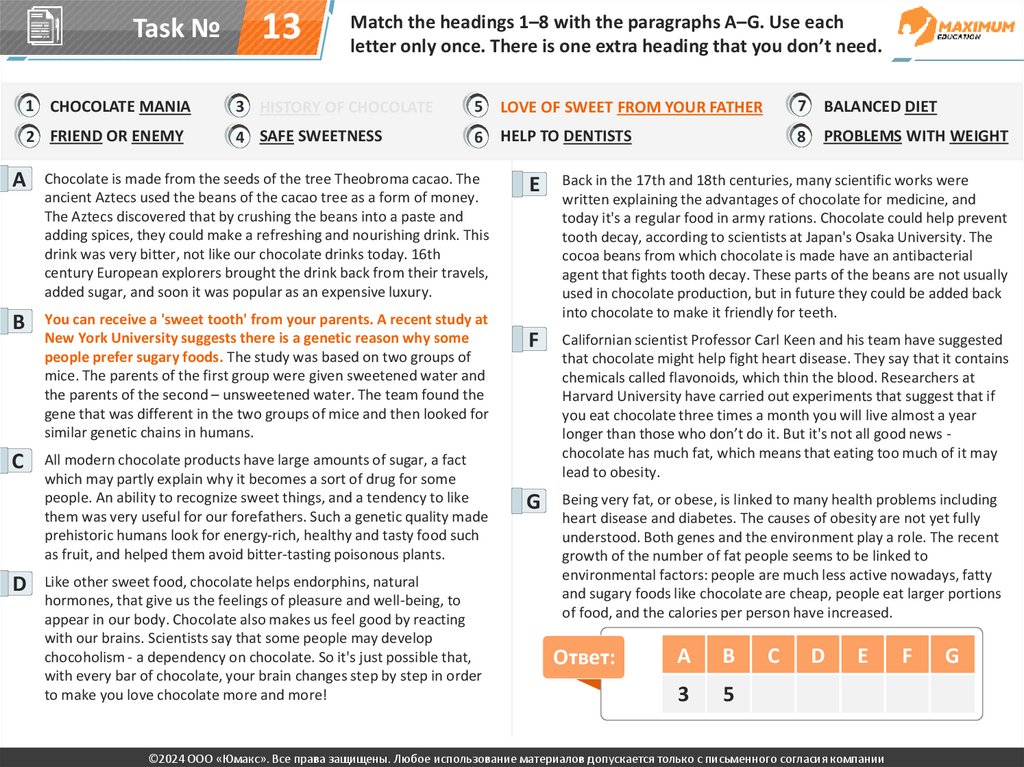
Task №13
Match the headings 1–8 with the paragraphs A–G. Use each
letter only once. There is one extra heading that you don’t need.
1 CHOCOLATE MANIA
3 HISTORY OF CHOCOLATE
5
LOVE OF SWEET FROM YOUR FATHER
7
BALANCED DIET
2 FRIEND OR ENEMY
4 SAFE SWEETNESS
6
HELP TO DENTISTS
8
PROBLEMS WITH WEIGHT
A
Chocolate is made from the seeds of the tree Theobroma cacao. The
ancient Aztecs used the beans of the cacao tree as a form of money.
The Aztecs discovered that by crushing the beans into a paste and
adding spices, they could make a refreshing and nourishing drink. This
drink was very bitter, not like our chocolate drinks today. 16th
century European explorers brought the drink back from their travels,
added sugar, and soon it was popular as an expensive luxury.
B
You can receive a 'sweet tooth' from your parents. A recent study at
New York University suggests there is a genetic reason why some
people prefer sugary foods. The study was based on two groups of
mice. The parents of the first group were given sweetened water and
the parents of the second – unsweetened water. The team found the
gene that was different in the two groups of mice and then looked for
similar genetic chains in humans.
C
All modern chocolate products have large amounts of sugar, a fact
which may partly explain why it becomes a sort of drug for some
people. An ability to recognize sweet things, and a tendency to like
them was very useful for our forefathers. Such a genetic quality made
prehistoric humans look for energy-rich, healthy and tasty food such
as fruit, and helped them avoid bitter-tasting poisonous plants.
D
Like other sweet food, chocolate helps endorphins, natural
hormones, that give us the feelings of pleasure and well-being, to
appear in our body. Chocolate also makes us feel good by reacting
with our brains. Scientists say that some people may develop
chocoholism - a dependency on chocolate. So it's just possible that,
with every bar of chocolate, your brain changes step by step in order
to make you love chocolate more and more!
E
Back in the 17th and 18th centuries, many scientific works were
written explaining the advantages of chocolate for medicine, and
today it's a regular food in army rations. Chocolate could help prevent
tooth decay, according to scientists at Japan's Osaka University. The
cocoa beans from which chocolate is made have an antibacterial
agent that fights tooth decay. These parts of the beans are not usually
used in chocolate production, but in future they could be added back
into chocolate to make it friendly for teeth.
F
Californian scientist Professor Carl Keen and his team have suggested
that chocolate might help fight heart disease. They say that it contains
chemicals called flavonoids, which thin the blood. Researchers at
Harvard University have carried out experiments that suggest that if
you eat chocolate three times a month you will live almost a year
longer than those who don’t do it. But it's not all good news chocolate has much fat, which means that eating too much of it may
lead to obesity.
G
Being very fat, or obese, is linked to many health problems including
heart disease and diabetes. The causes of obesity are not yet fully
understood. Both genes and the environment play a role. The recent
growth of the number of fat people seems to be linked to
environmental factors: people are much less active nowadays, fatty
and sugary foods like chocolate are cheap, people eat larger portions
of food, and the calories per person have increased.
Ответ:
A
B
C
D
E
©2024 ООО «Юмакс». Все права защищены. Любое использование материалов допускается только с письменного согласия компании
F
G
57.
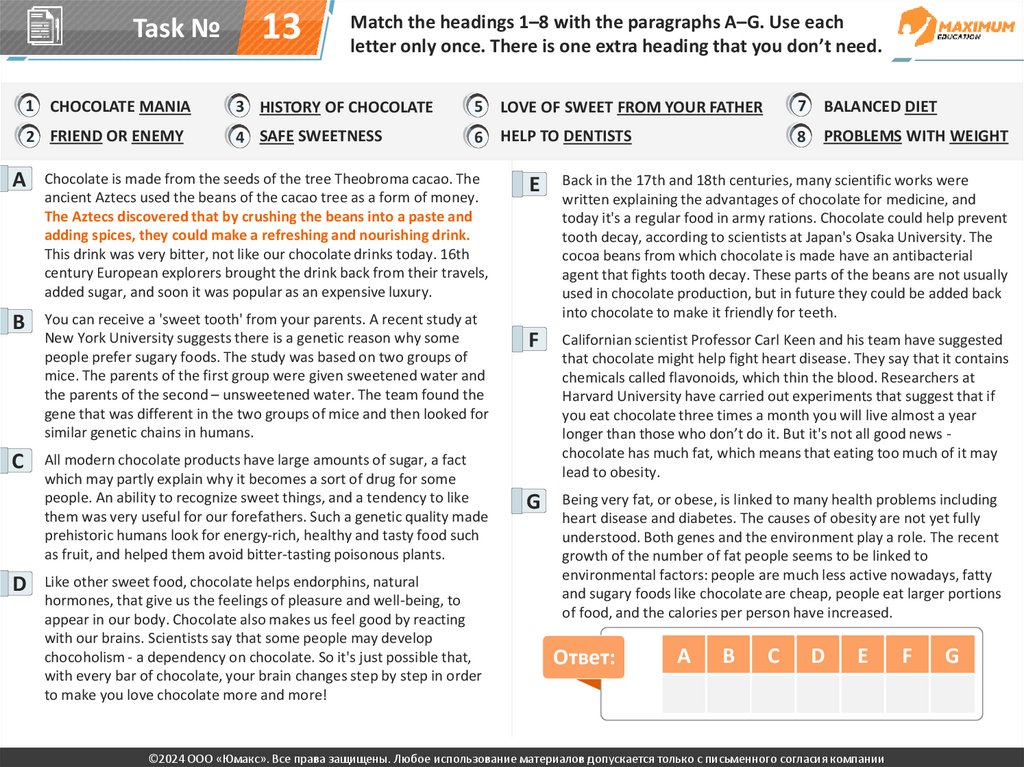
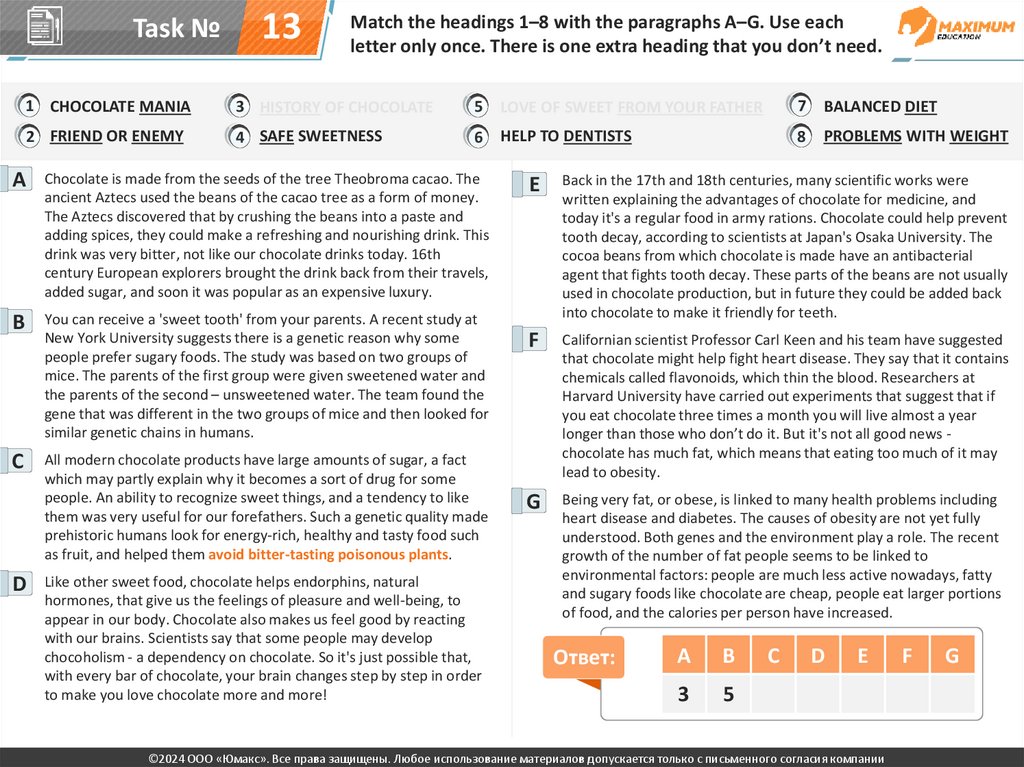
Task №13
Match the headings 1–8 with the paragraphs A–G. Use each
letter only once. There is one extra heading that you don’t need.
1 CHOCOLATE MANIA
3 HISTORY OF CHOCOLATE
5
LOVE OF SWEET FROM YOUR FATHER
7
BALANCED DIET
2 FRIEND OR ENEMY
4 SAFE SWEETNESS
6
HELP TO DENTISTS
8
PROBLEMS WITH WEIGHT
A
Chocolate is made from the seeds of the tree Theobroma cacao. The
ancient Aztecs used the beans of the cacao tree as a form of money.
The Aztecs discovered that by crushing the beans into a paste and
adding spices, they could make a refreshing and nourishing drink.
This drink was very bitter, not like our chocolate drinks today. 16th
century European explorers brought the drink back from their travels,
added sugar, and soon it was popular as an expensive luxury.
B
You can receive a 'sweet tooth' from your parents. A recent study at
New York University suggests there is a genetic reason why some
people prefer sugary foods. The study was based on two groups of
mice. The parents of the first group were given sweetened water and
the parents of the second – unsweetened water. The team found the
gene that was different in the two groups of mice and then looked for
similar genetic chains in humans.
C
All modern chocolate products have large amounts of sugar, a fact
which may partly explain why it becomes a sort of drug for some
people. An ability to recognize sweet things, and a tendency to like
them was very useful for our forefathers. Such a genetic quality made
prehistoric humans look for energy-rich, healthy and tasty food such
as fruit, and helped them avoid bitter-tasting poisonous plants.
D
Like other sweet food, chocolate helps endorphins, natural
hormones, that give us the feelings of pleasure and well-being, to
appear in our body. Chocolate also makes us feel good by reacting
with our brains. Scientists say that some people may develop
chocoholism - a dependency on chocolate. So it's just possible that,
with every bar of chocolate, your brain changes step by step in order
to make you love chocolate more and more!
E
Back in the 17th and 18th centuries, many scientific works were
written explaining the advantages of chocolate for medicine, and
today it's a regular food in army rations. Chocolate could help prevent
tooth decay, according to scientists at Japan's Osaka University. The
cocoa beans from which chocolate is made have an antibacterial
agent that fights tooth decay. These parts of the beans are not usually
used in chocolate production, but in future they could be added back
into chocolate to make it friendly for teeth.
F
Californian scientist Professor Carl Keen and his team have suggested
that chocolate might help fight heart disease. They say that it contains
chemicals called flavonoids, which thin the blood. Researchers at
Harvard University have carried out experiments that suggest that if
you eat chocolate three times a month you will live almost a year
longer than those who don’t do it. But it's not all good news chocolate has much fat, which means that eating too much of it may
lead to obesity.
G
Being very fat, or obese, is linked to many health problems including
heart disease and diabetes. The causes of obesity are not yet fully
understood. Both genes and the environment play a role. The recent
growth of the number of fat people seems to be linked to
environmental factors: people are much less active nowadays, fatty
and sugary foods like chocolate are cheap, people eat larger portions
of food, and the calories per person have increased.
Ответ:
A
B
C
D
E
©2024 ООО «Юмакс». Все права защищены. Любое использование материалов допускается только с письменного согласия компании
F
G
58.
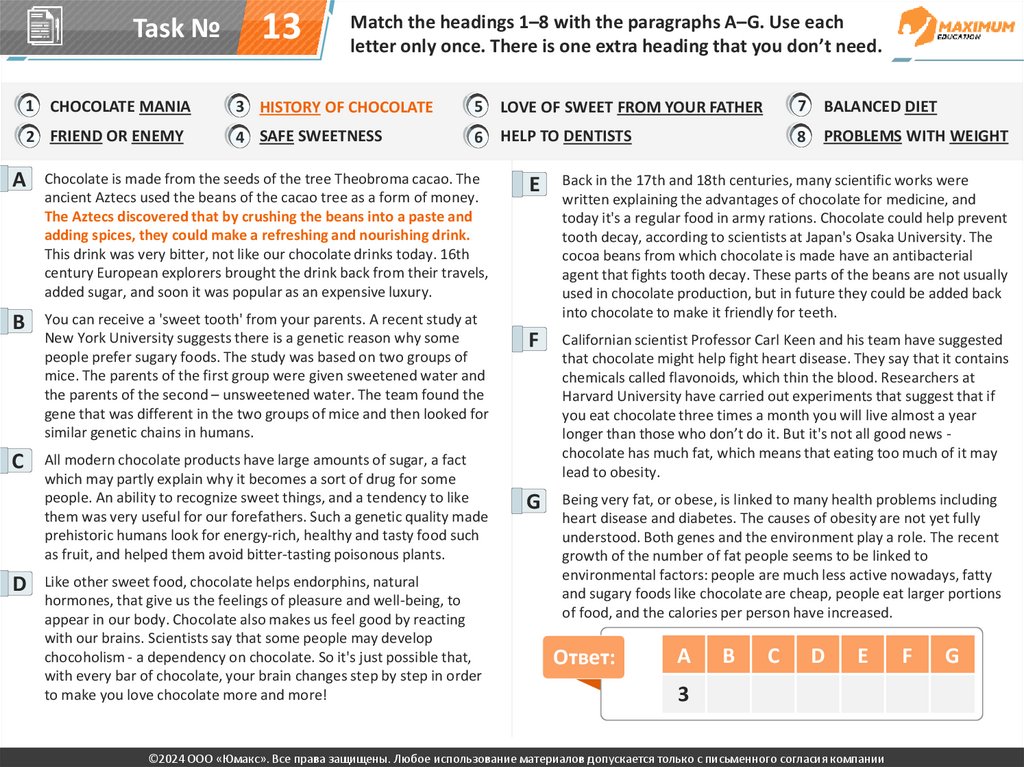
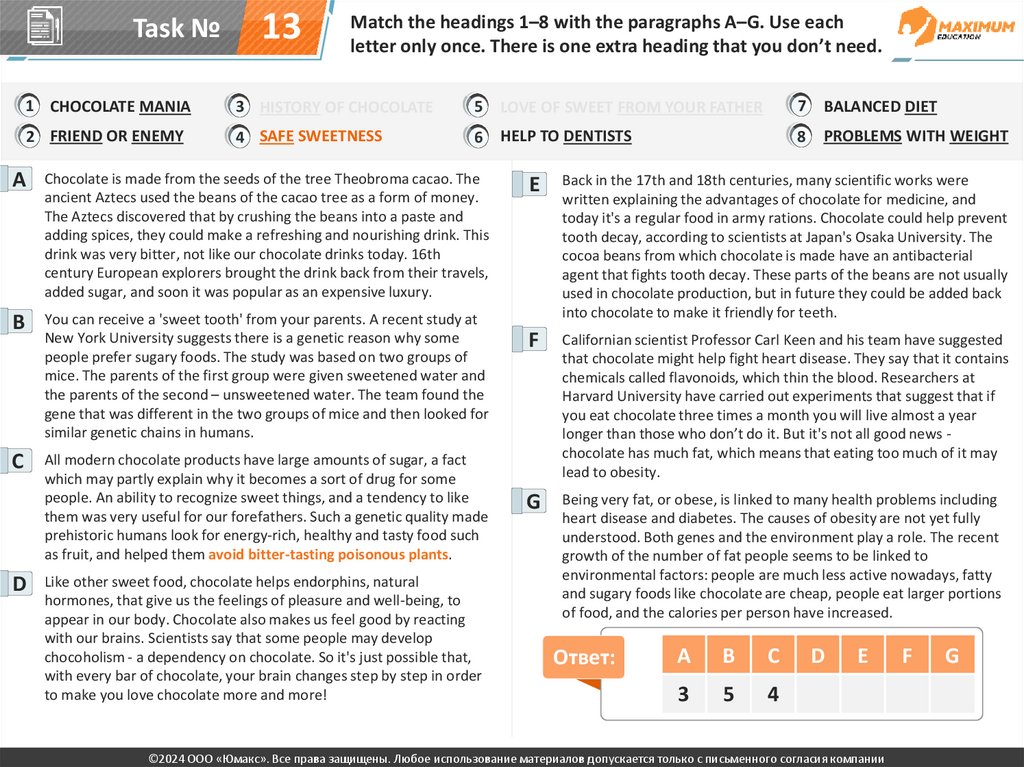
Task №13
Match the headings 1–8 with the paragraphs A–G. Use each
letter only once. There is one extra heading that you don’t need.
1 CHOCOLATE MANIA
3 HISTORY OF CHOCOLATE
5
LOVE OF SWEET FROM YOUR FATHER
7
BALANCED DIET
2 FRIEND OR ENEMY
4 SAFE SWEETNESS
6
HELP TO DENTISTS
8
PROBLEMS WITH WEIGHT
A
Chocolate is made from the seeds of the tree Theobroma cacao. The
ancient Aztecs used the beans of the cacao tree as a form of money.
The Aztecs discovered that by crushing the beans into a paste and
adding spices, they could make a refreshing and nourishing drink.
This drink was very bitter, not like our chocolate drinks today. 16th
century European explorers brought the drink back from their travels,
added sugar, and soon it was popular as an expensive luxury.
B
You can receive a 'sweet tooth' from your parents. A recent study at
New York University suggests there is a genetic reason why some
people prefer sugary foods. The study was based on two groups of
mice. The parents of the first group were given sweetened water and
the parents of the second – unsweetened water. The team found the
gene that was different in the two groups of mice and then looked for
similar genetic chains in humans.
C
All modern chocolate products have large amounts of sugar, a fact
which may partly explain why it becomes a sort of drug for some
people. An ability to recognize sweet things, and a tendency to like
them was very useful for our forefathers. Such a genetic quality made
prehistoric humans look for energy-rich, healthy and tasty food such
as fruit, and helped them avoid bitter-tasting poisonous plants.
D
Like other sweet food, chocolate helps endorphins, natural
hormones, that give us the feelings of pleasure and well-being, to
appear in our body. Chocolate also makes us feel good by reacting
with our brains. Scientists say that some people may develop
chocoholism - a dependency on chocolate. So it's just possible that,
with every bar of chocolate, your brain changes step by step in order
to make you love chocolate more and more!
E
Back in the 17th and 18th centuries, many scientific works were
written explaining the advantages of chocolate for medicine, and
today it's a regular food in army rations. Chocolate could help prevent
tooth decay, according to scientists at Japan's Osaka University. The
cocoa beans from which chocolate is made have an antibacterial
agent that fights tooth decay. These parts of the beans are not usually
used in chocolate production, but in future they could be added back
into chocolate to make it friendly for teeth.
F
Californian scientist Professor Carl Keen and his team have suggested
that chocolate might help fight heart disease. They say that it contains
chemicals called flavonoids, which thin the blood. Researchers at
Harvard University have carried out experiments that suggest that if
you eat chocolate three times a month you will live almost a year
longer than those who don’t do it. But it's not all good news chocolate has much fat, which means that eating too much of it may
lead to obesity.
G
Being very fat, or obese, is linked to many health problems including
heart disease and diabetes. The causes of obesity are not yet fully
understood. Both genes and the environment play a role. The recent
growth of the number of fat people seems to be linked to
environmental factors: people are much less active nowadays, fatty
and sugary foods like chocolate are cheap, people eat larger portions
of food, and the calories per person have increased.
Ответ:
A
B
C
D
E
3
©2024 ООО «Юмакс». Все права защищены. Любое использование материалов допускается только с письменного согласия компании
F
G
59.
Task №13
Match the headings 1–8 with the paragraphs A–G. Use each
letter only once. There is one extra heading that you don’t need.
1 CHOCOLATE MANIA
3 HISTORY OF CHOCOLATE
5
LOVE OF SWEET FROM YOUR FATHER
7
BALANCED DIET
2 FRIEND OR ENEMY
4 SAFE SWEETNESS
6
HELP TO DENTISTS
8
PROBLEMS WITH WEIGHT
A
Chocolate is made from the seeds of the tree Theobroma cacao. The
ancient Aztecs used the beans of the cacao tree as a form of money.
The Aztecs discovered that by crushing the beans into a paste and
adding spices, they could make a refreshing and nourishing drink. This
drink was very bitter, not like our chocolate drinks today. 16th
century European explorers brought the drink back from their travels,
added sugar, and soon it was popular as an expensive luxury.
B
You can receive a 'sweet tooth' from your parents. A recent study at
New York University suggests there is a genetic reason why some
people prefer sugary foods. The study was based on two groups of
mice. The parents of the first group were given sweetened water and
the parents of the second – unsweetened water. The team found the
gene that was different in the two groups of mice and then looked for
similar genetic chains in humans.
C
All modern chocolate products have large amounts of sugar, a fact
which may partly explain why it becomes a sort of drug for some
people. An ability to recognize sweet things, and a tendency to like
them was very useful for our forefathers. Such a genetic quality made
prehistoric humans look for energy-rich, healthy and tasty food such
as fruit, and helped them avoid bitter-tasting poisonous plants.
D
Like other sweet food, chocolate helps endorphins, natural
hormones, that give us the feelings of pleasure and well-being, to
appear in our body. Chocolate also makes us feel good by reacting
with our brains. Scientists say that some people may develop
chocoholism - a dependency on chocolate. So it's just possible that,
with every bar of chocolate, your brain changes step by step in order
to make you love chocolate more and more!
E
Back in the 17th and 18th centuries, many scientific works were
written explaining the advantages of chocolate for medicine, and
today it's a regular food in army rations. Chocolate could help prevent
tooth decay, according to scientists at Japan's Osaka University. The
cocoa beans from which chocolate is made have an antibacterial
agent that fights tooth decay. These parts of the beans are not usually
used in chocolate production, but in future they could be added back
into chocolate to make it friendly for teeth.
F
Californian scientist Professor Carl Keen and his team have suggested
that chocolate might help fight heart disease. They say that it contains
chemicals called flavonoids, which thin the blood. Researchers at
Harvard University have carried out experiments that suggest that if
you eat chocolate three times a month you will live almost a year
longer than those who don’t do it. But it's not all good news chocolate has much fat, which means that eating too much of it may
lead to obesity.
G
Being very fat, or obese, is linked to many health problems including
heart disease and diabetes. The causes of obesity are not yet fully
understood. Both genes and the environment play a role. The recent
growth of the number of fat people seems to be linked to
environmental factors: people are much less active nowadays, fatty
and sugary foods like chocolate are cheap, people eat larger portions
of food, and the calories per person have increased.
Ответ:
A
B
C
D
E
3
©2024 ООО «Юмакс». Все права защищены. Любое использование материалов допускается только с письменного согласия компании
F
G
60.
Task №13
Match the headings 1–8 with the paragraphs A–G. Use each
letter only once. There is one extra heading that you don’t need.
1 CHOCOLATE MANIA
3 HISTORY OF CHOCOLATE
5
LOVE OF SWEET FROM YOUR FATHER
7
BALANCED DIET
2 FRIEND OR ENEMY
4 SAFE SWEETNESS
6
HELP TO DENTISTS
8
PROBLEMS WITH WEIGHT
A
Chocolate is made from the seeds of the tree Theobroma cacao. The
ancient Aztecs used the beans of the cacao tree as a form of money.
The Aztecs discovered that by crushing the beans into a paste and
adding spices, they could make a refreshing and nourishing drink. This
drink was very bitter, not like our chocolate drinks today. 16th
century European explorers brought the drink back from their travels,
added sugar, and soon it was popular as an expensive luxury.
B
You can receive a 'sweet tooth' from your parents. A recent study at
New York University suggests there is a genetic reason why some
people prefer sugary foods. The study was based on two groups of
mice. The parents of the first group were given sweetened water and
the parents of the second – unsweetened water. The team found the
gene that was different in the two groups of mice and then looked for
similar genetic chains in humans.
C
All modern chocolate products have large amounts of sugar, a fact
which may partly explain why it becomes a sort of drug for some
people. An ability to recognize sweet things, and a tendency to like
them was very useful for our forefathers. Such a genetic quality made
prehistoric humans look for energy-rich, healthy and tasty food such
as fruit, and helped them avoid bitter-tasting poisonous plants.
D
Like other sweet food, chocolate helps endorphins, natural
hormones, that give us the feelings of pleasure and well-being, to
appear in our body. Chocolate also makes us feel good by reacting
with our brains. Scientists say that some people may develop
chocoholism - a dependency on chocolate. So it's just possible that,
with every bar of chocolate, your brain changes step by step in order
to make you love chocolate more and more!
E
Back in the 17th and 18th centuries, many scientific works were
written explaining the advantages of chocolate for medicine, and
today it's a regular food in army rations. Chocolate could help prevent
tooth decay, according to scientists at Japan's Osaka University. The
cocoa beans from which chocolate is made have an antibacterial
agent that fights tooth decay. These parts of the beans are not usually
used in chocolate production, but in future they could be added back
into chocolate to make it friendly for teeth.
F
Californian scientist Professor Carl Keen and his team have suggested
that chocolate might help fight heart disease. They say that it contains
chemicals called flavonoids, which thin the blood. Researchers at
Harvard University have carried out experiments that suggest that if
you eat chocolate three times a month you will live almost a year
longer than those who don’t do it. But it's not all good news chocolate has much fat, which means that eating too much of it may
lead to obesity.
G
Being very fat, or obese, is linked to many health problems including
heart disease and diabetes. The causes of obesity are not yet fully
understood. Both genes and the environment play a role. The recent
growth of the number of fat people seems to be linked to
environmental factors: people are much less active nowadays, fatty
and sugary foods like chocolate are cheap, people eat larger portions
of food, and the calories per person have increased.
Ответ:
A
B
3
5
C
D
E
©2024 ООО «Юмакс». Все права защищены. Любое использование материалов допускается только с письменного согласия компании
F
G
61.
Task №13
Match the headings 1–8 with the paragraphs A–G. Use each
letter only once. There is one extra heading that you don’t need.
1 CHOCOLATE MANIA
3 HISTORY OF CHOCOLATE
5
LOVE OF SWEET FROM YOUR FATHER
7
BALANCED DIET
2 FRIEND OR ENEMY
4 SAFE SWEETNESS
6
HELP TO DENTISTS
8
PROBLEMS WITH WEIGHT
A
Chocolate is made from the seeds of the tree Theobroma cacao. The
ancient Aztecs used the beans of the cacao tree as a form of money.
The Aztecs discovered that by crushing the beans into a paste and
adding spices, they could make a refreshing and nourishing drink. This
drink was very bitter, not like our chocolate drinks today. 16th
century European explorers brought the drink back from their travels,
added sugar, and soon it was popular as an expensive luxury.
B
You can receive a 'sweet tooth' from your parents. A recent study at
New York University suggests there is a genetic reason why some
people prefer sugary foods. The study was based on two groups of
mice. The parents of the first group were given sweetened water and
the parents of the second – unsweetened water. The team found the
gene that was different in the two groups of mice and then looked for
similar genetic chains in humans.
C
All modern chocolate products have large amounts of sugar, a fact
which may partly explain why it becomes a sort of drug for some
people. An ability to recognize sweet things, and a tendency to like
them was very useful for our forefathers. Such a genetic quality made
prehistoric humans look for energy-rich, healthy and tasty food such
as fruit, and helped them avoid bitter-tasting poisonous plants.
D
Like other sweet food, chocolate helps endorphins, natural
hormones, that give us the feelings of pleasure and well-being, to
appear in our body. Chocolate also makes us feel good by reacting
with our brains. Scientists say that some people may develop
chocoholism - a dependency on chocolate. So it's just possible that,
with every bar of chocolate, your brain changes step by step in order
to make you love chocolate more and more!
E
Back in the 17th and 18th centuries, many scientific works were
written explaining the advantages of chocolate for medicine, and
today it's a regular food in army rations. Chocolate could help prevent
tooth decay, according to scientists at Japan's Osaka University. The
cocoa beans from which chocolate is made have an antibacterial
agent that fights tooth decay. These parts of the beans are not usually
used in chocolate production, but in future they could be added back
into chocolate to make it friendly for teeth.
F
Californian scientist Professor Carl Keen and his team have suggested
that chocolate might help fight heart disease. They say that it contains
chemicals called flavonoids, which thin the blood. Researchers at
Harvard University have carried out experiments that suggest that if
you eat chocolate three times a month you will live almost a year
longer than those who don’t do it. But it's not all good news chocolate has much fat, which means that eating too much of it may
lead to obesity.
G
Being very fat, or obese, is linked to many health problems including
heart disease and diabetes. The causes of obesity are not yet fully
understood. Both genes and the environment play a role. The recent
growth of the number of fat people seems to be linked to
environmental factors: people are much less active nowadays, fatty
and sugary foods like chocolate are cheap, people eat larger portions
of food, and the calories per person have increased.
Ответ:
A
B
3
5
C
D
E
©2024 ООО «Юмакс». Все права защищены. Любое использование материалов допускается только с письменного согласия компании
F
G
62.
Task №13
Match the headings 1–8 with the paragraphs A–G. Use each
letter only once. There is one extra heading that you don’t need.
1 CHOCOLATE MANIA
3 HISTORY OF CHOCOLATE
5
LOVE OF SWEET FROM YOUR FATHER
7
BALANCED DIET
2 FRIEND OR ENEMY
4 SAFE SWEETNESS
6
HELP TO DENTISTS
8
PROBLEMS WITH WEIGHT
A
Chocolate is made from the seeds of the tree Theobroma cacao. The
ancient Aztecs used the beans of the cacao tree as a form of money.
The Aztecs discovered that by crushing the beans into a paste and
adding spices, they could make a refreshing and nourishing drink. This
drink was very bitter, not like our chocolate drinks today. 16th
century European explorers brought the drink back from their travels,
added sugar, and soon it was popular as an expensive luxury.
B
You can receive a 'sweet tooth' from your parents. A recent study at
New York University suggests there is a genetic reason why some
people prefer sugary foods. The study was based on two groups of
mice. The parents of the first group were given sweetened water and
the parents of the second – unsweetened water. The team found the
gene that was different in the two groups of mice and then looked for
similar genetic chains in humans.
C
All modern chocolate products have large amounts of sugar, a fact
which may partly explain why it becomes a sort of drug for some
people. An ability to recognize sweet things, and a tendency to like
them was very useful for our forefathers. Such a genetic quality made
prehistoric humans look for energy-rich, healthy and tasty food such
as fruit, and helped them avoid bitter-tasting poisonous plants.
D
Like other sweet food, chocolate helps endorphins, natural
hormones, that give us the feelings of pleasure and well-being, to
appear in our body. Chocolate also makes us feel good by reacting
with our brains. Scientists say that some people may develop
chocoholism - a dependency on chocolate. So it's just possible that,
with every bar of chocolate, your brain changes step by step in order
to make you love chocolate more and more!
E
Back in the 17th and 18th centuries, many scientific works were
written explaining the advantages of chocolate for medicine, and
today it's a regular food in army rations. Chocolate could help prevent
tooth decay, according to scientists at Japan's Osaka University. The
cocoa beans from which chocolate is made have an antibacterial
agent that fights tooth decay. These parts of the beans are not usually
used in chocolate production, but in future they could be added back
into chocolate to make it friendly for teeth.
F
Californian scientist Professor Carl Keen and his team have suggested
that chocolate might help fight heart disease. They say that it contains
chemicals called flavonoids, which thin the blood. Researchers at
Harvard University have carried out experiments that suggest that if
you eat chocolate three times a month you will live almost a year
longer than those who don’t do it. But it's not all good news chocolate has much fat, which means that eating too much of it may
lead to obesity.
G
Being very fat, or obese, is linked to many health problems including
heart disease and diabetes. The causes of obesity are not yet fully
understood. Both genes and the environment play a role. The recent
growth of the number of fat people seems to be linked to
environmental factors: people are much less active nowadays, fatty
and sugary foods like chocolate are cheap, people eat larger portions
of food, and the calories per person have increased.
Ответ:
A
B
C
3
5
4
D
E
©2024 ООО «Юмакс». Все права защищены. Любое использование материалов допускается только с письменного согласия компании
F
G
63.
Task №13
Match the headings 1–8 with the paragraphs A–G. Use each
letter only once. There is one extra heading that you don’t need.
1 CHOCOLATE MANIA
3 HISTORY OF CHOCOLATE
5
LOVE OF SWEET FROM YOUR FATHER
7
BALANCED DIET
2 FRIEND OR ENEMY
4 SAFE SWEETNESS
6
HELP TO DENTISTS
8
PROBLEMS WITH WEIGHT
A
Chocolate is made from the seeds of the tree Theobroma cacao. The
ancient Aztecs used the beans of the cacao tree as a form of money.
The Aztecs discovered that by crushing the beans into a paste and
adding spices, they could make a refreshing and nourishing drink. This
drink was very bitter, not like our chocolate drinks today. 16th
century European explorers brought the drink back from their travels,
added sugar, and soon it was popular as an expensive luxury.
B
You can receive a 'sweet tooth' from your parents. A recent study at
New York University suggests there is a genetic reason why some
people prefer sugary foods. The study was based on two groups of
mice. The parents of the first group were given sweetened water and
the parents of the second – unsweetened water. The team found the
gene that was different in the two groups of mice and then looked for
similar genetic chains in humans.
C
All modern chocolate products have large amounts of sugar, a fact
which may partly explain why it becomes a sort of drug for some
people. An ability to recognize sweet things, and a tendency to like
them was very useful for our forefathers. Such a genetic quality made
prehistoric humans look for energy-rich, healthy and tasty food such
as fruit, and helped them avoid bitter-tasting poisonous plants.
D
Like other sweet food, chocolate helps endorphins, natural
hormones, that give us the feelings of pleasure and well-being, to
appear in our body. Chocolate also makes us feel good by reacting
with our brains. Scientists say that some people may develop
chocoholism - a dependency on chocolate. So it's just possible that,
with every bar of chocolate, your brain changes step by step in order
to make you love chocolate more and more!
E
Back in the 17th and 18th centuries, many scientific works were
written explaining the advantages of chocolate for medicine, and
today it's a regular food in army rations. Chocolate could help prevent
tooth decay, according to scientists at Japan's Osaka University. The
cocoa beans from which chocolate is made have an antibacterial
agent that fights tooth decay. These parts of the beans are not usually
used in chocolate production, but in future they could be added back
into chocolate to make it friendly for teeth.
F
Californian scientist Professor Carl Keen and his team have suggested
that chocolate might help fight heart disease. They say that it contains
chemicals called flavonoids, which thin the blood. Researchers at
Harvard University have carried out experiments that suggest that if
you eat chocolate three times a month you will live almost a year
longer than those who don’t do it. But it's not all good news chocolate has much fat, which means that eating too much of it may
lead to obesity.
G
Being very fat, or obese, is linked to many health problems including
heart disease and diabetes. The causes of obesity are not yet fully
understood. Both genes and the environment play a role. The recent
growth of the number of fat people seems to be linked to
environmental factors: people are much less active nowadays, fatty
and sugary foods like chocolate are cheap, people eat larger portions
of food, and the calories per person have increased.
Ответ:
A
B
C
3
5
4
D
E
©2024 ООО «Юмакс». Все права защищены. Любое использование материалов допускается только с письменного согласия компании
F
G
64.
Task №13
Match the headings 1–8 with the paragraphs A–G. Use each
letter only once. There is one extra heading that you don’t need.
1 CHOCOLATE MANIA
3 HISTORY OF CHOCOLATE
5
LOVE OF SWEET FROM YOUR FATHER
7
BALANCED DIET
2 FRIEND OR ENEMY
4 SAFE SWEETNESS
6
HELP TO DENTISTS
8
PROBLEMS WITH WEIGHT
A
Chocolate is made from the seeds of the tree Theobroma cacao. The
ancient Aztecs used the beans of the cacao tree as a form of money.
The Aztecs discovered that by crushing the beans into a paste and
adding spices, they could make a refreshing and nourishing drink. This
drink was very bitter, not like our chocolate drinks today. 16th
century European explorers brought the drink back from their travels,
added sugar, and soon it was popular as an expensive luxury.
B
You can receive a 'sweet tooth' from your parents. A recent study at
New York University suggests there is a genetic reason why some
people prefer sugary foods. The study was based on two groups of
mice. The parents of the first group were given sweetened water and
the parents of the second – unsweetened water. The team found the
gene that was different in the two groups of mice and then looked for
similar genetic chains in humans.
C
All modern chocolate products have large amounts of sugar, a fact
which may partly explain why it becomes a sort of drug for some
people. An ability to recognize sweet things, and a tendency to like
them was very useful for our forefathers. Such a genetic quality made
prehistoric humans look for energy-rich, healthy and tasty food such
as fruit, and helped them avoid bitter-tasting poisonous plants.
D
Like other sweet food, chocolate helps endorphins, natural
hormones, that give us the feelings of pleasure and well-being, to
appear in our body. Chocolate also makes us feel good by reacting
with our brains. Scientists say that some people may develop
chocoholism - a dependency on chocolate. So it's just possible that,
with every bar of chocolate, your brain changes step by step in order
to make you love chocolate more and more!
E
Back in the 17th and 18th centuries, many scientific works were
written explaining the advantages of chocolate for medicine, and
today it's a regular food in army rations. Chocolate could help prevent
tooth decay, according to scientists at Japan's Osaka University. The
cocoa beans from which chocolate is made have an antibacterial
agent that fights tooth decay. These parts of the beans are not usually
used in chocolate production, but in future they could be added back
into chocolate to make it friendly for teeth.
F
Californian scientist Professor Carl Keen and his team have suggested
that chocolate might help fight heart disease. They say that it contains
chemicals called flavonoids, which thin the blood. Researchers at
Harvard University have carried out experiments that suggest that if
you eat chocolate three times a month you will live almost a year
longer than those who don’t do it. But it's not all good news chocolate has much fat, which means that eating too much of it may
lead to obesity.
G
Being very fat, or obese, is linked to many health problems including
heart disease and diabetes. The causes of obesity are not yet fully
understood. Both genes and the environment play a role. The recent
growth of the number of fat people seems to be linked to
environmental factors: people are much less active nowadays, fatty
and sugary foods like chocolate are cheap, people eat larger portions
of food, and the calories per person have increased.
Ответ:
A
B
C
D
3
5
4
1
E
©2024 ООО «Юмакс». Все права защищены. Любое использование материалов допускается только с письменного согласия компании
F
G
65.
Task №13
Match the headings 1–8 with the paragraphs A–G. Use each
letter only once. There is one extra heading that you don’t need.
1 CHOCOLATE MANIA
3 HISTORY OF CHOCOLATE
5
LOVE OF SWEET FROM YOUR FATHER
7
BALANCED DIET
2 FRIEND OR ENEMY
4 SAFE SWEETNESS
6
HELP TO DENTISTS
8
PROBLEMS WITH WEIGHT
A
Chocolate is made from the seeds of the tree Theobroma cacao. The
ancient Aztecs used the beans of the cacao tree as a form of money.
The Aztecs discovered that by crushing the beans into a paste and
adding spices, they could make a refreshing and nourishing drink. This
drink was very bitter, not like our chocolate drinks today. 16th
century European explorers brought the drink back from their travels,
added sugar, and soon it was popular as an expensive luxury.
B
You can receive a 'sweet tooth' from your parents. A recent study at
New York University suggests there is a genetic reason why some
people prefer sugary foods. The study was based on two groups of
mice. The parents of the first group were given sweetened water and
the parents of the second – unsweetened water. The team found the
gene that was different in the two groups of mice and then looked for
similar genetic chains in humans.
C
All modern chocolate products have large amounts of sugar, a fact
which may partly explain why it becomes a sort of drug for some
people. An ability to recognize sweet things, and a tendency to like
them was very useful for our forefathers. Such a genetic quality made
prehistoric humans look for energy-rich, healthy and tasty food such
as fruit, and helped them avoid bitter-tasting poisonous plants.
D
Like other sweet food, chocolate helps endorphins, natural
hormones, that give us the feelings of pleasure and well-being, to
appear in our body. Chocolate also makes us feel good by reacting
with our brains. Scientists say that some people may develop
chocoholism - a dependency on chocolate. So it's just possible that,
with every bar of chocolate, your brain changes step by step in order
to make you love chocolate more and more!
E
Back in the 17th and 18th centuries, many scientific works were
written explaining the advantages of chocolate for medicine, and
today it's a regular food in army rations. Chocolate could help
prevent tooth decay, according to scientists at Japan's Osaka
University. The cocoa beans from which chocolate is made have an
antibacterial agent that fights tooth decay. These parts of the beans
are not usually used in chocolate production, but in future they could
be added back into chocolate to make it friendly for teeth.
F
Californian scientist Professor Carl Keen and his team have suggested
that chocolate might help fight heart disease. They say that it contains
chemicals called flavonoids, which thin the blood. Researchers at
Harvard University have carried out experiments that suggest that if
you eat chocolate three times a month you will live almost a year
longer than those who don’t do it. But it's not all good news chocolate has much fat, which means that eating too much of it may
lead to obesity.
G
Being very fat, or obese, is linked to many health problems including
heart disease and diabetes. The causes of obesity are not yet fully
understood. Both genes and the environment play a role. The recent
growth of the number of fat people seems to be linked to
environmental factors: people are much less active nowadays, fatty
and sugary foods like chocolate are cheap, people eat larger portions
of food, and the calories per person have increased.
Ответ:
A
B
C
D
3
5
4
1
E
©2024 ООО «Юмакс». Все права защищены. Любое использование материалов допускается только с письменного согласия компании
F
G
66.
Task №13
Match the headings 1–8 with the paragraphs A–G. Use each
letter only once. There is one extra heading that you don’t need.
1 CHOCOLATE MANIA
3 HISTORY OF CHOCOLATE
5
LOVE OF SWEET FROM YOUR FATHER
7
BALANCED DIET
2 FRIEND OR ENEMY
4 SAFE SWEETNESS
6
HELP TO DENTISTS
8
PROBLEMS WITH WEIGHT
A
Chocolate is made from the seeds of the tree Theobroma cacao. The
ancient Aztecs used the beans of the cacao tree as a form of money.
The Aztecs discovered that by crushing the beans into a paste and
adding spices, they could make a refreshing and nourishing drink. This
drink was very bitter, not like our chocolate drinks today. 16th
century European explorers brought the drink back from their travels,
added sugar, and soon it was popular as an expensive luxury.
B
You can receive a 'sweet tooth' from your parents. A recent study at
New York University suggests there is a genetic reason why some
people prefer sugary foods. The study was based on two groups of
mice. The parents of the first group were given sweetened water and
the parents of the second – unsweetened water. The team found the
gene that was different in the two groups of mice and then looked for
similar genetic chains in humans.
C
All modern chocolate products have large amounts of sugar, a fact
which may partly explain why it becomes a sort of drug for some
people. An ability to recognize sweet things, and a tendency to like
them was very useful for our forefathers. Such a genetic quality made
prehistoric humans look for energy-rich, healthy and tasty food such
as fruit, and helped them avoid bitter-tasting poisonous plants.
D
Like other sweet food, chocolate helps endorphins, natural
hormones, that give us the feelings of pleasure and well-being, to
appear in our body. Chocolate also makes us feel good by reacting
with our brains. Scientists say that some people may develop
chocoholism - a dependency on chocolate. So it's just possible that,
with every bar of chocolate, your brain changes step by step in order
to make you love chocolate more and more!
E
Back in the 17th and 18th centuries, many scientific works were
written explaining the advantages of chocolate for medicine, and
today it's a regular food in army rations. Chocolate could help
prevent tooth decay, according to scientists at Japan's Osaka
University. The cocoa beans from which chocolate is made have an
antibacterial agent that fights tooth decay. These parts of the beans
are not usually used in chocolate production, but in future they could
be added back into chocolate to make it friendly for teeth.
F
Californian scientist Professor Carl Keen and his team have suggested
that chocolate might help fight heart disease. They say that it contains
chemicals called flavonoids, which thin the blood. Researchers at
Harvard University have carried out experiments that suggest that if
you eat chocolate three times a month you will live almost a year
longer than those who don’t do it. But it's not all good news chocolate has much fat, which means that eating too much of it may
lead to obesity.
G
Being very fat, or obese, is linked to many health problems including
heart disease and diabetes. The causes of obesity are not yet fully
understood. Both genes and the environment play a role. The recent
growth of the number of fat people seems to be linked to
environmental factors: people are much less active nowadays, fatty
and sugary foods like chocolate are cheap, people eat larger portions
of food, and the calories per person have increased.
Ответ:
A
B
C
D
E
3
5
4
1
6
©2024 ООО «Юмакс». Все права защищены. Любое использование материалов допускается только с письменного согласия компании
F
G
67.
Task №13
Match the headings 1–8 with the paragraphs A–G. Use each
letter only once. There is one extra heading that you don’t need.
1 CHOCOLATE MANIA
3 HISTORY OF CHOCOLATE
5
LOVE OF SWEET FROM YOUR FATHER
7
BALANCED DIET
2 FRIEND OR ENEMY
4 SAFE SWEETNESS
6
HELP TO DENTISTS
8
PROBLEMS WITH WEIGHT
A
Chocolate is made from the seeds of the tree Theobroma cacao. The
ancient Aztecs used the beans of the cacao tree as a form of money.
The Aztecs discovered that by crushing the beans into a paste and
adding spices, they could make a refreshing and nourishing drink. This
drink was very bitter, not like our chocolate drinks today. 16th
century European explorers brought the drink back from their travels,
added sugar, and soon it was popular as an expensive luxury.
B
You can receive a 'sweet tooth' from your parents. A recent study at
New York University suggests there is a genetic reason why some
people prefer sugary foods. The study was based on two groups of
mice. The parents of the first group were given sweetened water and
the parents of the second – unsweetened water. The team found the
gene that was different in the two groups of mice and then looked for
similar genetic chains in humans.
C
All modern chocolate products have large amounts of sugar, a fact
which may partly explain why it becomes a sort of drug for some
people. An ability to recognize sweet things, and a tendency to like
them was very useful for our forefathers. Such a genetic quality made
prehistoric humans look for energy-rich, healthy and tasty food such
as fruit, and helped them avoid bitter-tasting poisonous plants.
D
Like other sweet food, chocolate helps endorphins, natural
hormones, that give us the feelings of pleasure and well-being, to
appear in our body. Chocolate also makes us feel good by reacting
with our brains. Scientists say that some people may develop
chocoholism - a dependency on chocolate. So it's just possible that,
with every bar of chocolate, your brain changes step by step in order
to make you love chocolate more and more!
E
Back in the 17th and 18th centuries, many scientific works were
written explaining the advantages of chocolate for medicine, and
today it's a regular food in army rations. Chocolate could help prevent
tooth decay, according to scientists at Japan's Osaka University. The
cocoa beans from which chocolate is made have an antibacterial
agent that fights tooth decay. These parts of the beans are not usually
used in chocolate production, but in future they could be added back
into chocolate to make it friendly for teeth.
F
Californian scientist Professor Carl Keen and his team have suggested
that chocolate might help fight heart disease. They say that it contains
chemicals called flavonoids, which thin the blood. Researchers at
Harvard University have carried out experiments that suggest that if
you eat chocolate three times a month you will live almost a year
longer than those who don’t do it. But it's not all good news chocolate has much fat, which means that eating too much of it may
lead to obesity.
G
Being very fat, or obese, is linked to many health problems including
heart disease and diabetes. The causes of obesity are not yet fully
understood. Both genes and the environment play a role. The recent
growth of the number of fat people seems to be linked to
environmental factors: people are much less active nowadays, fatty
and sugary foods like chocolate are cheap, people eat larger portions
of food, and the calories per person have increased.
Ответ:
A
B
C
D
E
3
5
4
1
6
©2024 ООО «Юмакс». Все права защищены. Любое использование материалов допускается только с письменного согласия компании
F
G
68.
Task №13
Match the headings 1–8 with the paragraphs A–G. Use each
letter only once. There is one extra heading that you don’t need.
1 CHOCOLATE MANIA
3 HISTORY OF CHOCOLATE
5
LOVE OF SWEET FROM YOUR FATHER
7
BALANCED DIET
2 FRIEND OR ENEMY
4 SAFE SWEETNESS
6
HELP TO DENTISTS
8
PROBLEMS WITH WEIGHT
A
Chocolate is made from the seeds of the tree Theobroma cacao. The
ancient Aztecs used the beans of the cacao tree as a form of money.
The Aztecs discovered that by crushing the beans into a paste and
adding spices, they could make a refreshing and nourishing drink. This
drink was very bitter, not like our chocolate drinks today. 16th
century European explorers brought the drink back from their travels,
added sugar, and soon it was popular as an expensive luxury.
B
You can receive a 'sweet tooth' from your parents. A recent study at
New York University suggests there is a genetic reason why some
people prefer sugary foods. The study was based on two groups of
mice. The parents of the first group were given sweetened water and
the parents of the second – unsweetened water. The team found the
gene that was different in the two groups of mice and then looked for
similar genetic chains in humans.
C
All modern chocolate products have large amounts of sugar, a fact
which may partly explain why it becomes a sort of drug for some
people. An ability to recognize sweet things, and a tendency to like
them was very useful for our forefathers. Such a genetic quality made
prehistoric humans look for energy-rich, healthy and tasty food such
as fruit, and helped them avoid bitter-tasting poisonous plants.
D
Like other sweet food, chocolate helps endorphins, natural
hormones, that give us the feelings of pleasure and well-being, to
appear in our body. Chocolate also makes us feel good by reacting
with our brains. Scientists say that some people may develop
chocoholism - a dependency on chocolate. So it's just possible that,
with every bar of chocolate, your brain changes step by step in order
to make you love chocolate more and more!
E
Back in the 17th and 18th centuries, many scientific works were
written explaining the advantages of chocolate for medicine, and
today it's a regular food in army rations. Chocolate could help prevent
tooth decay, according to scientists at Japan's Osaka University. The
cocoa beans from which chocolate is made have an antibacterial
agent that fights tooth decay. These parts of the beans are not usually
used in chocolate production, but in future they could be added back
into chocolate to make it friendly for teeth.
F
Californian scientist Professor Carl Keen and his team have suggested
that chocolate might help fight heart disease. They say that it contains
chemicals called flavonoids, which thin the blood. Researchers at
Harvard University have carried out experiments that suggest that if
you eat chocolate three times a month you will live almost a year
longer than those who don’t do it. But it's not all good news chocolate has much fat, which means that eating too much of it may
lead to obesity.
G
Being very fat, or obese, is linked to many health problems including
heart disease and diabetes. The causes of obesity are not yet fully
understood. Both genes and the environment play a role. The recent
growth of the number of fat people seems to be linked to
environmental factors: people are much less active nowadays, fatty
and sugary foods like chocolate are cheap, people eat larger portions
of food, and the calories per person have increased.
Ответ:
A
B
C
D
E
F
3
5
4
1
6
2
©2024 ООО «Юмакс». Все права защищены. Любое использование материалов допускается только с письменного согласия компании
G
69.
Task №13
Match the headings 1–8 with the paragraphs A–G. Use each
letter only once. There is one extra heading that you don’t need.
1 CHOCOLATE MANIA
3 HISTORY OF CHOCOLATE
5
LOVE OF SWEET FROM YOUR FATHER
7
BALANCED DIET
2 FRIEND OR ENEMY
4 SAFE SWEETNESS
6
HELP TO DENTISTS
8
PROBLEMS WITH WEIGHT
A
Chocolate is made from the seeds of the tree Theobroma cacao. The
ancient Aztecs used the beans of the cacao tree as a form of money.
The Aztecs discovered that by crushing the beans into a paste and
adding spices, they could make a refreshing and nourishing drink. This
drink was very bitter, not like our chocolate drinks today. 16th
century European explorers brought the drink back from their travels,
added sugar, and soon it was popular as an expensive luxury.
B
You can receive a 'sweet tooth' from your parents. A recent study at
New York University suggests there is a genetic reason why some
people prefer sugary foods. The study was based on two groups of
mice. The parents of the first group were given sweetened water and
the parents of the second – unsweetened water. The team found the
gene that was different in the two groups of mice and then looked for
similar genetic chains in humans.
C
All modern chocolate products have large amounts of sugar, a fact
which may partly explain why it becomes a sort of drug for some
people. An ability to recognize sweet things, and a tendency to like
them was very useful for our forefathers. Such a genetic quality made
prehistoric humans look for energy-rich, healthy and tasty food such
as fruit, and helped them avoid bitter-tasting poisonous plants.
D
Like other sweet food, chocolate helps endorphins, natural
hormones, that give us the feelings of pleasure and well-being, to
appear in our body. Chocolate also makes us feel good by reacting
with our brains. Scientists say that some people may develop
chocoholism - a dependency on chocolate. So it's just possible that,
with every bar of chocolate, your brain changes step by step in order
to make you love chocolate more and more!
E
Back in the 17th and 18th centuries, many scientific works were
written explaining the advantages of chocolate for medicine, and
today it's a regular food in army rations. Chocolate could help prevent
tooth decay, according to scientists at Japan's Osaka University. The
cocoa beans from which chocolate is made have an antibacterial
agent that fights tooth decay. These parts of the beans are not usually
used in chocolate production, but in future they could be added back
into chocolate to make it friendly for teeth.
F
Californian scientist Professor Carl Keen and his team have suggested
that chocolate might help fight heart disease. They say that it contains
chemicals called flavonoids, which thin the blood. Researchers at
Harvard University have carried out experiments that suggest that if
you eat chocolate three times a month you will live almost a year
longer than those who don’t do it. But it's not all good news chocolate has much fat, which means that eating too much of it may
lead to obesity.
G
Being very fat, or obese, is linked to many health problems including
heart disease and diabetes. The causes of obesity are not yet fully
understood. Both genes and the environment play a role. The recent
growth of the number of fat people seems to be linked to
environmental factors: people are much less active nowadays, fatty
and sugary foods like chocolate are cheap, people eat larger portions
of food, and the calories per person have increased.
Ответ:
A
B
C
D
E
F
3
5
4
1
6
2
©2024 ООО «Юмакс». Все права защищены. Любое использование материалов допускается только с письменного согласия компании
G
70.
Task №13
Match the headings 1–8 with the paragraphs A–G. Use each
letter only once. There is one extra heading that you don’t need.
1 CHOCOLATE MANIA
3 HISTORY OF CHOCOLATE
5
LOVE OF SWEET FROM YOUR FATHER
7
BALANCED DIET
2 FRIEND OR ENEMY
4 SAFE SWEETNESS
6
HELP TO DENTISTS
8
PROBLEMS WITH WEIGHT
A
Chocolate is made from the seeds of the tree Theobroma cacao. The
ancient Aztecs used the beans of the cacao tree as a form of money.
The Aztecs discovered that by crushing the beans into a paste and
adding spices, they could make a refreshing and nourishing drink. This
drink was very bitter, not like our chocolate drinks today. 16th
century European explorers brought the drink back from their travels,
added sugar, and soon it was popular as an expensive luxury.
B
You can receive a 'sweet tooth' from your parents. A recent study at
New York University suggests there is a genetic reason why some
people prefer sugary foods. The study was based on two groups of
mice. The parents of the first group were given sweetened water and
the parents of the second – unsweetened water. The team found the
gene that was different in the two groups of mice and then looked for
similar genetic chains in humans.
C
All modern chocolate products have large amounts of sugar, a fact
which may partly explain why it becomes a sort of drug for some
people. An ability to recognize sweet things, and a tendency to like
them was very useful for our forefathers. Such a genetic quality made
prehistoric humans look for energy-rich, healthy and tasty food such
as fruit, and helped them avoid bitter-tasting poisonous plants.
D
Like other sweet food, chocolate helps endorphins, natural
hormones, that give us the feelings of pleasure and well-being, to
appear in our body. Chocolate also makes us feel good by reacting
with our brains. Scientists say that some people may develop
chocoholism - a dependency on chocolate. So it's just possible that,
with every bar of chocolate, your brain changes step by step in order
to make you love chocolate more and more!
E
Back in the 17th and 18th centuries, many scientific works were
written explaining the advantages of chocolate for medicine, and
today it's a regular food in army rations. Chocolate could help prevent
tooth decay, according to scientists at Japan's Osaka University. The
cocoa beans from which chocolate is made have an antibacterial
agent that fights tooth decay. These parts of the beans are not usually
used in chocolate production, but in future they could be added back
into chocolate to make it friendly for teeth.
F
Californian scientist Professor Carl Keen and his team have suggested
that chocolate might help fight heart disease. They say that it contains
chemicals called flavonoids, which thin the blood. Researchers at
Harvard University have carried out experiments that suggest that if
you eat chocolate three times a month you will live almost a year
longer than those who don’t do it. But it's not all good news chocolate has much fat, which means that eating too much of it may
lead to obesity.
G
Being very fat, or obese, is linked to many health problems including
heart disease and diabetes. The causes of obesity are not yet fully
understood. Both genes and the environment play a role. The recent
growth of the number of fat people seems to be linked to
environmental factors: people are much less active nowadays, fatty
and sugary foods like chocolate are cheap, people eat larger portions
of food, and the calories per person have increased.
Ответ:
A
B
C
D
E
F
G
3
5
4
1
6
2
8
©2024 ООО «Юмакс». Все права защищены. Любое использование материалов допускается только с письменного согласия компании
71.
Emergent Vocabulary1
2
3
4
5
6
7
8
9
72.
Emergent Vocabulary1
2
3
4
5
6
7
8
9
made from –
73.
Emergent Vocabulary1
made from – сделанный из чего-то, т.е
произведённый каким-то определённым образом
2
3
4
5
6
7
8
9
74.
Emergent Vocabulary1
made from – сделанный из чего-то, т.е
произведённый каким-то определённым образом
2
3
4
5
6
7
8
9
to have/to be a sweet tooth –
75.
Emergent Vocabulary1
made from – сделанный из чего-то, т.е
произведённый каким-то определённым образом
2
to have/to be a sweet tooth – сладкоежка, устойчивое
выражение
3
4
5
6
7
8
9
76.
Emergent Vocabulary1
made from – сделанный из чего-то, т.е
произведённый каким-то определённым образом
2
to have/to be a sweet tooth – сладкоежка, устойчивое
выражение
3
4
5
6
7
8
9
be based on sth –
77.
Emergent Vocabulary1
made from – сделанный из чего-то, т.е
произведённый каким-то определённым образом
2
to have/to be a sweet tooth – сладкоежка, устойчивое
выражение
3
be based on sth – на основе чего-либо, исходя из
чего-либо
4
5
6
7
8
9
78.
Emergent Vocabulary1
made from – сделанный из чего-то, т.е
произведённый каким-то определённым образом
2
to have/to be a sweet tooth – сладкоежка, устойчивое
выражение
3
be based on sth – на основе чего-либо, исходя из
чего-либо
4
5
6
7
8
9
react with sth –
79.
Emergent Vocabulary1
made from – сделанный из чего-то, т.е
произведённый каким-то определённым образом
2
to have/to be a sweet tooth – сладкоежка, устойчивое
выражение
3
be based on sth – на основе чего-либо, исходя из
чего-либо
4
5
6
7
8
9
react with sth – вступать в реакцию с чем-либо
80.
Emergent Vocabulary1
made from – сделанный из чего-то, т.е
произведённый каким-то определённым образом
2
to have/to be a sweet tooth – сладкоежка, устойчивое
выражение
3
be based on sth – на основе чего-либо, исходя из
чего-либо
4
react with sth – вступать в реакцию с чем-либо
5
dependency on sth –
6
7
8
9
81.
Emergent Vocabulary1
made from – сделанный из чего-то, т.е
произведённый каким-то определённым образом
2
to have/to be a sweet tooth – сладкоежка, устойчивое
выражение
3
be based on sth – на основе чего-либо, исходя из
чего-либо
4
react with sth – вступать в реакцию с чем-либо
5
dependency on sth – зависимость от чего-либо
6
7
8
9
82.
Emergent Vocabulary1
made from – сделанный из чего-то, т.е
произведённый каким-то определённым образом
2
to have/to be a sweet tooth – сладкоежка, устойчивое
выражение
3
be based on sth – на основе чего-либо, исходя из
чего-либо
4
react with sth – вступать в реакцию с чем-либо
5
dependency on sth – зависимость от чего-либо
6
carry out experiments –
7
8
9
83.
Emergent Vocabulary1
made from – сделанный из чего-то, т.е
произведённый каким-то определённым образом
2
to have/to be a sweet tooth – сладкоежка, устойчивое
выражение
3
be based on sth – на основе чего-либо, исходя из
чего-либо
4
react with sth – вступать в реакцию с чем-либо
5
dependency on sth – зависимость от чего-либо
6
carry out experiments – проводить эксперименты
7
8
9
84.
Emergent Vocabulary1
made from – сделанный из чего-то, т.е
произведённый каким-то определённым образом
2
to have/to be a sweet tooth – сладкоежка, устойчивое
выражение
3
be based on sth – на основе чего-либо, исходя из
чего-либо
4
react with sth – вступать в реакцию с чем-либо
5
dependency on sth – зависимость от чего-либо
6
carry out experiments – проводить эксперименты
7
lead to sth –
8
9
85.
Emergent Vocabulary1
made from – сделанный из чего-то, т.е
произведённый каким-то определённым образом
2
to have/to be a sweet tooth – сладкоежка, устойчивое
выражение
3
be based on sth – на основе чего-либо, исходя из
чего-либо
4
react with sth – вступать в реакцию с чем-либо
5
dependency on sth – зависимость от чего-либо
6
carry out experiments – проводить эксперименты
7
lead to sth – привести к чему-либо
8
9
86.
Emergent Vocabulary1
made from – сделанный из чего-то, т.е
произведённый каким-то определённым образом
2
to have/to be a sweet tooth – сладкоежка, устойчивое
выражение
3
be based on sth – на основе чего-либо, исходя из
чего-либо
4
react with sth – вступать в реакцию с чем-либо
5
dependency on sth – зависимость от чего-либо
6
carry out experiments – проводить эксперименты
7
lead to sth – привести к чему-либо
8
play a role –
9
87.
Emergent Vocabulary1
made from – сделанный из чего-то, т.е
произведённый каким-то определённым образом
2
to have/to be a sweet tooth – сладкоежка, устойчивое
выражение
3
be based on sth – на основе чего-либо, исходя из
чего-либо
4
react with sth – вступать в реакцию с чем-либо
5
dependency on sth – зависимость от чего-либо
6
carry out experiments – проводить эксперименты
7
lead to sth – привести к чему-либо
8
play a role – вносить свой вклад, играть свою роль (в
переносном смысле)
9
88.
Emergent Vocabulary1
made from – сделанный из чего-то, т.е
произведённый каким-то определённым образом
2
to have/to be a sweet tooth – сладкоежка, устойчивое
выражение
3
be based on sth – на основе чего-либо, исходя из
чего-либо
4
react with sth – вступать в реакцию с чем-либо
5
dependency on sth – зависимость от чего-либо
6
carry out experiments – проводить эксперименты
7
lead to sth – привести к чему-либо
8
play a role – вносить свой вклад, играть свою роль (в
переносном смысле)
9
be linked to sth –
89.
Emergent Vocabulary1
made from – сделанный из чего-то, т.е
произведённый каким-то определённым образом
2
to have/to be a sweet tooth – сладкоежка, устойчивое
выражение
3
be based on sth – на основе чего-либо, исходя из
чего-либо
4
react with sth – вступать в реакцию с чем-либо
5
dependency on sth – зависимость от чего-либо
6
carry out experiments – проводить эксперименты
7
lead to sth – привести к чему-либо
8
play a role – вносить свой вклад, играть свою роль (в
переносном смысле)
9
be linked to sth – связанный с чем-то
90.
Let’s go!Task 14
©2024 ООО «Юмакс». Все права защищены. Любое использование материалов допускается только с письменного согласия компании
91.
Task №14
Complete the statements with the correct form of the verbs in brackets (active or passive). Mark the
statements as True, False or Not stated according to the text in Exercise 13.
Statement
T
F
NS
1. The ancient Aztecs _________________
the first chocolate as we know it today of
the tree Theobroma cacao beans (make).
2. A 'sweet tooth' can
_________________ from your parents
(receive).
3. Modern chocolate products
_________________ a sort of drug for all
people (become).
4. Some parts of the cocoa beans will
soon _________________ back into
chocolate to prevent tooth decay (add).
5. Your brain _________________ with
every bar of chocolate and
_________________ you love chocolate
more and more (change, make).
6. Chemicals called flavonoids
_________________ by researchers at
Harvard University (find).
7. Obesity _________________ only to
genes and diabetes (link).
©2024 ООО «Юмакс». Все права защищены. Любое использование материалов допускается только с письменного согласия компании
92.
Task №14
Complete the statements with the correct form of the verbs in brackets (active or passive). Mark the
statements as True, False or Not stated according to the text in Exercise 13.
Statement
T
F
NS
1. The ancient Aztecs made the first
chocolate as we know it today of the tree
Theobroma cacao beans.
2. A 'sweet tooth' can
_________________ from your parents
(receive).
3. Modern chocolate products
_________________ a sort of drug for all
people (become).
4. Some parts of the cocoa beans will
soon _________________ back into
chocolate to prevent tooth decay (add).
5. Your brain _________________ with
every bar of chocolate and
_________________ you love chocolate
more and more (change, make).
6. Chemicals called flavonoids
_________________ by researchers at
Harvard University (find).
7. Obesity _________________ only to
genes and diabetes (link).
©2024 ООО «Юмакс». Все права защищены. Любое использование материалов допускается только с письменного согласия компании
93.
Task №13
Установите соответствие заголовков 1–8 абзацам текста А–G. Занесите
свои ответы в таблицу. Используйте каждую цифру только один раз. В
задании одна тема лишняя.
1 CHOCOLATE MANIA
3 HISTORY OF CHOCOLATE
5
LOVE OF SWEET FROM YOUR FATHER
7
BALANCED DIET
2 FRIEND OR ENEMY
4 SAFE SWEETNESS
6
HELP TO DENTISTS
8
PROBLEMS WITH WEIGHT
A
Chocolate is made from the seeds of the tree Theobroma cacao. The
ancient Aztecs used the beans of the cacao tree as a form of money.
The Aztecs discovered that by crushing the beans into a paste and
adding spices, they could make a refreshing and nourishing drink. This
drink was very bitter, not like our chocolate drinks today. 16th
century European explorers brought the drink back from their travels,
added sugar, and soon it was popular as an expensive luxury.
B
You can receive a 'sweet tooth' from your parents. A recent study at
New York University suggests there is a genetic reason why some
people prefer sugary foods. The study was based on two groups of
mice. The parents of the first group were given sweetened water and
the parents of the second – unsweetened water. The team found the
gene that was different in the two groups of mice and then looked for
similar genetic chains in humans.
C
All modern chocolate products have large amounts of sugar, a fact
which may partly explain why it becomes a sort of drug for some
people. An ability to recognize sweet things, and a tendency to like
them was very useful for our forefathers. Such a genetic quality made
prehistoric humans look for energy-rich, healthy and tasty food such
as fruit, and helped them avoid bitter-tasting poisonous plants.
D
Like other sweet food, chocolate helps endorphins, natural
hormones, that give us the feelings of pleasure and well-being, to
appear in our body. Chocolate also makes us feel good by reacting
with our brains. Scientists say that some people may develop
chocoholism - a dependency on chocolate. So it's just possible that,
with every bar of chocolate, your brain changes step by step in order
to make you love chocolate more and more!
E
Back in the 17th and 18th centuries, many scientific works were
written explaining the advantages of chocolate for medicine, and
today it's a regular food in army rations. Chocolate could help prevent
tooth decay, according to scientists at Japan's Osaka University. The
cocoa beans from which chocolate is made have an antibacterial
agent that fights tooth decay. These parts of the beans are not usually
used in chocolate production, but in future they could be added back
into chocolate to make it friendly for teeth.
F
Californian scientist Professor Carl Keen and his team have suggested
that chocolate might help fight heart disease. They say that it contains
chemicals called flavonoids, which thin the blood. Researchers at
Harvard University have carried out experiments that suggest that if
you eat chocolate three times a month you will live almost a year
longer than those who don’t do it. But it's not all good news chocolate has much fat, which means that eating too much of it may
lead to obesity.
G
Being very fat, or obese, is linked to many health problems including
heart disease and diabetes. The causes of obesity are not yet fully
understood. Both genes and the environment play a role. The recent
growth of the number of fat people seems to be linked to
environmental factors: people are much less active nowadays, fatty
and sugary foods like chocolate are cheap, people eat larger portions
of food, and the calories per person have increased.
Ответ:
A
B
C
D
E
F
G
3
5
1
2
6
7
8
©2024 ООО «Юмакс». Все права защищены. Любое использование материалов допускается только с письменного согласия компании
94.
Task №13
Установите соответствие заголовков 1–8 абзацам текста А–G. Занесите
свои ответы в таблицу. Используйте каждую цифру только один раз. В
задании одна тема лишняя.
1 CHOCOLATE MANIA
3 HISTORY OF CHOCOLATE
5
LOVE OF SWEET FROM YOUR FATHER
7
BALANCED DIET
2 FRIEND OR ENEMY
4 SAFE SWEETNESS
6
HELP TO DENTISTS
8
PROBLEMS WITH WEIGHT
A
Chocolate is made from the seeds of the tree Theobroma cacao. The
ancient Aztecs used the beans of the cacao tree as a form of money.
The Aztecs discovered that by crushing the beans into a paste and
adding spices, they could make a refreshing and nourishing drink.
This drink was very bitter, not like our chocolate drinks today. 16th
century European explorers brought the drink back from their travels,
added sugar, and soon it was popular as an expensive luxury.
B
You can receive a 'sweet tooth' from your parents. A recent study at
New York University suggests there is a genetic reason why some
people prefer sugary foods. The study was based on two groups of
mice. The parents of the first group were given sweetened water and
the parents of the second – unsweetened water. The team found the
gene that was different in the two groups of mice and then looked for
similar genetic chains in humans.
C
All modern chocolate products have large amounts of sugar, a fact
which may partly explain why it becomes a sort of drug for some
people. An ability to recognize sweet things, and a tendency to like
them was very useful for our forefathers. Such a genetic quality made
prehistoric humans look for energy-rich, healthy and tasty food such
as fruit, and helped them avoid bitter-tasting poisonous plants.
D
Like other sweet food, chocolate helps endorphins, natural
hormones, that give us the feelings of pleasure and well-being, to
appear in our body. Chocolate also makes us feel good by reacting
with our brains. Scientists say that some people may develop
chocoholism - a dependency on chocolate. So it's just possible that,
with every bar of chocolate, your brain changes step by step in order
to make you love chocolate more and more!
E
Back in the 17th and 18th centuries, many scientific works were
written explaining the advantages of chocolate for medicine, and
today it's a regular food in army rations. Chocolate could help prevent
tooth decay, according to scientists at Japan's Osaka University. The
cocoa beans from which chocolate is made have an antibacterial
agent that fights tooth decay. These parts of the beans are not usually
used in chocolate production, but in future they could be added back
into chocolate to make it friendly for teeth.
F
Californian scientist Professor Carl Keen and his team have suggested
that chocolate might help fight heart disease. They say that it contains
chemicals called flavonoids, which thin the blood. Researchers at
Harvard University have carried out experiments that suggest that if
you eat chocolate three times a month you will live almost a year
longer than those who don’t do it. But it's not all good news chocolate has much fat, which means that eating too much of it may
lead to obesity.
G
Being very fat, or obese, is linked to many health problems including
heart disease and diabetes. The causes of obesity are not yet fully
understood. Both genes and the environment play a role. The recent
growth of the number of fat people seems to be linked to
environmental factors: people are much less active nowadays, fatty
and sugary foods like chocolate are cheap, people eat larger portions
of food, and the calories per person have increased.
Ответ:
A
B
C
D
E
F
G
3
5
1
2
6
7
8
©2024 ООО «Юмакс». Все права защищены. Любое использование материалов допускается только с письменного согласия компании
95.
Task №14
Complete the statements with the correct form of the verbs in brackets (active or passive). Mark the
statements as True, False or Not stated according to the text in Exercise 13.
Statement
T
F
NS
1. The ancient Aztecs made the first
chocolate as we know it today of the tree
Theobroma cacao beans.
2. A 'sweet tooth' can
_________________ from your parents
(receive).
3. Modern chocolate products
_________________ a sort of drug for all
people (become).
4. Some parts of the cocoa beans will
soon _________________ back into
chocolate to prevent tooth decay (add).
5. Your brain _________________ with
every bar of chocolate and
_________________ you love chocolate
more and more (change, make).
6. Chemicals called flavonoids
_________________ by researchers at
Harvard University (find).
7. Obesity _________________ only to
genes and diabetes (link).
©2024 ООО «Юмакс». Все права защищены. Любое использование материалов допускается только с письменного согласия компании
96.
Task №14
Complete the statements with the correct form of the verbs in brackets (active or passive). Mark the
statements as True, False or Not stated according to the text in Exercise 13.
Statement
T
F
NS
1. The ancient Aztecs made the first
chocolate as we know it today of the tree
Theobroma cacao beans.
2. A 'sweet tooth' can be received from
your parents.
3. Modern chocolate products
_________________ a sort of drug for all
people (become).
4. Some parts of the cocoa beans will
soon _________________ back into
chocolate to prevent tooth decay (add).
5. Your brain _________________ with
every bar of chocolate and
_________________ you love chocolate
more and more (change, make).
6. Chemicals called flavonoids
_________________ by researchers at
Harvard University (find).
7. Obesity _________________ only to
genes and diabetes (link).
©2024 ООО «Юмакс». Все права защищены. Любое использование материалов допускается только с письменного согласия компании
97.
Task №13
Установите соответствие заголовков 1–8 абзацам текста А–G. Занесите
свои ответы в таблицу. Используйте каждую цифру только один раз. В
задании одна тема лишняя.
1 CHOCOLATE MANIA
3 HISTORY OF CHOCOLATE
5
LOVE OF SWEET FROM YOUR FATHER
7
BALANCED DIET
2 FRIEND OR ENEMY
4 SAFE SWEETNESS
6
HELP TO DENTISTS
8
PROBLEMS WITH WEIGHT
A
Chocolate is made from the seeds of the tree Theobroma cacao. The
ancient Aztecs used the beans of the cacao tree as a form of money.
The Aztecs discovered that by crushing the beans into a paste and
adding spices, they could make a refreshing and nourishing drink. This
drink was very bitter, not like our chocolate drinks today. 16th
century European explorers brought the drink back from their travels,
added sugar, and soon it was popular as an expensive luxury.
B
You can receive a 'sweet tooth' from your parents. A recent study at
New York University suggests there is a genetic reason why some
people prefer sugary foods. The study was based on two groups of
mice. The parents of the first group were given sweetened water and
the parents of the second – unsweetened water. The team found the
gene that was different in the two groups of mice and then looked for
similar genetic chains in humans.
C
All modern chocolate products have large amounts of sugar, a fact
which may partly explain why it becomes a sort of drug for some
people. An ability to recognize sweet things, and a tendency to like
them was very useful for our forefathers. Such a genetic quality made
prehistoric humans look for energy-rich, healthy and tasty food such
as fruit, and helped them avoid bitter-tasting poisonous plants.
D
Like other sweet food, chocolate helps endorphins, natural
hormones, that give us the feelings of pleasure and well-being, to
appear in our body. Chocolate also makes us feel good by reacting
with our brains. Scientists say that some people may develop
chocoholism - a dependency on chocolate. So it's just possible that,
with every bar of chocolate, your brain changes step by step in order
to make you love chocolate more and more!
E
Back in the 17th and 18th centuries, many scientific works were
written explaining the advantages of chocolate for medicine, and
today it's a regular food in army rations. Chocolate could help prevent
tooth decay, according to scientists at Japan's Osaka University. The
cocoa beans from which chocolate is made have an antibacterial
agent that fights tooth decay. These parts of the beans are not usually
used in chocolate production, but in future they could be added back
into chocolate to make it friendly for teeth.
F
Californian scientist Professor Carl Keen and his team have suggested
that chocolate might help fight heart disease. They say that it contains
chemicals called flavonoids, which thin the blood. Researchers at
Harvard University have carried out experiments that suggest that if
you eat chocolate three times a month you will live almost a year
longer than those who don’t do it. But it's not all good news chocolate has much fat, which means that eating too much of it may
lead to obesity.
G
Being very fat, or obese, is linked to many health problems including
heart disease and diabetes. The causes of obesity are not yet fully
understood. Both genes and the environment play a role. The recent
growth of the number of fat people seems to be linked to
environmental factors: people are much less active nowadays, fatty
and sugary foods like chocolate are cheap, people eat larger portions
of food, and the calories per person have increased.
Ответ:
A
B
C
D
E
F
G
3
5
1
2
6
7
8
©2024 ООО «Юмакс». Все права защищены. Любое использование материалов допускается только с письменного согласия компании
98.
Task №13
Установите соответствие заголовков 1–8 абзацам текста А–G. Занесите
свои ответы в таблицу. Используйте каждую цифру только один раз. В
задании одна тема лишняя.
1 CHOCOLATE MANIA
3 HISTORY OF CHOCOLATE
5
LOVE OF SWEET FROM YOUR FATHER
7
BALANCED DIET
2 FRIEND OR ENEMY
4 SAFE SWEETNESS
6
HELP TO DENTISTS
8
PROBLEMS WITH WEIGHT
A
Chocolate is made from the seeds of the tree Theobroma cacao. The
ancient Aztecs used the beans of the cacao tree as a form of money.
The Aztecs discovered that by crushing the beans into a paste and
adding spices, they could make a refreshing and nourishing drink. This
drink was very bitter, not like our chocolate drinks today. 16th
century European explorers brought the drink back from their travels,
added sugar, and soon it was popular as an expensive luxury.
B
You can receive a 'sweet tooth' from your parents. A recent study at
New York University suggests there is a genetic reason why some
people prefer sugary foods. The study was based on two groups of
mice. The parents of the first group were given sweetened water and
the parents of the second – unsweetened water. The team found the
gene that was different in the two groups of mice and then looked for
similar genetic chains in humans.
C
All modern chocolate products have large amounts of sugar, a fact
which may partly explain why it becomes a sort of drug for some
people. An ability to recognize sweet things, and a tendency to like
them was very useful for our forefathers. Such a genetic quality made
prehistoric humans look for energy-rich, healthy and tasty food such
as fruit, and helped them avoid bitter-tasting poisonous plants.
D
Like other sweet food, chocolate helps endorphins, natural
hormones, that give us the feelings of pleasure and well-being, to
appear in our body. Chocolate also makes us feel good by reacting
with our brains. Scientists say that some people may develop
chocoholism - a dependency on chocolate. So it's just possible that,
with every bar of chocolate, your brain changes step by step in order
to make you love chocolate more and more!
E
Back in the 17th and 18th centuries, many scientific works were
written explaining the advantages of chocolate for medicine, and
today it's a regular food in army rations. Chocolate could help prevent
tooth decay, according to scientists at Japan's Osaka University. The
cocoa beans from which chocolate is made have an antibacterial
agent that fights tooth decay. These parts of the beans are not usually
used in chocolate production, but in future they could be added back
into chocolate to make it friendly for teeth.
F
Californian scientist Professor Carl Keen and his team have suggested
that chocolate might help fight heart disease. They say that it contains
chemicals called flavonoids, which thin the blood. Researchers at
Harvard University have carried out experiments that suggest that if
you eat chocolate three times a month you will live almost a year
longer than those who don’t do it. But it's not all good news chocolate has much fat, which means that eating too much of it may
lead to obesity.
G
Being very fat, or obese, is linked to many health problems including
heart disease and diabetes. The causes of obesity are not yet fully
understood. Both genes and the environment play a role. The recent
growth of the number of fat people seems to be linked to
environmental factors: people are much less active nowadays, fatty
and sugary foods like chocolate are cheap, people eat larger portions
of food, and the calories per person have increased.
Ответ:
A
B
C
D
E
F
G
3
5
1
2
6
7
8
©2024 ООО «Юмакс». Все права защищены. Любое использование материалов допускается только с письменного согласия компании
99.
Task №14
Complete the statements with the correct form of the verbs in brackets (active or passive). Mark the
statements as True, False or Not stated according to the text in Exercise 13.
Statement
T
F
NS
1. The ancient Aztecs made the first
chocolate as we know it today of the tree
Theobroma cacao beans.
2. A 'sweet tooth' can be received from
your parents.
3. Modern chocolate products
_________________ a sort of drug for all
people (become).
4. Some parts of the cocoa beans will
soon _________________ back into
chocolate to prevent tooth decay (add).
5. Your brain _________________ with
every bar of chocolate and
_________________ you love chocolate
more and more (change, make).
6. Chemicals called flavonoids
_________________ by researchers at
Harvard University (find).
7. Obesity _________________ only to
genes and diabetes (link).
©2024 ООО «Юмакс». Все права защищены. Любое использование материалов допускается только с письменного согласия компании
100.
Task №14
Complete the statements with the correct form of the verbs in brackets (active or passive). Mark the
statements as True, False or Not stated according to the text in Exercise 13.
Statement
T
F
NS
1. The ancient Aztecs made the first
chocolate as we know it today of the tree
Theobroma cacao beans.
2. A 'sweet tooth' can be received from
your parents.
3. Modern chocolate products become a
sort of drug for all people.
4. Some parts of the cocoa beans will
soon _________________ back into
chocolate to prevent tooth decay (add).
5. Your brain _________________ with
every bar of chocolate and
_________________ you love chocolate
more and more (change, make).
6. Chemicals called flavonoids
_________________ by researchers at
Harvard University (find).
7. Obesity _________________ only to
genes and diabetes (link).
©2024 ООО «Юмакс». Все права защищены. Любое использование материалов допускается только с письменного согласия компании
101.
Task №13
Установите соответствие заголовков 1–8 абзацам текста А–G. Занесите
свои ответы в таблицу. Используйте каждую цифру только один раз. В
задании одна тема лишняя.
1 CHOCOLATE MANIA
3 HISTORY OF CHOCOLATE
5
LOVE OF SWEET FROM YOUR FATHER
7
BALANCED DIET
2 FRIEND OR ENEMY
4 SAFE SWEETNESS
6
HELP TO DENTISTS
8
PROBLEMS WITH WEIGHT
A
Chocolate is made from the seeds of the tree Theobroma cacao. The
ancient Aztecs used the beans of the cacao tree as a form of money.
The Aztecs discovered that by crushing the beans into a paste and
adding spices, they could make a refreshing and nourishing drink. This
drink was very bitter, not like our chocolate drinks today. 16th
century European explorers brought the drink back from their travels,
added sugar, and soon it was popular as an expensive luxury.
B
You can receive a 'sweet tooth' from your parents. A recent study at
New York University suggests there is a genetic reason why some
people prefer sugary foods. The study was based on two groups of
mice. The parents of the first group were given sweetened water and
the parents of the second – unsweetened water. The team found the
gene that was different in the two groups of mice and then looked for
similar genetic chains in humans.
C
All modern chocolate products have large amounts of sugar, a fact
which may partly explain why it becomes a sort of drug for some
people. An ability to recognize sweet things, and a tendency to like
them was very useful for our forefathers. Such a genetic quality made
prehistoric humans look for energy-rich, healthy and tasty food such
as fruit, and helped them avoid bitter-tasting poisonous plants.
D
Like other sweet food, chocolate helps endorphins, natural
hormones, that give us the feelings of pleasure and well-being, to
appear in our body. Chocolate also makes us feel good by reacting
with our brains. Scientists say that some people may develop
chocoholism - a dependency on chocolate. So it's just possible that,
with every bar of chocolate, your brain changes step by step in order
to make you love chocolate more and more!
E
Back in the 17th and 18th centuries, many scientific works were
written explaining the advantages of chocolate for medicine, and
today it's a regular food in army rations. Chocolate could help prevent
tooth decay, according to scientists at Japan's Osaka University. The
cocoa beans from which chocolate is made have an antibacterial
agent that fights tooth decay. These parts of the beans are not usually
used in chocolate production, but in future they could be added back
into chocolate to make it friendly for teeth.
F
Californian scientist Professor Carl Keen and his team have suggested
that chocolate might help fight heart disease. They say that it contains
chemicals called flavonoids, which thin the blood. Researchers at
Harvard University have carried out experiments that suggest that if
you eat chocolate three times a month you will live almost a year
longer than those who don’t do it. But it's not all good news chocolate has much fat, which means that eating too much of it may
lead to obesity.
G
Being very fat, or obese, is linked to many health problems including
heart disease and diabetes. The causes of obesity are not yet fully
understood. Both genes and the environment play a role. The recent
growth of the number of fat people seems to be linked to
environmental factors: people are much less active nowadays, fatty
and sugary foods like chocolate are cheap, people eat larger portions
of food, and the calories per person have increased.
Ответ:
A
B
C
D
E
F
G
3
5
1
2
6
7
8
©2024 ООО «Юмакс». Все права защищены. Любое использование материалов допускается только с письменного согласия компании
102.
Task №13
Установите соответствие заголовков 1–8 абзацам текста А–G. Занесите
свои ответы в таблицу. Используйте каждую цифру только один раз. В
задании одна тема лишняя.
1 CHOCOLATE MANIA
3 HISTORY OF CHOCOLATE
5
LOVE OF SWEET FROM YOUR FATHER
7
BALANCED DIET
2 FRIEND OR ENEMY
4 SAFE SWEETNESS
6
HELP TO DENTISTS
8
PROBLEMS WITH WEIGHT
A
Chocolate is made from the seeds of the tree Theobroma cacao. The
ancient Aztecs used the beans of the cacao tree as a form of money.
The Aztecs discovered that by crushing the beans into a paste and
adding spices, they could make a refreshing and nourishing drink. This
drink was very bitter, not like our chocolate drinks today. 16th
century European explorers brought the drink back from their travels,
added sugar, and soon it was popular as an expensive luxury.
B
You can receive a 'sweet tooth' from your parents. A recent study at
New York University suggests there is a genetic reason why some
people prefer sugary foods. The study was based on two groups of
mice. The parents of the first group were given sweetened water and
the parents of the second – unsweetened water. The team found the
gene that was different in the two groups of mice and then looked for
similar genetic chains in humans.
C
All modern chocolate products have large amounts of sugar, a fact
which may partly explain why it becomes a sort of drug for some
people. An ability to recognize sweet things, and a tendency to like
them was very useful for our forefathers. Such a genetic quality made
prehistoric humans look for energy-rich, healthy and tasty food such
as fruit, and helped them avoid bitter-tasting poisonous plants.
D
Like other sweet food, chocolate helps endorphins, natural
hormones, that give us the feelings of pleasure and well-being, to
appear in our body. Chocolate also makes us feel good by reacting
with our brains. Scientists say that some people may develop
chocoholism - a dependency on chocolate. So it's just possible that,
with every bar of chocolate, your brain changes step by step in order
to make you love chocolate more and more!
E
Back in the 17th and 18th centuries, many scientific works were
written explaining the advantages of chocolate for medicine, and
today it's a regular food in army rations. Chocolate could help prevent
tooth decay, according to scientists at Japan's Osaka University. The
cocoa beans from which chocolate is made have an antibacterial
agent that fights tooth decay. These parts of the beans are not usually
used in chocolate production, but in future they could be added back
into chocolate to make it friendly for teeth.
F
Californian scientist Professor Carl Keen and his team have suggested
that chocolate might help fight heart disease. They say that it contains
chemicals called flavonoids, which thin the blood. Researchers at
Harvard University have carried out experiments that suggest that if
you eat chocolate three times a month you will live almost a year
longer than those who don’t do it. But it's not all good news chocolate has much fat, which means that eating too much of it may
lead to obesity.
G
Being very fat, or obese, is linked to many health problems including
heart disease and diabetes. The causes of obesity are not yet fully
understood. Both genes and the environment play a role. The recent
growth of the number of fat people seems to be linked to
environmental factors: people are much less active nowadays, fatty
and sugary foods like chocolate are cheap, people eat larger portions
of food, and the calories per person have increased.
Ответ:
A
B
C
D
E
F
G
3
5
1
2
6
7
8
©2024 ООО «Юмакс». Все права защищены. Любое использование материалов допускается только с письменного согласия компании
103.
Task №14
Complete the statements with the correct form of the verbs in brackets (active or passive). Mark the
statements as True, False or Not stated according to the text in Exercise 13.
Statement
T
F
NS
1. The ancient Aztecs made the first
chocolate as we know it today of the tree
Theobroma cacao beans.
2. A 'sweet tooth' can be received from
your parents.
3. Modern chocolate products become a
sort of drug for all people.
4. Some parts of the cocoa beans will
soon _________________ back into
chocolate to prevent tooth decay (add).
5. Your brain _________________ with
every bar of chocolate and
_________________ you love chocolate
more and more (change, make).
6. Chemicals called flavonoids
_________________ by researchers at
Harvard University (find).
7. Obesity _________________ only to
genes and diabetes (link).
©2024 ООО «Юмакс». Все права защищены. Любое использование материалов допускается только с письменного согласия компании
104.
Task №14
Complete the statements with the correct form of the verbs in brackets (active or passive). Mark the
statements as True, False or Not stated according to the text in Exercise 13.
Statement
T
F
NS
1. The ancient Aztecs made the first
chocolate as we know it today of the tree
Theobroma cacao beans.
2. A 'sweet tooth' can be received from
your parents.
3. Modern chocolate products become a
sort of drug for all people.
4. Some parts of the cocoa beans will
soon be added back into chocolate to
prevent tooth decay.
5. Your brain _________________ with
every bar of chocolate and
_________________ you love chocolate
more and more (change, make).
6. Chemicals called flavonoids
_________________ by researchers at
Harvard University (find).
7. Obesity _________________ only to
genes and diabetes (link).
©2024 ООО «Юмакс». Все права защищены. Любое использование материалов допускается только с письменного согласия компании
105.
Task №13
Установите соответствие заголовков 1–8 абзацам текста А–G. Занесите
свои ответы в таблицу. Используйте каждую цифру только один раз. В
задании одна тема лишняя.
1 CHOCOLATE MANIA
3 HISTORY OF CHOCOLATE
5
LOVE OF SWEET FROM YOUR FATHER
7
BALANCED DIET
2 FRIEND OR ENEMY
4 SAFE SWEETNESS
6
HELP TO DENTISTS
8
PROBLEMS WITH WEIGHT
A
Chocolate is made from the seeds of the tree Theobroma cacao. The
ancient Aztecs used the beans of the cacao tree as a form of money.
The Aztecs discovered that by crushing the beans into a paste and
adding spices, they could make a refreshing and nourishing drink. This
drink was very bitter, not like our chocolate drinks today. 16th
century European explorers brought the drink back from their travels,
added sugar, and soon it was popular as an expensive luxury.
B
You can receive a 'sweet tooth' from your parents. A recent study at
New York University suggests there is a genetic reason why some
people prefer sugary foods. The study was based on two groups of
mice. The parents of the first group were given sweetened water and
the parents of the second – unsweetened water. The team found the
gene that was different in the two groups of mice and then looked for
similar genetic chains in humans.
C
All modern chocolate products have large amounts of sugar, a fact
which may partly explain why it becomes a sort of drug for some
people. An ability to recognize sweet things, and a tendency to like
them was very useful for our forefathers. Such a genetic quality made
prehistoric humans look for energy-rich, healthy and tasty food such
as fruit, and helped them avoid bitter-tasting poisonous plants.
D
Like other sweet food, chocolate helps endorphins, natural
hormones, that give us the feelings of pleasure and well-being, to
appear in our body. Chocolate also makes us feel good by reacting
with our brains. Scientists say that some people may develop
chocoholism - a dependency on chocolate. So it's just possible that,
with every bar of chocolate, your brain changes step by step in order
to make you love chocolate more and more!
E
Back in the 17th and 18th centuries, many scientific works were
written explaining the advantages of chocolate for medicine, and
today it's a regular food in army rations. Chocolate could help prevent
tooth decay, according to scientists at Japan's Osaka University. The
cocoa beans from which chocolate is made have an antibacterial
agent that fights tooth decay. These parts of the beans are not usually
used in chocolate production, but in future they could be added back
into chocolate to make it friendly for teeth.
F
Californian scientist Professor Carl Keen and his team have suggested
that chocolate might help fight heart disease. They say that it contains
chemicals called flavonoids, which thin the blood. Researchers at
Harvard University have carried out experiments that suggest that if
you eat chocolate three times a month you will live almost a year
longer than those who don’t do it. But it's not all good news chocolate has much fat, which means that eating too much of it may
lead to obesity.
G
Being very fat, or obese, is linked to many health problems including
heart disease and diabetes. The causes of obesity are not yet fully
understood. Both genes and the environment play a role. The recent
growth of the number of fat people seems to be linked to
environmental factors: people are much less active nowadays, fatty
and sugary foods like chocolate are cheap, people eat larger portions
of food, and the calories per person have increased.
Ответ:
A
B
C
D
E
F
G
3
5
1
2
6
7
8
©2024 ООО «Юмакс». Все права защищены. Любое использование материалов допускается только с письменного согласия компании
106.
Task №13
Установите соответствие заголовков 1–8 абзацам текста А–G. Занесите
свои ответы в таблицу. Используйте каждую цифру только один раз. В
задании одна тема лишняя.
1 CHOCOLATE MANIA
3 HISTORY OF CHOCOLATE
5
LOVE OF SWEET FROM YOUR FATHER
7
BALANCED DIET
2 FRIEND OR ENEMY
4 SAFE SWEETNESS
6
HELP TO DENTISTS
8
PROBLEMS WITH WEIGHT
A
Chocolate is made from the seeds of the tree Theobroma cacao. The
ancient Aztecs used the beans of the cacao tree as a form of money.
The Aztecs discovered that by crushing the beans into a paste and
adding spices, they could make a refreshing and nourishing drink. This
drink was very bitter, not like our chocolate drinks today. 16th
century European explorers brought the drink back from their travels,
added sugar, and soon it was popular as an expensive luxury.
B
You can receive a 'sweet tooth' from your parents. A recent study at
New York University suggests there is a genetic reason why some
people prefer sugary foods. The study was based on two groups of
mice. The parents of the first group were given sweetened water and
the parents of the second – unsweetened water. The team found the
gene that was different in the two groups of mice and then looked for
similar genetic chains in humans.
C
All modern chocolate products have large amounts of sugar, a fact
which may partly explain why it becomes a sort of drug for some
people. An ability to recognize sweet things, and a tendency to like
them was very useful for our forefathers. Such a genetic quality made
prehistoric humans look for energy-rich, healthy and tasty food such
as fruit, and helped them avoid bitter-tasting poisonous plants.
D
Like other sweet food, chocolate helps endorphins, natural
hormones, that give us the feelings of pleasure and well-being, to
appear in our body. Chocolate also makes us feel good by reacting
with our brains. Scientists say that some people may develop
chocoholism - a dependency on chocolate. So it's just possible that,
with every bar of chocolate, your brain changes step by step in order
to make you love chocolate more and more!
E
Back in the 17th and 18th centuries, many scientific works were
written explaining the advantages of chocolate for medicine, and
today it's a regular food in army rations. Chocolate could help prevent
tooth decay, according to scientists at Japan's Osaka University. The
cocoa beans from which chocolate is made have an antibacterial
agent that fights tooth decay. These parts of the beans are not usually
used in chocolate production, but in future they could be added back
into chocolate to make it friendly for teeth.
F
Californian scientist Professor Carl Keen and his team have suggested
that chocolate might help fight heart disease. They say that it contains
chemicals called flavonoids, which thin the blood. Researchers at
Harvard University have carried out experiments that suggest that if
you eat chocolate three times a month you will live almost a year
longer than those who don’t do it. But it's not all good news chocolate has much fat, which means that eating too much of it may
lead to obesity.
G
Being very fat, or obese, is linked to many health problems including
heart disease and diabetes. The causes of obesity are not yet fully
understood. Both genes and the environment play a role. The recent
growth of the number of fat people seems to be linked to
environmental factors: people are much less active nowadays, fatty
and sugary foods like chocolate are cheap, people eat larger portions
of food, and the calories per person have increased.
Ответ:
A
B
C
D
E
F
G
3
5
1
2
6
7
8
©2024 ООО «Юмакс». Все права защищены. Любое использование материалов допускается только с письменного согласия компании
107.
Task №14
Complete the statements with the correct form of the verbs in brackets (active or passive). Mark the
statements as True, False or Not stated according to the text in Exercise 13.
Statement
T
F
NS
1. The ancient Aztecs made the first
chocolate as we know it today of the tree
Theobroma cacao beans.
2. A 'sweet tooth' can be received from
your parents.
3. Modern chocolate products become a
sort of drug for all people.
4. Some parts of the cocoa beans will
soon be added back into chocolate to
prevent tooth decay.
5. Your brain _________________ with
every bar of chocolate and
_________________ you love chocolate
more and more (change, make).
6. Chemicals called flavonoids
_________________ by researchers at
Harvard University (find).
7. Obesity _________________ only to
genes and diabetes (link).
©2024 ООО «Юмакс». Все права защищены. Любое использование материалов допускается только с письменного согласия компании
108.
Task №14
Complete the statements with the correct form of the verbs in brackets (active or passive). Mark the
statements as True, False or Not stated according to the text in Exercise 13.
Statement
T
F
NS
1. The ancient Aztecs made the first
chocolate as we know it today of the tree
Theobroma cacao beans.
2. A 'sweet tooth' can be received from
your parents.
3. Modern chocolate products become a
sort of drug for all people.
4. Some parts of the cocoa beans will
soon be added back into chocolate to
prevent tooth decay.
5. Your brain changes with every bar of
chocolate and makes you love chocolate
more and more.
6. Chemicals called flavonoids
_________________ by researchers at
Harvard University (find).
7. Obesity _________________ only to
genes and diabetes (link).
©2024 ООО «Юмакс». Все права защищены. Любое использование материалов допускается только с письменного согласия компании
109.
Task №13
Установите соответствие заголовков 1–8 абзацам текста А–G. Занесите
свои ответы в таблицу. Используйте каждую цифру только один раз. В
задании одна тема лишняя.
1 CHOCOLATE MANIA
3 HISTORY OF CHOCOLATE
5
LOVE OF SWEET FROM YOUR FATHER
7
BALANCED DIET
2 FRIEND OR ENEMY
4 SAFE SWEETNESS
6
HELP TO DENTISTS
8
PROBLEMS WITH WEIGHT
A
Chocolate is made from the seeds of the tree Theobroma cacao. The
ancient Aztecs used the beans of the cacao tree as a form of money.
The Aztecs discovered that by crushing the beans into a paste and
adding spices, they could make a refreshing and nourishing drink. This
drink was very bitter, not like our chocolate drinks today. 16th
century European explorers brought the drink back from their travels,
added sugar, and soon it was popular as an expensive luxury.
B
You can receive a 'sweet tooth' from your parents. A recent study at
New York University suggests there is a genetic reason why some
people prefer sugary foods. The study was based on two groups of
mice. The parents of the first group were given sweetened water and
the parents of the second – unsweetened water. The team found the
gene that was different in the two groups of mice and then looked for
similar genetic chains in humans.
C
All modern chocolate products have large amounts of sugar, a fact
which may partly explain why it becomes a sort of drug for some
people. An ability to recognize sweet things, and a tendency to like
them was very useful for our forefathers. Such a genetic quality made
prehistoric humans look for energy-rich, healthy and tasty food such
as fruit, and helped them avoid bitter-tasting poisonous plants.
D
Like other sweet food, chocolate helps endorphins, natural
hormones, that give us the feelings of pleasure and well-being, to
appear in our body. Chocolate also makes us feel good by reacting
with our brains. Scientists say that some people may develop
chocoholism - a dependency on chocolate. So it's just possible that,
with every bar of chocolate, your brain changes step by step in order
to make you love chocolate more and more!
E
Back in the 17th and 18th centuries, many scientific works were
written explaining the advantages of chocolate for medicine, and
today it's a regular food in army rations. Chocolate could help prevent
tooth decay, according to scientists at Japan's Osaka University. The
cocoa beans from which chocolate is made have an antibacterial
agent that fights tooth decay. These parts of the beans are not usually
used in chocolate production, but in future they could be added back
into chocolate to make it friendly for teeth.
F
Californian scientist Professor Carl Keen and his team have suggested
that chocolate might help fight heart disease. They say that it contains
chemicals called flavonoids, which thin the blood. Researchers at
Harvard University have carried out experiments that suggest that if
you eat chocolate three times a month you will live almost a year
longer than those who don’t do it. But it's not all good news chocolate has much fat, which means that eating too much of it may
lead to obesity.
G
Being very fat, or obese, is linked to many health problems including
heart disease and diabetes. The causes of obesity are not yet fully
understood. Both genes and the environment play a role. The recent
growth of the number of fat people seems to be linked to
environmental factors: people are much less active nowadays, fatty
and sugary foods like chocolate are cheap, people eat larger portions
of food, and the calories per person have increased.
Ответ:
A
B
C
D
E
F
G
3
5
1
2
6
7
8
©2024 ООО «Юмакс». Все права защищены. Любое использование материалов допускается только с письменного согласия компании
110.
Task №13
Установите соответствие заголовков 1–8 абзацам текста А–G. Занесите
свои ответы в таблицу. Используйте каждую цифру только один раз. В
задании одна тема лишняя.
1 CHOCOLATE MANIA
3 HISTORY OF CHOCOLATE
5
LOVE OF SWEET FROM YOUR FATHER
7
BALANCED DIET
2 FRIEND OR ENEMY
4 SAFE SWEETNESS
6
HELP TO DENTISTS
8
PROBLEMS WITH WEIGHT
A
Chocolate is made from the seeds of the tree Theobroma cacao. The
ancient Aztecs used the beans of the cacao tree as a form of money.
The Aztecs discovered that by crushing the beans into a paste and
adding spices, they could make a refreshing and nourishing drink. This
drink was very bitter, not like our chocolate drinks today. 16th
century European explorers brought the drink back from their travels,
added sugar, and soon it was popular as an expensive luxury.
B
You can receive a 'sweet tooth' from your parents. A recent study at
New York University suggests there is a genetic reason why some
people prefer sugary foods. The study was based on two groups of
mice. The parents of the first group were given sweetened water and
the parents of the second – unsweetened water. The team found the
gene that was different in the two groups of mice and then looked for
similar genetic chains in humans.
C
All modern chocolate products have large amounts of sugar, a fact
which may partly explain why it becomes a sort of drug for some
people. An ability to recognize sweet things, and a tendency to like
them was very useful for our forefathers. Such a genetic quality made
prehistoric humans look for energy-rich, healthy and tasty food such
as fruit, and helped them avoid bitter-tasting poisonous plants.
D
Like other sweet food, chocolate helps endorphins, natural
hormones, that give us the feelings of pleasure and well-being, to
appear in our body. Chocolate also makes us feel good by reacting
with our brains. Scientists say that some people may develop
chocoholism - a dependency on chocolate. So it's just possible that,
with every bar of chocolate, your brain changes step by step in
order to make you love chocolate more and more!
E
Back in the 17th and 18th centuries, many scientific works were
written explaining the advantages of chocolate for medicine, and
today it's a regular food in army rations. Chocolate could help prevent
tooth decay, according to scientists at Japan's Osaka University. The
cocoa beans from which chocolate is made have an antibacterial
agent that fights tooth decay. These parts of the beans are not usually
used in chocolate production, but in future they could be added back
into chocolate to make it friendly for teeth.
F
Californian scientist Professor Carl Keen and his team have suggested
that chocolate might help fight heart disease. They say that it contains
chemicals called flavonoids, which thin the blood. Researchers at
Harvard University have carried out experiments that suggest that if
you eat chocolate three times a month you will live almost a year
longer than those who don’t do it. But it's not all good news chocolate has much fat, which means that eating too much of it may
lead to obesity.
G
Being very fat, or obese, is linked to many health problems including
heart disease and diabetes. The causes of obesity are not yet fully
understood. Both genes and the environment play a role. The recent
growth of the number of fat people seems to be linked to
environmental factors: people are much less active nowadays, fatty
and sugary foods like chocolate are cheap, people eat larger portions
of food, and the calories per person have increased.
Ответ:
A
B
C
D
E
F
G
3
5
1
2
6
7
8
©2024 ООО «Юмакс». Все права защищены. Любое использование материалов допускается только с письменного согласия компании
111.
Task №14
Complete the statements with the correct form of the verbs in brackets (active or passive). Mark the
statements as True, False or Not stated according to the text in Exercise 13.
Statement
T
F
NS
1. The ancient Aztecs made the first
chocolate as we know it today of the tree
Theobroma cacao beans.
2. A 'sweet tooth' can be received from
your parents.
3. Modern chocolate products become a
sort of drug for all people.
4. Some parts of the cocoa beans will
soon be added back into chocolate to
prevent tooth decay.
5. Your brain changes with every bar of
chocolate and makes you love chocolate
more and more.
6. Chemicals called flavonoids
_________________ by researchers at
Harvard University (find).
7. Obesity _________________ only to
genes and diabetes (link).
©2024 ООО «Юмакс». Все права защищены. Любое использование материалов допускается только с письменного согласия компании
112.
Task №14
Complete the statements with the correct form of the verbs in brackets (active or passive). Mark the
statements as True, False or Not stated according to the text in Exercise 13.
Statement
T
F
NS
1. The ancient Aztecs made the first
chocolate as we know it today of the tree
Theobroma cacao beans.
2. A 'sweet tooth' can be received from
your parents.
3. Modern chocolate products become a
sort of drug for all people.
4. Some parts of the cocoa beans will
soon be added back into chocolate to
prevent tooth decay.
5. Your brain changes with every bar of
chocolate and makes you love chocolate
more and more.
6. Chemicals called flavonoids were found
by researchers at Harvard University.
7. Obesity _________________ only to
genes and diabetes (link).
©2024 ООО «Юмакс». Все права защищены. Любое использование материалов допускается только с письменного согласия компании
113.
Task №13
Установите соответствие заголовков 1–8 абзацам текста А–G. Занесите
свои ответы в таблицу. Используйте каждую цифру только один раз. В
задании одна тема лишняя.
1 CHOCOLATE MANIA
3 HISTORY OF CHOCOLATE
5
LOVE OF SWEET FROM YOUR FATHER
7
BALANCED DIET
2 FRIEND OR ENEMY
4 SAFE SWEETNESS
6
HELP TO DENTISTS
8
PROBLEMS WITH WEIGHT
A
Chocolate is made from the seeds of the tree Theobroma cacao. The
ancient Aztecs used the beans of the cacao tree as a form of money.
The Aztecs discovered that by crushing the beans into a paste and
adding spices, they could make a refreshing and nourishing drink. This
drink was very bitter, not like our chocolate drinks today. 16th
century European explorers brought the drink back from their travels,
added sugar, and soon it was popular as an expensive luxury.
B
You can receive a 'sweet tooth' from your parents. A recent study at
New York University suggests there is a genetic reason why some
people prefer sugary foods. The study was based on two groups of
mice. The parents of the first group were given sweetened water and
the parents of the second – unsweetened water. The team found the
gene that was different in the two groups of mice and then looked for
similar genetic chains in humans.
C
All modern chocolate products have large amounts of sugar, a fact
which may partly explain why it becomes a sort of drug for some
people. An ability to recognize sweet things, and a tendency to like
them was very useful for our forefathers. Such a genetic quality made
prehistoric humans look for energy-rich, healthy and tasty food such
as fruit, and helped them avoid bitter-tasting poisonous plants.
D
Like other sweet food, chocolate helps endorphins, natural
hormones, that give us the feelings of pleasure and well-being, to
appear in our body. Chocolate also makes us feel good by reacting
with our brains. Scientists say that some people may develop
chocoholism - a dependency on chocolate. So it's just possible that,
with every bar of chocolate, your brain changes step by step in order
to make you love chocolate more and more!
E
Back in the 17th and 18th centuries, many scientific works were
written explaining the advantages of chocolate for medicine, and
today it's a regular food in army rations. Chocolate could help prevent
tooth decay, according to scientists at Japan's Osaka University. The
cocoa beans from which chocolate is made have an antibacterial
agent that fights tooth decay. These parts of the beans are not usually
used in chocolate production, but in future they could be added back
into chocolate to make it friendly for teeth.
F
Californian scientist Professor Carl Keen and his team have suggested
that chocolate might help fight heart disease. They say that it contains
chemicals called flavonoids, which thin the blood. Researchers at
Harvard University have carried out experiments that suggest that if
you eat chocolate three times a month you will live almost a year
longer than those who don’t do it. But it's not all good news chocolate has much fat, which means that eating too much of it may
lead to obesity.
G
Being very fat, or obese, is linked to many health problems including
heart disease and diabetes. The causes of obesity are not yet fully
understood. Both genes and the environment play a role. The recent
growth of the number of fat people seems to be linked to
environmental factors: people are much less active nowadays, fatty
and sugary foods like chocolate are cheap, people eat larger portions
of food, and the calories per person have increased.
Ответ:
A
B
C
D
E
F
G
3
5
1
2
6
7
8
©2024 ООО «Юмакс». Все права защищены. Любое использование материалов допускается только с письменного согласия компании
114.
Task №13
Установите соответствие заголовков 1–8 абзацам текста А–G. Занесите
свои ответы в таблицу. Используйте каждую цифру только один раз. В
задании одна тема лишняя.
1 CHOCOLATE MANIA
3 HISTORY OF CHOCOLATE
5
LOVE OF SWEET FROM YOUR FATHER
7
BALANCED DIET
2 FRIEND OR ENEMY
4 SAFE SWEETNESS
6
HELP TO DENTISTS
8
PROBLEMS WITH WEIGHT
A
Chocolate is made from the seeds of the tree Theobroma cacao. The
ancient Aztecs used the beans of the cacao tree as a form of money.
The Aztecs discovered that by crushing the beans into a paste and
adding spices, they could make a refreshing and nourishing drink. This
drink was very bitter, not like our chocolate drinks today. 16th
century European explorers brought the drink back from their travels,
added sugar, and soon it was popular as an expensive luxury.
B
You can receive a 'sweet tooth' from your parents. A recent study at
New York University suggests there is a genetic reason why some
people prefer sugary foods. The study was based on two groups of
mice. The parents of the first group were given sweetened water and
the parents of the second – unsweetened water. The team found the
gene that was different in the two groups of mice and then looked for
similar genetic chains in humans.
C
All modern chocolate products have large amounts of sugar, a fact
which may partly explain why it becomes a sort of drug for some
people. An ability to recognize sweet things, and a tendency to like
them was very useful for our forefathers. Such a genetic quality made
prehistoric humans look for energy-rich, healthy and tasty food such
as fruit, and helped them avoid bitter-tasting poisonous plants.
D
Like other sweet food, chocolate helps endorphins, natural
hormones, that give us the feelings of pleasure and well-being, to
appear in our body. Chocolate also makes us feel good by reacting
with our brains. Scientists say that some people may develop
chocoholism - a dependency on chocolate. So it's just possible that,
with every bar of chocolate, your brain changes step by step in order
to make you love chocolate more and more!
E
Back in the 17th and 18th centuries, many scientific works were
written explaining the advantages of chocolate for medicine, and
today it's a regular food in army rations. Chocolate could help prevent
tooth decay, according to scientists at Japan's Osaka University. The
cocoa beans from which chocolate is made have an antibacterial
agent that fights tooth decay. These parts of the beans are not usually
used in chocolate production, but in future they could be added back
into chocolate to make it friendly for teeth.
F
Californian scientist Professor Carl Keen and his team have suggested
that chocolate might help fight heart disease. They say that it
contains chemicals called flavonoids, which thin the blood.
Researchers at Harvard University have carried out experiments that
suggest that if you eat chocolate three times a month you will live
almost a year longer than those who don’t do it. But it's not all good
news - chocolate has much fat, which means that eating too much of
it may lead to obesity.
G
Being very fat, or obese, is linked to many health problems including
heart disease and diabetes. The causes of obesity are not yet fully
understood. Both genes and the environment play a role. The recent
growth of the number of fat people seems to be linked to
environmental factors: people are much less active nowadays, fatty
and sugary foods like chocolate are cheap, people eat larger portions
of food, and the calories per person have increased.
Ответ:
A
B
C
D
E
F
G
3
5
1
2
6
7
8
©2024 ООО «Юмакс». Все права защищены. Любое использование материалов допускается только с письменного согласия компании
115.
Task №14
Complete the statements with the correct form of the verbs in brackets (active or passive). Mark the
statements as True, False or Not stated according to the text in Exercise 13.
Statement
T
F
NS
1. The ancient Aztecs made the first
chocolate as we know it today of the tree
Theobroma cacao beans.
2. A 'sweet tooth' can be received from
your parents.
3. Modern chocolate products become a
sort of drug for all people.
4. Some parts of the cocoa beans will
soon be added back into chocolate to
prevent tooth decay.
5. Your brain changes with every bar of
chocolate and makes you love chocolate
more and more.
6. Chemicals called flavonoids were found
by researchers at Harvard University.
7. Obesity _________________ only to
genes and diabetes (link).
©2024 ООО «Юмакс». Все права защищены. Любое использование материалов допускается только с письменного согласия компании
116.
Task №14
Complete the statements with the correct form of the verbs in brackets (active or passive). Mark the
statements as True, False or Not stated according to the text in Exercise 13.
Statement
T
F
NS
1. The ancient Aztecs made the first
chocolate as we know it today of the tree
Theobroma cacao beans.
2. A 'sweet tooth' can be received from
your parents.
3. Modern chocolate products become a
sort of drug for all people.
4. Some parts of the cocoa beans will
soon be added back into chocolate to
prevent tooth decay.
5. Your brain changes with every bar of
chocolate and makes you love chocolate
more and more.
6. Chemicals called flavonoids were found
by researchers at Harvard University.
7. Obesity is linked only to genes and
diabetes.
©2024 ООО «Юмакс». Все права защищены. Любое использование материалов допускается только с письменного согласия компании
117.
Task №13
Установите соответствие заголовков 1–8 абзацам текста А–G. Занесите
свои ответы в таблицу. Используйте каждую цифру только один раз. В
задании одна тема лишняя.
1 CHOCOLATE MANIA
3 HISTORY OF CHOCOLATE
5
LOVE OF SWEET FROM YOUR FATHER
7
BALANCED DIET
2 FRIEND OR ENEMY
4 SAFE SWEETNESS
6
HELP TO DENTISTS
8
PROBLEMS WITH WEIGHT
A
Chocolate is made from the seeds of the tree Theobroma cacao. The
ancient Aztecs used the beans of the cacao tree as a form of money.
The Aztecs discovered that by crushing the beans into a paste and
adding spices, they could make a refreshing and nourishing drink. This
drink was very bitter, not like our chocolate drinks today. 16th
century European explorers brought the drink back from their travels,
added sugar, and soon it was popular as an expensive luxury.
B
You can receive a 'sweet tooth' from your parents. A recent study at
New York University suggests there is a genetic reason why some
people prefer sugary foods. The study was based on two groups of
mice. The parents of the first group were given sweetened water and
the parents of the second – unsweetened water. The team found the
gene that was different in the two groups of mice and then looked for
similar genetic chains in humans.
C
All modern chocolate products have large amounts of sugar, a fact
which may partly explain why it becomes a sort of drug for some
people. An ability to recognize sweet things, and a tendency to like
them was very useful for our forefathers. Such a genetic quality made
prehistoric humans look for energy-rich, healthy and tasty food such
as fruit, and helped them avoid bitter-tasting poisonous plants.
D
Like other sweet food, chocolate helps endorphins, natural
hormones, that give us the feelings of pleasure and well-being, to
appear in our body. Chocolate also makes us feel good by reacting
with our brains. Scientists say that some people may develop
chocoholism - a dependency on chocolate. So it's just possible that,
with every bar of chocolate, your brain changes step by step in order
to make you love chocolate more and more!
E
Back in the 17th and 18th centuries, many scientific works were
written explaining the advantages of chocolate for medicine, and
today it's a regular food in army rations. Chocolate could help prevent
tooth decay, according to scientists at Japan's Osaka University. The
cocoa beans from which chocolate is made have an antibacterial
agent that fights tooth decay. These parts of the beans are not usually
used in chocolate production, but in future they could be added back
into chocolate to make it friendly for teeth.
F
Californian scientist Professor Carl Keen and his team have suggested
that chocolate might help fight heart disease. They say that it contains
chemicals called flavonoids, which thin the blood. Researchers at
Harvard University have carried out experiments that suggest that if
you eat chocolate three times a month you will live almost a year
longer than those who don’t do it. But it's not all good news chocolate has much fat, which means that eating too much of it may
lead to obesity.
G
Being very fat, or obese, is linked to many health problems including
heart disease and diabetes. The causes of obesity are not yet fully
understood. Both genes and the environment play a role. The recent
growth of the number of fat people seems to be linked to
environmental factors: people are much less active nowadays, fatty
and sugary foods like chocolate are cheap, people eat larger portions
of food, and the calories per person have increased.
Ответ:
A
B
C
D
E
F
G
3
5
1
2
6
7
8
©2024 ООО «Юмакс». Все права защищены. Любое использование материалов допускается только с письменного согласия компании
118.
Task №13
Установите соответствие заголовков 1–8 абзацам текста А–G. Занесите
свои ответы в таблицу. Используйте каждую цифру только один раз. В
задании одна тема лишняя.
1 CHOCOLATE MANIA
3 HISTORY OF CHOCOLATE
5
LOVE OF SWEET FROM YOUR FATHER
7
BALANCED DIET
2 FRIEND OR ENEMY
4 SAFE SWEETNESS
6
HELP TO DENTISTS
8
PROBLEMS WITH WEIGHT
A
Chocolate is made from the seeds of the tree Theobroma cacao. The
ancient Aztecs used the beans of the cacao tree as a form of money.
The Aztecs discovered that by crushing the beans into a paste and
adding spices, they could make a refreshing and nourishing drink. This
drink was very bitter, not like our chocolate drinks today. 16th
century European explorers brought the drink back from their travels,
added sugar, and soon it was popular as an expensive luxury.
B
You can receive a 'sweet tooth' from your parents. A recent study at
New York University suggests there is a genetic reason why some
people prefer sugary foods. The study was based on two groups of
mice. The parents of the first group were given sweetened water and
the parents of the second – unsweetened water. The team found the
gene that was different in the two groups of mice and then looked for
similar genetic chains in humans.
C
All modern chocolate products have large amounts of sugar, a fact
which may partly explain why it becomes a sort of drug for some
people. An ability to recognize sweet things, and a tendency to like
them was very useful for our forefathers. Such a genetic quality made
prehistoric humans look for energy-rich, healthy and tasty food such
as fruit, and helped them avoid bitter-tasting poisonous plants.
D
Like other sweet food, chocolate helps endorphins, natural
hormones, that give us the feelings of pleasure and well-being, to
appear in our body. Chocolate also makes us feel good by reacting
with our brains. Scientists say that some people may develop
chocoholism - a dependency on chocolate. So it's just possible that,
with every bar of chocolate, your brain changes step by step in order
to make you love chocolate more and more!
E
Back in the 17th and 18th centuries, many scientific works were
written explaining the advantages of chocolate for medicine, and
today it's a regular food in army rations. Chocolate could help prevent
tooth decay, according to scientists at Japan's Osaka University. The
cocoa beans from which chocolate is made have an antibacterial
agent that fights tooth decay. These parts of the beans are not usually
used in chocolate production, but in future they could be added back
into chocolate to make it friendly for teeth.
F
Californian scientist Professor Carl Keen and his team have suggested
that chocolate might help fight heart disease. They say that it contains
chemicals called flavonoids, which thin the blood. Researchers at
Harvard University have carried out experiments that suggest that if
you eat chocolate three times a month you will live almost a year
longer than those who don’t do it. But it's not all good news chocolate has much fat, which means that eating too much of it may
lead to obesity.
G
Being very fat, or obese, is linked to many health problems including
heart disease and diabetes. The causes of obesity are not yet fully
understood. Both genes and the environment play a role. The recent
growth of the number of fat people seems to be linked to
environmental factors: people are much less active nowadays, fatty
and sugary foods like chocolate are cheap, people eat larger portions
of food, and the calories per person have increased.
Ответ:
A
B
C
D
E
F
G
3
5
1
2
6
7
8
©2024 ООО «Юмакс». Все права защищены. Любое использование материалов допускается только с письменного согласия компании
119.
Task №14
Complete the statements with the correct form of the verbs in brackets (active or passive). Mark the
statements as True, False or Not stated according to the text in Exercise 13.
Statement
T
F
NS
1. The ancient Aztecs made the first
chocolate as we know it today of the tree
Theobroma cacao beans.
2. A 'sweet tooth' can be received from
your parents.
3. Modern chocolate products become a
sort of drug for all people.
4. Some parts of the cocoa beans will
soon be added back into chocolate to
prevent tooth decay.
5. Your brain changes with every bar of
chocolate and makes you love chocolate
more and more.
6. Chemicals called flavonoids were found
by researchers at Harvard University.
7. Obesity is linked only to genes and
diabetes.
©2024 ООО «Юмакс». Все права защищены. Любое использование материалов допускается только с письменного согласия компании
120.
Let’s go!Task 15
©2024 ООО «Юмакс». Все права защищены. Любое использование материалов допускается только с письменного согласия компании
121.
Task №15
Прочитайте приведённый ниже текст. Преобразуйте, если необходимо, слова, напечатанные заглавными буквами в конце строк,
обозначенных номерами 19–24, так, чтобы они грамматически соответствовали содержанию текста. Заполните пропуски
полученными словами. Каждый пропуск соответствует отдельному заданию из группы 19–24.
Popsicle
19
20
21
That night the temperature ________ and froze things, including Frank's drink. That
didn't stop him from tasting it.
DROP
18 years ________ Frank started his business.
LATE
Just over 1 billion popsicles ________in the US each year. Out of the 30 flavours to
choose from, orange has been the favourite for many years.
EAT
Mother’s Day
22
We are a family of four: my mom, my dad, my brother and I. One morning my dad
________ cooking breakfast.
START
23
Ben, my ________ brother, asked him: "Why are you making Mommy breakfast? Is
she sick?"
YOUNG
24
"No, dear," replied her father, "it's Mother's Day." Immediately the boy had another
question. "Oh," he said, "then ________ every other day Father's Day?"
BE
©2024 ООО «Юмакс». Все права защищены. Любое использование материалов допускается только с письменного согласия компании
122.
Task №15
Прочитайте приведённый ниже текст. Преобразуйте, если необходимо, слова, напечатанные заглавными буквами в конце строк,
обозначенных номерами 19–24, так, чтобы они грамматически соответствовали содержанию текста. Заполните пропуски
полученными словами. Каждый пропуск соответствует отдельному заданию из группы 19–24.
Popsicle
19
20
21
That night the temperature DROPPED and froze things, including Frank's drink. That
didn't stop him from tasting it.
DROP
18 years ________ Frank started his business.
LATE
Just over 1 billion popsicles ________in the US each year. Out of the 30 flavours to
choose from, orange has been the favourite for many years.
EAT
Mother’s Day
22
We are a family of four: my mom, my dad, my brother and I. One morning my dad
________ cooking breakfast.
START
23
Ben, my ________ brother, asked him: "Why are you making Mommy breakfast? Is
she sick?"
YOUNG
24
"No, dear," replied her father, "it's Mother's Day." Immediately the boy had another
question. "Oh," he said, "then ________ every other day Father's Day?"
BE
©2024 ООО «Юмакс». Все права защищены. Любое использование материалов допускается только с письменного согласия компании
123.
Task №15
Прочитайте приведённый ниже текст. Преобразуйте, если необходимо, слова, напечатанные заглавными буквами в конце строк,
обозначенных номерами 19–24, так, чтобы они грамматически соответствовали содержанию текста. Заполните пропуски
полученными словами. Каждый пропуск соответствует отдельному заданию из группы 19–24.
Popsicle
19
20
21
That night the temperature DROPPED and froze things, including Frank's drink. That
didn't stop him from tasting it.
DROP
18 years LATER Frank started his business.
LATE
Just over 1 billion popsicles ________in the US each year. Out of the 30 flavours to
choose from, orange has been the favourite for many years.
EAT
Mother’s Day
22
We are a family of four: my mom, my dad, my brother and I. One morning my dad
________ cooking breakfast.
START
23
Ben, my ________ brother, asked him: "Why are you making Mommy breakfast? Is
she sick?"
YOUNG
24
"No, dear," replied her father, "it's Mother's Day." Immediately the boy had another
question. "Oh," he said, "then ________ every other day Father's Day?"
BE
©2024 ООО «Юмакс». Все права защищены. Любое использование материалов допускается только с письменного согласия компании
124.
Task №15
Прочитайте приведённый ниже текст. Преобразуйте, если необходимо, слова, напечатанные заглавными буквами в конце строк,
обозначенных номерами 19–24, так, чтобы они грамматически соответствовали содержанию текста. Заполните пропуски
полученными словами. Каждый пропуск соответствует отдельному заданию из группы 19–24.
Popsicle
19
20
21
That night the temperature DROPPED and froze things, including Frank's drink. That
didn't stop him from tasting it.
DROP
18 years LATER Frank started his business.
LATE
Just over 1 billion popsicles ARE EATEN in the US each year. Out of the 30 flavours to
choose from, orange has been the favourite for many years.
EAT
Mother’s Day
22
We are a family of four: my mom, my dad, my brother and I. One morning my dad
________ cooking breakfast.
START
23
Ben, my ________ brother, asked him: "Why are you making Mommy breakfast? Is
she sick?"
YOUNG
24
"No, dear," replied her father, "it's Mother's Day." Immediately the boy had another
question. "Oh," he said, "then ________ every other day Father's Day?"
BE
©2024 ООО «Юмакс». Все права защищены. Любое использование материалов допускается только с письменного согласия компании
125.
Task №15
Прочитайте приведённый ниже текст. Преобразуйте, если необходимо, слова, напечатанные заглавными буквами в конце строк,
обозначенных номерами 19–24, так, чтобы они грамматически соответствовали содержанию текста. Заполните пропуски
полученными словами. Каждый пропуск соответствует отдельному заданию из группы 19–24.
Popsicle
19
20
21
That night the temperature DROPPED and froze things, including Frank's drink. That
didn't stop him from tasting it.
DROP
18 years LATER Frank started his business.
LATE
Just over 1 billion popsicles ARE EATEN in the US each year. Out of the 30 flavours to
choose from, orange has been the favourite for many years.
EAT
Mother’s Day
22
We are a family of four: my mom, my dad, my brother and I. One morning my dad
STARTED cooking breakfast.
START
23
Ben, my ________ brother, asked him: "Why are you making Mommy breakfast? Is
she sick?"
YOUNG
24
"No, dear," replied her father, "it's Mother's Day." Immediately the boy had another
question. "Oh," he said, "then ________ every other day Father's Day?"
BE
©2024 ООО «Юмакс». Все права защищены. Любое использование материалов допускается только с письменного согласия компании
126.
Task №15
Прочитайте приведённый ниже текст. Преобразуйте, если необходимо, слова, напечатанные заглавными буквами в конце строк,
обозначенных номерами 19–24, так, чтобы они грамматически соответствовали содержанию текста. Заполните пропуски
полученными словами. Каждый пропуск соответствует отдельному заданию из группы 19–24.
Popsicle
19
20
21
That night the temperature DROPPED and froze things, including Frank's drink. That
didn't stop him from tasting it.
DROP
18 years LATER Frank started his business.
LATE
Just over 1 billion popsicles ARE EATEN in the US each year. Out of the 30 flavours to
choose from, orange has been the favourite for many years.
EAT
Mother’s Day
22
We are a family of four: my mom, my dad, my brother and I. One morning my dad
STARTED cooking breakfast.
START
23
Ben, my YOUNGER brother, asked him: "Why are you making Mommy breakfast? Is
she sick?"
YOUNG
24
"No, dear," replied her father, "it's Mother's Day." Immediately the boy had another
question. "Oh," he said, "then ________ every other day Father's Day?"
BE
©2024 ООО «Юмакс». Все права защищены. Любое использование материалов допускается только с письменного согласия компании
127.
Task №15
Прочитайте приведённый ниже текст. Преобразуйте, если необходимо, слова, напечатанные заглавными буквами в конце строк,
обозначенных номерами 19–24, так, чтобы они грамматически соответствовали содержанию текста. Заполните пропуски
полученными словами. Каждый пропуск соответствует отдельному заданию из группы 19–24.
Popsicle
19
20
21
That night the temperature DROPPED and froze things, including Frank's drink. That
didn't stop him from tasting it.
DROP
18 years LATER Frank started his business.
LATE
Just over 1 billion popsicles ARE EATEN in the US each year. Out of the 30 flavours to
choose from, orange has been the favourite for many years.
EAT
Mother’s Day
22
We are a family of four: my mom, my dad, my brother and I. One morning my dad
STARTED cooking breakfast.
START
23
Ben, my YOUNGER brother, asked him: "Why are you making Mommy breakfast? Is
she sick?"
YOUNG
24
"No, dear," replied her father, "it's Mother's Day." Immediately the boy had another
question. "Oh," he said, "then IS every other day Father's Day?"
BE
©2024 ООО «Юмакс». Все права защищены. Любое использование материалов допускается только с письменного согласия компании
128.
Let’s go!Task 16
©2024 ООО «Юмакс». Все права защищены. Любое использование материалов допускается только с письменного согласия компании
129.
Task №16
Study the advertisement.
You are considering visiting a new eatery in your city
and you’d like to get more information. In 1.5 minutes
you are to ask four direct questions.
location
if they have a vegetarian menu
if there are any delivery details
waiting time
You have 20 seconds to ask each question.
©2024 ООО «Юмакс». Все права защищены. Любое использование материалов допускается только с письменного согласия компании
130.
Task №16
Study the advertisement.
You are considering visiting a new eatery in your city
and you’d like to get more information. In 1.5 minutes
you are to ask four direct questions.
location
Where is the eatery located?
if they have a vegetarian menu
if there are any delivery details
waiting time
You have 20 seconds to ask each question.
©2024 ООО «Юмакс». Все права защищены. Любое использование материалов допускается только с письменного согласия компании
131.
Task №16
Study the advertisement.
You are considering visiting a new eatery in your city
and you’d like to get more information. In 1.5 minutes
you are to ask four direct questions.
location
Where is the eatery located?
Do you provide a
if they have a vegetarian menu vegetarian menu?
if there are any delivery details
waiting time
You have 20 seconds to ask each question.
©2024 ООО «Юмакс». Все права защищены. Любое использование материалов допускается только с письменного согласия компании
132.
Task №16
Study the advertisement.
You are considering visiting a new eatery in your city
and you’d like to get more information. In 1.5 minutes
you are to ask four direct questions.
location
Where is the eatery located?
Do you provide a
if they have a vegetarian menu vegetarian menu?
if there are any delivery details Are there any delivery
details?
waiting time
You have 20 seconds to ask each question.
©2024 ООО «Юмакс». Все права защищены. Любое использование материалов допускается только с письменного согласия компании
133.
Task №16
Study the advertisement.
You are considering visiting a new eatery in your city
and you’d like to get more information. In 1.5 minutes
you are to ask four direct questions.
location
Where is the eatery located?
Do you provide a
if they have a vegetarian menu vegetarian menu?
if there are any delivery details Are there any delivery
details?
waiting time
What is the waiting time?
You have 20 seconds to ask each question.
©2024 ООО «Юмакс». Все права защищены. Любое использование материалов допускается только с письменного согласия компании
134.
Let’s go!Task 17
©2024 ООО «Юмакс». Все права защищены. Любое использование материалов допускается только с письменного согласия компании
135.
Task №17
Imagine that you are doing a project on different kinds of burgers among teenagers.
Fill the table below.
Problems that can arise with eating burgers
Solutions to these problems
©2024 ООО «Юмакс». Все права защищены. Любое использование материалов допускается только с письменного согласия компании
136.
ConclusionPart 3
Отработать активную лексику: глаголы и прилагательные;
Отработать навыки выполнения форматных заданий 10, 19-24;
Отработать пассивный залог;
Отработать навыки необходимые для выполнения задания 38
©2024 ООО «Юмакс». Все права защищены. Любое использование материалов допускается только с письменного согласия компании