
 Программирование
Похожие презентации:






Introduction to MapReduce and Hadoop Jie Tao Karlsruhe Institute of Technology
1. Introduction to MapReduce and Hadoop Jie Tao Karlsruhe Institute of Technology jie.tao@kit.edu
Die Kooperation von Forschungszentrum Karlsruhe GmbHund Universität Karlsruhe (TH)
2. Why Map/Reduce?
Massive dataCan not be stored on a single machine
Takes too long to process in serial
Application developers
Never dealt with large amount (petabytes) of data
Less experience with parallel programming
Google proposed a simple programming model – MapReduce
– to process large scale data
The first MapReduce library on March 2003
Hadoop: Map/Reduce implementation for clusters
Open source
Widely adopted by large Web companies
2 | J. Tao | MapReduce & Hadoop | 06.01.2026
KIT - Die Kooperation von
Forschungszentrum Karlsruhe GmbH
und Universität Karlsruhe (TH)
3. Introduction to MapReduce
A programming model for processing large scale dataAutomatic parallelization
Friendly to procedural languages
Data processing is based on a map step and a reduce step
Apply a map operation to each logical “record” in the input to
generate intermediate values
Followed by the reduce operation to merge the same
intermediate values
Sample use cases
Web data processing
Data mining and machine learning
Volume rendering
Biological applications (DNA sequence alignments)
3 | J. Tao | MapReduce & Hadoop | 06.01.2026
KIT - Die Kooperation von
Forschungszentrum Karlsruhe GmbH
und Universität Karlsruhe (TH)
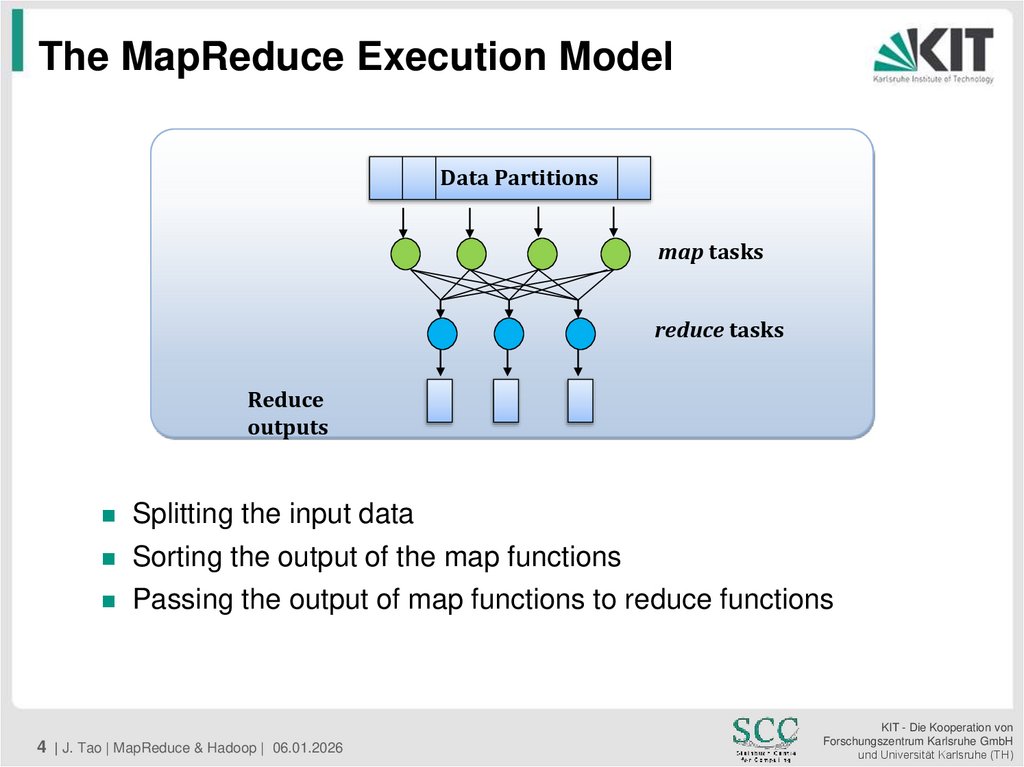
4. The MapReduce Execution Model
Data Partitionsmap tasks
reduce tasks
Reduce
outputs
Splitting the input data
Sorting the output of the map functions
Passing the output of map functions to reduce functions
4 | J. Tao | MapReduce & Hadoop | 06.01.2026
KIT - Die Kooperation von
Forschungszentrum Karlsruhe GmbH
und Universität Karlsruhe (TH)
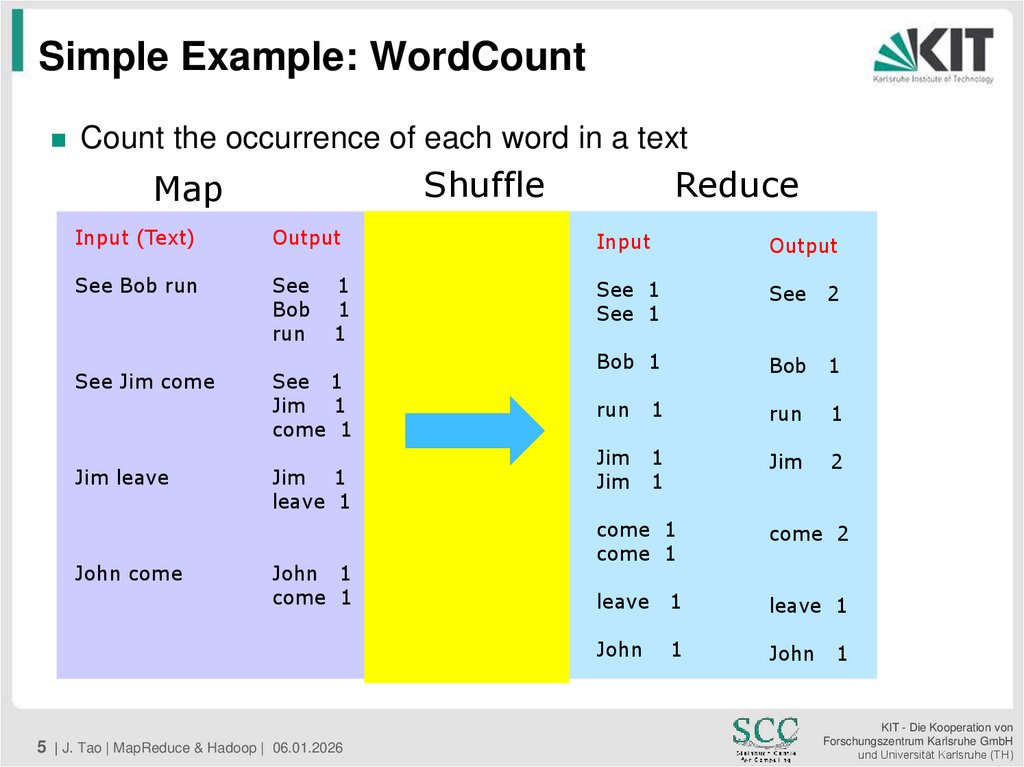
5. Simple Example: WordCount
Count the occurrence of each word in a textShuffle
Map
Reduce
Input (Text)
Output
Input
Output
See Bob run
See
Bob
run
See 1
See 1
See
2
Bob 1
Bob
1
run
1
run
1
Jim
Jim
1
1
Jim
2
See Jim come
Jim leave
John come
1
1
1
See 1
Jim 1
come 1
Jim 1
leave 1
John 1
come 1
5 | J. Tao | MapReduce & Hadoop | 06.01.2026
come 1
come 1
come 2
leave
1
leave 1
John
1
John
1
KIT - Die Kooperation von
Forschungszentrum Karlsruhe GmbH
und Universität Karlsruhe (TH)
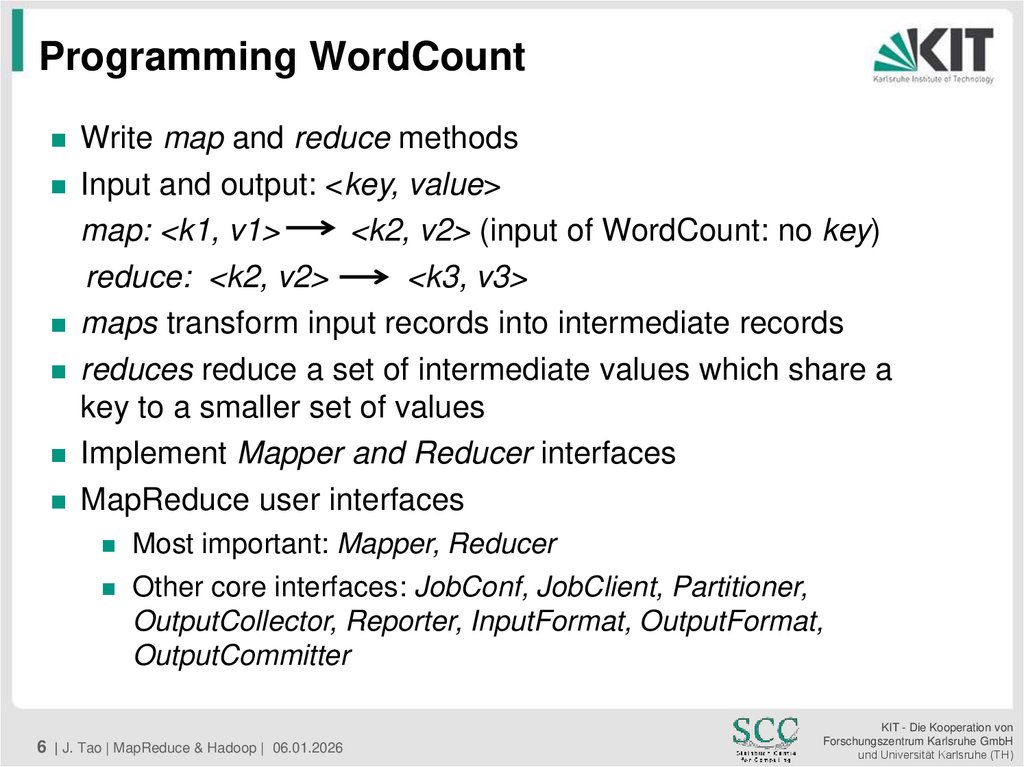
6. Programming WordCount
Write map and reduce methodsInput and output: <key, value>
map: <k1, v1>
<k2, v2> (input of WordCount: no key)
reduce: <k2, v2>
<k3, v3>
maps transform input records into intermediate records
reduces reduce a set of intermediate values which share a
key to a smaller set of values
Implement Mapper and Reducer interfaces
MapReduce user interfaces
Most important: Mapper, Reducer
Other core interfaces: JobConf, JobClient, Partitioner,
OutputCollector, Reporter, InputFormat, OutputFormat,
OutputCommitter
6 | J. Tao | MapReduce & Hadoop | 06.01.2026
KIT - Die Kooperation von
Forschungszentrum Karlsruhe GmbH
und Universität Karlsruhe (TH)
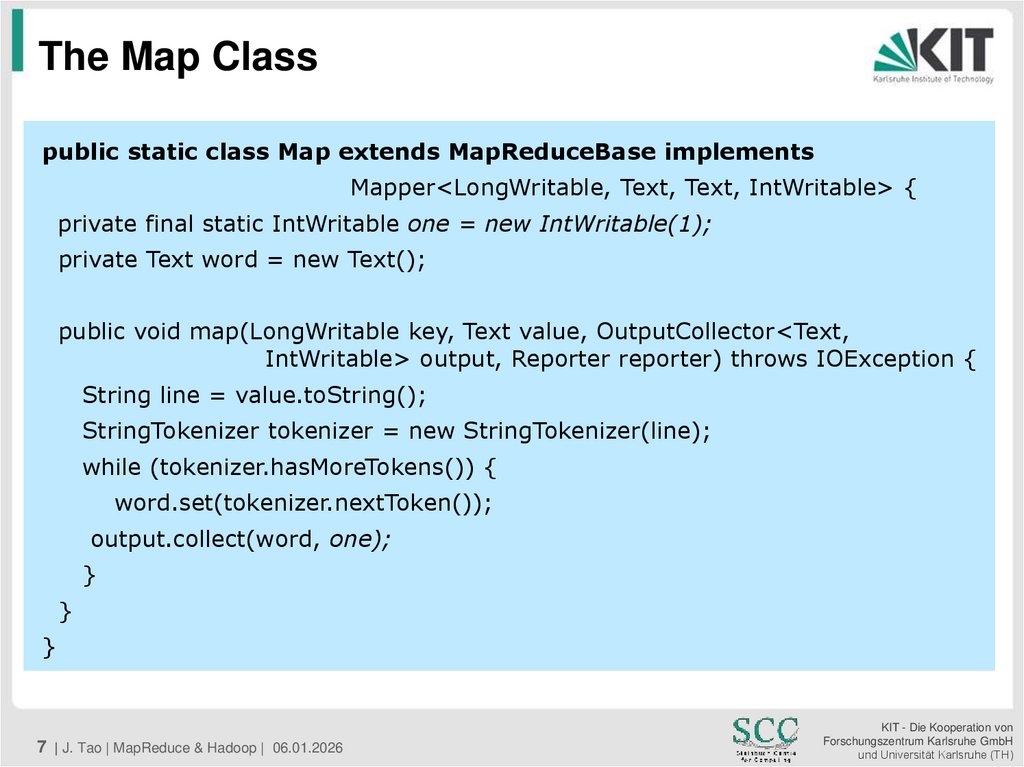
7. The Map Class
public static class Map extends MapReduceBase implementsMapper<LongWritable, Text, Text, IntWritable> {
private final static IntWritable one = new IntWritable(1);
private Text word = new Text();
public void map(LongWritable key, Text value, OutputCollector<Text,
IntWritable> output, Reporter reporter) throws IOException {
String line = value.toString();
StringTokenizer tokenizer = new StringTokenizer(line);
while (tokenizer.hasMoreTokens()) {
word.set(tokenizer.nextToken());
output.collect(word, one);
}
}
}
7 | J. Tao | MapReduce & Hadoop | 06.01.2026
KIT - Die Kooperation von
Forschungszentrum Karlsruhe GmbH
und Universität Karlsruhe (TH)
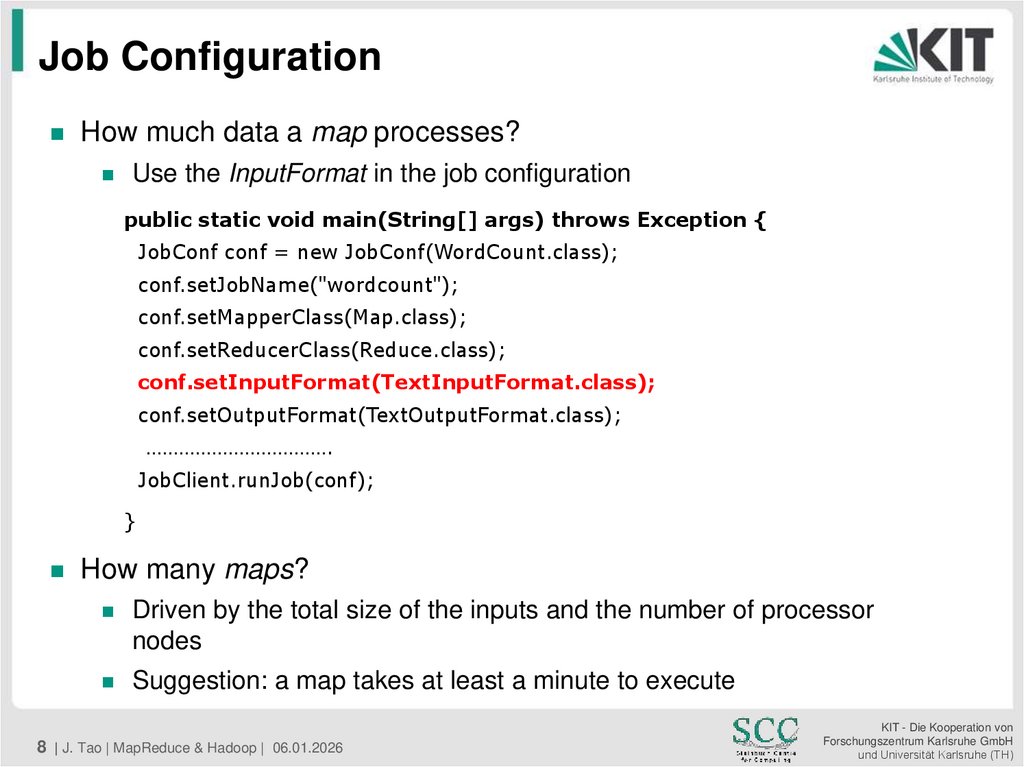
8. Job Configuration
How much data a map processes?Use the InputFormat in the job configuration
public static void main(String[] args) throws Exception {
JobConf conf = new JobConf(WordCount.class);
conf.setJobName("wordcount");
conf.setMapperClass(Map.class);
conf.setReducerClass(Reduce.class);
conf.setInputFormat(TextInputFormat.class);
conf.setOutputFormat(TextOutputFormat.class);
…………………………….
JobClient.runJob(conf);
}
How many maps?
Driven by the total size of the inputs and the number of processor
nodes
Suggestion: a map takes at least a minute to execute
8 | J. Tao | MapReduce & Hadoop | 06.01.2026
KIT - Die Kooperation von
Forschungszentrum Karlsruhe GmbH
und Universität Karlsruhe (TH)
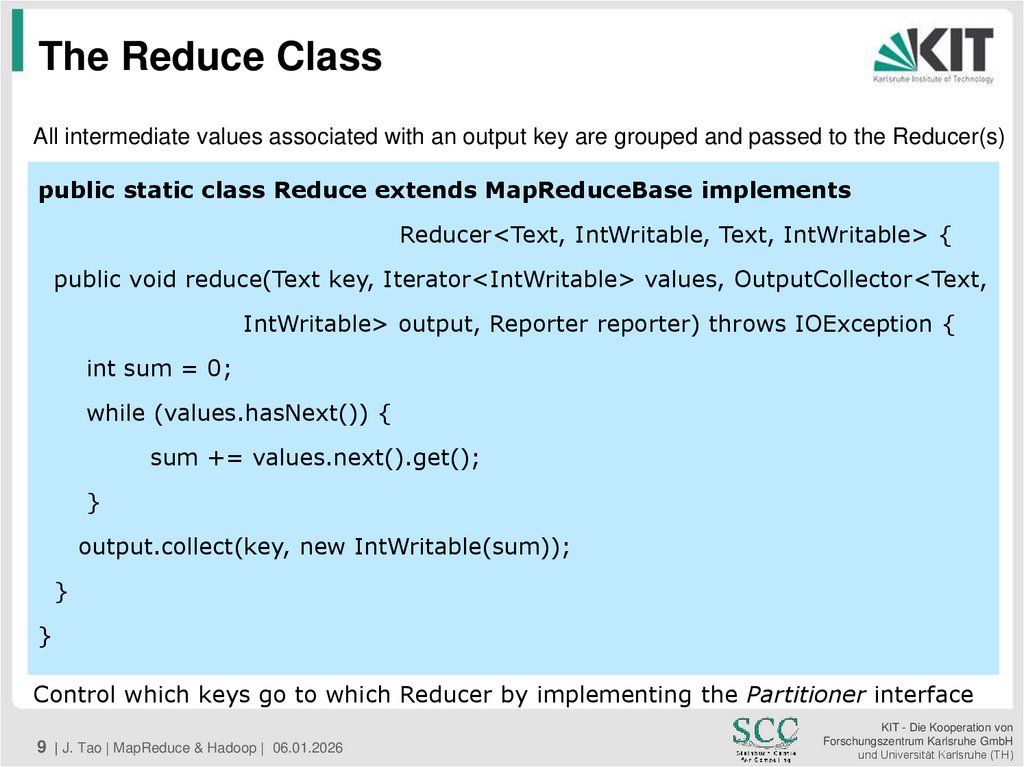
9. The Reduce Class
All intermediate values associated with an output key are grouped and passed to the Reducer(s)public static class Reduce extends MapReduceBase implements
Reducer<Text, IntWritable, Text, IntWritable> {
public void reduce(Text key, Iterator<IntWritable> values, OutputCollector<Text,
IntWritable> output, Reporter reporter) throws IOException {
int sum = 0;
while (values.hasNext()) {
sum += values.next().get();
}
output.collect(key, new IntWritable(sum));
}
}
Control which keys go to which Reducer by implementing the Partitioner interface
9 | J. Tao | MapReduce & Hadoop | 06.01.2026
KIT - Die Kooperation von
Forschungszentrum Karlsruhe GmbH
und Universität Karlsruhe (TH)
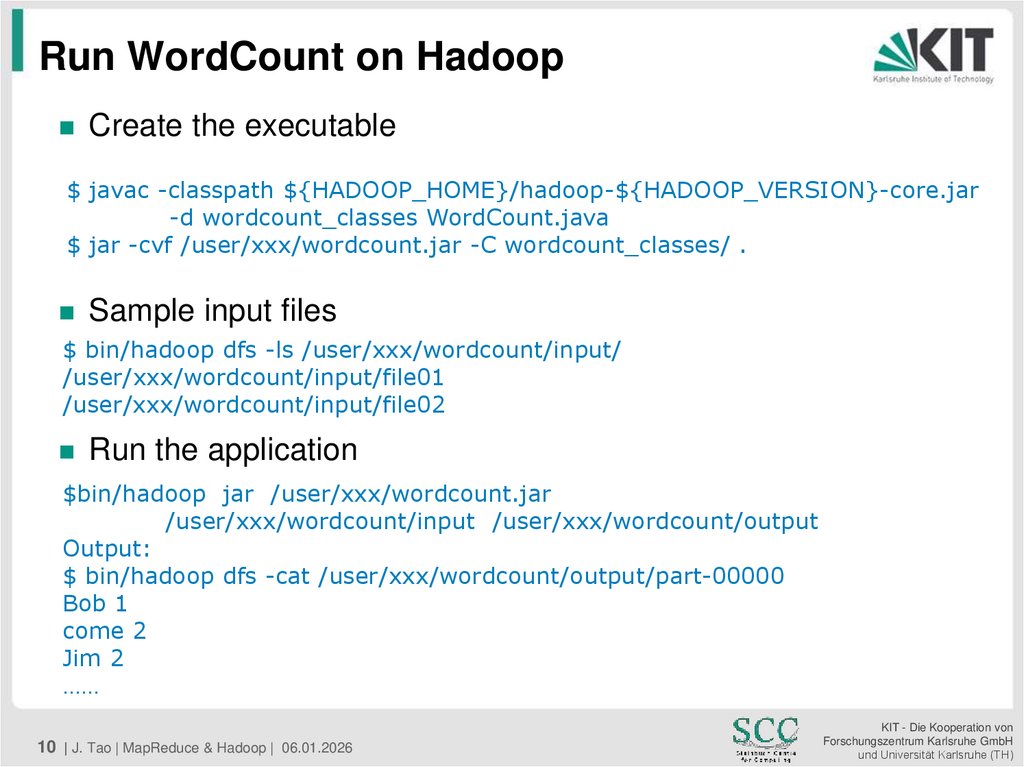
10. Run WordCount on Hadoop
Create the executable$ javac -classpath ${HADOOP_HOME}/hadoop-${HADOOP_VERSION}-core.jar
-d wordcount_classes WordCount.java
$ jar -cvf /user/xxx/wordcount.jar -C wordcount_classes/ .
Sample input files
$ bin/hadoop dfs -ls /user/xxx/wordcount/input/
/user/xxx/wordcount/input/file01
/user/xxx/wordcount/input/file02
Run the application
$bin/hadoop jar /user/xxx/wordcount.jar
/user/xxx/wordcount/input /user/xxx/wordcount/output
Output:
$ bin/hadoop dfs -cat /user/xxx/wordcount/output/part-00000
Bob 1
come 2
Jim 2
……
10 | J. Tao | MapReduce & Hadoop | 06.01.2026
KIT - Die Kooperation von
Forschungszentrum Karlsruhe GmbH
und Universität Karlsruhe (TH)
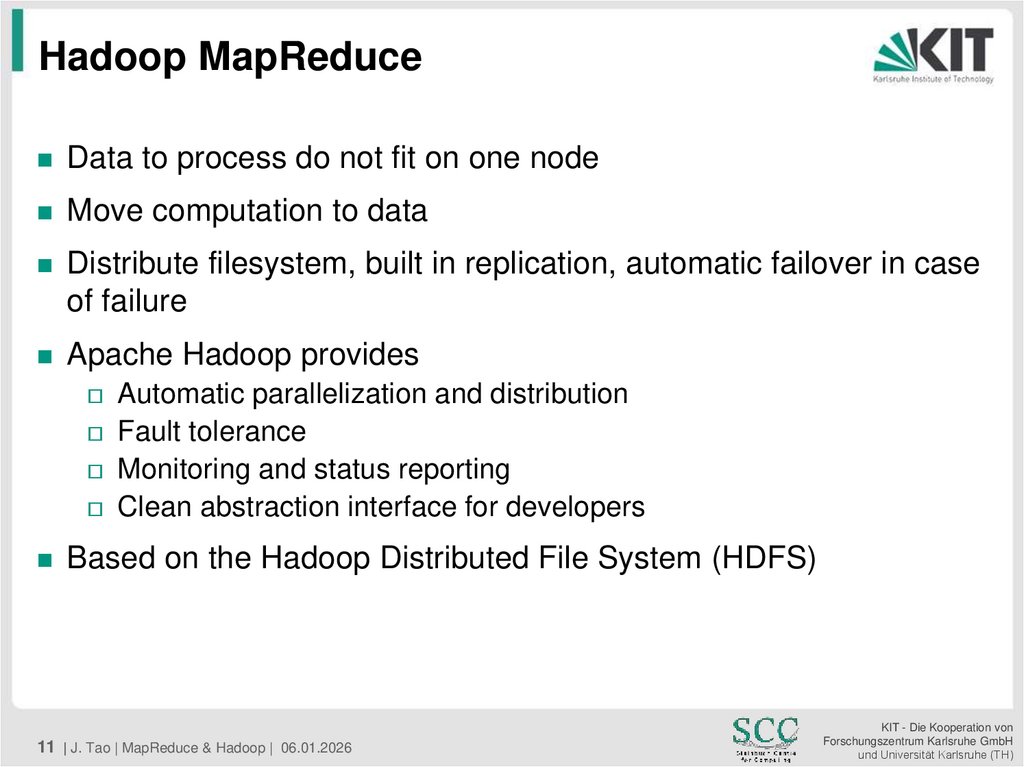
11. Hadoop MapReduce
Data to process do not fit on one nodeMove computation to data
Distribute filesystem, built in replication, automatic failover in case
of failure
Apache Hadoop provides
Automatic parallelization and distribution
Fault tolerance
Monitoring and status reporting
Clean abstraction interface for developers
Based on the Hadoop Distributed File System (HDFS)
11 | J. Tao | MapReduce & Hadoop | 06.01.2026
KIT - Die Kooperation von
Forschungszentrum Karlsruhe GmbH
und Universität Karlsruhe (TH)
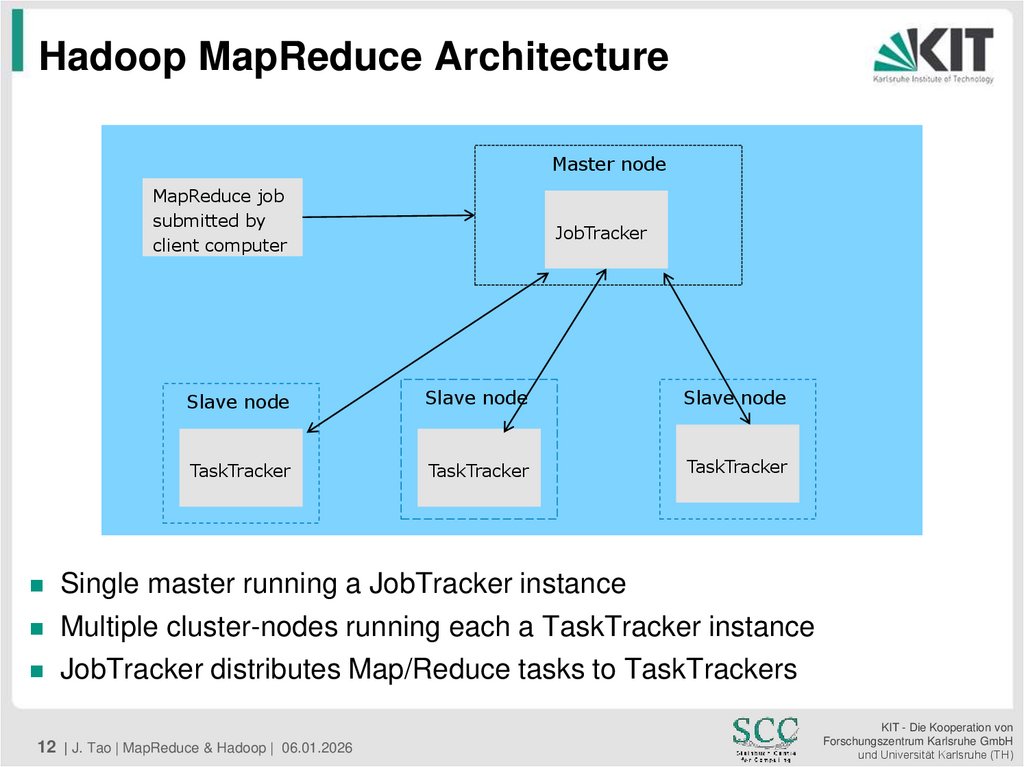
12. Hadoop MapReduce Architecture
Master nodeMapReduce job
submitted by
client computer
JobTracker
Slave node
Slave node
Slave node
TaskTracker
TaskTracker
TaskTracker
Single master running a JobTracker instance
Multiple cluster-nodes running each a TaskTracker instance
JobTracker distributes Map/Reduce tasks to TaskTrackers
12 | J. Tao | MapReduce & Hadoop | 06.01.2026
KIT - Die Kooperation von
Forschungszentrum Karlsruhe GmbH
und Universität Karlsruhe (TH)
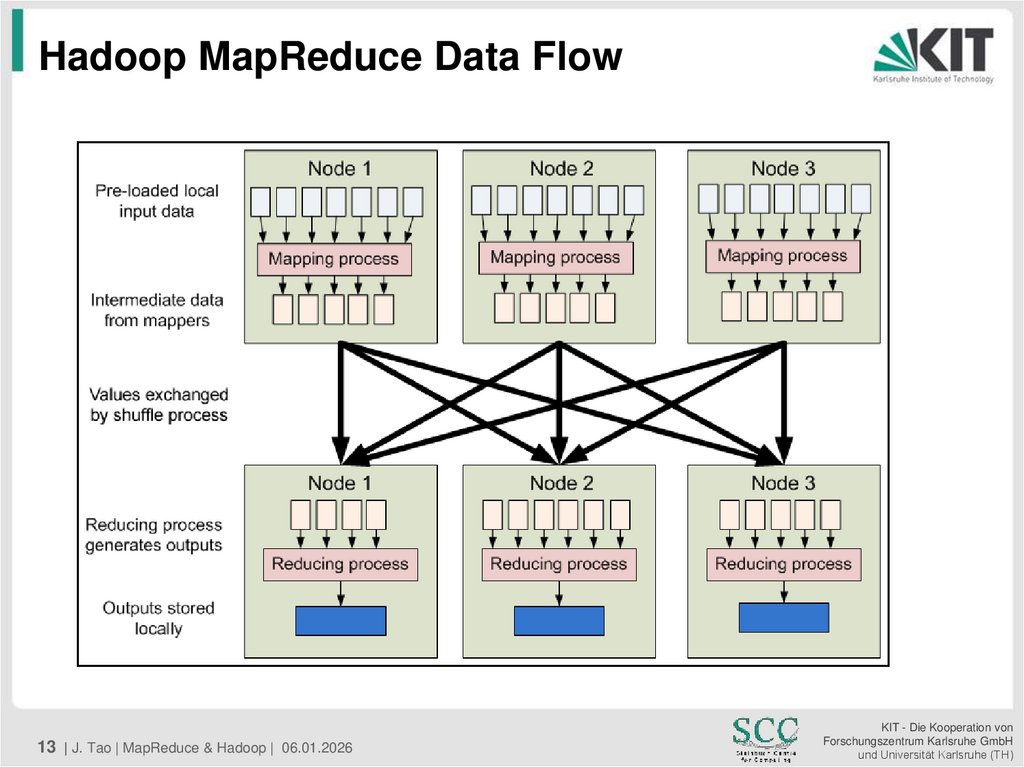
13. Hadoop MapReduce Data Flow
13 | J. Tao | MapReduce & Hadoop | 06.01.2026KIT - Die Kooperation von
Forschungszentrum Karlsruhe GmbH
und Universität Karlsruhe (TH)
14. Hadoop Distributed File System
A scalable, fault tolerant distributed file system able to run on acluster of commodity hardware
A master/slave architecture
Single NameNode
Multiple DataNodes
Files are broken into 64 MB or 128 MB Blocks
Blocks replicated across several DataNodes to handle hardware
failure (default replication number is 3)
Single file system Namespace for the whole cluster
NameNode holds the file system metadata (files names, block
locations, replication factor, etc)
14 | J. Tao | MapReduce & Hadoop | 06.01.2026
KIT - Die Kooperation von
Forschungszentrum Karlsruhe GmbH
und Universität Karlsruhe (TH)
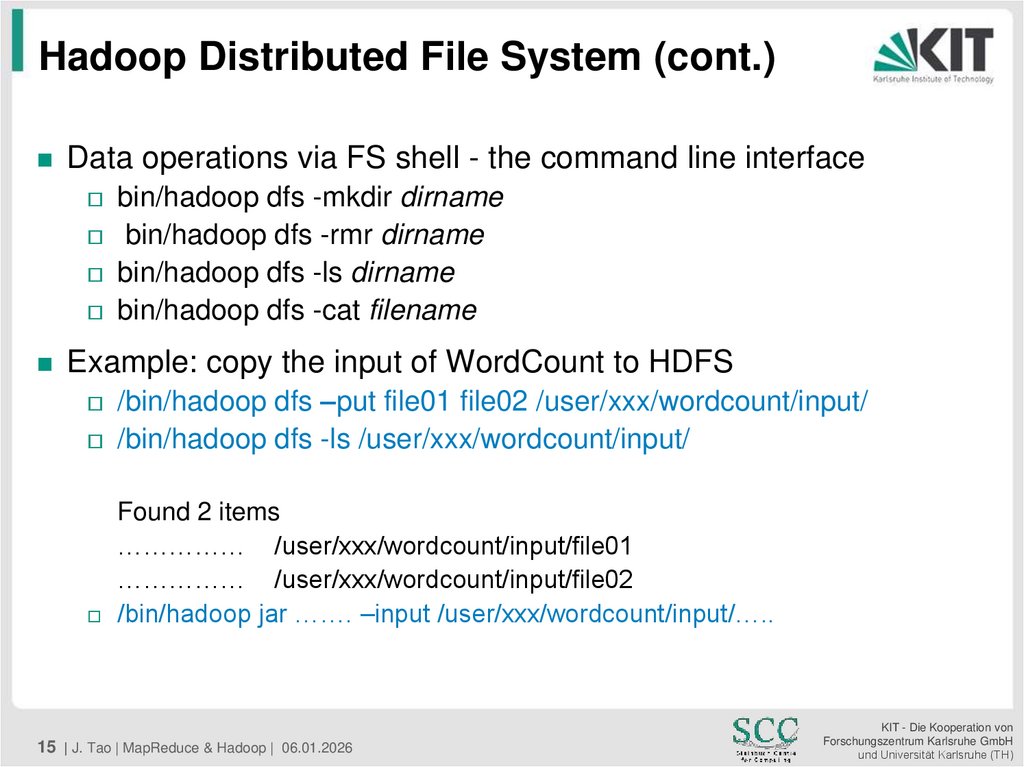
15. Hadoop Distributed File System (cont.)
Data operations via FS shell - the command line interfacebin/hadoop dfs -mkdir dirname
bin/hadoop dfs -rmr dirname
bin/hadoop dfs -ls dirname
bin/hadoop dfs -cat filename
Example: copy the input of WordCount to HDFS
/bin/hadoop dfs –put file01 file02 /user/xxx/wordcount/input/
/bin/hadoop dfs -ls /user/xxx/wordcount/input/
Found 2 items
…………… /user/xxx/wordcount/input/file01
…………… /user/xxx/wordcount/input/file02
/bin/hadoop jar ……. –input /user/xxx/wordcount/input/…..
15 | J. Tao | MapReduce & Hadoop | 06.01.2026
KIT - Die Kooperation von
Forschungszentrum Karlsruhe GmbH
und Universität Karlsruhe (TH)
16. Hadoop on Distributed Clusters
MotivationHadoop is limited to a single cluster
Existing distributed data centers owns solid cluster scheduling
frameworks
Requirement on computational capacity from large applications
Goal: g-Hadoop – runing MapReduce on multiple clusters
An on-going work at SCC/KIT; collaboration with the Indiana
University
Tasks
Replacing HDFS with Gfarm – a Grid Datafarm
Integration with the batch systems
16 | J. Tao | MapReduce & Hadoop | 06.01.2026
KIT - Die Kooperation von
Forschungszentrum Karlsruhe GmbH
und Universität Karlsruhe (TH)
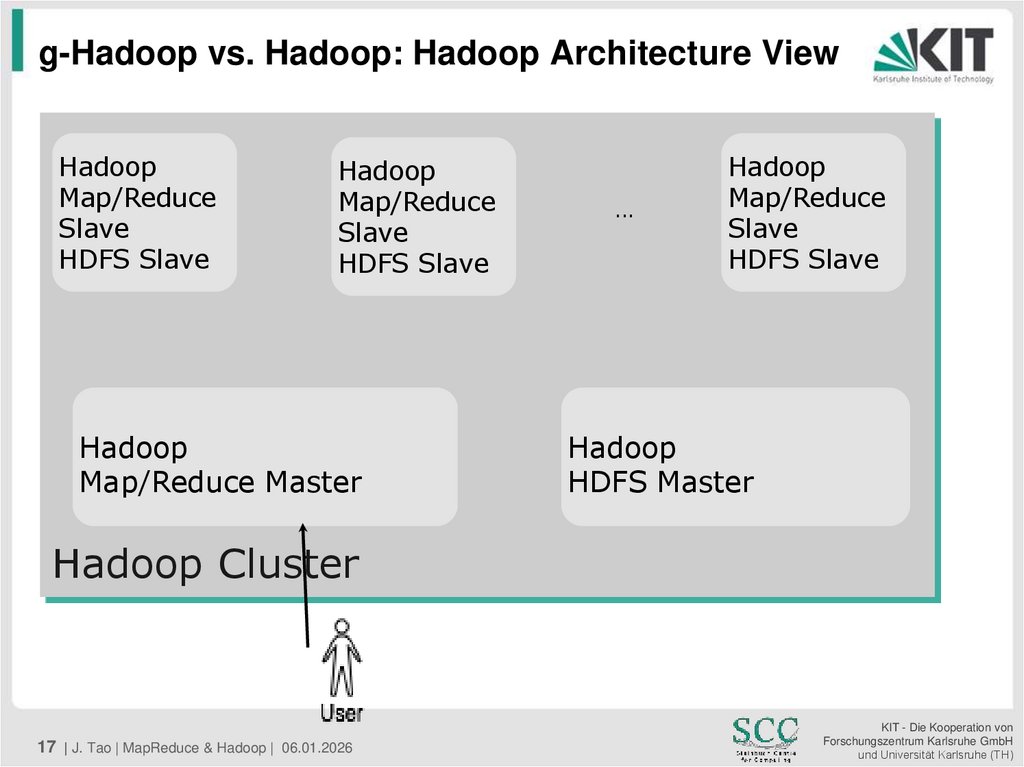
17. g-Hadoop vs. Hadoop: Hadoop Architecture View
HadoopMap/Reduce
Slave
HDFS Slave
Hadoop
Map/Reduce
Slave
HDFS Slave
Hadoop
Map/Reduce Master
...
Hadoop
Map/Reduce
Slave
HDFS Slave
Hadoop
HDFS Master
Hadoop Cluster
17 | J. Tao | MapReduce & Hadoop | 06.01.2026
KIT - Die Kooperation von
Forschungszentrum Karlsruhe GmbH
und Universität Karlsruhe (TH)
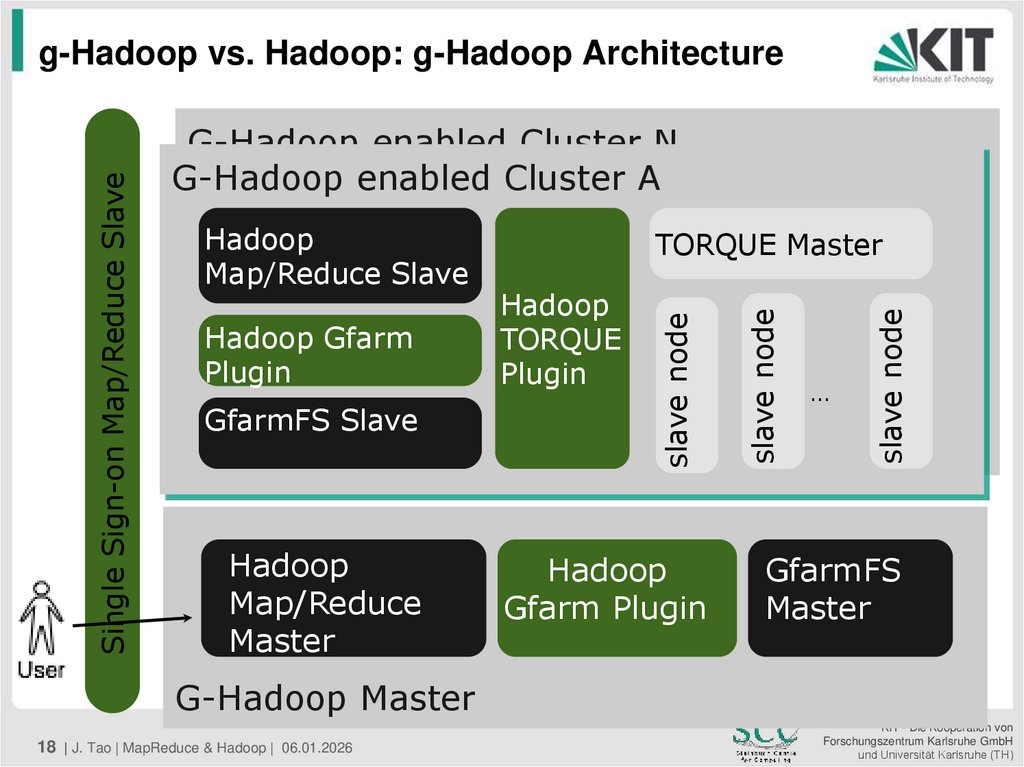
18. g-Hadoop vs. Hadoop: g-Hadoop Architecture
G-Hadoop enabled Cluster NG-Hadoop enabled Cluster A
GfarmFS Slave
Hadoop
Map/Reduce
Master
Hadoop
TORQUE
Plugin
Hadoop
Gfarm Plugin
...
slave node
Hadoop Gfarm
Plugin
TORQUE Master
slave node
Hadoop
Map/Reduce Slave
slave node
Single Sign-on Map/Reduce Slave
g-Hadoop vs. Hadoop: g-Hadoop Architecture
GfarmFS
Master
G-Hadoop Master
18 | J. Tao | MapReduce & Hadoop | 06.01.2026
KIT - Die Kooperation von
Forschungszentrum Karlsruhe GmbH
und Universität Karlsruhe (TH)
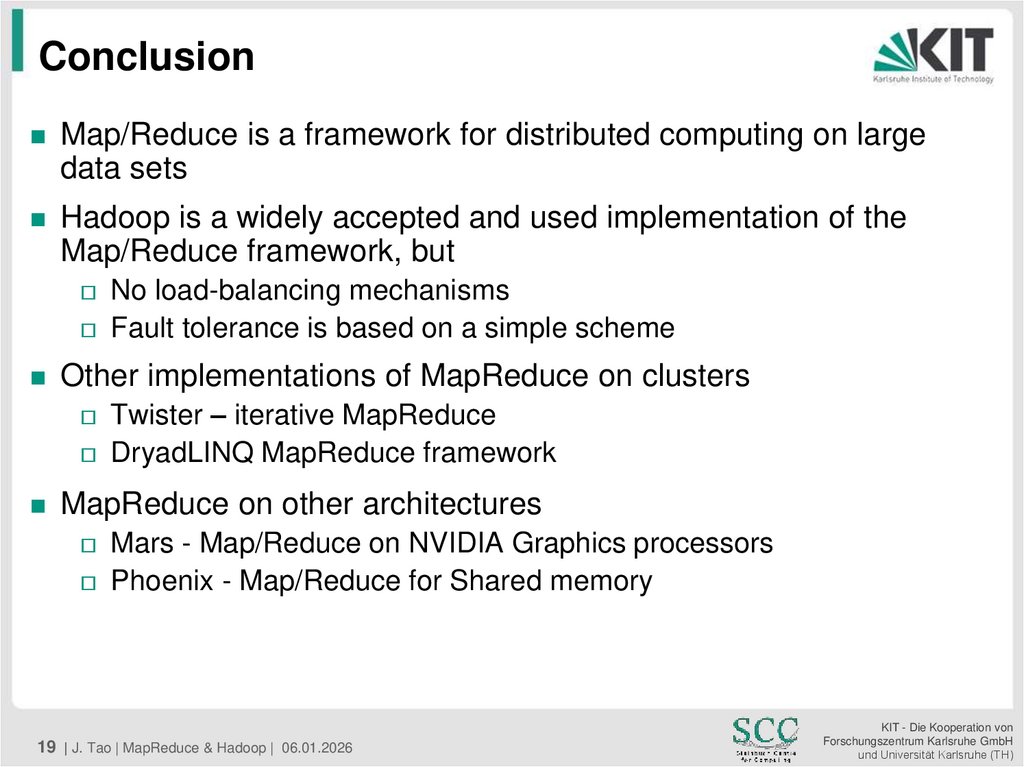
19. Conclusion
Map/Reduce is a framework for distributed computing on largedata sets
Hadoop is a widely accepted and used implementation of the
Map/Reduce framework, but
No load-balancing mechanisms
Fault tolerance is based on a simple scheme
Other implementations of MapReduce on clusters
Twister – iterative MapReduce
DryadLINQ MapReduce framework
MapReduce on other architectures
Mars - Map/Reduce on NVIDIA Graphics processors
Phoenix - Map/Reduce for Shared memory
19 | J. Tao | MapReduce & Hadoop | 06.01.2026
KIT - Die Kooperation von
Forschungszentrum Karlsruhe GmbH
und Universität Karlsruhe (TH)
20. Links
Hadoop (also MapReduce and HDFS)http://hadoop.apache.org/
Twister Interactive MapReduce
http://www.iterativemapreduce.org/
1st MapReduce Workshop (by HPDC 2010)
http://graal.ens-lyon.fr/mapreduce/
Dean, Jeff and Ghemawat, Sanjay, MapReduce: Simplified
Data Processing on Large Clusters
http://labs.google.com/papers/mapreduce-osdi04.pdf
20 | J. Tao | MapReduce & Hadoop | 06.01.2026
KIT - Die Kooperation von
Forschungszentrum Karlsruhe GmbH
und Universität Karlsruhe (TH)