Похожие презентации:






Treatment
1. Treatment
• NSAIDs• Corticosteroids
• Sometimes used immunosuppressants
2.
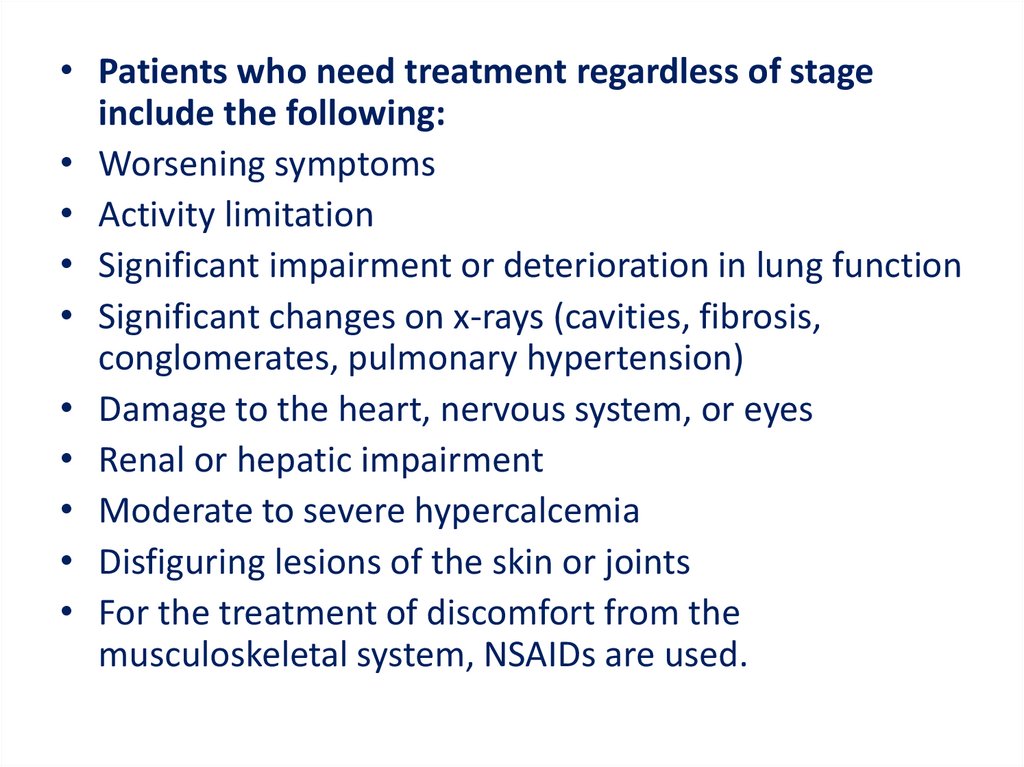
• Patients who need treatment regardless of stageinclude the following:
• Worsening symptoms
• Activity limitation
• Significant impairment or deterioration in lung function
• Significant changes on x-rays (cavities, fibrosis,
conglomerates, pulmonary hypertension)
• Damage to the heart, nervous system, or eyes
• Renal or hepatic impairment
• Moderate to severe hypercalcemia
• Disfiguring lesions of the skin or joints
• For the treatment of discomfort from the
musculoskeletal system, NSAIDs are used.
3. Corticosteroids
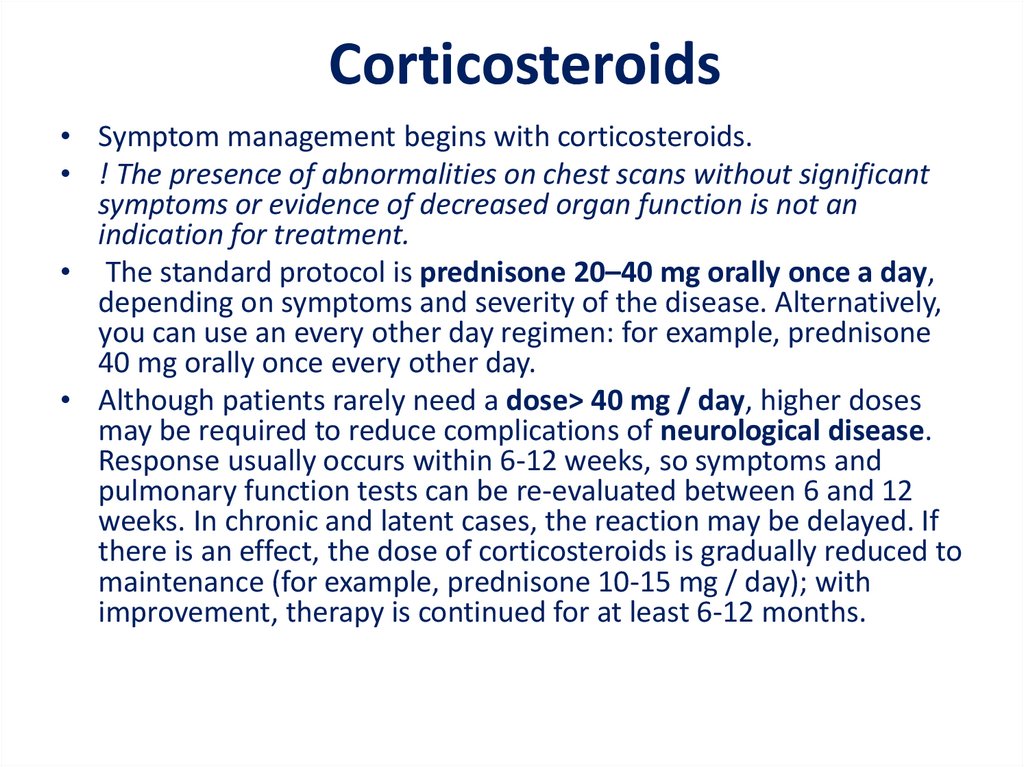
• Symptom management begins with corticosteroids.• ! The presence of abnormalities on chest scans without significant
symptoms or evidence of decreased organ function is not an
indication for treatment.
• The standard protocol is prednisone 20–40 mg orally once a day,
depending on symptoms and severity of the disease. Alternatively,
you can use an every other day regimen: for example, prednisone
40 mg orally once every other day.
• Although patients rarely need a dose> 40 mg / day, higher doses
may be required to reduce complications of neurological disease.
Response usually occurs within 6-12 weeks, so symptoms and
pulmonary function tests can be re-evaluated between 6 and 12
weeks. In chronic and latent cases, the reaction may be delayed. If
there is an effect, the dose of corticosteroids is gradually reduced to
maintenance (for example, prednisone 10-15 mg / day); with
improvement, therapy is continued for at least 6-12 months.
4.
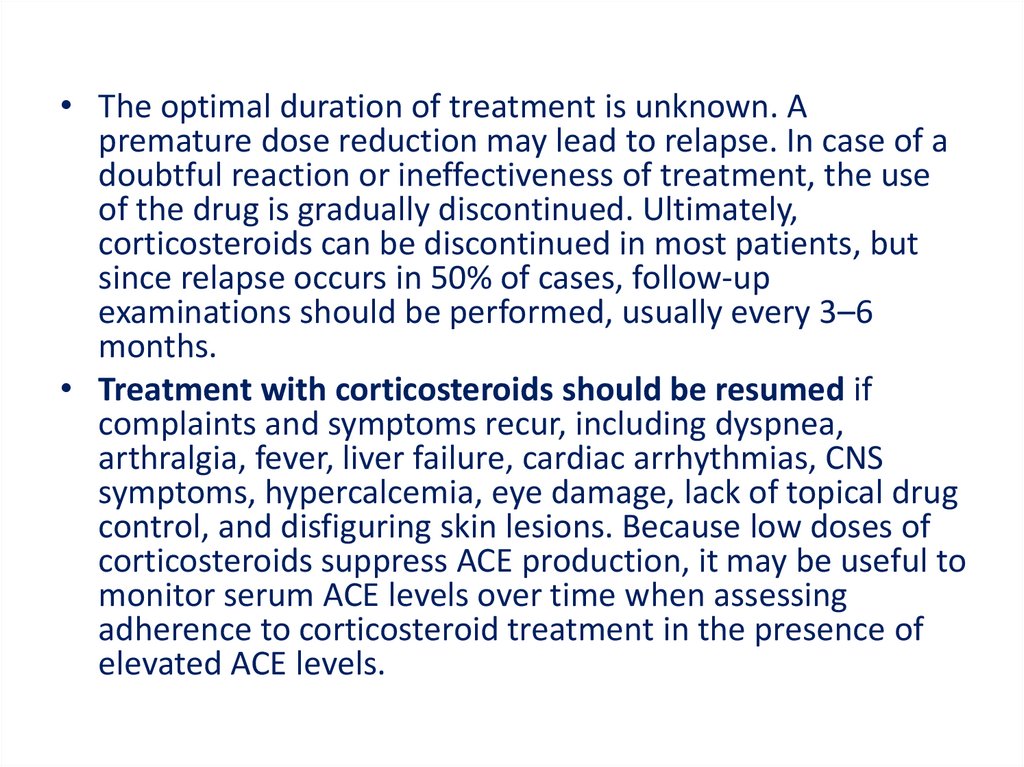
• The optimal duration of treatment is unknown. Apremature dose reduction may lead to relapse. In case of a
doubtful reaction or ineffectiveness of treatment, the use
of the drug is gradually discontinued. Ultimately,
corticosteroids can be discontinued in most patients, but
since relapse occurs in 50% of cases, follow-up
examinations should be performed, usually every 3–6
months.
• Treatment with corticosteroids should be resumed if
complaints and symptoms recur, including dyspnea,
arthralgia, fever, liver failure, cardiac arrhythmias, CNS
symptoms, hypercalcemia, eye damage, lack of topical drug
control, and disfiguring skin lesions. Because low doses of
corticosteroids suppress ACE production, it may be useful to
monitor serum ACE levels over time when assessing
adherence to corticosteroid treatment in the presence of
elevated ACE levels.
5.
• Inhaled corticosteroids can relieve cough in patientswith endobronchial involvement or airway
hyperresponsiveness. Inhalation of large doses of
budesonide or fluticasone has sometimes been shown
to be effective in pulmonary stages I-III, while
combinations of systemic and inhaled steroids have a
positive effect on both clinical symptoms and changes
on radiographs in stages II-IV.
• Local corticosteroids may be helpful in treating
dermatitis, sinusitis, and eye diseases.
• When treating with corticosteroids or
immunosuppressants, prophylaxis for Pneumocystis
jirovecii pneumonia should be considered.
6. Immunosuppressants
• ! Treatment with immunosuppressants is carried out in case ofintolerance to moderate doses of corticosteroids, refractoriness of
sarcoidosis to corticosteroids, or if treatment with corticosteroids is
required for a long time.
• In about 10% of cases when therapy is necessary, tolerated doses of
corticosteroids are ineffective, and a 6-month trial of methotrexate
therapy at a dose of 10-15 mg / week should be carried out.
Methotrexate and corticosteroids are given initially; after 6-8
weeks, the dose of corticosteroids can be gradually reduced, and in
many cases their use can be discontinued. However, the maximum
effect of methotrexate can be observed after 6-12 months. In such
cases, the dose of prednisolone should be decreased more slowly.
Determination of blood corpuscles and liver enzymes should be
performed first every 1–2 weeks, then every 4–6 weeks, as soon as
a stable dose is reached. In patients receiving methotrexate, folate
(1 mg orally per day) is recommended.
7.
• Other drugs that have been effective in a small number of patientswho do not respond to corticosteroid treatment or who experience
complicating side effects include azathioprine, mycophenolate
mofetil, cyclophosphamide, chloroquine or hydroxychloroquine,
and infliximab. Immunosuppressants are often more effective in
refractory cases, and relapse is common after stopping treatment.
The TNF inhibitor infliximab may be effective in treating chronic
steroid-dependent pulmonary sarcoidosis, refractory lupus fever,
and neurosarcoidosis. It is administered intravenously at a dose of
3-5 mg / kg once, repeated in 2 weeks, and then administered 1
time / month.
• Hydroxychloroquine 400 mg orally once a day or 200 mg orally
twice a day may be as effective for treating hypercalcemia, sarcoid
skin lesions, or enlarged patient-discomfortable or disfiguring
peripheral lymph nodes.