 Образование
Похожие презентации:





Discuss
1.
• Some people believe that teenagersshould concentrate equally on all
subjects at school. Others believe that
teenagers should focus on a subject
that they are good at or they find
interesting.
Discuss both these views and give your
own opinion.
2.
Band 5• Certain individuals trust that children had better pay attention same on
all lessons in school. Others argue that they should study one subject
that they keen on. This essay will discuss both views before reaching a
verdict.
• Band 6
• People have opposing views on whether students should engage in all
curriculums or focus only on their specific subject. I will explore the
rationale for both beliefs as well as proffer justification for my own
viewpoint.
• Band 7
• Nowadays, there are different views on whether it's better for students
to be taught all subjects equally in schools or to focus on studying a
particular subject more deeply. In my opinion, both perspectives have
their own advantages and disadvantages.
3.
• Traditionally, teenagers studying at school were expected tostudy a broad range of subjects with equal concentrations.
In recent years, however, attitudes in educationalist circles
have shifted towards the idea that priority should be given
to subjects that match students’ talents and interests. Both
of these approaches have merits, and thus, I believe that
students should develop a solid foundation in all subjects
early on and start to narrow down their concentration as
they approach graduation.
4.
• The arguments in favour of focusing equally on all subjects are mainlyassociated with the acquisition of a well-rounded education and discovery
of talents and passions. It goes without saying that such an approach to
learning will allow students to develop a solid grasp of many subject areas,
which will undoubtedly be important in their adulthood. This is especially
true in today’s world where the breadth of knowledge people are expected
to have on various issues is increasing. An average person today is expected
to speak at least one foreign language, be tech-savvy, and have at least a
basic understanding of business, geopolitics, and economics. These
expectations cannot be met without studying various subjects well at school.
In addition, by studying a variety of subjects, students can discover new
passions, talents, or perhaps even their true calling. This won’t be possible
if teenagers concentrate only on one subject at the expense of all others.
5.
• On the other hand, the rationale behind teenagers focusing onone subject has to do with motivation and the mastery of their
chosen field. Obviously, if students spend most of their time and
effort studying the subject they are good at or interested in, they
are more likely to remain motivated long-term. More importantly,
though, concentrating on one subject with sustained consistency
will increase the likelihood of attaining mastery in that discipline.
This will have positive effects well beyond school in their
academic and professional lives as universities and employers
place a high value on people with specialised expertise and indepth understanding of their field.
6.
• Given the apparent merits of both approaches, implementing ablended system will benefit the students most. I believe that the
most efficacious combination would be for students to focus on all
subjects in middle school (up to the age 15-16) because at these
ages, they are still trying to find their passions and are years away
from applying to university or for a job. By the high school stage
(ages 15-18) though, they should have at least some idea of what
career path they want to follow, and prioritise one, or perhaps a
few, subjects that align with that path. This way, students will get
the best of both worlds: a well-rounded education with a robust
understanding of various subjects and a deep knowledge of their
selected spheres.
7.
• In conclusion, studying all subjectsequally and focusing on only one subject
both have their respective benefits to
students. This being the case, teenagers
should adopt both approaches,
preferably the former in middle school
and the latter in high school.
8.
• 1. TV and movies are less engaging than traditional readingmethods for most children.
• 2. Educational TV programs can improve children’s cognitive
skills,such as counting and problem-solving.
• 3. Educational apps and digital media are only effective when
parents guide the learning process.
• 4. ‘Reading Rainbow’ is mentioned as an example of a program
that discourages children from reading independently.
• 5. The article states that digital media can help children develop
creativity by allowing them to create their own stories or music
9.
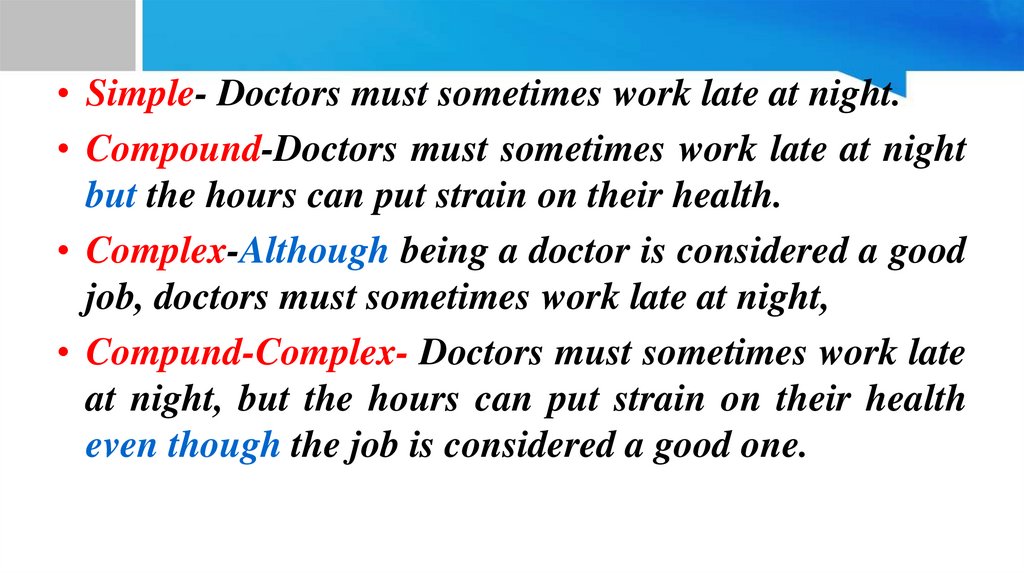
• Simple- Doctors must sometimes work late at night.• Compound-Doctors must sometimes work late at night
but the hours can put strain on their health.
• Complex-Although being a doctor is considered a good
job, doctors must sometimes work late at night,
• Compund-Complex- Doctors must sometimes work late
at night, but the hours can put strain on their health
even though the job is considered a good one.
10.
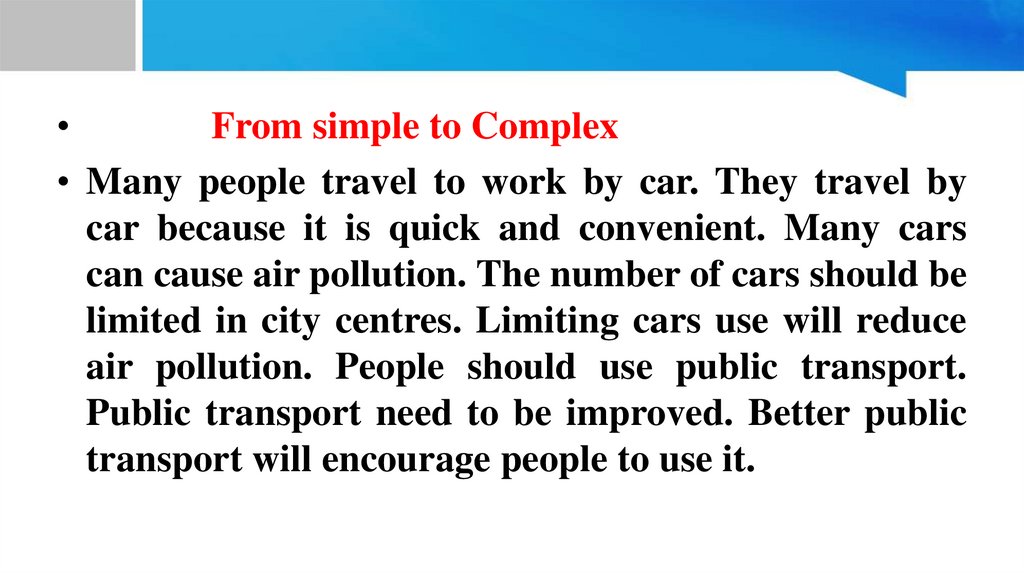
From simple to Complex
• Many people travel to work by car. They travel by
car because it is quick and convenient. Many cars
can cause air pollution. The number of cars should be
limited in city centres. Limiting cars use will reduce
air pollution. People should use public transport.
Public transport need to be improved. Better public
transport will encourage people to use it.
11.
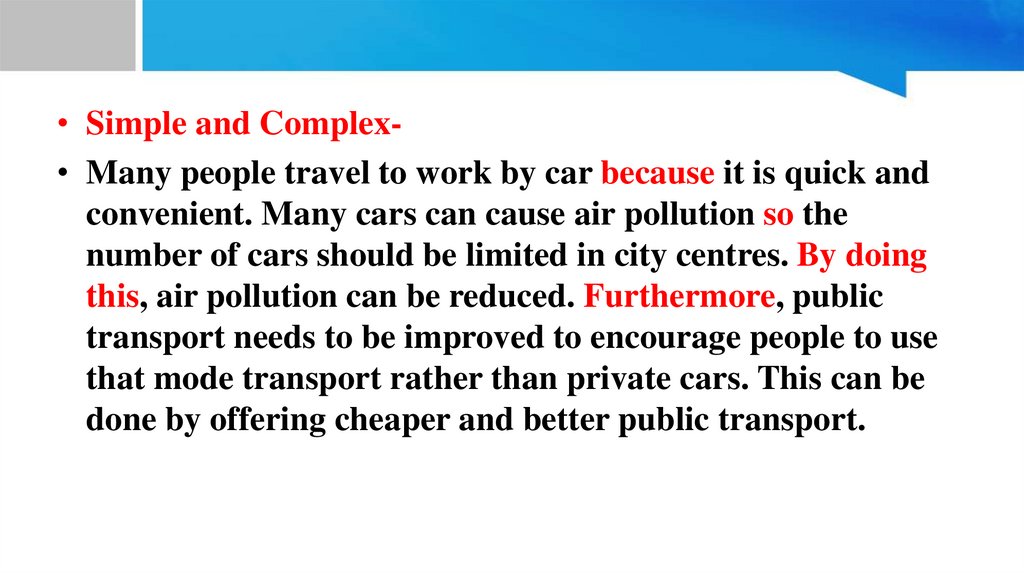
• Simple and Complex• Many people travel to work by car because it is quick andconvenient. Many cars can cause air pollution so the
number of cars should be limited in city centres. By doing
this, air pollution can be reduced. Furthermore, public
transport needs to be improved to encourage people to use
that mode transport rather than private cars. This can be
done by offering cheaper and better public transport.
12.
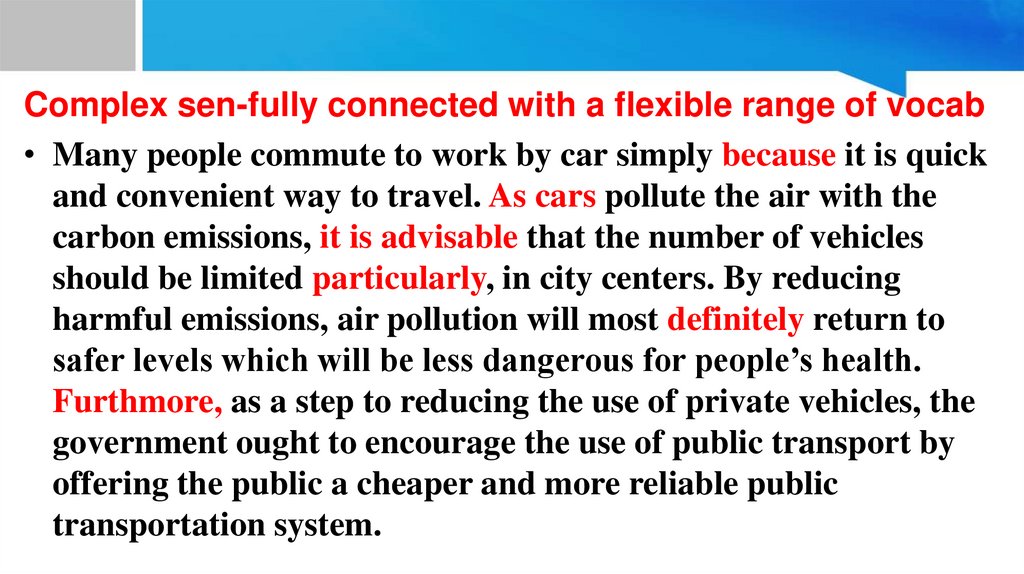
Complex sen-fully connected with a flexible range of vocab• Many people commute to work by car simply because it is quick
and convenient way to travel. As cars pollute the air with the
carbon emissions, it is advisable that the number of vehicles
should be limited particularly, in city centers. By reducing
harmful emissions, air pollution will most definitely return to
safer levels which will be less dangerous for people’s health.
Furthmore, as a step to reducing the use of private vehicles, the
government ought to encourage the use of public transport by
offering the public a cheaper and more reliable public
transportation system.
13.
• Mobil phones are good for people. People canuse mobile phones in all places. This is good
thing for people and communication. It is also
good for emergencies. mobile phones are quick
to use. For ex if i send a text to my friends, they
can reply in one minute. Smartphones have
internet access. People can go online and do
banking or shopping with a mobile phone.