
 Информатика
Похожие презентации:







Distributed Operating Systems
1. Distributed Operating Systems
Process SynchronisationSubmitted to Dr. PARVATHI R
SUBMITTED BY: Gaurav Deswal
Apoorv Srivastava
Subrata Sahoo
18MCA1014
18MCA1046
18MCA1072
2. Process Synchronisation
Synchronization is important if we want tocontrol access to a single, shared resource
agree on the ordering of events
3. Mutual exclusion
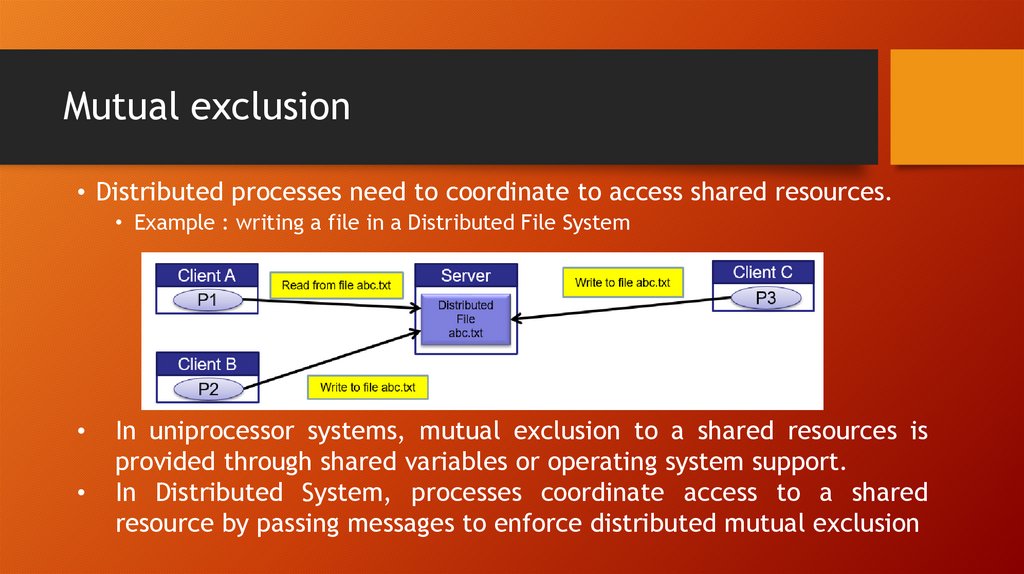
• Distributed processes need to coordinate to access shared resources.• Example : writing a file in a Distributed File System
In uniprocessor systems, mutual exclusion to a shared resources is
provided through shared variables or operating system support.
In Distributed System, processes coordinate access to a shared
resource by passing messages to enforce distributed mutual exclusion
4. Types of Distributed Mutual Exclusion
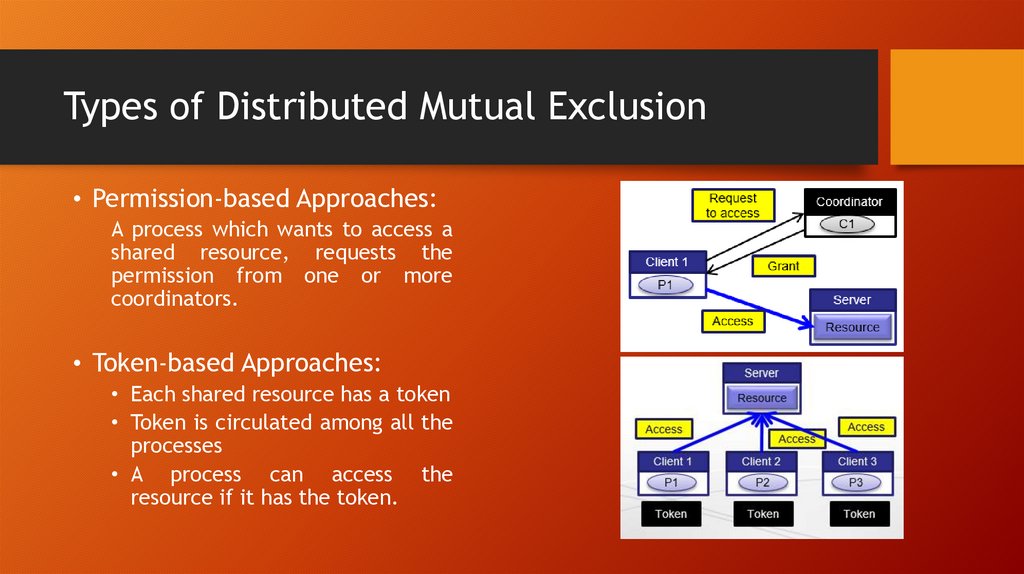
• Permission-based Approaches:A process which wants to access a
shared resource, requests the
permission from one or more
coordinators.
• Token-based Approaches:
• Each shared resource has a token
• Token is circulated among all the
processes
• A process can access the
resource if it has the token.
5. Token based approach: Token ring
• Each resource is associated with a token.• The token is circulated among processes.
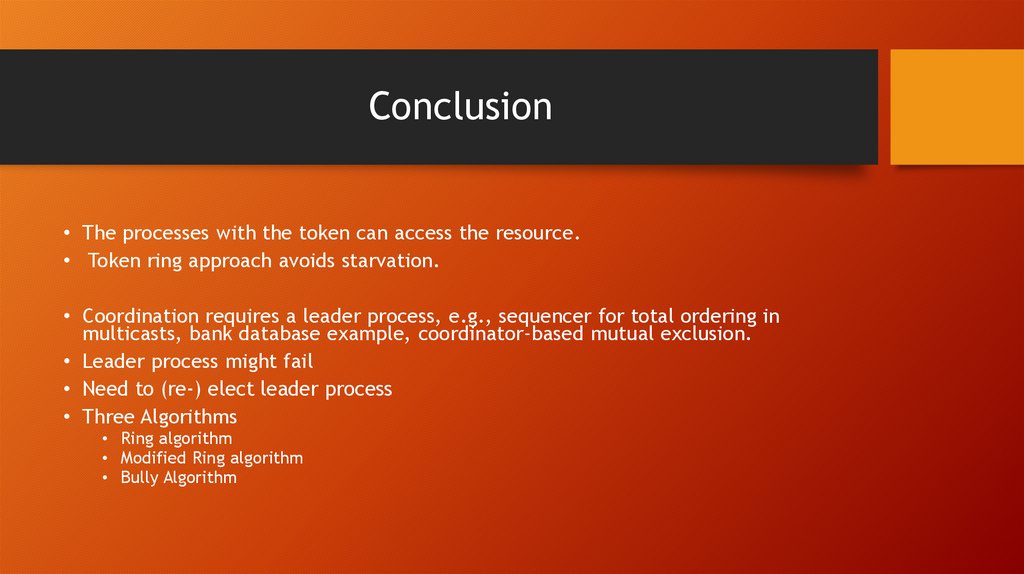
• The processes with the token can access the resource.
• Token ring approach avoids starvation.
6. Election Algorithms
• If we are using one process as a coordinator for a shared resourcehow do we select that one process?
7. Solution – an Election
• All processes currently involved get together to choose acoordinator
• If the coordinator crashes or becomes isolated, elect a new
coordinator
• If a previously crashed or isolated process, comes on line, a new
election may have to be held
8. Assumptions and Requirements
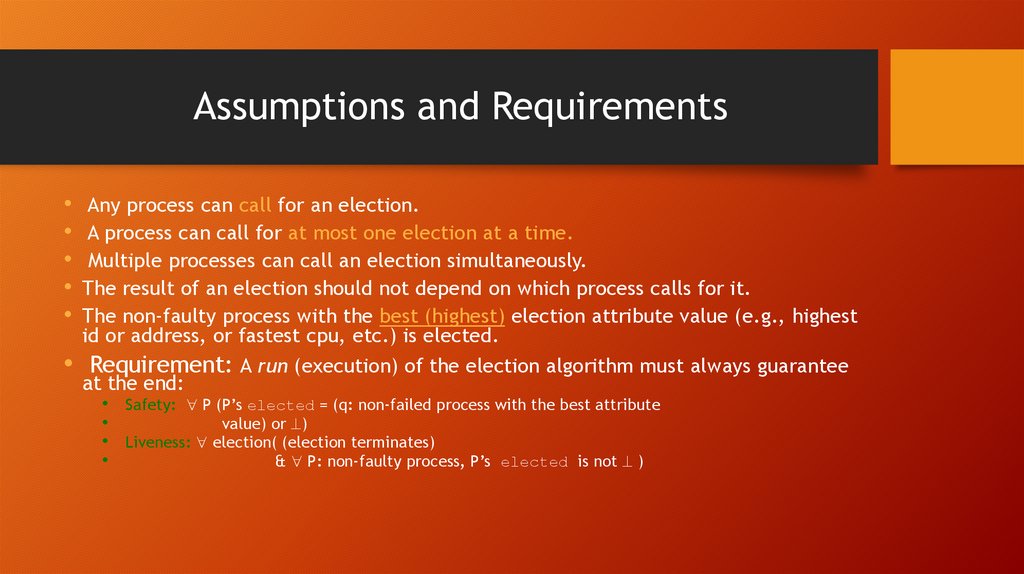
• Any process can call for an election.• A process can call for at most one election at a time.
• Multiple processes can call an election simultaneously.
• The result of an election should not depend on which process calls for it.
• The non-faulty process with the best (highest) election attribute value (e.g., highest
id or address, or fastest cpu, etc.) is elected.
• Requirement: A run (execution) of the election algorithm must always guarantee
at the end:
• Safety: P (P’s elected = (q: non-failed process with the best attribute
value) or )
• Liveness: election( (election terminates)
& P: non-faulty process, P’s elected is not )
9. Election Algorithms
• Wired systems• Bully algorithm
• Ring algorithm
10. Bully Algorithm
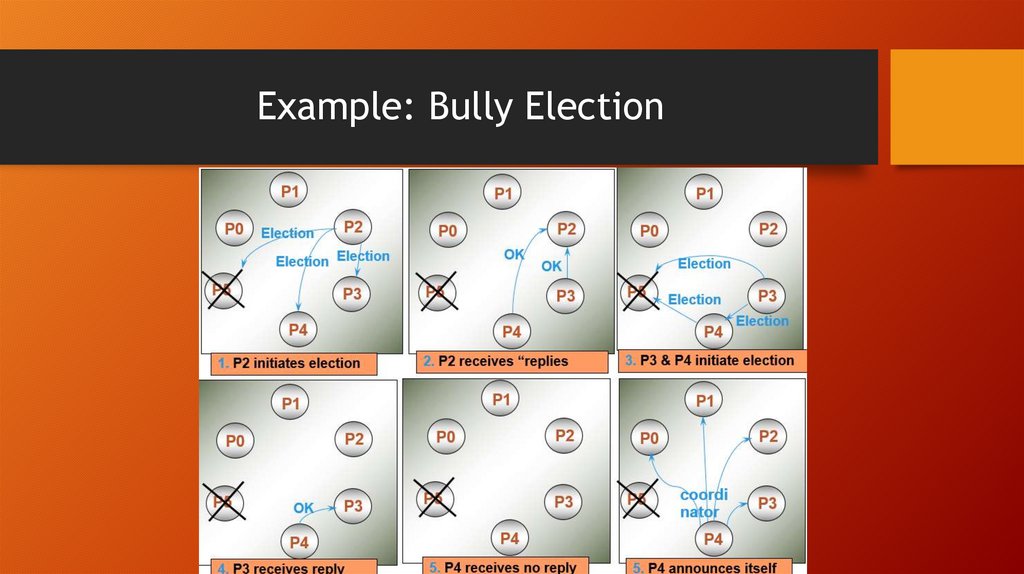
• A node initiates election by sending an “election” message to onlynodes that have a higher id than itself.
• A node that receives an “election” message replies with answer, &
starts an election – unless it has already.
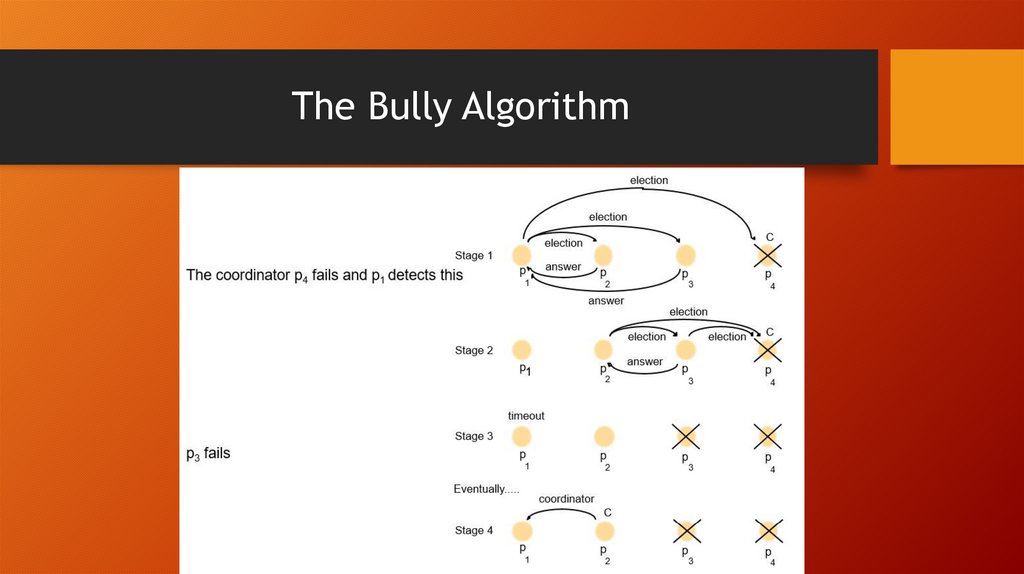
• When a process finds the coordinator has failed, if it knows its id
is the highest, it elects itself as coordinator, then sends a
coordinator message to all processes with lower identifiers.
11. Example: Bully Election
12. The Bully Algorithm
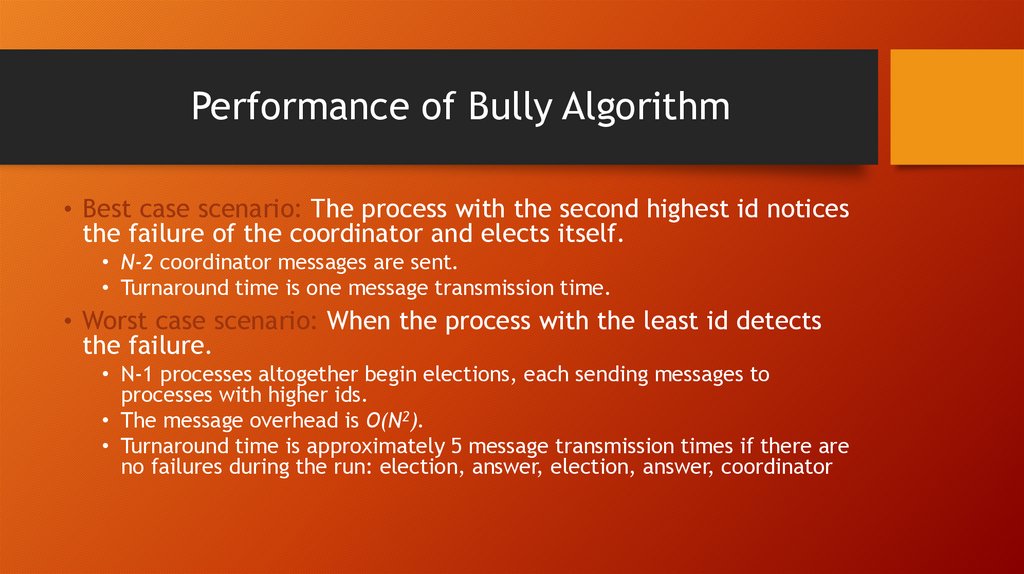
13. Performance of Bully Algorithm
• Best case scenario: The process with the second highest id noticesthe failure of the coordinator and elects itself.
• N-2 coordinator messages are sent.
• Turnaround time is one message transmission time.
• Worst case scenario: When the process with the least id detects
the failure.
• N-1 processes altogether begin elections, each sending messages to
processes with higher ids.
• The message overhead is O(N2).
• Turnaround time is approximately 5 message transmission times if there are
no failures during the run: election, answer, election, answer, coordinator
14. Conclusion
• The processes with the token can access the resource.• Token ring approach avoids starvation.
• Coordination requires a leader process, e.g., sequencer for total ordering in
multicasts, bank database example, coordinator-based mutual exclusion.
• Leader process might fail
• Need to (re-) elect leader process
• Three Algorithms
• Ring algorithm
• Modified Ring algorithm
• Bully Algorithm