 Программное обеспечение
Похожие презентации:










Full-Stack development and the utility of Java
1.
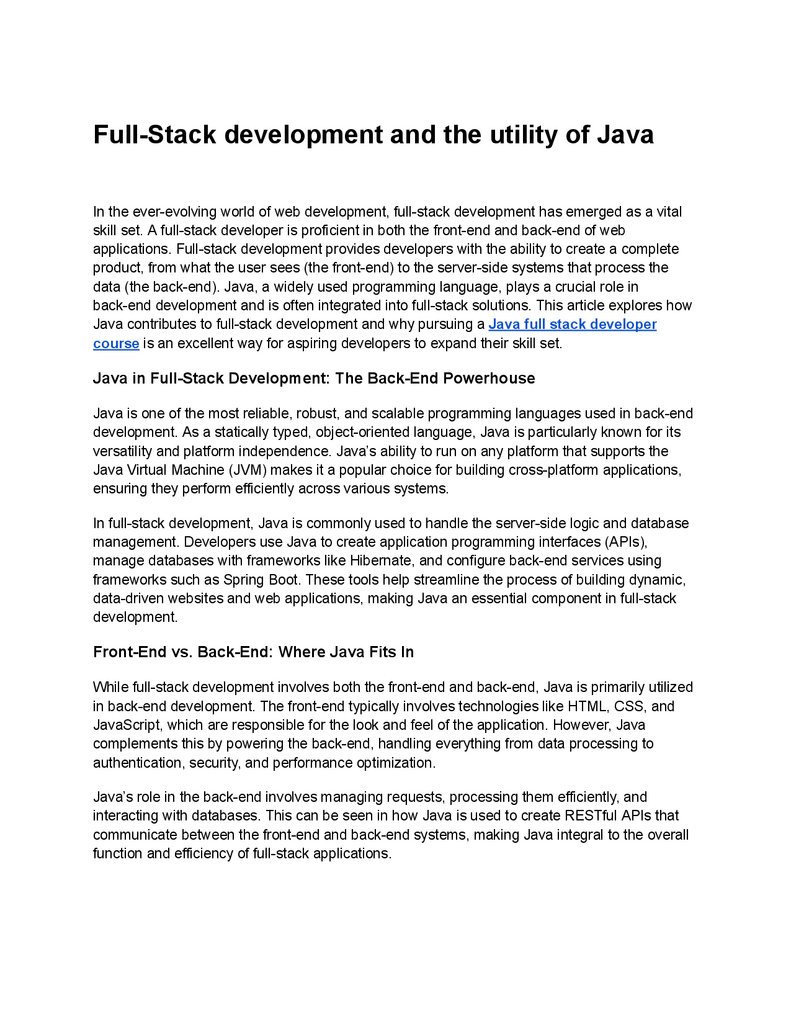
Full-Stack development and the utility of JavaIn the ever-evolving world of web development, full-stack development has emerged as a vital
skill set. A full-stack developer is proficient in both the front-end and back-end of web
applications. Full-stack development provides developers with the ability to create a complete
product, from what the user sees (the front-end) to the server-side systems that process the
data (the back-end). Java, a widely used programming language, plays a crucial role in
back-end development and is often integrated into full-stack solutions. This article explores how
Java contributes to full-stack development and why pursuing a Java full stack developer
course is an excellent way for aspiring developers to expand their skill set.
Java in Full-Stack Development: The Back-End Powerhouse
Java is one of the most reliable, robust, and scalable programming languages used in back-end
development. As a statically typed, object-oriented language, Java is particularly known for its
versatility and platform independence. Java’s ability to run on any platform that supports the
Java Virtual Machine (JVM) makes it a popular choice for building cross-platform applications,
ensuring they perform efficiently across various systems.
In full-stack development, Java is commonly used to handle the server-side logic and database
management. Developers use Java to create application programming interfaces (APIs),
manage databases with frameworks like Hibernate, and configure back-end services using
frameworks such as Spring Boot. These tools help streamline the process of building dynamic,
data-driven websites and web applications, making Java an essential component in full-stack
development.
Front-End vs. Back-End: Where Java Fits In
While full-stack development involves both the front-end and back-end, Java is primarily utilized
in back-end development. The front-end typically involves technologies like HTML, CSS, and
JavaScript, which are responsible for the look and feel of the application. However, Java
complements this by powering the back-end, handling everything from data processing to
authentication, security, and performance optimization.
Java’s role in the back-end involves managing requests, processing them efficiently, and
interacting with databases. This can be seen in how Java is used to create RESTful APIs that
communicate between the front-end and back-end systems, making Java integral to the overall
function and efficiency of full-stack applications.
2.
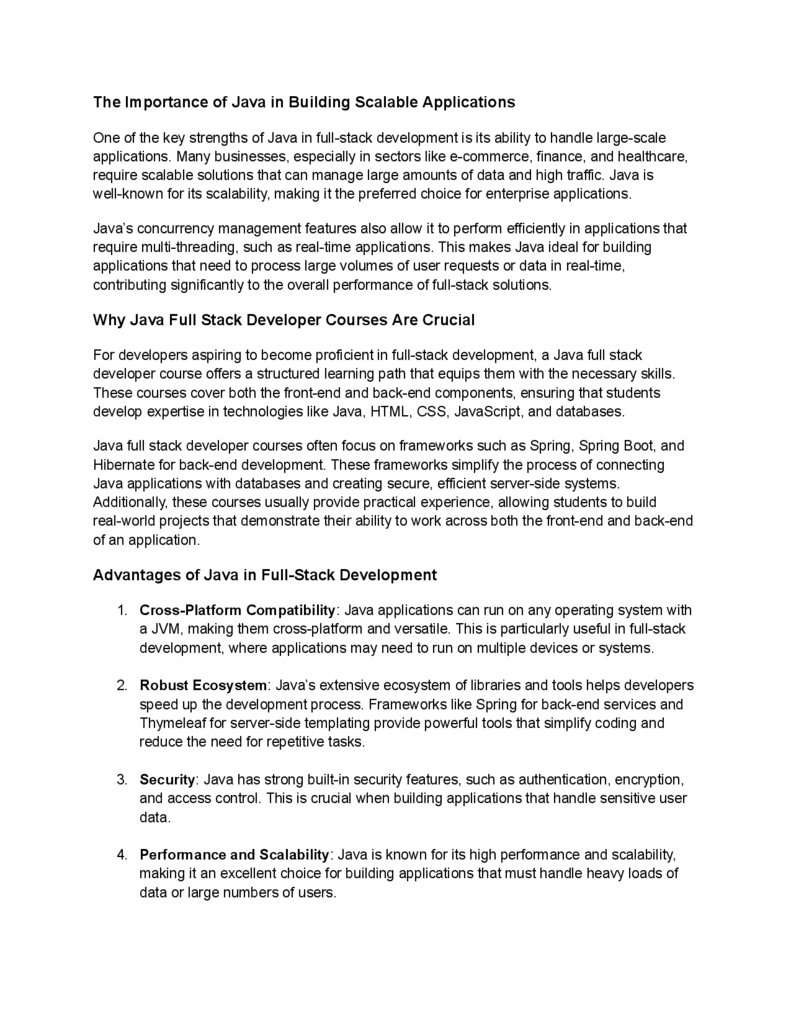
The Importance of Java in Building Scalable ApplicationsOne of the key strengths of Java in full-stack development is its ability to handle large-scale
applications. Many businesses, especially in sectors like e-commerce, finance, and healthcare,
require scalable solutions that can manage large amounts of data and high traffic. Java is
well-known for its scalability, making it the preferred choice for enterprise applications.
Java’s concurrency management features also allow it to perform efficiently in applications that
require multi-threading, such as real-time applications. This makes Java ideal for building
applications that need to process large volumes of user requests or data in real-time,
contributing significantly to the overall performance of full-stack solutions.
Why Java Full Stack Developer Courses Are Crucial
For developers aspiring to become proficient in full-stack development, a Java full stack
developer course offers a structured learning path that equips them with the necessary skills.
These courses cover both the front-end and back-end components, ensuring that students
develop expertise in technologies like Java, HTML, CSS, JavaScript, and databases.
Java full stack developer courses often focus on frameworks such as Spring, Spring Boot, and
Hibernate for back-end development. These frameworks simplify the process of connecting
Java applications with databases and creating secure, efficient server-side systems.
Additionally, these courses usually provide practical experience, allowing students to build
real-world projects that demonstrate their ability to work across both the front-end and back-end
of an application.
Advantages of Java in Full-Stack Development
1. Cross-Platform Compatibility: Java applications can run on any operating system with
a JVM, making them cross-platform and versatile. This is particularly useful in full-stack
development, where applications may need to run on multiple devices or systems.
2. Robust Ecosystem: Java’s extensive ecosystem of libraries and tools helps developers
speed up the development process. Frameworks like Spring for back-end services and
Thymeleaf for server-side templating provide powerful tools that simplify coding and
reduce the need for repetitive tasks.
3. Security: Java has strong built-in security features, such as authentication, encryption,
and access control. This is crucial when building applications that handle sensitive user
data.
4. Performance and Scalability: Java is known for its high performance and scalability,
making it an excellent choice for building applications that must handle heavy loads of
data or large numbers of users.
3.
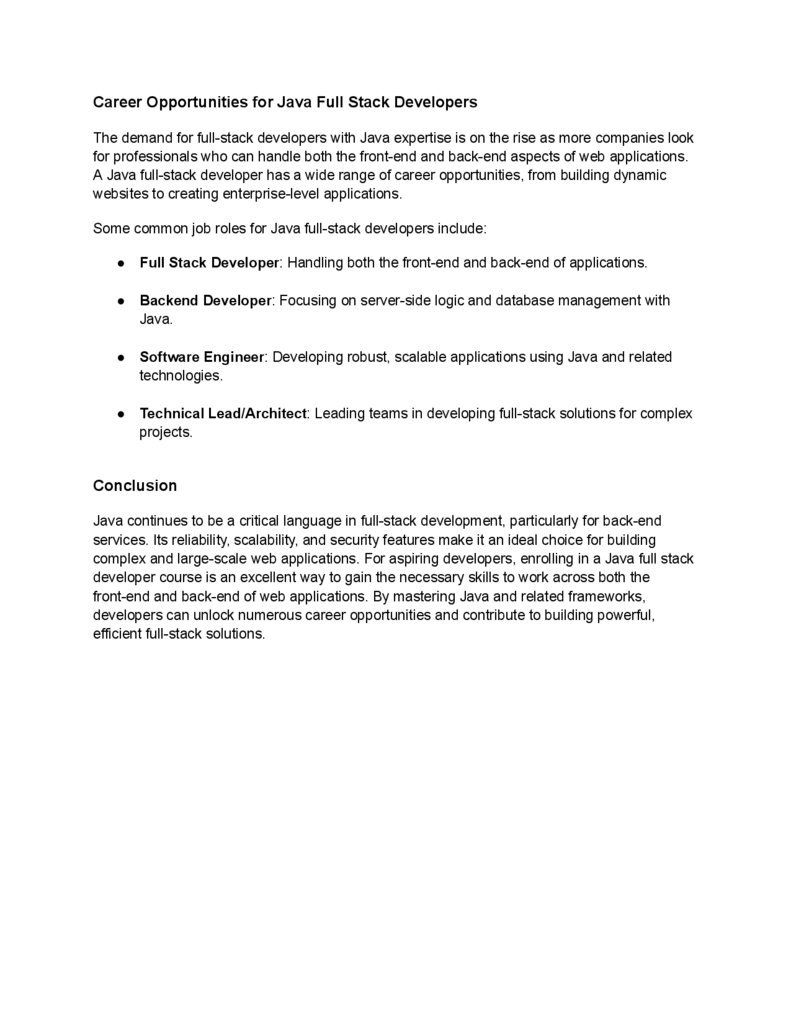
Career Opportunities for Java Full Stack DevelopersThe demand for full-stack developers with Java expertise is on the rise as more companies look
for professionals who can handle both the front-end and back-end aspects of web applications.
A Java full-stack developer has a wide range of career opportunities, from building dynamic
websites to creating enterprise-level applications.
Some common job roles for Java full-stack developers include:
● Full Stack Developer: Handling both the front-end and back-end of applications.
● Backend Developer: Focusing on server-side logic and database management with
Java.
● Software Engineer: Developing robust, scalable applications using Java and related
technologies.
● Technical Lead/Architect: Leading teams in developing full-stack solutions for complex
projects.
Conclusion
Java continues to be a critical language in full-stack development, particularly for back-end
services. Its reliability, scalability, and security features make it an ideal choice for building
complex and large-scale web applications. For aspiring developers, enrolling in a Java full stack
developer course is an excellent way to gain the necessary skills to work across both the
front-end and back-end of web applications. By mastering Java and related frameworks,
developers can unlock numerous career opportunities and contribute to building powerful,
efficient full-stack solutions.