

 Английский язык
Похожие презентации:



Lecture 1
1.
Lecture 1Prepared by Mukhtarova
N.K.
2.
Plan:THEORETICAL PART: What is phonetics?
Classification of sounds
Features of articulation
Transcription symbols
PRACTICAL PART: Basic phonetics(video):
International Phonetic Alphabet
Schwa sound
Quiz time
3.
What is phonetics?Phonetics
(from the Greek word, phone which
means 'sound' or 'voice')is
the science of the sounds of
human speech.
Someone who is an expert in
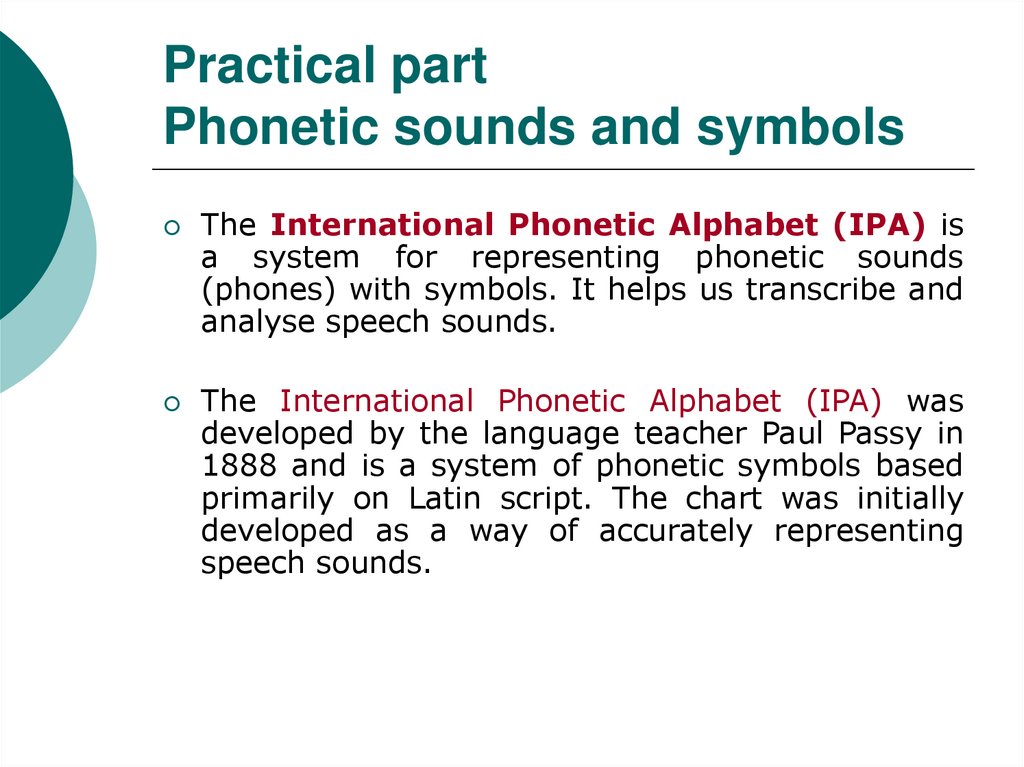
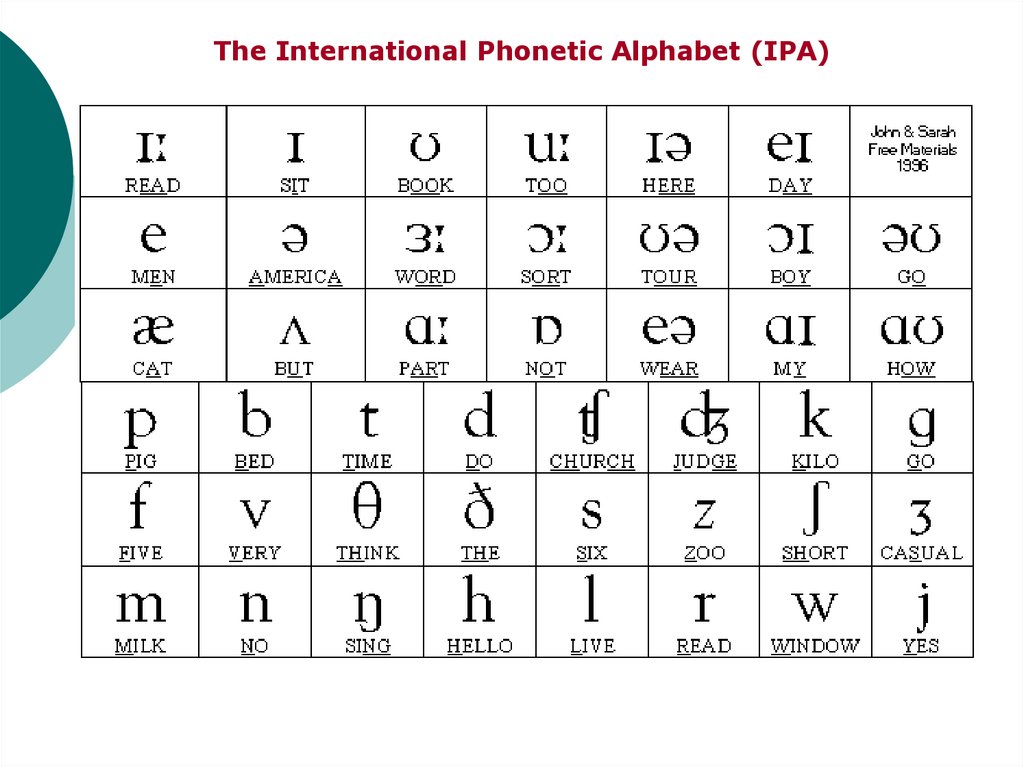
phonetics is called a phonetician.
4.
The science of phonetics aims to describe all thesounds of all the world’s languages
Articulatory phonetics: the production
of speech sounds
Acoustic phonetics: the physical way
speech sounds travel
Auditory phonetics: the way people
perceive speech sounds
5.
Articulatory phoneticsDefinition: The study of how
humans use their speech organs
to produce specific sounds.
6.
Articulatoryphonetics
is
concerned with the way sounds are
created and aims to explain how we
move
our
speech
organs
(articulators) to produce certain
sounds.
Generally speaking, articulatory
phonetics looks at how aerodynamic
energy (airflow through the vocal
tract) is transformed into acoustic
energy (sound).
7.
Humans can produce sound simply by expellingair from the lungs; however, we can produce
(and pronounce) a large number of different
sounds by moving and manipulating our speech
organs (articulators).
Our speech organs are:
Lips
Teeth
Tongue
Palate
Uvula (the teardrop-shaped soft tissue that
hangs at the back of your throat)
Nasal and oral cavities
Vocal cords
8.
Pronunciation in phoneticsUsually, two speech organs make
contact with each other to affect the
airflow and create a sound. The point
where the two speech organs make
the most contact is named the place
of articulation.
The way in which the contact forms
and then releases is named
the manner of articulation.
9.
Let's look at the [p] sound as anexample.
Example:
To produce the [p] sound, we join our lips
together tightly (place of articulation). This
causes a slight build-up of air, which is then
released when the lips part (manner of
articulation), creating a burst of sound
associated with the letter P in English.
10.
In English, there are two main sounds wecreate: consonants and vowels.
“A consonant is a speech sound which is pronounced by
stopping the air from flowing easily through the mouth,
especially by closing the lips or touching the teeth with
the tongue”.
(Cambridge Advanced Learner’s Dictionary)
11.
The study of the production ofconsonant sounds can be divided
into three areas:
voice, place of
articulation, and manner of
articulation.
12.
VoiceIn articulatory phonetics, voice refers to the presence or
absence of vibration of the vocal cords.
There are two types of sound:
Voiceless sounds - These are made when the air passes
through the vocal folds, with no vibration during the
production of sounds, like [s] as in sip.
Voiced sounds - These are made when the air passes
through the vocal folds, with vibration during the
production of sounds like [z] as in zip.
13.
Place of ArticulationThe place of articulation refers to the point where the
construction of airflow takes place
Bilabial - Sounds produced with both lips, such as
[p], [b], [m].
Labiodentals - Sounds produced with the upper
teeth and the lower lip, such as [f] and [v].
Interdental - Sounds produced with the tongue
in between the upper and lower teeth, such as [θ]
(the 'th' sound in think).
14.
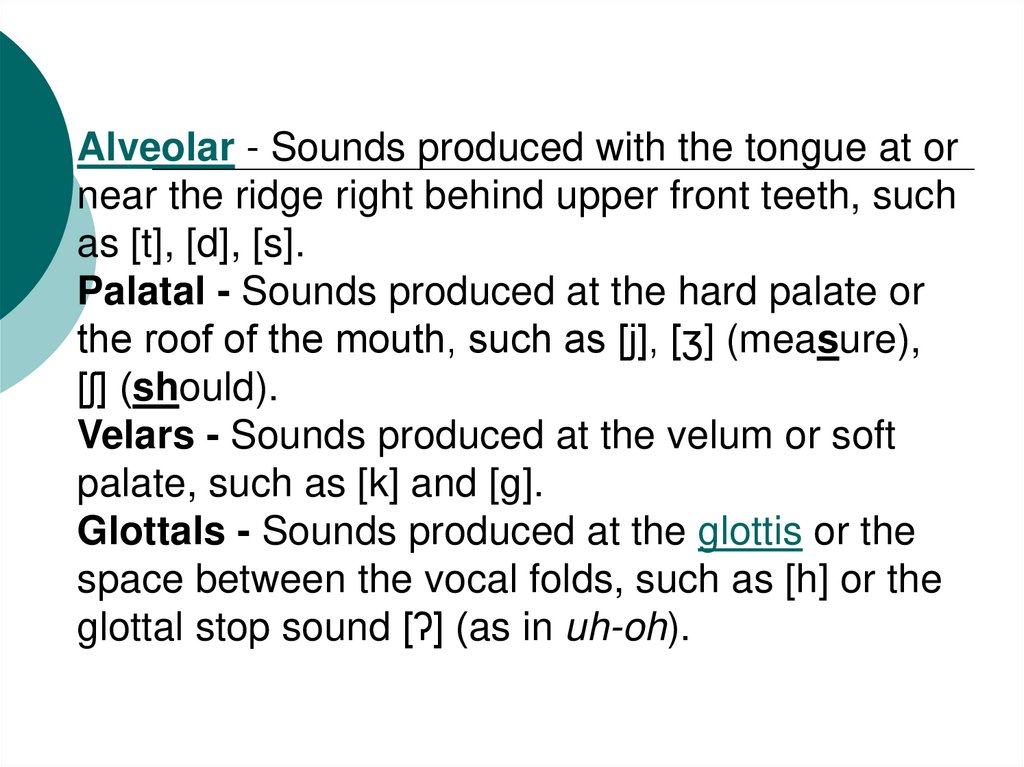
Alveolar - Sounds produced with the tongue at ornear the ridge right behind upper front teeth, such
as [t], [d], [s].
Palatal - Sounds produced at the hard palate or
the roof of the mouth, such as [j], [ʒ] (measure),
[ʃ] (should).
Velars - Sounds produced at the velum or soft
palate, such as [k] and [g].
Glottals - Sounds produced at the glottis or the
space between the vocal folds, such as [h] or the
glottal stop sound [ʔ] (as in uh-oh).
15.
Manner of ArticulationManner of articulation examines the
arrangement and interaction
between the articulators (speech
organs) during the production of
speech sounds..
In phonetics, speech sounds can be
divided into five different types
based on the manner of articulation.
16.
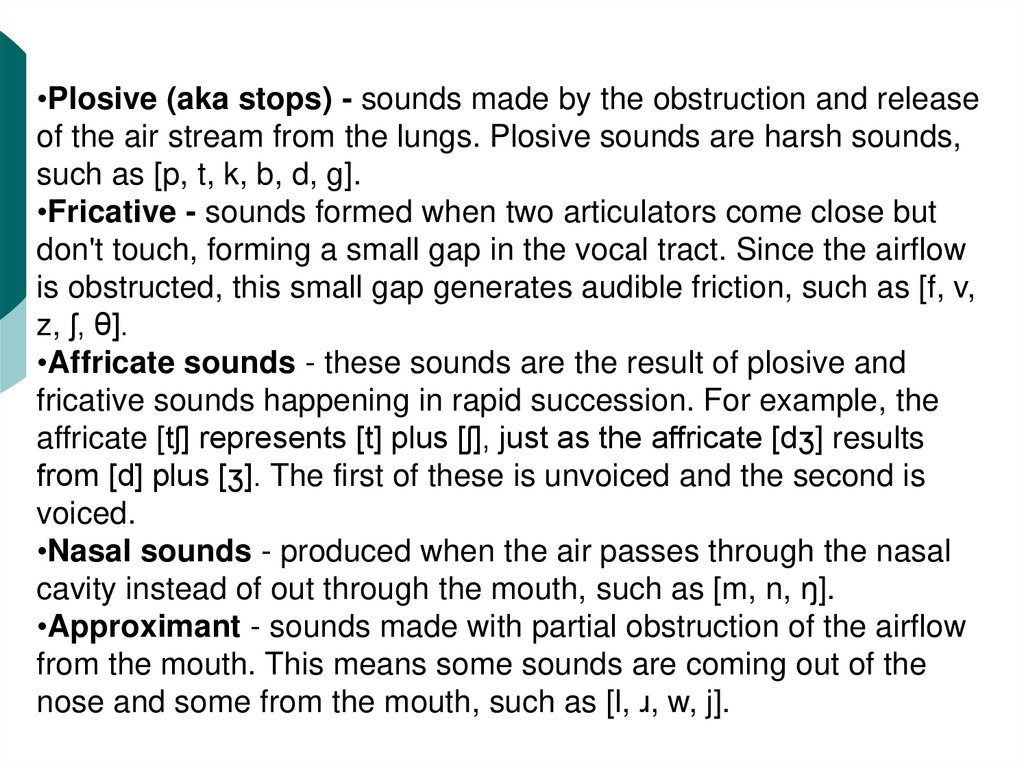
•Plosive (aka stops) - sounds made by the obstruction and releaseof the air stream from the lungs. Plosive sounds are harsh sounds,
such as [p, t, k, b, d, g].
•Fricative - sounds formed when two articulators come close but
don't touch, forming a small gap in the vocal tract. Since the airflow
is obstructed, this small gap generates audible friction, such as [f, v,
z, ʃ, θ].
•Affricate sounds - these sounds are the result of plosive and
fricative sounds happening in rapid succession. For example, the
affricate [tʃ] represents [t] plus [ʃ], just as the affricate [dʒ] results
from [d] plus [ʒ]. The first of these is unvoiced and the second is
voiced.
•Nasal sounds - produced when the air passes through the nasal
cavity instead of out through the mouth, such as [m, n, ŋ].
•Approximant - sounds made with partial obstruction of the airflow
from the mouth. This means some sounds are coming out of the
nose and some from the mouth, such as [l, ɹ, w, j].
17.
Vowels“A vowel is a speech sound produced
when the breath flows out through the
mouth without being blocked by the
teeth, tongue, or lips”.
(Cambridge Learner’s Dictionary)
Linguists describe vowel sounds according
to three criteria: Height,
Backness and Roundness.
18.
Acoustic phoneticsDefinition:
The study of how speech sounds
travel, from the moment they are
produced by the speaker until they
reach the listener's ear
19.
Acoustic phonetics looks at the physicalproperties of sound, including the frequency,
intensity, and duration, and analyses how sound is
transmitted.
When sound is produced, it creates a sound
wave that travels through the acoustic medium (this is
usually the air, but it could also be water, wood, metal
etc., as sound can travel through anything except a
vacuum!). When the sound wave reaches our eardrums,
it causes them to vibrate; our auditory system then
converts these vibrations into neural impulses. We
experience these neural impulses as sound.
20.
Auditory phoneticsThe study of how people hear
speech sounds. It is concerned with
speech perception.
21.
This branch of phonetics studies the reception andresponse to speech sounds, mediated by the ears, the
auditory nerves, and the brain.
While the properties of acoustic phonetics are objectively
measurable, the auditory sensations examined in auditory
phonetics are more subjective and are typically studied
by asking listeners to report on their perceptions. Thus,
auditory phonetics studies the relationship between
speech and the listener's interpretation.
22.
Practical partPhonetic sounds and symbols
The International Phonetic Alphabet (IPA) is
a system for representing phonetic sounds
(phones) with symbols. It helps us transcribe and
analyse speech sounds.
The International Phonetic Alphabet (IPA) was
developed by the language teacher Paul Passy in
1888 and is a system of phonetic symbols based
primarily on Latin script. The chart was initially
developed as a way of accurately representing
speech sounds.
23.
The IPA aims to represent allqualities of speech and sounds
present in language, including
phones, phonemes,
intonation, gaps between sounds,
and syllables. The IPA symbols
consist of letter-like symbols,
diacritics, or both.
24.
It is important to note that the IPA is not specific to anyparticular language and can be used globally to help
language learners.
The IPA was created to help describe sounds (phones),
not phonemes; however, the chart is often used for
phonemic transcription. The IPA itself is big. Therefore,
when studying the English language, we would most likely
use a phonemic chart (based on the IPA), which only
represents the 44 English phonemes.
25.
The International Phonetic Alphabet (IPA)26.
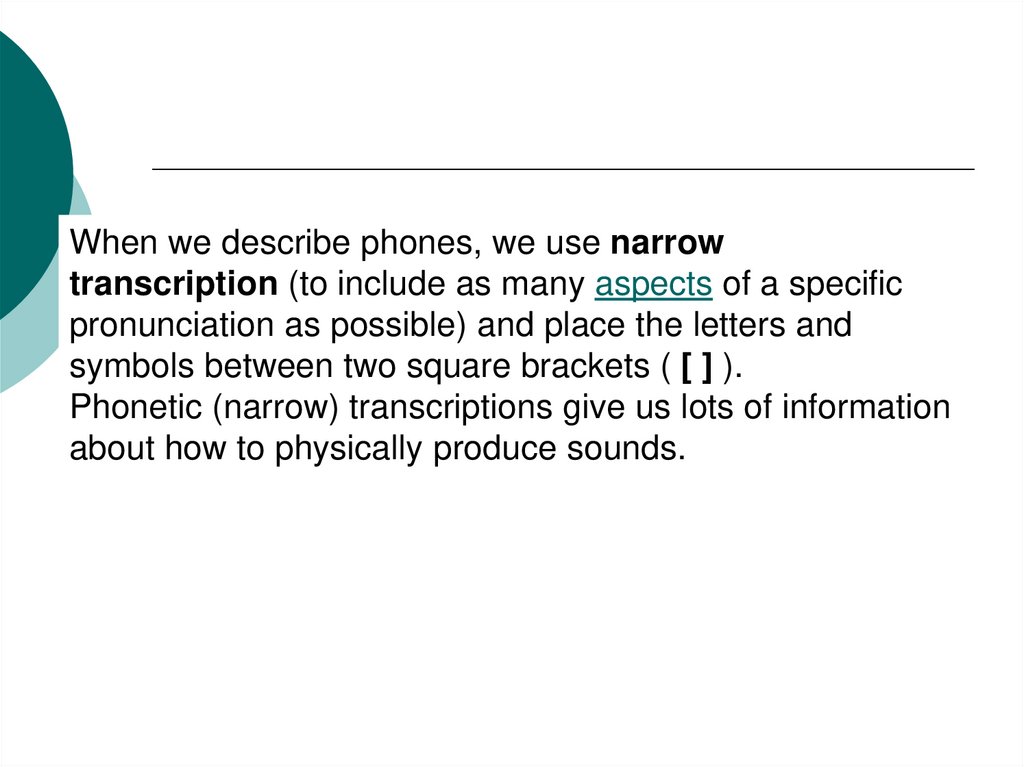
When we describe phones, we use narrowtranscription (to include as many aspects of a specific
pronunciation as possible) and place the letters and
symbols between two square brackets ( [ ] ).
Phonetic (narrow) transcriptions give us lots of information
about how to physically produce sounds.
27.
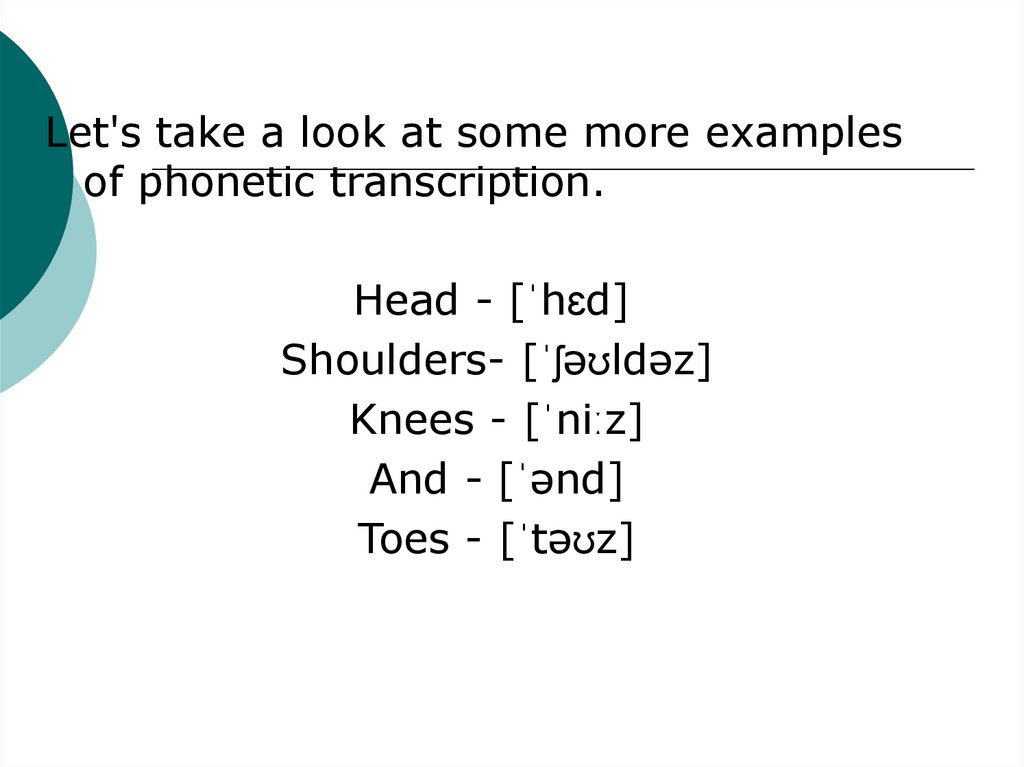
Let's take a look at some more examplesof phonetic transcription.
Head - [ˈhɛd]
Shoulders- [ˈʃəʊldəz]
Knees - [ˈniːz]
And - [ˈənd]
Toes - [ˈtəʊz]
28.
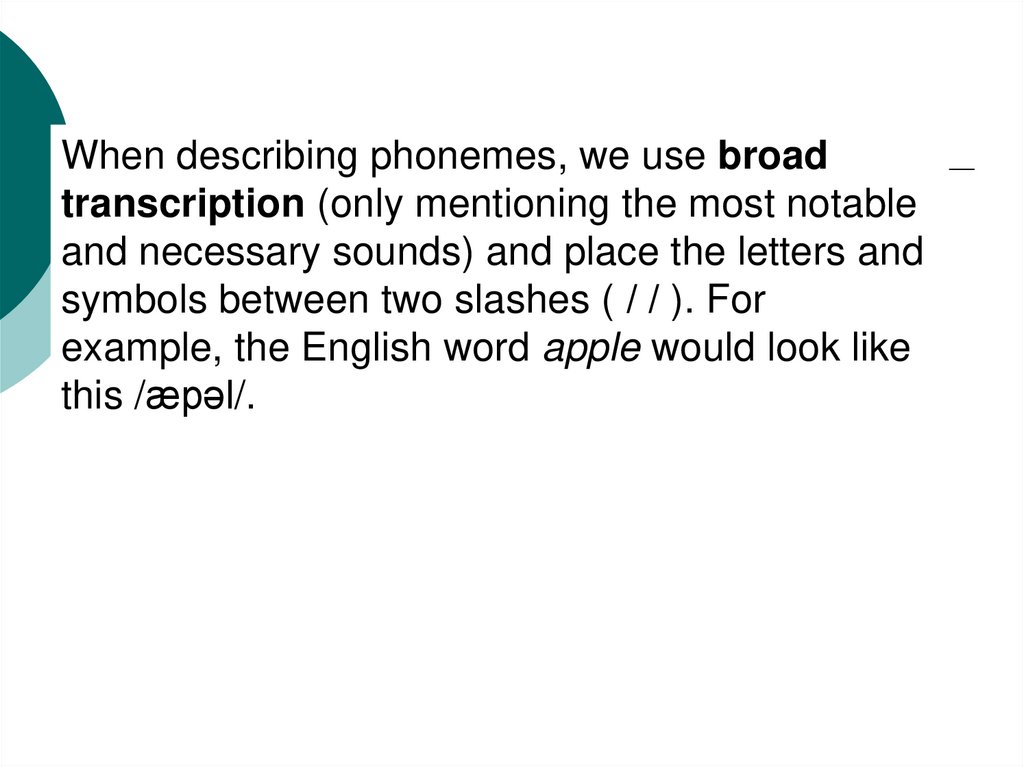
When describing phonemes, we use broadtranscription (only mentioning the most notable
and necessary sounds) and place the letters and
symbols between two slashes ( / / ). For
example, the English word apple would look like
this /æpəl/.
29.
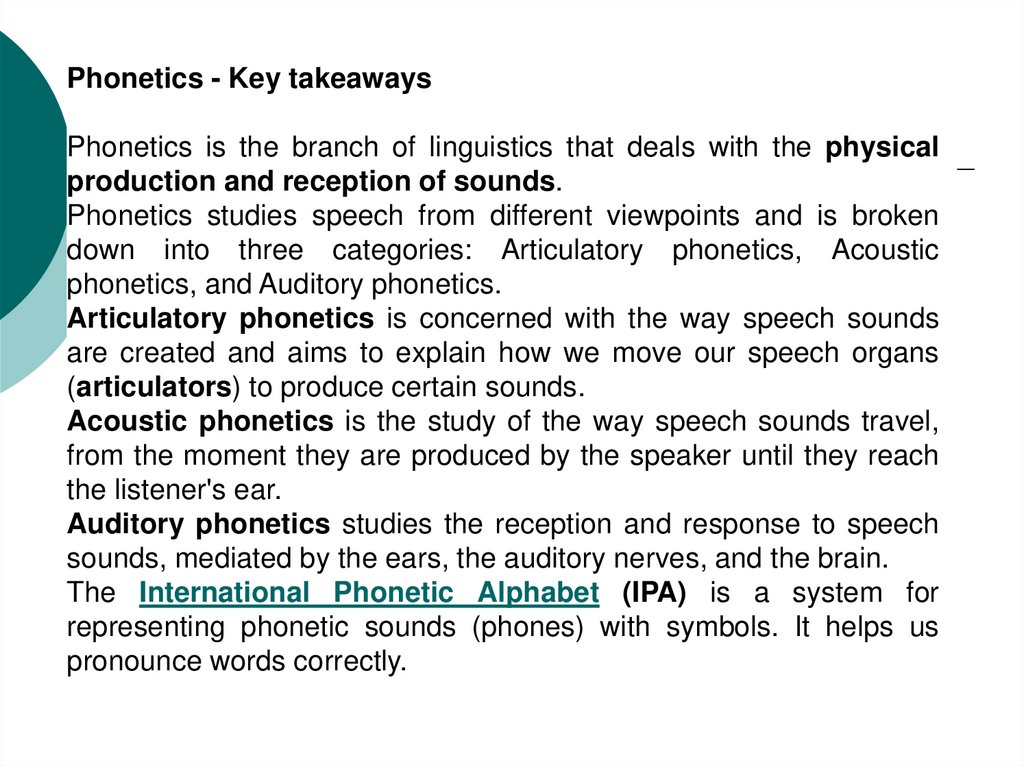
Phonetics - Key takeawaysPhonetics is the branch of linguistics that deals with the physical
production and reception of sounds.
Phonetics studies speech from different viewpoints and is broken
down into three categories: Articulatory phonetics, Acoustic
phonetics, and Auditory phonetics.
Articulatory phonetics is concerned with the way speech sounds
are created and aims to explain how we move our speech organs
(articulators) to produce certain sounds.
Acoustic phonetics is the study of the way speech sounds travel,
from the moment they are produced by the speaker until they reach
the listener's ear.
Auditory phonetics studies the reception and response to speech
sounds, mediated by the ears, the auditory nerves, and the brain.
The International Phonetic Alphabet (IPA) is a system for
representing phonetic sounds (phones) with symbols. It helps us
pronounce words correctly.
30.
ReferencesVideo links to practice IPA and schwa
letters:
https://youtu.be/ugppjNn8uIE?feature=shar
ed
https://youtu.be/hMbL3PoQJ_0?feature=sh
ared