


 Английский язык
Похожие презентации:




The Present Simple and the Present Continuous Tenses
1.
Monday,the eighth of SeptemberClass Work
English
Lesson
4
All about me
2.
The Present Simple andthe Present Continuous Tenses
3.
The Present Simple or Present Continuous Tense?Теперішній неозначений чи теперішній тривалий час?
The Present Simple Tense
The Present Simple Tense
уживається на позначення
постійних станів або дій,
що регулярно повторюються.
She cooks dinner every day.
4.
The Present Simple or Present Continuous Tense?Теперішній неозначений чи теперішній тривалий час?
The Present Simple Tense
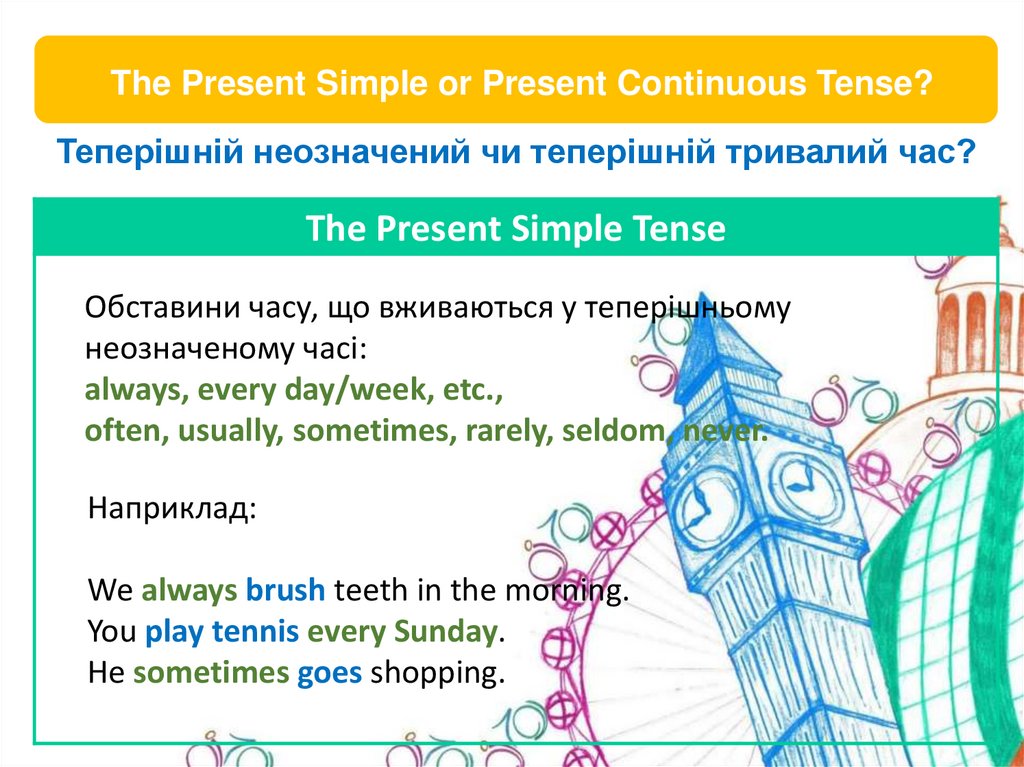
Обставини часу, що вживаються у теперішньому
неозначеному часі:
always, every day/week, etc.,
often, usually, sometimes, rarely, seldom, never.
Наприклад:
We always brush teeth in the morning.
You play tennis every Sunday.
He sometimes goes shopping.
5.
6.
The Present Simple or Present Continuous Tense?Теперішній неозначений чи теперішній тривалий час?
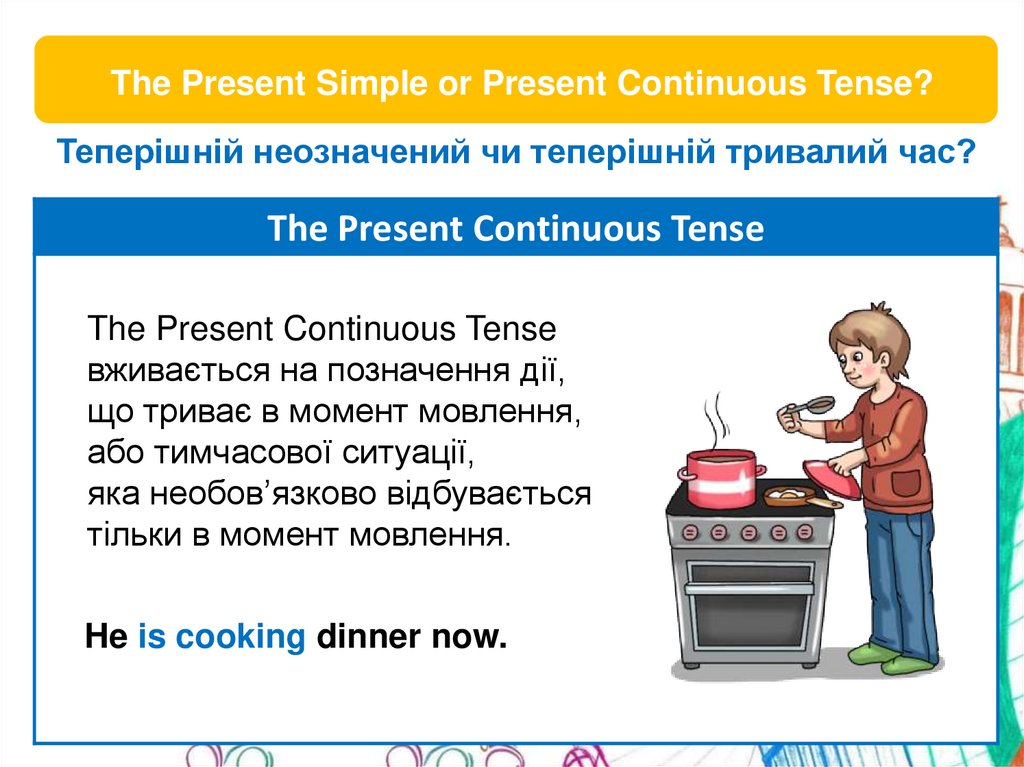
The Present Continuous Tense
The Present Continuous Tense
вживається на позначення дії,
що триває в момент мовлення,
або тимчасової ситуації,
яка необов’язково відбувається
тільки в момент мовлення.
He is cooking dinner now.
7.
The Present Simple or Present Continuous Tense?Теперішній неозначений чи теперішній тривалий час?
The Present Continuous Tense
Обставини часу, що вживаються у теперішньому тривалому
часі:
now, today, at the moment, these days.
Наприклад:
She is cleaning her room now.
They are preparing for the exams these days.
You are playing tennis at the moment.
8.
9.
The Present Simple or Present Continuous Tense?Теперішній неозначений чи теперішній тривалий час?
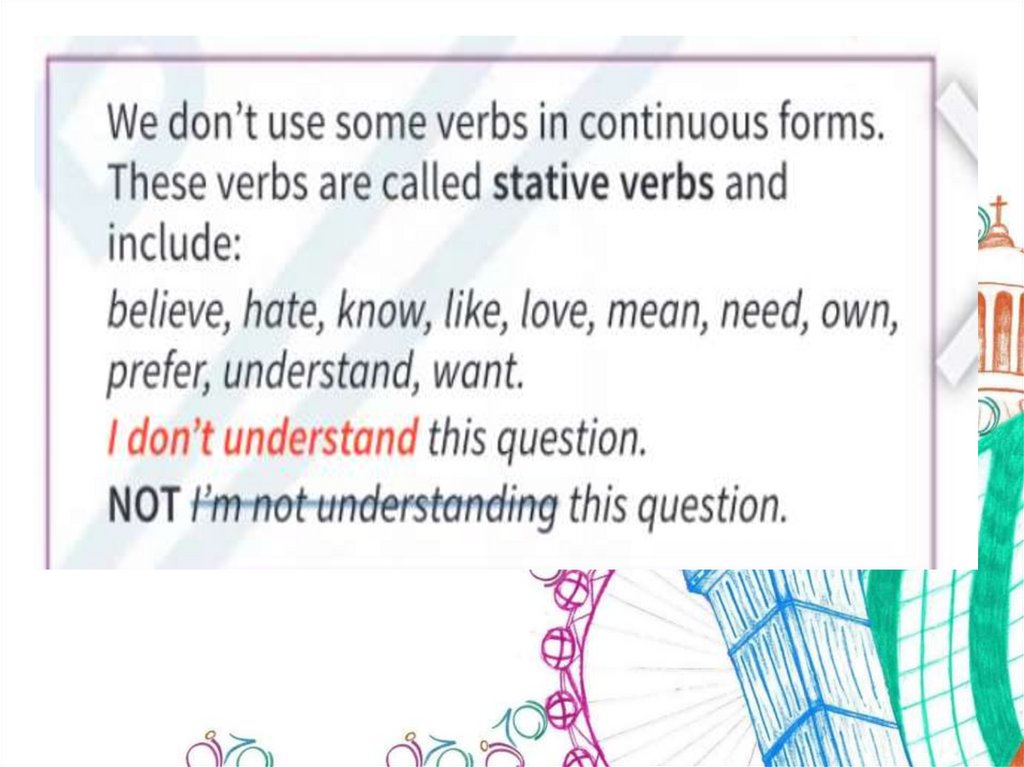
Запам’ятайте дієслова, які переважно не вживаються у the
Present Continuous Tense. Вони вживаються
у the Present Simple Tense:
see, hear, like, love, hate, want, think, believe, understand,
remember, forget, need.
Наприклад:
I see my friend on the playground.
She wants to buy a present for her mother.
10.
11.
Choose the correct sentence.She likes playing the piano.
She is liking playing the piano.
12.
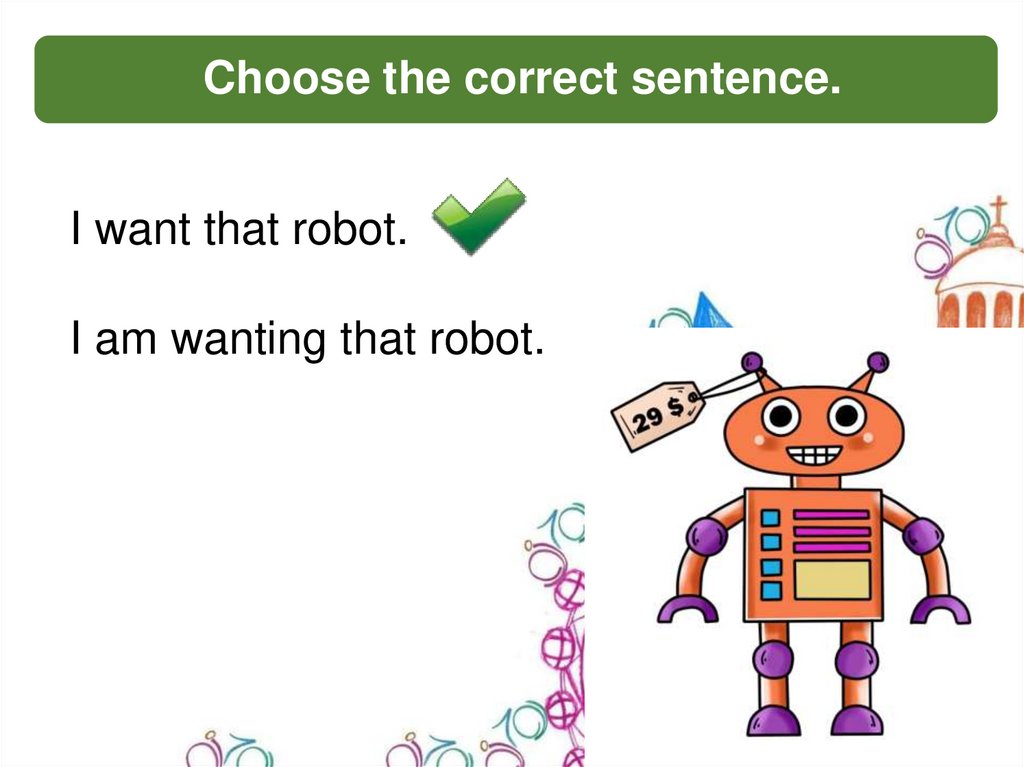
Choose the correct sentence.I want that robot.
I am wanting that robot.
13.
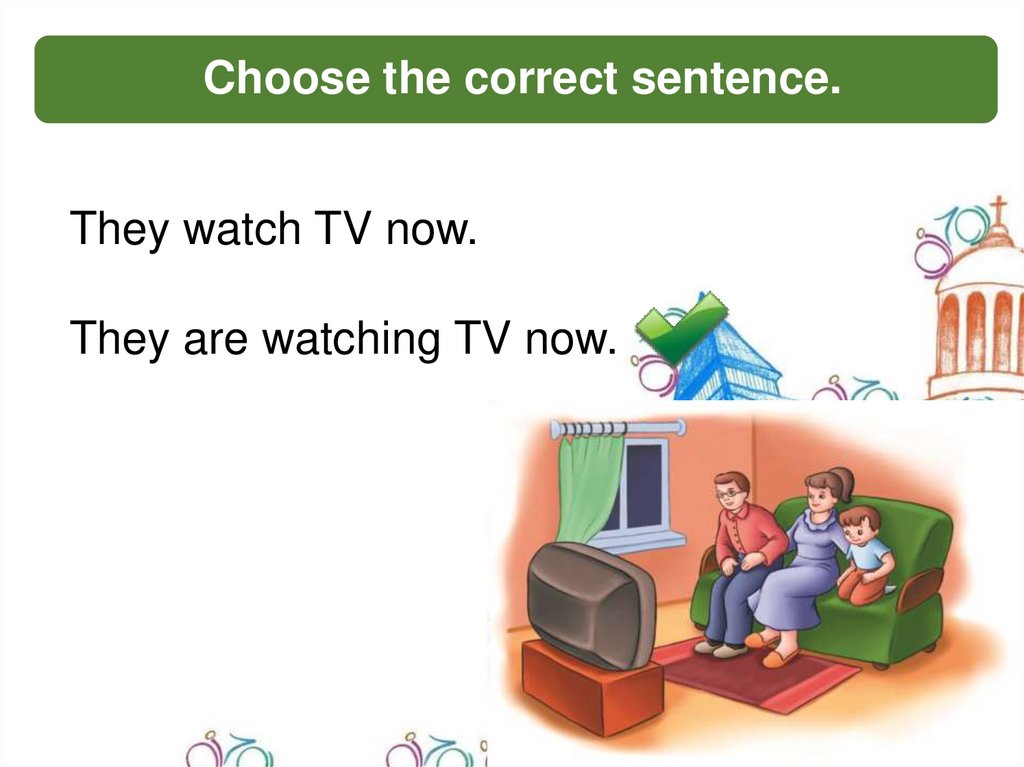
Choose the correct sentence.They watch TV now.
They are watching TV now.
14.
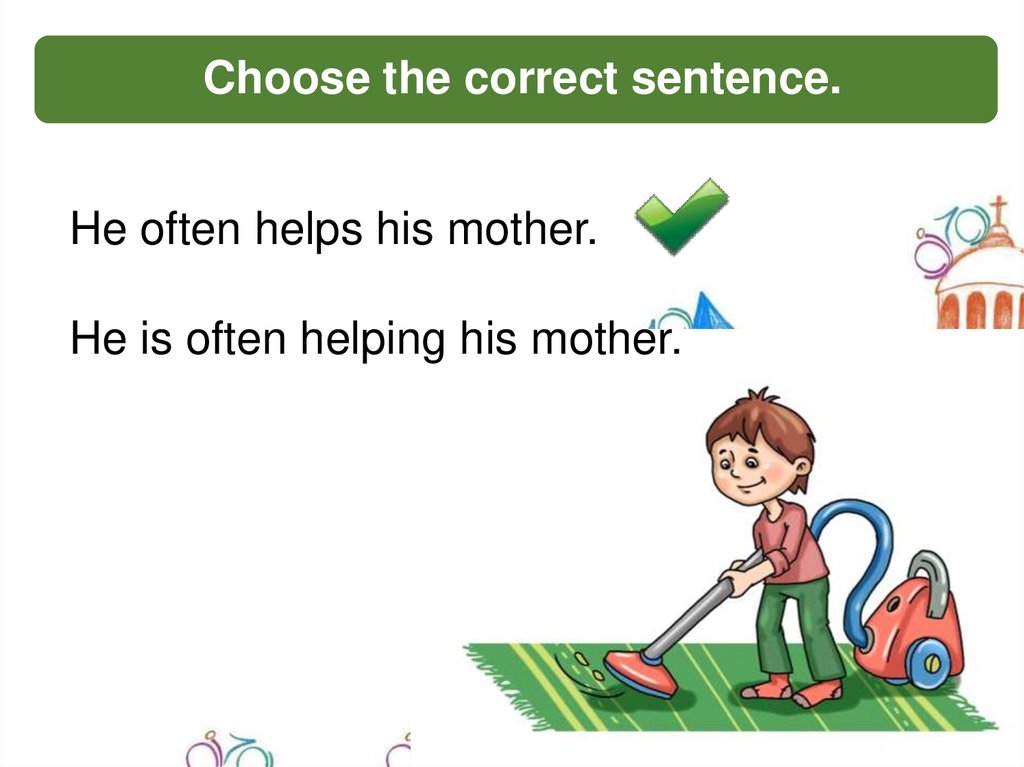
Choose the correct sentence.He often helps his mother.
He is often helping his mother.
15.
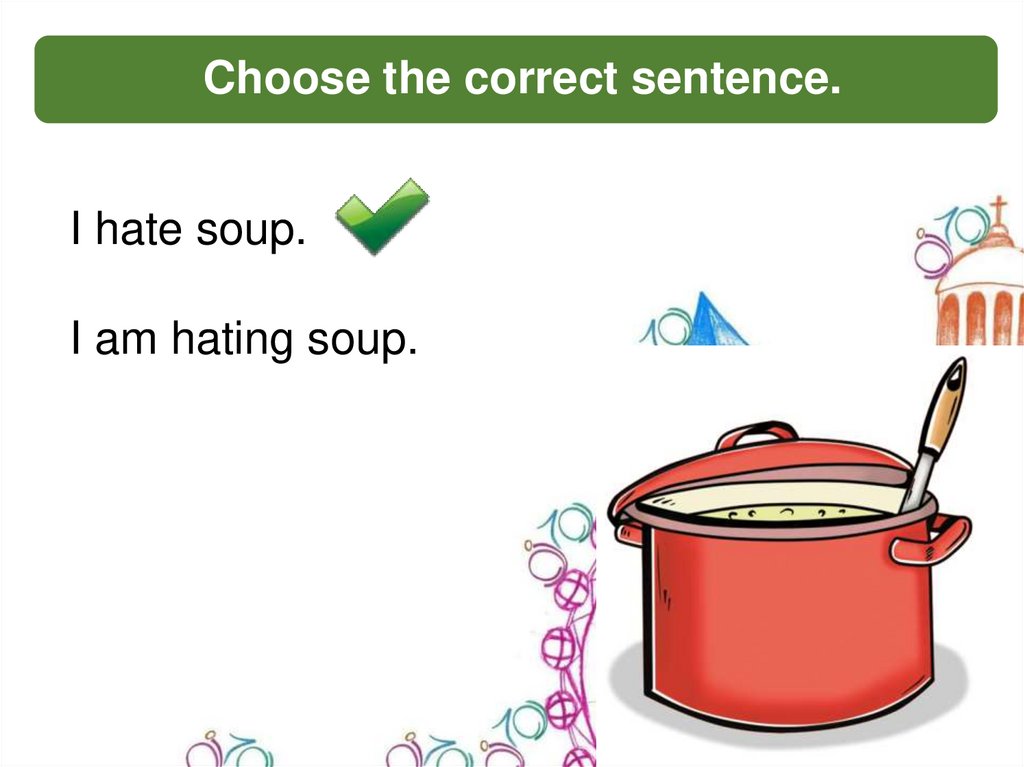
Choose the correct sentence.I hate soup.
I am hating soup.
16.
https://www.liveworksheets.com/worksheet/en/esl-grammar/45383
https://wordwall.net/uk/resource/62527421/
%d0%b0%d0%bd%d0%b3%d0%bb%d1%
96%d0%b9%d1%81%d1%8c%d0%ba%d0
%b0/present-sim-or-pres-cont
17.
18.
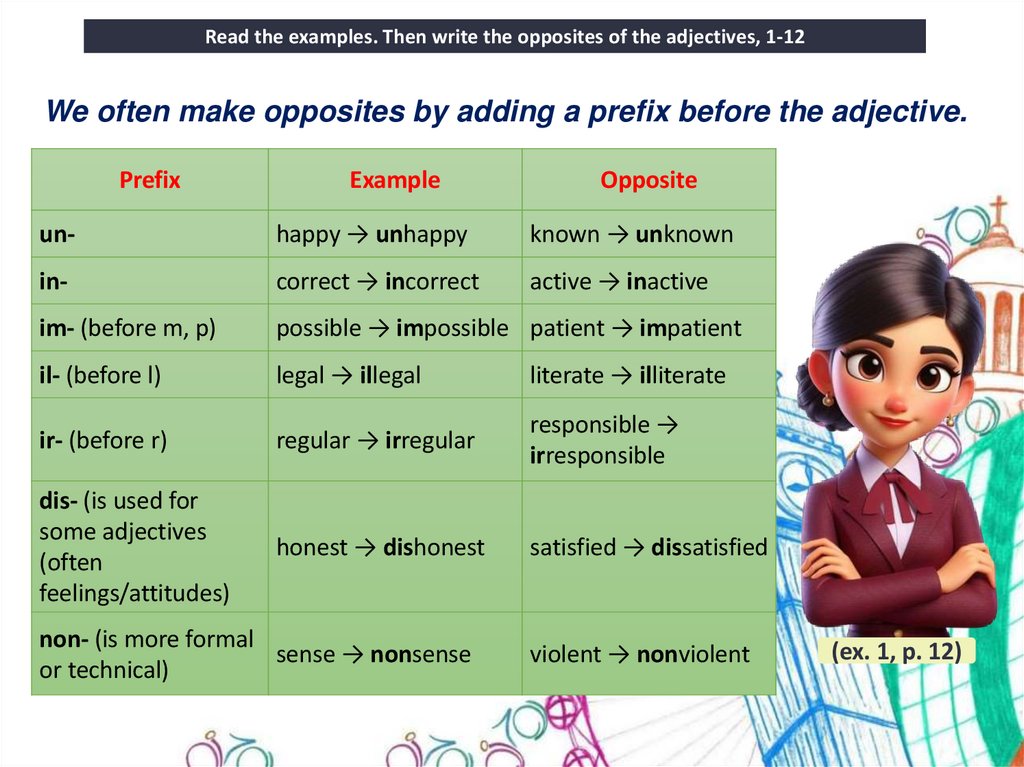
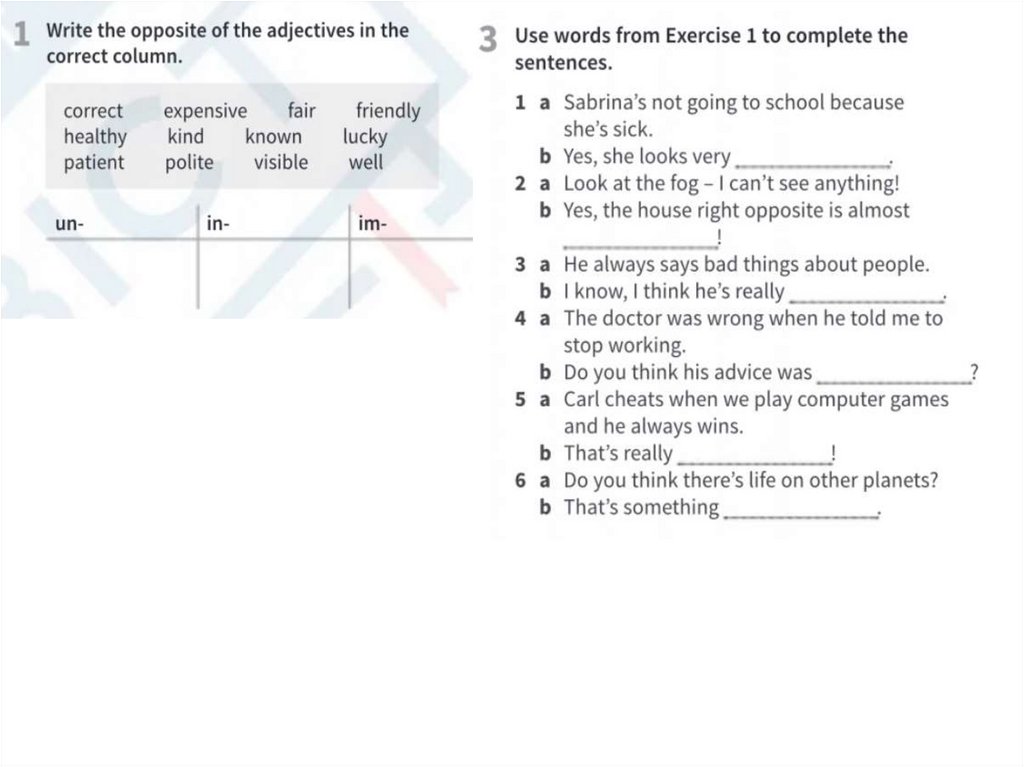
Read the examples. Then write the opposites of the adjectives, 1-12We often make opposites by adding a prefix before the adjective.
Prefix
Example
Opposite
un-
happy → unhappy
known → unknown
in-
correct → incorrect
active → inactive
im- (before m, p)
possible → impossible patient → impatient
il- (before l)
legal → illegal
literate → illiterate
ir- (before r)
regular → irregular
responsible →
irresponsible
dis- (is used for
some adjectives
(often
feelings/attitudes)
honest → dishonest
satisfied → dissatisfied
non- (is more formal
sense → nonsense
or technical)
violent → nonviolent
(ex. 1, p. 12)
19.
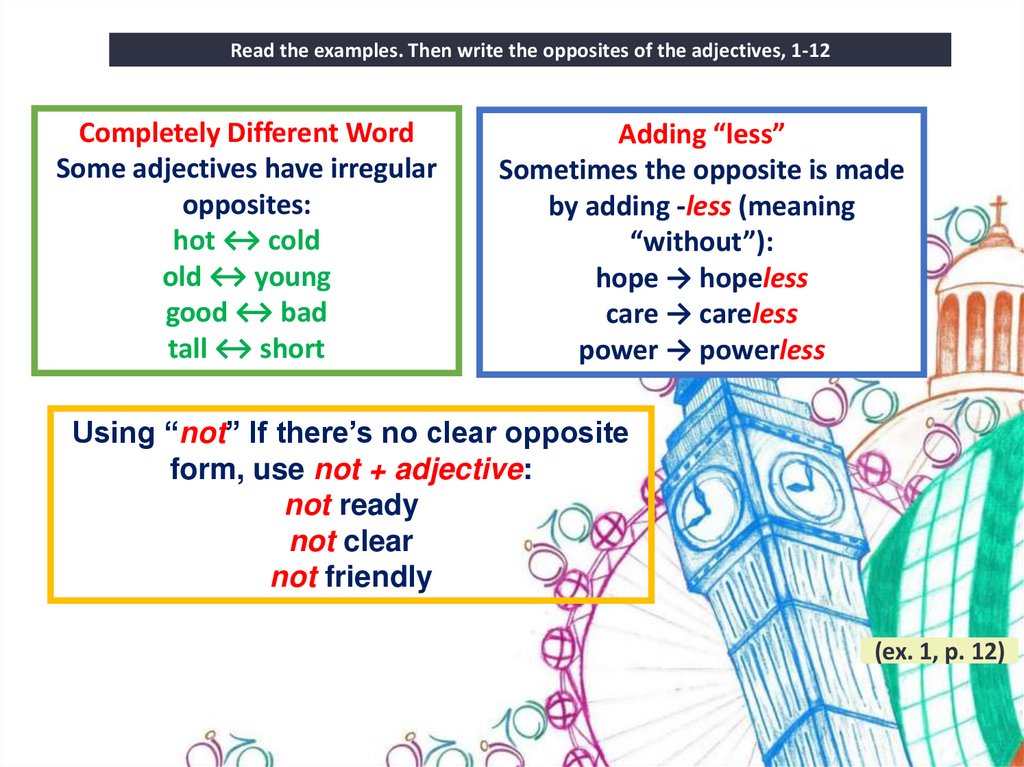
Read the examples. Then write the opposites of the adjectives, 1-12Completely Different Word
Some adjectives have irregular
opposites:
hot ↔ cold
old ↔ young
good ↔ bad
tall ↔ short
Adding “less”
Sometimes the opposite is made
by adding -less (meaning
“without”):
hope → hopeless
care → careless
power → powerless
Using “not” If there’s no clear opposite
form, use not + adjective:
not ready
not clear
not friendly
(ex. 1, p. 12)
20.
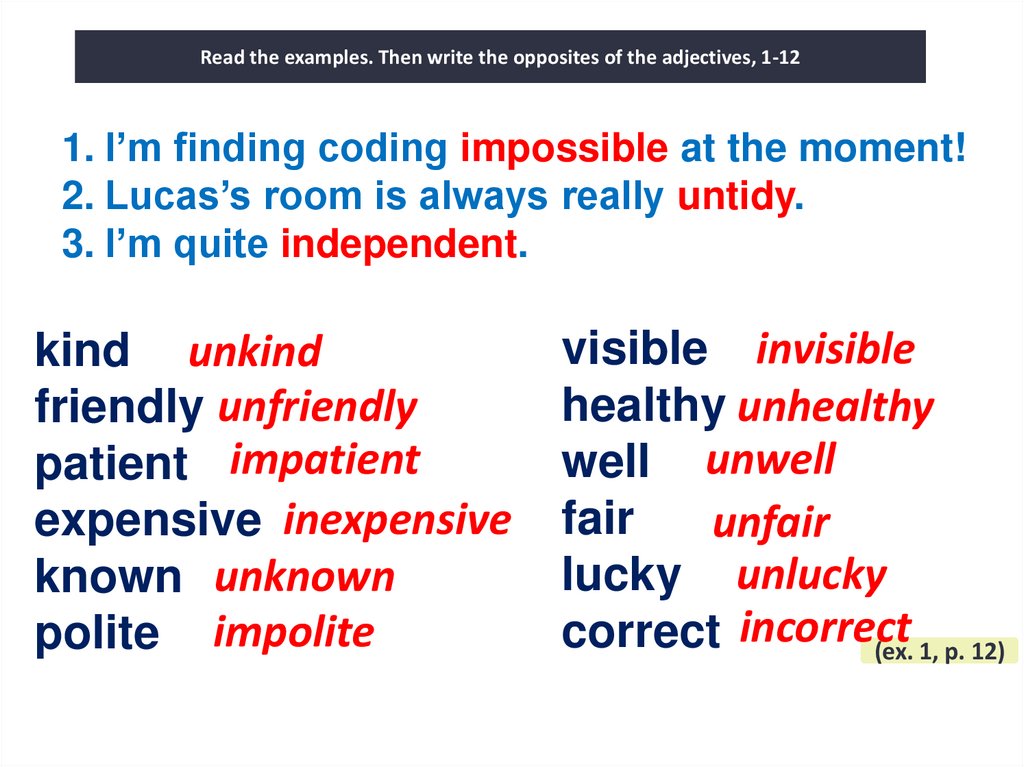
Read the examples. Then write the opposites of the adjectives, 1-121. I’m finding coding impossible at the moment!
2. Lucas’s room is always really untidy.
3. I’m quite independent.
kind unkind
friendly unfriendly
patient impatient
expensive inexpensive
known unknown
polite impolite
visible invisible
healthy unhealthy
well unwell
fair
unfair
lucky unlucky
correct incorrect
(ex. 1, p. 12)
21.
Student’s BookStudent’s Book
(ex. 2, p. 13)
Agree with these
sentences. Use an
adjective from Ex.1 on
p.12 or its opposite
22.
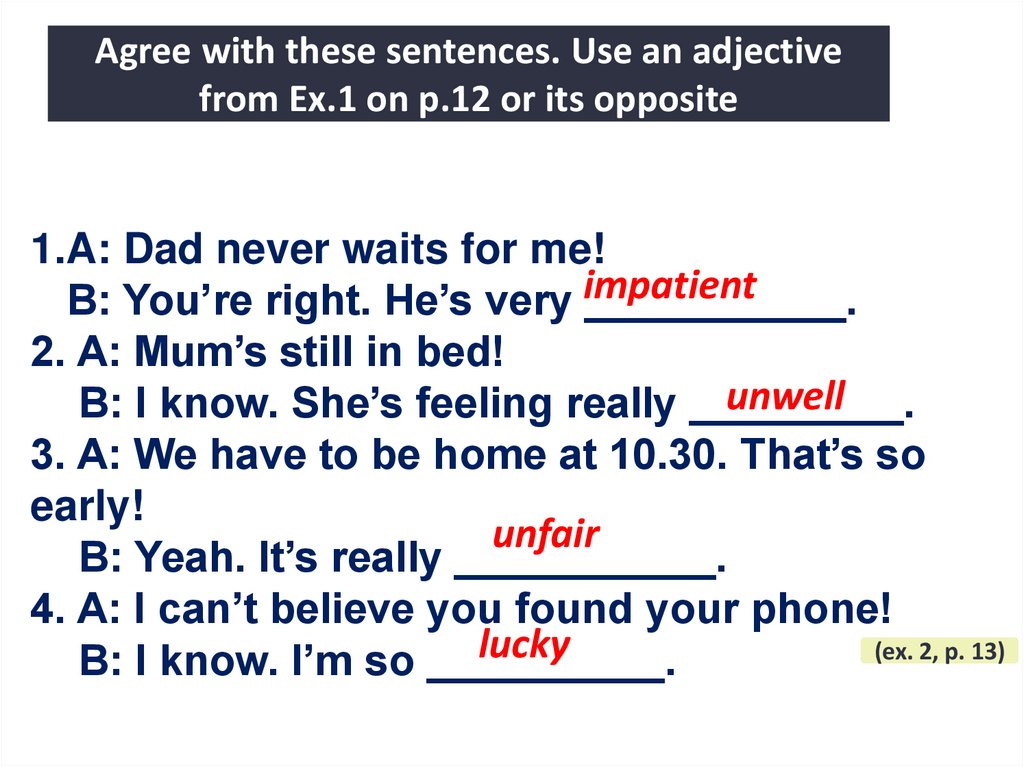
Agree with these sentences. Use an adjectivefrom Ex.1 on p.12 or its opposite
1.A: Dad never waits for me!
B: You’re right. He’s very impatient
___________.
2. A: Mum’s still in bed!
unwell
B: I know. She’s feeling really _________.
3. A: We have to be home at 10.30. That’s so
early!
unfair
B: Yeah. It’s really ___________.
4. A: I can’t believe you found your phone!
lucky
(ex. 2, p. 13)
B: I know. I’m so __________.