
 Психология
Похожие презентации:




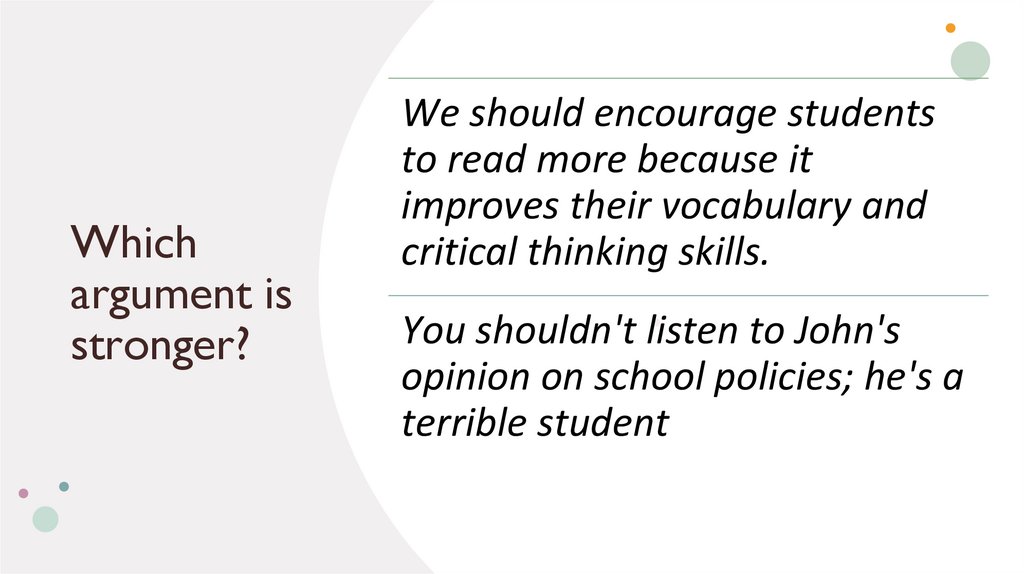
Which argument is stronger?
1.
Whichargument is
stronger?
We should encourage students
to read more because it
improves their vocabulary and
critical thinking skills.
You shouldn't listen to John's
opinion on school policies; he's a
terrible student
2.
Logical fallaciesGlobal Perspectives and Project
Work
Grade 11
3.
Learning objectives11CO2.1 select information and evidence that is relevant
to an argument or issue
4.
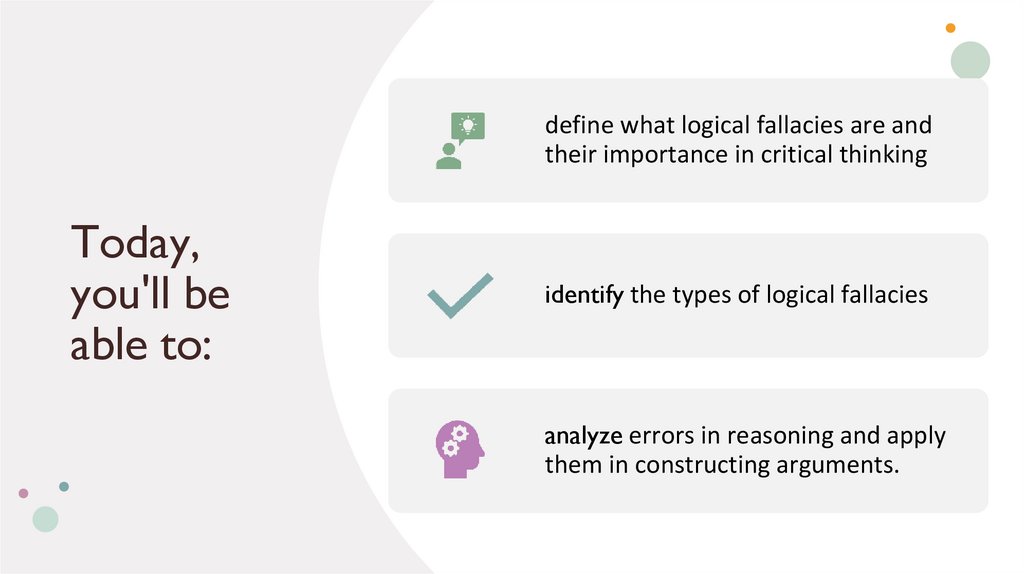
define what logical fallacies are andtheir importance in critical thinking
Today,
you'll be
able to:
identify the types of logical fallacies
analyze errors in reasoning and apply
them in constructing arguments.
5.
Assessment-
identify ⅚ logical fallacies correctly
6.
What is a logicalfallacy?
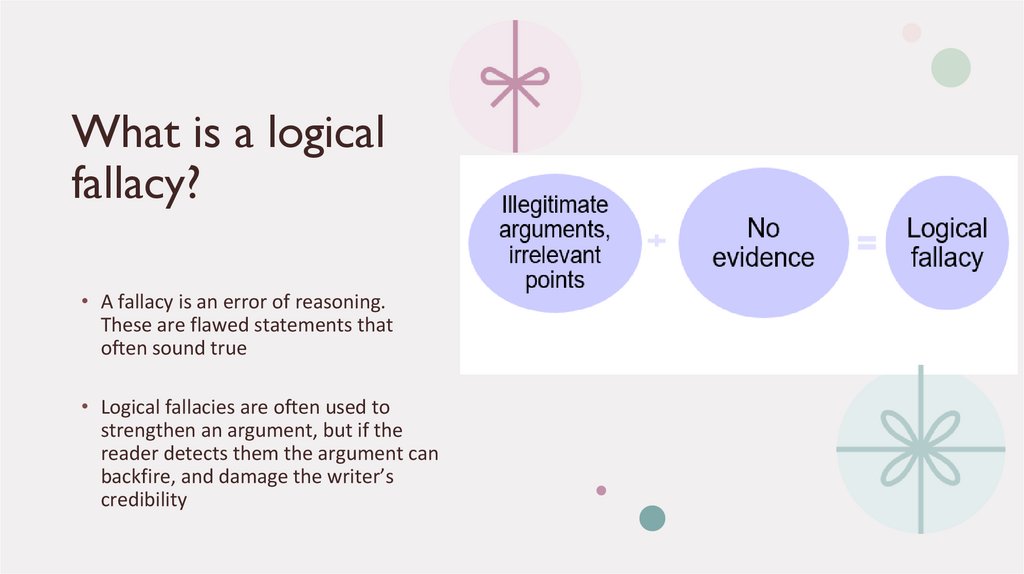
• A fallacy is an error of reasoning.
These are flawed statements that
often sound true
• Logical fallacies are often used to
strengthen an argument, but if the
reader detects them the argument can
backfire, and damage the writer’s
credibility
7.
Which argument is sound (logical and well-reasoned)and which one is faulty (contains weaknesses or flaws).
1. We need to stop using cars. Otherwise, the planet will be doomed.
2. Having all documents in print has always worked fine for us. And yet she wants
to change that.
3. My wife reads a lot of books about healthy living and she says that drinking
coffee is bad for you.
4. If you don’t do your homework, you’ll fail the course. And if you fail, you won’t
graduate. This, in turn, will lead to limited job prospects, and eventually, a life of
poverty.
5. You voted for Mr. Smith regardless of the fact that he won’t allocate more funds
for education? You must hate children.
6. Since you’ve never been a CEO, I don’t think your opinions about business
matter.
8.
Watch the video and complete the table9.
Go back to the argumentsyou analysed before and
identify and name the type
of logical fallacy for each
argument.
Answer key:
1. false dilemma
2. appeal to tradition
3. authoritative argument
4. slippery slope
5. strawman argument
6. personal attack
10.
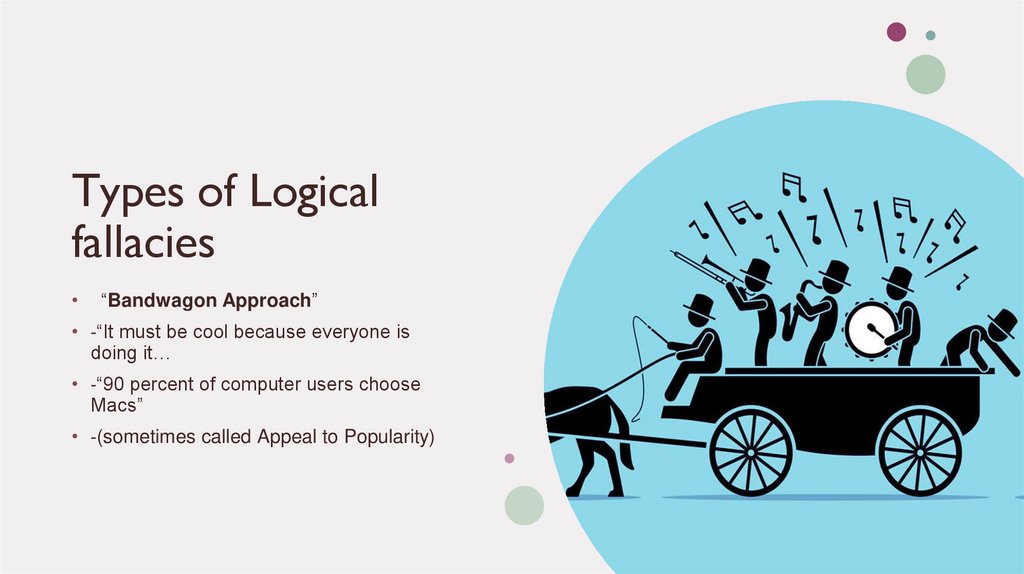
Types of Logicalfallacies
“Bandwagon Approach”
• -“It must be cool because everyone is
doing it…
• -“90 percent of computer users choose
Macs”
• -(sometimes called Appeal to Popularity)
11.
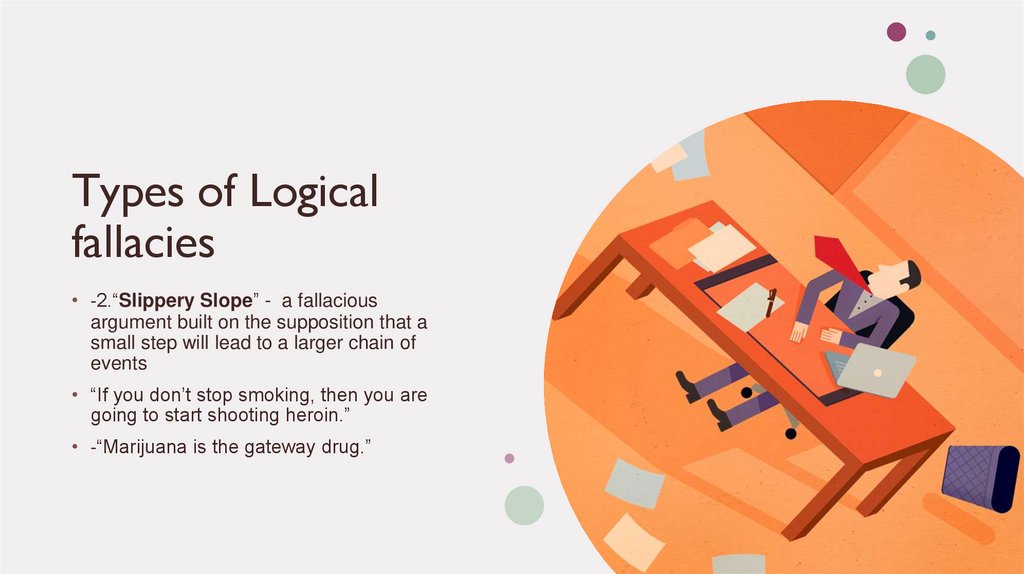
Types of Logicalfallacies
• -2.“Slippery Slope” - a fallacious
argument built on the supposition that a
small step will lead to a larger chain of
events
• “If you don’t stop smoking, then you are
going to start shooting heroin.”
• -“Marijuana is the gateway drug.”
12.
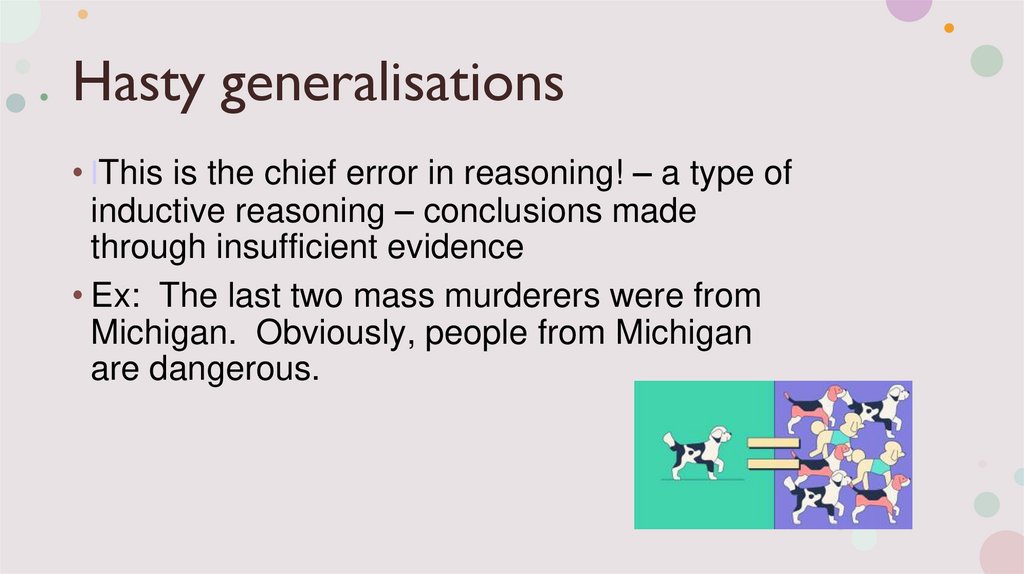
Hasty generalisations• lThis is the chief error in reasoning! – a type of
inductive reasoning – conclusions made
through insufficient evidence
• Ex: The last two mass murderers were from
Michigan. Obviously, people from Michigan
are dangerous.
13.
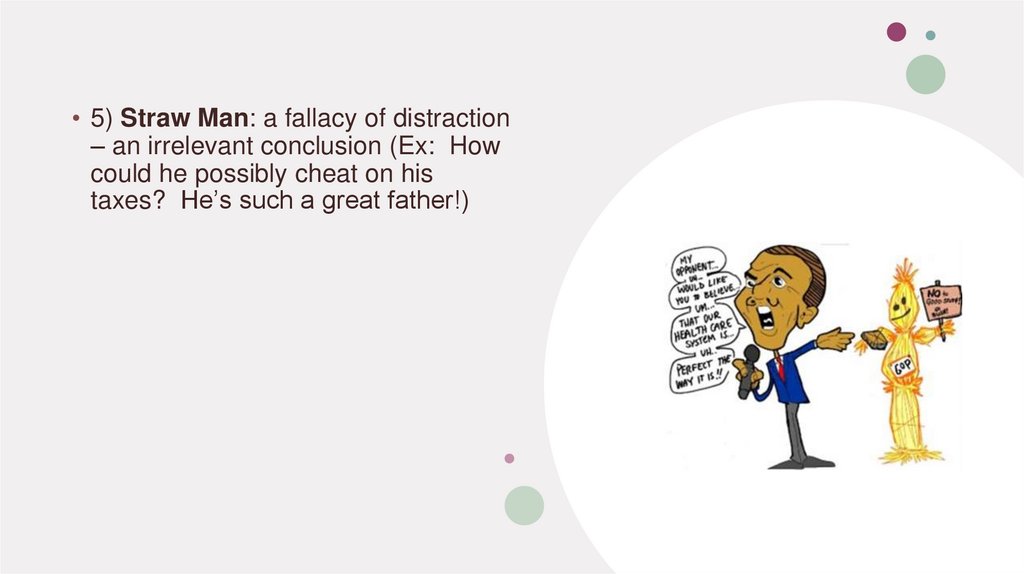
• 5) Straw Man: a fallacy of distraction– an irrelevant conclusion (Ex: How
could he possibly cheat on his
taxes? He’s such a great father!)
14.
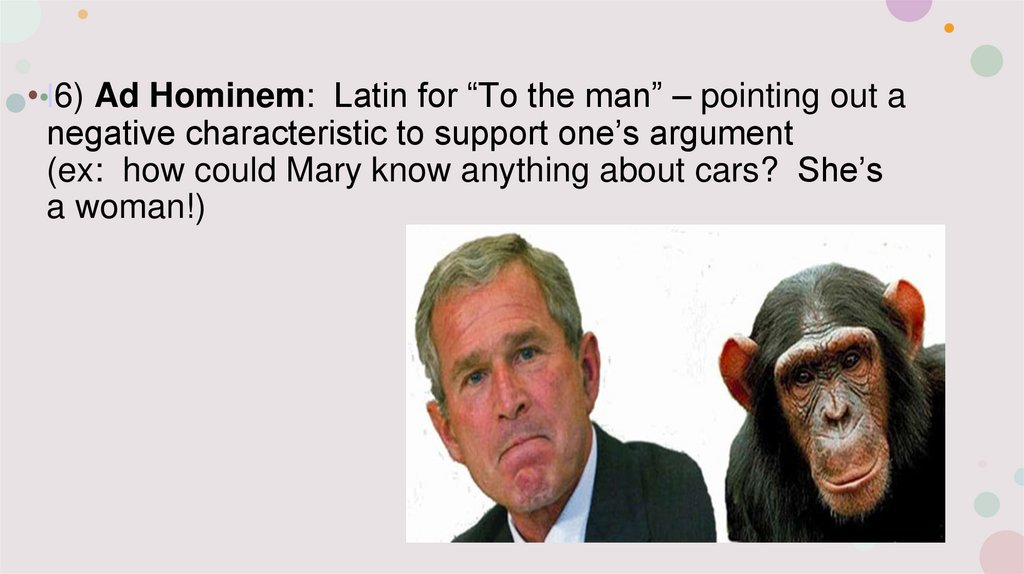
• l6) Ad Hominem: Latin for “To the man” – pointing out anegative characteristic to support one’s argument
(ex: how could Mary know anything about cars? She’s
a woman!)
15.
• lFaulty Cause/effect: Ex: “we’vebeen in business 50 years – That
makes us the best!
16.
• Red Herring• An irrelevant argument, attempting to mislead and distract an audience by
bringing up an unrelated but emotionally loaded issue. E.g., "In regard to
my several bankruptcies and recent indictment for corruption let’s be
straight up about what’s really important: Terrorism! Just look at what
happened last week in [name the place]. Vote for me and I'll fight those
terrorists anywhere in the world!"
17.
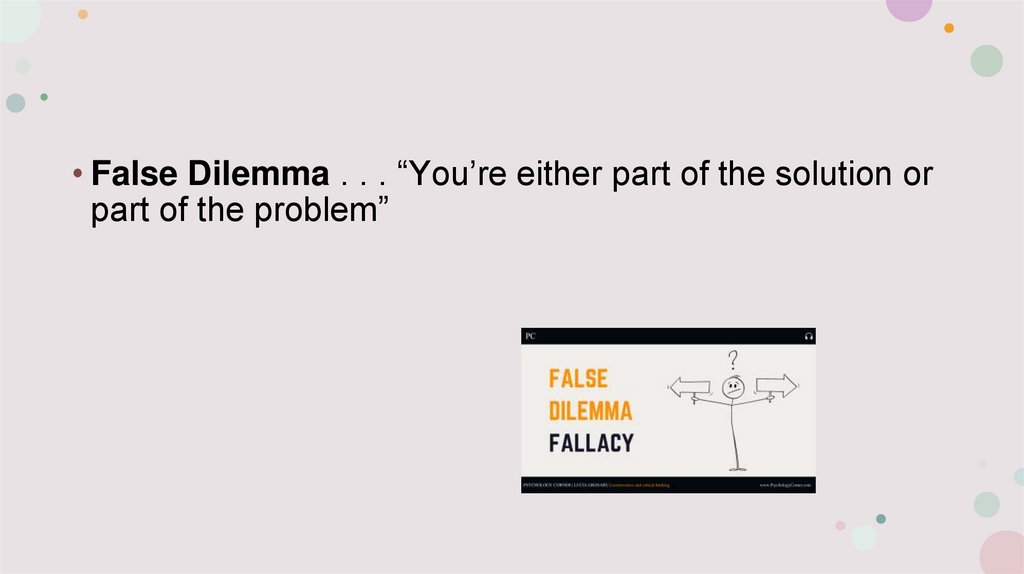
• False Dilemma . . . “You’re either part of the solution orpart of the problem”
18.
Lets check:1. The people who favor the tax increase bill will give you lots of reasons why they think it
should be passed. But, in fact it is a lousy bill that should be defeated because it Senator
Whitney Berton supports it. You know him, the guy who is widely suspected of being guilty
of tax evasion.
2. Students from Jefferson High School are all so friendly and helpful. I’m sure of this because
just last week I got lost and a very helpful and friendly student got me all straightened out.
1. Despite the women’s movement in the 1970s, women still do not receive equal pay forequal
worth. Obviously, all such attempts to change the status quo are doomed to failure.
1. Legalization of abortion will lead to murder of the old and the physically and mentally
handicapped.
19.
Answer Key:• 1. Ad Hominem
The assumption made in this example is that if the speaker (Senator Whitney Berton) proves to be unacceptable
(suspected of being guilty of tax evasion) in some way, then his statements must also be unacceptable. Attacking
the author of the statement is a technique to shift the attention from the true issue (tax-increase bill).
• 2. Hasty Generalization
This statement is very dangerous because the writer draws a conclusion (all students from Jefferson High School
are friendly and helpful) based on insufficient evidence (only one student was helpful and friendly).
• 3. Hasty Generalization
This statement is also illogical because the writer draws a conclusion (all attempts to change the status quo are
doomed to failure) on the basis that “women still do not receive equal pay for equal worth.” Does the writer know
if every woman still does not receive equal pay?
• 4. Slippery Slope
This arguer is clearly guilty of a slippery slope fallacy because he/she claims that legalizing abortion will
inevitably lead to murdering the elderly and so on. The arguer does not provide evidence that this will happen but
makes an assumption based on just taking the first step (legalizing abortion).
20.
Portfolio task21.
Work in groups of four.Porfolio task:
Creating
Misinformation
Write a research abstract on one of your
topics.
Use at least four of the specified fallacies.
22.
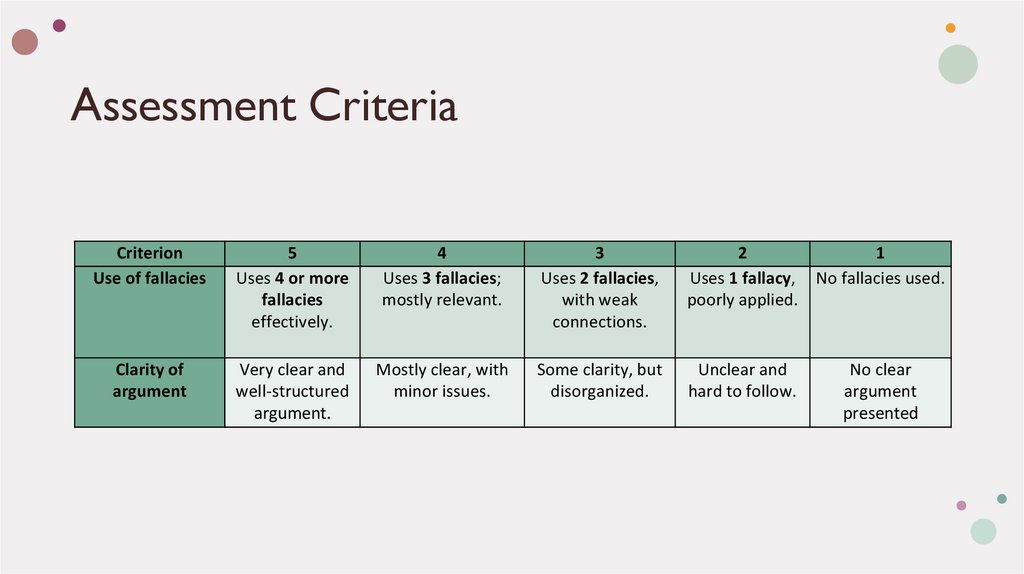
Assessment CriteriaCriterion
Use of fallacies
5
Uses 4 or more
fallacies
effectively.
4
Uses 3 fallacies;
mostly relevant.
3
Uses 2 fallacies,
with weak
connections.
2
1
Uses 1 fallacy, No fallacies used.
poorly applied.
Clarity of
argument
Very clear and
well-structured
argument.
Mostly clear, with
minor issues.
Some clarity, but
disorganized.
Unclear and
hard to follow.
No clear
argument
presented
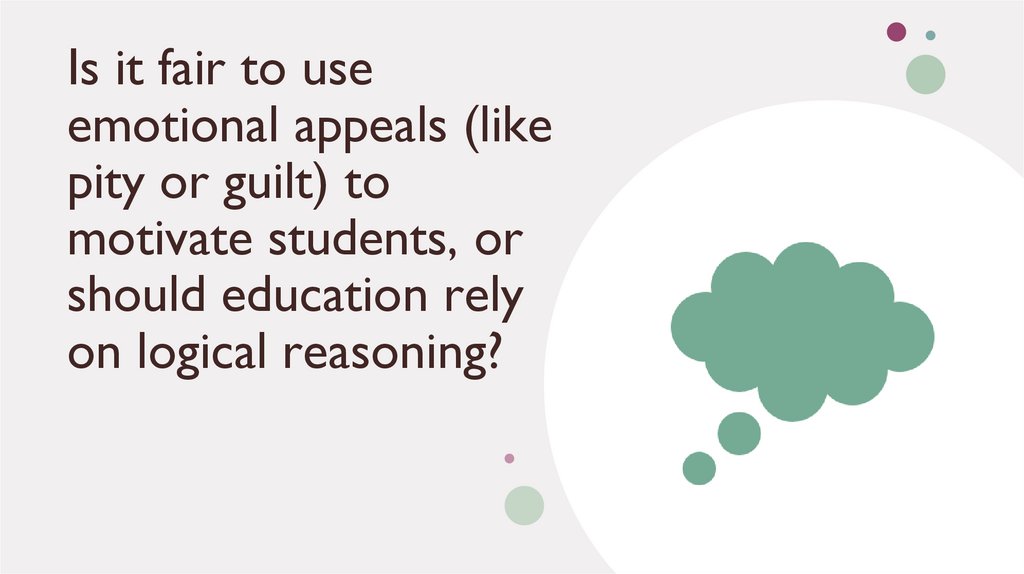
23.
Is it fair to useemotional appeals (like
pity or guilt) to
motivate students, or
should education rely
on logical reasoning?