 Психология
Похожие презентации:



Recognizing arguments
1.
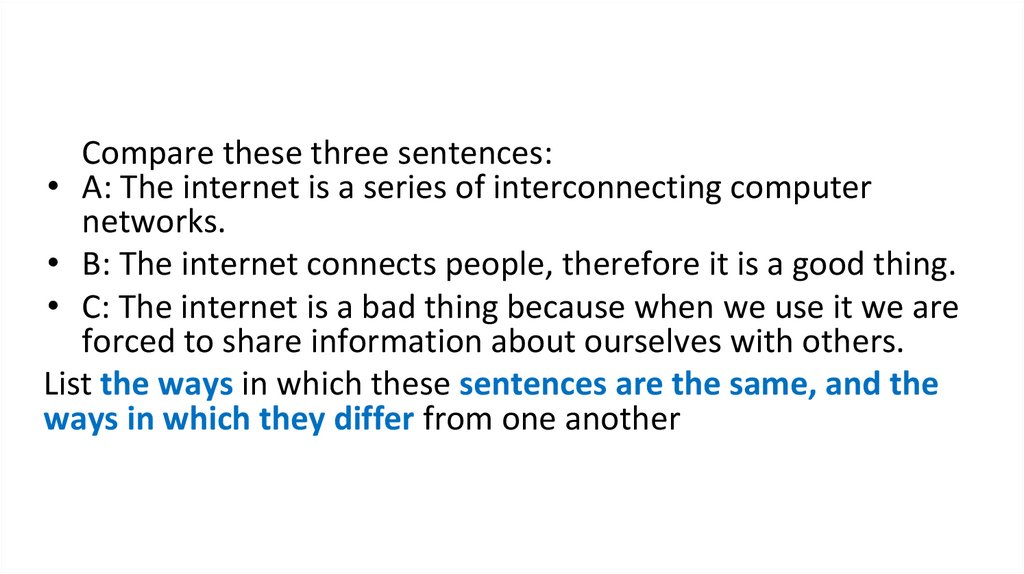
Compare these three sentences:• A: The internet is a series of interconnecting computer
networks.
• B: The internet connects people, therefore it is a good thing.
• C: The internet is a bad thing because when we use it we are
forced to share information about ourselves with others.
List the ways in which these sentences are the same, and the
ways in which they differ from one another
2.
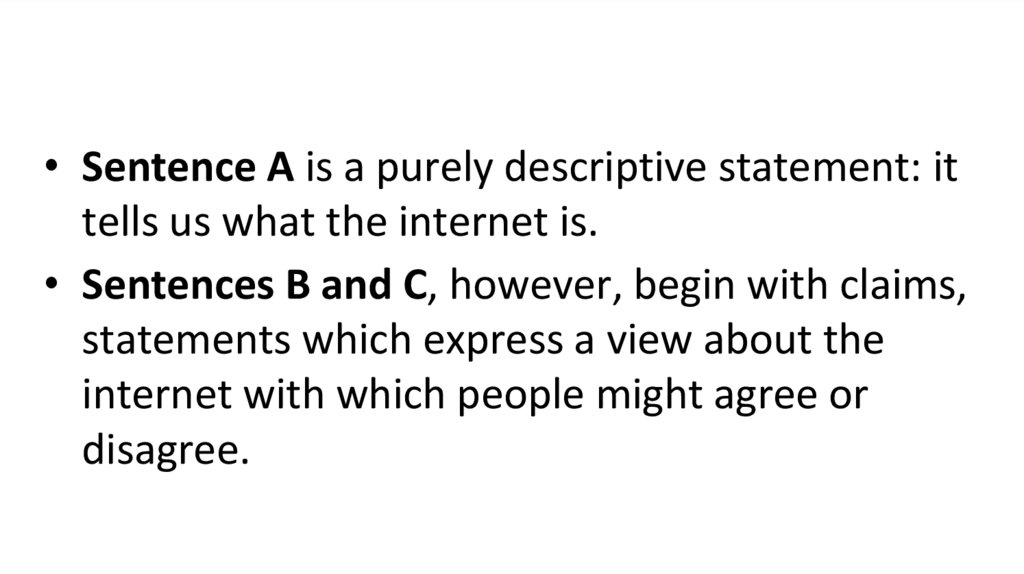
• Sentence A is a purely descriptive statement: ittells us what the internet is.
• Sentences B and C, however, begin with claims,
statements which express a view about the
internet with which people might agree or
disagree.
3.
Recognizingarguments
When we present claims,
we need to provide
reasons to justify. It
makes an
argument.Otherwise, our
claims are just assertions.
4.
ArgumentsEvaluating arguments
5.
Learning objectivesCO 1.1 select information and evidence that is
relevant to an argument or issue
6.
Lesson objectivesLEARN TO IDENTIFY
ARGUMENT’S
STRUCTURAL PARTS.
EVALUATE TYPES OF
REASONING
DIFFERENTIATE BETWEEN
DEDUCTIVE AND
INDUCTIVE REASONING
7.
Assessment-
identify, premises and conclusion in 6/8 arguments;
differentiate correctly 7/9 deductive and inductive arguments
8.
ArgumentsHow would you define ‘an
argument’?
What parts or elements do
you think an argument has?
9.
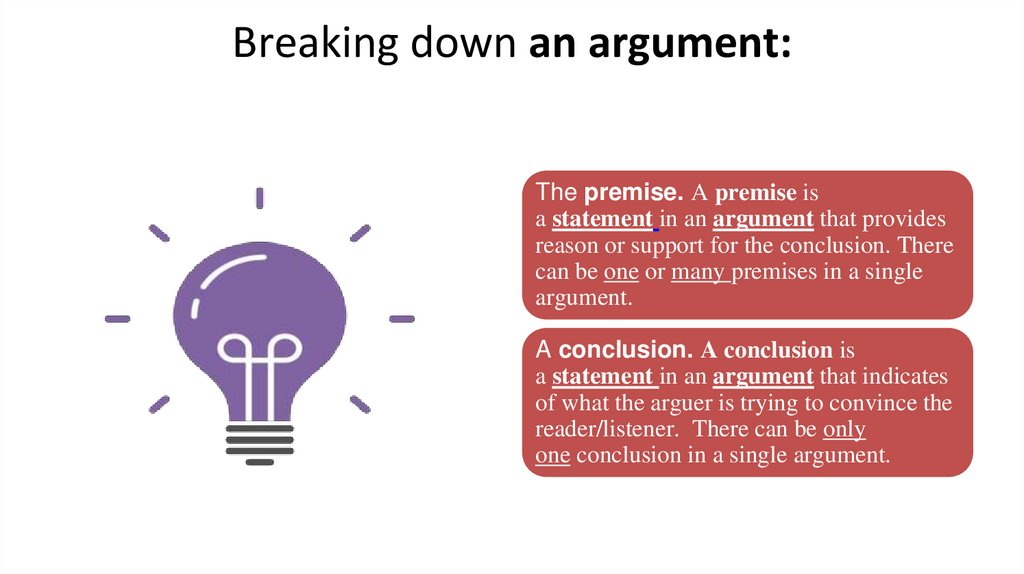
Breaking down an argument:The premise. A premise is
a statement in an argument that provides
reason or support for the conclusion. There
can be one or many premises in a single
argument.
A conclusion. A conclusion is
a statement in an argument that indicates
of what the arguer is trying to convince the
reader/listener. There can be only
one conclusion in a single argument.
10.
Breaking down the argumentRewrite the following arguments listing
the premise(s) first and the conclusion last.
11.
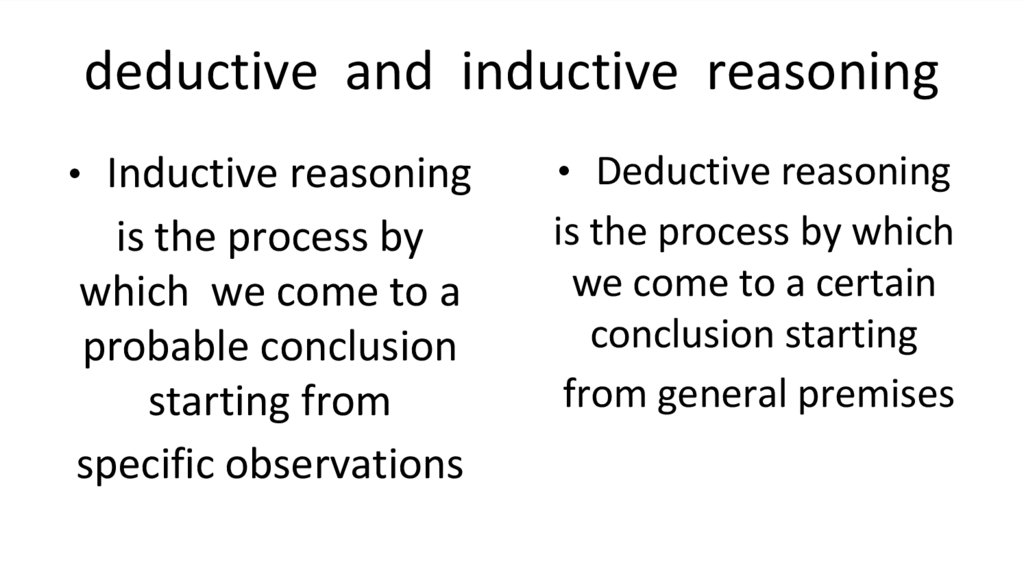
deductive and inductive reasoning• Inductive reasoning
• Deductive reasoning
is the process by
which we come to a
probable conclusion
starting from
specific observations
is the process by which
we come to a certain
conclusion starting
from general premises
12.
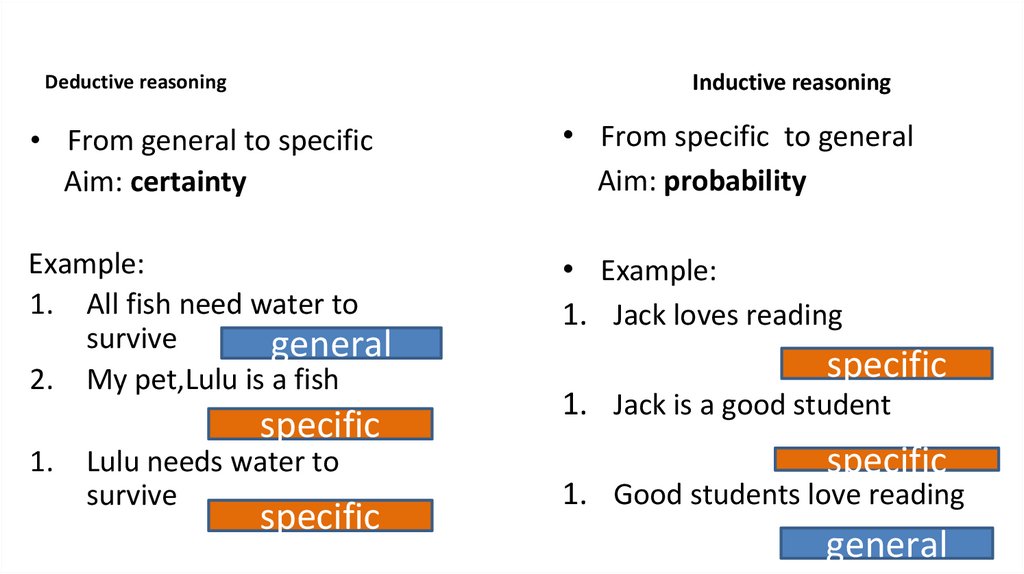
Inductive reasoningDeductive reasoning
• From general to specific
Aim: certainty
• From specific to general
Example:
1. All fish need water to
survive
general
2. My pet,Lulu is a fish
• Example:
1. Jack loves reading
specific
1.
Lulu needs water to
survive
specific
Aim: probability
specific
1. Jack is a good student
specific
1. Good students love reading
general
13.
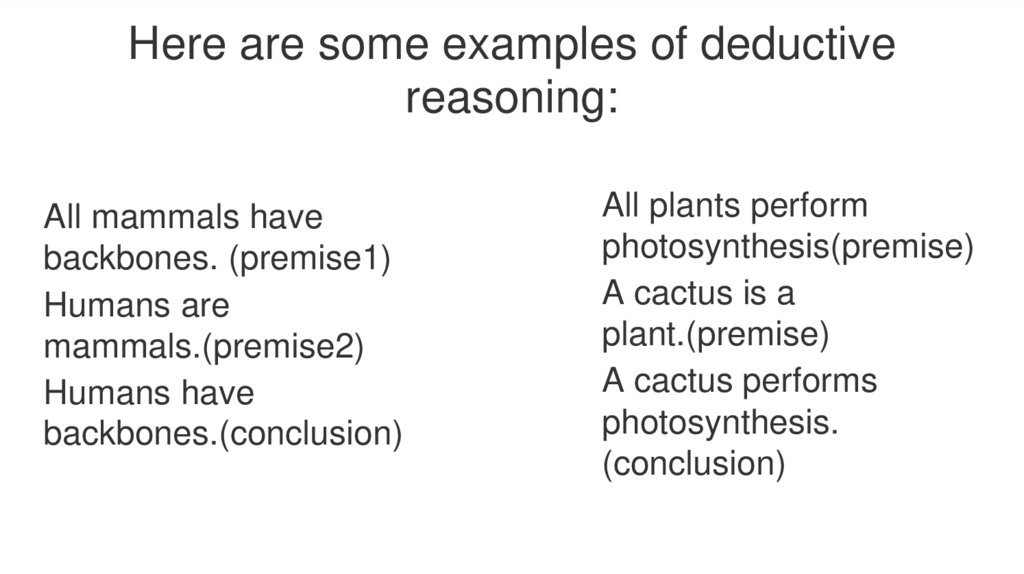
Here are some examples of deductivereasoning:
All mammals have
backbones. (premise1)
Humans are
mammals.(premise2)
Humans have
backbones.(conclusion)
All plants perform
photosynthesis(premise)
A cactus is a
plant.(premise)
A cactus performs
photosynthesis.
(conclusion)
14.
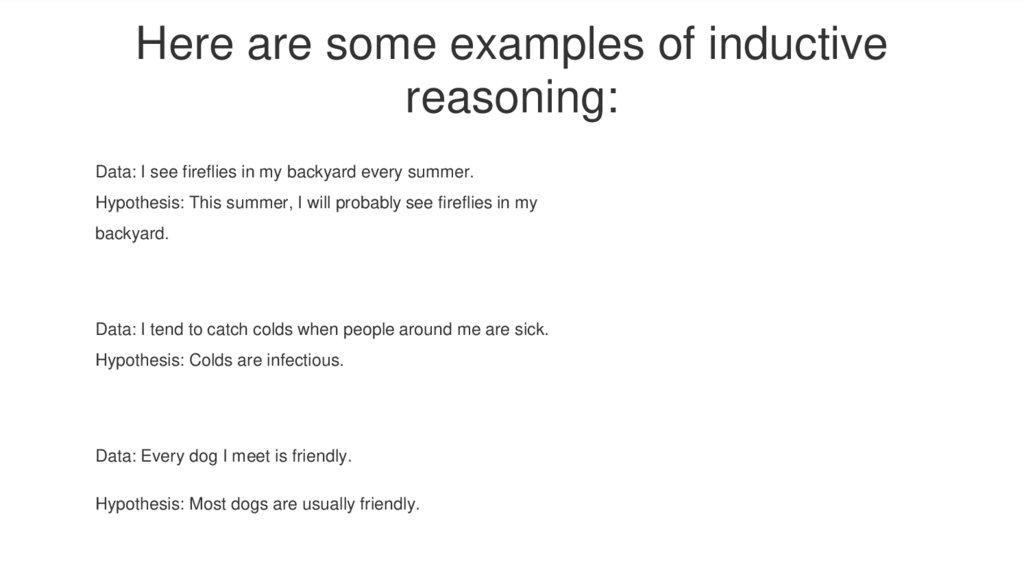
Here are some examples of inductivereasoning:
Data: I see fireflies in my backyard every summer.
Hypothesis: This summer, I will probably see fireflies in my
backyard.
Data: I tend to catch colds when people around me are sick.
Hypothesis: Colds are infectious.
Data: Every dog I meet is friendly.
Hypothesis: Most dogs are usually friendly.
15.
Deductive and inductive argumentsRead the statements and identify whether they
are inductive or deductive.
16.
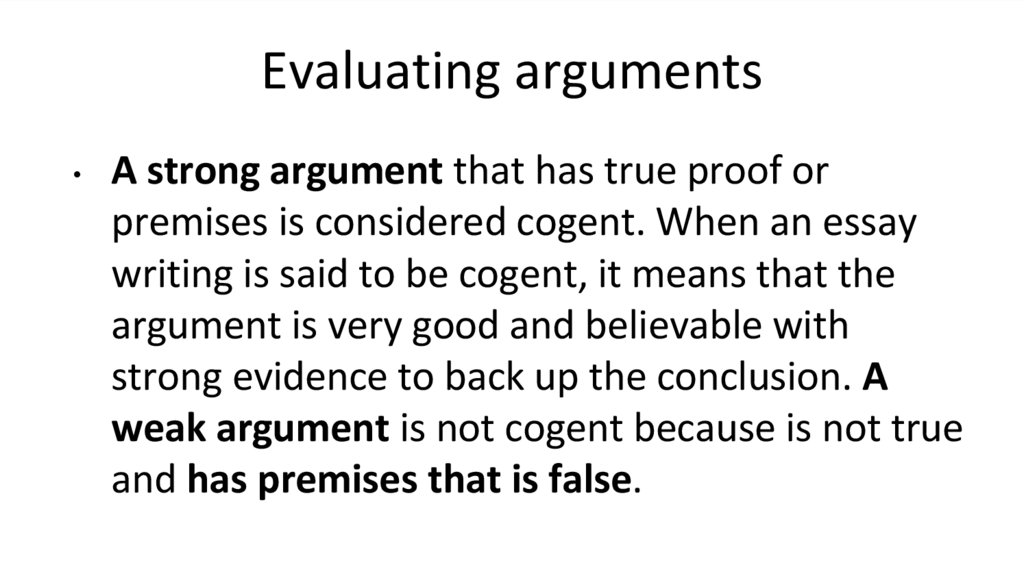
Evaluating argumentsA strong argument that has true proof or
premises is considered cogent. When an essay
writing is said to be cogent, it means that the
argument is very good and believable with
strong evidence to back up the conclusion. A
weak argument is not cogent because is not true
and has premises that is false.
17.
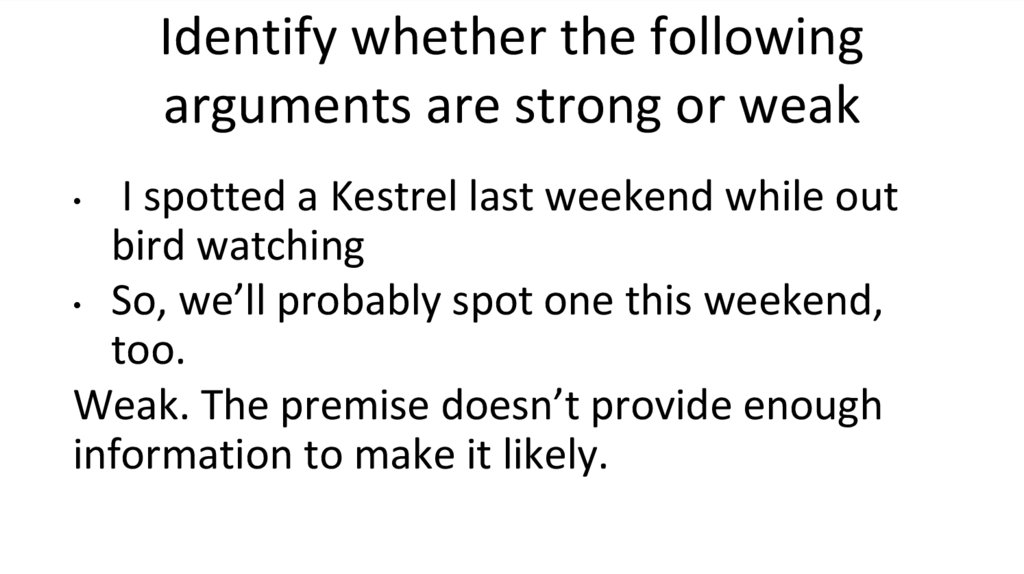
Identify whether the followingarguments are strong or weak
I spotted a Kestrel last weekend while out
bird watching
• So, we’ll probably spot one this weekend,
too.
Weak. The premise doesn’t provide enough
information to make it likely.
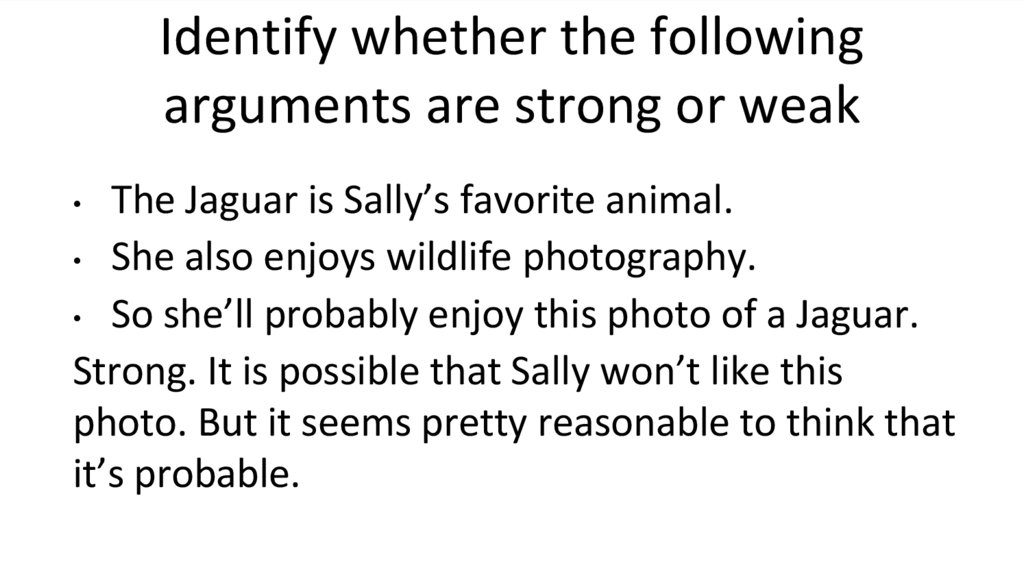
18.
Identify whether the followingarguments are strong or weak
The Jaguar is Sally’s favorite animal.
• She also enjoys wildlife photography.
• So she’ll probably enjoy this photo of a Jaguar.
Strong. It is possible that Sally won’t like this
photo. But it seems pretty reasonable to think that
it’s probable.
19.
ReflectionIn today’s lesson,
• I have learned…
• … is still unclear..
• I want to learn more about..