Похожие презентации:



Англ
1.
THE DEVICES ASSISTING HUMANSIN VARIOUS FORMS OF
COMPUTATION HAVE THEIR ROOTS
IN THE ANCIENT PAST
2.
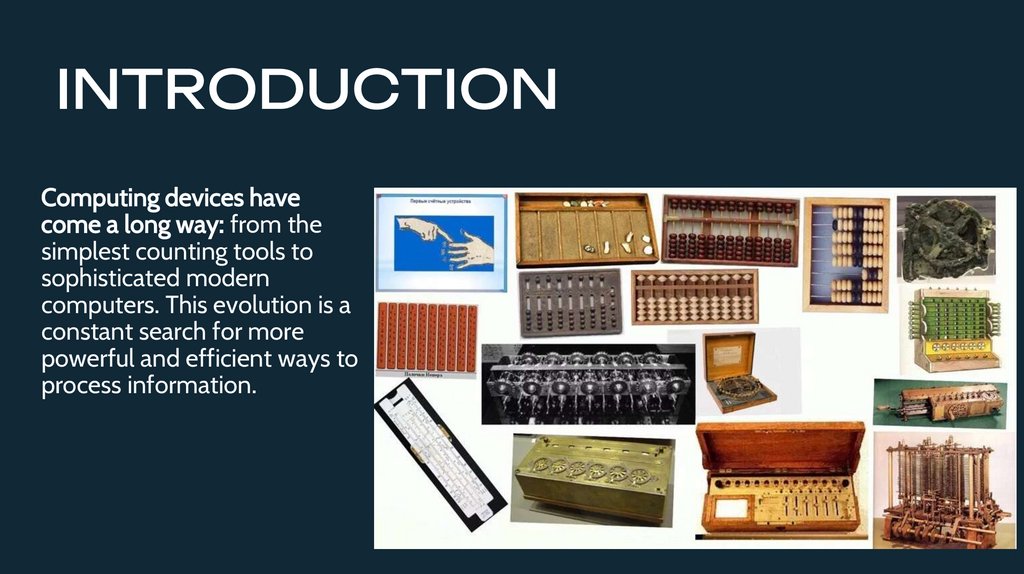
INTRODUCTIONComputing devices have
come a long way: from the
simplest counting tools to
sophisticated modern
computers. This evolution is a
constant search for more
powerful and efficient ways to
process information.
3.
Early MechanicalFoundations
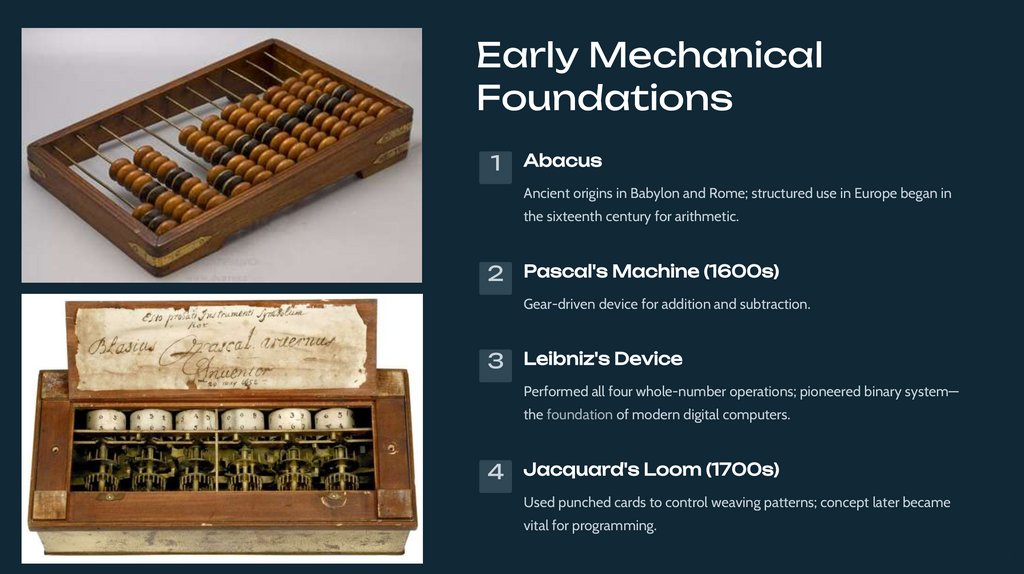
1
Abacus
Ancient origins in Babylon and Rome; structured use in Europe began in
the sixteenth century for arithmetic.
2 Pascal's Machine (1600s)
Gear-driven device for addition and subtraction.
3 Leibniz's Device
Performed all four whole-number operations; pioneered binary system—
the foundation of modern digital computers.
4 Jacquard's Loom (1700s)
Used punched cards to control weaving patterns; concept later became
vital for programming.
4.
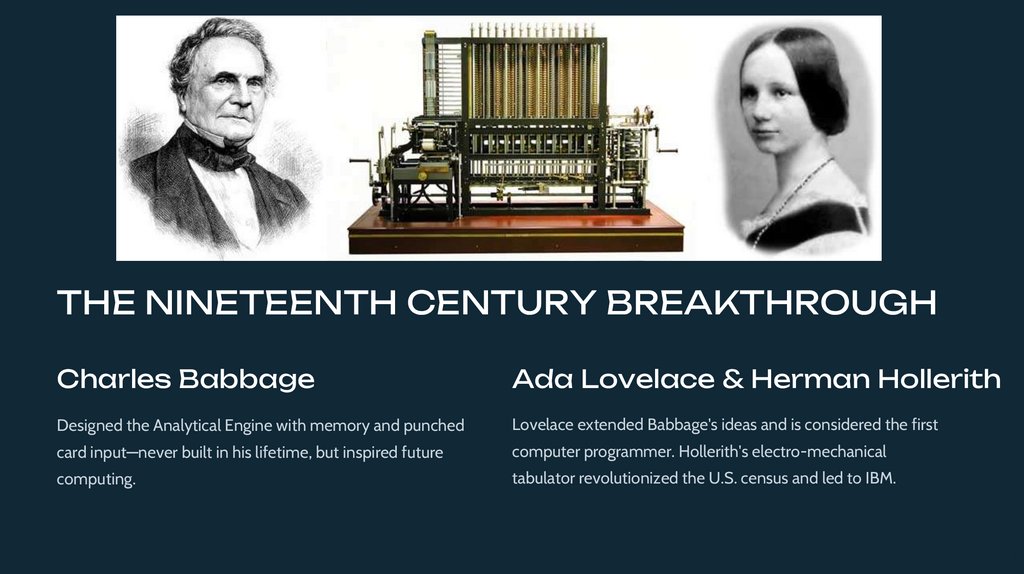
THE NINETEENTH CENTURY BREAKTHROUGHCharles Babbage
Ada Lovelace & Herman Hollerith
Designed the Analytical Engine with memory and punched
Lovelace extended Babbage's ideas and is considered the first
card input—never built in his lifetime, but inspired future
computer programmer. Hollerith's electro-mechanical
computing.
tabulator revolutionized the U.S. census and led to IBM.
5.
THE GENERATIONS OFELECTRONIC COMPUTING
UNIVAC I's delivery in 1951 marked the modern computing era,
categorized into distinct generations:
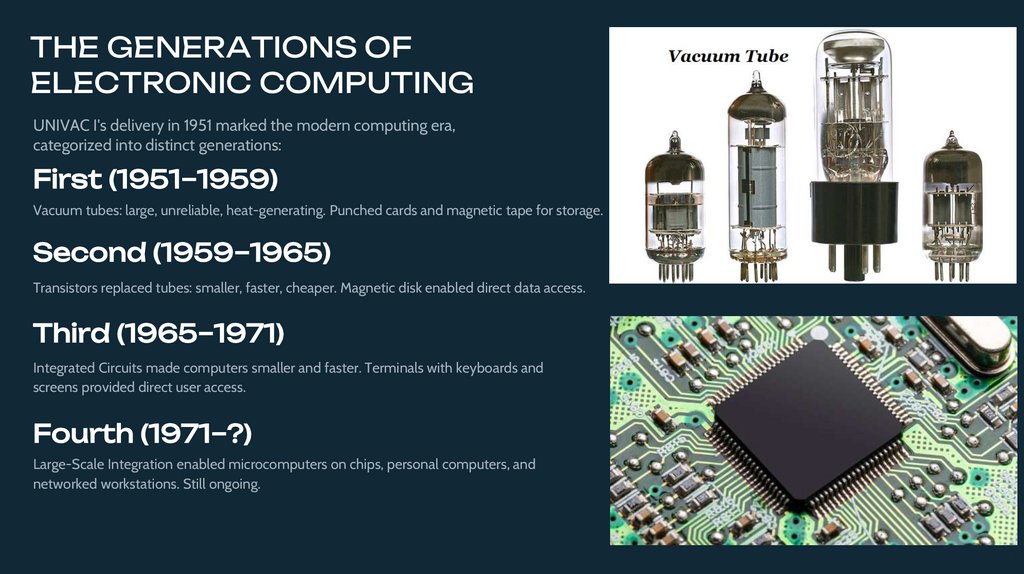
First (1951–1959)
Vacuum tubes: large, unreliable, heat-generating. Punched cards and magnetic tape for storage.
Second (1959–1965)
Transistors replaced tubes: smaller, faster, cheaper. Magnetic disk enabled direct data access.
Third (1965–1971)
Integrated Circuits made computers smaller and faster. Terminals with keyboards and
screens provided direct user access.
Fourth (1971–?)
Large-Scale Integration enabled microcomputers on chips, personal computers, and
networked workstations. Still ongoing.
6.
THE PARALLEL EVOLUTIONOF SOFTWARE
Hardware advances were matched by software development, transforming how
humans interact with machines:
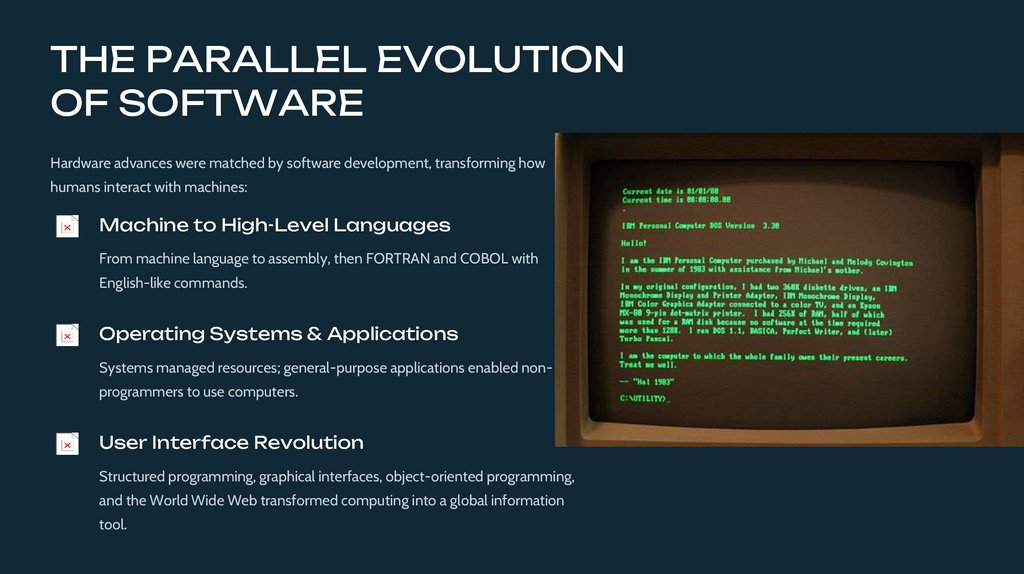
Machine to High-Level Languages
From machine language to assembly, then FORTRAN and COBOL with
English-like commands.
Operating Systems & Applications
Systems managed resources; general-purpose applications enabled nonprogrammers to use computers.
User Interface Revolution
Structured programming, graphical interfaces, object-oriented programming,
and the World Wide Web transformed computing into a global information
tool.
7.
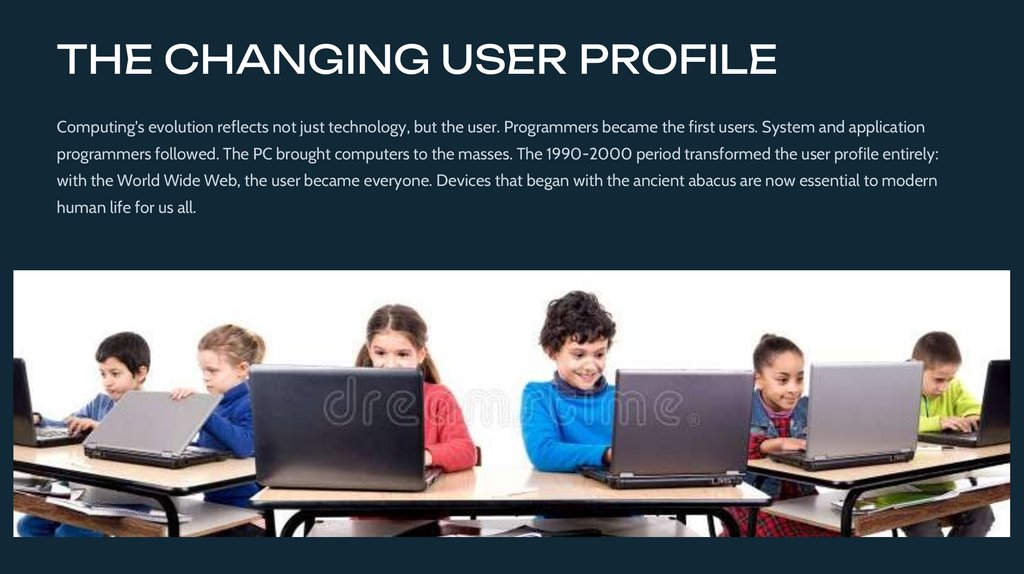
THE CHANGING USER PROFILEComputing's evolution reflects not just technology, but the user. Programmers became the first users. System and application
programmers followed. The PC brought computers to the masses. The 1990-2000 period transformed the user profile entirely:
with the World Wide Web, the user became everyone. Devices that began with the ancient abacus are now essential to modern
human life for us all.
8.
Meet the SpeakersVerenko Aleksey
Bragina Daria
gorom.1van.ov@gmail.com
dasha2006@gmail.com
+7 928 241 28 86
+7 960 657 78 87
Student of Gubkin Russian State University of Oil and Gas
Student of Gubkin Russian State University of Oil and Gas
Telegram: @YBIFO
Telegram: @dshlknss