
 Математика
Похожие презентации:









SECTION 7.1 Functions Defined on General Sets
1.
CHAPTER 7FUNCTIONS
Copyright © Cengage Learning. All rights reserved.
2.
SECTION 7.1Functions Defined on
General Sets
Copyright © Cengage Learning. All rights reserved.
3. Relations
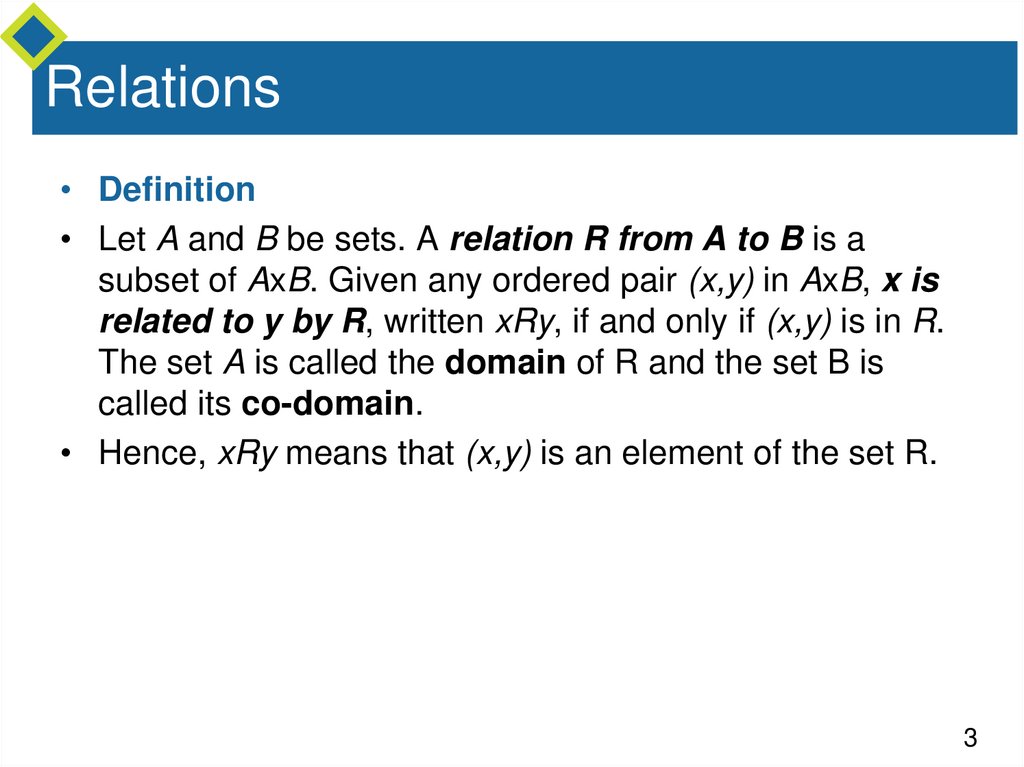
• Definition• Let A and B be sets. A relation R from A to B is a
subset of AxB. Given any ordered pair (x,y) in AxB, x is
related to y by R, written xRy, if and only if (x,y) is in R.
The set A is called the domain of R and the set B is
called its co-domain.
• Hence, xRy means that (x,y) is an element of the set R.
3
4. Functions Defined on General Sets
45. Arrow Diagrams
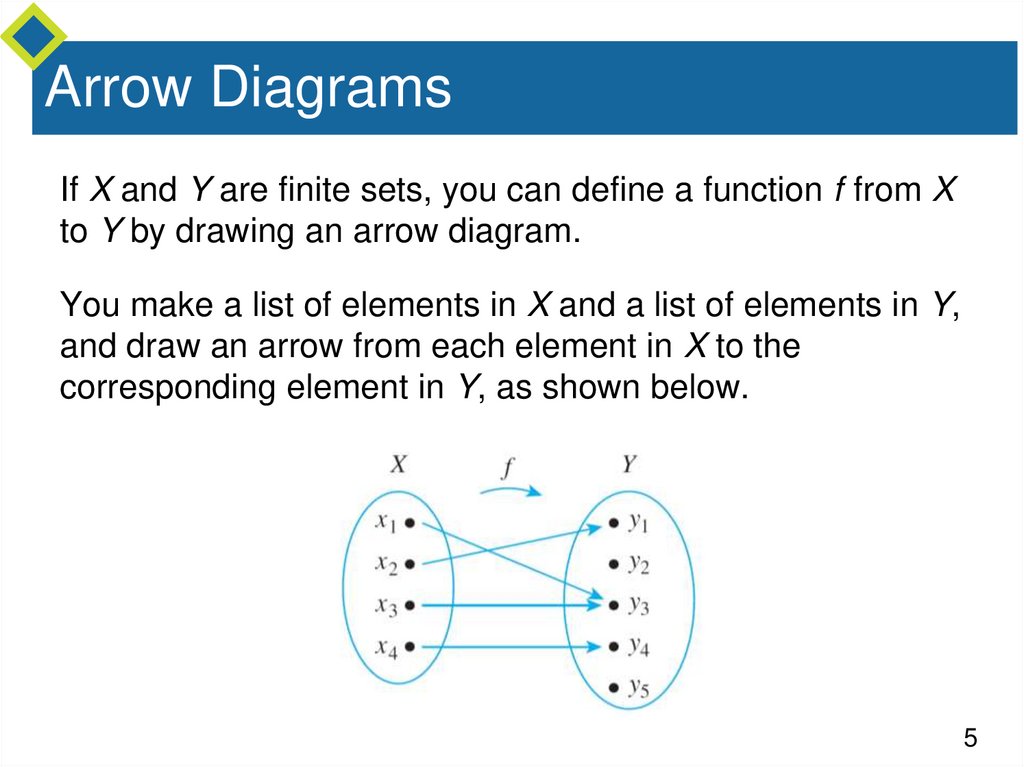
If X and Y are finite sets, you can define a function f from Xto Y by drawing an arrow diagram.
You make a list of elements in X and a list of elements in Y,
and draw an arrow from each element in X to the
corresponding element in Y, as shown below.
5
6. Arrow Diagrams
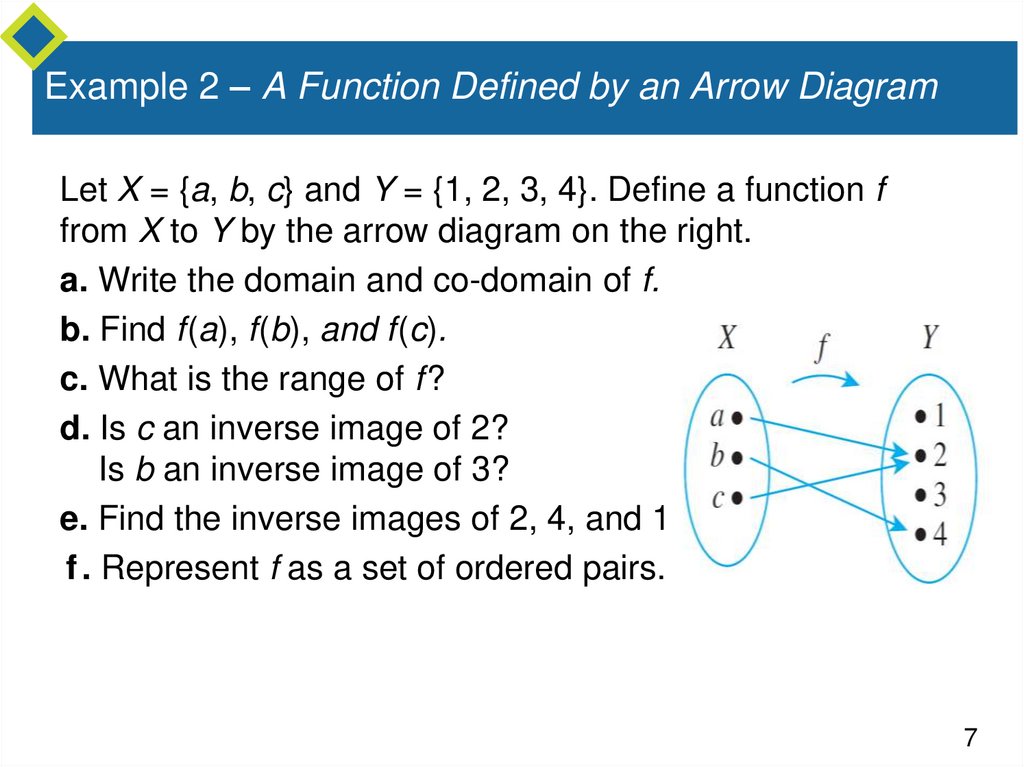
This arrow diagram does define a function because1. Every element of X has an arrow coming out of it.
2. No element of X has two arrows coming out of it that
point to two different elements of Y.
6
7. Example 2 – A Function Defined by an Arrow Diagram
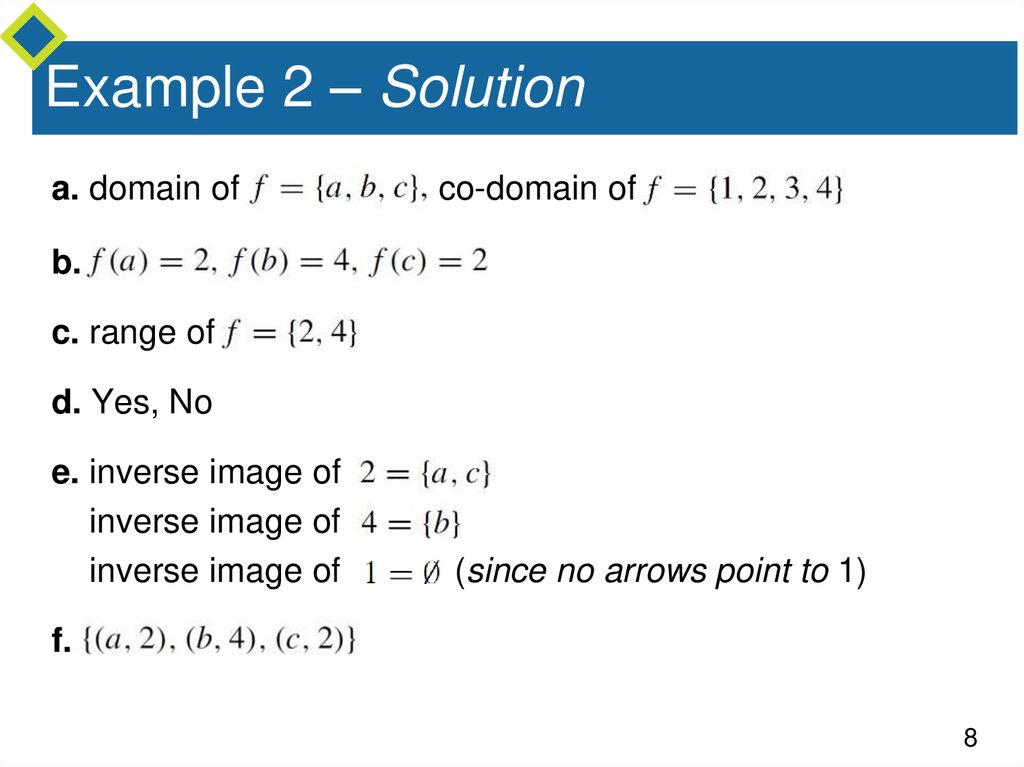
Let X = {a, b, c} and Y = {1, 2, 3, 4}. Define a function ffrom X to Y by the arrow diagram on the right.
a. Write the domain and co-domain of f.
b. Find f(a), f(b), and f(c).
c. What is the range of f?
d. Is c an inverse image of 2?
Is b an inverse image of 3?
e. Find the inverse images of 2, 4, and 1.
f . Represent f as a set of ordered pairs.
7
8. Example 2 – Solution
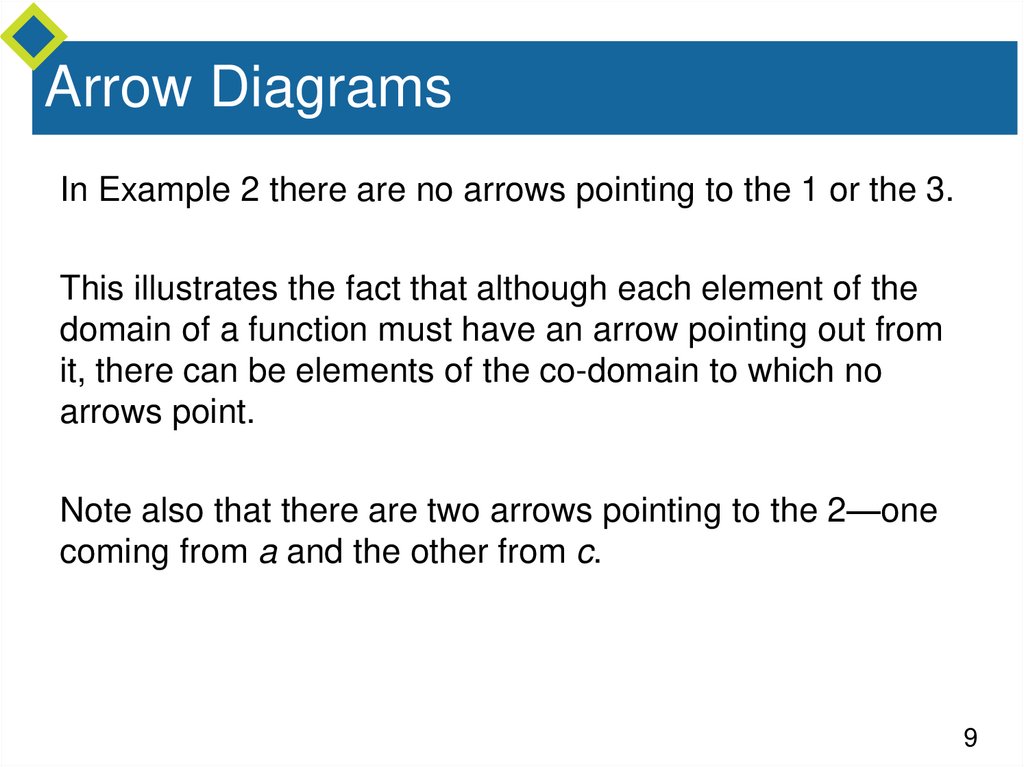
a. domain ofco-domain of
b.
c. range of
d. Yes, No
e. inverse image of
inverse image of
inverse image of
(since no arrows point to 1)
f.
8
9. Arrow Diagrams
In Example 2 there are no arrows pointing to the 1 or the 3.This illustrates the fact that although each element of the
domain of a function must have an arrow pointing out from
it, there can be elements of the co-domain to which no
arrows point.
Note also that there are two arrows pointing to the 2—one
coming from a and the other from c.
9
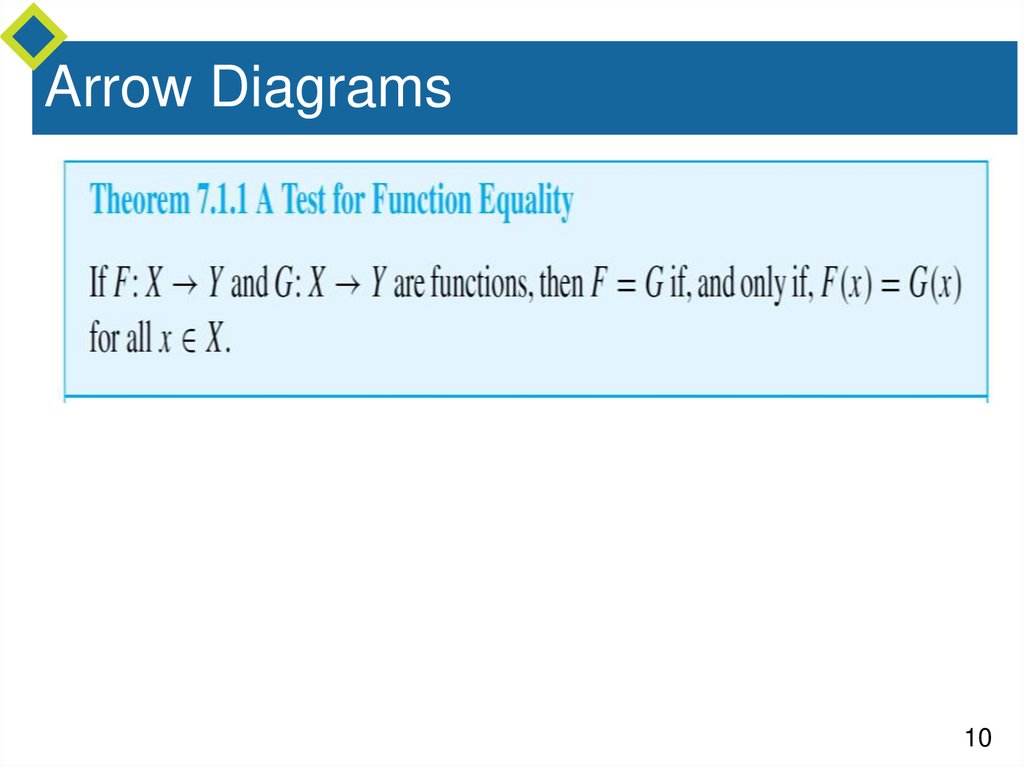
10. Arrow Diagrams
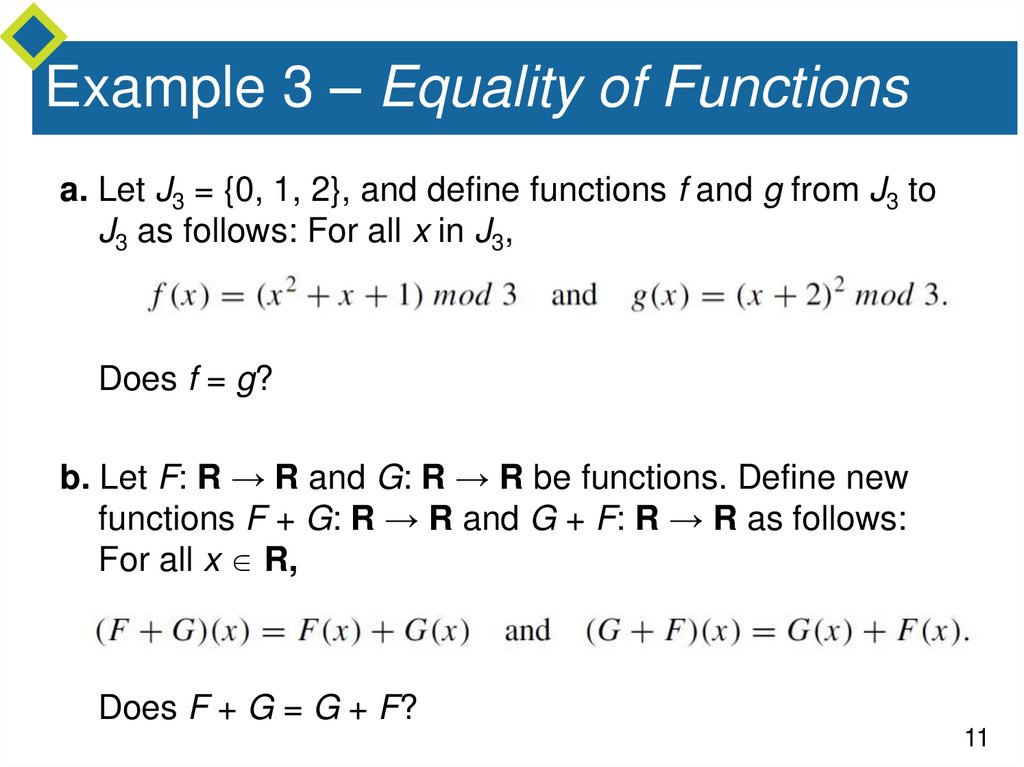
1011. Example 3 – Equality of Functions
a. Let J3 = {0, 1, 2}, and define functions f and g from J3 toJ3 as follows: For all x in J3,
Does f = g?
b. Let F: R → R and G: R → R be functions. Define new
functions F + G: R → R and G + F: R → R as follows:
For all x R,
Does F + G = G + F?
11
12. Example 3 – Solution
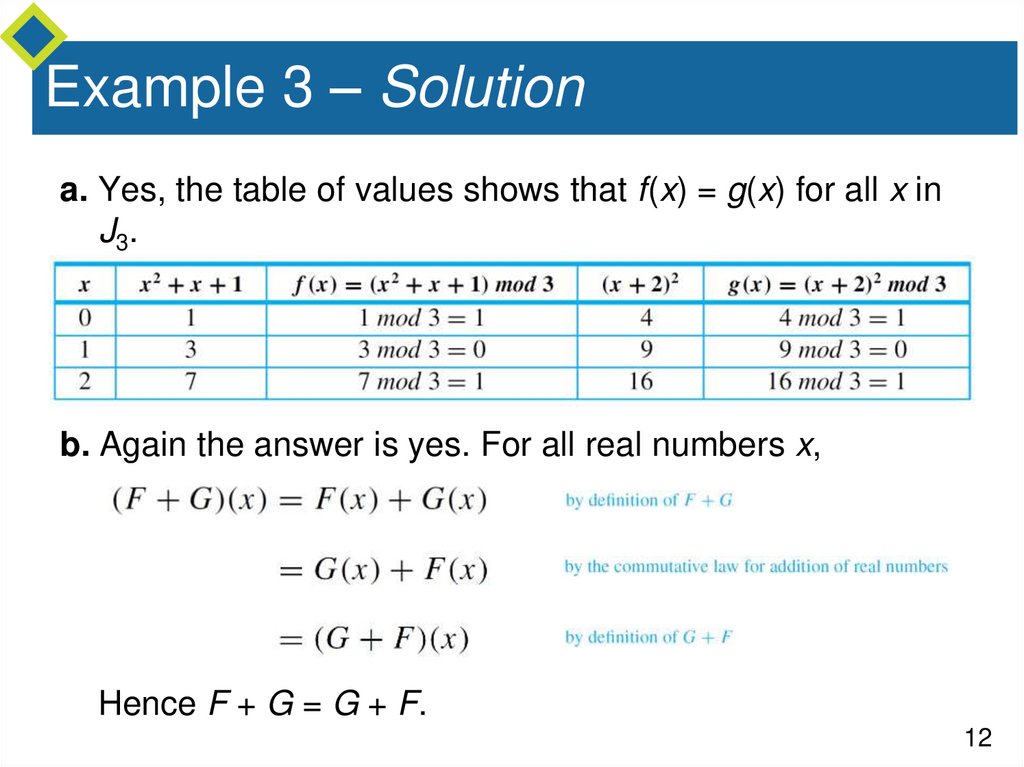
a. Yes, the table of values shows that f(x) = g(x) for all x inJ3.
b. Again the answer is yes. For all real numbers x,
Hence F + G = G + F.
12
13. Example 4 – The Identity Function on a Set
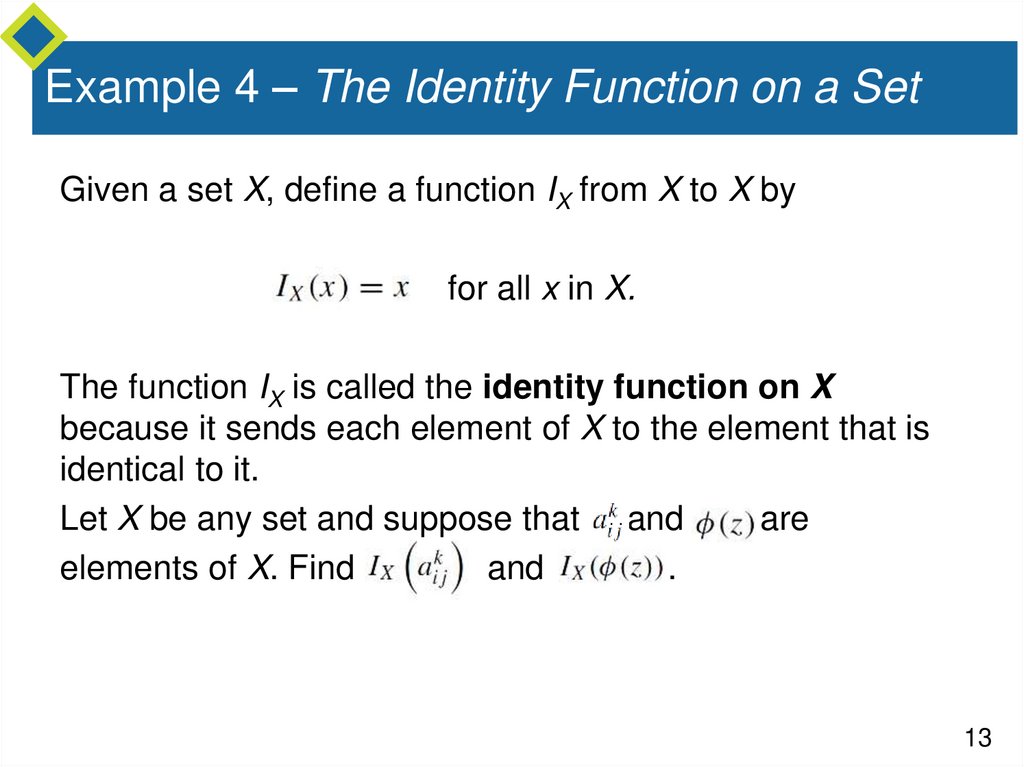
Given a set X, define a function IX from X to X byfor all x in X.
The function IX is called the identity function on X
because it sends each element of X to the element that is
identical to it.
Let X be any set and suppose that and
are
elements of X. Find
and
.
13
14. Example 4 – Solution
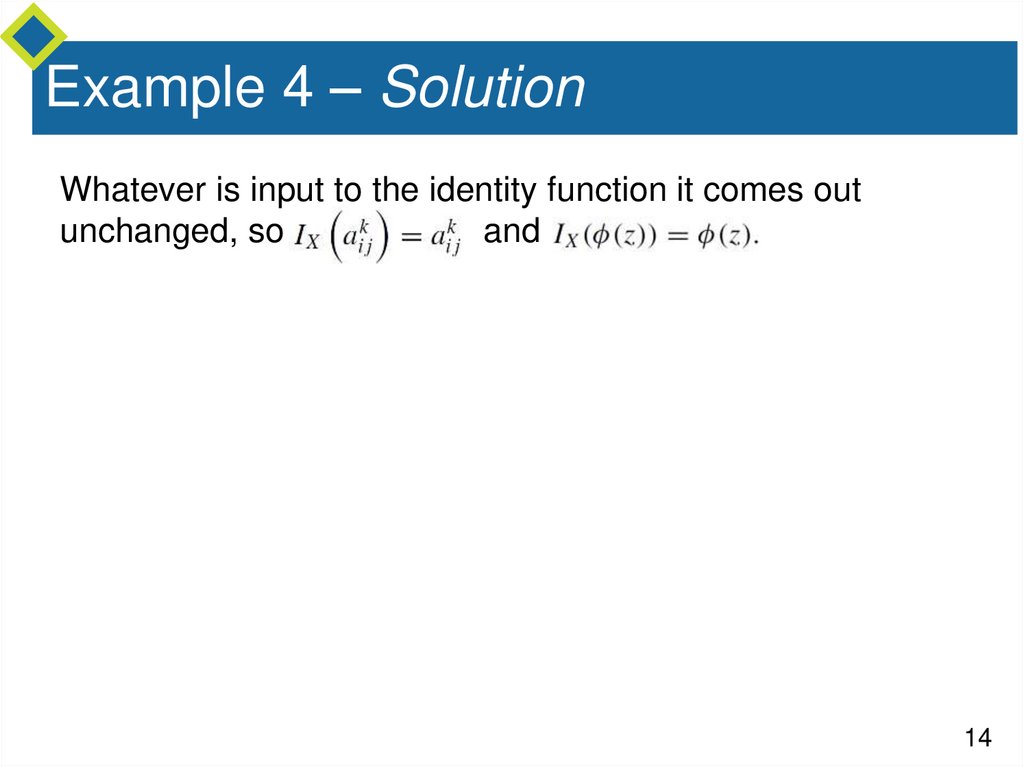
Whatever is input to the identity function it comes outunchanged, so
and
14
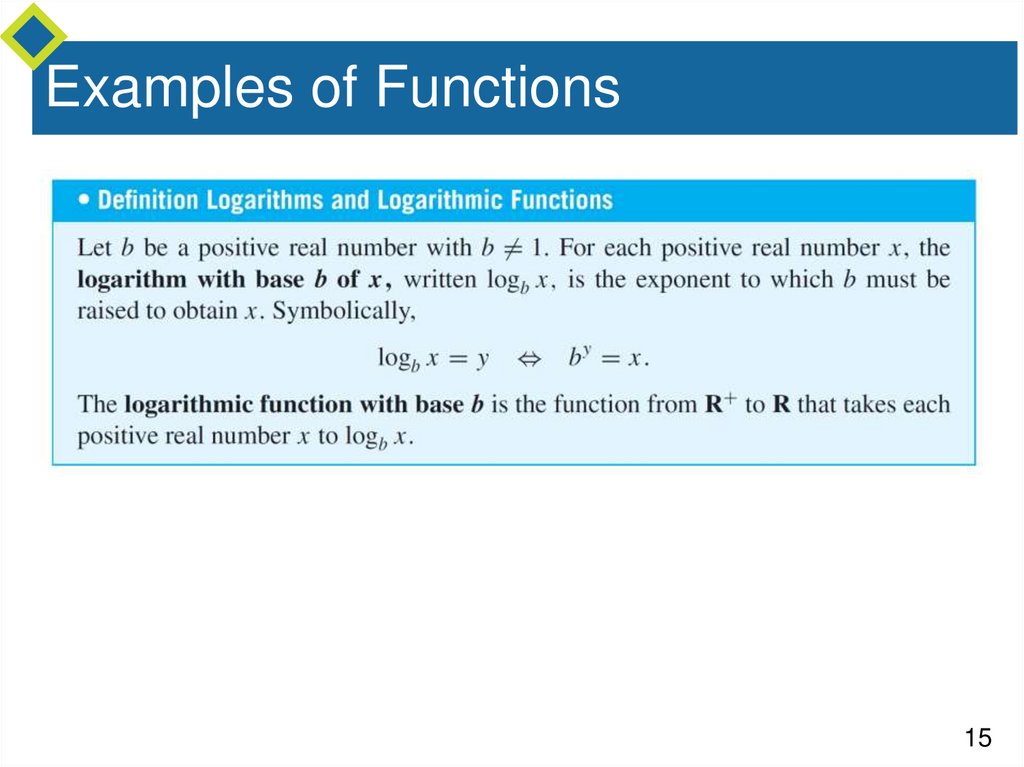
15. Examples of Functions
1516. Example 8 – The Logarithmic Function with Base b
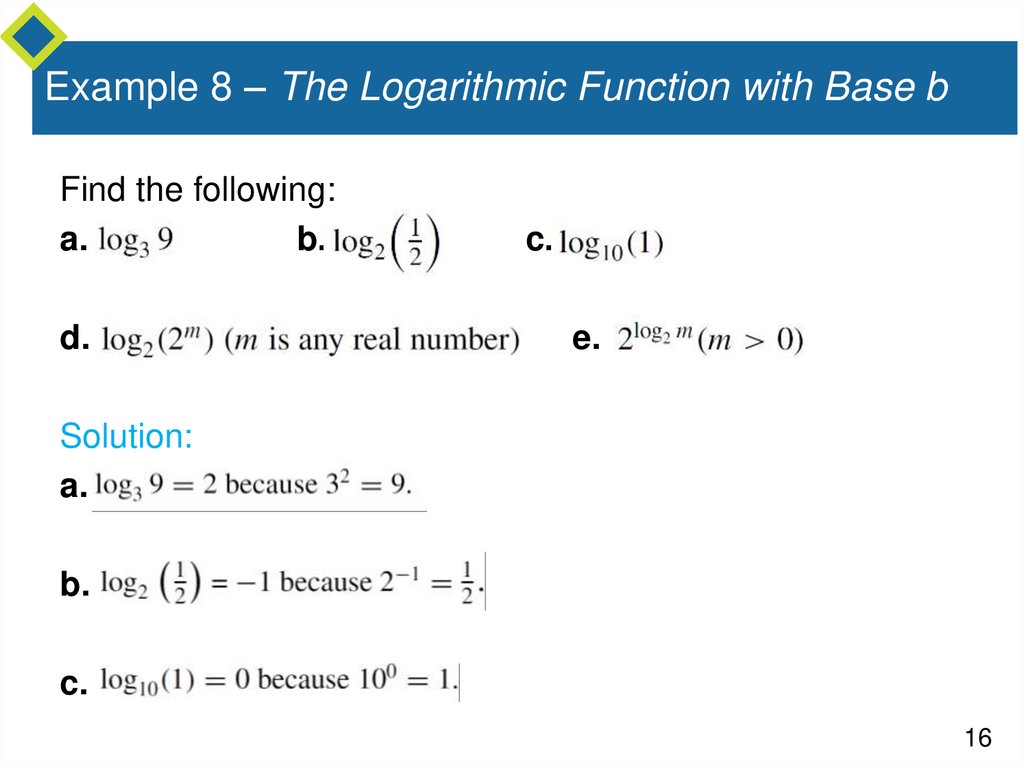
Find the following:a.
b.
d.
c.
e.
Solution:
a.
b.
c.
16
17. Example 8 – Solution
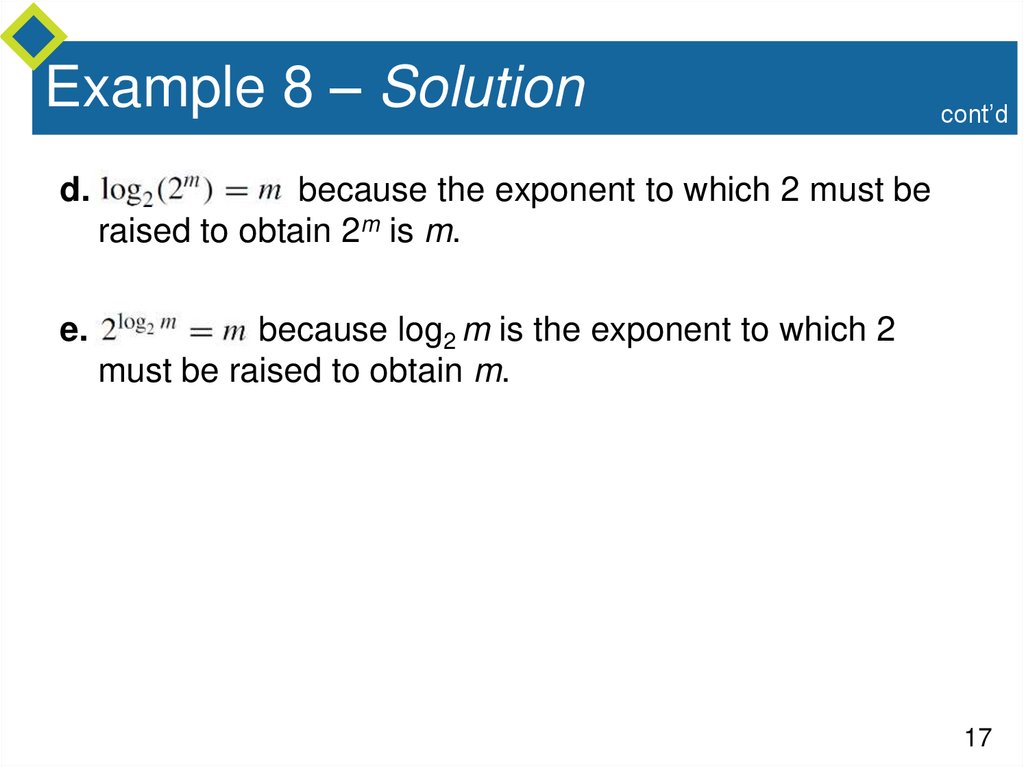
d.because the exponent to which 2 must be
raised to obtain 2m is m.
e.
because log2 m is the exponent to which 2
must be raised to obtain m.
cont’d
17
18. Checking Whether a Function Is Well Defined
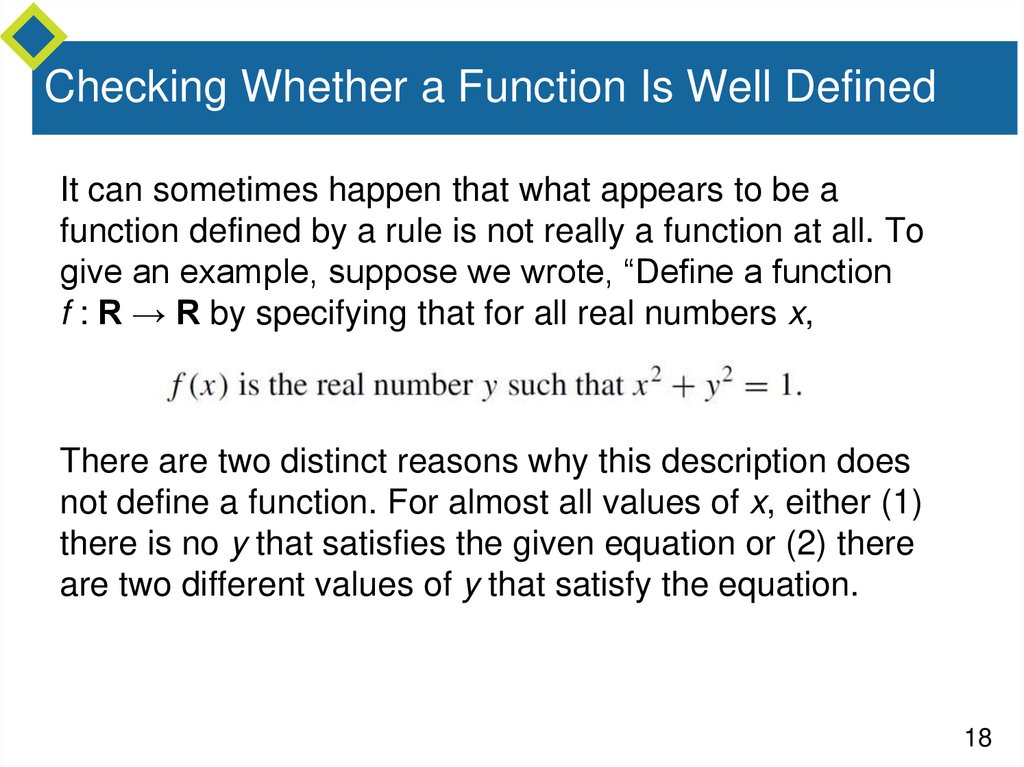
It can sometimes happen that what appears to be afunction defined by a rule is not really a function at all. To
give an example, suppose we wrote, “Define a function
f : R → R by specifying that for all real numbers x,
There are two distinct reasons why this description does
not define a function. For almost all values of x, either (1)
there is no y that satisfies the given equation or (2) there
are two different values of y that satisfy the equation.
18
19. Checking Whether a Function Is Well Defined
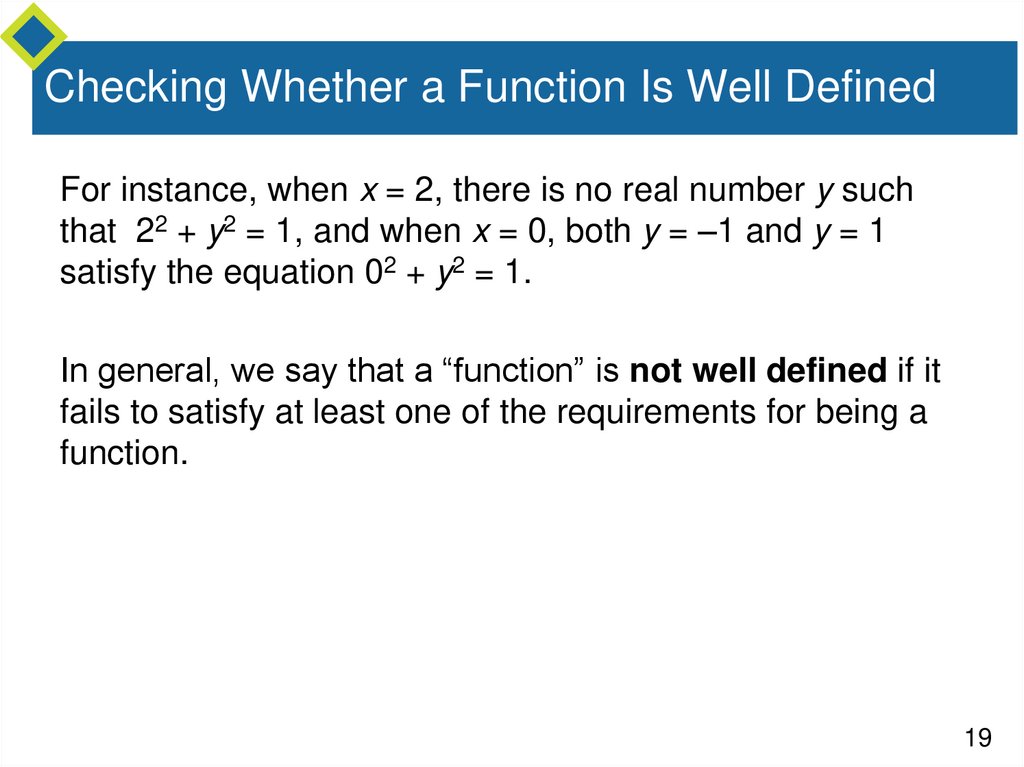
For instance, when x = 2, there is no real number y suchthat 22 + y2 = 1, and when x = 0, both y = –1 and y = 1
satisfy the equation 02 + y2 = 1.
In general, we say that a “function” is not well defined if it
fails to satisfy at least one of the requirements for being a
function.
19
20. Example 12 – A Function That Is Not Well Defined
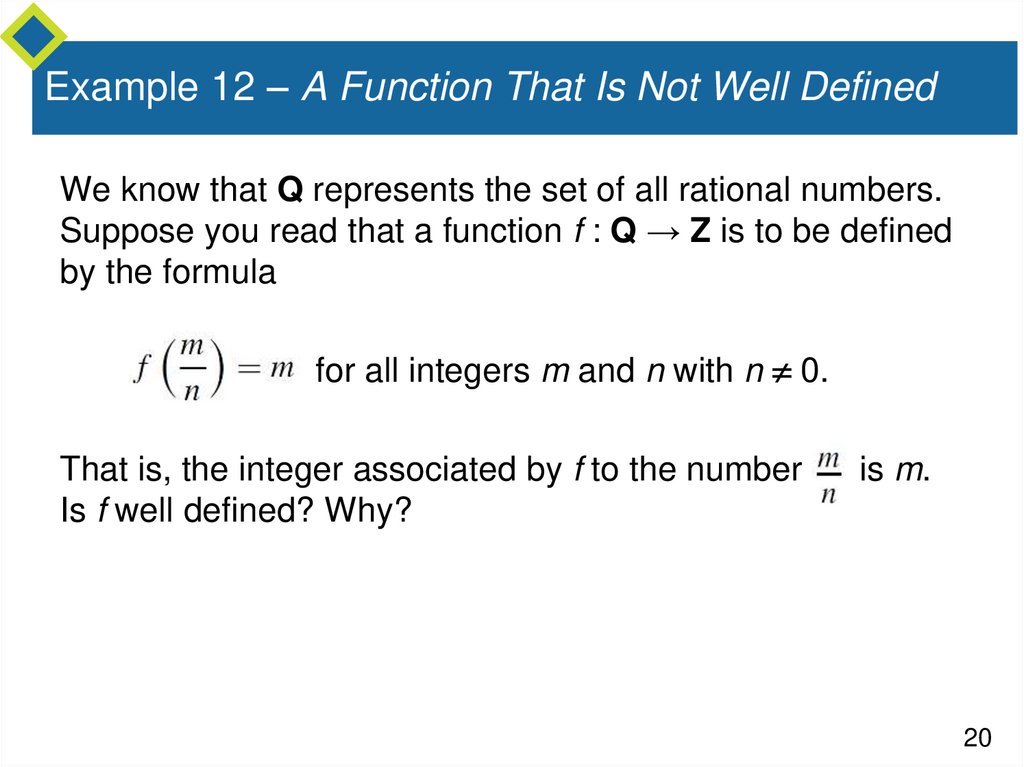
We know that Q represents the set of all rational numbers.Suppose you read that a function f : Q → Z is to be defined
by the formula
for all integers m and n with n 0.
That is, the integer associated by f to the number
Is f well defined? Why?
is m.
20
21. Example 12 – Solution
The function f is not well defined.The reason is that fractions have more than one
representation as quotients of integers.
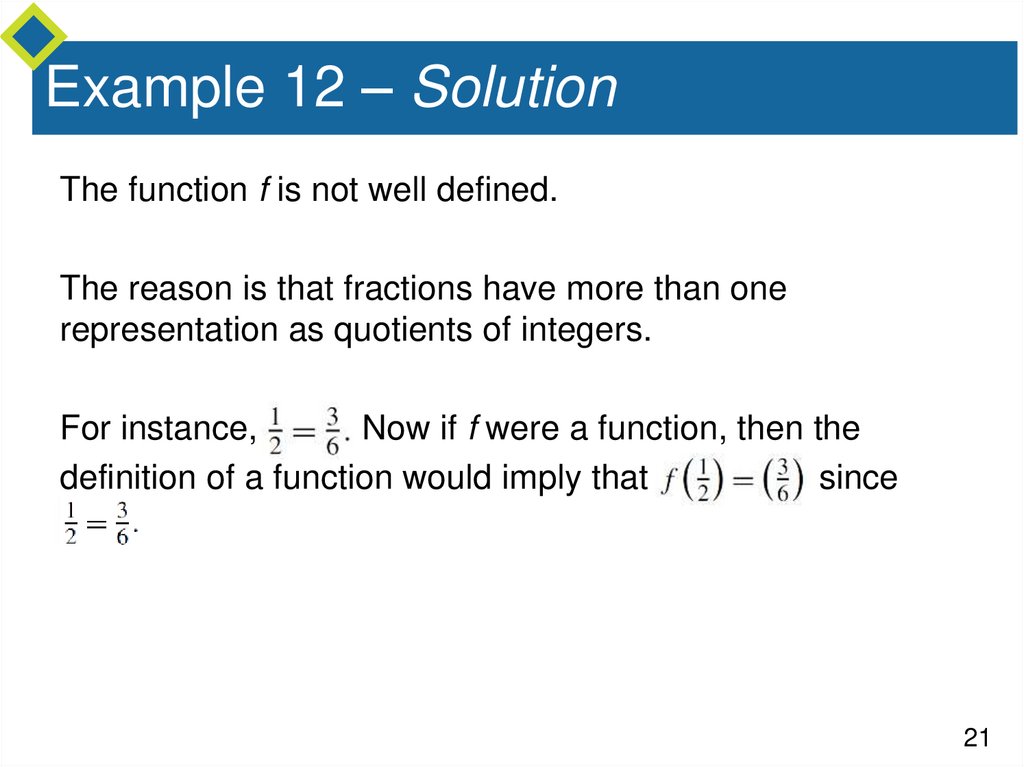
For instance,
Now if f were a function, then the
definition of a function would imply that
since
21
22. Example 12 – Solution
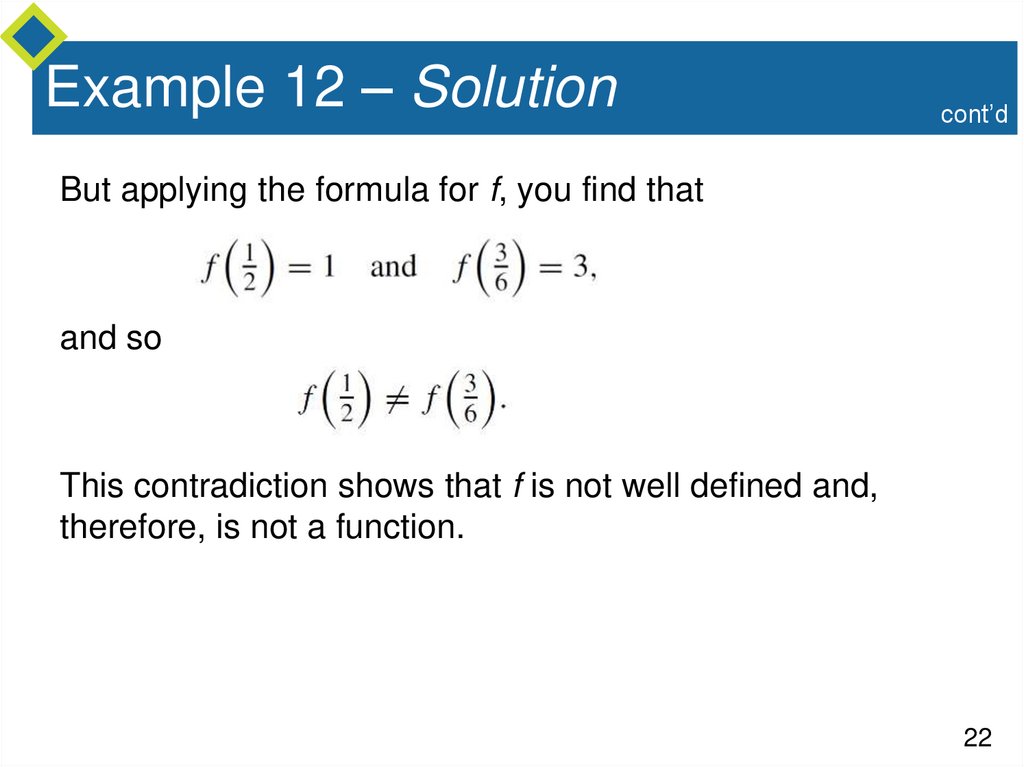
cont’dBut applying the formula for f, you find that
and so
This contradiction shows that f is not well defined and,
therefore, is not a function.
22
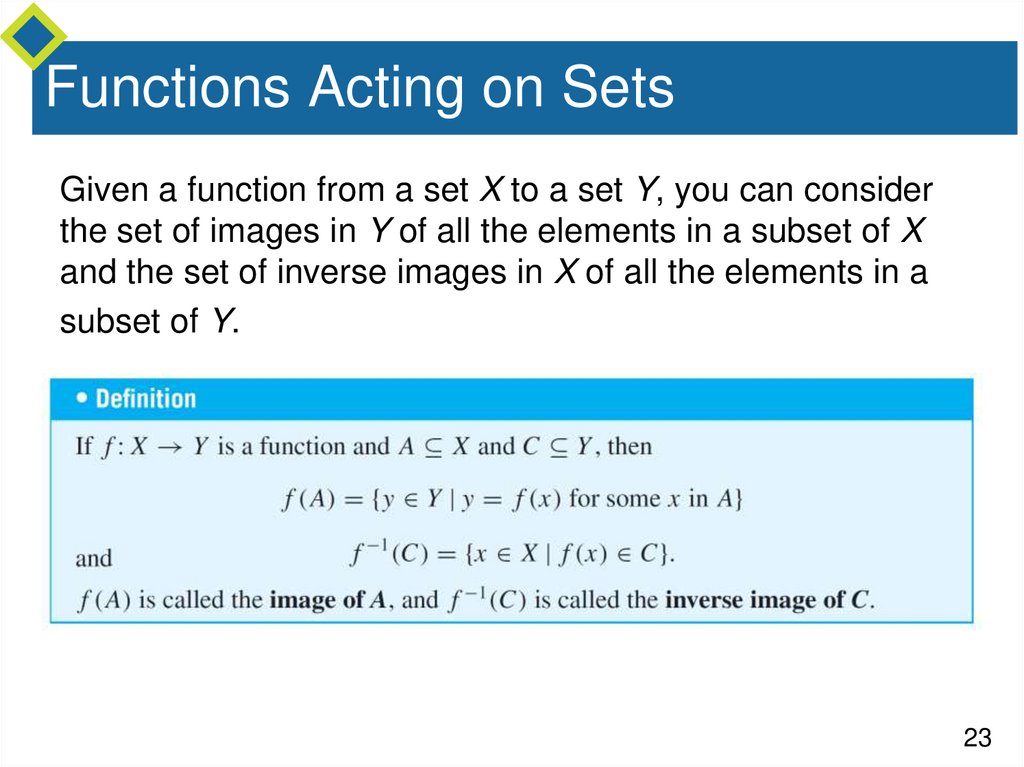
23. Functions Acting on Sets
Given a function from a set X to a set Y, you can considerthe set of images in Y of all the elements in a subset of X
and the set of inverse images in X of all the elements in a
subset of Y.
23
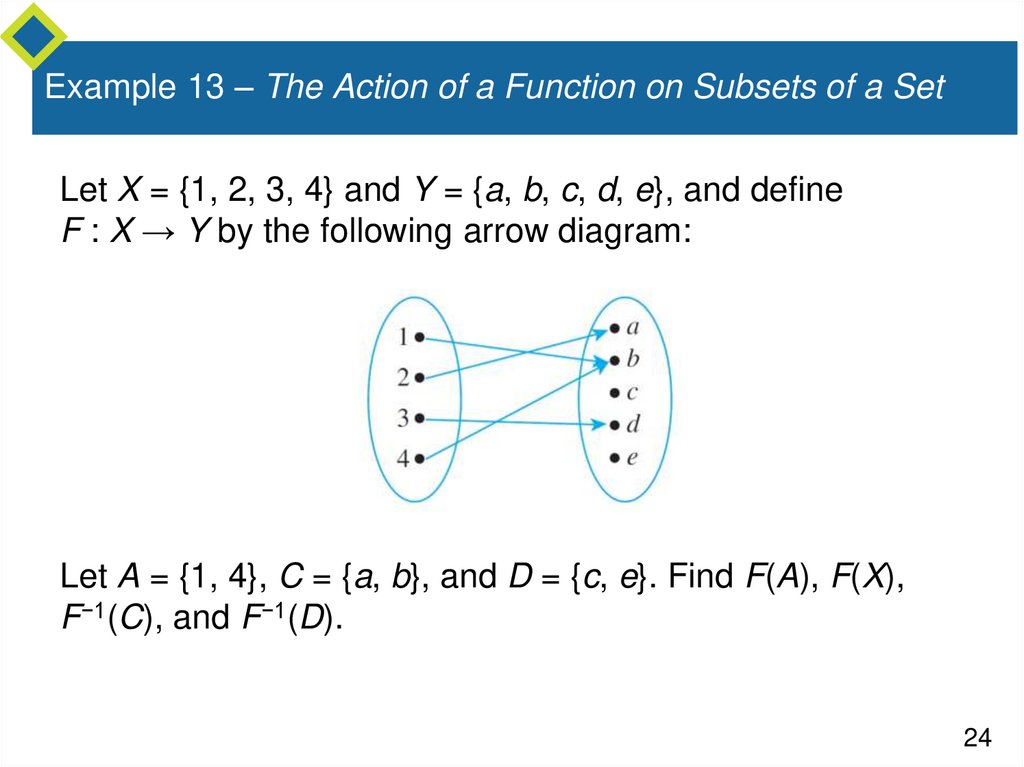
24. Example 13 – The Action of a Function on Subsets of a Set
Let X = {1, 2, 3, 4} and Y = {a, b, c, d, e}, and defineF : X → Y by the following arrow diagram:
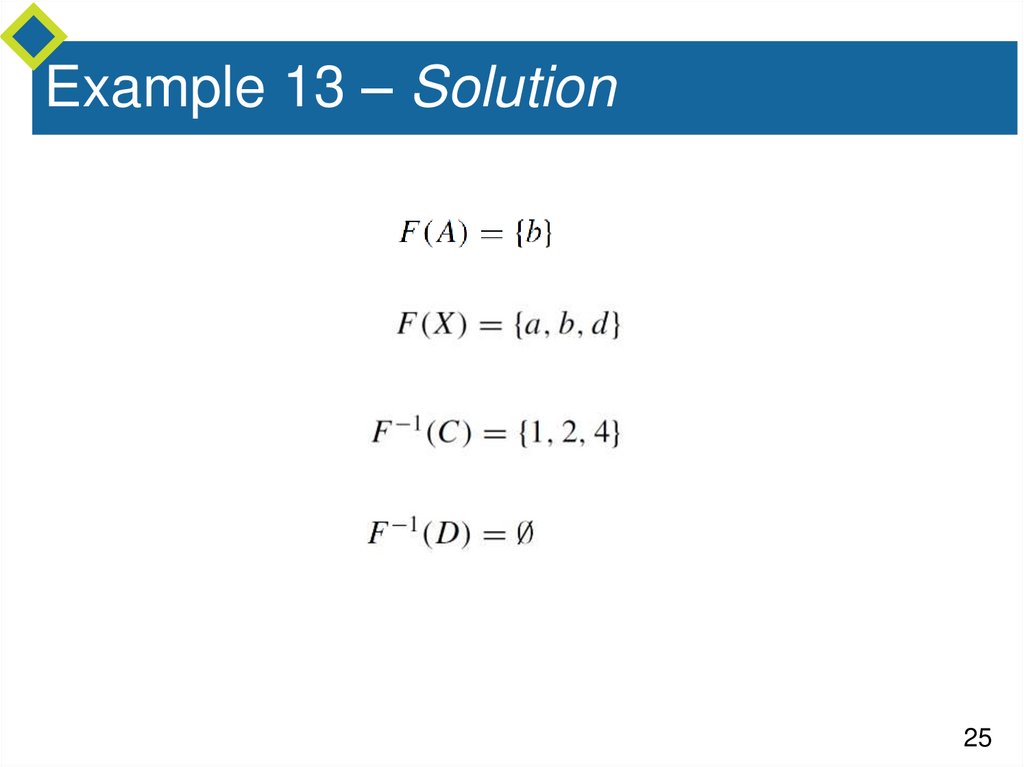
Let A = {1, 4}, C = {a, b}, and D = {c, e}. Find F(A), F(X),
F−1(C), and F−1(D).
24
25. Example 13 – Solution
2526. Exercises
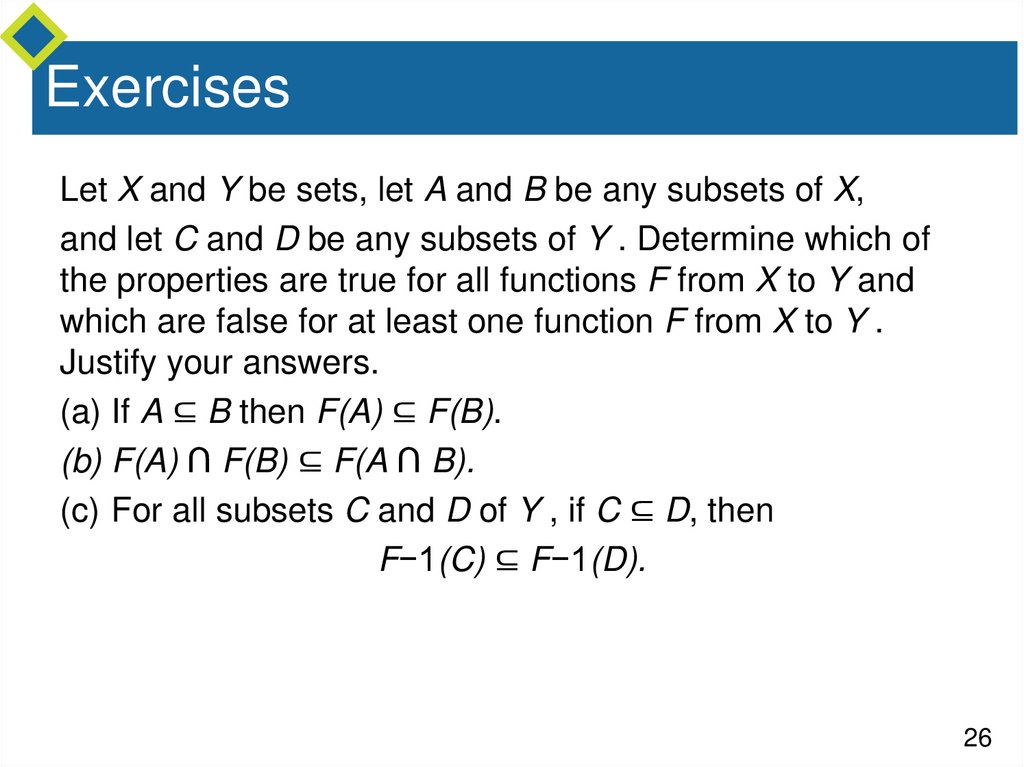
Let X and Y be sets, let A and B be any subsets of X,and let C and D be any subsets of Y . Determine which of
the properties are true for all functions F from X to Y and
which are false for at least one function F from X to Y .
Justify your answers.
(a) If A ⊆ B then F(A) ⊆ F(B).
(b) F(A) ∩ F(B) ⊆ F(A ∩ B).
(c) For all subsets C and D of Y , if C ⊆ D, then
F−1(C) ⊆ F−1(D).
26