
 Математика
Похожие презентации:









Section 7.3. Composition of functions
1.
CHAPTER 7FUNCTIONS
Copyright © Cengage Learning. All rights reserved.
2.
SECTION 7.3Composition of Functions
Copyright © Cengage Learning. All rights reserved.
3.
Composition of FunctionsConsider two functions, the successor function and the
squaring function, defined from Z (the set of integers) to Z,
and imagine that each is represented by a machine.
If the two machines are hooked up so that the output from
the successor function is used as input to the squaring
function, then they work together to operate as one larger
machine.
In this larger machine, an integer n is first increased by 1 to
obtain n + 1; then the quantity n + 1 is squared to obtain
(n + 1)2.
3
4.
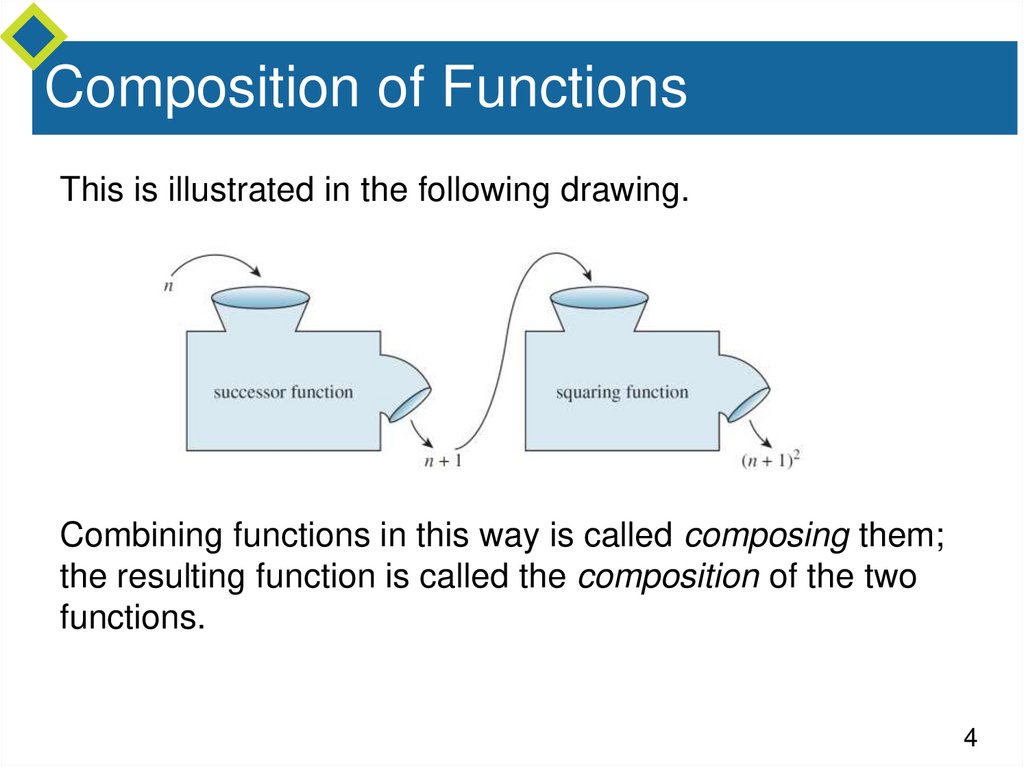
Composition of FunctionsThis is illustrated in the following drawing.
Combining functions in this way is called composing them;
the resulting function is called the composition of the two
functions.
4
5.
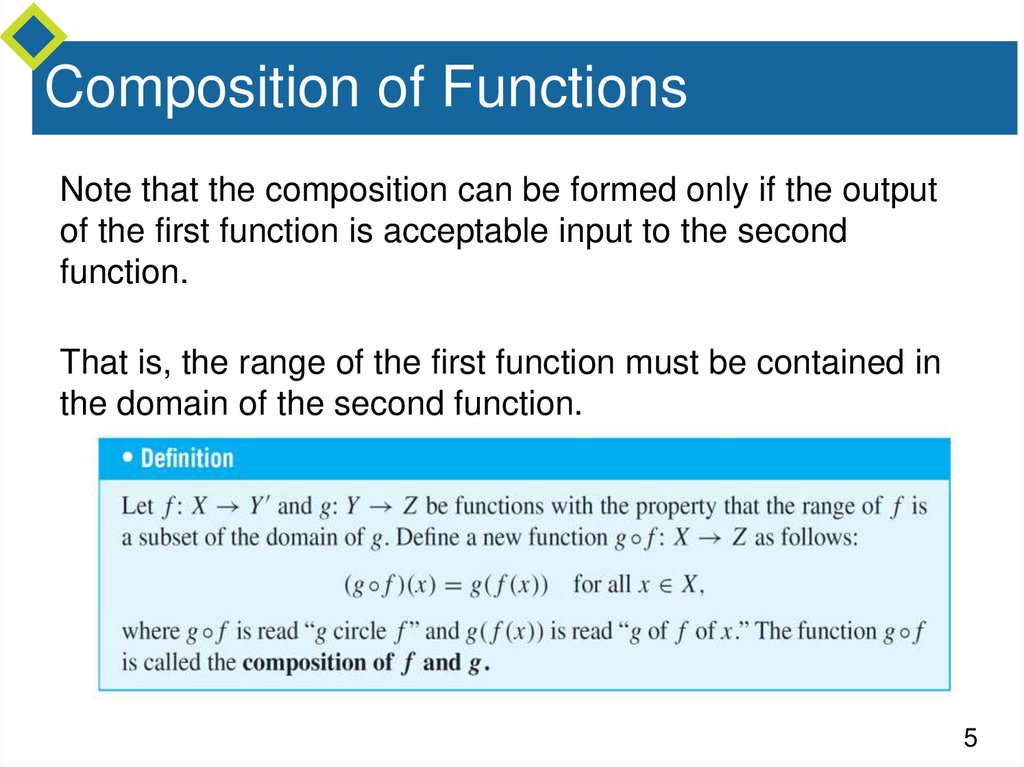
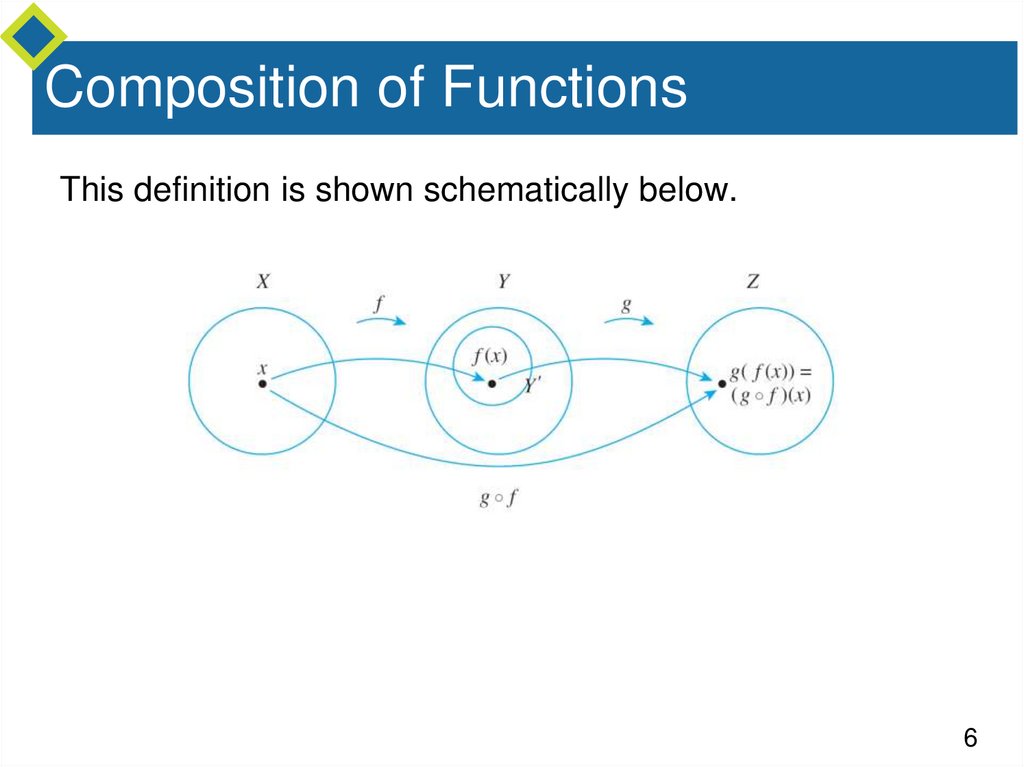
Composition of FunctionsNote that the composition can be formed only if the output
of the first function is acceptable input to the second
function.
That is, the range of the first function must be contained in
the domain of the second function.
5
6.
Composition of FunctionsThis definition is shown schematically below.
6
7.
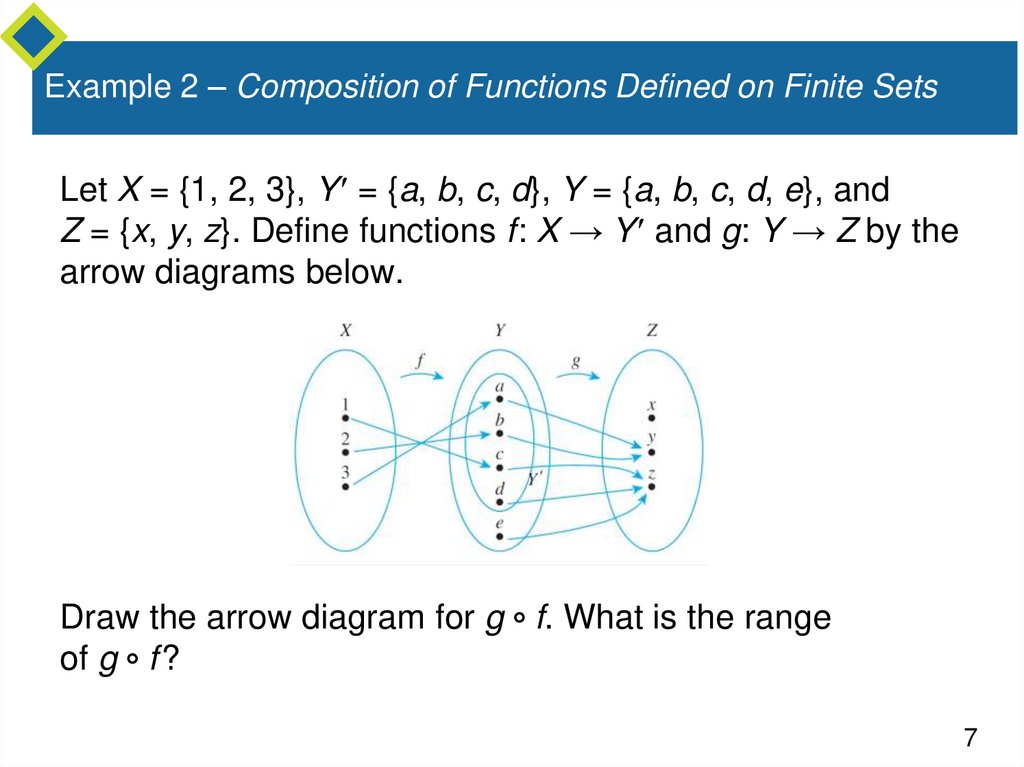
Example 2 – Composition of Functions Defined on Finite SetsLet X = {1, 2, 3}, Y = {a, b, c, d}, Y = {a, b, c, d, e}, and
Z = {x, y, z}. Define functions f: X → Y and g: Y → Z by the
arrow diagrams below.
Draw the arrow diagram for g f. What is the range
of g f ?
7
8.
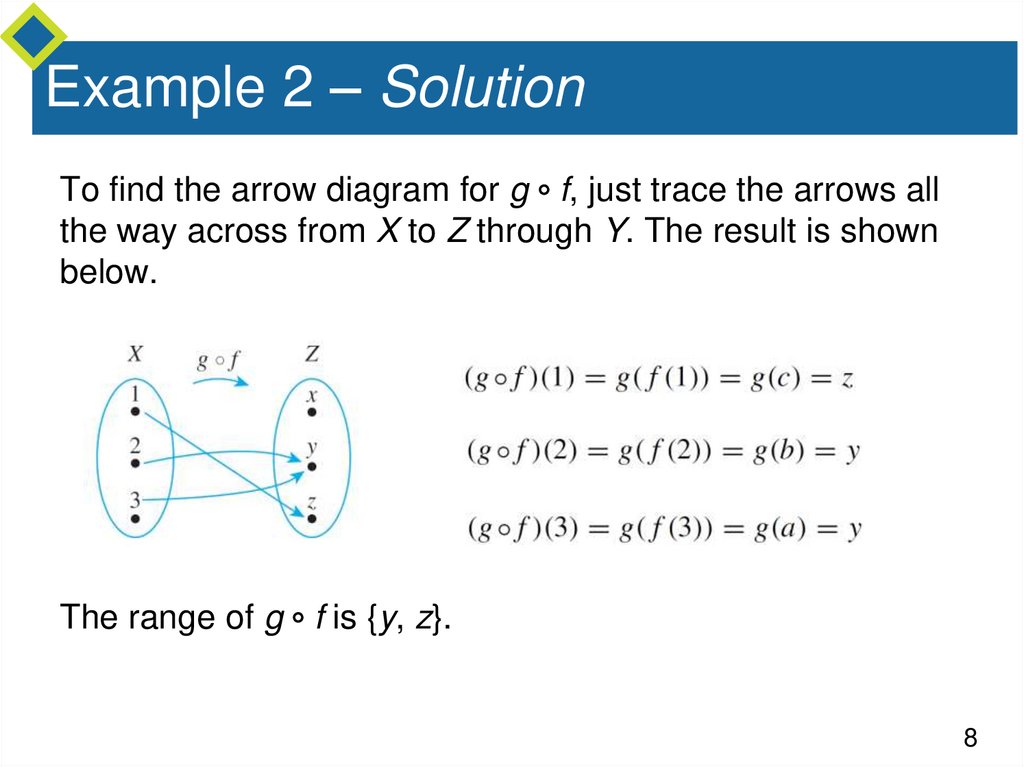
Example 2 – SolutionTo find the arrow diagram for g f, just trace the arrows all
the way across from X to Z through Y. The result is shown
below.
The range of g f is {y, z}.
8
9.
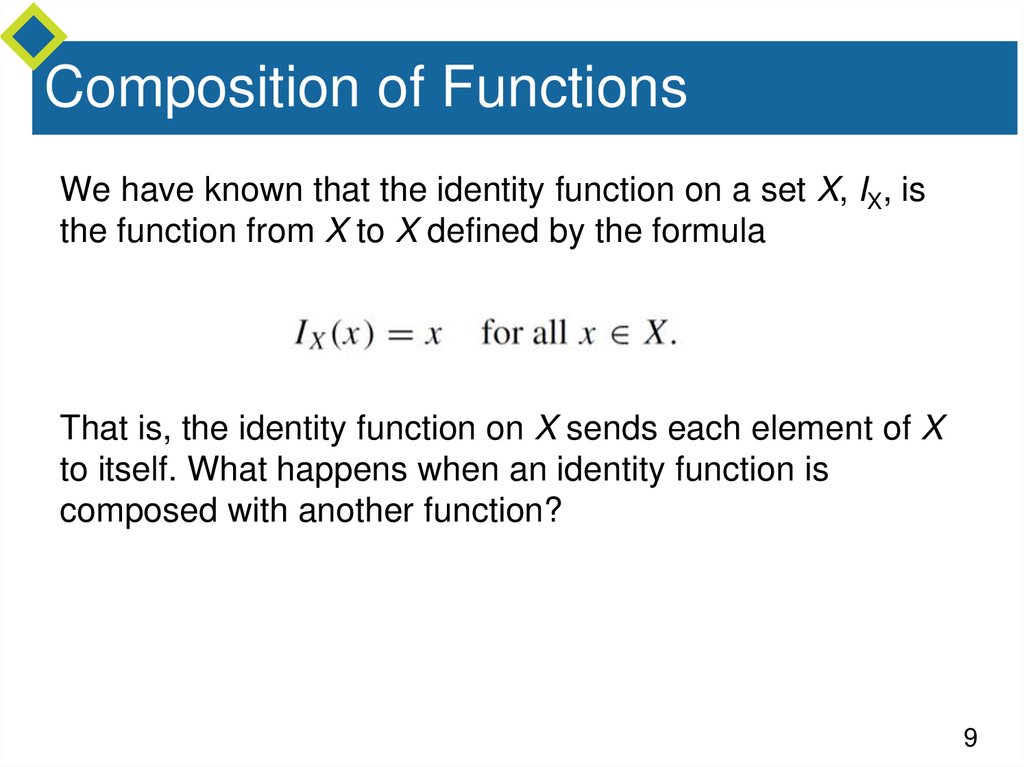
Composition of FunctionsWe have known that the identity function on a set X, IX, is
the function from X to X defined by the formula
That is, the identity function on X sends each element of X
to itself. What happens when an identity function is
composed with another function?
9
10.
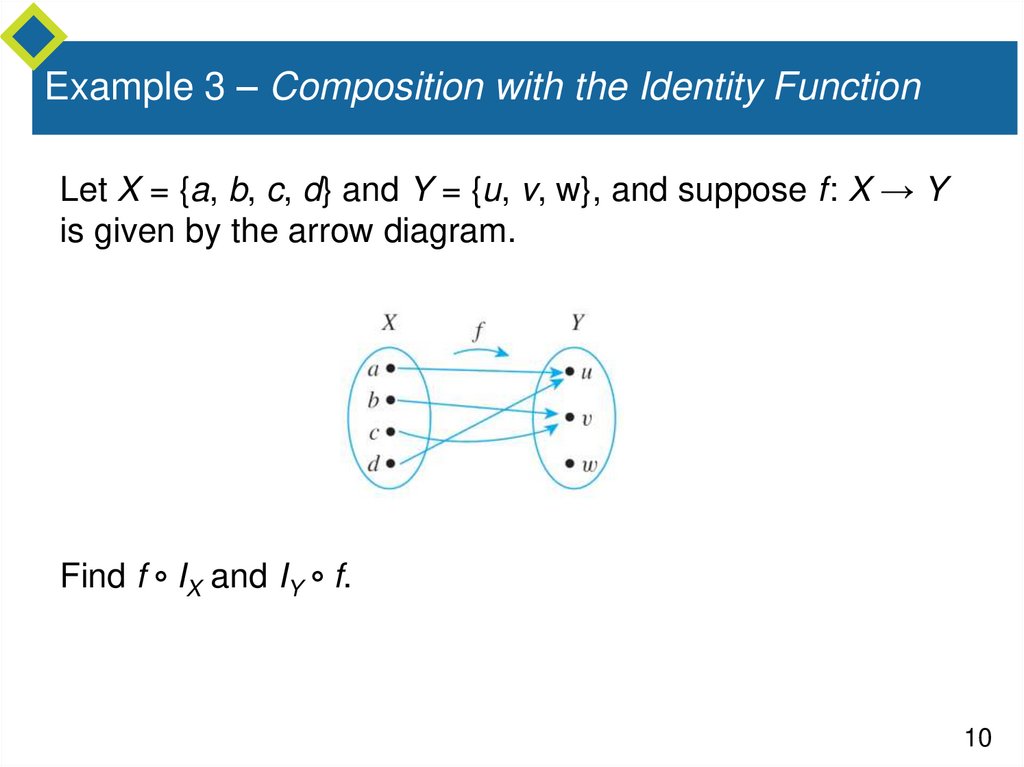
Example 3 – Composition with the Identity FunctionLet X = {a, b, c, d} and Y = {u, v, w}, and suppose f: X → Y
is given by the arrow diagram.
Find f IX and IY f.
10
11.
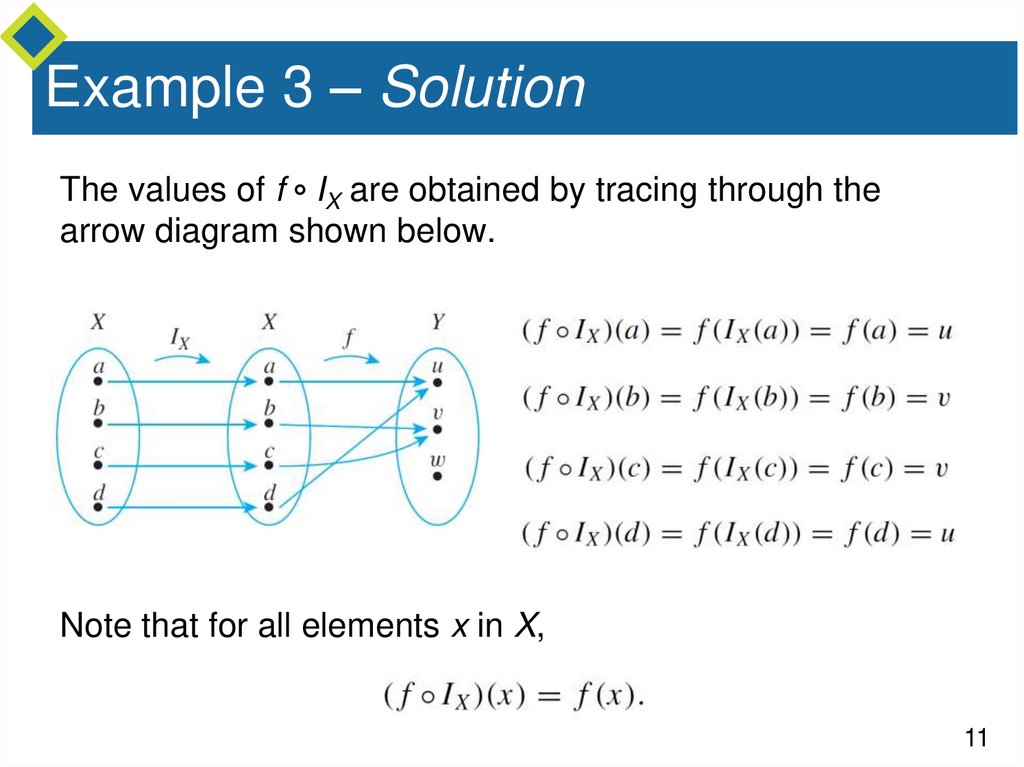
Example 3 – SolutionThe values of f IX are obtained by tracing through the
arrow diagram shown below.
Note that for all elements x in X,
11
12.
Example 3 – Solutioncont’d
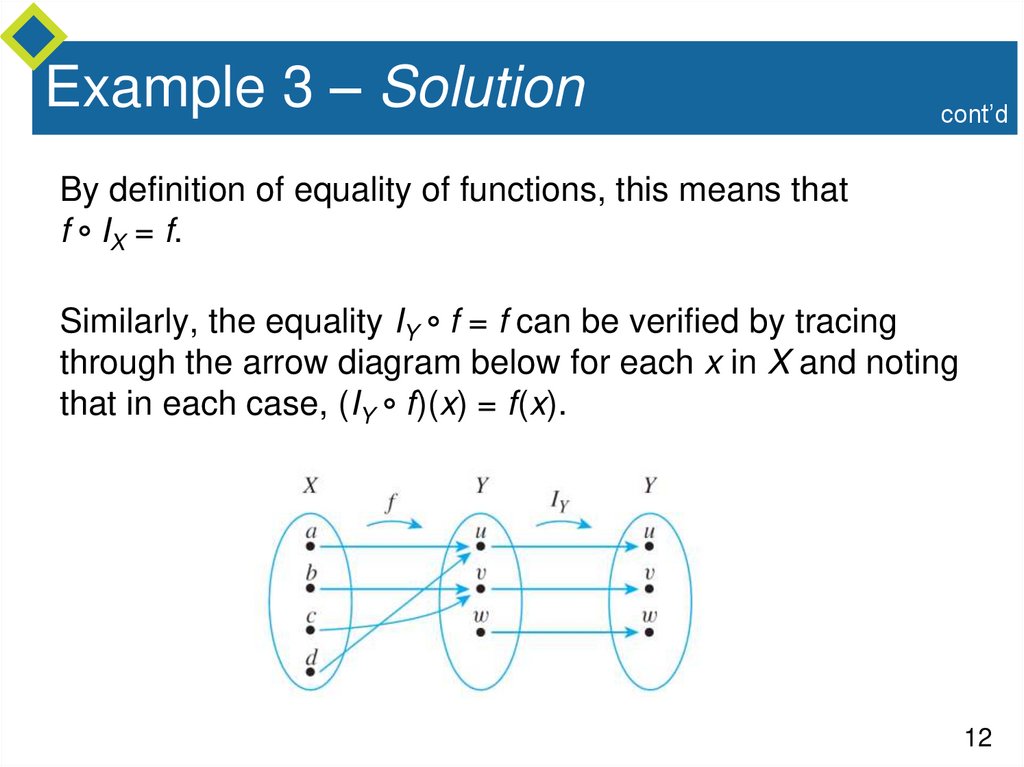
By definition of equality of functions, this means that
f IX = f.
Similarly, the equality IY f = f can be verified by tracing
through the arrow diagram below for each x in X and noting
that in each case, (IY f)(x) = f(x).
12
13.
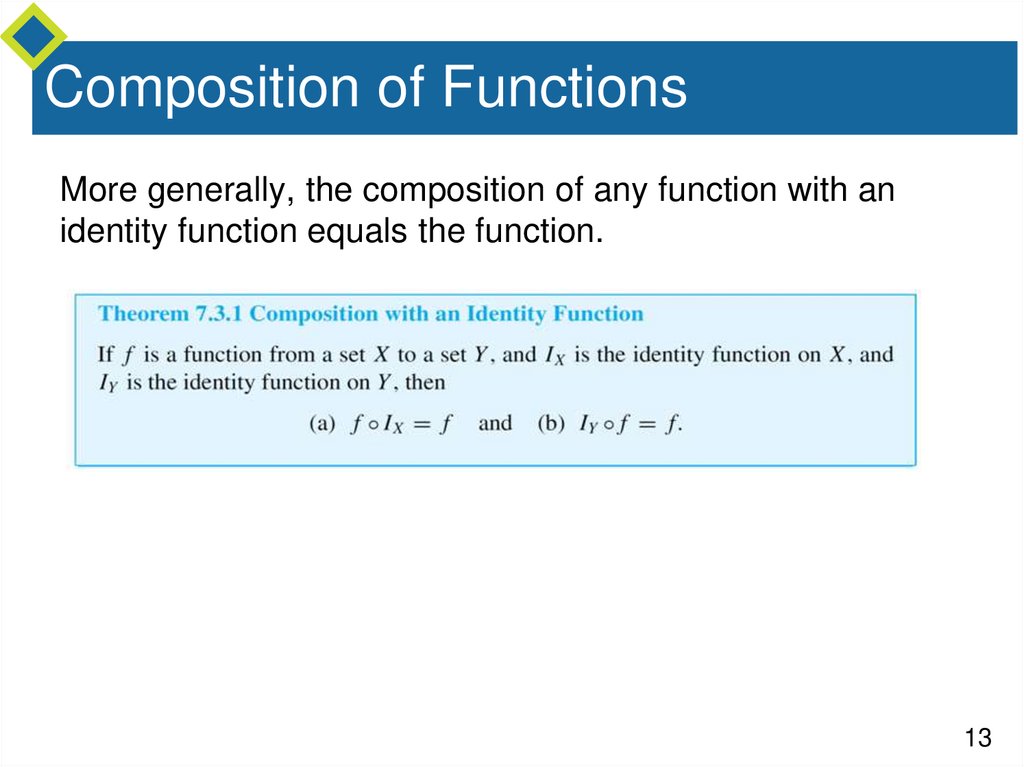
Composition of FunctionsMore generally, the composition of any function with an
identity function equals the function.
13
14.
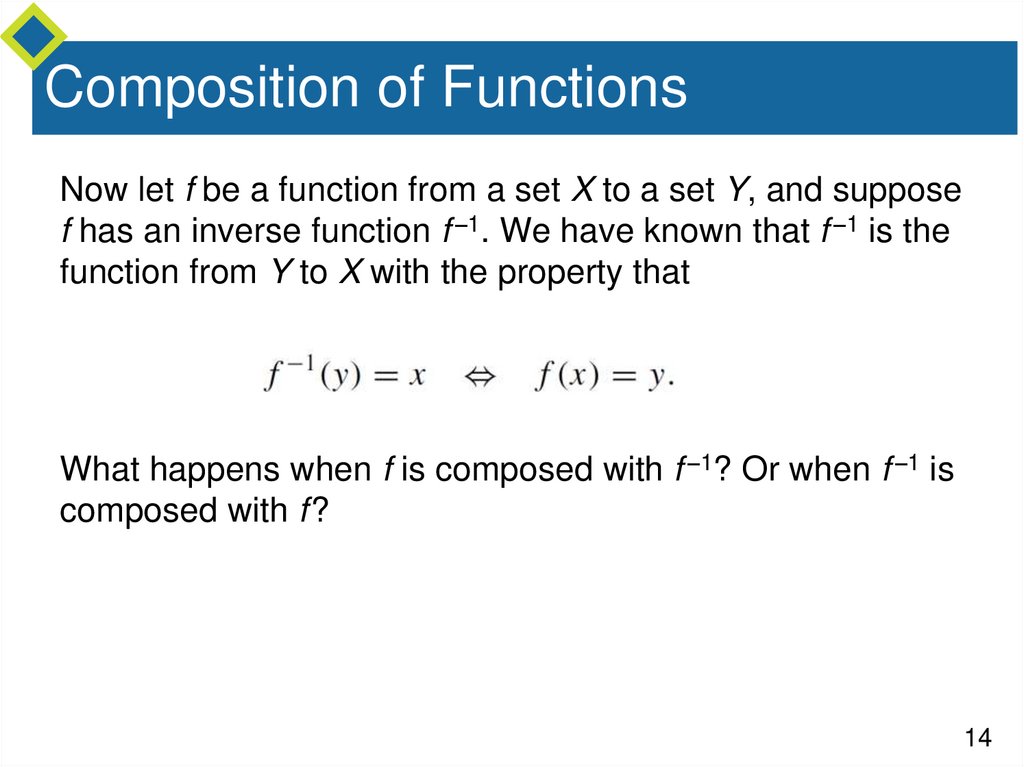
Composition of FunctionsNow let f be a function from a set X to a set Y, and suppose
f has an inverse function f –1. We have known that f –1 is the
function from Y to X with the property that
What happens when f is composed with f –1? Or when f –1 is
composed with f?
14
15.
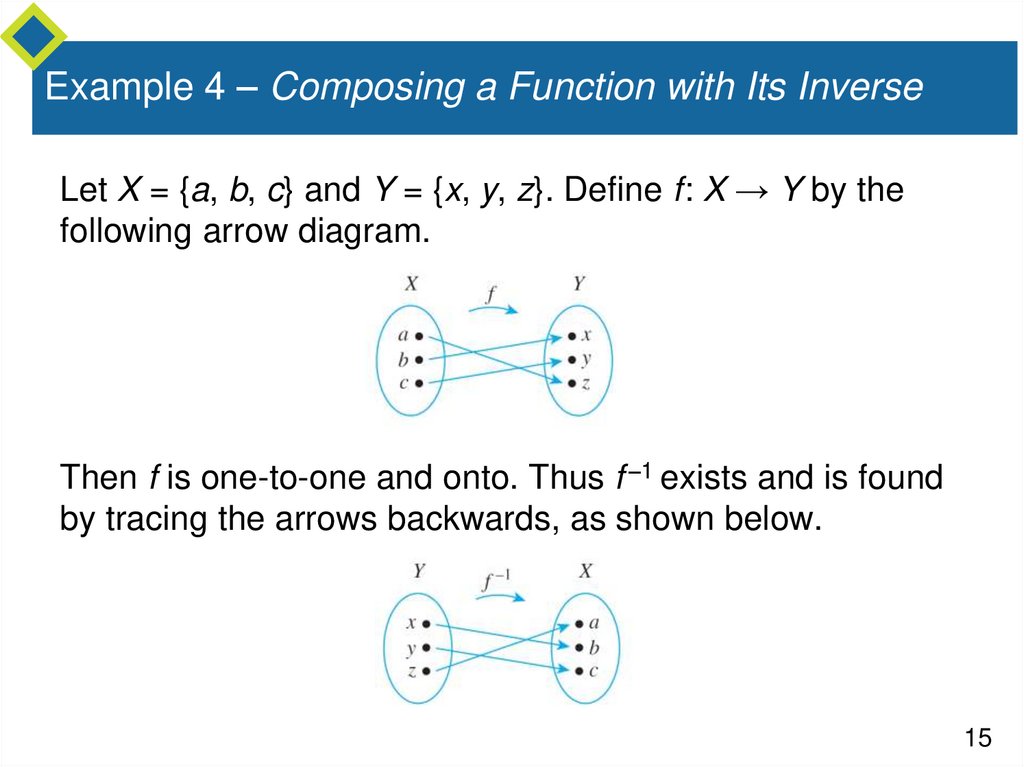
Example 4 – Composing a Function with Its InverseLet X = {a, b, c} and Y = {x, y, z}. Define f: X → Y by the
following arrow diagram.
Then f is one-to-one and onto. Thus f –1 exists and is found
by tracing the arrows backwards, as shown below.
15
16.
Example 4 – Composing a Function with Its Inversecont’d
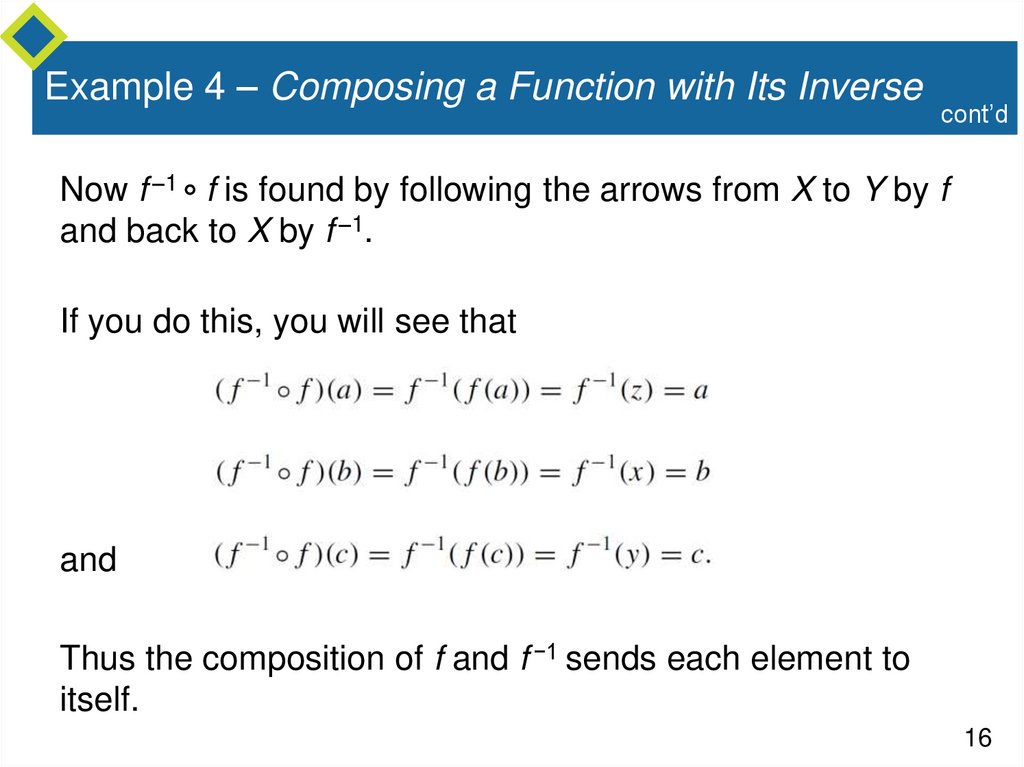
Now f –1 f is found by following the arrows from X to Y by f
and back to X by f –1.
If you do this, you will see that
and
Thus the composition of f and f −1 sends each element to
itself.
16
17.
Example 4 – Composing a Function with Its Inversecont’d
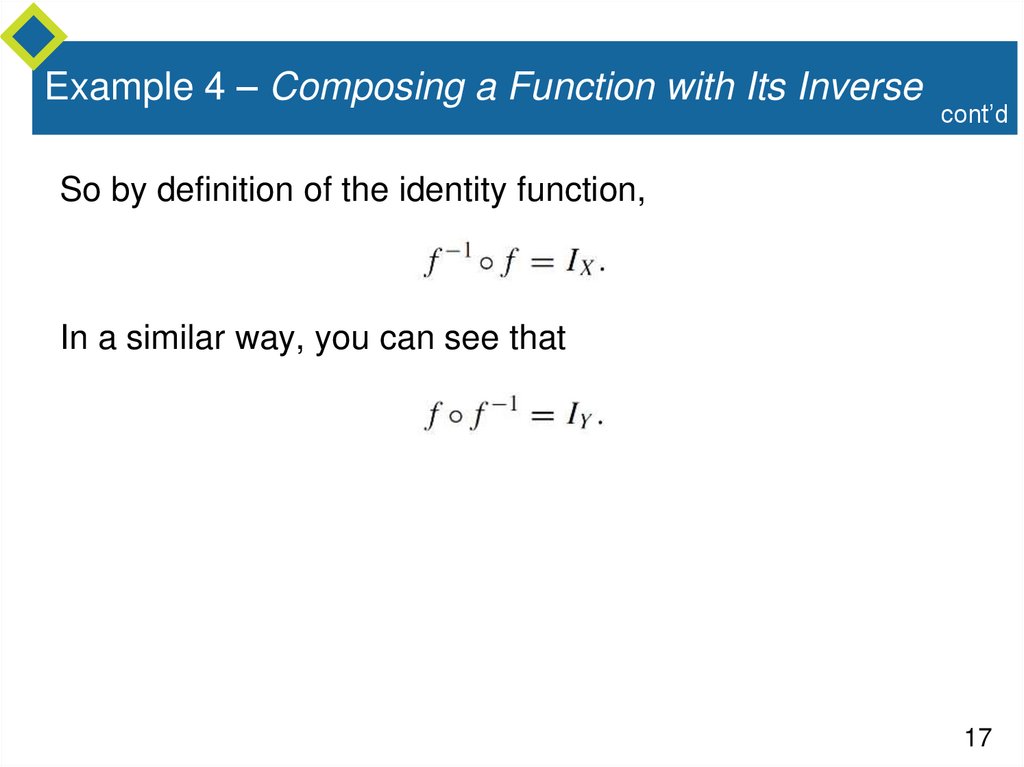
So by definition of the identity function,
In a similar way, you can see that
17
18.
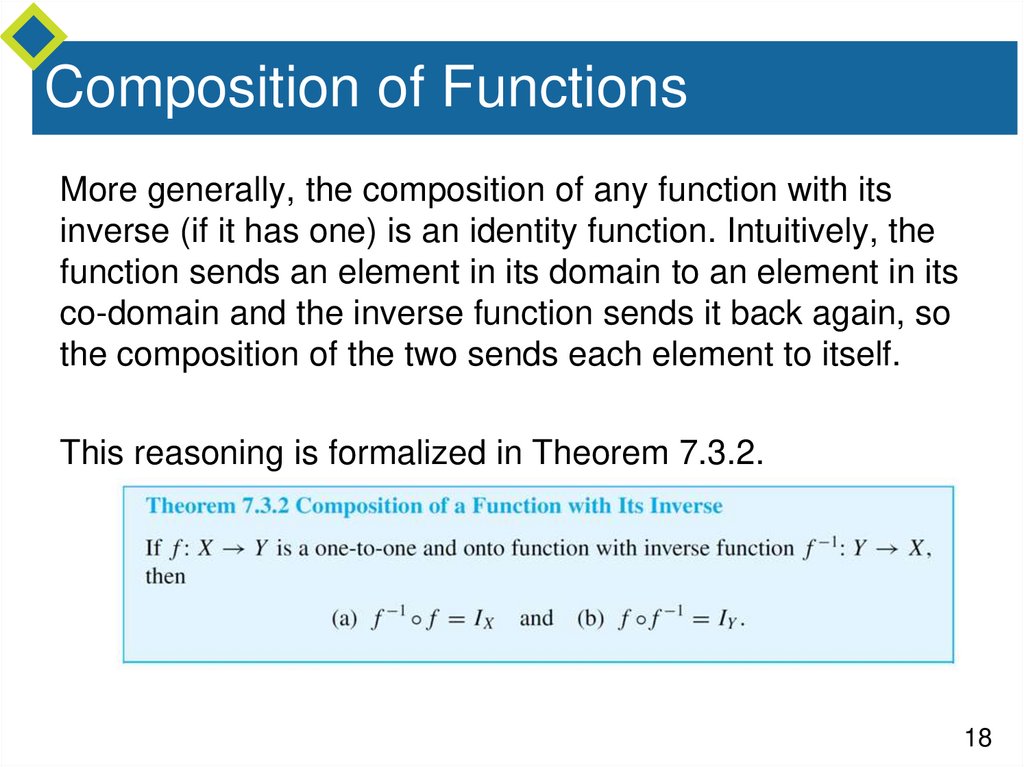
Composition of FunctionsMore generally, the composition of any function with its
inverse (if it has one) is an identity function. Intuitively, the
function sends an element in its domain to an element in its
co-domain and the inverse function sends it back again, so
the composition of the two sends each element to itself.
This reasoning is formalized in Theorem 7.3.2.
18
19.
Composition of One-to-OneFunctions
19
20.
Composition of One-to-One FunctionsThe composition of functions interacts in interesting ways
with the properties of being one-to-one and onto. What
happens, for instance, when two one-to-one functions are
composed? Must their composition be one-to-one?
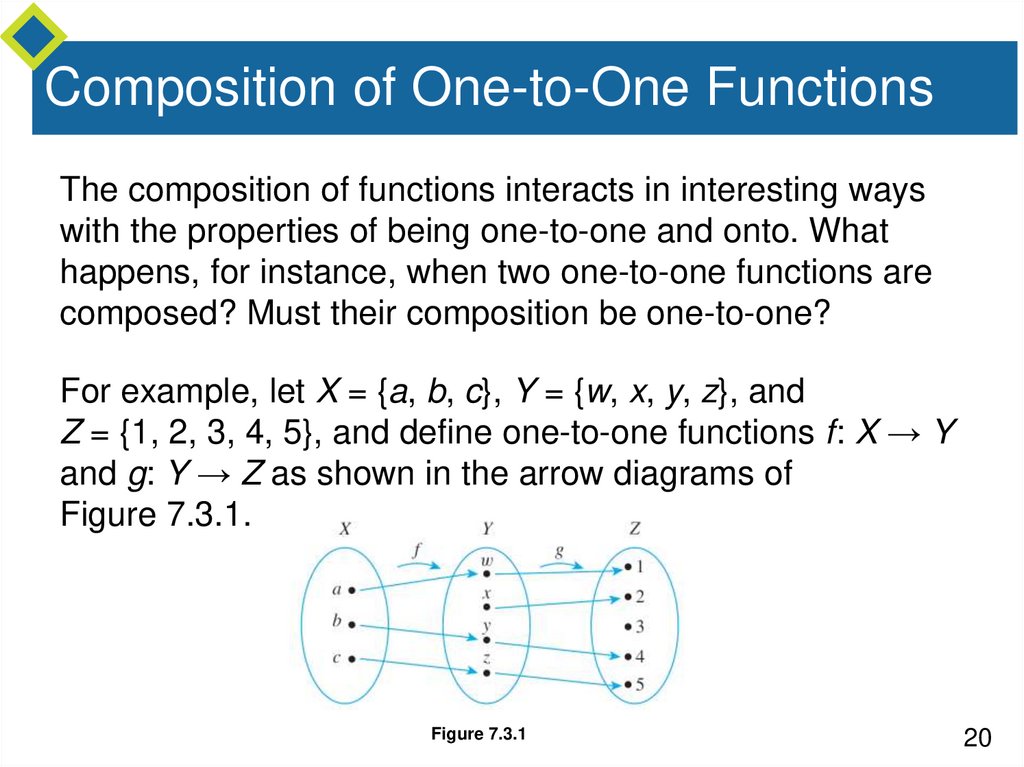
For example, let X = {a, b, c}, Y = {w, x, y, z}, and
Z = {1, 2, 3, 4, 5}, and define one-to-one functions f: X → Y
and g: Y → Z as shown in the arrow diagrams of
Figure 7.3.1.
Figure 7.3.1
20
21.
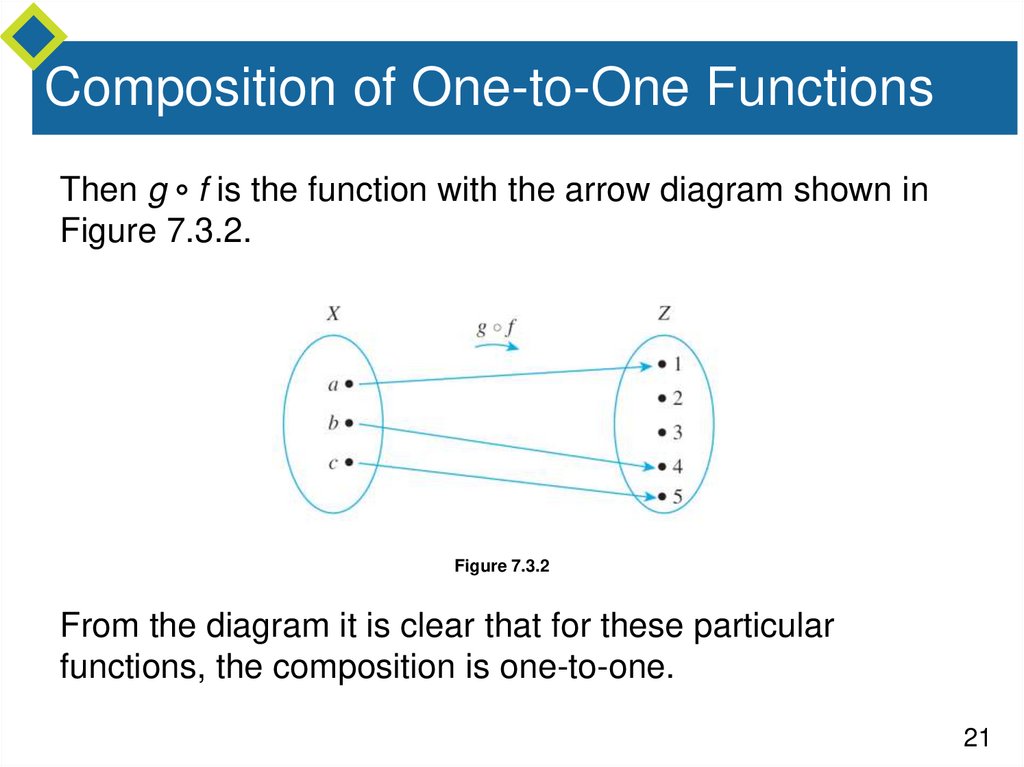
Composition of One-to-One FunctionsThen g f is the function with the arrow diagram shown in
Figure 7.3.2.
Figure 7.3.2
From the diagram it is clear that for these particular
functions, the composition is one-to-one.
21
22.
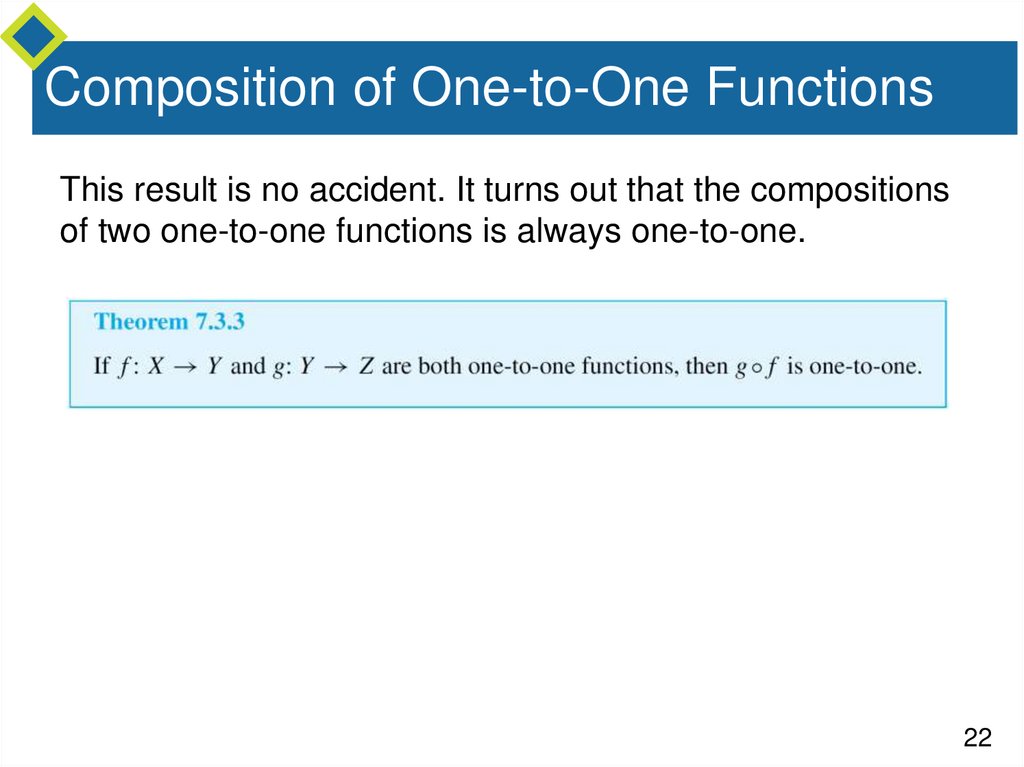
Composition of One-to-One FunctionsThis result is no accident. It turns out that the compositions
of two one-to-one functions is always one-to-one.
22
23.
Composition of Onto Functions23
24.
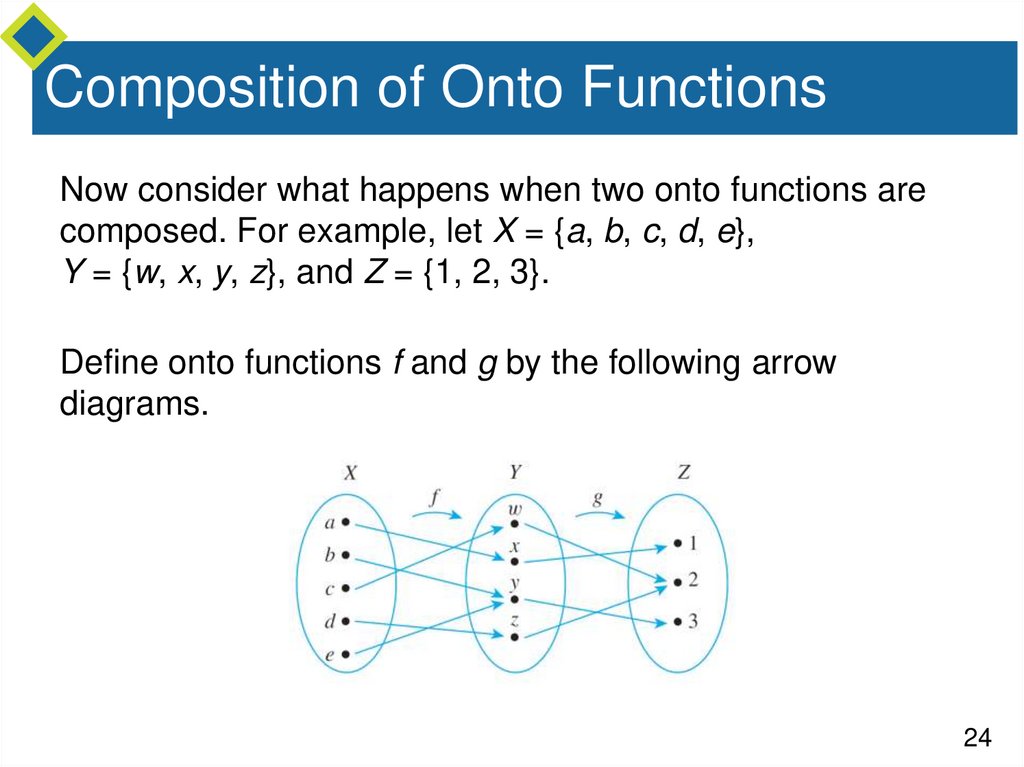
Composition of Onto FunctionsNow consider what happens when two onto functions are
composed. For example, let X = {a, b, c, d, e},
Y = {w, x, y, z}, and Z = {1, 2, 3}.
Define onto functions f and g by the following arrow
diagrams.
24
25.
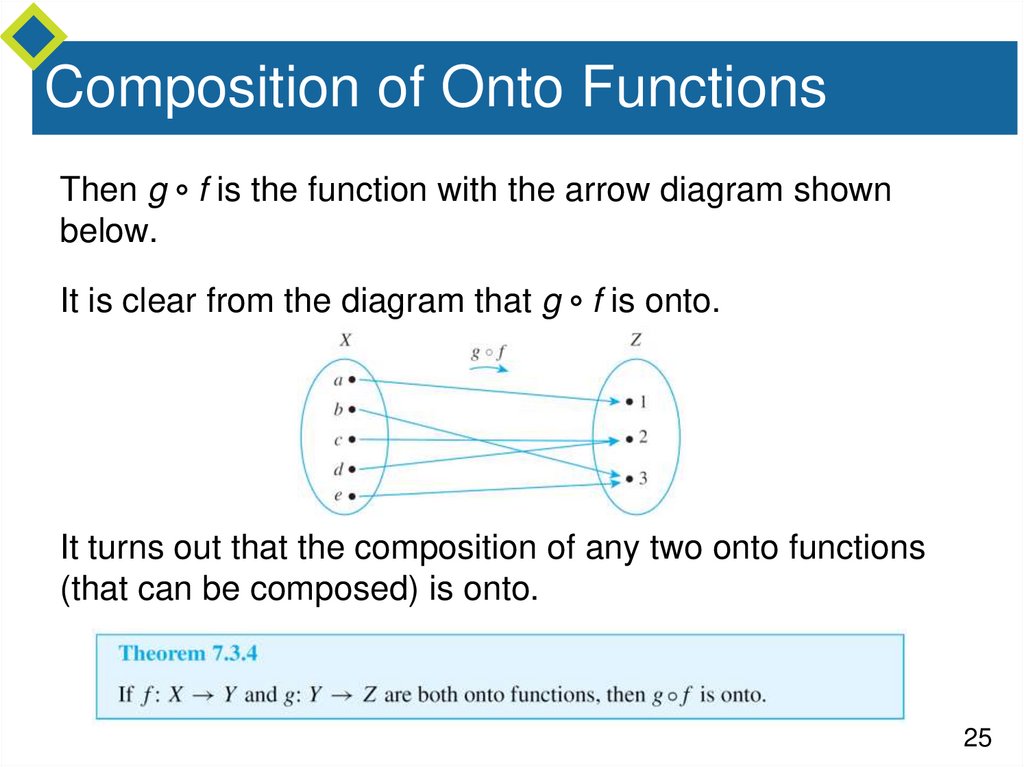
Composition of Onto FunctionsThen g f is the function with the arrow diagram shown
below.
It is clear from the diagram that g f is onto.
It turns out that the composition of any two onto functions
(that can be composed) is onto.
25
26.
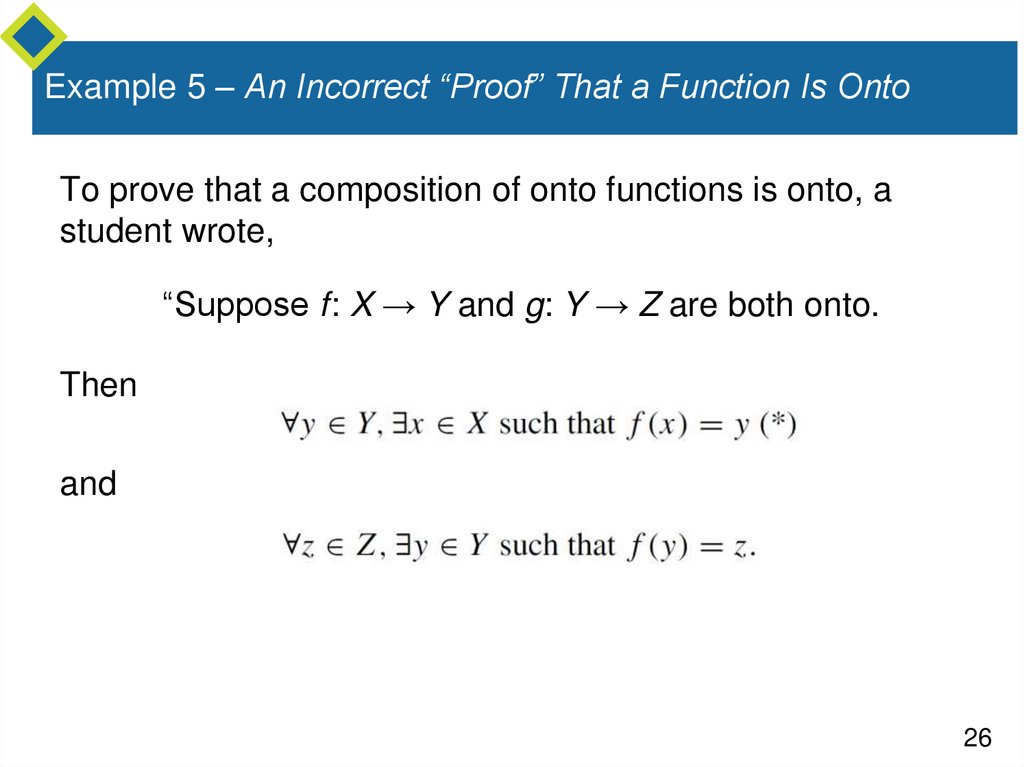
Example 5 – An Incorrect “Proof” That a Function Is OntoTo prove that a composition of onto functions is onto, a
student wrote,
“Suppose f: X → Y and g: Y → Z are both onto.
Then
and
26
27.
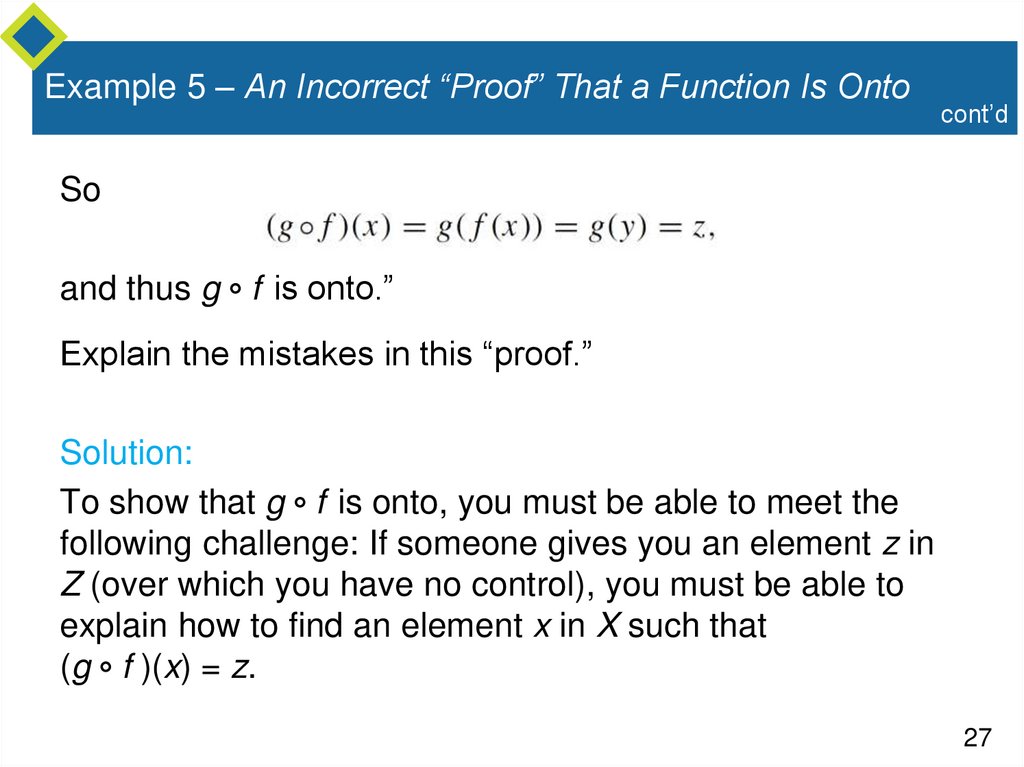
Example 5 – An Incorrect “Proof” That a Function Is Ontocont’d
So
and thus g f is onto.”
Explain the mistakes in this “proof.”
Solution:
To show that g f is onto, you must be able to meet the
following challenge: If someone gives you an element z in
Z (over which you have no control), you must be able to
explain how to find an element x in X such that
(g f )(x) = z.
27
28.
Example 5 – Solutioncont’d
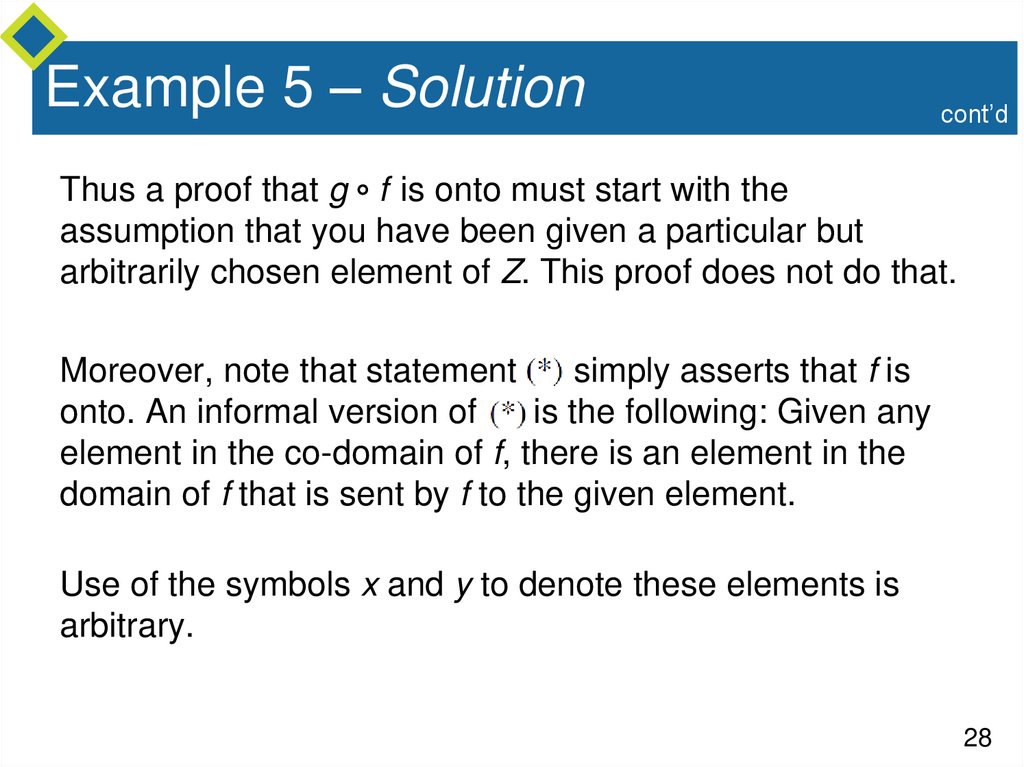
Thus a proof that g f is onto must start with the
assumption that you have been given a particular but
arbitrarily chosen element of Z. This proof does not do that.
Moreover, note that statement
simply asserts that f is
onto. An informal version of
is the following: Given any
element in the co-domain of f, there is an element in the
domain of f that is sent by f to the given element.
Use of the symbols x and y to denote these elements is
arbitrary.
28
29.
Example 5 – Solutioncont’d
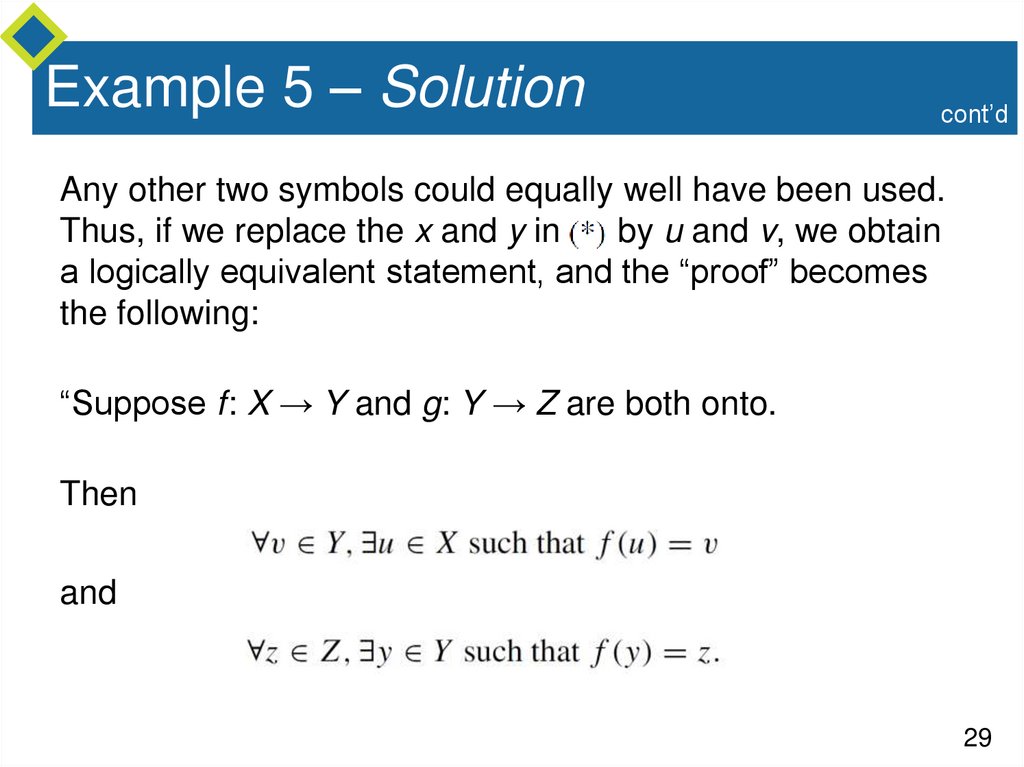
Any other two symbols could equally well have been used.
Thus, if we replace the x and y in
by u and v, we obtain
a logically equivalent statement, and the “proof” becomes
the following:
“Suppose f: X → Y and g: Y → Z are both onto.
Then
and
29
30.
Example 5 – Solutioncont’d
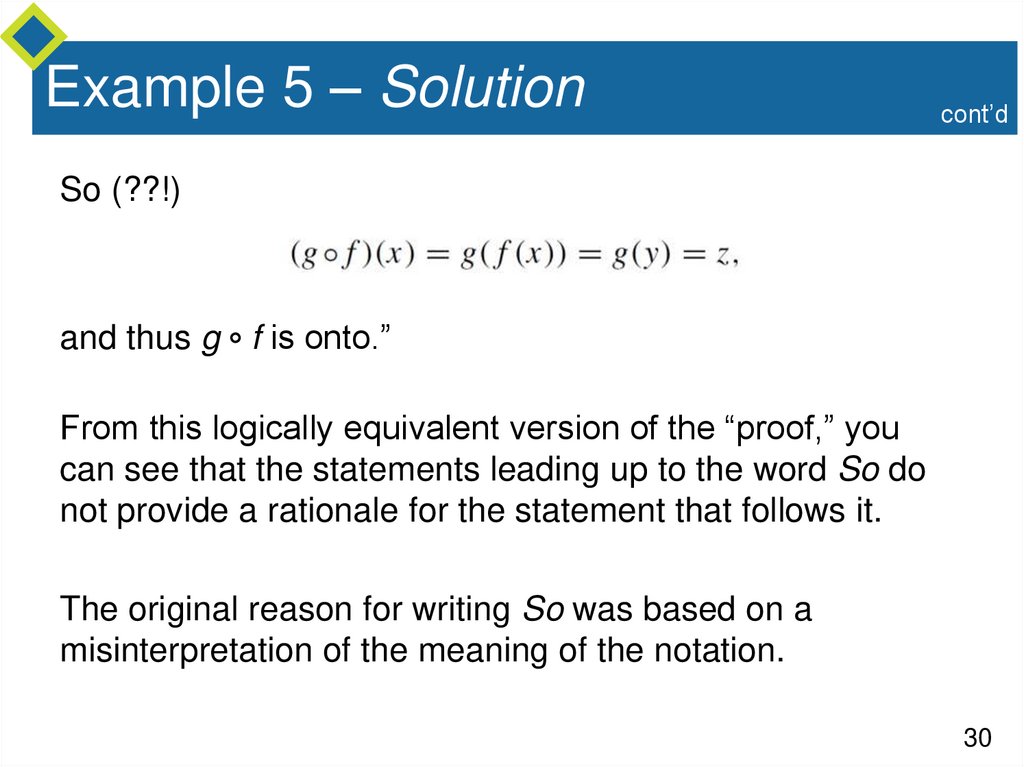
So (??!)
and thus g f is onto.”
From this logically equivalent version of the “proof,” you
can see that the statements leading up to the word So do
not provide a rationale for the statement that follows it.
The original reason for writing So was based on a
misinterpretation of the meaning of the notation.
30
31.
Exercises: 131
32.
Exercises32
33.
Solution 133
34.
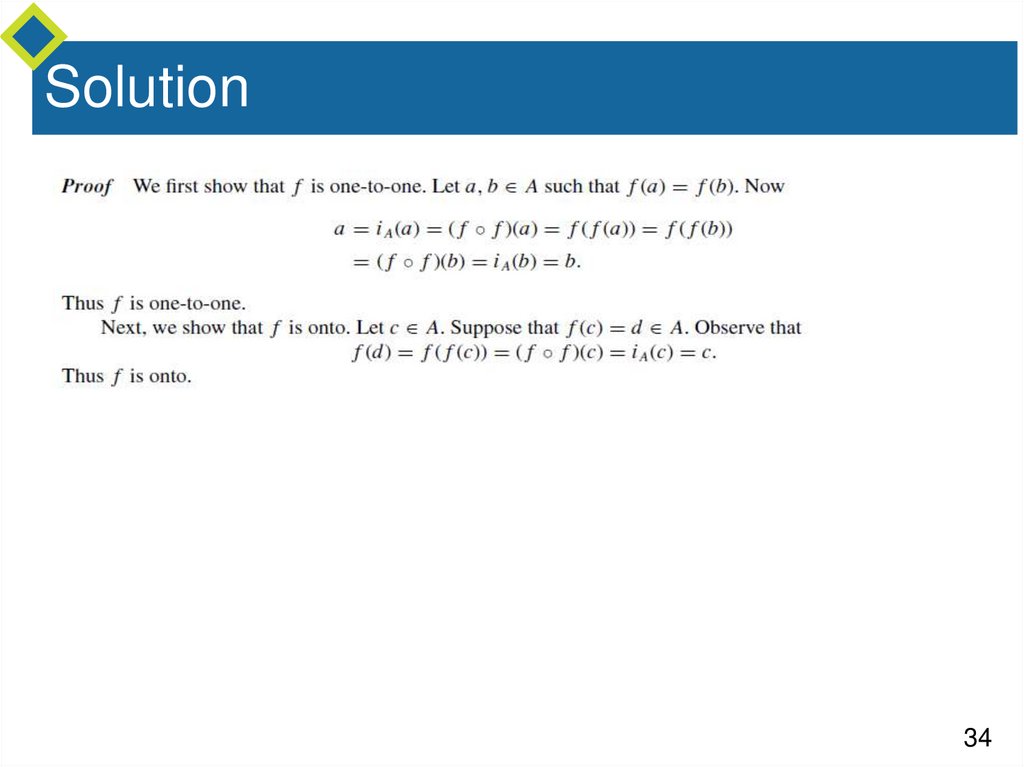
Solution34
35.
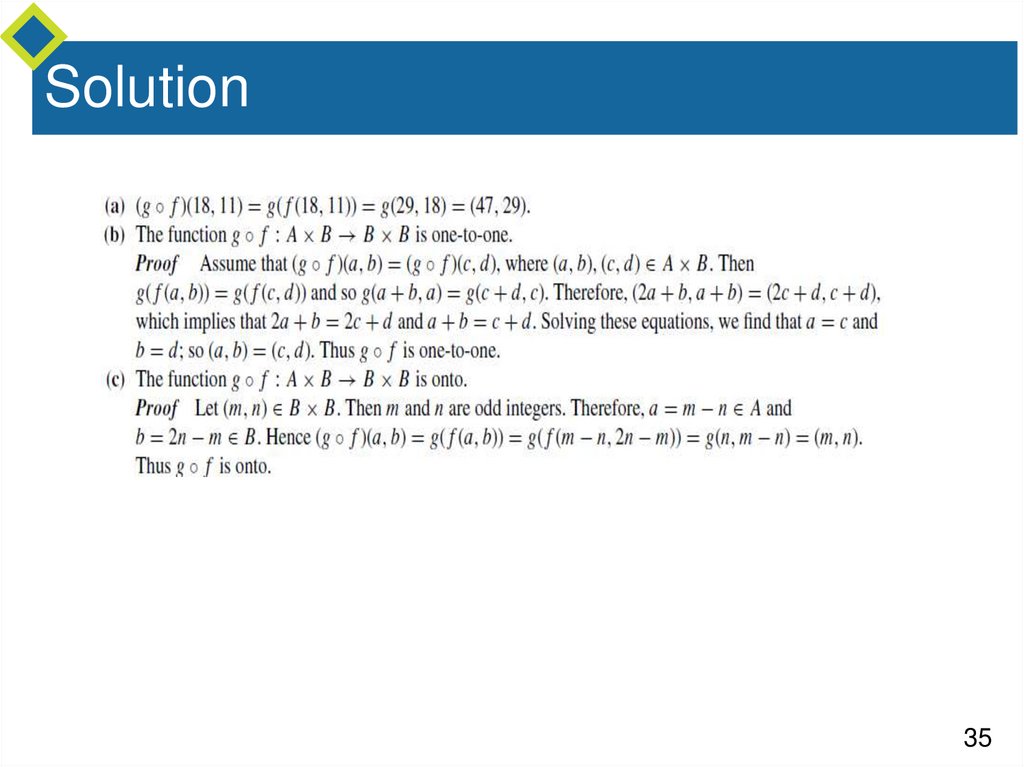
Solution35