
 Промышленность
Похожие презентации:









Open Top Containers - Container Surveyor
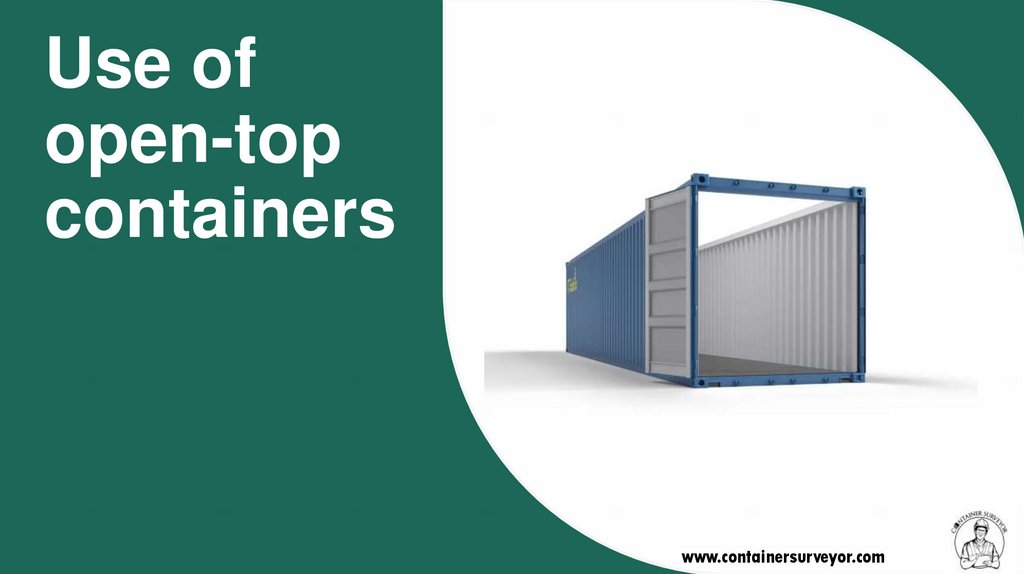
1. Use of open-top containers
www.containersurveyor.com2. What is an Open Top Container & Why They Are Important ?
What is an Open Top Container& Why They Are Important ?
Open top containers can be identified as shipping containers
without a fixed roof panel (roof or ceiling). This type of
container is specifically designed to handle specialized cargo
that falls under major categories such as construction,
agricultural, and industrial equipment. In fact, open top
containers are primarily used for oversized or irregularly
shaped cargo that cannot be loaded through the standard
container doors.
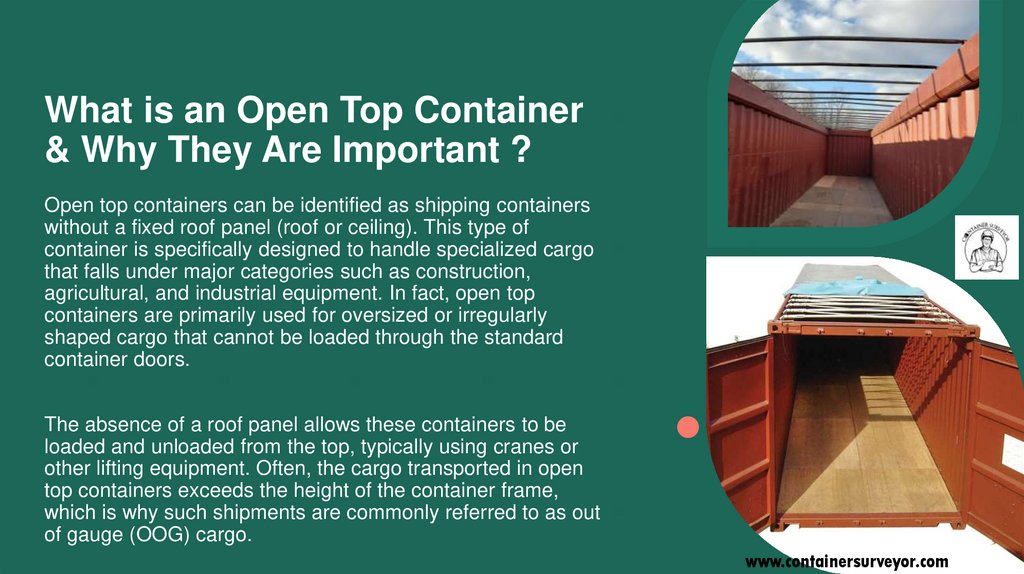
The absence of a roof panel allows these containers to be
loaded and unloaded from the top, typically using cranes or
other lifting equipment. Often, the cargo transported in open
top containers exceeds the height of the container frame,
which is why such shipments are commonly referred to as out
of gauge (OOG) cargo.
www.containersurveyor.com
3. Key Points: Open Top Containers
www.containersurveyor.comKey Points: Open Top Containers
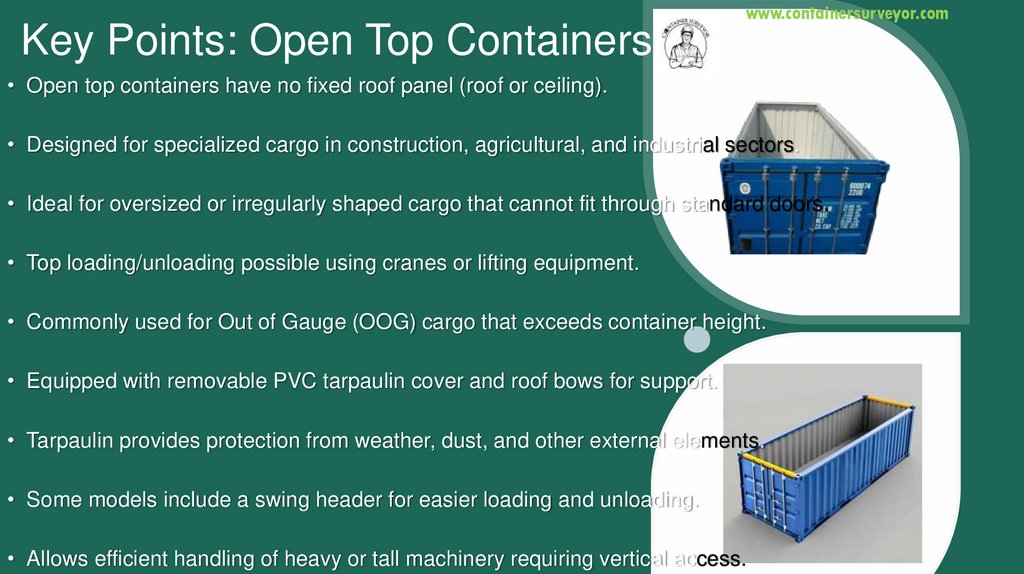
• Open top containers have no fixed roof panel (roof or ceiling).
• Designed for specialized cargo in construction, agricultural, and industrial sectors.
• Ideal for oversized or irregularly shaped cargo that cannot fit through standard doors.
• Top loading/unloading possible using cranes or lifting equipment.
• Commonly used for Out of Gauge (OOG) cargo that exceeds container height.
• Equipped with removable PVC tarpaulin cover and roof bows for support.
• Tarpaulin provides protection from weather, dust, and other external elements.
• Some models include a swing header for easier loading and unloading.
• Allows efficient handling of heavy or tall machinery requiring vertical access.
4. Specific Goods Transported Using Open Top Containers
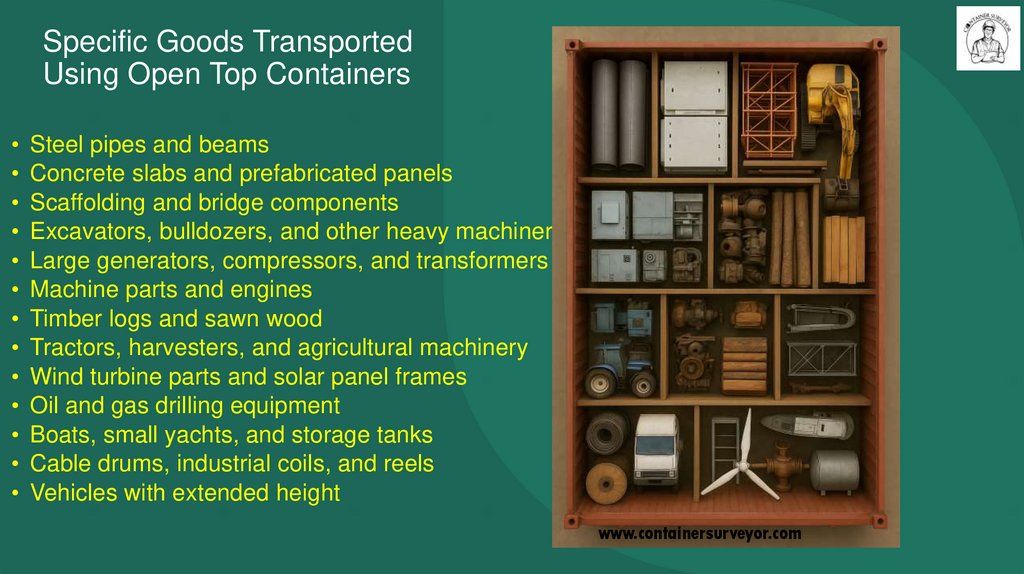
• Steel pipes and beams• Concrete slabs and prefabricated panels
• Scaffolding and bridge components
• Excavators, bulldozers, and other heavy machinery
• Large generators, compressors, and transformers
• Machine parts and engines
• Timber logs and sawn wood
• Tractors, harvesters, and agricultural machinery
• Wind turbine parts and solar panel frames
• Oil and gas drilling equipment
• Boats, small yachts, and storage tanks
• Cable drums, industrial coils, and reels
• Vehicles with extended height
www.containersurveyor.com
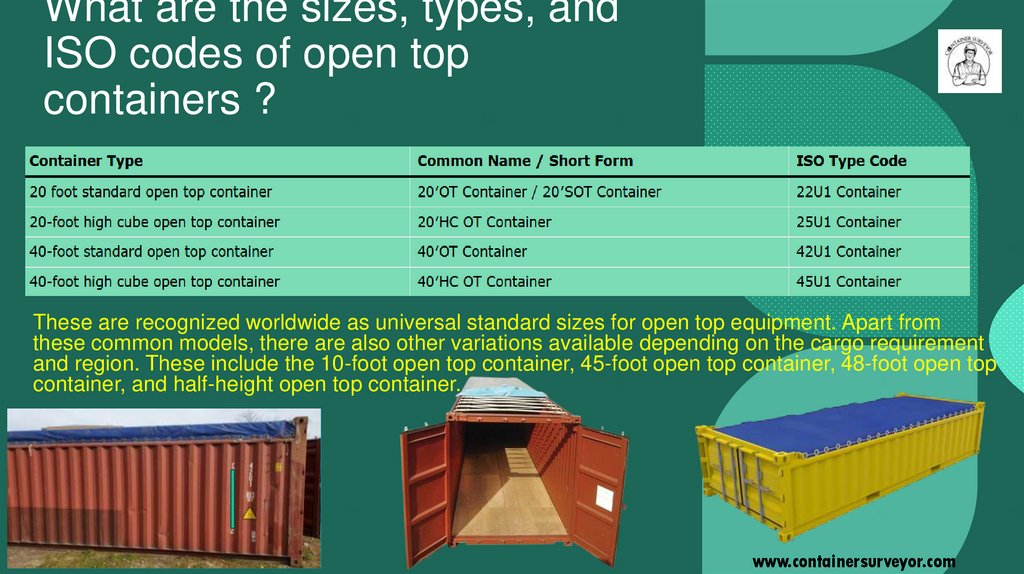
5. What are the sizes, types, and ISO codes of open top containers ?
These are recognized worldwide as universal standard sizes for open top equipment. Apart fromthese common models, there are also other variations available depending on the cargo requirement
and region. These include the 10-foot open top container, 45-foot open top container, 48-foot open top
container, and half-height open top container.
www.containersurveyor.com
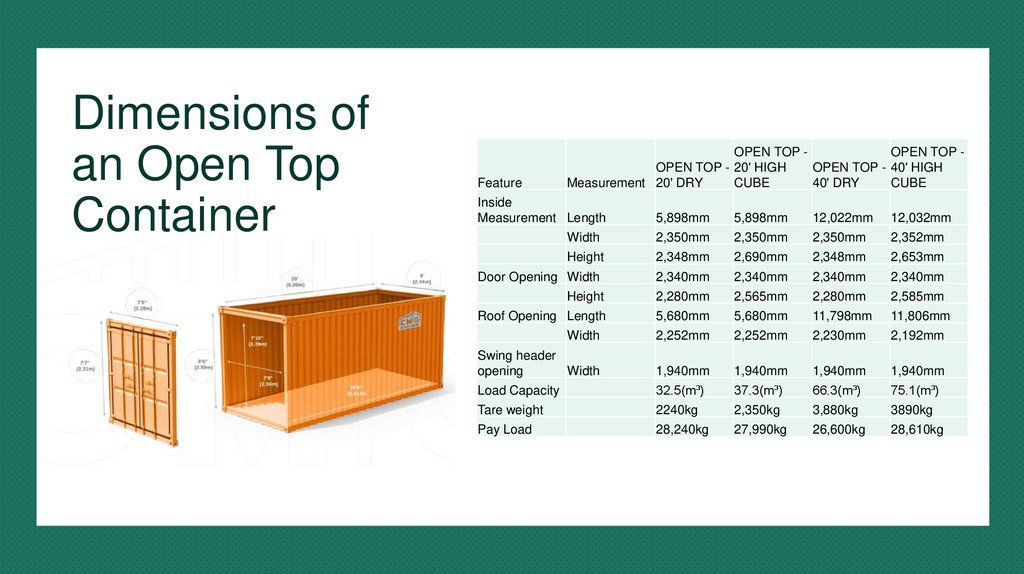
6. Dimensions of an Open Top Container
FeatureOPEN TOP OPEN TOP OPEN TOP - 20' HIGH
OPEN TOP - 40' HIGH
Measurement 20' DRY
CUBE
40' DRY
CUBE
Inside
Measurement Length
5,898mm
5,898mm
12,022mm
12,032mm
Width
2,350mm
2,350mm
2,350mm
2,352mm
Height
2,348mm
2,690mm
2,348mm
2,653mm
Door Opening Width
2,340mm
2,340mm
2,340mm
2,340mm
Height
2,280mm
2,565mm
2,280mm
2,585mm
Roof Opening Length
5,680mm
5,680mm
11,798mm
11,806mm
Width
2,252mm
2,252mm
2,230mm
2,192mm
Swing header
opening
Width
1,940mm
1,940mm
1,940mm
1,940mm
Load Capacity
32.5(m³)
37.3(m³)
66.3(m³)
75.1(m³)
Tare weight
2240kg
2,350kg
3,880kg
3890kg
Pay Load
28,240kg
27,990kg
26,600kg
28,610kg
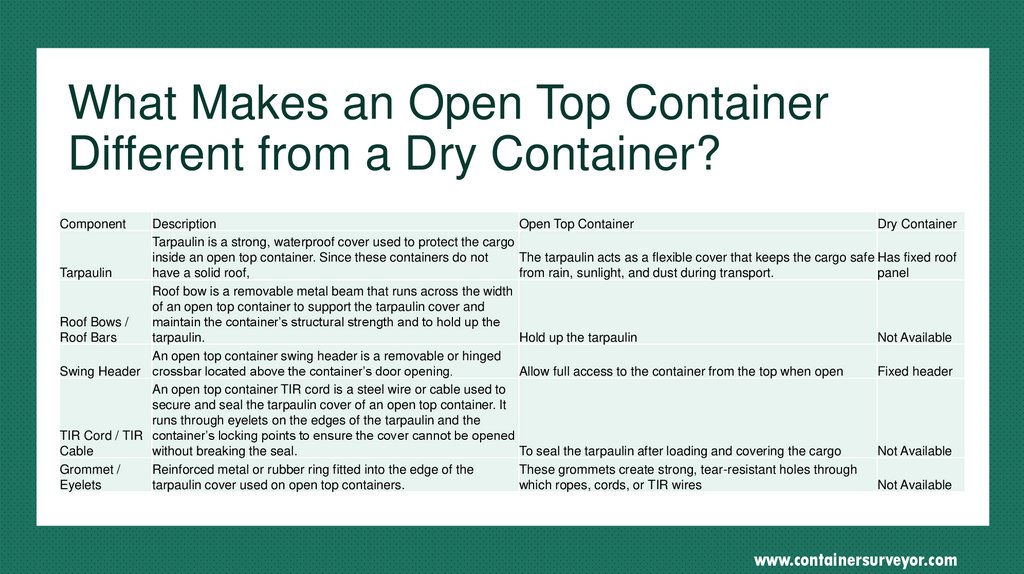
7. What Makes an Open Top Container Different from a Dry Container?
ComponentDescription
Open Top Container
Dry Container
Tarpaulin is a strong, waterproof cover used to protect the cargo
inside an open top container. Since these containers do not
The tarpaulin acts as a flexible cover that keeps the cargo safe Has fixed roof
Tarpaulin
have a solid roof,
from rain, sunlight, and dust during transport.
panel
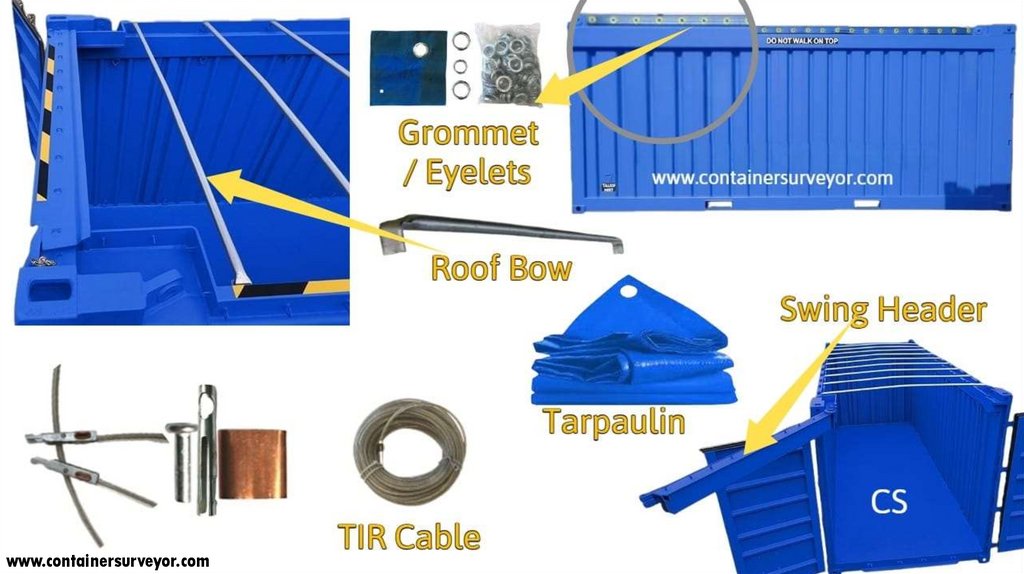
Roof bow is a removable metal beam that runs across the width
of an open top container to support the tarpaulin cover and
Roof Bows /
maintain the container’s structural strength and to hold up the
Roof Bars
tarpaulin.
Hold up the tarpaulin
Not Available
An open top container swing header is a removable or hinged
Swing Header crossbar located above the container’s door opening.
Allow full access to the container from the top when open
Fixed header
An open top container TIR cord is a steel wire or cable used to
secure and seal the tarpaulin cover of an open top container. It
runs through eyelets on the edges of the tarpaulin and the
TIR Cord / TIR container’s locking points to ensure the cover cannot be opened
Cable
without breaking the seal.
To seal the tarpaulin after loading and covering the cargo
Not Available
Grommet /
Reinforced metal or rubber ring fitted into the edge of the
These grommets create strong, tear-resistant holes through
Eyelets
tarpaulin cover used on open top containers.
which ropes, cords, or TIR wires
Not Available
www.containersurveyor.com
8.
www.containersurveyor.com9. Pros and Cons of Open Top Containers
ProsCons
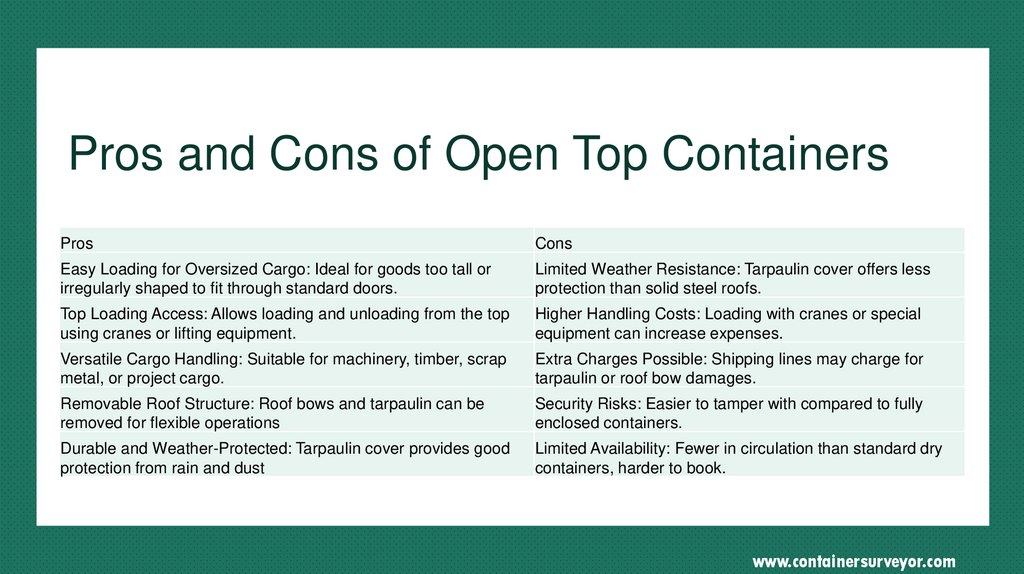
Easy Loading for Oversized Cargo: Ideal for goods too tall or
irregularly shaped to fit through standard doors.
Limited Weather Resistance: Tarpaulin cover offers less
protection than solid steel roofs.
Top Loading Access: Allows loading and unloading from the top
using cranes or lifting equipment.
Higher Handling Costs: Loading with cranes or special
equipment can increase expenses.
Versatile Cargo Handling: Suitable for machinery, timber, scrap
metal, or project cargo.
Extra Charges Possible: Shipping lines may charge for
tarpaulin or roof bow damages.
Removable Roof Structure: Roof bows and tarpaulin can be
removed for flexible operations
Security Risks: Easier to tamper with compared to fully
enclosed containers.
Durable and Weather-Protected: Tarpaulin cover provides good
protection from rain and dust
Limited Availability: Fewer in circulation than standard dry
containers, harder to book.
www.containersurveyor.com
10. Tips for Shippers and Consignees on Handling Open Top Containers
In this section, we are not going to discuss the loading orunloading process. Instead, let’s focus on some of the
common issues that consignees face when returning empty
open top containers at the destination yard.
Tips for
Shippers
and
Consignees
on Handling
Open Top
Containers
Quite often, consignees experience trouble because the
original tarpaulin is missing, or a duplicate tarpaulin has
been used instead. In other cases, roof bows are missing,
partially missing, or TIR cables are either lost, cut, or
damaged. These issues usually lead to unnecessary
disputes and additional charges during container return.
Let’s look at some key points both shippers and consignees
should follow to avoid such problems.
www.containersurveyor.com
11. From the Shipper’s Side
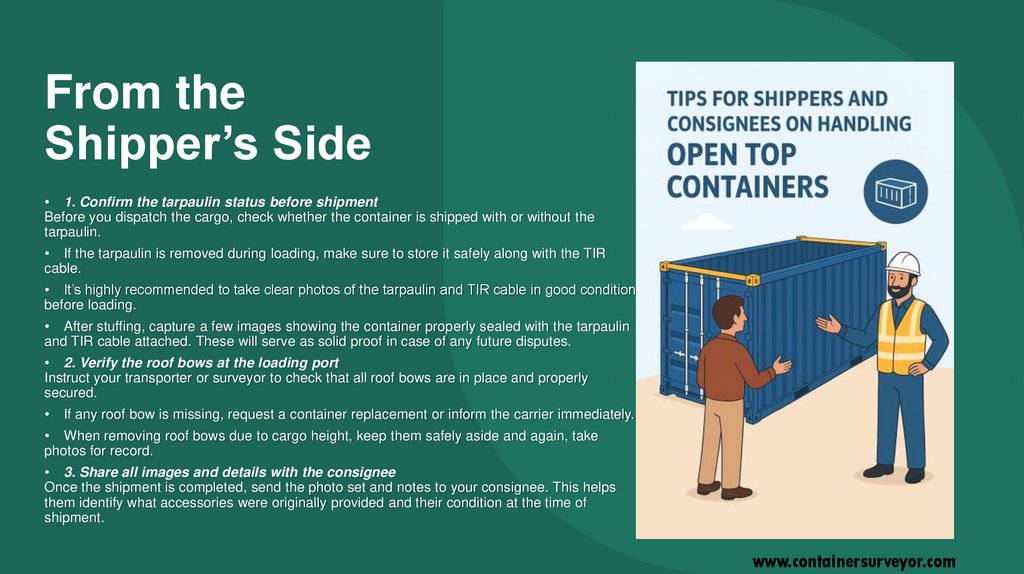
• 1. Confirm the tarpaulin status before shipmentBefore you dispatch the cargo, check whether the container is shipped with or without the
tarpaulin.
• If the tarpaulin is removed during loading, make sure to store it safely along with the TIR
cable.
• It’s highly recommended to take clear photos of the tarpaulin and TIR cable in good condition
before loading.
• After stuffing, capture a few images showing the container properly sealed with the tarpaulin
and TIR cable attached. These will serve as solid proof in case of any future disputes.
• 2. Verify the roof bows at the loading port
Instruct your transporter or surveyor to check that all roof bows are in place and properly
secured.
If any roof bow is missing, request a container replacement or inform the carrier immediately.
• When removing roof bows due to cargo height, keep them safely aside and again, take
photos for record.
• 3. Share all images and details with the consignee
Once the shipment is completed, send the photo set and notes to your consignee. This helps
them identify what accessories were originally provided and their condition at the time of
shipment.
www.containersurveyor.com
12. From the Consignee’s Side
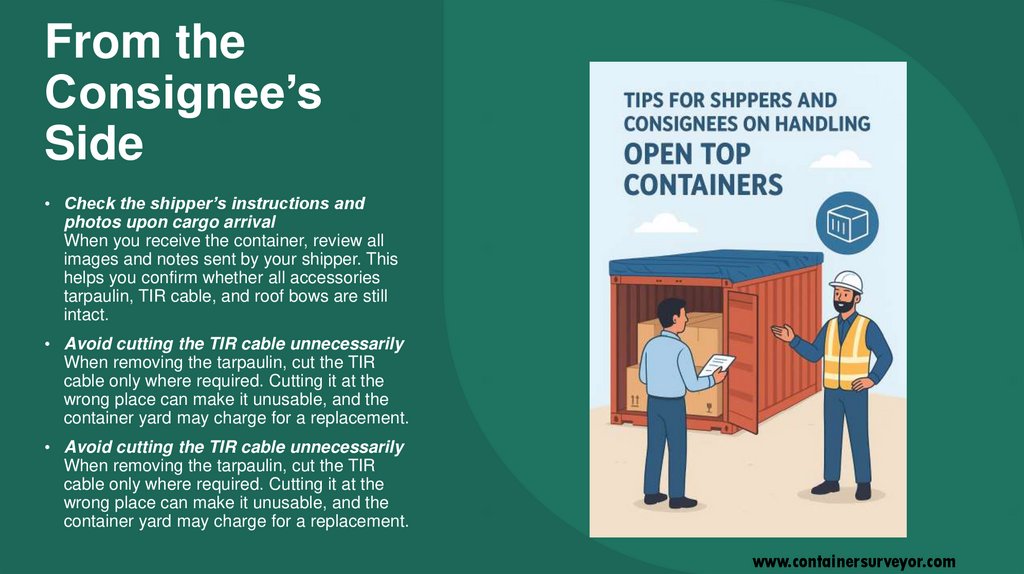
• Check the shipper’s instructions andphotos upon cargo arrival
When you receive the container, review all
images and notes sent by your shipper. This
helps you confirm whether all accessories
tarpaulin, TIR cable, and roof bows are still
intact.
• Avoid cutting the TIR cable unnecessarily
When removing the tarpaulin, cut the TIR
cable only where required. Cutting it at the
wrong place can make it unusable, and the
container yard may charge for a replacement.
• Avoid cutting the TIR cable unnecessarily
When removing the tarpaulin, cut the TIR
cable only where required. Cutting it at the
wrong place can make it unusable, and the
container yard may charge for a replacement.
www.containersurveyor.com