Похожие презентации:





Number_Theory_and_Diophantine_Approximations
1.
Number Theory and DiophantineApproximations
• (A Brief Historical and Theoretical Overview)
2.
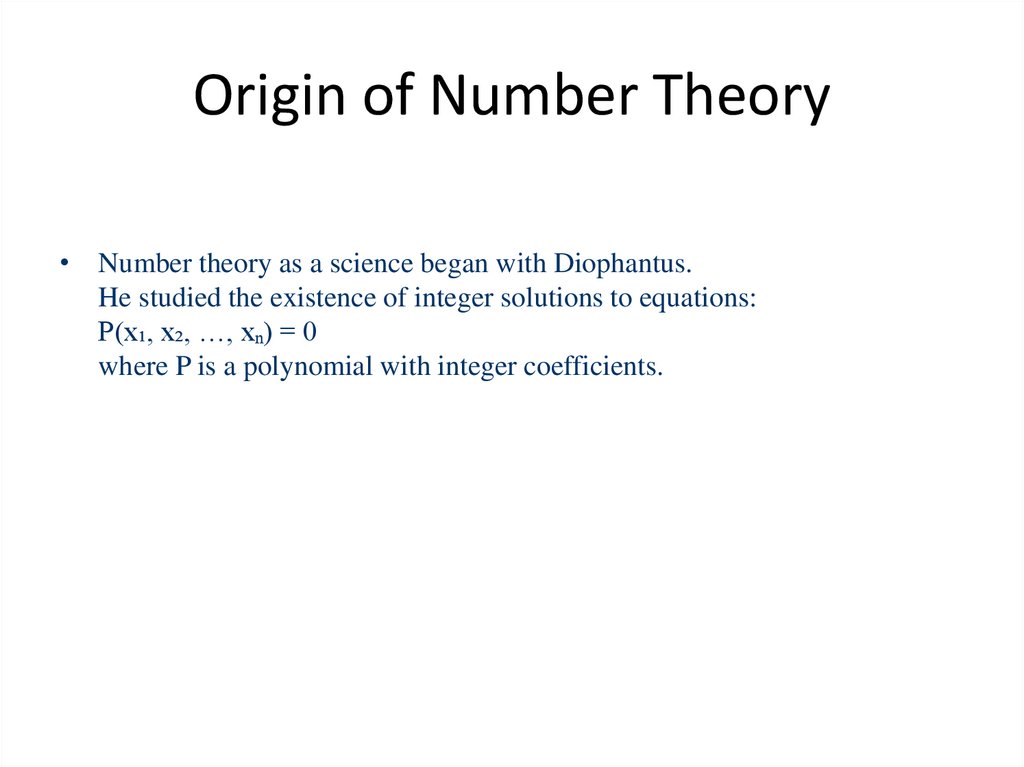
Origin of Number Theory• Number theory as a science began with Diophantus.
He studied the existence of integer solutions to equations:
P(x₁, x₂, …, xₙ) = 0
where P is a polynomial with integer coefficients.
3.
Research Direction• My research is connected with geometric interpretation of Diophantine
approximations.
The theory studies how well real numbers can be approximated by rational
numbers.
4.
Historical Context• This field has a rich 19th-century history, closely linked with the evolution
of mathematical thought.
Many great mathematicians contributed to its foundation and development.
5.
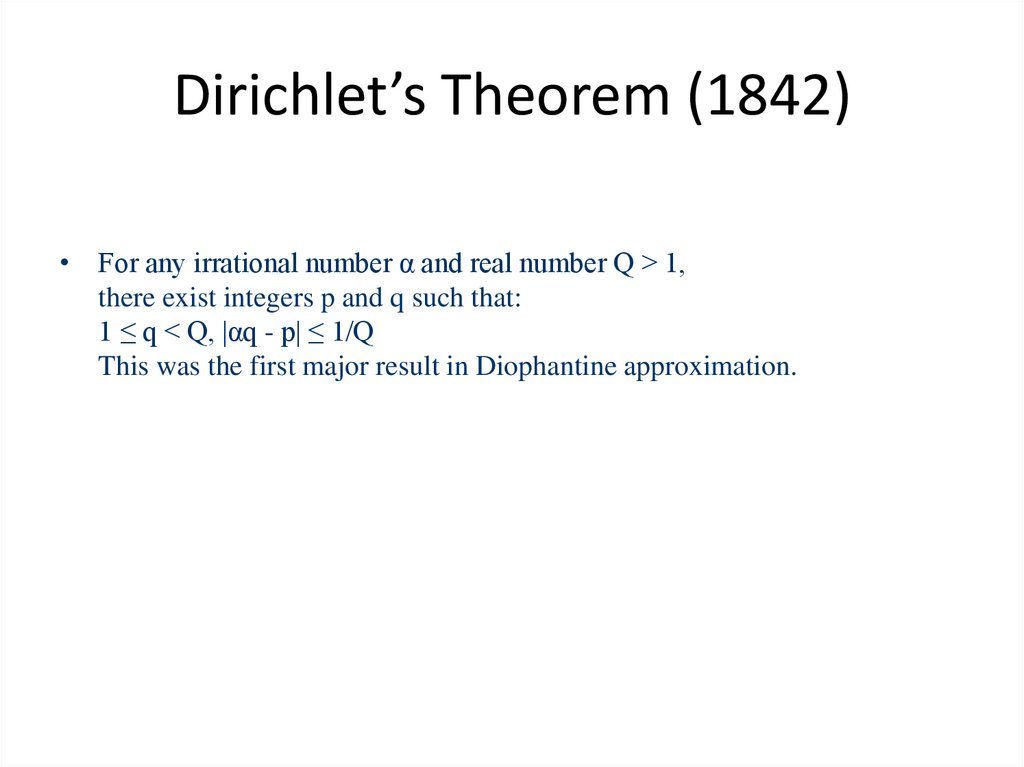
Dirichlet’s Theorem (1842)• For any irrational number α and real number Q > 1,
there exist integers p and q such that:
1 ≤ q < Q, |αq - p| ≤ 1/Q
This was the first major result in Diophantine approximation.
6.
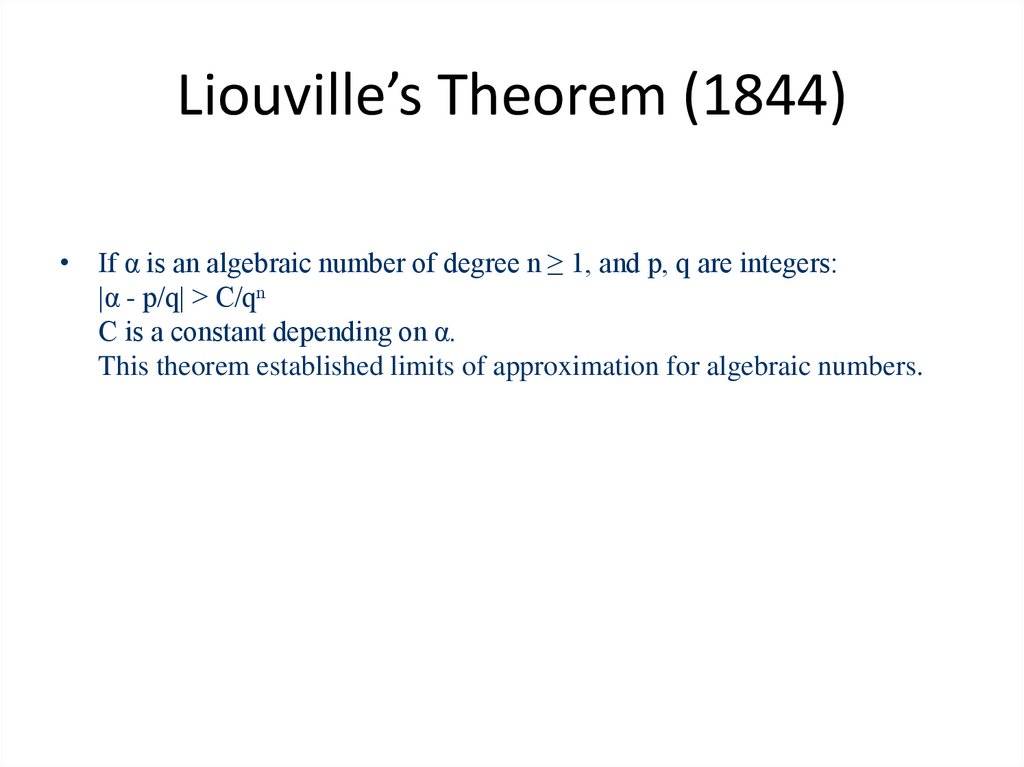
Liouville’s Theorem (1844)• If α is an algebraic number of degree n ≥ 1, and p, q are integers:
|α - p/q| > C/qⁿ
C is a constant depending on α.
This theorem established limits of approximation for algebraic numbers.
7.
Minkowski and Geometry ofNumbers
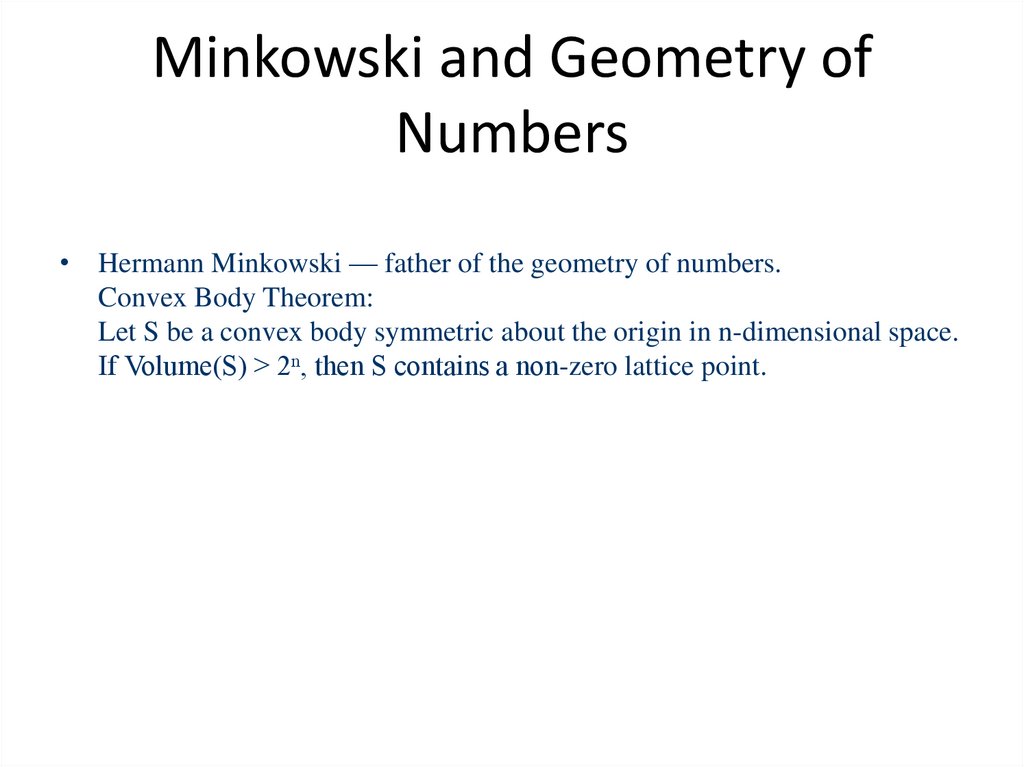
• Hermann Minkowski — father of the geometry of numbers.
Convex Body Theorem:
Let S be a convex body symmetric about the origin in n-dimensional space.
If Volume(S) > 2ⁿ, then S contains a non-zero lattice point.
8.
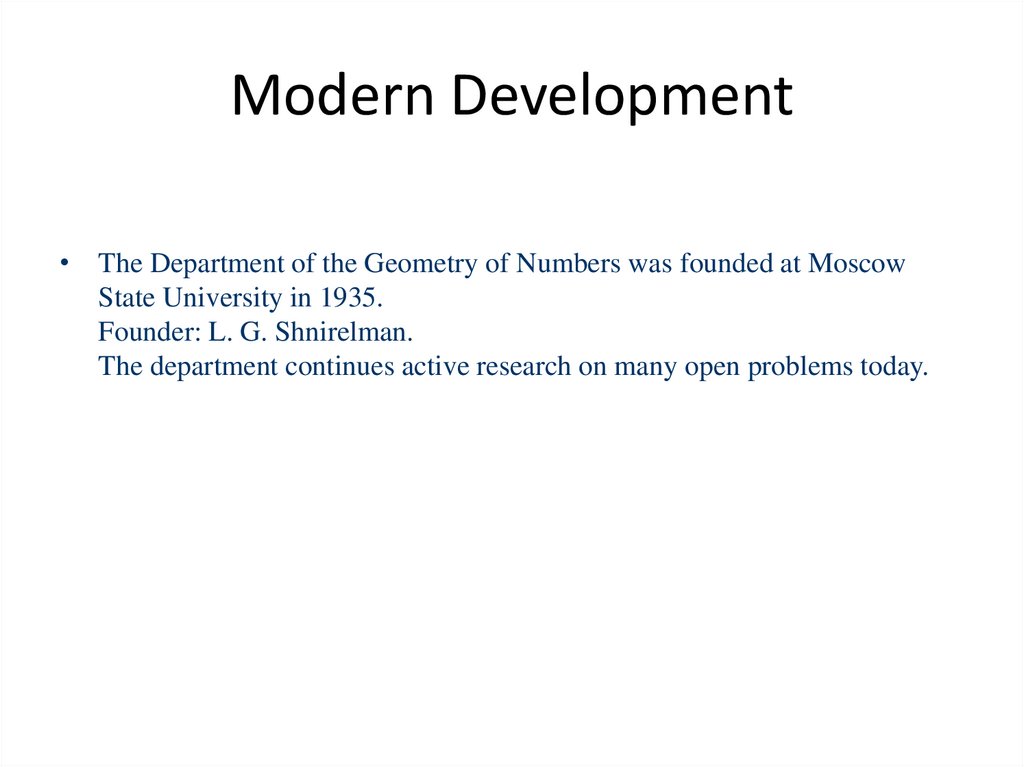
Modern Development• The Department of the Geometry of Numbers was founded at Moscow
State University in 1935.
Founder: L. G. Shnirelman.
The department continues active research on many open problems today.
9.
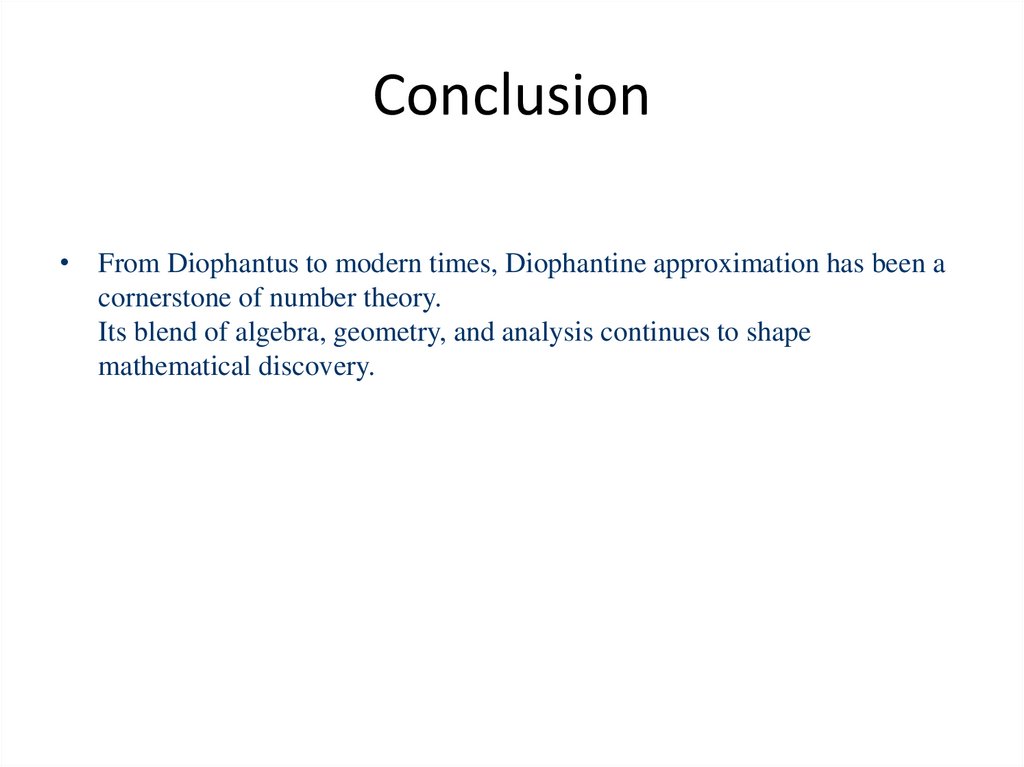
Conclusion• From Diophantus to modern times, Diophantine approximation has been a
cornerstone of number theory.
Its blend of algebra, geometry, and analysis continues to shape
mathematical discovery.
10.
References / Acknowledgment• Based on classical works by Dirichlet, Liouville, and Minkowski.
Historical and theoretical materials from the Faculty of Mechanics and
Mathematics, MSU.