 Английский язык
Похожие презентации:




Phonostylistics. Lecture 2
1. Phonostylistics Lecture 2 18.09.2025
Phonostylistics
Lecture 2
18.09.2025
2025
2. AGENDA
1. Concept of phonetic basis: types and aspects, articulatory basis of English and Russian2. Consonants: general characteristic, classification principles, modifications, learner problems
3. Vowels: classification, modifications, modern tendencies in vowels pronunciation
4. Teaching sounds: communicative framework, tips, toolbox, error correction
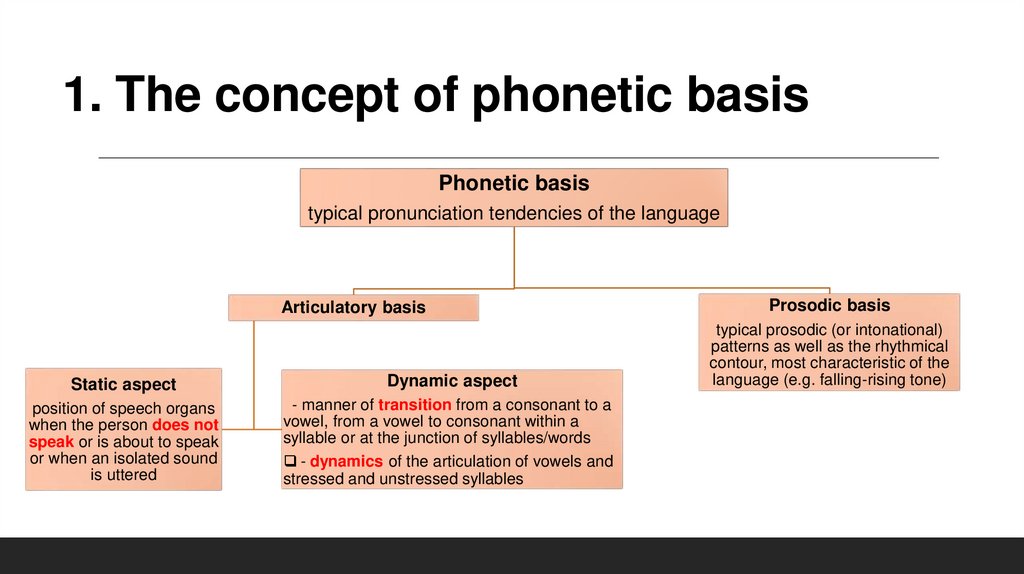
3. 1. The concept of phonetic basis
Phonetic basistypical pronunciation tendencies of the language
Articulatory basis
Static aspect
Dynamic aspect
position of speech organs
when the person does not
speak or is about to speak
or when an isolated sound
is uttered
- manner of transition from a consonant to a
vowel, from a vowel to consonant within a
syllable or at the junction of syllables/words
- dynamics of the articulation of vowels and
stressed and unstressed syllables
Prosodic basis
typical prosodic (or intonational)
patterns as well as the rhythmical
contour, most characteristic of the
language (e.g. falling-rising tone)
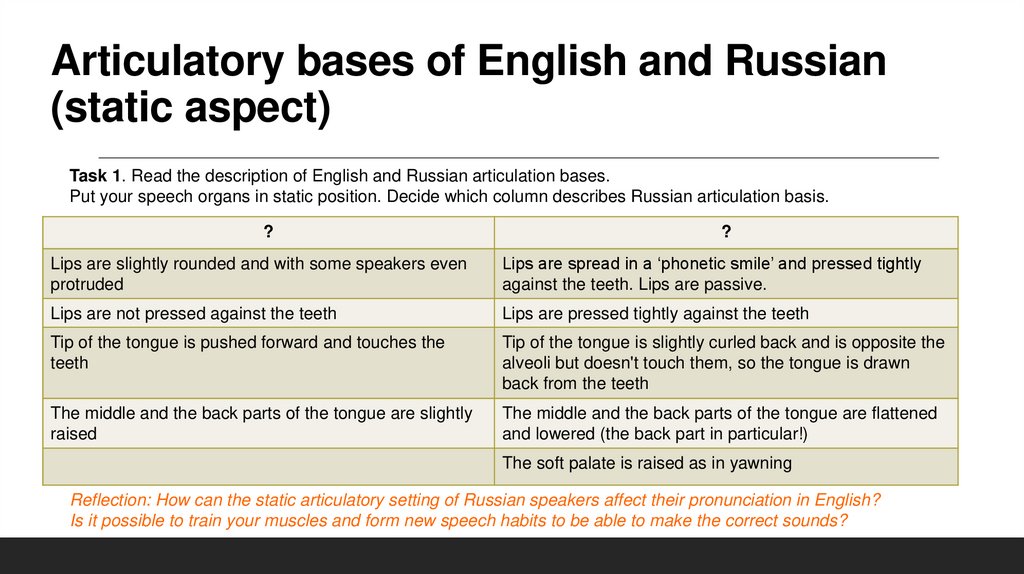
4. Articulatory bases of English and Russian (static aspect)
Task 1. Read the description of English and Russian articulation bases.Put your speech organs in static position. Decide which column describes Russian articulation basis.
?
?
Lips are slightly rounded and with some speakers even
protruded
Lips are spread in a ‘phonetic smile’ and pressed tightly
against the teeth. Lips are passive.
Lips are not pressed against the teeth
Lips are pressed tightly against the teeth
Tip of the tongue is pushed forward and touches the
teeth
Tip of the tongue is slightly curled back and is opposite the
alveoli but doesn't touch them, so the tongue is drawn
back from the teeth
The middle and the back parts of the tongue are slightly
raised
The middle and the back parts of the tongue are flattened
and lowered (the back part in particular!)
The soft palate is raised as in yawning
Reflection: How can the static articulatory setting of Russian speakers affect their pronunciation in English?
Is it possible to train your muscles and form new speech habits to be able to make the correct sounds?
5. Articulatory bases of English and Russian (dynamic aspect)
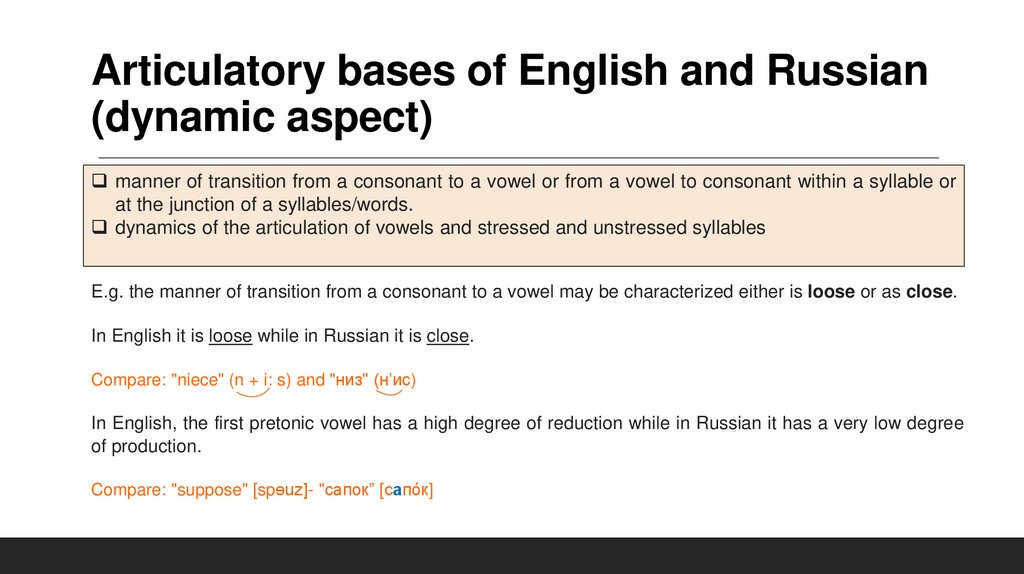
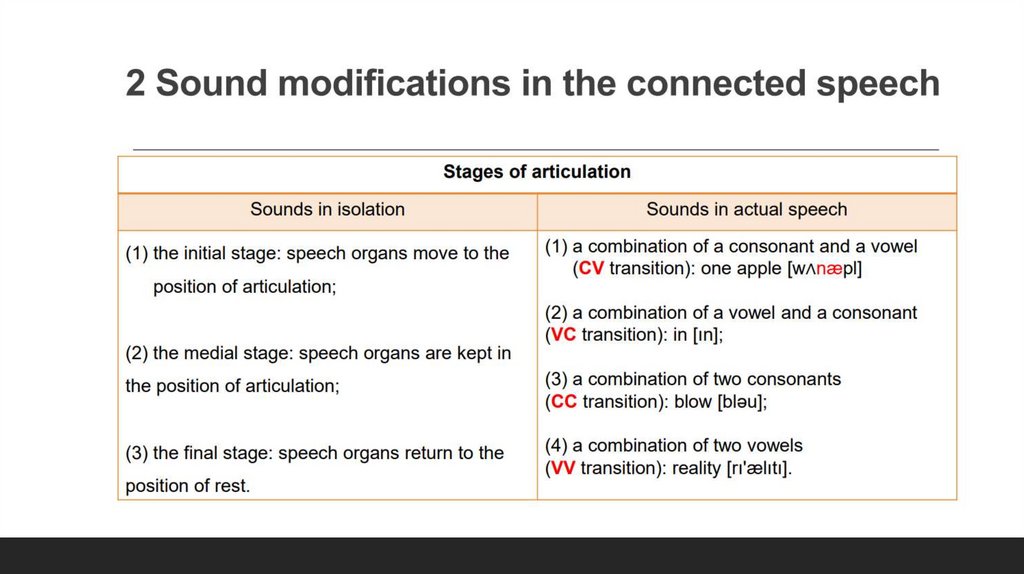
manner of transition from a consonant to a vowel or from a vowel to consonant within a syllable orat the junction of a syllables/words.
dynamics of the articulation of vowels and stressed and unstressed syllables
E.g. the manner of transition from a consonant to a vowel may be characterized either is loose or as close.
In English it is loose while in Russian it is close.
Compare: "niece" (n + i: s) and "низ" (н’ис)
In English, the first pretonic vowel has a high degree of reduction while in Russian it has a very low degree
of production.
Compare: "suppose" [spɘuz]- "сапок” [сапóк]
6.
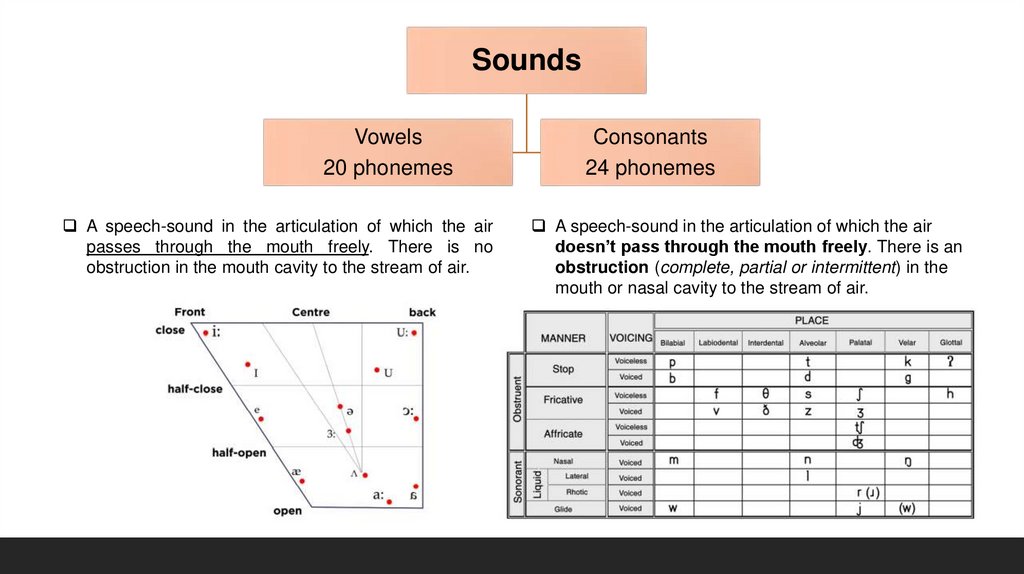
SoundsVowels
20 phonemes
A speech-sound in the articulation of which the air
passes through the mouth freely. There is no
obstruction in the mouth cavity to the stream of air.
Consonants
24 phonemes
A speech-sound in the articulation of which the air
doesn’t pass through the mouth freely. There is an
obstruction (complete, partial or intermittent) in the
mouth or nasal cavity to the stream of air.
7.
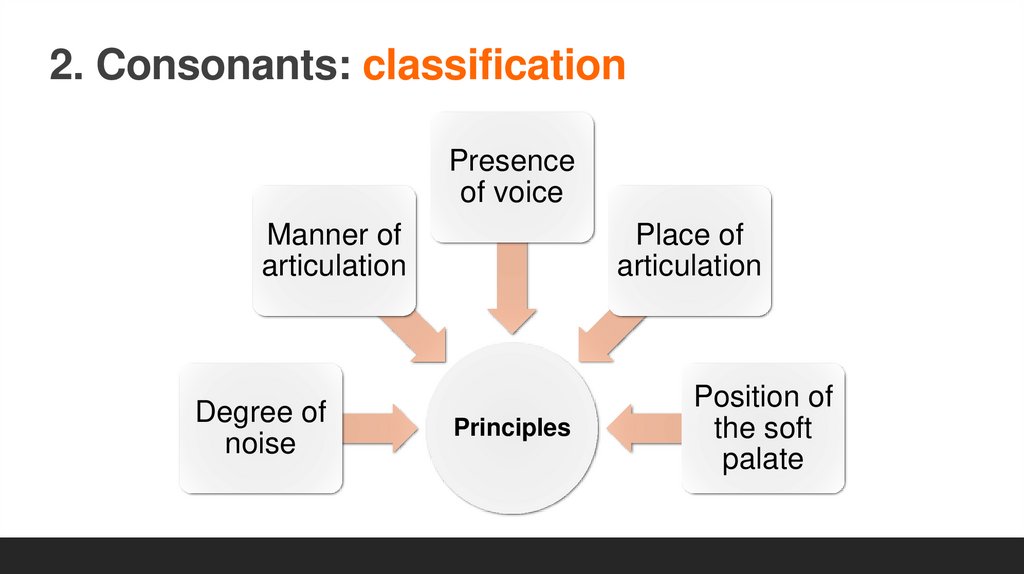
2. Consonants: classificationPresence
of voice
Manner of
articulation
Degree of
noise
Place of
articulation
Principles
Position of
the soft
palate
8. Consonants: 1 degree of noise
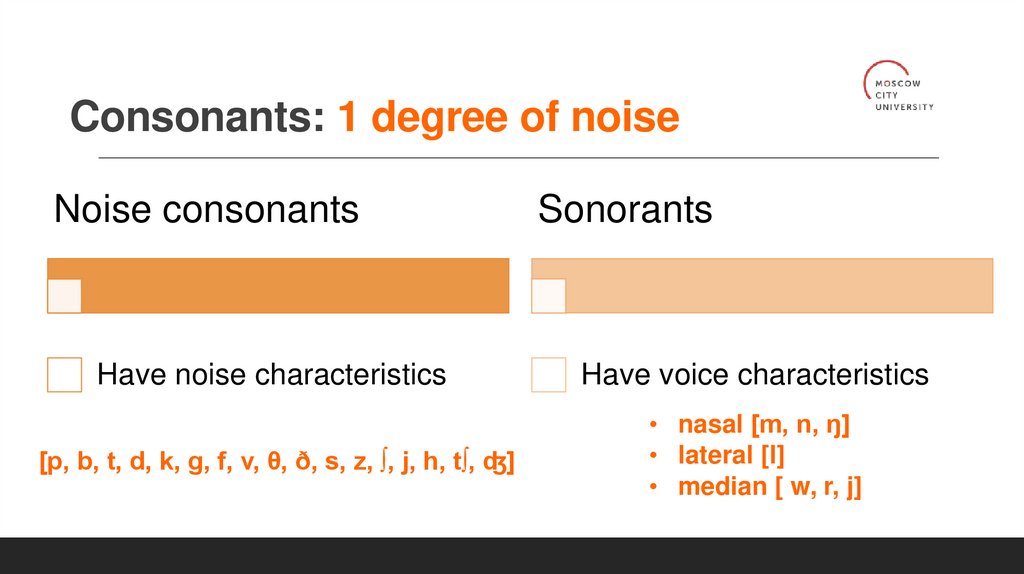
Noise consonantsSonorants
Have noise characteristics
Have voice characteristics
[p, b, t, d, k, g, f, v, θ, ð, s, z, ∫, j, h, t∫, ʤ]
• nasal [m, n, ŋ]
• lateral [l]
• median [ w, r, j]
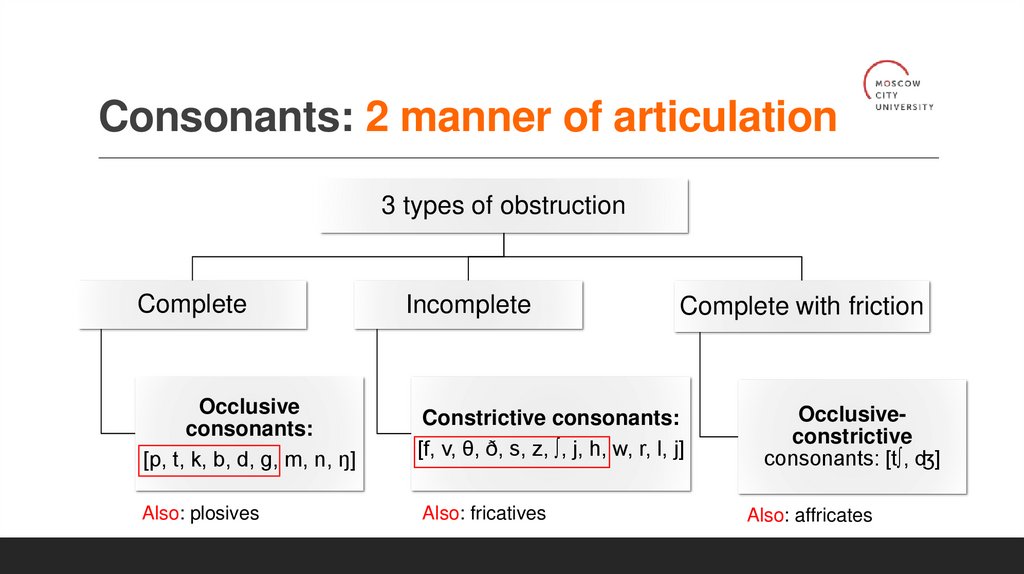
9. Consonants: 2 manner of articulation
3 types of obstructionComplete
Incomplete
Occlusive
consonants:
[p, t, k, b, d, g, m, n, ŋ]
Constrictive consonants:
[f, v, θ, ð, s, z, ∫, j, h, w, r, l, j]
Also: plosives
Also: fricatives
Complete with friction
Occlusiveconstrictive
consonants: [t∫, ʤ]
Also: affricates
10.
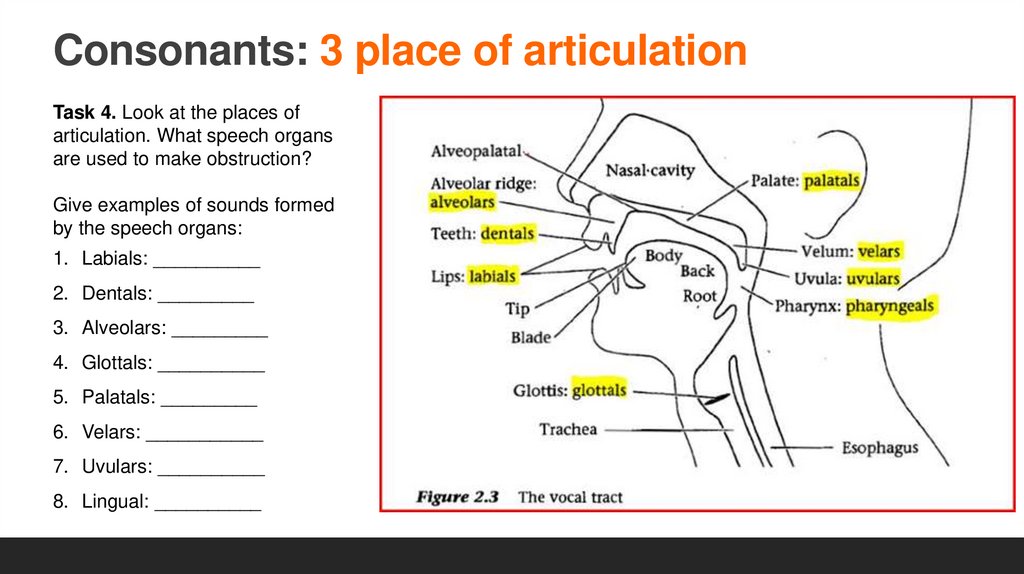
Consonants: 3 place of articulationTask 4. Look at the places of
articulation. What speech organs
are used to make obstruction?
Give examples of sounds formed
by the speech organs:
1. Labials: __________
2. Dentals: _________
3. Alveolars: _________
4. Glottals: __________
5. Palatals: _________
6. Velars: ___________
7. Uvulars: __________
8. Lingual: __________
11.
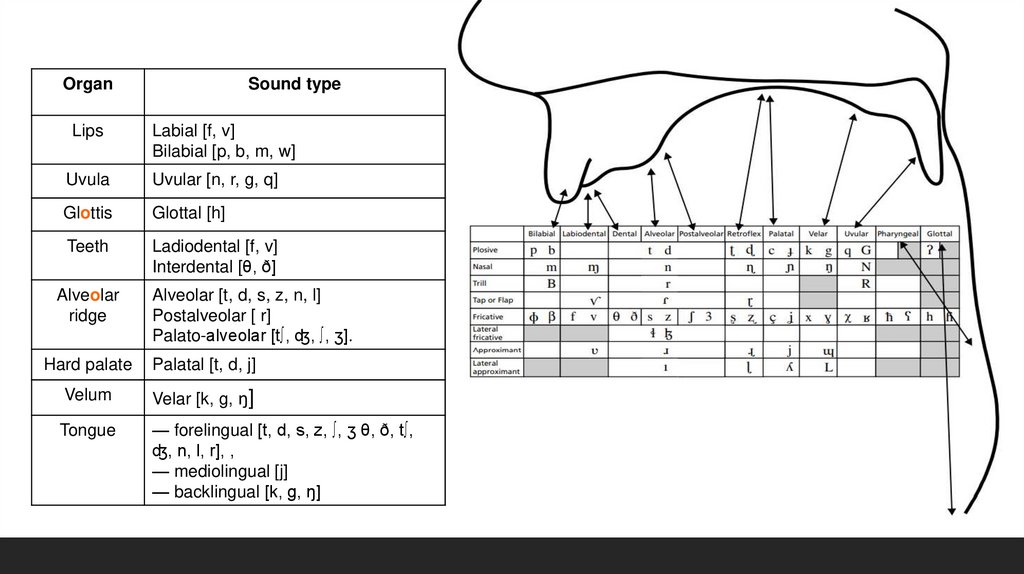
OrganSound type
Lips
Labial [f, v]
Bilabial [p, b, m, w]
Uvula
Uvular [n, r, g, q]
Glottis
Glottal [h]
Teeth
Ladiodental [f, v]
Interdental [θ, ð]
Alveolar
ridge
Alveolar [t, d, s, z, n, l]
Postalveolar [ r]
Palato-alveolar [t∫, ʤ, ∫, ʒ].
Hard palate
Palatal [t, d, j]
Velum
Velar [k, g, ŋ]
Tongue
— forelingual [t, d, s, z, ∫, ʒ θ, ð, t∫,
ʤ, n, l, r], ,
— mediolingual [j]
— backlingual [k, g, ŋ]
12.
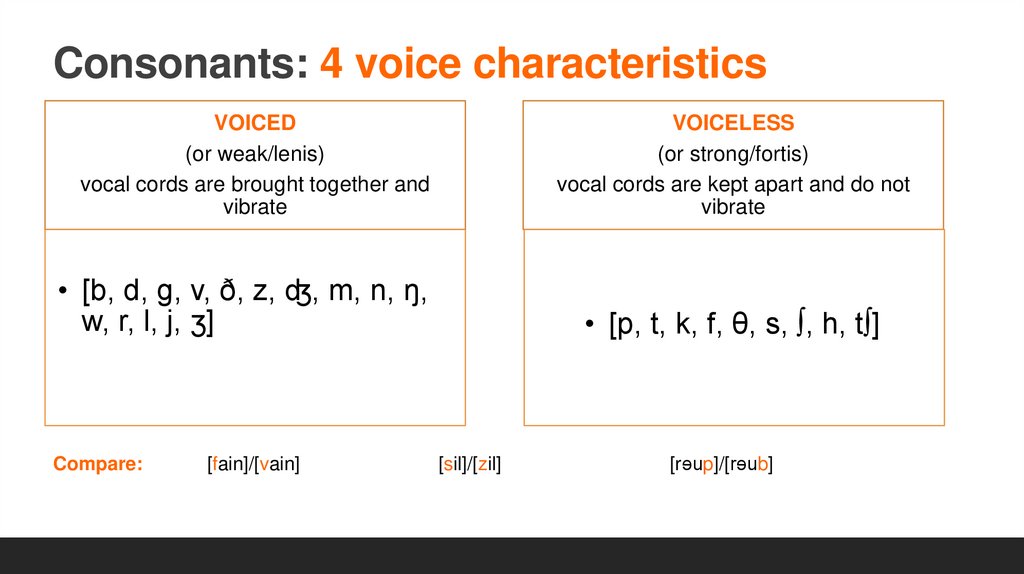
Consonants: 4 voice characteristicsVOICED
(or weak/lenis)
vocal cords are brought together and
vibrate
VOICELESS
(or strong/fortis)
vocal cords are kept apart and do not
vibrate
• [b, d, g, v, ð, z, ʤ, m, n, ŋ,
w, r, l, j, ʒ]
• [p, t, k, f, θ, s, ∫, h, t∫]
Compare:
[fain]/[vain]
[sil]/[zil]
[rɘup]/[rɘub]
13.
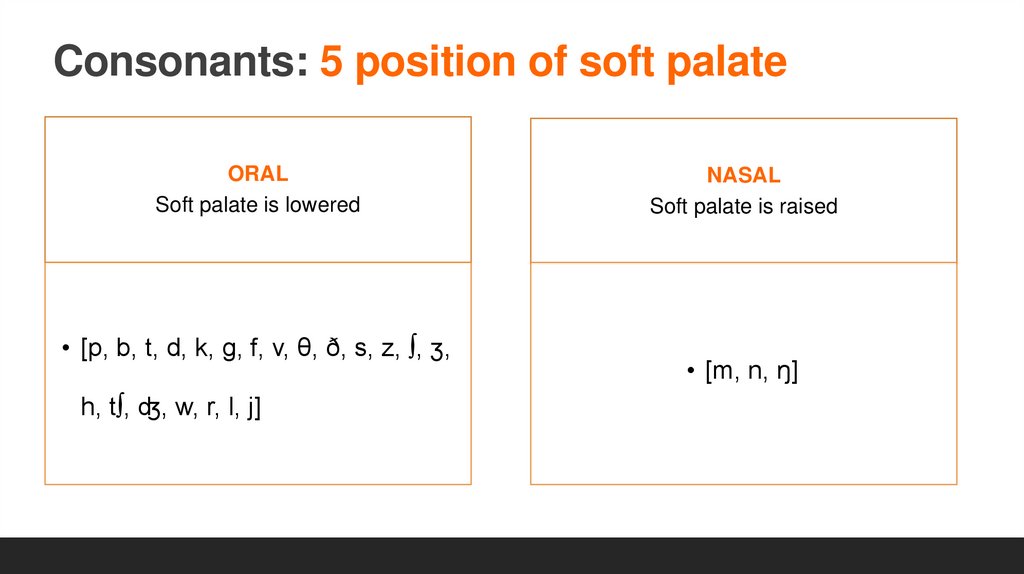
Consonants: 5 position of soft palateORAL
Soft palate is lowered
• [p, b, t, d, k, g, f, v, θ, ð, s, z, ∫, ʒ,
h, t∫, ʤ, w, r, l, j]
NASAL
Soft palate is raised
• [m, n, ŋ]
14.
15.
16.
17.
18.
19.
20.
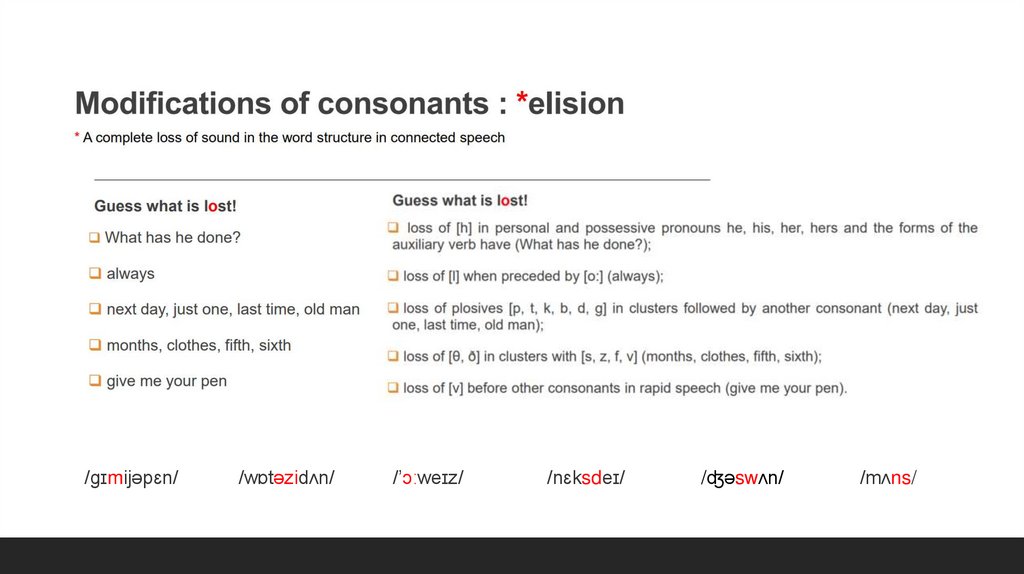
/ɡɪmijəpɛn//wɒtəzidʌn/
/’ɔːweɪz/
/nɛksdeɪ/
/ʤəswʌn/
/mʌns/
21.
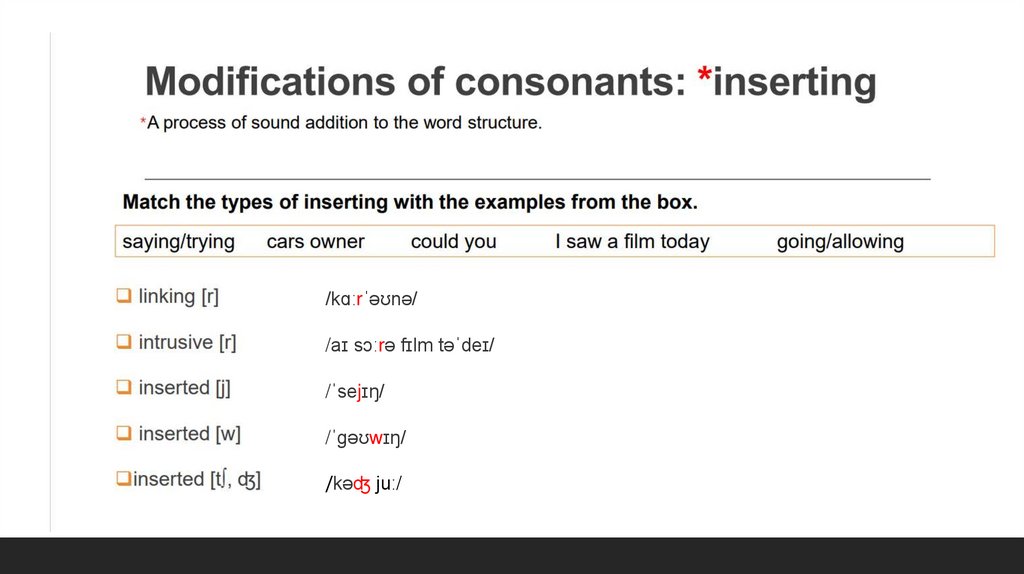
/kɑːrˈəʊnə//aɪ sɔːrə fɪlm təˈdeɪ/
/ˈsejɪŋ/
/ˈɡəʊwɪŋ/
/kəʤ juː/
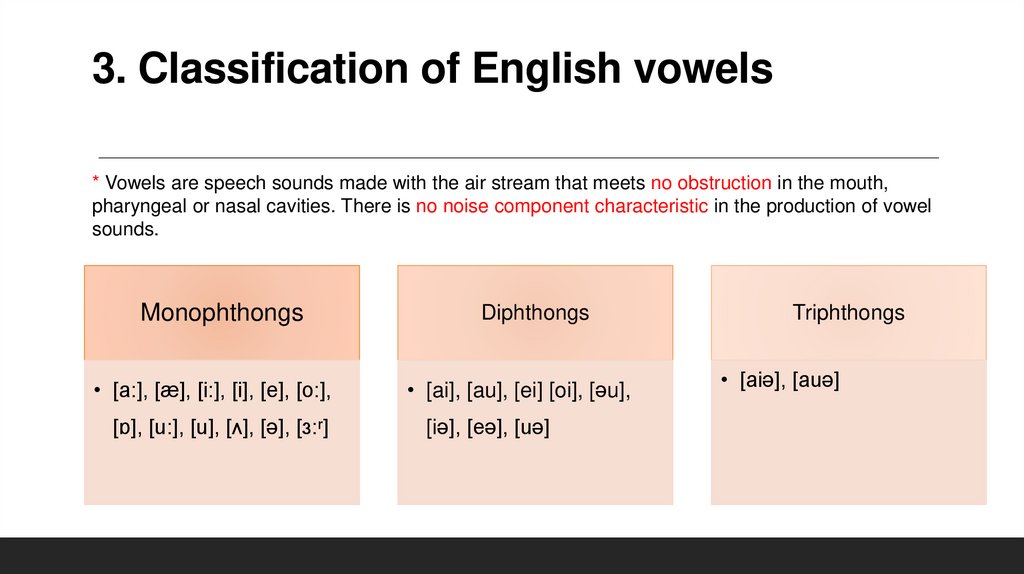
22. 3. Classification of English vowels
* Vowels are speech sounds made with the air stream that meets no obstruction in the mouth,pharyngeal or nasal cavities. There is no noise component characteristic in the production of vowel
sounds.
Monophthongs
• [a:], [æ], [i:], [i], [e], [o:],
[ɒ], [u:], [u], [ʌ], [ə], [ɜ:ʳ]
Diphthongs
• [ai], [au], [ei] [oi], [əu],
[iə], [eə], [uə]
Triphthongs
• [aiə], [auə]
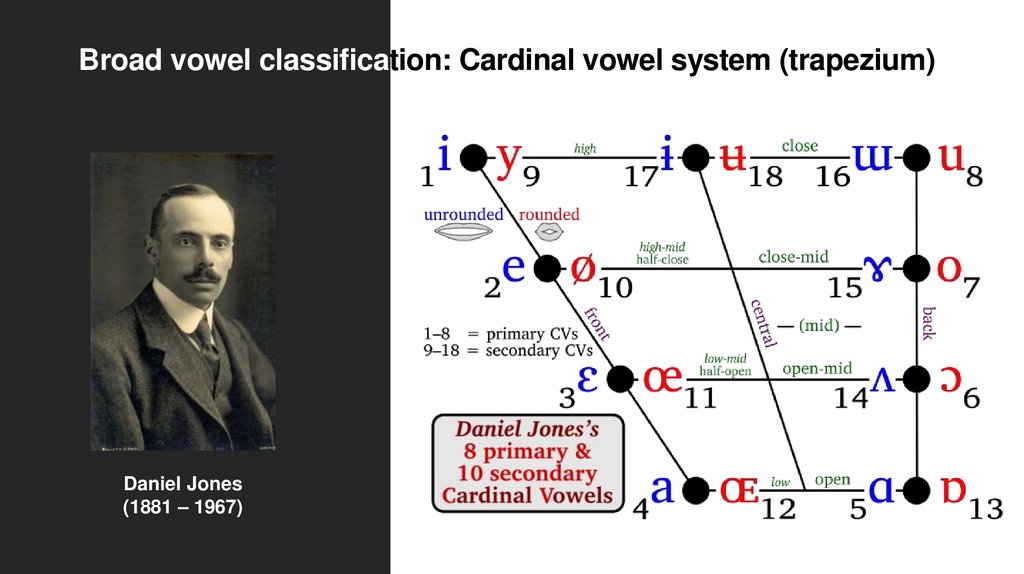
23. Broad vowel classification: Cardinal vowel system (trapezium)
Daniel Jones(1881 – 1967)
24.
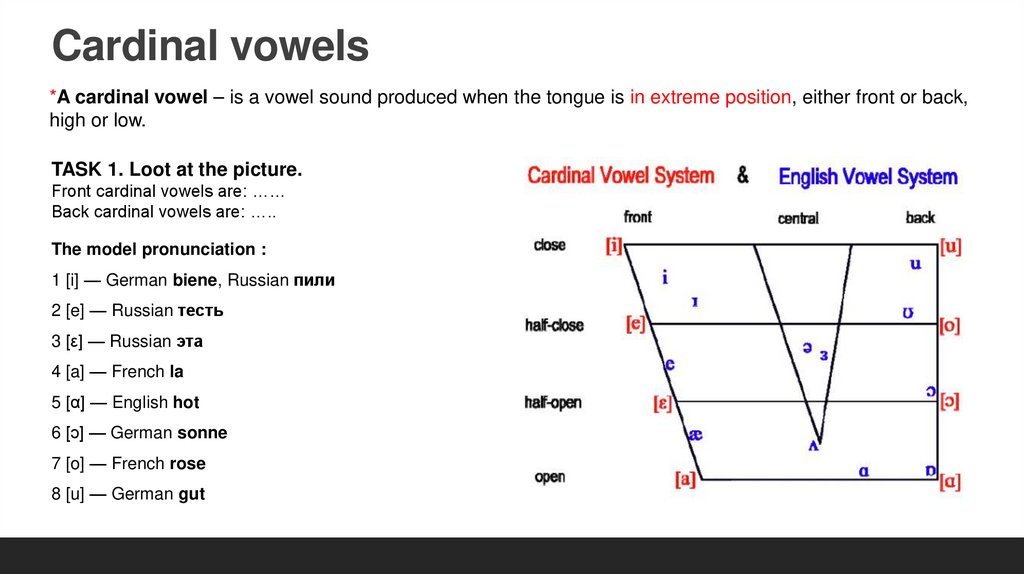
Cardinal vowels*A cardinal vowel – is a vowel sound produced when the tongue is in extreme position, either front or back,
high or low.
TASK 1. Loot at the picture.
Front cardinal vowels are: ……
Back cardinal vowels are: …..
The model pronunciation :
1 [i] — German biene, Russian пили
2 [e] — Russian тесть
3 [ε] — Russian эта
4 [a] — French la
5 [α] — English hot
6 [ɔ] — German sonne
7 [o] — French rose
8 [u] — German gut
25.
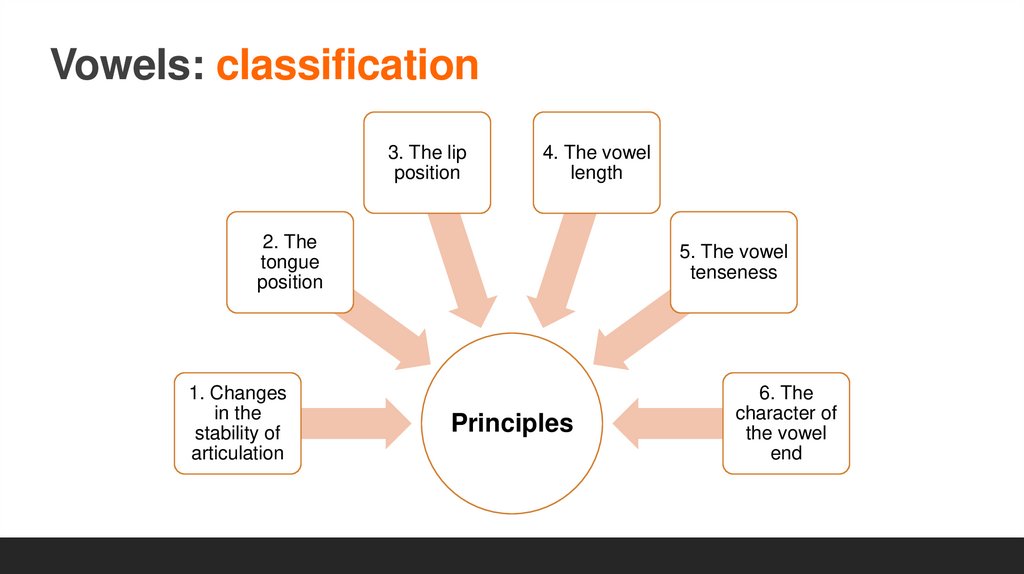
Vowels: classification3. The lip
position
4. The vowel
length
2. The
tongue
position
1. Changes
in the
stability of
articulation
5. The vowel
tenseness
Principles
6. The
character of
the vowel
end
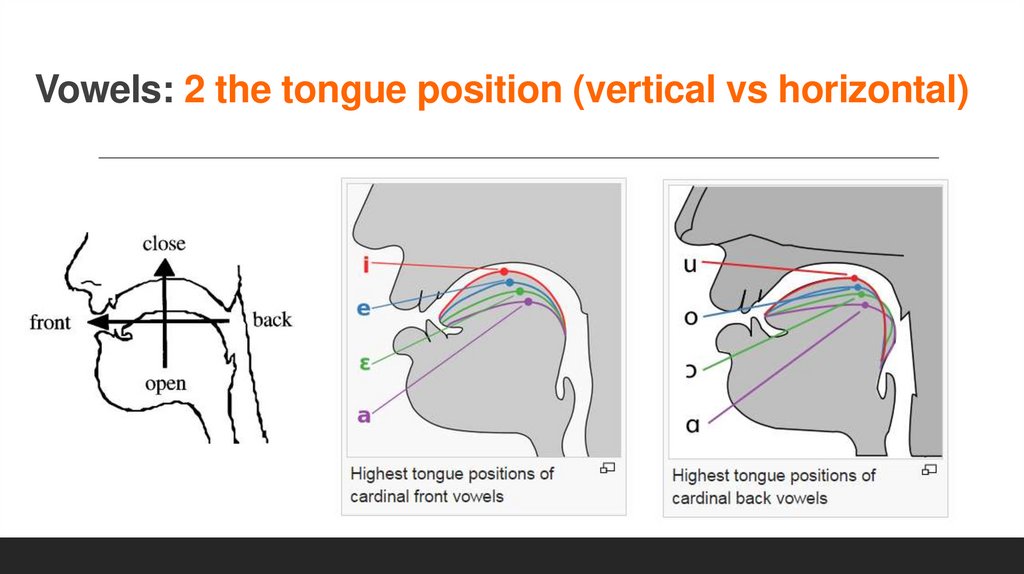
26. Vowels: 2 the tongue position (vertical vs horizontal)
27.
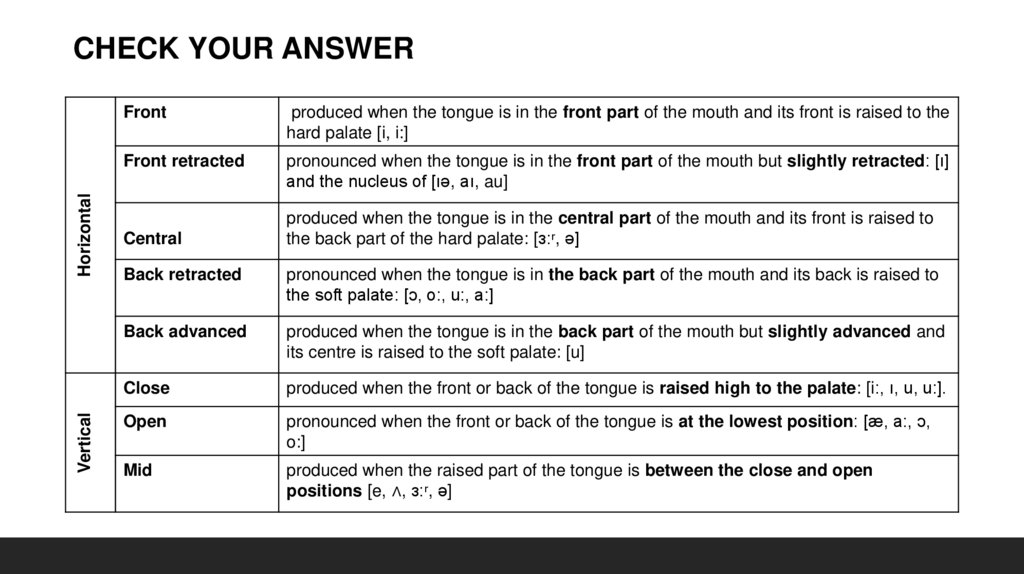
VerticalHorizontal
CHECK YOUR ANSWER
Front
produced when the tongue is in the front part of the mouth and its front is raised to the
hard palate [i, i:]
Front retracted
pronounced when the tongue is in the front part of the mouth but slightly retracted: [ı]
and the nucleus of [ıə, aı, au]
Central
produced when the tongue is in the central part of the mouth and its front is raised to
the back part of the hard palate: [ɜ:ʳ, ə]
Back retracted
pronounced when the tongue is in the back part of the mouth and its back is raised to
the soft palate: [ɔ, o:, u:, a:]
Back advanced
produced when the tongue is in the back part of the mouth but slightly advanced and
its centre is raised to the soft palate: [u]
Close
produced when the front or back of the tongue is raised high to the palate: [i:, ı, u, u:].
Open
pronounced when the front or back of the tongue is at the lowest position: [æ, a:, ɔ,
o:]
Mid
produced when the raised part of the tongue is between the close and open
positions [e, ∧, ɜ:ʳ, ə]
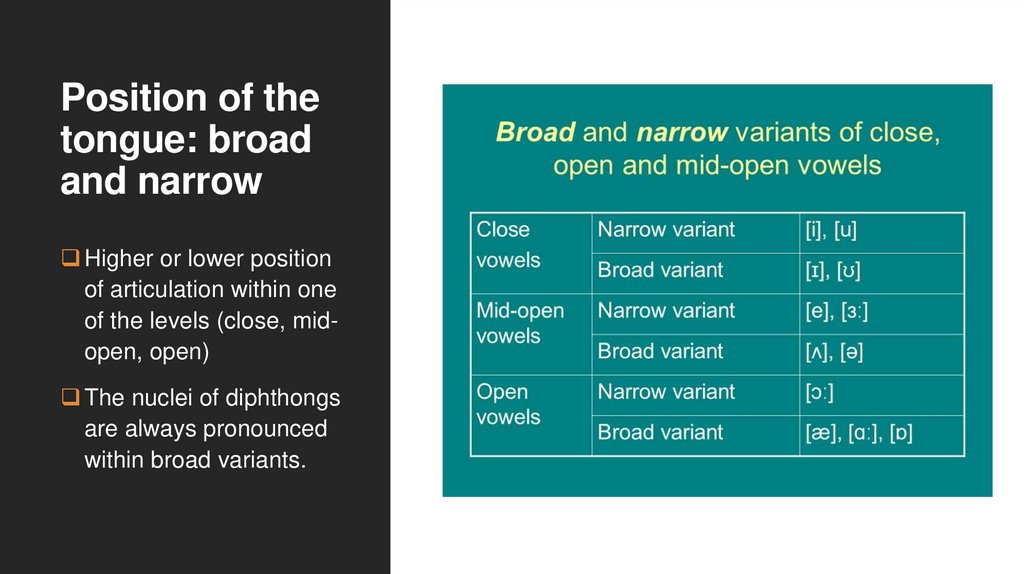
28. Position of the tongue: broad and narrow
Higher or lower positionof articulation within one
of the levels (close, midopen, open)
The nuclei of diphthongs
are always pronounced
within broad variants.
29.
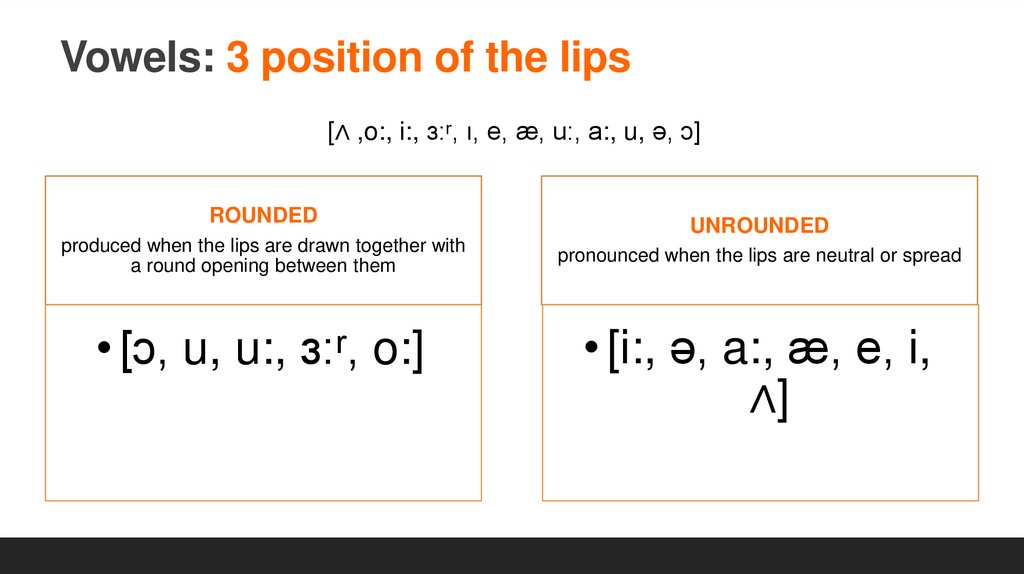
Vowels: 3 position of the lips[∧ ,o:, i:, ɜ:ʳ, ı, e, æ, u:, a:, u, ə, ɔ]
ROUNDED
produced when the lips are drawn together with
a round opening between them
• [ɔ, u, u:, ɜ:ʳ, o:]
UNROUNDED
pronounced when the lips are neutral or spread
• [i:, ə, a:, æ, e, i,
∧]
30.
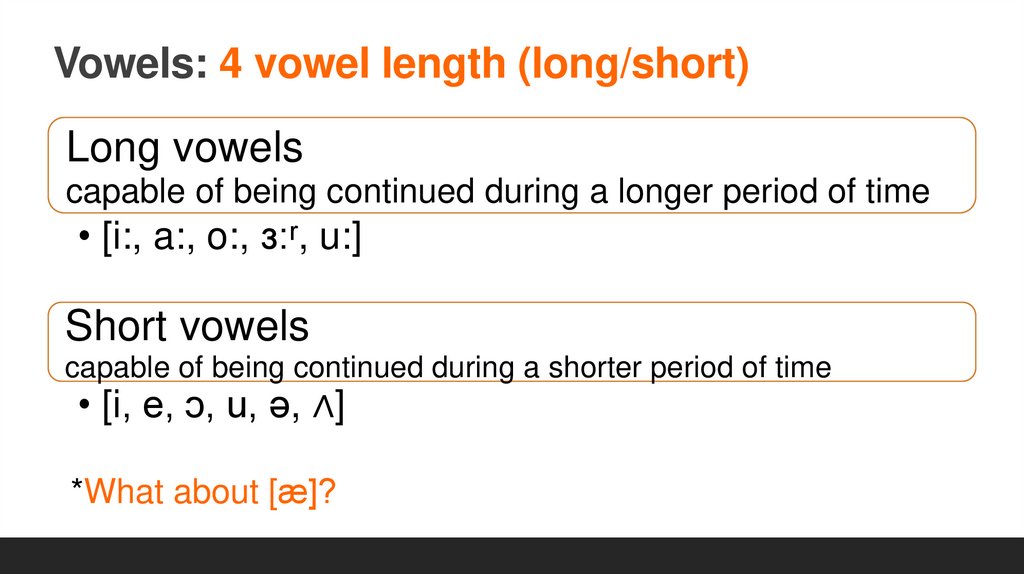
Vowels: 4 vowel length (long/short)Long vowels
capable of being continued during a longer period of time
• [i:, a:, o:, ɜ:ʳ, u:]
Short vowels
capable of being continued during a shorter period of time
• [i, e, ɔ, u, ə, ∧]
*What about [æ]?
31.
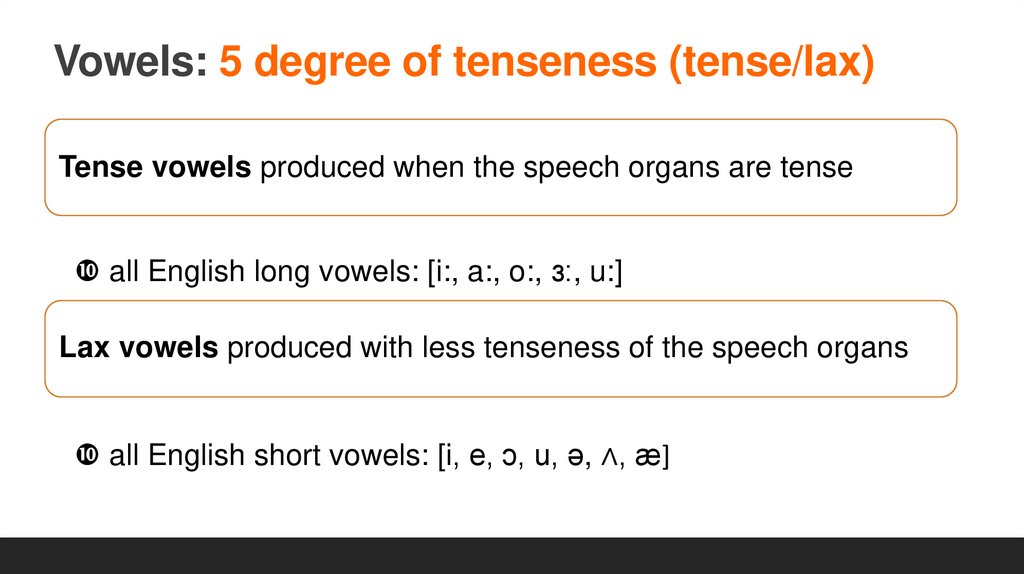
Vowels: 5 degree of tenseness (tense/lax)Tense vowels produced when the speech organs are tense
all English long vowels: [i:, a:, o:, ɜ:, u:]
Lax vowels produced with less tenseness of the speech organs
all English short vowels: [i, e, ɔ, u, ə, ∧, æ]
32.
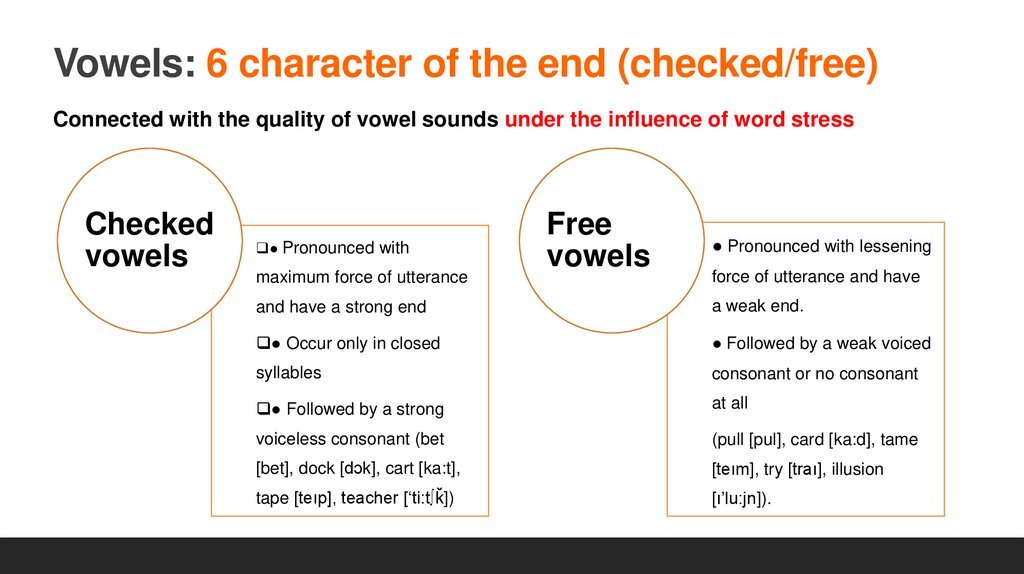
Vowels: 6 character of the end (checked/free)Connected with the quality of vowel sounds under the influence of word stress
Checked
vowels
● Pronounced with
maximum force of utterance
Free
vowels
● Pronounced with lessening
force of utterance and have
and have a strong end
a weak end.
● Occur only in closed
● Followed by a weak voiced
syllables
consonant or no consonant
● Followed by a strong
at all
voiceless consonant (bet
(pull [pul], card [ka:d], tame
[bet], dock [dɔk], cart [ka:t],
[teım], try [traı], illusion
tape [teıp], teacher [‘ti:t∫ǩ])
[ı’lu:jn]).
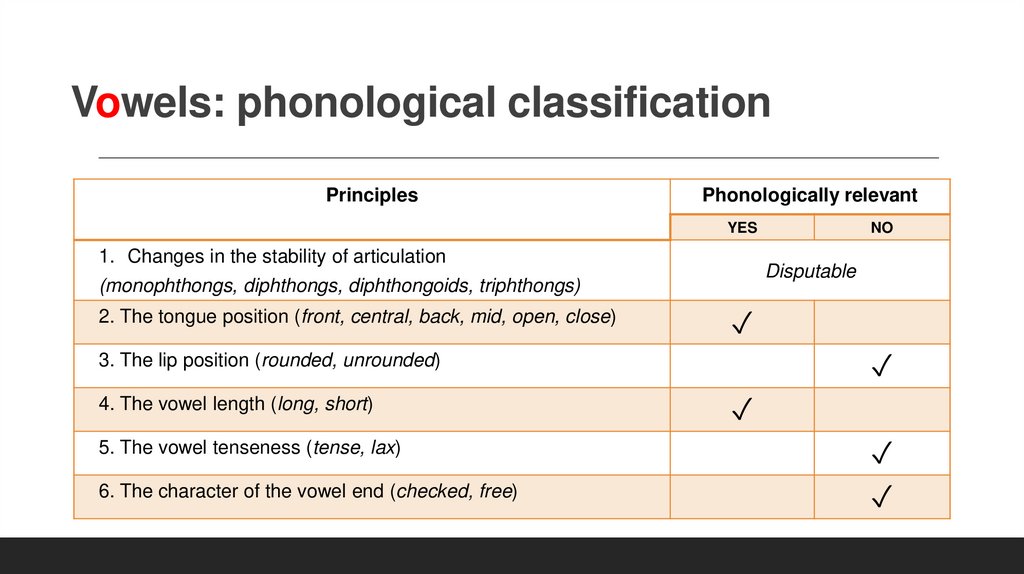
33. Vowels: phonological classification
PrinciplesPhonologically relevant
YES
1. Changes in the stability of articulation
Disputable
(monophthongs, diphthongs, diphthongoids, triphthongs)
2. The tongue position (front, central, back, mid, open, close)
✓
✓
3. The lip position (rounded, unrounded)
4. The vowel length (long, short)
5. The vowel tenseness (tense, lax)
6. The character of the vowel end (checked, free)
NO
✓
✓
✓
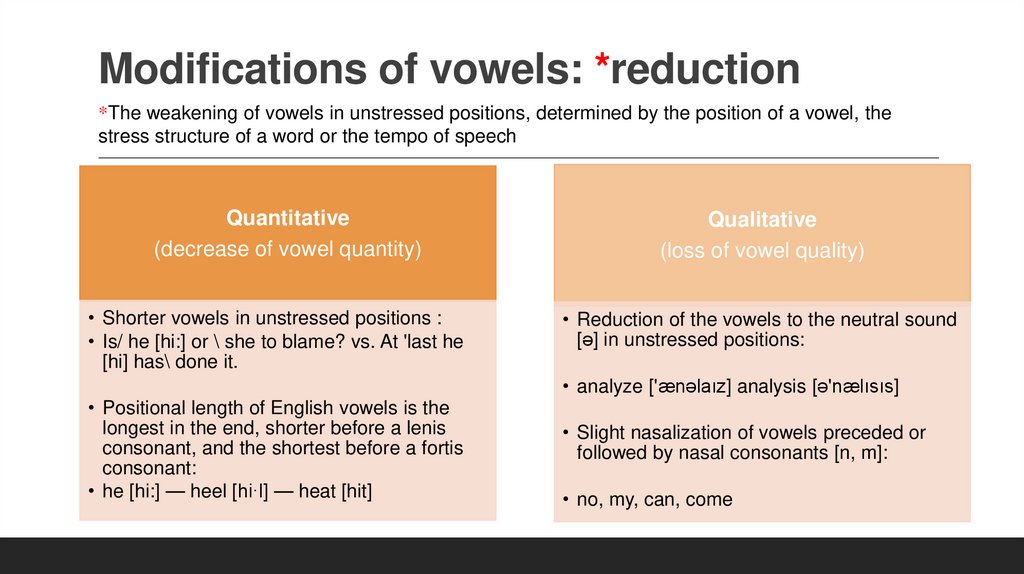
34. Modifications of vowels: *reduction
*The weakening of vowels in unstressed positions, determined by the position of a vowel, thestress structure of a word or the tempo of speech
Quantitative
(decrease of vowel quantity)
Qualitative
(loss of vowel quality)
• Shorter vowels in unstressed positions :
• Is/ he [hi:] or \ she to blame? vs. At 'last he
[hi] has\ done it.
• Reduction of the vowels to the neutral sound
[ə] in unstressed positions:
• analyze ['ænəlaız] analysis [ə'nælısıs]
• Positional length of English vowels is the
longest in the end, shorter before a lenis
consonant, and the shortest before a fortis
consonant:
• he [hi:] — heel [hi·l] — heat [hit]
• Slight nasalization of vowels preceded or
followed by nasal consonants [n, m]:
• no, my, can, come
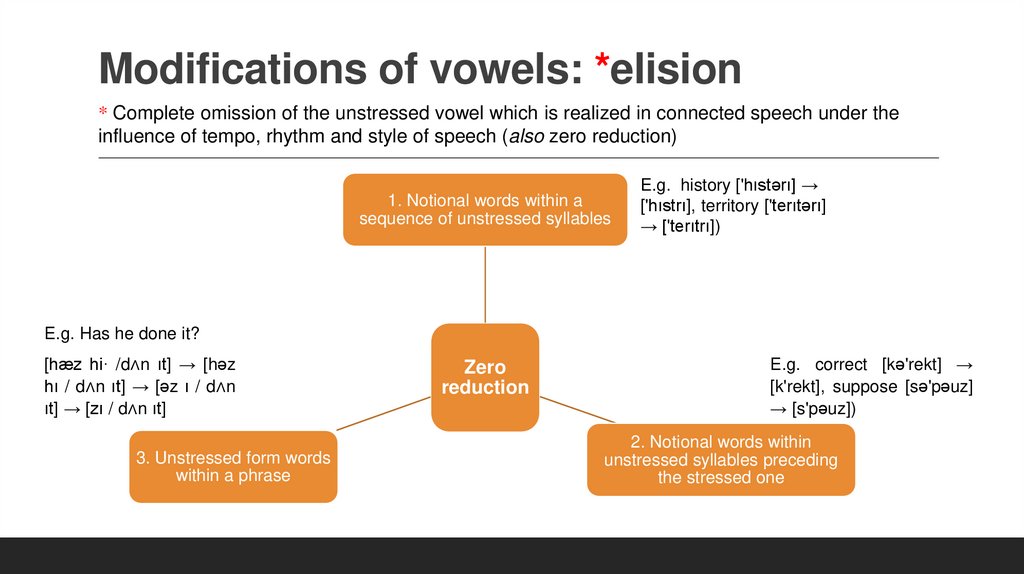
35. Modifications of vowels: *elision
* Complete omission of the unstressed vowel which is realized in connected speech under theinfluence of tempo, rhythm and style of speech (also zero reduction)
1. Notional words within a
sequence of unstressed syllables
E.g. history ['hıstərı] →
['hıstrı], territory ['terıtərı]
→ ['terıtrı])
E.g. Has he done it?
[hæz hi· /d∧n ıt] → [həz
hı / d∧n ıt] → [əz ı / d∧n
ıt] → [zı / d∧n ıt]
3. Unstressed form words
within a phrase
Zero
reduction
E.g. correct [kə'rekt] →
[k'rekt], suppose [sə'pəuz]
→ [s'pəuz])
2. Notional words within
unstressed syllables preceding
the stressed one
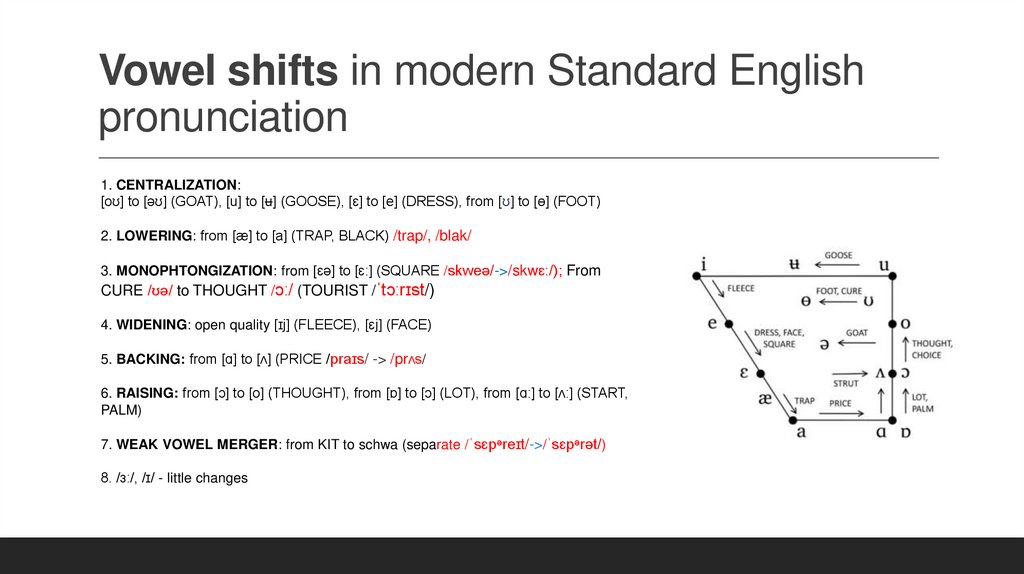
36. Vowel shifts in modern Standard English pronunciation
1. CENTRALIZATION:[oʊ] to [əʊ] (GOAT), [u] to [ʉ] (GOOSE), [ɛ] to [e] (DRESS), from [ʊ] to [ɵ] (FOOT)
2. LOWERING: from [æ] to [a] (TRAP, BLACK) /trap/, /blak/
3. MONOPHTONGIZATION: from [ɛə] to [ɛː] (SQUARE /skweə/->/skwɛː/); From
CURE /ʊə/ to THOUGHT /ɔː/ (TOURIST /ˈtɔːrɪst/)
4. WIDENING: open quality [ɪj] (FLEECE), [ɛj] (FACE)
5. BACKING: from [ɑ] to [ʌ] (PRICE /praɪs/ -> /prʌs/
6. RAISING: from [ɔ] to [o] (THOUGHT), from [ɒ] to [ɔ] (LOT), from [ɑː] to [ʌː] (START,
PALM)
7. WEAK VOWEL MERGER: from KIT to schwa (separate /ˈsɛpᵊreɪt/->/ˈsɛpᵊrət/)
8. /ɜː/, /ɪ/ - little changes