

 Образование
Похожие презентации:





Educational and scientific seminar
1.
Educational and scientificseminar
Developing a facility management strategy: key components for
success
https://spacewell.com/resources/blog/developing-a-facilitymanagement-strategy-key-components-for-success/
Ahmadi Nahid and Lim Elina, group УБ25-1
2.
The relevance of the problemWithout a solid strategy, companies risk inefficiency, higher costs,
safety issues, and missed opportunities for sustainability. A good
FM strategy can optimize performance, extend asset lifecycles,
improve workplace productivity, and contribute to environmental
goals.
3.
Subject, object of the research• Subject: The subject of the research is the strategic
development, structuring, and implementation of a
comprehensive facility management (FM) strategy within
modern organizations.
• Object: The organization’s physical assets (buildings,
infrastructure) and how they are managed (through
maintenance, space planning, energy use, safety, tech) to
support business operations efficiently.
4.
Problematic question, hypothesis• Problematic question: How can organizations design and implement
a facility management strategy that reduces costs, increases
productivity, ensures safety and compliance, and supports
sustainability?
• Hypothesis: By building a strategy around key components — such
as asset management, space optimization, energy management,
safety/compliance, and technology integration — companies will
realize significant benefits (cost savings, efficiency, sustainability).
5.
Novelty of the articleWhat the article brings new or especially well organized is a clear,
structured model for an FM strategy that is both strategic and
practical. The novelty lies in combining traditional FM concerns
with technology-driven, forward-looking strategic planning,
packaged in a framework that organizations can follow.
6.
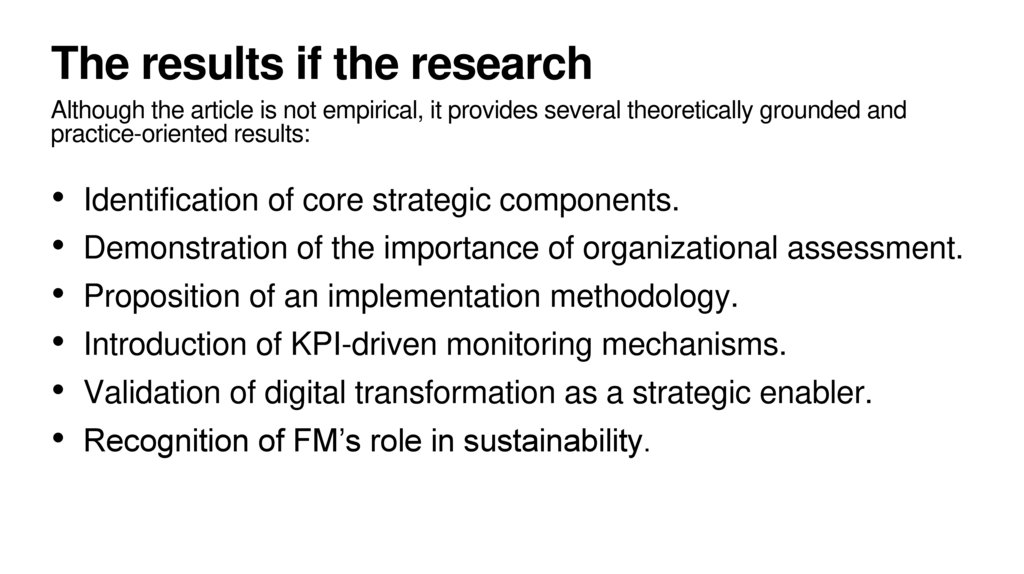
The results if the researchAlthough the article is not empirical, it provides several theoretically grounded and
practice-oriented results:
• Identification of core strategic components.
• Demonstration of the importance of organizational assessment.
• Proposition of an implementation methodology.
• Introduction of KPI-driven monitoring mechanisms.
• Validation of digital transformation as a strategic enabler.
• Recognition of FM’s role in sustainability.
7.
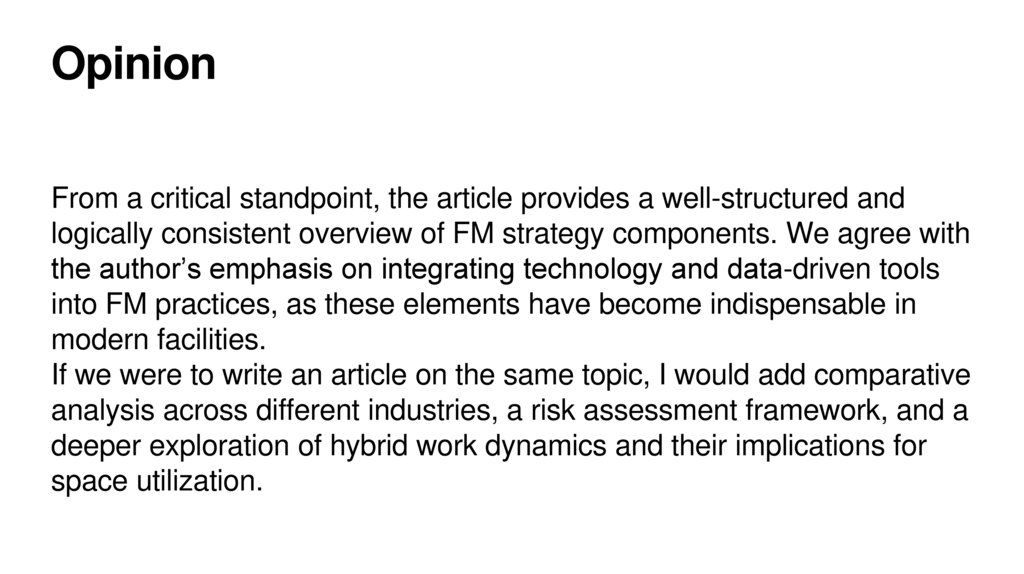
OpinionFrom a critical standpoint, the article provides a well-structured and
logically consistent overview of FM strategy components. We agree with
the author’s emphasis on integrating technology and data-driven tools
into FM practices, as these elements have become indispensable in
modern facilities.
If we were to write an article on the same topic, I would add comparative
analysis across different industries, a risk assessment framework, and a
deeper exploration of hybrid work dynamics and their implications for
space utilization.