










 Экономика
Похожие презентации:








Financial Modeling and Statistics
1. Financial Modeling and Statistics
Presented by Group:00017750_0001868
6_00016575_00020
790_00016388
2. Agenda
1.Introduction to Research Topic
2.
Theoretical and Empirical Background
3.
Research Variables and Descriptive
Statistics
4.
EDA: Correlation Analysis
5.
Regression Analysis
6.
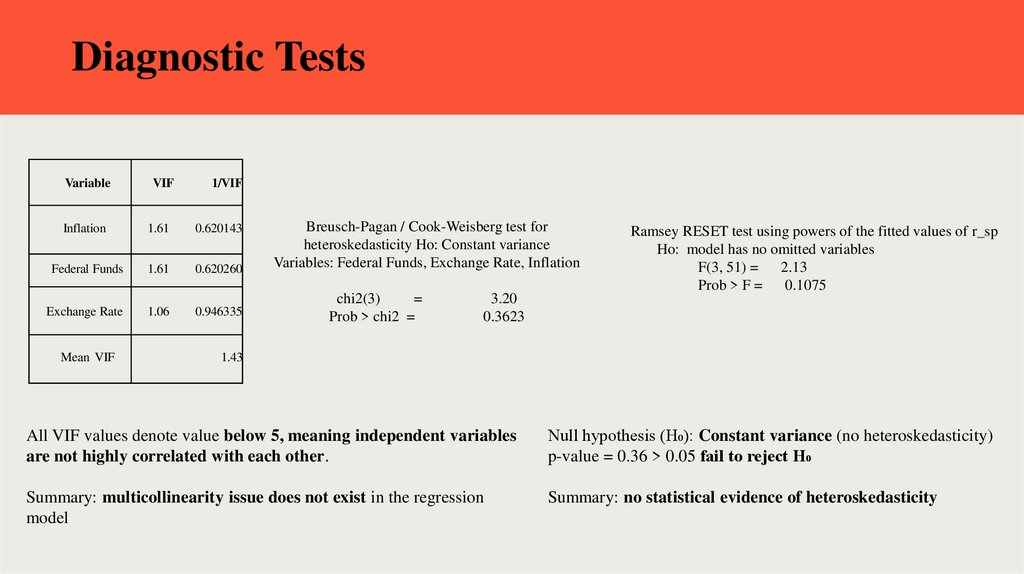
Diagnostic Tests
7.
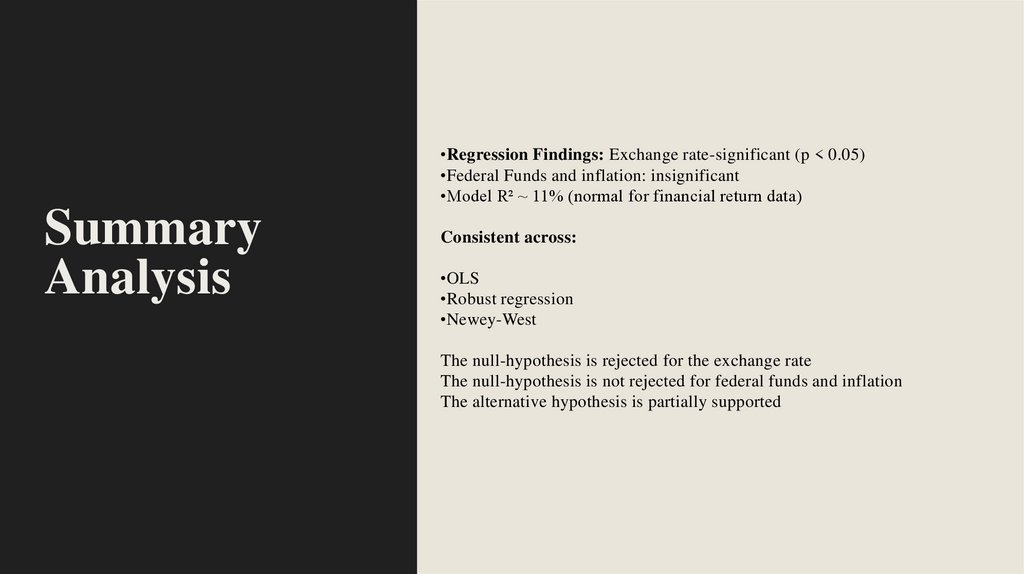
Key Findings
8.
Summary and Recommendations
3. Stock Market Index and Macroeconomic Indicators
4. Why Stock Market Analysis ? “Stock Market plays a vital role in the economic growth of nations by generating capital allocation
Research MotivationWhy Stock Market Analysis ?
“Stock Market plays a vital role in the economic growth of nations by generating capital
allocation and wealth creation. The Stock Market is impacted by diverse factors such as Gross
Domestic Product (GDP), Foreign Direct Investment (FDI), Consumer Price Index (CPI),
Interest Rate, and Exchange Rate, directly impacting investor behavior, market liquidity, and
overall economic environment.
The role of Federal Funds, Inflation, and Exchange Rates in Stock Market Returns:
Through monetary policy, which affects the presence of money and credit, the Federal Funds
has a critical role in maintaining inflation in check while promoting economic development.
By overseeing and regulating commercial banks, the Federal Funds fosters the safety of the
U.S. banking and financial systems
5. Theoretical Background
CAPM: stock returns depend on systematic macroeconomic conditions measured bybeta (β).
More risk-more required return.
β = 1: asset has market-level risk
β > 1: asset is riskier than the market
β < 1: asset is less risky than the market
β = 0: asset has no market risk (risk-free)
risk-free rate (Rᶠ) —Fed Funds Rate
M=market portfolio
Rᶠ to E(Rₘ) =risk premium
Ri=Rf+βi(E[Rm]−Rf)
shows the expected return of an asset as a function of:
Rᶠ: risk-free rate
βᵢ: systematic risk (asset)
(E[Rₘ] – Rᶠ): market risk premium
Higher placement = higher inflation
Low Unemployment=High Inflation
High Unemployment=Low Inflation
Central banks boosts or decreases interest rates to respond
to inflation affecting:
Discount Rates
Investment
Corporate Earnings
Stock Valuations
6.
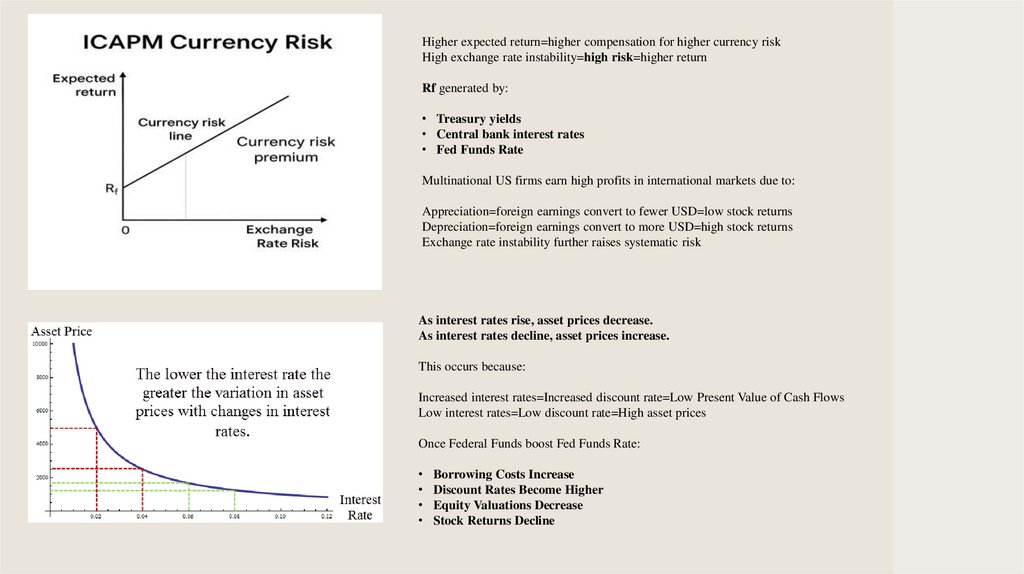
Higher expected return=higher compensation for higher currency riskHigh exchange rate instability=high risk=higher return
Rf generated by:
• Treasury yields
• Central bank interest rates
• Fed Funds Rate
Multinational US firms earn high profits in international markets due to:
Appreciation=foreign earnings convert to fewer USD=low stock returns
Depreciation=foreign earnings convert to more USD=high stock returns
Exchange rate instability further raises systematic risk
As interest rates rise, asset prices decrease.
As interest rates decline, asset prices increase.
This occurs because:
Increased interest rates=Increased discount rate=Low Present Value of Cash Flows
Low interest rates=Low discount rate=High asset prices
Once Federal Funds boost Fed Funds Rate:
Borrowing Costs Increase
Discount Rates Become Higher
Equity Valuations Decrease
Stock Returns Decline
7. How Trends in Macroeconomic Indicators Impact Stock Market Returns?
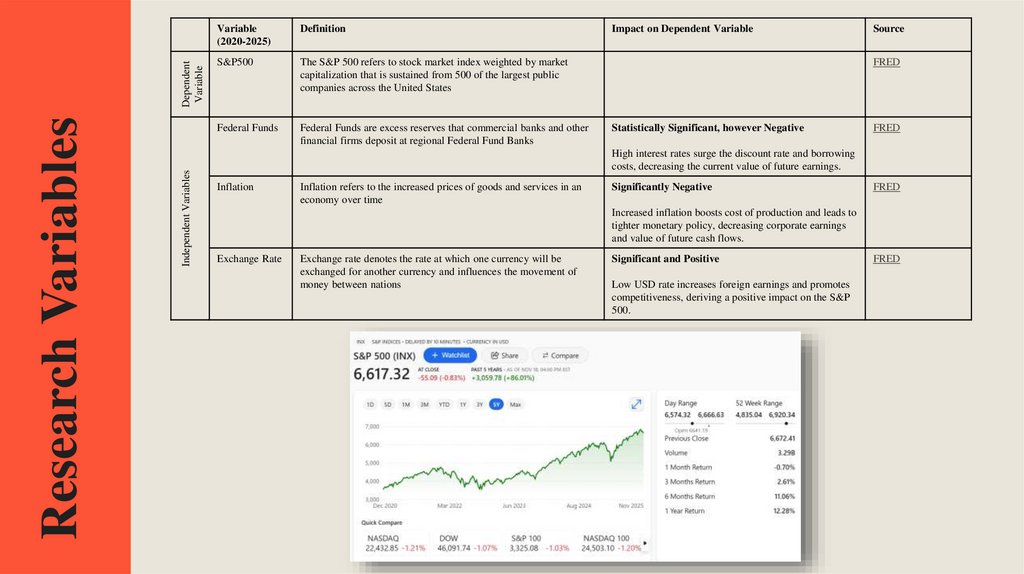
Key Research Variables:Dependent Variable: S&P 500
Independent Variables: Federal Funds (Interest Rate), Inflation
(CPI), and Exchange Rate (USD to EUR)
Research Hypothesis:
Null Hypothesis (H₀):
Interest rate (Fed Funds), inflation (CPI), and exchange rate has no
significant impact on S&P 500 returns
Alternative Hypothesis (H₁):
At least one macroeconomic indicator significantly affect S&P 500
returns.
Each coefficient tests: