 Английский язык
 Лингвистика
Похожие презентации:



Dictionaries of different types in the English language acquisition Part I
1. Dictionaries of different types in the English language acquisition Part I
2. Key terms
Lexicography - one of the branch of linguistics dealing withthe theory and practice of compiling dictionaries.
Dictionary - a book that lists the words of a language in a
certain order (usually alphabetical) and gives their meanings,
or that gives the equivalent words in a different language.
3. Dictionary structure
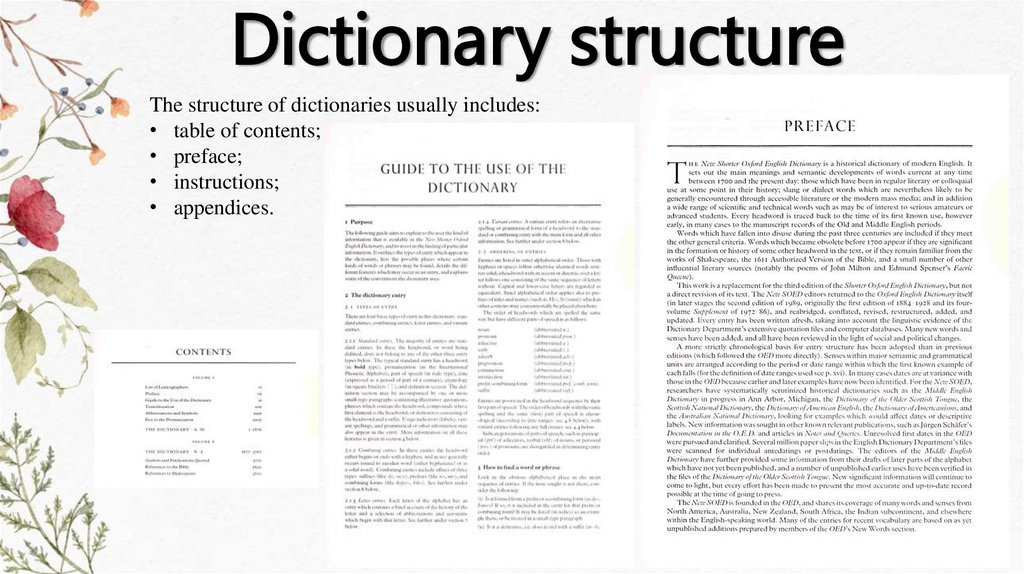
The structure of dictionaries usually includes:• table of contents;
• preface;
• instructions;
• appendices.
4.
5.
Classification of dictionariesAccording to the choice of items included and the sort of information given about these items:
encyclopedic and linguistic.
1. Encyclopedic dictionaries are scientific reference books dealing with every branch of
knowledge, or with one particular branch, usually in alphabetical order, e.g. the Oxford
Paperback Encyclopedia, Random House Webster's Biographical Dictionary.
Explanatory dictionaries also fall into diachronic and synchronic with regard to time.
2. Linguistic dictionaries are word-books the subject-matter of which is lexical units and
their linguistic properties such as pronunciation, meaning, origin, peculiarities of use, and
other linguistic information.
6.
Classification of dictionariesLinguistic dictionaries can be further divided into different categories by different criteria.
1. According to the scope of their word-list linguistic dictionaries are divided into
general and restricted.
General dictionaries represent the vocabulary as a whole with a degree of completeness
depending upon the scope and the bulk of the book in question.
Restricted dictionaries cover only a certain specific part of the vocabulary. Restricted
dictionaries can be subdivided depending on whether:
• the words are chosen according to the sphere of human activity in which they are used (1);
• the type of the units themselves (2);
• the relations existing between them (3).
7.
Classification of dictionaries2. According to the information they provide all linguistic dictionaries fall into two groups:
explanatory and specialized.
Explanatory dictionaries present a wide range of data, especially with regard to the semantic
aspect of the vocabulary items entered, e.g. the New Oxford Dictionary of English.
Explanatory dictionaries also fall into diachronic and synchronic with regard to time.
Diachronic (historical) dictionaries reflect the development of the English vocabulary by
recording the history of form and meaning for every word registered, e.g. the Oxford English
Dictionary.
Synchronic (descriptive) dictionaries are concerned with the present-day meaning and usage of
words, e.g. the Advanced Learner's Dictionary of Current English.
Specialized dictionaries deal with lexical units only in relation to some of their characteristics, i.e.
only in relation to their etymology, frequency, pronunciation, usage, e.g. the Longman
Pronunciation Dictionary.
8.
Classification of dictionaries3. According to the language of explanations, i.e. whether the information about the items
entered given in the same language or in another language, all dictionaries are divided into:
monolingual and bilingual.
In monolingual dictionaries the words and the information about them are given in the
same language, e.g. the New Shorter Oxford English Dictionary.
Bilingual dictionaries are those that explain words by giving their equivalents in another
language, e.g. the English-Russian Phraseological Dictionary (by A.V.Kunin).
They may have two principal purposes:
• reference for translation;
• guidance for expression.
9. Structure of the dictionary entry
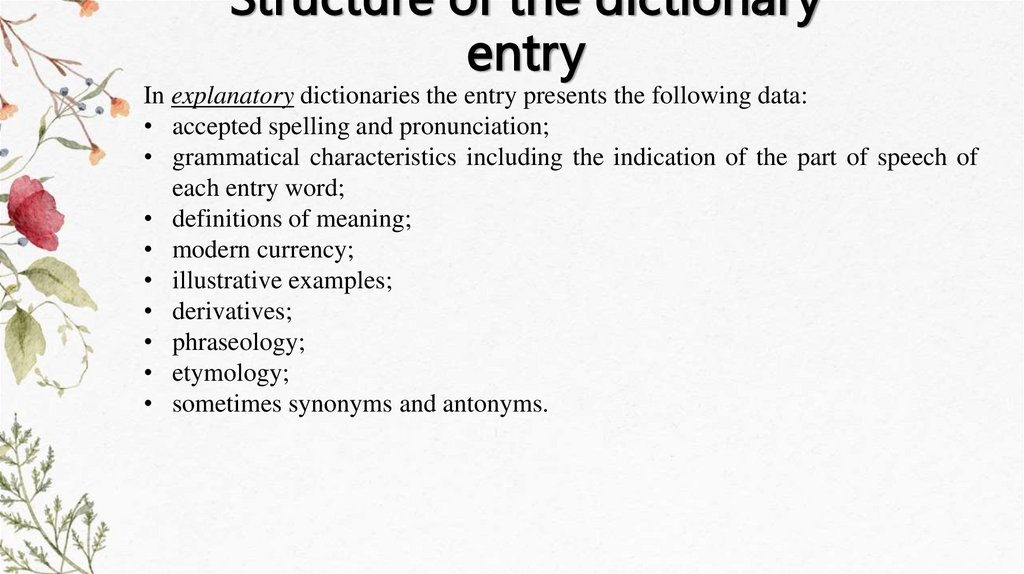
In explanatory dictionaries the entry presents the following data:• accepted spelling and pronunciation;
• grammatical characteristics including the indication of the part of speech of
each entry word;
• definitions of meaning;
• modern currency;
• illustrative examples;
• derivatives;
• phraseology;
• etymology;
• sometimes synonyms and antonyms.
10.
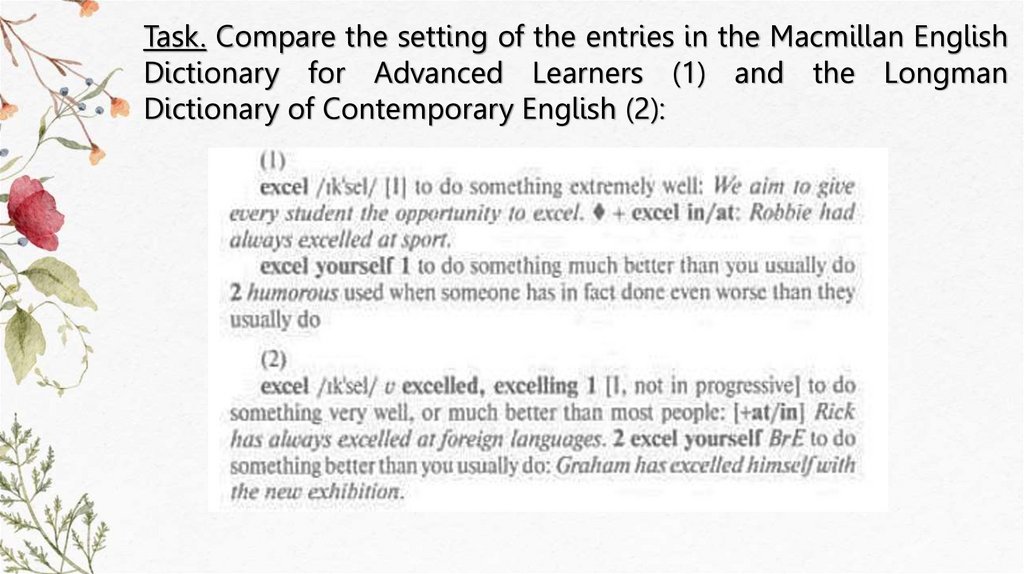
Task. Compare the setting of the entries in the Macmillan EnglishDictionary for Advanced Learners (1) and the Longman
Dictionary of Contemporary English (2):
11.
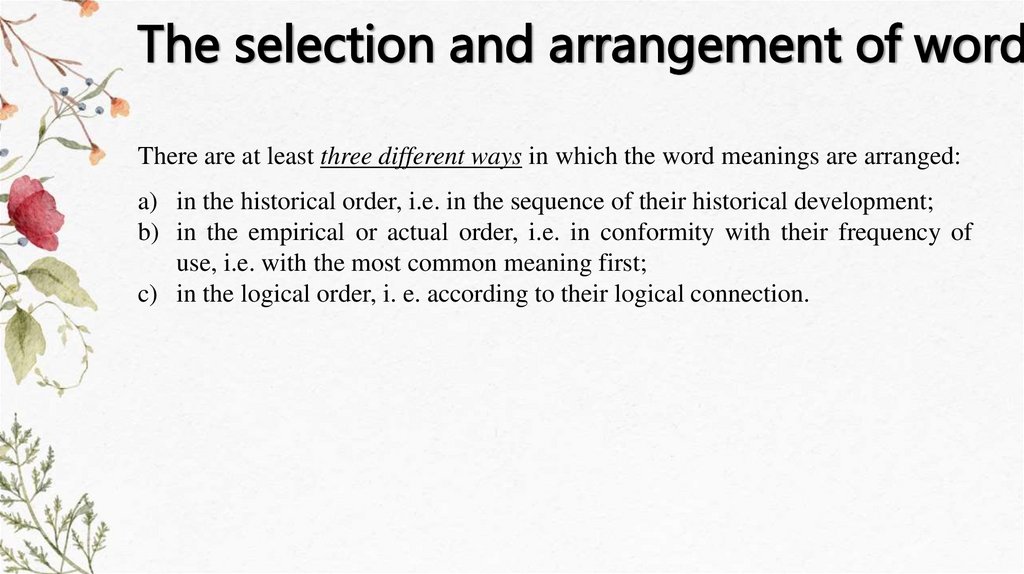
The selection and arrangement of wordThere are at least three different ways in which the word meanings are arranged:
a) in the historical order, i.e. in the sequence of their historical development;
b) in the empirical or actual order, i.e. in conformity with their frequency of
use, i.e. with the most common meaning first;
c) in the logical order, i. e. according to their logical connection.
12.
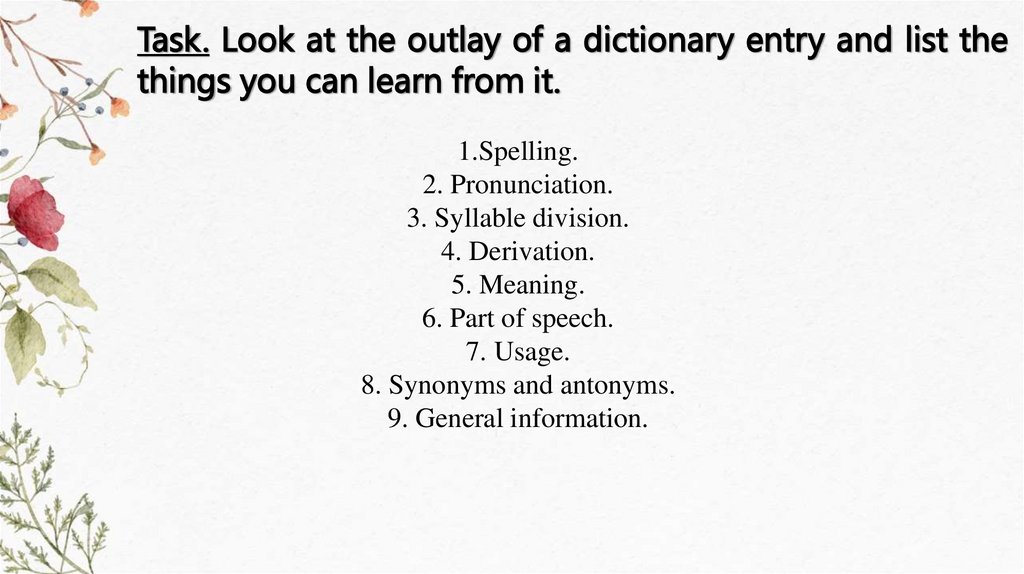
Task. Look at the outlay of a dictionary entry and list thethings you can learn from it.
1.Spelling.
2. Pronunciation.
3. Syllable division.
4. Derivation.
5. Meaning.
6. Part of speech.
7. Usage.
8. Synonyms and antonyms.
9. General information.
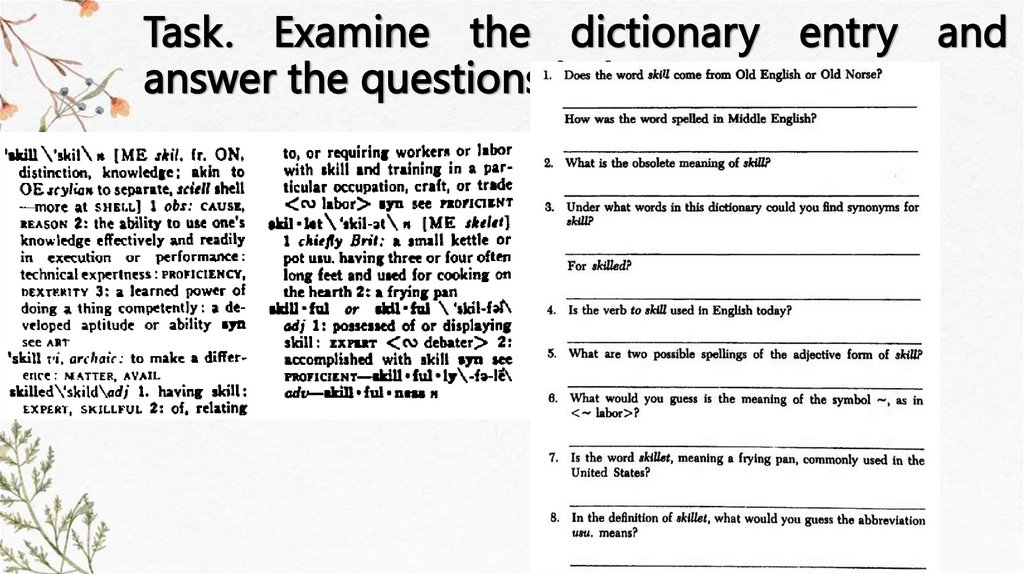
13. Task. Examine the dictionary entry and answer the questions below.
14. The definition of meanings
Meanings of words may be defined in different ways:a) by means of linguistic definitions that are only concerned with words as
speech material. They are used in the majority of entries;
b) by means of encyclopedic definitions that are concerned with things for
which the words are names;
c) by means of synonymous words and expressions;
d) by means of cross-references.
15.
Exercise 1The following words are familiar to you. However, look up each word in the
dictionary which you usually use. Notice how the different meanings are divided
according to parts of speech. Sometimes a numbered meaning will have several
lettered meanings. Provide the total number of different meanings for each word.
run ___________ fast ___________ set___________ work___________
16.
Exercise 2Notice the different meanings of the word play in the following sentences. Using
your dictionary, find the specific meaning of play in each sentence. Provide the
meaning on the line after each sentence.
1. The children like to play in the afternoon
2. Mary will play the piano in the concert
3. The play produced by the Drama Club was a success.
4. It was a clever play that won the football game for us.
17.
The illustrative materialThe presentation of illustrative material depends on the type of the dictionary
and on the aim the compilers set themselves. They can illustrate the first and
the last known occurrences of the entry word, the successive changes in its
meaning; they place words in a context to clarify their meanings and usage.
Illustrative examples can be drawn from different sources.
Some dictionaries indicate the author, the work, the page, verse, or line, and
the precise date of the publication, some indicate only the author to give at
least basic orientation about the time when the word occurs.