 Лингвистика
Похожие презентации:








World English accents in the context of globalization
1.
World English accents in thecontext of globalization
A study of the interaction between linguistic variation
and globalization processes.
The main thesis: In the era of globalization, the English language
simultaneously unites and diversifies, accents become symbols of
identity, and linguistic norms shift towards multilingual regions.
Group: T25Y1KFHST-02
2025
Students:
Artyom Zaichenko
Maxim Sukhorukov
Ilya Tsepkov
Boris Nedovodey
2.
Relevance and problems of the studyIn the era of globalization, English has established itself as the dominant
language. However, its spread has led to the emergence of numerous
regional and social accents that challenge traditional notions of "standard"
English.
Why is it relevant?
Understanding the role of
English in international
communication, education and
business.
Key questions:
How does globalization affect
the perception of accents?
What are the social and
cultural globalizations in
relation to language?
Is it possible to return to
linguistic accents?
Contradictions in linguistics
Standardization vs. diversification,
native speaker norms vs. non-native speaker norms.
3.
Research methodologyTo obtain objective and comprehensive results in the study of global
English accents, an integrated methodological approach is used,
combining quantitative and qualitative methods of analysis.
Methods of analysis
Corpus analysis: identifying the frequency and contexts of
use of linguistic features.
Comparative phonetics: analysis of pronunciation norms and
deviations.
Data sources
Speech corpora (e.g. ICE, GloWbE).
Media (YouTube).
Scientific articles on linguistic research.
Criteria for selecting accents
Geographic distribution.
Availability of representative data corpora.
4.
Theory: two vectors of developmentGlobalization creates a contradiction in the development of language:
Standardization (Americanization)
Diversification
The influence of media (Netflix, YouTube, Hollywood) is
promoting the spread of "General American" pronunciation; in
Britain, local dialects are being supplanted by Estuary
English.
The emergence of "New Englishes"—regional variants of
English (Spanglish, Hinglish, Runglish). Accent becomes a
marker of identity, not a mistake.
The key phenomenon — English as a Lingua Franca (ELF): English as a means of communication between nonnative speakers, where the priority is comprehensibility rather than grammatical accuracy.
5.
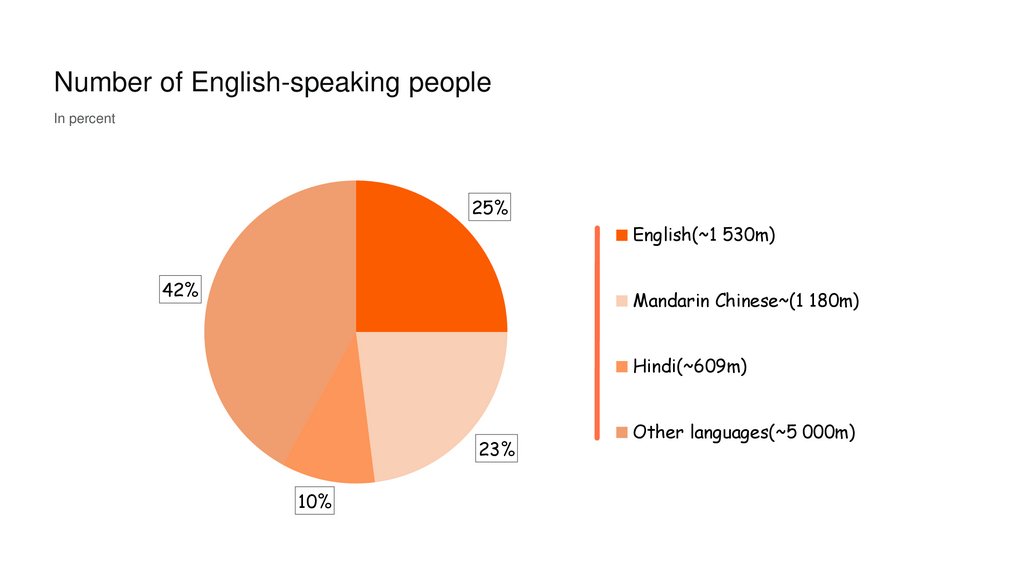
Number of English-speaking peopleIn percent
25%
English(~1 530m)
42%
Mandarin Chinese~(1 180m)
Hindi(~609m)
23%
10%
Other languages(~5 000m)
6.
7.
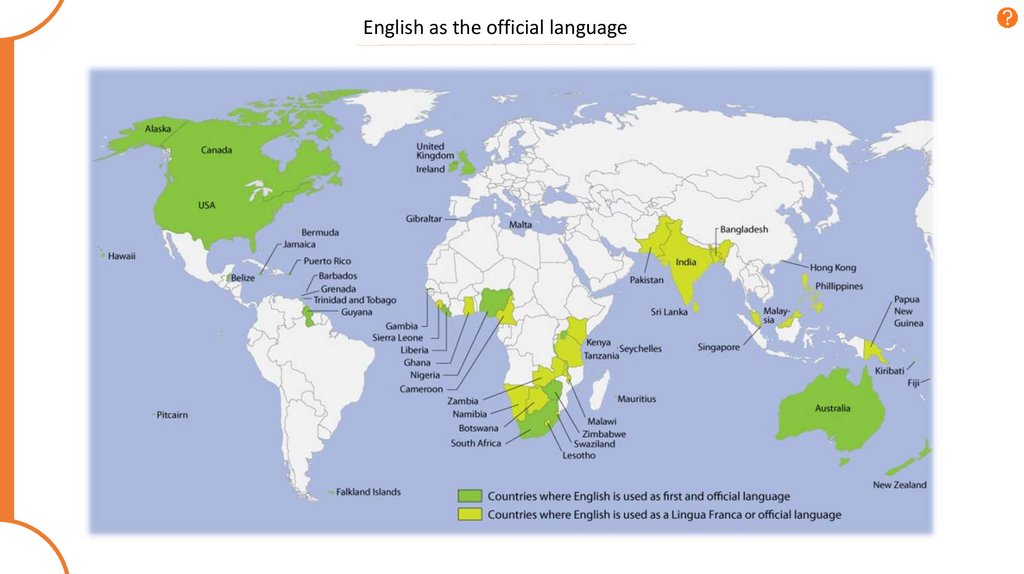
English as the official language8.
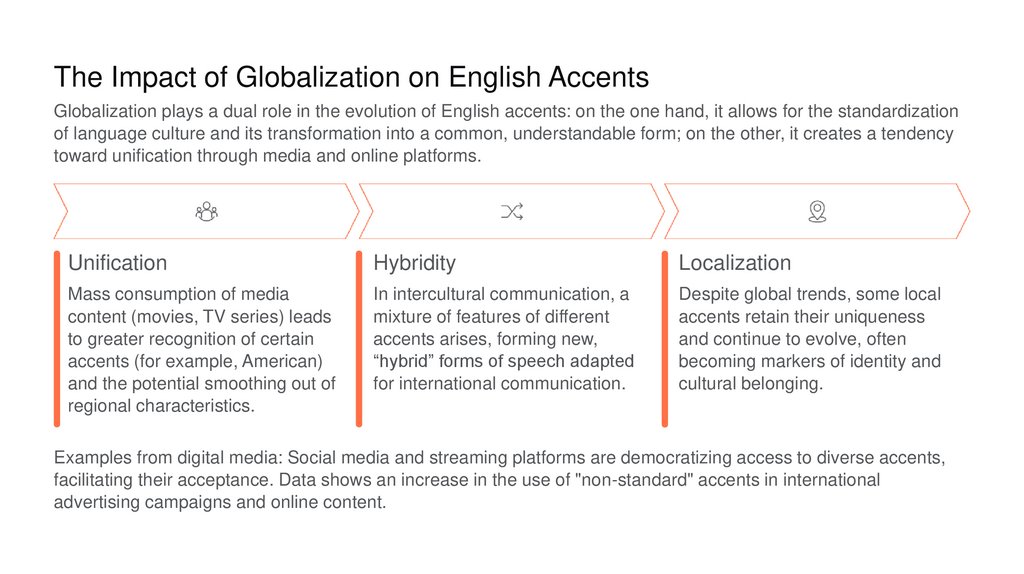
The Impact of Globalization on English AccentsGlobalization plays a dual role in the evolution of English accents: on the one hand, it allows for the standardization
of language culture and its transformation into a common, understandable form; on the other, it creates a tendency
toward unification through media and online platforms.
Unification
Hybridity
Localization
Mass consumption of media
content (movies, TV series) leads
to greater recognition of certain
accents (for example, American)
and the potential smoothing out of
regional characteristics.
In intercultural communication, a
mixture of features of different
accents arises, forming new,
“hybrid” forms of speech adapted
for international communication.
Despite global trends, some local
accents retain their uniqueness
and continue to evolve, often
becoming markers of identity and
cultural belonging.
Examples from digital media: Social media and streaming platforms are democratizing access to diverse accents,
facilitating their acceptance. Data shows an increase in the use of "non-standard" accents in international
advertising campaigns and online content.
9.
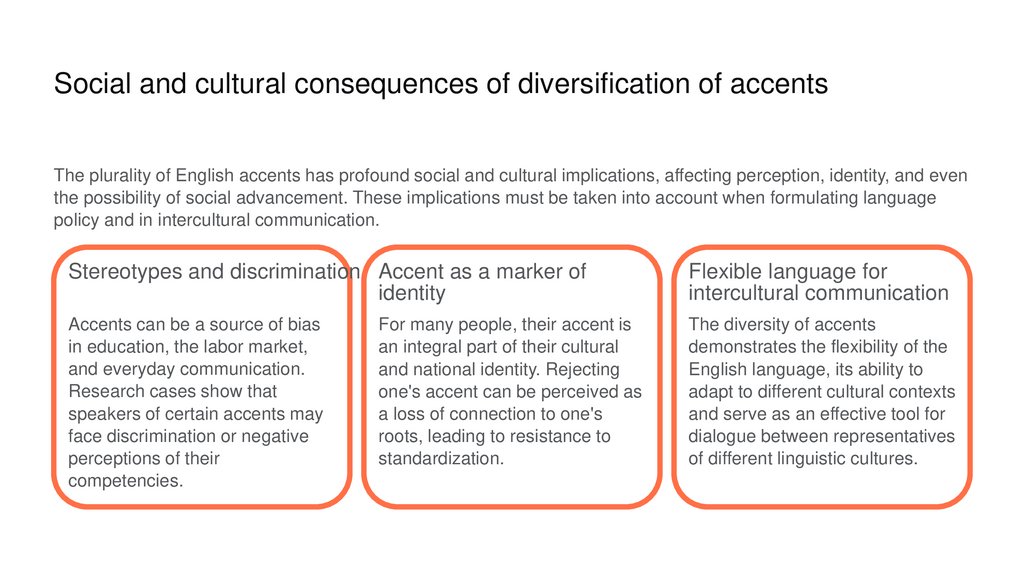
Social and cultural consequences of diversification of accentsThe plurality of English accents has profound social and cultural implications, affecting perception, identity, and even
the possibility of social advancement. These implications must be taken into account when formulating language
policy and in intercultural communication.
Stereotypes and discrimination Accent as a marker of
identity
Flexible language for
intercultural communication
Accents can be a source of bias
in education, the labor market,
and everyday communication.
Research cases show that
speakers of certain accents may
face discrimination or negative
perceptions of their
competencies.
The diversity of accents
demonstrates the flexibility of the
English language, its ability to
adapt to different cultural contexts
and serve as an effective tool for
dialogue between representatives
of different linguistic cultures.
For many people, their accent is
an integral part of their cultural
and national identity. Rejecting
one's accent can be perceived as
a loss of connection to one's
roots, leading to resistance to
standardization.
10.
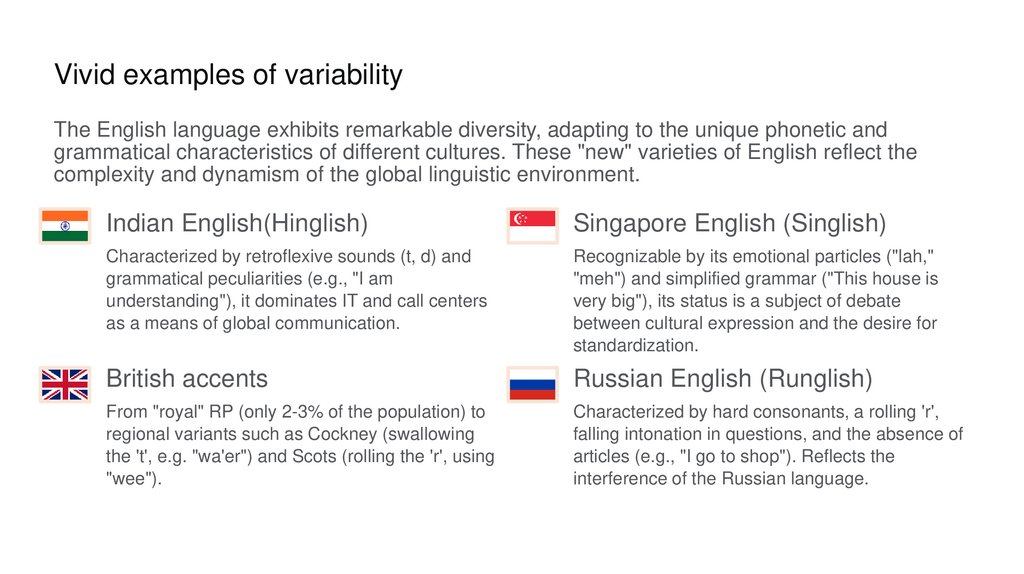
Vivid examples of variabilityThe English language exhibits remarkable diversity, adapting to the unique phonetic and
grammatical characteristics of different cultures. These "new" varieties of English reflect the
complexity and dynamism of the global linguistic environment.
Indian English(Hinglish)
Singapore English (Singlish)
Characterized by retroflexive sounds (t, d) and
grammatical peculiarities (e.g., "I am
understanding"), it dominates IT and call centers
as a means of global communication.
Recognizable by its emotional particles ("lah,"
"meh") and simplified grammar ("This house is
very big"), its status is a subject of debate
between cultural expression and the desire for
standardization.
British accents
Russian English (Runglish)
From "royal" RP (only 2-3% of the population) to
regional variants such as Cockney (swallowing
the 't', e.g. "wa'er") and Scots (rolling the 'r', using
"wee").
Characterized by hard consonants, a rolling 'r',
falling intonation in questions, and the absence of
articles (e.g., "I go to shop"). Reflects the
interference of the Russian language.
11.
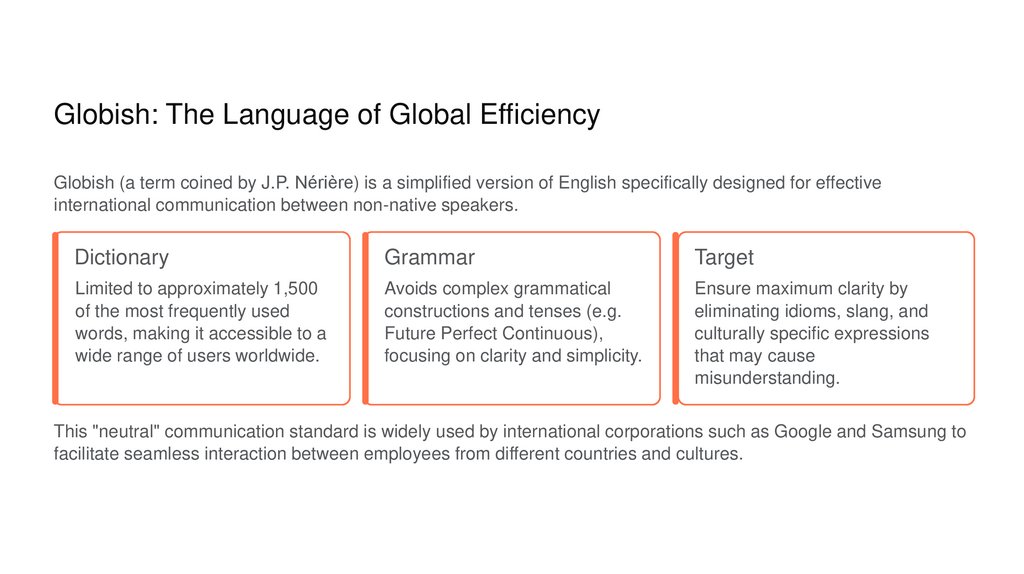
Globish: The Language of Global EfficiencyGlobish (a term coined by J.P. Nérière) is a simplified version of English specifically designed for effective
international communication between non-native speakers.
Dictionary
Grammar
Target
Limited to approximately 1,500
of the most frequently used
words, making it accessible to a
wide range of users worldwide.
Avoids complex grammatical
constructions and tenses (e.g.
Future Perfect Continuous),
focusing on clarity and simplicity.
Ensure maximum clarity by
eliminating idioms, slang, and
culturally specific expressions
that may cause
misunderstanding.
This "neutral" communication standard is widely used by international corporations such as Google and Samsung to
facilitate seamless interaction between employees from different countries and cultures.