
Похожие презентации:










Marimet - Tech Description
1.
Vertical EM Surveying System for Deep-Sea PolymetallicSulphide Exploration
Technical concept, methodology, and validation framework
Target: Deep-sea polymetallic sulphide (DSPS) deposits
Depth range: up to 4000 m
Application: exploration and resource evaluation
Focus: thickness estimation and drill targeting
Basis: vertical EM configuration
2.
Purpose of the Presentation• Present the physical and technical principles of the
system
• Describe the system architecture and survey workflow
• Demonstrate modelling-based validation of
measurement capability
• Position the solution within current marine EM practices
• Provide a basis for independent technical assessment
3. Geological and Exploration Context
• DSPS occur along mid-ocean ridgesand rift valleys
• Deposits exhibit high electrical
conductivity contrast
• Typical lateral dimensions: 100–1000
m
• Typical thickness: several meters to
several tens of meters
• Exploration challenge: reliable
thickness estimation under deepwater conditions
4. Scale of the Exploration Problem
• Global rift length: ~67,000 km• Investigation corridor: ~20 km per rift
• Total prospective area: ~1.34 million
km²
• Typical exploration unit: 1° latitude
(~111 × 20 km)
• High demand for scalable, highproductivity methods
5. Review of Existing Marine EM Approaches
• Towed CSEM systems (horizontalgeometry)
• Seabed-deployed receivers
• Component-based AUV EM systems
• Common limitations:
• Geometry instability
• Limited lateral resolution
• Low productivity
• Elevated operational risk
6. Conceptual Approach
• Use of a vertically oriented EM system• Controlled source excitation (lowfrequency)
• Multi-offset vertical receiver line
• Deployment via ROV with stable
positioning
• Measurement independent of seabed
topography
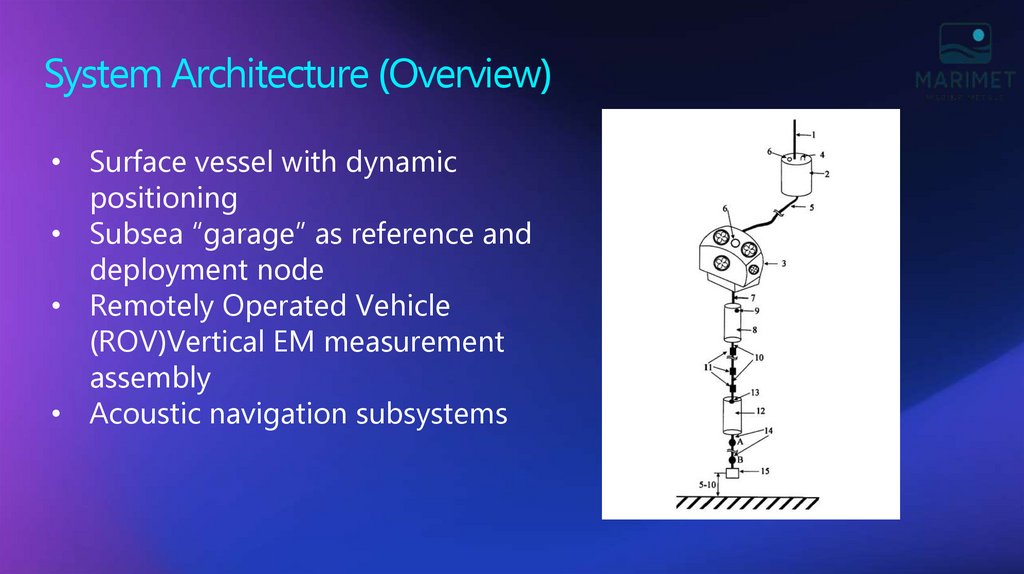
7. System Architecture (Overview)
• Surface vessel with dynamicpositioning
• Subsea “garage” as reference and
deployment node
• Remotely Operated Vehicle
(ROV)Vertical EM measurement
assembly
• Acoustic navigation subsystems
8. Vertical EM Measurement Principle
• Generator and receiver lines alignedon a single vertical axis
• Frequency range: 0–20 Hz
• Generator located below receiver line
• Multiple electrode spacings enable
depth sensitivity
• Optimised for sub-horizontal
conductive layers
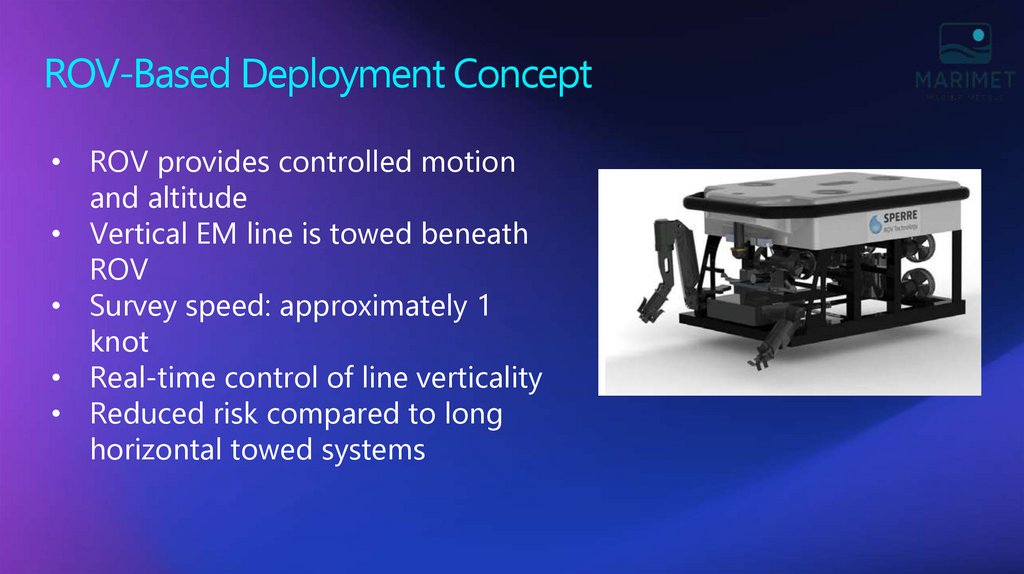
9. ROV-Based Deployment Concept
• ROV provides controlled motionand altitude
• Vertical EM line is towed beneath
ROV
• Survey speed: approximately 1
knot
• Real-time control of line verticality
• Reduced risk compared to long
horizontal towed systems
10. Navigation and Positioning Framework
• Acoustic positioning of garagerelative to vessel
• Acoustic positioning of ROV
relative to garage
• Positioning accuracy: ≤0.2% of
slant range
• Navigation independent of seabed
morphology
• Supports repeatable survey grids
11. Survey Geometry and Coverage
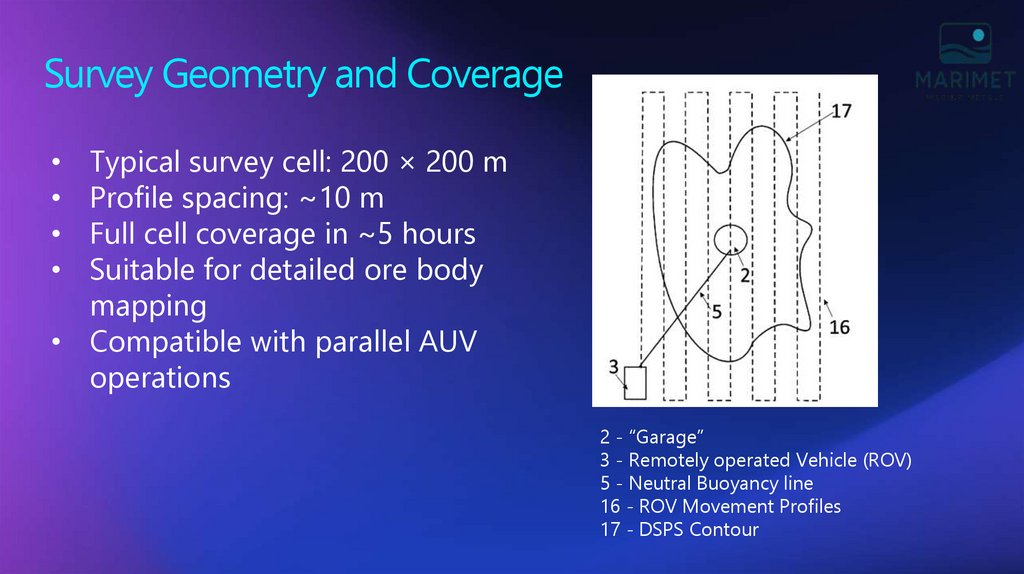
Typical survey cell: 200 × 200 mProfile spacing: ~10 m
Full cell coverage in ~5 hours
Suitable for detailed ore body
mapping
• Compatible with parallel AUV
operations
2 - “Garage”
3 - Remotely operated Vehicle (ROV)
5 - Neutral Buoyancy line
16 - ROV Movement Profiles
17 - DSPS Contour
12. Numerical Modelling Framework
• Three-layer model: water – DSPS –basement
• Variable DSPS thickness (5–50 m)
• Frequency-dependent response
analysis
• Normalisation against background
response
• Focus on signal robustness and
sensitivity
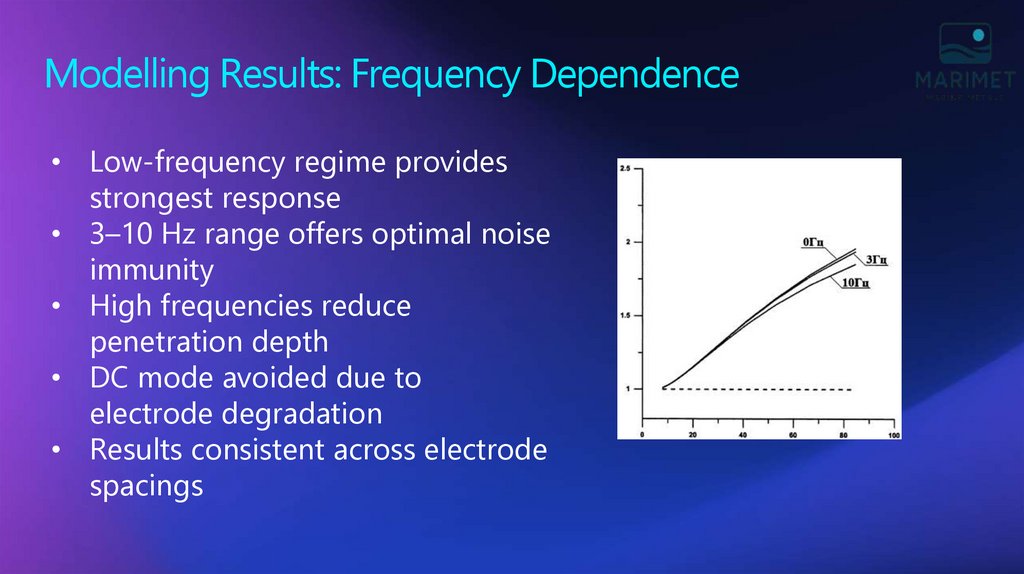
13. Modelling Results: Frequency Dependence
• Low-frequency regime providesstrongest response
• 3–10 Hz range offers optimal noise
immunity
• High frequencies reduce
penetration depth
• DC mode avoided due to
electrode degradation
• Results consistent across electrode
spacings
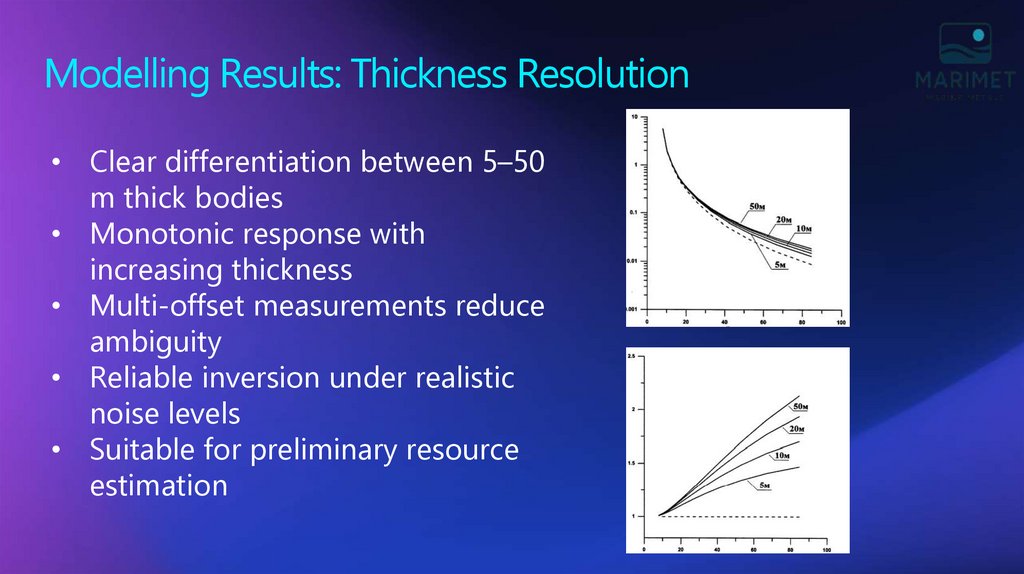
14. Modelling Results: Thickness Resolution
• Clear differentiation between 5–50m thick bodies
• Monotonic response with
increasing thickness
• Multi-offset measurements reduce
ambiguity
• Reliable inversion under realistic
noise levels
• Suitable for preliminary resource
estimation
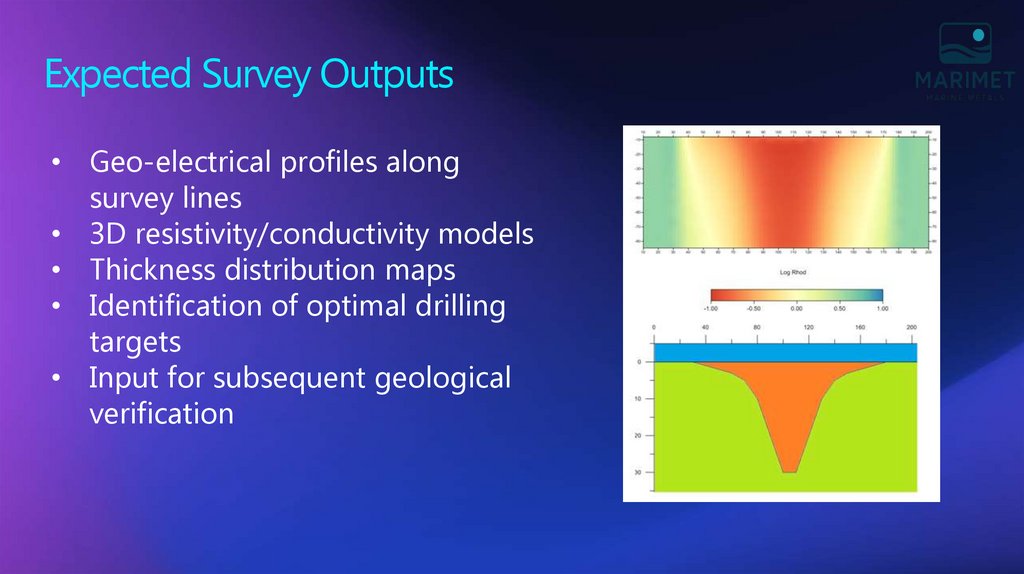
15. Expected Survey Outputs
• Geo-electrical profiles alongsurvey lines
• 3D resistivity/conductivity models
• Thickness distribution maps
• Identification of optimal drilling
targets
• Input for subsequent geological
verification
16. Integration into Full Exploration Workflow
• Regional reconnaissance (AUV)• Delineation of conductive anomalies
(AUV)
• Thickness estimation (ROV vertical EM)
• Targeted coring and sampling
• Optional environmental and visual
surveys in parallel
17. Comparison with Existing Services
• Higher spatial resolution than towedCSEM
• Lower survey time per km²
• Reduced vessel day requirements
• Improved operational safety
• Complementary to seismic methods
18. Operational Productivity: Time Efficiency
Standard exploration unit: 1° latitude (≈ 2,220 km²)
Profile spacing at regional stage: 500 m
Full EM exploration cycle per unit: ~45 days (50 days incl.
contingency)
Thickness evaluation of a single ore body: 7–8 hours
Multiple ore bodies processed sequentially within the
same vessel campaign
No additional vessel time required for parallel non-EM
surveys
Time estimates include deployment, recovery, recharging, and
operational buffers.
19. Economic Impact: Vessel Time and Cost Structure
Typical vessel day rate: USD 30–35k/day (baseline)
Total vessel time per 1° unit: ~45–50 days
Estimated vessel cost per unit: USD 1.35–1.75M
Thickness determination integrated into EM survey (no
separate campaign)
Avoids high-cost full-scale 3D seismic acquisition
Enables earlier go/no-go decisions before drilling
20. Economic value across the multi-stage exploration workflow
Regional EM (AUV): early elimination of non-prospective
areas
Delineation EM (AUV): reduction of target uncertainty
Vertical EM (ROV): quantitative thickness estimation
Targeted coring: reduced number of drill locations
Parallel execution of environmental and visual surveys
Overall reduction of total exploration CAPEX per km²
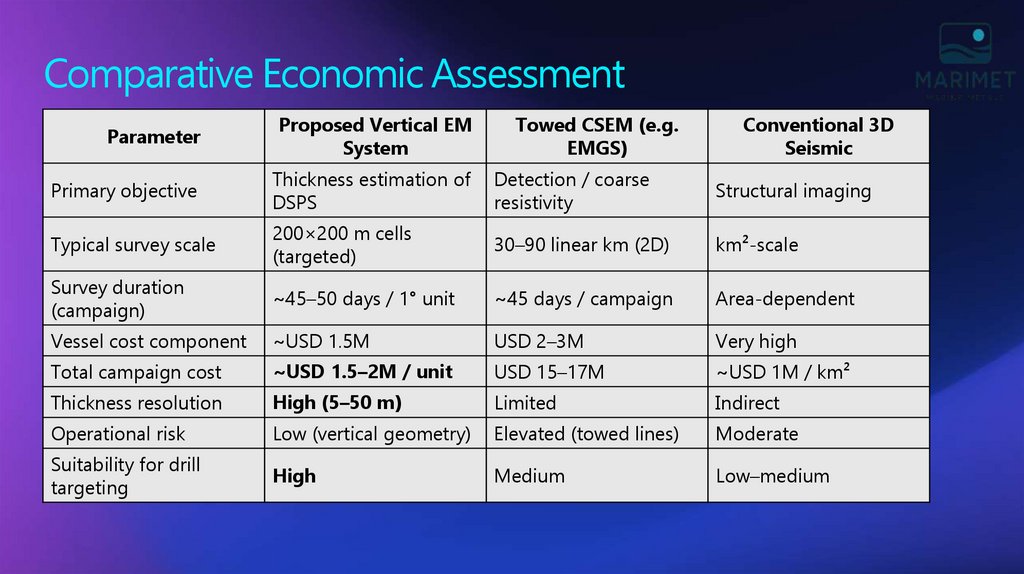
21. Comparative Economic Assessment
ParameterProposed Vertical EM
System
Towed CSEM (e.g.
EMGS)
Conventional 3D
Seismic
Primary objective
Thickness estimation of
DSPS
Detection / coarse
resistivity
Structural imaging
Typical survey scale
200×200 m cells
(targeted)
30–90 linear km (2D)
km²-scale
Survey duration
(campaign)
~45–50 days / 1° unit
~45 days / campaign
Area-dependent
Vessel cost component
~USD 1.5M
USD 2–3M
Very high
Total campaign cost
~USD 1.5–2M / unit
USD 15–17M
~USD 1M / km²
Thickness resolution
High (5–50 m)
Limited
Indirect
Operational risk
Low (vertical geometry)
Elevated (towed lines)
Moderate
Suitability for drill
targeting
High
Medium
Low–medium
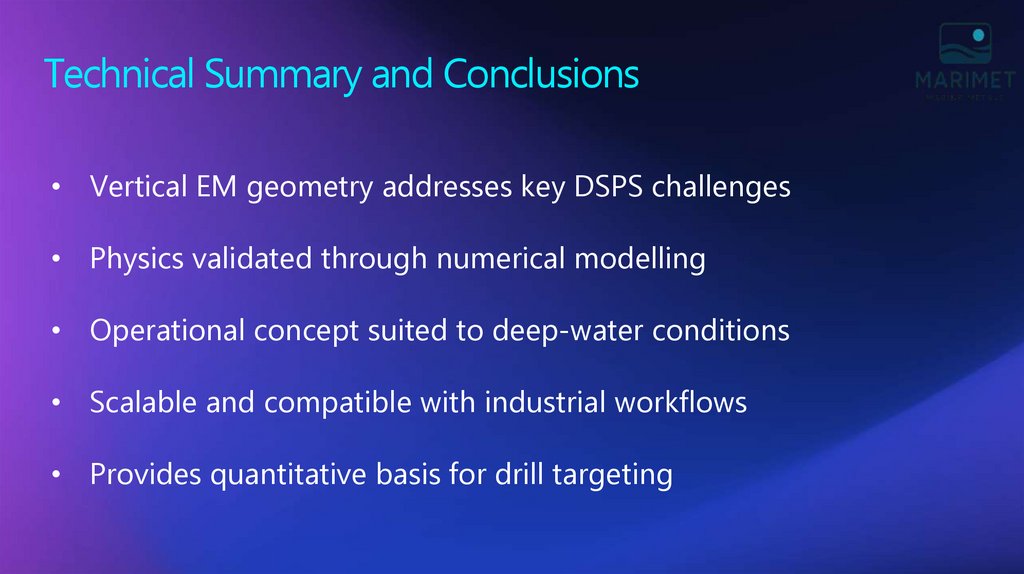
22. Technical Summary and Conclusions
• Vertical EM geometry addresses key DSPS challenges• Physics validated through numerical modelling
• Operational concept suited to deep-water conditions
• Scalable and compatible with industrial workflows
• Provides quantitative basis for drill targeting
23. Core Engineering Team
"The architects of the technology. This coreteam ensures continuity of knowledge and
drives future innovation."
Dr. Evgeniy Lisitsyn
Petrov
Dr. Vladimir Kyasper
Dr. Alexander
Decades of collective experience in marine geophysics, co-authors of
key publications, and inventors on foundational patents. Their
system-level know-how in integrating hardware and software is most
valuable asset.
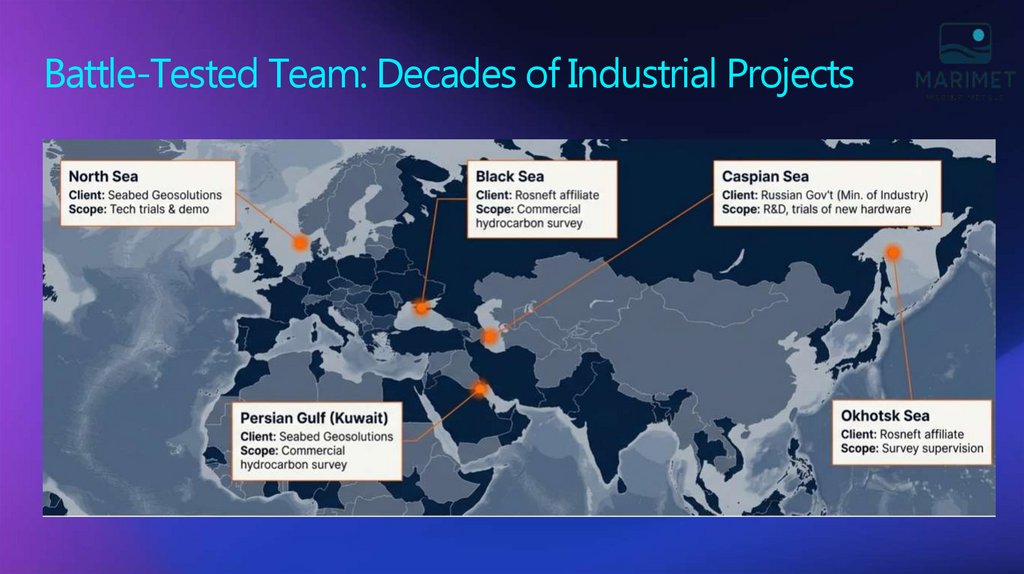
24. Battle-Tested Team: Decades of Industrial Projects
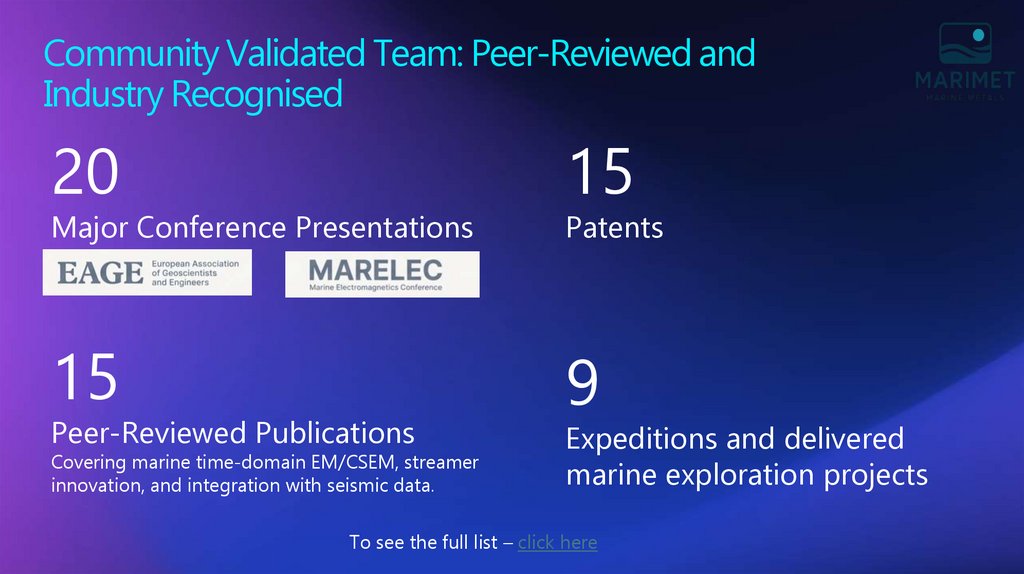
25. Community Validated Team: Peer-Reviewed and Industry Recognised
2015
15
9
Major Conference Presentations
Peer-Reviewed Publications
Covering marine time-domain EM/CSEM, streamer
innovation, and integration with seismic data.
Patents
Expeditions and delivered
marine exploration projects
To see the full list – click here
26.
We explore seabed to empower theenergy transition
https://www.marimet.com/
k.golokteev@marimet.com